The relationship between nature connectedness and eudaimonic well-being: A meta-analysis
Alison Pritchard,a Dr Miles Richardson,a Prof David Sheffield,a Dr Kirsten McEwana a University of Derby, Kedleston Road, Derby, DE22 1GB, UK
[email protected] [email protected] [email protected] [email protected]
Corresponding Author: Alison Pritchard, [email protected]
Alison Pritchard
Human Sciences Research Centre University of Derby
Kedleston Road Derby
DE22 1GB UK
The relationship between nature connectedness and eudaimonic well-being: A meta-analysis
Abstract
Nature connectedness relates to an individual’s subjective sense of their relationship with the natural world. A recent meta-analysis has found that people who are more connected to nature also tend to have higher levels of self-reported hedonic well-being; however, no reviews have focussed on nature connection and eudaimonic well-being. This meta-analysis was undertaken to explore the relationship of nature connection with eudaimonic well-being and to test the hypothesis that this relationship is stronger than that of nature connection and hedonic well-being. From 20 samples (n = 4758), a small significant effect size was found for the relationship of nature connection and eudaimonic well-being (r = 0.24); there was no significant difference between this and the effect size (from 30 samples n = 11638) for hedonic well-being (r = 0.20). Of the eudaimonic well-being subscales, personal growth had a moderate effect size which was significantly larger than the effect sizes for autonomy, purpose in life/meaning, self-acceptance, positive relations with others and environmental mastery, but not vitality. Thus, individuals who are more connected to nature tend to have greater eudaimonic well-being, and in particular have higher levels of self-reported personal growth.
Keywords: Nature connection/connectedness, eudaimonic well-being, hedonic well-being, psychological well-being, personal growth, meta-analysis
1. Introduction
Many would argue that nature and the human psyche are inextricably linked, and that this relationship is of fundamental importance to human and environmental health: the risks of being disconnected from nature are the development of behaviours and attitudes that ultimately damage our physical and mental health and cause irreparable harm to the planet (Mayer and Frantz, 2004). Understanding the causes and consequences of our relationship with nature is therefore crucial. Individuals commonly report feeling emotionally close to,
and an integral part of nature, and this is reflected in the construct of nature connectedness (NC) (Mayer and Frantz, 2004). The importance of this sense of relatedness is evidenced by numerous studies linking NC with a range of well-being measures including hedonic (‘feeling good’) and eudaimonic (‘functioning well’) indicators (e.g. Capaldi et al. 2014; Howell et al. 2011; Nisbet and Zelenski 2013; Pensini et al. 2016).
There have been some mixed results in the research on NC and well-being, and a number of authors have suggested that this may be because different aspects of well-being relate to NC in different ways (e.g. Howell and Passmore 2013; Capaldi et al. 2014). Furthermore, it has been suggested that the link between NC and eudaimonic well-being (EWB) may be stronger than the link between NC and hedonic well-being (HWB) (e.g. Capaldi et al. 2014; Howell et al. 2011). For example, Howell et al. (2011) found that ‘feeling good’ aspects of well-being were less reliably associated with NC than ‘functioning well’ aspects of well-being. Other studies have also found that current mood and subjective well-being had relatively low correlations with NC, compared with eudaimonic measures of well-being (e.g. Cervinka et al. 2012; Howell et al. 2013). The possibility that EWB and HWB may have different strengths of association with NC would be consistent with evidence from other well-being research that, although EWB and HWB are related, they tend to be associated with different motives, behaviours and experiences. For example, EWB has been found to relate more strongly than HWB to experiences which enable personal growth and development, and with being challenged and striving to achieve something (Waterman 1993). Likewise, eudaimonic motives and behaviours are more likely than hedonic motives and behaviours to predict EWB outcomes such as meaning, elevating experiences and sense of connection with a greater whole (Henderson et al. 2013; Huta and Ryan 2010). There is also evidence that increases in EWB may sometimes be accompanied by reduced HWB
pro-environmental behaviours (Mayer and Frantz 2004) and such behaviours, because they can be costly, time-consuming or difficult, may be more likely to lead to EWB but not HWB
(Venhoeven et al. 2013). Also worthy of note is the fact that eudaimonia is more likely to be associated with long-term and enduring well-being, whereas HWB is more likely to dissipate in the short-term (McMahan and Estes 2011). As NC is known to increase over time if individuals visit nature frequently (Richardson et al. 2016a), it is thus plausible that NC is more strongly associated with EWB than HWB for this additional reason.
This possibility deserves further consideration, particularly as there is a relative lack of research into the relationship between nature and EWB (Cleary et al 2017). A recent meta-analysis has found that NC and hedonic well-being (HWB) (as measured by positive affect, vitality and life satisfaction) are associated (Capaldi et al. 2014), but there have been no systematic reviews focussing on NC and EWB which provide a qualitative synthesis of research in this area. There is also a lack of understanding of the potential explanatory mechanisms involved in the NC-EWB relationship (Cleary et al 2017).
Many existing theories concerning the effects of nature on well-being were originally developed a number of years ago and have not been the subject of recent major revision (McMahan & Estes 2015). For example the biophilia hypothesis (Wilson, 1984) suggests that people have an innate need to affiliate with nature, and that satisfaction of this need results in well-being benefits such as improved positive affect; stress reduction theory (SRT; Ulrich, 1979) predicts that decreased physiological and psychological stress responses result from exposure to nature and thus results in improved well-being, and attention restoration theory (ART; Kaplan, 1995) predicts that exposure to nature helps reduce attentional fatigue thus leading to improved cognitive functioning and positive affect. However, a number of authors have suggested that current theories may not provide a complete explanation of the wellbeing benefits of nature (Cleary et al 2017; Schweitzer et al 2018). Furthermore, current
explanatory theories tend to be couched more in terms of contact with nature than connection with nature. There is therefore a clear need for greater understanding of the relationship between NC and EWB, as well as a need to develop comprehensive theoretical frameworks which encompass EWB (Cleary et al 2017). Meta-analysis has been used here in order to consolidate results from a number of studies to create a single more precise assessment of the magnitude of the relationship between NC and EWB (the effect size), compare this with the relationship of NC and HWB, and examine potential moderators of this relationship.
Although causation cannot be inferred from meta-analysis, if different strengths of
association between NC and different types of well-being were to be found, then that may signal the possibility that different causal mechanisms are involved. This meta-analysis therefore also aims to test the hypothesis that the link between NC and EWB may be stronger than the link between NC and HWB, in order to guide theory development and inform future research into potential causal pathways between NC and EWB.
1.1 Well-being
The philosophical origins of eudaimonia can be traced back to the works of Aristotle, who described eudaimonia as a consequence of living in accordance with one’s ‘daimon’ or true self, in accordance with one’s values, and fulfilling one’s best potential (self-realisation) (Waterman, 2008). By contrast, hedonia relates to maximising pleasure and is rooted in the philosophy of Aristippus (Venhoeven et al. 2013). The contrast between these two
philosophies has provoked much debate as to the best ways to conceptualise and measure well-being (e.g. Kashdan et al. 2008; Waterman 2008). In particular the validity of
conceptualising well-being solely as ‘happiness’ has been questioned by a number of authors (e.g. Ryff 1989; Waterman 2008), who advocate the importance of defining well-being in terms of optimal psychological functioning.
EWB is often measured with Ryff’s scale of psychological well-being (Ryff 1989), which has six subscales: personal growth relates to being open to new ideas and experiences, and realizing one’s full potential; purpose in life links to the presence of goals in life, and feelings of meaningfulness; autonomy comprises self-determination and independence; environmental mastery describes a sense of competence in managing the context in which one lives; self-acceptance refers to having a positive attitude towards the self; and positive relations with others relates to having warm and trusting relations. Another aspect of well-being - vitality – is a part of what it means to be fully functioning and psychologically well (Ryan and Deci 2001). Vitality is defined as having physical and mental energy and is associated with feeling more alive and more engaged with the world, and with being outdoors, in the presence of natural elements (Ryan et al. 2010).
EWB is related to, but distinct from, HWB (Huta and Ryan 2010; Ryan and Deci 2001) and it is likely that eudaimonia and hedonia each influence and nurture the
development of the other (Fredrickson 2004). Understanding the nature of this reciprocity may be found in functional theories of positive affect and well-being such as Frederickson’s broaden and build theory (Fredrickson 2004), which proposes that positive emotions, as well as being an indicator of HWB, have an important role in the development of optimal
functioning over the long term. For example, joy ‘creates the urge to play, push the limits and be creative’, and contentment ‘creates the urge to sit back and savour life’s current circumstances and integrate these circumstances into new views of self and the world’ (Fredrickson 2004, p. 1369). Positive emotions widen the array of possible thoughts and actions available to an individual, enabling them to build resources and grow psychologically. 1.2 Nature connectedness
Given the range of well-being benefits associated with nature contact (e.g. Bowler et al. 2010; McMahan and Estes 2015), there is growing concern that modern ways of living,
particularly in western cultures, undermine our sense of belonging to nature (Bragg 1996; Roszak 1995), and that this may be contributing to increased rates of mental and emotional ill-health (Windhorst and Williams 2015). Consequently, there is increasing emphasis on the importance of feeling connected with nature (over and above simply spending time in nature) as a potential means of developing and maintaining our well-being. NC has been described as ‘an individual’s trait level of feeling emotionally connected to the natural world’ (Cervinka et al. 2012, p. 380), and studies have shown that NC tends to be higher in people who have previous (childhood) experience of nature (Hinds and Sparks 2008) and in those who experience nature more frequently (Mayer and Frantz 2004). Correlational studies have shown that NC is associated with a variety of eudaimonic well-being indicators, such as autonomy, vitality, meaning, and personal growth (Cervinka et al. 2012; Howell et al. 2011; Nisbet and Zelenski 2013; Pensini, et al. 2016), as well as with hedonic well-being (Capaldi et al. 2014). There is some evidence that NC may mediate the relationship between exposure to nature and well-being (Mayer et al., 2009; Webber et al., 2015; Pensini et al., 2016), but the evidence is not consistent as other studies have found that NC does not influence the relationship between nature exposure and wellbeing (Passmore & Howell, 2014; Passmore & Holder, 2017).
Three of the most commonly used NC measures are the Connectedness to Nature Scale (CNS) (Mayer and Frantz 2004), the Nature Relatedness (NR) scale (Nisbet et al. 2009), and the Inclusion of Nature with Self (INS) (Schultz 2002). The CNS includes
fourteen statements such as ‘I often feel a sense of oneness with the natural world around me’ and ‘my personal welfare is independent of the welfare of the natural world’ (reverse scored). The NR scale includes questions such as ‘I feel connected to all living things and the earth’, and ‘I take notice of wildlife wherever I am’. There are two versions of the NR scale: a 21-item version measuring three dimensions of connectedness (self-identity, experience and
environmental behaviour), and a 6-item version comprising two dimensions (self-identity and experience). The Inclusion of Nature with Self (INS) (Schultz 2002) is a single item measure which assesses people’s perception of themselves as being part of, or distinct from, the natural environment. It comprises a series of two circles depicting ‘self’ and ‘nature’ with varying degrees of overlap, and individuals are asked to choose which set of circles best represents their relationship with nature.
Other measures include the Allo-Inclusive identity scale (AII) (Leary et al. 2008), the Connectivity with Nature (CWN) scale (Dutcher et al. 2007), and the Environmental Identity scale (EID) (Clayton 2003), which examine the extent to which a connection with the
environment is part of an individual’s identity. The Connection to Nature Index (CNI) (Cheng and Monroe 2012) comprises four dimensions: enjoyment of nature, empathy for nature, sense of oneness and sense of responsibility, and the Commitment to Nature scale (COM) (Davis et al. 2009) assesses the sense of responsibility felt toward the environment, and attitudes about one’s own relationship with nature.
Although these measures vary in the extent to which they measure emotional, experiential or cognitive connection to nature, a review by Tam (2013) found strong
convergence amongst them. Tam (2013) concluded that the various measures of NC can be considered as ‘markers of the same underlying construct’. In this review, therefore, it was assumed that all such measures can be treated the same for analytical purposes.
2. Methods
For the purposes of this study, the relationship of NC with two main well-being concepts was assessed: HWB, which relates to aspects of ‘feeling well’, and EWB which relates more to ‘functioning well’. Two main meta-analyses, one for each aspect of well-being, were conducted, to test the hypothesis that EWB is more strongly associated with NC
than is HWB. Further meta-analyses were also undertaken on the subscales of the well-being measures, to assess any differences between them.
In this review, EWB was defined as comprising one or more of the six dimensions as measured by Ryff 's Psychological Well-being Scale - autonomy, personal growth, self-acceptance, life purpose, environmental mastery, positive relatedness (Ryff 1989), or vitality, or meaningfulness. Although Capaldi et al. (2014) included vitality as a hedonic construct, in this review, vitality was classed as a eudaimonic aspect of well-being because it is often conceptualised as such in the literature (e.g. Ryan and Deci 2001; Wolsko and Lindberg 2013; Zelenski and Nisbet 2014). Meaning was also included in the review as an aspect of EWB because it is conceptually similar to the Ryff purpose in life subscale. HWB was defined as one or more validated measures of life satisfaction and positive affect. 2.1 Search strategy
Several databases were searched from 1999 (the date of first published NC tool) until June 2016, including PsychINFO, MEDLINE, PsychArticles, Science Direct (Elsevier), CINAHL Plus, PubMed Central, EBSCO e-journals and Biomedcentral.
References of included studies were searched, as well as studies citing the included studies. Authors of included studies were contacted as necessary for any additional
information to afford meta-analysis. Well-being search terms included psychological well-being, subjective well-well-being, hedonic well-well-being, eudaimonic well-well-being, positive affect, life satisfaction, autonomy, personal growth, self-acceptance, life purpose, vitality, and
happy/happiness. NC terms included variations of the following phrases: nature connectedness, nature relatedness, inclusion of nature in self, commitment to nature, emotional affinity with nature and relationship with nature.
Papers were included if they reported on the relationship between well-being and NC, included at least one validated measure of EWB (autonomy, purpose in life, environmental mastery, personal growth, self-acceptance, positive relatedness, meaningfulness or vitality), or HWB (positive affect, life satisfaction), and included a self-reported measure of trait NC. Studies had to include sufficient information (a correlation coefficient and sample size) in order that effect sizes could be coded. All study designs were included, but experimental designs were included only if they reported a baseline measure (before any experimental manipulation) of the relationship between well-being and NC. Studies not in the English language were excluded. This meta-analysis used slightly different inclusion criteria to those used by Capaldi et al. (2014), in that studies were excluded if they did not use validated measures, or were Master’s theses, conference proceedings or unpublished data. 2.3 Coding procedure
A coding form was developed for the review by the main author. Information collected included year, publication type, country, target population, population
characteristics (gender, age), type of analysis, measure(s) of NC, measure(s) of well-being used, study design and setting. Two researchers coded the studies independently, and then resolved any differences by discussion. Levels of agreement between the two reviewers was high – Cohen’s Kappa for the main categorical variables (year of study, type of publication, country, target population) was 0.87. For those samples with more than one measure of NC or well-being, weighted average effect sizes were calculated. Twenty-five papers met the inclusion criteria (see Figure 1 for the meta-analysis flow chart), and a total of fifty effect sizes from 34 samples were included in the meta-analysis (30 effect sizes were included in the HWB meta-analysis, and 20 included in the EWB meta-analysis).
Two separate meta-analyses were undertaken, one each for HWB and EWB. Pearson’s product-moment correlations (r) were used to determine effect size for the
relationship of NC and well-being. The correlation coefficients were converted in Fisher’s Z values before being meta-analysed. Data were entered into Meta-Essentials (Van Rhee et al. 2015), and random-effects models were used to calculate mean effect sizes. Effect sizes between 0.10 and 0.29 are considered small, those between 0.30-0.49 are moderate, and those of 0.50 and above are deemed to be high (Cohen 1992).
Cochran’s Q and I2 were used to assess variability. A significant Q value (i.e. one with a p value of less than 0.10) indicates significant heterogeneity among effect sizes. The I2 statistic assesses the extent of variability in effect sizes; values between 1 and 49 indicate low heterogeneity, 50-74 moderate heterogeneity, and 75-100 high heterogeneity. In the case of significant heterogeneity, moderator analyses were undertaken.
3. Results
3.1 Overview of included studies
Twenty-five studies were identified with a total of 34 samples (see Table 1 for descriptive information) dating from 2004 to 2016. Eighteen studies were from peer reviewed journals, five were PhD theses, one study was classed as ‘grey literature’ (i.e. not available through the usual bibliographic sources such as databases or indexes) and one classed as a book chapter. Of the 34 samples, thirteen (38%) were from Canada, nine (26%) from Europe, eight (24%) from the United States and one each from Australia, India,
Colombia and Hong Kong. The percentage of females ranged from 39.2% to 86.6% and average age ranged from 11 to 63.42 years. Of the target population, 44% of samples were of adults/community, 34% college/University students, 15% mixed adults and students, and one sample (3%) was of children. The target population was not stated for one sample. Measures of NC and well-being included in the meta-analysis are given in Tables 2 and 3.
3.2 Main results
A total of 50 effect sizes were recorded, 20 effect sizes for the relationship between EWB and NC, and 30 for the relationship between HWB and NC. The total sample size for studies with EWB was 4758 (range 50 to 452) and HWB was 11638 (range 39 to 2203).
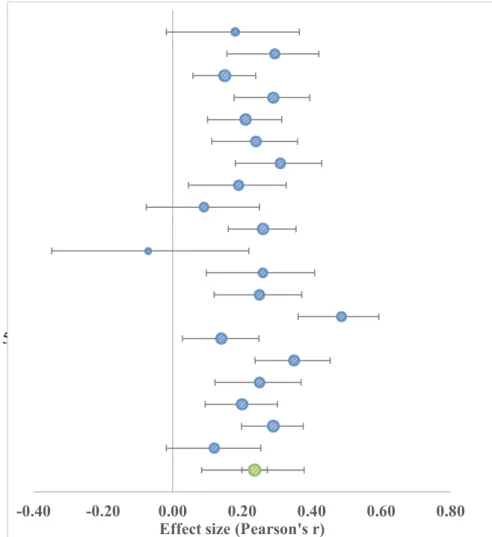
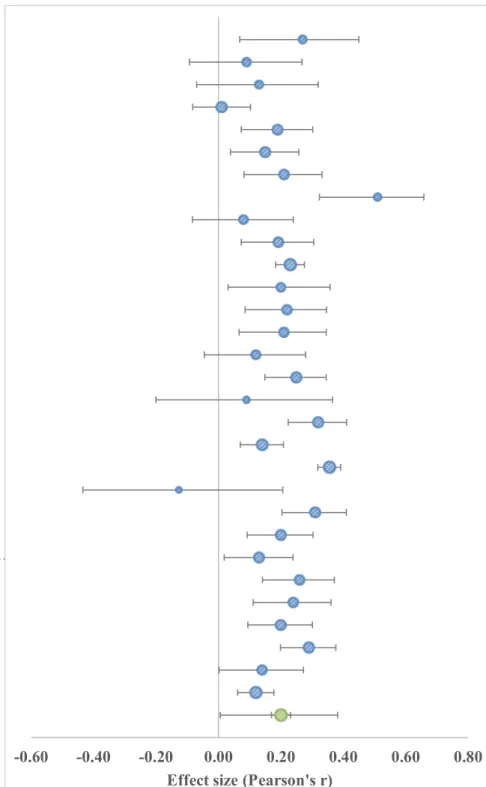
Figure 2 shows the forest plot for the meta-analysis with EWB. There was a small mean effect size of r = 0.24, 95% CI (0.20, 0.27). Variability across samples was significant (Q = 41.55, p < 0.01) and moderate (I2 = 54.28%). Figure 3 shows the forest plot for the meta-analysis with HWB. There was a small mean effect size of r = 0.20, 95% CI (0.17, 0.23). This effect size is similar to the one reported in Capaldi et al. (2014) (r = 0.18 (0.15-0.22)). Variability across samples was significant (Q = 124.37, p < 0.001) and high (I2 = 76.68%).
3.3 Moderator analyses
Moderator analyses were undertaken to determine if gender or age accounted for the variability. Average age was not a significant predictor of effect size for either HWB (slope = 0.00, SE = 0.00, Z = 0.81, p = 0.42) or EWB (slope = 0.00, SE = 0.00, Z = 1.64, p = 0.10). Percent female was not a significant predictor of effect size for either HWB (slope = 0.00, SE = 0.00, Z = 0.24, p = 0.81) or EWB (slope = 0.00, SE = 0.00, Z = 0.51, p = 0.61).
3.4 Publication bias analyses
Publication bias was initially examined by a funnel plot of effect size against standard error; the funnel plot for the effectsizesfor both HWB and EWB appeared to be
asymmetrical, an indication of possible bias. This was explored further using two more tests for publication bias: the Begg test (Begg and Mazumdar 1994) and the Egger test (Egger et al. 1997). For EWB, the Begg and Mazumdar adjusted rank correlation (τ = -0.07, p = 0.65) and Egger’s coefficient (intercept = -2.29, t = -1.42, p = 0.24) were both non-significant, indicating no bias. Similarly, for HWB, both the Begg and Mazumdar adjusted rank
correlation (τ = -0.09, p = 0.49) and Egger’s intercept (intercept = -1.37, t = -1.13, p = 0.27) were also non-significant, again indicating no bias.
3.5 Additional meta-analyses on specific well-being and nature connectedness measures To further investigate the relationship between NC and well-being, separate meta-analyses were also conducted on the three most common NC measures used (CNS, INS and NR), and, where this information was available, on the subscales of the various well-being measures. The results are summarised in Table 4.
3.5.1 Effect sizes for the well-being measures
Nine samples were identified for the subscales of personal growth (n = 2,197), autonomy (n = 2,197), and vitality (n = 2,141); twelve samples were included for purpose in life and meaning (n = 2,922), and four samples with n = 686 for each of environmental mastery, self-acceptance and positive relations with others. There was a small mean weighted effect size for all the EWB subscales except for personal growth which had a
moderate mean effect size of r = 0.31 (0.27-0.35). The next largest effect size was for vitality r = 0.25 (0.20-0.30), which compares to the vitality effect size of r = 0.24 (0.19-0.29)
reported in Capaldi’s meta-analysis (Capaldi et al. 2014). The personal growth effect size was significantly larger than the effect sizes for autonomy (r = 0.20), purpose in life and meaning (r = 0.20), self-acceptance (r = 0.17), positive relations with others (r = 0.16) and environmental mastery (r = 0.12) (Table 4).
Of the HWB subscales, the mean weighted effect size for positive affect was r = 0.25 (0.21-0.29) and that for life satisfaction was r = 0.17 (0.13-0.22). These results compare to the effect sizes reported in Capaldi et al. (2014) of r = 0.22 (0.19-0.25) for positive affect and r = 0.16 (0.11-0.20) for life satisfaction.
There was a small mean weighted effect size for all NC measures and EWB, and for all NC measures and HWB (Table 4). The effect sizes for HWB were similar to those reported in Capaldi et al. (2014) of CNS r = 0.18, NR r = 0.18 and INS r = 0.25. 4. Discussion and conclusion
The purpose of this review was to explore the relationship between NC and EWB by means of a meta-analysis and to compare this with the relationship between NC and HWB. The data showed a small positive correlation between NC and EWB, indicating that
individuals who are connected to nature are more likely to be flourishing and functioning well psychologically. However, the hypothesis that NC would be more strongly associated with EWB than it is with HWB was not supported, and there may be a number of possible explanations for this. Firstly, it is worth considering that the way EWB has been defined for the purposes of this study (i.e. based on Ryff’s definition (1989)) may not be sufficiently comprehensive. For example, Huta (2015) identified a number of aspects of eudaimonic functioning – including self-regulation, ethics, contribution, and thoughtfulness - that are not included in the definition used by Ryff (1989). It may be that future studies, exploring the relationship between NC and these other aspects of EWB, can add to our understanding. Secondly, Huta and Waterman (2014) highlight the distinction between well-being measures based on cognitive-affective experiences and those based on ways of functioning. They suggest that using measures from different categories may lead to difficulties in making direct comparisons between eudaimonia and hedonia (Huta and Waterman 2014). The fact that, in this review, the EWB measures tended to fall into the ’functioning’ category, whereas the HWB measures tended to be based more on experiences, may have resulted in any true differences being obscured. Perhaps future research addressing these conceptual and definitional issues may help clarify the findings of this review.
Although the difference between the respective effect sizes for EWB and HWB was not significant, there were effect size differences between the EWB subscales. All the well-being subscales had small positive correlations with NC, with the exception of personal growth which had a moderately positive relationship. In addition, the effect size for personal growth was significantly larger than all the other eudaimonic subscales, except for vitality, and was also significantly larger than the effect size for life satisfaction. These findings suggest that, in order to further explore the relationship between NC and EWB, it may be fruitful to focus on specific aspects of EWB rather than on composite measures.
There is evidence that NC mediates the relationship between exposure to nature and EWB (Mayer et al. 2009; Pensini et al. 2016; Webber et al. 2015), which would be consistent with a causal mechanism whereby nature exposure leads to increased NC, which in turn leads to improved EWB. However, another study has found that NC does not moderate the effect of nature exposure on EWB (as measured by elevating experience) (Passmore and Howell 2014), which implies that NC may not play a part in promoting EWB. It is also possible that, if a causal association does exist, it is in the other direction, with EWB leading to increased NC; or it may be that the relationship between NC and EWB is bi-directional.
A number of authors have suggested that NC may benefit EWB because it provides a route through which basic psychological needs can be met (e.g. Cleary et al. 2017; Howell and Passmore 2013; Nisbet et al. 2009). As described in Ryan and Deci’s self-determination theory, three basic psychological needs – autonomy, competence and relatedness – are considered essential for psychological growth, integrity and well-being (Ryan and Deci 2000). It is plausible that NC provides a route through which these basic needs are met and so leads to increased EWB. For example, the basic psychological need for relatedness could be met by being exposed to nature which in turn is known to increase feelings of
that the relationship between nature affiliation and well-being could be mediated by a greater sense of social connectedness, and nature connection has been found to promote pro-social behaviour such as altruism and generosity (Weinstein et al. 2009). It also seems likely that nature connection promotes a form of relatedness distinct from social (human) connectedness and important in its own right (Cleary et al. 2017). This is supported by research from
Zelenski and Nisbet (2014), who found that the concept of nature relatedness was distinct from other forms of relatedness - including connectedness with family and friends - and was a significant and distinct predictor of happiness.
In relation to increasing autonomy, nature could be a route through which individuals are enabled to express their personal distinctiveness, and not feel constrained by external influences such as the values imposed by society (Howell and Passmore 2013; Ridder 2005). Ridder’s (2005) concept of a ‘nature-inspired autonomy’ describes the importance of
recognising the value of naturalness as a means of gaining a personal sense of freedom and escaping from the dissatisfaction caused by extrinsic influences of society. The freedom and autonomy felt in wild nature enables individuals to reinforce their own intrinsic beliefs and values, to gain perspective on the things that really matter, and to feel inspired (Ridder 2005). There is some empirical support for this idea: Weinstein et al. (2009) found that, when asked to view scenes from nature or from ‘non-nature’ (such as cityscapes), participants who were more immersed in the nature scenes felt a greater sense of autonomy; by contrast, participants who were immersed in the non-nature scenes felt reduced autonomy.
Competence needs could be met through learning about natural environments and ecosystems, as well as through enhanced self-knowledge and self-development gained from being connected to nature. Outdoor learning, outdoor play and wilderness expeditions have all been linked with improved well-being, cognition, personal, social and emotional
development, as well as higher achievement and increased motivation to learn (Lovell, 2016a).
The association of vitality with NC can also be linked with the fulfilment of psychological needs. Ryan and Frederick (1997) considered that vitality is a part of the ‘fully-functioning’ person and should therefore be linked with agency and growth, and with the need for autonomy, competence and relatedness. They found supporting evidence that vitality is associated with self-actualisation and self-determination, as well as mental health and self-esteem (Ryan and Frederick 1997).
In this review, NC had a significantly stronger association with personal growth than most of the other aspects of EWB, which raises the possibility that our relationship with nature may have a particularly important role in furthering psychological growth and
development. Ryff described personal growth as perhaps the nearest of all her six subscales to EWB because it is specifically concerned with self-realisation and is akin to Maslow’s concepts of self-actualisation and self-transcendence (Koltko-Rivera 2016; Ryff and Singer 2008). Huta and Ryan (2010) expected that, since eudaimonia is oriented towards excellence and growth, it would be related to uplifting experiences (such as contact with the natural world) which stretched people beyond their usual boundaries. Such ‘elevating experiences’ are ‘where a person feels awe, elevation to a higher level of awareness and a connection with some greater whole’ (Huta and Ryan 2010 p. 740). NC has been found to correlate strongly with the value of self-transcendence (Tam 2013) and also to predict transcendent and awe-inspiring experiences, particularly in wild nature (Davis and Gatersleben 2013). The ‘higher order’ emotions such as awe and wonder, which are often associated with transcendent experiences, could be a key mediating influence in the relationship between NC and personal growth. Awe has been defined as ‘an emotional response to perceptually vast stimuli that overwhelm current mental structures, yet facilitate attempts as accommodation’ (Shiota et al.
2007 p. 944). Thus, the sense of awe felt in nature could lead to an expansion in individuals’ mental structures and frames of reference, as well as an expanded sense of self, and so foster personal growth. This would be consistent with Frederickson’s broaden and build theory of positive emotions (Fredrickson 2004). Likewise, the association that NC has with meaning and purpose in life is also in accord with the idea that self-change is brought about when people accommodate new experiences after having contact with nature: people often describe awe-inspiring experiences in nature as giving them a sense of perspective on their life, goals, and purpose (Silvia et al. 2015).
4.1 Future research
In general, more well-controlled studies are needed which explore the direction of the relationship between NC and well-being. Furthermore, much NC research has used
composite measures of being which may mask potential differences among the well-being subscales. More nuanced studies exploring the links between NC and specific aspects of EWB, such as personal growth, would help tease any differences apart.
There is a general lack of research on children’s well-being and nature connection - in this review all but one of the included studies was of adults. Childhood experience may be an important route by which individuals become connected to nature in the first place (e.g. Lovell 2016b), and experiences in nature may enhance optimal child development (Kellert 2002). The association found in this review of NC and personal growth in adults would suggest that nature’s effect on childhood development may be equally - if not more - important. Orr (1993) speculated that there could be a window of opportunity in childhood for connecting to nature, similar to the window of opportunity for language development. If this is the case, the consequences for nature disconnection in childhood could be long-term, and not easily repaired by experiences in adulthood. Conducting longitudinal studies which follow individuals over their life-course would help address this gap.
Additional research is needed to explore which particular qualities of nature may affect HWB and EWB. It is possible that different types of nature elicit different emotions and, by implication, could affect different types of psychological functioning. For example, familiar nature may be more likely to lead to feelings of calm and contentment and thus be more restorative (Richardson et al. 2016b), whereas unfamiliar objects in nature - those that transcend previous knowledge – may be more likely to produce awe and wonder than familiar objects (Keltner and Haidt 2003) and thus stimulate new ideas and experiences. Nature-induced awe may be triggered by large natural objects, such as mountains or vistas, by natural events such as storms, or by objects with infinite repetition such as fractals, waves and patterns in nature (Keltner and Haidt 2003). Factors such as the degree of naturalness of an environment (the extent to which it is free of human intervention) may also be important in the relationship with EWB (Ridder 2007). Furthermore, there is evidence that levels of actual or perceived biodiversity (Dallimer et al. 2010; Fuller et al. 2007; Luck et al. 2011), or the degree of landscape heterogeneity (Fuller et al. 2007; Jorgensen and Gobster 2010), are linked with well-being and these aspects are therefore worthy of further investigation.
It is also worth exploring how different patterns of nature exposure may affect the relationship between NC and well-being. For example, there is evidence of a dose-response effect between frequency of visits to nature and EWB, but not HWB (White et al. 2017). By contrast, the same study found that self-reported HWB (as felt on the previous day) was significantly related to a visit to nature that day, but that EWB was not. Thus, two possible nature exposure mechanisms may be at work – a short-term restorative effect linked to HWB, and a longer-term (additive) effect of increased visit frequency linked to EWB, possibly due to greater NC developing over that time. Dose-response and short and long-term effects of nature exposure are important variables to be explored in further research.
Finally, most of the research on NC and its association with well-being has been undertaken in westernised societies. Although there is some evidence that the association of NC and well-being persists across non-westernised cultures (e.g. Capaldi et al. 2017; Tam 2013), there are cultural differences in the way in which humans perceive and value nature (Olivos and Clayton 2016), and so our understanding remains limited
4.2 Limitations
A common aspect of correlational studies is that the direction of effect and causality remains unclear. Furthermore, a lack of representativeness of the study population could have resulted in bias - most studies comprised non-random and/or self-selected adult subjects. Males were generally under-represented, and a high proportion of the studies were of
students. However, the moderator analyses indicated that neither age nor percent female were significant predictors of effect size indicating that the results were not affected by these factors. In addition, a number of the included studies involved participants who were either park visitors, exercised in natural settings, or were gardeners, and it is conceivable that these participants may have had higher than average NC. This may have resulted in range
restriction and thus attenuation of reported effect sizes. 4.3 Conclusion
This review has shown that NC is associated with EWB, and one aspect of EWB - personal growth – appears to have a significantly stronger relationship with NC than most other EWB subscales. These results signal the important role NC may play in contributing to positive psychological functioning and highlight the possibility that different aspects of EWB may relate to NC to varying extents. Multiple pathways – perhaps mediated by a range of emotions and elicited by different aspects of nature - may be involved in the relationship between NC and EWB.
This research did not receive any specific grant from funding agencies in the public, commercial, or not-for-profit sectors.
Table 1
Summary of included studies
Study Sample
number
N Location Mean age (years)
% female
Type of publication Cervinka et al. (2012) 1.1 94 Austria 37.3 57.4 Peer reviewed
journal Cervinka et al. (2012) 1.2 119 Austria 36.0 52.1 Peer reviewed
journal Cervinka et al. (2012) 1.5 101 Austria 34.3 54.5 Peer reviewed
journal Creedon (2012) 2 187 USA 35 72 PhD Thesis Howell et al. (2011) 3.1 452 Canada 22.17 69.4 Peer reviewed
journal Howell et al. (2011) 3.2 275 Canada 20.39 68 Peer reviewed
journal Howell et al. (2013) 4.1 311 Canada 22.7 68 Peer reviewed
journal Howell et al. (2013) 4.2 227 Canada 23.29 63 Peer reviewed
journal Kumar et al. (2014) 5 80 India Age
range 20-30 Not stated Peer reviewed journal
Leary et al. (2008) 6 148 USA Not stated
Not stated
Other
Loureiro and Veloso (2014) 7 268 Portugal 32 (gp 1) 33 (gp 2) 58.2 Peer reviewed journal Marselle (2013) 8 1,647 UK 87% aged 55 or older 66 PhD Thesis
Mayer and Frantz (2004) 9 135 USA 36 74.2 Peer reviewed journal Nisbet (2011) 10 207 Canada 27.81 77.8 PhD Thesis Nisbet and Zelenski (2013) 11.1 184 Canada 19.48 67.4 Peer reviewed
journal Nisbet and Zelenski (2013) 11.2 145 Canada 42.37 39.2 Peer reviewed
journal Nisbet and Zelenski (2013) 11.3 354 Canada 20.03 59.9 Peer reviewed
journal Okvat (2011) 12 50 USA 63.42 84 PhD Thesis Pensini et al. (2016) 13 141 Germany 22.43 65 Peer reviewed
journal Reist (2004) 14 357 Canada 36.42 66 PhD Thesis Richardson et al. (2015) 15 775 UK 11 47.5 Grey literature Richardson et al. (2016a) 16 2,203 UK 41.03 86.6 Peer reviewed
journal Schultz and Tabanico (2007) 17 39 USA Not
stated
67.5 Peer reviewed journal Scopelliti et al. (2016) 18 300 Colombia 43.47 50.3 Peer reviewed
journal
Tam (2013) 19 322 Hong
Kong
20.36 45.8 Peer reviewed journal Trigwell et al. (2014) 20 216 Australia 35.32 71.1 Peer reviewed
journal Webber et al. (2015) 21 171 UK 50 67 Peer reviewed
journal Windhorst and Williams (2015) 22 308 Canada 98%
aged between 18-24
79 Peer reviewed journal
Wolsko and Lindberg (2013) 23.1 256 USA 30.11 62.9 Peer reviewed journal Wolsko and Lindberg (2013) 23.2 223 USA 33.30 61.4 Peer reviewed
journal Zelenski and Nisbet (2014) 24.1a 331 Canada 20.5 71.3 Peer reviewed
journal Zelenski and Nisbet (2014) 24.1b 415 Canada 32.3 79.7 Peer reviewed
journal Zelenski and Nisbet (2014) 24.2 204 Canada Mean in
the 25-34 range
60 Peer reviewed journal
Zhang et al. (2014) 25 1,108 USA 44.08 44.4 Peer reviewed journal
Table 2
Nature connectedness measures included in the meta-analysis
Measure Citation Sample number*
Allo-inclusive Identity Scale Leary et al. (2008) 3.2, 4.1, 6 Connectedness to Nature
Scale (CNS)
Mayer and Frantz (2004) 1.1, 1.2, 1.5, 3.1, 3.2, 4.1, 4.2, 5, 7, 8, 9, 12, 13, 18, 19, 20, 21, 23.1, 23.2, 25.1 Inclusion of Nature in Self
(INS)
Schultz (2002) 10, 13.2, 14, 16, 17, 19, 24.1a, 24.1b
Nature Relatedness Scale (21 items) (NR-21)
Nisbet et al. (2009) 2, 3.2, 4.1, 11.1, 11.2, 11.3, 19
NR-6 (short form) Nisbet and Zelenski (2013) 10, 13.2, 22, 24.1a, 24.1b, 24.2
Connection to Nature Index Cheng and Monroe (2012) 15 Commitment to Nature
(COM)
Davis et al. (2009) 19
Connectivity with Nature (CWN)
Dutcher et al. (2007) 19
Emotional Affinity toward
Nature (EATN) Kals et al. (1999)
19
Environmental Identity (EID) Clayton (2003) 19
*Sample number comprises the number of the included paper (prefix); if included papers reported more than one study the study number used by that paper is given as the suffix. (In paper 24, study 1, the student and community samples were reported separately; hence these have been numbered 24.1a and 24.1b respectively).
Table 3
Well-being measures included in meta-analysis Type of
well-being
Measure Citation Sample number*
Hedonic well-being
Affective mood state Ajzen and Driver (2001) 17
Emotional wellness scale Diener and Biswas-Diener (2008)
19
General happiness single item Abdel-Khalek (2006) 16 Positive and negative affect
schedule
Watson et al. (1988) 5, 7, 8, 10, 11.1, 11.2, 11.3, 12, 18, 24.1a, 24.1b, 24.2 Steen happiness index Seligman et al. (2005) 4.1, 4.2
Mental Health Continuum Short Form (14 item) –emotional well-being
Keyes et al. (2008) 4.1, 4.2, 22
Multi-Dimensional Comfort Scale (MDPF) - Current Mood
Steyer et al. (1997) 1.1
SF-36 health Survey (mental well-being)
Bullinger and Kirchberger (1989)
1.5
Satisfaction with life scale Diener et al. (1985) 1.2, 5, 6, 9, 10, 14, 19, 25 Scale of positive and negative
experience
Diener et al. (2010) 23.1, 23.2
Subjective Happiness Scale (SHS) Lyubomirsky and Lepper (1999)
10, 19
Student Life Satisfaction Scale Huebner (1991) 15 Quality of life, enjoyment and
satisfaction questionnaire
Q-SF)
Keyes 40-item measure of well-being – emotional well-well-being
Keyes (2005) 3.1, 3.2, 4.1, 4.2
Eudaimonic well-being
Vitality scale from the short-form (SF-36) health survey
Bullinger and Kirchberger (1989)
1.5, 12
Psychological well-being inventory Ryff (1989) 3.1, 3.2, 4.1, 4.2, 10, 11.1, 11.2, 11.3, 13, 20, 24.1a, 24.1b, 24.2 Questionnaire for Eudaimonic
Well-being (QEWB)
Waterman et al. (2010) 21
Subjective Vitality Scale Ryan and Frederick (1997) 10, 11.1, 11.2, 11.3, 23.1, 23.2, 24.1a, 24.1b, 24.2, General life purpose scale Byron and Miller-Perrin (2009) 4.1 Meaning in life questionnaire
(presence)
Steger et al. (2006) 4.1, 13
Meaningful life measure Morgan and Farsides (2009) 4.1, 4.2 Flourishing scale Diener et al. (2010) 23.1, 23.2 Keyes 40-item measure of
well-being – psychological well-well-being
Keyes (2005) 3.1, 3.2
Mental Health Continuum Short Form (14 item) – psychological well-being
Keyes et al. (2008) 22
*Sample number comprises the number of the included paper (prefix); if included papers reported more than one study the study number used by that paper is given as the suffix. (In paper 24, study 1, the student and community samples were reported separately; hence these have been numbered 24.1a and 24.1b respectively).
Table 4
Meta-analysis results Nature
connectedness
measure Well-being measure r (95% CI LL-UL) Q I
2 No
samples n All NC measures EWB 0.24 (0.20-0.27) 41.6 54.28 20 4,758
HWB 0.20 (0.17-0.23) 124 76.68 30 11,638 NR only EWB 0.22 (0.18-0.26) 16.9 40.97 11 2,921 HWB 0.19 (0.16-0.22) 11.2 10.59 11 3,056 CNS only EWB 0.26 (0.21-0.32) 27.4 63.5 11 2,423 HWB 0.20 (0.16-0.24) 43.7 65.65 16 5,867
INS only EWB 0.27 (0.21-0.33) 4.34 30.81 4 1,094 HWB 0.27 (0.19-0.35) 30.1 80.07 7 3,874
All NC measures
(HWB subscales) Positive affect Life satisfaction 0.25 (0.21-0.29) 0.17 (0.13-0.21) 63.1 68.32 27.2 52.24 21 7,961 14 4,530 All NC measures (EWB subscales) Vitality 0.25 (0.20-0.30) 15.5 48.36 9 2,141 Personal growth 0.31 (0.27-0.35) 12.5 35.97 9 2,197 Autonomy 0.20 (0.16-0.25) 15.5 48.33 9 2,197 Purpose in life / meaning 0.20 (0.17-0.23) 12.2 9.54 12 2,922 Environmental mastery 0.12 (0.05-0.19) 3.69 18.65 4 686 Self-acceptance 0.17 (0.09-0.24) 4.46 32.67 4 686 Positive relations others 0.16 (0.08-0.23) 4.21 28.71 4 686
Fig.1 Meta-analysis flow chart
Records identified through
database searching n=359 Records identified through other sources n=5
Records after duplicates removed n=176
Records excluded based on abstract review: n=136 Records screened n=176
Full text articles assessed for eligibility n=40
Full text articles excluded n=15. (5=baseline measures of NC or WB not taken; 4=not validated measure of wellbeing; 2=duplicate; 1=WB/NC correlations not reported; 2=state NC measure used; 1=wellbeing measure combined EWB&HWB Studies included in meta-analysis
Fig. 2 Effect size for the relationship between NC and EWB 1.5 - Cervinka et al. (2001) 2.2 - Creedon (2012) 3.1 - Howell et al. (2011) 3.2 - Howell et al. (2011) 4.1 - Howell et al. (2013) 4.2 - Howell et al. (2013) 10 - Nisbet (2011)
11.1 - Nisbet and Zelenski (2013) 11.2 - Nisbet and Zelenski (2013) 11.3 - Nisbet and Zelenski (2013) 12 - Okvat (2011)
13.2 - Pensini (2016) 20 - Trigwell (2014) 21 - Webber (2015)
22.1 - Windhorst and Williams (2015) 23.1 - Wolsko and Lindberg (2013) 23.2 - Wolsko and Lindberg (2013) 24.1a - Zelenski and Nisbet (2014) 24.1b - Zelenski and Nisbet (2014) 24.2 - Zelenski and Nisbet (2014) Overall effect size
-0.40 -0.20 0.00 0.20 0.40 0.60 0.80
Fig. 3 Effect size for the relationship between NC and HWB 1.1 - Cervinka et al. (2001) 1.2 - Cervinka et al. (2001) 1.5 - Cervinka et al. (2001) 3.1 - Howell et al. (2011) 3.2 - Howell et al. (2011) 4.1 - Howell et al. (2013) 4.2 - Howell et al. (2013) 5 - Kumar et al. (2014) 6 - Leary et al. (2008)
7 - Loureiro and Veloso (2014) 8 - Marselle (2013)
9.4 - Mayer and Frantz (2004) 10 - Nisbet (2011)
11.1 - Nisbet and Zelenski (2013) 11.2 - Nisbet and Zelenski (2013) 11.3 - Nisbet and Zelenski (2013) 12 - Okvat (2011)
14 - Reist (2004)
15 - Richardson et al. (2015) 16 - Richardson et al. (2016b) 17 - Schultz and Tabanico (2004) 18 - Scopelliti et al. (2016) 19 - Tam (2013)
22.1 - Windhorst and Williams (2015) 23.1 - Wolsko and Lindberg (2013) 23.2 - Wolsko and Lindberg (2013) 24.1a - Zelenski and Nisbet (2014) 24.1b - Zelenski and Nisbet (2014) 24.2 - Zelenski and Nisbet (2014) 25.1 - Zhang et al. (2014)
Overall effect size
-0.60 -0.40 -0.20 0.00 0.20 0.40 0.60 0.80
5. References (starred references are those included in the meta-analysis)
Abdel-Khalek, A. (2006). Measuring happiness with a single-item scale. Social Behavior and Personality: An International Journal, 34, 139-150.
Ajzen, I., & Driver, B. L. (2001). Application of the theory of planned behavior to leisure choice. Journal of Leisure Research, 24, 207–224.
Begg, C. B., & Mazumdar, M. (1994). Operating characteristics of a rank correlation test for publication bias. Biometrics, 50, 1088-1101.
Bragg, E. A. (1996). Towards ecological self: Deep ecology meets constructionist self-theory. Journal of Environmental Psychology, 18, 93-108.
Bowler, D. E., Buyung-Ali, L. M., Knight, T. M., & Pullin, A. S. (2010). A systematic review of evidence for the added benefits to health of exposure to natural environments. BMC public health, 10(1), 456.
Bullinger, M., & Kirchberger, I. (1989). SF-36 Fragebogen zum gesundheitszustand [SF-36 Health-Survey]. Göttingen: Hogrefe.
Byron, K., & Miller-Perrin, C. (2009). The value of life purpose: Purpose as a mediator of faith and well-being. Journal of Positive Psychology, 41, 64–70.
Capaldi, C. A., Dopko, R. L., & Zelenski, J. M. (2014). The relationship between nature connectedness and happiness: A meta-analysis. Frontiers in Psychology,5, 976. Capaldi, C. A., Passmore, H.-A., Ishii, R., Chistopolskaya, K. A., Vowinckel, J., Nikolaev, E.
L., & Semikin, G. I. (2017). Engaging with natural beauty may be related to well-being because it connects people to nature: Evidence from three cultures.
*Cervinka, R., Röderer, K., & Hefler, E. (2012). Are nature lovers happy? On various indicators of well-being and connectedness with nature. Journal of Health Psychology, 17, 379–388.
Cheng, J. C. H., & Monroe, M. C. (2012). Connection to nature: Children’s affective attitude toward nature. Environment and Behavior, 44, 31-49.
Clayton, S. (2003). Environmental identity: A conceptual and operational definition. In S. Clayton, & S. Opotow (Eds.), Identity and the natural environment (pp. 45-65). Cambridge, MA: MIT Press.
Cleary, A., Fielding, K. S., Bell, S. L., Murray, Z., & Roiko, A. (2017). Exploring potential mechanisms involved in the relationship between eudaimonic wellbeing and nature connection. Landscape and Urban Planning, 158, 119–128.
Cohen, J. (1992). A power primer. Psychological Bulletin,112, 155-159.
*Creedon, M. A. (2012). Connectedness to nature and its relationship to meaning in life (Unpublished doctoral thesis). Massachusetts School of Professional Psychology, United States - Massachusetts.
Dallimer, M., Irvine, K., Skinner, A., Davies, Z., Rouquette, J., Maltby, L., Warren, P., Armsworth, P., & Gaston, K. (2010). Biodiversity and the feel-good factor: Understanding associations between self-reported human well-being and species richness. Bioscience, 62, 47-55.
Davis, J. L., Green, J. D., & Reed, A. (2009). Interdependence with the environment: Commitment, interconnectedness, and environmental behavior. Journal of Environmental Psychology, 29, 173-180.
Davis, N., & Gatersleben, B. (2013). Transcendent experiences in wild and manicured settings: The influence of the trait connectedness to nature. Ecopsychology, 5(2), 92-102.
Diener, E., & Biswas-Diener, R. (2008). Rethinking happiness: The science of psychological wealth. Malden, MA: Blackwell Publishing.
Diener, E., Emmons, R. A., Larsen, R. J., & Griffin, S. (1985). The satisfaction with life scale. Journal of Personality Assessment, 49, 71-75.
Diener, E., Wirtz, D., Tov, W., Kim-Prieto, C., Choi, D.-W., Oishi, S., & Biswas-Diener, R. (2010). New well-being measures: Short scales to assess flourishing and positive and negative feelings. Social Indicators Research, 97, 143–156.
Dutcher, D. D., Finley, J. C., Luloff, A. E., & Johnson, J. B. (2007). Connectivity with nature as a measure of environmental values. Environment and Behavior, 39, 474-493. Egger, M., Smith, G. D., Schneider, M., & Minder, C. (1997). Bias in meta-analysis detected
by a simple, graphical test. British Medical Journal, 315, 629-634.
Endicott, J., Nee, J., Harrison, W., & Blumenthal, R. (1993). Quality of life enjoyment and satisfaction questionnaire: A new measure. Psychopharmacology Bulletin, 29, 321-326.
Fredrickson, B. L. (2004). The broaden-and-build theory of positive emotions. Philosophical Transactions of the Royal Society of London. Series B, Biological Sciences, 359, 1367–1377.
Fuller, R., Irvine, K., Devine-Wright, P., & Gaston, K. (2007). Psychological benefits of greenspace increase with biodiversity. Biology Letters, 3, 390-394.
Henderson, L. W., Knight, T., & Richardson, B. (2013). An exploration of the well-being benefits of hedonic and eudaimonic behaviour. Journal of Positive Psychology, 8(4), 322–336.
Hinds, J., & Sparks, P. (2008). Engaging with the natural environment: The role of affective connection and identity. Journal of Environmental Psychology, 28, 109-120.
*Howell, A. J., Dopko, R. L., Passmore, H.-A., & Buro, K. (2011). Nature connectedness: Associations with well-being and mindfulness. Personality and Individual
Differences, 51, 166-171.
Howell, A. J., & Passmore, H. (2013). The nature of happiness: Nature affiliation and mental well-being. In C. L. M. Keyes (Ed.), Mental well-being: International contributions to the study of positive mental health. (pp. 231–257). New York: Springer.
*Howell, A. J., Passmore, H.-A., & Buro, K. (2013). Meaning in nature: Meaning in life as a mediator of the relationship between nature connectedness and well-being. Journal of Happiness Studies, 14, 1681-1696.
Huebner, E. S. (1991). Initial development of the student's life satisfaction scale. School Psychology International, 12, 231-240.
Huta, V. (2015). An overview of hedonic and eudaimonic well-being concepts. In L.
Reinecke, & M. B. Oliver (Eds.), Handbook of media use and well-being (Chapter 2). New York: Routledge.
Huta, V., & Ryan, R. M. (2010). Pursuing pleasure or virtue: The differential and overlapping well-being benefits of hedonic and eudaimonic motives. Journal of Happiness
Studies, 11, 735-762.
Huta, V., & Waterman, A. S. (2014). Eudaimonia and its distinction from hedonia: Developing a classification and terminology for understanding conceptual and operational definitions. Journal of Happiness Studies, 15, 1425-1456.
Jorgensen, A., & Gobster, P. (2010). Shades of green: Measuring the ecology of urban green space in the context of human health and well-being. Nature and Culture, 5(3), 338-363.
Kals, E., Schumacher, D., & Montada, L. (1999). Emotional affinity toward nature as a motivational basis to protect nature. Environment and Behavior, 31, 178-202.
Kaplan, S. (1995). The restorative benefits of nature: Toward an integrative framework. Journal of Environmental Psychology, 15, 169-182.
Kashdan, T. B., Biswas-Diener, R., & King, L. A. (2008). Reconsidering happiness: The costs of distinguishing between hedonics and eudaimonia. Journal of Positive Psychology, 3(4), 219–233.
Kellert, S. R. (2002). Experiencing nature: Affective, cognitive and evaluative development in children. In P. H. Kahn, & S. R. Kellert (Eds.), Children and nature:
Psychological, sociocultural, and evolutionary investigations (pp.117-151). Cambridge, MA: MIT Press.
Keltner, D., & Haidt, J. (2003). Approaching awe: A moral, spiritual, and aesthetic emotion. Cognition and Emotion, 17, 297–314.
Keyes, C. L. M. (2005). Mental illness and/or mental health? Investigating the axioms of the complete state model of health. Journal of Consulting and Clinical Psychology, 73, 539–548.
Keyes, C. L. M., Wissing, M., Potgieter, J. P., Temane, M., Kruger, A., & van Rooy, S. (2008). Evaluation of the mental health continuum-short form (MHC-SF) in
Setswana-speaking South Africans. Clinical Psychology & Psychotherapy, 15, 181– 192.
Koltko-Rivera, M. E. (2006). Rediscovering the later version of Maslow’s hierarchy of needs: Self-transcendence and opportunities for theory, research, and unification. Review of General Psychology, 10, 302–317.
*Kumar, R., Lal, R., Bansal, Y., & Sethi, K. V. K. (2014). Relationship between
connectedness to nature and subjective well-being. Indian Journal of Psychological Science,4, 59-63.
*Leary, M. R., Tipsord, J. M., & Tate, E. B. (2008). Allo-inclusive identity: Incorporating the social and natural worlds into one’s sense of self. In H. Wayment, & J. Bauer (Eds.), Transcending self-interest: Psychological explorations of the quiet ego (pp. 137-147). Washington, D.C.: American Psychological Association.
*Loureiro, A., & Veloso, S. (2014). Outdoor exercise, well-being and connectedness to nature. Psico, 45, 299-304.
Lovell, R. (2016a). EIN017 Links between natural environments and learning: Evidence briefing. http://publications.naturalengland.org.uk/publication/ 5253709953499136. Accessed July 2017.
Lovell, R. (2016b). EIN015 Connection to nature: Evidence briefing.
http://publications.naturalengland.org.uk/publication/4792791243161600. Accessed July 2017.
Luck, G., Davidson, P., Boxall, D., & Smallbone, L. (2011). Relations between urban bird and plant communities and human well-being and connection to nature. Conservation Biology, 25(4), 816-826.
Lyubomirsky, S., & Lepper, H. (1999). A measure of subjective happiness: Preliminary reliability and construct validation. Social Indicators Research, 46, 137-155. *Marselle, M., 2013. Growing resilience through interaction with nature (GRIN)
(Unpublished doctoral thesis). De Montfort University, United Kingdom. *Mayer, F. S., & Frantz, C. M. (2004). The connectedness to nature scale: A measure of
individuals’ feeling in community with nature. Journal of Environmental Psychology, 24, 503–515.
Mayer, F. S., Frantz, C. M., Bruehlman-Senecal, E., & Dolliver, L. (2009). Why is nature beneficial? The role of connectedness to nature. Environment and Behavior, 41, 607-643.
McMahan, E.A., & Estes, D. (2011). Hedonic versus eudaimonic conceptions of well-being: evidence of differential associations with self-reported well-being. Social Indicators Research, 103(1), 93-108.
McMahan, E. A., & Estes, D. (2015). The effect of contact with natural environments on positive and negative affect: A meta-analysis. Journal of Positive Psychology, 10, 507-519.
Morgan, J., & Farsides, T. (2009). Measuring meaning in life. Journal of Happiness Studies, 10, 197–214.
*Nisbet, E. K. (2011). A nature relatedness intervention to promote happiness and
environmental concern (Unpublished doctoral thesis). Carleton University, Ottawa, ON.
*Nisbet, E. K., & Zelenski, J. M., (2013). The NR-6: a new brief measure of nature relatedness. Frontiers in Psychology, 4, 813.
Nisbet, E. K., Zelenski, J. M., & Murphy, S. A. (2009). The nature relatedness scale: Linking individuals’ connection with nature to environmental concern and behavior.
Environment and Behavior, 41, 715-740.
∗Okvat, H. A. (2011). A pilot study of the benefits of traditional and mindful community gardening for urban older adults’ subjective well-being (Unpublished doctoral thesis). Arizona State University, Tempe, AZ.
Olivos, P., & Clayton, S. (2016). Self, nature and well-being: Sense of connectedness and environmental identity for quality of life. In G. Fleury-Bahi, E. Pol,
& O. Navarro (Eds.), Handbook of environmental psychology and quality of life research (pp. 107–126). New York, NY: Springer.
Orr, D. W. (1993). Love it or Lose it: The coming biophilia revolution. In S. Kellert, & E. O. Wilson (Eds.), The biophilia hypothesis (pp. 415-440). Washington, DC: Island Press.
Passmore, H-A., & Holder, M.D. (2017). Noticing nature: Individual and social benefits of a two-week intervention. The Journal of Positive Psychology, 12(6), 537-546.
Passmore, H.-A., & Howell, A. J. (2014). Nature involvement increases hedonic and eudaimonic well-being: A two-week experimental study. Ecopsychology, 6(3), 148-154.
*Pensini, P., Horn, E., & Caltabiano, N. (2016). An exploration of the relationships between adults' childhood and current nature exposure and their mental well-being. Children, Youth and Environments, 26, 125-147.
*Reist, D.M. (2004). Materialism vs. an ecological identity: Towards an integrative framework for a psychology of sustainable living (Unpublished doctoral thesis). University of Toronto, Toronto, ON.
*Richardson, M., Cormack, A., McRobert, L., & Underhill, R. (2016a). 30 days wild:
Development and evaluation of a large-scale nature engagement campaign to improve well-being. PLoS ONE, 11(2), e0149777.
Richardson, M., McEwan, K., Maratos, F., & Sheffield, D. (2016b). Joy and calm: How an evolutionary functional model of affect regulation informs positive emotions in nature. Evolutionary Psychological Science, 2, 308–320.
*Richardson, M., Sheffield, D., Harvey, C., & Petronzi, D. (2015). The impact of children’s connection to nature: A report for the Royal Society for the Protection of Birds, University of Derby for RSPB.
Ridder, B. (2005). Reorienting environmentalism to nature-inspired-autonomy. Griffith Journal of the Environment, 1, 1–26.
Ridder, B. (2007). An exploration of the value of naturalness and wild nature. Journal of Agricultural and Environmental Ethics, 20, 195-213.
Roszak, T. (1995). Where psyche meets Gaia. In T. Roszak, M. E. Gomes, & A. D. Kanner (Eds.), Ecopsychology: Restoring the earth, healing the mind (pp. 1-20). San
Francisco, CA: Sierra Club Books.
Ryan, R. M., & Deci, E. L. (2000). Self-determination theory and the facilitation of intrinsic motivation, social development, and well-being. American Psychologist, 55, 66-78. Ryan, R. M., & Deci, E. L. (2001). On happiness and human potentials: A review of research
on hedonic and eudaimonic well-being. Annual Review of Psychology, 52, 141-166. Ryan, R. M., & Frederick, C. (1997). On energy, personality, and health: subjective vitality
as a dynamic reflection of well-being. Journal of Personality,65, 529-565. Ryan, R. M., Weinstein, N., Bernstein, J., Warren Brown, K., Mistretta, L., & Gagne, M.
(2010). Vitalizing effects of being outdoors and in nature. Journal of Environmental Psychology,30, 159–168.
Ryff, C. D. (1989). Happiness is everything, or is it? Explorations on the meaning of psychological well-being. Journal of Personality and Social Psychology, 57, 1069-1081.
Ryff, C. D., & Singer, B. H. (2008). Know thyself and become what you are: A eudaimonic approach to psychological well-being. Journal of Happiness Studies, 9, 13–39 Seligman, M. E. P., Steen, T. A., Park, N., & Peterson, C. (2005). Positive psychology
progress: Empirical validation of interventions. American Psychologist, 60, 410–421. Schultz, P. W. (2002). Inclusion with nature: The psychology of human-nature relations. In P.
Schmuck, & W. P. Schultz (Eds.), Psychology of sustainable development (pp. 62– 78). Norwell, MA: Kluwer.
*Schultz, P., & Tabanico, J. (2007). Self, identity, and the natural environment: Exploring implicit connections with nature. Journal of Applied Social Psychology, 37, 1219-1247.
Schweitzer, R.D., Glab, H., & Brymer, E. (2018). The Human–Nature Experience: A Phenomenological-Psychoanalytic Perspective. Frontiers in Psychology. 9, 969. *Scopelliti, M., Carrus, G., Adinolfi, C., Suarez, G., Colangelo, G., Lafortezza, R., Panno, A.,
& Sanesi, G. (2016). Staying in touch with nature and well-being in different income groups: The experience of urban parks in Bogota. Landscape and Urban Planning, 148, 139-148.
Shiota, M. N., Keltner, D., & Mossman, A. (2007). The nature of awe: Elicitors, appraisals, and effects on self-concept. Cognition and Emotion, 21, 944-963.
Silvia, P. J., Fayn, K., Nusbaum, E. C., & Beaty, R. E. (2015). Openness to experience and awe in response to nature and music: Personality and profound aesthetic experiences. Psychology of Aesthetics, Creativity, and the Arts, 9, 376–384.
Steger, M. F., Frazier, P., Oishi, S., & Kaler, M. (2006). The meaning in life questionnaire: Assessing the presence of and search for meaning in life. Journal of Counseling Psychology, 53, 80–93.
Steyer, R., Schwenkmezger, P., Notz, P., & Eid, M. (1997). Der mehrdimensionale befindlichkeitsfragebogen(MDBF) [The multidimensional comfort questionnaire (MDBF)]. Göttingen: Hogrefe.
*Tam, K. (2013). Concepts and measures related to connection with nature: Similarities and differences. Journal of Environmental Psychology, 34, 64–78.
*Trigwell, J. L., Francis, A. J. P., & Bagot, K. L., (2014). Nature connectedness and
eudaimonic well-being: Spirituality as a potential mediator. Ecopsychology, 6, 1–11.
Ulrich, R. S., Simons, R. F., Losito, B. D., Fiorito, E., Miles, M. A., & Zelson, M. (1991).
Stress recovery during exposure to natural and urban environments. Journal of Environmental Psychology, 11, 201–230.
Van Rhee, H. J., Suurmond, R., & Hak, T. (2015). User manual for Meta-Essentials: Workbooks for meta-analysis (Version 1.0) Rotterdam, The Netherlands: Erasmus Research Institute of Management. www.erim.eur.nl/research-support/meta-essentials. Accessed April 2016.
Venhoeven, L. A., Bolderdijk, J. W., and Steg, L. (2013). Explaining the paradox: how pro-environmental behaviour can both thwart and foster well-being. Sustainability, 5, 1372–1386.
Waterman, A. S. (1993). Two conceptions of happiness: Contrasts of personal expressiveness (eudaimonia) and hedonic enjoyment. Journal of Personality and Social Psychology, 64(4), 678-691.
Waterman, A. S. (2008). Reconsidering happiness: A eudaimonist’s perspective. Journal of Positive Psychology, 3(4), 234-252.
Waterman, A. S., Schwartz, S. J., Zamboanga, B. L., Ravert, R. D., Williams, M. K., Agocha, V. B., Kim, S. Y., & Donnellan, M. B. (2010). The questionnaire for eudaimonic well-being: Psychometric properties, demographic comparisons, and evidence of validity. Journal of Positive Psychology, 5(1), 41–61.
Watson, D., Clark, L. A., & Tellegen, A. (1988). Development and validation of brief measures of positive and negative affect: the PANAS scales. Journal of Personality and Social Psychology, 54, 1063–1070.
*Webber, J., Hinds, J., & Camic, P. M., (2015). The well-being of allotment gardeners: A mixed methodological study. Ecopsychology, 7, 20–28.
Weinstein, N., Przybylski, A., & Ryan, R. (2009). Can nature make us more caring? Effects of immersion in nature on intrinsic aspirations and generosity. Personality and Social Psychology Bulletin, 35, 1315-1329.
White, M., Pahl, S., Wheeler, B., Depledge, M., & Fleming, L. (2017). Natural environment and subjective wellbeing: Different types of exposure are associated with different aspects of wellbeing. Health & Place, 45, 77-84.
Wilson, E.O. (1984). Biophilia. Cambridge: Harvard University Press.
*Windhorst, E., & Williams, A. (2015). Growing up, naturally: The mental health legacy of early nature affiliation. Ecopsychology, 7, 115–125.
*Wolsko, C., & Lindberg, K., (2013). Experiencing connection with nature: The matrix of psychological well-being, mindfulness, and outdoor recreation. Ecopsychology, 5, 80-91.
∗Zelenski, J. M., & Nisbet, E. K. (2014). Happiness and feeling connected: The distinct role of nature relatedness. Environment and Behaviour, 46, 3-23.
*Zhang, J. W., Howell, R. T., & Iyer, R. (2014). Engagement with natural beauty moderates the positive relation between connectedness with nature and psychological well-being. Journal of Environmental Psychology, 38, 55–63.
Example refs with retrieved date / accessed date taken from JHapStudies webpage 27th Apr: Central Intelligence Agency (CIA). (2015). GDP—Real growth rate (%). Retrieved March
22, 2015, from www.cia.gov.
Deng, Y., Gyourko, J., & Wu, J. (2012). Land and house price measurement in China. NBER working paper No. 18403. http://www.nber.org/papers/w18403. Accessed 23 Apr 2019.
ONS (2014b). Personal well-being estimates geographical breakdown, April
2013 to March 2014. Dataset available at
asets/personalwellbeingestimatesgeographicalbreakdown. Accessed August 2017