An Evaluation of Input Devices for
Timbre Space Navigation
ROEL VERTEGAAL
MPhil Dissertation
Department of Computing
University of Bradford
An Evaluation of Input Devices for
Timbre Space Navigation
An experimental evaluation of the impact of input devices on human
performance in a four-dimensional timbre space navigation task.
Roeland Petrus Hubertus VERTEGAAL
This dissertation is submitted
in part fulfilment of the
requirements for the
Degree of Master by Advanced Study
in Computer Science.
Department of Computing
University of Bradford
Abstract
This thesis presents experimental research into the impact of input devices on human performance in a four-dimensional timbre space navigation task using ISEE, a high-level synthesizer-independent user interface. Subjects carried out two tasks: in the first task four different input device types (mouse, relative joystick, absolute joystick and dataglove) were used to reach target positions in a perceptual space using audio-visual feedback; in the second task only the glove was used in audio-visual and auditory-only feedback conditions. Data was analysed for speed, accuracy and control integration (the amount of cross-dimensional motion) of the devices. Results indicate a highly significant effect of the choice of input device on the efficacy of timbre manipulation. The mouse was the fastest and most accurate device, then come the absolute joystick, relative joystick and glove. The glove scored significantly better in control integration with 3 out of 4 dimensions, which might indicate a closer correspondence of the perceptual structure of the timbre space with that of the glove. The visual 2 x 2-D representation had no significant effect on control integration and visual feedback did improve accuracy significantly, but not speed. These results have significant implications for the design of intuitive interfaces for direct control of sounds in composition and performance activities.
Keywords: Human-Computer Interaction, User Interface, Input Devices, Computer Music Synthesis, Timbre Space.
MPhil Computer Science Dissertation
Roel Vertegaal
Sound Information Technology Research Group
Department of Computing University of Bradford
Bradford, BD7 1DP, United Kingdom [email protected]
An Evaluation of
Input Devices for
Timbre Space
Navigation
An experimental evaluation of the impact of input devices on human
performance in a four-dimensional timbre space navigation task.
Keywords: Human-Computer Interaction, User Interface, Input Devices, Computer Music Synthesis, Timbre Space.
Abstract
This thesis presents experimental research into the impact of input devices on human performance in a four-dimensional timbre space navigation task using ISEE, a high-level synthesizer-independent user interface. Subjects carried out two tasks: in the first task four different input device types (mouse, relative joystick, absolute joystick and dataglove) were used to reach target positions in a perceptual space using audio-visual feedback; in the second task only the glove was used in audio-visual and auditory-only feedback conditions. Data was analysed for speed, accuracy and control integration (the amount of cross-dimensional motion) of the devices. Results indicate a highly significant effect of the choice of input device on the efficacy of timbre manipulation. The mouse was the fastest and most accurate device, then come the absolute joystick, relative joystick and glove. The glove scored significantly better in control integration with 3 out of 4 dimensions, which might indicate a closer correspondence of the perceptual structure of the timbre space with that of the glove. The visual 2 x 2-D representation had no significant effect on control integration and visual feedback did improve accuracy significantly, but not speed. These results have significant implications for the design of intuitive interfaces for direct control of sounds in composition and performance activities.
This dissertation is submitted in part fulfilment of the requirements for the Degree of Master by Advanced Study in Computer Science.
Table of Contents
Chapter 1. Introduction ...1
1.1 Overview...1
1.2 Aim and Strategy...3
1.3 Analysis Results and Conclusions ...7
1.4 Structure of the Thesis ...8
Chapter 2. Issues in Human-Synthesizer Interaction ...9
2.1 Human-Computer Interaction ...9
2.1.1 Direct Manipulation...9 2.1.2 Motor Control Theory ...1 1 2.2 The Control Problem...1 2 2.2.1 Traditional Research...1 2 2.2.2 Timbre Space...1 5 2.2.3 ISEE: Converting Timbre Space into a Generic Synthesis Model...1 6 2.3 Generic Input Device Experimentation ...1 7 2.3.1 Overview ...1 7 2.3.2 Two-Dimensional Input Device Experimentation ...1 8 2.3.3 Fitts’ Law ...1 9 2.3.4 Multidimensional Input Device Experimentation...2 0 2.3.5 Perceptual Structure...2 2 2.4 Summary...2 4 Chapter 3. Materials and Methods ...2 5 3.1 Materials...2 5 3.1.1 Input Devices ...2 5 3.1.2 Computing and Synthesis Apparatus ...2 9 3.1.3 Software Configuration...2 9 3.1.4 Subjects and Environment ...3 3 3.2 Methods ...3 4 3.2.1 Input Device Experiment...3 4 3.2.2 Screen Experiment...3 6 3.2.3 Questionnaires...3 7 3.2.4 Analysis Methods...3 7 Chapter 4. Results...4 0 4.1 Input Device Experiment ...4 0 4.1.1 Movement Times ...4 0 4.1.2 Best Accuracy...4 0 4.1.3 Control Integration...4 1 4.2 Screen Experiment ...4 3 4.2.1 Movement Times ...4 3 4.2.2 Best Accuracy...4 3 4.2.3 Control Integration...4 3 4.3 Qualitative Data...4 4 Chapter 5. Discussion ...4 7 5.1 Input Device Experiment ...4 7 5.1.1 Movement Time and Accuracy...4 7 5.1.2 Control Integration...4 8 5.2 Screen Experiment ...4 9 5.2.1 Movement Time and Accuracy...4 9 5.2.2 Control Integration...4 9 5.3 Qualitative Data...5 1 Chapter 6. Conclusions...5 2 6.1 Findings...5 2 6.2 Future Directions...5 3 References...5 5 Appendix A. Questionnaires ...5 7 A 1. Input Device Experiment Questionnaire...5 7 A 2. Screen Experiment Questionnaire...5 8 A 3. ISEE Questionnaire ...5 9
Acknowledgements
I would like to thank Dr. Barry Eaglestone for being such an excellent coach, S. Joy Mountford of the Apple Computer, Inc. Human Interface Group for initiating this project and entrusting me with a selection of their input devices, Kurt Schmucker of Apple Computer, Inc. for his crucial support, Dr. Michael Clarke and the students of the Huddersfield University Music Department for providing me with facilities and subjects, Tom Wesley for providing me with a computer, Debby Twigger for the unrewarding task of being the first guinea pig, Carole Stainton for her advice on statistics, Rob Jacob of the Naval Research Lab for sending me a pre-press copy of his excellent paper on perceptual structure, Iain Millns for letting me use his printer all the time and being such a great sport, Geoff Davies for his advice on
experimentation, Ernst Bonis without whom ISEE would not have existed, Tamas Ungvary for giving me lots of incentives to continue this work, Leonard Newnham for making me go on wheels, Miriam Netten for standing by me, my parents for their valuable support, the people from the ‘Admiral Nelson’, particularly Joyce and Frank Clarke, for making us feel at home in England and last, but certainly not least, the VSB Bank, The Netherlands for their VSB Grant without which this research could never have taken place.
Chapter 1. Introduction
1.1 Overview
The advent of low-cost high-performance computer technology now makes possible wide-spread integration of digitally synthesised sound within computer systems. However, full exploitation of this facility has been impeded by the lack of simple intuitive computer interfaces with which to design and manipulate the sounds. This research addresses this problem through a study of one specific area of audio-related applications: computer music composition and performance.
Musicians and composers in many genre of music have for many years made extensive and sophisticated use of digital sound synthesis. However, whereas in the past complicated low-level user interfaces used to be no more than a discomfort for the insider, they now present a real barrier to the many instrumentalists who want to make use of the full potential of digital sound synthesis systems. New ways of interfacing human and computer are therefore required which facilitate the interaction between composer or performer and the sound synthesis process. Developments in the area of Human-Computer Interaction (HCI) have already brought about significant changes in the ways in which people work with computers. Computer Music, the discipline that studies the synthesis of music using computers, has only partially benefitted from these new developments, as will be demonstrated in the next chapter. We have therefore chosen to seek new paradigms for human-synthesizer interaction through the application of HCI knowledge and technology to the interfacing problems that exist in Computer Music. This thesis will focus on the process of interaction between composer or performer and the computer music synthesis process.
Musician-synthesizer interaction is problematic since user interfaces must resolve two conflicting requirements: the simple, direct and intuitive real-time control of sounds by the musician and the constructive control of the inherently complex synthesis technology. Some aspects of the real-time control of synthesized sound were successfully handled early on by introducing existing musical instrument user interfaces. A good example is the use of the piano keyboard, an input device with a history of hundreds of years of refinement, as a general controller for pitch and loudness. By the same token, one could imitate the timbre1 control capabilities of
traditional instruments. After all, musicians have always been able to manipulate the timbre their instrument produces very effectively. For example, simply changing the position where the bow hits the strings produces a significant change in timbre of a
1 The quality of sound that enables one to discriminate two steady-state complex tones with equal pitch
violin, and is only one example of the quick and accurate timbre modifications musical instruments are capable of. However, traditional timbre controllers are too limited and idiosyncratic to cover the enormous potential of timbral control in current sound synthesizers. This is because the timbral potential of the synthesizer lies hidden amongst the many highly idiosyncratic parameters. The only way to modify timbre in a constructive way, is through manipulation of the parameters of sound synthesis algorithms such as Waveshaping, Frequency Modulation and Additive Synthesis.
In order to develop a more direct manipulation of timbre the following strategy was devised:
• Generalize timbre parameters according to human perception and cognition; • Generalize the timbre controller in order to operate these parameters.
However, the development of intuitive generic user interfaces for the modification of timbre is hindered by gaps in the knowledge of human timbre perception and
cognition. As will be demonstrated in § 2.2, questions as to how many parameters humans use to categorize timbre, and what these parameters are, have only been answered partially. Trying to answer these questions is an essential step in the development of a more intuitive user interface for timbre manipulation. It will be shown that the Intuitive Sound Editing Environment (ISEE) attempts to address these issues by introducing a generalized timbre control scheme based on expert perception and cognition (Vertegaal and Bonis 1994). ISEE provides us with demonstrator software on which further research into a generic hardware timbre controller can be predicated.
This thesis will concentrate on that research. It studies one specific aspect of human-computer interfaces for sound synthesis systems: the use of generic input devices for the direct manipulation of timbre. In particular, a range of low- and
multidimensional input devices have been evaluated experimentally for navigational tasks within a four-dimensional space of timbres.
1.2 Aim and Strategy
The general aim of this project was to compare the performance of a number of state-of-the-art input devices in a multidimensional positioning2 task with auditory
feedback, taking into account current HCI issues concerning the applications of multidimensional input devices and the use of audio in user interfaces. The
comparison was made through experiments using current input devices in a timbre manipulation task. The project was set up to allow generalization of the
experimental evidence in order to provide a genuine contribution to the body of Human-Computer Interaction research. Initial literature study therefore had to examine the following four aspects of human-computer interfaces for synthesizers:
• Backgrounds of Human-Computer Interaction; • Research into computer music controllers; • Research into timbre control structures; • Input device technology and evaluation.
These issues will be reviewed in the next chapter. The objective of this initial study was to select a small number of characteristic input devices and outline appropriate experiments for their evaluation. The initial study confirmed the originality of the proposed research, since none of the work described in the literature share the project aims. It also clarified the nature of the problem and the appropriate research methods. This resulted in the following strategy:
1) Identify the hypotheses on which the experiments are based.
The first hypothesis followed our research objectives. A control experiment was however deemed necessary to establish the impact of the restricted 2 x 2-D on-screen feedback on the way the multidimensional input device would be moved through space (i.e., its control integration), resulting in a second hypothesis. The following hypotheses were identified as a basis for the experiments:
Ê
The choice of input device in a 4 degrees of freedom (DOF) sound manipulation taskwith 2 x 2-D visual positioning feedback will affect performance and control integration significantly.
À
Removing the 2 x 2-D on-screen positioning feedback will affect performance andcontrol integration significantly.
2 Usually when one speaks of positioning, movement on the x, y or z axis of 3-D space is implied. When
more dimensions are involved, movement often becomes manipulation: rolling, tilting and swiveling objects in space. However, for reasons of clarity, a 4-D ISEE timbre control task is considered here to be a positioning task.
Since the demonstrator system used in this study pertains to music synthesis, experiments were to be carried out using musicians. Because musicians can be expected to have a better than average response to auditory feedback, conclusions as to the appropriateness of the auditory-only feedback condition in the control experiment were to be regarded as exploratory from the start.
2) Identify the experimental procedures and design the experiments for hypothesis testing, taking statistical analysis requirements into account.
Further literature study focused on the following two aspects of experimental psychology:
• Quantitative and qualitative experiment design; • Statistical analysis.
A repeated measures (related) experimental design, where every subject performs all conditions, proved the most convenient method given the low number of subjects. Complex counterbalancing and randomization of stimuli were introduced to prevent order effects. Significance testing was to be performed using t-tests. To obtain qualitative information questionnaires were designed based on summated ratings. 3) Identify qualitative and quantitative parameters for testing of the efficacy of input devices.
As will be demonstrated in the next chapter, the time taken to reach a target position is an important measure when assessing the efficacy of an input device. However, as with any positioning task, the only way to get a meaningful measure is by taking the accuracy with which the device is positioned into account. Thus, the movement time needed to reach a certain accuracy became the main indicator of efficacy. The mean best accuracy reached throughout the trials with each device was used as a
complementary measure. For multidimensional devices, measuring the amount of cross-dimensional motion during the experiments is important. This says something about the efficiency of movement a device is capable of, independent of speed constraints. Based on the literature, it was decided to perform all measurements retroactively, in order to prevent mistakes during the trials. All movement during the tests was therefore to be recorded.
4) Identify a selection of state-of-the-art low- and multidimensional input devices and acquire them.
Three input devices were selected given the available funding and other pragmatic constraints such as availability of appropriate software drivers. The literature indicated that a specific area of interest would be the comparison between the
performance of multidimensional and low-dimensional devices in a multidimensional task. The Nintendo Power Glove, a dataglove with 8 DOF, was selected because of its history as a multidimensional timbre controller (Lee, Freed et al. 1991), its low cost and hardware compatibility. Literature also indicated that it would be interesting to compare the performance of a relative device (i.e., a device that controls the speed and direction of the parameter change) with that of an absolute device (i.e., a device the position of which is directly related to the parameter setting). The Gravis Advanced Mousestick II joystick, which can be switched from absolute to relative operation, permitted a study of this aspect without side effects. The Apple Standard Mouse was added to the selection because of its general acceptance and availability, yielding a total of four input device types to study. Figure 1 shows the selection of input devices used.
5) Select a random group of musicians with some experience in sound synthesis.
We depended on an opportunity sample of music students of the Huddersfield University Music Department, where the experiments were to take place in a studio. 15 students volunteered, providing a large enough sample group if, according to the literature, a related experiment design was used.
6) Develop a new version of ISEE with improved visual feedback.
Since work on ISEE had not yet been finished, the software needed to be made ready for the experiments. This involved a new user interface design and a significant amount of C++ Macintosh programming. However, that work is beyond the scope of this thesis and is treated elsewhere (Vertegaal 1992).
7) Set up ISEE to work with the alternative input devices and design an appropriate timbre space for experimentation.
Max, a musical data-flow oriented configuration tool, was used in conjunction with driver software to filter and redirect Power Glove positioning data via MIDI3 to the
ISEE system. Simultaneously, Max could record all experimental data. Joystick and mouse controls were implemented in C++. Auditory feedback was mapped to the positioning space according to a design by Ernst Bonis, which was selected because of its clear timbral diversity.
8) Establish the relative quality of the alternative input devices, through experiments involving the sample user population.
The first hypothesis was tested empirically by letting the subjects operate four timbre parameters, represented by two dots on a screen, in order to reach a target position. Each parameter produced a corresponding change in timbre, thus providing auditory feedback. Each subject performed several sessions, during each of which all devices were aimed at the same target position. The second hypothesis was tested similarly, but only the glove was used. In those sessions, the subjects reached for a target position under two feedback conditions: audio-visual and auditory-only.
1.3 Analysis Results and Conclusions
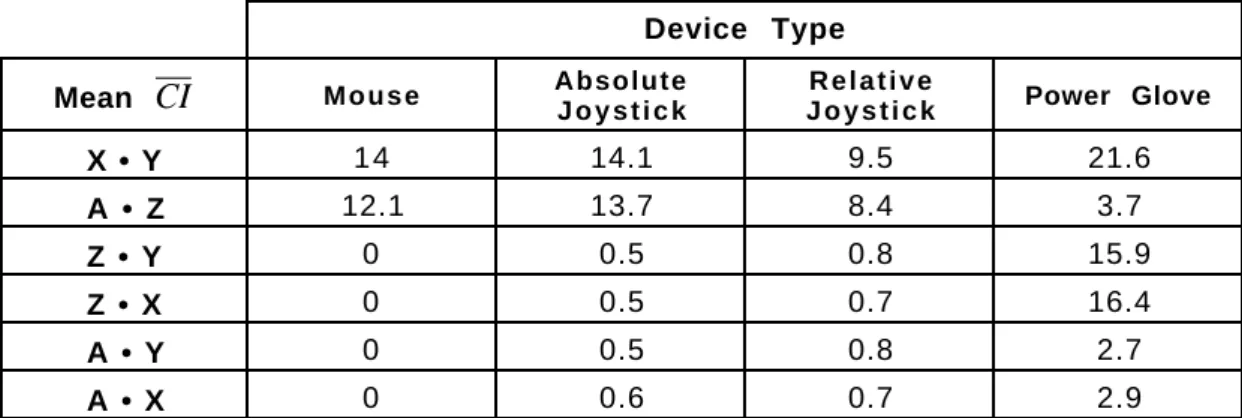
During analysis, the mean movement time needed to reach a certain accuracy (i.e., a distance to target in Euclidian space) was compared between all device pairs. T-tests indicated a highly significant difference in speed and accuracy between the four device types. The mouse was the fastest and most accurate device, then came the absolute joystick, relative joystick and Power Glove. More than anything, the ease with which the low-dimensional input devices outperformed the multidimensional Power Glove demonstrates the impact of cost-cutting measures on multidimensional device performance. The speed and accuracy deficiencies of the Power Glove are mainly due to the low-cost construction of its ultrasonic positioning system. Its erratic behaviour necessitates filtering and causes lag. The low resolution of its roll information eliminates its use in refined tasks with more than 3 degrees of freedom.
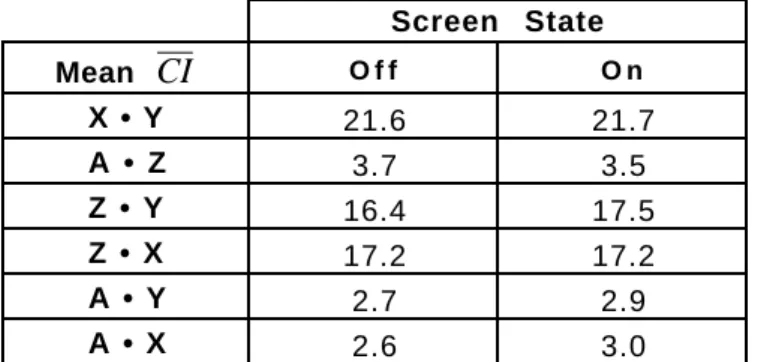
Of the tested devices, the cheapest low-dimensional device, the mouse, remains the best option, even in this multidimensional task. However, when the control integration (i.e., angle of movement) was examined for all axis pairs, the Power Glove demonstrated its future potential by effectively integrating the axes in 3-D space. Also, the glove provided higher integration of the axes in 2-D space than the low-dimensional devices. Control integration did not differ significantly between the audio-visual and auditory-only conditions of the second experiment. The visual representation thus proved satisfactory, since its separation of 4-D space into two 2-D projections had no significant impact on multidimensional device utilization and corresponded nicely with the perceptual structure of the low-dimensional devices. Loss of visual feedback reduced the accuracy significantly, but not the speed when the accuracy criterion was met. A majority of the subjects appreciated the ISEE timbre manipulation scheme. They thought it made sound synthesis easier and liberated them from technicalities, without restricting them artistically.
The ISEE Overtones and Brightness timbre parameters were considered useful auditory navigational aids. The encouraging results with auditory-only feedback stimulates further research into its use.
1.4 Structure of the Thesis
The next chapter will present the literature review, where we will discuss the backgrounds of Human-Computer Interaction, research into computer music
controllers, research into timbre control structures and input device experimentation. The third chapter will focus on the materials and methods used during the
experiments and the analysis phase: what was used, why and how. The fourth chapter will present the results of the analysis of experimental data. In the fifth chapter we will try to find explanations for the results found. The conclusions and a future programme of research will be presented in the sixth and final chapter.
Chapter 2. Issues in Human-Synthesizer Interaction
One would expect most of the research into hardware music controllers to find its origins in experimental Human-Computer Interaction. When looking at the literature, however, it becomes clear that this is not the case. New methods of controlling computer music are hardly ever empirically evaluated. Most hardware is custom built and designed to be controlled by the inventor. It is all too easily disregarded that when establishing a new timbre control paradigm, HCI design principles should be taken into account. We must of course look at the history of research into timbre controllers in order to understand the issues involved, but an understanding of traditional user interface research can aid the development of generic user-friendly interfaces for musicians and composers alike. The initial research therefore focused on these two areas. This chapter summarizes this first phase of the project, in which the modern principles of HCI and problems concerning musical timbre control were reviewed through the literature. In summary, the conclusion is that generic utilization has hardly been an issue in the design of computer music controllers. Paradigms for translating movement into sound have not been generalized to provide new user interfaces for intuitive timbre control. Traditional evaluation techniques for computer input devices can provide a solid basis for the evaluation of computer music
controllers.
In this chapter, current knowledge in the field of Human-Computer Interaction concerning direct manipulation in graphic user interfaces and movement theory will be discussed and related to timbre control. An overview will be presented of
Computer Music research into the development of input devices for real-time control of digital sound. This will be followed by a review of timbre control structures, featuring the timbre space and Intuitive Sound Editing Environment paradigms for mapping low-dimensional controller data to high-dimensional synthesis parameters. Finally, the literature pertaining computer input device evaluation will be discussed, featuring a theoretical basis for the evaluation of low- as well as multidimensional input devices.
2.1 Human-Computer Interaction
2.1.1 Direct ManipulationWith the advent of graphical user interfaces in sound synthesis computer software as well as sound synthesizers, one would expect the notion of direct manipulation of timbre to have gained ground. This section will demonstrate that current
fundamental principals of direct manipulation. Therefore, we will look at the
available literature for the principles and benefits of a direct manipulation approach. According to Nelson (1980), direct manipulation is a user interface technique where objects and actions are represented by a model of reality. Physical action is used to manipulate the objects of interest, which in turn give feedback about the effect of the manipulation. A good example in the real world is driving a car. To turn left, the driver rotates the steering wheel to the left, resulting in an immediate change of scenery, which provides essential visual feedback. This approach is essentially different from a command oriented approach, which would consist of issuing a directional command such as GO RIGHT, and then issuing a command to show the heading of the car. A good example in the Computer Music domain is transposing notes using a notation editor, in which case the metaphor is the note symbol, the action is moving the note vertically on the staff and feedback consists of note and hand position and the resulting audible change in pitch.
Rutkowski (1982) noted that an important aspect of direct manipulation is the principle of transparency, where attention shifts from issuing commands to
observing results conveyed by feedback: “The user is able to apply intellect directly to the task; the tool itself seems to disappear.” In order for that to work, feedback should be consistent with the user’s expectations of the task’s results.
Shneiderman (1987) argues that with direct manipulation systems, there may be substantial task-related semantic knowledge (e.g., the composer’s knowledge about score writing), but users need to acquire only a modest amount of computer-related semantic knowledge and syntactic knowledge (e.g., the composer need not know that a score is not just put in a drawer, but in fact is saved as a MIDI file on a disk, nor that transposing that score consists of applying a change-key-number function to all note-on and note-off events in the score). Task-related semantics should dominate the users’ concerns, reducing the distraction of dealing with the computer semantics and the syntax. To achieve maximum effect, computer-related semantics would need to be replaced by task-related semantics. This brings us to the question what the semantics of timbre control could be. Though this will be further discussed in § 2.2, brightness will be used in the next example to indicate where current
synthesis user interfaces fail to implement the principals of direct manipulation correctly.
Most synthesis parameters can nowadays be controlled in real-time by external controllers using typical ad hoc configurations. Usually, each degree of freedom (DOF) directly controls one synthesis model parameter, which need not necessarily behave in a perceptually linear or consistent fashion. For example, to change the brightness of a tone generated by Frequency Modulation (Chowning 1973), one could change the output level of a modulator. Though most of the time this seems to affect
the brightness of the sound, in fact, one controls the width of the spectrum, which might result in noise due to aliasing if, for instance, operator feedback is active, resulting in a loss of correspondence between the task-related semantics and synthesizer-related semantics. A more direct mapping between task-related
semantics (I want to make a sound brighter) and synthesizer-related semantics (then I need to change the output level of the modulator or the feedback level or both) could easily be achieved if control would operate at a higher level of abstraction. Then every synthesizer could have a brightness parameter that would produce similar effects.
Achieving true direct manipulation of timbre is a step to be taken before we can test generic input devices, since it helps operating those devices in a more meaningful way, possibly improving their performance. Accomplishing direct manipulation includes the identification of the semantics of timbre manipulation and the implementation of those semantics in a consistent fashion.
2.1.2 Motor Control Theory
Another traditional aspect of HCI that points towards a high-level control mapping based on a task-related semantics is that of motor control theory. When musicians want to express a timbre during a performance on stage, one would expect them to be able to do so in a controlled and meaningful manner. However, with electronic timbre expression this proves problematic. When musicians start practising a piece, they need to adjust errors using auditory, visual, tactile and muscular receptor feedback. As they progress, priority shifts from high-level visual and auditory feedback to lower-level tactile and muscular receptor feedback, resulting in the ability to perform without visual or auditory feedback (Keele 1973). Keele (1968) attributes this behaviour to the compilation of movements into ready-for-use motor programs. The linkage of motor programs during the final autonomous phase of skill learning reduces the amount of cognitive control necessary, clearing the mind for other tasks such as musical expression (Fitts and Posner 1967). However, for each type of sound and for each type of synthesis model, the same timbral expression means different hardware controls must be manipulated in different ways, making it virtually impossible to reach the autonomous learning phase for the generic
application of perceptually meaningful (i.e., not synthesis model based) timbre modifications.
This results in the use by jazz musicians of dedicated input devices aimed at modifying a single synthesis parameter which does behave in a musically consistent and meaningful way (e.g., breath control of the modulatorenvelopebias to implement brightness on an FM synthesizer). These dedicated input devices are often
limited to one degree of freedom, since they are used to control a single parameter of the sound synthesis model. Since the number of limbs that can be used to operate these devices is limited, this approach reduces the power of the synthesis model in generating a wealth of different timbres considerably.
A suitable control mapping will need to restrict the number of parameters, yet provide more diversity than single parameter controllers. Lee and Wessel (1992) support this low- to high-dimensional approach.
2.2 The Control Problem
Before we attempt to test input devices in a generic timbre manipulation task we need to look at the literature in order to select a suitable timbre manipulation model. This model should adhere to the constraints mentioned in earlier paragraphs,
providing a consistent task-related, low- to high-dimensional mapping between control information and synthesis information. In the past, such perceptually based timbre control structures have been devised, featuring a reduced number of
parameters. However, since it is difficult to generalize such parameters for all possible timbres, most studies into timbre controllers have focused on performance instead of generic sound synthesis.
2.2.1 Traditional Research
The literature of computer music controller development reveals a significant
difference in approach with standard HCI input device research. To illustrate this, a number of typical articles on real-time control of digital sound synthesis from recent years are treated here.
Cadoz, Luciani et al. (1984) and Cadoz, Luciani et al. (1993) describe a musical virtual reality system called Cordis that is based on two forms of instrumental models for digital sound synthesis:
• Input devices that capture physical gestures and react to these gestures with programmable feedback;
• Sound synthesis techniques based on the simulation of physical sound producing mechanisms.
At the time this was a revolutionary idea, integrating the development of physical modelling as a synthesis model with the idea of reactive input devices. However, the input devices that were developed for this system were designed to physically emulate traditional musical instrument behaviour. Traditional instruments typically provide enormous control potential at a considerable cost of training time. With their
performance, the idiosyncrasy of traditional input devices is modelled as well. This means different input devices are needed to play different virtual instruments. Though it is claimed that this approach is viable for use in real-time sound synthesis control, it is typically designed for skilled performance, rather than generic user interface utilization.
The VideoHarp, presented by Rubine and McAvinney (1988), is a multipurpose musical input device more than anything designed to please an audience with its spectacular visual appeal. It features different regions modelling traditional instrument behaviour. A keyboard region, bowing region, conductor region and modifier region can be mapped using MIDI channel messages, basic control
commands for MIDI devices. My key criticism on this research is that it lacks even a
heuristic specification of the low- to high-dimensional mapping of region data to synthesis data. Also, it does not present any kind of empirical evaluation of the device by musicians.
Gibet & Florens (1988) and Gibet & Marteau (1990) base their gestural control system on motor system theory. Like Cadoz, Luciani et al. (1984), their approach follows the physical modelling paradigm. With this approach, they intend to achieve direct manipulation of sound by restoring the causal link as the natural law for sound synthesis. This relies on the theory that the objects of the perception emerge out of the representation of gestures that produce the sound. Though it is clear that a direct correlation between gesture and sound reduces cognitive processing load and enhances performance (Keele 1973), the expectations of a performer are related to real world objects. This impairs utilization of the system as a generic sound
synthesis control paradigm, since a generalized mapping between gesture and timbre is not provided.
In (Mathews 1989; Mathews 1991) the Radio Baton is described. It is a 3 DOF controller which uses low-frequency radio waves to determine position on the x, y and z axes. In these papers, the instrument is presented as a MIDI sequence
conductor. A difference is made between expressive and predetermined components of western classical music. It is claimed that predetermined components can be left to the computer, allowing the performer to concentrate all his attention on the expressive aspects of music. The system would relieve the performer of data processing and motor control tasks involved in (prima vista) score reading. The instrument can be set up to act like a drum, where beats on an imaginary plane can act as triggers for note sequences and tempo controls. When the baton is close to the plane, it can be used to control pitch bend and vibrato of the notes played. Though pitch is indeed an important means of expression, timbre control should not be marginalized. Unfortunately, by basing his system on the rigid western classical music tradition, Mathews reduces timbre to a predetermined and therefore
automatically handled component. To my knowledge, the baton has never been empirically evaluated as a generic instrument.
Another real-time performance controller is presented in (Bauer and Foss 1992), a paper resembling a reference manual. This system uses ultrasonic sound to determine the position of up to four wands in 3-space4. The system, called GAMS, requires the
definition of a substantial amount of relations between on-stage positions and MIDI channel messages. Via MIDI, not just music is controlled, but also lighting and
imaging. A formalism for a meaningful mapping of control information to the various media is not discussed. Not surprisingly, the audience could not understand what was happening during trial performances. Consequently, the idiosyncrasies of the system, rather than the contents of the performance, became the point of discussion. All these systems, from the The Hands (Waisvisz 1985) to Oculus Ranae (Collinge and Parkinson 1988), have the following in common:
• They are intended to be idiosyncratic for artistic reasons; • They focus on performance;
• They are hardly ever empirically evaluated.
The above survey indicates that problems of human-synthesizer interfacing in the field of Computer Music have been tackled primarily through the development of innovative hardware controllers. However, the use of these as generic controllers is limited, because researchers have failed to developed accompanying formalisms for the low- to high-dimensional control mapping. This omission may have been caused by the considerable influence technicians have traditionally had on Computer Music research. Fortunately, some research into generic control formalisms has been done, and can form the basis for further evaluation and development of synthesizer control mechanisms and techniques. Not surprisingly, this research is typically conducted by psychologists and HCI experts working in the Computer Music domain.
In (Buxton, Patel et al. 1982), the Objed system is described as a part of the SSSP, a computer composition environment that was one of the first to introduce direct manipulation principals in digital sound synthesis. Subsequent graphical MIDI editors were all based on the same principle: that of manipulating sliders to control on-screen synthesis model parameters. However, early on the authors recognized that approach to be no more than a substitute, and that timbre should ideally be controlled according to perceptual rather than acoustical attributes. They also emphasized the importance of minimizing non-musical problems of the sound
synthesis task and permitting the composer to understand the perceptual consequences of their actions.
Eaglestone (1988) states that computer instrument development is an iterative process of design, prototyping and empirical evaluation. He relates the control problem to that of achieving data independence in a database environment, and hence achieving an abstract, user oriented interface. The paper sets out the right path, but remains rather abstract.
Lee, Freed et al. (1991) and Lee & Wessel (1992) demonstrate how a Mattel Power Glove was used in combination with a neural network to produce real-time control of timbre during performances. As a control mapping a timbre space was used in which a limited number of sounds were organised in a geometrical model according to perceived timbre differences. This approach elegantly features all
constraints set out earlier in this thesis, including a well-based formalism for the real-time mapping of low-dimensional perceptual parameters to high-dimensional
synthesis model parameters. This approach will be elaborated upon in the next paragraph.
2.2.2 Timbre Space
Wessel (1974), Grey (1975) and Plomp (1976) proved it possible to explain differences in timbre with far fewer degrees of freedom than are needed by most synthesis algorithms. In (Wessel 1985), the timbre control problem is addressed by using a perceptual mapping produced with multidimensional scaling techniques (Shepard 1974). In this approach, a timbre space is derived from a matrix of timbre dissimilarity judgements made by humans comparing all pairs of a set of timbres. In such a space timbres that are close sound similar, and timbres that are far apart sound different.
To use a timbre space as a synthesis control structure one specifies a coordinate in the space using an input device. Synthesis parameters are then generated for that particular point in space. This involves interpolation between the different originally judged timbres. A crude approach to implementing a timbre space for synthesis control would be to create a lookup table where for every coordinate a corresponding synthesis parameter set is defined which only needs to be looked up, providing a very efficient translation scheme. However, this approach claims considerable storage space, imposes problems on automated interpolation and therefore makes the definition task too laborious. Fortunately, more graceful methods have been found. Lee and Wessel (1992) report that they have successfully trained a neural network to generate parameters for several synthesis models with timbre space coordinates as input, automatically providing timbral interpolation. This approach
does however involve substantial computational power in order to train the neural network.
Plomp (1976) indicates that when using multidimensional scaling to define timbre spaces the number of timbre space dimensions increases with the variance in the assessed timbres. This makes it difficult to derive a generalized synthesis model from this strategy. When trying to reduce the number of dimensions artificially by using several less varied timbre spaces, the dimensions of the different timbre spaces might not correlate, which could cause usability problems if used as synthesis
parameters. Generic use of timbre space is also inhibited by the need to use existing sound examples judged by a human panel. How could a musician construct his own timbre spaces? What if he wants to generate totally new sounds?
Feiten and Ungvary (1991) are making progress with the automation of the laborious timbre organizing task by replacing the human panel with a specially trained neural network. However, the input sounds still need to be quite similar in order for this to work. With the number of sounds the complexity of the network increases disproportionally. In their study, the automated categorization successfully matches their manual classification. However, where the matching of 54 sounds takes no more than 100 neurons, as many as 400 neurons are needed to match 82 sounds. This clearly demonstrates the limitations of the system with respect to memory and computational power.
Grey (1975) theorizes about the nature of the dimensions of the 3-D timbre space he derived from an experiment in which 16 closely related re-synthesized instrument stimuli with similar envelope behaviour (varying from wind instruments to strings) were compared on similarity. He indicates that one dimension could express instrument family partitioning, another dimension could relate to spectral energy distribution, and a third dimension could relate to the temporal pattern of (inharmonic) transient phenomena. Though these conclusions cannot simply be generalized, they do give us an indication of the nature of appropriate parameters to be used when generalizing timbre space as a synthesis model.
2.2.3 ISEE: Converting Timbre Space into a Generic Synthesis Model
The Intuitive Sound Editing Environment (Vertegaal and Bonis 1994) attempts to generalize the timbre space paradigm for generic user interface purposes by concentrating on the defining dimensions of timbre space. Assuming these parameters are orthogonal, every point in space can be defined by combining synthesis data associated with the projections of its coordinates. In order to reduce the number of parameters needed, instruments are abstracted into perceptual categories. This way, four high-level timbre parameters—Overtones, Brightness,
Articulation and Envelope—are applied to instrument categories with different scales of refinement. One such four-dimensional definition of an instrument category is called an instrument space. The abstract timbre parameters can operate several synthesis model parameters at once, with the intention to increase the perceptual consistency of timbre modification and reduce the amount of parameters that need be controlled, without losing power. The system hides the used synthesizer(s) or synthesis model(s) for the naive user, constituting the transparency principle of Rutkowski (1982). ISEE, described in more detail in chapter 3, is a computer based user interface shell which uses MIDI to control the synthesis process on both external and internal sound synthesis platforms.
One of the main disadvantages of ISEE is the laborious instrument space definition task. Every axis of every instrument space needs to be constructed for every synthesizer by recording minimum and maximum synthesizer parameter values. However, this approach does reduce the amount of memory and
computational power needed substantially, making real-time performance possible using low-cost PCs and relatively cheap MIDI equipment. The high level of
abstraction of the ISEE timbre parameters combined with its classification scheme make it possible to model a far greater variety of instruments than possible with traditional timbre space. Non-existing instrument families can easily be defined as long as design heuristics are followed or extrapolated. ISEE readily allows a
usability study of generic input devices in a timbral direct manipulation environment.
2.3 Generic Input Device Experimentation
2.3.1 OverviewMany studies have tested and compared the usability of input devices in the manipulation of on-screen graphic objects. The available literature was used to determine which input devices to test in our multidimensional timbre navigation task. Also, an appropriate experimentational strategy emerged from the literature.
Chen, Mountford et al. (1988) defended the utilization of 2-D input devices in multidimensional control manipulation tasks: there is evidence that users are not able to successfully perform fully integrated 3-D control manipulations—rolling, tilting and swiveling—using all possible combinations of axes provided by
multidimensional input devices. Also, 2-D input devices were the cheapest and most dominant devices in the late eighties, something still true at present. It is therefore rewarding to compare performance of multidimensional devices with that of low-dimensional devices.
2.3.2 Two-Dimensional Input Device Experimentation
Two-dimensional input devices are capable of movement in two directions (2 DOF), usually described by the x and y axes. They include many types of joysticks,
trackballs, mice and graphic tablets. For an overview and taxonomy, see (Mackinlay, Card et al. 1990). This group of input devices has become the most prevalent besides the keyboard. Much research into the performance of 2-D input devices was invoked by the emergence of the graphical user interface (GUI) in the late seventies. The choice of the mouse as the standard GUI input device was based on this research. Though many of these studies would seem to be outdated, they give a good insight into the research practice of input device evaluation.
In (Card, English et al. 1978), five subjects used a mouse, isometric joystick (which uses force control) and keys to position a cursor to select target words on a screen. The experiments show that the mouse is the fastest and most accurate positioning device. It is shown that the positioning time of the mouse is near-optimal. This paper gives many clues as to appropriate experimentation and analysis methods, which include analysis of variance to check the significance of contributing factors and t-tests to check for significance of differences between mean movement times (MT). Movement time is the determinant in positioning tasks and therefore the most
commonly used dependent variable in such experimentation (Keele 1973). Movement time is measured from the beginning until the end of the actual movement. It excludes reaction time (RT), which is measured from the onset of the stimulus to the onset of the movement. As will be demonstrated in § 2.3.3, MT depends on the distance and precision of the movement. Itgives us a good measure of the efficacy of an input device in a given task where a target position is aimed for from a certain distance with a certain precision. The harder it is to accomplish the task, the longer it will take. However, some tasks are too difficult to complete, rendering MT infinite. An additional measure for the accuracy of a given input device in a particular task is therefore its error rate. The error rate is the percentage of trials where the subjects were not able to reach the required accuracy.
According to Roberts and Moran (1983), four is the minimum number of subjects needed to get any reliability of measurement and get some indication of individual user variation. In most early experiments a small number of subjects performed a great number of trials. Coolican (1990) presents a comprehensive overview of experimental methods and statistical analysis procedures in experimental psychology. It was used as a guide to the experimental methods observed in the literature and served as a reference for the design and analysis of the experiments at
hand. It indicates that it is better to use more subjects, even if that would cause a smaller number of trials per subject to be performed.
In (Buxton 1986), the nulling problem is presented as a user interface design constraint. When a single device is used to modify multiple parameters and that device is absolute (i.e., its position corresponds directly with the parameter position like a volume fader), problems occur when switching parameters. The position of the device will still be that of the last modified parameter, and will thus not reflect the correct setting of the new parameter. According to Buxton, the nulling problem that will occur in ISEE when changing instrument space while an absolute device is used might easily be solved by using a relative device (i.e., a device that controls the direction and speed of the parameter change) instead. However, a relative device causes control to be less direct and thus increases cognitive processing load (Keele 1968). In order to resolve the nulling problem it is interesting to compare the
performance of a relative device with that of an absolute device. If the relative device does not affect performance too adversely, it might be the better choice.
An excellent taxonomy of current input devices is given by Mackinlay, Card et al. (1990). Of the relative devices, the mouse is the most commonly used. Joysticks can be absolute or relative, which makes them ideal for comparing the usability of an absolute versus a relative device.
2.3.3 Fitts’ Law
According to MacKenzie and Buxton (1993), the prevalence of direct manipulation interfaces has resulted in a paradigm shift for modelling user performance. Keystroke models used in early studies such as (Card, Moran et al. 1980), are of diminished
importance, since performance in direct manipulation systems is closer described by
movement models. Fitt’s law is the most important of those models. Originally described in (Fitts 1954), it is an essentially one-dimensional model of human movement describing the time (MT) to move to and select a target of width W which lies at a distance (or amplitude) A:
MT
=
a
+
b log
2(
2 A / W
)
(1)where a and b are constants determined through linear regression of empirical data. The log term is known as the index of difficulty (ID) of the movement task. Fitts’ law is commonly applied to target acquisitions on interactive computer systems
(MacKenzie, Sellen et al. 1991; Kabbash, MacKenzie et al. 1993). One of the strengths in Fitts’ law is that the reciprocal of b (the index of performance (IP) or bandwidth) can motivate performance comparisons across factors such as device, limb or task. However, serious doubts as to the applicability of this law to
multidimensional movement are raised by MacKenzie and Buxton (1992). It is stated that the model can break down and yield unrealistic ratings in tasks with more than one dimension. Though this problem can be partially corrected for two-dimensional tasks by using modifications of the index of difficulty (e.g., the Shannon formulation (MacKenzie 1992)), there is not enough evidence to support the use of Fitts’ law for modelling the outcome of the present four-dimensional timbre space experiments. 2.3.4 Multidimensional Input Device Experimentation
Multidimensional input devices are capable of movement in more than two
directions. Control data provided by these devices is often segregated in positioning data (i.e., placement in 3-space on the x, y and z axes) and manipulation data (i.e., orientation in 3-space: pitch, yaw and roll). They include adaptations of traditional input devices and more exotic devices such as datagloves and headtrackers. For an overview and taxonomy, see (Mackinlay, Card et al. 1990). Though the application of multidimensional devices in military flight simulators has been researched since the sixties, most of these devices emerged from Computer Graphics research in the late eighties. They are typically used in 3-D modelling tasks and Virtual Reality experiments (Pimentel and Teixeira 1993).
In a key paper on multidimensional device experimentation by Jacob and Sibert (1992), it is stated that performance in a multidimensional task with simultaneous control of all dimensions depends on the perceptual composition of the task’s dimensions. The perceptual structure of a task is described by the integration of its dimensions or parameters. Some parameters of a task are operated simultaneously, while others are operated separately. Similarly, input devices can be characterized as integral or separable based on whether it is natural to move diagonally across its different axes of movement. The processing of perceptual structure will be further treated in § 2.3.5. In their study, Jacob and Sibert compared the Polhemus 3-Space Isotrak with a conventional mouse in two three-attribute tasks:
• A task of which the dimensions tend to be perceived as integral. The subjects manipulated the x-y position and the size of an object to match a target; • A task of which the dimensions tend to be perceived as separable. The
subjects manipulated the x-y position and the colour of an object to match a target.
The Polhemus senses changes in magnetic field and reports the three spatial
coordinates used in this experiment together with three angular coordinates 60 times each second. All degrees of freedom of this device can be controlled simultaneously, making it an integral device. The mouse, a 2-D device, had a mode change button to allow control over the third attribute, making it a separable device. It was found that
neither device was uniformly better, but that the separable device performed better in the separable task and the integral device performed better in the integral task. Consequently, the choice of hardware controller should be based on the perceptual composition of the task at hand. § 2.3.5 will discuss the consequences of this notion for our timbre space navigation task.
An excellent experimental strategy emerged from this paper: all experiments were recorded to allow retroactive simulation of experiments at different accuracy criteria. This greatly reduces the risk of erroneous trial termination caused by inappropriate criterion settings or inadvertently passing through the criterion.
Pausch (1991) has studied the use of two multidimensional input devices, the
Nintendo Power Glove and the Polhemus 3-Space Isotrak, as low-cost virtual reality controllers. The possibility to wear the Polhemus on the head is interesting from a musician’s point of view, since it could give musicians using wind controllers hands-free control over the timbre of their instrument. However, it has a lag of 150-250 milliseconds which would hinder timbre control. A newer version, the Polhemus Fastrak reduces this problem. The problem with these trackers, however, is their expensive and delicate nature, which rendered them unavailable for use in this experiment.
The Nintendo Power Glove uses ultrasonics to sense three spatial coordinates and variable resistor material for sensing finger bend. The low resolution of the roll
information (i.e., rotation around the z-axis) of the Power Glove is indicated to be problematic, as is its unstable behaviour. However, it is one of the few
multidimensional devices affordable to musicians. Moreover, to my knowledge, a study in which the Power Glove’s performance is compared with that of a selection of low-dimensional devices has not been performed. It is interesting to note that Wessel, the founder of timbre space research uses a modified Power Glove for timbre space navigation in (Lee and Wessel 1992). However, this study gives no clues as to the relative effectiveness of this device in such a task. It would be very interesting to put this in the Computer Music domain much hyped Virtual Reality device into perspective.
A delay between input action and output response is often observed when using multidimensional input devices. MacKenzie and Ware (1993) studied this so-called
lag with a 2 DOF device that was modelled according to Fitts’ law. It was
demonstrated that lag has a multiplicative effect on Fitts’ index of difficulty (ID), the log term in equation (1). In their experiments, they showed that a 225 ms lag caused movement times and error rates to increase by 64% and 214% respectively.
The lag of multidimensional input devices is usually caused by an accumulation of the following factors:
• Filtering overhead due to the erratic nature of the sensing technology used in these devices (ultrasonic or electromagnetic tracking);
• The amount of computational power needed to process the considerable amount of control information these devices generate;
• The rendering of on-screen feedback, which is slow in typical applications of these devices: 3-D manipulation tasks and virtual environment control. It is important to take the effects of lag on human performance into account when discussing experimental results.
2.3.5 Perceptual Structure
Overview
An excellent explanation of the processing of perceptual structure is given by Jacob and Sibert (1992). A multidimensional object is characterized by its attributes. A red circle has several attributes: size, colour, shape and location. These attributes define a perceptual space. Garner (1974) observed that relationships between the attributes of an object can be perceived in two ways that differ in how well the component attributes remain identifiable. Some attributes are integrally related to one another. The values of these attributes combine to form a single composite perception in the observer’s mind causing the object to be seen as a unitary whole. Other attributes are
separably related. The attributes remain distinct and the observer does not integrate them, identifying the object as a collection of attributes. The horizontal and vertical position of the red circle in an outline square are seen as integral, while its colour and shape are perceived separably.
This notion becomes clearer when we extend it to interactive tasks, in which the attributes of an object are altered. According to Jacob and Sibert (1992), interaction is simply the movement through the perceptual space constituted by the attributes that are varied. Integral movement is Euclidean and cuts across all dimensions defined by the attributes; separable movement is city-block metric and moves
parallel to the axes of the space. Most tasks cannot be classified as purely integral or separable but are a hybrid of both. The control spaces of input devices can be
viewed in a similar way. Input devices with more than one degree of freedom can be characterised as integral, separable or hybrid according to whether it is natural to move diagonally across its different degrees of freedom. With integral devices, movement is in Euclidean space and cuts across all dimensions of control. A separable device, however, constrains movement to a stair step pattern; movement
occurs along one dimension at a time. The amount of integration of two or more control dimensions of an input device is known as the control integration of those dimensions.
Using Control Integration to Determine the Perceptual Structure of a Task
I advance the thesis that the observed control integration of a well-integrated
multidimensional input device which is applied to a task can indicate the perceptual composition of that task. For example, when manipulating both colour and position of the above-mentioned circle with a well-integrated multidimensional device, movement patterns will reveal that position and colour are not modified simultaneously.
Mountford, Spires et al. (1987) suggest that subjects simply do not use those axes that are no part of their perception of the task. More conclusive evidence for this hypothesis was given by Jacob after personal communication. Empirical evidence supporting my hypothesis is presented in (Jacob, Sibert et al. 1994). In that study, trajectory analysis revealed that the path of an input device is significantly
influenced by the structure of the perceptual space of the task providing the device used is not restrictive (i.e., the control axes of the device are well-integrated).
The perceptual integration of the dimensions of instrument spaces (i.e., 4-D ISEE timbre spaces) is unknown. However, the three spatial axes (x, y, z) of
multidimensional input devices are known to be well-integrated (Jacob and Sibert 1992). According to my hypothesis, it should be possible to predict the perceptual structure of three out of four dimensions of an instrument space by computing the control integration of the three spatial dimensions of a multidimensional device such as the Power Glove during instrument space navigation. As a measure for the
integration of two attributes, I propose control integration (CI): a ratio scale
indicating the amount of diagonal movement between two axes, x and y, in radians or degrees. Maximum integration in any direction results in a maximum CI of 1/4 π radians or 45 degrees, minimum integration in any direction results in a minimum CI
of 0 radians or degrees. The control integration of movement on any pair of axes (x, y) at any given moment in time is a function of the first order differential of that movement:
CI
=
−1tan
dy
dx
−
1
4
π −
1
4
π
(2)When investigating the perceptual structure of a three-dimensional task the control integration needs to be calculated for all four possible axes pairs at every sampling
interval. An average
CI
can then be calculated for each pair by adding the individual samples(
CI
k)
and dividing that number by the number of samples n:CI
=
kCI
k=1 n∑
n
(3)Since
CI
also depends on the direction of the vector from the starting point to the target position in a trial, trials with vectors in all directions should be performed in order to get an accurate absolute indication of the control integration. However, in the present experiments control integration data will only be used as a relative measure to indicate differences between input devices. This reduces the need for such a great diversity of target vectors considerably.2.4 Summary
Achieving true direct manipulation of timbre, where task-related semantics are used to control the sound synthesis process according to human perception, is a first step towards the meaningful application of generic computer input devices in intuitive timbre manipulation. Generic use of traditional idiosyncratic computer music controllers is limited since they lack accompanying formalisms for the low- to high-dimensional mapping of control parameters to synthesis parameters. The
generalization of the timbre space paradigm featured in the Intuitive Sound Editing Environment brought the meaningful utilization of generic computer input devices in timbre manipulation a step closer.
The evaluation of the efficacy of input devices in any task should be based on standard HCI experimental practice. The observed movement time and accuracy with which devices are used by subjects to reach for targets in the control space can be used to establish their efficacy. For optimal use, the control structure of the input device should correspond with the perceptual structure of the timbre manipulation task. The perceptual structure of a task is established by analyzing movement patterns of a non-restricted multidimensional device used during experimentation.
Chapter 3. Materials and Methods
In this chapter, the materials and methods used in the experimentation are described in detail. Firstly, the equipment is presented, featuring the input devices that were evaluated, the computing apparatus and software used and the exact circumstances under which the experiments took place. In the second part, the experimental
procedures for the testing of both hypotheses are explained in detail. Finally, the analysis procedures are discussed.
3.1 Materials
3.1.1 Input DevicesThree input devices were tested:
• Nintendo Power Glove (sometimes referred to as the Mattel Power Glove) • Advanced Gravis Mousestick II, in relative and absolute mode
• Apple Standard Mouse
The Nintendo Power Glove is a low-cost dataglove with 8 degrees of freedom (DOF). Two transmitters mounted on the back of the user’s hand send ultrasonic pulses to three receivers configured in an L-shape. This way, 3-space position and roll are determined. The glove communicates successfully within 3 to 4 meters distance from the receivers when it is oriented towards them. The signal of the glove degrades and is eventually lost as it is turned away from the receivers. The glove remains usable at up to a 45 degree angle from the receivers. The coordinate information (x, y, z) of the glove is reported accurate to within 6 millimeters when the glove is within 2 meters from the receivers (Pausch 1991), but such accuracy is only possible when the data is heavily filtered. The roll information, where roll is the angle made by pivoting the hand around the axis of the forearm, is reported in one of twelve possible positions. In addition, finger bend is determined from the varying resistance through materials running the length of the fingers. The bending state of the user’s thumb, index, middle and ring finger are each reported as a two-bit integer. The gestures conveyed by the four-position finger bend data are ideal indicators of status and can be used to issue commands, as long as ambiguous gestures are avoided.
The Power Glove was connected to a GoldBrick hardware interface which
converted the encrypted glove information to the Apple Desktop Bus (ADB) format used by Apple Macintosh computers. Since the GoldBrick driver software could not run under Apple System 7, the glove data was processed on the computer system that was used to remotely control and record the experiments. Max, the musical
software package that performed those tasks, was also capable of processing and relaying the Power Glove information. The Max implementation is further discussed in § 3.1.3.
Since the subjects faced a computer monitor to get visual feedback throughout the experiments, the receivers were fitted around that screen. With particularly small subjects the position of the receivers needed minor adjustments, so that each subject would be able to reach all parameter extremes. The 3-space coordinates were used to control the first three ISEE timbre parameters in an absolute fashion as shown in figure 2. The x and y axes were directly mapped to the Brightness and Overtones
parameters conveyed by the left coordinate system in figure 3, while the z axis was mapped to the Articulation parameter in the right coordinate system in figure 2. All controlled parameters had a resolution of 128 positions. The x axis had a range of approximately 3 meters around the centre of the monitor, while the y axis ranged from just above the floor to about 2 meters up. When the subjects positioned the glove at a distance of approximately 10 centimeters from the screen, the Articulation
would obtain its minimum value, while its maximum value was reached with the glove approximately 3 meters from the screen, providing a control space of
approximately 18 m3. The controller to display (C:D) ratio of the glove thus ranged
from 60:1 for the x and z axes to 40:1 for the y axis. Though this control space would seem large, any reduction of the C:D ratios would decrease the accuracy of the glove considerably.
Since the roll of the glove only reports 12 positions, absolute roll control could not achieve the correct resolution (128 positions) for the Envelope parameter. Roll was therefore implemented in a relative fashion: when the wrist was rolled to the right, the Envelope parameter would move towards the right, when the wrist was rolled to the left, the Envelope parameter would move towards the left. With the wrist in resting position, the Envelope parameter would not change. In figure 3, the Envelope
parameter is conveyed by the horizontal axis in the right coordinate system.
The glove was engaged by making a fist, with the thumb put between the fingers. This way, when the glove was put on, the parameters could not be accidentally moved. Pointing the index finger at a particular point in space would cause ISEE to zoom in, while wiggling the thumb would cause ISEE to zoom out. These zooming features, further described in § 3.1.3, were however disabled during the experiments, allowing the subjects only to move in a single instrument space. At the beginning of each session, the glove was calibrated to map the centre of the control space to the centre of the parameter space. The subjects needed to wear the glove on the right hand, but this did not pose any real problems since most subjects were right-handed.
Figure 2: Power Glove setup Figure 3: Control Monitor