Water Conservation Methods for a Residential Building
Baishali Pradhan, Assistant Professor,
Department of Architecture and planning, Lovely Professional
University, Phagwara, Jalandhar, Punjab, [email protected]
Abstract - Water is fundamental to life, livelihood, and sustainable development. Water is the world available to human beings and there is only a small amount of water available for us. The cities present a depressing scene of poverty, slums, shortages of water and power, rivers turning into drains, pollution, insanitation, and diseases. Water will be a critical issue and a major problem in urban areas. India has more than 17% of the world’s population, but it has only around 4% of renewable resources. A very less amount of water available and since humans are not using water resources judicially, then we will be in the severe water crisis.
Water services should be planned for our future generation. The kind of infrastructure such as pumping system, reservoir capacity, pipe sizes and treatment plant for a building depends on water demand to be filled. As water is required for domestic uses at residences such as for drinking, bathing, cooking, washing clothes, etc. Water is needed in different buildings for their different requirements such as for institutions, business, commercial building, for watering the parks or garden, a public fountain for aesthetic, sprinkling and road wash. Water also requires for emergencies such as firefighting. The usage of water in domestic use, industrial use and commercial uses are different as per the demand of the usage. The kind of infrastructure such as pumping system, reservoir capacity, pipe sizes and treatment plant for a building depends on water demand to be filled.
As a large amount of water uses in residential buildings is more rather than the other buildings. Thus, this research will restrict to only how to consume water efficiently and understand what kind of water conservation techniques should be used in the residential building to make it sustainable.
Keywords —Energy Efficient, Residential Building, Renewable sources, Sustainable, Water conservation
I.
I
NTRODUCTIONOverall the World available to humans is in a small amount. In the world’s freshwater water is about 2.5%. This freshwater further segregated into three parts that are Glaciers which have 69.5 % of it, Surface water having 0.4% and Groundwater having 30.1%. Thus, the total surface area freshwater for the world is about 0.4% which is small in amount. For example there was a water scarcity in Chennai, where the water is being sent through the train for them to sustain. In some other cities, there is also water scarcity where people don’t get enough water to do their basic needs in some other cities. That’s why, water scarcity is being the major issue in the urban cities and these challenges can be reduced if we smartly use waterto make the environment sustainable.
As water demand for residential, commercial and industrial purposes are different concerning their
requirements. Water demand in residential buildings is more
Figure 1 - present scenario of water demand in India.
than the other building demands. Water is required for domestic uses at residences such as for drinking, bathing, cooking, washing clothes, flushing, landscaping, etc. The appliances such as washing machines, dishwashers and coolers and the future growth rates are varies for water demand. So, to consume or reduce this wastage of water, we can judicially use water, protect resources, use effective and efficient management and be a responsible man. Acquire awareness and knowledge about water sources, sectoral demands, availability, supply systems and governance.
Figure 2 - chart of water demand for various purposes in the residence
It observed that some water-saving appliances such as low flow fixtures, low flow showerheads, etc can minimize the water usage by 50- 75% without harming the life. To minimize the wastage of water, some advanced techniques should be incorporated into the design. Water-conserving methods, if adopted can reduce water use by 52% in toilet flushing followed by washing clothes and dishes etc. these new technologies not only conserve water but also prove cost-efficient to the consumers. With the help of technology, the quality of life can be maintained even per capita water supplies.
3 R’S OF WATER EFFICIENCY
Water efficiency aims are to minimize the water demand needed for the building and reduce the water supply. First on is Reduce the water consumption by using of Low flow fixtures. The second one is to use the rainwater wastage through Recharge Rainwater harvesting for future use by customers’. Third is to reuse the water wastage by treating the wastewater that comes from the building or treated the stormwater. Thus, this research shows how these 3R’s will achieved for a sustainable built environment.
II.
WATER
CONSERVATION
METHODS
There are different kinds of approaches that each should follow for water conservation to make a design sustainable. The first purpose is to reduce the water use conventionally and design water saving buildings. Another purpose by the use of advanced technology to minimize water wastage. These approaches towards the water efficiency which helps in water conservation methods to a residential building. It is determined that water supply can be increased up to the extent of 70 percent by the help of various new technologies available. The modern efficient water technology for the water demand norms can be fixed as low as 50 lpcd as
against prevailing 135 lpcd. The extent of water-saving varies from 25 percent to 65 percent based on the type of method or technique taken and with the help of these new technologies the quality of life can be maintained. Some of the new technologies that are used such as the installation of low flow fixtures, on-site STP, enhanced irrigation system, rainwater harvesting and water metering. Reduce the consumption of water in building through on-site STP with the help of wastewater treatment. The water which is wasted, it should capture first and then treated after that reuse the treated water. This capturing of water also be stormwater or rainwater. In this way there will help in reducing the dependency on all of the water resources. By capturing the rainwater we can use it for longer years.
Figure 3 - This picture shows how to make water efficient.
REDUCING DOMESTIC WATER USE
The water demand for domestic purposes has increased by 65 percent. There are some easy steps we can manage to minimize the amount of water. For example, some showers use only a third of the water required for a bath and using a glass of water during brushing, not leaving tap running, this could save as much at least 9000litres of water person per year. A modern toilet uses 7 liters per flush or less compared to the older one which using 9 litres or more, reducing the volume of water in the cistern, by fitting a HIPPO bag that reduces the amount of water used by each flush.
The two major appliances that’s uses in the kitchen are the automatic washing machine and the dishwasher. The modern washing machine uses less water and it has a sensor to sense the amount of water that it requires for washing, thus there is no wastage of water. The use of water meters, increasingly installed as new houses are built, it will encourage more economical use of water. A reduction of domestic use to 100 litres per person per day, would leave an extra 40000 litres/second in rivers. It would also reduce the volume of wastewater and the associated cost of treatment.
Water saving building
The water supply in buildings in many ways. There are various ways to reduce the consumption if we use the water judicially. The residence should be planned in such a way that it must has to recycle rainwater and have an in-building greywater treatment system. Only 6 percent or more water
is used for drinking and cooking, even though all domestic water is to the standard for potable water. About one-third of domestic water supply is used for WC flushing and this water could be of a lower quality.
This is the main starting point to reduce water demand. This can be done in several ways, including the use of more efficient dishwashers and washing machines, low water volume, WCs, taps that aerate the water stream and low flow fixtures. The water use should be reduced to at least 100 litres/person/day. More alternatives are also available such as composting toilets and waterless urinals.
1. Biological compositing system
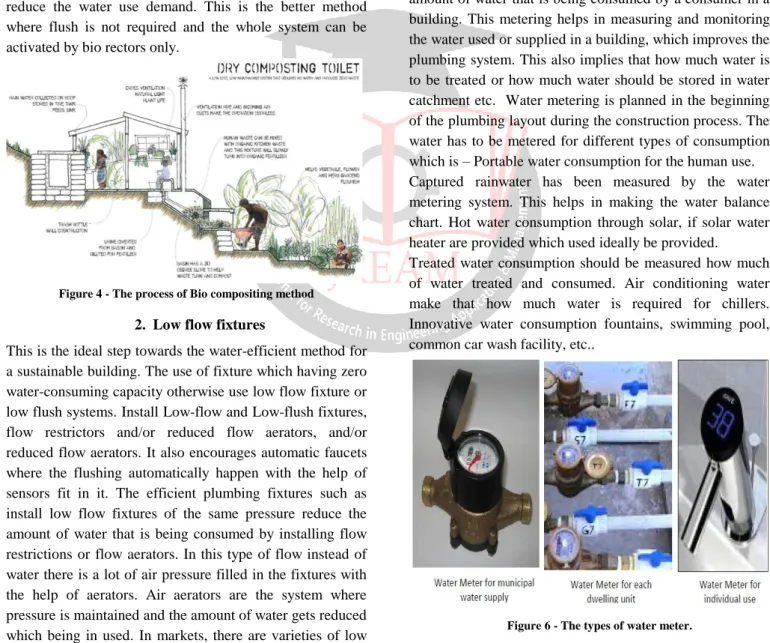
The microorganism process using oxygen in the air converts sludge and organic wastes into carbon dioxide, water and energy. It has bio-reactors to convert the sludge into hygienic pollution and germs free materials which is not possible in the digestion process. In this system, it can reduce the water use demand. This is the better method where flush is not required and the whole system can be activated by bio rectors only.
Figure 4 - The process of Bio compositing method 2. Low flow fixtures
This is the ideal step towards the water-efficient method for a sustainable building. The use of fixture which having zero water-consuming capacity otherwise use low flow fixture or low flush systems. Install Low-flow and Low-flush fixtures, flow restrictors and/or reduced flow aerators, and/or reduced flow aerators. It also encourages automatic faucets where the flushing automatically happen with the help of sensors fit in it. The efficient plumbing fixtures such as install low flow fixtures of the same pressure reduce the amount of water that is being consumed by installing flow restrictions or flow aerators. In this type of flow instead of water there is a lot of air pressure filled in the fixtures with the help of aerators. Air aerators are the system where pressure is maintained and the amount of water gets reduced which being in used. In markets, there are varieties of low flow fixtures are available. There is also have a provision to add aerators to the existing fixtures.
Figure 5 - The types of low flow fixtures. 3. Water Metering System
Technology which automatically collects metering data and transfers it to a central database for analysis and decision-making. AMR water meters are generally called “smart meters”. AMR system usually consist of a one way communications with the utility, in the form of sending Recorded data at regular intervals.
Water metering is for monitoring and controlling the amount of water that is being consumed by a consumer in a building. This metering helps in measuring and monitoring the water used or supplied in a building, which improves the plumbing system. This also implies that how much water is to be treated or how much water should be stored in water catchment etc. Water metering is planned in the beginning of the plumbing layout during the construction process. The water has to be metered for different types of consumption which is – Portable water consumption for the human use. Captured rainwater has been measured by the water metering system. This helps in making the water balance chart. Hot water consumption through solar, if solar water heater are provided which used ideally be provided.
Treated water consumption should be measured how much of water treated and consumed. Air conditioning water make that how much water is required for chillers. Innovative water consumption fountains, swimming pool, common car wash facility, etc..
Figure 6 - The types of water meter.
All these have to be measured separately and this measurement will go for preparing water balance charts. In addition to this, there are also water measures for that which is going towards the treatment plants and how much water is
received from the treatment plant. Then the heads will going to be meter sufficiently.
4. Rainwater Harvesting System
Rainwater harvesting is a common principle for water conservation method. Rainwater harvesting has the collection system which includes storage for later use and recharge the underground Aquifers of rainwater. Rainwater enters to the ground aquifers and recharge it. This water stored for future use. The surface should be pervious one so that rain can easily enter the underground. If it would be impervious surface then rainwater doesn’t allow to percolate down to the underground. RWH has been practiced for centuries. For example Johads of Rajasthan, Tankas of Bikaner, Bamboo drip irrigation, etc.
RWH is considered to be clear than the grey water. Its quality is good but contaminated with some gases, dust and microorganisms in the atmosphere. Nitrogen and oxygen are the main impurities in rainwater.
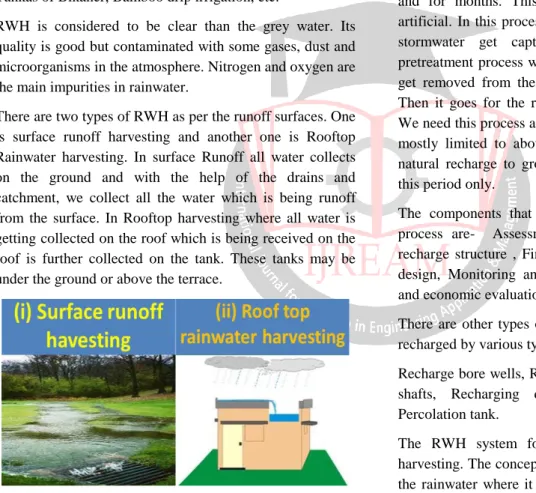
There are two types of RWH as per the runoff surfaces. One is surface runoff harvesting and another one is Rooftop Rainwater harvesting. In surface Runoff all water collects on the ground and with the help of the drains and catchment, we collect all the water which is being runoff from the surface. In Rooftop harvesting where all water is getting collected on the roof which is being received on the roof is further collected on the tank. These tanks may be under the ground or above the terrace.
Figure 7 - The types of RWH.
The size of the tank will vary with the demand, the available area of collection surface and the percentage of demand that is to be met from the tank. A huge tank will protect against severe droughts but the cost and space disadvantage. The cost of such a system for a home would have an economic payback period of about 10 years. The environmental benefits need for mains water is reduced and the infrastructure demands on both supply and disposal are reduced.
Timelines for RWH system -
During predesign analyses the conceptual site plan Decreasing in impervious area and so that
decreasing in runoff volumes.
During design of the storm water management system and perform preliminary calculations to size the system.
The project team should proper install and operate the storm water management system by reviewing the contractor’s as-built drawings during construction.
The system of RWH Artificial Recharge of ground water. Basically, this artificial recharge is defined as the recharge that occurs when the natural pattern of recharge deliberately modified to increase the recharge. It aims at extending the recharge period in the post monsoon season for about three and for months. This process of recharge itself is not artificial. In this process, there is a capture zone where the stormwater get captured and then enters into the pretreatment process where the debris and harmful bacteria get removed from the storm water and then it recharges. Then it goes for the recovery process and post treatment. We need this process as the occurrence of rainfall in india is mostly limited to about the three months in a year. The natural recharge to ground water reservoir is restricted to this period only.
The components that requires for the artificial recharge process are- Assessment of source water, Planning of recharge structure , Finalization of specific techniques and design, Monitoring and impact of assessment , Financial and economic evaluation., Operation and maintenance.
There are other types of ground water aquifers that can be recharged by various types of recharging methods-
Recharge bore wells, Recharge pits, Soakaways or recharge shafts, Recharging dug well, Recharge trench and Percolation tank.
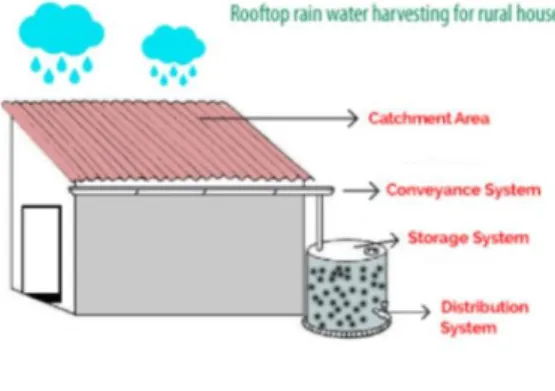
The RWH system for building is Roof top rainwater harvesting. The concept of this process involves the tapping the rainwater where it falls. Storage and reuse of collected rainwater is easier process to harvest rainwater. This is the simplest method of roof top rainwater harvesting is the collection of rainwater in a large pot/vessel kept beneath the edge of the roof. In this method water is collected from roof using drain pipes/gutters fixed to roof edge.
Figure 8 – Roof top rain harvesting of the building 5. Water efficient landscaping
The Reduction in consumption of water, we consider the reduction for irrigation requirements. For a large site, water that is used for gardening or irrigation is a huge amount of water, it will not appear at the first. The water required for the irrigation is not portable even the treated grey water or captured rainwater can be continually used into irrigation without any filtration or treatment much of it required because it is not portable.
Figure 9 – landscaping area on the site planning.
To limit or eliminate the use of potable water or other natural surface or subsurface water resources available on or near the project site for landscape irrigation.
Plan the surface retention water body with the help of the roots may draw the amount of moisture that is required for the growth of the plant or combination of these two. Some points that will help in reducing the water requirement for landscaping are as follows-
i. Minimizing the lawn area
Lawns are water intensive, they require a lot of water and they also require a lot of maintenance. So, if there is 100 percent lawn, the total area of the landscaping covered with a lawn then there is there is 0 percent of water saving. However, if we reduce the lawn area to 25 percent, we can achieve a water saving of around 48.5 percent which is close to 50 percent just by reducing a substantial amount of area which was going towards lawns.
ii. Minimize the tree and shrub/plantation
If we increase the area for plantation of trees and shrubs. Now, trees specially require very less amount of watering irrigation and also if the shrubs are carefully chosen.
iii. Maximize native trees or shrubs
Increasing the area for tree plantation and shrub plantation. The trees and shrubs and all other plants which are going to be planted should be chosen as native trees and shrubs.
iv. Grouping of plant species as per water requirement we have even chosen selected the species of trees shrubs smaller plants to be planted we have to club them, we have to group them, we cannot do that; there is one tree and around that, there are shrubs and then there are smaller plants the ground covers.
v. Xeriscaping method
There are specific plants which require no watering at all throughout their lifetime for example, cactus. So, different types of cacti may also be used, this is how we would go ahead with xeriscaping.
vi. Water efficient irrigation system
There are small sprinklers are distributed over the entire landscape, efficiencies drip irrigation has the maximum efficiency which is around 90 percent while multiple sprinklers is around 75 percent efficient and sprinklers are around 62.5 percent efficient.
Table 1 – efficient landscaping water usage during irrigation. 6. Recycling and Reusing of Grey water
In Indian scenario our cities and towns, they produce huge amounts of waste water daily and there is data available from organizations such as CPCB and others and the approximately 70 percent of the domestic water, which is taken in is released as wastewater that is the minimum amount of water which is sent out as a waste water. The only water which is consumed out of this 100 percent is for drinking, cooking and irrigation landscaping. Rest of the water results it is being used and then it is being released as wastewater. This 70 percent of the water which is consumed coming out as a waste water, it is a huge volume. Now, this wastewater is categorized in two categories; one is a grey water and the other one is a black water. Black water is the sewage and comes from toilet us which contains fecal matter urine. The grey water comes from the kitchen, bathroom and laundry area of domestic buildings. Both the waste water contains some amount of chemicals, toxics materials and bacteria etc. and this is need to be treated before use for landscaping, bathing and other secondary uses. Grey water is easier to treat than the black water as the grey water contains only less amount of toxics materials which is easy to treat and recycled.
As we know that water resources, underground aquifer,
Irrigation System Efficiency (%)
Sprinkler 0.625
Multiple Sprinkler 0.75
surface aquifers, our rivers, even our glacier, they are shrinking and reducing. A huge scarcity of water resource available that is why reusing and retreating of grey water technique is used in domestic purposes.
This treated waste water can use for different purposes like irrigation, gardening, flushing, cooling, in air conditioning system and as boiler feed water for boilers.
The composition of waste water that comes from bathroom that 50-60% of total grey water and has some faecal contamination through the body washing associated with the bacteria and viruses. The grey water which comes from the cloth washing which generates 25-35% of total grey water. The composition of grey water which comes from the kitchen and it gives the 10% of the total grey water volume. It is contaminated with the food particles, oils, fats, and other wastes. Kitchen waste water not much suitable for reuse in the types of grey water systems due to its organic pollutants and fats.
Grey water can be treated by aerating to prevent it from turning septic and then dosed with coagulant, chlorinated and then subjected to filtration by pressure. The current practice is to combine sullage and sewage and treat the mixture in STP (sewage treatment plant).
Dual Plumbing System
Investing time and equipment in a system designed to filter, store and disinfect grey water may make reuse a more convenient practice. All bathing grey water can be collected separately by separate plumbing and collected at ground level in separate tank by double plumbing. Flushing supply pipeline can be separated completely from terrace providing additional tank of suitable capacity. Many state of government are mandating the provision of STP and dual plumbing lines or residential apartments.
Figure 10 – Dual plumbing system for a residential building.
7. Smart water supply system
Smart Water Supply System have improved efficiency, longevity, and reliability of the underlying physical water network by better measuring, collecting, analyzing, and acting upon a wide range of network events. This can take shape in different phases of the utility process, such as real-time monitoring and automation, operational readiness, or network planning.
If we consider the smart water system then it takes the whole city or major area not only one residence building. It is a huge processing system which engages in the monitoring and controlling the supply of water from one major location to the different locations.
A smart water network is an integrated set of products, solutions and systems that enable utilities to remotely and continuously monitor and diagnose problems, prioritize and manage maintenance issues and use data to optimize all aspects of the water distribution network.
Figure 11 – Smart water management system
The key necessity for automation of water supply systems is installation of sensors (flow, pressure and quality sensor) and controlling tools at strategic locations within the system, which are then remotely monitored and controlled. Remote monitoring is typically done using Programmable Logic Controller (PLC), Supervisory Control and Data Acquisition (SCADA), and Global Systems for Mobile Communication (GSM).
The scope of automation in water supply is to monitor and control the pumping system and to check the raw water quality at the source. In the drinking water treatment, the scope is to monitor and control the treatment like aeration, flocculation, filtration and controlling the chemical dosing system, control of pumping treated water for distributing and treated the water quality. The third stage of scope is to monitor and control the water distribution network system.
III.
CODES
AND
STANDARD
The code and standard are regulating the building water supply and management to make a sustainable building. The national building code, GRIHA, LEED, IGBC compliance leads the world on the path of sustainability. If the building follows the compliance in standard and codes which are mandatory then the building could be manage the water conservation.
Several countries around the world have already started devising green building designs in all their construction works with special emphasis on water conservation and are encouraging their citizens to use water efficient technologies. Numerous rating systems to evaluate the efficient use of water in buildings have been brought into practice. Protection of the remaining fresh water resources around the world has become a matter of global significance and measures are being taken to preserve them so as to avoid facing the problem of water scarcity in the future.
IV.
C
ONCLUSIONAs the conserving the scarce water and recycling used water is major challenge for residences. By adopting the conventional methods and new technology for water conservation helps in built the sustainable residential building. Good water conservation method should be an absolute priority for every generation, and for every government throughout the world. It ensures that everyone in the world has daily access to safe, clean water that they can use for drinking and other purposes in the residential building. This helps in reducing the water wastage as well as the saving of cost.
So, before it is too late, let us all, as individuals, families, communities, companies & institutions, pledge towards using water. Wisely. Intelligence is not in lavishness but in conservation, so that our future generations can continue to enjoy the blissful feeling and touch of water.
R
EFERENCES[1] NPTEL course on sustainable architecture, by Dr. Avlokita Aggarwal.
[2] NPTEL course on sustainable architecture, by Dr. Manaj Kumar Tiwari.
[3] EPA (2010-01-13). "How to Conserve Water and Use It Effectively". Washington, DC. Retrieved 2010-02-03.Das, M. 2007. Clean India action for water.
[4] “Water harvesting and conservation” , by HDRA, International Development Programme
[5] Environment & water India, 2000. 3rd Annual International Exhibition, Conference
[6] California Energy Commission, California's Water-Energy Relationship (November 2005).
[7] National Action Plan on Climate Change, Govt. of India, Prime Minister’s Council on Climate Change. Online. http://pmindia.nic.in/Pg01-52.pdf
[8] National Water Policy-India, Govt. of India, Ministry
of Water Resources.
http://mowr.gov.in/writereaddata/linkimages/nwp20025 617515534.pdf
[9] United Nations Environment Program (UNEP) and Division of Technology Industry and Economics (DTIE), Eco-house Guidelines, pp. 5-6, 2006.
[10]Manual on Water Supply and Treatment, Central Public health and Environmental Engineering Organization, Government of India, pp. 13, 1999.
[11]Kishore, K., Save environment with green construction, Civil Engineering Portal.
[12]Bardhan, S., Carbon Foot-Print Studies and Sustainable Architectural Concepts for Coastal Eco-Tourism, unpublished Doctoral thesis, Jadavpur University, 2008.