Procedia Computer Science 60 ( 2015 ) 178 – 187
1877-0509 © 2015 The Authors. Published by Elsevier B.V. This is an open access article under the CC BY-NC-ND license (http://creativecommons.org/licenses/by-nc-nd/4.0/).
Peer-review under responsibility of KES International doi: 10.1016/j.procs.2015.08.117
ScienceDirect
19th International Conference on Knowledge Based and Intelligent Information and Engineering
Systems
Dynamic Objective Sampling in Many-Objective Optimization
Mihaela Elena Breaban, Adrian IfteneFaculty of Computer Science, ”Alexandru Ioan Cuza” University of Iasi, Romania
Abstract
Given the poor convergence of multi-objective evolutionary algorithms (MOEAs) demonstrated in several studies that address many-objective optimization, we propose a simple objective sampling scheme that can be incorporated in any MOEA in order to enhance its convergence towards the Pareto front. An unsupervised clustering algorithm is applied in the space of objectives at various moments during the search process performed by the MOEA, and only representative objectives are used to guide the optimizer towards the Pareto front during next iterations. The effectiveness of the approach is experimentally demonstrated in the context of the NSGA-II optimizer. The redundant objectives are eliminated during search when the number of clusters (representative objectives) is automatically selected by an unsupervised standard procedure, popular in the field of unsupervised machine learning. Furthermore, if after eliminating all the redundant objectives the number of conflicting objectives is still high, continuing to eliminate objectives by imposing a lower number of clusters speeds-up the convergence towards the Pareto front.
c
2015 The Authors. Published by Elsevier B.V. Peer-review under responsibility of KES International.
Keywords: many-objective optimization; unsupervised objective selection; clustering; rank correlation
1. Introduction
In the context of multi-objective optimization by means of evolutionary computation techniques, there are generally two distinct conflicting requirements highly addressed in literature: the convergence of solutions towards the Pareto front and the diversity of solutions in the objective space. A series of very good optimizers based on the concept of Pareto dominance were proposed, that deal successfully with both requirements for problems involving a relative small number of conflicting objectives (i.e. NSGA-II1, SPEA22, etc.). According to the experimental studies presented in
literature, problems with up to 5 objectives are efficiently solved with regard to the quality of solutions and the time complexity of the algorithm. Unfortunately, the performance of these methods degrade drastically as the number of objectives increases. The reason is obvious: the number of non-dominated solutions increases exponentially in the number of objectives. Under these circumstances, the Pareto dominance criterion alone is not able to impose a sufficiently high selection pressure towards the Pareto front in the selection phase of the evolutionary algorithm, and new heuristics have to be formulated at this step.
E-mail addresses:[email protected] (Mihaela Elena Breaban)., [email protected] (Adrian Iftene).
© 2015 The Authors. Published by Elsevier B.V. This is an open access article under the CC BY-NC-ND license (http://creativecommons.org/licenses/by-nc-nd/4.0/).
Given the above context, the paper proceeds as follows. Section 2 briefly reviews the enhancements proposed in literature in the framework of MOEAs to deal with many objectives. Section 3 describes the approach we propose to exclude redundant objectives and, if still necessary, to even ignore a subset of non-redundant objectives in order to speed-up convergence. Section 4 demonstrates the efficiency of our approach by experimental analysis. Conclusions are formulated in Section 5.
2. Enhancements for many-objective optimization
In classical MOEAs, the Pareto dominance concept and some slight modifications as-dominance proved to pro-vide good criteria for achieving convergence when applied to problems with a few objectives. Such a criterion is often used in the selection phase of the algorithm in conjunction with a second one that guaranties diversity. Diversity is necessary in order to uniformly cover the entire Pareto front. Diversity can be achieved in several ways and this is the principal factor that discriminates among several well-known MOEAs. However, the highest priority in the selection phase is given to the dominance criterion.
In the context of many-objective optimization the convergence of MOEAs proved to be very slow. Since the number of non-dominated solutions is very high, the dominance criterion cannot distinguish among solutions anymore and consequently, selection is performed only from the diversity perspective.
To enhance the convergence, several ideas were proposed in literature. A more comprehensive survey can be found in3, here we briefly mention some distinct ideas that, with small variations, may be found in several experimental studies across literature.
The Pareto-dominance concept was modified in order to reduce the number of non-dominated solutions in4,5.
New heuristics able to rank the non-dominated solutions based on a qualitative criteria (and not quantitatively, as the diversity criterion acts) were proposed. An experimental evaluation of several such ranking methods is made in6.
Redundant objectives are sought and eliminated. These approaches are usually applied on a population of non-dominated solutions obtained after a costly run of a MOEA in the full objective space. Redundant objectives are those whose exclusion do not modify the dominance relations among solutions. In this view, Brockhoffet al. propose an exact and a greedy strategy to eliminate redundant objectives7. With the same aim, Deb and Saxena8 propose the
use of Principal Component Analysis to retain the objectives with high variance and which are negatively correlated. In9 non-conflicting objectives are identified by fitting a line to each objective and comparing the slopes between
them; only one objective is eliminated at a given iteration involving a full run of a MOEA. In10a feature selection
algorithm is applied on the set of non-dominated solutions obtained in a standard run of a MOEA. Unfortunately, all these approaches are computationally expensive as they require full (and repeated8,9) runs of a MOEA. They are a
posteriori methods. Identifying with high accuracy the minimal set of non-redundant objectives becomes the goal of these investigations.
Our proposal is also based on the idea of reducing the number of objectives. Unlike the above approaches of this kind, removing redundant objectives is not a goal in our studies, but a mean to solve efficiently the problem at hand. Therefore, we need a quick heuristic to decide at a given step in the MOEA which objectives are non-conflicting and should be excluded such that the standard Pareto-dominance criterion is able to effectively and accurately discriminate among candidate solutions. By excluding objectives, the evaluation step at each iteration within the MOEA is less expensive and the convergence is improved.
We found a similar idea - eliminating objectives during search - in11. The authors use an iterative procedure called
KOSSA that eliminatesqobjectives at each step, until a number ofkconflicting objectives are retained. Bothqand k are parameters of the procedure that influence the behavior of the algorithm. The linear correlation is used as a measure of the degree of conflict between objectives. The iterations of the reduction procedure are interleaved with the iterations of the MOEA. In12the same authors propose a different scheme: instead of eliminating objectives, they partition the objective space using a similar method that employ the parameterq: each objective subspace is made of qless-conflicting objectives. The search is conducted independently in each objective subspace. The thesis13contains detailed experimental analysis of the method.
Our work is essentially different from13with regard to the objective sampling procedure. We employ a completely
unsupervised clustering strategy in conjunction with the rank-based correlation. In our settings, the size of the objec-tive subspaces is not fixed, but varies in accordance with the degree of correlation among the objecobjec-tives; as a result,
unlike in13, all the redundant objectives can be grouped together in larger clusters and eventually eliminated, while
highly conflicting objectives can form singleton clusters. By using an unsupervised clustering technique, the choice of the number of objectives to be selected is natural: this is a very important feature since the performance of the evolutionary algorithm is very sensitive to the parameter tuning phase. Moreover, rank correlation is better suited for our purposes since in the Pareto-dominance concept the relative magnitude of the objectives is not taken into account; two objectives may be perfectly correlated under the rank correlation signifying that they rank identically the solu-tions, while the linear correlation may take lower values in such cases, falsely indicating disagreeing objectives. Two objectives with high rank-correlation can be considered redundant under our interpretation because they both agree with regard to the optimal solution. Depending on the distribution of the candidate solutions in the population, the unsupervised objective selection step can retain more or less objectives at different moments during the run. This dynamic selection scheme directs the search towards different regions of the Pareto frontier, depending on the degree of conflict within the objective space at given moments.
3. Dynamic objective selection
We choose NSGA-II as basis for our algorithm, being the most popular MOEA at the moment. However, the objective selection scheme we are proposing behaves like an add-on that can be easily incorporated in any MOEA: at given iterations, all objective functions are evaluated for the current population and our selection algorithm decides which ones should be used in subsequent search. Thus, the evolutionary algorithm does not require any changes.
3.1. Objective Selection
We employ a simple and popular unsupervised clustering algorithm to reduce the number of objective functions during search. The goal is to obtain groups of non-conflicting objectives and to retain only one representative from each group.
The entire population at a given iteration, including the dominated solutions, are used in the objective selection phase. From the data analyst perspective that performs a clustering analysis, our data set is composed ofn ob js records that correspond to then ob jsobjectives defined by the problem to be solved; each recordiis described by a number ofpop sizenumerical attributes, corresponding to the values of the objectiveicomputed for each of the pop sizecandidate solutions in the population.
As clustering algorithm, a simple hierarchical version known as ”single linkage” is chosen. It starts by creating n ob jsclusters, one cluster containing one record. At each step the two closest clusters are joined. The distance between two clusters is given by the shortest distance between any two items belonging to the two different clusters.
Since the clustering algorithm requires distance computations, a distance function is necessary to measure the dissimilarity between two objectives. The distance should be chosen such that small values indicate non-conflicting objectives that should lie in the same cluster. Usually, the Pearson correlation is used in literature to measure the similarity of two objectives8,10,13but since it measures the linear dependency between the objectives it is not
appro-priate for our goal. Two objectives are non-conflicting if they rank similarly the solutions and this property does not require that the two objectives are linearly dependent. The most appropriate similarity measure in this regard is rank correlation. In our studies, we use the Spearman formulation of the rank correlation coefficient. This is a similarity measure returning values in range [-1,1]. Negative values close to -1 indicate opposite rankings corresponding to conflicting objectives, while positive values close to 1 indicate agreement. Since we require a distance function (only positive values, the highest-the most conflicting), we apply a simple linear transformation on the Spearman indexsas follows:d=1−s. A 0 value ford, corresponds this time to perfect agreement.
Unlike linear correlation that necessitates linear-time complexity, the rank correlation requires sorting, increasing time complexity toO(pop sizelog(pop size)). In the context of NSGA-II, sorting the solutions with respect to each objective is already required in the selection phase in order to implement the crowding concept that ensures diversity. Therefore, in the context of this specific algorithm, the choice of this distance measure does not consistently increase the time complexity. The single link clustering algorithm has complexityO(n ob js2)14: the distances between any
The result of any hierarchical algorithm is a dendrogram, a binary tree showing which clusters are joined at each iteration in the algorithm. At the root level all records are put in one cluster. The user has to choose in the dendrogram the level that corresponds to the desired number of clusters. In an unsupervised scenario, the number of clusters can be chosen automatically, usually based on the height between consecutive levels in the dendrogram, which actually corresponds to the distance between the clusters being joined. These distances (heights) are plotted over the number of clusters and a knee is identified and subsequently used to extract the natural number of groups. We employ this approach in order to identify the optimum number of clusters, and the experimental section demonstrates that it is able to accurately group non-conflicting objectives and further exclude redundant objectives. The knee on the plot is automatically identified by identifying the levelicorresponding to the maximum value for the ratioheighti/heighti−1. Figure 2 in the experimental section illustrates the procedure for the selection of the optimal number of clusters. The levels in the tree are numbered starting at the leaf level; therefore, the optimal number of clusters is computed as the difference between the number of objectives to be clustered and the level number corresponding to the knee.
After groups containing non-conflicting objectives are retrieved, only one representative from each group is ex-tracted: the medoid, corresponding to the objective that has the smallest average dissimilarity to the objectives in the same cluster. In this phase, for each objective, the sum of distances to all members of the same clusters are computed; the objective corresponding to the minimal value is chosen. Because this objective yields the ranking that is most similar to those provided by all other objectives in the same cluster, it is expected that its minimization results also in the minimization of the objectives it represents.
3.2. Integrating the selection phase: NSGA-II-DS
This section reviews shortly the standard NSGA-II algorithm and describes how the objective selection phase is integrated.
In NSGA-II, a populationPof size pop sizeis randomly initialized in the decision space of the problem. These are evaluated according to the set of objectivesOand the non-dominated fronts are extracted using the standard Pareto dominance concept. Crowding distances are computed for each individual using the Manhattan distance between its left neighbor and its right neighbor on the same dominance front in the objective space. At this step, solutions are sorted in accordance with each objective in turn.
At each iteration the following operations occur. Binary tournament selection is used to select individuals for the variation phase, using as the first criterion the dominance principle and than, if equally ranked, the crowding distance. As variation operators, our algorithm implements the SBX crossover and the polynomial mutation. A new pop-ulation P consisting of pop size offsprings is generated and evaluated in accordance with the setOof objective functions.
Selection for survival occurs on the two merged populations and requires new computations to determine the dominance fronts and the crowding distances. The individuals are deterministically selected at first based on their ranking given by their front number and then, in case of equality, based on their crowding distances.
A new populationPof sizepop sizeis thus obtained and the whole process is reiterated.
The objective selection phase is incorporated in NSGA-II as follows. Right from the beginning, after the initializa-tion of the populainitializa-tion and its evaluainitializa-tion, the original set of objectivesOis reduced by eliminating currently redundant objectives (with regard to the current population) as explained in section 3.1. The algorithm proceeds with a reduced set of objectivesOused further for solution evaluation. During the search process, the subsetOis regenerated from the original setO. In this regard, at a given iteration, the current population is reevaluated on the entire objective set Oand the objective selection method is run again to extract a new reduced setO.
The original scheme of NSGA-II is further enhanced for the case when after objective selection|O|is still large. We incorporate the ranking scheme proposed in15 when selection for variation occurs. For each objective inO,
ranks are associated to each individual in the population (NSGA-II already sorts the population with regard to each objective in order to compute crowding distances). Equal ranks are assigned to individuals with equal values on the same objective. The overall rank of an individual is the sum of its ranks on all objectives inO. This rank is used instead of the crowding distance in binary tournament selection, to differentiate among the individuals when the entire populationPconsists of non-dominated solutions: from two randomly chosen individuals, the highest ranked one is selected. The final algorithm, denoted henceforth NSGA-II-DS (elitist Non-dominated Sorting GA with Dynamic objective Sampling) is illustrated in pseudo-code, next:
Initialize random populationPof sizepop size EvaluatePwith regard to all objectives inO
Perform objective selection and retain a subset (O) fromO
fori=1 to max iterdo
if(condition to reevaluate redundancy istrue)then
EvaluatePwith regard toO
Perform objective selection and retain a subset (O)
end if
Assign ranks based on Pareto Dominance forO Determine crowding distances on each front P=∅
while(size(new populationP)<pop size)do
Tournament selection(dominance, crowding distance) Recombination
Mutation
Add new solutions toP
end while
EvaluatePwith regard toO CombinePandP(2*pop size)
Assign ranks based on Pareto dominance forO Determine crowding distances on each front
Select P (pop size) based on dominance and then on crowding
end for
4. Experiments
To assess the efficiency of the objective selection scheme within NSGA-II-DS, we empirically compare the new algorithm with a modified NSGA-II (yet denoted NSGA-II in the experimental section) that incorporates the average ranking method of non-dominated solutions which is used in the selection phase for survival to replace the crowding criterion if the set of non-dominated solutions exceeds pop size. Under these settings, NSGA-II-DS differs from NSGA-II only by the objective selection phase that is incorporated in NSGA-II-DS.
4.1. Test problems
Experimental analysis is performed on the DTLZ5 problem set which is used in several studies reported in the literature to evaluate the performance of MOEAs8,10,7,9. DTLZ5(I,M) problem set allows various settings regarding
the total number of objectives - M, and the true dimensionality of the Pareto front with regard to the number of dimensions -I. The problem is formulated as follows:
min f1(x)=(1+100g(xM))cos(θ1)...cos(θM−2)cos(θM−1))
min f2(x)=(1+100g(xM))cos(θ1)...cos(θM−2)sin(θM−1))
min f3(x)=(1+100g(xM))cos(θ1)...sin(θM−2))
...
min fM−1(x)=(1+100g(xM))cos(θ1)sin(θ2))
min fM(x)=(1+100g(xM))sin(θ1))
where g(xM)=xi∈xM(xi−0.5)2 0≤xi≤1,fori=1,2, ...n
(1)
The number of variables isn= M+k−1. We usedk=10 in our experiments. To analyze the convergence towards the Pareto front, we use, as in8, the property that the optimum solutions haveg(x
4.2. Parameter settings
In all the experiments, the SBX crossover is applied on each pair of variables with probability 0.9 and distribution index 2. The polynomial mutation modifies each gene with probability 1/n(nis the number of variables) and index 1. The choice of these parameters was based on an empirical analysis.
The objective selection routine is applied every 20 iterations in all experimental studies. Larger values seem to slow down the convergence.
Other parameters, like the size of the population and the number of iterations, depend on the experiment and are described correspondingly.
4.3. Results
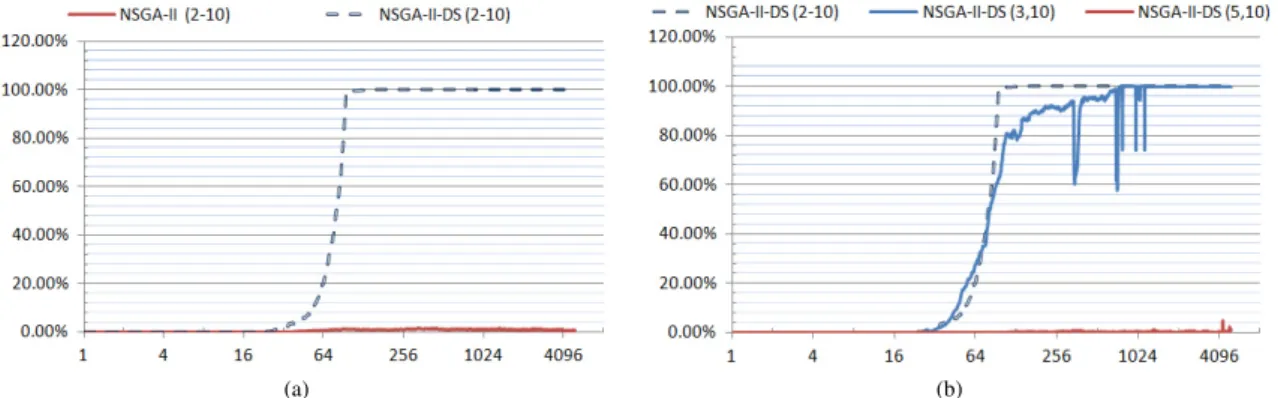
In a first setting, the algorithms were executed with a population of 500 individuals for 5000 iterations. The number of candidate solutions close to the Pareto front (havingg<0.01) during the run, expressed as percentage of the population size, is illustrated in figure 1 and is obtained as average over 10 runs.
In accordance with the observations in8, only up to 12 individuals in a NSGA-II run come close to the Pareto
front for DTLZ5(2,10), while for DTLZ5(3,10) only 2 individuals (from 500) were closed to the Pareto front at some iterations but were quickly lost during the run. In contrast, NSGA-II-DS drives all the individuals in the proximity of the Pareto front in only 100 iterations for the problems DTLZ5(2,10) and DTLZ5(3,10). As illustrated in Figure 1, the performance of NSGA-II-DS decreases consistently for DTLZ5(5,10), which clearly illustrates the decay in performance when more than 4 conflicting objectives are optimized.
The good performance of NSGA-II-DS is perfectly justified. The objective selection scheme groups all non-conflicting objectives in one cluster and, consequently, the MOEA replaces them with a single representative criterion. Even from the initialization phase of the algorithm, on the randomly generated population, the non-conflicting criteria are detected. During the run, subsequent uses of the objective selection scheme generates the same natural clusters; there are variations with regard to the representative objective extracted from the group of non-conflicting objectives. Because NSGA-II-DS eliminates in these runs all the redundant objectives and works only with the I conflicting objectives, it reproduces closely the runs of a standard NSGA-II on the problems defined with the true dimensionality of objective space.
(a) (b)
Fig. 1. The percentage of solutions in the proximity of the Pareto front (g < 0.01) during a run (the number of iterations is illustrated on a logarithmic scale); a) comparative performance for NSGA-II and NSGA-II-DS on problem DTLZ5(2,10); b) performance of NSGA-II-DS for 3 poblem instances: DTLZ5(2,10), DTLZ5(3,10) and DTLZ5(5,10).
Experiments with smaller populations are carried out to study the convergence of NSGA-II-DS.
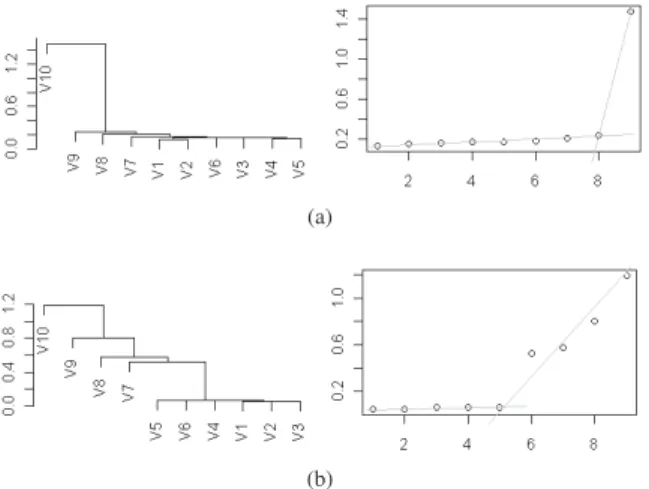
Figure 2 illustrates the objective selection algorithm for a population consisting of only 100 individuals randomly generated for DTLZ5(2,10) and DTLZ5(5,10). The knee on the plots at the right indicate clearly the number of non-conflicting, relevant objectives: for DTLZ5(2,10) the knee corresponds to 10-8=2 clusters while for DTLZ5(5,10) the knee corresponds to 10-5=5 clusters. It is impressive that by using a small randomly generated population, the method
is capable of clearly distinguishing the non-conflicting objectives most of the times, in a completely unsupervised scenario. For DTLZ5(2,10) objective 10 is shown to be clearly in conflict with the others that were clustered in one compact group; as a representative for the group of non-conflicting objectives, objective 4 was extracted. Therefore, NSGA-II-DS proceeds to minimize objectives 10 and 4 for a number of 20 iterations. Every 20 iterations the original 10 objectives are separated again into 2 or several groups based on the current population of the algorithm, and a new representative may be chosen for the non-conflicting group. Shortly, the algorithm converges and existing differences in the rankings corresponding to nonconflicting objectives vanish. Values equal to 1 obtained for the Spearman correlation in late iterations of the algorithm, indicate that redundant objectives (in accordance with the definition given by Brockhoff7) are identified: their exclusion do not modify the dominance structure with regard to the remaining objectives.
To better understand the dynamic of the population, a run of the algorithm is detailed next for DTLZ5(2,10). The following sequence gives the sets of objectives used during 500 iterations of the algorithm with a population consisting of 100 individuals (each set used for 20 iterations): (3,10), (6,10),(3,10), (4,10), (5,10), (7,9,10), (3,10), (5,10), (1,10), (5,10), (4,10),(6,10),(5,10),(1,10),(3,10),(1,10), (1,10), (1,10) and the series continues with the pair (1,10) indicating convergence. Each time the pair (1,10) was selected, a perfect correlation was recorded for every pair of objectives in the set (1,2,3,4,5,6,7,8,9). All solutions in the final population are in the proximity of the Pareto front (withg(xM)<0.01). The average value ofg(xM) in the final population is 1.37E-4 with a standard deviation of 1.52E-6.
For DTLZ5(5,10) 5 groups are created from the initial population of size 100. Objectives 10, 9, 8 and 7 are each put in a singleton cluster. The remaining objectives are grouped together as non-conflicting and objective 3 is extracted as representative. In most of the runs, subsequent objective selection calls, return the same groups with rare changes in the medoid of the non-conflicting group. However, the overall performance of NSGA-II-DS is very poor due to the large number of conflicting objectives (5 objectives) identified and used during search by the MOEA.
(a)
(b)
Fig. 2. Objective selection for a) DTLZ5(2,10) and b) DTLZ5(5,10)
As the experimental results show, NSGA-II-DS is able to reduce the space of objectives by removing only the redundant objectives. For DTLZ5(7,10) objectives 5 to 10 are always selected and one more is added from the set of non-conflicting objectives. By removing the redundant objectives during the run, the MOEA thus benefits from lower evaluation costs and increased convergence towards the Pareto front.
We are further interested in reducing the objective space below the natural choice made by the unsupervised clus-tering algorithm that removes only the redundant objectives, in order to enhance the performance of the algorithm when more than 4 conflicting objectives are present. The algorithm is run again with a population of 100 individuals for 500 iterations with the number of clusters not automatically chosen, but set to a predefined constant. Figure 3 a) illustrates the averageg(xM) in the set of the non-dominated solutions computed at each iteration during the run of the algorithm, for several settings of the number of clusters, for DTLZ5(5,10) (left) and DTLZ5(7,10) (right) - instances that have more than 4 conflicting objectives. For both problems, the ascending line corresponds this time to NSGA-II
on the problems consisting of the conflicting objectives (I=M) - eliminating by hand the redundant objectives in order to have a baseline for assessing the performance of NSGA-II-DS when redundant objectives begin to be excluded. Be-cause the number of objectives taken into account at the selection phase is still high, the criterion used to discriminate among objectives is the diversity (crowding distances) and therefore the population diverges from the Pareto front.
In the case of NSGA-II-DS with supervised selection scheme (the number of clusters is fixed apriori to the desired number of objectives to be selected), when the number of objectives is reduced to less than 5 objectives the population converges towards the Pareto front. The conflicting objectives used along the run are interleaved; the most conflicting ones are selected at a given moment by our sampling scheme. For the case of 3 objectives selected among the conflicting ones, the population seems to converge faster. For a number of 4 and 3 objectives used, the size of the non-dominated front (with regard to all M=10 objectives) reaches the size of the population in less than 50 iterations; this indicates a good spread of the dominated solutions. When only 2 objectives are used, the size of the non-dominated front (computed for M objectives), which, late in the run, seems closer to the Pareto front than in the other cases, rarely reaches the size of the population; this indicates that reducing too much the objective space, the spread of the solutions along the Pareto front is diminished.
For problem DTLZ5(5,10), in the case when all conflicting objectives were used, the solutions seem to move away from the Pareto frontier, while in the case when 4 objectives are used, the solutions converge. Among the four objectives selected, 8, 9 and 10 were constantly present and the fourth one was extracted from the set of non-conflicting objectives containing objectives from 1 to 6. Interesting to notice is that is that objective 7 was never selected while each of the objectives in the non-conflicted set was at least once selected during one run.
The same experiment was performed on DTLZ5(7,10). When only four objectives have to be selected, objectives 9 and 10 are every time selected in conjunction with two alternating objectives. As in the case when 7 objectives are selected, the population is quickly filled with non-dominated solutions. Average (g(xM)) is represented in figure 3 b). Like in the case of the previous experiment, working with a reduced set of objectives speeds up convergence.
The two plots below illustrate the average behavior of the algorithm over 10 runs.
(a) (b)
Fig. 3. Average g(xM) in the set of non-dominated solutions at different iterations for a) DTLZ5(5,10) and b)DTLZ5(7,10). The decreasing line indicating convergence corresponds to NSGA-II-DS with 4 conflicting objectives selected both in a) and b). The increasing line in a) corresponds to NSGA-II-DS with 5 conflicting objectives selected while in b) it corresponds to NSGA-II-DS with 7 conflicting objectives selected.
These simple experiments suggest that, when performing many-objective optimization it is beneficial to constantly keep only a small number of the most conflicting objectives in conjunction with one or two objectives chosen alter-natively from the rest. The MOEA is able to reach convergence when working with less than 5 conflicting objectives. We are now interested in the optimum number of conflicting objectives that should be used in NSGA-II-DS. The epsilon indicator was used to make pairwise comparisons between the above settings.
All NSGA-II-DS runs with less than 4 objectives are significantly better compared with the NSGA-II applied on the set of all the conflicting objectives (of cardinality I). This affirmation is clearly supported by the results in Table
Problem instance NSGA-II-DS/NSGA-II NSGA-II/NSGA-II-DS DTLZ5(7,10) - r=2 0.00090 50.88583 DTLZ5(7,10) - r=3 0.00099 50.88583 DTLZ5(7,10) - r=4 1.52660 50.59689 DTLZ5(5,10) - r=2 0.77628 5.446549 DTLZ5(5,10) - r=3 0.10510 5.667232 DTLZ5(5,10) - r=4 1.28637 5.660014
Table 1. Comparison of NSGA-II and NSGA-II-DS under the additiveindicator; results are reported as average over 30 runs. Parameterr
specifies the number of objectives retained in the NSGA-II-DS runs.
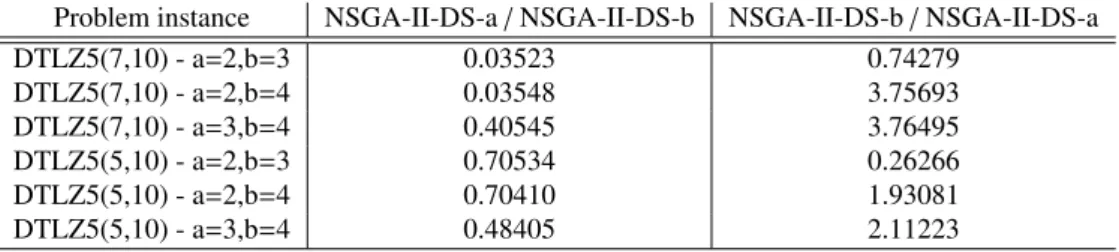
Problem instance NSGA-II-DS-a/NSGA-II-DS-b NSGA-II-DS-b/NSGA-II-DS-a
DTLZ5(7,10) - a=2,b=3 0.03523 0.74279 DTLZ5(7,10) - a=2,b=4 0.03548 3.75693 DTLZ5(7,10) - a=3,b=4 0.40545 3.76495 DTLZ5(5,10) - a=2,b=3 0.70534 0.26266 DTLZ5(5,10) - a=2,b=4 0.70410 1.93081 DTLZ5(5,10) - a=3,b=4 0.48405 2.11223
Table 2. Comparison of NSGA-II-DS with a number ofaselected objectives vs. NSGA-II-DS with a number ofbselected objectives, under the additiveindicator; results are reported as average over 30 runs.
1 that presents the values of the additiveindicator as average over 30 runs. The additiveindicator for two sets of nondominated solutionsAandBis defined asI+(A,B)= inf∈{∀zB ∈ B,∃zA ∈As.t.zA + zB}. The smaller the values ofI+(A,B) and the larger the values ofI+(B,A), the better setAis compared to setB. The first column in Table 1 corresponds to evaluating the additiveindicator where setAis the set of nondominated solutions obtained with NSGA-II-DS with the number of objectives restricted torand setBis the set of nondominated solutions obtained with NSGA-II with the number of objectives restricted toI. As expected, all the experiments indicate that NSGA-II-DS outperforms NSGA-II. Moreover, in case of the problem DTLZ5(5,10), taking into account that NSGA-II was executed in fact for M=I=5 - eliminating the redundant objectives apriori - and that NSGA-II-DS was executed on the complete objective space (M=10, I=5), the results clearly indicate that the number of objectives should be restricted to at most 4.
Restricting the number of objectives below 5 clearly draws significant improvements in performance, not only with regard to the proximity of the nondominated set relative to the true Pareto front, but also with regard to the computational costs of fitness evaluation. What is the optimal cardinality of the reduced objective set in NSGA-II-DS? Table 2 tries to answer this question by reporting the additiveindicator for pairwise comparisons involving different settings of the cardinality of the reduced objective space. In Table 2 variablesaandbillustrate the cardinality imposed in the objective selection step in NSGA-II-DS, both taking values below 5.NS GA−II−DS−areferences the NSGA-II-DS algorithm with the cardinality of the reduced objective space set toa; a similar interpretation stands forNS GA−II−DS −bnotation. Each line corresponds to a given setting foraandbfor a given problem instance. The magnitude of the values of the additiveindicator in this Table, compared to those in Table 1, indicate that the performance of the method is not so sensitive on the size of the reduced objective space given that its cardinality is set below 5. However, the results indicate that a cardinality of 2 and 3 is more successful than 4. Taking into account a previous result that indicates that a cardinality of only 2 results in a poor spread of the solutions along the Pareto front and supported by the comparisons under the additiveindicator for the problem instance DTLZ5(5,10), we conclude that, when the natural choice of the conflicting objectives exceeds cardinality 4, a good setting would be to restrict the objective selection phase to a number of only 3 objectives.
5. Conclusion
The paper presents a method that is able to detect redundant objectives at the runtime within a MOEA. By elimi-nating redundant objectives and working in a reduced objective space the evaluation cost is lowered and better
conver-gence is achieved. Objective selection is performed automatically, using an efficient unsupervised clustering algorithm that is very popular in the data mining community being able to detect natural groups in data. No parameter is involved and the number of clusters does not need to be specified in advance.
Experiments show that, after eliminating the redundant objectives, when the cardinality of the selected set of conflicting objectives is still high, reducing further the objective space by retaining fewer of the most conflicting objectives is important. Thus, the method proposed goes beyond elimination of redundant objectives and proposes a general scheme capable to auto-adapt and select at various moments during the search a small number of specific objectives such that a many-objective problem could be efficiently solved.
Further studies aim at validating the objective selection scheme on real-world many-objective problems and in the context of several state of the art MOEAs.
6. Acknowledgements
This work was supported by the ERA-NET CHIST-ERA grantMultimedia and User Credibility Knowledge Ex-traction - MUCKE(2 CHIST-ERA/01.10.2012).
References
1. Deb, K., Pratap, A., Agarwal, S., Meyarivan, T.. A fast elitist multi-objective genetic algorithm: Nsga-ii. IEEE Transactions on Evolutionary Computation2000;6:182–197.
2. Zitzler, E., Laumanns, M., Thiele, L.. Spea2: Improving the strength pareto evolutionary algorithm. Tech. Rep.; 2001.
3. Ishibuchi, H., Sakane, Y., Tsukamoto, N., Nojima, Y.. Evolutionary many-objective optimization by nsga-ii and moea/d with large populations. In:SMC. 2009, p. 1758–1763.
4. Ikeda, K., Kita, H., Kobayashi, S.. Failure of pareto-based moeas: Does nondominated really mean near to optimal? In:Proceedings of the 2001 Congress on Evolutionary Computation (CEC 2001); CEC 2001. Piscataway, New Jersey: IEEE Service Center; 2001, p. 957–962. 5. Sato, H., Aguirre, H.E., Tanaka, K.. Controlling dominance area of solutions and its impact on the performance of moeas. In:Proceedings
of the 4th international conference on Evolutionary multi-criterion optimization; EMO’07. Berlin, Heidelberg: Springer-Verlag. ISBN 978-3-540-70927-5; 2007, p. 5–20. URL:http://dl.acm.org/citation.cfm?id=1762545.1762552.
6. Corne, D.W., Knowles, J.D.. Techniques for highly multiobjective optimisation: some nondominated points are better than others. In:
Proceedings of the 9th annual conference on Genetic and evolutionary computation; GECCO ’07. New York, NY, USA: ACM. ISBN 978-1-59593-697-4; 2007, p. 773–780.
7. Brockhoff, D., Zitzler, E.. Are all objectives necessary? on dimensionality reduction in evolutionary multiobjective optimization. In:
Proceedings of the 9th international conference on Parallel Problem Solving from Nature; PPSN’06. Berlin, Heidelberg: Springer-Verlag. ISBN 3-540-38990-3, 978-3-540-38990-3; 2006, p. 533–542.
8. Saxena, D.K., Deb, K.. Non-linear dimensionality reduction procedures for certain large-dimensional multi-objective optimization prob-lems: employing correntropy and a novel maximum variance unfolding. In: Proceedings of the 4th international conference on Evolu-tionary multi-criterion optimization; EMO’07. Berlin, Heidelberg: Springer-Verlag. ISBN 978-3-540-70927-5; 2007, p. 772–787. URL: http://dl.acm.org/citation.cfm?id=1762545.1762611.
9. Zhou, C., Zheng, J., Li, K., Lv, H.. Objective reduction based on the least square method for large-dimensional multi-objective optimization problem. In: Proceedings of the 2009 Fifth International Conference on Natural Computation - Volume 04; ICNC ’09. Washington, DC, USA: IEEE Computer Society. ISBN 978-0-7695-3736-8; 2009, p. 350–354.
10. Jaimes, L.A., Coello Coello, C.A., Chakraborty, D.. Objective reduction using a feature selection technique. In:Proceedings of the 10th annual conference on Genetic and evolutionary computation; GECCO ’08. New York, NY, USA: ACM. ISBN 978-1-60558-130-9; 2008, p. 673–680.
11. Jaimes, L.A., Coello, C., Uras Barrientos, J.. Online objective reduction to deal with many-objective problems. In: Ehrgott, M., Fonseca, C., Gandibleux, X., Hao, J.K., Sevaux, M., editors.Evolutionary Multi-Criterion Optimization; vol. 5467 ofLecture Notes in Computer Science. Springer Berlin Heidelberg. ISBN 978-3-642-01019-4; 2009, p. 423–437.
12. Jaimes, A.L., Aguirre, H., Tanaka, K., Coello Coello, C.. Objective space partitioning using conflict information for many-objective optimization. In: Schaefer, R., Cotta, C., Kolodziej, J., Rudolph, G., editors.Parallel Problem Solving from Nature, PPSN XI; vol. 6238 of
Lecture Notes in Computer Science. Springer Berlin Heidelberg. ISBN 978-3-642-15843-8; 2010, p. 657–666.
13. Jaimes, A.L..Techniques to deal with manyobjective optimization problems using evolutionary algorithms. Ph.D. thesis; National Polytech-nic Institute of Mexico; 2011.
14. Sibson, R.. SLINK: An optimally efficient algorithm for the single-link cluster method.The Computer Journal1973;16(1):30–34. 15. Bentley, P.J., Wakefield, J.P.. Finding acceptable pareto-optimal solutions using multiobjective genetic algorithms. 1998.