IOP Conference Series: Materials Science and Engineering
PAPER • OPEN ACCESS
Texture-based Feature using Multi-blocks Gray Level Co-occurrence
Matrix for Ethnicity Identification
To cite this article: M Z Osman et al 2020 IOP Conf. Ser.: Mater. Sci. Eng. 769 012032
View the article online for updates and enhancements.
The 6th International Conference on Software Engineering & Computer Systems IOP Conf. Series: Materials Science and Engineering 769 (2020) 012032
IOP Publishing doi:10.1088/1757-899X/769/1/012032
Texture-based Feature using Multi-blocks Gray Level
Co-occurrence Matrix for Ethnicity Identification
M Z Osman1, M A Maarof2, M F Rohani2
1 Soft Computing and Intelligence System (SPINT), Faculty of Computing, Universiti Malaysia Pahang, Lebuhraya Tun Razak, 26300 Gambang, Kuantan, Pahang,
Malaysia
2 Information Assurance and Security Research Group (IASRG), School of Computing, Universiti Teknologi Malaysia, 81310, Skudai, Johor, Malaysia Email: [email protected]
Abstract. Ethnicity identification for demographic information has been studied for soft biometric analysis, and it is essential for human identification and verification. Ethnicity identification remains popular and receives attention in a recent year especially in automatic demographic information. Unfortunately, ethnicity identification in a multi-class which consist of several ethnic classes may degrade the accuracy of the ethnic identification. Thus, this paper purposely analyses the accuracy of the texture-based ethnicity identification model from facial components under four-class ethnics. The proposed model involved several phases such as face detection, feature selection, and classification. The detected face then exploited by three proposed face block which are 1×1, 1×2 and 2×2. In the feature extraction process, a Grey Level Co-occurrence Matrix (GLCM) under different face blocks were employed. Then, final stage was undergone with several classification algorithms such as Naïve Bayes, BayesNet, k -Nearest Neighbour (k-NN), Random Forest, and Multilayer Perceptron (MLP). From the experimental result, we achieved a better result 2×2 face block feature compared to 1×1 and 2×2 feature representation under Random Forest algorithm.
1. Introduction
An ethnic group or ethnicity is a category of people which are identified based on the similarities of society, culture, ancestry, language or nation [1]. The ethnic group generally is formed based on the biological unit which made up from skin colour, head shape, hair, face shape and blood type.
Ethnicity identification can be referred as multi-class and inter-class identification problem. Multi-class problem involved several different ethnic groups and it was the most frequently studies by researchers [2]. Ethnic group exploited normally are Asian, African American, and Caucasian ethnics [3-5]. Meanwhile inter-class identification involved sub-ethnic group such as Chinese, Koreans, and Japanese. Several researchers adopted this dataset issue in intra-class ethnic problem such as [6, 7]. In multi-class ethnic, most of the researchers employed ethnicity identification based on two or three class ethnics. Two-class ethnic such as Asian and non-Asian [8], or Asian and Caucasian [9] are frequently employed. Three-class ethnic also showed a popularity where majority of researchers exploited three ethnics such as Asian, African American and Caucasian ethnics [10]. However, lack of ethnicity identification methods that exploited more than three ethnics since the performance of the methods reported to be dropped. The performance of two and three class problem reported with
The 6th International Conference on Software Engineering & Computer Systems IOP Conf. Series: Materials Science and Engineering 769 (2020) 012032
IOP Publishing doi:10.1088/1757-899X/769/1/012032
2
results are above 94% until 99%. In addition to the ethnic class, Hispanic ethnic was only tested and reported by [11, 12]. According to [2], to have an accurate performance for ethnicity identification in uncontrolled environment is challenging. Feature representation also affect the performance of the ethnicity identification. Therefore, several searchers have been experimental with different feature representations such as skin tone feature [13, 14], and texture feature [15, 16]. Texture feature can be categorized into two: global and local features. Global feature known as holistic representation is most studied feature extraction used in ethnicity identification. It has the capability to preserve configural information which is the interrelations between facial regions. Meanwhile local feature also has gain popularity which capable in term of unconstrained ethnic identification [7]. One of example local texture is local binary pattern used by [15, 16]. Gabor feature is reported as a suitable feature for ethnicity identification. Unfortunately, Gabor feature produced high dimension of feature vector which might increasing the processing time.
The aim of this paper is to investigate the performance of ethnicity identification method by using different face blocks and GLCM feature extraction technique. This study also reveals the analysis on four-class ethnic groups which are Asian, African American, Caucasian and Hispanic.
2. Methodology
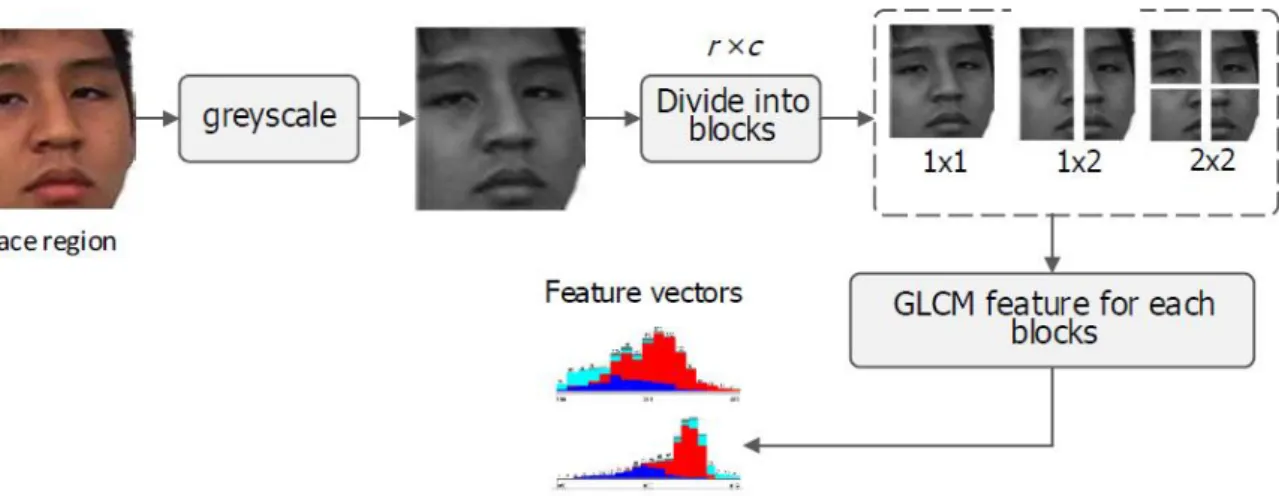
This section provides a brief on the methodology of the proposed methods. There are three main stages involved which are face detection, feature extraction, and classification. Figure 1 shows the flow of the proposed ethnicity identification method.
Figure 1. Texture feature using GLCM analysis and face blocks representation 2.1. FacePlace Database
FacePlace was created by the Tarrlab at Brown University. This database includes multiple image for over 200 individuals of many different races with consistent lighting, multiple views, real emotions, and disguises (and some participants returned for a second session several weeks later with a haircut, or new beard, etc). FacePlace is obtained from the Internet that contains four major ethnics such as Asian, Caucasian, African-American, and Hispanic groups. The images from this database were examined through the following stages.
2.2. Face Detection
A face detection is necessary to locate the existence of human in the image. For this purpose, a well-known Viola-Jones face detector was employed because of the face detection algorithm was not require color information to local the face region.
The 6th International Conference on Software Engineering & Computer Systems IOP Conf. Series: Materials Science and Engineering 769 (2020) 012032
IOP Publishing doi:10.1088/1757-899X/769/1/012032
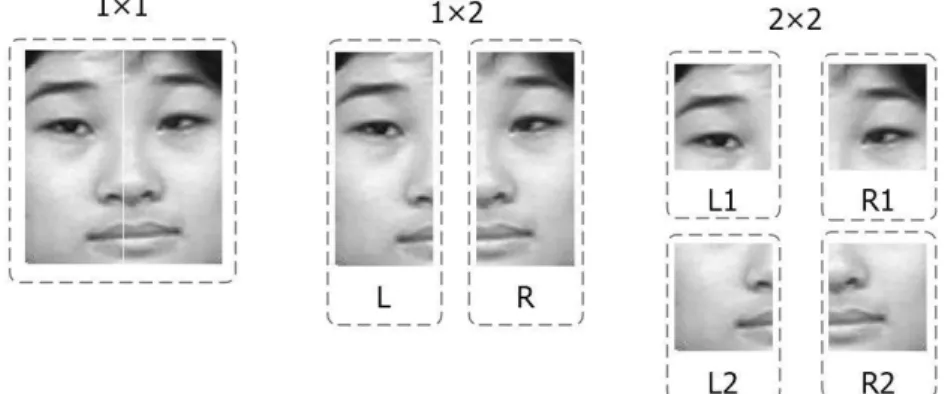
Figure 2. The design of multi-blocks face in three representations 2.3. Feature Extraction with GLCM
In this face, GLCM was employed to access the performance of ethnicity identification using textural features. GLCM also known as gray-level spatial dependence matrix. It calculates the frequency of pair pixels with specific values and in specified spatial relationship occur in the input image. Some of the textural features such as contrast, correlation, energy, and homogeneity are commonly derived to represent statistical texture information. Despite of these features, a total of 22 texture features employed to analyse the performance of the proposed method.
In this phase, three input representation which were applied to form the blocks. Example of blocks can be found in Figure 1 showing the flowchart of extracting texture feature. The detected face region was transformed into grayscale with fix scale for all detected faces. The gray-scale face region was then divided into r×c, where is the horizontal (row) and c is the vertical (column). The first block is the original size 1×1 representation. The second block divided the face region into two separated columns. The last block divided the face region into two row and two columns. Therefore, each sub-block in each blocks were calculated to extract the texture feature. The feature space for this study is the total of GLCM feature (22)×r×c. Labels in Figure 2 L1and R1is the first row, while L2 and R2 is the second row. Each of blocks represent different characteristic of ethnic groups. The 1×1 utilised the original gray-scale format as the global feature. Meanwhile 1×2 slicing the gray-scale face into two sub blocks. The 1×2 illustrated two sub blocks that slicing the left and right eye independently. The nose and mouth are separated each other. On the other hands, 2×2 slicing into more blocks which is four sub blocks. Each sub blocks in L1, R1, L2 and R2 have independently separated each other. L1andR1in the first row holds the eyes and eyebrow of left and right face view. L2 and R2 holds half of nose and mouth. Both nose and mouth are calculated independently. Therefore, each of three introduced blocks might characterised the ethnic group differently according to the texture appearance of sub blocks.
2.4. Classification Algorithms
During the experimental stage, there were five different classification algorithms were employed which are Naive Bayes, BayesNet, k-NN, Random Forest and MLP. Results of the study are presented in the following section.
3. Results and Discussion
This section described the findings and discussion on texture feature of human face using GLCM measures. There are three parts in this section where the results are based on the three types of input representation (face blocks) of 1×1, 1×2, and 2×2. The face blocks were designed to search for the best performance using GLCM measures. The results of texture-based feature are described in the following sections.
The 6th International Conference on Software Engineering & Computer Systems IOP Conf. Series: Materials Science and Engineering 769 (2020) 012032
IOP Publishing doi:10.1088/1757-899X/769/1/012032
4
(a)
(b)
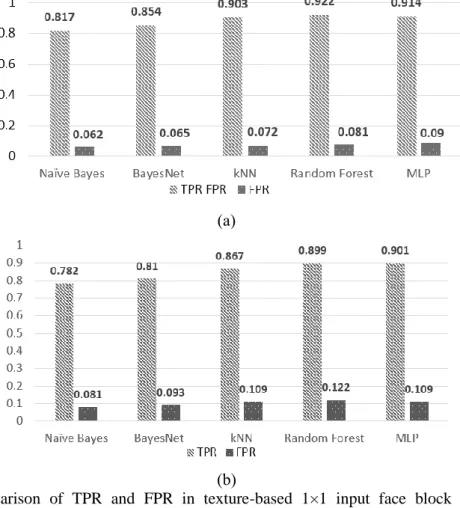
Figure 3. Comparison of TPR and FPR in texture-based 1×1 input face block using different classification algorithms in (a) TrainSet and (b) TestSet
3.1. GLCM Texture Feature with 1×1 Face Blocks
The texture feature for 1×1 face block was obtained from the original human face (the gray-scale input). The 1×1 face block produced a total of 22 texture features. Figure 3 present the train and test set results of ethnic identification based in the 1×1 face block using different classifiers.
In train set as shown in Figure 4, Random Forest presented the highest TPR with 0.922 and FPR 0.081. It is then followed by MLP with TPR 0.914, k-NN with TPR 0.603. In addition to the analysis, Figure 3(b) illustrates the comparison of testset which was also tested using different classifiers. Based on the Figure 5, MLP has the superiority with TPR 0.901 and FPR 0.109 compared to Random Forest which conquered in train set. According to the results collected in both train and test set, Random Forest and MLP showed a good performance with almost equal to TPR. Even though Random Forest and MLP produced the highest overall accuracy, they suffer in identifying Hispanic group successfully. Majority of the Hispanic ethnic was identified as Asian and Caucasian ethnic. Meanwhile, MLP identified all Hispanic as Caucasian ethnic. The findings show that the Hispanic could be having a similar characteristic as in Asian and Caucasian feature. Weak correlation in characterizing the Hispanic uniquely is the factor that Hispanic ethnic is challenging to identified. 3.2. GLCM Texture Feature with 1×2 Face Blocks
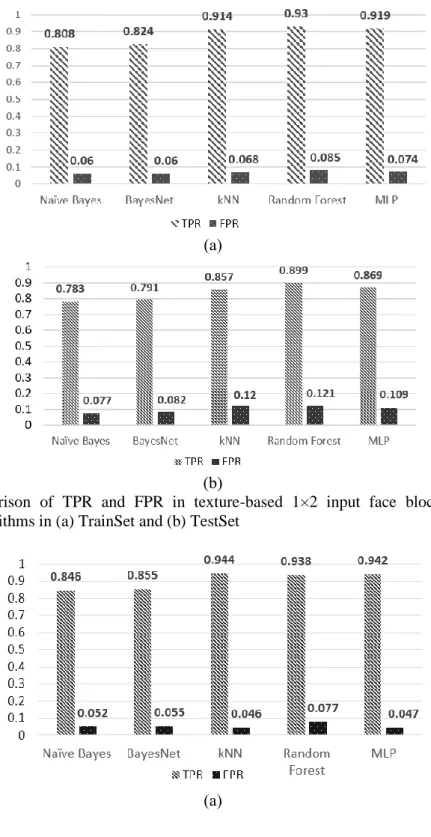
The texture feature further was investigated using 1×2 face blocks. This block was formed by dividing the human face region onto 1 row and 2 columns. Then, each subblocks was exploited to calculate the GLCM features. Hence, a total of 44 features were obtained using 1×2 face blocks. Figure 4 showed the results of TPR and FPR in train and test set data. According to Figure 4(a), the train set data
The 6th International Conference on Software Engineering & Computer Systems IOP Conf. Series: Materials Science and Engineering 769 (2020) 012032
IOP Publishing doi:10.1088/1757-899X/769/1/012032
achieved the highest TPR by Random Forest classifier with 0.930, followed by MLP with TPR 0.919, and k-NN with 0.914. Meanwhile, the test set in Figure 4(b), the Random Forest also revealed the superiority by producing TPR 0.899. Then, it was followed by MLP and k-NN respectively with TPR 0.869 and 0.857. The Naive Bayes and BayesNet produced TPR with less than 0.8.
(a)
(b)
Figure 4. Comparison of TPR and FPR in texture-based 1×2 input face block using different classification algorithms in (a) TrainSet and (b) TestSet
The 6th International Conference on Software Engineering & Computer Systems IOP Conf. Series: Materials Science and Engineering 769 (2020) 012032
IOP Publishing doi:10.1088/1757-899X/769/1/012032
6
(b)
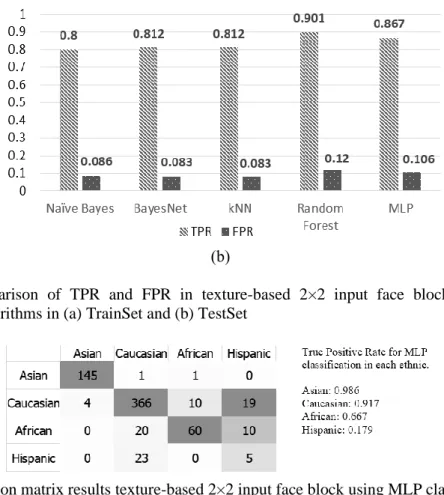
Figure 5. Comparison of TPR and FPR in texture-based 2×2 input face block using different classification algorithms in (a) TrainSet and (b) TestSet
Figure 6. Confusion matrix results texture-based 2×2 input face block using MLP classifier 3.3. GLCM Texture Feature with 2×2 Face Blocks
This block was formed by dividing the human face region onto 2 rows and 2 columns. Then, each sub blocks exploited to calculate the GLCM feature. Hence, a total of 88 features were obtained using 2×2 face blocks.
Figure 5 showed the results of TPR and FPR for train and test using different classification algorithms. In the train set as displayed in Figure 5(b), k-NN classifier has the highest TPR with 0.944, followed by the comparable TPR using MLP with 0.942, and Random Forest with TPR 0.938. The Random Forest classifier in Figure 5(b), surpass the MLP and k-NN classifiers. Despite TPR and FPR results, the confusion matrix shown in Figure 6 indicates MLP classifier fails to successfully to identify correct Hispanic group. However, the Hispanic group mostly was identified in Caucasian ethnic group.
4. Conclusion
As a conclusion, we have presented an experimental result using different classification algorithm under three face blocks and GLCM texture feature. From the experimental, we can see the accuracy of ethnicity identification was influenced by classifier and type of face block used. Four ethnics which are Asian, African American, Caucasian and Hispanic were used. Based on the findings, the proposed method performs well when employing 2×2 face block and using Random Forest classifier in the test set. However, the results also revealed that, the proposed method sometimes difficult to identify Hispanic class successfully. Hispanic mostly was wrongly identified as Caucasian ethnic group. This might due to close interrelation feature class between Hispanic and Caucasian ethnic group. Therefore, hybrid or fusion feature from relevant color or texture feature would help to reduce the gaps. For future enhancement, feature selection will be implemented in texture-based feature to reduce the
The 6th International Conference on Software Engineering & Computer Systems IOP Conf. Series: Materials Science and Engineering 769 (2020) 012032
IOP Publishing doi:10.1088/1757-899X/769/1/012032
dimension of feature vector. Other than that, deep learning method also one of potential advancement can be made for ethnicity identification.
Acknowledgement
We would like to show our gratitude to Universiti Malaysia Pahang (RDU vote numberRDU1803142) for supporting this research.
References
[1] Peoples, J. and G. Bailey, Humanity: An introduction to cultural anthropology. 2011: Cengage Learning.
[2] Anwar, I. and N.U. Islam, Learned features are better for ethnicity classification. Cybernetics and Information Technologies, 2017. 17(3): p. 152-164.
[3] Hosoi, S., E. Takikawa, and M. Kawade. Ethnicity estimation with facial images. in Automatic Face and Gesture Recognition, 2004. Proceedings. Sixth IEEE International Conference on. 2004. IEEE.
[4] Stavrianos, C., Facial Anatomy and Mapping Across Races' C. Stavrianos," C. Papadopoulos," O. Pantelidou,“I. Emmanouil and “N. Petalotis" Department of Endodology (Forensic Odontology),“Department of Removable Prosthodontics. 2012.
[5] Xiao, K., et al., Characterising the variations in ethnic skin colours: a new calibrated data base for human skin. Skin Research and Technology, 2017. 23(1): p. 21-29.
[6] Duan, X.-d., et al. Ethnic features extraction and recognition of human faces. in Advanced Computer Control (ICACC), 2010 2nd International Conference on. 2010. IEEE.
[7] Fu, S., H. He, and Z.-G. Hou, Learning race from face: A survey. IEEE transactions on pattern analysis and machine intelligence, 2014. 36(12): p. 2483-2509.
[8] Ding, H., et al. Facial ethnicity classification based on boosted local texture and shape descriptions. in Automatic Face and Gesture Recognition (FG), on 10th IEEE International Conference and Workshops. 2013. IEEE.
[9] Zarei, A. and D. Mou. Artificial neural network for prediction of ethnicity based on iris texture. 2012. IEEE.
[10] Bekhouche, S.E., et al., Pyramid multi-level features for facial demographic estimation. Expert Systems with Applications, 2017. 80: p. 297-310.
[11] Klare, B. and A.K. Jain. On a taxonomy of facial features. 2010 Fourth IEEE International Conference on Biometrics: Theory, Applications and Systems (BTAS). 2010. IEEE.
[12] Muhammad, G., et al. Race recognition from face images using Weber local descriptor. 2012. IEEE.
[13] Chen, H., et al., A Novel Race Classification Method Based on Periocular Features Fusion. International Journal of Pattern Recognition and Artificial Intelligence, 2017. 31(08): p. 1750026.
[14] Roomi, S.M.M., et al. Race classification based on facial features. in Computer Vision, Pattern Recognition, Image Processing and Graphics (NCVPRIPG), 2011 Third National Conference on. 2011. IEEE.
[15] Bougourzi, F., et al., A comparative study on textures descriptors in facial gender classification. 2017.