Final recommended questions for
the 2011 Census in England and
Wales
Language
Table of Contents
1. Summary... 4
2. Introduction ... 7
3. Background ... 8
3.1 Differing questions and terminology... 8
3.2 Welsh language question... 8
3.3 Main language and English proficiency questions ... 8
4. User requirements ... 9
4.1 User requirement for information on language... 9
4.2 User preferences for language concepts ... 10
5. Methods of question testing ... 12
5.1 Qualitative testing ... 12
5.1.1 Cognitive testing ... 12
5.2 Quantitative testing ... 12
5.2.1 Lambeth Postal Test ... 12
5.2.2 2007 Postal Test ... 13
5.2.3 2007 Census Test... 13
5.2.4 2008 Postal Test ... 13
5.2.5 March 2009 Postal Test ... 13
5.2.6 July 2009 Postal Test... 13
5.2.7 Opinions (Omnibus) survey question testing ... 13
6. Development of the question... 15
6.1 Knowledge questions – which languages can you understand, speak, read or write? .. 15
6.1.1 Sectional layout... 15
6.1.2 Full matrix style ... 17
6.1.2.1 Full matrix, version 1... 17
6.1.2.2 Full matrix, version 2 ... 18
6.1.2.3 Full matrix, version 3... 19
6.1.2.4 Full matrix, version 4 ... 20
6.1.2.5 Full matrix, version 5 ... 22
6.1.3 Simplified matrix style... 22
6.1.3.1 Simplified matrix, version 1 ... 23
6.1.3.2 Simplified matrix, version 2 ... 24
6.1.3.3 Simplified matrix, version 3 ... 26
6.1.4 General comments on a matrix style language question ... 27
6.2 New Zealand style conversation questions ... 28
6.2.1 Conversation question, version 1 ... 28
6.2.2 Conversation question, version 2 ... 29
6.3 US style, two-part question ... 31
6.3.1 Part 1 primary language ... 31
6.3.1.1 Primary language, version 1: ‘Is a language other than English used every day in your household?’... 32
6.3.1.2 Primary language, version 2: ‘Do you speak a language other than English or Welsh at home?’ ... 33
6.3.1.3 Primary language, version 3: ‘What is your main language?’ ... 34
6.3.2 Part 2 English language proficiency ... 37
6.3.3 Conclusions for England and Wales language question... 40
6.4.1.1 Collecting knowledge of Welsh data in England ... 44
6.4.2 Frequency of speaking Welsh ... 44
7. Recommended location of the question... 46
8. Final recommendations... 47
9. References... 49
1. Summary
Question development for the 2011 Census began in 2005. An iterative and comprehensive
process of user consultation, evaluation and prioritisation of user requirements, and qualitative and quantitative question testing has been carried out to inform decisions on the questions to be
included in the 2011 Census. This paper presents the final language question recommendations for the 2011 Census in England and Wales.
A question on knowledge of Welsh has been included in every census in Wales since 1891 and it is recommended that this question continues to be asked in Wales in 2011. Questions about languages other than Welsh have never been asked in an England and Wales census.
Consultations with key users of census data in 2005 and 2007 revealed strong demand for the inclusion of questions on language. Overall, 92 per cent of respondents to the 2007 consultation on ethnicity, identity, language and religion expressed a requirement for information on language. Respondents to the consultations recognised a number of ways in which information on language would be used, including:
• to provide services in appropriate languages where English is not understood, including
English for speakers of other languages (ESOL) provision
• to monitor the uptake of minority national languages
• to monitor the use of British Sign Language
• to gain a better understanding of the ethno-religious diversity of the UK population
• to understand the impact of English (or Welsh) language ability on employment and other
social inclusion indicators
• to identify linguistic resources in the UK for business reasons
• to plan and monitor Welsh language provision in Wales.
A variety of quantitative and qualitative methodologies have been employed to test the questions recommended for inclusion in the 2011 Census. Qualitative question testing on language has been conducted by the data collection methodology (DCM) branch in ONS through a programme of cognitive testing running since February 2005. Quantitative question testing has been conducted at various intervals since June 2006 using a variety of methodologies.
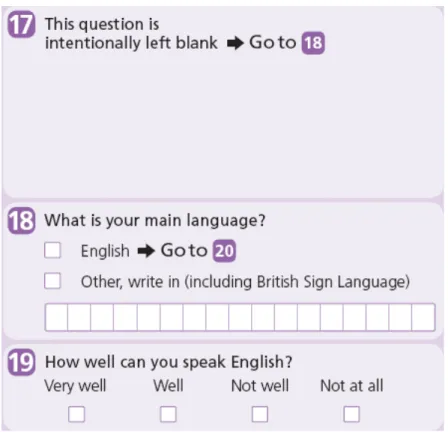
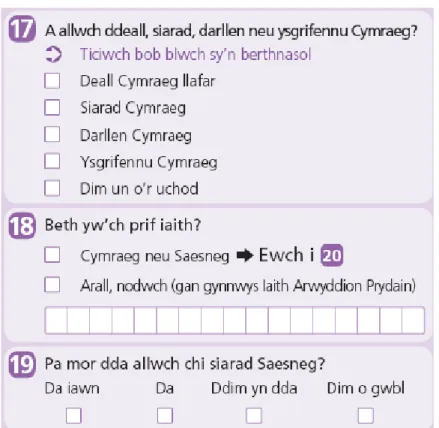
A number of different styles of language question have been considered. Initially, a matrix format was considered, including Welsh, English and other languages in the same question. However, testing suggested the question was difficult for respondents to understand. Separate questions asking about main language and spoken English proficiency were subsequently developed to meet the greatest possible number of user requirements within space constraints. These questions performed well in testing and this paper therefore includes recommendations for the following three questions on language:
• Knowledge of Welsh (asked in Wales only)
• Main language
• Spoken English proficiency
The questions presented below are those for England and Wales that are recommended for the 2011 Census, subject to Parliamentary approval which ONS hopes to attain by the end of 2009.
Figure 1.1: Final recommended language questions for England
2. Introduction
The next census will take place on 27 March 2011. The proposed topics to be included were announced in the 2011 Census White Paper published in December 2008. To access the White Paper and read further information about how the content of the 2011 Census was determined, please refer to the ONS website at:
http://www.ons.gov.uk/census/2011-census/2011-census-questionnaire-content/question-and-content-recommendations-for-2011/index.html
Question development for the 2011 Census began in 2005. An iterative and comprehensive process of user consultation, evaluation and prioritisation of user requirements, and question testing has been carried out to inform the decisions on the questions to be included in the 2011 Census. The questions for England and Wales have been developed with the Welsh Assembly Government and through close collaboration with the statistical offices of Scotland and Northern Ireland. A key aim of this collaboration is to minimise differences between questionnaires across the UK, though it is recognised that differing circumstances will sometimes require different solutions. A paper on the UK differences in census questions will shortly be available on the ONS website.
This paper outlines the development of the language questions. There are equivalent papers which present the recommendations for each of the other questions within the ethnicity, [national] identity, language and religion (EILR) topic area. Questions on the following topics have been
recommended for the 2011 Census:
• National identity
• Ethnic group
• Knowledge of Welsh language (Wales only)
• Main language
• Spoken English proficiency
• Religious affiliation
These questions complement the suite of migration questions that have been recommended:
• Country of birth
• Usual address one year ago
• Month and year of arrival to the UK
• Intended length of stay in the UK
• Passports held (as a proxy for citizenship)
The paper will begin by outlining user requirements for information on language in England and Wales, before explaining the testing conducted in developing the recommended questions. The question development process is then explained in detail and the final language question recommendations for the 2011 Census are presented. These recommendations are subject to Parliamentary approval which ONS hopes to obtain by the end of 2009.
3. Background
3.1 Differing questions and terminology
There are many aspects of language use and impact that can be captured in a questionnaire. This paper uses a number of terms to refer to different aspects of language:
• language ability: Genericterm referring to all aspects of language
• language knowledge/skill: Whether a person can understand/speak/read/write a
language without any reference to how well they can do it
• language proficiency: How well a person understands/speaks/reads/writes a language
• frequency: How often a person uses a language 3.2 Welsh language question
A question on knowledge of Welsh has been included in every census in Wales since 1891. The knowledge of Welsh question collects information on the ability of respondents to understand spoken Welsh, speak Welsh, read Welsh and write Welsh.
The Welsh Language Act 1993 places a duty on public organisations in Wales to treat both the Welsh and English languages equally. The main requirement for collecting data on Welsh knowledge is to inform policy development and for monitoring purposes. Although there is some user requirement to collect information on Welsh speakers in England, this question has not been asked in England as there is also strong user requirement for information on a wide range of languages and singling out Welsh would therefore be unsatisfactory to most users.
3.3 Main language and English proficiency questions
Questions about English and other languages have never been asked in an England and Wales census, though they have been included in other national surveys.
Since 2001 ONS has carried out a programme of research, consultation, testing and analysis to establish the most suitable questions for the 2011 Census in England and Wales. This has included consultation with data users and providers; qualitative and quantitative question testing; carrying out an equality impact assessment; and working with Scotland and Northern Ireland to harmonise the questions where possible.
4. User requirements
The inclusion of questions in the 2011 Census must be supported by a clear user requirement for the information. The user consultation process began in 2005 with a formal three month general topics consultation in which there were around 80 responses received commenting on the subject of language, from a variety of central government, local authority and other data users. A summary of the comments relating to language can be found at
http://www.ons.gov.uk/about/consultations/closed-consultations/consultation-on-2011-census---responses/index.html
The Welsh Assembly Government produced a summary of 2005 consultation responses from Welsh organisations or referring to ‘Wales specific’ topics. The summary is available at
http://wales.gov.uk/topics/statistics/headlines/pop-2007/pop-2006/hdw200603081/?skip=1&lang=en
An additional detailed consultation exercise was carried out between December 2006 and March 2007 (referred to throughout the paper as the 2007 consultation) to refine the user requirements for information on ethnicity, identity, language and religion from the 2011 Census. The report of the 2007 consultation can be found at
http://www.ons.gov.uk/census/2011-census/consultations/eth-group-nat-iden/index.html
The summary of Welsh organisations and ‘Wales specific’ topics from the 2007 consultation can be found at
http://wales.gov.uk/topics/statistics/headlines/pop-2007/hdw200710312/?lang=en
4.1 User requirement for information on language
In May 2005 ONS published a consultation document ‘The 2011 Census: Initial view on content for England and Wales’. The consultation document proposed that a question on knowledge of Welsh language should continue to be included in Wales in the 2011 Census, but that there was
insufficient evidence of user demand to justify inclusion of English language proficiency. However, the responses to the consultation showed strong user demand for additional questions on
language. The 2007 consultation confirmed this demand, with 92 per cent of respondents declaring a requirement for language information. As table 4.1 shows, the greatest requirement for language information came from local and regional government (96 per cent).
Table 4.1 2007 consultation respondents requiring information on language
Organisation type Yes
(%)
No (%)
Total Respondents
Central and devolved government 86 14 21
Experts, community and special interest groups 88 12 121
Local and regional government 96 4 84
Local service providers 93 7 45
All respondents 92 8 271
Respondents to the consultations identified a number of reasons for requiring a question on language, including:
• to provide services in appropriate languages where English is not understood, including English for speakers of other languages (ESOL) provision: By far the most
common interest in language is to facilitate the provision of public services, both by identifying the need for translation and interpretation services in the short term and for providing English language lessons in the medium term
• to monitor the uptake of minority national languages: Some respondents required
information on the knowledge of UK languages other than English, including Welsh outside of Wales, Cornish, Gaelic and Scots, for which there is an interest in increasing uptake. Information on regional and minority languages is also required to monitor their use for protection and promotion under the European Charter for Regional or Minority Languages
• to monitor the use of British Sign Language: Several requests were received for the
inclusion of British Sign Language within the language question.
• to gain a better understanding of the ethno-religious diversity of the UK population:
Some local and regional authority respondents thought that the language question would enhance the data already captured in the ethnic group and religious affiliation questions.
• to understand the impact of English (or Welsh) language ability on employment and other social inclusion indicators: Including a question on language proficiency in the
census would be useful as it would cover the whole population, including people whose first language is English or Welsh. The information gained could be used to analyse the impact of language ability on employment and other social inclusion indicators
• to identify linguistic resources in the UK for business reasons: Some respondents
required information about languages spoken in general
• to plan and monitor Welsh provision in Wales: The majority (85 per cent) of
respondents from Wales needed general language information from the 2011 Census. Although not asked for specific details of their requirements for a Welsh knowledge
question, most of these also stated that they required Welsh language data to comply with the Welsh Language Act 1993, which places a duty on public organisations in Wales to treat both the Welsh and English languages equally. There was also a strong need from the Welsh Assembly Government and Welsh users for the question to be comparable with the 2001 Welsh language question.
4.2 User preferences for language concepts
There is not enough space to record all aspects of language ability in the census. Thus there was an initial need to be clear about the precise aspect(s) of language ability that were required by census users so that the relevant language information could be collected.
The 2007 consultation document provided a list of 19 different aspects of ability that weren’t
covered in the 2001 Census. To explore the need for a new question on language, data users were asked to indicate whether they required this information and if so, to what extent (table 4.2).
Table 4.2: 2007 consultation respondents (English and Welsh data users) requiring information on
aspects of language ability
Organisation type Very
important (%) Quite important (%) Do not need (%)
Ability to speak English 78 15 7
Ability to understand spoken English 77 15 8
Mother tongue or first language 75 20 5
Main language (spoken at home) 75 19 6
Preferred spoken language for communicating with public authorities
74 17 9
Preferred written language for communicating with public authorities
72 18 10
Ability to read English 72 19 9
Which languages are spoken, other than English 70 25 6
Which languages are read, other than English 60 31 8
Which languages are written, other than English 50 37 12
Frequency of speaking other languages 45 29 27
Other aspects of language ability 27 6 66
Frequency of speaking Welsh 13 13 74
Ability to speak Welsh (among population in England) 11 14 75
Ability to understand spoken Welsh (among population in England)
10 16 74
Ability to write Welsh (among population in England) 10 13 77
Ability to read Welsh (among population in England) 10 14 76
In addition to this information about importance, ONS also received more detailed responses about user need. The preferences expressed by data users allowed ONS to construct a number of essential and desirable requirements of a new language question:
Essential that the question
• is able to capture spoken languages
• is able to capture sign languages
• allows data users to understand whether respondents had English language difficulties and if
so what alternative languages services should be provided in
• consistently excludes people with low English language proficiency when recording English
speakers
• is generally clear to respondents and is understood as intended
• does not impact on the knowledge of Welsh language question
Desirable that the question
• consistently excludes people with low proficiency in other languages when capturing
languages other than English
• captures proficiency in English
• captures proficiency in other languages
• allows users to distinguish languages used for translation/ learnt at school, etc
• simultaneously captures multiple languages to gain the best understanding of ethno-linguistic
diversity and resource
• captures where and how languages are used
• captures written language knowledge
• captures knowledge of understanding of spoken language
• capture knowledge of reading languages
5. Methods of question testing
A variety of quantitative and qualitative methodologies have been employed to test the questions recommended for inclusion in the 2011 Census.
5.1 Qualitative testing
Qualitative testing on language has been conducted by the data collection methodology (DCM) branch in ONS through a programme of cognitive testing which began in February 2005.
5.1.1 Cognitive testing
The aim of this testing was to devise questions that collect accurate and meaningful information that meets user requirements, minimises the burden on respondents and are designed to conform as closely as possible to best practice of questionnaire design. The testing was split into four main phases:
• Pre-testing for the 2007 Census Test (February 2005 – April 2006)
• Whole Questionnaire Testing for the 2007 Census Test (June 2006 – August 2006)
• Testing for the 2009 Census Rehearsal
o Wave 1 (November 2006 to January 2007)
o Wave 2 (April to May 2007)
o Wave 3 (July to September 2007)
o Wave 4 (October and November 2007)
o Wave 5 (January to March 2008)
o Wave 6 (April to July 2008 )
o Welsh language testing, Wave 1 (October to November 2007)
o Welsh language testing, Wave 2 (June and July 2008)
• Testing for 2011 Census
o Wave 7 (March and April 2009)
o Whole questionnaire testing – English language (June and July 2009)
o Whole questionnaire testing – Welsh language (June and July 2009)
5.2 Quantitative testing
Analysis on the performance of the language question has been conducted for several quantitative tests since June 2006.
5.2.1 Lambeth Postal Test
From June to July 2006, a test of postal enumeration procedures was carried out in the London Borough of Lambeth. Although this was designed to test aspects of the field operation for the 2011 Census, it allowed the opportunity to analyse and evaluate the performance of the questions. A response rate of 25 per cent was obtained and 366 household questionnaires were returned, giving 787 individual respondents. Some of this data was analysed to help inform the development of the language questions prior to the 2007 Census Test.
5.2.2 2007 Postal Test
The ONS questionnaire design and content team ran a postal test of 10,400 households across England in April 2007. Although the main objective of this test was aimed at testing issues related to questionnaire length, it also provided valuable information on the acceptability and
understanding of definitions and questions, particularly new questions such as language.
5.2.3 2007 Census Test
A large scale census test was carried out covering 100,000 households in England and Wales on 13 May 2007. The test took place in Bath and North East Somerset, Camden, Carmarthenshire, Liverpool and Stoke-on-Trent. This allowed the opportunity to test new and updated questions. A detailed evaluation of the 2007 test can be found on the ONS website at:
http://www.ons.gov.uk/census/2011-census/2011-census-project/2007-test/2007-test-questionnaire-evaluation.pdf
5.2.4 2008 Postal Test
In July 2008 two postal surveys were carried out, each with a sample of 10,200 households, one across England, and the other in Northampton. The main purpose was to test any impact on response rates of including a question on intended length of stay in the UK.
The test also allowed valuable analysis to be conducted on the performance of the questions developed for the 2009 Census Rehearsal.
5.2.5 March 2009 Postal Test
In March 2009, a postal test was conducted with the primary aim of assisting the development of questions relating to the student population. 20,000 questionnaires were sent to three separate sample areas. 10,000 were sent to a random sample of households in England, of which 5,000 were sent to Durham city and 5,000 were sent to an area of central Norwich. The latter two areas were chosen because they are known to have a high concentration of students, along with a number of other characteristics desirable for testing.
5.2.6 July 2009 Postal Test
In July 2009, a postal test was conducted with the primary aim of testing the questions relating to ethnicity and identity. 27,000 questionnaires were sent to areas of England selected for
characteristics that were desirable for the purposes of the test.
5.2.7 Opinions (Omnibus) survey question testing
The Opinions (Omnibus) survey is an ONS run, multi-purpose survey based on interviews with a monthly sample of around 1,200 adults (aged 16 and over) in private households. It currently forms part of the Integrated Household Survey (IHS). One adult is selected from each household to answer the questions. It differs from the census in that interviews are carried out face-to-face by members of the general field force of interviewers in ONS.
As part of the testing process, the questions ‘What is your main language?’, ‘Which of these is true of your main language?’ and ‘How well do you speak English?’ were all included in May and June 2008, as shown in the figures below.
Figure 5.1: Language question on Opinions Survey May-June 2008 (England)
What is your main language? 1. English
2. Other (including sign languages) (please specify)
Figure 5.2: Language question on Opinions Survey May-June 2008 (Wales)
What is your main language? 1. English or Welsh
2. Other (including sign languages) (please specify)
Figure 5.3: English proficiency question on Opinions Survey May-June 2008
How well do you speak English? 1. Very well
2. Well 3. Not well 4. Not at all
Figure 5.4: Supplementary language question on Opinions Survey May-June 2008
Which of these is true of your main language? 1. It is the first language I could ever speak 2. I use it most of the time
3. I speak it when I am at home 4. I speak it with my family 5. I speak it with my friends 6. I speak it at school or work
6. Development of the question
This section provides a detailed description of how the questions evolved from the beginning of testing through to the finalisation of the questions. It uses evidence gathered from all the strands of research described in the previous sections.
ONS tested the following language questions:
Knowledge questions (Section 6.1)
• What language(s) can you understand, speak, read or write?
• Which of these can you do? (followed by a list of language skills)
Conversation questions (Section 6.2)
• In which language(s) could you have a conversation about a lot of everyday things?
• In which language(s) can you have a conversation about a lot of everyday things?
Two-part questions (Section 6.3)
• Is a language other than English used every day in your household?
• Do you speak a language other than English or Welsh at home?
• What is your main language?
• How well do you speak English?
• How well can you speak English?
Questions for Wales only (Section 6.4)
• Can you understand, speak, read, or write Welsh?
• Do you speak Welsh daily, weekly, less often or never?
6.1 Knowledge questions – which languages can you understand, speak, read or write?
The first series of questions to be tested were based on the knowledge of Welsh questions included in previous censuses and asked ‘Which languages can you understand speak, read or write?’. The response options provided in the question included those for English, Welsh, British Sign Language (BSL) and ‘Other’ languages. All tested versions of the question have carried an instruction to ‘tick all boxes that apply’.
ONS tested a variety of response layouts, which developed iteratively through cognitive testing.
6.1.1 Sectional layout
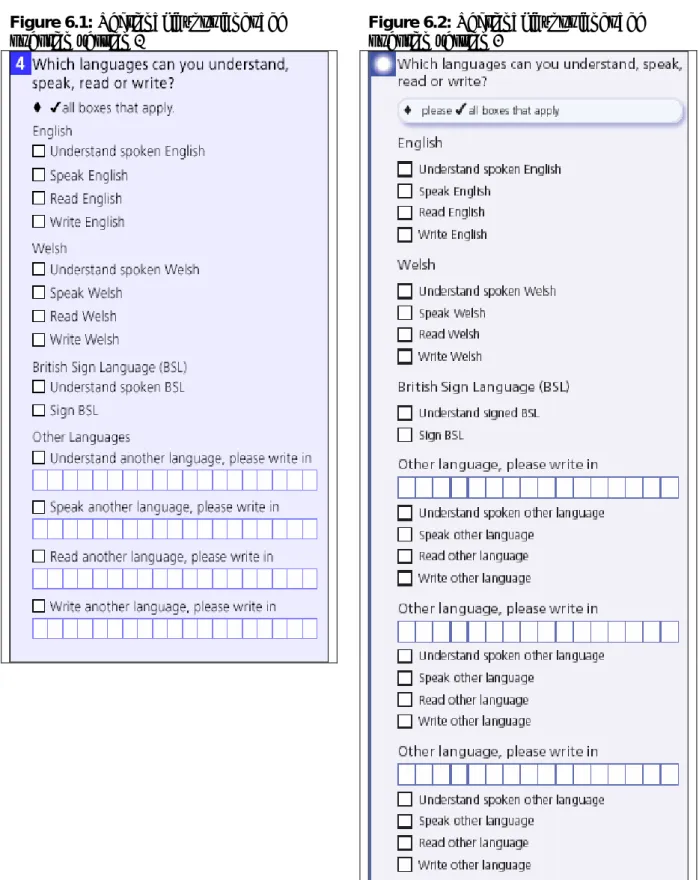
Initially ONS laid out the response options in a sectional design, arranged in a vertical order on the page. The question consisted of separate parts or sections listed in the order of ‘English’, ‘Welsh’, ‘British Sign Language’ and ‘Other’ language(s). After each section header there were separate tick-boxes for reporting knowledge to understand, speak, read or write that language.
The first question tested allowed just one ‘Other’ language to be reported for each skill
(understanding, speaking, reading and writing) (Figure 6.1). ONS then changed the layout to allow an additional two languages, and related abilities in each, to be included (Figure 6.2).
Figure 6.1: Sectional layout language
question version 1 Figure 6.2:
Sectional layout language question version 2
An advantage of the second version of this question was that it allowed multiple languages (and concepts) to be captured independently, allowing for complex analysis. Version 1 made it easy for people to indicate if they speak and read different languages (for example Punjabi is spoken but written mostly in either Gurmukhī or Shahmukhi). However, in the majority of cases where respondents wish to record an additional language, the format could prove burdensome if the same language has to be written out four times.
In preliminary cognitive testing, respondents generally interpreted the question to be asking about native and learnt languages. When answering the question respondents considered their first language(s), and also languages they had learnt at a later time, perhaps at school.
One disadvantage identified was that respondents found the question quite complex as it asked for a lot of separate information. The question was also far too long for inclusion in the census
questionnaire.
6.1.2 Full matrix style
To make the language question fit into the available space ONS redesigned the response options into a matrix style.
6.1.2.1 Full matrix, version 1
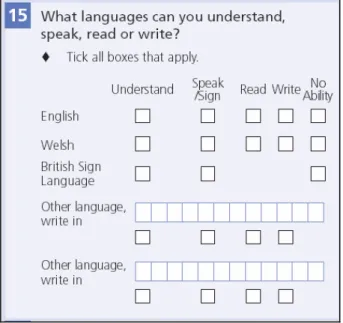
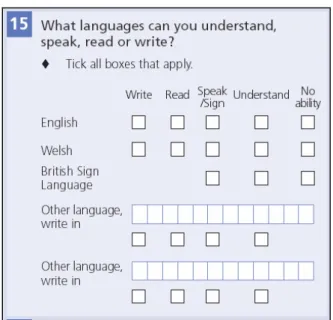
The first full matrix version of the question consisted of four parts. It asked respondents about their knowledge of English, Welsh and British Sign Language, and then their knowledge of an ‘Other’ language of their choice. The tick-boxes relating to knowledge ran horizontally from left to right
reading ‘Understand’, ‘Speak/Sign’, ‘Read’,1 ‘Write’,1 and ‘No Ability’,1 (Figure 6.3).
Figure 6.3: Full matrix language question version 1
Some respondents, despite ticking that they could ‘Understand’, ‘Read’ and ‘Write’ English, did not tick that they could ‘Speak/Sign’ it. Generally, if a person can understand, read and write English they will usually be able to speak it as well. Therefore, the number of respondents leaving the ‘Speak/Sign’ box blank was surprising, suggesting that they may have been confused by the tick-box or interpreted ‘speak/sign’ as meaning ‘speak and sign’.
There were five tick-boxes for Welsh, four representing types of language knowledge and one to declare ‘no ability’, so for this part of the question to be completed correctly there should be at least one box ticked. However, many individuals without any knowledge of the Welsh language did not tick the ‘No ability’ box.
ONS was not able to draw any conclusions about the BSL part of the question because of the low number of respondents who had any knowledge of BSL in the tests of this version.
In relation to the final part of the question, the vast majority of respondents who reported another language both wrote in the language and ticked at least one box ‘Understand’, ‘Speak/Sign’, ‘Read’ or ‘Write’, as intended.
6.1.2.2 Full matrix, version 2
For the next round of testing ONS added an additional tick-box for the reporting of ‘No ability’ in BSL and the option to report on a second ‘Other’ language. ONS also removed the ‘No ability’ in the ‘Other’ language(s) tick-box as it was not needed (Figure 6.4).
Figure 6.4: Full matrix language question version 2
Respondents did not understand this version well. Responses were generally incomplete and inconsistent, and data was unreliable and of poor quality. Some respondents only ticked
‘Understand’, taking this to cover all language skills (when it was designed to mean ‘understand spoken language’).
‘If you’re saying that you understand it, then you can obviously speak and sign it, and read and write it can’t you?’ (Whole Questionnaire Testing, 2006)
As a result the boxes to the right of the ‘Understand’ box were often not considered:
‘I didn’t think they … Oh, yes. Now it’s pointed out, yes I can see. I should have done that shouldn’t I?’ (Whole Questionnaire Testing, 2006)
Where respondents did not indicate that they had any knowledge of Welsh or BSL, they often did not indicate that they had ‘No ability’ either.
Respondents generally did not understand what the ‘Speak/Sign’ option meant, and as a result, many chose to leave it blank:
This under-recording of the ability to speak a language would give the misleading impression that ability to speak languages is lower than the abilities to understand, read and write.
Those who recorded more than one ‘Other’ language explained that they had entered them in order of fluency. One respondent spoke a language from Nigeria, but did not think to include it until questioned by the interviewer because they were not expecting to be asked about this:
‘… you would not expect something like that to come on the census form because you are expecting … the numbers, to know the numbers of people in this country, I would not expect to go into my roots.’ (Whole Questionnaire Testing, 2006)
6.1.2.3 Full matrix, version 3
For the third version, ONS reordered the ability response boxes to remove the emphasis from the ‘Understand’ tick-box, which had previously come first. From left to right the tick-boxes now read: ‘Write’, ‘Read’, ‘Speak/Sign’, ‘Understand’ and ‘No ability’ (Figure 6.5).
Figure 6.5: Full matrix language question version 3
Moving the ‘Understand’ tick-box improved responses to this question, with respondents generally continuing to read across each row after ticking their initial response. However, many respondents continued to answer the question inconsistently and incorrectly and as with earlier testing, often missed the ‘No ability’ boxes.
Once again, several respondents were confused by the ‘Speak/Sign’ tick-box. Some thought that it applied only to sign language. Others did not know what it meant:
‘Speak and sign? Are you talking about sign language there? I don’t know … I can read and write in English but when I came to that it threw me, that “speak and sign’’.’ (Whole Questionnaire Testing, 2006)
Some respondents felt that to declare an additional language they should have a fairly high standard, possibly even be fluent:
‘You would have to be a little bit less than fluency… pretty bilingual.’ (Whole Questionnaire Testing, 2006)
However, other respondents felt that a lower standard was acceptable and therefore included an additional language.
As with version 2 some respondents for whom English was not their first language did not record their mother tongue:
‘I didn’t put my own language on; I didn’t see that as an ability, … because that’s just like a natural thing.’ (Whole Questionnaire Testing, 2006)
6.1.2.4 Full matrix, version 4
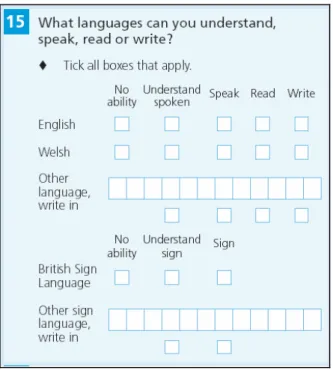
For version 4 (Figure 6.6) ONS moved the ‘No ability’ box to be the first response option to increase its visibility and encourage respondents to tick it if appropriate. This allowed the position of the ‘Understand’ category to be changed and the response options to be rearranged so that the order reflected what the question was asking, that is understand, speak, read or write. ONS also renamed the ‘Understand’ category ‘Understand spoken’.
As respondents had difficulty understanding the category label ‘Speak/sign’, ONS gave BSL its own category labels of ‘Understand sign’ and ‘Sign’. The second ‘Other language’ option was also replaced with an ‘Other sign language’ option to accommodate those who use something other than BSL.
This version of the question was included in the 2007 Census Test and in the 2007 consultation.
Figure 6.6: Full matrix language question version 4
Less than one-half (46 per cent) of respondents to the 2007 consultation who required information on language thought that this version would meet their needs. The principal problems identified by data users included:
• the lack of information on a person’s main/preferred language of communication
• the need to gather information on different levels of ability
• the need for information on different aspects of language ability, particularly English
language proficiency, proficiency in other languages, and levels of illiteracy
The error rates for this question in the 2007 Census Test were quite high. Errors are recorded where respondents fail to answer the question or provide a logically inconsistent answer, such as ticking ‘no ability’ and ‘understand spoken’. The English section of the question had the lowest error rate of the five sections but was still relatively high at 6.7 per cent. The Welsh section of the language question had the highest error rate at 71.2 per cent. The majority of this can be attributed to the high number of non-responses. Many of these non-responses (99.2 per cent) were from the English regions of the census test. While it could be assumed that most people in England don’t have any ability in Welsh and therefore left the question blank, the high amount of non-responses would have an adverse effect on the quality of data collected.
For the people who provided a write-in response to the ‘Other language’ section, 33.5 per cent failed to indicate their ability in this language. The sign language sections also had high error rates; the ‘British Sign Language’ section had a 61.5 per cent error rate and the ‘Other sign language’ section had 52.6 per cent. A large proportion of the British Sign Language error is again down to many people failing to provide a response to the question.
The census test evaluation survey found that of the 182 responses that indicated difficulty with the census individual questions, language was the second most problematic question (11.0 per cent of those reporting difficulty). Most of these respondents found it to be badly worded and in other comments, many explained they didn’t know the level of expertise required.
This version also performed poorly during cognitive testing, with respondents often failing to tick all relevant boxes. They commonly missed the ‘Understand spoken’ box. A number of respondents did not notice it, but in some cases they interpreted the four ability boxes as a scale, where ‘Understand spoken’ was the lowest ability level and ‘Write’ was the highest:
‘It seems to me that it’s graded … speak, read, write means good at it.’ (Wave 1)
In these cases the ‘Understand spoken’ box was often left blank while the rest were ticked. The perception of a graded structure resulted in a proportion of respondents whose responses indicated they were able to speak, read and write, but not understand speech.
The ‘Understand spoken’ box was also often missed in the 2007 Census Test. Almost one-third of respondents in England test areas indicated that they spoke, read and wrote English but did not tick ‘Understand spoken’.
Some respondents with more than one additional language were unsure how to respond using the limited space available. They were inconsistent in how they decided whether to include a language or not. One respondent was fluent in three languages. They wrote in one of the languages, but could offer no reason for selecting the one they had written. Adopting this question would mean that multilingual respondents would be left to enter a language according to their own criteria, leading to inconsistent selection criteria and data that would be difficult to interpret correctly. The high error rates found throughout testing indicated that many respondents failed to understand this question and that it needed to be simplified.
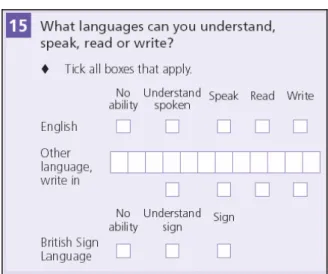
6.1.2.5 Full matrix, version 5
For the next version (Figure 6.7) ONS redesigned the matrix by removing the ‘Welsh language’ row (intending to collect this information in a separate question similar to that used in 2001) and
removing the ‘Other sign language’ option.
Figure 6.7: Full matrix language question version 5
Cognitive testing found that completion errors remained likely. Many respondents took some time to read and make sense of how to answer the question, suggesting that the question may be too complex. Often respondents did not tick the boxes that were relevant to them, particularly the English ‘Understand spoken’ box. Many also did not tick any of the boxes in the ‘British Sign Language’ row.
Respondents with insufficient space to record their other languages tended to declare their languages in order of fluency:
‘I could have included French and German but there wasn’t enough space … Russian is the one I’m most fluent in.’ (Wave 2, Version B)
Some respondents wrote in their additional languages outside the write-in boxes. This creates problems for processing as such information will not be scanned or will be flagged up to be dealt with by hand, leading to more expensive and time-consuming processing costs.
6.1.3 Simplified matrix style
As a result of the problems identified with the full matrix layout, ONS simplified and shortened the question by:
• changing the question from ‘What language(s) can you understand, speak, read or write?’
to ‘Which of these can you do?’ and including a list of language abilities
• re-designing the matrix so the ability categories were listed vertically, rather than
horizontally
• removing the British Sign Language category in the assumption that the write-in space
• reinstating the ‘Welsh’ tick-boxes
• focussing the option to report other languages on spoken ability only (as this was a high
priority for users and removed the need for a complex tick-box layout)
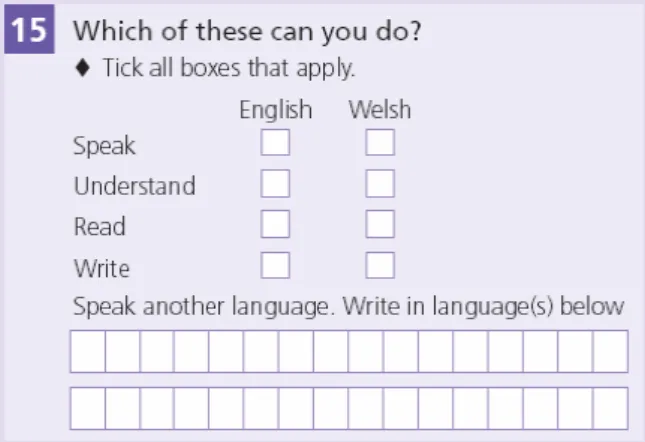
6.1.3.1 Simplified matrix, version 1
For the first version of the simplified matrix ONS included two rows of write-in boxes where ‘Other’ languages spoken could be recorded (Figure 6.8).
Figure 6.8: Simplified matrix language question version 1
Respondents were generally able to understand the question and answer quickly. There were fewer completion errors compared with the full matrix design of the language question.
During cognitive testing the majority of respondents used all four tick-boxes for ‘English’.
Like the earlier question, ‘What languages can you understand, speak, read or write?’ this version of the question did not give respondents any guidance about the proficiency level required for reporting a language. Again, this caused confusion. As one respondent stated:
‘If it said “speak another language fluently” I would know what that meant a bit more and I definitely wouldn’t even hover over it.’ (Wave 2)
‘That bit doesn’t say to me, can you do a bit of Del-boy French to get you through on holiday, or can you hold a decent conversation or are you fluent?’ (Wave 2)
As with earlier testing, responses covered a range of different interpretations and inconsistent decisions about whether or not to include another language. Two respondents who had lived in Spain decided not to include Spanish. One had lived there for 15 years and explained that they decided not to write in the language because:
‘I can’t speak it like a native.’ (Wave 2)
The other felt they did not speak it well enough to consider it to be ‘a second language’. Another respondent had a contrasting interpretation, including German because they had a German GCSE and enjoyed visiting Germany (Wave 2).
A further respondent assumed that the questionnaire did not need to know about languages that they felt were not useful in the UK:
‘Ghanaian language, will that be of any help in this country? I don’t think so, that’s why I left it.’ (Wave 2)
6.1.3.2 Simplified matrix, version 2
In the next version of the language question ONS included an additional row of write-in boxes to provide more room for respondents to write in additional languages (Figure 6.9). This version was also tested in Welsh (Figure 6.10).
Figure 6.9: Simplified matrix language
question version 2 (English language)
Figure 6.10: Simplified matrix language
question version 2 (Welsh language)
Cognitive testing in English showed that respondents had little trouble in deciding which English language ability tick-boxes to choose. In Welsh language testing all respondents ticked the Welsh language and English language ability boxes for ‘Speak’, ‘Understand’, ‘Read’ and ‘Write’ with most mentioning that their selections were based on being able to confidently ‘speak’, ‘understand’, ‘read’ and ‘write’ in both languages. Only one respondent hesitated before ticking all the boxes:
‘Ro’n i’n meddwl bod “siarad Cymraeg a Saesneg” yn ddigon ... ond wedyn pan welais i’r gweddill... deall, ac yn y blaen, wnes i sylwi ‘mod i’n gallu gwneud rheina hefyd.’
[I thought that “Speaking Welsh and English” was enough ... but then when I saw the rest ... understand, and so on, I realised that I can do those too.]
(Wave 1 Welsh language testing) However, in Wave 1 Welsh language testing, Welsh-speaking respondents had three variations on their interpretation of ‘Deall’ [‘Understand’].
• some interpreted ‘Deall’ [‘Understand] to refer to understanding spoken Welsh only:
‘O safbwynt bod rhywun yn siarad efo chi ... ac ych chi’n deall beth maen nhw’n ddweud.’
[From the perspective of someone talking to you ... and you can understand what they’re saying.]
• others interpreted ‘Deall’ as referring to being able to understand spoken Welsh and understand written Welsh:
‘Hynny yw dilyn beth sy’n digwydd mewn sgwrs neu dilyn yr ystyr wrth ddarllen rhywbeth.’
[That is follow what’s happening in a
conversation or following the meaning when reading something.]
(Wave 1 Welsh language testing)
• in some cases respondents interpreted ‘Deall’ as referring to being able to speak, read and
write the language.
‘Os ych chi’n gallu siarad e, darllen e, a ysgrifennu e, wedyn ych chi’n gallu deall e – buase dim rhaid i chi gael ‘deall’ fan hyn.’
[If you can speak it, read it and write it, then you can understand it – so there’ll be no need for ‘understand’ here.]
(Wave 1 Welsh language testing) As with earlier findings, some respondents in English language testing seemed to find it difficult to decide whether to write in additional languages, or which Welsh tick-boxes to choose, because there was a lack of proficiency indicators:
‘It’s not giving you the option to say oh I can speak a little, a lot, or my Welsh is very good or whatever.’ (Wave 3)
With reference to their knowledge of the Italian language, one respondent said:
‘[I can] speak a little bit, understand a little bit, I can read, like … but there’s not space to write “mother tongue” or levels of proficiency.’ (Wave 3)
In Welsh language testing generally, respondents believed that fluency in another language, rather than holding a qualification or the ability to speak ‘a little’, was necessary to declare a knowledge of that language:
Achos dw i’n ystyried bo fi’n eitha rugl ynddyn nhw. Dw i ddim yn eu defnyddio nhw yn aml...ond fi’n weddol rhugl ynddyn nhw
[Because I consider myself to be quite fluent in them. I don’t use them often ... but I’m quite fluent in them]
(Wave 1 Welsh language testing) ‘Gwnes i TGAU Ffrangeg ... ond ddim yn
gallu siarad yn rhugl...felly’n teimlo mod i ddim yn ddigon da i nodi hwnna.’
[I did GCSE French ... but I’m not fluent ... so I felt that I wasn’t good enough to note that.]
(Wave 1 Welsh language testing) The provision of a third row of write-in boxes generally provided adequate space for respondents to write in additional languages although a few respondents wanted to be asked about different levels of language ability:
‘Ond dyw e ddim cweit yn rhoi darlun cyflawn ... gall unrhyw un dweud bod nhw’n siarad Cymraeg os ydyn nhw’n gallu cyfri i bump neu ddweud bore da. Mae angen
[But it doesn’t quite give a full picture ... anyone can say that they speak Welsh if they can count up to five, or say good morning. It should be included whether you
cynnwys a ydych chi’n gallu siarad yn achlysurol, yn rhugl ... ac yn y blaen ... gwahanol lefelau. Mae rhai yn siarad neu wedi colli’r arfer. Mae rhai yn gallu siarad Cymraeg ond ddim yn dewis siarad, a does dim opsiwn ar gyfer dysgwyr ...fel fy
ngwraig, sy’n gallu siarad tipyn go lew o’r Gymraeg, ond ddim yn ystyried ei bod hi’n rhugl.’
can speak occasionally, fluently, and so on ... the different levels. Some have lost the use of their Welsh. Some can speak Welsh, but choose not to ... and there’s no option for learners, like my wife, who can speak quite a bit, but doesn’t consider herself to be fluent.]
(Wave 1 Welsh language testing) Respondents who had children under three years old were unsure about which boxes they should tick, if any. One respondent said they would tick ‘Speak’, commenting:
‘Even if it’s a few words, even if it’s key words, then I’d still consider that she [the baby] can speak English’. (Wave 3)
Other respondents with young children acted differently, such as writing in ‘BABY SO IS NOT SPEAKING YET’, or recording that the child is able to understand the language but is not able to speak.
Clearly, how respondents answer for their babies could have implications on the accuracy of the data collected in terms of incorrectly ticking boxes or not ticking boxes to answer the question on behalf of the baby. However, it is important to note that for 2001, outputs on the knowledge of Welsh question were based on respondents aged 3 or older. Outputs for the 2011 Census have not yet been determined, but the same filter is likely to be applied for young children answering the language questions.
6.1.3.3 Simplified matrix, version 3
In light of this testing, for version 3 of the simplified matrix ONS included a ‘Baby too young to talk’ tick-box (Figure 6.11). To make space available for this, ONS removed the third row of write-in boxes. ONS preferred to add a tick-box rather than an instruction (for example ‘Do not complete for children under 3’) as this would reveal whether people who did not indicate any ability did so because they were a child or because they had mistakenly missed the question.
ONS also added a proficiency indicator to guide respondents about whether they should report other languages. This was done by changing the wording for the other language category to ‘If you are fluent in any other languages, please write in below’.
All respondents ticked the English language ability boxes for ‘Understand’, ‘Speak’, ‘Read’ and ‘Write’. As with the other simplified matrixes, cognitive testing indicated that respondents find this design easier to understand than the full matrix.
The introduction of the word ‘fluent’ in relation to other languages helped to clarify for what
respondents should include. This led to respondents correctly deciding not to include languages in which they had some ability, but were not fluent in:
‘I do have small amount of ability in French and German from school but not enough to actually have a command of the language, therefore I didn’t write it.’ (Wave 4.1)
Testing of this version of the question with respondents who had babies too young to talk was limited.
Stakeholders from the Census Diversity Advisory Group were concerned about the loss of reference to signing and the Welsh Assembly Government were concerned about ensuring
consistency with 2001. The introduction of English tick-boxes in the first column, and the use of the word ‘fluent’ in the second part of the question may influence respondents’ interpretation of the knowledge of Welsh tick-boxes.
6.1.4 General comments on a matrix style language question
Space constraints on the census questionnaire are a significant factor in the development of questions. The matrix format was initially appealing as it offered the most concise way of asking about English, Welsh and other languages.
However, testing suggested that respondents found all versions of the matrix style language question difficult to complete. The complexity of the question resulted in various completion errors which gave inconsistent and incomplete data. The two-language (English and Welsh) format gives the respondent more information to process and increases the burden on respondents.
A significant problem identified in testing was the lack of clarity about the level of proficiency required for respondents to report that they could understand, speak, read or write a language. Those with English as a first language, and with some knowledge of another language, particularly struggled with this question. Respondents often applied variable standards of language proficiency when choosing whether or not to report another language.
It is clear that respondents indicating competency in a language will sometimes have a lower level of skills than others who have chosen not to declare a language. The range of interpretations about what this question was asking meant that answers were inconsistent and therefore not
comparable, which would lead to statistics that provide an unreliable picture of language ability. International research and best practice also advises that a matrix format is not appropriate for a question in a self-complete census questionnaire (for example, Dillman, 2000). Questions using a matrix or tabular format are known to be difficult to understand and interpret for people with poor comprehension skills or English as a second language. They also cause confusion among respondents and add to the challenge of getting respondents to follow a questionnaire in the predefined order.
More fundamentally, after a review of consultation responses ONS was concerned that the matrix format would not be able to meet key user requirements. Many data users need language
information to understand how many people do not have sufficient English language ability to access public services. In addition to cognitive testing findings, there is evidence that capturing people who can speak a language without any indication of the level of proficiency includes those
with low ability. For example, a survey of south Asians in England in 1994 found that of those people who said they could speak English the proportion that could speak ‘just a little English’ (as opposed to ‘very well’ or ‘fairly well’) ranged from 12 per cent amongst Indian men to 33 per cent amongst Bangladeshi women (Johnson 2000).
Analysis by Haseldon (2003) of the knowledge of Welsh language question found that ‘definitions of ‘understanding’, ‘speaking’, ‘reading’ and ‘writing’ vary from person to person and depend upon the design of the question.
Based on findings from cognitive testing, quantitative testing, international best practice and external research ONS decided that a matrix style language question should not be adopted in the England and Wales census. Instead, efforts were made to develop a new question on English and other languages that could be asked separately from the question on Knowledge of Welsh
language.
6.2 New Zealand style conversation questions
ONS developed and tested a conversation question adapted from the language question used in New Zealand’s census, which asked ‘In which language(s) could you have a conversation about a lot of everyday things?’ (Figure 6.12).
Figure 6.12: New Zealand language question, 2006 Census
The focus of the question was on collecting data about languages that respondents could speak and understand. There was no option to report written or reading ability as spoken language was the priority for users.
6.2.1 Conversation question, version 1
In early testing ONS had briefly trialled a version of the conversation question addressing English, Welsh, British Sign Language (BSL) and ‘Other’ languages. Cognitive testing was undertaken when the tick-box for ‘Other’ languages included examples of other languages (‘such as Cornish, Urdu, Hindi’) and also when these examples were removed (Figures 6.13 and 6.14).
Figure 6.13: Conversation question version
1a Figure 6.14:
Conversation question version 1b
Respondents interpreted the question as asking about languages they could speak and understand:
‘… you can’t have a conversation unless you can understand [the language].’ (Preliminary testing)
When answering the question respondents took into account their mother tongue and also any additional language(s) they had learnt later on. They understood it to be asking about the language they usually used:
‘… that’s about the languages you most of the time speak, I live here, I most of the time speak English.’ (Preliminary testing)
However, testing of this question at this stage was limited. This question was put to one side while testing of the matrix versions continued.
6.2.2 Conversation question, version 2
ONS reconsidered using a conversation approach when the matrix style question was rejected and the decision was taken to develop a question that could be asked separately from the Welsh language proficiency question. The Welsh tick-box was therefore removed from this question. To make the question less hypothetical than ‘…could you have a conversation…’ ONS amended it to ‘In which languages can you have a conversation about a lot of everyday things?’
ONS first tested the question with a tick-box for ‘Other’ language with ‘write in main language’ (Figure 6.15). The question was further tested after it was amended to ‘write in main other language’ (Figure 6.16) to avoid confusion if English or British Sign Language (BSL) were the respondent’s main language.
Figure 6.15: Conversation question version
2a – ‘Other, write in main language’) Figure 6.16:
Conversation question version 2b - ‘Other, write in main other language’)
Respondents generally considered ‘A lot of everyday things’ to mean talking about domestic and day to day issues, such as housework, shopping, going to the doctor, the weather, car repairs and work, rather than being able to engage in complex discussions or any kind of technical or
philosophical debate.
The choice of whether or not to record a language was ultimately influenced by what respondents considered to be the required level of proficiency in order to ‘have a conversation about a lot of everyday things’. Testing identified that there were mixed opinions about the level of language ability required. The majority of respondents suggested that in relation to this question a relatively good to high standard of a language was necessary. For example:
‘Which languages I can have a conversation in for some hours, about almost everything, … so in which languages I have a very good level.’ (Wave 5)
But other respondents thought that the level of ability required was more basic:
‘… just if you can communicate perhaps say if you went somewhere on holiday and you knew a bit about the language, which perhaps if you could just get by really.’ (Wave 5) Reasons respondents gave for not reporting a language included that they were not fluent, or that they believed their ability was not of a high enough standard, including that they were not as proficient as they used to be, to justify including it in the answer to this question.
Reintroducing the BSL option was an advantage to the question, as without it, it may not be obvious that BSL should be written as another language. Several respondents had some
knowledge of BSL, but like the verbal languages, people often chose not to record them because they did not feel that they had sufficient ability:
‘I know bits and pieces of sign language, but again not enough to feel that I can answer that question.’ (Wave 5)
Overall ‘main’ language was defined as ‘mother tongue’, a ‘first’ language or fluent language. However, for others ‘main language’ referred to the languages they used on a daily basis, which meant that they did not record their ‘mother tongue’ or ‘first’ language if they did not use it in the UK. A person who spoke Swahili at home with their spouse did not report it because when they thought of ‘everyday things’ they thought of English, as they live in Britain and therefore use English to carry out their daily activities. Another respondent who was from Kenya and whose first language was Somali did not include this and solely ticked ‘English’. They explained that this was because:
‘I only speak English here. I don’t have anybody to speak Somali with, you know.’ (Wave 5) Respondents with babies highlighted that a language question did not really apply as their child was too young to talk.
These findings indicate that asking this style of question would lead to the collection of inconsistent data. Further development would also be required before users considered it suitable for their needs. Furthermore, the Welsh Assembly Government expressed concern that the question may interact with the Welsh language knowledge question if respondents think they should apply the ‘a lot of everyday things’ proficiency measure to both questions. It was therefore decided that this question would not be suitable for inclusion.
6.3 US style, two-part question
As none of the previously tested style of questions met all the essential elements of a suitable language question, let alone the desirable elements, ONS decided to test an alternative style of question for meeting user requirements within space constraints. This was a two-part question asking about primary language, followed by proficiency in English. The question was based on the language questions asked on the US census long form questionnaire in 2000 (Figure 6.17).
Figure 6.17: United States language question, Census 2000, long form questionnaire
Three versions of the primary language question (the first part of the question) were developed and tested. One collected household level data:
• ‘Is a language other than English used every day in your household?’ (In England)
The other two versions captured individual level data:
• ‘Do you speak a language other than English or Welsh at home?’ (in Wales) and ‘Do you
speak a language other than English at home?’ (in England)
• ‘What is your main language?’
They also guided the respondent to include sign languages, clarifying that the question was not only interested in spoken languages.
6.3.1 Part 1 primary language
The key purpose of a primary language question is to establish the language that public authorities can communicate with respondents in. The questions were designed to work in conjunction with the second part of the two-part question which asks about English language proficiency.
6.3.1.1 Primary language, version 1: ‘Is a language other than English used every day in your household?’
ONS intended to include the first version of the primary language question in the ‘household’ section of the questionnaire, followed by an individual question on English proficiency in the
‘individual’ questions. This question asked about languages spoken in the household (Figure 6.18).
Figure 6.18: Primary language question version 1 - Household language (England)
A limitation of this question was that it did not capture other languages spoken well by residents if they are not spoken every day in the household. ONS recognised that ‘language at home’ will produce an underestimate of linguistic capacity, particularly for respondents who do not speak their 'mother tongue' at home, but may still understand it and have the capacity to revive it, and in some cases may be active users of the language in other contexts (for example at work or at community events and organisations).
Cognitive testing found that compared with the conversation style question (see Section 6.2), this question was easier for respondents to answer and more straightforward, especially as it did not ask about proficiency:
‘… it’s not concerned with how well you speak it …’ (Wave 5)
However, the inference is that a language would not be spoken in the household every day unless it was of a high standard.
As this question asked about languages spoken in the household respondents sometimes included languages that their family members or housemates who they lived with spoke, even though they did not personally speak them. For example:
‘My brother and sister can converse in German so I would write that too.’ (Wave 5) A bilingual respondent felt that the question was context specific, as they spoke different
languages at home with different people. However, another respondent who spoke Somali as their first language said they would not include this in response to the question as they did not speak it in the UK as they did not have anybody else to speak Somali with. They would only include it if they had family staying with them in the UK as they would then be using the language.
One respondent made a contrasting decision and included languages spoken by their housemate, even though these languages were not used in the house between those living there. Respondents therefore appeared to be inconsistent in their interpretation of what was meant by language known and languages actually used at home. A key problem with this was that languages would not be attributable to individuals.
Also the question would not provide information for people living in communal establishments as they would not receive the household question. According to the 2001 Census 1 million people (2 per cent of the UK population) were living in a communal establishment. Of those non-staff living in
and Black African’, ‘White and Asian’, ‘Other Mixed’, ‘Other Asian’, ‘Black African’, ‘Chinese’ and ‘Any other ethnic group’ populations.
ONS therefore ruled out the inclusion of a household question.
6.3.1.2 Primary language, version 2: ‘Do you speak a language other than English or Welsh at home?’
ONS then considered replacing the question with ‘Do you speak a language other than English at home?’ in England and ‘Do you speak a language other than English or Welsh at home?’ in Wales, on the ‘Individual’ section of the questionnaire (Figure 6.19). ‘BSL’ was included rather than ‘sign languages’ because at the time of designing the question there was not enough space available on the questionnaire to use the longer example (‘Including sign languages’ would have taken up
another line on the page). ONS only tested the Wales version of the question.
Figure 6.19: Primary language question version 2a - language spoken at home (Wales)
The Wales version did not make any attempt to distinguish between people whose home language is Welsh from those whose home language is English because user need is mainly to identify those people who cannot function in an official language and there was no space to ask about them separately.
The testing of this version was limited but ONS was concerned that the reference to ‘BSL’ may confuse respondents.
The question was amended by changing the wording for the ‘Yes’ tick-box from ‘Yes, write in main other language (include BSL)’ to ‘Yes, write in main other language below (including sign
languages)’. This was done for two reasons:
• to clarify what ‘BSL’ meant, as testing showed that individuals who did not have English as a first
language were unsure what ‘BSL’ was
• the word ‘including’ replaced ‘include’ as it was softer, more of a request than a command
(Figure 6.20).
Figure 6.20: Primary language question version 2b - including ‘sign languages’
(English language version, Wales)
One advantage of this version of the question is that it may be straightforward to complete if the head of household is answering on behalf of other respondents. However, there were a number of problems:
• it was too large for the available space (because the question runs onto two lines). The extra space required would need to be made up, perhaps by removing the instruction in the
subsequent religion question
• it was still unable to capture other languages spoken well by residents if they are not spoken
every day in the household. One respondent who did not have English as a first language also ticked ‘No’ as they only spoke English at home. Another respondent who spoke Somali as their first language but did not speak it while living in the UK, chose to tick ‘No’
• it may be meaningless for respondents who live alone and do not talk to anyone at home (Siegel
et al 2001, Extra and Gorter 2008). In 2001, 30 per cent of all households were one-person households (except for ‘White Irish’ and ‘Mixed White and Black Caribbean’ ethnic minorities who were under represented in one-person households)
• the concept of languages spoken at home is a complex one and may require further
qualifications, such as to whom and when (Extra and Gorter 2008)
• the fact that multiple other languages may be spoken at home appears to overshadow the
instruction to write in the main other language and since there is limited write-in space it may lead to difficulties processing the data. In cognitive testing not all respondents noticed the reference to include ‘main’ language. One respondent wrote in their main language of Somali, but then went on to include Arabic and Urdu in their answer.
• analysis of the US version revealed an uncertainty about the level of proficiency required to state
another language. (Siegel et al 2001)
• ‘at home’ might be interpreted as a respondent’s current home where they live, their childhood
home where they grew up, or their home country that they visit occasionally with different answers in each case (Siegel et al 2001)
As a result of these considerations ONS decided not to recommend this version for the 2011 Census.
6.3.1.3 Primary language, version 3: ‘What is your main language?’
Following concerns that language spoken at home may not be clear to respondents ONS tested an alternative wording, asking ‘What is your main language?’ in the May 2008 module of the Opinions Survey as well as subsequent postal tests and waves of cognitive testing (figure 6.21).
In the second part of Wave 6 ONS changed ‘Other, write in (including sign language)’ to the plural ‘Other, write in (including sign languages)’ to include all possible sign languages and not just one sign language, which may have been confusing (Figure 6.22). Concerns that respondents would write in ‘sign languages’ rather than a specific sign language led ONS to change the instruction to ‘including British Sign Language’ for the March 2009 and July 2009 postal tests (Figure 6.24). For the English version of the question in Wales, ONS tested both the wording ‘English or Welsh’ (Figure 6.22) and ‘Welsh or English’ (Figure 6.23) for the first tick-box.