Published in the proceedings of the 2nd IEEE International Symposium on Cluster Computing and the Grid (CCGrid2002), May 21-24, 2002, Berlin, Germany.
The gSOAP Toolkit for Web Services and Peer-To-Peer Computing Networks
Robert A. van Engelen
∗and
Kyle A. Gallivan
†Department of Computer Science and School of Computational Science and Information Technology
Florida State University
Tallahassee, FL 32306-4530
{
engelen,gallivan
}
@cs.fsu.edu
Abstract
This paper presents the gSOAP stub and skeleton com-piler. The compiler provides a unique SOAP-to-C/C++ language binding for deploying C/C++ applications in SOAP Web Services, clients, and peer-to-peer computing networks. gSOAP enables the integratation of (legacy)
C/C++/Fortran codes, embedded systems, and real-time software in Web Services, clients, and peers that share computational resources and information with other SOAP-enabled applications, possibly across different platforms, language environments, and disparate organizations lo-cated behind firewalls. Results on interoperability, legacy code integration, scalability, and performance are given.
1. Introduction
Many recent efforts in distributed computing are aimed at developing general-purpose distributed computing infras-tructures, providing integrated security, availability, scala-bility, reliascala-bility, and manageability for general distributed computing applications. Examples of infrastructures ex-ploring general distributed computing are Charlotte [1], Javalin/Javalin++ [13, 14], HARNESS [2], Legion [10], and Globus [7]. These infrastructures address the technologies needed to build computational grids [8]. Grids are persis-tent environments that enable software applications to inte-grate instruments, displays, computational and information resources that are managed by diverse organizations.
A number of distributed computing infrastructures em-brased Java as the programming language of choice. Java has many features that make it desirable for distributed computing. Java’s low performance can sometimes be in-creased through proprietary packages and compilation tech-niques [12]. However, the integration of system software, small-scale embedded systems, and real-time software re-∗Supported in part by NSF grants CCR-0105422 and CCR-9904943 †Supported in part by NSF grant EIA-0072043
mains problematic. Because software development has be-come more expensive than the cost of technology, porting (legacy) codes to Java is not cost effective. The use of the Java native interface can leverage production cost some-what, but requires the writing of application wrapper rou-tines by hand which is costly and error prone.
A more recent development is the Simple Object Ac-cess Protocol (SOAP) [3]. SOAP is a versatile message exchange format that is simple and light-weight. The XML-based protocol is language and platform neutral, which means that information sharing relationships can be ini-tiated among disparate parties, across different platforms, languages and programming environments. SOAP is not a competitive technology to component systems and object-request broker architectures such as the CORBA compo-nent model [15] and DCOM, but rather complements these technologies. CORBA, DCOM, and Enterprise Java [17] enable resource sharing within a single organization while SOAP technology aims to bridge the sharing of resources among disparate organizations possibly located behind fire-walls. SOAP applications exploit a wire-protocol (typically HTTP) to communicate with Web Services to retrieve dy-namic content. For example, real-time stock quote infor-mation of a stock portfolio can be graphed on the display of a cell phone or can be analyzed within a spreadsheet program running on a desktop computer. This allows real-time “what-if” scenarios and enables the development of agents that access real-time information [21]. Other ex-amples are the visualization of factory processes on PDAs, control and visualization of large-scale simulations from a desktop computer, the sharing of laboratory results using cell phones, remote database access, and science portals.
This paper presents the gSOAP software development kit (SDK) [20]. The gSOAP stub and skeleton compiler en-ables (legacy) C/C++ and Fortran applications (via C-to-Fortran bindings) to share computational resources and in-formation with other applications, possibly across different platforms, language environments, networks, and organiza-tions. As a result, scientific applications, embedded sys-tems, and real-time software can interoperate as clients,
ser-vices, or peers. The stringent memory and response time requirements by these systems require efficient and special-ized (de)marshalling algorithms. Especially important for numerical applications and libraries to keep the optimized data structures intact. Other SOAP C++ toolkits adopt class libraries for SOAP-specific data types. The libraries use pointers, lists, and heap space extensively. Such implemen-tations are undesirable for legacy applications and embed-ded and real-time systems because of the recoding effort and the resulting indirect memory accesses, heap storage, and performance degradation.
The remainder of this paper is organized as follows. Sec-tion 2 discusses the key features of SOAP for Internet and peer-to-peer computing. Section 3 introduces the gSOAP compiler design, implementation, and use. Preliminary re-sults are presented in Section 4, including interoperability, legacy code integration, and scalability and performance tests. Finally, Section 5 summarizes the conclusions.
2. The Simple Object Access Protocol
This section discusses SOAP and presents a brief overview of SOAP APIs and SDKs.
2.1. Interoperability
SOAP is a language- and platform-neutral RPC protocol that adopts XML as the marshalling format. SOAP appli-cations typically use the firewall-friendly HTTP transport protocol. These and other key interoperability features of SOAP are summarized below:
Ubiquity. The SOAP protocol and its industry-wide sup-port promises to make services available to users anywhere, e.g. in cellphones, pocket PCs, PDAs, embedded systems, and desktop applications.
Simplicity. SOAP is a light-weight protocol based on XML. An example of a simple SOAP service is a sensor device that responds to a request by sending an XML string containing the sensor readout. This device requires limited computing capabilities and can be easily incorporated into an embedded system.
Services. SOAP Web Services are units of application logic providing data and services to other applications over the Internet or intranet. A Web Service can be as simple as a shell or Perl script that uses the Common Gateway Inter-face (CGI) of a Web server such as Apache. A web service can also be a server-side ASP, JSP, or PHP script, or an exe-cutable CGI application written in a programming language for which an off-the-shelf XML parser is available.
WSDL. The Web Service Description Language (WSDL) is an XML format for describing network services as ab-stract collections of communication endpoints capable of
client WSDL Web client Java service client C++ Perl client C# develop invoke publish
Figure 1. Web Service, WSDL, and Clients
exchanging structured information. The platform- and language-neutral WSDL descriptions published by Web Services enable the automatic generation of SOAP stubs for the development of clients within a specific programming environment. The language-specific stubs can be used to in-voke the remote methods of the Web Service, see Figure 1.
UDDI. The Universal Description, Discovery, and Inte-gration (UDDI) specification provides a universal service for registry, lookup, discovery, and integration of world-wide business services [19]. WSDL descriptions comple-ment UDDI by providing the abstract interface to a service.
Transport. A SOAP message can be sent using HTTP, SMTP, TCP, UDP, and so on. A SOAP message can also be routed, meaning a server can receive a message, determine that it is not the final destination, and route the message elsewhere. During the routing, different transport protocols can be used.
Security. SOAP over HTTPS is secure. The entire HTTP message, including both the headers and the body of the HTTP message, is encrypted using public asymmetric en-cryption algorithms. SOAP extensions that include digital signatures are also available, see W3C note [4]. Single sign-on (authenticatisign-on) and delegatisign-on mechanisms [8] required for Grid computing can be easily built on top of SOAP.
Firewalls. Firewalls can be configured to selectively al-low SOAP messages to pass through, because the intent of a SOAP message can be determined from the message header.
Compression. HTTP1.1 supports gzipped transfer encod-ings, enabling compression of SOAP messages on the fly.
Persistence. Long-term data persistence using NFS or database storage is only useful if the protocols and con-tent encoding formats also persist in the form of meta-data. Applications are frequently upgraded, or worse, support is terminated. Software upgrades can make it difficult to ex-tract data stored in outdated formats and often this means that information is lost. Because SOAP is based on XML and XML is often heralded as “self-describing”1, the SOAP
message and its content can be easily made persistent. 1XML documents contain meta-data such as type information. XML
Transactions. SOAP provides transaction-handling ca-pabilities through the SOAP message header part. The transaction-handling capabilities allow a state-full imple-mentation of a Web Service by a server-side solution uti-lizing local persistent storage media.
Exceptions. SOAP supports remote exception handling. The possible disadvantages of SOAP are:
GC. The absence of mechanisms for distributed garbage collection (GC) and the absence of objects-by-reference.
Floats. Floats and doubles are represented in decimal (text) form in XML, which can possibly contribute to a loss of precision. Other SOAP encodings such as hexBinary and Base64 can be used to encode e.g. IEEE 754 standard float-ing point values, but this may hamper the interoperability of systems that use other floating point representations.
2.2. SOAP Toolkits for Internet Computing
A large number of SOAP toolkits are available for dif-ferent programming languages and platforms, see e.g. [11]. Toolkits range from simple APIs to elaborate SDKs for SOAP client and server development. Examples are SOAP::Lite for Perl, Apache SOAP for Java, the .NET framework SDK, and the gSOAP toolkit for C and C++.
The use of SOAP for simple applications does not nec-essarily require an elaborate SDK for the application to participate in a distributed computing infrastructure. A SOAP application can be as simple as a script that prints an XML string. Consider for example the shell script shown in Figure 2. The echocommand sends an XML-formatted request for a sensor readout to a simple SOAP remote method dispatcher utilitydispatch. This utility simply forwards the string to a SOAP service connected todbsrv.cs.fsu.eduport 18080 by opening a socket, passing the string on to the service, and by returning the response to the standard output stream. In Figure 2, the
deserutility applies an XSLT transformation to the SOAP XML response to emit the result in a readable text form. XSLT transformations can be used to transform XML into any format, including plain text, HTML, and PDF.
Script languages such as Perl provide flexible SOAP im-plementations that typically support dynamic stub genera-tion by utilizing WSDL descripgenera-tions. Figure 3 depicts a Perl SOAP client implemented with SOAP::Lite that utilizes the
#!/bin/sh
echo "<e:Envelope xmlns:e=... xmlns:n=...><e:Body>\ <n:getReadout><sensor>$1</sensor></n:getReadout>\ </e:Body></e:Envelope>"\
| dispatch "dbsrv.cs.fsu.edu:18080" | deser
Figure 2. A Shell-Based SOAP Client
use SOAP::Lite; print SOAP::Lite
-> service(
’http://www.xmethods.net/sd/StockQuoteService.wsdl’) -> getQuote(’AOL’);
Figure 3. A Perl SOAP Client
WSDL description of the XMethods Delayed Stock Quote service to dynamically create agetQuoteproxy and stub to request a stock quote.
Most Java SOAP toolkits offer run-time stub genera-tion facilities using dynamic type inspecgenera-tion and/or provide compile-time stub generation. The lower response time of a client that uses a pre-compiled stub improves the over-all quality of service of the client. Precompiling the stub routines saves the overhead for generating these routines at run time via dynamic type inspection. An example Apache SOAP 2.2 Java client that accesses the Delayed Stock Quote Service has about 40 lines of Java code (not shown).
SOAP C++ toolkits adopt class libraries for marshalling SOAP data types with an XML parser and generator. Each SOAP data type, which is essentially an XML schema type, has a corresponding class in the library. The library ap-proach forces a user to adapt the application logic to these libraries or the user has to implement wrappers by hand that copy the application-specific data structures into the SOAP-specific data structures and vice-versa.
2.3. SOAP Peer-To-Peer Computing
SOAP does not enforce a strict client-server relationship but does not endorse a specific peer-to-peer (P2P) architec-ture either. A platform-independent SOAP P2P computing infastrucure can be build using JXTA [18] and the .NET framework.
The use of a shell for “on the fly” distributed computa-tion with pipes to connect applicacomputa-tions as shown in Figure 2 is somewhat similar to the JXTA shell. However, in con-trast to Unix pipes, JXTA pipes are bidirectional allowing applications to be peers with respect to eachother.
The MS .NET framework SDK enables the develop-ment of P2P infrastructures with UDDI, WSDL, and SOAP clients and Web Services developed in languages such as Visual Basic, C#, C++, and Haskell. The .NET architec-ture includes the Common Language Runtime (CLR) for managing objects. The CLR can perform SOAP message exchange as part of the serialization capabilities of objects managed by the CLR. This solution is platform-specific and the strict use of managed objects on the heap has an impact on memory use and overall performance. Furthermore, Vi-sual C++ applications have to use an interface to the CLR to create and use managed objects which adds a whole new layer of complexity to pure C++ applications.
3. The gSOAP Stub and Skeleton Compiler
This section motivates the design of the gSOAP stub and skeleton compiler and briefly presents its implementation.
3.1. Design Characteristics
The critical gSOAP compiler design characteristics are:
Precompiling (De)Marshalling Routines. The stubs, skeletons, serialization, and deserialization routines are pre-compiled to minimize dynamic type inspection. Deserial-izion deals with SOAP “forward” references by tracking unresolved pointers. Serialization is a two-stage process to comply to SOAP’s multi-referenced object encoding rules.
Support for Native Data Types. The pre-compiled mar-shalling routines serialize and deserialize native C/C++ and user-defined data types and this data is not extended with additional information such as tags. As a result, restructur-ing compiler techniques can be used to compile and opti-mize an application’s kernel routines together with the mar-shalling routines. For example, a restructuring compiler can optimize data placement in memory to reduce memory ac-cess latencies [16]. Also cache-conscious data placement strategies can be used to improve memory access [5].
Minimizing Memory Operations. To avoid data copy-ing overhead, serialization and deserialization operations are performed in situ on the application’s native data struc-tures that are static, stack, and/or heap allocated.
Mimimizing Memory Use. Stand-alone client and server executables have a small memory footprint (typically less than 150K). This enables deployment of SOAP clients and services in small-scale embedded systems. The commonly used technique to buffer the whole output message to de-termine the HTTP message length is expensive for small devices such as PDAs. Instead, the message length is deter-mined in a separate serialization pass (two-stage “count and send” serialization). Additional memory overhead is lim-ited to the use of a hash table required for the determination of multireferenced objects. The size of the hash table corre-sponds to the number of pointers within the marshalled data structures.
Efficient XML Parsing. gSOAP’s runtime library
in-cludes a customized parser that parses XML on demand without keeping parts of the XML document in memory.
Preservation of Structure. When a data structure is en-coded in SOAP and deen-coded on the receiving side it is an exact copy of the structure of the original. The copy, however, may occupy a different memory region, including static/stack/heap allocations, and therefore pointers within the copy may use different address values than the original. To preserve structure, SOAP multireferenced object encod-ing is used to encode arbitrary (cyclic) graph structures.
Legacy Application Integration. The use of pre-compiled marshalling routines for native C/C++ and user-defined data types enables the integration of C and C++ legacy applications within SOAP clients, services, and peers. This also enables the integration of Fortran legacy applications within SOAP clients and services through the use of existing C-to-Fortran bindings provided by the Unix linker or through MS Windows DLLs.
Platform Independence. The compiler generates platform-independent C and C++ source code for the stubs, skeletons, and marshalling routines. SOAP clients and services run on Linux, Unix, MS Windows 98/2000/NT/XP/CE, PocketPC, and embedded systems.
3.2. Implementation
The stubs of the remote methods to be invoked by a SOAP client are generated by a utility that translates the WSDL service description of a Web Service into C and C++ declarations that are stored in a standard header file. This translation makes the remote method proxy interface transparent to a user. The gSOAP compiler executable,
soapcpp, processes the C/C++ declarations and generates C and/or C++ source code stubs for integration in a client.
This unique aspect of gSOAP’s SOAP-to-C/C++ lan-guage binding is illustrated with an example SOAP client. The client program prints the stock value of the stock ticker symbol provided as an argument. The quote.h
header file shown in Figure 4 is produced from the XMethods Delayed Stock Quote service WSDL. This func-tion prototype specifies all of the necessary details for
soapcpp to generate the stub. The string and float primitive types of the remote method parameters are en-coded and deen-coded in SOAP as standardized XML schema types (i.e. xsi:type=”xsd:string” and xsi:type=”xsd:float”). The client program is shown in Figure 5. The client uses the proxysoap call ns getQuotegenerated by
soapcppfromquote.h. The source code includes the
namespaces table with XML namespace URIs. The service namespace URI is urn:xmethods-delayed-quoteswhich is bound to thensprefix.
The implementation of a SOAP Web Service is initiated with the writing of an interface description in a C or C++ header file. The header file contains the declaration of the remote methods and the data structures used by the remote method parameters. Thesoapcppcompiler generates the skeleton and marshalling routines from the header file. Also a WSDL service description is generated bysoapcpp. An example Web Service is presented in Section 4.1.
int ns__getQuote(char *symbol, float &result);
const char endpt[] = "http://services.xmethods.net/soap"; main(int argc, char **argv)
{ float q;
if (!soap_call_ns__getQuote(endpt, "", argv[1], q)) cout << q;
}
struct Namespace namespaces[] = {
{"SOAP-ENV","http://schemas.xmlsoap.org/soap/envelope/"}, {"SOAP-ENC","http://schemas.xmlsoap.org/soap/encoding/"}, {"xsi", "http://www.w3.org/2001/XMLSchema-instance"}, {"xsd", "http://www.w3.org/2001/XMLSchema"}, {"ns", "urn:xmethods-delayed-quotes"}, {NULL, NULL} }
Figure 5. A C++ SOAP Client
3.3. Marshalling and Demarshalling
Thesoapcppcompiler generates (de)marshalling rou-tines that are SOAP 1.1 and mostly SOAP 1.2 compliant. The C/C++ data types are encoded and decoded as SOAP XML schema types as follows:
Basic Types. The primitive C types (including bool,
char*,wchar t*, andtime t) are encoded as built-in primitive XML schema types, such as xsd:int, xsd:double, and xsd:string. Atypedefconstruct is used to inform the
soapcppcompiler how to store XML schema types, e.g:
typedef double xsd decimal;
This allows (legacy) applications to use doubles with no change, while the doubles are encoded and decoded as e.g. xsd:decimal schema types.
Enumerations. C enumerations are recognized by the
soapcpp compiler and (de)serialized with symbolic names as XML schema enumeration types.
Structs. The ComplexType XML schema type is used for data structures that resemble structs with fields in SOAP.
Classes. Like structs, the ComplexType XML schema type is used for encoding classes instances. Only single class inheritance is supported due to SOAP encoding con-straints. Serialization and deserialization methods are au-tomatically added by soapcppto class definitions. The methods recursively encode/decode all fields of a class. Dy-namic method binding is used to serialize derived class in-stances at run-time. This enables “black-box” clients and services that operate on derived class instances.
Pointers. Pointers are not explicitly part of a SOAP payload. However, SOAP supports multi-referenced ob-jects and nil obob-jects in XML which allows serialization of pointer-like structures such as lists, trees, and arbitrary (cyclic) graphs. Such structures keep their structural iden-tity. The compiler assumes that all pointers used in an appli-cation point to a single object in memory andvoidpointers are not supported. Applications that use pointers to point to multiple objects need to use dynamic arrays instead to re-veal the number of elements refered to by the pointer to the serializers, see dynamic array encoding below.
Fixed-Size Arrays. Fixed-size C/C++ arrays are mar-shalled as SOAP-ENC:Array types.
Dynamic Arrays. Many C/C++ applications use pointers to arrays. This poses a problem for the serializers to get the size of the array pointed to. The compiler recognizes a special data structure for dynamic arrays that are declared as a struct or class with a pointer field and a size field, e.g.
struct ArrayOfInt { int * ptr; int size; } A
declares an arrayA of ints which is encoded as a SOAP-ENC:Array with arrayType xsd:int[]. Multi-dimensional ar-rays can be declared in a similar way.
Compound Types. A SOAP compound type is a struct/class, array, or a list of unordered elements. Such lists are supported through the declaration of a dynamic ar-ray with a namespace prefix for the struct/class name, e.g.
class ns vector { X * ptr; int size; } V
declares a vectorVofXencoded as a ns:vector schema type.
Special Types. The xsd:base64Binary, xsd:hexBinary, and SOAP-ENC:base64 XML schema types are useful for transmitting raw binary data such as images. These types are declared as a dynamic array of typeunsigned char.
4. Results
This section presents preliminary test results on inter-operability, legacy code integration, scalability, and perfor-mance of clients and services developed with gSOAP.
4.1. Test 1: Interoperability
gSOAP participates in White Mesa’s interop lab [22],
which is the premier site for SOAP toolkit development and interop testing. In addition, example clients and ser-vices were developed with gSOAP to test interoperability with various real-world services offered by Xmethods [23], see Table 1.
Name Owner Toolkit
Delayed Stock Quotes XMethods GLUE Currency Exchange XMethods GLUE XMethods Filesystem XMethods Apache XMethods Listings XMethods Apache Flight Tracker ObjectSpace Apache
Who Is Shiv Kumar Delphi
Calculator XML Components XMLCLX UDDI Proxy Service DSTC Pty Ltd MS. NET
Glossary Luhala SOAPLite
n1__getQuote(char *symbol, float &result); n2__getRate(char *country1, char *country2,
float &result); n3__getQuote(char *symbol, char *country, float &result);
Figure 6.quotex.h
main()
{ soap_serve(); // wait for request and call skeleton }
char endpt[] = "http://services.xmethods.net/soap"; n3__getQuote(char *symbol, char *country, float &result) { float q, r;
if (soap_call_n1__getQuote(endpt, "", symbol, q) || soap_call_n2__getRate(endpt, "", "us", country, r))
return SOAP_FAULT; // pass exception on to the caller result = q*r;
return SOAP_OK; // all OK }
Figure 7.quotex.cpp
We illustrate how the functionalities of the XMethods Delayed Stock Quote and Currency Exchange services can be combined into one new Web Service that accepts a stock ticker name and a currency symbol and returns the currency-converted stock quote. This new service acts both as a server and as a client: after accepting stock ticker name and currency symbol from a client it communicates with the XMethods services to retrieve the stock quote in a dollar amount and to convert the quote into the requested currency. Figure 6 shows the header file input tosoapcppthat serves as the interface definition of the three remote meth-ods of the three Web Services involved. Each remote method is specified as a function prototype. The remote method name, parameter names, and types are specific to each service and can be extracted from the published WSDL descriptions. Because C lacks a means for explicitly de-noting in/out parameter passing modes,soapcppuses the convention that the last parameter of the function is the out-put parameter. The integer return value is used for SOAP exception handling and indicates success or failure.
Figure 7 depicts the full server code (except for the namespace URI table which is omitted from the figure). When the service is deployed as a simple CGI application, thesoap serveroutine called inmainwaits for requests on the input stream, inspects the intended remote method invocation from the XML payload, and calls the appropri-ate skeleton routine. The skeleton routine demarshalls the request and calls the n3 getQuoteroutine. This rou-tine in turn calls the proxies of the n1 getQuoteand
n2 getRateremote methods of the XMethods services to retrieve the current stock quote and currency exchange rate. The routine computes the currency-converted stock quote and returnsSOAP OKindicating success. The skele-ton converts the result in a SOAP compliant response and sends the response back to the client.
class ivector
{ int *__ptr; int __size; ... // class methods }; class vector
{ double *__ptr; int __size; ... // class methods }; class matrix
{ vector *__ptr; int __size; ... // class methods }; ns__ludcmp(matrix *a, struct ns__ludcmpResponse
{matrix a; ivector i; double d;} &result);
Figure 8.lu.h
ns__ludcmp(matrix *a, struct ns__ludcmpResponse &result) { result.a = *a;
return ludcmp(result.a, result.i, result.d); }
ludcmp(matrix &a, ivector &i, double &d) { ... }
Figure 9.luserver.cpp
4.2. Test 2: Legacy Code Integration
The gSOAP stub and skeleton compiler generates mar-shalling routines for user-defined C/C++ data structures, thereby enabling the integration of legacy codes in SOAP applications. Consider for example the LU decomposition algorithmludcmpand related routineslubksb (backsub-stitution),lusol(solver), andluinv(inversion) of Nu-merical Recipies in C [6]. We implemented these in a Web Service with gSOAP. Figure 8 depicts the header file seg-ment to declare ludcmp. The ns ludcmpResponse
struct contains the output parameters: the decomposed ma-trixa, reordering index vectori, and a doubled.
Figure 9 depicts the server code with the implementa-tion of thens ludcmpremote method. The algorithms in Numerical Recipies in C use dynamic array structures for matrices and vectors, i.e. a matrix is an array of pointers to arrays. We implemented these asmatrix,vector, and
ivectorclasses with pointers and size information. The size information is required for serialization and deserial-ization (see also Section 3.3). The use of classes for arrays did not require significant changes to the originalludcmp
routine. Thens ludcmpfunction is a simple interface to theludcmproutine. Becauseludcmpapplies in situ LU decomposition, prior to callingludcmpthe interface sets the output matrix reference to the input matrix pointer.
Figure 10 illustrates the service architecture. The SOAP interface for the service is generated bysoapcpp. The
in-algorithms ludcmp lubksb lusol luinv skeleton skeleton skeleton skeleton deserialize serve SOAP request SOAP response
soapcpp generated interface deserialize serialize deserialize serialize serialize deserialize serialize
terface consists of thesoap serveroutine that dispatches the requests to the generated skeleton routines of the remote methods. The skeleton demarshalls the request parameters, calls the solver routine, (e.g. lusol in the figure), mar-shalls the result parameters, and sends the response back to the client. The linear solver service runs as a CGI appli-cation or as a stand-alone server serving requests via BSD Unix sockets. soapcppalso generates a WSDL descrip-tion for service discovery and client access.
This example demonstrates that minimal effort is re-quired to incorporate legacy C routines in a Web Service. More importantly, the critical data structures of the routines (pointers to arrays of doubles) could be used, however with the necessary embedding of array size information for the
gSOAP compiler-generated (de)serializers.
4.3. Test 3: Scalability and Performance
The payload of a SOAP remote method request and re-sponse message requires more bandwidth than protocols that adopt binary serialization formats such as Java’s ob-ject serialization format. To improve efficiency, a multi-protocol approach can be used [9] but that complicates im-plementation by requiring multiple protocol APIs. Instead, compression methods such as HTTP 1.1 gzipped transfer encodings should be used with SOAP to significantly re-duce bandwidth demands2.
The gSOAP stub and skeleton compiler improves mar-shalling performance significantly by providing fast in situ (de)serialization of data structures. SOAP C/C++ client and service implementations tend to be much more efficient compared to implementations in other languages. We ob-served that Perl SOAP::Lite and Apache 2.2 SOAP client implementations of the XMethods Delayed Stock Quote service were respectively about 3 times slower and 2 times slower compared to a gSOAP client implementation in C.
We tested the scalability and performance of the LU de-composition Web Service and a Web Service that we devel-oped to produce magic squares. Both services have a high bandwidth demand because of the matrices and vectors con-tained in the request and response messages. The service applications were compiled with gcc and tested on a dual Pentium III 550MHz machine with 1G memory and 256K level-1 cache running Red Hat Linux. The client applica-tions were compiled with gcc and tested on a dual Pentium III 933MHz machine with 256K memory and 256K level-1 cache running Red Hat Linux. The machines are connected with a 10BaseT Ethernet LAN with low to moderate traffic. Tests were performed by invoking remote methods a 100 times and during different times a day.
On the dual Pentium III 550MHz machine, the mar-shalling routines achieved ≈60,000 two-stage “count and
2XML compression rates are typically very high.
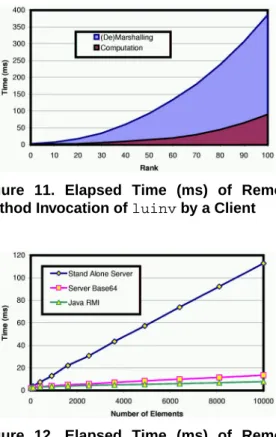
Figure 11. Elapsed Time (ms) of Remote
Method Invocation ofluinvby a Client
Figure 12. Elapsed Time (ms) of Remote Method Invocation by a Client of a Magic Square Service Compared to Java RMI
send” serializations3per second and the demarshalling
rou-tines achieved≈90,000 deserializations per second over the standard 10BaseT Ethernet LAN.
Figure 11 shows the (de)marshalling+communication overhead compared to the compute time for matrices up to order 100. The (de)marshalling+communication overhead is the total time for marshalling a matrix by the client stub, sending the uncompressed matrix over the 10BaseT Ether-net, demarshalling the matrix by the skeleton, marshalling the inverted matrix, and sending the inverted matrix back to the client who demarshalls it. The compute time for matrix inversion byluinvaccounts for≈20% of the total elapsed time. The remaining 80% is largely consumed by the over-head introduced by (de)marshalling and communication.
Figure 12 shows the scalability and performance of SOAP remote method invocation by a client of the magic squares service compared to a Java 1.2.2 RMI Linux imple-mentation of a magic squares service and client (the matrix is a Java int[][] array). Two SOAP service implementations were tested: one with the 32-bit integer matrices marshalled as SOAP arrays and one that uses SOAP Base64 encod-ing. A Base64 binary encoded matrix takes 33% more space compared to internal storage, but is far less demanding on
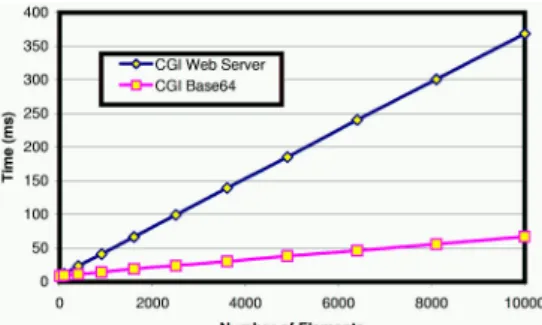
Figure 13. Elapsed Time (ms) of Remote Method Invocation by a Client of a CGI-Based Magic Square Web Service
bandwidth compared to SOAP arrays. Thex-axis denotes the size of the matrix as the number of matrix elements to illustrate the linear scalability of the remote method invoca-tion (the magic squares algorithm is linear in the number of elements of a matrix). Java RMI performance is better for larger matrices due to optimizations in the Java RMI socket layer which have not yet been implemented in gSOAP.
Figure 13 depicts the elapsed times of the two different magic squares service implementations deployed as CGI applications on an Apache Web server 1.3.22 running on a dual Pentium III 550MHz machine with 1G memory and 256K level-1 cache. The services are scalable, but CGI in-troduces a significant overhead.
5. Conclusions
The SOAP protocol and the abundance of SOAP toolkits promise to make the development of business and science portals with programming- and platform-neutral Web Ser-vices easy and very likely in the near future. The gSOAP stub and skeleton compiler provides a unique SOAP-to-C++ language binding for the development of SOAP-enabled ap-plications such as clients, services, and peers. Other SOAP C++ toolkits adopt a SOAP-centric view and offer SOAP APIs for C++ that require the use of class libraries for SOAP-like data structures. This solution often forces a user to adapt the application logic to these libraries, which is undesirable for the integration of legacy applications, em-bedded, and real-time systems. In contrast, gSOAP pro-vides transparent SOAP API through the use of compiler technology that hides irrelevant SOAP-specific details from the user. The compiler automatically maps native and user-defined C and C++ data types to semantically equivalent SOAP data types and vice-versa. As a result, full SOAP interoperability is achieved with a simple API relieving the user from the burden of SOAP details and enabling him or her to concentrate on the application-essential logic.
References
[1] A. Baratloo, M. Karaul, Z. Kedem, and P. Wyckoff. Char-lotte: Metacomputing on the web. In The 9thInt’l Confer-ence on Parallel and Distributed Computing Systems, 1996.
[2] Beck et al. HARNESS: A next generation distributed virtual machine. Future Generation Computer Systems, 15, 1999. [3] D. Box et al. Simple object access protocol 1.1, 2000.
http://www.w3.org/TR/SOAP.
[4] A. Brown et al. SOAP security extensions: Dig-ital signature. Technical report, W3C, 2001. http://www.w3.org/TR/SOAP-dsig.
[5] T. Chilimbi, M. Hill, and J. Larus. Cache-conscious struc-ture layout. In SIGPLAN Conference on Programming
Lan-guage Design and Implementation, pages 1–12, 1999.
[6] B. Flannery, W. Press, S. Teukolsky, and W. Vettering.
Nu-merical Recipes in C. Cambridge University Press,
Cam-bridge UK, 2nd edition, 1992.
[7] I. Foster and C. Kesselman. Globus: A metacomputing in-frastructure toolkit. International Jnl. of Supercomputer
Ap-plications, 11(2):115–128, 1997.
[8] I. Foster, C. Kesselman, and S. Tuecke. The anatomy of the Grid. International Journal of Supercomputer Applications, 15(3):200–222, 2001.
[9] M. Govindaraju et al. Requirements for and evaluation of RMI protocols for scientific computing. In Supercomputing, 2000.
[10] A. Grimshaw and W. Wulf. The legion vision of a worldwide virtual computer. CACM, 40(1):39–45, 1997.
[11] P. Kulchenko. SOAP::Lite for Perl. http://www.soaplite.com.
[12] J. Moreira, S. Midkiff, M. Gupta, P. Artigas, P. Wu, and G. Almasi. The NINJA project. CACM, 44(10):102–109, 2001.
[13] M. Neary, S. Brydon, P. Kmiec, S. Rollins, and P. Cappello. Javalin++: Scalability issues in global computing. In ACM
Java Grande, pages 171–180, San Fransisco, CA, 1999.
[14] M. Neary, B. Christansen, P. Cappello, and K. Schauser. Javalin: Parallel computing on the internet. Future
Gen-eration Computing Systems, 15:659–674, 1999.
[15] OMG. CORBA component model. http://www.omg.org. [16] G. Rivera and C.-W. Tseng. Data transformations for
elim-inating conflict misses. In ACM SIGPLAN Converence on
Programming Language Design and Implementation,
Mon-treal, Canada, June 1998.
[17] Sun Microsystems. Enterprise java beans technology. http://java.sun.com/products/ejb/.
[18] Sun Microsystems. Project JXTA: Technical specification, version 1.0, 2001.
[19] UDDI. The universal description, discov-ery, and integration (UDDI) specification. http://www.uddi.org/specification.html.
[20] R. van Engelen. The gSOAP toolkit 2.1, 2001. http://sourceforge.net/projects/gsoap2.
[21] R. van Engelen, K. Gallivan, G. Gupta, and G. Cybenko. XML-RPC agents for distributed scientific computing. In
IMACS’2000 Conference, Lausanne, Switzerland, 2000.
[22] White Mesa. White mesa interop lab. http://www.whitemesa.com/interop.htm.
[23] XMethods. XMethods service listings. http://www.xmethods.com.