Air Force Institute of Technology
AFIT Scholar
Theses and Dissertations Student Graduate Works
9-18-2014
An Artificial Neural Network-based
Decision-Support System for Integrated Network Security
Tyrone A. LewisFollow this and additional works at:https://scholar.afit.edu/etd
This Thesis is brought to you for free and open access by the Student Graduate Works at AFIT Scholar. It has been accepted for inclusion in Theses and Recommended Citation
Lewis, Tyrone A., "An Artificial Neural Network-based Decision-Support System for Integrated Network Security" (2014).Theses and Dissertations. 565.
AN ARTIFICIAL NEURAL NETWORK-BASED DECISION-SUPPORT SYSTEM FOR INTEGRATED NETWORK SECURITY
THESIS SEPTEMBER 2014
Tyrone A. L. Lewis Sr., Major, USA AFIT-ENG-T-14-S-09
DEPARTMENT OF THE AIR FORCE AIR UNIVERSITY
The views expressed in this thesis are those of the author and do not reflect the official policy or position of the United States Air Force, Department of Defense, or the United States Government. This material is declared a work of the U.S. Government and is not subject to copyright protection in the United States.
AFIT-ENG-T-14-S-09
AN ARTIFICIAL NEURAL NETWORK-BASED DECISION-SUPPORT SYSTEM FOR INTEGRATED NETWORK SECURITY
THESIS
Presented to the Faculty
Department of Electrical and Computer Engineering Graduate School of Engineering and Management
Air Force Institute of Technology Air University
Air Education and Training Command In Partial Fulfillment of the Requirements for the Degree of Master of Science in Cyber Operations
Tyrone A. L. Lewis Sr. BS Major, USA
AFIT-ENG-T-14-S-09
AN ARTIFICIAL NEURAL NETWORK-BASED DECISION-SUPPORT SYSTEM FOR INTEGRATED NETWORK SECURITY
Tyrone A. L. Lewis Sr. B.S. Major, USA
Approved:
//signed// August 26, 2014
Brian G. Woolley, Major, USAF (Chairman) Date
//signed// August 26, 2014
Kenneth Hopkinson, PhD (Member) Date
//signed// August 26, 2014 Michael Grimaila, PhD, CISM, CISSP (Member) Date
//signed// August 26, 2014
AFIT-ENG-T-14-S-09
Abstract
As large-scale Cyber attacks become more sophisticated, local network defenders should employ strength-in-numbers to achieve mission success. Group collaboration re-duces individual efforts to analyze and assess network traffic. Network defenders must evolve from an isolated defense in sector policy and move toward a collaborative strength-in-numbers defense policy that rethinks traditional network boundaries. Such a policy incorporates a network watch approach to global threat defense, where local de-fenders share the occurrence of local threats in real-time across network security bounda-ries, increases Cyber Situation Awareness (CSA) and provides localized decision-support. A single layer feed forward artificial neural network (ANN) is employed as a global threat event recommender system (GTERS) that learns expert-based threat mitiga-tion decisions. The system combines the occurrence of local threat events into a unified global event situation, forming a global policy that allows the flexibility of various local policy interpretations of the global event. Such flexibility enables a Linux based network defender to ignore windows-specific threats while focusing on Linux threats in real-time. In this thesis, the GTERS is shown to effectively encode an arbitrary policy with 99.7% accuracy based on five threat-severity levels and achieves a generalization accuracy of 96.35% using four distinct participants and 9-fold cross-validation.
Acknowledgments
To my beautiful wife and best friend, thanks for your attentive ear and loving support. For my advisor MAJ Brian G. Woolley, and fellow committee members, I humbly ex-press my sincere appreciation for your guidance and support throughout the course of this research effort. I dedicate this effort to better understand those who work tirelessly to defend our network boundaries against sophisticated global threats. Keep up the fight!
Thank you for this opportunity,
Table of Contents
Page
Abstract ...v
Acknowledgments... vi
Table of Contents ... vii
List of Figures ...x
List of Tables ... xii
List of Acronyms ... xiii
I. Introduction ...1
1.1 Problem Statement...10
1.2 Motivation ...10
1.3 Hypothesis ...12
1.4 Objectives ...14
II. Literature Review ...15
2.1 Situation Awareness ...15
2.2 Team Situation Awareness Considerations ...19
2.3 Historical Overview of Automation for the Intrusion Detection Process ...20
2.3.1 Intrusion Detection and Prevention Fundamentals ...22
2.3.2 Current Intrusion Detection and Prevention Systems Usage ...24
2.3.2.1 Intrusion Detection and Prevention System Types ...26
2.3.2.2 Multi-Level Architecture for Intrusion Detection and Prevention ...28
2.5 Artificial Neural Networks ...34
2.5.1 Fundamentals of Neural Network Engineering ...35
2.5.2 Single Layer Feed Forward Artificial Neural Network Structure ...36
2.5.3 Back propagation Gradient Descent Algorithm ...38
2.5.6 K-Fold Cross-Validation ...42
2.7 Chapter Summary ...44
III. Methodology ...45
3.1 General Problem Review ...53
3.2 Problem Statement...57
3.3 Experimental Methodology ...58
3.3.1 System Boundaries ...59
3.3.2 Scope and Limitations ...59
3.4 System Services ...60
3.4.1 Decision Support Services ...60
3.4.2 Off-Line Services ...62
3.4.3 System Workload ...66
3.5 System Performance Metrics ...67
3.5.1 System Parameters...67
3.5.2 System Factors...70
3.5.3 System Evaluation Technique ...72
3.5.4 Decision-Support Evaluation Technique ...74
3.6 Experimental Design ...74
3.6.2 Scenario II Single Decision-Support Profile Design ...77
3.6.2.1 Scenario II Single Decision-Support Profile Baseline + Noise ...80
3.6.2.2 Scenario II Single Decision-Support Profile Baseline+Noise+CV ...80
3.6.3 Scenario III Group Decision-Support Profile Design ...80
3.7 Methodology Summary ...82
IV. Analysis and Results ...83
4.1 Pilot Study Results ...83
4.2 Scenario II- Analysis of the effects of Noise and Cross-Validation on Decision-Support Profiles ...86
4.3 Scenario-III Multiple DSP Interactions Results and Interpretations ...93
4.4 Scenario-III Group DSP Baseline+CV Results and interpretations ...98
4.5 Chapter Summary ...100
V. Conclusions and Recommendations ...102
5.1 Significance and Contributions of Research ...103
5.2 Recommendations for Action ...104
5.3 Research Summary ...105
Appendix A Decision-Support Profile Survey ...108
Bibliography ...151 Vita 155
List of Figures
Page
Figure 1. The General Situation, Isolated Security Boundaries in Cyberspace ... 3
Figure 2. Single Layer Artificial Neural Network adapted from (Heaton, 2012)... 37
Figure 3. Target Learning and Stimuli Classification (Mitchell, 1997) ... 38
Figure 4. Conventional Threat Event Recommender System Scheme ... 46
Figure 5. ANN-Based Global Threat Event Recommender System ... 48
Figure 6. Lightning’s Operational Block-Diagram ... 49
Figure 7. Local Decision-Support Profile Component under Test (CUT) ... 61
Figure 8. Lightning’s Off-Line Training Parameters ... 63
Figure 9. Pilot Study Logical View of 4-Area IDPS Integrated ANN Structure... 77
Figure 10. Logical ANN Scenario-II Performance ANN Structure ... 79
Figure 11. Logical Group Scenario-III ANN Structure ... 81
Figure 12. Pilot Study Results with Errors ... 84
Figure 13. Pilot Study Error-Free Dataset Results ... 85
Figure 14. Baseline Decision-Support Profile (Local Policy) ... 87
Figure 15. Single Decision-Support Profile Baseline +Noise Results... 89
Figure 16. Single Decision-Support Profile Baseline +Noise+ CV Results ... 90
Figure 17. Single Decision-Support Profile Accuracy Summary Results ... 91
Figure 18. Single Decision-Support Profile Error Summary Results ... 91
Figure 19. Group Decision-Support Profile Baseline Results ... 95
Figure 20. Group Decision-Support Profile Baseline PPL Accuracy Results ... 97
Figure 22. Group Decision-Support Profile Baseline+CV Results ... 99 Figure 23. Group Decision-Support Profile Baseline+CV Accuracy Results ... 99 Figure 24. Group Decision-Support Profile Baseline+CV Error Results ... 100
List of Tables
Page
Table 1. Intrusion Detection Types, Deployment and Scope (Scarfone & Mell, 2007). . 28
Table 2. IDPS Security Architecture Components (Scarfone & Mell, 2007) ... 29
Table 3. System Under Test Employing Back propagation (Mitchell, 1997) ... 36
Table 4. K-Fold Cross-Validation with Back propagation ... 44
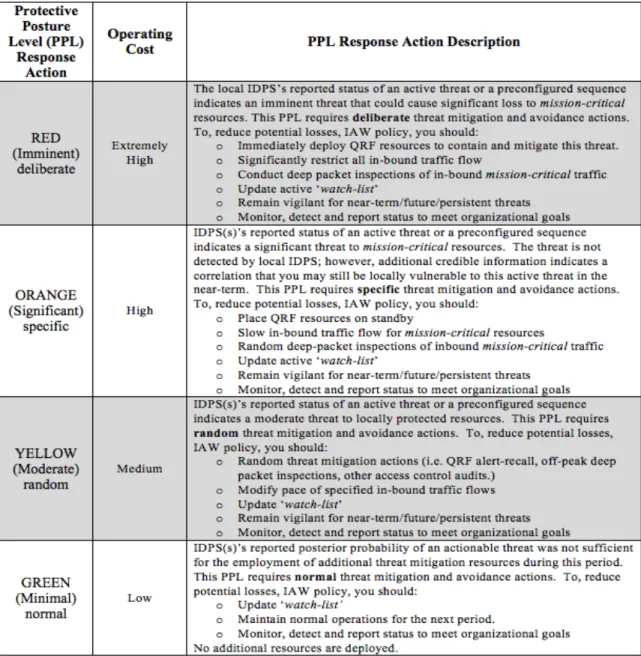
Table 5. Protective Posture Level Operating Cost Adapted from (Defense, 2001). ... 51
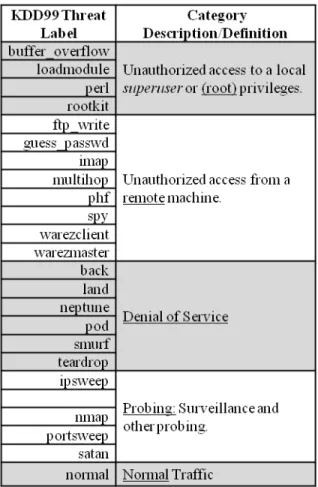
Table 6. KDD99 Threat label Category Definitions (Hettich & Bay, 1999) ... 52
Table 7. Determining Local Decision Support Profiles (DSP) Strategies ... 62
Table 8. 10%KDD99 Threat Labels and Category Statistics (Hettich & Bay, 1999) ... 65
Table 9. Threat Risk Factor Mapping to Threat-Severity Level (Pipken, 2000) ... 66
Table 10. Pilot Study-1 Initial Global Policy Dataset w/Errors ... 75
Table 11. Corrected 32-Sample Dataset errors ... 84
List of Acronyms
ANN Artificial neural network
CTSSB Critical Task Site Selection Board DoD Department of Defense
DSP Decision-Support Profile DSS Decision-Support System GDTA Goal-Directed Task Analysis
GTERS Global Threat Event Recommender System
HB Host Based IDPS
IDPS Intrusion Detection and Preventions System IDS Intrusion Detection System
IPS Intrusion Prevention System LAN Local-Area Network
MODESTA Modeling, Emulation, Simulation Tool for Analysis
NB Network-Based IDPS
NBA Network Based Analysis IDPS NBA Network Behavior Analysis IDPS OSI Open Systems Interconnections PPL Protective Posture Level
WNB Wireless Network-Based IDPS XOR Exclusive OR Function
AN ARTIFICIAL NEURAL NETWORK-BASED DECISION-SUPPORT SYSTEM FOR INTEGRATED NETWORK SECURITY
I. Introduction
Conventionally, isolating network security boundaries was an effective method of mini-mizing security vulnerabilities. Isolated defense worked well against targeted threats where the network security boundary was well defined. Today however, network security boundaries in Cyberspace span geospatial and geopolitical boundaries, making isolated network defense against globally occurring threats more undefined. To overcome this situation, this research calls for a strength-in-numbers approach to global threat network defense, where independent neigh-bors participate in global threat reporting. The hope is that the aggregated events can be filtered based on localized policy and interests to provide localized, customizable situational awareness and decision-support for isolated network defenders. Choosing the best course of action to im-plement such a collaborative effort can often be accomplished through modeling and simulation of the operational environment. The purpose of the modeling and simulation environment is to explore those conditions which likely provides the necessary information to support decision-making in real-time under similar conditions. This research effort develops such a simulated en-vironment using a single layer feed forward artificial neural network (ANN) to provide the deci-sion-support to the isolated network defender.
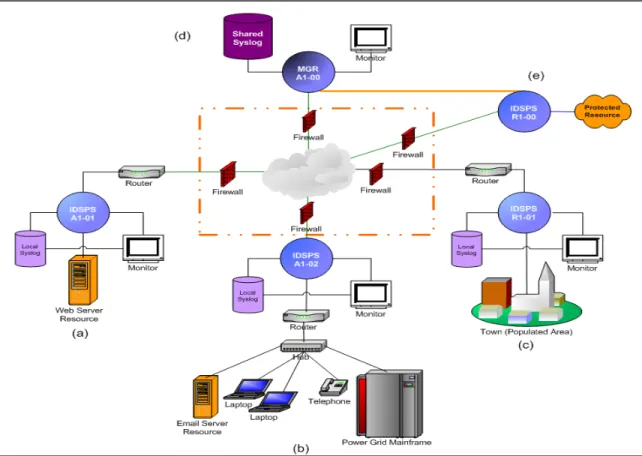
We begin with a background of the general situation and larger problem of modeling and simulating large-scale communication networks. There are five distinct local area networks that are separated by a firewall in the large-scale network (Figure 1) that represents a subset of the larger Cyberspace (i.e. The Internet). Each LAN’s local firewall provides specific filtering ser-vices for the LAN. Often times the configurations vary drastically, but as interests of the LANs become more similar, the configurations may also become more similar. The goal of the firewall, as a sensor, is to prevent unauthorized or undesirable traffic from entering the LAN security boundary. Sensors can take on several names in networking, to include access control lists, in-trusion detection systems, inin-trusion prevention systems as examples. These sensors enhance the decision-maker’s ability to monitor detect and respond to network security violations and threats. Appropriate responses enable the network security defender to win in Cyberspace. In static envi-ronments, where the threat is well defined, the strategic employment of sensors provides reliable decision-support. However, as the level of global threat sophistication increase, old rules may no longer apply for appropriate decision-making, and thus the strategy to win must be altered in a contested and dynamic operational environment of globally occurring threats.
The production of a plan or strategy to win becomes the courses of action that an entity hopes to attain as their winning goal, thus war-gaming is of significant importance for decision-makers, who desire to win. War-gaming is a conscious attempt to form a mental model of the area of operation’s situation (Wade Norman, 2010). Conventional war-gaming methods employ the belt, avenue-in-depth and the box techniques to model and simulate the operational environ-ment (U.S. Army, 2011). War-gaming is not strictly for the military, as business organizations employ terms like game-face, competitive advantage and corporate strategy.
Figure 1. The General Situation, Isolated Security Boundaries in Cyberspace
For the business organization, war-gaming is the strategy, plans, goals and objectives that they hope to achieve in order to gain a competitive advantage and minimize costs against threat vulnerabilities or aggressive competitors. The strategy is often rehearsed, actions and reactions are simulated and courses of action are further refined and developed that yield the best courses of action. Each disparate LAN has an independent strategy to win according to their organiza-tional goals and objectives. In (Figure 1a), a web server is being protected by the LAN’s firewall and intrusion detection device. (Figure 1b) has a LAN that provides network security for a power
Each LAN has a different set of protected resources, which needs a customized strategy to provide security vulnerability protection against a globally occurring threat event that crosses network security boundaries. These seemingly dissimilar LANs may share a common need to actively participate in defending against such a global threat. The development of a way to col-laborate across network security boundaries would provide a strength-in numbers approach to defending against global threats, where the adversary’s strategy is to win, by making organiza-tions lose indiscriminately. Defining a mental model, which provides simulated globally occur-ring threat situations, may lead to a winning strategy in Cyberspace. Mental models are tools that help people think about how something works. Building and maintaining effective mental models where complex systems are involved; require significant data filtering, are dynamic in nature, are adaptive in nature and are can create significant challenges to obtaining good SA (Endsley & Bolte, 2003).
Modeling and simulating mental models that represent Cyberspace as an operational bat-tlefield for good CSA, is an ongoing challenge for the Department of Defense (DoD). The Na-tional Cyber Range, using Strategic Initiative 2: Employ new defense operating concepts to pro-tect DoD networks and systems, is intended to enable the military and others to address this need by simulating and testing new technologies and capabilities (U.S. Army, 2011). The Army is developing the Modeling, Emulation, Simulation Tool for Analysis (MODESTA), which is a ho-listic tactical modeling and simulations program that provides a large-scale systems–of-systems approach to modeling and simulating Cyber activities, which enhances decision-support and war-gaming efforts in Cyberspace (Jontz, 2014). In fact, all branches of the US military are conduct-ing research in Cyberspace and developconduct-ing new ways to operationalize the manmade domain.
These efforts include the development of decision-support systems (DSS) and mental models that enhance the decision-making process by the Air Force’s Research Laboratory (AFRL) and Air Force Institute of Technology (AFIT).
AFRL has declared Cyberspace as the ultimate complex and adaptive system, and acknowledges that the DoD must develop and integrate real-time situational awareness mecha-nisms to enable contextual understanding and enhance decision-making domains (Phister, 2010). Phister contends that the DoD will require more than just purely defensive measures to achieve information superiority in Cyberspace. He calls for required information technologies in the Cognitive, Social, Information, and Physical Domains in Cyberspace. This research effort hopes to make contributions in the cognitive, social and physical domains by developing a mental model of a simulated IDPS environment using an ANN-based recommender system.
The research models the LAN’s culture to consist of the set of traffic-mix and the strate-gy to win given the traffic mix. The traffic mix is the traffic type (i.e. voice, video, data, Face book, email, secure voice, peak busy hour, bandwidth utilization etc.) that is unique to the LAN. No two sets separately managed LANs will have the exact same traffic mix. The organizational behavior modeling and simulation capability is derived from the local policy or threat mitigation responses that are appropriate for the organization that is providing network security defense. Information exploitation and understanding is achieved by providing the capability of localized interpretation of globally occurring events. These two items represent the cognitive and social domain elements of the research. The ANN-based recommender system represents the robust
Mental models of simulated complex systems like intrusion detection and protection sys-tems (IDPS) can provide information overload, out-of-the-loop syndrome and create complexity creep. As a result, full automation efforts can lead to inappropriate decision-making despite a change in the contextual environment (Endsley & Garland, 2000). The employment of the ANN-based mental model provides a partially automated solution that makes the best threat mitigation recommendation to the local network defender, given the occurrence of a global event.
Effective situation awareness in time sensitive environments is critical. In his thesis, Raulerson argued that cyber defenders must first have SA of their respective cyber networks in order to defend them (Raulerson, 2013). He went on to develop a tool that aggregates data from heterogeneous sensors creating a real-time network model using data fusion techniques for im-proved SA. Raulerson used the Common Vulnerability Scoring System to provide scores to vul-nerabilities and attacks categories in the CVE online repository to conduct his risk assessment of protected resources (Raulerson, 2013). This research adapts the CVE and risk factor calculations methods provided by Pipken (2002). Finally, Raulerson’s approach of aggregating from dissimi-lar sensors provided a SA picture using a centralized virtual machine to manage the network and demonstrated that data fusion using multiple disparate networks was beneficial.
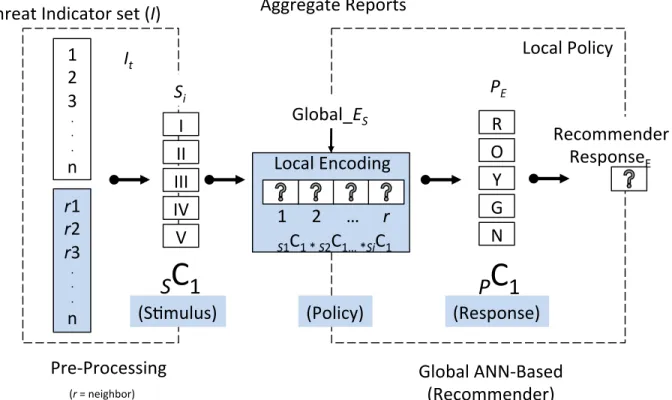
This research differs from Raulerson’s research effort in three primary ways. First, the ANN is employed as the communications infrastructure and the associated link weights are ad-justed during training. As a result there is no need to maintain a central repository of threats. In Raulerson’s the sensor’s ability to identify malicious traffic directly from five different sensor devices and assesses the amount of information that an administrator utilizes as a measure of da-ta reduction.
In this work, the second primary difference, the performance of the sensor devices are not con-sidered in the evaluation of the SUT, instead the ability to recommend the protective posture lev-el that matches expert human opinion is assessed.
Data reduction processing is not necessary for the network defender in real-time since the network’s physical structure contains the weights that specify the level of information contribu-tion from data resources (i.e. participant reports) this is significantly different from Raulerson’s work because it directly introduces the human-element into the overall threat mitigation and avoidance control loop. By doing this, the SUT can interpret multiple sensor inputs and provide a locally defined threat-severity level that maps to a desired protective posture level to mitigate or avoid threats.
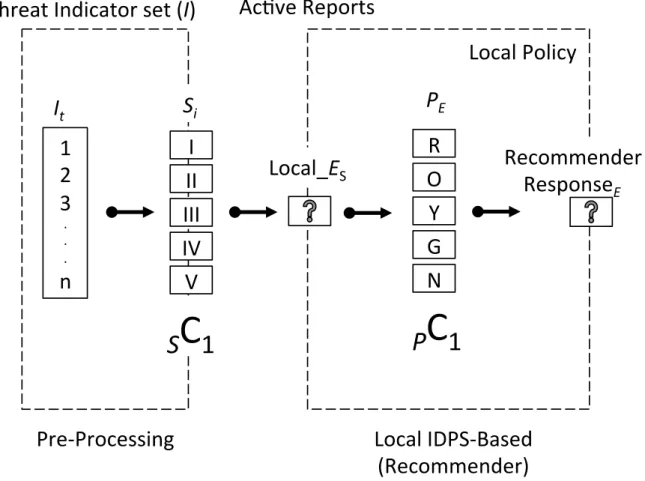
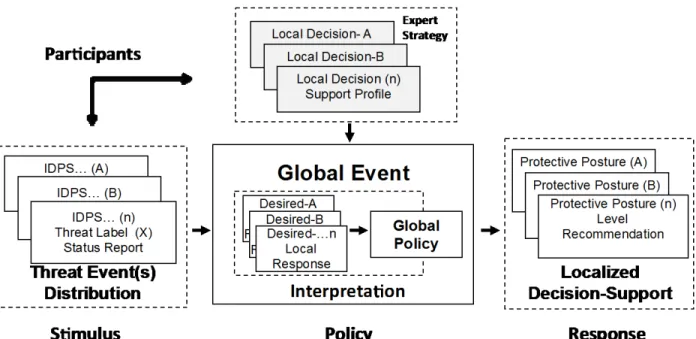
Each locally defined threat-severity level can then be mapped to a localized protective posture level. In the event that the pattern is detected in real-time, the ANN provides the protec-tive posture level recommendation specified in the Decision-support profile. The decision-support profile is determined off-line and learned by the ANN during training. Finally, the third distinction from Raulerson’s work, the resulting recommendation is customized for each inde-pendent participant based on their desired response given the global event detected using the ANN-based model. This capability provides a predictive decision-support capability for threat mitigation and avoidance. Because the ANN learns the expert’s desired-response, the local net-work defender does not have to process the details of the recommendation in real-time event de-tection. In Raulerson’s work, there is no method to provide customized real-time
decision-In research by Lyons (2014), a predictive recommender system that provides the Cyber defender a list of recommended defense actions based on information gained from nearest neigh-bor similarity assessments. Prior to this, little research had been conducted to develop a pure recommender system for cyber defense (Lyons, 2014). Although the research did not provide significant insight into comparable predictors, additional effort in this area may yield benefits.
From such inspiration, this research integrates IDPS agents from separate large-scale dis-similar networking environments using a single feed forward artificial neural network to generate security posture recommendations. Such recommendations are based on an aggregated global policy that provides localized recommendations for decision-support, which is different than pre-senting the network defender with a list of options as the decision-support mechanism. Further-more, this method does not store reports in a central repository, instead the ANN structure pro-vides a link-weighted structure that aggregates the contribution level of reports from several IDPS sensors and learns the appropriate response.
An ANN’s structure is a subset of complex adaptive system (CAS). The definition for a CAS in this research is: A complex system containing adaptive agents, networked so that the en-vironment of each adaptive agent includes other agents in the system (Holland & Miller, 1991). The IDPS agents utilize three simple rules of monitoring their operational environment for un-wanted traffic, detecting the status of unun-wanted traffic behavior and reporting the status of criti-cal SA element cues to decision-makers. Because the global Internet or Cyberspace in this con-text is comprised, of dissimilar and independent local area networks (LANs) they are represented as IDPS agents who provide IDPS services in the intrusion detection and prevention process (IDP). The emergent behavior of their independent threat reporting is learned by the ANN and recommends a threat mitigation protective posture level (PPL) to local decision-makers.
This thesis abstracts the IDP as a working model to investigate a specific case of how critical cue elements influence the war fighter’s SA and decision-making in collaborative envi-ronments. For example, the research shows that when sharing threat information, a decision-maker is presented with a clearer picture of globally occurring threats not only for their local en-vironment, but also for threats occurring at participating neighbor networks. As a result, this ad-ditional threat awareness provided by neighbors may provide actionable information to local-decision-makers if the neighbor reports are interpreted as something meaningful to the local area. Neighbor reports enable local decision-makers to make informed decisions on how to mitigate and avoid threats against their local network boundary, thus the reports provide local decision-support. Collaborative teams working toward a common goal of threat mitigation, has strength-in-numbers for network defense by sharing neighbor reports. By incorporating collaborative threat mitigation across security boundaries, interested business organizations and the DoD may benefit from collaborative neighbor reporting in Cyberspace.
The experimental results of the DSS show a 99.7% recommendation accuracy when trained exhaustively over small situation sets and a generalization accuracy of 96.35% (i.e. 9-fold cross-validation) when recommending protective postures for previously unseen threats. The research shows how an individual’s independent report of locally occurring threats contributes to a global threat operational picture and thus an increased situational awareness for the isolated network security boundary defender in Cyberspace.
1.1 Problem Statement
How can disparate expert security professionals share information across virtual network security boundaries while providing localized decision-support to novice defenders? The prob-lem should be addressed because the research effort enables novice local network defenders to make more appropriate and informed threat mitigation decisions. Often times, cultural or local policy prevent the sharing of threat information, leaving an isolated network defender vulnerable despite the existence of a true global threat that crosses network security boundaries in Cyber-space. If reports of the occurrence of threats are received in a timely manner to novice defenders, situation awareness may provide actionable decision-support in the defense of protected re-sources. The desire to assist the isolated defender leads to the motivation of this research.
1.2 Motivation
The motivation of this work is to assist the novice local network defender who has the complex task of network security and defense. Such novice defenders tend to rely solely on their intrusion detection and prevention systems to assist their decision-making, best practices and their own local policy guidance to achieve their organizational goals and objectives and less on higher levels of situational awareness.
How will our defenders act in isolation when unaware of globally trending threats which their networks are vulnerable? Physical isolation is a conventional method of minimizing vulner-abilities in a world where security boundaries are more defined (Ware, 1970). In Cyberspace, these previously defined physical network security boundaries become only virtual or semantic for a global adversary. The thought that isolation of a network provides the best defense strategy in the face of a globally occurring threat is just as conventional and outdated.
An isolated or unaware network defender is placed at a disadvantage against globally occurring threats. Employing group participation (i.e. strength-in-numbers) provides a method to minimize risk against globally occurring threats that cross network security boundaries. Such a method provides a greater benefit to defend against blind spots for network security. Previous leakage (Ware, 1970) of security vulnerabilities becomes a blind spot in Cyberspace in some situations like the mega breeches mentioned in a recent report, where personally identifiable information was compromised from public information systems (Symantec, 2014). This research effort hopes to contribute to the cause of providing collaborative network defense strength-in-numbers for those network defenders that desire to minimize risk against global adversaries that disregard conventional network security boundaries.
As other nations develop controls within Cyberspace as weapons, so too must the United States, which remains vulnerable by the very manipulation of information that could put the na-tion at a significant disadvantage and cripple our protected resources such as industrial control systems. By studying the nature of CAS, trust convergence, and the emergent behavior of glob-ally occurring threats in intrusion detection and prevention networks, this research adapts the concepts found in conventional neighborhood watch programs. Artificial Neural Networks (ANNs) concepts are employed to offer a neighborhood watch like protocol for global threat mit-igation and avoidance. The resulting emergent behavior of real-time threat event collaboration between groups of participating neighbors may provide actionable recommendations and deci-sion-support for local decision-makers.
1.3 Hypothesis
Effective Cyber SA can be achieved by employing an artificial neural network as a global threat event recommender system (GTERS) in intrusion detection and prevention environments. ANNs can encode expert security professional’s decision-support profiles for network intrusion detection and prevention networks to enable report collaboration across network security bound-aries and make best-fit protective posture level recommendations in uncertain situations. The ability to collaborate across network boundaries provides a strength-in-numbers approach to de-fense that provides decision-support to novice defenders based on expert knowledge.
The research aims to demonstrate a DSS capable of encoding expert user’s decisions about what threat protection posture level is most appropriate given a particular set of threat in-dicators. Such a system is intended to serve as a recommender system in the absence of an ex-pert security professional.
To accomplish this, a single-layer feed-forward artificial neural network (ANN) custom-ized with the back-propagation gradient descent algorithm to map the status of multiple local threat event detections as reported by IDPSs. The aggregated IDPS event reports are then used as stimulus to the ANN while the ANN response is used to recommend a best-fit protective pos-ture level that matches the local-decision maker’s desired response. The simulations environ-ment provides a environ-mental model to facilitate the developenviron-ment of the decision-support concept. The focus of this research is on the capability of the ANN to provide security posture level recom-mendations based on external network threats. The IDPSs are considered as being interconnected across a simulated secure communications infrastructure on a separate management network. Participants in the collaborative network are considered fully trusted.
The results of adjusting the learning rate of the ANN with 0.005, 0.3, 0.7 and 1.0 values show that the ANN can accurately recommend the learned protective posture levels of expert de-cision-makers 90% of the time using a noisy decision-support profile and 9-fold cross-validation. Without cross-validation or noise the ANN has a recommendation accuracy of 99.7% for the baseline profile. When tested using four independent decision-support profiles in collaboration, the ANN’s average generalization accuracy improves to 96.35% without noisy decision-support profiles and 9-fold cross-validation. The research shows significant accuracy for group collabo-ration using ANNs.
Having the capability to enable the novice network defender’s decision-making using ex-pert decision-support profiles is a significant step towards global-threat defense in collaborative network security environments. The ANN’s ability to encode independent threat reports into an aggregate global event provides the isolated defender with customized situation awareness about local threats of interest. Employing the generalization capability of the of the ANN structure to provide localized decision-support is different from any of the previous research efforts. The data implies that as more network defenders participate, a more representative global threat picture begins to emerge from the localized reporting actions of dissimilar defenders.
The ANN provides a robust and meaningful way to provide situational awareness about global threats that are occurring locally and those that are occurring against trusted neighbors. Such a capability can lead to effective strength-in-numbers, early warning capability, and reduce threat mitigation cost for Cyberspace security professionals. Having provided the specific research
1.4 Objectives
This research has three objectives. (1) Design, build and model a wide-area intercon-nected network using a software simulation package that will be used as the mental model to fa-cilitate understanding and evaluate the testing of the experimental objective. (2) Determine the effects of the interactions of critical element cues needed for SA and network defense in Cyber-space. These critical element cues will be modeled in the simulation to represent the status of monitoring, detecting and responding to threat traffic. And (3) to determine the effects of em-ploying an ANN, which encodes local expert decision-support profiles and recommends the best protective posture level given the occurrence of a global threat event in a simulated collaborative event detection environment.
The rest of this research is organized as follows; a literature review in Chapter II frames the situation of the intrusion detection process (IDP) that describes the behavioral interactions of the decision-maker and the intrusion detection and prevention system (IDPS) as the DSS. The system under test (SUT), research methodology, experimental hypothesis and the approach to achieve the experimental goals are found in Chapter III.
The experimental design was performed using a pilot study, single noisy decision-support profile scenario and a group collaboration scenario. The scenario results are then presented in chapter IV. The conclusions, contributions and future research recommendations are provided in Chapter V. The Appendix contains a survey to develop advanced decision-support profiles of Cyberspace security professionals.
II. Literature Review
“Behavior is a difficult subject matter, not because it is inaccessible, but because it is ex-tremely complex. … It is changing, fluid, and evanescent, and … makes great technical demands upon the ingenuity and energy of the scientist” (Skinner, 2005).
To understand how Cyber SA can be enhanced by a decision-support system (DSS), a brief introduction of situation awareness and decision-making provides the necessary back-ground on the development of intrusion detection and security automation. A brief historical overview of literature that explains the intrusion detection process (IDP), which describes a cus-tom relationship that exists between a human and the DSS, is made. After intrusion detection and prevention fundamentals and their employment strategies have been explored, a review of the phenomenon called emergent behavior and complex adaptive systems are discussed.
2.1 Situation Awareness
Situation awareness (SA) is defined as “the perception of the elements in the environment within a volume of time and space, the comprehension of their meaning, and the projection of their status in the near future” (Endsley & Garland, 2000). Effective SA has three components. Perception of the elements (the basic cues to make a decision in a given situation or context) in the environment is the first component and provides Level-1 SA. Challenges for modeling and
For the IDP, the element is the threat signature, label or perception of some unwanted or undesirable behavior that occurs or originates from external traffic mix sources. The traffic mix is the data that the IDPS filters for a network security boundary. The elements can change de-pending on the time of day, the interpretations of an element’s status and meaning or several fac-tors that may contribute to why an element is a cue.
The second component of SA is the comprehension of the current situation and represents Level-2 SA. Understanding and synthesizing the interactions of element cues are critical in providing decision-support that enables the successful attainment of organizational goals and ob-jectives. Level-3 SA is the projection of future states and is the last component of SA. After per-ceiving the status of the elements (Level-1), synthesizing now they interact in a particular con-text (Level-2) the user is now able to predict the status of the elements in the near future (Endsley & Bolte, 2003). Projection can thus be formalized as understanding what the current situation means to you in the future. At the lowest level (i.e. survival) projection is the recogni-tion of danger in a given situarecogni-tion. Such projecrecogni-tions then shape decision-making.
As Cyberspace security professionals perform the IDP to protect their network bounda-ries, they employ DSSs to assist and shape their decision-making. In isolated network defense environments, the network defender’s local DSS can only provide shaping support for locally occurring threats. The decision-maker must find alternative decision-support avenues to gain a global situational awareness (i.e. contact higher authorities to determine if some unknown traffic is malicious or not). By enabling collaboration of threat reports, perhaps the time to provide meaningful decision support could have been achieved near real time.
A meaningful DSS enables the mental model of the decision-maker and allows for higher levels of SA to be achieved (Endsley & Garland, 2000). The role of mental models is to compliment DSSs and is invaluable to achieving good SA (Endsley & Garland, 2000).
As previously mentioned a mental model is a method that people use to better understand something and are key enablers of comprehension and projection. Endsley and Garland (2000) assert that mental models are systematic in nature and contain both a semantic knowledge and system knowledge of how something works. Semantic knowledge is the logical meaning or in-terpretation of something, where system knowledge knows about the more tangible components of how and what something is. In physical environments, systems knowledge is more concrete, while semantic knowledge can vary significantly (e.g. language).
In addition, experience plays a significant role in SA when using mature and experienced mental models. Experience with mental models can create a level of positive automaticity, which can appear as automatic behavior responses (Endsley & Garland, 2000). Positive automa-ticity is learned or reinforcement from previous instances (i.e. experiences) of making appropri-ate decisions in similar situations for the decision-maker. As the decision is made more often without negative consequences, the decision-maker is relieved of dedicating significant amounts of thought before making the decision. As a result, experienced decision-makers may appear to be in an automatic state when making decisions because of the positively reinforced decisions, which Endsley and Garland (2000) call automatic behavior.
Caution should be used when developing modeling and simulation tools that provide a stale or old status of elements in dynamic operational environments, where behaviors evolve over time and the status of a particular element’s meaning has changed with relation to the perceived or actual impact on achieving organizational goals and objectives. Making automatic decision us-ing inappropriate element status perception can be detrimental. Mental models can incorporate validity, similar to playing poker, or risk assessments before automatically deciding to act on sensitive or priority tasks. In time-sensitive environments, the automated approach might be the best choice in uncertain situations when using an errant mental model.
The ANN’s ability to provide an approximated best-fit protective posture level based on the mental model of an expert security professional will be assessed to determine how well the ANN’s recommendation accuracy is when faced with unseen data. This measure of performance provides the generalization accuracy of the ANN recommender system. High generalization ac-curacy further enables the decision-maker to make appropriate decisions and accomplish their organizational goals and objectives, thus providing enhanced SA.
Endsley and Garland (2000) introduce a concept called goal-directed task analysis (GDTA), which is a design approach that focuses on the basic goals of the operator, major deci-sions needed to accomplish the goals and the SA requirements for each decision. Another ap-proach is to use the Delphi study method (Turof, 1975), or the Army’s Critical Task and Site Analysis Board process (Army, 2004). Both processes conduct an analysis of a job or skill set population and each have several phases that include interviewing human subjects, assessing the current skills, abilities, and required knowledge to be successful decision-makers.
These design methods can enhance mental model and simulation capability by obtain validation of the basic goals, decision of monitoring, detection and responding to intrusions and the percep-tion and comprehension elements. This work presents a survey based on the SA model intro-duced by Endsley and Garland (2000) that is designed to develop an expert mental model that can be used to train an automated system for security professionals. In particular, the system presented here specifically address intrusion detection and prevention related jobs. Such surveys can take up to a year or more to obtain validated data. The proposed survey for this research has been included in Appendix A.
As expert DSPs are developed, in theory, the ANN can learn and recommend more com-plex protective posture recommendations to novice Cyberspace security professionals. In this way, team collaboration supported by ANN structures is warranted for future research.
2.2 Team Situation Awareness Considerations
Endsley and Garland (2000) define team SA as “the degree to which every team member possesses the SA required for his or her responsibilities”. Interestingly, team SA is different from SA in that it is the degree to which all members have the same SA on the same requirements.
Shared SA requirements should include shared SA devices, mechanisms, requirements and processes for those teams. These requirements can be determined using survey techniques like the Delphi Method, the CTSSB, or the GDTA job analysis surveys. These methods focus on the overlap of shared requirements. The realization here is that such concepts for SA are directly
2.3 Historical Overview of Automation for the Intrusion Detection Process
Intrusion detection is the process of monitoring the events occurring in a computer sys-tem or network and analyzing them for signs of possible incidents, which are violations or immi-nent threats of violation of computer security policies, acceptable use policies, or standard secu-rity practices (Scarfone & Mell, 2007). An intrusion detection system (IDS) is software that au-tomates the intrusion detection process.
An intrusion prevention system (IPS) is software that has all the capabilities of an intru-sion detection system and can attempt to stop possible incidents. Both devices are used inter-changeably and will be referred to as Intrusion detection and prevention systems (IDPS).
Hart (2005) provided a history of intrusion detection systems, in which he identified three factors that contributed to the need for intrusion detection. The first is increased acquisition and usage of resource-sharing systems in the DoD. A growing need to employ resource-sharing sys-tems within an open computing environment while maintaining security was the second factor. Resource-sharing systems are those that distribute the resources of a computer system, allowing geographically separated people the capability to work on the system concurrently (Ware, 1970). Ware (1970) further asserts that security boundaries vulnerabilities are leakage points that come in five groups: physical surroundings, hardware, software, communications links, and organiza-tional (i.e. personnel and procedures). Employing a combination of protection features can safe-guard the leakage points.
Interestingly, Ware (1970) called for an immediate modification to policy to allow mili-tary centers and contractors to acquire and operate such systems. This call led to the develop-ment of security audits on these geographically separated resource-sharing systems and the third factor in the development of intrusion detection.
The third factor that led to the creation of intrusion detection, Unmanageable volume of audit data being produced, contributes to the motivations of conducting this research effort (Hart, 2005). Intrusion detection emerged as a discipline from computer security where the focus is on resource –sharing systems.
A standard vocabulary for discussing intrusion detection was provided by (Anderson, 1980), which and outlined the fundamental problem of conducting a security audit trail. Ander-son argued the following: that independent audit trails from multiple systems are more difficult for security analysts in networked environments to analyze in real time.
Instead, Anderson proposed a security monitoring surveillance system that would auto-mate the process of conducting security audits. Furthermore, he suggests that a correlation of events between groups would provide additional granularity for identifying abnormal behavior. Providing information in real-time was an enduring challenge. Analysis of the first intrusion de-tection models revealed that IDPS initially fell into two distinct categories: anomaly detection and signature detection (Denning, 1986).
The next milestone for IDPS occurred with the introduction of the Network System Mon-itor (NSM), which provided the ability to monMon-itor network traffic (Bace, 2000). The Distributed Intrusion Detection System (DIDS) was the first integration of host and network-based intrusion detection capabilities and garnered large-scale support from the U.S. Air Force, the National Se-curity Agency, and the U.S. Department of Energy (Hart, 2005). The DIDS established itself as the first integrated tool for collecting and correlating evidentiary data related to computer misuse,
This section provided the historical creation of the intrusion detection system that formed the anomaly detection and the signature based detection initial categories. The next section de-scribes two additional IDSP categories, the fundamental functionality of IDPS, their types and typical operational employment.
2.3.1 Intrusion Detection and Prevention Fundamentals
A network security boundary experiences the arrival and departure of networking traffic in ways that match the organizational culture, design, communications needs and network ser-vices. Collectively, the characteristic of the network traffic that enters and departs a network se-curity boundary is considered its traffic mix (e.g. a voice network may have a high traffic volume of voice data using UDP, but only has low TCP traffic for file transfers.
The ability to monitor a given traffic mixture within a specific computing area, detect suspicious, malicious or unwanted traffic signal activity, and report to those detected signals are inherent to all software or hardware based intrusion detection devices. Devices with additional proactive response abilities are called IPS, because they actively provide prevention and protec-tion for selected critical-resources. This research combines such capabilities in a simulated envi-ronment to show how collaboration among distinct networks enhances the protection of critical-resources. The process of intrusion detection requires an evolving role-sharing partnership be-tween a Cyber security professional’s decision-making ability coupled with an IDPS ability to filter and classify traffic mix, detect undesirable traffic, and report intrusive (i.e. malicious) ac-tivity. Given the volume and rate of data entering such a network, the Cyber security profession-al’s ability to make informed decisions on how to best protect network resources depends heavily on their ability to configure and interpret reports from the IDPS.
Such responses then can be translated into configurations for the IDPS. The goal is to allow the IDPS to handle threats based on the configurations rules so that the security professional can then make informed, appropriate and timely decisions.
Knowledge of network behavior and situational awareness are critical skills of a Cyber security professional. The Cyber security professional, in fact, it is the IDPS’s ability to provide information summarization that creates enhanced situational awareness. This interdependency works well for Cyber security professional's that have a mature understanding of their managed networking environment and a deep understanding of the IDPS configuration rule-sets.
This relationship between the security professional and the IDPS is critical in that a weak point will increase the workload of the security professional. In this way, the security profes-sional increases the workload of the Cyber security profesprofes-sional. In this regard, the Cyber securi-ty professional is performing the monitoring, detecting, and reporting of the network conditions rather than allowing the IDPS to be automated extension of their capabilities.
This conventional relationship creates two bottlenecks. One exists with the automation of the device itself. Although the device is capable of precisely processing and detecting signals near network speeds with an average delay of 1 microsecond, its accuracy becomes inappropriate in dynamic network environments (Carter, 2006). However, if no signature matches, then the nefarious traffic will go undetected by the IDPS.
Such an inability to adapt to the varying traffic signatures degrades the effectiveness of the IDPS, and places a larger load on the decision-making of the Cyber security professional.
Such a lack of situational awareness leads to an incomplete understanding the operational envi-ronment and an inability to apply appropriate configurations that support their local network. Together, the Cyber security professional’s decision process and the IDPS’s detection ability, determine the accuracy and precision of the IDP.
The Cyber security professional is continuously monitoring their network conditions, en-acting policy and operational changes. Cyber security professionals are interested in defending their assigned critical resources within their area of responsibility and monitor the response(s) of their IDPS for signs of intrusions, an alerting signal indicating a need to modify or repair their device(s), or a need to make decisions that will mitigate, shape or prevent future intrusions with-in their direct or supported networkwith-ing environment.
2.3.2 Current Intrusion Detection and Prevention Systems Usage
Modern IDPS systems are primarily focused on identifying possible incidents. In par-ticular, their primary role is to identify reconnaissance activity that could indicate imminent at-tack on protected internal networks (Scarfone & Mell, 2007). Due to an increasing dependence on IT and potential impact of an intrusion against those systems, IDPSs have become a necessary addition to the security infrastructure (Scarfone & Mell, 2007). Some critical aspects of intru-sion detection devices include their type, functions, major capabilities, implementation strategies, and interconnectedness.
Key functions of all intrusion detection and prevention devices are monitoring, detecting and reporting events. Reporting and alert methods are conventionally done in the form of email, IDPS GUI, syslog messages, SNMP traps, custom defined scripts(Scarfone & Mell, 2007).
A report provides detailed information about the conditions of the network during the occurrence of the alerting event. More advanced devices are capable of preventing intrusions in addition to simple detection capability.
Prevention functions include automatic modification of user security profiles when a new threat is detected and are designed to prevent three categories of attacks (Scarfone & Mell, 2007). Category 1 includes stopping the attack by terminating connections or settings, blocking access to target devices from the offending source, and blocking all access to the target from the offending source. Category 2 includes changing the security environment by modifying the con-figurations and settings of other security controls to disrupt an attack. Reconfiguring router ac-cess control lists, altering host-based firewall settings, and applying patches to a host if the IPS detects host vulnerabilities are examples. Category 3 changes the content of the attack payload, removes or replaces malicious portions of an attack’s payload to diffuse potentially destructive capability. This is accomplished by file removal of suspicious emails or by packet-normalization where a packet is inspected, and repackaged after suspicious content has been discarded.
Despite such abilities to prevent these three categories of attacks, malicious or uninten-tional security violations can still occur through user evasion, dynamic malware payload, or sim-ple modifications to existing exploitation techniques. To defend against this, a tuning process must be continuously conducted between the device and the Cyber security professional to achieve maximum performance levels. The tuning process can be formalized for intrusion detec-tion and prevendetec-tion methods to protect against these categories of attacks.
This is the simplest form of detection, but a Cyber security professional’s lack of understanding of misuse is confounded with multiple user application usage. Anomaly based detection (ABD) is the second detection method. This process monitors and compares observed events to normal baseline traffic behavior. This is an effective technique but is resource intensive to construct a common operation picture that describes normal behavior of the network and individual user profile patterns. The third method is called State Protocol Analysis.
The process of state protocol analysis is an advanced version of the signature-based pro-cess where collective trusts of signature definitions based on protocol usage are shared. Compar-isons of these predetermined signature profiles are made against observed events to identify any deviations. Trust dominates this concept because a vendor specific profile specifies how a pro-tocol should or should not be used (Carter, 2006). Finally, the last primary method of detection is the Combination. The combination method provides a mixture of the above methods. Using multiple methods of detection enables the security professional the opportunities reduces the overall security risk and reduce leakage that may arise from just a single method alone. This method is usually more costly and complex to maintain however provides more accurate and broad coverage of the protected network resources. Raulerson’s research employed multiple sensor types in his research, which was found to be beneficial (Raulerson, 2013).
2.3.2.1 Intrusion Detection and Prevention System Types
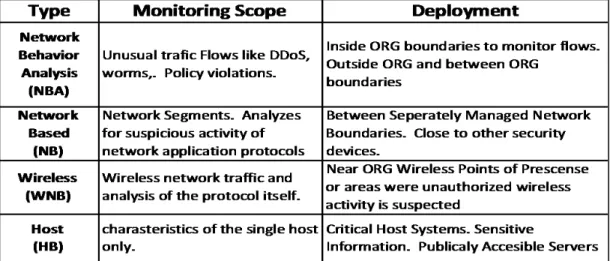
There are four types of intrusion detection devices (Scarfone & Mell, 2007). Each type has a recommended monitoring scope and likely places that the device can be employed in the network boundary to detect transport or layer three and four protocol of the open systems inter-connections (OSI) model.
The network behavior analysis (NBA) type of IDSP is typically used to detect traffic mix viola-tions that would cause denial of service to the organization’s network services or resources. NBA systems are found inside network boundaries to detect insider threats, outside network bounda-ries to detect outside threats, and between the two dispersed, yet commonly managed network boundaries when an organization is geographically dispersed.
The network based (NB) IDPS is typically employed to monitor network segments and analyzes segments of the network for suspicious traffic at the application layer of the OSI model. NB IDPSs can be found placed between separately managed network security boundaries and close to mission critical resources.
Wireless network behavior (WNB) IDPS are customized to detect malicious traffic like the NBA and NB types, however the NB has specialized ability to detect the wireless medium transport protocols (i.e. Wi-Fi, hotspots). WNB can be found near an organization’s primary point of presence that provides wireless networking services to customers. The actual device is employed in a location to provide the best detection of malicious traffic to protect authorized wireless customers within the wireless security boundary.
The host based (HB) IDPS is the oldest type and is typically employed to provide IDP for a specific network device or individual host. These types can be found near mission critical re-sources within network security boundaries, i.e. secure data storage areas, financial web servers, industrial control devices, databases that contain personally identifiable information, (Scarfone & Mell, 2007).
These IDPS types are summarized in Table 1 and can be employed to meet the needs of the security professional, and usually are managed using from the same network that the device filters traffic on. A multi-level architecture involves the management of IDPS devices that pro-vided filtering services on more than one network interface card and in multiple IP address spac-es. Multi-level architectures are discussed next.
Table 1. Intrusion Detection Types, Deployment and Scope (Scarfone & Mell, 2007).
2.3.2.2 Multi-Level Architecture for Intrusion Detection and Prevention
To avoid attacks on the security system itself, the management network is hidden from other network traffic using a separate physical network interface (Scarfone & Mell, 2007). In this way, one network interface is used in the filtering of a network’s traffic mix (inbound or outbound), while the other is reserved for the secure management of the IDPS system. There are three benefits to having a hidden management network: 1) bandwidth assurance, 2) conceal-ment of IDPS identity from malicious users, 3) and protection from attacks.
Some disadvantages to maintaining a separate management network include additional cost to maintain the network, which is easily mitigated with the implementation of virtual local area network (VLAN). The major components of the IDPS architecture will be discussed next.
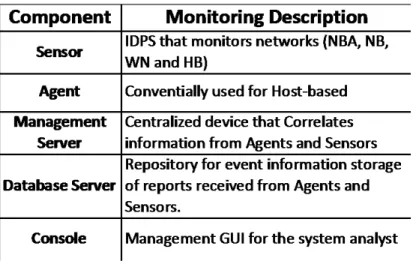
There are five primary components in the IDPS security architecture. The primary IDPS is often called sensor components because it provides the monitoring, detection and reporting of configured signatures. Sensors are used for all four types of IDSPs. The second components are agents, which are typically deployed in host-based IDS employment configurations. The man-agement server component provides a way to centralize and correlate information from multiple IDSP that are dispersed through a commonly managed network security boundary. The database server component of the security architecture provides a repository for event information storage of IDPS reports that agent components and sensors provide to the management server. The last component, console, is the component that provides a visualization of the intrusion detection process for the security professional. IDPS. Table 2 provides a summary of the IDPS security architecture components found in the special publication of the National Institute of Standards and Technology 800-94. (Scarfone & Mell, 2007).
Having discussed IDP and IDPS fundamentals, the concept of what an agent is can now be introduced for this research. The IDPS represents the decision-support agent that uses the three IDP rules of monitoring, detecting and reporting of malicious traffic. The agents provide network boundary protection for the entire local area of interest in the modeled IDP environ-ment. In this way, the IDPS agent is a HB that has sensor capability for the entire LAN. Due to the nature of the IDPS as an agent, we discuss the role of the agent in complex adaptive systems during the next section.
2.3.2.3 Intrusion Detection Process as a Complex Adaptive System
Holland and Miller (1991) introduced the concept of complex adaptive systems (CAS). This work describes a system that consists of a network of interacting agents that exhibit a dy-namic, aggregate behavior. The behavior emerges from the individual activities of the agents and as a result, its aggregate behavior can be described without a detailed knowledge of the be-havior of the individual agents. This ability to define an observable bebe-havior or response without understanding the underlying conditions that brought about the condition is the discovery of emergent behavior phenomenon. Holland and Miller (1991) also define a complex adaptive agent (CAA) as an agent that satisfies an additional property of possessing the capability within a CAS to be assigned a value and the agent behaves to increase this value over time, thus forming the basis of a learning system. The definition for a CAS in this research is: A complex system containing adaptive agents, networked so that the environment of each adaptive agent includes other agents in the system (Holland & Miller, 1991). Phister (2010) refers to Cyberspace as the Ultimate CAS and outlines the challenges faced by the DoD to model and simulate a Cyberspace battlefield for military support operations (Phister, 2010).
This research models a large-scale IDP simulation environment as an interconnected set of IDPS, acting as complex adaptive agents. The independent actions of each IDPS agent pro-vide threat reports that are occurring at their local network security boundary. The ANN’s CAS structure is employed as the primary enabler of the aggregation of the independent agent reports. The result of these aggregated reports realized by the ANN structure provides protective posture level recommendations in real-time as decision-support for the Cyberspace network security pro-fessional.
Section 2.3 discussed current usage of IDPS as DSS, their functions, types, and architec-ture and how this research simulates a networked environment using sensory IDPS as agents to form a CAS. The phenomenon of emergent behavior discovery is a goal of this research and is introduced next.
2.4 Introduction to Emergence
Agents performing three simple rules create a situation where the development of a men-tal model, which explains a larger behavior, seemingly disjointed and very complicated. How can the aggregate reporting of independent agent components of network security boundaries somehow yield an emergent behavior that provides enhanced SA to network security profession-al? In his seminal work, Lewes (1875) asserts, “Every resultant is either a sum or a difference of the co-operant forces; … The emergent is unlike its components insofar as these are incommen-surable, and it cannot be reduced to their sum or their difference" (Lewes, 1875).
Such naturally occurring behaviors are biologically based and variations occur in human society (Easley & Kleinberg, 2010). In the field of complexity, local emergence is where collec-tive behavior appears in a small part of a system and global emergence occurs where colleccollec-tive behavior pertains to the system as a whole (Bar-Yam, 1997). Miller and Page 2007 argued that the Law of large numbers including the Central Limit Theorem can provide a theorem which ex-plains the relatively general conditions under which certain types of emergent behavior from sto-chastic micro level levels actions of individual agents can arise. The Law of large numbers is one of several theorems expressing the idea that as the number of trials of a random process in-creases; the difference between the expected and actual values goes to zero (Renze & Weisstein, 2014). Thus the aim of this research is to study how the phenomenon of emergence occurs within a system of collaborating IDPSs that is interconnected using a single layer feed forward ANN. Adapting the universal nature of emergence, manmade controls to control emergence in commu-nication networks are found in the next section.
2.4.1 Emergence in Communications Networks
Since all biological systems are results of evolutionary processes that show, robustness and adaptive powers (Floreano & Mattiusi, 2008), other disciplines develop algorithms that mim-ic the natural evolutionary process. Evolution in biology discipline is defined as: the change in genetic composition of a population over successive generations, which may be caused by natu-ral selection, inbreeding, hybridization, or mutation, a concept introduced by Charles Darwin in 1809 (Quammen, 2008). Within the field of CAS, emergent behavior can occur as: open-loop emergent behavior or feed-back loop emergent behavior.
Open-loop emergent behavior is observed as a restructuring of a network from repeated applications of internal stimulus. A network’s behavior that is restructured by external stimulus defines the process of feedback-loop emergent behavior (Lewis, 2009). In this research, local policies, organizational goals and objectives are the primary stimulus that contributes to open-loop emergence if it occurs. The traffic mix and any malicious activity detected represent the feedback-loop emergent behavior if it exists in this research. It is interesting to think about local policy as a contributing stimulus for open-loop emergent behavior and is discussed further in the next section.
2.4.2 Emergence as a Result of Local Policy and Objectives
Constraints are based on organizational goals, and are tested in this research only to ob-serve the system for open-loop or feedback-loop emergent behavior characteristics, if it exists. Such constraints in learning systems may provide a good representation for local policy network defense. Local policy actions typically, only have local change of a larger governing system and occur at the tactical or micro level. It is interesting to see multiple individual local policies having together in sufficient numbers, that their collective behavior is seen as an emergent be-havior, specifically open-loop emergent bebe-havior, i.e. one that did not exist before and could not be expressed by an individual.
The process of developing the modeling a simulations environment enabled an intuitive understanding of how the application of the ANN as a CAS is able to aggregate the individual
If the two LANs share a common distribution of network threats, have similar traffic mixtures, and similar local policy strategies for network defense, then one can assign an arbitrary value to their particular approach to network defense. The probability that the average or mean µ de-sired-response and situation events pairs differ (i.e. independent expert DSPs) by less than some arbitrary value tends to approach 1 as we increase the number (i.e. IDPS agents) in the collabora-tive system. In such a system, a stable aggregate property (i.e. Global Policy of learned DSPs), emerges from combining the reporting activities of the IDPS agents.
As discussed in Miller and Page (2007) the restriction is that the common distribution has mean µ, here the IDPSs average defense strategy is similar. This is profound for network defense and implies that the more similar in nature that LANs are, the more likely that their re-sponses will be similar when faced with network threats. This research employs artificial neural network concepts to facilitate such network policies and to determine if this possible emergent behavioral response is significant.
2.5 Artificial Neural Networks
Artificial neural networks (ANN) are biologically inspired computational networks. The hope is that such a system may enhance the IDPS and security professional’s decision-making cycle by acting as a DSS. This section discusses the fundamentals of neural network engineer-ing that began as threshold logic, fundamentals of ANNs, feed forward sengineer-ingle layer ANN struc-ture, the back propagation gradient descent algorithm the sigmoid activation function and k-fold cross-validation.
2.5.1 Fundamentals of Neural Network Engineering
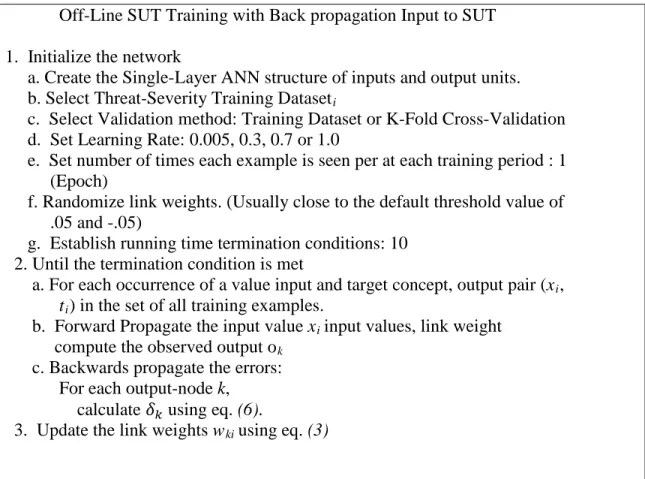
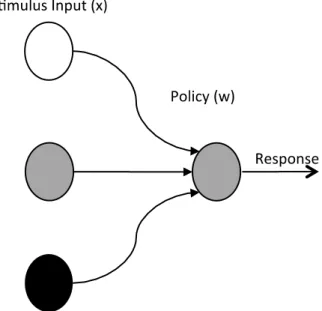
McCulloch (1943) established the term threshold logic that would branch into computa-tional logic and artificial intelligence. Rosenblatt (1953) introduced the perceptron as a pattern recognition system based on a two-layer learning model. The perceptron’s inability to solve the exclusive or (XOR) problem limited the pattern recognition systems to only linearly separable types of patterns (Floreano & Mattiusi, 2008). The implication is that the pattern could be divid-ed into two groups, if a pattern was introducdivid-ed to the system that did not distinctly fall into one of the groups, it could not be classified. Solving the XOR problem with additional computation-al units (i.e. hidden nodes) was accomplished using back propagation (Williams, Rumelhart, & McClelland, 1986) leading the way for additional gains in machine learning and artificial intelli-gence. Artificial networks are computational models of biological neural network systems in the form of software and hardware (Floreano & Mattiusi, 2008). In machine learning, artificial neu-ral networks (ANNs) have the independent goal of obtaining highly efficient learning algorithms, despite the emulation of biological processes.
ANNs can provide practical methods of machine learning using algorithms such as back propagation and are the best among interpreting complex sensory data (Mitchell, 1997). The SUT code snippet employing the back propagation algorithm adapted from Mitchell (1997) and Wilensky (2006) is presented next.