Repository ISTITUZIONALE
Multicriteria Evaluation for Top-k and Sequence-based Recommender Systems / Monti, Diego Michele. - (2020 May 07), pp. 1-195.
Original
Multicriteria Evaluation for Top-k and Sequence-based Recommender Systems
Publisher:
Published DOI:
Terms of use: Altro tipo di accesso
Publisher copyright
(Article begins on next page)
This article is made available under terms and conditions as specified in the corresponding bibliographic description in the repository
Availability:
This version is available at: 11583/2841172 since: 2020-07-22T19:48:37Z Politecnico di Torino
Doctoral Program in Computer and Control Engineering (32 cycle)
Multicriteria Evaluation for
Top-k and Sequence-based
Recommender Systems
Diego Michele Monti
* * * * * *
Supervisors:
Prof. Maurizio Morisio, Supervisor Dr. Giuseppe Rizzo, Co-supervisor
Doctoral Examination Committee:
Prof. Luis Martínez-López, Referee, Universidad de Jaén
Prof. Olga C. Santos, Referee, Universidad Nacional de Educación a Distancia Prof. Andrea Bottino, Politecnico di Torino
Prof. Marco Torchiano, Politecnico di Torino Dr. Iacopo Vagliano, Amsterdam UMC
cial – NoDerivatives 4.0 International License. Visit http://creativecommons. org/licenses/by-nc-nd/4.0/ to view a copy of this license.
I hereby declare that, the contents and organisation of this dissertation constitute my own original work and does not compromise in any way the rights of third parties, including those relating to the security of personal data.
Diego Michele Monti Turin, May 7th, 2020
Context The need of effectively identifying relevant items from a potentially
over-whelming catalog has led to the creation of automatic approaches for supporting users of online platforms in such a time-consuming task. Recommender systems are software tools and algorithms designed to suggest items to users according to their preferences. The traditional goal of the recommendation problem is to cre-ate a ranked list of suggestions for each user. However, a more novel paradigm is represented by algorithms capable of exploiting the temporal dimension of the available ratings, known as sequence-based recommender systems. Differently from the field of information retrieval, performing an offline experiment for comparing multiple recommendation approaches is a challenging task, as the ground truth is represented by the subjective preferences of the users collected before the introduc-tion of the system under evaluaintroduc-tion. Nevertheless, it represents a powerful tool for selecting the most promising approaches to be further tested in subsequent trails.
Goal In this dissertation, we study how to perform the offline evaluation of a
generic recommender system by exploiting a multicriteria approach that relies on a set of heterogeneous metrics. We provide an answer to the following research questions: what is the current state-of-the-art regarding multicriteria recommender systems and how their are evaluated in literature; how can a multicriteria evalu-ation approach be exploited for comparing different sequence-based recommender systems; what is the most suitable protocol for performing an offline evaluation of a top-k recommender system; and to what extent the structure of a rating dataset
can influence the results of an offline evaluation.
Method To answer the first question, we investigate the topic of multicriteria
recommender systems with a systematic literature review. Regarding the second question, we propose an evaluation framework called Sequeval designed to com-pare in a replicable way different sequence-based recommenders considering eight dimensions. With respect to the third question, we introduce RecLab, an evalua-tion toolkit designed following a distributed approach to overcome some limitaevalua-tions of the currently available evaluation solutions. Finally, for addressing the fourth question, we describe a method based on data visualization to explore the structure
versions of an existing collection of ratings.
Results From the systematic literature review, we observed that is not possible to
directly compare the results obtained with different multicriteria recommendation approaches due to the extreme variability in the reported experimental protocols. We exploited Sequeval and RecLab to successfully conduct some experimental cam-paigns involving different recommenders and datasets. The availability of multicri-teria metrics enables the experimenter to obtain a more comprehensive picture of the systems under consideration. We validated our visualization method and gener-ative approach by qualitgener-atively and quantitgener-atively comparing the results obtained with different rating datasets. Finally, we considered two novel recommendation approaches as possible use cases of multicriteria evaluation methods.
Conclusion In summary, this dissertation deals with the problem of conducting
an offline comparison of recommender systems considering both traditional and sequential scenarios. We designed the proposed frameworks for addressing the most critical problems that emerged from literature, namely the non-reproducibility of the results, the comparability of different studies, and the bias of relying on a few metrics only. The software code of our frameworks is freely available on the Web in an attempt to foster further reuse and extension.
This dissertation represents the end of a journey that lasted about three years and a half and it would not have been possible without the help and the continuous support of different people with whom I had the privilege to collaborate.
First of all, I would like to thank my supervisor, prof. Maurizio Morisio, for encouraging me to pursue a doctorate title and for always helping to face the difficulties that such a choice necessarily implies, and my co-supervisor, Giuseppe Rizzo, for always trying, and hopefully succeeding, in making me a more mature researcher. Indeed, I would like to thank prof. Marco Torchiano, for recruiting me as a teaching assistant since my first year and for introducing me to the topic of data visualization, and Luca Ardito, for the always precious advice and suggestions. A very special thank goes to Iacopo Vagliano, for helping to orientate myself in the complex world of recommender systems during my early days, and to Enrico Palumbo, for the countless hours spent together debating mathematical equations and configuration parameters of our experiments.
Of course, I would like to mention all the colleagues and friends who con-tributed to the positive and vibrant atmosphere of Lab 1, strictly in alphabeti-cal order: Alysson Dos Santos, Amirhosein Toosi, Edoardo Battegazzorre, Erion Çano, Francesco Strada, Isabeau Oliveri, Mariachiara Mecati, Riccardo Coppola, Rifat Rashid, and Simone Leonardi.
Several experimental activities that I conducted would not have been possible without the computational resources kindly provided by the hpc@politoproject
(http://hpc.polito.it), to which I am grateful.
Last but not least, I would like to thank my parents for their unconditional love and fundamental support during this journey.
List of Tables x
List of Figures xii
Glossary xiii
1 Introduction 1
2 Background 9
2.1 Recommender Systems . . . 9
2.1.1 Top-k Recommender Systems . . . 10
2.1.2 Sequential Recommender Systems . . . 11
2.1.3 Review-based Recommender Systems . . . 13
2.1.4 Linked Data-based Recommender Systems . . . 14
2.2 Offline Evaluation . . . 14
2.2.1 Experimental Reproducibility . . . 15
2.2.2 Beyond Accuracy . . . 17
2.2.3 Visualization Approaches . . . 17
2.2.4 Synthetic Datasets . . . 18
3 Multicriteria Recommender Systems 19 3.1 Methodology . . . 20
3.1.1 Research Questions and Search String . . . 20
3.1.2 Selection Process . . . 22 3.1.3 Quality Assessment . . . 22 3.1.4 Data Extraction. . . 23 3.1.5 Synthesis . . . 24 3.2 Results . . . 24 3.2.1 Included Studies . . . 25 3.2.2 Research Problems . . . 25 3.2.3 Recommendation Approaches . . . 30 3.2.4 Multicriteria Techniques . . . 32 3.2.5 Application Domains . . . 35
3.2.7 Evaluation Metrics . . . 37 3.2.8 Evaluation Datasets . . . 39 3.2.9 Future Works . . . 40 3.3 Discussion . . . 43 3.3.1 Included Studies . . . 43 3.3.2 Research Problems . . . 43 3.3.3 Recommendation Approaches . . . 44 3.3.4 Multicriteria Techniques . . . 44 3.3.5 Application Domains . . . 47 3.3.6 Evaluation Protocols . . . 48 3.3.7 Evaluation Metrics . . . 48 3.3.8 Evaluation Datasets . . . 49 3.3.9 Future Works . . . 49 3.3.10 Threats to Validity . . . 50 3.4 Conclusion . . . 51
4 Evaluation of Sequence-based Recommender Systems 53 4.1 Sequence-based Recommender Systems . . . 55
4.2 Sequeval Evaluation Framework . . . 58
4.2.1 Evaluation Protocol. . . 59 4.2.2 Evaluation Metrics . . . 60 4.2.3 Implementation . . . 65 4.3 Experimental Analysis . . . 67 4.3.1 Experimental Setup . . . 68 4.3.2 Datasets . . . 69 4.3.3 Results . . . 71 4.3.4 Discussion . . . 73 4.4 Conclusion . . . 75
5 Evaluation of Top-k Recommender Systems 77 5.1 RecLab Evaluation Framework. . . 78
5.2 Interaction Protocol . . . 80 5.3 Evaluation Metrics . . . 82 5.3.1 Coverage . . . 82 5.3.2 Precision . . . 83 5.3.3 Recall . . . 83 5.3.4 nDCG . . . 83 5.3.5 Novelty . . . 83 5.3.6 Diversity . . . 84 5.3.7 Serendipity . . . 84 5.4 Experimental Results . . . 84
6 Qualitative Analysis with Rating Datasets Visualization 89
6.1 Visualization Approach . . . 90
6.1.1 Scatter Plot Construction . . . 90
6.1.2 Software Implementation . . . 91
6.2 Evaluation Campaign . . . 93
6.2.1 Experimental Setup . . . 93
6.2.2 Discussion . . . 94
6.3 Conclusion . . . 96
7 Generation and Evaluation of Synthetic Datasets 99 7.1 Dataset Generation . . . 100
7.1.1 User Clustering and Distribution Learning . . . 101
7.1.2 Rating Sampling . . . 101
7.2 Experimental Setup . . . 102
7.3 Results . . . 104
7.3.1 Number of User Communities . . . 104
7.3.2 Synthetic and Reference Datasets . . . 104
7.4 Conclusion . . . 106
8 First Use Case: Semantic Review Recommender 109 8.1 Approach . . . 110
8.1.1 Semantic Annotation and Discovery . . . 111
8.1.2 Recommendation . . . 114
8.1.3 Ranking Functions . . . 115
8.2 Evaluation Procedure . . . 116
8.3 Evaluation Results . . . 118
8.3.1 Optimizing the SemRevRec Parameters . . . 118
8.3.2 Comparison with Baselines . . . 123
8.4 Discussion . . . 124
8.5 Conclusion . . . 126
9 Second Use Case: Music Recommender System 127 9.1 Ensemble . . . 128
9.2 Recurrent Neural Networks. . . 129
9.2.1 Input Vectors . . . 130 9.2.2 Learning Model . . . 132 9.2.3 Generating Predictions . . . 133 9.3 Title2Rec . . . 133 9.4 Optimization . . . 134 9.4.1 RNN Optimization . . . 135
9.4.3 Ensemble Optimization . . . 137
9.5 Experimental Results . . . 138
9.6 Conclusion . . . 139
10 Conclusion and Future Work 141
10.1 Limitations . . . 143
10.2 Future work . . . 144
A Systematic Literature Review 147 B Publication List 161
2.1 Comparison of recommendation techniques . . . 10
2.2 Example of rating matrix. . . 11
3.1 Digital libraries considered . . . 21
3.2 Inclusion and exclusion criteria . . . 22
3.3 Studies per selection step . . . 23
3.4 Quality questions . . . 23
3.5 Data extraction form . . . 24
3.6 Studies per recommendation approach . . . 32
3.7 Studies per recommendation technique . . . 35
3.8 Studies per evaluation protocol . . . 37
3.9 Studies per evaluation metric . . . 39
3.10 Studies per category of future work . . . 42
3.11 Benefits and issues of the techniques . . . 46
4.1 Statistics about the sequences . . . 69
4.2 Experimental results with Yes.com . . . 72
4.3 Experimental results with Foursquare . . . 72
4.4 Time to evaluate the algorithms . . . 73
4.5 Interpretation of the metrics . . . 74
5.1 Evaluation with MovieLens 1M and random splitting . . . 85
5.2 Evaluation with MovieLens 1M and timestamp splitting. . . 85
5.3 Evaluation with LastFM and random splitting . . . 86
6.1 Experimental comparison with LastFM . . . 95
7.1 Statistics about the synthetic datasets . . . 103
7.2 Precision obtained by varying the clusters . . . 104
7.3 Experimental results with the synthetic MovieLens 100K . . . 105
7.4 Experimental results with the synthetic MovieLens 1M . . . 106
7.5 Experimental results with the synthetic LastFM . . . 107
8.1 Properties of the discovery phase . . . 113
8.2 Statistics about datasets and reviews . . . 116
8.3 Configuration parameters of SemRevRec . . . 119
8.4 Experimental results with MovieLens and DBpedia . . . 119
8.7 Experimental results with Wikidata . . . 123
8.8 Comparison using the MovieLens dataset . . . 124
8.9 Comparison using the LibraryThing dataset . . . 124
8.10 Comparison using the LastFM dataset . . . 125
9.1 Results of the RNN models . . . 136
9.2 Results of different approaches . . . 139
1.1 Overview of the dissertation structure . . . 6
3.1 Systematic literature review protocol . . . 20
3.2 Studies per year of publication . . . 26
3.3 Quality scores per publication type . . . 26
3.4 Quality score per quality question . . . 27
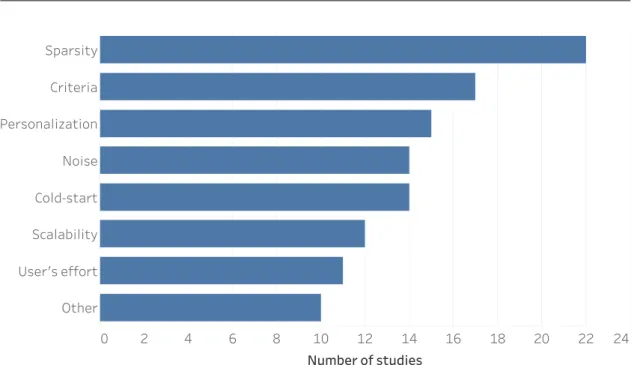
3.5 Studies per research problem . . . 30
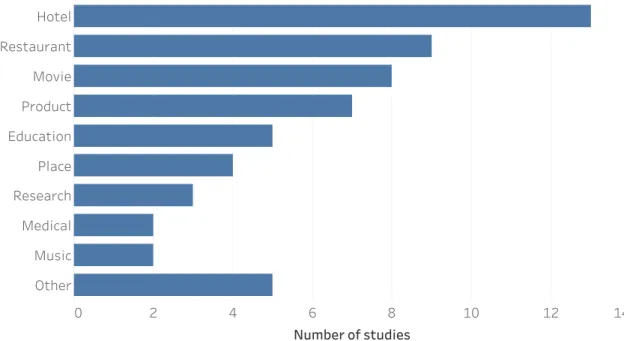
3.6 Studies per application domain . . . 36
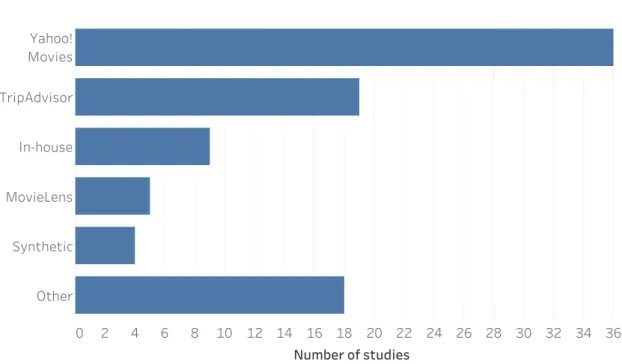
3.7 Studies per evaluation dataset . . . 41
3.8 Ideal multicriteria recommender . . . 47
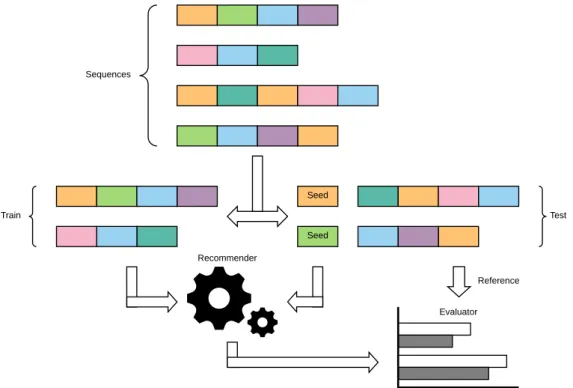
4.1 Sequeval evaluation procedure . . . 60
4.2 UML class diagram of sequeval . . . 66
4.3 Number of ratings per item . . . 70
5.1 RecLab interaction protocol . . . 81
6.1 Scatter plot of MovieLens 100K . . . 92
6.2 Scatter plot of MovieLens 1M . . . 93
6.3 Configuration of RS-viz. . . 94
6.4 Scatter plots of LastFM . . . 97
8.1 SemRevRec architecture . . . 112
8.2 Entities extracted from the reviews . . . 117
8.3 nDCG with MovieLens and Wikidata . . . 121
8.4 Comparison between DBpedia and Wikidata . . . 122
9.1 Ensemble architecture for playlist completion. . . 128
9.2 RNN architecture for playlist completion . . . 129
9.3 Pipeline for the title embedding model . . . 131
9.4 Strategies for generating track predictions . . . 134
collaborative filtering (CF): a recommendation approach based on the rating
be-haviour of similar users on similar items.
content-based recommender system: a recommendation approach based on the
pref-erences of the users and the characteristics of the items.
evaluation framework: an evaluation protocol, a set of evaluation metrics, and, if
available, a software implementation of them.
evaluation protocol: the procedure that needs to be followed by a researcher to
perform an experiment.
hybrid recommender system: a recommendation approach that combines different
techniques to select the suggested items.
knowledge-based recommender system: a recommendation approach based on
ex-ternally encoded domain knowledge.
multicriteria evaluation: an experimental approach based on a comprehensive set
of different evaluation metrics.
multicriteria recommender system: a recommender system that exploits multiple
ratings per item expressed over different criteria.
offline evaluation: an experimental approach based on user preferences collected
before the introduction of the system under evaluation.
online evaluation: an experimental approach that consists in making a novel
rec-ommender system available to a potentially large community of users.
rating dataset: a dataset containing the preferences expressed by a set of users over
a catalog of items at a certain timestamp.
recommender system (RS): a software tool and an algorithm designed to suggest
personalized sequences of items.
sequential recommender system: a recommender system designed to consider the
timestamp associated with user ratings.
synthetic dataset: a rating dataset created in an artificial way.
top-k recommender system: a recommender system capable of suggesting a list of
the k most relevant items per user.
user study: an experimental approach that consists in making a recommender
Introduction
Due to the large variety of products and digital content available on the Web, an increasing number of people are interested in obtaining personalized suggestions, in order to reduce the effort of inspecting all the items in a catalog for selecting the best one according to their preferences. An automated tool capable of recommending items to users in a personalized way is defined as arecommender system [112].
Recommender systems (RS) were initially conceived at the beginning of the 1990s [51] and, nowadays, they are considered part of a research field that is in-dependent from information retrieval [61]. In fact, while search engines are based on queries and, therefore, they react to user stimuli, recommender systems try to automatically identify items that could be of interest for a certain user [11].
A popular recommendation technique, called collaborative filtering (CF), con-sists of learning users’ preferences by only relying on their interactions with the items available in a catalog. For example, using a nearest-neighbor search or a ma-chine learning model, it is possible to select the most relevant items for each user who has interacted enough with the system [122]. An alternative approach to this problem is represented by content-based recommenders, which can generate sug-gestions by matching users’ profiles with the features of the items [11,12]. Another family of recommendation methods proposed in the literature is represented by hy-brid algorithms that are capable of combining both collaborative and content-based filtering for mitigating the individual weaknesses of the previous techniques [120].
In a collaborative filtering setting, users are typically required to rate items that are already familiar with, relying on a numerical scale, for example a 5-star scale. This value should objectively represent the utility that the user gained from the consumption of that item. Given a sufficient number of users and ratings, a recommender system is capable of predicting the utility score that a user would assign to unrated items [4]. The items with the highest predicted rating are finally suggested to the user, in a top-k ranked list.
A well-established line of research is related to the minimization of the error in predicting these values. However, such a task has limited practical applications,
because several techniques capable of predicting ratings with a high accuracy are already available [102]. Furthermore, accurate suggestions may sometimes not be the most useful ones for users [61]. For example, predicting high ratings for a popular item is probably accurate, but not meaningful, as users are likely to be already aware of that item.
In recent years, this traditional approach has been put aside in favor of others closer to the needs of the users. For example, many recommender systems now rely on binary or implicit signals in order to create a personalized experience [55]. Those signals are more intuitive to be understood and easier to be generated. An-other important factor that has started to be considered as a possible input of the recommender is the temporal dimension of the preferences [108].
In general, the offline evaluation of recommender systems is a challenging task, because, differently from the field of information retrieval, the ground truth is always uncertain, as it is based on the subjective preferences of the users collected before the introduction of the system under evaluation [62]. In fact, it is widely known that novel recommendation approaches should be evaluated in the context of online experiments involving human subjects in order to obtain reasonably robust results about their performance.
Nevertheless, most of the studies available in literature support their conclusions with offline trails relying on the preferences of users collected without considering the algorithms under investigation [55]. Despite the possible weaknesses of this ap-proach [116], offline experiments are extremely popular among researchers because of their limited costs and the theoretical reproducibility of their results. In indus-try, they are usually considered a powerful tool for pruning the number of possible recommender systems that need to be tested with real users, thus mitigating the economical impact of eventual failures.
This dissertation discusses how to perform the offline evaluation of a generic recommender system by exploiting a multicriteria approach that relies on a com-prehensive set of different metrics. By adopting the proposed protocols, it is pos-sible to obtain a more general picture of the systems under evaluation, avoiding frequent problems like the popularity bias and the non reproducibility of the re-sults. We experiment with multiple offline evaluation techniques in the context of both traditional and sequential recommenders.
Furthermore, we investigate the main characteristics of different rating datasets and how they can influence the performance of the systems that rely on them. Fi-nally, we also consider the topic of multicriteria from a different angle, by analyzing existing methods for exploiting a multifaceted knowledge of users’ preferences.
More formally, we answer to the following top-level research questions.
RQ1 What is the current state-of-the-art regarding multicriteria recommender
RQ2 How can a multicriteria evaluation approach be exploited for comparing
dif-ferent sequence-based recommender systems?
RQ3 What is the most suitable protocol for performing an offline evaluation of a
top-k recommender system?
RQ4 To what extent the structure of a rating dataset can influence the results of
an offline evaluation?
As regards RQ1, we conduct a systematic literature review to investigate in dept the field of multicriteria recommender systems, considering the exploited rec-ommendation approaches and how the proposed algorithms were evaluated.
We analyze the different machine learning and data mining techniques typically exploited in literature and we classify them according to the recommendation phase. Furthermore, we review how the proposed algorithms have been evaluated with respect to the experimental settings, the metrics, and the datasets. In Chapter3, we provide detailed answers to the following research questions.
RQ1.1 What are the most relevant studies addressing multicriteria RSs? RQ1.2 What are the most challenging problems faced by researchers? RQ1.3 What are the approaches used by multicriteria recommenders? RQ1.4 Which techniques and methods have been proposed?
RQ1.5 In which domains multicriteria recommender systems are applied? RQ1.6 Which protocols and frameworks are used for their evaluation? RQ1.7 Which metrics are considered during their evaluation?
RQ1.8 Which datasets are used for testing the algorithms? RQ1.9 What are the most promising directions for future works?
With respect to RQ2, we research and prototype an offline evaluation frame-work called Sequeval that is designed to evaluate recommender systems capable of suggesting sequences of items, instead of lists of items. In Chapter 4, we pro-vide a set of mathematical definitions to characterize in a precise way what is a recommender system capable of suggesting sequences. In detail, we expand the traditional concept of rating by adding to it the notion of temporal dimension.
Then, we propose to consider a sequence as a temporally ordered list of ratings and a sequence-based recommender as a function that is able to return a sequence given its required length and a seed rating. These definitions are conceived as an
extension of the seminal works on recommenders capable of suggesting sequences available in literature [108].
Starting from this formalization, we propose an evaluation protocol that can be applied to any sequence-based recommender system. First, an initial dataset is transformed into a set of sequences. Then, the available sequences are split between training and test sets. At this point, one or more external recommenders are plugged into the framework: they are exposed to the training sequences and they are asked to create suggested sequences starting from the same seeds of the test ones. Finally, considering the recommendations available, the framework can compute eight different evaluation metrics.
We report the lessons learned using this framework for assessing the performance of four baselines and two recommender systems based on conditional random fields and recurrent neural networks, considering two rating datasets. Sequeval is publicly available and it can be exploited by researchers and practitioners when experiment-ing with sequence-based recommender systems, providexperiment-ing comparable and objective evaluation results. In Chapter 4, we consider the following research questions.
RQ2.1 What is the formal definition of a sequence-based recommender system? RQ2.2 How already established metrics can be extended and adapted for
evaluat-ing a sequence-based recommender system?
RQ2.3 Against which baseline approaches a sequence-based recommender system
can be compared?
For addressing RQ3, we introduce RecLab, an evaluation toolkit discussed in Chapter 5 and based on RESTful APIs that can be used to overcome the problem of evaluating traditional recommenders in heterogeneous settings. In fact, because the recommenders are deployed on different servers, the evaluator does not need to know their implementation details.
The researcher can specify the experimental parameters in a Web-based inter-face for starting a new evaluation campaign. RecLab will then contact all the recommenders selected as part of the comparison and it will display the results computed considering a comprehensive set of seven different metrics.
We propose a Web-based interaction protocol in order to standardize the pro-cedure for evaluating the recommenders. The evaluator first requests the training of a new model, then it provides the training set created according to the settings of the experiment. When the model is ready, the evaluator asks the recommender to create a list of k suggestions for each user of the test set. The results of all
experiments are permanently stored and publicly available in order to support ac-countability and comparative analyses. In Chapter 5, we provide an answer to the following research questions.
RQ3.1 How can different top-k recommender systems be fairly compared in
het-erogeneous settings without necessary exposing their algorithms?
RQ3.2 To what extent it is possible to support the reproducibility of the
experi-ments and the accountability of the results?
RQ3.3 How can the availability of different metrics support the experimenter in
the interpretation of the obtained results?
Regarding RQ4, we explore a method for visualizing the structure of a rat-ing dataset in Chapter 6 and we discuss how to generate a synthetic dataset for evaluation purposes in Chapter 7.
We introduce a qualitative approach based on data visualization for creating a graphical summary of any collection of user preferences. This method is useful for visually identifying similarities and differences among various rating datasets. In fact, if two datasets result in similar visualizations, the behavior of different recommender systems relying on them will be consistent. Furthermore, we develop a Web-based tool, named RS-viz, for easily constructing the proposed visualization and comparing rating datasets in an intuitive way. In Chapter 6, we consider the following research questions.
RQ4.1 How can data visualization techniques be exploited to create a graphical
summary of the main characteristics of a rating dataset?
RQ4.2 To what extent the graphical representation of different rating datasets can
be useful to easily identify their similarities and diversities?
Another relevant problem that we try to address in this dissertation is related to the shortage of publicly available rating datasets. In fact, it is necessary to rely on a collection of user preferences obtained in a particular domain to perform an offline experiment, but the availability of such datasets is often limited. Some researchers have started to rely on synthetic ratings. However, the results obtained from these experiments may be questionable, as the generated datasets are usually not capable of capturing the characteristics of a particular domain of interest.
For this reason, we propose an approach for automatically generating synthetic datasets with a configurable number of users leveraging on a reference dataset that is used as the seed of the process and that encodes the peculiarities of a domain of interest. Such a method could also be exploited for anonymizing existing datasets before their public release in the context of privacy-aware suggestions. In Chapter7, we analyze the following research questions.
RQ4.3 What is the impact of using a synthetic dataset instead of a real one on
RQ4.4 Can a generative approach be exploited to create a synthetic dataset that
exhibits properties similar enough to the ones of a real dataset?
RQ4.5 To what extent this method can be consistently applied to datasets from
different domains and of different sizes?
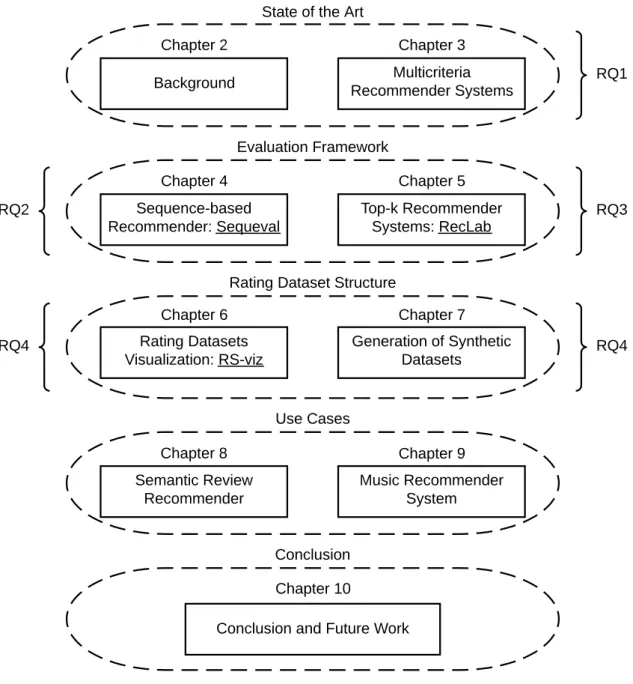
Multicriteria Recommender Systems Sequence-based Recommender: Sequeval Top-k Recommender Systems: RecLab Rating Datasets Visualization: RS-viz Generation of Synthetic Datasets Semantic Review Recommender Music Recommender System Background Chapter 2
State of the Art
Evaluation Framework
RQ1
RQ2 RQ3
Conclusion and Future Work
RQ4 RQ4
Rating Dataset Structure
Use Cases Conclusion Chapter 3 Chapter 4 Chapter 5 Chapter 6 Chapter 7 Chapter 8 Chapter 9 Chapter 10
Figure 1.1: An overview of the dissertation structure illustrating its division in chapters, the top-level research questions and the main outcomes of the related research activity. The software tools developed are underlined.
In summary, as depicted in Figure 1.1, this dissertation deals with the problem of conducting an offline comparison of recommender systems from different per-spectives. We analyze existing approaches for exploiting multicriteria ratings, with a special emphasis on the methods currently employed for validating the quality of the suggestions. Then, we discuss multicriteria evaluation techniques, considering both sequence-based recommenders as well as more traditional approaches. Fur-thermore, we explore the problem of selecting the right dataset according to the evaluation context by visualizing its structure and generating alternative versions of it. Finally, we apply our knowledge of multicriteria evaluation techniques to dif-ferent use cases. We propose and evaluate with an ensemble of metrics a semantic review recommender capable of annotating product reviews to extract useful infor-mation from them and a music recommender system designed to create playlists starting from a few songs that represent the seeds of the process.
The remainder of this dissertation is organized as follows. In Chapter 2, we review existing recommendation and evaluation approaches available in literature and the associated challenges. In Chapter3, we report the results of a systematic literature review dealing with the topic of multicriteria recommender systems. In Chapter 4, we introduce Sequeval, our framework for evaluating sequence-based recommender systems, while, in Chapter5, we discuss RecLab, a Web-based eval-uation toolkit for top-k recommenders. In Chapter 6, we describe a qualitative
method for visualizing the ratings available in any collection of users’ preferences. In Chapter7, we present our approach for generating a synthetic dataset that ex-hibits the same properties of a real one. In Chapter 8, we report on the creation and evaluation of a semantic review recommender, while, in Chapter9, we describe our approach for automatically generating music playlists. Finally, in Chapter 10, we formulate our conclusions and we discuss open issues and possible future works.
Background
Nowadays, the amount of information available on the Web is overwhelming. For this reason, the availability of tools capable of selecting from a huge catalog a short list of items that are of potential interest for a particular user is a critical success factor for almost any online platform. Therefore, recommender systems represent one of the technical solutions commonly employed in industry to address the issue of effectively exploring a vast horizon of possible choices.
A related and equally popular approach is represented by search engines. De-spite the common roots of these solutions, the task of evaluating with an offline experiment a recommender system is usually more challenging, as the ground truth is represented by subjective, and sometimes even emotional, preferences.
In this chapter, we first review some of the recommendation approaches available in literature (Section2.1), then we discuss the main challenges associated with their offline evaluation (Section2.2).
2.1
Recommender Systems
According to Ricci et al. [112], recommender systems are software tools and algorithms designed to suggest items to users according to their preferences.
In general, recommender systems can be classified in different categories based on the recommendation approach. The most widespread categories of recommender systems are content-based, collaborative filtering, knowledge-based, and hybrid [4], as summarized in Table 2.1. Content-based recommenders only rely on the past preferences of the current user in order to construct her profile and select sug-gested items. In contrast, collaborative filtering approaches analyze the behaviour of similar users for identifying candidate items. A knowledge-based recommender embeds domain-specific knowledge that is used for matching user requirements with items of potential interest. Finally, hybrid approaches combine in many dif-ferent ways the previous methods. Other less common categories of recommender
systems include community-based and demographic techniques [19]. A community-based recommender also considers the relationships of trust among its users, while a demographic recommender mainly relies on demographic profiles.
Method Advantages Disadvantages
Content-based Transparency, limited
privacy issues Requires a descriptionof the items Collaborative filtering Scalability, only based
on ratings Data sparsity and coldstart problems Knowledge-based No interaction history
required Difficult to the createthe model
Hybrid Combines multiple
ap-proaches together Limited performance
Table 2.1: Comparison of the advantages and disadvantages of the recommendation techniques mentioned in [4].
A detailed analysis of the recommendation approaches available in literature is beyond the scope of this dissertation. Many authors already conducted different studies dealing with the topic of recommender systems. Park et al. [102] reviewed hundreds of journal articles for analyzing the main application fields and data mining techniques exploited by different recommenders. Hong et al. [66] discussed the literature about context-aware recommenders, while Figueroa et al. [44] and Çano et al. [21] conducted systematic literature reviews about Linked Data and hybrid recommender systems respectively.
More recently, Quadrana et al. [108] classified different approaches according to their capability of managing sequences of items. Portugal et al. [105] reviewed commonly exploited machine learning techniques, while Zhang et al. [139] discussed the most promising deep learning methods for generating personalized items.
In the following, we briefly introduce a formal definition of the recommenda-tion problem. Then, we review the recommendarecommenda-tion approaches considered in this dissertation, that is top-k, sequential, review-based, and Linked Data-based ones.
Please note that sequence-based recommender systems are a generalization of se-quential recommenders and they will be defined later in Section4.1.
2.1.1
Top-k Recommender Systems
Traditionally, recommender systems try to identify for each user an item that maximises the utility that she should gain from the consumption of that item [18]. In other words, recommender systems estimate a utility functionR(υ, ι) that, given
a user υ ∈ U and an item ι ∈ I, predicts if ι should be recommended to υ. In
function. The formal definition of this problem, as provided by Adomavicius & Tuzhilin [2], is reported in Equation 2.1.
∀υ ∈ U, ι′υ = arg max
ι∈I R(υ, ι) (2.1)
In practice, users are commonly asked to quantify their preferences with nu-merical values, called ratings. For example, ratings could be the number of stars assigned to a product or the indication if they liked or not a movie. Therefore, the utility function R is used by the system to calculate the ratings that users would
probably assign to unknown items. Such a value measures the appropriateness of recommending an item to a certain user.
The ratings already available can be represented as a matrix, similar to the one illustrated in Table2.2. In real systems, this matrix should be sparse, because the number of unknown cells is usually extremely elevated [112]. In fact, users can provide ratings on a limited set of items, especially if the catalog is very large.
Item_1 Item_2 Item_3 Item_4 Item_5
User_1 5 3 4 4 ?
User_2 ? 1 ? 3 3
User_3 4 3 ? ? 5
User_4 3 ? 1 ? ?
User_5 ? 5 5 2 1
Table 2.2: An example of rating matrix. Unknown ratings are denoted with an interrogative mark.
Different approaches can be exploited to compute unknown ratings. For exam-ple, in a collaborative filtering setting, popular techniques include user-based or item-based k-NN and matrix factorization methods [69].
Even if the recommendation problem is traditionally formalized as the task of predicting unknown ratings, many commercial systems provide to each user a ranked list of suggestions [81]. Therefore, a recommender system capable of select-ing k items per user can be defined as a top-k recommender. It is straightforward
to obtain a top-k list starting from the predicted ratings, as it is sufficient to sort
them and select only the items with the highest computed values [2].
2.1.2
Sequential Recommender Systems
A recommender system designed to consider the timestamp associated to user ratings can be defined as a sequential recommender [108]. In the following, we review some examples of sequential recommenders available in literature.
Zhou et al. [140] proposed a web recommender system based on a sequential pattern mining algorithm. The recommender is trained with the access logs of a website and its goal is to predict the pages that are likely to be visited by a certain user, given her previously visited pages. The authors proposed to store the model in a tree-like structure, relying on a technique originally designed for matching substrings over a finite alphabet of characters. A recommendation is then created by matching the sequence of pages already visited by the target user with the sequences previously analyzed by the algorithm.
In the context of market basket analysis, it is also possible to exploit the se-quence of previous transactions to predict what a customer is going to buy next [5]. Rendle et al. [110] proposed a method based on personalized transition graphs over Markov chains, while Wang et al. [134] designed a recommender capable of modeling both the sequential information from previous purchases and the overall preferences by a hybrid representation.
Bellogín and Sánchez [15] proposed a similarity metric designed to compare users in the context of CF recommender systems. This metric takes into account the temporal sequence of users’ ratings to identify common behaviors. The au-thors argue that it is possible to consider a sequence of items as a string, where each character represents an item, and compare them using the longest common subsequence algorithm [63].
More recently, He et al. [59] introduced the concept of translation-based
rec-ommendation. While a traditional recommender only considers the pairwise inter-actions between items and users, their idea is to model a third-order relationship among a user, the items she interacted with in the past, and the item she is going to visit next. Each user can be represented as a vector in a transition space: given the current item, it is possible to compute where the next one will be located. At recommendation time, it is possible to generate a list of suggested items by relying on a nearest-neighbor search.
On the other hand, the task of generating recommendations of sequences was already discussed and presented in a seminal work by Herlocker et al. [62]. The authors suggested that it would be intriguing to be able to suggest, in the music domain, not only the songs that will be probably liked by a certain user, but also a playlist of songs that is globally pleasing. Moreover, they also proposed to apply this recommendation methodology in the context of scientific literature, where it is necessary to read a sequence of articles to become familiar with a certain topic.
The problem of recommending music songs was later addressed by Chen et al. [28], who designed and implemented a recommender system capable of generat-ing personalized playlists by modelgenerat-ing them as Markov chains. Their algorithm is capable of learning, from a set of training playlists, how to represent each song as a point in a latent space. Then, starting from a seed song, it is possible to create a playlist of an arbitrary length by repeatedly sampling the transition probabilities
between adjacent songs. The resulting playlist is personalized because of the cho-sen seed. Furthermore, each user can influence the generation process by specifying some parameters: for example, a user might be more interested in popular songs, while another one in songs that are strictly related to the given seed.
Another typical application for a sequence-based recommender is thenext
point-of-interest (POI) prediction problem [108]. Given some training sequences of pre-viously liked geographical locations, this task consists of predicting a sequence of venues that is pleasing for a given user. Feng et al. [43] proposed an algorithm capable of creating sequences of POIs that have not been already visited. The au-thors developed a Metric Embedding algorithm that captures both the sequential information and individual preference. Such metric is then exploited to create a Markov chain model capable of representing the transition probabilities between a given POI and the next one. The key features that are implicitly considered in the embedding creation phase are the conceptual similarity and the geographical distance of the analyzed venues.
A different line of research is represented by recommenders capable of analyz-ing sequences of multimedia objects. For example, Albanese et al. [7] proposed a hybrid recommender system for retrieving multimedia content based on the the-ory of social choice and capable of exploiting, among other signals, the implicit browsing preferences of its users. Later, the authors of [8] introduced a multimedia recommendation algorithm capable of combining semantic descriptors and usage patterns. The proposed approach can manage different media types and it enables users to explore several multimedia channels at the same time. Possible applications of such technologies are represented by browsing tools for virtual museums [10] and recommenders of cultural heritage sites [123].
2.1.3
Review-based Recommender Systems
The exploitation of user reviews in recommender systems is a well-known re-search topic, as reported by Cheng et al. [27]. Some techniques try to tackle the problem of building the profile of users by analyzing their reviews, while others focus on the identification of the main features of the items to recommend.
Different strategies have been proposed in the literature to address the latter problem. Some researchers have suggested methods able to identify the sentiment associated with the features of an item exploiting a domain-specific ontology [1] or its technical description [136]. A common aspect of these techniques is that the possible features are already available before performing the analysis. However, in literature there are also approaches for unsupervised extraction of product features and sentiment from reviews [107,119].
Another possibility is to identify the main characteristics of an item with the help of natural language processing methods, without any previous knowledge of the context. For example, a popular technique considers bigrams that frequently
occur in reviews and that are associated with a word expressing an emotion [41]. In this case, the goal of the recommender system is suggesting items with the same features of the ones liked by the target user, but with a better global sentiment. In the best of our knowledge, there is only one attempt to exploit user reviews for recommendation tasks using semantic annotation. Dzikowski et al. [42] applied semantic annotation to reviews while users are editing them. Their goal was to produce annotated reviews of restaurants through Linked Data in order to generate tags to be associated with the reviewed items.
2.1.4
Linked Data-based Recommender Systems
In the past, some studies reviewed different Linked Data-based recommender systems that were proposed in literature [37, 44]. Typically, these recommender systems consider the relationships among resources by taking into account the ex-isting links in the Web of Data and use them to measure a semantic similarity. Such relationships can be direct links or paths between the items to recommend. In the following, we summarize the main works in this field.
Damljanovic et al. [36] suggested domain experts in an open innovation sce-nario. Their approach generates recommendations by discovering related resources through hierarchical or transversal relationships in DBpedia. Passant [104] pre-senteddbrec, a music recommender system, which mainly relies on a measure named
Linked Data Semantic Distance (LDSD). This measure is based on the number of direct and indirect links between two resources. Heitmann and Hayes [60] also pro-posed a recommender system which exploited Linked Data to mitigate the new-user, new-item and sparsity problems of collaborative recommender systems.
More recently, Musto et al. [95] studied the impact of the knowledge available in the Web of Data on the overall performance of a graph-based recommendation algorithm. Vagliano et al. [131] presented a recommendation algorithm based on Linked Data which exploits existing relationships between resources by dynamically analyzing both their categories and their explicit references to other resources. Di Noia et al. [38] described a model-based approach to provide content-based recommendations with Linked Data. Ostuni et al. [98] defined a neighborhood-based graph kernel for matching graph-neighborhood-based item representations. Di Noia et al. [39] introduced SPrank, a hybrid algorithm which extracts semantic path-based features from DBpedia and computes recommendations using Learning to Rank.
2.2
Offline Evaluation
To the best of our knowledge, the first survey that deals with the problem of evaluating a recommender system was conducted by Herlocker et al. [62]. In their work, the authors discuss when it is appropriate to perform an offline evaluation
and when it is necessary to carry on an online, or in vivo, experiment. The former is particularly useful to select a small set of potentially good candidates that will be further compared in a real scenario. However, to be complete and trustworthy, such an evaluation needs to rely on a set of well-defined metrics, that should be able to capture all characteristics of the recommended items.
An offline analysis is an experimental approach based on user preferences col-lected before the introduction of the system under evaluation. Therefore, it is a simple and effective method to conduct large scale evaluations, usually considering different algorithms and datasets. Its major requirement is the availability of a collection of user preferences in the domain of interest. If the dataset at disposal also includes timestamps, it is possible to exploit it considering ratings and sugges-tions according to their temporal order. However, offline evaluasugges-tions are based on datasets that are usually sparse: for this reason, it is not possible to reliably eval-uate recommendations that involve items with no ratings available from the target user. Furthermore, offline experiments based on existing rating datasets cannot consider other important factors such as the usability of the user interface. An alternative approach is represented by live experiments. They can be classified as user studies when they are conducted in a controlled environment with a limited set of subjects or as online analyses when a recommender system is made available to a potentially large community of users.
In the following, we introduce the problem of experimental reproducibility, then we explain why it is necessary to consider a multicriteria set of metrics for conduct-ing a reliable evaluation. Finally, we review existconduct-ing visualization and generative approaches in the context of rating datasets.
2.2.1
Experimental Reproducibility
Different authors analyzed the experimental reproducibility of offline evalua-tions in the context of recommender systems. For example, Jannach et al. [70] compared several recommendation algorithms in an offline experiment, analyzing their performance by relying on a comprehensive evaluation framework. The au-thors considered different splitting protocols and metrics, designed to characterize both the accuracy, in terms of rating and ranking, and the coverage of the suggested items. The results of the experimental trails suggest that some common algorithms, despite their high accuracy, tend to only recommend popular items that are proba-bly not very interesting for the users of a real system. This problem is related to the popularity biases introduced by the offline evaluation protocol: for this reason, it is not advisable to compare different algorithms by relying only on measures related to their accuracy. In addition, different splitting protocols produce significantly different and non-comparable outcomes.
experiments with the purpose of evaluating recommender systems. Such experi-ments can be classified as offline trails, user studies, or online analysis that involve a live system. Several properties of a recommender system can be evaluated: for example, the most common ones are user preference, prediction accuracy, coverage, and utility. The authors argue that the possibility of measuring these properties is strongly influenced by the kind of study and, in the most extreme scenario, some of them cannot be obtained. For example, it is very difficult to measure users’ preference in an offline setting.
For each property, different commonly exploited metrics are presented and dis-cussed. Even if the main metrics proposed for evaluating the most popular prop-erties are widely known and understood, usually there is little agreement about the most appropriate metrics for characterizing the least common properties. For example, several definitions, and several metrics, related to the property of utility are available in the literature. The authors also point out that a key decision of offline experiment design is the splitting protocol because this choice will greatly influence the final outcome of the measures.
Bellogín et al. [14] proposed an evaluation framework designed following the methodologies of the information retrieval field. They suggest that the evaluation procedures available in information retrieval are widespread: for this reason, they could be successfully exploited by the recommender systems community to create a shared evaluation protocol based on ranking, as this setting is more similar to the one of a live system. Unfortunately, three different design decisions need to be taken to achieve this goal.
The items considered for the evaluation could be all items available in the dataset, or only the items available in the test set. The non-relevant items for a certain user could be represented by all items in the test set not rated by that user, or by a subset of it with a fixed size. Finally, the global metric could be computed by averaging its value on all users, or on all ratings available in the test set. Different design choices will result in different evaluation protocols and results. The authors also identify two sources of biases in offline evaluations protocols: the sparsity bias and the popularity bias.
Several software tools are available with the purpose of simplifying the process of comparing the performance of recommendation algorithms. They typically include some evaluation protocols and a reference implementation of well-known techniques. Said and Bellogín [116] compared several of these tools to check if their results are consistent. They discovered that the values obtained with the same dataset and algorithm may vary significantly among different frameworks. For this reason, it is not feasible to directly compare the scores reported by these tools, because they are obtained relying on several protocols. The discrepancies reported by the authors are mainly caused by the data splitting protocol, the strategy used to generate the candidate items, and the implementation choices related to the evaluation metrics.
2.2.2
Beyond Accuracy
In their survey dealing with the problem of evaluating a recommender system, Herlocker et al. [62] review several accuracy metrics usually exploited by different authors and they classify them into three categories: predictive accuracy metrics, classification accuracy metrics, and rank accuracy metrics. These groups are strictly related to the purpose of the recommender system: predicting a rating for each user-item pair, identifying an item as appropriate or not for a user, and creating an ordered list of recommended items for a user. After discussing the accuracy-based metrics, they argue that, in order to draw a reliable conclusion, it is necessary to also consider other properties of the recommended items. In their opinion, a recommender system should be capable of providing suggestions that are not only accurate but also useful. For example, an extremely popular item may be an accurate but not an interesting suggestion. For this reason, they also discuss other metrics that could be considered beyond the traditional concept of accuracy, such as coverage, learning rate, novelty, serendipity, and confidence.
The idea of relying not only on accuracy-based metrics is also supported by Ge et al. [47]. In their work, the authors state that the purpose of an evaluation protocol is to assess the quality of the recommended items and not their accuracy. However, metrics like precision and recall alone are not capable of verifying that the recommendations are actually useful. In fact, only the users of the system can judge their quality in the context of an online experiment. Therefore, their suggestion is to consider a multicriteria set of metrics and not only accuracy when it is necessary to perform an offline study.
2.2.3
Visualization Approaches
Different authors have proposed to create interactive visualizations for quali-tative evaluating the goodness of the recommended items or helping the users to identify the most relevant suggestions. For example, Kunkel et al. [77] created a 3D map-based visualization that represents the preferences of a user on the entire space of items. The user can inspect the profile created by the recommender and also manually modify it, if necessary.
Çoba et al. [31] extended therrecsyslibrary by adding to it graphical capabilities
for performing an offline visual evaluation of different recommendation approaches with respect to the popularity of the suggested items. Gil et al. [50] introduced VisualRS, a tool capable of creating tree graph structures for exploring the most important relationships between items or users. The graph-based visualization is useful for comparing the results of different recommendation approaches and se-lecting the most appropriate one for a given task. In contrast, Cardoso et al. [23] proposed to combine the output of different recommender systems with human-generated data to allow users to explore the suggested items in an effective way.
This method could also be exploited to compare the results of different recom-mender systems in a qualitative way.
2.2.4
Synthetic Datasets
Synthetic datasets are commonly used in literature to assess the performance of database systems or to study the behavior of data mining algorithms. For ex-ample, Agrawal et al. [6] created a generator of retail transactions intended for the evaluation of association rule algorithms, while Houkjær et al. [67] introduced a software capable of creating relational data for benchmarking purposes. Such tools can generate realistic data in terms of their statistical distributions, which can be empirically learned for existing datasets or provided by a researcher using domain-specific languages.
Similar approaches have been also explored in the field of recommender systems, usually because of the lack of public datasets with the required characteristics. Tso et al. [127] created a synthetic data generator for evaluating context-aware recom-menders based on Dirichlet and Chi-square distributions. The metric of informa-tion entropy is then exploited to control the randomness of the synthetic data. A similar method has been discussed by Pasinato et al. [103]: their intuition is to represent the heterogeneous rating behaviors of the users with different statistical distributions.
Manouselis et al. [84] presented a tool, named CollaFis, capable of creating synthetic ratings for the evaluation of either single-criteria or multi-criteria rec-ommender systems. The users of CollaFis need to specify the characteristics of the generated data, like the number of users, items, and criteria. A common as-pect of all the previously mentioned methods is that researchers are required to choose and configure the statistical distributions that are exploited to generate the artificial datasets. However, the main problem of such an approach is that it is im-possible to predict the real behavior of many different users with a few statistical distributions [88].
Another possible line of research is related to the imitation of a real collection of preferences. For example, Rodríguez-Hernández et al. [25] developed a software, DataGenCARS, for creating artificial ratings using a set of parameters provided by the user or inferred from a reference dataset. However, in Chapter7, we argue that statistics computed at a global level are not informative enough to create a synthetic dataset, as they are not able to capture the different behaviors of the various groups of users.
Multicriteria Recommender
Systems
The traditional approach to the recommendation problem discussed in Sec-tion 2.1 could be considered somewhat limited, as users typically tends to judge items according to different criteria [2]. For example, we can easily imagine to as-sign different ratings to a movie, expressing how much we liked the story, the acting, the direction, and the visual effects. Such multiple ratings could be exploited by a recommender system in order to identify more effectively which items should be suggested. For this reason, different authors started to propose multicriteria recom-mender systems, namely methods capable of suggesting items by relying on ratings provided over different criteria instead of a single one [4, 83].
In this chapter, we investigate the state of the art in the field of multicriteria rec-ommender systems. We follow the systematic literature review protocol proposed by Kitchenham & Charters [76], in order to enable other researchers to easily ver-ify and reproduce our work. We consider nine different research questions that encompass various aspects of the reviewed studies.
In particular, we analyze the most important problems that multicriteria rec-ommenders aim to address, as well as the exploited recommendation approaches, according to the taxonomy created by Burke [19]. We also describe the different machine learning and data mining techniques typically included in a multicriteria recommender and we identify which methods are frequently utilized in each recom-mendation phase, thus we try to describe the structure of an ideal multicriteria RS. We quantitatively measure the domains that are the most appropriate ones for such systems and we review how the proposed algorithms have been evaluated with re-spect to the experimental settings, the metrics, and the exploited datasets. Finally, we describe the most promising directions for future works that are mentioned in the reviewed studies.
We considered a total number of 93 studies, published from 2003 to 2018, to perform this systematic literature review. To the best of our knowledge, this is
the first review conducted in the field of multicriteria recommender systems that follows a standardized and repeatable protocol. We aim that our study could be useful to other researchers working in this area, especially for better identifying possible approaches and future trends.
The remainder of this chapter is structured as follows. In Section 3.1, we detail the protocol that we followed for conducting the review. Then, we present the quantitative results in Section 3.2 and we provide a possible interpretation of the outcomes of the review in Section 3.3. Finally, we conclude this chapter with Section3.4, while, in AppendixA, we report the list of selected studies.
3.1
Methodology
We decided to perform this review according to the guidelines designed by Kitchenham & Charters for Systematic Literature Reviews (SLR) in the field of Software Engineering [76]. This method guarantees that the outcome of the review is verifiable and repeatable by other researches. The protocol, which is graphically illustrated in Figure 3.1, was developed by the author of this dissertation.
Definition of research questions Construction of search string
Selection of sources Search and selection of studies
Quality assessment Data extraction
Synthesis
Figure 3.1: The systematic literature review protocol designed following the guide-lines by Kitchenham & Charters [76].
3.1.1
Research Questions and Search String
The purpose of this systematic literature review is to identify the studies describ-ing multicriteria recommender systems and to understand the motivations behind
their usage, the techniques employed, the experimental protocols used to validate them, and the related research challenges. For these reasons, we defined the fol-lowing research questions.
RQ1.1 What are the most relevant studies addressing multicriteria RSs? RQ1.2 What are the most challenging problems faced by researchers? RQ1.3 What are the approaches used by multicriteria recommenders? RQ1.4 Which techniques and methods have been proposed?
RQ1.5 In which domains multicriteria recommender systems are applied? RQ1.6 Which protocols and frameworks are used for their evaluation? RQ1.7 Which metrics are considered during their evaluation?
RQ1.8 Which datasets are used for testing the algorithms? RQ1.9 What are the most promising directions for future works?
In order to retrieve the studies related to multicriteria recommender systems, we defined the following preliminary set of keywords: {Multicriteria, Recommender System}. This initial set was expanded to include alternative spellings and we defined the search string used to query the digital sources as follows.
( m u l t i c r i t e r i a OR " m u l t i c r i t e r i a " OR " multi - c r i t e r i a ") AND (" r e c o m m e n d e r s y s t e m " OR " r e c o m m e n d a t i o n s y s t e m ")
We selected six scientific digital libraries that contain primary studies related to the field of computer science, as detailed in Table 3.1. Other more general sources, like Google Scholar, were not included because they usually index studies already available in the primary sources.
Source URL
ACM Digital Library https://dl.acm.org
IEEE Xplore http://ieeexplore.ieee.org
ISI Web of Knowledge http://www.webofknowledge.com ScienceDirect https://www.sciencedirect.com
Scopus https://www.scopus.com
Springer Link https://link.springer.com
3.1.2
Selection Process
The selection process was performed during January 2019. We inserted the search query in the search field of the digital libraries selected as sources for the review and we retrieved all the studies identified by the respective search engines. Because of the high number of false positive results, we decided to limit our search to the title, abstract, and keywords with IEEE Xplore, ISI Web of Knowledge, and Scopus. The preliminary set initially contained 1256 studies. We checked their titles and authors in order to discover possible duplicates: after having removed duplicated results, the preliminary set was reduced to 950 studies.
Furthermore, for objectively identifying the studies to include in the review, we defined a set of inclusion and exclusion criteria, which are summarized in Table3.2. We first applied the criteria in a coarse selection phase by only considering their ab-stracts and we obtained a list of 301 papers. Then, we analyzed again the available studies in a detailed selection phase by reading relevant portions of their content. We finally selected 93 studies as part of this literature review, as summarized in Table3.3. The full list, sorted by source, year of publication and author, is available in Appendix A.
Code Inclusion criteria
IC1 Papers describing multicriteria recommender systems IC2 Papers published in conferences and journals
IC3 Papers written in English language Code Exclusion criteria
EC1 Papers not addressing recommender systems
EC2 Papers addressing RSs without multicriteria ratings EC3 Papers that report only abstracts or posters
EC4 Papers that describe a planned research1 EC5 Grey literature and book chapters
Table 3.2: The inclusion and exclusion criteria.
3.1.3
Quality Assessment
For objectively assessing the quality of the studies selected as part of this review, we defined eight quality questions, as listed in Table 3.4. It is possible to assign to each question the scores of 0, 0.5, and 1, that correspond, respectively, to the
1We defined a planned research as a study that only contains a high level description of the proposed methodology, without the details necessary to implement it.
Source Search Coarse Detailed
ACM Digital Library 27 24 11
IEEE Xplore 38 36 15
ISI Web of Knowledge 31 25 6
ScienceDirect 344 81 19
Scopus 118 62 24
Springer Link 392 73 18
Total 950 301 93
Table 3.3: The number of studies after each selection step.
answersYes, Partly, andNo. During the quality assessment phase, we provided an
answer to each question for all studies included in the review. Code Quality question
QQ1 Did the study clearly describe the problems that it is addressing? QQ2 Did the study review the related work for the problem?
QQ3 Did the study compare its approach with possible alternatives? QQ4 Did the study describe the components of the proposed RS? QQ5 Did the study provide an empirical evaluation of the solution? QQ6 Did the study present a clear statement of the findings? QQ7 Did the study analyze the application scenarios of the RS? QQ8 Did the study recommend any further research activity?
Table 3.4: The quality questions.
3.1.4
Data Extraction
We carefully read multiple times the primary studies that are selected as part of this review. During this phase, we identified the data available in the works useful for providing an answer to the research questions introduced in Section3.1.1. More in details, we looked for the information listed in Table 3.5. This process was supported by the data analysis software tool NVivo.2 We relied on this tool to minimize the manual effort required for applying the methodology described in Section3.1.5.
2
Field Description RQ
Code An internal identifier of the study
-Title - RQ1.1
Authors -
-Publication year - RQ1.1
Publication name -
-Source The digital library that contains the study
-Type Conference or journal
-DOI -
-Research problem The problem that the study tries to address RQ1.2
Contribution The description of the proposed method RQ1.3
Implementation How the method was implemented RQ1.4
Domain The domain of the recommended items RQ1.5
Evaluation protocol The protocol used to evaluate the method RQ1.6
Evaluation metric The metric used to compare the RS RQ1.7
Dataset The dataset used to execute the evaluation RQ1.8
Limitation The limitations of the proposed method RQ1.9
Future work The suggestions for future works RQ1.9
Quality score -
-Table 3.5: The data extraction form.
3.1.5
Synthesis
We synthesized the results of our review following the Cruzes & Dyba method-ology [34] for combining and comparing the results of the primary studies that we considered. While reading the selected studies, we associated relevant portions of their text with codes. A code is a label applied to text segments that discuss the same theoretical or descriptive idea and that is used to aggregate in an organic way the data that we are analyzing. We initially defined some general codes associated with the research questions. Then, we created more specialized sub-codes related to the content of the studies, thus following an integrated approach that combines both inductive and deductive methods and that is considered the most appropriate one for a systematic review [34]. We subsequently aggregated the codes in themes, and we mapped these themes back to the original research questions. The outcomes of this last phase are reported in Section 3.2, grouped by research question.
3.2
Results
In this section, we highlight the findings of our systematic literature review regarding multicriteria recommender systems, according to the research questions
![Table 2.1: Comparison of the advantages and disadvantages of the recommendation techniques mentioned in [4].](https://thumb-us.123doks.com/thumbv2/123dok_us/1990922.2795781/25.892.175.723.245.459/table-comparison-advantages-disadvantages-recommendation-techniques-mentioned.webp)
![Figure 3.1: The systematic literature review protocol designed following the guide- guide-lines by Kitchenham & Charters [76].](https://thumb-us.123doks.com/thumbv2/123dok_us/1990922.2795781/35.892.316.576.555.899/figure-systematic-literature-protocol-designed-following-kitchenham-charters.webp)