~ 1 ~
Human Resource
Development Masterplan
for Private and Corporate
Sector
(2008-2013)
Department of Human Resources, Ministry of
Labour and Human Resources
Bhutan Management Development Consultancy
~ 2 ~
Table of Contents ACRONYMS/ABBREVIATIONS... 1 GLOSSARY... 2 1 INTRODUCTION ... 3 1.1 Overview ... 4 Part I ... 62 REVIEW OF THE 9th HRD MASTER PLAN FOR PRIVATE AND CORPORATE SECTORS ... 6
2.1 Review of 9FYP Document ... 6
2.2 Review of the HRD Master Plan for Private and Corporate Sector (2002-2008) ... 7
2.2.1 9th HRD Master Plan budget Allocation (Nu. Million) ... 8
2.3 Achievement against Plan ... 9
2.4 Lessons learnt ... 12
3 NATIONAL HUMAN RESOURCE PERSPECTIVES, CHALLENGES AND FOCUS OF THE TENTH FIVE YEAR PLAN ... 15
3.1 Challenges and Focus ... 17
4 HUMAN RESOURCE DEVELOPMENT MASTER PLAN OF THE PRIVATE AND CORPORATE SECTORS (2008-2013) – THEME, OBJECTIVES AND BUDGET. ... 21
4.1 Human Resource Development Planning During the 10th Plan Period ... 21
4.1.1 Sources of External Human Resource Supply ... 21
4.2 Supply from In-country Institutions based on the present trend. ... 22
4.3 Demand for Human resources in the Private and Corporate Sector ... 26
5 Human Resource Development Requirements ... 28
5.2 Overall HR Development Strategies for the Corporate and Private Sectors ... 33
Part II ... 38
6 Sectoral Human Resource Development Needs ... 38
6.1 Production and Mining Sector ... 38
6.1.1 Sectoral Objectives ... 39
6.1.2 Competency Gaps ... 39
6.1.3 HRD Objectives ... 39
6.1.4 Key Result Areas ... 39
6.2 Finance Sector ... 40
6.2.1 Sector Objectives ... 40
6.2.2 Competency Gaps ... 41
6.2.3 HRD Objectives ... 41
6.2.4 Key Result Areas ... 41
6.2.5 Summary of Training Budget Proposed ... 41
6.3 Trading and Service Sector... 42
6.3.1 Sectoral Objectives ... 42
~ 3 ~
6.3.3 HRD Objectives ... 42
6.3.4 Key Result Areas ... 42
6.4 Education Sector ... 43
6.4.1 Sectoral Objectives ... 43
6.4.2 Competency Requirements/gaps ... 43
6.4.3 HRD Objectives ... 43
6.4.4 Key Result Areas ... 43
6.5 Information and Communication Technology Sector ... 44
6.5.1 Sector Objective: ... 44
6.5.2 Competency Requirements/gaps ... 45
6.5.3 HRD Objectives ... 45
6.5.4 Key Result Areas ... 45
6.5.5 Hospitality Sector ... 45
6.5.6 Sector Objective: ... 46
6.5.7 Competency Requirements/gaps ... 46
6.5.8 HRD Objectives ... 46
6.5.9 Key Result Areas ... 46
6.6 Power Sector ... 47
6.6.1 Sectoral Objectives ... 47
6.6.2 Competency Requirements/gaps ... 47
6.6.3 HRD Objectives:... 48
6.6.4 Key Result Areas ... 48
6.7 Construction Sector ... 48
6.7.1 Sectoral Objectives ... 49
6.7.2 Competency Requirements/gaps ... 49
6.7.3 HRD Objectives ... 49
6.7.4 Key Result Areas ... 49
6.8 Media, Communication and Transport ... 50
6.8.1 Sectoral Objectives ... 50
6.8.2 Competency Requirements/gaps ... 51
6.8.3 HRD Objectives ... 51
6.8.4 Key Result Areas ... 51
Annexure ... 52
6.9 Annexure 1: List of Courses conducted by other Government Agencies ... 52
6.10 Annexure 2: Projected Supply of from Ex-country Institutions ... 54
6.11 Annexure 4: Distribution of Trainings by Slots and Budget for All Sectors ... 58
6.12 Annexure 5: Ex-country Slots and Budget... 59
6.13 Annexure 6: In-country Slots and Budget ... 60
~ 4 ~
62
6.16 Annexure 9: HRD Implementation Plan Finance Sector for the 10FYP ... 65
6.17 Annexure 10: HRD Implementation Plan for Trading and Services Sector ... 75
6.18 Annexure 11: HRD Implementation Plan for Education Sector ... 79
6.19 Annexure 12: HRD Implementation Plan for the Information and Communication Technology ... 81
6.20 Annexure 13: HRD Implementation Plan for Hospitality and Tourism Sector ... 83
6.21 Annexure 14: HRD Implementation Plan for Power Sector ... 85
6.22 Annexure 15: HRD Implementation Plan for Construction Sector ... 90
6.23 Annexure 16: HRD Implementation Plan for the Media, Communication and Transport Services for the 10FYP... 92
6.24 Annexure 17: List of Participants for the Consultative Workshop ... 97
List of Figures and Tables Figure 1: Structural Changes to the Economy ... 7
Figure 2: Distribution of Trainings by Slots and Budget implemented during the 9FYP... 10
Figure 3: Sector wise achievement by Slots and Budget ... 11
Figure 4: Population and Work Force Projection (In thousands) ... 15
Figure 5: Percentage growth of Work Force... 16
Figure 6: Number of Employees by Sector of Employment, 2007 ... 17
Figure 7: Number of People Employed in the Private and Corporate Sector ... 18
Figure 8: Types of Establishment ... 19
Figure 9: Undergraduates from ex-country institutions during the 9FYP Period ... 22
Figure 10: Sherubtse Graduates up to 2013 ... 23
Figure 11: RTC Graduates up to 2013 ... 23
Figure 12: Jigme Namgyal Polytechnic Graduates ... 23
Figure 13: Royal Institute of Management graduates 2009 – 2013 ... 24
Figure 14: Graduates from Samtse College of Education ... 24
Figure 16: Graduates of the Royal Institute of Health Sciences during the 10 FYP ... 25
Figure 17: Graduates of the VTIs during the 10 FYP ... 25
Figure 18: Projected ATP Graduates by 3013 ... 26
Figure 19: Comparison of overall Distribution budget and Budget for Priority A HRD Requirements... 29
Figure 20: Comparison of Overall Distribution of Slots and slots for Priority “A” HRD Activities 30 Figure 21: Comparison of 9FYP and 10FYP HRD (Planned) ... 33
Table 1 : Companies under the DHI... 6
Table 2: Budget outlay for the 9th Plan HRD for the private and corporate sector ... 8
Table 3: Sector wise budget allocation for the 9th FYP ... 9
Table 4: Source of Funds and Share of Slots by Funding Source (9FYP) ... 9
Table 5: Distribution of Slots and Budget (In-country and Ex-country) by Sector of the 9FYP ... 10
Table 6: Sector wise achievement by Slots and Budget ... 11
Table 7: Projected Work Force ... 16
Table 8: Distribution of Establishment by Investment ... 19
Table 9 : Projected HR supply from in-country training Institutes during the 10th FYP ... 22
Table 10: Summary of Vocational and Apprentice Training Program Participants ... 26
Table 11: Summary of Pre Service Candidates during the 10FYP ... 26
~ 5 ~
Table 13: Expatriate Workers by Sector ... 28
Table 14: Distribution of Budget and Slots by Sector for the 10FYP ... 29
Table 15: Slots and Budget by Priority ... 29
Table 16: Overall Sector wise allocation of slots and budget by level of training... 30
Table 17: Ex-Country Trainings by Level of Courses ... 31
Table 18: In- Country Trainings by Level of Courses ... 32
Table 19: Budget proposal for Production and Mining Sector ... 39
Table 20: Budget Proposal for the Finance sector ... 41
Table 21: Budget Proposal for the Trading Sector ... 42
Table 22: Budget for Education Sector ... 44
Table 23: Budget for ICT Sector ... 45
Table 24: Budget proposal for the Hospitality Sector ... 47
Table 25: Budget proposal for the Power Sector ... 48
Table 26: Budget proposal for Construction Sector ... 50
Table 27: Budget Proposal for the Media, Communication, and Transport Sector ... 51
~ 1 ~
ACRONYMS/ABBREVIATIONS
ACC Anti-Corruption Commission
AV Audio Visual
BCSR Bhutan Civil Service Rules and Regulations
BDFCL Bhutan Finance Development Corporation
BICMA Bhutan Info Com and Media Authority
BNB Bhutan National Bank
BOB Bank of Bhutan
BPO Business Process Outsourcing
CBS Centre for Bhutan Studies
DDC Dzongkha Development Commission
EP 2010 Economic Policy 2010
DHI Druk Holdings and Investment
ECB Election Commission of Bhutan
GG Plus Good Governance Plus
GNH Gross National Happiness
GNHC Gross National Happiness Commission
HC Human Capital
HDI Human Development Index
HR Human Resources
HRD Human Resource Development
HRM Human Resource Management
ICT Information and Communication Technology
IPO Initial Public Offering
MCT Media Communication and Transport
MDG Millennium Development Goal
MIS Management Information System
NAS National Assembly Secretariat
NEC National Environment Commission
NGO Non Government Organizations
NHRDN National Human Resource Development Needs
NLC National Land Commission
NPPF National Pension and Provident Fund
NSB National Statistics Bureau
OAG Office of the Attorney General
OD Organization Development
PCS Position Classification System
P&M Production and Mining
~ 2 ~
RCSC Royal Civil Service Commission
RGoB Royal Government of Bhutan
RICB Royal Insurance Corporation of Bhutan
RIM Royal Institute of Management
RTC Royal Thimphu College
RUB Royal University of Bhutan
GLOSSARY
Druk Gyalpo His Majesty the King of Bhutan
Dungkhag Sub-District
Dzongkhag District
Dzongkhag Yargye Tshogdu District Development Committee
Gewog Block
Gewog Yargye Tshogchung Block Development Committee
Lhengye Zhungtshog The Cabinet
~ 3 ~
1 INTRODUCTION
The private and Corporate plays a vital role in the socio economic development of the Bhutan. In order to accelerate the development of our economy, it is important to recognize the integrated roles of the public and the private sector. The success of the private sector will directly or indirectly contribute towards the success of the governments’ development initiatives. The government must therefore, support the development of the Human Resources Requirements of the private and corporate sector and integrate it into the development programmes.
The Human Resource Development (HRD) Master plan document is a comprehensive HRD Master Plan for the Private and Corporate Sectors which includes assessment of training needs in relation to organizational goals and objectives. Further the master plan has considered developing relationships between training needs and HRD programmes of the organizations and their future development goals. The process adopted intends to help the private and corporate sectors understand the importance of HRD for organisational effectiveness and make HRD interventions more effective through proper co-ordination among different stakeholders.
The HRD Master plan will guide the planning and development of the human resources in the private and corporate sectors during the 10th Five Year Plan. The master plan reflects the
sectoral HRD objectives and activities critical for the improvement of the sectors. It is expected that the plan will be a continuous and dynamic one able to incorporate the changing priorities of the sectors.
The Plan consists of two parts:
Part I covers the broad analysis of macro issues, review of 9FYP, economic scenarios and the supply from both within and outside the country.
Part II consists of the HRD requirements of the sectors in the following broad categories: 1. Brief description of sectors
2. Sectoral Objectives
3. Competency Requirements 4. HRD Objectives
5. Key Result Areas 6. Training plans
7. Summary of HR Budget 8. Implementation Schedule.
Trainings need to be related to sector specific objectives and competencies with systematic impact assessment carried out both at the organizational and national Level. Further the plan also has been synchronized with the National Human Resource Development Policy (NHRDP) and the Economic Development Policy (EDP).
Country Background
Bhutan is a small landlocked country situated along the Southern slope of the Himalayan range, bordering the Tibetan region of China in the North and India in the West, South, and East. The country occupies an area of 38,394 square kilometres of rugged mountains that ranges from 300 meters in the southern foothills to over 7500 meters in the north. The country has large rugged-terrains and small agricultural land.
It is the world’s youngest democracy and elected its first democratic government in 2008. This transition to a democratic constitutional monarchy was initiated and choreographed by the fourth Druk Gyalpo Jigme Singye Wangchuck.
Gross National Happiness (GNH) is the principle philosophy of the Bhutanese socio-economic development, social welfare, and governance. GNH is a concept introduced and developed by the fourth King, His Majesty Jigme Singye Wangchuck that propagates a balance between material and non-material components of development. The philosophy and practice of GNH propounds that, there is a need to go beyond material development and focus on issues of equity,
~ 4 ~
environment, good governance, and spiritual development. The path towards GNH is guided by “Bhutan 2020: A vision towards Peace, Prosperity, and Happiness”
According to the Population and Housing Census of Bhutan (PHCB) carried out in 2005, the population of Bhutan was 672,425 and projected to rise to 733,004 by 2013. The average annual rate of population growth is expected to decline from 1.8 percent in 2005-2010 to around 1 % in 2020-2030. Demographically the Bhutanese population is relatively young with a median age of 22.3 years and ageing index of 14.2. This poses a challenge for creating employment as it implies that there are far more people entering the workforce then those retiring from the work force.
1.1 Overview
Bhutan emerged from its self imposed isolation only in the early sixties. Since then development has been rapid and its economy has grown rapidly over the last four decades. The economy has registered a long term average annual growth rate of real GDP of 7.6% since 1980.
The greatest impetus to the economy is still provided by foreign aid and driven by large scale hydroelectric projects. The Bhutanese economy has been gradually shifting from the primary sector to the secondary and tertiary sectors resulting in significant structural changes. The share of primary sector has declined from 29% to 19% of GDP in the Ninth Plan and the secondary and tertiary sector increased to 45% and 35% respectively. The share of primary sector is expected to decline to 16% during the 10FYP and the industry and service sectors grow to 47% and 9%1
Of the GDP respectively.
The major sectors of the economy are hydroelectricity and construction with most construction activities centring around large hydropower plants. Hydropower is projected to be the country’s largest growth sector in the foreseeable future. Expansion of the hydropower industry and generation of electricity is expected to boost the growth of energy-intensive industries in the country besides having multiplier effects on the economy.
India is the major trading partner of Bhutan with most of power produced and mineral products exported to India. Tourism is another important economic sector. Bhutan is a major attraction for eco- and cultural tourism. This sector is a vital source of hard foreign currency and a major contributor to employment generation.
In spite of rapid economic growth in the past and efforts made by the Royal Government of Bhutan (RGoB), sustainable economic growth continues to remain a major challenge. The economic growth is largely financed from external aid resources. The fiscal deficit is high, balance of payment situation is weak, public debt is mounting, and foreign exchange reserves are difficult to sustain as it is not built through exports. Therefore, RGoB has formulated an “Economic Policy 2010 (EP 2010) with the objective of stimulating economic reforms based on the free market principles and the rule of law.
This EP 2010, clearly shows the RGoBs' commitment to support and develop the private sector, which is the “engine of growth” of the country. The Economic Policy will be the apex economic development policy of the country and guiding document for all ministries and agencies to stimulate business development. This will be complemented and worked in tandem with the NHRDP 2010, which is an umbrella policy for guiding respective sectors in meeting the HR requirement to support the growing economy. These policies reflect selective government interventions to stimulate growth sectors2 so that their expansion benefits the productivity of
the economy as a whole.
The Royal Government shall also provide incentives for the promotion of green technology, micro-hydro projects, solar, wind, bio-mass and energy efficiency and conservation programmes. The success of the country’s environment conservation efforts shall be one of the main drivers
1 Draft Tenth Five Year Plan (2008-2013), Main Document
~ 5 ~
for developing the “Brand Bhutan” theme. Protection of biodiversity, genetic resources, and promotion of indigenous knowledge shall be pursued.
The RGoB has identified a broad range of economic growth opportunities which are based on developing the “Brand Bhutan”3 in tourism, culture, handicrafts, textiles and agro produce. These
have been broadly categorized as follows:
High Quality Green Services (High end education, High end medical services, ICT, Data Centres, Tourism, Financial services, Consultancy services, BPOs and KPOs, Meetings, incentives, conferences and expositions (MICE))
Agro and Forest based products
Energy
Art, Culture and Entertainment Natural Resources
Transportation and Related Services Construction
Other Manufacturing Undertakings
~ 6 ~
Part I2 REVIEW OF THE 9th HRD MASTER PLAN FOR PRIVATE AND CORPORATE SECTORS 2.1 Review of 9FYP Document
The Royal Government of Bhutan (RGoB) has always placed strong emphasis on the Human Resource Capital is crucial in materializing and sustaining the socio-economic development goals and Human resource development has been always accorded high priority by the Royal Government.
Bhutan 2020: A Vision for Peace, Prosperity, and Happiness believes in public private partnership in the development of the nation. Among others Bhutan 2020 also recognizes the importance of developing a long-term HRD perspective plan, the need to providing enabling environment, strengthen existing institutions and establish new ones in building a base for a stronger economic growth. The appropriate knowledge, skills and attitude of the citizens has been acknowledged as an important factor in achieving GNH.
The development of Human capital is crucial to ensure long-term sustainability and successful development of the economy. The Government continues to provide free basic education and health services to its citizens in order to develop human resources in both the public and private sectors.
Since the Fifth Plan, emphasis has been made the development on economic self-reliance growth of hydropower, mining, and industry, and the participation of the private sector was encouraged in economic development activities by corporatizing and privatising various state-owned enterprises. The Bhutan Chamber of Commerce and Industry (BCCI) was established in 1980 with a view to promote and support the private sector. Privatisation was further pursued in the nineties in Bhutan. The Royal Government disinvested its shares in Bhutan Tourism Corporation Limited, Penden Cement Authority Limited, Bhutan Carbide and Chemicals Limited, Bhutan Board Products Limited, Gedu Wood Manufacturing Corporation and various construction and road maintenance establishments were privatised.
A Royal Charter issued in November 2007 decreed that the a government holding body, the Druk Holding and Investment be constituted to lead and complement the private sector growth. One of its primary responsibilities is to “Promote and encourage entrepreneurship and business development through venture capital and other required institutional support”.
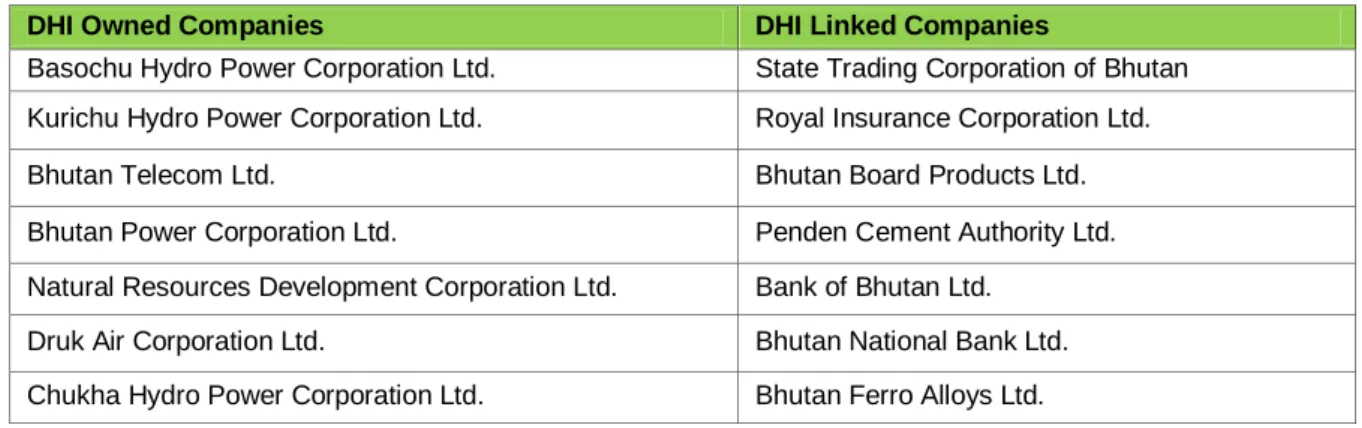
14 of the 22 companies earlier owned by the Royal Government and controlled by the Ministry of Finance, were transferred to the DHI. It has taken over various functions as regards management of the 14 government owned companies. DHI aims at ensuring good corporate governance among companies under its hold and improving performance of linked companies. It has a major responsibility for raising funds and making investment for the Royal Government. It is expected to develop a new corporate culture in the country.
Table 1 : Companies under the DHI
DHI Owned Companies DHI Linked Companies
Basochu Hydro Power Corporation Ltd. State Trading Corporation of Bhutan
Kurichu Hydro Power Corporation Ltd. Royal Insurance Corporation Ltd.
Bhutan Telecom Ltd. Bhutan Board Products Ltd.
Bhutan Power Corporation Ltd. Penden Cement Authority Ltd.
Natural Resources Development Corporation Ltd. Bank of Bhutan Ltd.
Druk Air Corporation Ltd. Bhutan National Bank Ltd.
Chukha Hydro Power Corporation Ltd. Bhutan Ferro Alloys Ltd.
~ 7 ~
To facilitate the process of developing the private sector, the RGoB has established many large organisations and promoted joint venture because there was lack of capital in the private sector to establish large and strategic organisations.
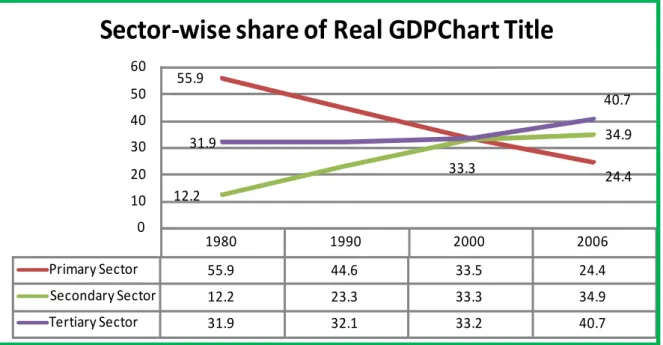
There has been a very noticeable change in the economic structure of Bhutan over the last decade, with the secondary and tertiary sectors of the economy growing more rapidly than the primary sector. The share of the primary sector declined from 29% of the GDP in 2002 to 19% in 2007. These changes reflect that the economy has modernized as the share of the primary sector in the GDP has declined. This is viewed as a shift away from less productive to the more productive sectors.
These structural changes have been driven mainly by the public sector through hydropower projects and financial support from donors flowing through the government. However as highlighted in the EDP , the occupational structure of the economy has not shifted in a manner consistent with the changes in the sectoral composition of GDP and is a disturbing trend reflecting jobless growth. However as highlighted in the EDP , the occupational structure of the economy has not shifted in a manner consistent with the changes in the sectoral composition of GDP and is a disturbing trend reflecting jobless growth.
Figure 1: Structural Changes to the Economy
1980 1990 2000 2006 Primary Sector 55.9 44.6 33.5 24.4 Secondary Sector 12.2 23.3 33.3 34.9 Tertiary Sector 31.9 32.1 33.2 40.7 55.9 24.4 12.2 33.3 34.9 31.9 40.7 0 10 20 30 40 50 60
Sector-wise share of Real GDPChart Title
Source: Economic Development Policy 2010
2.2 Review of the HRD Master Plan for Private and Corporate Sector (2002-2008)
The Royal Government since the initiation of the 6th FYP, has not only taken the lead role in
taking a holistic approach to human resources development planning for the private and the corporate sector, but also has generously supported the HRD of these sectors. During the 9th FYP,
the Royal Government has taken yet another initiative by separating the HRD of the corporate and private sectors from that of the civil service and committing 50% of the total Ninth HRD Budget outlay for the human resource development in the two sectors.
The need for a separate comprehensive HRD master plan for the private and corporate sector was felt necessary as the government recognized that majority of the prospective job seekers were not attracted to join the private firms and companies, though jobs were available in these sectors. With the initiation of Ninth Plan, Human resource development in the private sector was seen as a means of creating demand in the private sector for employment.
~ 8 ~
With the commencement of Ninth FYP, the Department of Human Resources under the Ministry of Labour and Human Resource has been given the responsibility to plan, coordinate and implement the HRD Master Plan for the private and corporate sector.
The distinctive feature of the 9th HRD Masters Plan for the private and corporate sector are the
sectoral approach with an overview of the current status of each sector, its respective objectives, competencies requirement, HRD Objectives and key result area. The six sectors are broadly categorized as follows:
i. Service Sector: including media, communications and transport, tourism and hospitality and trading;
ii. Production Sector: including manufacturing/production/mining Sector and hydro power industries;
iii. Construction Sector; iv. Finance Sector;
v. Education Sector: including the private education schools and private training institutes; and
vi. Information Technology Sector: including IT training institutes, IT enterprises, and IT consultancy firms.
In line with the Royal Government’s high priority on the private sector development, HRD Master Plan has been prepared exclusively for the private and corporate sectors to be implemented during the 9th FYP period. The then Department of Employment and Labour (DEL)
took a lead role in preparing the master plan. The representatives of the private and corporate sectors were also actively involved in the process of its formulation.
Unlike in the civil service, the private and corporate sectors comprise of various types of industries particularly in the aspects of their missions, goals, and strategies. In view of this, preparation of plan based on the needs of individual enterprises was not foreseen to be an appropriate approach. Therefore, the plan was developed on sector based, which is grouped into six broad categories as already mentioned above.
The 9th HRD master plan has been developed to ensure a balanced human resource development
across all sectors with the following objectives:
i. Enhance the human resource capacities of the corporate and private sectors, ii. Enhance the employability of new generation of Bhutanese workforce, iii. Breed a new generation of entrepreneurs,
iv. Enhance the competitiveness of Bhutanese products both in the domestic and international markets, and
v. Contribute towards the achievement of the national goal of self-reliance and His Majesty’s vision of Gross National Happiness
2.2.1 9th HRD Master Plan budget Allocation (Nu. Million)
Table 2: Budget outlay for the 9th Plan HRD for the private and corporate sector
Category No. of Slots Budget (in Nu.
Millions) % Slots % of Budget
In-country 6557 274 83% 18%
Fellowship 1309 1151 17% 77%
Contingency 75 5
Total 7866 1500 100% 100%
~ 9 ~
Table 3: Sector wise budget allocation for the 9th FYPSN Sector Amount (in Nu.
Millions) % allocation 1. Service 450.00 30% 2. Manufacturing/Production 375.00 25% 3. Construction 225.00 15% 4. Finance 150.00 10% 5. Education 150.00 10% 6. Information Technology 150.00 10% Total 1500.00 100%
Source: Status Report of HRD of 9FYP, DHR, MoLHR
The sector-wise budget allocation as shown in the table 3 and table 4 is based on the thrust areas identified by the Royal Government in the Ninth Plan period.
2.3 Achievement against Plan
The entire planned activities of the 9FYP HRD for the private and corporate sector could not be implemented. Only 47% of the planned budget and 57% of the slots were implemented for the 9FYP HRD. The budget was made up of contributions from various sources which include funds provided by the RGoB, the Government of India (GoI), the SDA and other agencies. The bulk of the HRD was implemented through Ad-hoc donor agencies. (Refer to Table 4 below for details of fund amounts and slots implemented through the different funding sources.)
Donor Agencies other than the SDS and the Government of India (GoI) contributed to 17% of the HRD slots and comprised of 91% of the budget. This seeming mismatch between the slots allocated and budget utilized is due to the bulk of the long term programmes being implemented through these funds, which takes up far more share of the budget than short term courses. Table 4: Source of Funds and Share of Slots by Funding Source (9FYP)
Funding Source Slots Budget in Millions of Nu.
RGB 2916 28.98
GoI 357 29.99
SDS 445 2.4
Other Donors 783 601.57
4501 662.94
Source: Status Report of HRD of 9FYP, DHR, MoLHR
The cost of fellowships by donor agencies other the SDS and the GoI are monetized values of fellowships implemented under such funding. A cursory analysis of the proportions of the trainings implemented within the country and outside the country, it seems that in-country are more cost effective, (over 2,800 trained with a budget of Nu.30 million against, 350 trained for a budget of Nu. 30 million in India and 780 with a budget of Nu. 600 million in other countries.). However, these figures do not take into account the durations of the trainings. The average training durations range from one to two weeks for in-country courses, whereas trainings in India from one to four years in India and ex country training courses from one month to two years.
~ 10 ~
The figures below illustrate the implementation of the 9FYP HRD.
Figure 2: Distribution of Trainings by Slots and Budget implemented during the 9FYP by Sector
Source: Status Report of HRD of 9FYP, DHR, MoLHR
Table 5: Distribution of Slots and Budget (In-country and Ex-country) by Sector during the 9FYP
Slots budget Slots in %age Budget in %age
In-country 3541 33.68 79% 5%
Ex-country 960 629.26 21% 95%
Total 4501 662.94 100% 100%
The service sector was the largest recipient of the HRD support. It has received the largest share of ex-country HRD development programmes both in terms of Slots and in terms of budget followed by the IT and Education Sector. This is due to the inclusion of a wide range of industries under the Service sector.
Support to the education sector was mainly from donor funds and were implemented outside the country. Education Sector had a very small share of the in-country slots and budget, which seem to imply that capacity to train teachers does not exist in the country, which is not true, rather it indicates the large demand for trained teachers in the government education system which absorbs almost all graduated of the two National Institutes of Education (NIE) in the country.
This trend of HRD support during the 9FYP seems to show a strong support for the education and services sector. However this apparent trend cannot be treated as a true indicator of the overall HRD implementation strategy of the Royal Government because much of the segregations into sectors was made on the nature of the course rather than the sector they were employed in.
The Apprentice Training Programme (ATP) has received the largest portion of the in-country budget (49% but comprises of only 19% of the slots implemented. This is due to the length of the ATP course which is 12 months, compared to other in-country courses ranging from 1 week to 3 weeks.
The figures below presents a pictorial view of the distribution of slots and budget implemented during the 9FYP. 79% of the trainings were implemented in-country utilizing only 5% of the training budget utilized and 21% of the slots implemented ex- country using 95% of the training budget utilized. Services 63% Production 3% Construction 11% Finance 10% Education 7% IT 6%
Distribution of Slots by Sector
Services 66% Production 3% Construction 2% Finance 8% Education 10% IT 11%
~ 11 ~
Table 6: Sector wise achievement by Slots and Budget
Slot Budget (in million Nu.)
Sector Planned Implemented Planned Implemented
Service 2425 3100 450 445.42 Production 1789 100 375 22.11 Construction 1330 434 225 13.31 Finance 825 367 150 55.64 Education 582 251 150 62.97 Information technology 915 249 150 68.95 TOTAL 7866 4501 1500 662.94
Figure 3: Sector wise achievement by Slots and Budget
Source: Status Report of HRD of 9FYP, DHR, MoLHR
Of the total in-country HRD needs, 54% of the slots were implemented utilizing only 13% of the In-country training budget and for ex-country trainings 54% of the budget utilized to implement 73% of the slots. These findings seem to indicate that there was an overestimation in the cost of both ex-country and in-country trainings. This appears to be true for in-country trainings. With monetized cost of implementing long term slots on fellowship, the cost of ex-country is clearly an underestimation of the costs of trainings.
128%
6% 33% 44% 43% 27% 57%
Achievement in Implementation (Slots)
Planned Implemented
99%
6% 6% 37%
42% 46% 45%
Achievements in Implementation (Budget)
~ 12 ~
2.4 Lessons learntSome of the critical lessons learnt during the implementation of the 9FYP HRD Master plan for the private and corporate sector are:
i. During the 9FYP the government had principally committed a budget of Nu. 1500 million
for capacity development of the private and corporate sector. However, it must be noted that the funds were uncommitted in nature and were not made available for the implementation of the Master Plan, especially for the implementation of long-term programmes. Majority of the HRD programmes were implemented through multilateral and bilateral donor assistance (ad-hoc offers and financial support). Relying solely on donors has resulted in training programmes not always fulfilling the HRD requirements of the private and corporate sector. This has resulted in trainings that were irregular and supply driven.
ii. Though HRD masterplan was prepared in consultation with stakeholders (through
meetings and workshops), no systematic training need assessment was conducted to assess the real HRD needs of the private and corporate sector. Further, there was no proper post-training evaluation carried out to assess the impact of the trainings on individual trainee, the nominating organization and the private sector growth in general. This has been mainly due to lack of staff capacity to undertake such assessment studies.
iii.There was no monitoring and evaluation carried out for most of the programmes
implemented under the HRD for private and corporate sector, specifically for ex-country training programme due to shortage of adequate staff, capacity of the existing staff and lack of budget. M&E is crucial for effective and implementation of any programmes to ensure the achievement of HRD objectives.
iv.Ninety percent of Bhutan’s private firms/companies being small/ medium in nature and
the lack of policies/strategies to encourage private firms/companies to invest in their employee’s capacity and skill development needs has resulted in HRD not being given importance. The lack of long-term HRD plans in almost all the private firm/companies and most of the corporations shows that the Private and Corporate sectors do not identify and prioritize capacity development needs of their staff in line with organizational needs.
v. During the initial stage of implementation of the master plan, the department was
directly involved in the coordination and implementation of many in-country training programmes which are now being outsourced to the private training providers or consultancy firms. With outsourcing, the department has been able to implement more HRD programmes and activities. Thus M&E becomes more important to ensure that these programmes are effective and directly contributes to private sector growth.
~ 13 ~
vi. The department has not been able to successfully implement the master plan, mainly due
to shortage of staff, staff capacity and lack of funds. Though human resource development of the private and corporate sector has been accorded equal priority with that of public sector (during the 9th FYP), support from the Royal government in terms of
implementation of the programmes have been inadequate.
vii. Much of the activities implemented during the 9th FYP have been with the help of
bilateral and multilateral donor assistance, which is ad-hoc in nature and do not necessarily meet the HRD requirement of our private and corporate sector. Though the government has developed friendly policies to bring about the development in these sectors, not much has been done in terms of supporting the HRD needs based on TNA carried out by the respective sectors.
viii.Private and corporate sector HRD has been implemented mainly through various
in-country and ex-in-country programmes offered by the government. The ministry has not been able to create an enabling environment for adequate private sector participation and initiatives towards developing and strengthening their HR needs. The ministry will have to institute mechanisms to promote and encourage private and corporate sector to invest in their HRD through tax and other government policies.
ix.The private sector HRD was mainly implemented through partnering with private sector
associations. These associations act as an important link between the government and the sectors they represent for fostering growth in the private sector. However, their primary interest is in the business development and less in HRD. Furthermore outreach of HRD programmes and activities has been limited to few and not the entire sector. Thus it is important to institute HRD units in these associations which should provide information regarding HRD needs of their sector and facilitate HRD activities.
x. MoLHR is the apex HRD ministry in the country. In addition it is responsible for planning,
facilitating and implementing HRD for private and corporate sector. However, streamlining HRD procedure is one of the major challenges facing the ministry with others agencies directly implementing HRD for private and corporate sector. This has lead to ambiguity on the roles of MoLHR and other HRD implementing agencies amongst the private and corporate sector and the donors. This has resulted in insufficient funds and delays affecting the overall achievement of HRD for private and corporate sector.
~ 14 ~
The following flow chart shows the existing procedure for implementing HRD programme for the private and corporate sector.
Diagram 1: Flow Chart: for Implementation process for HRD for Private and Corporate Sectors MFA receives fellowship offers from Bilateral/
Multilateral donor agencies
MFA sends invitation for nomination to RCSC RCSC sends invitation for nomination to MoLHR
MoLHR process for nomination by: 1. Sending invitation to relevant
sector/agency/organization 2. Advertising the course in the media
Sector/agency/oprganization forward nomination to MoLHR
MoLHR process selection and forwards the final nomination to RCSC
RCSC process for nomination for ad-hoc long-term HRD programme for the private and
corporate sector
RCSC forwards the nomination to MFA
MFA forward nomination to relevant donor
~ 15 ~
3 NATIONAL HUMAN RESOURCE PERSPECTIVES, CHALLENGES AND FOCUS OF THE TENTH FIVE YEAR PLAN
The RGoB’s emphasis on the Human Resource Capital continues to be carried on in the 10FYP. The Royal Government recognizes investment in the human capital as crucial to ensure long-term sustainable and successful development of the economy. Given such importance accorded to the HRD, the Government continues to provide free basic education to its citizens.
Providing productive and meaningful employment to all citizens through education and training is a priority for the RGoB. The Ministry of Labour and Human Resources has been created towards this end and to focus on the Human Resource Development needs of the private and corporate sector with the vision: “A Nation where there is gainful employment for all its citizens” with the mission of facilitating human resource development for economic development and to ensure gainful employment for all Bhutanese workforce.
The EP 2010, also recognizes that there are constraints in the private sector which includes Human Resources to a large extent, which, unless systematically removed, will hamper the realization of the goals of the EP 2010. These have been listed as follows:
Lack of management skills, Shortage of professionals, Low productivity of labour, Difficult access to finance, High transportation cost, Small domestic market, Limited exports and markets, Absence of R&D capability, Inadequate infrastructure and Inconsistent policies.
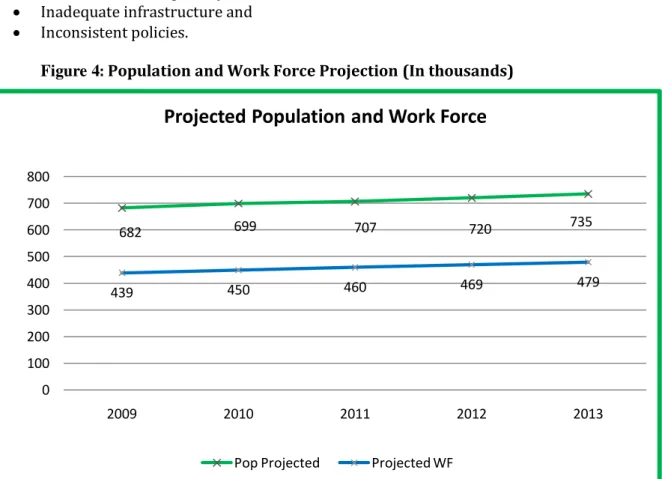
Figure 4: Population and Work Force Projection (In thousands)
Source: Population Projection 2005-2008 (Figures in Thousands)
682 699 707 720 735 439 450 460 469 479 0 100 200 300 400 500 600 700 800 2009 2010 2011 2012 2013
Projected Population and Work Force
~ 16 ~
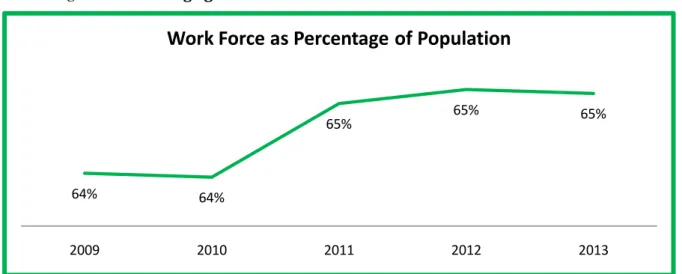
Figure 5: Percentage growth of Work Force
Source: Population Projection of Bhutan 2005-2030
Table 7: Projected Work Force
Year 2009 2010 2011 2012 2013
Projected Workforce 439,045 449,531 459,678 469,450 478,822
Increase over previous Year 10,486 10,147 9,772 9,372
Source: Population Projection of Bhutan 2005-2030
The labour productivity in the agriculture and industrial sector has been generally low which if unattended would undermine the competitive edge of the nation. The government understands this and is providing numerous incentives and trainings to farmers through programmes implemented by the Ministry of Agriculture.
The changing trends in the economic activities also necessitates that the country prepare for changing knowledge and skill needs of the future, both in terms of capacity and in numbers. Human resource development policies must ensure that these requirements of the progress of economic change are considered while developing HRD programmes for the future.
The Tenth Five Year Plan aims at creating additional employment through vitalization of industries and other policy interventions. The Plan also aims at developing quality and critical mass of human capital to foster a culture of creativity, innovation and enterprise and thereby facilitating poverty reduction in the country. In particular, the plan focuses on the following HR intervention areas:
(i) Striving for excellence in education with emphasis on enhancing quality of education at all levels;
(ii) Addressing shortage and quality of human resources in both the public and private sector in the areas of professional and high skilled occupations;
(iii) Fostering greater civil service professionalism and specialization and enhancing capacity at the centre and local government levels;
(iv) Enhancing labour productivity across agricultural, industrial and service sectors; (v) Facilitating full employment, particularly among educated youths;
(vi) Promotion of gender development and equity; and
(vii) Provision of increasing in-country education and training facilities through partnership with external institutions.
The Tenth Five Year Human Resource Development Master Plan aims to effectively integrate and align human resources of the country to the emerging development needs of the country with focus on enhancing productivity and professionalism, improving quality and coverage of education and training and creation of employment opportunities.
64% 64%
65% 65% 65%
2009 2010 2011 2012 2013
~ 17 ~
The past five years’ sectoral composition of nominal GDP shows that the secondary sector which was stagnant until 2006 has over taken other sectors in 2007. While the share of primary sector shows a clear decreasing trend over the past five years, the share of the tertiary (services) sector has suddenly fallen in 20074. This sudden change in the sectoral trend of the Bhutanese economy in 2007 is mainly due to full commissioning of 1020 MW Tala Hydroelectric Project.
3.1 Challenges and Focus
The Tenth Five Year Human Resource Master Plan aims to effectively integrate and align human resources of the country to the emerging development needs of the country with focus on enhancing productivity and professionalism, improving quality and coverage of education and training and creation of employment opportunities.
The private and corporate sector has been identified as the main engine of economic growth. Bhutan 2020: A Vision for Peace, Prosperity and Happiness clearly states that the private and corporate sector will be the mainstay of national development. Further, this sector is envisioned to be the major provider of employment for the Bhutanese youth. Bhutan 2020 projects that Bhutan’s hydropower sector will be the prime mover of industrialisation, supported by clean manufacturing and fast growing tourism sector.
The private and corporate sector face difficulty in finding qualified and trained manpower. The HRD services have to be reinforced to help the sector achieve its goals and become competitive. Bhutanese youth’s preference is for government jobs as they are seen as more secure and having greater career potential. The second preference is for corporations. Working for the corporations is equated as good as working for the Royal Government. Only those who do not manage to get into the above opt for the private sector. Both the private and corporate sector organisations need high quality manpower both at all levels. The private sector need to be trained and clear and attractive career path defined.
It is expected that approximately 93,000 jobs have to be created during the Tenth Plan which poses an enormous challenge. With the increasing investment in education sector, the growth of labour force has exceeded the available employment opportunities and therefore the national unemployment has increased to 4% in 2009 from 1.4% in 19995 which has to be addressed
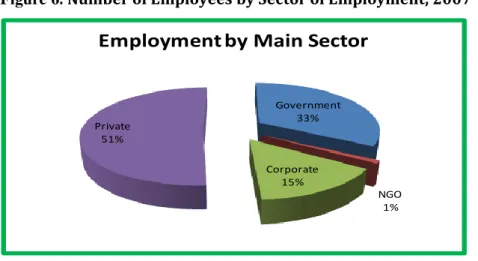
through relevant strategies and intervention by the Government. The Private and Corporate Sectors generates three fourths of the employment and therefore must be given due attention.
Figure 6: Number of Employees by Sector of Employment, 2007
Government 33% NGO 1% Corporate 15% Private 51%
Employment by Main Sector
Source: Labour Market Information Bulletin 2008, DoE, MoLHR
The Bhutanese industry has low level of productivity due to, lack of technology and low level of human capital. Foreign Direct Investment (FDI) and joint ventures are important ways to
4 RMA Annual Report 2008 5 Labour force Survey 2009
~ 18 ~
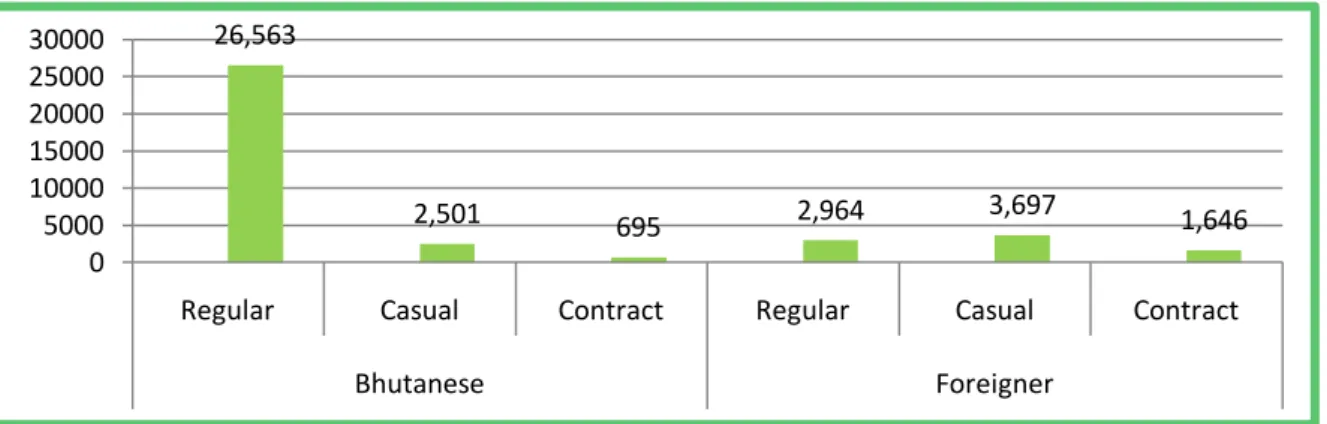
enhance productivity and create wealth and the Royal Government has considered that in a very positive light. The “engine of growth” (private sector) employed 38,066 employees, of whom 78% (29759) are Bhutanese and 22% foreigners (8307)
Figure 7: Number of People Employed in the Private and Corporate Sector
Source: Establishment Census, 2008, LMID, DoE, MoLHR
An extensive survey of 100 private sector organisations was conducted by the Ministry of Trade & Industry, Bhutan Chamber of Commerce, UNDP and the World Bank in 2001. The survey shows that there is a shortage of skills at all levels and that the productivity of labour force is low.
Most glaringly, very few employees receive any kind of in-service training. The Bhutanese managers had limited exposure to modern practices and management tools and techniques. The following reasons were cited for poor HRD efforts:
Lack of incentives from the Royal Government High turnover of the Bhutanese workers
The Large Number of foreign Workers in the Country Contract nature of foreign workers
Availability of trained workers from neighbouring countries
The RGoB having recognized these challenges and constraints facing the private sector, has identified and proposed the main objective of the NHRDP, as HRD for the private and corporate sectors.. The NHRDP recognizes that the economic goals of the country can be achieved only by the creation of appropriate human capital. The MoLHR has been identified as the central agency for developing HRD frameworks, facilitating coordination among HRD agencies and monitoring and integrating HRD Plans, services and activities.
The private sector respondents felt that it is the responsibility of the Royal Government to provide support for HRD. This is probably due to the nascent stage of the development of entrepreneurial spirit and modern management practices. Lack of awareness about the need for effective training, and the close relationship between training and development of their employees in developing right kind of skills and attitudes and increased productivity and profitability has led to mismatch of skills and low productivity of the Bhutanese work force. The Tenth Five Year Plan (2008-2013) emphasises strengthening of industry which includes manufacturing, hydropower, tourism, cultural industries and Information and Communication Technology. The Plan stresses on knowledge content of the economy and to enhance productivity of its industrial base through innovation, creativity, and enterprise. Marketing knowledge and savvy are emphasised as vital for the success of the Tenth Plan.
26,563 2,501 695 2,964 3,697 1,646 0 5000 10000 15000 20000 25000 30000
Regular Casual Contract Regular Casual Contract
~ 19 ~
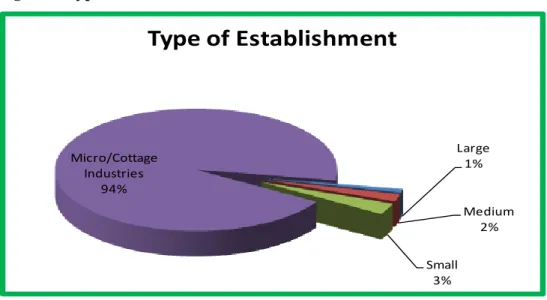
The Tenth Plan strongly emphasises on the importance of the Micro, Small and Medium Enterprises (MSMEs) (94.6 %of the Bhutanese private sector undertaking fall into the category of SMEs.) as a major source of employment and crucial means of enhancing income and poverty reduction. With relative low levels of capital investment required, the sector offers decent employment and income generation opportunities, particularly for Bhutanese youth and other weaker sections of Bhutanese society
The Ministry of Economic Affairs (MoEA) plans to establish a Department of MSMEs to give greater attention to this sector of the economy. The Financial sector has provided support to the development of the SME, Bhutan Development Finance Corporation (BDFC) has a scheme to lend loans to the MSMEs in the country.
Figure 8: Types of Establishment
Large 1% Medium 2% Small 3% Micro/Cottage Industries 94%
Type of Establishment
Source: Establishment Census, 2008, LMID, DoE, MoLHR
Table 8: Distribution of Establishment by Investment
Sl/No Ownership
Investment
Micro/Cottage Small Medium Large Total
1 Public/Corporation 208 19 5 38 270
2 Private 6,561 170 53 96 6,880
3
Joint Ventures 8 2 - 2 12
Total 6,777 191 58 136 7,162
Source: Establishment Census, 2008, LMID, DoE, MoLHR
The National Human Resource Development Policy of Bhutan 2010 purports to strongly support the development of the private sector in the country and has outlined some economic activities that hold opportunity for entrepreneurs.
~ 20 ~
The Economic policy, 2010 has identified various areas of economic opportunities. High quality green services are one such area. It consists of high- end education and medical services, ICT, data centres, tourism, financial services, consulting services, BPOs and KPOs, and Meeting, Incentives, Conferences and Expositions (MICE). Thus, education is given the status of industry. It will help the educational sector to have similar financial and economic benefits as other industries enjoy.
The draft policy also visualises Bhutan to be a hub of general education and for specialised study on technical skills, environmental conservation, Buddhism, GNH and renewable energy. It proposes that general and specialised colleges, such as in the field of ICT, architecture, engineering, medical and law shall be allowed and be encouraged to open franchise/campus in the country.
The draft foreign direct investment policy, states that FDI is defined in terms of convertible foreign exchange, unless specified in bilateral agreements. Therefore, Bhutan will have to enter into bilateral agreement with neighbouring countries to attract foreign direct investment in other currencies.
~ 21 ~
4 HUMAN RESOURCE DEVELOPMENT MASTER PLAN OF THE PRIVATE AND CORPORATE SECTORS (2008-2013) – THEME, OBJECTIVES AND BUDGET. 4.1 Human Resource Development Planning During the 10th Plan Period
Human resource planning is a tool to determine the demand for human resources by an organization to achieve its strategic goals. HR planning will determine the qualifications, competencies, and numbers required to realize the organizational goals and objectives.
It is also used to study the supply of human resources available from internal and external sources which may be tapped to meet the organizational needs. Internal supply refers to the human resources existing within an organization which may be strategically reallocated via promotions, transfers and trainings to meet requirements and external supply refers to all human resources available outside of the organization who may be recruited based on their qualifications and experience.
Forecasting is a key element of HR planning. However, while it can be used to produce estimates and projections, it is seldom precise. This is mainly due to the dynamic and ever globalizing work environment in which human resources are the mobile capital.
Therefore, HR planning is moving towards a more flexible and responsive approach which involves monitoring of developments that affect human resource requirements and enhancement of capacity to adapt to change.
Objective of 10th HRD master plan
i. Guide private and corporate sector HRD and to enable private and corporate sector to understand economic policy direction of the country,
ii. Promote private and corporate sector growth through support in building appropriate human resource capacities in the private and corporate sector,
iii. To ensure and enhance need based HRD training programmes catering to the present and future needs of the private sector and corporate sector.
iv. promote coordination among different HRD agencies in implementing various HRD activities;
v. To develop appropriate skills among Bhutanese youth to emerging needs of the private and corporate sectors.
4.1.1 Sources of External Human Resource Supply
Human resources in Bhutan have three main sources:
A pool of under-graduates and graduates from professional degree courses in India and abroad; Under-Graduate Pool (Supply from ex-country institutions)
In-country pre-service education institutions; and
In-country (pre-service and in-service) training institutions;
Ex country
Each category is described in more detail below. Figures include only students completing studies before the beginning of, or during the 10th Plan.
The pool will also comprise of graduates in Engineering, Agriculture, Livestock, and Forestry; Medicine, Survey, Statistics, Computer Science, Law, Education and Academics and other social studies. The projected supply of undergraduates from ex-country is shown in (Figure 8. and Annexure 2: Projected Supply of Undergraduates in Various Fields (From Abroad) during the 10FYP)
~ 22 ~
Figure 9: Undergraduates from ex-country institutions during the 9FYP Period
Source: Projected supply is based on the NGOP 2008
4.2 Supply from In-country Institutions based on the present trend.
It is expected that by 2013, there will be 10,014 graduates ready to enter the job market,. This number excludes the graduates passing out from different course levels from in-country private training Institutes. The projected supply expected that in-country training institutes will produce candidates with following qualifications in various fields:
Table 9 : Projected HR supply from in-country training Institutes during the 10th FYP
Name of Institute PG Dip Bachelors Dip Cert In 2008 By 2013
Sherubtse College 800 160 800 CST 190 38 190 JNP 975 195 975 ILCS 135 27 135 RIM 3 735 203 1080 NIE , Paro 95 940 207 1035 NIE , Samtse 410 1090 300 1500 CNR 305 61 305 RIHS 215 310 105 525 RTC 577 577 Gaeddu College of Business Studies 832 832 Vocational Institutes 2060 412 2060 Total 859 3,987 2,240 2,370 1,290 10,014
Source: the projected supply is based on the number of candidates graduated in 2008
Details of the graduates of in-country Institutes provide various courses:
Sherubtse College has been supplying under-graduates in Arts, Commerce, Computer Applications, and General Science. During the course of the 10th Plan, it will supply about 800
under-graduates, the majority of whom will be in the areas of Arts, Commerce, and Science. In addition to the above, the Gaeddu college of Business Studies will be supplying graduates to the national pool. It is expected that the college will contribute between 250 to 300 graduates to the work force. 0 1000 2000 3000 225 55 105 20 30 410 15 435 2822
~ 23 ~
Figure 10: Sherubtse Graduates up to 2013Source: The projected supply is based on the number of candidates graduated in 2008
The College of Science and Technology has been offering Bachelors degree in Civil & Electrical. During the course of the 10th Plan, it is expected to supply 190 Engineers. The Institute expects
to produce 80 Civil Engineers and 110 Electrical Engineers during the plan.
Jigme Namgyal Polytechnic has been offering Diploma and Certificate level courses in the field of engineering. During the 10th Plan, it is expected to supply 975 Diploma holders. 50.3% of the
total candidates will be graduated in Civil Engineering; 33.4% in Electrical Engineering; and 16.4% in Mechanical Engineering.
Figure 11: RTC Graduates up to 2013
Source: The projected supply is based on the number of candidates graduated in 2008
Figure 12: Jigme Namgyal Polytechnic Graduates
Source: The projected supply is based on the number of candidates graduated in 2008
The Institute of Language and Cultural Studies supplies under-graduates in Language, Literature and Culture. During the 10th Plan, 135 students will graduate from the institute.
The Royal Institute of Management (RIM) is the only institute of its kind in the country. It provides in-service as well pre-service training in areas of general management, information management, financial management, and management at post-graduate diploma and certificate levels. Every year, the RIM trains about 203 candidates. During the 10th Plan, 1080 candidates
are expected to graduate from the Institute.
190 125 185 120 170 10 0 50 100 150 200
English Honours geography Honours Economic Honours B. Sc (Physica) B. Sc (Life Sc.)Physica) B.Com Honours
Sherubtse Graduates up to 2013 (800)
277 300 260 270 280 290 300 310 2012 2013RTC Graduates in the 10FYP Period (577)
490 325 160 0 200 400 600
Civil Electrical mechanical
~ 24 ~
Figure 13: Royal Institute of Management graduates 2009 – 2013
Source: The projected supply is based on the number of candidates graduated in 2008
The two Colleges of Education at Paro & Samtse supply trained teachers at the primary as well as secondary level in subject areas. All trainees of B Ed. (primary and secondary level) and PGCE courses are pre-service candidates. Annually these two Institutes supply about 400 trained teachers and during the 10th Plan they will be supplying approximately 2,535 trained teachers
across all levels of education. They also train about 100 in-service Teachers for the PG in Education.
Figure 14: Graduates from Samtse College of Education
Source: The projected supply is based on the number of candidates graduated in 2008
The College of Natural Resource and Bhutan Forestry Institute supply mainly pre-service trained people at Diploma and Certificate levels in areas of forestry, agriculture and livestock besides training in-service staff and farmers. Annually, about 65 trainees graduate from these institutes at the Diploma level. During the 10th Plan there will be 305 Diploma holders in
Agriculture (110), Livestock Services (70) and Forestry services (120) available for employment. The college has a plan to upgrade its course from Diploma to Bachelors degree level.
Figure 15: Graduates of the College of Natural Resources during the 10 FYP
Source: The projected supply is based on the number of candidates graduated in 2008
165 170 10 145 145 100 150 195 0 50 100 150 200 250
PGDPA PGDFM PGDNL DIMS DFM DTRA DNL DFM
Graduated of RIM (1080)
0 100 200 Diploma in Agriculture Diploma in Animal husbandry Diploma in Forestry 110 70 125~ 25 ~
The Royal Institute of Health Sciences supplies Health Assistants, General Nurses and Auxiliary Nurse Midwives and technicians at an annual rate of 105 such trained health personnel annually. It is estimated that in the 10th Plan the Royal Institute of Health Sciences will be
supplying about 525 trained personnel.
Figure 15: Graduates of the Royal Institute of Health Sciences during the 10 FYP
Source: The projected supply is based on the number of candidates graduated in 2008
Vocational Training Institutions providing, technical and vocational personnel are supplied by a number of institutes under the Department of Human Resources of the MOLHR. These Institutes include the National Institute of Zorig Chusum, Vocational Technical Institutes, and Driving Institutes. The supply, which is mainly pre-service, consists of Certificate level holders. During the Plan period these Institutes, in total, will also supply about 2060 trained personnel comprising of technicians (Civil, Mechanical And Electrical), business and tourism operators, computer programmers and operators, traditional Artisans and Craftsman, Auto-mechanics, drivers and construction workers (Carpenters, Masons etc).
Figure 16: Graduates of the VTIs during the 10 FYP
The projected supply is based on the number of candidates graduated in 2008
Apprenticeship Training Programme (ATP)
The ATP is one of the most successful job placement programmes of the MoHLR. Since its inception in 2000 it has had 863 participants and over 250 organizations from various sectors all over Bhutan participated in the Program. It has had a very high job placement rate over 90%. Participation by gender in this program has also been fairly well balance (54% Males to 46% females).
Most proprietors and managers have said that this was a very good initiative of the MoLHR as it ensured that the organizations could actually train and evaluate the participants in areas and skills actually required by the company or sector. The value of this program could be strengthened if a certification was issued for participation in this program. This implies a proper schedule of phased learning program and activities which can be assessed and evaluated by the MoLHR. The MoLHR will also have to strengthen its monitoring and evaluation of such programs.
60 20 40 10 20 20 75 20 25 20 115 0 20 40 60 80 100 120 140
RIHS Graduates in the 10FYP (425)
190 154 221 214 583 731 731 731 731 731 0 200 400 600 800 1000 2004 2005 2006 2007 2008 2009 2010 2011 2012 2013
VTI Graduates
~ 26 ~
However, a few have voiced dissatisfaction with the attitude of the participants as they seem to be uninterested in the work and are participating in the programme only to have a source of income while seeking other employment opportunities.
Based on the participation rate in the ATP, it is expected that the program will successfully train and place about 1905 job seekers (90% of 2200 participants) during the 10FYP.
Figure 17: Projected ATP Graduates by 3013
Source: Based on Historical data of participation in the ATP Programme since 2004
Table 10: Summary of Vocational and Apprentice Training Program Participants
Historical Data Projected
Institutes 2004 2005 2006 2007 2008 2009 2010 2011 2012 2013 Total
IZC 26 57 36 29 81 370 150 150 150 150 970
VTI 190 154 221 214 583 731 731 731 731 731 3,655
ATP 300 300 300 300 400 375 350 380 400 400 1,930
Total 6,555
Table 11: Summary of Pre Service Candidates during the 10FYP
Institutes No. of Graduates
Ex-country Institutes 4,117
In-country Institutions 9,569
Total 14,091
The pre-service supply of graduates in various fields both from In-country and Ex-country over the 10FYP period is 14,091. In-country institutions include the RIM, VTIs, RIHS, NIEs, JNP, CST, Gaeddu College of Business Studies, Sherubtse College, CNR, ILCS, and the Institute of Zorig Chusums.
Besides above institutions supplying trained HR to the labour market, there are approximately 80 to 90 private training providers in the country providing various Technical and Vocational Education and Training (TVET) programmes. These training institutes provide certificate and diploma courses. The supply projection for these training providers have not been accounted for in the supply projection.
4.3 Demand for Human resources in the Private and Corporate Sector
Despite the policy of the Royal Government of replacing expatriate workers in Bhutan with Bhutanese personnel, establishments are being permitted to employ foreign professional skills, wherever there is a shortage of Bhutanese professionals. The FDI policy of 2002 also allows FDI
54 31 22 91 156 375 400 350 380 400 400 0 200 400 600 2003 2004 2005 2006 2007 2008 2009 2010 2011 2012 2013