Deploying Oracle Database 12c on
Red Hat Enterprise Linux 6
Best Practices
Roger Lopez, Principal Software Engineer RHCE
Version 1.0
February 2014
1801 Varsity Drive™ Raleigh NC 27606-2072 USA Phone: +1 919 754 3700 Phone: 888 733 4281 Fax: +1 919 754 3701 PO Box 13588
Research Triangle Park NC 27709 USA
Linux is a registered trademark of Linus Torvalds. Red Hat, Red Hat Enterprise Linux and the Red Hat "Shadowman" logo are registered trademarks of Red Hat, Inc. in the United States and other
countries.
Oracle and Java are registered trademarks of Oracle.
Intel, the Intel logo and Xeon are registered trademarks of Intel Corporation or its subsidiaries in the United States and other countries.
All other trademarks referenced herein are the property of their respective owners.
© 2014 by Red Hat, Inc. This material may be distributed only subject to the terms and conditions set forth in the Open Publication License, V1.0 or later (the latest version is presently available at
http://www.opencontent.org/openpub/).
The information contained herein is subject to change without notice. Red Hat, Inc. shall not be liable for technical or editorial errors or omissions contained herein.
Distribution of modified versions of this document is prohibited without the explicit permission of Red Hat Inc.
Distribution of this work or derivative of this work in any standard (paper) book form for commercial purposes is prohibited unless prior permission is obtained from Red Hat Inc.
The GPG fingerprint of the [email protected] key is:
Comments and Feedback
In the spirit of open source, we invite anyone to provide feedback and comments on any reference architectures. Although we review our papers internally, sometimes issues or typographical errors are encountered. Feedback allows us to not only improve the quality of the papers we produce, but allows the reader to provide their thoughts on potential improvements and topic expansion to the papers. Feedback on the papers can be provided by emailing [email protected]. Please refer to the title within the email.
Staying In Touch
Join us on some of the popular social media sites where we keep our audience informed on new reference architectures as well as offer related information on things we find interesting.
Like us on Facebook: https://www.facebook.com/rhrefarch Follow us on Twitter: https://twitter.com/RedHatRefArch Plus us on Google+: https://plus.google.com/u/0/b/114152126783830728030/
Accessing Reference Architectures
There are two ways to access Red Hat reference architectures:
• The Red Hat customer portal at http://access.redhat.com using a customer login
Table of Contents
1 Executive Summary... 1
2 Reference Architecture Environment... 2
2.1 Reference Architecture Overview... 2
2.2 Network Topology... 3
2.3 Hardware Details... 4
2.4 File System Layout & Disk Space Details... 5
2.5 Storage Layout... 6
2.6 Swap Space... 6
2.7 Security: Firewall Settings... 7
2.8 Security: SELinux... 7
3 Reference Architecture Configuration Details... 8
3.1 Setting OS Hostname... 8
3.2 Network Configuration... 8
3.2.1 Configuring /etc/resolv.conf file... 9
3.2.2 Public Network Configuration... 9
3.2.3 NTP Configuration... 11
3.3 OS Configuration... 12
3.3.1 Using the Red Hat Subscription Manager (Option A)... 12
3.3.2 Accessing the RHN Repository (Option B)... 13
3.3.3 Oracle Database 12c Release 1 (12.1) Package Requirements... 14
3.3.4 Configuring Security-Enhanced Linux (SELinux)... 16
3.3.5 Configuring Firewall Settings... 16
3.3.6 Setting Virtual Memory... 18
3.3.7 Setting Shared Memory... 19
3.3.8 Setting Semaphores... 21
3.3.9 Ephemeral Network Ports... 21
3.3.10 Optimizing Network Settings... 22
3.3.11 Increasing synchronous I/O Requests... 22
3.3.12 Increasing File Handles... 23
3.3.13 User Accounts & Groups... 24
3.3.14 Setting Shell Limits for the Grid and Oracle User... 25
3.4 Storage Configuration... 28
3.4.2 Partitioning Device Mapper Shared Disks... 31
3.4.3 Configuring Oracle ASM Disks... 31
3.4.3.1 Oracle ASMLib Alternative: Configuring udev Rules... 31
3.4.3.2 Configuring Oracle ASMLib... 33
3.4.4 Optimizing Database Storage using Automatic System Tuning... 36
4 Oracle 12c R1 Configuration... 39
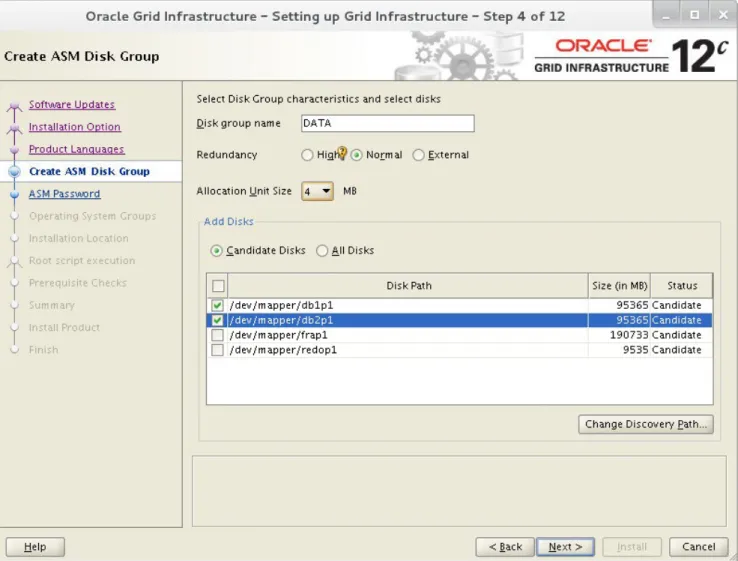
4.1.1 Installing Oracle Grid Infrastructure (Required for ASM)... 39
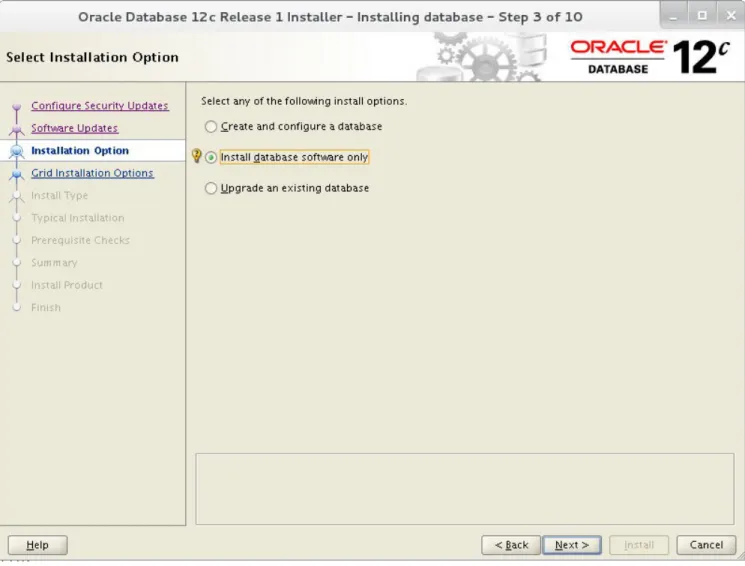
4.1.2 Installing Oracle 12c R1 Database Software... 43
4.1.3 Creating ASM Diskgroups via the ASM Configuration Assistant (ASMCA)... 48
4.1.4 Creating Pluggable Databases using Database Configuration Assistant (DBCA).... 50
4.1.5 Enabling HugePages... 57
5 Logging into the Oracle Container Database 12c Release 1 (12.1)... 59
6 Common Tasks when Managing CDB and PDBs... 62
6.1 Connect to a CDB... 62
6.2 Connect to a PDB... 63
6.3 Managing a CDB... 64
6.4 Managing a PDB... 65
6.5 Location of Data files of PDBs & CDB... 66
7 Conclusion... 68
Appendix A: Revision History... 69
Appendix B: Contributors ... 70
Appendix C: DM Multipath Configuration File... 71
Appendix D: Iptables Configuration File... 73
Appendix E: Huge Pages Script... 74
Appendix F: Oracle Database Package Requirements Text File... 75
Appendix G: Kernel Parameters... 76
Appendix H: Limits Configuration File (99-grid-oracle-limits.conf)... 77
Appendix J: Sample Kickstart File... 79
Appendix K: Configuration Files... 80
Appendix L: Troubleshooting ORA-* Errors... 81
1 Executive Summary
IT organizations face challenges of optimizing Oracle database environments to keep up with the ever increasing workload demands and evolving security risks. This reference architecture provides a step-by-step deployment procedure with the latest best practices to install and configure an Oracle Database 12c Release 1 (12.1) with Oracle Automatic Storage
Management (ASM). It is suited for system, storage, and database administrators deploying Oracle Database 12c Release 1 (12.1) on Red Hat Enterprise Linux 6. It is intended to provide a Red Hat | Oracle reference architecture that focuses on the following tasks:
• Deploying Oracle Grid Infrastructure 12c Release 1 (12.1.0.1.0)
• Deploying Oracle Database Software 12c Release 1 (12.1.0.1.0)
• Deploying an Oracle Database 12c Release 1 (12.1.0.1.1) with shared SAN disks
• Using Oracle ASM disks with udev rules
• Using Oracle ASM with Oracle ASMLib (with SELinux enabled, requires SELinux
version 3.7.19-231 available by default in RHEL 6.5)
2 Reference Architecture Environment
This section focuses on the components used during the deployment of Oracle Database 12c with Oracle Automatic Storage Management (ASM) on Red Hat Enterprise Linux 6 x86_64 in this reference architecture.
2.1 Reference Architecture Overview
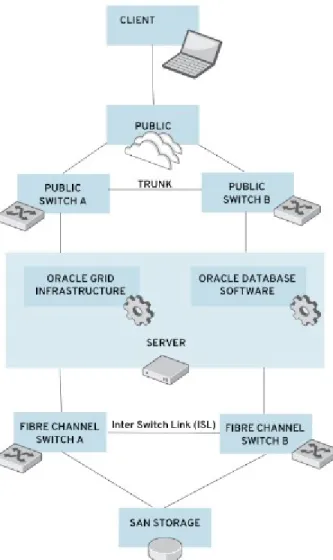
A pictorial representation of the environment used in this reference environment is shown in
Figure 1: Reference Architecture Overview.
Figure 1: Reference Architecture Overview
2.2 Network Topology
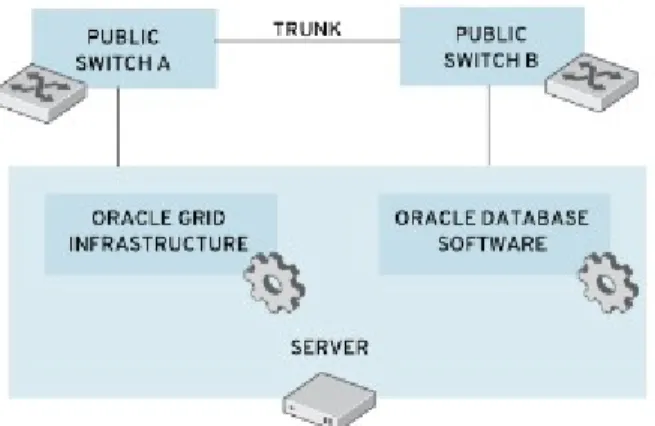
The network topology used in this reference environment consists of two public switches with a link aggregation that connect the two switches together (Public Switch A and Public Switch B), creating a single logical switch. Ethernet device em1 on the server connects to Public Switch A, while Ethernet device em2 on the server connects to Public Switch B. Ethernet devices em1 and em2 are bonded together as a bond device, bond0, providing high availability for the network traffic. Figure 2.2.1: Network Topology shows the pictorial representation of the two public switches connecting to the server, while Figure 2.2.2: Ethernet Bonding shows the bonding of Ethernet device em1 and em2 as part of the bond0
device.
Figure 2.2.1: Network Topology
2.3 Hardware Details
The following are the minimum hardware requirements to properly install Oracle Database 12c on a x86_64 system:
• Minimum of 1 GB of RAM for the installation of both Oracle Grid Infrastructure and Oracle Database, however 2 GB of memory or more is recommended
• Minimum of 1 Network Interface Card (NIC), however 2 NICs are recommended for high availability (HA) as used in the reference environment
• Red Hat Enterprise Linux 6.x Server x86_64 with kernel 2.6.32-71 or higher
• Console access that supports 1024 x 768 resolution to ensure correct display of Oracle's Universal Installer (OUI).
Table 2.3.1: Server Details specifies the hardware for the server used within this reference environment. This hardware meets the minimum requirements for properly installing Oracle Database 12c Release 1 (12.1) on a x86_64 system.
Server Hardware Specifications
Oracle 12c Release 1 Standalone Server
(db-oracle-node1)
[1 x HP ProLiant DL370 G6 Server]
Red Hat Enterprise Linux 6.5 kernel 2.6.32-431.el6.x86_64 2 Socket, 8 Core (16 cores)
Intel(R) Xeon(R) CPU W5580 @ 3.20 GHz 48 GB of memory, DDR3 4096 MB @ 1333
MHz DIMMs
2 x NetXen NX3031 1/10-Gigabit Network Interface Cards (NICs) for public network 1 x Qlogic ISP2532 8GB Fibre Channel Dual
Port HBA
Table 2.3.1: Server Details
Table 2.3.2: Switch Details specifies the Fibre Channel and Ethernet switches used within this reference environment.
Switch Hardware
2 x Brocade Silkworm Fibre Switches 2 x HP ProCurve Gigabit Switches
Table 2.3.3: Storage Details specifies the storage used for storing Oracle data files within this reference environment.
Storage Hardware Specification
HP StorageWorks MSA2324fc Dual
Controller Array 24 x 146 GB 15K SAS Hard disks
Table 2.3.3: Storage Details
2.4 File System Layout & Disk Space Details
The following are the minimum disk space requirements for properly installing Oracle Database 12c Release 1 (12.1) software for this reference environment.
Software Disk Space
Oracle Grid Infrastructure Home (includes
software files) 9.7 GB
Oracle Database Home Enterprise Edition
(includes software files and data files) 9.8 GB
/tmp 1 GB
Table 2.4.1:Disk Space Requirements
NOTE: The actual amount of disk space consumed for Oracle Grid Infrastructure Home and Oracle Database Home Enterprise Edition may vary.
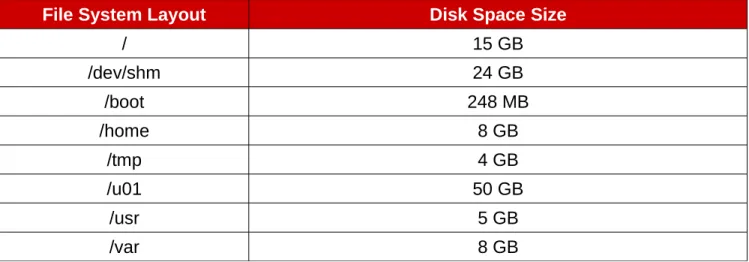
Table 2.4.2: File System Layout specifies the file system layout for the server used in this reference environment. The layout ensures the disk space requirements to properly install the Oracle Grid Infrastructure and Oracle Database software for Oracle Database 12c Release 1 (12.1).
File System Layout Disk Space Size
/ 15 GB /dev/shm 24 GB /boot 248 MB /home 8 GB /tmp 4 GB /u01 50 GB /usr 5 GB /var 8 GB
While the size of the Oracle data files varies for each solution, the following are the Oracle data file sizes used for this reference environment.
Volume Volume Size
Oracle Database Volume 1 (db1) 100 GB
Oracle Database Volume 2 (db2) 100 GB
Fast Recovery Area (fra) 200 GB
Oracle Redo Log Volume (redo) 10 GB
Table 2.4.3: Oracle Data File Sizes for Reference Architecture
2.5 Storage Layout
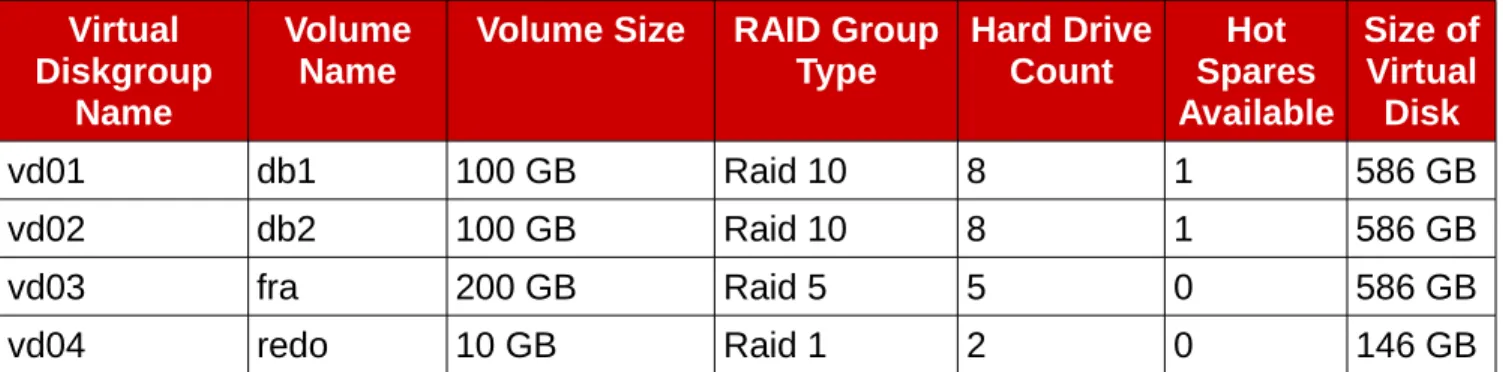
Table 2.5.1: Storage Disk Layout for Reference Architecture shows the storage disk layout for each volume.
Virtual Diskgroup
Name
Volume Name
Volume Size RAID Group Type Hard Drive Count Hot Spares Available Size of Virtual Disk vd01 db1 100 GB Raid 10 8 1 586 GB vd02 db2 100 GB Raid 10 8 1 586 GB vd03 fra 200 GB Raid 5 5 0 586 GB vd04 redo 10 GB Raid 1 2 0 146 GB
Table 2.5.1: Storage Disk Layout for Reference Architecture
2.6 Swap Space
Swap space is determined by the amount of RAM found within the system. The following table displays the swap space recommendation. This reference environment allocates 16 GB of RAM for swap space.
RAM Swap Space
2 GB up to 16 GB Equal to the size of RAM
Greater than 16 GB 16 GB of RAM
Table 2.6.1: Recommended Swap Space
NOTE: When calculating swap space, ensure not to include RAM assigned for hugepages. More information on hugepages can be found in Section 4.1.5 Enabling HugePages
2.7 Security: Firewall Settings
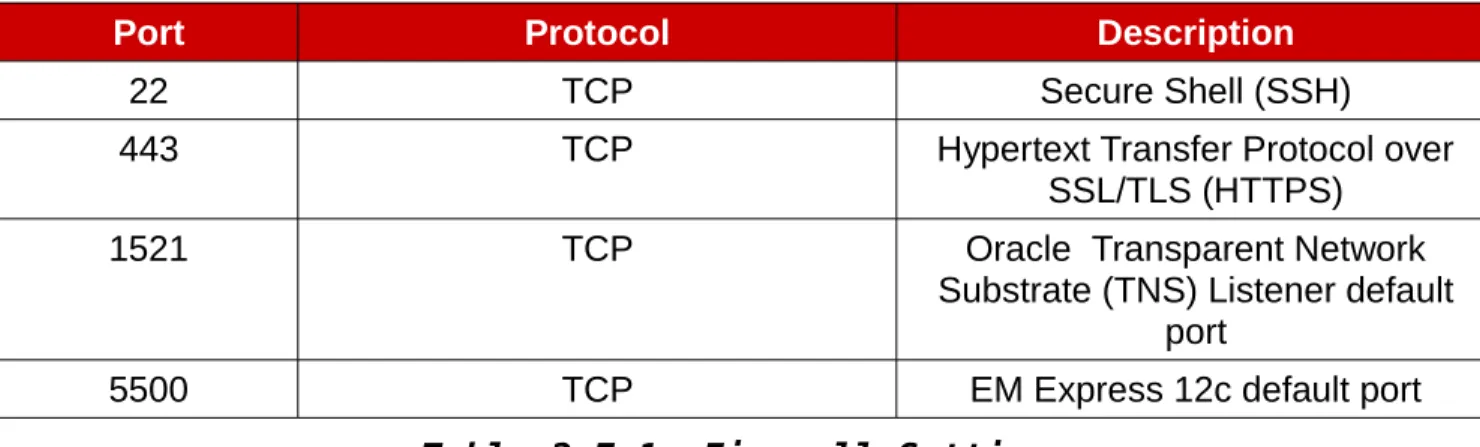
This section focuses on providing the details required to run iptables successfully for an Oracle Database environment. Table 2.7.1: Firewall Settings lists the enabled ports in this reference environment.
Port Protocol Description
22 TCP Secure Shell (SSH)
443 TCP Hypertext Transfer Protocol over
SSL/TLS (HTTPS)
1521 TCP Oracle Transparent Network
Substrate (TNS) Listener default port
5500 TCP EM Express 12c default port
Table 2.7.1: Firewall Settings
2.8 Security: SELinux
Starting with Oracle 11g Release 2 version 11.2.0.3, SELinux is supported for Oracle
database environments. The system in this reference environment runs with SELinux enabled and set to ENFORCING mode. Table 2.8.1: SELinux Packages lists the required SELinux
packages. In order to take advantage of SELinux enablement with Oracle ASMLib, SELinux
version 3.7.19-211 or higher is required. With the release of Red Hat Enterprise Linux 6.5, this requirement is met and no further action is required.
Package Version
selinux-policy 3.7.19-231
selinux-policy-targeted 3.7.19-231
3 Reference Architecture Configuration
Details
This reference architecture focuses on the deployment of Oracle Database 12c Release 1 (12.1) with Oracle Automatic Storage Management (ASM) on Red Hat Enterprise Linux 6 x86_64. The configuration is intended to provide a comprehensive Red Hat | Oracle solution. The key solution components covered within this reference architecture consists of:
• Red Hat Enterprise Linux 6 Update 5
• Oracle Grid Infrastructure 12c Release 1 (12.1.0.1.0)
• Oracle Database 12c Release 1 Software Installation (12.1.0.1.0)
• Deploying an Oracle Database 12c Release 1 (12.1.0.1.0) with shared SAN disks
• Enabling Security-Enhanced Linux (SELinux)
• Configuring Device Mapper Multipathing
• Using udev Rules
• Using Oracle ASMLib (with SELinux enabled, requires SELinux version 3.7.19-231 available by default within RHEL 6.5)
3.1 Setting OS Hostname
A unique host name is required for the installation of Oracle Database 12c Release 1 (12.1) The host name within this reference environment is: db-oracle-node1. To set the host name, please follow the instructions below.
Set the host name via the use of the hostname command. An example of setting db-oracle-node1 host name is shown below.
# hostname db-oracle-node1.cloud.lab.eng.bos.redhat.com
Edit the /etc/sysconfig/network file's host name variable with the host name provided above. An example of the /etc/sysconfig/network file on db-oracle-node1 is shown below.
# cat /etc/sysconfig/network NETWORKING=yes
HOSTNAME=db-oracle-node1.cloud.lab.eng.bos.redhat.com NOZEROCONF=yes
3.2 Network Configuration
The network configuration focuses on the proper creation of a bonded network interface. It ensures the NetworkManager is disabled, and configures the /etc/resolv.conf file. The bonded network interface provides an Oracle environment with high availability in case of a public network interface failure.
3.2.1 Configuring /etc/resolv.conf file
The resolver is a set of routines in the C library that provides access to the Internet Domain Name System (DNS). The resolver configuration file contains information that is read by the resolver routines the first time they are invoked by a process. The file is designed to be human readable and contains a list of keywords with values that provide various types of resolver information.1 The /etc/resolv.conf file for this reference environment consists of two configuration options: nameserver and search. The search option is used to search for a host name that is part of a particular domain. The nameserver option is the IP address of the name server the system (db-oracle-node1) must query. If more than one nameserver is listed, the resolver library queries them in order. An example of the /etc/resolv.conf file used on the reference environment is shown below.
cat /etc/resolv.conf search cloud.lab.eng.bos.redhat.com nameserver 10.16.143.247 nameserver 10.16.143.248 nameserver 10.16.255.2
3.2.2 Public Network Configuration
The public network configuration consists of two network interfaces bonded together to provide high availability. The example below shows how to bond physical interfaces em1 and
em2 with a bond device labeled bond0. If NetworkManager is installed, ensure it is disabled. Check the status of NetworkManager:
# chkconfig –-list | grep NetworkManager
NetworkManager 0:off 1:off 2:off 3:off 4:off 5:off 6:off
Disable NetworkManager:
# service NetworkManager stop # chkconfig NetworkManager off
As the root user, execute the following command which creates a file named bonding.conf
within the /etc/modprobe.d/ directory needed to create a bonded device for multiple network interfaces. The bonding.conf file is also part of AppendixKConfiguration Files
# echo "alias bond0 bonding" > /etc/modprobe.d/bonding.conf
As the root user, create a backup of the ifcfg-em1 & ifcfg-em2 files, create the ifcfg-bond0
file and edit the ifcfg-em1 & ifcfg-em2 configuration files found within /etc/sysconfig/network-scripts. Anexample can be seen below.
# cp scripts/ifcfg-em1 /etc/sysconfig/network-scripts/ifcfg-em1.bkup # cp scripts/ifcfg-em2 /etc/sysconfig/network-scripts/ifcfg-em2.bkup # cat /etc/sysconfig/network-scripts/ifcfg-bond0 DEVICE="bond0"
BONDING_OPTS="mode=1 miimon=100 primary=em1" NM_CONTROLLED="no" IPADDR="10.16.142.51" NETMASK="255.255.248.0" GATEWAY="10.16.143.254" ONBOOT="yes" # cat /etc/sysconfig/network-scripts/ifcfg-em1 DEVICE="em1" BOOTPROTO="none" HWADDR="00:25:B3:A8:6F:18" IPV6INIT="no" NM_CONTROLLED="no" ONBOOT="yes" TYPE="Ethernet" UUID="3db45d28-e63c-401b-906a-ef095de4fc1e" SLAVE="yes" MASTER="bond0" # cat /etc/sysconfig/network-scripts/ifcfg-em2 DEVICE="em2" BOOTPROTO="none" HWADDR="00:25:B3:A8:6F:19" IPV6INIT="no” NM_CONTROLLED="no" ONBOOT="yes" TYPE="Ethernet" UUID="7d29d87f-52bb-4dc6-88ca-d0857c7d7fd9" SLAVE="yes" MASTER="bond0"
After all the network scripts are configured, restart the network service via the command:
# service network restart
Shutting down interface bond0: [ OK ] Shutting down loopback interface: [ OK ] Bringing up loopback interface: [ OK ] Bringing up interface bond0: [ OK ]
3.2.3 NTP Configuration
The ntpd program is an operating system daemon which sets and maintains the system time, synchronizing with Internet standard time servers2. The ntpd program operates by exchanging messages with one or more configured servers at designated poll intervals. To configure the ntpd daemon, follow the instructions below.
1. Edit the /etc/ntp.conf file with a text editor such as vi.
# vi /etc/ntp.conf
2. Locate the following public server pool section, and modify to include the appropriate NTP servers. For the purposes of this reference environment, only one NTP server is used, but three is recommended. The iburst option is added to speed up the time in which it takes to properly sync with the NTP servers.
# Use public servers from the pool.ntp.org project.
# Please consider joining the pool (http://www.pool.ntp.org/join.html). server 10.16.255.2 iburst
3. Save all the changes within the /etc/ntp.conf file 4. Restart the ntpd daemon via the command:
# service ntpd restart
Shutting down ntpd: [FAILED] Starting ntpd: [ OK ]
NOTE: Shutting down ntpd daemon provides a status of 'FAILED' if the ntpd daemon is currently off.
5. Ensure that the ntpd daemon is started when the system is booted.
# chkconfig ntpd on
3.3 OS Configuration
3.3.1 Using the Red Hat Subscription Manager (Option A)
The subscription-manager command is used to register systems to the Red Hat Network (RHN) and to manage the subscription entitlements for the systems. The --help option can be specified on the command line to query the command for the available options. If the --help
option is issued along with a command directive, then options available for the specific command directive are listed.
To use Red Hat Subscription Management for providing packages to a system, the system must first register with the service. To register a system, use the subscription-manager
command and pass the register command directive. If the --username and --password
options are specified, then the command will not prompt for the RHN Network authentication credentials.
An example of registering a system using subscription-manager is shown below.
# subscription-manager register --username [User] --password '[Password]' The system has been registered with id: abcd1234-ab12-ab12-ab12-481ba8187f60
After a system is registered, it must be attached to an entitlement pool. For the purposes of this reference environment, the Red Hat Enterprise Linux Server is the pool chosen. To identify and subscribe to the Red Hat Enterprise Linux Server entitlement pool, the following command directives are required.
# subscription-manager list --available | grep -A8 "Red Hat Enterprise Linux Server"
Subscription Name: Red Hat Enterprise Linux Server, Standard (8 sockets) (Unlimited guests)
Provides: Red Hat Beta
Red Hat Enterprise Linux 7 Public Beta Red Hat Enterprise Linux Server
Red Hat Software Collections Beta (for RHEL Server) SKU: RH0186633
Pool ID: 8a85f984411b738d01415681d1ec393f Available: 199
Suggested: 1
Service Level: STANDARD Service Type: L1-L3 Multi-Entitlement: No
# subscription-manager attach --pool 8a85f984411b738d01415681d1ec393f
Successfully attached a subscription for: Red Hat Enterprise Linux Server, Standard (8 sockets) (Unlimited guests)
The Red Hat Enterprise Linux supplementary repository is part of subscribing to the Red Hat Enterprise Linux Server entitlement pool, however, it is disabled by default. To enable the supplementary repository, use the yum-config-manager command.
NOTE: The following step is optional and only required when implementing the use of Oracle
ASMLib as shown in Section 3.4.3.2 Configuring Oracle ASMLib. Implementing Oracle
ASMLib is not required in order to use Oracle ASM disks. This reference architecture features two methods of implementation Section 3.4.3.1Oracle ASMLib Alternative: Configuring udev Rules and Section 3.4.3.2 Configuring Oracle ASMLib
# yum-config-manager --enable rhel-6-server-supplementary-rpms Loaded plugins: product-id
============================================================== repo: rhel-6-server-supplementary-rpms =============================================================== [rhel-6-server-supplementary-rpms] bandwidth = 0 base_persistdir = /var/lib/yum/repos/x86_64/6Server baseurl = https://cdn.redhat.com/content/dist/rhel/server/6/6Server/x86_64/supplementa ry/os cache = 0 cachedir = /var/cache/yum/x86_64/6Server/rhel-6-server-supplementary-rpms cost = 1000 enabled = 1 [ ... Output Abbreviated ... ]
For more information on the use of Red Hat Subscription Manager, please visit the Red Hat Enterprise Linux 6 documentation3.
3.3.2 Accessing the RHN Repository (Option B)
Instructions on how to register a system and manage subscriptions on Red Hat Enterprise Linux 6 can be found within the Red Hat Linux 6 Deployment Guide documentation4.
NOTE: If Section 3.3.1 Using the Red Hat Subscription Manager (Option A) is setup, please skip this section.
3 Red Hat Enterprise Linux Subscription Management - https://access.redhat.com/site/documentation/en-US/Red_Hat_Enterprise_Linux/6/html/Deployment_Guide/registering-cmd.html
4 Red Hat Enterprise Linux 6 Deployment Guide, https://access.redhat.com/site/documentation/en-US/Red_Hat_Enterprise_Linux/6/html-single/Deployment_Guide/index.html#entitlements
The following table shows the required channels via the Red Hat Network to support the installation of Oracle.
Channel Source
rhel-x86_64-server-6 RHN Classic
rhel-x86_64-server-supplementary-6 (optional if not configuring ASMLib)
RHN Classic
Table 3.3.2.1: Required Channels
NOTE: The rhel-x86_64-server-supplementary-6 channel is a requirement for the
implementation of Oracle ASMLib found in Section 3.4.3.2 Configuring Oracle ASMLib. However, Oracle ASMLib is not required for the use of Oracle ASM disks. This reference architecture features two methods of implementation Section3.4.3.1Oracle ASMLib Alternative: Configuring udev Rules and Section 3.4.3.2 Configuring Oracle ASMLib
3.3.3 Oracle Database 12c Release 1 (12.1) Package
Requirements
A specific set of packages is required to properly deploy Oracle Database 12c Release 1 (12.1) on Red Hat Enterprise Linux 6 (x86_64). The number of installed packages required varies depending on whether a default or minimal installation of Red Hat Enterprise Linux 6 (x86_64) is performed. For the purposes of this reference environment, a minimal Red Hat Enterprise Linux 6 installation is performed to reduce the number of installed packages. A sample kickstart file as been provided within Appendix KConfiguration Files. Red Hat Enterprise Linux 6 installation requires the following group packages:
Required Group Packages
@Base @Core
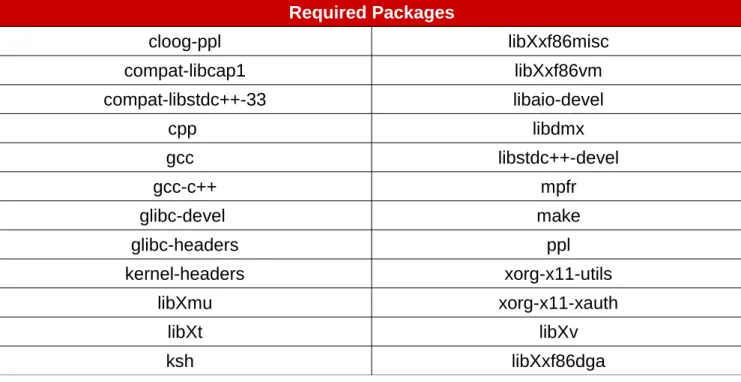
Oracle Grid Infrastructure 12.1 and Oracle Database 12.1 required x86_64 RPM packages5: Required Packages cloog-ppl libXxf86misc compat-libcap1 libXxf86vm compat-libstdc++-33 libaio-devel cpp libdmx gcc libstdc++-devel gcc-c++ mpfr glibc-devel make glibc-headers ppl kernel-headers xorg-x11-utils libXmu xorg-x11-xauth libXt libXv ksh libXxf86dga
Table 3.3.3.2: Required Packages
After the installation of Red Hat Enterprise Linux 6 is completed, create a file, req-rpm.txt, that contains the name of each RPM package listed above on a separate line. For simplicity, this
req-rpm.txt file is included in Appendix FOracle Database Package Requirements Text File.
Use the yum package manager to install the packages and any of their dependencies with the following command:
# yum install `awk '{print $1}' ./req-rpm.txt`
A minimum installation of Red Hat Enterprise Linux 6 does not install the X Window System
server package, but only the required X11 client libraries. In order to run the Oracle Universal Installer (OUI), a system with the X Window System server package installed is required. Using a system with X Window System installed, SSH into the Oracle Database server with the -Y option to ensure trusted X11 forwarding is set. The command is as follows:
# ssh -Y db-oracle-node1
Alternatively, if a system with the X Window System server package is unavailable, install the
X Window System server package directly on the Oracle Database Server.
# yum groupinstall "X Window System"
5 Linux OS Installation with Reduced Set of Packages for Running Oracle Database Server [ID 728346.1] via http://support.oracle.com
3.3.4 Configuring SecurityEnhanced Linux (SELinux)
SELinux is an implementation of a mandatory access control (MAC) mechanism developed by the National Security Agency (NSA). The purpose of SELinux is to apply rules on files and processes based on defined policies. When policies are appropriately defined, a system running SELinux enhances application security by determining if an action from a particular process should be granted thus protecting against vulnerabilities within a system. The implementation of Red Hat Enterprise Linux 6 enables SELinux by default and appropriately sets it to the default setting of ENFORCING. It is highly recommended that SELinux be kept in ENFORCING mode when running Oracle Database 12c Release 1 (12.1).
Verify that SELinux is running and set to ENFORCING:
As the root user,
# sestatus
SELinux status: enabled SELinuxfs mount: /selinux Current mode: enforcing Mode from config file: enforcing Policy version: 24
Policy from config file: targeted
If the system is running in PERMISSIVE or DISABLED mode, modify the /etc/selinux/config file and set SELinux to enforcing as shown below.
SELINUX=enforcing
The modification of the /etc/selinux/config file takes effect after a reboot. To change the setting of SELinux immediately without a reboot, run the following command:
# setenforce 1
For more information on Security-Enhanced Linux, please visit the Red Hat Enterprise Linux 6 Security-Enhanced Linux User Guide
3.3.5 Configuring Firewall Settings
Firewall access and restrictions play a critical role in securing your Oracle Database 12c Release 1 (12.1) environment. It is recommended that the firewall settings be configured to permit access to the Oracle Database network ports only from authorized database or database-management clients. For example, in order to allow access to a specific database client with an IP address of 10.16.142.54 and to make requests to the database server via SQL*Net using Oracle's TNS (Transparent Network Substrate) Listener (default port of 1521), the following firewall rule must be added to the iptables configuration file found at
/etc/sysconfig/iptables.
-A INPUT -m state --state NEW -m tcp -p tcp -s 10.16.142.54 --dport 1521 -j ACCEPT
Likewise, if a particular database client with an IP address of 10.16.142.54 required access to the web-based EM Express that uses the default port of 5500, the following firewall rule must be added to the iptables configuration file found at /etc/sysconfig/iptables.
-A INPUT -m state --state NEW -m tcp -p tcp -s 10.16.142.54 --dport 5500 -j ACCEPT
Once the rules have been modified within the /etc/sysconfig/iptables, run the following command to activate:
# service iptables restart
iptables: Setting chains to policy ACCEPT: nat mangle filte[ OK ] iptables: Flushing firewall rules: [ OK ] iptables: Unloading modules: [ OK ] iptables: Applying firewall rules: [ OK ]
NOTE: A full listing of all the firewall settings within the /etc/sysconfig/iptables file for this reference architecture can be found at AppendixDIptables Configuration File.
3.3.6 Setting Virtual Memory
Tuning virtual memory requires the modification of five kernel parameters that affect the rate at which virtual memory is used within Oracle databases. It is important to note the
recommended values listed are to be used as a starting point when setting virtual memory.
A brief description6 and recommended settings for the virtual memory parameters, as well as, the definition of dirty data are described below.
SWAPPINESS6 - A value from 0 to 100 which controls the degree to which the system swaps. A
high value prioritizes system performance, aggressively swapping processes out of physical memory when they are not active. A low value prioritizes interactivity and avoids swapping processes out of physical memory for as long as possible, which decreases response latency. The default value is 60. The Oracle recommended value is 0.
DIRTY DATA – Dirty data is data that has been modified and held in the page cache for performance benefits. Once the data is flushed to disk, the data is clean.
DIRTY_RATIO6 – Contains, as a percentage of total system memory, the number of pages at
which a process which is generating disk writes will itself start writing out dirty data. The default value is 20. The recommended value is 80. The reasoning behind increasing the value from the standard Oracle 15 recommendation to 80 is because dirty ratio defines the
maximum percentage of total memory that be can be filled with dirty pages before user processes are forced to write dirty buffers themselves during their time slice instead of being allowed to do more writes. All processes are blocked for writes when this occurs, not just the processes that filled the write buffers. This can cause what is perceived as unfair behavior where a single process can hog all the I/O on a system. As for all parameters in this reference architecture, there is no “one-size fits all” value and the recommendation should be only seen as a starting point.
DIRTY_BACKGROUND_RATIO6 – Contains, as a percentage of total system memory, the number of
pages at which the background write back daemon will start writing out dirty data. The Oracle recommended value is 3.
DIRTY_EXPIRE_CENTISECS6 - Defines when dirty in-memory data is old enough to be eligible for
writeout. The default value is 3000, expressed in hundredths of a second. The Oracle recommended value is 500.
DIRTY_WRITEBACK_CENTISECS6 - Defines the interval of when writes of dirty in-memory data are
written out to disk. The default value is 500, expressed in hundredths of a second. The Oracle recommended value is 100.
Prior to making any changes to the /etc/sysctl.conf ensure to create a backup as follows:
# cp /etc/sysctl.conf /etc/sysctl.conf.bkup
The following is a snippet from the /etc/sysctl.conf file with the five virtual memory parameters set with the recommended settings:
vm.swappiness = 0
vm.dirty_background_ratio = 3 vm.dirty_ratio = 80
vm.dirty_expire_centisecs = 500 vm.dirty_writeback_centisecs = 100
For the changes to take effect immediately, run the following command:
# sysctl -p
NOTE: A full listing of all the kernel parameters modified within the /etc/sysctl.conf file can be found at AppendixGKernel Parameters.
3.3.7 Setting Shared Memory (SHMMAX, SHMALL, SHMMNI)
Shared memory allows processes to communicate with each other by placing regions of memory into memory segments. In the case of Oracle, shared memory segments are used by the System Global Area (SGA) to store incoming data and control information. The size of Oracle's SGA impacts the amount of shared memory pages and shared memory segments to be set within a system. By default, Red Hat Enterprise Linux 6 provides a large amount of shared memory pages and segments. However, the appropriate allocation for a system depends on the size of the SGA within an Oracle database instance.
In order to allocate the appropriate amount of shared memory pages and shared memory segments for a system running an Oracle database, the kernel parameters SHMMAX, SHMALL, and SHMMNI must be set.
SHMMAX – is the maximum size in bytes of a single shared memory segment SHMALL – is the maximum total amount of shared memory pages
SHMMNI – is the maximum total amount of shared memory segments
A default installation of Red Hat Enterprise Linux 6 x86_64 provides a maximum size of a single shared memory segment, SHMMAX, to 68719476736 bytes, equivalent to 64 GB. This value is important since it regulates the largest possible size of one single Oracle SGA shared memory segment. If the Oracle SGA is larger than the value specified by SHMMAX
(default 64 GB), then Oracle will be required to create multiple smaller shared memory segments to completely fit Oracle's SGA. This can cause a significant performance penalty, especially in NUMA environments. In an optimal NUMA configuration, a single shared memory segment for Oracle's SGA is created on each NUMA node. If SHMMAX is not properly
sized and creates multiple shared memory segments, SHMMAX limitations may keep the system
from evenly distributing the shared memory segments across each NUMA node. To determine a proper SHMMAX value, the Oracle Database parameter SGA_MAX_SIZE needs to be
analyzed. If intending to set SGA_MAX_SIZE to a value larger than 64 GB, set SHMMAX to a size
in bytes larger than the SGA_MAX_SIZE. If in doubt on how to properly set SHMMAX, a value of
4398046511104 (4 TB) can be used. This value is purposely set higher than the architectural memory limits to ensure that any Oracle SGA value set within an Oracle database instance
may fit in one single shared memory segment.
After calculating SHMMAX, the next step is to determine the maximum amount of shared
memory pages (SHMALL) in a system by capturing system's page size in bytes. The following
command can be used to obtain the system page size.
# getconf PAGE_SIZE 4096
A default installation of Red Hat Enterprise Linux 6 x86_64 provides a SHMALL value of
4294967296, the equivalent of 16 TB in system pages. This is determined by the following:
SHMALL IN BYTES * PAGE_SIZE
From the example above, 4294967296 bytes * 4096 bytes = 17592186044416 bytes = 16 TB in system pages
To ensure an adequate amount of memory pages are allocated to a single Oracle SGA, it is recommended that the value of SHMALL be set to the following:
SHMMAXINBYTES / PAGE_SIZE
For example, on a system with the SHMMAX set to 4398046511104, the value of SHMALL is
calculated as follows:
# echo “4398046511104 / 4096” | bc 1073741824
SHMMNI is the maximum total amount of shared memory segments. A default installation of Red Hat Enterprise Linux 6 x86_64 provides a SHMMNI default value of 4096. By optimizing the SHMMAX value with one shared memory segment per Oracle SGA, this parameter reflects the
maximum number of Oracle and ASM instances that can be started on a system. Oracle recommends the value of SHMMNI to be left at the default value of 4096.
Snippet of the /etc/sysctl.conf file:
kernel.shmmax = 4398046511104 kernel.shmall = 1073741824 kernel.shmmni = 4096
In order for the changes take effect immediately, run the following command:
# sysctl -p
NOTE: A full listing of all the kernel parameters modified within the /etc/sysctl.conf file can be found at AppendixGKernel Parameters.
3.3.8 Setting Semaphores (SEMMSL, SEMMNI, SEMMNS)
Red Hat Enterprise Linux 6 provides semaphores for synchronization of information between processes. The kernel parameter sem is composed of four parameters:
SEMMSL – is defined as the maximum number of semaphores per semaphore set SEMMNI – is defined as the maximum number of semaphore sets for the entire system SEMMNS – is defined as the total number of semaphores for the entire system
NOTE:SEMMNS is calculated by SEMMSL * SEMMNI
SEMOPM – is defined as the total number of semaphore operations performed per semop
system call.
The following line is required within the /etc/sysctl.conf file to provide sufficient semaphores for Oracle:
kernel.sem = 250 32000 100 128
In order for the changes take effect immediately, run the following command:
# sysctl -p
NOTE: A full listing of all the kernel parameters modified within the /etc/sysctl.conf file can be found at AppendixGKernel Parameters.
3.3.9 Ephemeral Network Ports
Oracle recommends that the ephemeral default port range be set starting at 9000 to 65500. This ensures that all well known ports used by Oracle and other applications are avoided. To set the ephemeral port range, modify the /etc/sysctl.conf file and add the following line:
net.ipv4.ip_local_port_range = 9000 65500
In order for the changes take effect immediately, run the following command:
# sysctl -p
NOTE: A full listing of all the kernel parameters modified within the /etc/sysctl.conf file can be found at AppendixGKernel Parameters.
3.3.10 Optimizing Network Settings
Optimizing the network settings for the default and maximum buffers for the application sockets in Oracle is done by setting static sizes to RMEM and WMEM. The RMEM parameter
represents the receive buffer size, while the WMEM represents the send buffer size. The
recommended values by Oracle are configured within the /etc/sysct.conf file.
net.core.rmem_default = 262144 net.core.rmem_max = 4194304 net.core.wmem_default = 262144 net.core.wmem_max = 1048576
In order to make the changes take effect immediately, run the following command:
# sysctl -p
NOTE: A full listing of all the kernel parameters modified within the /etc/sysctl.conf file can be found at AppendixGKernel Parameters.
3.3.11 Increasing synchronous I/O Requests
The kernel parameter FS.AIO-MAX-NR sets the maximum number of current asynchronous I/O
requests. Oracle recommends setting the value to 1048576. In order to add FS-AIO-MAX-NR to 1048576, modify the /etc/sysctl.conf file as follows:
fs.aio-max-nr = 1048576
In order for the changes take effect immediately, run the following command:
# sysctl -p
NOTE: A full listing of all the kernel parameters modified within the /etc/sysctl.conf file can be found at AppendixGKernel Parameters.
3.3.12 Increasing File Handles
The kernel parameter FS.FILE-MAX sets the maximum number of open file handles assigned to
the Red Hat Enterprise Linux 6 operating system. Oracle recommends that for each Oracle database instance found within a system, allocate 512*PROCESSSES in addition to the open file handles already assigned to the Red Hat Enterprise Linux 6 operating system.
PROCESSES within a database instance refers to the maximum number of processes that can be concurrently connected to the Oracle database by the oracle user. The default value for PROCESSES is300 for Oracle Database 12c Release 1 (12.1). To properly calculate the FS.FILE-MAX for a system, first identify the current FS.FILE-MAX allocated to the system via the following command:
# cat /proc/sys/fs/file-max 32768
Next, add all the PROCESSES together from each Oracle database instance found within the system and multiple by 512 as seen in the following command.
# echo “512 * 300” | bc 153600
NOTE: To determine the current PROCESSES value, log into each Oracle database instance and run the following command below. Since no Oracle database has yet been created within this reference environment, the default value of 300 PROCESSES is used.
SQL> show parameter processes;
NAME TYPE VALUE
--- ---
processes integer 300
Finally, add the current FS.FILE-MAX value with the new value found from multiplying
512*PROCESSES to attain the new FS.FILE-MAX value.
# echo “32768 + 153600” | bc 186368
While the value of the FS.FILE-MAX parameter varies upon every environment, this reference
environment sets the value at 6815744. Oracle recommends a value no smaller than 6815744. Due to the calculation in the above example equating to 186368, the minimum Oracle recommended value is used. In order to add FS.FILE-MAX to 6815744, modify the /etc/sysctl.conf file as follows:
fs.file-max = 6815744
In order for the changes take effect immediately, run the following command:
NOTE: Oracle ASMLib does not open file descriptors for each device, but instead opens one file descriptor per Oracle process. This reference environment features both methods of implementation, Section3.4.3.1Oracle ASMLib Alternative: Configuring udev Rules and
Section 3.4.3.2 Configuring Oracle ASMLib. However, during the installation of Oracle Database 12c Release 1 (12.1) the FS.FILE-MAX kernel parameter must be set to at least
6815744.
NOTE: It is recommended to revisit the FS.FILE-MAXvalue if the PROCESSES value is
increased for any Oracle database instances created.
NOTE: A full listing of all the kernel parameters modified within the /etc/sysctl.conf file can be found at AppendixGKernel Parameters.
3.3.13 User Accounts & Groups
Prior to the installation of Oracle Database 12c Release 1 (12.1), Oracle recommends the creation of a grid user for the Oracle Grid Infrastructure and an oracle user for the Oracle Database software installed on the system. For the purposes of this reference environment, the Oracle Grid Infrastructure for a standalone server software owner is the user grid and the Oracle Database software owner is the user oracle. Each user is designated different groups to handle specific roles based on the software installed. However, the creation of separate users requires that both the oracle user and the grid user have a common primary group, the Oracle central inventory group (OINSTALL).
The following are the recommended system groups created for the installation of the Oracle Database and part of the oracle user.
OSDBA group (DBA) – determines OS user accounts with DBA privileges
OSOPER group (OPER) – an optional group created to assign limited DBA privileges (SYSOPER
privilege) to particular OS user accounts
With the release of Oracle Database 12c (12.1), Oracle introduces three additional database groups that are optional, but recommended. The recommended following groups provide the ability to separate administrative privileges for common database operations and limit
privileged access of the OSDBA group (DBA).
OSBACKUPDBA group (BACKUPDBA) – an optional group created to assign limited administrative privileges (SYSBACKUP privilege) to a user for database backup and recovery
OSDGDBA group (DGDBA) – an optional group created to assign limited administrative
privileges (SYSDG privilege) to a user for administering and monitoring Oracle Data Guard
OSKMDBA group (KMDBA) – an optional group created to assign limited administrative
privileges (SYSKM privilege) to a user for encryption key management when using Oracle Wallet
Manager
The following are the recommended system groups created for the installation of the Oracle Grid Infrastructure and part of the grid user
OSASM group (ASMADMIN) – provides administrative access for storage files via the SYSASM
privilege
OSOPER group (ASMOPER) – an optional group created to assign limited DBA privileges with
regards to ASM to particular OS user accounts
As the root user, create the following user accounts, groups, and group assignments using a consistent UID and GID assignments across your organization:
# groupadd --gid 54321 oinstall # groupadd --gid 54322 dba # groupadd --gid 54323 asmdba # groupadd --gid 54324 asmoper # groupadd --gid 54325 asmadmin # groupadd --gid 54326 oper # groupadd --gid 54327 backupdba # groupadd --gid 54328 dgdba # groupadd --gid 54329 kmdba
# useradd --uid 54321 --gid oinstall --groups dba,oper,asmdba,asmoper,\ > backupdba,dgdba,kmdba oracle
# passwd oracle
# useradd --uid 54322 --gid oinstall --groups dba,asmadmin,asmdba,asmoper grid # passwd grid
Verify the oracle and grid user correctly display the appropriate primary and supplementary groups via the commands:
# id oracle uid=54321(oracle) gid=54321(oinstall) groups=54321(oinstall),54322(dba),54323(asmdba),54324(asmoper),54326(oper), 54327(backupdba),54328(dgdba),54329(kmdba) # id grid uid=54322(grid) gid=54321(oinstall) groups=54321(oinstall),54322(dba),54323(asmdba),54324(asmoper),54325(asmadmin)
3.3.14 Setting Shell Limits for the
Grid
and
Oracle
User
Oracle recommends the following settings for the soft and hard limits for the number of open file descriptors (nofile), number of processes (nproc), and size of the stack segment (stack) allowed by each user respectively. The purpose of setting these limits is to prevent a system wide crash that could be caused if an application, such as Oracle, were allowed to exhaust all of the OS resources under an extremely heavy workload.
Create a file labeled 99-grid-oracle-limits.conf within /etc/security/limits.d/ as follows:
# touch /etc/security/limits.d/99-grid-oracle-limits.conf
NOTE: The reason that the /etc/security/limits.conf file is not directly modified is due to the order in which limit files are read in the system. After reading the /etc/security/limits.conf file, files within the /etc/security/limits.d/ directory are read. If two files contain the same entry, the entry read last takes precedence. For more information visit Red Hat Article: “What order are
the limit files in the limits.d directory read in?”7
Within the /etc/security/limits.d/99-grid-oracle-limits.conf file, add the following soft and hard limits for the oracle and grid user:
oracle soft nproc 16384 oracle hard nproc 16384 oracle soft nofile 1024 oracle hard nofile 65536 oracle soft stack 10240 oracle hard stack 32768 grid soft nproc 16384 grid hard nproc 16384 grid soft nofile 1024 grid hard nofile 65536 grid soft stack 10240 grid hard stack 32768
Due to Bug 159714218, the soft limit of nproc is not adjusted at runtime by the Oracle
database. Due to this, if the nproc limit is reached, the Oracle database may become unstable and not be able to fork additional processes. A high enough value for the maximum number of concurrent threads for the given workload must be set, or use the hard limit value of 16384 as done above if in doubt.
NOTE: Modifications made to the 99-grid-oracle-limits.conf file take effect immediately.
However, please ensure that any previously logged in oracleor griduser sessions (if any) are logged out and logged back in for the changes to take effect.
As the root user, create a shell script labeled oracle-grid.sh within /etc/profile.d/ to create the
ulimits for the oracle and grid user. The contents of the oracle-grid.sh script:
#Setting the appropriate ulimits for oracle and grid user if [ $USER = "oracle" ]; then
if [ $SHELL = "/bin/ksh" ]; then ulimit -u 16384 ulimit -n 65536 else ulimit -u 16384 -n 65536 fi fi
if [ $USER = "grid" ]; then
if [ $SHELL = "/bin/ksh" ]; then ulimit -u 16384 ulimit -n 65536 else ulimit -u 16384 -n 65536 fi fi
7 What order are the limits files in the limits.d directory read in? - https://access.redhat.com/site/solutions/199993
8 Oracle Documentation 12.1 -
NOTE: While the ulimit values can be set directly within the /etc/profile file, it is recommended to create a custom shell script within /etc/profile.d instead. The oracle-grid.sh script can be downloaded from the Appendix KConfiguration Files
As oracle and grid user, verify the ULIMIT values by running the following command:
# ulimit -a
core file size (blocks, -c) 0
data seg size (kbytes, -d) unlimited scheduling priority (-e) 0
file size (blocks, -f) unlimited pending signals (-i) 385878 max locked memory (kbytes, -l) 14854144 max memory size (kbytes, -m) unlimited open files (-n) 65536 pipe size (512 bytes, -p) 8 POSIX message queues (bytes, -q) 819200 real-time priority (-r) 0 stack size (kbytes, -s) 10240 cpu time (seconds, -t) unlimited max user processes (-u) 16384 virtual memory (kbytes, -v) unlimited file locks (-x) unlimited
3.4 Storage Configuration
The following storage configuration section describes the best practices for setting up device mapper multipath, the use of udev rules or Oracle ASMLib for ASM disk management, and the use of the tuned package for optimal performance.
3.4.1 Setting up DMMultipath
Device mapper multipath provides the ability to aggregate multiple I/O paths to a newly created device mapper mapping to achieve high availability, I/O load balancing, and persistent naming. The following procedures provide the best practices to installing and configuring device mapper multipath devices.
NOTE: Ensure Oracle database volumes are accessible via the operating system prior to continuing with the section below.
1. As the root user, install the device-mapper-multipath package using the yum package manager.
# yum install device-mapper-multipath
2. Copy the multipath.conf file found within /usr/share/doc/device-mapper-multipath-0.4.9/
to /etc/
# cp /usr/share/doc/device-mapper-multipath-0.4.9/multipath.conf /etc/
3. Capture the scsi id of the local disk(s) on the system.
# scsi_id --whitelisted --replace-whitespace –-device=/dev/sda 3600508b1001030353434363646301200
4. Uncomment and modify the blacklist section within the /etc/multipath.conf file to include the scsi id of the local disk on the system. Once complete, save the changes made to the multipath.conf file.
blacklist {
wwid 3600508b1001030353434363646301200
devnode "^(ram|raw|loop|fd|md|dm-|sr|scd|st)[0-9]*" devnode "^hd[a-z]"
}
5. Start the multipath daemon.
# service multipathd start
Starting multipathd daemon: [ OK ]
6. Enable the multipath daemon to ensure it is started upon boot time.
7. Identify the dm- device, size, and WWID of each device mapper volume for Oracle data disks and recovery disks. In this example, volume mpathb is identified via the following command:
# multipath -ll
Figure 3.4.1.1: Multipath Device (mpathb) properly identifies the current multipath alias name, size, WWID, and dm device. This information is required for the application of a custom alias to each volumeas shown in step 9.
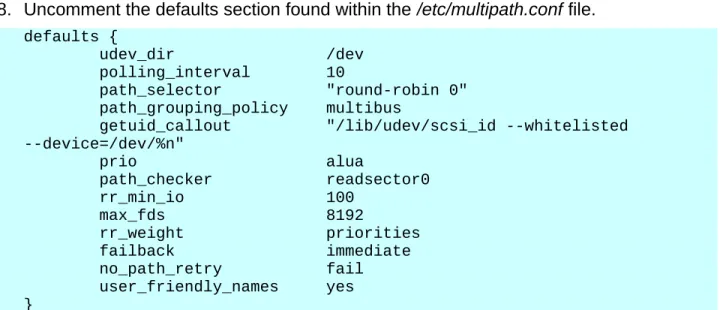
8. Uncomment the defaults section found within the /etc/multipath.conf file.
defaults {
udev_dir /dev polling_interval 10
path_selector "round-robin 0" path_grouping_policy multibus
getuid_callout "/lib/udev/scsi_id --whitelisted --device=/dev/%n" prio alua path_checker readsector0 rr_min_io 100 max_fds 8192 rr_weight priorities failback immediate no_path_retry fail user_friendly_names yes }
NOTE: The standard options can be customized to better fit your storage array capabilities. Check with your storage vendor for details.
9. Uncomment the multipath section found within the /etc/multipath.conf file and create an alias for each device mapper volume in order to enable persistent naming of those volumes. Once complete, save the changes made to the multipath.conf file. The output should resemble the example below. For reference, refer to the Oracle data volumes created for this reference environment displayed in Table 2.4.3: Oracle Data File Sizes for Reference Architecture.
multipaths { multipath { wwid 3600c0ff000d7e7a899d8515101000000 alias db1 } multipath { wwid 3600c0ff000dabfe5a7d8515101000000 alias db2 } multipath { wwid 3600c0ff000d7e7a8dbd8515101000000 alias fra } multipath { wwid 3600c0ff000dabfe5f4d8515101000000 alias redo } }
10. Restart the device mapper multipath daemon.
# service multipathd restart ok
Stopping multipathd daemon: [ OK ] Starting multipathd daemon: [ OK ]
11. Verify the device mapper paths and aliases are displayed properly. Below is an example of one device mapper device labeled fra.
# multipath -ll
fra (3600c0ff000d7e7a89e85ac5101000000) dm-10 HP,MSA2324fc size=186G features='1 queue_if_no_path' hwhandler='0' wp=rw |-+- policy='round-robin 0' prio=130 status=active
| |- 3:0:0:3 sdd 8:48 active ready running | |- 3:0:1:3 sdh 8:112 active ready running | |- 4:0:0:3 sdt 65:48 active ready running | `- 4:0:1:3 sdx 65:112 active ready running `-+- policy='round-robin 0' prio=10 status=enabled |- 3:0:2:3 sdl 8:176 active ready running |- 3:0:3:3 sdp 8:240 active ready running |- 4:0:2:3 sdab 65:176 active ready running `- 4:0:3:3 sdaf 65:240 active ready running
3.4.2 Partitioning Device Mapper Shared Disks
Partitioning of the device mapper shared disks is only required when using Oracle ASMLib. This reference environment provides instructions to configure either Oracle ASMLib or udev
rules. Partitions for each device mapper volume are created to comply with either option. Create a partition for each device mapper volume (db1,db2,fra,redo) using parted as displayed below for device db1.
# parted /dev/mapper/db1 mklabel gpt mkpart primary "1 -1" Information: You may need to update /etc/fstab.
Once the partition is created, a newly created device mapper device is created as db1p1.
# ls -l /dev/mapper/db1p1
lrwxrwxrwx. 1 root root 8 Apr 16 15:15 /dev/mapper/db1p1 -> ../dm-11
NOTE: A newly created partition requires the alias name followed by p1 such as db1p1 seen above. If p1 is missing, please run the following kpartx command to add the partition mappings to the device mapper disks.
# kpartx -a /dev/mapper/db1
If the following kpartx command does not add the p1 suffix to each partition, reboot the system.
3.4.3 Configuring Oracle ASM Disks
The configuration of Oracle ASM requires the use of either udev rules or Oracle's ASMLib. Oracle's ASMLib is an optional utility used to manage and assist users with Oracle ASM devices and is not required for proper operation of Oracle ASM disks. Moreover, Oracle
ASMLib does not have any impact on Oracle Database performance and requires a kernel module labeled kmod-oracleasm and proprietary user space utilities to properly function.
udev rules represent an alternative to Oracle's ASMLib and does not require additional kernel modules, thus keeping an overall smaller footprint on the Linux system. While this reference architecture documents both methods of implementation, only one method can be applied for a given solution. This section covers best practices of using Red Hat's native udev rules to setup the appropriate permissions for each device mapper disk, as well as, the best practices for Oracle's ASMLib.
3.4.3.1 Oracle ASMLib Alternative: Configuring udev Rules
The configuration of Oracle ASM requires the use of either udev rules or Oracle's ASMLib. This section, focuses on the best practices of using Red Hat's native udev rules to setup the appropriate permissions for each device mapper disk.
NOTE: If following the steps in this section, please ignore Section 3.4.3.2 Configuring Oracle ASMLib
1. As the root user, identify the Device Mapper Universally Unique IDentifier (DM_UUID) for each device mapper volume. The example below shows the DM_UID for the
partitions of the volumes labeled db1,db2,fra, and redo.
# for i in db1p1 db2p1 frap1 redop1; do printf "%s %s\n" "$i" "$(udevadm info --query=all --name=/dev/mapper/$i | grep -i dm_uuid)"; done
db1p1 E: DM_UUID=part1-mpath-3600c0ff000d7e7a899d8515101000000 db2p1 E: DM_UUID=part1-mpath-3600c0ff000dabfe5a7d8515101000000 frap1 E: DM_UUID=part1-mpath-3600c0ff000d7e7a8dbd8515101000000 redop1 E: DM_UUID=part1-mpath-3600c0ff000dabfe5f4d8515101000000
2. Create a file labeled 99-oracle-asmdevices.rules within /etc/udev/rules.d/
3. Within 99-oracle-asmdevices.rules file, create rules for each device similar to the example below:
KERNEL=="dm-*",ENV{DM_UUID}=="part1-mpath-3600c0ff000dabfe5f4d8515101000000",OWNER="grid",GROUP="asmadmin",MODE="06 60"
To understand the rule above, it can be read as follows:
If any dm- device (dm-*) matches the DM_UUID of
part1-mpath-3600c0ff000dabfe5f4d8515101000000, assign that dm- device to be owned by the
grid user and part of the ASMADMIN group with the permission mode set to 0660.
4. Save the file labeled 99-oracle-asmdevices.rules
5. Locate the dm- device for each Oracle related partition. An example of how to find the
dm- device for each partition is to run the following command:
# for i in db1p1 db2p1 frap1 redop1; do printf “%s %s\n” “$i” “$(ls -ll /dev/mapper/$i)”; done
db1p1 lrwxrwxrwx. 1 root root 8 May 20 20:39 /dev/mapper/db1p1 -> ../dm-11 db2p1 lrwxrwxrwx. 1 root root 8 May 20 20:39 /dev/mapper/db1p1 -> ../dm-12 frap1 lrwxrwxrwx. 1 root root 8 May 20 20:39 /dev/mapper/db1p1 -> ../dm-13 redop1 lrwxrwxrwx. 1 root root 8 May 20 20:39 /dev/mapper/db1p1 -> ../dm-14
6. Apply and test the rules created within the 99-oracle-asmdevices.rules by running a
udevadmtest on each device.
# udevadm test /sys/block/dm-11 [ ... Output Abbreviated ... ] udevadm_test: DM_NAME=db1p1
udevadm_test: DM_UUID=part1-mpath-3600c0ff000d7e7a86485ac5101000000 udevadm_test: DM_SUSPENDED=0
udevadm_test: DEVLINKS=/dev/mapper/db1p1 /dev/disk/by-id/dm-name-db1p1 /dev/disk/by-id/dm-uuid-part1-mpath-3600c0ff000d7e7a86485ac5101000000 /dev/block/253:11
udevadm_test: ID_FS_TYPE=oracleasm
7. Confirm the device has the desired permissions
# ls -lh /dev/dm-11
NOTE: For simplicity, this 99-oracle-asmdevices.rules file is included in AppendixI 99-oracle-asmdevices.rules
3.4.3.2 Configuring Oracle ASMLib
In order to configure Oracle ASMLib the following components are required:
kmod-oracleasm, oracleasm-support, and oracleasmlib
NOTE: If Section3.4.3.1 Oracle ASMLib Alternative: Configuring udev Rules has been configured, ignore this section and continue to Section 3.4.4 Optimizing Database Storage using Automatic System Tuning
The ASMLib kernel module package (kmod-oracleasm) is provided for Red Hat customers via the Supplementary Channel on Red Hat Network (RHN). In order to properly install and configure ASMLib the following procedures must be followed.
As the root user,
1. Enable the Red Hat Enterprise Linux 6 Supplementary repository as shown in Section
3.3.1Using the Red Hat Subscription Manager (Option A) or via the RHN Classic knowledge base article9.
2. Download the ASMLib library package (oracleasmlib)
# wget http://download.oracle.com/otn_software/asmlib/oracleasmlib-2.0.4-1.el6.x86_64.rpm
3. Download the ASMLib utilites package (oracleasm-support) # wget
http://public- yum.oracle.com/repo/OracleLinux/OL6/latest/x86_64/getPackage/oracleasm-support-2.1.8-1.el6.x86_64.rpm
4. Install the ASMLib kernel module package (kmod-oracleasm), ASMLib library package (oracleasmlib), ASMLib utilities package (oracleasm-support) using the following command:
# yum install kmod-oracleasm oracleasmlib-2.0.4-1.el6.x86_64.rpm oracleasm-support-2.1.8-1.el6.x86_64.rpm
9 Enabling the Supplementary Repository Knowledge Base Article, https://access.redhat.com/knowledge/articles/58637
5. Configure ASMLib using the following command:
# /usr/sbin/oracleasm configure -i
Configuring the Oracle ASM library driver.
This will configure the on-boot properties of the Oracle ASM library driver. The following questions will determine whether the driver is loaded on boot and what permissions it will have. The current values will be shown in brackets ('[]'). Hitting <ENTER> without typing an answer will keep that current value. Ctrl-C will abort.
Default user to own the driver interface []: grid Default group to own the driver interface []: asmadmin Start Oracle ASM library driver on boot (y/n) [ n ]: y Scan for Oracle ASM disks on boot (y/n) [y]: y
Writing Oracle ASM library driver configuration: done
6. Within /etc/sysconfig/oracleasm, set the ORACLEASM_SCANORDER and
ORACLEASM_SCANEXCLUDE parameters as follows:
# ORACLEASM_SCANORDER: Matching patterns to order disk scanning ORACLEASM_SCANORDER="dm"
# ORACLEASM_SCANEXCLUDE: Matching patterns to exclude disks from scan ORACLEASM_SCANEXCLUDE="sda"
NOTE: The ORACLEASM_SCANORDER set to dm ensures that when oracleasm scans the disks, it is appropriately scanning devices known by the kernel. The
ORACLEASM_SCANEXCLUDE is set to sda ensuring that local disk sda is to be ignored by oracleasm.
7. Run the following oracleasm command to ensure that oracleasm is enabled.
# /etc/init.d/oracleasm enable
Writing Oracle ASM library driver configuration: done
Initializing the Oracle ASMLib driver: [ OK ] Scanning the system for Oracle ASMLib disks: [ OK ]
8. Run the following oracleasm command to create and label all Oracle related volumes as an ASM disk. The example below creates an ASM disk labeled DATA1 for the following /dev/mapper/db1p1 partition.
# /usr/sbin/oracleasm createdisk DATA1 /dev/mapper/db1p1 Writing disk header: done
Instantiating disk: done
NOTE: It is highly recommended to have all Oracle related disks to be included within Oracle ASM.
9. Verify all the Oracle ASM disks created are listed. # /usr/sbin/oracleasm listdisks DATA1 DATA2 FRA1 REDO1
10. If no disks are listed or if any disks are missing, run the following command to rescan the ASM disks.
# /usr/sbin/oracleasm scandisks Reloading disk partitions: done Cleaning any stale ASM disks... Scanning system for ASM disks...
NOTE: If the issue persists after a rescan of the Oracle ASM disks, a reboot of the system might be required via the reboot, shutdown, or init 6 commands:
3.4.4 Optimizing Database Storage using Automatic System
Tuning
The tuned package in Red Hat Enterprise Linux 6 is recommended for automatically tuning the system for common workloads via the use of profiles. Each profile is tailored for different workload scenarios such as:
• enterprise-storage
• power savings
• high network throughput
It is recommended to create a custom profile (enterprise-storage-no-thp) with the same settings as the enterprise-storage profile but that disables Transparent HugePages (THP) for Oracle databases workload environments. For more information on why THP is disabled, see
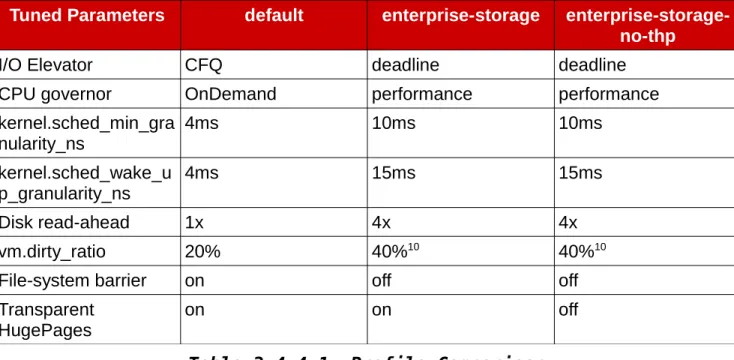
Section4.1.5Enabling HugePages. Table 3.4.4.1: Profile Comparison provides details between the default profile, storage profile, and the custom profile enterprise-storage-no-thp.
Tuned Parameters default enterprise-storage enterprise-storage-no-thp
I/O Elevator CFQ deadline deadline
CPU governor OnDemand performance performance
kernel.sched_min_gra nularity_ns 4ms 10ms 10ms kernel.sched_wake_u p_granularity_ns 4ms 15ms 15ms Disk read-ahead 1x 4x 4x vm.dirty_ratio 20% 40%10 40%10
File-system barrier on off off
Transparent
HugePages on on off
Table 3.4.4.1: Profile Comparison
The following procedures provide the steps that are required to create, install, enable, and select the enterprise-storage-no-thp profile.
1. Install the tuned package via the yum package manager.
# yum install tuned
2. Enable tuned to ensure it is started upon boot time.
# chkconfig tuned on