OpenBU http://open.bu.edu
Theses & Dissertations Boston University Theses & Dissertations
2017
High-dimensional quantum
information processing with linear
optics
https://hdl.handle.net/2144/23564 Boston University
COLLEGE OF ENGINEERING
Dissertation
HIGH-DIMENSIONAL QUANTUM INFORMATION
PROCESSING WITH LINEAR OPTICS
by
CASEY A. FITZPATRICK
B.A., Boston University, 2011
M.S., Boston University, 2017
Submitted in partial fulfillment of the
requirements for the degree of
Doctor of Philosophy
2017
First Reader
Alexander V. Sergienko, PhD
Professor of Electrical and Computer Engineering Professor of Physics
Second Reader
Gregg Jaeger, PhD
Associate Professor of Natural Sciences and Mathematics
Third Reader
Roberto Paiella, PhD
Professor of Electrical and Computer Engineering Professor of Materials Science and Engineering
Fourth Reader
Mark Kon, PhD
you’d better make it quantum mechanical, and by golly it’s a wonderful problem, because it doesn’t look so easy.
Richard Feynman, Simulating Physics with Computers, 1982
I would like to thank Alexander Sergienko, David Simon, and Gregg Jaeger for guiding me through the strange world of the quantum. I would like to thank Geshe Dorji Damdul for advising that I channel my general interests towards physics. I would like to thank my parents for encouraging me every step of the way, and Tessa for keeping me sane every step of the way. Also, thanks to Nick and Christine.
Casey Alan Fitzpatrick Boston, MA
April, 2017
PROCESSING WITH LINEAR OPTICS
CASEY A. FITZPATRICK
Boston University, College of Engineering, 2017
Major Professor: Alexander V. Sergienko, PhD
Professor of Electrical and Computer Engineering
Professor of Physics
ABSTRACT
Quantum information processing (QIP) is an interdisciplinary field concerned with the development of computers that utilize quantum mechanical properties of nature to carry out their function. QIP systems have become vastly more practical since the turn of the century. Today, QIP applications span imaging, cryptographic security, computation, and simulation (quantum systems that mimic other quantum systems). Many important strategies improve quantum versions of classical information sys-tem hardware, such as single photon detectors and quantum repeaters. Another more abstract strategy engineers high-dimensional quantum state spaces, so that each suc-cessful event carries more information than traditional two-level systems allow. Pho-tonic states in particular bring the added advantages of weak environmental coupling and data transmission near the speed of light, allowing for simpler control and lower system design complexity.
In this dissertation, numerous novel, scalable designs for practical high-dimensional linear-optical QIP systems are presented. First, a correlated photon imaging scheme
objects using measurements, as well as building images out of those interactions is reported. Then, a statistical detection method using chains of OAM superpositions distributed according to the Fibonacci sequence is established and expanded upon. It is shown that the approach gives rise to schemes for sorting, detecting, and generating the recursively defined high-dimensional states on which some quantum cryptographic protocols depend.
Finally, an ongoing study based on a generalization of the standard optical multi-port for applications in quantum computation and simulation is remulti-ported upon. The architecture allows photons to reverse momentum inside the device. This in turn enables realistic implementation of controllable linear-optical scattering vertices for carrying out quantum walks on arbitrary graph structures, a powerful tool for any quantum computer.
It is shown that the novel architecture provides new, efficient capabilities for the optical quantum simulation of Hamiltonians and topologically protected states. Fur-ther, these simulations use exponentially fewer resources than feedforward techniques, scale linearly to higher-dimensional systems, and use only linear optics, thus offering a concrete experimentally achievable implementation of graphical models of discrete-time quantum systems.
1 Introduction 1
1.1 Context and contents of this dissertation . . . 1
1.2 Structure of this dissertation . . . 3
1.3 Background . . . 6
1.3.1 Quantum Optics . . . 7
1.3.2 Quantum Information Processing and Quantum Computing . 14 1.3.3 Quantum walks . . . 20
2 Correlated photon imaging and symmetry detection with orbital angular momentum states 27 2.1 Overview . . . 27
2.2 Orbital angular momentum (OAM) states . . . 30
2.2.1 Laguerre-Gauss modes . . . 30
2.2.2 Object representation . . . 30
2.3 Apparatus . . . 32
2.3.1 Phase-sensitive detection object detection . . . 32
2.4 Imaging and information for complex objects . . . 36
2.4.1 Imaging and joint OAM spectra . . . 37
2.4.2 Off-axis translation and mutual information . . . 41
2.4.3 Rotational-insensitivity of object signature . . . 44
2.5 Summary . . . 45
3.1 Overview . . . 49
3.2 Fibonacci key distribution . . . 52
3.2.1 Fibonacci state generation and the Fibonacci protocol . . . 54
3.3 Discriminating superposition states . . . 56
3.3.1 Polarization superposition detection example . . . 56
3.3.2 Extension to Fibonacci-OAM superposition sorting & detection 60 3.4 Generalizations of OAM superposition state detection schemes . . . . 62
3.5 State synthesis . . . 66
3.6 Security . . . 72
3.6.1 Setup for Key Distribution . . . 75
3.6.2 Effect of eavesdropping: qualitative discussion . . . 79
3.6.3 Discriminating superposition states . . . 81
3.6.4 Mutual Information and Security . . . 84
3.6.5 Security analysis conclusions . . . 89
3.7 Summary . . . 89
4 Quantum simulation using quantum walks on linear-optical multi-port networks 91 4.1 Undirected linear-optical multi-ports . . . 92
4.1.1 Overview of the undirected linear-optical multiport . . . 93
4.1.2 Directionally-Unbiased Optical Three-ports . . . 95
4.1.3 Paths and amplitudes through the device . . . 100
4.1.4 Entangled state processing . . . 101
4.1.5 Probabilistic Controlled Entangled-State Gates . . . 107
4.2 Quantum simulation of discrete-time Hamiltonians using directionally-unbiased linear-optical multiports . . . 111 4.2.1 Review of directionally-unbiased multiports for discrete-time
Hamiltonian simulation . . . 114 4.2.2 Review of discrete-time Hamiltonians . . . 118 4.2.3 Dynamics on a discrete three-point configuration space . . . . 121 4.2.4 Time-reversible systems . . . 127 4.3 Quantum simulation of topologically protected states using
directionally-unbiased linear-optical multiports . . . 137 4.3.1 Winding numbers and topologically protected states . . . 139 4.3.2 Review of directionally-unbiased multiports for quantum
simu-lation of topologically protected states . . . 143 4.3.3 Simulating the modified SSH Hamiltonian . . . 146 4.4 Summary . . . 155
5 Conclusions 160
5.1 Summary of work and future directions . . . 160
A Appendices 164
A.1 Fibonacci Protocol Reconciliation . . . 164 A.2 Fibonacci Probability Matrices . . . 166
References 170
Curriculum Vitae 181
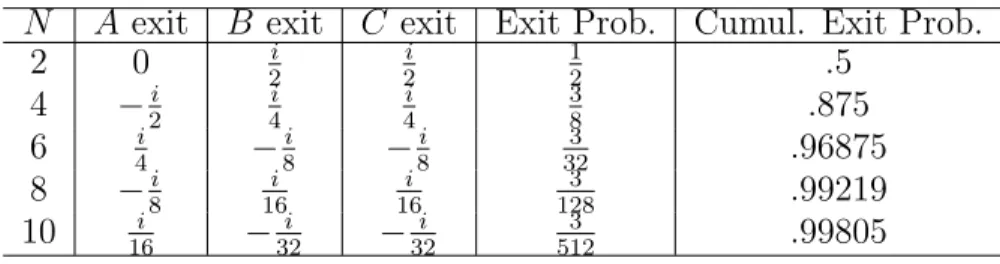
4.1 Amplitudes for paths exiting at time t = N T, assuming input at A. Columns 2-4 give amplitudes for exit at each port. The last columns give exit probability at t = N T and cumulative exit probability for
t≤N T. . . 96 4.2 Ψ+ can be converted to any desired output Bell state. Here the s
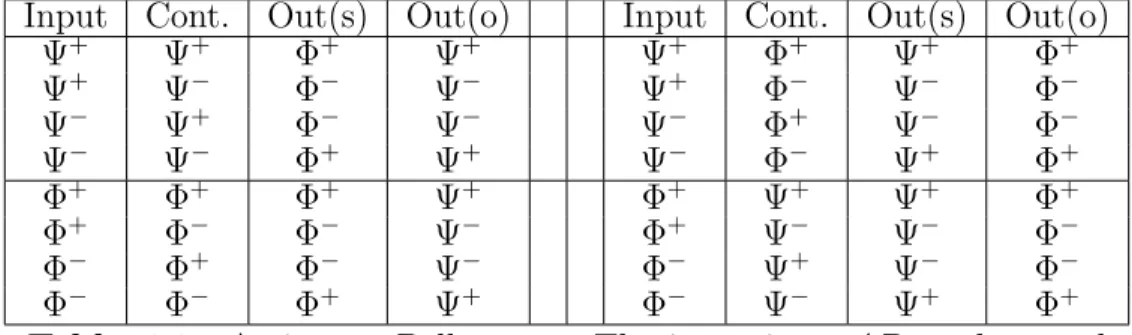
condition is assumed. . . 106 4.3 Action on Bell states. The input is at AB, and control at AC, with
output at BC conditioned, respectively, on detecting the same (s) or opposite (o) polarizations at A. . . 106
1·1 The figure from (Manouchehri and Wang, 2013), shows a compari-son between the resulting distributions for a classical (dotted red) and quantum walk on an infinite line after t = 100 steps, starting at the origin with the initial state |ψi0 = √1
2(|hi+|vi)⊗ |0i and using the operator ˆU of Eq. 1.24 to evolve the system according to Eq. 1.25. The ballistic spreading present in the quantum walk clearly distinguishes it from its classical counterpart. . . 23
2·1 A phase-insensitive setup allowing measurement of correlated OAM content, but no image reconstruction. . . 33 2·2 A setup allowing object image reconstruction via transition amplitude
phase-sensitive measurement of correlated OAM content. . . 34 2·3 (a) The CSI reconstruction usinglmax = 10,pmax = 7, with opaque star
object of max width 0.9w0 in lower right corner. (b) The amplitude phase spectrum of the amplitudes in Eq. 2.4 across all measured l
values (that is, the α in Sec. 2.2), for the case (p = 2, p0 = 7) (c) The joint OAM spectrum of the star, having summed over all p, and (d) the same spectrum with the conservation diagonal removed. . . 39
construction using lmax = 10, pmax = 7; (c) The joint OAM spectrum
of the fighter jet, summed over all p with the conservation diagonal removed. . . 40 2·5 (a) Opaque tank object of max width 0.7w0 and, (b) the CSI
recon-struction using lmax = 10, pmax = 7; (c) The joint OAM spectrum of
the tank, summed over all pwith the conservation diagonal removed. 41 2·6 (a) The CSI reconstruction of a translated opaque star, usinglmax = 10,
pmax= 7; (b) The joint OAM spectrum of the translated star, summed
over all pwith the conservation diagonal removed. . . 42 2·7 (a) The CSI reconstruction of a translated opaque fighter jet, using
lmax = 10, pmax = 7; (b) The joint OAM spectrum of the fighter jet,
summed over all p with the conservation diagonal removed. . . 42 2·8 (a) The CSI reconstruction of a translated opaque tank, using lmax =
10, pmax = 7; (b) The joint OAM spectrum of the tank, summed over
allp with the conservation diagonal removed. . . 42 2·9 Mutual information carried by off-diagonal components of joint OAM
spectrum, for various objects, as a function of distance from beam center with lmax = 10, pmax = 5; increasing pmax will increase the
mutual information substantially. Note that each object’s off-diagonal information content exceeds one bit per photon at the beam center. . 43 2·10 (a)One of many orientations measured for the 8-fold symmetric object;
(b) The CSI reconstruction is blurry as expected, due to the random rotations of the object; (c) The joint OAM spectrum, however, is in-sensitive to object rotation about a fixed axis. . . 44
OAM states. The L and D detection stages respectively test for dif-ferent OAM eigenstates or difdif-ferent superposition states. Interference between scatterings in aperiodic Vogel spiral lead to an OAM spectrum in the pump that is restricted to the Fibonacci sequence. The filters after the crystal remove any non-Fibonacci values that appear in the down conversion process. See (Simon et al., 2013) for more detailed description of the apparatus. . . 53 3·2 Apparatus for statistically distinguishing sets of vertically or
horizon-tally polarized photons from diagonally-polarized photons. The half-wave plates rotate vertical and horizontal polarization states to a di-agonal state, in order to restore indistinguishability between paths. If the photons are vertically or horizontally polarized, the two detectors
C and D will register the same number of events. For diagonally po-larized states at +45◦ from the horizontal, destructive interference will prevent detector D from registering any events, with constructive in-terference occurring at detector C. For inputs states polarized along the other diagonal (−45◦) the roles of the detectors are reversed: con-structive interference occurs atDand destructive interference prevents
C from firing. . . 57
with the half-wave plates in the upper and lower copies taking the polarization vectors to opposite diagonals. If either of the states |Vi or|Hiis input, all four detectors have equal probability of firing. But if one of the two superposition states| %i= √1
2(| ↑i+| →i) or| -i= 1
√
2(| ↑i − | →i) is input, then only theCdetector in one interferometer and the D detector in the other can fire. (The π phase shift in one branch of the bottom interferometer is not necessary, but is inserted to keep the labeling of theC and D detectors consistent in the upper and lower interferometers. ) . . . 59 3·4 A portion of a detection unit for statistically detecting superpositions
of OAM states, analogous to the polarization version of the previous figure. The sorter separates different OAM values, which are then shifted to zero OAM by spiral wave plates or holograms (the yellow circles). From the top downward, the OAM shifters shown change the incoming OAM value by ∆l =−Fn−2,−Fn,−Fn+2,−Fn+4. Superposi-tions of the form |Fni+|Fn+2i cause constructive interference at the
Cn detectors and destructive interference at the Dn detectors, while
OAM eigenstates lead to equal detection rates at both types. Coming out of the same sorter is a similar arrangement (not shown) for the states . . .|Fn−1i, |Fn+1i, |Fn+3i, . . . 61
yellow circle represents an OAM shifter that takes the OAM in that branch to zero. Each place where lines split or cross is implied to have a beam splitter. The portion shown has OAM values from ln to ln+4 coming out of the OAM sorter. . . 64 3·6 Portion of setup for detecting states of the form−|xni+12|xn−1i, where
{xn}is a predetermined set of OAM values. One output from the first
beam splitter in thenth line is attenuated in amplitude by 12 and the other output is phase shifted byπ. . . 65 3·7 (a) An OAM sorter followed by detectors makes measurements in a
four-dimensional space spanned by the four incoming basis states (the states |Fni, . . .|Fm+3i in the case drawn). (b) An arrangement for measuring in a basis that is mutually unbiased to the basis of (a). The yellow circles shift the OAM to zero, so that interference can occur, and 50/50 beam splitters are implied at each of the points where lines cross. Additional beam splitters (not shown) are needed in some of the lines to equalize the detection probabilities in the four detectors (M1, . . . , M4). . . 66
the Fibonacci recurrence relation. Given a superposition of two input state (for example|xni=|Fni and |xn+1i=|Fn+1i), the cell produces a state proportional to |xn+2i ≡ √12(|xni+|xn+1i.). The attenuation of the amplitude in the bottom line by √1
2 is there to ensure that the amplitudes of the three states are equal. By adding additional attenuations and phases shifts in the various branches, units cells for any other complex, linear recursion relation can be constructed. . . . 68 3·9 Recursive state generator (RSG). Multiple copies of the unit cell of Fig.
3·8 (represented by the blue boxes) can be concatenated in a fractal-like manner to form a set of output states that obey the Fibonacci relation |xni = √12|xn−1i +|xn−2i. Each additional cell added has half the output intensity of the previous cell. The attenuations (beam splitters), represented by the red circles, are added to make all of the final output intensities equal. Adding additional attenuations and phases shifts inside the unit cell, other recurrence relations can be realized in Hilbert space. . . 68 3·10 The apparatus of Fig. 3·15 (with the detectors removed) is abbreviated
as a single unit, represented by the green box (left side of figure). Multiple copies of this unit can be repeated, with the output of each used as input to the next (right side). The result is that the apparatus alternately switches between the L and D bases. . . 70
LandDmeasurements, each of the two entangled photons can be made
to walk randomly up and down one of the two chains of states shown. The left-hand chain is constructed from states |Fni with odd index n,
the right-hand chain is built from states with even n. The |Cni and
|Dnistates are those that are detected by the Cn and Dn detectors in
Fig. 3·15. . . 71 3·12 Schematic setup for generating cryptographic key with Fibonacci-valued
OAM states. . . 78 3·13 Outcome probabilities for eigenstates. (a) When there is no
eavesdrop-ping and Bob measures in theL basis, an incoming eigenstate should be detected correctly 100% of the time. (b) When Eve measures in the D basis, each eigenstates can result in two different superposition detections. If she sends one of these superpositions on to Bob, the net result is that there are now three eigenstates that he could detect. . . 80
eavesdropping, an incoming superposition state leads to three possible outcomes when Bob makes a measurement in the superposition (D) basis: the state can be identified correctly with probability 12, or it can be misidentified as one of the other two allowed superpositions that have nonzero overlap with it. (b) When Eve measures in the L basis, each of the two possible eigenstates that result can lead to two different superpositions. The net result is that there are three outcomes that have nonzero overlap with the two eigenstates, so that the same probabilities occur as in figure (a), unless an addition is made to the apparatus (section 3.6.3). . . 81 3·15 A portion of a detection unit for statistically detecting superpositions
of OAM states, analogous to the polarization version of the previous figure. The sorter separates different OAM values, which are then shifted to zero OAM by spiral wave plates or holograms (the yellow circles). From the top downward, the OAM shifters shown change the incoming OAM value by ∆l=−Fm−2,−Fm,−Fm+2,−Fm+4. Superpo-sitions of the form|Fmi+|Fm+2icause constructive interference at the
Cm detectors and destructive interference at the Dm detectors, while
OAM eigenstates lead to equal detection rates at both types. . . 83 3·16 The disturbance to the probability distribution, plotted against the
eavesdropping fraction,η. . . 86 3·17 The mutual information (upper red curve) shared between Alice and
Bob, and the information gain per trial by Eve (lower blue curve) as functions ofη. . . 88
3·19 The secret key rateκ as function of disturbance, D. . . 89 4·1 Schematic of the directionally-unbiased three-port. Beam splitters
con-nect input ports to two internal edges and a mirror unit U. U is com-posed of a mirrorM and phase plateP (inset). Reflection at a mirror unit imparts to each photon a total phase factor of−i. . . 95 4·2 The paths of length up to N = 10 that enter port A and then exit at
the same port. . . 102 4·3 The paths of length up to N = 10 that enter port A and then exit at
the portB. . . 103 4·4 The paths of length up to N = 8 that enter port A and then exit at
the portC. . . 104 4·5 Two-photon input enters portsA/B, with control state entering A/C.
Output exits portsB/C. . . 105 4·6 The multiport produces the Abelian 4-group multiplication table (a).
(b) CyclicZ2 subgroups describe reflections about axes shown in (c). 108 4·7 Directionally-unbiased four-port. Generalizations to any number of
ports≥3 are possible. . . 111 4·8 (a) The beam splitter is a four-port device. Initially, all four ports are
symmetric. (b) But when a photon is input to one port the symmetry is broken: the photon can exit from ports 3 and 4, but not 1 or 2. The fact that the photon cannot reverse direction and exit out input port 1 is referred to by saying that the beam splitter isdirectionally biased: the presence of the photon in one port biases the output toward two of the four possible output directions. . . 114
ased four-port. The rectangles after the beam splitters in (a) and (b) represent the vertex mirror unit shown in (c); this unit consists of a mirror and a phase-shifter. The distance between each beam splitter and the adjacent mirror unit is half the distance d between one beam splitter and the next. . . 115 4·10 (a) A string of multiports connected sequentially, with each output of
one feeding directly into the input of the next. There is a three-state quantum walk among the three lines as the photons progress spatially from left to right. (For clarity, the figures are not drawn to scale: the multiports should be very small compared to the distances between them.) (b) State preparation occurs on the left and photons are coupled into the system through the three input ports. Detection occurs on the right, with a detector in each line. Depending on the experiment being performed, the detectors may be connected in coincidence. . . 122 4·11 (a) A compact system equivalent to that of Fig. 4·10, but which
oper-ates using just two multiports; the spatial evolution from left to right in Fig. 4·10 is replaced by time evolution within a single region. The pho-tons travel in opposite directions on successive time steps. (For clarity, the figures are not drawn to scale: the multiports should be very small compared to the distances between them.) (b) After coupling the in-put into the system, a gated optical switch allows measurement of the output state after a fixed number of time steps. . . 128
m labels the site, and three edges within the site are labeled 0,±1. If propagation direction of the light is included, then this doubles the number of states per site. . . 131 4·13 Energy level diagram of the three state system of Fig. 4·12. E3 is
constant, while E1 and E2 oscillate with k. Note that E1 has no gap with E2 orE3, but that E2 and E3 are always separated by a gap. . 134 4·14 As the quasi-momentumk ranges over a full Brouillon zone, the vector
d(k) traces out a closed curve in thex−yplane. The winding number
ν counts the number of times the curve encircles the singular point at the origin. ν is positive if the curve is traversed counter-clockwise, negative if traversed clockwise. . . 141 4·15 (a) The directionally unbiased three-port. (b) The directionally
un-biased four-port. The rectangles after the beam splitters in (a) and (b) represent the vertex mirror unit shown in the inset of (a). This unit consists of a mirror and a phase-shifter. The distance between each beam splitter and the adjacent mirror unit is half the distance d
between one beam splitter and the next. . . 144 4·16 The SSH Hamiltonian describes motion of a particle hopping on a
chain of sites with two substates per site. v andw are respectively the intracell and intercell hopping amplitudes per unit time. . . 147
and Hillery, 2004a; Feldman and Hillery, 2004a; Feldman and Hillery, 2007) is equivalent to a pair of directionally unbiased three-ports ar-ranged as shown, with a relative phase shift between the two pairs of connected multiports. . . 148 4·18 Simulating the SSH Hamiltonian with diamond graphs. Each diamond
graph is made from two directionally unbiased three-ports, as shown in Fig. 4·17, so that each cell (indicated by the dashed curves) is made from four three-ports. The two diamond graphs at each site may have two different internal phase shifts, φa and φb. The two substates at
each site correspond to two polarizations; the shaded areas have verti-cal polarization (state b), while the unshaded regions have horizontal polarization (state a). The red rectangles are phase plates that rotate the polarization by 90◦. . . 150 4·19 Energy bands in the first Brillouin zone for the MSSH model. There
are three energy eigenstates: the top two levels are degenerate. The band gap vanishes when the two phases are equal (a) and opens up when the two phase values differ. The gap is still very small in (b), but grows as |φa−φb| increases (c), reaching its maximum size when
|φa−φb|=π (d). . . 152
the MSSH model. The points along each curve are parameterized by
k. (a) The value of φa controls the horizontal position of the circle’s
center. All of the circles shown haveφb = 0, but different values ofφa.
(b) φb changes the circle’s size. The curves shown all have φa = 0 and
different values of φb. Note that for some phase values the circles will
enclose the origin, indicating a nonzero winding number. . . 154 4·21 Comparison of MSSH quantum walk with topologically protected edge
state (left) and MSSH quantum walk with normal ballistic spreading (right) for 0 ≤ t ≤ 200. The two walks are simulated for the ar-rangement shown in Fig. 4·18. The topology on the left uses (φa =
1.5, φb = 2.5) when m ≤0, giving a winding number ν 6= 0; this joins
up with aν = 0 region having phase shifts of (φa= 3π/4, φb = 0) when
m≥0. The result is a localized state confined to the boundary of these topologies, indicated by the peak that arises at m = 0. In contrast, the topology on the right uses φa = 0, φb = 0 for all m, leading to a
ballistic quantum walk in one dimension. . . 156
matrices. Different rows correspond to different outcomes for Bob, while columns correspond to Alice’s outcomes. The first row and col-umn label detection of outcomes not included in the range of the al-phabet used for key generation. The remaining rows and columns of L0 label allowed eigenstates, and those of D0 alternately label Cn
and Dn detection events signalling allowed superposition states.
Sim-ilarly, C0 has eigenstate events running horizontally, with Cn and Dn
events vertically. L0, C0, and D0 are respectively (N + 1)×(N + 1), (N+ 1)×(2N + 1), and (2N + 1)×(2N + 1) matrices. . . 167
CSI . . . Correlated spiral imaging H.c. . . Hermitian conjugate
OAM . . . Orbital angular momentum QIP . . . Quantum information processing QKD . . . Quantum key distribution
RSG . . . Recursive state generator
SGDT . . . Superposition generation and detection tree SSH . . . Su-Schrieffer-Heeger
Chapter 1
Introduction
1.1
Context and contents of this dissertation
Quantum information processing (QIP) is an interdisciplinary scientific field con-cerned with the research and development of computers and information processing systems that explicitly use quantum mechanical properties of nature to carry out their function (Venegas-Andraca, 2012; Feynman, 1982). QIP systems have become vastly more practical since the turn of the century. Today, applications of QIP span imaging, cryptographic network security (Gisin et al., 2002), computation (Nielsen and Chuang, 2010) and simulators (quantum systems that mimic other quantum sys-tems) (Georgescu et al., 2014; Aspuru-Guzik and Walther, 2012; Hauke et al., 2012), measurement (Sergienko and Jaeger, 2003) and more (Schuld et al., 2015). By utiliz-ing quantum-physical resources such as entanglement, QIP systems can offer various advantages, such as increased information capacity and energy efficiency, compared to classical analogues (Howard et al., 2014). In practice, however, QIP system perfor-mance still faces many challenges, like low data rates caused by losses and inefficiencies inherent to the underlying quantum resources (Gisin et al., 2002). As QIP systems become more commonplace, new approaches are needed if these limitations are to be overcome.
infor-mation system hardware, such as (single photon) detectors and (quantum) repeaters (Sangouard et al., 2011). Another, more abstract strategy seeks to engineer high-dimensional quantum state spaces for increased capacity, so that each successful event may carry more information than traditional two-level systems such as polar-ization and spin allow. The general strategy for QIP system development employed throughout this research looks to utilize high-dimensional quantum states, both as increased-capacity information carriers and as unique resources with additional useful properties.
High-dimensional optical states in particular bring to QIP the added advantages of weak environmental coupling and data transmission near the speed of light (Knill et al., 2001). Using these high-dimensional bosons for QIP allows for simpler control, facilitating lower system design complexity. Some high-dimensional optical states, such as orbital angular momentum (OAM) eigenstates, it is shown, even offer novel information retrieval capabilities, such as the ability extract symmetry information about material objects using a small number of interactions.
In this dissertation, numerous novel, scalable designs for practical high-dimensional QIP systems based on linear optics are reported (Fitzpatrick et al., 2014; Simon et al., 2015a; Simon et al., 2015b; Simon et al., 2016; Simon et al., 2017a; Simon et al., 2017b). First, a correlated photon imaging scheme using OAM states to de-tect rotational symmetries in objects with a small number of measurements, as well as building images out of those interactions is presented (Fitzpatrick et al., 2014). Then, a cryptographic key distribution protocol using chains of OAM superpositions distributed according to the Fibonacci sequence is established and expanded upon. It is shown that the protocol maintains the increased security of quantum key dis-tribution, and schemes for sorting, detecting, and generating the recursively defined
high-dimensional states on which the protocol depends are described (Simon et al., 2015a; Simon et al., 2015b).
Finally, an ongoing study based on a generalization of the standard optical mul-tiport for applications in quantum computation and simulation is reported (Simon et al., 2016). The architecture allows photons to reverse momentum inside the device. This in turn enables realistic implementation of controllable linear-optical scattering vertices for carrying out quantum walks on arbitrary graph structures, a powerful tool for any quantum computer.
It is shown that the novel architecture provides new, efficient capabilities for the optical quantum simulation of Hamiltonians (Simon et al., 2017a) and topologically protected states (Simon et al., 2017b). Further, these simulations use exponentially fewer optical resources than feed-forward techniques, making them efficient alterna-tives to current approaches. Most of the multiport architectures also scale linearly to higher-dimensional systems and use only linear optics, making them versatile build-ing blocks of potentially complex information processbuild-ing networks. Ultimately, the directionally-unbiased linear-optical multiports offer a physically concrete, experimen-tally achievable implementation of high-dimensional graphical models of discrete-time quantum systems, thus introducing a heretofore unexplored avenue of research in op-tical quantum information and computation research.
1.2
Structure of this dissertation
This report is divided into 5 chapters. The original research reported here is primar-ily contained in Ch. 2, Ch. 3, and Ch. 4, with each of those chapters focusing on published work related to one application (or set of applications) related to the main theme. Concluding remarks are given in Ch. 5. The current chapter is dedicated
to introductory remarks as well as background materials that may be useful for the subsequent chapters.
In Chapter 2 a novel photonic imaging system using high-dimensional correlated orbital angular momentum states (OAM), as well as numerical results demonstrating the method’s image reconstruction capabilities and information capacity in terms of bits carried per detected photon, originally reported in (Fitzpatrick et al., 2014), is presented. Further, the system is numerically demonstrated to be capable of identi-fying arbitrarily rotating objects, thus illustrating the rotational insensitivity of this correlation method. Specifically, it is shown that the coincidence spectra generated using the method remain unchanged even when the target object undergoes random rotations between measurements.
In Chapter 3 an interferometric method for statistically discriminating between nonorthogonal states in high-dimensional Hilbert spaces for use in quantum informa-tion processing, originally reported in (Simon et al., 2015a) and (Simon et al., 2015b), is presented. The method is illustrated for the case of photon orbital angular momen-tum (OAM) states. These states belong to pairs of bases that are mutually unbiased on a sequence of two-dimensional subspaces of the full Hilbert space, but the vectors within the same basis are not necessarily orthogonal to each other. Over multiple trials, this method allows OAM eigenstates to be distinguished from superpositions of multiple such eigenstates. Variations of the same method are shown to be capable of preparing and detecting arbitrary linear combinations of states in Hilbert space. One further variation allows the construction of chains of states obeying recurrence relations on the Hilbert space itself, potentially opening a new range of possibilities for more abstract information-coding algorithms to be carried out experimentally in an simple manner. Among other applications, it is shown that this approach provides
a passive means of switching between pairs of high-dimensional mutually unbiased OAM bases, simplifying the switching process compared to other active methods such as polarization-controlled switching.
Finally, in Chapter 4 the concept of directionally-unbiased optical multiports is introduced, in which photons may reflect back out of the input direction (Simon et al., 2016). These multiports allow optical scattering experiments to be carried out on ar-bitrary undirected graphs via linear optics. It is shown that the particular architecture of the multiports allows for an exponential decrease in required optical components, compared to feed-forward techniques, when carrying out quantum walk experiments. By utilizing the dynamic modelling techniques of the scattering theory formulation of quantum walks, efficiently implementable applications exploring quantum walks on complex networks can be explored. Two such applications from the area of quan-tum simulation, which concerns quanquan-tum systems that mimic the dynamics of other quantum systems (Feynman, 1982), are presented. The first application addresses the general issue of simulating discrete-time Hamiltonians with both spatial and in-ternal degrees of freedom using one-dimensional chains of multiports (Simon et al., 2017a). Simple examples are studied and practical issues such as state-generation, measurement, and resource requirements are considered. In the second application, a special case of such Hamiltonians is studied. Specifically, it is shown through analysis and simulation that a modified version of the Su-Schrieffer-Heeger (SSH) Hamiltonian can be simulated (Simon et al., 2017b). The SSH example is of particular importance for the future of optical quantum simulation research and development because the system exhibits states of non-zero winding number and has topologically-protected boundary states, which are of increasing importance in condensed matter physics and quantum computing because of their robust invariance under bulk deformations of
the system. Additionally, remarks are made regarding future research opportunities in the novel area of experimental quantum graph theory.
The following section introduces at some background materials that may be of use in the later chapters.
1.3
Background
Quantum information processing, quantum computation, and quantum system engi-neering are inherently interdisciplinary, drawing heavily on concepts and techniques from mathematics, statistics, computer science, optics, materials science, and of course quantum physics. Because of this, constructing a comprehensive introduc-tion to the relevant scientific results is no simple task, and has been the subject of many important manuscripts in recent years (Nielsen and Chuang, 2010; Jaeger, 2007; Wilde, 2013; Kitaev et al., 2002; Le Bellac, 2006; Lipton and Regan, 2014; Simon et al., 2017c).
Given the scale of such an endeavor, a comprehensive introduction to all relevant topics is beyond the scope of this dissertation. Nevertheless, in this section an at-tempt is made to introduce in a basic way selected subsets of content relevant to the understanding of the research presented below. For the most part, however, the background material relevant to a particular chapter is introduced within the chapter in which the result appears in a section called “Overview”. The background material presented here is merely meant to set the stage for the result-specific contextualization appearing at the beginning of later chapters.
The background material is divided into three broad sections. In Sec. 1.3.1, con-cepts from quantum optics needed to comprehend the role of the electromagnetic field as an information resource in quantum information processing are briefly introduced.
In Sec. 1.3.2, various areas from quantum information processing and quantum com-putation are introduced in a relatively non-technical way; more specific aspects of these areas are directly addressed later in Chs. 2,3, and 4. Finally, in Sec. 1.3.3 the basic aspects of quantum walks are introduced, both as a dynamic modeling tool in quantum information processing as well as an motivation for application design, as is demonstrated explicitly in Ch. 4. In each section, additional references are given for the interested reader.
1.3.1 Quantum Optics
In this section some aspects of quantum optics relevant to the research presented below are reviewed. Specifically, the construction of a complete basis quantum optical “number” states from single mode electromagnetic field operators is sketched, since the application designs in the remainder of this dissertation are typically studied within the context of a single-mode field. Next, basic properties of quantum optical coherence functions are considered as an avenue into the topic of photon statistics and detection, which is the main means of information extraction from the systems presented in this dissertation. Then, the quantum mechanical description of some beam splitters are reviewed. Finally, the relevance of quantum entanglement and nonlinear optics to the research presented in this dissertation is described. For a comprehensive introduction to quantum optics, see (Gerry and Knight, 2005; Scully et al., 1998; Loudon, 2000).
Field quantization and photon number states
In the case of an electromagnetic field polarized along the x-direction, such that the electric field satisfies E(r, t) = exEx(z, t) and the magnetic field satisfies B(r, t) = eyBy(z, t), where ei is a unit polarization vector, and confined to a one-dimensional
cavity along thez-axis with perfectly conducting walls atz = 0 andz =L, Maxwell’s equations (with no sources) in SI units give
∇ ×E=−∂B ∂t ∇ ×B=µ00 ∂E ∂t ∇ ·B= 0 ∇ ·E= 0. (1.1)
A single-mode field satisfying the above constraints is given by
Ex(z, t) = 2ω2 V 0 1/2 q(t) sin(kz) By(z, t) = µ00 k 2ω 2 V 0 1/2dq(t) dt cos(kz), (1.2)
where ω is the frequency of the mode, k=ω/c is the wave number,c is the speed of light, andV is the effective volume of the cavity. The boundary conditions at z =L
require that ωm = c(mπ/L) for m = 1,2, . . .; the notation ω then indicates a fixed
frequency.
The time-dependent factorq(t) has a dimension of length, leading to the interpre-tation of a canonical position variable. Thus dqdt =p(t) may be interpreted as canonical momentum for a “particle” of unit mass, hence the corpuscular name “photon.”
The system Hamiltonian, H, giving the classical field energy then reduces to
H = 1 2 Z dV 0E2(r, t) + 1 µ0 B2(r, t) = 1 2(p 2 +ω2q2). (1.3)
In other words, a single-mode field can be viewed as a harmonic oscillator where the electric and magnetic fields play roles analogous to position and momentum (Gerry
and Knight, 2005).
Then, by the correspondence rule of quantum mechanics (Sakurai et al., 1995), we may replaceq and p by their operator equivalents, ˆq and ˆp, satisfying the cannonical commutation relation,
[ˆq,pˆ] = ˆqpˆ−pˆqˆ =i~ˆI,
(1.4)
where ˆIis the identity operator (dropped henceforth), ~is the Plank constant, andi
is the imaginary number √−1. The Hamiltonian is thus rewritten as
ˆ
H = 1 2(ˆq
2+ω2pˆ2). (1.5)
At this point, the non-observable, non-Hermitian annhilation (ˆa) and creation ( ˆa†)
operators are introduced,
ˆ a= (2~ω)1/2(ωqˆ+ipˆ) ˆ a†= (2~ω)1/2(ωqˆ−ipˆ) [ˆa,ˆa†] = 1, (1.6)
so that the Hamiltonian operator ˆH may be rewritten as ˆ
H=~ω ˆa†ˆa+ 1 2
. (1.7)
The operator product ˆa†ˆais called thenumber operator, henceforth denoted as ˆn. The relevance of this name can be seen by the following observation. Following (Gerry and Knight, 2005), let |ni denote an energy eigenstate of the single mode field with
corresponding energy eigenvalue En. Then ˆ H|ni=~ω nˆ+1 2 =En|ni, (1.8)
so multiplying by the creation operator ˆa† and employing the commutation relation of Eqn. 1.6 gives
~ω nˆ+1
2
(ˆa†|ni) = (En+~ω)(ˆa†|ni), (1.9)
the eigenvalue equation for the state ˆa†|ni. It is by way of this relationship that it is said a “quantum” of energy, or loosely speaking, a photon is created by ˆa† (Gerry and Knight, 2005).
Having established this fundamental concept of quantum optics and quantum in-formation processing, it is tempting to continue the exploration of the various proper-ties of these photonic number states. However, the intent of this section is to merely give a flavor of the concept of photon as a natural result of the quantization of the electromagnetic field.
Leaving aside the exciting foundational results related to zero-point energy, field quadratures, and multi-mode field quantization, and the various uncertainty relations that come into play, it suffices to note here that the number states |ni are taken
to represent a state of the field containing n photons, and these states form
a complete set such that
∞ X
n=0
|nihn|= 1. (1.10)
For a closer study of field quantization, see Ch. 2 of (Gerry and Knight, 2005), which has been followed here, or see (Scully et al., 1998) for an advanced introduction.
Quantum coherence and photon detection
For a two-photon state in linear optical system, the joint probability densityp(x1,x2) is the fourth-order correlation function is the coincidence rate G(2)(x
1,x2) (Glauber, 1963).
The single-photon probability density p(x1) gives the probability of observing pho-ton at x1 at all, regardless of presence of second photon.
The marginal probability density p¯(x1) gives the probabilitiy of observing photon atx1 and the other photon at any −∞<x2 <∞.
A bucket detector simply registers the presence of a photon with no information about the properties of the photon, based on the fact that the marginal density of detection explicitly assumes the other photon in a two photon systems is anywhere in the detection plane by integrating out the second plane. It can therefore serve as a gating signal for another scanning detector (measuring location) associated to the other photon (Abouraddy et al., 2001).
Deviations from classical probability theory. Classically we would expect that
p(x1) = ¯p(x1), but this is not always the case in quantum. Sometimes, in non-factorizable states, measurement of ¯p(x1) can allow the extraction of information about p(x2).
Independent coherent systems. If the state amplitude is factorisable, then there is nothing to be gained by measuring simultaneous detections (coincidence rates)—all information is contained in the single photon densities (singles rates).
Quantum mechanical description of beam splitters
Constructing a naive quantum analogue to the classical beam splitter leads to a violation of commutation relations between the creation and annihilation operators.
Specifically, assuming that the incident field ˆa1 is partially reflected, such that ˆa2 =
raˆ1 for complex reflectance r and the rest of the field is partially transmitted, such that ˆa3 =taˆ1 for complex transmittance t leads to
[ˆa2,ˆa
†
3] =rt
∗ 6
= 0, (1.11)
despite the requirement that
[ˆai,ˆa
†
j] =δij
[ˆa†i,ˆa†j] = [ˆai,ˆaj] = 0.
(1.12)
This issue is overcome by introducing a field operator for the classically empty input mode ˆa0 on the other side of the beam splitter, along with corresponding trans-mittance and reflectance operators t0 and r0 (Gerry and Knight, 2005). This leads to the transformation, ˆ a2 ˆ a3 = t0 r r0 t ˆ a0 ˆ a1 , (1.13)
which satisfy Eqns. 1.12 as long as the so-calledreciprocity relations,
|r0|=|r|, |t0|=|t|, |r|2+|t|2 = 1, r∗
t0+r0t∗ = 0, and r∗t+r0t0∗ = 0 (1.14)
hold (Gerry and Knight, 2005).
In the case of a 50-50 beam splitter constructed using a single dielectric layer, the reflected and transmitted beams differ by a phase factor of exp(±iπ/2) =±i, leading to the unitary transformation
BS√1 2 1 i −i 1 , (1.15)
transforma-tion is the building block for much of the research presented in Ch. 4.
Entanglement and nonlinear optics
A pure quantum state is said to be entangled if it is non-factorisable. For example, applying the transformation BS of Eqn. 1.15 to the state |0i0|1i1 leads to
|0i0|1i1 BS
−−→ √1
2(i|1i2|0i3− |0i2|1i3), (1.16) in which the component states of the superposition |1i2 and |0i3 cannot be factored into a product of states proportional to|1i2|0i3 or|0i2|1i3.
It has already been mentioned that correlations between component systems in entangled states can lead to deviations from classical probability theory; this is the basis for entangled states as a novel resource in quantum information processing applications. Here, we briefly mention a standard optical approach to generating entangled photonic states using nonlinear optical interactions.
Under sufficiently strong incident radiation, some crystals exhibit an induced polarization-density vector that is deformed beyond the linear response relationships typically used to describe dispersion and absorption effects in the medium. In these cases, higher-order terms in the power series expansion of the polarization density must be considered, leading to second-order (or higher) contributions to the system Hamiltonian. Only when the crystal is anisotropic, specifically non-centrosymmetric, is the second-order susceptibility tensor,χ(2), which controls the strength of the non-linear interaction, non-vanishing (Boyd, 2003).
In the non-degenerate case, the interaction Hamiltonian can be written as
ˆ
H1 ∼χ(2)aˆpˆa†sˆa
†
where the subscript p denotes the pump field, which is annihilated while two other fields, the so-called signal (s) and idler (i) are created according to the phase-matching constraints
~ωp =~ωs+~ωi ~kp ≈~ks+~ki.
(1.18)
The production of two output beams satisfying these conditions is called down-conversion, and there are two general types of down-conversion satisfying the phase-matching conditions above. In type I down-conversion, by definition the signal and idler photons have the same polarization, orthogonal to that of the pump. Like-wise, in type II, the signal and idler have orthogonal polarizations, and are emitted along two cones. The intersection of these cones can be used as a way of selecting polarization-entangled states (Gerry and Knight, 2005).
The typical setup for down-conversion (expanded upon where relevant in the body of this dissertation) is a monochromatic pump, and down-converted beams are filtered with narrow band spectral filters (Abouraddy et al., 2001; Saleh et al., 2000). For a more comprehensive discussion of down-conversion, see (Scully et al., 1998).
1.3.2 Quantum Information Processing and Quantum Computing
In this section, the major milestones of quantum information processing, quantum computation, and their applications are briefly introduced in order to provide fur-ther context for the research presented in this dissertation. Specifically, a high-level introduction to general concepts from quantum computing are given as a means of introducing the more specific area of quantum simulators. Then major results from quantum cryptographic key distribution and quantum imaging are mentioned. This section minimizes technicalities where possible because much of the relevant technical context is presented as needed in the body of this dissertation. Throughout, the
low-dimensional nature of many of these results is emphasized in order to set the stage for the research presented below.
Quantum Computing and quantum simulators
The field of quantum computing is often said to have been founded by Feynman in (Feynman, 1982) (see (Benioff, 1980) for an earlier account), where the difficulty of simulating quantum systems using classical computational devices was analyzed. Since then, there have been many efforts to implement a computer designed based on the laws of quantum mechanics, since such a system could inherently be better at simulating the dynamics of quantum systems.
The emphasis on simulating quantum systems has, over time, wained in favor of implementing a so-called quantum Turing machine (Benioff, 1980), or general pur-pose quantum computer; these efforts were especially advanced by the results of (Shor, 1994), which showed that a quantum computer could find the prime factors of large numbers much faster (in terms of algorithmic complexity) than any classi-cal computer. Such a computer would take advantage of quantum superposition by processing states often referred to as qubits, whose general form can be written as
|Ψi=α|0i+β|1i ∈ H, (1.19)
where |α|2 +|β|2 = 1 for complex probability amplitudes α and β. Qubits span a two-dimensional Hilbert space H. A typical qubit state may be constructed from polarization states of a photon,
|Ψi= √1
2(|Hi+|Vi), (1.20)
When n qubit states of dimension 2 are composed, they span a state space of complex dimension 2n, hence the interest in harnessing their properties.
However, higher-dimensional “qubits” called qudits for thed-dimensional version, can also be constructed- for much of this dissertation those states are employed. The composition ofn qudit states spans a state space of dimensiondn. Although, there is
no fundamental information-theoretic gain in using qudits (any system of qudits can be simulated by a system of qubits (Kitaev et al., 2002)), these states can be useful in mitigating the effects of lossy systems or rare events, as long as the overhead of distinguishing d different states does not supersede the advantages of working in a state space with richer structure. This advantage can lead to the ability to extract more information per successful measurement event and, therefore, lead to lower resource requirements.
It was mentioned above that the original search for quantum simulators has less-ened in the years since (Feynman, 1982). Relatively recently this trend has started to reverse (Georgescu et al., 2014; Schreiber et al., 2012; Simon et al., 2017a; Simon et al., 2017b). Currently, after nearly 40 years, the quest for a general purpose quan-tum computer has come up short, although serious progress has been made. Some even question the relevance of quantum computer were it to exist, because quantum algorithms that are provably better than any classical algorithm are still very few. In the absence of a quantum Turing machine implementation, researchers have started to return to Feynman’s original goal of designing special purpose quantum comput-ers, specifically for simulating difficult-to-control quantum systems. The idea is that a controllable, albeit limited quantum simulation of a quantum mechanical system may in some cases outperform practical classical simulations of the same system or class of systems.
It is this line of research that motivates much of the content of Ch. 4, where these topics are expanded upon in more detail. Because general quantum computation is not studied in this dissertation, a discussion of the traditional circuit model of quantum computation is omitted here; for an extensive introduction to this model, see (Nielsen and Chuang, 2010). However, it is worth mentioning the central idea that the circuit model of quantum computation is one in which a sequence of logic operations (gates) described by unitary transformations are applied to a set of qubit states, after which a measurement is made on the system in order to obtain the result of the computation (Jaeger, 2007).
Quantum Key Distribution
Quantum key distribution (QKD) is a field of communication research concerned with the sharing of random classical bit strings using quantum states. It is currently the most successful application of quantum information processing (Jaeger, 2007). Where relevant in Ch. 3, the technicalities of QKD protocols will be reviewed. Here, a high-level summary of the goals and standard techniques of QKD is given.
As an example, suppose Alice wants to share a cryptographic key with Betty, but a third party Eve wants to intercept and resend the information contained in Alice’s key (the key of course can be used to encode and decode another bit string, hence the relation to cryptography). Because of QKD, if Alice encodes her cryptographic key as an appropriate sequence of quantum states and sends them to Betty over an appropriate communication channel, it is possible to follow protocols which guarantee that if Eve attempts to intercept and resend the information, according to the laws of quantum mechanics her presence can be detected in the resulting measurement statistics. In this way, appropriate quantum communication channels are said to be
secure in that Alice and Betty areguaranteed by the laws of physics to see theimprint of Eve’s interference with their system. Exactly how these protocols can be carried out is the subject of QKD research.
Typical QKD protocols rely on three relatively simple aspects of quantum me-chanical systems. The first is theno-cloning theorem, which states that an arbitrary unknown quantum state cannot be perfectly copied (Nielsen and Chuang, 2010). This fact leads to a statistically guaranteed error rate when attempting to intercept and resend quantum information. The second aspect of quantum mechanics most relevant for QKD is the superposition principle, which states that any linear combination of valid quantum states of a system is a quantum state of the system. This property provides a way of introducing uncertainty into the technique, since the result of a measurement of a system in quantum superposition has some probability to yield any of the states in the superposition that have non-zero amplitude. The third aspect of QKD’s success relies on the use of not all mutually orthogonal states (Jaeger, 2007), which introduce further uncertainty by requiring both Alice and Betty to measure their states in “compatible” bases to yield encoded bit values, something which is only later verified via aclassical communication channel.
The most commonly used QKD protocols are the BB84 protocol and the E91 protocol (Bennett and Brassard, 1984; Ekert, 1991). In BB84, attenuated coherent states approximating single photon states are used along with polarization coding on 4 pure quantum states forming two conjugate Hilbert space bases. In E91, entangled pairs in the form of Bell States (Bell, 1966) are used to communicate information. Simply put, the latter is an entangled version of the former. Additionally, E91 is pas-sive in the sense that Alice and Betty need not choose the basis in which to measure; this is not the case in BB84, where the conjugate bases mentioned above correspond
to two polarization bases offset by 45 degrees (the so-called “diagonal” basis), and users must choose which basis to measure in for any given event. In E91, a beam splitter passively “chooses” the basis in which each photon is measured, and perfect entanglement guarantees a perfect correlation with the other party’s measurements.
In Ch. 3, a high-dimensional protocol is introduced. Of the two techniques men-tioned above, it is more similar to E91 because it uses entangled photon pairs (oc-cupying a higher-dimensional state space than the Bell states used in E91). Further comparison and elaboration of quantum key distribution methodology is given in Ch. 3.
Quantum Imaging
Quantum imaging is more appropriately called correlated photon imaging. A specific application of such a technique is presented in Ch. 2. Here a very brief sketch of the general idea is offered.
In correlated photon imaging, one of the two photons scatters off an object, into a detector. This process alone is insufficient to generate an image of the spatial distribution of the scattering object. However, if the detector is a bucket (count) detector that is gated by the correlated photon impinging on a second detector whose transverse location is known, an image of the scattering object may be reconstructed in terms of the coincidence counts of the two photons as a function of the transverse location of the second detector, despite the fact that the spatially-resolved radiation never interacted directly with the scattering object (Abouraddy et al., 2001; Pittman et al., 1995).
The correlation employed in many of these experiments, for example (Pittman et al., 1995), is entanglement generated from down-conversion.
In Ch. 2, a correlated photon imaging technique that uses no spatially resolving measurements is presented.
1.3.3 Quantum walks
In order to contextualize the research presented in Ch. 4, basic properties of the quantum walk are now introduced, since aspects of this dynamical modelling tool are used in (Simon et al., 2016; Simon et al., 2017a; Simon et al., 2017b). A quantum walk is the quantum analogue of a classical random walk (Aharonov et al., 2001; Aharonov et al., 1993). Note at the outset that we do not use the phrase quantum random walk: even though a measurement result will be random, the evolution of the quantum walk state itself is not random, but unitary, whereas the evolution of a classical random walk (from step to step) is in fact random, associated to some probability system.
Quantum walks have utility as both an abstract tool for quantum algorithm devel-opment as well as a physical model for the emergence of global properties from local interactions (Aharonov et al., 2001). In algorithm development, quantum walks pro-vide a useful means for studying quadratically faster search techniques on marked databases (Portugal, 2013), providing the quadratic speedup over classical cases (Aharonov et al., 2001), and have recently been shown capable of universal quantum (and therefore classical) computation (Childs, 2009). This alternative to the circuit model of quantum computation leads to new possibilities for quantum computational architectures, a topic which is further explored in Ch. 4.
As for directly physical applications, quantum walks have been used as quantum simulators (Georgescu et al., 2014; Aspuru-Guzik and Walther, 2012) to study two-particle entanglement dynamics (Schreiber et al., 2012), percolation graphs
(Chan-drashekar and Busch, 2013; Cuquet and Calsamiglia, 2009; Koll´ar et al., 2014; Leung et al., 2010; Rigovacca and Di Franco, 2015; Ujfalusi and Varga, 2014), topological state protection (Fedrizzi et al., 2012; Lu et al., 2014) and phase engineering (Asb´oth, 2012; Kitagawa et al., 2010b), and even photosynthetic energy transfer (Mohseni et al., 2008).
Quantum walks can be formulated in a variety of ways, all of which have various relationships to one another, as is shown below. Yet, the unifying idea behind all quantum walk models can be paraphrased as follows. A quantum particle traverses some network structure with its state acted on by a unitary operation throughout, either continually or at discrete time steps. These operations typically lead to a complicated superposition which in turn allows the various eigenstate amplitudes to interfere constructively or destructively. This essentially moves ”mass” around the probability distribution associated to measurement of the system, sometimes leading to distinctly non-classical behavior. We now turn to some examples to make these points more clear.
Coined quantum walks
The basic notions related to quantum walks are now built up through the follow-ing example of a discrete time quantum walk (DTQW). While the below instance of the model may appear very simple, more advanced approaches to DTQW have been shown capable of performing allquantum (and therefore classical) computation (Lovett et al., 2010).
The simplest example of a quantum walk takes place on an infinite line. The walker is taken to be a two-level system, that is, a physical qubit, say with quantum numbers h and v, with a position on the line between (−∞,∞). In other words,
the walker is a quantum particle that “lives” in a Hilbert space composed of a so-called coin space, Hc = {|hi,|vi}, indexing the position, and a (countable) position
space, Hp = (. . . ,|−1i,|0i,|1i, . . .), indexing the position. The total space is then
Ht = Hc⊗ Hp. If the system starts in the internal state h, at the origin, it can be
written as
|ψi0 = √1
2(|hi+|vi)⊗ |0i, (1.21)
where |ψi0 ∈ Ht.
Each step of the DTQW consists of two operations. First, thecoin operation acts on Hc, applying a unitary rotation to the coin basis. The quantum analogue of a
balanced coin operation is the Hadamard operation, which we write here as
ˆ
H = √1
2(|hihh|+|hihv|+|vihh|−|vihv|). (1.22) Next, the conditional translation operator acts on Hp, shifting the particle left or
right (in the case of the line) depending on the associated coin state. A conditional shift operation in our case would look something like
ˆ S=|hihh|⊗X i |i+ 1ihi|+|vihv|⊗X i |i−1ihi|. (1.23)
Of course, interesting coin operations place the particle into a superposition of coin states, so that multiple conditional shifts are applied simultaneously. It is pre-cisely this process that leads to amplitude interference and interesting non-classical dynamics. The total unitary operation onHt is then given by
ˆ
Figure 1·1: The figure from (Manouchehri and Wang, 2013), shows a comparison between the resulting distributions for a classical (dotted red) and quantum walk on an infinite line after t = 100 steps, starting at the origin with the initial state|ψi0 = √1
2(|hi+|vi)⊗|0iand using the operator ˆU of Eq. 1.24 to evolve the system according to Eq. 1.25. The ballistic spreading present in the quantum walk clearly distinguishes it from its classical counterpart.
and the quantum walk after t time steps is completely described by
|ψit= ˆUt|ψi0. (1.25)
The above quantum walk, after t = 100 steps leads to the distribution shown in Fig. 1·1. The ballistic spreading present in the quantum walk clearly distinguishes it from its classical counterpart (Manouchehri and Wang, 2013). Specifically, we note that, unlike classical random walks described by Markov chain dynamics which converge to a stationary distribution, the quantum walk will never converge to a stationary distribution. This is because of the requirement of unitary evolution: unitary operations preserve vector norms, so that the distance between two distinct vectors describing the system over time can never go to zero. However, notions of convergence can be recovered by looking to the limiting distribution of the average of
the probability distribution over time (Aharonov et al., 2001). These techniques are especially useful for more complicated structures, such as high-dimensional graphs.
Scattering theory approach to high-dimensional quantum walks on graphs
The approaches to defining quantum walks taken in Sec. 1.3.3 can be extended in a straightforward way to higher-dimensional systems, i.e., graphs, first done in (Aharonov et al., 1993) (see (Venegas-Andraca, 2012) for a comprehensive review). Each site is taken to be a node at which a local coin operation on Hc is defined, and
the number of edges emanating from the node gives the possible conditional transla-tions at that node. If the graph isk-regular, then all nodes have the same coin space dimensionality (Venegas-Andraca, 2012).
As mentioned in 1.3.3, much of the research into quantum walks uses abstract graph structures in the service of algorithm development, such as searching databases with quadratic speedup over classical approaches (Portugal, 2013). The primary motivations to have physical implementations of complex graph structures are many. For one, building the “physical” hardware capable of performing a desired quantum walk could usher in new alternatives to the gate-based and adiabatic-based models of quantum computation. However, specific walk implementations are typically very restricted in the types of graph connections they are capable of modeling. There is some very recent effort to overcome these limitations (Nitsche et al., 2016), but our group is taking a different approach. We aim to implement physical nodes of a graph using linear optics. To accomplish this, we rely on an alternative formulation of the quantum walk model, to which we turn now.
In (Feldman and Hillery, 2004b; Feldman and Hillery, 2004a; Feldman and Hillery, 2007), an alternative formulation of the quantum walk was presented. This version
is based on scattering theory, and seeks to characterize the walk using an approach analogous to the well-known ˆS-matrix technique. Here, the walking particle is incident on a vertex (or, node of graph) that has n edges. The particle is taken to have some reflection amplitude; that is, the particle can leave on the edge it came in on. The remaining n−1 edges associate to the particle a transmission amplitude. The basis states for the particle represent its momentum on the edges, so that the walk “takes place” on directed edges of the graph (however, each edge has both directions).The matrix representation of the operator at a given node of valencen has dimension 2n. LetObe the label for the vertex at which the nedges meet. Then input states are described by|kOi, wherek = 1,· · · , n. The reflection amplitudergives the transition rule that takes|kOito|Oki, where the reversal of labels in the ket indicates a reversal of momentum for the particle. The transmission amplitude tgives the transition rule to any other output state |Oji where j 6=k.
Assuming transmission amplitudes are equal for all states | Oji where j 6= k, unitarity leads to the following conditions onr and t. Evolution is unitary as long as the beam splitter relations,
1 = (n−1)|t|2+|r|2 (1.26)
0 = (n−2)|t|2+r∗t+t∗r, (1.27)
are satisfied (Feldman and Hillery, 2004b).
Note that this approach to quantum walks does not require a coin space, Hc,
exponentially reduces the dimension of the problem. Also, it can be used to study any graph (Feldman and Hillery, 2004b).
Armed with these basic notions we can now understand better the role that quan-tum walks played in developing the research presented in Sec. 4.1: the goal is to
physically ground the abstract models used in the study of quantum walks, with hopes of developing a more powerful, yet more efficient experimental photonic quan-tum simulator apparatus than has previously been implemented. First, however, we return to the context of high-dimensional QIP for use in quantum imaging.
Chapter 2
Correlated photon imaging and symmetry
detection with orbital angular momentum
states
In this chapter an application of high-dimensional quantum information processing (QIP) within the context of correlated photon imaging using orbital angular mo-mentum (OAM) states is presented. Both the schematic design of correlated spiral imaging (CSI) and numerical results developed in (Fitzpatrick et al., 2014) are re-ported. It is shown that reliance on the OAM decomposition of photons generally has two attractive features when compared to more traditional approaches like po-larization or spatial mode decomposition. First, the OAM modes of a photon are inherently planar, i.e., two-dimensional. This allows each photon to carry more in-formation about the structure of a given object under consideration per interaction. Second, the basis of OAM states is infinite dimensional, which in principle allows much more information to be encoded in each successful event.
2.1
Overview
Recently, a new method of correlated optical sensing was introduced (Simon and Sergienko, 2012), in which correlations between the orbital angular momentum (OAM) states (Allen et al., 1999; Yao and Padgett, 2011) of two light beams or photons are
measured through coincidence counting and singles rates. If an object is placed in one of the paths, the correlations are effected in ways that are useful for efficient sensing applications. It is shown that the sensing procedure employs the inherent rotational symmetries of OAM modes in order to increase the information per photon measured, while decreasing the number of measurements needed to identify or even image tar-get objects. All correlations used are based on count rates, so that no measurements in position space are needed. By relying on the OAM correlations explored below, simple robust measurements may be used to extract more information for less energy as compared to traditional photon-based sensing applications.
Aside from predicting image reconstruction capabilities, the method explored in (Simon and Sergienko, 2012) suggested that objects leave an imprint in the off-diagonal components of the joint OAM coincidence spectrum, where the off-diagonal represents the well-known conservation of OAM (Mair et al., 2001). The latter was confirmed experimentally for simple cases in (Uribe-Patarroyo et al., 2013). In these experiments it was observed that, for centered objects, the joint OAM spectrum sig-nifies and object’s basic rotational symmetries in a predictable way, namely that only the off-diagonal components of the spectrum for which lo+lr =N are nonzero when
the object transmission pro has an N-fold rotational symmetry, where lo and lr
rep-resent the OAM content of the object and reference beam, respectively. The theory introduced in (Simon and Sergienko, 2012) also suggests a potential imaging scheme based on correlated OAM states, which we will hereafter refer to as correlated spi-ral imaging (CSI) in reference to what is traditionally called digital spiral imaging (Molina-Terriza et al., 2007a; Torner et al., 2005; Torres et al., 2003), an interesting related but inherently non-imaging spectroscopic method. By contrast, CSI allows full image reconstruction by way of singles rates measurements, as well as object