Equational Abstraction Refinement for Certified Tree
Regular Model Checking
Yohan Boichut, Benoˆıt Boyer, Thomas Genet, Axel Legay
To cite this version:
Yohan Boichut, Benoˆıt Boyer, Thomas Genet, Axel Legay. Equational Abstraction Refinement
for Certified Tree Regular Model Checking. [Technical Report] 2010.
<
inria-00501487v2
>
HAL Id: inria-00501487
https://hal.inria.fr/inria-00501487v2
Submitted on 11 May 2012
HAL
is a multi-disciplinary open access
archive for the deposit and dissemination of
sci-entific research documents, whether they are
pub-lished or not.
The documents may come from
teaching and research institutions in France or
abroad, or from public or private research centers.
L’archive ouverte pluridisciplinaire
HAL, est
destin´
ee au d´
epˆ
ot et `
a la diffusion de documents
scientifiques de niveau recherche, publi´
es ou non,
´
emanant des ´
etablissements d’enseignement et de
recherche fran¸
cais ou ´
etrangers, des laboratoires
publics ou priv´
es.
Equational Abstraction Refinement for Certified
Tree Regular Model Checking
Y. Boichut1, B. Boyer4, T. Genet2, and A. Legay3
1
LIFO - Universit´e Orl´eans, France 2 IRISA - Universit´e Rennes 1, France
3
INRIA - Rennes, France
4 VERIMAG - Universit´e Joseph Fourier, France
Abstract. Tree Regular Model Checking(TRMC) is the name of a fam-ily of techniques for analyzing infinite-state systems in which states are represented by trees and sets of states by tree automata. The central problem is to decide whether a set of bad states belongs to the set of reachable states. An obstacle is that this set is in general neither regular nor computable in finite time.
This paper proposes a new CounterExample Guided Abstraction Re-finement (CEGAR) algorithm for TRMC. Our approach relies on a new equational-abstraction based completion algorithm to compute a regu-lar overapproximation of the set of reachable states in finite time. This set is represented by R/E-automata, a new extended tree automaton
formalism whose structure can be exploited to detect and remove false positives in an efficient manner. Our approach has been implemented in TimbukCEGAR, a new toolset that is capable of analyzing Java pro-grams by exploiting an elegant translation from the Java byte code to term rewriting systems. Experiments show that TimbukCEGAR outper-forms existing CEGAR-based completion algorithms. Contrary to exist-ing TRMC toolsets, the answers provided by TimbukCEGAR are certi-fied by Coq, which means that they are formally proved correct.
1
Introduction
Infinite-state models are often used to avoid potentially artificial assumptions on data structures and architectures, e.g. an artificial bound on the size of a stack or on the value of an integer variable. At the heart of most of the techniques that have been proposed for exploring infinite state spaces, is a symbolic rep-resentation that can finitely represent infinite sets of states. In this paper, we rely on Tree Regular Model Checking (TRMC) [19, 31], and assume that states of the system are represented by trees and sets of states by tree automata. The transition relation of the system is represented by a set of rewriting rules. Con-trary to specific approaches that are dedicated to specific applications, TRMC is generic and expressive enough to describe a broad class of communication pro-tocols [5], various C programs [16] with complex data structures, multi-threaded programs [34], cryptographic protocols [26, 28, 6], and Java [13].
In TRMC, the central objective is to decide whether a set of states repre-senting some state-property belongs to the set of reachable states. An obstacle is that this set is in general neither regular nor computable in a finite time. Most existing solutions rely on computing the transitive closure of the transi-tion relatransi-tion of the systems through heuristic-based semi-algorithms [31, 5], or on the computation of some regular abstraction of the set of reachable states [19, 16]. While the first approach is precise, it is acknowledged to be ineffective on complex systems. This paper focuses on the second approach.
The first abstraction-based technique for TRMC,Abstract Tree Regular Model Checking(ATRMC), was proposed by Bouajjani et al [17, 15, 16]. ATRMC com-putes sequences of automata by successive applications of the rewriting relation to the automaton representing the initial set of states. After each computation step, techniques coming from predicate abstraction are used to over-approximate the set of reachable states. If the property holds on the abstraction, then it also holds on the concrete system. Otherwise, a counter-example is detected and the algorithm has to decide if it is a false positive or not. In case of a spuri-ous counter-example, the algorithm refines the abstraction by backward prop-agation of the set of rewriting rules. The approach, which may not terminate, proceeds in a CounterExample Guided Abstraction Refinement fashion by suc-cessive abstraction/refinement until a decision can be taken. The approach has been implemented in a toolset capable, in part, to analyse C programs.
Independently, Genet et al. [24] proposedCompletion that is another tech-nique to compute an over-approximation of the set of reachable states. Comple-tion exploits the structure of the term rewriting system to add new transiComple-tions in the automaton and obtain a possibly overapproximation of the set of one-step successor states. Completion leads to a direct application of rewriting rules to the automaton, while other approaches rely on possibly heavy applications of sequences of transducers to represent this step. Completion alone may not be sufficient to finitely computes the set of reachable states. A first solution to this problem is to plug one of the abstraction techniques implemented in ATRMC. However, in this paper, we prefer another solution that is to apply equational abstraction [33]. There, the merging of states is induced by a set of equations that largely exploit the structure of the system under verification and its cor-responding TRS, hence leading to accurate approximations. We shall see that, initially, such equations can easily be derived from the structure of the system. Latter, they are refined automatically with our procedure without manual in-tervention. Completion with equational abstraction has been applied to very complex case studies such as the verification of (industrial) cryptography proto-cols [26, 28] and Java bytecode applications [13]. CEGAR algorithms based on equational-abstraction completion exist [11, 12], but are known to be inefficient. In this paper, we design the first efficient and certified CEGAR framework for equational-abstraction based completion algorithm. Our approach relies on
R/E-automaton, that is a new tree automaton formalism for representing sets of reachable states. In R/E-automata, equational abstraction does not merge states, but rather link them with rewriting rules labeled with equations. Such
technique is made easy by exploiting the nature of the completion step. During completion steps, such equations are propagated, and the information can used to efficiently decide whether a set of terms is reachable from the set of initial states. If the procedure concludes positively, then the term is indeed reachable. Else, one has to refine theR/E-automaton and restart the process again.
Our approach has been implemented in TimbukCEGAR. (T)RMC toolsets result from the combination of several libraries, each of them being implemented with thousands of lines of code. It is thus impossible to manually prove that those tool deliver correct answers. A particularity of TimbukCEGAR is that it is certi-fied. In order to ensure that the whole set of reachable states has been explored, any TRMC technique needs to check whether a candidate overapproximation
B is indeed a fixed point, that is if L(B) ⊇ R∗(L(A)). Such check has been implemented in various TRMC toolsets, but there is no guarantee that it be-haves correct. In [20], a checker for tree automata completion was designed and proved correct using the Coq [10] proof assistant. Any automatonB that passes the checker can be claimed to formally satisfy the fixed point. TimbukCEGAR implements an extension of [20] for R/E-automata, which means that the tool delivers correct answers. Our TimbukCEGAR is capable, in part, of analyzing Java programs by exploiting a elegant translation from the javabyte code to term rewriting systems. Experiments show that TimbukCEGAR outperforms existing CEGAR-based completion algorithms by orders of magnitude.
Related work. Regular Model Checking (RMC) was first applied to compute the set of reachable states of systems whose configurations are represented by words [18, 14, 22]. The approach was then extended to trees and applied to very simple case studies [5, 19]. Other regular model checking works can be found in [3, 4], where an abstraction of the transition relation allows to exploit well-quasi ordering for finite termination. Such techniques may introduce false positives; a CEGAR approach exists for the case of finite word [2], but not for the one of trees. Learning techniques apply to RMC [37, 38] but trees have not yet been considered. We mention that our work extends equational abstractions [33, 36] with counter-example detection and refinement. We mention the existence of other automata-based works that can handle a specific class of system [34]. CEGAR principles have been implemented in various tools such as Arme [35] or SLAM [8]. Those specific tools are more efficient than our approach. On the other hand, RMC and rewriting rules offers a more general framework in where the abstraction and the refinements can be computed in a systematic manner.
Structure of the paper. Section 2 introduces the basic definitions and con-cepts used in the paper. TRMC and Completion are introduced in Section 3.
R/E-automata are introduced in Section 4. A new completion procedure is then defined in Section 5. Section 6 proposes a CEGAR approach for TRMC and Completion. Section 7 presents TimbukCEGAR. Section 8 concludes the paper and discusses future research. Due to space constraints proofs are reported to appendix.
2
Background
In this section, we introduce some definitions and concepts that will be used throughout the rest of the paper (see also [7, 21, 30]). Let F be a finite set of symbols, each associated with an arity function, and letX be a countable set of
variables.T(F,X) denotes the set oftermsandT(F) denotes the set ofground terms (terms without variables). The set of variables of a term t is denoted by Var(t). A substitution is a function σ from X into T(F,X), which can be uniquely extended to an endomorphism ofT(F,X). Apositionpfor a termtis a word over N. The empty sequence λ denotes the top-most position. The set
Pos(t) of positions of a term t is inductively defined byPos(t) ={λ} ift∈ X
and Pos(f(t1, . . . , tn)) = {λ} ∪ {i.p| 1 ≤i ≤nandp∈ Pos(ti)} otherwise. If p∈ Pos(t), thent|p denotes the subterm oftat positionpandt[s]pdenotes the term obtained by replacement of the subterm t|p at positionpby the terms.
A term rewriting system (TRS) R is a set of rewrite rules l → r, where
l, r ∈ T(F,X),l 6∈ X, andVar(l)⊇ Var(r). A rewrite rulel →r isleft-linear
(resp. right-linear) if each variable ofl (resp.r) occurs only once inl. A TRSR
is left-linear if every rewrite rulel→rofRis left-linear. The TRSRinduces a rewriting relation →R on terms as follows. Lets, t∈ T(F,X) and l →r∈ R,
s→Rtdenotes that there exists a positionp∈ Pos(s) and a substitutionσsuch that s|p =lσ andt=s[rσ]p. The reflexive transitive closure of →R is denoted by→∗
Rands→!Rtdenotes thats→∗Rtandtis irreducible byR. The set ofR -descendants of a set of ground termsIisR∗(I) ={t∈ T(F)| ∃s∈I s.t.s→∗
R
t}. An equation setE is a set ofequations l =r, wherel, r ∈ T(F,X). For all equationl=r∈Eand all substitutionσ, we havelσ=Erσ. The relation =E is the smallest congruence such that for all substitutionσwe havelσ=rσ. Given a TRS R and a set of equations E, a term s ∈ T(F) is rewritten modulo E
into t∈ T(F), denoteds→R/E t, if there exists0 ∈ T(F) and t0 ∈ T(F) such that s=E s0 →R t0 =E t. Thus, the set of R-descendants moduloE of a set of ground termsI isR/E∗(I) ={t∈ T(F)| ∃s∈I s.t.s→∗R/E t}.
LetQbe a finite set of symbols with arity 0, calledstates, such thatQ∩F=∅.
T(F ∪Q) is called the set ofconfigurations. Atransitionis a rewrite rulec→q, where c is a configuration and q is state. A transition is normalized when
c = f(q1, . . . , qn), f ∈ F is of arity n, and q1, . . . , qn ∈ Q. A ε-transition is a transition of the form q→q0 where qand q0 are states. A bottom-up nonde-terministic finite tree automaton (tree automaton for short) over the alphabet
F is a tuple A = hF,Q,QF, ∆i, where QF ⊆ Q, ∆ is a set of normalized transitions and ε-transitions. The transitive and reflexive rewriting relationon
T(F ∪Q) induced by all the transitions ofAis denoted by →∗
A. The tree
lan-guage recognized byAin a stateqisL(A, q) ={t∈ T(F)|t→∗
Aq}. We define
L(A) =S
q∈QF L(A, q).
3
Tree Regular Model Checking with Completion
We first introduceTree Regular Model Checking(TRMC), a tree automata based framework to represent possibly infinite-state systems. In TRMC, a program is
represented by a tuple (F,A,R), whereFis an alphabet on which a set of terms
T(F) can be defined; A is the tree automaton representing a possibly infinite set of configurations I, andR is a set of term rewriting rules that represent a transition relationRel. We consider the following problem.
Definition 1 (Reachability Problem (RP)).Consider a program(F,A,R)
and a set of bad terms Bad. The Reachability Problem consists in checking whether there exists a term ofR∗(L(A))that belongs toBad.
For finite-state systems, computing the set of reachable terms (R∗(L(A))) re-duces to enumerating the terms that can be reached from the initial set of con-figurations. For infinite-state systems, acceleration-based methods are needed to perform this possibly infinite enumeration in a finite time. In general, such accel-erations are not precise and the best one can obtain is anR-closed approximation
A∗R,E. A tree automatonA∗R,E isR-closed if for all termss, t∈ T(F) such that
s→R t ands is recognized by A∗R,E into stateq then so ist. It is easy to see that if A∗R,E isR-closed and L(A∗R,E)⊇ L(A), then L(A∗R,E)⊇ R∗(L(A)). A wide range of acceleration techniques have been developed, most of them have been discussed in Section 1. Here, we focus on Completion [24], whose objective is to computes successive automata A0
R =A,A1R,A2R, . . .that represent the ef-fect of applying the set of rewriting rules to the initial automaton. To compute infinite sets in a finite time, each completion step is eventually followed by an widening operator. More precisely, each application ofR, which is called a com-pletion step, consists in searching for critical pairs ht, qi with s→R t, s→∗A q
andt6→∗
Aq. The idea being that the algorithm solves the critical pair by
build-ing from AiR, a new tree automaton AiR+1 with the additional transitions that represent the effect of applying R. As the language recognized by A may be infinite, it is not possible to find all the critical pairs by enumerating the terms that it recognizes. The solution that was promoted in [24] consists in applying sets of substitutionsσ:X 7→Q mapping variables of rewrite rules to states that represent infinite sets of (recognized) terms. Given a tree automatonAi
R and a rewrite rulel→r∈ R, to find all the critical pairs ofl→ronAi
R, completion uses amatching algorithm[23] that produces the set of substitutionsσ:X 7→Q
and statesq∈Q such thatlσ→∗
Ai
R
qandrσ6→∗
Ai
R
q. Solving critical pairs thus consists in adding new transitions: rσ→q0 and q0 →q. Those new transitions may have to benormalizedin order to satisfy the definition of transitions of tree automata (see [23] for details). As it was shown in [24], this operation may add not only new transitions but also new states to the automaton. In the rest of the paper, the completion-step operation will be represented byC, i.e., the automa-ton obtained by applying the completion step toAi
Ris denotedC(AiR). Observe that when considering right-linear rewriting rules, we have thatCis precise, i.e. it does not introduce inAiR+1terms that cannot be obtain fromAi
Rby applying the set of rewriting rules. Observe also that if the system is non left-linear, then completion step may not produce all the reachable terms. Non left-linear rules will not be considered in the present paper.
The problem is that, except for specific classes of systems [23, 25], the au-tomaton representing the set of reachable terms cannot be obtained by applying
a finite number of completion steps. The computation process thus needs to be accelerated. For doing so, we apply awidening operator Wthat uses a setE of equations5 to merge states and produce a R-closed automaton that is an over-approximation of the set of reachable terms, i.e., an automatonA∗R,E such that
L(A∗R,E) ⊇ R∗(L(A)). An equation u = v is applied to a tree automaton A as follows: for all substitution σ : X 7→ Q and distinct states q1 and q2 such that uσ →∗
A q1 and vσ →∗A q2, states q1 and q2 are merged. Completion and widening steps are applied, i.e., AiR+1,E = W(C(Ai
R,E)), until a R-closed fixpoint
A∗R,E is found. Our approximation framework and methodology are close to the equational abstractions of [33]. In [27], it has been shown that, under some as-sumptions, the widening operator may be exact, i.e., does not add terms that are not reachable.
Example 1. LetR={f(x)→f(s(s(x)))}be a rewriting system,E={s(s(x)) =
s(x)} be an equation, and A=hF,Q,QF, ∆ibe a tree automaton with QF =
{q0}and ∆={a→q1, f(q1)→q0}, i.e.L(A) ={f(a)}. The first completion step finds the following critical pair:
f(q1)→∗Aq0andf(s(s(q1)))6→∗Aq0. Hence, the completion algorithm producesA1
R=C(A) having all transitions ofA plus{s(q1)→q2, s(q2)→q3, f(q3)→q4, q4→q0}where s(s(q1)) A1R ∗ s(q1) ∗ A1R q3 q2
q2, q3, q4are new states produced by normalization off(s(s(q1)))→q0. Applying
Wwith the equations(s(x)) =s(x) onA1Ris equivalent to renameq3intoq2. The set of transitions ofA1R,E is thus∆∪ {s(q1)→q2, s(q2)→q2, f(q2)→q4, q4→
q0}. Completion stops onA1R,E that isR-closed, and thusA∗R,E =A 1 R,E. Observe that if the intersection betweenA∗R,E andBadis not empty, then it does not necessarily mean that the system does not satisfy the property. Consider a set Bad = {f(s(a)), f(s(s(a)))}, the first term of this set is not reachable from A, but the second is. There is thus the need to successively refine theR -closed automaton. The latter can be done by using a CounterExample Guided Abstraction Refinement algorithm (CEGAR). Developing such an algorithm for completion and equational abstraction is the objective of this paper.
4
R
/E-Automata
Existing CEGAR approaches [17, 15, 16, 11] check for spurious counter examples by performing a sequence of applications of the rewriting rules to A∗R,E. To avoid this potentially costly step, we suggest to replace the merging of states by the addition of new rewriting rules that carry out information on the merging through equations. Formally:
Definition 2 (R/E-automaton).Given a TRSRand a setE of equations, a
R/E-automaton A is a tuplehF,Q,QF, ∆∪εR∪εEi.∆is a set of normalized
5 Those equations have to be provided by the user. In many cases, they can be pro-duced when formalizing the problem in the TRMC framework [36]. The situation is similar for the predicates used in [17, 15, 16].
transitions. εE is a set of ε-transitions. εR is a set of ε-transitions labeled by
> or conjunctions over predicates of the form Eq(q, q0) where q, q0 ∈ Q , and q→q0∈εE.
SetεR is used to distinguish a term from its successors that has been obtained by applying one or several rewriting rules. Instead of merging states according to the set of equations, A links them with epsilon transitions in εE. During completion step, when exploiting critical pairs, the combination of transitions in
εE generates transition inεR that are labeled with a conjunction of equations representing those transitions inεE. In what follows, we use →∗∆ to denote the transitive and reflexive closure of ∆. Given a set ∆ of normalized transitions, the set of representatives of a stateqis defined byRep(q) ={t∈ T(F)|t→∗
∆q}.
Definition 3 (Run of a R/E-automaton A). – t|p=f(q1, . . . , qn)andf(q1, . . . , qn)→q∈∆ thent > −→At[q]p – t|p=qand q→q0 ∈εE then t Eq(q,q0) −−−−−→At[q0]p – t|p=qand q α −→q0∈ε R thent α −→At[q0]p – u−→α Av andv α0 −→Awthen u α∧α0 −−−→Aw Theorem 1. ∀t∈ T(F ∪Q), q∈Q, t−→αAq ⇐⇒ t→∗Aq
A run−→α abstracts a rewriting path of→R/E. Ift α
−→q, then there exists a term
s∈Rep(q) such thats→∗
R/Et. The formulaαdenotes the subset of transitions ofεE needed to recognizet intoq.
Example 2. Let I=f(a) be an initial set of terms,R={f(c)→g(c), a→b}
be a set of rewriting rules, andE ={b=c} be a set of equations. We buildA
an overapproximation automaton forR∗(I), usingE. Thanks toε-transitions, the automaton A repre-sented in Fig. 1 contains some information about the path used to reach terms usingRandE. Each state has a representative term from which others are obtained. The equalityb=cis represented by the two transitions qc → qb and qb → qc of εE, taking into account that b and c are the repre-sentatives terms for statesqb andqc, respectively. Consider now State qc, Transition qb → qc indi-cates that the termb is obtained from Termc by using the equality. Conversely, Transitionqc→qb leads to the conclusion that Term cis obtained
qf qg f(qa) g(qc) qa qb qc a b c Eq(qc, qb) > = = Fig. 1:AutomatonA
qb → qa of εR denote rewriting steps. The transition qb → qa denotes that the term b is a descendant of a by rewriting. Using Definition 3, the runs
f(c) −−−−−−→Eq(qc,qb) q indicates that to obtain f(c) from f(a) – the representative term of qf – we used the equality b =c, which is obtained from qc →qb. We indeed observef(a)→Rf(b) =Ef(c). If we now consider the transitionqg→qf we labeled the transition with the formula Eq(qc, qb). To reachg(c) fromf(a), we rewrite f(c). We have seen this term is reachable thanks to the equivalence relation induced by b=c. By transitivity, this equivalence is also used to reach the term g(c). We thus label the transition ofεR to save this information. We obtain the run g(c)−−−−−−→Eq(qc,qb) qf. We observe that the transitionqb →qa is la-beled by the formula>sincebis reachable fromawithout any equivalence. By congruence, so isf(b) fromf(a). The runf(b)−>→qf denotes it.
We now introduce a property that will be used in the refinement procedure to distinguish between counter-examples and false positives.
Definition 4 (A well-defined R/E-automaton). A is a well-defined R/E
-automaton, if :
– For all stateqof A, and all term v such thatv−>→Aq, there existsua term
representative ofq such thatu→∗ Rv
– Ifq−→φ q0 is a transition ofεR, then there exist termss, t∈ T(F) such that
s→φAq,t
>
→Aq0 andt→R s.
The first item in Definition 4 guarantees that every term recognized by using transitions labeled with the formula >is indeed reachable from the initial set. The second item is used to refine the automaton. A rewriting step of →R/E denoted byq−→φ q0 holds thanks to some transitions ofεEthat occurs inφ. If we remove transitions inεEin such a way thatφdoes not hold, then the transition q−→φ q0 should also be removed.
According to the above construction, a termtthat is recognized by using at least a transition labeled with a formula different from>can be removed from the language of the R/E-automaton by removing some transitions inεE. This “pruning” operation will be detailed in Section 6.
5
Solving the Reachability Problem with
R
/E-automaton
In this section, we extend the completion and widening principles introduced in Section 3 to take advantage of the structure of R/E−automata. We con-sider an initial set I that can be represented by a tree automaton A0
R,E =
hF,Q0,Q
F, ∆0i, and transition relation represented by a set of linear rewriting rules R. In the next section, we will see that the right-linearity condition may be relaxed using additionnal hypotheses. We compute successive approximations
Ai
R,E=hF,Qi,Qf, ∆i∪εiR∪εiEifromA0R,EusingA i+1
R,E =W(C(AiR,E)). Observe that A0
5.1 The Completion step C
Extending completion toR/E-automaton requires to modify the concept of crit-ical pair and so the algorithm to compute them. A critcrit-ical pair for a R/E -automaton is a triplehrσ, α, qisuch that lσ→rσ, lσ−→αAi
R,E qand there is no
formulaα0 such thatrσ α 0 −→Ai
R,E q. The resolution of such a critical pair consists
of adding toC(Ai
R,E) the transitions to obtainrσ α
−→C(Ai
R,E)q. This is followed
by a normalization stepNorm whose definition is similar to the one for classical tree automata (see appendix D).
Definition 5 (Resolution of a critical pair). Given aR/E-automaton A=
hF,Q,Qf, ∆∪εR∪εEiand a critical pairp=hrσ, α, qi, theresolution ofpon
A is theR/E-automaton A0 =hF,Q0,Qf, ∆0∪ε0R∪εEiwhere – ∆0=∆∪Norm(rσ, ∆\∆0);
– ε0R=εR∪ {q0
α
−→q} whereq0 is the state such thatrσ→∆0\∆
0 q
0; – Q0 is the union of Q with the set of states added when creating ∆0.
Note that∆0, the set of transitions ofA0R, is not used in the normalization pro-cess. This is to guarantee thatA0 is well-defined. TheR/E-automatonC(AiR,E) is obtained by recursively applying the above resolution principle to all critical pairspof the set of critical pairs between RandAi
R,E.
The set of all critical pairs is obtained by solving thematching problemslEq
for all rewrite rule l → r ∈ R and all state q ∈ Ai
R,E. Solving lEq is in two steps. First, one computes S, that is the set of all couples (α, σ) such that α
is a formula, σ is a substitution of X 7→ Qi, and lσ −→α q. The formula αis a conjunction of PredicateEq that denotes the used transitions ofεE to rewrite lσinq, in accordance with Definition 3. Due to space constraints the algorithm, which always terminates, can be found in Appendix C.
Second, after having computed S for lEq, we identify elements of the set that correspond to critical pairs. By definition ofS, we know that there exists a transition lσ−→α Ai
R,E q for (α, σ)∈S. If there exists a transitionrσ
α0
−→Ai
R,E q,
thenrσ has already been added toAi
R,E. If there does not exist a transition of the form rσ α
0 −→Ai
R,E q, thenhrσ, α
0, qiis a critical pair to solve onAi
R,E. The following theorem shows that our methodology is complete.
Theorem 2. If Ai
R,E is well-defined then so is C(AiR,E), and ∀q ∈ Qi, ∀t ∈
L(Ai
R,E, q),∀t0∈ T(F),t→Rt0 =⇒ t0∈ L(C(AiR,E), q).
Example 3. Let R = {f(x) → f(s(s(x)))} be a set of rewriting rules and
A0
R,E = hF,Q,QF, ∆0i be a tree automaton such that QF = {q0} and ∆0 =
{a → q1, f(q1) → q0}. The solution of the matching problem f(x)Eq0 is
S={(σ, φ)}, withσ={x→q1}andφ=>. Hence, sincef(s(s(q1)))6 >
−→A0
R,E q0,
hf(s(s(q1))),>, q0iis the only critical pair to be solved. So, we haveC(A0R,E) =
hF,Q1,Q
∆1= Norm(f(s(s(q1))),∅)∪∆0={s(q1)→q2, s(q2)→q3, f(q3)→q4} ∪∆0, ε1R={q4 > −→q0}, sincef(s(s(q1)))→∆1\∆0 q4,ε0E=∅andQ1={q0, q1, q2, q3, q4}. Observe that ifC(Ai
R,E) =AiR,E, then we have reached a fixpoint.
5.2 The Widening Step W
Consider aR/E-automatonA=hF,Q,Qf, ∆∪εR∪εEi, the widening consists in computing aR/E-automatonW(A) that is obtained fromAby usingE. For each equationl=rinE, we consider all pair (q, q0) of distinct states of Qi such that there exists a substitution σ to obtain the following diagram. Observe that −=→A, the transitive and reflexive rewriting relation induced by∆∪εE, defines particular runs which exclude transitions of εR. This allow to build a more accurate ap-proximation. The improvment in accurary is detailed in [27].
lσ E = A rσ = A q q0
Intuitively, if we have u −=→A q, then we know that there exists a term t of Rep(q) such that t =E u. The automaton W(A) is given by the tuple
hF,Q,Qf, ∆∪εR∪ε0Ei, whereε0E is obtained by adding the transitionsq→q0 andq0 →qtoεE (for each pair (q, q0)).
Theorem 3. Assuming thatAis well-defined, we have Asyntactically included inW(A), andW(A)is well-defined.
Example 4. Consider the R/E-automatonC(A0R,E) given in Example 3. Using Equation s(s(x)) = s(x), we computeA1
R,E =
W(C(A0
R,E)). We have σ={x7→q1} and the following diagram. We then obtainA1
R,E =hF,Q1,Qf, ∆1∪ε1R∪ ε1Ei, whereε1E=ε0E∪ {q3→q2, q2→q3}andε0E=∅. s(s(q1)) E = C(A0R,E) s(q1) = C(A0R,E) q3 q2
Observe thatA1R,E is a fixpoint, i.e.,C(A1R,E) =A1R,E.
6
A CEGAR procedure for
R
/E-automata
LetRbe a TRS,Ibe a set of initial terms characterized by theR/E−automaton
A0R,EandBadthe set of forbidden terms represented byABad. We now complete our CEGAR approach by proposing a technique that checks whether a term is indeed reachable from the initial set of terms. If the term is a spurious counter-example i.e. an counter-counter-example of the approximation, then it has to be removed from the approximation automatically, else one can deduce that the involved term is actually reachable.
LetAk
R,E =hF,Q k,Q
f, ∆k∪εkR∪εkEibe aR/E-automaton obtained afterk steps of completion and widening fromA0R,E and assume thatL(AkR,E)∩Bad6=
∅. Let SAk
R,E∩ABad be a set of triples hq, q
0, φi whereq is a final state of Ak
R,E, q0 is a final state of ABad and φ is a formula on transitions of εkE and such that for each triple (q, q0, φ), the formula φ holds if and only if there exists
t ∈ L(Ak
R,E, q)∩ L(ABad, q0) and t φ
−→Ak
obtained using the algorithm in Definition 10 presented in Appendix H. We consider two cases. First, as Ak
R,E is well-defined, if φ = >, we deduce that t is indeed a reachable term. Otherwise, φ is an formula whose atoms are of the form Eq(qj, q0j), andt is possibly a spurious counter-example, and the run t−→φ Ak
R,E qmust be removed. Refinement consists in computing a pruned version
P(Ak
R,E, SAk
R,E∩ABad) ofA
k
R,E.
Definition 6. Given aR/E−automaton A=hF,Q,QF, ∆0∪∆∪εR∪εEiand
a set of specified by the automaton ABad, the prune process is defined by
P(A, SA∩ABad) = P(A0, SA0∩A
Bad)ifSA0∩ABad 6=∅ and with
A0=Clean(A, SA∩ABad)
A ifSA∩ABad =∅ or there exists t∈Bad
s.t.t−>→Aqf andqf ∈QF.
where Clean(A, SA∩ABad), consists of removing transitions of εE until for
each hqf, q0f, φi ∈ SA∩ABad,φ does not hold, i.e., φ=⊥ with qf, q
0
f respectively
two final states of A and ABad.
To replace PredicateEq(q, q0) by⊥inφ, we have to remove the transitionq→q0
fromεE. In addition, we also have to remove all transitionsq α
−→q0∈εR, where the conjunctionαcontains some atoms transitions removed fromεE. In general, removing Transition q→q0 may be too rude. Indeed, assuming that there also exists a transitionq00→qofεE, removing the transition q→q0 also avoids the induced reductionq00→q0 from the automaton and then, unconcerned terms of
q00 are also removed. To save those terms, Transition q00 → q0 is added to εE, but only if it has never been removed by a pruning step. This point is important to refine the automaton with accuracy. The prune step is called recursively as inferred transitions may keep the intersection non-empty.
Theorem 4. Let t∈Bad be a spurious counter-example. The pruning process always terminates, and removes all the runs of the formt−→φ q.
Example 5. We consider the R/E-automatonAof Example 2. It is easy to see thatArecognizes the termg(c). Indeed, by Definition 3, we haveg(c)−−−−−−→Eq(qc,qb) qf. Consider now the rewriting path f(a) →R f(b) =E f(c) →R g(c). If we remove the step f(b) =E f(c) denoted by the transition qc → qb, then g(c) becomes unreachable and should also be removed. The first step in pruning A
consists thus in removing this transition. In a second step, we propagate the information by removing all transition ofεR labeled by a formula that contains
Eq(qc, qb). This is done to remove all terms obtained by rewriting with the equivalenceb=Ec. After having pruned all the transitions, we observe that the terms recognized byAare given by the set{f(a), f(b)}.
Theorem 5 (Soundness on left-linear TRS). Consider a left-linear TRS R, a set of termsBad, a set of equationsE and a well-definedR/E−automaton
A0. Let A∗R,Ebe a fixpointR/E-automaton ofP(A0, SA0∩A
Bad)and A
0=W(C(A
i))
fori≥0. IfL(A∗R,E)∩Bad=∅, thenBad∩ R∗(L(A0)) =∅.
Theorem 6 (Completeness on Linear TRS). Given a linear TRSR, a set of termsBaddefined by automataABad, a set of equationsEand a well-defined
R/E−automaton A0. For anyi >0, let us considerAi be theR/E−automaton
obtained from Ai−1 in such a way: Ai =P(A0, SA0∩A
Bad)and A
0 =W(C(A
i−1)).
IfBad∩ R∗(L(A
0))6=∅ then there existst∈Badandj >0 such thatt >
→Aj qf
andqf is a final state of Aj.
This result also extends to left-linear TRS with a finite set of initial terms. This is sufficient to capture a large class of systems such as various java programs. Theorem 7 (Completeness on Left-Linear TRS). Theorem 6 extends to left-linear TRS if for any stateq of A0, the cardinality of Rep(q)is1.
7
Implementation and Certification
Our approach has been implemented in TimbukCEGAR that is an extension of the Timbuk 3.1 toolset [29]. Timbuk is a well-acknowledged tree automata library that implements several variants of the completion approach. TimbukCEGAR is around 11000 lines of OCaml, 75% of them being common with Timbuk 3.1. Tim-bukCEGAR exploits a BDD based representation of equation formulas through the Buddy BDD library [32].
A particularity of TimbukCEGAR is that it is certified. At the heart of any abstraction algorithm there is the need to check whether a candidate over-approximationBis indeed a fixed point, that is ifL(B)⊇ R∗(L(A)). Such check has been implemented in various TRMC toolsets, but there is no guarantee that it behaves correct, i.e., that the TRMC toolset gives a correct answer. In [20], a checker for tree automata completion was designed and proved correct using the Coq [10] proof assistant. As such, any TRMC toolset that produces an automa-tonB that passes the checker can be claimed to work properly. TimbukCEGAR implements an extension of [20] for R/E-automata, which means that the tool delivers correct answers.
In what follows, we describe how Java programs can be analyzed using our ap-proach. Both Timbuk and TimbukCEGAR are available athttp://www.irisa. fr/celtique/genet/timbuk/.
In a national initiative called RAVAJ [1], we have defined a generic certified verification chain based on TRMC. This chain is composed of three main links. The two first links rely on an encoding of the operational semantics of the pro-gramming language as a term rewriting system and a set of rewrite rules. The third link is a TRMC toolset, here TimbukCEGAR. With regards to classical static analysis, the objective is to use TRMC and particularly tree automata completion as a foundation mechanism for ensuring, by construction, safety of
static analyzers. For Java, using approximation rules instead of abstract domains makes the analysis easier to fine-tune. Moreover, our approach relies on a checker that certifies the answer to be correct.
We now give more details and report some experimental results. We used Copster [9], to compile a Java.classfile into a TRS. The obtained TRS mod-els exactly a subset of the semantics6 of the Java Virtual Machine (JVM) by rewriting a term representing the state of the JVM [13]. States are of the form
IO(st,in,out)wherestis a program state,inis an input stream andoutand output stream. A program state is a term of the formstate(f,fs,h,k)where
f is current frame, fs is the stack of calling frames, h a heap and k a static heap. A frame is a term of the formframe(m,pc,s,l)where mis a fully qual-ified method name, pc a program counter,s an operand stack and tan array of local variables. The frame stack is the call stack of the frame currently being executed:f. We consider the following program:
class List{ List next; int val;
public List(int elt, List l){ next= l;
if (elt<0) val= -elt; else val= elt; }
public void printSum(){ List l= this; int sum= 0; while (l != null){ sum= sum+l.val; l= l.next; } System.out.println(sum); }} class TestList{
public static void main(String[] argv){ List ls= null; int x= 0; while (x!=-1) { try {x= System.in.read();} catch(java.io.IOException e){}; ls= new List(x,ls); } ls.printSum(); } }
Let us now check that the sum output by the program can never be equal to zero, for all non-empty input stream of integers.
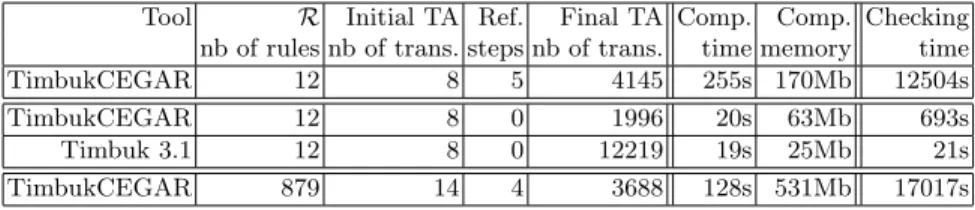
The TRS generated by Copster has 879 rules encoding both the JVM se-mantics and the bytecode of the above Java program. Initial terms are of the form IO(s,lin,nilout)where s is the initial JVM state, linis a non-empty unbounded list of integers and nilout is the empty list of outputs. Starting from this initial set of terms, completion is likely to diverge without approxima-tions. Indeed, the program is going to allocate infinitely many objects of class
List in the heap and, furthermore, compute an unbounded sum in the method
printSum. In the heap, there is one separate heap for each class. Each heap con-sists of a list of objects. For instance, in the heap for classList, objects are stored using a list constructorstackHeapList(x,y). Thus, to enforce termination we can approximate the heap for objects of classListusing the following equation
stackHeapList(x,y)=y. The effect of this equation is to collapse all the possi-ble lists built usingstackHeapList, hence all the possible heaps for classList. The other equations aresucc(x)=xandpred(x)=xfor approximating infinitely growing or decreasing integers.
6
essentially basic types, arithmetic, object creation, field manipulation, virtual method invocation, as well as a subset of the String library.
By using those equations, TimbukCEGAR finds a counterexample. This is due to the fact that, amongst all considered input streams, an input stream con-sisting of a list of 0 results into a 0 sum. The solution is to restrict the initial language to non-empty non-zero integer streams. However, refinement of equa-tions is needed sincesucc(x)=xandpred(x)=xput 0 and all the other integers in the same equivalence class. Refining those equations by hand is hard,e.g.using equationssucc(succ(x))=succ(x)andpred(pred(x))=pred(x)is not enough to eliminate spurious counterexamples. After 334 completion steps and 4 refine-ment steps, TimbukCEGAR is able to complete the automaton and achieve the certified proof. The resulting automaton produce by the tool has 3688 transitions which are produced in 128sand certified in 17017s. The memory usage for the whole process does not exceed 531M b. One of the reason for which certifying automata produced by TimbukCEGAR takes more time than for Timbuk 3.1 is that the checker has to normalize epsilon transitions of R/E-automata. This is straightforward but may cause an explosion of the size of the tree automaton to be checked. It is worth mentioning that the term rewriting rules corresponding to the above example is not right-linear. However, here completion steps do not introduce spurious counter examples.
We give another example of application in Appendix J.
8
Conclusion
We have presented a new CounterExample Guided Abstraction Refinement pro-cedure for TRMC based on equational abstraction. Our approach has been im-plemented in TimbukCEGAR that is the first TRMC toolset certified correct. Our approach leads, in part, to a java program analyzer starting from code to verification, but without relying on (1) potentially heavy assumptions on datas and architectures, (2) abstraction techniques when translating the code to TRS. We are convinced that our work open news doors in application of RMC approaches to rigorous system design. One of the remaining challenge is defini-tively to consider non left-linear TRS. Completion can be extended to deal with such TRS [25]. This is necessary to verify cryptographic protocols with comple-tion [26, 6]. The theoretical challenge is to extend the CEGAR complecomple-tion to non left-linear TRS. The technical challenge is to extend the Coq checker to handle non left-linear TRS and tree automata with epsilon transitions. Tackling those two goals would allow us to propose the firstcertifiedautomatic verification tool for security protocols, a major advance in the formal verification area.
Acknowledgements Thanks to F. Besson for his help in integrating Buddy.
References
1. Ravaj: Rewriting and approximations for java applications verification. http:
//www.irisa.fr/celtique/genet/RAVAJ.
2. P. A. Abdulla, Y.-F. Chen, G. Delzanno, F. Haziza, C.-D. Hong, and A. Rezine. Constrained monotonic abstraction: A cegar for parameterized verification. In CONCUR, LNCS. Springer, 2010.
3. P. A. Abdulla, G. Delzanno, and A. Rezine. Parameterized verification of infinite-state processes with global conditions. InCAV, LNCS. Springer, 2007.
4. P. A. Abdulla, N. B. Henda, G. Delzanno, F. Haziza, and A. Rezine. Parameterized tree systems. InFORTE, volume 5048 ofLNCS, pages 69–83. Springer, 2008. 5. P. A. Abdulla, A. Legay, A. Rezine, and J. d’Orso. Simulation-based iteration of
tree transducers. InTACAS, volume 3440 ofLNCS, pages 30–40. Springer, 2005. 6. Avispa – a tool for Automated Validation of Internet Security Protocols. http:
//www.avispa-project.org.
7. F. Baader and T. Nipkow. Term Rewriting and All That. Cambridge University Press, 1998.
8. T. Ball, B. Cook, V. Levin, and S. K. Rajamani. Slam and static driver verifier: Technology transfer of formal methods inside microsoft. InIFM, LNCS. Springer, 2004.
9. N. Barr´e, F. Besson, T. Genet, L. Hubert, and L. Le Roux. Copster homepage, 2009. http://www.irisa.fr/celtique/genet/copster.
10. Y. Bertot and P. Cast´eran. Interactive Theorem Proving and Program Develop-ment. Coq’Art: The Calculus of Inductive Constructions. Texts in Theoretical Computer Science. Springer Verlag, 2004.
11. Y. Boichut, R. Courbis, P.-C. Heam, and O. Kouchnarenko. Finer is better: Ab-straction refinement for rewriting approximations. InRTA, LNCS. Springer, 2008. 12. Y. Boichut, T.-B.-H. Dao, and V. Murat. Characterizing conclusive approximations by logical formulae. InRP, volume 6945 ofLNCS, pages 72–84. Springer, 2011. 13. Y. Boichut, T. Genet, T. Jensen, and L. Leroux. Rewriting Approximations for
Fast Prototyping of Static Analyzers. InRTA, LNCS 4533, pages 48–62, 2007. 14. B. Boigelot, A. Legay, and P. Wolper. Iterating transducers in the large (extended
abstract). InCAV, LNCS, pages 223–235. Springer, 2003.
15. A. Bouajjani, P. Habermehl, A. Rogalewicz, and T. Vojnar. Abstract regular tree model checking. ENTCS, 149(1):37–48, 2006.
16. A. Bouajjani, P. Habermehl, A. Rogalewicz, and T. Vojnar. Abstract rmc of complex dynamic data structures. InSAS, LNCS. Springer, 2006.
17. A. Bouajjani, P. Habermehl, and T. Vojnar. Abstract regular model checking. In CAV, volume 3114 ofLNCS, pages 372–386. Springer, 2004.
18. A. Bouajjani, B. Jonsson, M. Nilsson, and T. Touili. Regular model checking. In CAV, volume 1855 ofLNCS, pages 403–418. Springer-Verlag, 2000.
19. A. Bouajjani and T. Touili. Extrapolating tree transformations. InCAV, volume 2404 ofLNCS, pages 539–554. Springer, 2002.
20. B. Boyer, T. Genet, and T. Jensen. Certifying a Tree Automata Completion Checker. InIJCAR’08, volume 5195 ofLNCS. Springer, 2008.
21. H. Comon, M. Dauchet, R. Gilleron, F. Jacquemard, D. Lugiez, C. L¨oding, S. Tison, and M. Tommasi. Tree automata techniques and applications. 2008.
22. D. Dams, Y. Lakhnech, and M. Steffen. Iterating transducers. Journal of Logic and Algebraic Programming (JLAP), 52-53:109–127, 2002.
23. G. Feuillade, T. Genet, and V. Viet Triem Tong. Reachability Analysis over Term Rewriting Systems. Journal of Automated Reasonning, 33 (3-4):341–383, 2004. 24. T. Genet. Decidable approximations of sets of descendants and sets of normal
forms. InRTA, volume 1379 ofLNCS, pages 151–165. Springer-Verlag, 1998. 25. T. Genet. Reachability analysis of rewriting for software verification. Universit´e
de Rennes 1, 2009. Habilitation.
26. T. Genet and F. Klay. Rewriting for Cryptographic Protocol Verification. InProc. 17th CADE, volume 1831 ofLNAI. Springer-Verlag, 2000.
27. T. Genet and R. Rusu. Equational tree automata completion. JSC, 45, 2010. 28. T. Genet, Y.-M. Tang-Talpin, and V. Viet Triem Tong. Verification of Copy
Pro-tection Cryptographic Protocol using Approximations of Term Rewriting Systems. InWITS’2003, 2003.
29. T. Genet and V. Viet Triem Tong. Timbuk 2.0 – a Tree Automata Library. IRISA / Universit´e de Rennes 1, 2001.http://www.irisa.fr/celtique/genet/timbuk/. 30. R. Gilleron and S. Tison. Regular tree languages and rewrite systems.Fundamenta
Informaticae, 24:157–175, 1995.
31. Y. Kesten, O. Maler, M. Marcus, A. Pnueli, and E. Shahar. Symbolic model checking with rich assertional languages. InCAV, LNCS. Springer, 1997.
32. J. Lind-Nielsen. Buddy 2.4, 2002. http://buddy.sourceforge.net.
33. J. Meseguer, M. Palomino, and N. Mart´ı-Oliet. Equational abstractions. TCS, 403:239–264, 2008.
34. G. Patin, M. Sighireanu, and T. Touili. Spade: Verification of multithreaded dy-namic and recursive programs. InCAV, LNCS. Springer, 2007.
35. A. Podelski and A. Rybalchenko. Armc: The logical choice for software model checking with abstraction refinement. InPADL, LNCS, 2007.
36. T. Takai. A Verification Technique Using Term Rewriting Systems and Abstract Interpretation. InRTA, volume 3091 ofLNCS, pages 119–133. Springer, 2004. 37. A. Vardhan, K. Sen, M. Viswanathan, and G. Agha. Using language inference to
verify omega-regular properties. InTACAS, LNCS. Springer, 2005.
38. A. Vardhan and M. Viswanathan. Lever: A tool for learning based verification. In CAV, LNCS. Springer, 2006.
A
Running Example
Consider the R/E−automaton A1R,E given in Example 4 in Section 5.2. We define
ABadto be a tree automaton whose final state is q00 and whose transitions area → q10, s(q01) → q02, s(q02) → q01 and f(q02) → q00. The forbidden terms in L(ABad) are of
the form f(s2k+1(a)). We observe that L(A1
R,E)∩ L(ABad) 6= ∅. According to the
intersection algorithm described in Appendix H, one can build a set SA1
R,E∩ABad of
triples (q0, q00, φ), whereφ is the formula used to pruneA1R,E, i.e., to remove those
terms that belong to L(A1R,E)∩ L(ABad). Here, SA1
R,E∩ABad ={(q0, q
0
0, Eq(q2, q3)∧ Eq(q3, q2)),(q0, q00, Eq(q2, q3)),(q0, q00, Eq(q3, q2))}. Thus, we perform the prune step
P(A1R,E, SA1
R,E∩ABad). Removing the transition q2 → q3 from ε
1
E is sufficient to
in-validate Eq(q2, q3)∧Eq(q3, q2). Moreover, this action invalidates (q0, q00, Eq(q2, q3)) too. It remains to prune with (q0, q00, Eq(q3, q2)). This is done by removing the tran-sition q3 →q2 fromεE1. Thus,ε1E becomes empty. At this point, no transition ofε1R
can be removed. Indeed, all these transitions are all labeled by >. We thus define A2
R,E=P(A1R,E, SA1
R,E∩ABad), with∆
2=∆1,ε2
R=ε1R, andε2E =∅. We observe that
A2R,E is notR−closed and should be completed. We thus defineA3R,E =W(C(A2R,E)).
We found a new critical pair forf(x)→f(s(s(x))) and we obtain∆3=∆2∪ {s(q3)→ q5, s(q5)→q6, f(q6)→q7, andε3R=ε2R∪ {q7
> −→q4}.
The interesting point is in the application ofW. Observe that the transitions ofε3E
directly results from the application of the equation s(x) = s(s(x)), i.e. transitions q2→q3, q3→q2, q3→q5, q5→q3, q5→q6,andq6→q5.
The two transitionsq2→q3andq3 →q2 are ignored since they have been deleted earlier by a prune step, but two new transitions are added: q2 → q5 and q5 → q2. Indeed, it should have been possible to connectq2 and q5 together using transitions q2→q3andq3 →q5ifq2→q3had not been deleted. So,ε3E={q2→q5, q5→q2, q5→ q6, q6 →q5, q3 →q5, q5 →q3}. We then check the emptiness of L(A3R,E)∩ L(ABad).
This intersection is still not empty and we obtain the following set of triples: SA3 R,E∩ABad = (q0, q00, Eq(q3, q5)),(q0, q00, Eq(q5, q3)),(q0, q00, Eq(q5, q6)), (q0, q00, Eq(q6, q5)),(q0, q00, Eq(q2, q5)∧Eq(q5, q3)), (q0, q00, Eq(q2, q5)∧Eq(q5, q6)),(q0, q00, Eq(q5, q2)∧Eq(q3, q5)), (q0, q00, Eq(q5, q2)∧Eq(q6, q5)) .
So, in order to performP(A3
R,E, SA3
R,E∩ABad), the first transitions to remove are
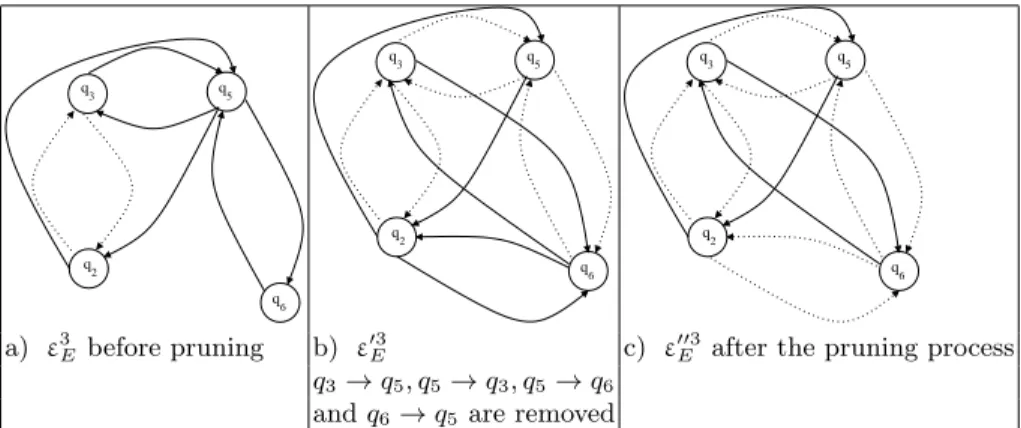
q3 →q5,q5 →q3,q5→q6 andq6→q5. According to Figure 2,ε3E of 2a. becomes the
one described in 2b. Note that four new transitions are generated:q3 →q6,q6 →q3, q2 → q6 and q6 → q2. We denote this new set of transitions by ε0E3. According to
Definition 6, one has to test if the removing of guilty transitions has broken the non-empty intersection. And here, it is not the case. Indeed, it is still possible to recognize an odd number ofsbetween the symbolsfandausing for instance the transitionq2→q6: f(s(a))→∗∆3 f(q2) andf(q2)→ ∗ ε03 E f(q6)→ε3 R q0. Let A 03 R,E be theR/E−automaton
such that ∆03 =∆3,ε0E3 and ε
03
R =ε3R. ComputingP(A3R,E, SA3
R,E∩ABad) remains to
computeP(A0R3,E, SA03
R,E∩ABad) whereSA0R3,E∩ABad is defined as follows:
SA03 R,E∩ABad = (q0, q00, Eq(q2, q6)),(q0, q00, Eq(q6, q2)∧Eq(q3, q6)), (q0, q00, Eq(q6, q2)),(q0, q00, Eq(q2, q6)∧Eq(q6, q3)) . Removing the transitionsq2 → q6 and q6 → q2 makes the whole set of formula involved inSA03
R,E∩ABad non valid. LetA
003
ε03
R, ε
003
E = ε
03
E \ {q2 → q6, q6 → q2} and ∆003 = ∆03. Note that as soon as these transitions are removed, the intersection betweenL(A00R3,E) andL(ABad) is empty. So,
P(A03 R,E, SA03 R,E∩ABad) =A 003 R,E and consequently,P(A3R,E, SA3 R,E∩ABad) =A 003 R,E. q q5 6 q 2 q 3 q q5 6 q 2 q 3 q q5 6 q 2 q 3 a) ε3Ebefore pruning b) ε 03 E c) ε 003
E after the pruning process
q3 →q5, q5→q3, q5→q6 andq6→q5 are removed
Fig. 2: Evolution ofε3Eduring the pruning process
ConsideringA4R,E=P(A
3
R,E, SA3
R,E∩ABad), we restart the completion process and
we observe thatA4R,E=C(A4R,E). We have thus reached a fix-point. There, we observe
that L(A4R,E)∩ L(ABad) =∅and conclude that R∗(I)∩Bad=∅. Observe that our
refinement is accurate in this case. IndeedL(A4
R,E) =f(s2k(a)), that is the exact set
of reachable states.
The above example cannot be handled with the approach of [11]. Indeed, this technique cannot handle set of bad terms whose cardinality is infinite.
B
Proof of Theorem 1
We want to show that the following result holds:
∀t∈ T(F ∪Q), q∈Q, t−→α Aq ⇐⇒ t→∗Aq
Proof. The proof is easily done by induction by arguing that it is enough to forget the formulas manipulated by the definition 3 to have the equivalent step with→A.
C
Matching Algorithm for
R
/E-automata
We assume a left-linear TRS R and a R/E-automaton AiR,E such that AiR,E =
hF,Qi,Qf, ∆i∪εiR∪εiEi
Definition 7 (Matching Algorithm).
of the matching problem, which is denotedlEq`Ai
R,ES, if there exists a derivation of
the statementlEq`Ai
R,E S using the rules:
(Var) xEq`A{(αk,{x7→qk})|qk αk −−→Aq} (x∈ X) (Delta) t1Eq1`AS1 . . . tnEqn`ASn f(t1, . . . , tn)Cq`ANn1Sk f(q1, . . . , qn)→q∈∆ (Epsilon) tCq`AS0 tCq 0 1`AS1 . . . tCq0n`ASn tEq`AS0∪Snk=1{(φ∧αk, σ)|(φ, σ)∈Sk} {(qk, αk)|qk αk −−→q}n 1 t /∈ X UsingNn 1Sj={(>, id)⊕(φ1, σ1)⊕· · ·⊕(φn, σn)|(φj, σj)∈Sj}, and(φ, σ)⊕(φ0, σ0) = (φ∧φ0, σ∪σ0).
Observe that, by definition, the matching problem considers possibly infinite runs of the formlσ−→α q. Indeed, transitions inεiR∪εiEcan introduce loops. In the matching
algorithm, we exclude such runs. This is done to keep a finite set of rewriting path, which is computable in a finite amount of time. It is worth mentioning that removing loops does not influence the result. As an example, consider the automatonAof Exam-ple 2. We observe thatf(b) Eq(qb,qc)∧Eq(qc,qb)
−−−−−−−−−−−−−→Aqf uses the loopf(b) =E f(c) =Ef(b).
This loop can be removed asf(a) →∗R f(b) can be obtained by f(b) >
−→A qf, a run
which does not contain any loops.
We show that the matching algorithm given in Definition 7 is complete.
Lemma 1. LetAbe aR/E−automaton,qone of its states,l∈ T(F,X)the linear left
member of a rewriting rule and σ a Q -substitution with a domain range-restricted to V(l). If the setSis solution of the matching problemlσEq, then we have∀(α, σ), lσ−→αA q⇐⇒(α, σ)∈S
Proof. Assuming F a set of symbols,X a set of variable and Q a set of states. We define A = hF,Q,Qf, ∆∪εR∪εEi; l ∈ T(F,X) and q ∈ Q; σ : Var(l) → Q and
α=Vn
1Eq(qk, qk0) such thatlσ α
−→Aq. The proof is done by induction on the terml.
Base case:lis a variable.
In this case,σ must be a Q-substitution of the formσ = {l 7→ q0}. Using this observation and the hypothesis, we have q0 −→α A q. The matching problem lEq is solved using Rule (Var). This means that S = {(αk,{l 7→ qk}) | qk
αk
−−→A q}. By definition ofS we see thatS contains (α, σ).
Induction: Assume nowlis a linear term of the formf(t1, . . . , tn).
We are going to decompose f(t1, . . . , tn)σ α
−→A q into sequences of transitions. First observe that, by splitting σ into σ1 . . .σn, we have that f(t1, . . . , tn)σ is equal
to f(t1σ1, . . . , tnσn). Assume σ = σ1 t · · · tσn with dom(σi) = V(ti) and ∀x ∈
dom(σi), σi(x) =σ(x). Sincelis linear, each variable inX occurs at most one time in
l. This means that the sets V(ti) are disjoints and so are the domains of theσi. This
ensures thatσis well-defined.
We now study the decomposition off(t1σ1, . . . , tnσn) α
−→Aq to show that transi-tions of Aused to recognized the termf(t1σ1, . . . , tnσn) are considered by the
We observe that the term f(t1σ1, . . . , tnσn) is recognized in State q. Indeed, we
havef(q1, . . . , qn)→q0∈∆, and each subtermtiσi is recognized in stateqisuch that
tiσi αi
−→qi. Composing recognizing of each subterm, we obtain the following sequence:
f(t1, . . . , tn) α1 −−→f(q1, t2, . . . , tn) V2 1αi −−−−→f(q1, q2, t3, . . . , tn) V3 1αi −−−−→. . . . . . Vn 1αi −−−−→f(q1, . . . , qn) Vn 1αi∧> −−−−−−→q0 There
are two cases that have to be considered : (1)q=q0 and (2)q=6 q0. (1) Ifq=q0, the decomposition is complete andf(t1σ1, . . . , tnσn)
α −→Aqwithα=Vn1αi. f(t1σ1, . . . , tnσn) Vn i=1αi −−−−−→f(q1, . . . , qn) Vn i=1αi −−−−−→q (2)q6=q0:f(t1σ1, . . . , tnσn) α
−→Aqholds only if we have a transitionq0
α0 −→qsuch that α=Vn 1αi∧α 0 . f(t1σ1, . . . , tnσn) Vn i=1αi −−−−−→f(q1, . . . , qn) > −→q0 α 0 −→q By induction, we know that for each sequence tiσi
αi
−→ qi, the matching problem
is solved i.e. tiEqi ` Si with Si contains (αi, σi). Rule (Delta) is applied to all
premises tiEqi `A Si for the transitionf(q1, . . . , qn) →q0 ∈ ∆. From this, we
ob-tain a set S0 = Nn
1Si. By unfolding the definition of N, we have S = {(>, id)⊕
(a1, s1)⊕. . .(an, sn) | (ai, si) ∈ Si}. Since each Si contains (αi, σi), S0 contains
(>, id)⊕(α1, σ1)⊕. . .(αn, σn) which is, by definition of⊕equal to (Vn1αi, σ). Thus, we
obtain a intermediate statementf(t1, . . . , tn)Cq0`AS0such thatf(t1, . . . , tn)σ
Vn 1αi
−−−−→
q0, where (Vn
1αi, σ)∈S0.
This statement must correspond to one of the premises of Rule (Epsilon) to produce the expected statementf(t1, . . . , tn)Eq`AS. Two cases have to be considered :q=q0 andq6=q0.
Iff(q1, . . . , qn)→q0 ∈ ∆is the last transition used to havef(t1, . . . , tn)σ α
−→Aq then we haveα=Vn
1αi and we are in the caseq =q
0
: this case corresponds to the premiss 0 of Rule (Epsilon) andS0=S0. By definition of Rule (Epsilon),S0is included inS. This means that (α, σ)∈S.
If we have q 6= q0, then it remains a sequence of transitions q0 α 0
−→ q to have f(t1, . . . , tn)σ
α
−→Aq. The couple (α0, q0) is in the set{(qk, αk)|qk αk
−−→q}.This means that the statementf(t1, . . . , tn)Eq`AS0is one the remaining premisses. By definition of Rule (Epsilon),S contains all couple (a∧α0, s) where (a, s)∈S0. In particular,S contains (Vn
1αi∧α
0
D
Normalization for
R
/E-automata
Definition 8 (Normalization).The normalization is done in two mutually inductive steps parametrized by the configuration cto recognize, and by the set of transitions∆
to extend. Let Qnew be a set of new states,
Norm(c, ∆) =Slice(d, ∆) c→∆d, andc, d∈ T(F ∪Q)
Slice(q, ∆) =∆ q∈Q
Slice(f(q1, . . . , qn), ∆) =∆∪ {f(q1, . . . , qn)→q} qi∈Q andq∈Qnew
Slice(f(t1, . . . , tn), ∆) =Norm(f(t1, . . . , tn),Slice(ti, ∆)) ti∈ T(F ∪Q)\Q
E
Proofs of Theorem 2
In order to prove thatC(AiR,E) is well-defined, we need to show that, first C(AiR,E) is
determinist if we do not consider the transition set ofAi
R,E (Lemma 2) and second,
solving one critical pair preserves well-definition (Lemma 3).
Lemma 2 (Existence of a representative). Assume that AR,E =hF,Q,Qf, ∆∪ εR∪εEiis aR/E-automaton obtained afterksteps of completion from A0R,E. Letcbe
a configuration. If∆0=Norm(c, ∆\∆0), then there exists a stateqsuch thatc→!
∆0 q.
Proof. Letµ :T(F ∪Q)→Nbe the measure that counts the number of occurences
of symbols in F of a configuration. Example : µ(f(q1, g(q2), a)) = 3. We define it inductively byµ(q) = 0 ifq∈Q, andµ(f(t1, . . . , tn)) = 1 +Pn1µ(ti).
AssumingFa set of symbols, andQa set of states. We defineAR,E=hF,Q,Qf, ∆∪ εR∪εEi;c∈ T(F ∪Q). Assume that∆1=∆\∆0 is determinist.
The first stepNorm(t, ∆1) consists in rewritingcby∆1 in its normal formd The second stepSlice(d, ∆1) returns∆2 such that there exists a unique stateq such thatd→!
∆2 q.
The proof is one by induction on the decreasing ofµ(d). We consider the 3 cases
ofSlice(d, ∆1)
1. Slice(q, ∆1) = ∆1. It means that d is the state q. There exists a unique state
,which isq, such thatd→!
∆1 q.
2. Slice(f(q1, . . . , qn), ∆1) =∆1∪ {f(q1, . . . , qn)→q|q∈Qnew}. Eachqiis a state.
The configurationf(q1, . . . , qn) can be used as the left-member of a normalised
ground transition. We build the new transition f(q1, . . . , qn) → q using a new
state q. Adding a such transition to ∆1 preserves determinism. We know that it is impossible to rewrite more d = f(q1, . . . , qn) using transitions of ∆1 : the
new transitionf(q1, . . . , qn)→q is the unique way to rewrited. We deduce that
∆2=∆1∪ {f(q
1, . . . , qn)→q|q∈Qnew}is deterministic, andd→!∆2q.
3. Slice(f(t1, . . . , tn), ∆1) =Norm(f(t1, . . . , tn),Slice(ti, ∆1) ),ti ∈ T(F ∪Q)\Q.
Here, we have the direct subtermti ofdwhich is not a state. We deduceµ(ti)<
µ(d) from the definition of µ. By induction, ∆ is extended by Slice(ti, ∆1) to
obtain ∆2 for which there exists a state q such that ti →!∆2 q. Using this new
set∆2, we unfoldNorm(f(t
1, . . . , tn), ∆2) which consists in rewritingf(t1, . . . , tn)
using∆2. We obtain a new configurationf(t10, . . . , t0n) where we know at lesst0i is
equal toqsince the direct subtermtican be rewritten inq using∆2. Note that if
some subterms oftiare also subterms of some othertj, it will also be rewritten by
∆2 int0j until we reach the normal form. Each step of rewriting by∆
2
replaces a symbol ofF by a state of Q by definition of a normalised transition. This remark allows to prove thatµ(f(t1, . . . , tn)> µ(f(t01, . . . , t0n). For the direct
subtermti, we know µ(ti) >0 (ti is not a state), andµ(t0i) = 0 (t
0
i is the state
q). For all other direct subterm tj with j <> i we deduce µ(tj) ≥ µ(t0j) from
tj→!∆2 t 0 j using∆2. We haveµ(f(t1, . . . , tn)> µ(f(t01, . . . , t 0 n) by definition ofµ, andf(t01, . . . , t 0
n) is rewritten as most as possible by the deterministic∆2. Then, we
use again the induction hypothesis to deduce that∆0 =Slice(f(t01, . . . , t0n), ∆2)
extends∆2 in order to have a unique stateq such that f(t0
1, . . . , t
0
n) →!∆3 q. By
transivity, we haved→!
∆0 qusing the deterministic set∆0 fordwhich is equal to f(t1, . . . , tn).
Finally, we proved that∆0=Slice(d, ∆1) extends∆1preserving its determinism such that there exists a state q for which d→!
∆0 q. We also know that c →!∆0 d. We can conclude that ∆0 = Norm(c, ∆1) is determinist, and there exists a state q such that c→!
∆0 q.
Let us now show that solving one critical pair preserves well-definition. LetCP=
{hr1σ1, α1, q1i, . . . ,hrnσn, αn, qni}be the finite set of critical pairs computed fromAiR,E
that have to be solved by using Definition 5. By definition, consideringA0=AiR,Ethere
exists a sequence of R/E−automataA1, . . . ,An, whereAj is obtained from Aj−1 by solving the critical pairhrjσj, αj, qji. Thus,C(AiR,E) =An. For a question of readability
and in order to prevent any confusion between notations, eachR/E−automatonAj is
defined as follows:Aj=hF,Qn+1,Qf, ∆0j∪ε
0j
R∪ε
0j Ei.
Lemma 3. Let Rbe a linear TRS. Let A and A0 be two R/E−automaton such that
A0 is obtained from A by solving a critical pairhrσ, α, qiof A. If A is well-defined then so is A0.
Proof. Assume thatA=hF,Q,Qf, ∆∪εR∪εEiandA0=hF,Q0,Qf, ∆0∪ε0R∪ε 0
Ei.
According to Definition 5, ∆0 = ∆∪Norm(rσ, ∆\∆0), ε0R = {q0
α
−→ q} ∪εR and
ε0E =εE. Following Definition 4, we first show in (1) that for all stateq00 ofA0, and
all termv such that v−>→A0 q00, there exists ua term representative of q00 such that u→∗Rv. Then, in (2) we show that ifq1
φ
−→q2 is a transition ofε0R, then there exist
termss, t∈ T(F) such thats→φA0q1,t
>
→A0q2 andt→Rs.
1. We show the property by induction on the height oft. Let us assume that for all term t0 of height less than the height of tand for all q ∈ QA0, we have t0 −>→A0 q =⇒ ∃u∈Rep(q) :u→∗
Rt0. Now let us prove that the result holds fort. We
consider several cases.
– Ifq∈QAandt
>
−→Aq, then sinceAis well defined, we get the representative u∈Rep(q) such thatu→∗
Rtfrom well-definition ofA.
– Assume now that q ∈QA, t6−>→Aq andt
>
−→A0 q. We show the property by induction on the height of t. Since t is recognized in A0 and not inA, this means that the run t0 −>→A0 q needs the transitions added by the resolution of a critical pair. Hence there exists a rewrite rulel →r, a substitutionσ :
X 7→ QA, a formula αand a state qc such that lσ α
−→A qc and hrσ, α, qci is
the critical pair. Moreover, the resolution of this critical pair produces the following set of transitions:∆A0 =Norm(rσ, ∆A\∆0) andεA
0 R =εAR∪ {q0c→ qc} such that rσ →!∆0\∆ 0 q 0 c. Recall that t 0 >
occurring inA. However, all thenewtransitions produced byNorm(rσ, ∆A\∆0) necessarily range onnew states, i.e. states not occurring inQA. As a result, those transitions cannot be used to gett0 >−→A0 qwithq∈QA. This means that the runt−>→A0 q uses at least onceq0c→qc andα=>. To sum up, we know
that there exists a ground context C[ ] such thatt =C[t0]−>→A0 C[q0c]
> −→A0 C[qc]
>
−→A q. Note that if qc0 →qc the same reasonning can be applied. We
start to reason on the occurrence of qc0 → qc that is the closest to q. Now,
our objective is to show that there existsu∈Rep(q0c) such that u→
∗
R t
0
. If t0 −>→A q0c, then sinceA is well defined the result is a direct consequence of
Definition 4. Otherwise this means thatqc0 is a new state ofA(i.e.q
0
c 6∈QA)
that has been added by the resolution of the critical pair, i.e.rσ→!
∆0 qc0. By
Lemma 2, we get that there exists a substitutionσ0 :X 7→ T(F) such that t0 =rσ0. Using the same Lemma, from t0=rσ0 −>→A0 q0c andrσ
>
−→A0 qc0, we get that for all variablexofr:σ0(x)−>→A0σ(x). Note thatσ(x)∈QAand that σ0(x) are necessarily terms of height less to the height oft. Using the induction hypothesis, we get that for all stateσ(x) there exists a representativeuxsuch
thatux →∗Rσ 0
(x). LetσRep be the substitution mapping every variablexto
ux. We haverσRep ∈Rep(q0c). Moreover,rσRep →∗Rrσ0 =t0. Now, we show
that lσRep →R rσRep. This is not straightforward since Var(l) ⊇ Var(r).
However, it is possible to extend σRep into σ0Rep, where every variable y of
Var(l) not occurring in σRep is mapped to a representative of σ(y). Hence,
lσRep0 →Rrσ 0 Rep→ ∗ Rt 0
. From the critical pair we know thatlσ−→αAqcand we
found thatα=>. Hencelσ0Rep
>
−→A qc. SinceA is well-defined, we get that
there is a representativev∈Rep(qc) such thatv→∗Rlσ 0
Rep. By transitivity of
→R, we get thatv →∗R t 0
. Above, we found thatt=C[t0]−>→A0 C[q0c]
> −→A0 C[qc]
>
−→Aq. From this andv∈Rep(qc), we get that C[v]
>
−→Aq. SinceA is well defined, we know that there exists a representativew∈Rep(q) such that w→∗
RC[v]. To conclude, we foundw∈Rep(q) andw→∗RC[v]→C[t0] =t.
– Ifq6∈QA (q∈QA0 \QA),t6
>
−→Aqandt
>
−→A0 q. Sinceq∈QA0 \QA, we know that q has been added by the resolution of a critical pair. As above, we can deduce that there exists a rewrite rule l→r, a substitutionσ:X 7→QA, a formulaαand a stateqcsuch thatlσ
α
−→Aqcandhrσ, α, qciis the critical pair.
Moreover, the resolution of this critical pair creates∆A0=Norm(rσ, ∆A\∆0) andεAR0 =εAR∪ {qc0 →qc}such thatrσ→!∆0\∆
0 q
0
c. Sinceqis a new state ofA0
that has been used in the normalization of a subterm ofrσ. More precisely, we know that there exists a terms∈ T(F,X) and a contextC[ ] (possibly empty) such thatrσ =C[s],C[s]σ →∗∆0 q0c and sσ →
∗
∆0 q. Similarly, we know that there exists a substitutionσ0 :X 7→ T(F) such thatsσ0=t. We get that for every variablexofr:σ0(x)−>→A0σ(x). Note thatσ(x)∈QAand thatσ0(x) are necessarily terms of height lesser to the height oft. By induction hypothesis, we obtain that for every stateσ(x) there exists a representativeuxsuch that
ux →∗Rσ 0
(x). LetσRep be the substitution mapping every variablexto ux.
We havesσRep∈Rep(q) andsσRep→∗Rsσ0=t.
2. It is easy to see that, for any transitions q1
φ
→q2 ∈εR, the property still holds.
Let us now focus on the transitionq0→α qresulting from the resolution of Critical pairhrσ, α, qi. By definition,hrσ, α, qiresults from the application of the matching algorithm of Definition 7 given in Appendix C. So there exists a rulel→r∈ Rsuch