EXPLORING THE ROLE OF PRINCIPALS IN
SUPPORTING PROFESSIONAL DEVELOPMENT IN SCHOOL-BASED
PROFESSIONAL LEARNING COMMUNITIES
BY
THEMBINKOSI WELLINGTON NENE
A dissertation submitted in partial fulfilment for the requirements for the degree of Master of Education
in Teacher Development Studies
SCHOOL OF EDUCATION
UNIVERSITY OF KWAZULU-NATAL
PIETERMARITZBURG
JANUARY 2019
ii
DECLARATION
I, Thembinkosi Wellington Nene, declare that:
(i) The research reported in this dissertation, except where otherwise indicated is my original work.
(ii) This dissertation has not been submitted for any degree or examination at any other university.
(iii) This dissertation does not contain other person‟s data, pictures, graphs or other information, unless specifically acknowledged as being sourced from other persons.
(iv) This dissertation does not contain other persons writing, unless specifically acknowledged as being sourced from other researchers. Where other written sources have been quoted, then:
a. Their words have been re-written but the general information attributed to them has been referenced.
b. Where their exact words have been used, their writing has been placed in italics and inside quotation marks, and referenced.
(v) This dissertation does not contain text, graphics or tables copied and pasted from the internet, unless specifically acknowledged, and the source being detailed in the dissertation and in the references section.
Student Signed:……….... Date………..
iii
DEDICATION
This work is dedicated to my late sister Lindeni F. Sokhela, who once said to me, “whatever you want to do my brother, do it, for as long it will make you happy at the end”. She paved my way to be educated and become a good teacher. May her soul rest in peace.
To my wife Thembelihle, and my children, Samkelo, Seluleko, Usiphile and Akhona, their love, support and understanding in this journey is much appreciated.
iv
ACKNOWLEDGEMENTS
I would like to thank the Almighty God for giving me strength, wisdom and patience to do and complete this work. Udumo lonke ngilunika uNkulunkulu.
My gratitude and appreciation goes to the following people and institutions for their contribution to the completion of this study
Dr J. Naidoo, my supervisor for the professional support throughout the journey Principals of the schools who were part of the study
My colleagues, Thanduxolo Rubela, Philani Goge, Siyabonga Magoso, Nqobile Maphanga, Nonhlanhla Mabaso and Nomthandazo Mpungose, for their words of encouragement and support in times of difficulties
My family, for their support, encouraging words, and for allowing me to take some of their time and invest it in this work.
v
LIST OF ACRONYMS
CPTD Continuous Professional Teacher Development
DH Departmental Head
DoE Department of Education
DP Deputy Principal
DTDC District Teacher Development Centres IQMS Integrated Quality Management Systems
KZN KwaZulu-Natal
NICPD National Institute for Curriculum and Professional Development
PD Professional Development
PLC Professional Learning Communities PTDI Provincial Teacher Development Institutes SMT School Management Team
vi
ABSTRACT
Principals have a very crucial role to play in professional development of teachers in school-based professional learning communities. This task demands that principals understand what professional development is and what role they need to play to support the teachers at their schools. The aim of this study was to explore the extent to which principals support professional development and the role of principals in supporting teacher professional development in school-based professional learning communities.
This is a case study of four school principals from uMgungundlovu and uMzinyathi districts This study draws on Desimone‟s (2011) conceptual framework, a primer on effective professional development, which identify five core features of effective professional development and Price‟s (2012) principal-teacher interactions. Convenience sampling was used to select the participants of the study. Semi-structured interviews and document analysis were used to gather data and thematic analysis was used to analyse the data.
The findings of the study revealed that principals had an understanding of teacher professional development. The study showed that principals played a key role in supporting teacher professional development in schools. This has been implemented through the promotion of teamwork, collaboration and mentoring within their schools. Principals identified some factors that enabled them to support professional development in schools, such as motivated teachers, implementation of Jika Imfundo, regular class visits, involvement of teachers in decision making and regular developmental meetings. However, the principals also shared some challenges that hindered then in supporting teacher professional development. These challenges included a high teacher workload and a lack of time for professional development activities. Hence, findings also revealed that principals had strategies in place to overcome some of the challenges that hindered them.
vii
TABLE OF CONTENTS
DECLARATION ... ii DEDICATION ... iii ACKNOWLEDGEMENTS ... iv LIST OF ACRONYMS ... v ABSTRACT ... vi CHAPTER ONE ... 1INTRODUCTION AND BACKGROUND OF THE STUDY ... 1
1.1 Introduction ... 1
1.2 Focus and purpose of the study ... 1
1.3 Background and Rationale ... 2
1.4 Research questions ... 3
1.5 Literature review ... 3
1.5.1 Teacher professional development ... 3
1.5.2 Professional learning communities ... 4
1.5.3 Role of principals in profession development ... 4
1.6 Methodological approach ... 4
1.6.1 Research design ... 5
1.6.2 Sampling ... 5
1.7 Overview of the dissertation... 5
1.8 Chapter summary... 6
CHAPTER TWO ... 7
LITERATURE REVIEW AND CONCEPTUAL FRAMEWORK ... 7
2.1 Introduction ... 7
2.2 Teacher professional development ... 7
2.3 Models of professional development ... 9
2.3.1 Training model ... 9
2.3.2 Coaching or mentoring ... 9
2.3.3 Deficit model ... 10
2.3.4 Cascade model ... 10
2.3.5 Community of practice model ... 10
2.3.6 Action research model ... 11
2.4 Strategies for teacher professional development ... 11
2.4.1 Time allocation for professional learning ... 11
2.4.2 Sound mentoring and induction programmes ... 11
2.4.3 Involvement of teachers in school decision-making ... 12
2.4.4 Government support for additional professional development ... 12
viii
2.6 Role of principals in profession development ... 14
2.6.1 Principals as stewards ... 15
2.6.2 Principals as models ... 16
2.6.3 Principals as experts ... 16
2.6.4 Principals as instructional leaders ... 17
2.6.5 Principals as supporters ... 17
2.7 Conceptual framework ... 18
2.8 Chapter summary... 21
CHAPTER 3 ... 22
RESEARCH DESIGN AND METHODOLOGY ... 22
3.1 Introduction ... 22
3.2 Interpretive research paradigm ... 22
3.3 Qualitative methodological approach ... 23
3.4 Case study research design ... 25
3.5 Convenience sampling ... 26
3.6 Data generation methods ... 28
3.6.1 Semi-structured interviews ... 28
3.6.2 Document analysis ... 29
3.7 Data analysis ... 30
3.8 Ethical considerations for the study ... 30
3.9 Limitations of the study ... 31
3.10 Trustworthiness ... 31
3.11 The role of the researcher ... 32
3.12 Chapter summary... 33
CHAPTER FOUR ... 34
PRESENTATION OF FINDINGS AND ANALYSIS ... 34
4.1 Introduction ... 34
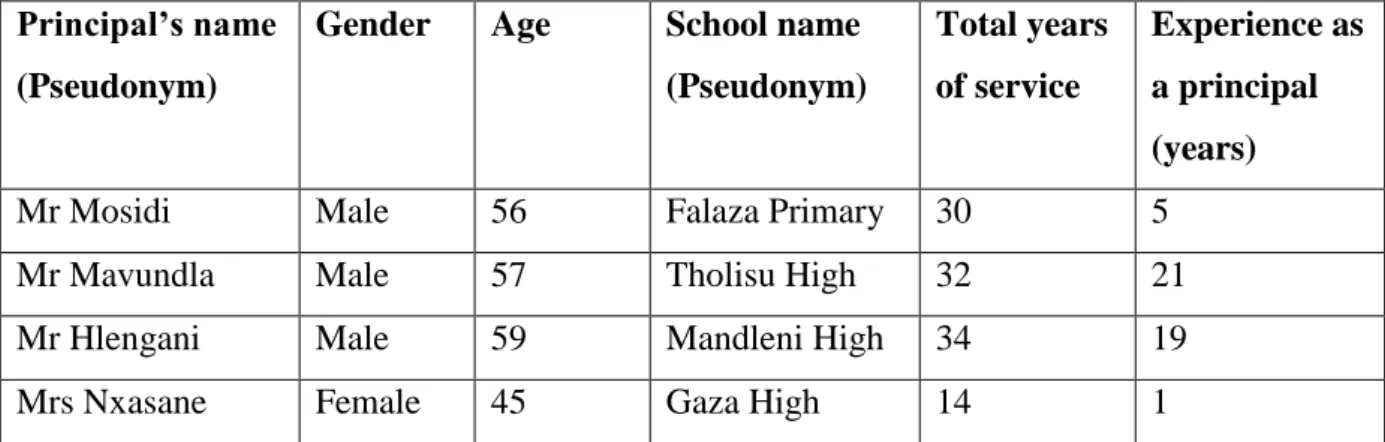
4.2 Brief profiles of the participants ... 34
4.2.1 Mr Mosidi ... 34
4.2.2 Mr Mavundla ... 35
4.2.3 Mrs Nxasane... 35
4.2.4 Mr Hlengani ... 35
4.3 The Principal as a steering wheel of professional development ... 37
4.4 Teamwork and collaboration ... 44
4.5 Mentoring and monitoring ... 47
4.6 Factors supporting teacher professional development ... 51
4.6.1 Committed and motivated teachers ... 51
ix
4.6.3 Implementation of Jika Imfundo and one-on-one meetings ... 53
4.6.4 Sharing decision making with the teachers ... 55
4.6.5 Frequency of interaction amongst teachers ... 57
4.7 Challenges hindering professional development ... 58
4.7.1 High workloads for teachers ... 59
4.7.2 No provision of time for professional development ... 60
4.7.3 Non-cooperative and non-supportive teachers ... 61
4.7.4 Strategies to overcome challenges ... 61
4.7.5 Creating space and time for development ... 61
4.7.6 Motivation ... 62
4.7 Chapter summary... 63
CHAPTER 5 ... 65
DISCUSSION OF FINDINGS, RECOMMENDATIONS AND CONCLUSION ... 65
5.1 Introduction ... 65
5.2 Summary of findings ... 65
5.3 The principal as a steering wheel of professional development ... 65
5.4 Principals support school-based professional development through teamwork, collaboration and mentoring ... 66
5.5 Motivated teachers, Jika Imfundo, regular class visits, teacher involvement and regular meetings enabled school-based professional development ... 69
5.6 High workloads, less time and non-co-operative teachers hindered school-based professional development ... 70
5.7 Principal used the strategies of creating time and space, and motivation to develop teachers ... 71
5.9 Recommendations ... 72
5.10 Conclusion ... 72
References ... 74
APPENDICES ... 85
APPENDIX A: Permission: KwaZulu-Natal Department of Education ... 85
APPENDIX B: Ethical clearance: University of KwaZulu-Natal ... 86
APPENDIX C: Information Sheet and Consent to Participants ... 87
APPENDIX D: Interview schedule ... 90
APPENDIX E: Turnitin certificate ... 91
CHAPTER ONE
INTRODUCTION AND BACKGROUND OF THE STUDY
1.1 Introduction
This chapter introduces this study which aims to explore the role of principals in supporting professional development in school-based professional learning communities. To begin, this chapter presents the focus and the purpose of the study. I then explain the rationale and objectives of the study. I further present the research questions for the study and provide a brief review of the related literature and the conceptual framework, methodological approach and the overview of the dissertation.
This study aims to understand how principals promote teacher professional development in their school-based professional learning communities (PLCs). Principals play a significant and multi-faceted role in setting the direction for their schools. One of their roles is to provide support and the professional development (PD) of teachers. Darling-Hammond, Chung Wei, Andree, Richardson and Orphanus (2009) claim that PD is likely to be more effective if it is an integral part of a larger school reform effort than just an isolated activity, and has nothing linked to other programmes that are taking place within the school. Guskey (2002) claims that PD can happen where there is a broad-based support for professional development and everyone is involved from all levels in a school.
Professional learning communities offer opportunities for enlightening the teaching and learning practices, and developing strong professional development practices. Learning in communities is a collaborative process that facilitates improved practice to address the problems. Therefore, this study aims to examine the role and the extent to which principals support professional development in school-based professional learning communities.
1.2 Focus and purpose of the study
This study focuses on principals and professional development in school-based PLCs. It is a small scale study as it encompasses only four schools which are ranked as quintile 2 and located in rural areas. The purpose of this study is to explore the role of principals in supporting teacher professional development in their school-based PLCs.
2 1.3 Background and Rationale
Guskey (2002) maintains that professional development is a primary vehicle that tries to bring about the needed change within a school. It is a tool through with which teaching is enhanced and thus improves student achievement (Petrie & McGee, 2012). According to Bedford and Rossow (2017), professional learning communities serve as innovative ways of meeting the professional development needs of a school. Watson (2014) asserts that PLCs at most schools provide opportunities for teachers to participate in professional development which in turn improves students‟ learning. He further claims that learning in a community emphasises collaborative learning and development of mutual trust and shared values.
Davis, Darling-Hammond, Lapointe and Meyerson (2005) claim that one of the roles of principals is to empower teachers to do their jobs efficiently, by offering academic support to advance their work and deliver models of practice and support. Price (2012) argues that principals are influential over the organisational climate of the school where they are able to foster cooperative and open environments where staff members are encouraged to give input.
However, in my 14 years of experience as a teacher in different high schools, I observed the stagnant role of some principals in promoting school-based professional learning communities. I have also noticed that some principals do not encourage and support teacher professional development or provide opportunities for school-based PLCs to be fully utilised. According to Tschannen-Moran (2009), some principals certainly use bureaucratic structures, hierarchy of authority and written rules and policies to deal with the size and complexity of their school resources and tasks. He further claims that an over-dependence on these components by some principals may interfere with the school‟s agility and hence, be counterproductive to the mission of continuous teacher professional development within the school-based PLC.
Opfer and Pedder (2011) argue that the essentiality of improving schools, increasing teacher excellence and enhancing student learning has led to a deep concern for teacher professional development as an important way of achieving these goals. They further claim that the problem is rooted in failing to consider that learning is attached to professional lives and working conditions.
3 1.4 Research questions
The aim of this study is to explore the role of principals in supporting professional development in school-based professional learning communities
This study will be guided by the following research questions:
1. To what extent do principals support professional development in school-based professional learning communities?
2. What factors enable or hinder principals to support professional development in school-based professional learning communities?
These questions will help me generate data to examine the extent to which school principals support professional development in their schools. It will also enhance understanding of factors that promote or hinder the principal‟s support of teacher development.
1.5 Literature review
The literature review of this study will define and describe concepts under three key themes of the study, which are teacher professional development, professional learning communities and the roles of principals in promoting teacher professional development.
1.5.1 Teacher professional development
According to Luft and Hewson (2014), professional development (PD) can be regarded as an on-going learning experience of the teacher that is initiated even before entering the classroom and endures until the end of the teacher‟s career in education. Hennesdottir, Irby, Novello and Shillingstad (2012) contend that PD is not a separate episode, as it is something that must occur all the time. Correspondingly, Hadar and Brody (2011) claim that effective professional development takes into consideration the personal and work related issues as teachers move along career paths from novice to expert. Petrie and McGee (2012) argue that professional development is seen as a vital vehicle through which to improve teaching and hence, improve learners‟ achievement. According to Villegas-Reimers (2003), professional development is perceived as a long term process as it recognises the fact that teachers learn over a period of time.
4 1.5.2 Professional learning communities
According to Hairon and Dimmock (2012), professional learning communities refer to a group of people or societies whereby people repeatedly develop their capacity to produce the results they aspire to and of which new knowledge and forms of thinking are cultivated. Similarly, Brodie (2013) claims that professional learning communities often refer to teachers critically cross-examining their practice in on-going processes and insightful and cooperative ways‟ in order to stimulate and enhance students‟ learning. This implies that PLCs are a platform where knowledge and expertise are developed continuously. Doolittle, Sudeck and Rattigan (2008) argue that when a learning community is developed, educational change can be successfully achieved. PLCs have become an innovative way to meet the professional development needs of the teachers and it has emerged as a mechanism to address the challenges of the teachers (Bedford & Rossow, 2017). In the same way, Hadar and Brody (2012) suggest that professional development of teachers is increasingly important in promoting and advancing educational practice.
1.5.3 Role of principals in profession development
According to Bredson and Johansson (2000), the school principal is a crucial player who provides leadership in staff development through their encouragement, support and their ability to influence others. Similarly, Davis, Darling-Hammond, Lapointe and Meyerson (2005) claim that one of the key roles of principals, is to empower teachers to do their job efficiently, by offering academic support to advance their work and deliver models of practice and support. However, Witten (2017) argues that when principals are confronted with many problems at their schools, they tend to concentrate on school‟s organisational functions in order to buffer teachers and institute rigid managerial structures that habitually do not encourage collaborative work in a school-based PLC.
1.6 Methodological approach
This study adopted a qualitative methodological approach since it aims at obtaining a detailed understanding and empirical evidence from participants‟ perspective. I believe that a qualitative methodological approach is most suitable for this study since it helps to gather rich and descriptive data from principals‟ perspectives. Semi-structured interviews and
5
document analysis were used to collect data for the study, which assisted me as the researcher to gather detailed and rich information from the participants.
1.6.1 Research design
This study used a case study research design. A case study is an organised in-depth study of a specific case in its setting (Bertram & Christiansen, 2014). In the same way, Zainal (2007) asserts that a case study technique assists the researcher with closely examining the data in a specific context. The case in this study is comprised of four schools whereby the principals of these four schools will be participants of the study and will be the source of information from their schools. Zainal (2007) claims that case studies are categorised into three different types, which are exploratory, descriptive and explanatory. In my research study, I adopted an exploratory case study because the purpose of this study is to explore the role of principals in supporting professional development in school-based PLCs and also to examine the factors that hinder or enable them to support teacher professional development in school-based PLCs.
1.6.2 Sampling
Convenience sampling was used to select participants for this study. Convenience sampling refers to selecting a sample which is convenient for the researcher to reach when collecting data (Bertram & Christiansen, 2014). Convenience sampling is sometimes known as opportunity sampling. Cohen and Manion (2011) argue that convenience sampling encompasses selecting the nearest individuals to serve as participants of the study. This study uses a convenience sample of four neighbouring schools, whereby their principals will be participants of the study. Even though the selected schools are from two different districts, they were convenient since they are from the same geographical area and it was easy for me as the researcher to reach them.
1.7 Overview of the dissertation
Chapter One focuses on the purpose of the study, the background and rationale, and outlines the research questions. The chapter includes a brief review of the literature related to the teacher professional development and a description of the methodological approach used in the study. Chapter One concludes with an overview of chapters one to five.
6
Chapter Two presents an in-depth literature review of the concepts pertaining to teacher professional development, professional learning communities and the role of principals in promoting professional development. These key concepts are examined in line with scholarly debates. Chapter Two concludes with an outline of the conceptual framework that underpins this study, drawing on Desimone‟s framework of teacher professional development and Price‟s principal-teacher interactions.
Chapter Three discusses the methodological approach of the study. It elaborates on the interpretive paradigm that underpins the study and describes the case study research design of the study including the data generation methods. The sampling procedures and sample size are also discussed and explained. The method of data analysis and ethical considerations, validity and trustworthiness are also discussed in this chapter.
Chapter Four presents and reports on the results obtained from the data analysis. Results are presented according to the research questions outlined for this study. This chapter includes the interpretation of the data and an explanation of the findings of the study, using Desimone‟s framework of teacher professional development and Price‟s principal-teacher interactions as the conceptual framework for analysis. .
Chapter Five presents the summary of the findings, recommendations for further research as well as the conclusions of the study.
1.8 Chapter summary
In this chapter, I explained the focus and purpose of the study. I then discussed the rationale of the study and elaborated on key issues relevant to the study. The research questions which assisted in gathering the data were presented. A brief review of the literature related to the study, the conceptual frameworks guiding data analysis as well as the methodological approach used in the study were discussed. The chapter concludes with an overview of the chapters in this dissertation.
7
CHAPTER TWO
LITERATURE REVIEW AND CONCEPTUAL FRAMEWORK
2.1 Introduction
This chapter will focuses on the review of literature relating to professional development (PD), professional learning communities and the roles of principals in an effort to support PD. The chapter firstly describes teacher professional development, outlining the views of various scholars on the concept of PD. Secondly, it explains the different models of PD which include training, mentoring, the deficit model, action research, the cascade model, a community of practice and the standard based model. It further discusses different strategies for teacher professional development. Moreover the chapter explains the notion of professional learning communities including their core features. In addition, the roles of school principals that help promote teacher professional development are discussed. To conclude, the chapter elaborates on the conceptual framework drawing on Desimone‟s framework of teacher professional development and Price‟s framework of principal-teacher interactions.
The aim of this chapter is to review literature of other scholars about the concept of teacher professional development, and to lay a foundation for the study as well as to identify the gaps that exist in the literature. The literature reviewed in this chapter is generated from different articles, dissertations and various books of scholars. Literature is presented and discussed in relation to three key issues, which are teacher professional development, professional learning communities and roles of school principals in promoting teacher development.
2.2 Teacher professional development
Guskey (2002) argues that professional development is an important component that stimulates change. Petrie and McGee (2012) assert that in PD teachers are stimulated to be active learners who are in pursuit of continuous development in their knowledge, understandings and skills to support their development as on-going learners. Correspondingly, Hadar and Brody (2011) claim that professional development results from concentrating on a common subject of teachers‟ professional practice. King (2016) contends that globally most teachers participate in professional development to improve their professional learning that will result in innovative practices and change. King (2016, p.574)
8
defines PD “as the growth of teacher expertise leading to a change in practice that results in improved student outcome”. In the same way, Xu (2016) claims that PD is a way of supporting teachers so they can improve their teaching practices. On the other hand, Soine and Lumpe (as cited in Rice, 2017) defines “teacher professional development as opportunities to learn from and about classroom practice, regardless of the format”. According to Kang, Cha and Ha (2013) PD refers to the practice and undertakings intended to enhance teachers‟ knowledge and understanding of the practice and the learning outcomes of students.
Villegas-Reimers (2003) contends that professional development is considered as a cooperative process. This implies that for the teacher to develop professionally there is a need for continuous interaction among teachers and other stakeholders like administrators and parents. In the same way, Hadar and Brody (2010) maintain that learning and knowledge are enhanced through social interaction. They further argue that the on-going discourse during group interaction and group reflection builds an environment that fosters deep learning and a climate which involves teachers maintaining their professional growth. Likewise, Rigelman and Ruben (2012) claim that learning transpires through community interaction, and communication and reflection hence, they believe that this happens irrespective of the age of the teacher.
Herselman and Botha (2014) argue that professional development has a very broad meaning as it incorporates training and learning that includes formal and informal means of assisting teachers not only to learn new skills, but also to cultivate new understandings into pedagogy and their practices, and explore new or advanced understandings of the content and resources. On the other hand, Hadar and Brody (2012) assert that professional development refers to an involvement in a course to advance teaching, and also includes changes in current practice. Correspondingly, Little (2006) contends that the subject-related expansion programs have the influence of rigorous professional development that develops teachers‟ understanding, hence changes teaching practices and stimulates student learning. Furthermore, she mentions that these programs will help teachers convert basic subject knowledge into pedagogical content knowledge. However, Grossman (1990) argues that previous researchers have only partially focused on the profession knowledge base of teachers and the content of professional education. Kang, Cha and Ha (2013) assert that in the past, PD usually referred to workshops and courses provided by the colleges. However, involving teachers in PD is a way to engage
9
them in their own learning and entails cautious planning, especially when teachers learn through different modes of professional development (Rice, 2017).
2.3 Models of professional development
Schlager and Fusco (2003) argue that PD programs encompass a group of teachers involved in a pre-arranged, organised set of interventions to achieve specific learning objectives. Borko (2004) claims that intensive professional development programs can help teachers to increase their knowledge and change their practice for the better. Kennedy (2005) as well as Engelbrecht and Ankiewicz (2015) describe and compare different models of continuous professional development by explaining some key characteristics.
2.3.1 Training model
Training is commonly known as the most used model for teacher PD and is used to support skills-based learning (Kennedy, 2005). Darling-Hammond and McLaughlin (1995) argue that training should emphasise the appropriateness of teaching and the evaluation process should not focus on transmission skills but on teacher collaboration. Day and Sachs (2004) claim that in-service education and training remains the chief means of obtaining development and seems to be cost-effective and accessible to most teachers.
2.3.2 Coaching or mentoring
This is a one-on-one liaison that is created between two teachers, a novice and experienced teacher with the aim of supporting the novice teacher in improving their skills and competencies (Kennedy, 2005). Similarly, Shank (2005, p.73) describes mentoring in education “as a one-on-one relationship between a highly competent, experienced (the mentor) and a novice teacher (the mentee)”. According to Rhodes and Beneicke (2002), the practise of coaching to support teachers is regarded as a positive model by teachers with the prospect of enhancing teacher practices. Hobson, Ashby, Malderez, and Tomlinson (2009) assert that mentoring is essential and one of the most effective methods of supporting the professional development of novice teachers.
10 2.3.3 Deficit model
This model was introduced to address observed shortcomings in teacher performance (Kennedy, 2005). Kennedy (2005) further elaborate that the primary cause of the poor teacher performance may stem from the poor practice of organisational management. Therefore, Witten (2017) argues that instructional leadership is one important leadership tactic that revolves around supporting teacher professional development, building and managing a cooperative school ethos and implementing that encourage discourses about teaching and learning within a school.
2.3.4 Cascade model
Kennedy (2005) describes the cascade model as a model that encompasses teachers attending a training event or workshop and disseminating knowledge and information gained from other colleagues when they come back. However, this view advocates a cognitive view of teacher learning as it involves knowledge acquired in one setting to be transferred to teachers in a different setting (Kelly, 2006). Engelbrecht and Ankiewicz (2015) claim that this model is linking centralised continuous professional teacher development (CPTD) and a school-based CPTD whereby, teachers from different schools are trained in a central venue then go back to their schools. In this case, the information is disseminated through that training.
2.3.5 Community of practice model
According to Hodkinson and Hodkinson (2004) a community of practice assists experienced teachers with their learning as part of their on-going work practice. Wenger (as cited in Kennedy, 2005) asserts that individuals are members of different communities of practice, and that learning in these communities encompasses three important elements: mutual engagement, understanding and tuning, and developing a set of practices and styles. Wenger (2006) contends that communities of practice are used by the people who participate in a practice of cooperative learning in a collective field of human enterprise. Preece (2014) argues that members of the communities of practice can meet frequently however, that does not imply that participants are forced to meet face to face but can network with other communities not related to their own community of practice.
11 2.3.6 Action research model
Bertram and Christiansen (2014, p.44) explain that “action research entails research done by researchers on their own practice”. Similarly, Hopkins (2002) describes action research as action arranged by enquiry, a personal effort at understanding while involved in a process of enhancement and transformation. Macintyre (2000) defines action research as an investigation of a problem through self-evaluation of a current practice with the aim of improving that practice. Action research can also be explained as a study of social circumstances including participants being researchers with the aim of increasing the quality of their actions in that situation and this can be perceived by the participants understanding the situation (Kennedy, 2005).
2.4 Strategies for teacher professional development
Professional development is a combination of personal and professional activities that teachers undergo through in their life-time as teachers (Maskit, 2011). According to Day and Gu (2007), professional development must be self-motivated and self-regulated. Some countries have employed trends and strategies to ensure that the professional development of teachers in their countries bear fruits and yield positive results (Darling-Hammond, Chung Wei, Andree, Richardson, and Orphunus, 2009).
2.4.1 Time allocation for professional learning
According to Darling-Hammond, Chung Wei, Andree, Richardson, and Orphunus (2009) allocation of time for PD activities within the given working time is an important element in supporting and encouraging teachers to participate in PD. In the same way, Desimone (2011) argues that PD activities should be allocated time that will be enough to ensure effectiveness. Kennedy (2005) claims that one of the models of PD, which is coaching, requires that professional learning takes place within the school amongst teachers themselves. This supports the idea that PD should be structured within work time.
2.4.2 Sound mentoring and induction programmes
A well-planned and administered induction and mentoring program is the foundation for a strong professional relationship in any school between novice and experienced teachers (Darling-Hammond et al., 2009). Kennedy (2005) maintains that mentoring encompasses a
12
more justifiable relationship amongst the novice and experienced teachers which allows the teachers involved to converse the possibilities, beliefs and knowledge in a less hierarchical fashion. Moreover, Cohen (1995) affirms that the partnership approach in a mentoring program should be understood as an improvement rather than the narrowing of a principle of teacher professional development. This implies that a student-centred approach should be at the centre of the teacher learning. In addition, Rhodes and Beneicke (2002) assert that the emphasis for PD is the importance of teachers learning with and from other teachers and the provision of support by the school to improve teacher practice through PD as well as the use of a school as a PLC.
2.4.3 Involvement of teachers in school decision-making
In most developed countries, teachers are actively involved in the curriculum and assessment development since they are the ones who experience PD (Darling-Hammond et al., 2009) Correspondingly, the Department of Basic Education and Higher Education and Training (2011) provides for the establishment of the National Institute for Curriculum and Professional Development (NICPD) that comprises of expert teacher educators, excellent practicing teachers and subject advisors that develop a system for teachers to ascertain and address teachers‟ developmental desires. This takes place through teacher networks as clusters that will enable teachers to work together on problems they encounter in their practice and that will promote individual development as well as group development (Jita & Mokhele, 2014).
2.4.4 Government support for additional professional development
According to Darling-Hammond et al. (2009) besides the normal working time that accommodates the normal professional collaboration for teachers, most countries in the West put more resources into supporting professional development of their teachers gathering expertise outside the school. Similarly, the Department of Basic Education and Higher Education and Training (2011) makes provision for the establishment of provincial teacher development institutes (PTDIs), district teacher development centres (DTDCs) and a bursary funding scheme known as the Funza Lushaka bursary scheme. These were introduced to strengthen the support for teacher development by the state.
13
Darling-Hammond et al. (2009) outline four trends and strategies for professional development, however this study mainly focused on three: time allocation for professional learning, mentoring and induction program, and the involvement of teachers in the decision making as these are at the helm of the school and its management.
2.5 Professional learning communities
DuFour, Richard and Robert (as cited in Hoaglund & Birkenfield, 2014, p.524) define a professional learning community as “educators committed to working collaboratively in on-going processes of collective inquiry and action research to achieve better results for the students they serve”. Correspondingly, Owen (2014) defines a PLC as a small cluster of teachers who decide to work together as a team to support one another to enhance student learning whereby the members of a community share and reflect on their experiences and practices. Buttram and Farley-Ripple (2016) assert that PLCs help by being an instrument that transforms the ethos of the school and hence, supports the instructional development of a school.
Brodie (2013) maintains that a PLC implies that the focus is not only on individual teacher learning but on collective professional learning. Likewise, Rigelman and Ruben (2012) argue that learning transpires through the social interaction, communication and reflection regardless of age. Similarly, Hadar and Brody (2010) contend that learning is an individual effort that is embedded in a socio-cultural element, therefore instead of concentrating on a self-contained practitioner, whose professional learning is developing from regular work, the emphasis is on professional development within a group of teachers in a work setting. Buttram and Farley-Ripple (2016) claim that most of the schools‟ functionality and its success is embedded in this view of cooperative action, through shared routine to achieve its objectives.
Doolittle et al. (2008) maintain that teachers in underperforming schools have a tendency to work in isolation from one another rather than as colleagues in a PLC. Watson (2014) contends that professional learning communities involve inclusion, whether a PLC is viewed as a community of professionals learning or as a community in which professional learning takes place. Brodie (2013) asserts that the content of learning and the approach that members of a PLC use to engage in learning are essential features of a PLC.
14
According to Doolittle et al. (2008), in a school learning community, teachers enhance their effectiveness so that learners benefit through the five key elements of a PLC, that is, supportive, shared leadership, collective leadership, shared values and vision, and shared personal practice. Vescio et al. (2008) suggest a clear and consistent focus on student learning as an additional characteristic of a PLC. Doolittle et al. (2008) further claim that through these organisational components a school learning community extends to a college of education. In the same way, Vescio et al. (2008) claim that there must be shared values and norms developed with regard to teacher learning in professional learning communities. Kruse, Louis and Bryk (as cited in Gray & Summers, 2015, p.61) highlight structural conditions that are crucial “to the development of a PLC, including: openness to improvement, trust and respect, access to expertise, supportive leadership, and socialisation”.
Rigelman and Ruben (2012) attest that in their design of a professional learning model, teachers were involved in teamwork on multiple levels to ensure sharing of information and collaboration amongst teachers. According to Brodie and Borko (2016), collaboration is understood as a voluntary and favourable commitment between teachers and groups engaged in educational institutions with the intention of sharing knowledge and resources to solve educational problems to achieve common goals. Vescio, Ross and Adams (2008) claim that PLCs are based on two assumptions, that is knowledge is situated in the day to day lived experiences of teachers and best understood through critical reflection with others who share the same experience. Secondly, it is assumed that energetically engaging teachers in PLCs will enhance their professional knowledge and hence, improve student learning. Similarly, Lieberman (2000) affirms that having a professional learning community distinguishes those teachers who functioned collaboratively to change the culture of their classrooms from those who tried new ideas in disjointed ways and who blamed students for their incapacity to learn.
2.6 Role of principals in profession development
It is the role of the principal to ensure that there is a positive educational outcome (Garner & Forbes, 2013). However, Buttram and Farley-Ripple (2016) argue that principals play a crucial part in either assisting or hampering a school in realizing achievement. Gray and Summers (2015) maintain that the school principal is responsible for creating supportive school organizations through strategies, procedures, and shared decision-making so that a PLC can be established and sustained on a continuous basis. Similarly, Bredeson and
15
Johansson (2000) assert that the school principal is responsible for creating and ensuring an effective school learning environment. In addition, Wahlstrom and Louis (2008) contend that the school principal can advance an atmosphere of compassion and trust as well as provide individual support to assist teachers in enhancing their teaching practices.
According to Birkerland and Feiman-Nemser (2012), the enduring success of thorough mentoring depends on a school manager‟s endeavours to incorporate it into a school‟s culture and systems. Bredeson and Johansson (2000) claim that successful teacher professional development in a school can be influenced by the school principal. Even though teachers themselves are in charge of their own PD, the school principal has to inspire and “support teacher learning not to be the gatekeepers or governors of teacher professional development” (Bredeson & Johansson, 2000, p. 390). Clifford, Behrostock-Sherratt and Fetters (2012) argue that a school principal is a key role player who influences the school conditions which include the strength of professional communities and professional support to the teachers.
Wahlostrom and Louis (2008) claim that there is a great need for a principal to use shared leadership and trust as a tool that will expand the decision making arenas in a school and that will help improve instruction. Principals do not have content knowledge of all disciplines, however, teachers will cooperate if they are involved in decision making. Bredeson and Johansson (2000) identified the following four roles of principals that will help them to influence teacher learning and hence, professional development of their teachers: stewards, models, supporter and instructional leaders.
2.6.1 Principals as stewards
According to Dipaola and Wather-Thomas (2003), principals are stewards who skilfully engage teachers in developmental activities that will enhance their practices. Correspondingly, Bredeson and Johansson (2000) maintain that school principals should recognize the links between teacher professional development, student learning and school excellence. Foley (2001) argues that principals as stewards are responsible for encouraging teachers to participate in developmental activities that will improve their teaching practices. Thus, if a principal believes that teacher learning is an essential part of the school development, then the school principal will ensure that the purpose is communicated to all teachers and all other stakeholders (Bredeson & Johansson, 2000).
16
Dipaola and Wather-Thomas (2003) further argue that principals are stewards and coaches in the building of a school culture of teacher development. Crow, Hausman and Scribner (2005) argue that, principals as stewards need to ensure that they communicate the importance of professional development in order to achieve the objectives of the school as well as the desires of the teachers for professional growth. Correspondingly, Kochan, Bredeson and Riehl (2005) argue that principals as stewards need to continuously recognize the links that exist amongst the principals and teacher professional development and the school as a whole.
2.6.2 Principals as models
A school principal has a significant influence on practices and beliefs of the teachers within the school as they serve as models for life-long learning (Bredeson & Johansson, 2000). According to the Employment of Educators Act (76 of 1998), one of the responsibilities of principals is to offer professional advice and support the work and performance of teachers within the school. Therefore, the principal as a teacher should emulate and promote life-long learning as it is one of the seven roles of the educator. For a principal to be a model, the principal must instil their beliefs about the importance of continuous development (Kochan, Bredeson & Riehl, 2005). Crow, Hausman and Scribner (2005) argue that an oriented principal sees their position beyond managing work and influencing behaviour and believes that their responsibility is to tap into the intrinsic motivation of others to instil a culture of the life-long learning.
2.6.3 Principals as experts
Principals are not specialists; however, they need to have the basic knowledge and skills that will help them perform special educational tasks (Diapola & Wather-Thomas, 2003). Similarly, Bredson and Johansson (2000) argue that principals need specific knowledge and skills that will help them develop human resources within the school to ensure quality provision of teaching and learning. The Employment of Educators Act (76 of 1998) states that it is the duty of the principal to develop training programs which are school-based to help capacitate teachers, especially those that are inexperienced in the field. As an expert the principal has to set a trend so that cooperation and participation of teachers in school activities will be achieved (Khan & Khan, 2014). Kochan, Bredeson and Riehl (2005) argue
17
that a principal that pursues knowledge through PD will acquire the knowledge and skills that will enable them to understand and predict situations with regard to developmental needs of their teachers.
2.6.4 Principals as instructional leaders
Instructional leadership is described as an integration of the tasks that seek to help teachers develop in their teacher practices (Blasé & Blasé, 1999). According to Marks and Printy (2003), instructional leadership suggests that the school principal is the main source of educational expertise. Bredson and Johansson (2000) claim that instructional leadership has a positive influence on teacher PD, through the use of various activities that encourage teacher learning. They further argue that principals provide support by restoring a positive attitude at all times about learning and professional development opportunities as teachers experience stress as a result of educational changes. Likewise, Vanassche and Kelchermans (2016, p. 8) attest that “professional development implies being confronted with and is in turn, affected by vulnerability as a structural condition of the profession”. Witten (2017) concurs that instructional leaders support teacher growth by allocating resources that will help enable instructional practice. Wahlostrom and Louis (2008) contend that principals should also create a sense of trust so that teachers will be willing to talk about instructional issues. Given that a principal cannot be an expert in all areas, he/she will thus be required to delegate some responsibilities with other teachers within a school.
According to Crow, Hausman and Scribner (2005), a successful principal is able to foster relations amongst the teachers that will promote professional interaction between the teachers in a school. The work of a principal is now more complex that only focusing on leaner achievement (Dipaola & Wather-Thomas, 2003). Today, principals play a very crucial role of shaping affective leadership that will enable them as principals to provide opportunities for growth in their schools (Marks & Printy, 2003). Crow et al. (2005) argue that principals have to influence teacher relations to foster effective cooperation amongst the teachers.
2.6.5 Principals as supporters
Bredson and Johansson (2000, p. 394) claim that “Providing support for teacher learning and growth is also a vital role for school principals”. This may happen through the provision of
18
financial support when teachers are required to attend workshops and conferences. In the same vein, Davis, Darling-Hammond, Lapointe and Meyerson (2005) argue that a school principal should help develop teachers enabling them to grow in their teaching practice. Kochan, Bredeson and Riehl (2005) argue that it is the role of the principal to make sure that enough resources are in place to support PD of their teachers within schools. This will demand that a principal be innovative in allocating enough time for teachers to learn in a school-based PLC. In the same vein, Khan and Khan (2014) argue that principals should not only manage of teachers but also ensure that there are available resources for teachers to enhance their work in the classroom, and that they are provided with these resources on time. Crow et al. (2005) argue that a principal as a PD architect, should model an anticipated a particular behaviour. They further elaborate that through this modelling, they should emulate what it means to interact and collaborate and reflect that principals do not only show support for certain behaviour but also how to enact such behaviour.
The literature discussed above helped me as a researcher to understand the roles of principals and the work of PLCs. It also assisted me to identify the gaps and shortcomings of the principals during data analysis since the aim of the study is to explore the role of principals in supporting professional development in school-based PLCs.
2.7 Conceptual framework
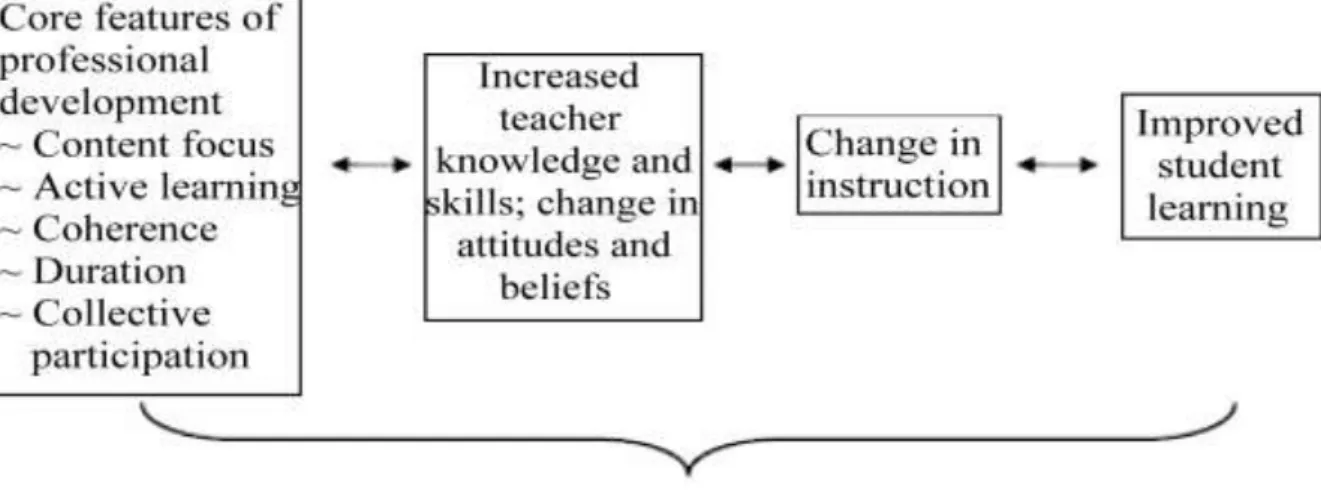
This study draws on Desimone‟s (2011) conceptual framework of teacher professional development and Price‟s (2012) outline of principal-teacher interactions and their affective relationships. According to Desimone (2011), professional development is a dynamic concept that has five core features which should be present in any professional development program. These core features of professional development are content focus, active learning, coherence, duration and collective participation. Desimone (2011) further mentions that one must be able to measure whether professional development produces the anticipated outcomes.
One of the features that Desimone (2011) recommends is content focus which stipulates that PD must mainly focus on the subject content and how teachers are going to teach this subject content to learners. The second feature of PD that Desimone (2011) mentions is active learning, which implies that teachers must be given an opportunity to be involved by
19
observing and be given feedback. This implies the active participation from all parties which are teachers and students. Desimone (2011) further claims that what teachers learn in a professional development activity must be in line with other professional development, their knowledge and beliefs, the school and the mission of the department of education and its policies. She describes this feature as coherence of the learning activities. She further claims that professional development activities should be spread over time and it must have a minimum number of contact time hours specified to ensure the effectiveness of PD activity. Lastly, Desimone (2011) argues that a group of teachers that are teaching the same grade or from the same school should collaboratively engage in professional development activities to build a professional learning community. Therefore, Desimone (2011) proposed four steps to be followed to ensure that professional development results in the desired outcomes. Figure 3.1 below shows the summary of the four steps according to Desimone (2011).
Figure 2.1: showing 4 steps of PD (Desimone, 2009)
However, since this study focused on professional development of teachers and not on improved student learning, I decided to adjust the fourth step to suit the study that will be conducted. Desimone‟s framework was used to analyse the first research question: To what extent do principals support professional development in school-based professional learning communities?
20 Figure 2.2 showing adjusted steps to suit the study
According to Desimone (2009), this model allows for testing the theory of teacher change and that of instruction. These two theories are referring to the fact that professional development changes teacher knowledge, beliefs and practices and suggests that changed practices will influence teacher performance and content delivery.
The second conceptual framework that I used in this study is Price‟s (2012) outline of principal-teacher interactions and their affective relationships. This conceptual framework assisted me to analyse the second research question: What factors enable or hinder principals to support professional development in school-based professional learning communities? Price (2012) argues that the principal‟s attitude towards teachers creates or breaks an atmosphere of learning. Price (2012) further describes a conceptual model of the principal-teacher relationship process that affects principal and principal-teacher attitudes.
According to Price (2012), one of the factors that influence the principal-teacher relationship is proximal relationship outcomes, which imply sharing decision making and frequent interaction with teachers to get a sense of their developmental needs. It is further argued that the effect of principals on a school‟s climate is stronger than the effect of instruction. Price (2012) suggests that the frequency of interaction and degree of power sharing between principals and teachers affect subordinate teacher attitudes.
Price (2012) contends that satisfaction, cohesion and commitment are some of the elements that influence the relationship between the principal and the teachers, which in turn will help the principal to promote professional development within a school. Furthermore, Price (2012)
Core features Content focus Active learning Coherent Duration Collective participation Increased teacher knowledge and skills, change in attitudes and beliefs Change in instruction A developed and capacitated teacher
21
argues that the amount of independence in school decisions affects teacher fulfilment and cohesion levels but not commitment. This may lead to the teachers being not cooperative to professional development programmes that are planned from within the school. Moreover, Price (2012) claims that the frequency of interactions and the level at which power is being shared between the principal and teachers affect subordinates‟ attitudes. This implies that if there is good interaction between them, then relations will be good and would enable the principal to provide support for professional development programmes.
2.8 Chapter summary
In this chapter, I have discussed various concepts relating to teacher professional development. I explained the different models of PD and described different strategies for teacher PD. I also described and discussed professional learning communities including their characteristics. I explained the key roles of school principals in supporting PD. The conceptual framework drawing on Desimone‟s (2011) framework of teacher professional development and Price‟s (2012) outline of principal-teacher interactions and their affective relationships underpinning this study was also discussed. The next chapter presents the data and discusses the results and findings.
22
CHAPTER 3
RESEARCH DESIGN AND METHODOLOGY
3.1 Introduction
The aim of this study was to explore the role of school principals in supporting teacher professional development in a school-based professional learning community. This chapter describes the theoretical orientation and the research design and methodology of this study. To begin, I explain the research paradigm, focussing on the characteristics and key features of the ontological and epistemological underpinnings of the interpretive research paradigm. Next, I outline the qualitative methodological approach of the study. Thereafter, I describe the case study research design. I also discuss the methods of data generation namely, semi-structured interviews and document analysis. In addition, I discuss the suitability of the qualitative methodological approach, interpretive paradigm, case study research design, and data generation methods for the study and hence, evaluate its strengths and its weaknesses. I further allude to the ethical considerations of the study and the issues of trustworthiness of the study focusing on credibility, dependability, transferability and confirmability. To conclude, I explain the role of the researcher throughout the study as well as possible strengths and limitations of this study.
3.2 Interpretive research paradigm
According to Whyuni (2012, p.69), “A research paradigm is a set of fundamental assumptions and beliefs as to how the world is perceived”. Thomas Kuhn (as cited in Maxwell, 2008, p.224), defines a paradigm as “a set of very general philosophical assumptions about the nature of the world (ontology) and how we can understand it (epistemology)”. In addition Mhlanga (2014) claims that interpretive researchers try to get into a person‟s condition and to understand from within for them to appreciate a person‟s world view.
The paradigm that was used in this research study is the interpretive paradigm. An interpretive paradigm is sometimes referred to as constructivism and these concepts were used synonymously in my discussion. According to Scotland (2012), an interpretive approach produces awareness and understandings of the behaviour and clarifies actions of participants‟ viewpoints. Lopez and Willis (2004) claim that the interpretive paradigm expresses the
23
notion that people‟s truths are habitually inclined to the domain where they belong. The reason for choosing the interpretive paradigm was because teacher professional development can be studied by understanding participants‟ views of the case that is being studied and through the recognition of their context and experiences‟ influence on the study (Mackenzie & Knipe, 2006). Likewise, Ponterotto (2005) attests that interpretivists support a reality that is established within a social and historical context.
This study is subject to people‟s behaviour as individuals and as a group (Bertram & Christiansen, 2014). Lopez and Willis (2004) contend that the meaning that the researcher obtains from an interpretive research paradigm is a composite of the meaning expressed by both participants and the researcher within the focus of the study. Ponterotto (2005) argues that in this paradigm, the researcher follows a hermeneutical approach that maintains that the meaning is hidden and it must be brought out through an interaction between the researcher and the participants, and this feature makes it a unique way of viewing the world.
According to Ponterotto (2005), interpretivists believe that there are many truths and constructed realities; hence, that truth is subjective to the context and the circumstances. Cohen and Manion (as cited by Mackenzie & Knipe, 2006) claim that truth or reality is socially constructed as conclusions can be made by understanding the patterns of meanings that are generated. Therefore, Ponterotto (2005) argues that the interaction between the researcher and the participants is pivotal to data gathering and analysing the lived experiences of the participants. The reason for choosing the interpretive paradigm is because I wanted to gain insights and understanding of the role of school principals in supporting and promoting teacher professional development in schools.
3.3 Qualitative methodological approach
According to Creswell (2014), there are three advanced research methodologies commonly used in research, namely, qualitative, quantitative and mixed methods. This study used a qualitative methodological approach which is based on the ontological assumption that reality is subjective and can be backed by individuals‟ perspectives. Ponterotto (2005) states that qualitative methodology refers to the comprehensive course of experimental methods aimed at describing and interpreting the understandings and practices of research participants in a setting of a specific context. In the same way, Creswell (2014) maintains that in qualitative
24
methodology, researchers gather information from the field of the location where participants are involved in the phenomenon under study. Correspondingly, Shange (2014) explains that her study used qualitative methodology since it intends to get a detailed understanding from participants. She further states that qualitative research tries to gather rich eloquent data in respect of a given context with the intention of understanding the case that is being studied.
Krauss (2005) contends that the potential of qualitative data to yield significant results allows it to be an exceptional and prevailing epistemological instrument for understanding the results of a study. In most cases qualitative researchers are directed by certain notions and perceptions concerning the subject that will be examined (Linda, 1994).
Qualitative research is constructed on the relativistic, constructivist ontology that suggests that there is no impartial truth (Krauss, 2005). She further claims that the purpose of the qualitative approach is to explain particular features of an occurrence with the idea of describing the focus of the study. According to Mack, Woodsong, MacQuee, Guest and Namey (2005) one of the key features of qualitative research is the ability to give a complex word-based description of how people (as individuals or group) experience a given research phenomenon under study.
Mack et al. (2005) argue that there are three commonly used methods of data generation of the qualitative methodological approach which are participant observation, in-depth interviews and focus groups. They further state that these methods generate data in the form of field notes, audio recordings, videos recording and transcripts, whereby a transcript refers to a written document that reflects what was said in an interview or a lesson which at times includes explanations of a certain body language. Similarly, Choy (2014) maintains that qualitative methodology uses a variety of data gathering and analysis methods which uses purposive sampling, semi-structured and open ended questions during interviews.
Johnson and Christensen (as cited in Macu, 2013) claim that qualitative research is centred on qualitative data and it tends to follow a descriptive style of systematic methods. Mack et al. (2005) contend that some of the benefits of qualitative methods in empirical research are the use of open-ended questions and probing which will allow participants the opportunity to answer in a way that they will feel comfortable, instead of forcing them to choose from given questions provided by the researcher. Hence, Choy (2014) asserts that qualitative methods
25
will generate soft data that is presented in terms of words, written sentences and pictures and so forth when compared to other methodologies. In most cases, qualitative studies usually rely on interpretive or critical paradigmatic stances (Choy, 2014).
Some of the benefits of qualitative research include an exploration of the understandings of similar and diverse groups of people in order to identify and unpack different perceptions in a given community (Choy, 2014). In addition, Creswell (2014) contends that researchers themselves are key instruments of the research as they gather data themselves through document review, observing behavioural patterns, or interviewing the participants, hence the researcher may get first-hand information when observation is used. On the other hand, Choy (2014) argues that the qualitative approach to cultural assessment enables the researcher to get more information regarding the underlying values, assumptions and beliefs of participants by probing and open ended inquiry.
Despite the advantages discussed above, qualitative research cannot remain without limitations. Choy (2014) argues that a main disadvantage of qualitative research is inclined with cultural analysis as the process is time consuming and some crucial aspects maybe ignored. He further argues that qualitative data cannot be objectively verifiable as it can be influenced by participants‟ feelings about the issue being studied. Because of the open ended inquiry, participants have more impact on the content of the data that is gathered (Choy, 2014).
3.4 Case study research design
There are various types of research designs that can be used when conducting a research study. According to Tichapondwa (2013), the concept case study is usually understood as being synonymous with qualitative methodology. This study has adopted a case study research design. A case study is an organized in-depth study of a specific case in its setting (Bertram & Christiansen, 2014). In the same way, Zainal (2007) asserts that a case study assists the researcher with closely examining the data in a specific context. A case study is a specific occurrence that is commonly considered to illustrate a more general principle (Cohen, Manion & Morrison, 2011). Bertram and Christiansen, (2014) further argue that a case study is mostly used by researchers in the interpretive paradigm. According to Zainal (2007, p. 1), a case study “allows the exploration and understanding of complex issues”.