The Kolb Learning Style Inventory—Version 3.1
2005 Technical Specifi cations
Alice Y. Kolb
Experience Based Learning Systems, Inc. David A. Kolb
Case Western Reserve University May 15, 2005
Abstract
The Kolb Learning Style Inventory Version 3.1 (KLSI 3.1), revised in 2005, is the latest revision of the original Learning Style Inventory developed by David A. Kolb. Like its predecessors, KLSI 3.1 is based on experiential learn-ing theory (Kolb 1984) and is designed to help individuals identify the way they learn from experience. This revi-sion includes new norms that are based on a larger, more diverse, and more representative sample of 6977 LSI users. The format, items, scoring and interpretative booklet remain identical with KLSI 3. The technical specifi cations are designed to adhere to the standards for educational and psychological testing developed by the American Educational Research Association, the American Psychological Association, and the National Council on Measurement in Educa-tion (1999). SecEduca-tion 1 of the technical specifi caEduca-tions describes the conceptual foundaEduca-tions of the LSI 3.1 in the theory of experiential learning (ELT). Section 2 provides a description of the inventory that includes its purpose, history, and format. Section 3 describes the characteristics of the KLSI 3.1 normative sample. Section 4 includes internal reli-ability and test-retest relireli-ability studies of the inventory. Section 5 provides information about research on the internal and external validity for the instrument. Internal validity studies of the structure of the KLSI 3.1 using correlation and factor analysis are reported. External validity includes research on demographics, educational specialization, con-current validity with other experiential learning assessment instruments, aptitude test performance, academic perfor-mance, experiential learning in teams, and educational applications.
1. CONCEPTUAL FOUNDATION—EXPERIENTIAL LEARNING THEORY AND
INDIVIDUAL LEARNING STYLES
The Kolb Learning Style Inventory differs from other tests of learning style and personality used in education by being based on a comprehensive theory of learning and development. Experiential learning theory (ELT) draws on the work of prominent twentieth century scholars who gave experience a central role in their theories of human learning and development-notably John Dewey, Kurt Lewin, Jean Piaget, William James, Carl Jung, Paulo Freire, Carl Rogers, and others-to develop a holistic model of the experiential learning process and a multi-linear model of adult development. The theory, described in detail in Experiential Learning: Experience as the Source of Learning and Development
(Kolb 1984), is built on six propositions that are shared by these scholars.
1. Learning is best conceived as a process, not in terms of outcomes. To improve learning in higher education, the primary focus should be on engaging students in a process that best enhances their learning —a process that includes feedback on the effectiveness of their learning efforts. “...education must be conceived as a continuing reconstruction of experience: ... the process and goal of education are one and the same thing.” (Dewey 1897: 79)
2. All learning is relearning. Learning is best facilitated by a process that draws out the students’ beliefs and ideas about a topic so that they can be examined, tested, and integrated with new, more refi ned ideas.
3. Learning requires the resolution of confl icts between dialectically opposed modes of adaptation to the world. Confl ict, differences, and disagreement are what drive the learning process. In the process of learning, one is called upon to move back and forth between opposing modes of refl ection and action and feeling and think-ing.
4. Learning is a holistic process of adaptation to the world. It is not just the result of cognition but involves the integrated functioning of the total person—thinking, feeling, perceiving, and behaving.
5. Learning results from synergetic transactions between the person and the environment. In Piaget’s terms, learning occurs through equilibration of the dialectic processes of assimilating new experiences into existing concepts and accommodating existing concepts to new experience.
6. Learning is the process of creating knowledge. ELT proposes a constructivist theory of learning whereby social knowledge is created and recreated in the personal knowledge of the learner. This stands in contrast to the “transmission” model on which much current educational practice is based, where pre-existing fi xed ideas are transmitted to the learner.
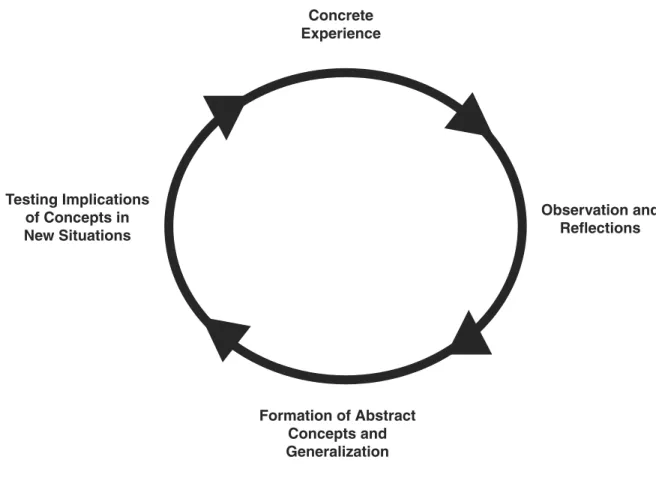
ELT defi nes learning as “the process whereby knowledge is created through the transformation of experience. Knowl-edge results from the combination of grasping and transforming experience” (Kolb 1984: 41). The ELT model por-trays two dialectically related modes of grasping experience-Concrete Experience (CE) and Abstract Conceptualization (AC)-and two dialectically related modes of transforming experience-Refl ective Observation (RO) and Active Experi-mentation (AE). Experiential learning is a process of constructing knowledge that involves a creative tension among the four learning modes that is responsive to contextual demands. This process is portrayed as an idealized learning cycle or spiral where the learner “touches all the bases”—experiencing, refl ecting, thinking, and acting-in a recursive process that is responsive to the learning situation and what is being learned. Immediate or concrete experiences are the basis for observations and refl ections. These refl ections are assimilated and distilled into abstract concepts from which new implications for action can be drawn. These implications can be actively tested and serve as guides in cre-ating new experiences (Figure 1). ELT proposes that this idealized learning cycle will vary by individuals’ learning style and learning context.
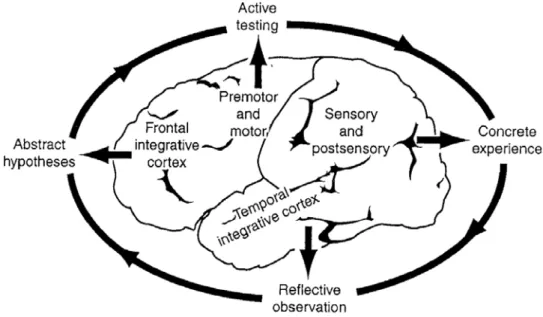
In The art of changing the brain: Enriching teaching by exploring the biology of learning, James Zull, a biologist and founding director of CWRU’s University Center for Innovation in Teaching and Education (UCITE), sees a link between ELT and neuroscience research, suggesting that this process of experiential learning is related to the process of brain functioning as shown in Figure 2. “Put into words, the fi gure illustrates that concrete experiences come through the sensory cortex, refl ective observation involves the integrative cortex at the back, creating new abstract concepts occurs in the frontal integrative cortex, and active testing involves the motor brain. In other words, the learning cycle arises from the structure of the brain.” (Zull 2002: 18-19)
Figure 1. The experiential learning cycle
Concrete Experience Testing Implications of Concepts in New Situations Observation and Reflections Formation of Abstract Concepts and Generalization
ELT posits that learning is the major determinant of human development and that how individuals learn shapes the course of their personal development. Previous research (Kolb 1984) has shown that learning styles are infl uenced by personality type, educational specialization, career choice, and current job role and tasks. Yamazaki (2002, 2004a) has recently identifi ed cultural infl uences as well. The ELT developmental model (Kolb 1984) defi nes three stages: (1) acquisition, from birth to adolescence, where basic abilities and cognitive structures develop; (2) specialization, from formal schooling through the early work and personal experiences of adulthood, where social, educational, and orga-nizational socialization forces shape the development of a particular, specialized learning style; and (3) integration in midcareer and later life, where nondominant modes of learning are expressed in work and personal life. Development through these stages is characterized by increasing complexity and relativism in adapting to the world and by increased integration of the dialectic confl icts between AC and CE and AE and RO. Development is conceived as multi-linear based on an individual’s particular learning style and life path—development of CE increases affective complexity, of RO increases perceptual complexity, of AC increases symbolic complexity, and of AE increases behavioral complexity. The concept of learning style describes individual differences in learning based on the learner’s preference for employ-ing different phases of the learnemploy-ing cycle. Because of our hereditary equipment, our particular life experiences, and the demands of our present environment, we develop a preferred way of choosing among the four learning modes. We resolve the confl ict between being concrete or abstract and between being active or refl ective in patterned, characteris-tic ways.
Much of the research on ELT has focused on the concept of learning style, using the Learning Style Inventory (LSI) to assess individual learning styles (Kolb 1971, 1985, 1999). While individuals tested on the LSI show many differ-ent patterns of scores, previous research with the instrumdiffer-ent has iddiffer-entifi ed four learning styles that are associated with different approaches to learning—Diverging, Assimilating, Converging, and Accommodating. The following sum-mary of the four basic learning styles is based on both research and clinical observation of these patterns of LSI scores (Kolb1984, 1999a).
Figure 2. The experiential learning cycle and regions of the cerebral cortex. Reprinted with permission of the author (Zull 2002)
An individual with diverging style has CE and RO as dominant learning abilities. People with this learning style are best at viewing concrete situations from many different points of view. It is labeled Diverging because a person with it performs better in situations that call for generation of ideas, such as a brainstorming session. People with a Diverging learning style have broad cultural interests and like to gather information. They are interested in people, tend to be imaginative and emotional, have broad cultural interests, and tend to specialize in the arts. In formal learning situa-tions, people with the Diverging style prefer to work in groups, listening with an open mind to different points of view and receiving personalized feedback.
An individual with an assimilating style has AC and RO as dominant learning abilities. People with this learning style are best at understanding a wide range of information and putting it into concise, logical form. Individuals with an Assimilating style are less focused on people and more interested in ideas and abstract concepts. Generally, people with this style fi nd it more important that a theory have logical soundness than practical value. The Assimilating learning style is important for effectiveness in information and science careers. In formal learning situations, people with this style prefer readings, lectures, exploring analytical models, and having time to think things through. An individual with a converging style has AC and AE as dominant learning abilities. People with this learning style are best at fi nding practical uses for ideas and theories. They have the ability to solve problems and make decisions based on fi nding solutions to questions or problems. Individuals with a Converging learning style prefer to deal with technical tasks and problems rather than with social issues and interpersonal issues. These learning skills are impor-tant for effectiveness in specialist and technology careers. In formal learning situations, people with this style prefer to experiment with new ideas, simulations, laboratory assignments, and practical applications.
An individual with an accommodating style has CE and AE as dominant learning abilities. People with this learn-ing style have the ability to learn from primarily “hands-on” experience. They enjoy carrylearn-ing out plans and involvlearn-ing themselves in new and challenging experiences. Their tendency may be to act on “gut” feelings rather than on logi-cal analysis. In solving problems, individuals with an Accommodating learning style rely more heavily on people for information than on their own technical analysis. This learning style is important for effectiveness in action-oriented careers such as marketing or sales. In formal learning situations, people with the Accommodating learning style prefer to work with others to get assignments done, to set goals, to do fi eld work, and to test out different approaches to completing a project.
FACTORS THAT SHAPE AND INFLUENCE LEARNING STYLES
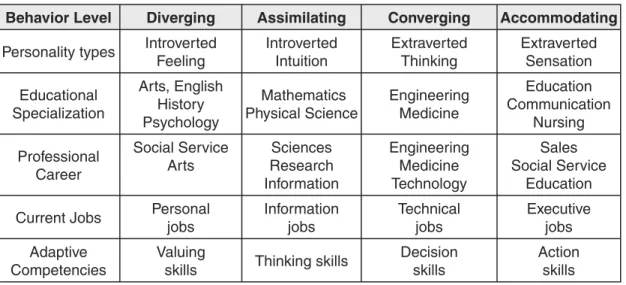
The above patterns of behavior associated with the four basic learning styles are shaped by transactions between people and their environment at fi ve different levels—personality, educational specialization, professional career, current job role, and adaptive competencies. While some have interpreted learning style as a personality variable (Garner 2000; Furnam, Jackson, and Miller 1999), ELT defi nes learning style as a social psychological concept that is only partially determined by personality. Personality exerts a small but pervasive infl uence in nearly all situations; but at the other levels, learning style is infl uenced by increasingly specifi c environmental demands of educational specialization, career, job, and tasks skills. Table 1 summarizes previous research that has identifi ed how learning styles are determined at these various levels.
Table 1. Relationship Between Learning Styles and Five Levels of Behavior
Behavior Level Diverging Assimilating Converging Accommodating
Personality types Introverted Feeling Introverted Intuition Extraverted Thinking Extraverted Sensation Educational Specialization Arts, English History Psychology Mathematics Physical Science Engineering Medicine Education Communication Nursing Professional Career Social Service Arts Sciences Research Information Engineering Medicine Technology Sales Social Service Education Current Jobs Personal
jobs Information jobs Technical jobs Executive jobs Adaptive Competencies Valuing
skills Thinking skills
Decision skills
Action skills
Personality Types
Although the learning styles of and learning modes proposed by ELT are derived from the works of Dewey, Lewin, and Piaget, many have noted the similarity of these concepts to Carl Jung’s descriptions of individuals’ preferred ways for adapting in the world. Several research studies relating the LSI with the Myers-Briggs Type Indicator (MBTI) indi-cate that Jung’s Extraversion/Introversion dialectical dimension correlates with the Active/Refl ective dialectic of ELT, and the MBTI Feeling/Thinking dimension correlates with the LSI Concrete Experience/ Abstract Conceptualization dimension. The MBTI Sensing type is associated with the LSI Accommodating learning style, and the MBTI Intui-tive type with the LSI Assimilating style. MBTI Feeling types correspond to LSI Diverging learning styles, and Think-ing types to ConvergThink-ing styles. The above discussion implies that the AccommodatThink-ing learnThink-ing style is the Extraverted Sensing type, and the Converging style the Extraverted Thinking type. The Assimilating learning style corresponds to the Introverted Intuitive personality type, and the Diverging style to the Introverted Feeling type. Myers (1962) descriptions of these MBTI types are very similar to the corresponding LSI learning styles as described by ELT (Kolb 1984, 83-85).
Educational Specialization
Early educational experiences shape people’s individual learning styles by instilling positive attitudes toward specifi c sets of learning skills and by teaching students how to learn. Although elementary education is generalized, an increas-ing process of specialization begins in high school and becomes sharper durincreas-ing the college years. This specialization in the realms of social knowledge infl uences individuals’ orientations toward learning, resulting in particular relations between learning styles and early training in an educational specialty or discipline. For example, people specializing in the arts, history, political science, English, and psychology tend to have Diverging learning styles, while those majoring
in more abstract and applied areas such as medicine and engineering have Converging learning styles. Individuals with Accommodating styles often have educational backgrounds in education, communications, and nursing, and those with Assimilating styles in mathematics and physical sciences.
Professional Career
A third set of factors that shape learning styles stems from professional careers. One’s professional career choice not only exposes one to a specialized learning environment, but it also involves a commitment to a generic professional problem, such as social service, that requires a specialized adaptive orientation. In addition, one becomes a member of a reference group of peers who share a professional mentality and a common set of values and beliefs about how one should behave professionally. This professional orientation shapes learning style through habits acquired in profes-sional training and through the more immediate normative pressures involved in being a competent profesprofes-sional. Research over the years has shown that social service and arts careers attract people with a Diverging learning style. Professions in the sciences and information or research have people with an Assimilating learning style. The Con-verging learning styles tends to be dominant among professionals in technology-intensive fi elds such as medicine and engineering. Finally, the Accommodating learning style characterizes people with careers in fi elds such as sales, social service, and education.
Current Job Role
The fourth level of factors infl uencing learning style is the person’s current job role. The task demands and pressures of a job shape a person’s adaptive orientation. Executive jobs, such as general management, that require a strong orien-tation to task accomplishment and decision making in uncertain emergent circumstances require an Accommodating learning style. Personal jobs, such as counseling and personnel administration, which require the establishment of personal relationships and effective communication with other people, demand a Diverging learning style. Informa-tion jobs, such as planning and research, which require data gathering and analysis, as well as conceptual modeling, require an Assimilating learning style. Technical jobs, such as bench engineering and production, require technical and problem-solving skills, which require a convergent learning orientation.
Adaptive Competencies
The fi fth and most immediate level of forces that shapes learning style is the specifi c task or problem the person is currently working on. Each task we face requires a corresponding set of skills for effective performance. The effec-tive matching of task demands and personal skills results in an adapeffec-tive competence. The Accommodaeffec-tive learning style encompasses a set of competencies that can best be termed Acting skills: Leadership, Initiative, and Action. The Diverging learning style is associated with Valuing skills: Relationship, Helping Others, and Sense Making. The Assimilating learning style is related to Thinking skills: Information Gathering, Information Analysis, and Theory Building. Finally, the Converging learning style is associated with Decision skills like Quantitative Analysis, Use of Technology, and Goal Setting (Kolb1984).
2. THE LEARNING STYLE INVENTORY
PURPOSE
The Learning Style Inventory (LSI) was created to fulfi ll two purposes:
1. To serve as an educational tool to increase individuals’ understanding of the process of learning from experi-ence and their unique individual approach to learning. By increasing awareness of how they learn, the aim is to increase learners’ capacity for meta-cognitive control of their learning process, enabling them to monitor and select learning approaches that work best for them in different learning situations. By providing a lan-guage for talking about learning styles and the learning process, the inventory can foster conversation among learners and educators about how to create the most effective learning environment for those involved. For this purpose, the inventory is best presented not as a test, but as an experience in understanding how one learns. Scores on the inventory should not be interpreted as defi nitive, but as a starting point for explora-tion of how one learns best. To facilitate this purpose, a self-scoring and interpretaexplora-tion book that explains the experiential learning cycle and the characteristics of the different learning styles, along with scoring and profi ling instructions, is included with the inventory.
2. To provide a research tool for investigating experiential learning theory (ELT) and the characteristics of individual learning styles. This research can contribute to the broad advancement of experiential learning and, specifi cally, to the validity of interpretations of individual learning style scores. A research version of the instrument, including only the inventory to be scored by the researcher, is available for this purpose.
The LSI is not a criterion-referenced test and is not intended for use to predict behavior for purposes of selection, placement, job assignment, or selective treatment. This includes not using the instrument to assign learners to dif-ferent educational treatments, a process sometimes referred to as tracking. Such categorizations based on a single test score amount to stereotyping that runs counter to the philosophy of experiential learning, which emphasizes indi-vidual uniqueness. “When it is used in the simple, straightforward, and open way intended, the LSI usually provides a valuable self-examination and discussion that recognizes the uniqueness, complexity, and variability in individual approaches to learning. The danger lies in the reifi cation of learning styles into fi xed traits, such that learning styles become stereotypes used to pigeonhole individuals and their behavior.” (Kolb 1981a: 290-291)
The LSI is constructed as a self-assessment exercise and tool for construct validation of ELT. Tests designed for predic-tive validity typically begin with a criterion, such as academic achievement, and work backward to identify items or tests with high criterion correlations. Even so, even the most sophisticated of these tests rarely rises above a .5 correla-tion with the criterion. For example, while Graduate Record Examinacorrela-tion Subject Test scores are better predictors of fi rst-year graduate school grades than either the General Test score or undergraduate GPA, the combination of these three measures only produces multiple correlations with grades ranging from .4 to .6 in various fi elds (Anastasi and Urbina 1997).
Construct validation is not focused on an outcome criterion, but on the theory or construct the test measures. Here the emphasis is on the pattern of convergent and discriminant theoretical predictions made by the theory. Failure to confi rm predictions calls into question the test and the theory. “However, even if each of the correlations proved to be quite low, their cumulative effect would be to support the validity of the test and the underlying theory.” (Selltiz, Jahoda, Deutsch, and Cook 1960: 160) Judged by the standards of construct validity, ELT has been widely accepted as a useful framework for learning-centered educational innovation, including instructional design, curriculum devel-opment, and life-long learning. Field and job classifi cation studies viewed as a whole also show a pattern of results consistent with the ELT structure of knowledge theory.
HISTORY
Five versions of the Learning Style Inventory have been published over the last 35 years. During this time, attempts have been made to openly share information about the inventory, its scoring, and its technical characteristics with other interested researchers. The results of their research have been instrumental in the continuous improvement of the inventory.
Learning Style Inventory-Version 1 (Kolb 1971, Kolb 1976)
The original Learning Style Inventory (LSI 1) was created in 1969 as part of an MIT curriculum development project that resulted in the fi rst management textbook based on experiential learning (Kolb, Rubin, and McIntyre 1971). It was originally developed as an experiential educational exercise designed to help learners understand the process of experiential learning and their unique individual style of learning from experience. The term “learning style” was coined to describe these individual differences in how people learn.
Items for the inventory were selected from a longer list of words and phrases developed for each learning mode by a panel of four behavioral scientists familiar with experiential learning theory. This list was given to a group of 20 graduate students who were asked to rate each word or phrase for social desirability. Attempting to select words that were of equal social desirability, a fi nal set of 12 items including a word or phrase for each learning mode was selected for pre-testing. Analysis showed that three of these sets produced nearly random responses and were thus eliminated, resulting in a fi nal version of the LSI with 9 items. These items were further refi ned through item-whole correlation analysis to include six scored items for each learning mode.
Research with the inventory was stimulated by classroom discussions with students, who found the LSI to be helpful to them in understanding the process of experiential learning and how they learned. From 1971 until it was revised in 1985, there were more than 350 published research studies using the LSI. Validity for the LSI 1 was established in a number of fi elds, including education, management, psychology, computer science, medicine, and nursing (Hickcox 1990, Iliff 1994). The results of this research with LSI 1 provided provided empirical support for the most complete and systematic statement of ELT, Experiential Learning: Experience as the Source of Learning and Development (Kolb 1984). Several studies of the LSI 1 identifi ed psychometric weaknesses of the instrument, particularly low internal consistency reliability and test-retest reliability.
Learning Style Inventory-Version 2 (Kolb 1985)
Low reliability coeffi cients and other concerns about the LSI 1 led to a revision of the inventory in 1985 (LSI 2). Six new items chosen to increase internal reliability (alpha) were added to each scale, making 12 scored items on each scale. These changes increased scale alphas to an average of .81 ranging from .73 to .88. Wording of all items was simplifi ed to a seventh grade reading level, and the format was changed to include sentence stems (e.g., “When I learn”). Correlations between the LSI 1 and LSI 2 scales averaged .91 and ranged from .87 to .93. A new more diverse normative reference group of 1446 men and women was created.
Research with the LSI 2 continued to establish validity for the instrument. From 1985 until the publication of the LSI 3 1999, more than 630 studies were published, most using the LSI 2. While internal reliability estimates for the LSI 2 remained high in independent studies, test-retest reliability remained low.
Learning Style Inventory-Version 2a (Kolb 1993)
In 1991 Veres, Sims, and Locklear published a reliability study of a randomized version of the LSI 2 that showed a small decrease in internal reliability but a dramatic increase in test-retest reliability with the random scoring format. To study this format, a research version of the random format inventory (LSI 2a) was published in 1993.
Kolb Learning Style Inventory-Version 3 (Kolb 1999)
In 1999 the randomized format was adopted in a revised self-scoring and interpretation booklet (LSI 3) that included a color-coded scoring sheet to simplify scoring. The new booklet was organized to follow the learning cycle, emphasiz-ing the LSI as an “experience in learnemphasiz-ing how you learn.” New application information on teamwork, managemphasiz-ing con-fl ict, personal and professional communication, and career choice and development were added. The LSI 3 continued to use the LSI 2 normative reference group until norms for the randomized version could be created.
Kolb Learning Style Inventory-Version 3.1 (Kolb 2005)
The new LSI 3.1 described here modifi ed the LSI 3 to include new normative data described below. This revision includes new norms that are based on a larger, more diverse and representative sample of 6977 LSI users. The format, items, scoring, and interpretative booklet remain identical to KLSI 3. The only change in KLSI 3.1 is in the norm charts used to convert raw LSI scores.
FORMAT
The Learning Style Inventory is designed to measure the degree to which individuals display the different learning styles derived from experiential learning theory. The form of the inventory is determined by three design parameters. First, the test is brief and straightforward, making it useful both for research and for discussing the learning process with individuals and providing feedback. Second, the test is constructed in such a way that individuals respond to it as they would respond to a learning situation: it requires them to resolve the tensions between the abstract-concrete and active-refl ective orientations. For this reason, the LSI format requires them to rank order their preferences for the abstract, concrete, active, and refl ective orientations. Third, and most obviously, it was hoped that the measures of learning styles would predict behavior in a way consistent with the theory of experiential learning.
All versions of the LSI have had the same format—a short questionnaire (9 items for LSI 1 and 12 items for subse-quent versions) that asks respondents to rank four sentence endings that correspond to the four learning modes— Concrete Experience (e.g., experiencing), Refl ective Observation (refl ecting), Abstract Conceptualization (thinking), and Active Experimentation (doing). Items in the LSI are geared to a seventh grade reading level. The inventory is intended for use by teens and adults. It is not intended for use by younger children. The LSI has been translated into many languages, including, Arabic, Chinese, French, Japanese, Italian, Portuguese, Spanish, Swedish, and Thai, and there have been many cross-cultural studies using it (Yamazaki 2002).
The Forced-Choice Format of the LSI
The format of the LSI is a forced-choice format that ranks an individual’s relative choice preferences among the four modes of the learning cycle. This is in contrast to the more common normative, or free-choice, format, such as the widely used Likert scale, which rates absolute preferences on independent dimensions. The forced-choice format of the LSI was dictated by the theory of experiential learning and by the primary purpose of the instrument.
ELT is a holistic, dynamic, and dialectic theory of learning. Because it is holistic, the four modes that make up the experiential learning cycle-CE, RO, AC, and AE- are conceived as interdependent. Learning involves resolving the creative tension among these learning modes in response to the specifi c learning situation. Since the two learning dimensions, AC-CE and AE-RO, are related dialectically, the choice of one pole involves not choosing the opposite pole. Therefore, because ELT postulates that learning in life situations requires the resolution of confl icts among interdependent learning modes, to be ecologically valid, the learning style assessment process should require a similar process of confl ict resolution in the choice of one’s preferred learning approach.
ELT defi nes learning style not as a fi xed trait, but as a dynamic state arising from an individual’s preferential resolu-tion of the dual dialectics of experiencing/conceptualizing and acting/refl ecting. “The stability and endurance of these states in individuals comes not solely from fi xed genetic qualities or characteristics of human beings: nor, for that matter, does it come from the stable fi xed demands of environmental circumstances. Rather, stable and endur-ing patterns of human individuality arise from consistent patterns of transaction between the individual and his or her
environment. The way we process the possibilities of each new emerging event determines the range of choices and decisions we see. The choices and decisions we make to some extent determine the events we live through, and these events infl uence our future choices. Thus, people create themselves through the choice of actual occasions they live through.” (Kolb 1984: 63-64)
The primary purpose of the LSI is to provide learners with information about their preferred approach to learning. The most relevant information for the learner is about intra-individual differences, his or her relative preference for the four learning modes, not inter-individual comparisons. Ranking relative preferences among the four modes in a forced-choice format is the most direct way to provide this information. While individuals who take the inventory sometimes report diffi culty in making these ranking choices, they report that the feedback they get from the LSI gives them more insight than had been the case when we used a normative Likert rating scale version. This is because the social desirability response bias in the rating scales fails to defi ne a clear learning style, that is, they say they prefer all learning modes. This is supported by Harland’s (2002) fi nding that feedback from a forced-choice test format was perceived as more accurate, valuable, and useful than feedback from a normative version.
The adoption of the forced-choice method for the LSI has at times placed it in the center of an ongoing debate in the research literature about the merits of forced-choice instruments between what might be called “rigorous statisticians” and “pragmatic empiricists.” Statisticians have questioned the use of the forced-choice format because of statistical limitations, called ipsativity, that are the result of the ranking procedure. Since ipsative scores represent the relative strength of a variable compared to others in the ranked set, the resulting dependence among scores produces method-induced negative correlations among variables and violates a fundamental assumption of classical test theory required for use of techniques such as analysis of variance and factor analysis-independence of error variance. Cornwell and Dunlap (1994) stated that ipsative scores cannot be factored and that correlation-based analysis of ipsative data pro-duced uninterpretable and invalid results (cf. Hicks 1970, Johnson et al. 1988). Other criticisms include the point that ipsative scores are technically ordinal, not the interval scales required for parametric statistical analysis; that they produce lower internal reliability estimates and lower validity coeffi cients (Barron 1996). While critics of forced-choice instruments acknowledge that these criticisms do not detract from the validity of intra-individual comparisons (LSI purpose one), they argue that ipsative scores are not appropriate for inter-individual comparisons, since inter-indi-vidual comparisons on a ranked variable are not independent absolute preferences, but preferences that are relative to the other ranked variables in the set (Barron 1996, Karpatschof and Elkjaer 2000). However, since ELT argues that a given learning mode preference is relative to the other three modes, it is the comparison of relative not absolute prefer-ences that the theory seeks to assess.
The “pragmatic empiricists” argue that in spite of theoretical statistical arguments, normative and forced-choice varia-tions of the same instrument can produce empirically comparable results. Karpatschof and Elkjaer (2000) advanced this case in their metaphorically titled paper “Yet the Bumblebee Flies.” With theory, simulation, and empirical data, they presented evidence for the comparability of ipsative and normative data. Saville and Wilson (1991) found a high correspondence between ipsative and normative scores when forced choice involved a large number of alternative dimensions.
Normative tests also have serious limitations, which the forced-choice format was originally created to deal with (Sisson 1948). Normative scales are subject to numerous response biases—central tendency bias, in which respondents avoid extreme responses, acquiescence response, and social desirability responding-and are easy to fake. Forced- choice instruments are designed to avoid these biases by forcing choice among alternatives in a way that refl ects real live choice making (Hicks 1970, Barron 1996). Matthews and Oddy found large bias in the extremeness of positive and negative responses in normative tests and concluded that when sources of artifact are controlled, “individual differ-ences in ipsative scores can be used to rank individuals meaningfully” (1997: 179). Pickworth and Shoeman (2000) found signifi cant response bias in two normative LSI formats developed by Marshall and Merritt (1986) and Geiger et al. (1993). Conversely, Beutell and Kressel (1984) found that social desirability contributed less than 4% of the
vari-In addition, ipsative tests can provide external validity evidence comparable to normative data (Barron 1996) or in some cases even better (Hicks 1970). For example, attempts to use normative rating versions of the LSI report reli-ability and internal validity data but little or no external validity (Pickworth and Shoeman 2000, Geiger et al. 1993, Romero et al. 1992, Marshall and Merritt 1986, Merritt and Marshall 1984).
Characteristics of the LSI Scales
The LSI assesses six variables: four primary scores that measure an individual’s relative emphasis on the four learning orientations—Concrete Experience (CE), Refl ective Observation (RO), Abstract Conceptualization (AC), and Active Experimentation (AE)—and two combination scores that measure an individual’s preference for abstractness over con-creteness (AC-CE) and action over refl ection (AE-RO). The four primary scales of the LSI are ipsative because of the forced-choice format of the instrument. This results in negative correlations among the four scales, the mean magni-tude of which can be estimated (assuming no underlying correlations among them) by the formula -1/(m - 1) where m is the number of variables (Johnson et al. 1988). This results in a predicted average method- induced correlation of -.33 among the four primary LSI scales.
The combination scores AC-CE and AE-RO, however, are not ipsative. Forced- choice instruments can produce scales that are not ipsative (Hicks 1970; Pathi, Manning, and Kolb 1989). To demonstrate the independence of the combi-nation scores and interdependence of the primary scores, Pathi, Manning, and Kolb (1989) had SPSS-X randomly fi ll out and analyze 1000 LSI’s according to the ranking instructions. While the mean intercorrelation among the primary scales was -.33 as predicted, the correlation between AC-CE and AE-RO was +.038.
In addition, if AC-CE and AE-RO were ipsative scales, the correlation between the two scales would be -1.0 according to the above formula. Observed empirical relationships are always much smaller, e.g. +.13 for a sample of 1591 graduate students (Freedman and Stumpf 1978), -.09 for the LSI 2 normative sample of 1446 respondents (Kolb 1999b), -.19 for a sample of 1296 MBA students (Boyatzis and Mainemelis 2000) and -.21 for the normative sample of 6977 LSI’s for the KLSI 3.1 described below.
The independence of the two combination scores can be seen by examining some example scoring results. For example, when AC-CE or AE-RO on a given item takes a value of +2 (from, say, AC = 4 and CE = 2, or AC = 3 and CE = 1), the other score can take a value of +2 or -2. Similarly when either score takes a value of +1 (from 4 -3, 3-2, or 2-1), the other can take the values of +3, +1, -1, or -3. In other words, when AC-CE takes a particular value, AE-RO can take two to four different values, and the score on one dimension does not determine the score on the other.
3. NORMS FOR THE LSI VERSION 3.1
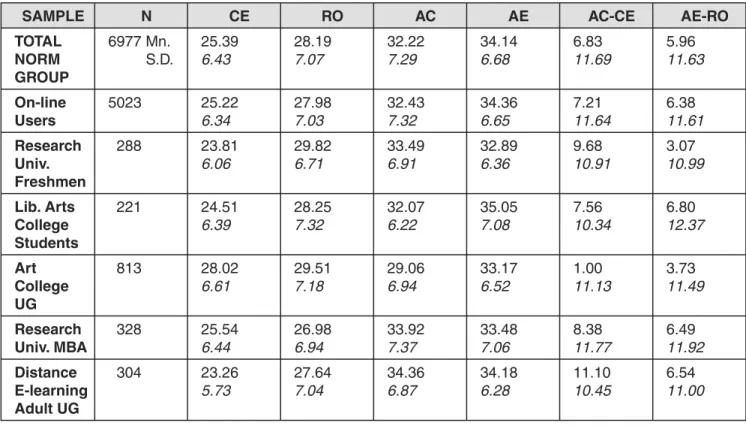
New norms for the LSI 3.1 were created from responses by several groups of users who completed the randomized LSI 3. These norms are used to convert LSI raw scale scores to percentile scores (see Appendix 1). The purpose of percen-tile conversions is to achieve scale comparability among an individual’s LSI scores (Barron 1996) and to defi ne cut-points for defi ning the learning style types. Table 2 shows the means and standard deviations for KLSI 3.1 scale scores for the normative groups.
Table 2. KLSI 3.1 Scores for Normative Groups
SAMPLE N CE RO AC AE AC-CE AE-RO
TOTAL NORM GROUP 6977 Mn. S.D. 25.39 6.43 28.19 7.07 32.22 7.29 34.14 6.68 6.83 11.69 5.96 11.63 On-line Users 5023 25.22 6.34 27.98 7.03 32.43 7.32 34.36 6.65 7.21 11.64 6.38 11.61 Research Univ. Freshmen 288 23.81 6.06 29.82 6.71 33.49 6.91 32.89 6.36 9.68 10.91 3.07 10.99 Lib. Arts College Students 221 24.51 6.39 28.25 7.32 32.07 6.22 35.05 7.08 7.56 10.34 6.80 12.37 Art College UG 813 28.02 6.61 29.51 7.18 29.06 6.94 33.17 6.52 1.00 11.13 3.73 11.49 Research Univ. MBA 328 25.54 6.44 26.98 6.94 33.92 7.37 33.48 7.06 8.38 11.77 6.49 11.92 Distance E-learning Adult UG 304 23.26 5.73 27.64 7.04 34.36 6.87 34.18 6.28 11.10 10.45 6.54 11.00
TOTAL NORMATIVE GROUP
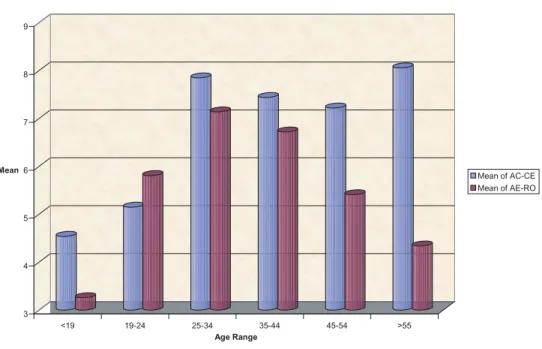
Normative percentile scores for the LSI 3.1 are based on a total sample of 6977 valid LSI scores from users of the instrument. This user norm group is composed of 50.4% women and 49.4% men. Their age range is 17-75, broken down into the following age-range groups: < 19 = 9.8%, 19-24 = 17.1%, 25-34 = 27%, 35-44 = 23%, 45-54 = 17.2%, and >54 = 5.8 %. Their educational level is as follows: primary school graduate = 1.2%, secondary school degree = 32.1%, university degree = 41.4%, and post-graduate degree = 25.3%. The sample includes college students and working adults in a wide variety of fi elds. It is made up primarily of U.S. residents (80%) with the remaining 20% of users residing in 64 different countries. The norm group is made up of six subgroups, the specifi c demo-graphic characteristics of which are described below.
On-line Users
This sample of 5023 is composed of individuals and groups who have signed up to take the LSI on-line. Group users include undergraduate and graduate student groups, adult learners, business management groups, military manage-ment groups, and other organizational groups. Half of the sample are men and half are women. Their ages range as fol-lows: <19 = .2%, 19-24 = 10.1%, 25-34 = 29.6%, 35-44 = 28.8%, 45-54 = 23/1%, >55 = 8.1 %. Their educational level is as follows: primary school graduate = 1.7%, secondary school degree = 18.2%, university degree = 45.5%, and postgraduate degree = 34.6%. Most of the on-line users (66%) reside in the U.S. with the remaining 34% living in 64 different countries, with the largest representations from Canada (317), U. K. (212), India (154), Germany (100), Brazil (75), Singapore (59), France (49), and Japan (42).
Research University Freshmen
This sample is composed of 288 entering freshmen at a top research university. 53% are men and 47% are women. All are between the ages of 17 and 22. More than 87% of these students intend to major in science or engineering.
Liberal Arts College Students
Data for this sample were provided by Kayes (2005). This sample includes 221 students (182 undergraduates and 39 part-time graduate students) enrolled in business courses at a private liberal arts college. Their average age is 22, rang-ing from 18 to 51. 52% are male and 48% are female.
Art College Undergraduates
This sample is composed of 813 freshmen and graduating students from three undergraduate art colleges. Half of the sample are men and half are women. Their average age is 20, distributed as follows: <19 =42.7%, 19-24 = 54.3%, 25-34 = 2%, >35 = 1%.
Research University MBA Students
This sample is composed of 328 full-time (71%) and part-time (29%) MBA students in a research university manage-ment school. 63% are men and 37% women. Their average age is 27, distributed as follows: 19-24 = 4.1%, 25-34 = 81.3%, 35-44 = 13.8%, 45-54 = 1%.
Distance E-learning Adult Undergraduate Students
This sample is composed of 304 adult learners enrolled in an e-learning distance education undergraduate degree pro-gram at a large state university. 56% are women and 44% men. Their average age is 36, distributed as follows: 19-24 = 6.3%, 25-34 = 37.5%, 35-44 = 40.1%, 45-54 = 14.5%, and > 55 = 1.6%.
CUT-POINTS FOR LEARNING STYLE TYPES
The four basic learning style types—Accommodating, Diverging, Assimilating, and Converging-are created by divid-ing the AC-CE and AE-RO scores at the fi ftieth percentile of the total norm group and plottdivid-ing them on the Learndivid-ing Style Type Grid (Kolb 1999a: 6). The cut point for the AC-CE scale is +7, and the cut point for the AE-RO scale is +6. The Accommodating type would be defi ned by an AC-CE raw score <=7 and an AE-RO score >=7, the Diverging type by AC-CE <=7 and AE-RO <=6, the Converging type by AC-CE >=8 and AE-RO >=7, and the Assimilating type by AC-CE >=8 and AE-RO <=6.
Recent theoretical and empirical work is showing that the original four learning styles can be refi ned to show nine distinct styles (Eickmann, Kolb, and Kolb 2004; Kolb and Kolb 2005a; Boyatzis and Mainemelis 2000). David Hunt and his associates (Abby, Hunt, and Weiser 1985; Hunt 1987) identifi ed four additional learning styles, which they identifi ed as Northerner, Easterner, Southerner, and Westerner. In addition a Balancing learning style has been identi-fi ed by Mainemelis, Boyatzis, and Kolb (2002) that integrates AC and CE and AE and RO. These nine learning styles can be defi ned by placing them on the Learning Style Type Grid. Instead of dividing the grid at the fi ftieth percentiles of the LSI normative distributions for AC-CE and AE-RO, the nine styles are defi ned by dividing the two normative distributions into thirds. On the AE-RO dimension, the active regions are defi ned by percentiles greater than 66.67% (raw scores => +12) while the refl ective regions are defi ned by percentiles less than 33.33% (<= +1). On the AC-CE dimension, the concrete regions are defi ned by <= +2 and the abstract regions by => 13. For example the NW accom-modating region would be defi ned by AC-CE raw scores <=2 and AE-RO scores =>12. (See Kolb and Kolb 2005a for examples and details.)
4. RELIABILITY OF THE KLSI 3.1
This section reports internal consistency reliability studies using Cronbach’s alpha and test-retest reliability studies for the randomized KLSI 3.1.
INTERNAL CONSISTENCY RELIABILITY
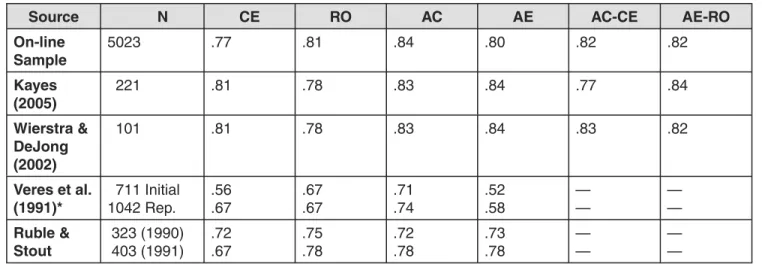
Table 3 reports Cronbach’s alpha coeffi cients for seven different studies of the randomized KLSI 3.1: the norm sub-sample of on-line LSI users, Kayes (2005) study of liberal arts college students, Wierstra and DeJong’s (2002) study of psychology undergraduates, Veres et al. (1991) initial and replication studies of business employees and students, and two studies by Ruble and Stout (1990, 1991) of business students. Wierstra and DeJong and Ruble and Stout used an LSI randomized in a different order than the KLSI 3.1. These results suggest that the KLSI 3.1 scales show good internal consistency reliability across a number of different populations.
Table 3. Internal Consistency Alphas for the Scale Scores of the KLSI 3.1
Source N CE RO AC AE AC-CE AE-RO
On-line Sample 5023 .77 .81 .84 .80 .82 .82 Kayes (2005) 221 .81 .78 .83 .84 .77 .84 Wierstra & DeJong (2002) 101 .81 .78 .83 .84 .83 .82 Veres et al. (1991)* 711 Initial 1042 Rep. .56 .67 .67 .67 .71 .74 .52 .58 — — — — Ruble & Stout 323 (1990) 403 (1991) .72 .67 .75 .78 .72 .78 .73 .78 — — — —
*Alpha coeffi cients are the average of three repeated administrations. Alphas for the initial administration were higher (average = .70).
TEST-RETEST RELIABILITY
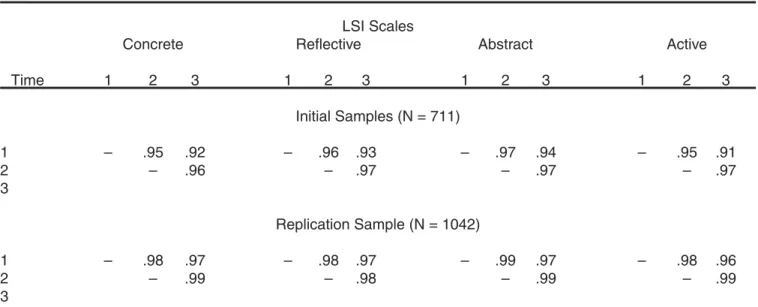
Two test-retest reliability studies of the randomized format KLSI 3.1 have been published. Veres et al. (1991) admin-istered the LSI three times at 8-week intervals to initial (N = 711) and replication (N =1042) groups of business employees and students and found test-retest correlations well above .9 in all cases. Kappa coeffi cients indicated that very few students changed their learning style type from administration to administration (See Table 4). Ruble and Stout (1991) administered the LSI twice to 253 undergraduate and graduate business students and found test-retest reliabilities that averaged .54 for the six LSI scales. A Kappa coeffi cient of .36 indicated that 47% of students changed their learning style classifi cation on retest. In these studies, test-retest correlation coeffi cients range from moderate to excellent. The discrepancy between the studies is diffi cult to explain, although ELT hypothesizes that learning style is situational, varying in response to environmental demands. Changes in style may be the result of discontinuous intervening experiences between test and retest (Kolb 1981a) or individuals’ ability to adapt their style to changing environmental demands (Mainemelis, Boyatzis, and Kolb 2002; Jones, Reichard, and Mokhtari 2003).
Table 4. Test-Retest Reliability for the KLSI 3.1 (Veres et al. 1991)
LSI Scales
Concrete Refl ective Abstract Active
Time 1 2 3 1 2 3 1 2 3 1 2 3 Initial Samples (N = 711) 1 – .95 .92 – .96 .93 – .97 .94 – .95 .91 2 – .96 – .97 – .97 – .97 3 Replication Sample (N = 1042) 1 – .98 .97 – .98 .97 – .99 .97 – .98 .96 2 – .99 – .98 – .99 – .99 3
Data source: Veres et al. (1991). Reproduced with permission. Time between tests was 8 weeks.
Note: Kappa coeffi cients for the initial sample were .81 for Time 1-Time 2, .71 for Time 1-Time 3 and .86 for Time
2-Time 3. These results indicate that very few subjects changed their learning style classifi cation from one administration to another. Table 5. Test-Retest Reliability for KLSI 3.1 (Ruble and Stout 1991)
Sample N CE RO AC AE AC-CE AE-RO
UG/Grad Business Majors
253 .37 .59 .61 .58 .48 .60
LSI was randomized, but in different order than KLSI 3.1. Time between tests was 5 weeks. Kappa coeffi cient was .36, placing 53% of respondents in the same category on retest.
5. VALIDITY
This section begins with an overview of validity research on the LSI 1 and LSI 2 from 1971 to the introduction of the KLSI 3 in 1999. It is followed by internal validity evidence for the KLSI 3.1 normative group including correlation and factor analysis studies of the LSI scales. The fi nal part is focused on external validity evidence for the KLSI 3.1 and other LSI versions. It begins with demographic relationships of learning style with age, gender, and education level. This is followed by evidence for the relationship between learning style and educational specialization. Concur-rent validity studies of relationships between learning style and other experiential learning assessment inventories are then presented followed by studies relating learning style to performance on aptitude tests and academic performance. Next, research on ELT and learning style in teams is presented. The fi nal part presents evidence for the practical utility of ELT and the LSI in the design and conduct of education in different disciplines in higher education.
AN OVERVIEW OF RESEARCH ON ELT AND THE LSI: 1971-1999
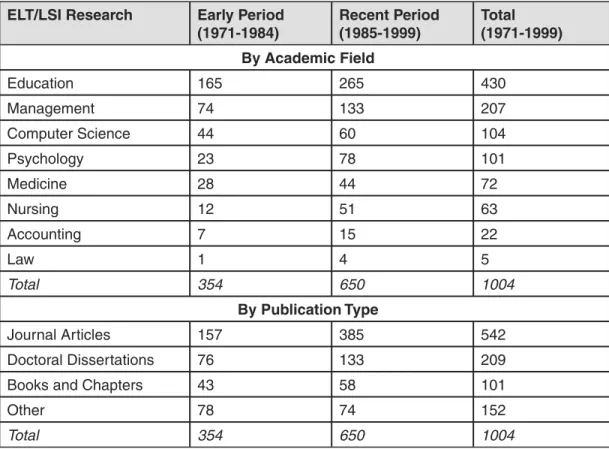
Since ELT is a holistic theory of learning that identifi es learning style differences among different academic specialties, it is not surprising to see that ELT/LSI research is highly interdisciplinary, addressing learning and educational issues in several fi elds. Since the fi rst publications in 1971 (Kolb 1971; Kolb, Rubin, and McIntyre 1971) there have been many studies on ELT using the LSI 1 and LSI 2. The Bibliography of Research on Experiential Learning Theory and The Learning Style Inventory (Kolb and Kolb 1999) included 1004 entries.
Table 6 shows the distribution of these studies by fi eld and publication period. The fi eld classifi cation categories are: Education (including K-12, higher education, and adult learning), Management, Computer/Information Science, Psychology, Medicine, Nursing, Accounting, and Law. Studies were also classifi ed as early (1971-1984) or recent (1985-1999). The division makes sense in that the most comprehensive statement of ELT, Experiential Learning, was published in 1984, and the original LSI was fi rst revised in 1985.
Table 6. Early and Recent ELT/LSI Research by Academic Field and Publication
ELT/LSI Research Early Period
(1971-1984) Recent Period (1985-1999) Total (1971-1999) By Academic Field Education 165 265 430 Management 74 133 207 Computer Science 44 60 104 Psychology 23 78 101 Medicine 28 44 72 Nursing 12 51 63 Accounting 7 15 22 Law 1 4 5 Total 354 650 1004 By Publication Type Journal Articles 157 385 542 Doctoral Dissertations 76 133 209
Table 6 also shows the distribution of the 1004 studies according to the publication type. More than 50% of the studies were published in journals, and another approximately 20% were doctoral dissertations. 10% of the studies were either books or book chapters, and the remaining 150 studies were conference presentations, technical manuals, working papers, and master theses. Numbers should be considered approximate, since a few recent citations have yet to be verifi ed by abstract or full text. Also, classifi cation by fi eld is not easy because many studies are interdisciplinary. However, the 1999 Bibliography probably does give a fair representation of the scope, topics, and trends in ELT/LSI research. The following is a brief overview of research activity in the various fi elds.
Education
The education category includes the largest number of ELT/LSI studies. The bulk of studies in education are in higher education (excluding professional education in the specifi c fi elds identifi ed below). K-12 education accounts for a relatively small number, as does adult learning alone. However, in many cases adult learning is integrated with higher education. A number of studies in the education category have been done with sample populations in U.K., Canada, Australia, Finland, Israel, Thailand, China, Melanesia, Spain, and Malta.
Many of the studies in higher education use ELT and the LSI as a framework for educational innovation. These include research on the matching of learning style with instructional method and teaching style and curriculum and program design using ELT (e.g., Claxton and Murrell 1987). A number of publications assess the learning style of various student, faculty, and other groups. Other work includes theoretical contributions to ELT, ELT construct validation, LSI psychometrics, and comparison of different learning style assessment tools. In adult learning there are a number of publications on ELT and adult development, moral development, and career development. The work of Sheckley and colleagues on adult learning at the University of Connecticut is noteworthy here (e.g., Allen, Sheckley, and Keeton 1993; Travers, 1998). K-12 education research has been primarily focused on the use of ELT as a frame-work for curriculum design, particularly in language and science. (e.g., McCarthy 1996, Hainer 1992)
Management
ELT/LSI research was fi rst published in the management fi eld, and there has continued to be substantial interest in the topic in the management literature. Studies can be roughly grouped into four categories: management and organi-zational processes, innovation in management education, theoretical contributions to ELT including critique, and psychometric studies of the LSI. Cross-cultural ELT/LSI research has been done in Poland, New Zealand, Australia, Canada, U.K., and Singapore. In the management/organization area, organizational learning is a hot topic. Dixon’s book The Organizational Learning Cycle (1999) is an excellent example.
Another group of studies has examined the relationship between learning style and management style, decision making, and problem solving. Other work has measured work- related learning environments and investigated the effect of a match between learning style and learning environment on job satisfaction and performance. ELT has been used as a framework for innovation in management education, including research on matching learning styles and learning environments, program design, and experiential learning in computerized business games (e.g., Boyatzis, Cowen, and Kolb 1995; Lengnick-Hall and Sanders 1997).
Other education work has been on training design, management development, and career development. Another area of research has been on the development and critique of ELT. Most psychometric studies of the LSI in the early period were published in management, while recent psychometric studies have been published in psychology journals. Hun-saker reviewed the early studies of the LSI 1 in management and concluded, “The LSI does not demonstrate suffi cient reliability to grant it the predictive reliability that such a measurement instrument requires. The underlying model, however, appears to receive enough support to merit further use and development.” (1981: 151)
Computer and Information Science
The LSI has been used widely in computer and information science, particularly to study end user software use and end user training (e.g., Bostrom, Olfman, and Sein, 1990; Davis and Bostrom, 1993). Of particular interest for this book on individual differences in cognitive and learning styles is the debate about whether these differences are suf-fi ciently robust to be taken into account in the design of end user software and end user computer training. Other studies have examined the relationship between learning style and problem solving and decision making, on-line search behavior, and performance in computer training and computer-assisted instruction.
Psychology
Studies in psychology have shown a large increase over time, with 77% of the studies in the recent period. Many of these recent studies were on LSI psychometrics. The fi rst version of the LSI was released in 1976 and received wide support for its strong face validity and independence of the two ELT dimensions of the learning process (Marshall and Meritt, 1985; Katz 1986). Although early critiques of the instrument focused on the internal consistency of scales and test-retest reliability, a study by Ferrell (1983) showed that the LSI version 1 was the most psychometrically sound among four learning instruments of that time. In 1985 version 2 of the LSI was released and improved the internal consistency of the scales (Veres, Sims, and Shake 1987; Sims, Veres, Watson, and Buckner 1986). Critiques of this version focused their attention on the test-retest reliability of the instrument, but a study by Veres, Sims, and Locklear (1991) showed that randomizing the order of the LSI version 2 items resulted in dramatic improvement of test-retest reliability. This fi nding led to experimental research and fi nally to the latest LSI revision, LSI Version 3 (Kolb 1999a). The LSI version 3 has signifi cantly improved psychometric properties, especially test-retest reliability (see Kolb 1999b). Other research includes factor analytic studies of the LSI, construct validation studies of ELT using the LSI, and com-parison of the LSI with other learning style and cognitive style measures. Another line of work uses ELT as a model for personal growth and development, including examination of counselor-client learning style match and its impact on counseling outcomes. Notable here is the work of Hunt and his colleagues at the Ontario Institute for Studies in Education (Hunt 1992,1987).
Medicine
The majority of studies in medicine focus on learning style analysis in many medical education specialties-residency training, anesthesia education, family medicine, surgical training, and continuing medical education. Of signifi cance here is the program of research by Baker and associates (e.g., Baker, Cooke, Conroy, Bromley, Hollon, and Alpert 1988; Baker, Reines, and Wallace 1985). Also Curry (1999) has done a number of studies comparing different mea-sures of learning styles. Other research has examined clinical supervision and patient-physician relationships, learn-ing style and student performance on examinations, and the relationship between learnlearn-ing style and medical specialty career choice.
Nursing
ELT/LSI research has also increased dramatically with, 81% of the nursing studies in the recent period. In 1990 Laschinger reviewed the experiential learning research in nursing and concluded, “Kolb’s theory of experiential learn-ing has been tested extensively in the nurslearn-ing population. Researchers have investigated relationships between learnlearn-ing style and learning preferences, decision-making skills, educational preparation, nursing roles, nursing specialty, fac-tors infl uencing career choices, and diagnostic abilities. As would be expected in a human service profession, nursing learning environments have been found to have a predominantly concrete learning press, matching the predominating concrete styles of nurses. Kolb’s cycle of learning which requires the use of a variety of learning modalities appears to be a valid and useful model for instructional design in nursing education.” (Laschinger 1990: 991)
Accounting
There has been considerable interest in ELT/LSI research in accounting education, where there have been two streams of research activity. One is the comparative assessment of learning style preferences of accounting majors and prac-titioners, including changes in learning style over the stages of career in accounting and the changing learning style demands of the accounting profession primarily due to the introduction of computers. Other research has been focused on using ELT to design instruction in accounting and studying relationships between learning style and per-formance in accounting courses.
In 1991 Ruble and Stout reviewed ELT/LSI research in accounting education. Reviewing the literature on predicting the learning styles of accounting students, they found mixed results and concluded that low predictive and classifi ca-tion validity for the LSI was a result of weak psychometric qualities of the original LSI and response set problems in the LSI 1985. They tentatively recommended the use of the randomized version proposed by Veres, Sims, and Locklear (1991). They wrote, “researchers who wish to use the LSI for predictive and classifi cation purposes should consider using a scrambled version of the instrument,” and note, “...it is important to keep in mind that assessing the validity of the underlying theoretical model (ELT) is separate from assessing the validity of the measuring instrument (LSI). Thus, for example, the theory may be valid even though the instrument has psychometric limitations. In such a case, sensitivity to differences in learning styles in instructional design may be warranted, even though assessment of an individual’s learning style is problematic” (p. 50).
Law
We are now seeing the beginning of signifi cant research programs in legal education, for example the program devel-oped by Reese (1998) using learning style interventions to improve student learning at the University of Denver Law School.
Evaluation of ELT and the LSI
There have been two recent comprehensive reviews of the ELT/LSI literature, one qualitative and one quantitative. In 1990 Hickcox extensively reviewed the theoretical origins of ELT and qualitatively analyzed 81 studies in accounting and business education, helping professions, medical professions, post-secondary education, and teacher education. She concluded that overall 61.7% of the studies supported ELT, 16.1% showed mixed support, and 22.2% did not support ELT.
In 1994 Iliff conducted a meta-analysis of 101 quantitative studies culled from 275 dissertations and 624 articles that were qualitative, theoretical, and quantitative studies of ELT and the LSI. Using Hickox’s evaluation format, he found that 49 studies showed strong support for the LSI, 40 showed mixed support, and 12 showed no support. About half of the 101 studies reported suffi cient data on the LSI scales to compute effect sizes via meta-analysis. Most studies reported correlations he classifi ed as low (<.5), and effect sizes fell in the weak (.2) to medium (.5) range for the LSI scales. In conclusion Iliff suggests that the magnitude of these statistics is not suffi cient to meet standards of predictive validity.
Most of the debate and critique in the ELT/LSI literature has centered on the psychometric properties of the LSI. Results from this research have been of great value in revising the LSI in 1985 and again in 1999. Other critiques, particularly in professional education, have questioned the predictive validity of the LSI. Iliff correctly notes that the LSI was not intended to be a predictive psychological test like IQ, GRE, or GMAT. The LSI was originally developed as a self-assessment exercise and later used as a means of construct validation for ELT. Judged by the standards of construct validity, ELT has been widely accepted as a useful framework for learning-centered educational innovation, including instructional design, curriculum development, and life-long learning. Field and job classifi cation studies viewed as a whole also show a pattern of results consistent with the ELT structure of knowledge theory described in Table 1.
Recent critiques have been more focused on the theory than the instrument, examining the intellectual origins and underlying assumptions of ELT from what might be called a post-modern perspective, where the theory is seen as indi-vidualistic, cognitivist, and technological (e.g., Kayes 2002, Vince1998, Holman et al.1997, Hopkins 1993).
INTERNAL VALIDITY EVIDENCE
Several predictions can be made from ELT about the relationship among the scales of the Learning Style Inventory. These relationships have been empirically examined in two ways—through a fi rst-order correlation matrix of the six LSI scales and through factor analysis of the four primary LSI scales and/or inventory items.
Correlation Studies of the LSI Scales
ELT proposes that the four primary modes of the learning cycle—CE, RO, AC, and AE-are composed of two inde-pendent dialectic (bipolar) dimensions: a “grasping” dimension measured by the combination score AC-CE and a “transformation” dimension measured by the RO combination score. Thus, the prediction is that AC-CE and AE-RO should be uncorrelated. Also, the CE and AC scales should not correlate with AE-AE-RO and the AE and AE-RO scales should not correlate with AC-CE. In addition, the dialectic poles of both combination dimensions should be nega-tively correlated, though not perfectly, since the dialectic relationship predicts the possibility of developmental integra-tion of the opposite poles. Finally, the cross-dimensional scales—CE/RO, AC/AE, CE/AE, and AC/RO—should not be correlated as highly as the within-dimension scales.
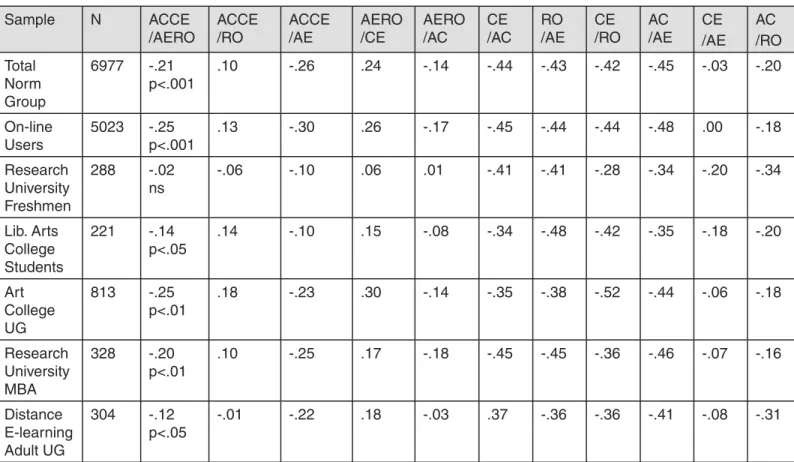
Table 7 shows these critical scale intercorrelations for the total normative sample and the subsamples. Correlations of AC and CE with the AC-CE dimension and AE and RO with the AE-RO dimensions are not included because they are artifi cially infl ated (all are above .8), because the combination score includes the scale score. The correlations between AC-CE and AE-RO are signifi cant but low. The correlation of .21 for the total norm group indicates that the two scales share only 4.4% common variance. This correlation is somewhat higher than for the LSI 2 norm group (-.09). RO has very low correlations with AC-CE, but correlations of AE with AC-CE are somewhat higher. Cor-relations of AC with AE-RO are quite low, but with CE are somewhat higher. As predicted, both AC and CE and AE and RO are highly negatively correlated. The cross-dimensional scales, CE/AE and AC/RO, have low correlations as predicted, but the CE/RO and AC/AE have higher correlations than predicted.
Signifi cance levels for correlations involving ipsative scales CE, RO, AC, and AE are not reported, since they are not meaningful because of method-induced negative correlations.
Table 7. KLSI 3.1 Scale Intercorrelations Sample N ACCE /AERO ACCE /RO ACCE /AE AERO /CE AERO /AC CE /AC RO /AE CE /RO AC /AE CE /AE AC /RO Total Norm Group 6977 -.21 p<.001 .10 -.26 .24 -.14 -.44 -.43 -.42 -.45 -.03 -.20 On-line Users 5023 -.25 p<.001 .13 -.30 .26 -.17 -.45 -.44 -.44 -.48 .00 -.18 Research University Freshmen 288 -.02 ns -.06 -.10 .06 .01 -.41 -.41 -.28 -.34 -.20 -.34 Lib. Arts College Students 221 -.14 p<.05 .14 -.10 .15 -.08 -.34 -.48 -.42 -.35 -.18 -.20 Art College UG 813 -.25 p<.01 .18 -.23 .30 -.14 -.35 -.38 -.52 -.44 -.06 -.18 Research University MBA 328 -.20 p<.01 .10 -.25 .17 -.18 -.45 -.45 -.36 -.46 -.07 -.16 Distance E-learning Adult UG 304 -.12 p<.05 -.01 -.22 .18 -.03 .37 -.36 -.36 -.41 -.08 -.31
Signifi cance levels for correlations involving ipsative scales CE, RO, AC, and AE are not reported, since they are not meaningful because of method-induced negative correlations.
Factor Analysis Studies.
We have identifi ed 17 published studies that used factor analysis to study the internal structure of the LSI. Most of these studies have focused on the LSI 2, have studied different kinds of samples and have used a number of different factor extraction and rotation methods and criteria for the interpretation of results. Seven of these studies supported the predicted internal structure of the LSI (Merritt and Marshall 1984, Marshall and Merritt 1985, Marshall and Mer-ritt 1986, Katz 1986, Brew 1996, Yaha 1998, and Kayes 2005); four studies found mixed support (Loo 1996, 1999; Willcoxson and Prosser 1996; and Brew 2002); and six studies found no support (Manfredo 1989; Newstead 1992, Cornwell, Manfredo and Dunlop 1991, Geiger, Boyle, and Pinto 1992; Ruble and Stout 1990; and Wierstra and de Jong 2002).
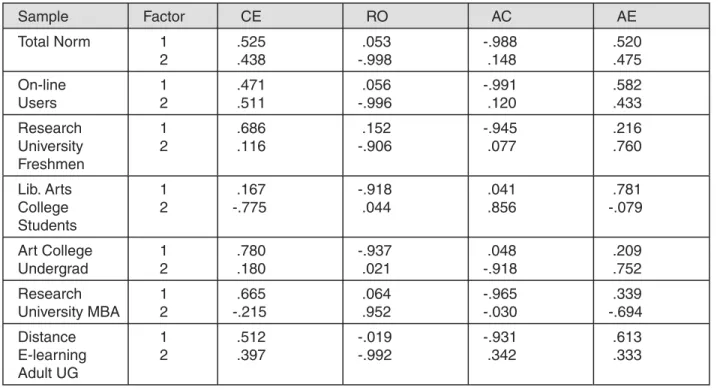
Factor analysis of the total normative sample and subgroups follows recommendations by Yaha (1998). Principal components analysis with varimax rotation was used to extract 2 factors using the 4 primary LSI scales. Analysis at the item level was not done, since it is not the item scores but the scale scores that are proposed as operational measures of the ELT learning mode constructs. Also, the -.33 correlation among the four items in a set (resulting from the ipsative forced-choice format) makes the interpretation of item factor loadings diffi cult. Loo argues that the analysis by scale scores alleviates this problem. “It should be noted that factoring scale scores (i.e. Yaha 1998) rather than item scores bypasses the issue of ipsative measures when testing for the two bipolar dimensions” (1999: 216).
ELT would predict that this factor analysis procedure would produce two bipolar factors, one with AC and CE as poles and the other with AE and RO as poles. This is the result for the research university freshmen sample, the liberal arts college sample, and the research university MBA students. However, the total normative sample, the on-line users, and the distance e-learning students show a more mixed result, with the AC scale as one pole and a combination of CE
and AE as the other in factor one. In factor two, RO is the dominant pole and CE and AE are the other pole. The art sample shows two different bipolar factors, with RO and CE as poles in factor one and AC and AE as poles in factor two. The percent of variance explained by the two factors is about the same in all seven analyses, with the total being between 70 and 75%—factor one 36-41% and factor two 29-35%.
Table 8. Norm Group Factor Analysis of KLSI 3.1 Scales
Sample Factor CE RO AC AE Total Norm 1 2 .525 .438 .053 -.998 -.988 .148 .520 .475 On-line Users 1 2 .471 .511 .056 -.996 -.991 .120 .582 .433 Research University Freshmen 1 2 .686 .116 .152 -.906 -.945 .077 .216 .760 Lib. Arts College Students 1 2 .167 -.775 -.918 .044 .041 .856 .781 -.079 Art College Undergrad 1 2 .780 .180 -.937 .021 .048 -.918 .209 .752 Research University MBA 1 2 .665 -.215 .064 .952 -.965 -.030 .339 -.694 Distance E-learning Adult UG 1 2 .512 .397 -.019 -.992 -.931 .342 .613 .333
Overall the results of correlation and factor analysis studies show similar results. As Loo notes, “...with only four scale scores, factoring may be unnecessary because the factor pattern structure can be accurately estimated from an inspec-tion of the correlainspec-tion pattern among the four scales” (1999: 216). These data are consistent with previous versions of the LSI (Kolb 1976b, 1985b) and give qualifi ed support for the ELT basis for the inventories. The support must be qualifi ed because the higher-than-predicted negative correlations between AC and AE, and CE and RO in the KLSI 3.1 normative groups is not predicted and results in the slightly increased negative correlation between AC-CE and AE-RO and the mixed-factor analysis results for all but the research university freshmen, the liberal arts college students, and the distance e-learning sample.