Software Agents Engineering (INGENIAS 2)
TIN2005-08501-C03
Juan Pavón
*Project coordinator
Universidad Complutense Madrid
Juan Carlos González Moreno
**Subproject Leader
Universidad de Vigo
Juan A. Botía
***Subproject leader
Universidad de Murcia
AbstractAgent-oriented methodologies are paving the way towards the adoption of agent technology in software industry. However, there are still several issues to address: testing mechanisms, specialized verification methods, a formally defined agent oriented development process, illustrative case studies, or better development tools. This should be considered in a changing context because of innovations in related areas, which are integrated in the agent paradigm. The purpose of this project is to address these needs and contribute to the agent-oriented software engineering field by providing, on the basis of a well-specified software development process, an open multi-agent systems (MAS) development framework that integrates methods, techniques and tools. This framework should facilitate the different activities of the development process, including requirements elicitation and validation, MAS modelling and specification, properties verification, code generation and testing. The framework follows a model-driven engineering approach, which facilitates the particularization to different application domains and the implementation of models in several target platforms (from standard agent execution platforms such as JADE or FIPA OS to specific application environments, such as mobile systems or agent based simulation engines). Related tools will be distributed as open source code at SourceForge.net, and the results of the project will be published at international conferences and journals, and presented in standardization and special interest groups in the area of agents (FIPA and AgentLink). It is also being experimented by other entities, from academy and industry, to get feedback in order to improve the framework, and facilitate technology transfer.
Keywords: Multi-agent systems, agent-oriented software engineering, INGENIAS methodology, INGENIAS Development Kit (IDK), model driven engineering, software process specification, multi-agent systems testing.
* Email: [email protected] ** Email: [email protected] *** Email: [email protected]
1.
Project goals
The INGENIAS 2 project starts from the experience of the three research groups in different aspects of agent-oriented software engineering, which are complementary and are integrated to cope with the following goals:
1. Extend and adapt to standards the INGENIAS methodology, in order to integrate different
tools and notations for the development of multi-agent systems (MAS). This is mainly under responsibility of INGENIAS-MDA subproject (UCM). This comprises tasks related to the development of MAS meta-models, using standards such as MOF, and evolution of the INGENIAS MAS meta-model to cope with new issues and agent-related standards.
2. Integration of new tools for implementation, testing and analysis of MAS. This is the main
activity of the INGENIAS-JADE subproject (UMurcia). It bases on the IDK ability to build code generation modules, and the expertise on the Jade agent platform by UCM and UMurcia. Test sequences can be generated to run on Jade, and the results are processed with data mining tools for analysis and visualization of massive data coming from experiments running large scale MAS. Another tool is the verification of certain properties of MAS by using social patterns. These are derived from Activity Theory, which allows to study contradictions between the individuals (agents) and the society (MAS organization).
3. Specification of agent-oriented software processes. This is the main purpose of the
INGENIAS-SPEM subproject (UVigo). Initially, INGENIAS methodology has been based on the Unified Development Process (UDP), but experience in the use of IDK tools has promoted the consideration of agile methodologies and other UDP variants. The use of a Process Modelling Language (PML) such as SPEM, will facilitate the description of the process using standard notations, integrating it with tools that support the enactment of the INGENIAS process, which will be adapted to the applications under development. This specification or model could be useful in general for instructors, stakeholders and mainly for software development practitioners. The specification of a well founded model to describe correct and valid development process for the INGENIAS methodology could help to find guidance on what is required of them in the roles defined by the process, to be used by process engineers to extend and modify the process in order to adapt it to the needs of the project in which are involved, and of course, it is appropriate for academic organizations in order to better instruct the Agent Oriented Software Development Discipine.
There is also a set of shared goals of the three subprojects:
4. Integrate and validate the applicability of the results of the subprojects. This will be done
with applications, not only by the participants of the project, but with collaboration with other entities, from academy and industry, to get feedback in order to improve the framework, and facilitate technology transfer.
5. Dissemination of the results of the project through classical channels such as international
conferences and journals, with great relevance in the area, and the promotion of workshops, such as DESMA in CEDI and Iberagents in Iberamia, which have been already created and chaired by members of the project.
6. Promote the use of INGENIAS in academia and industry with technical support and
formative tasks (tutorials and training material available at the INGENIAS web site).
7. Continue the contributions in international fora and networks that promote the
standardization and dissemination of agent technology, more concretely in agent-oriented software engineering and programming.
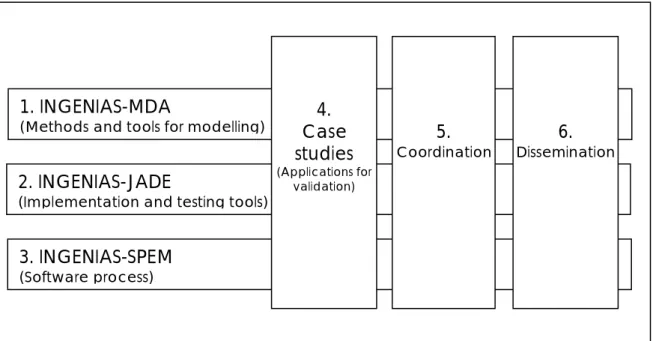
The project workplan has been structured into six workpackages, as shown in Figure 1. The first three correspond directly to the main goals of each subproject. The fourth is dedicated to develop applications for validation of the results of the subprojects, integrating them. The fourth deals with project coordination, and the sixth about dissemination and promotion of project results.
Figure 1Project workpackages structure
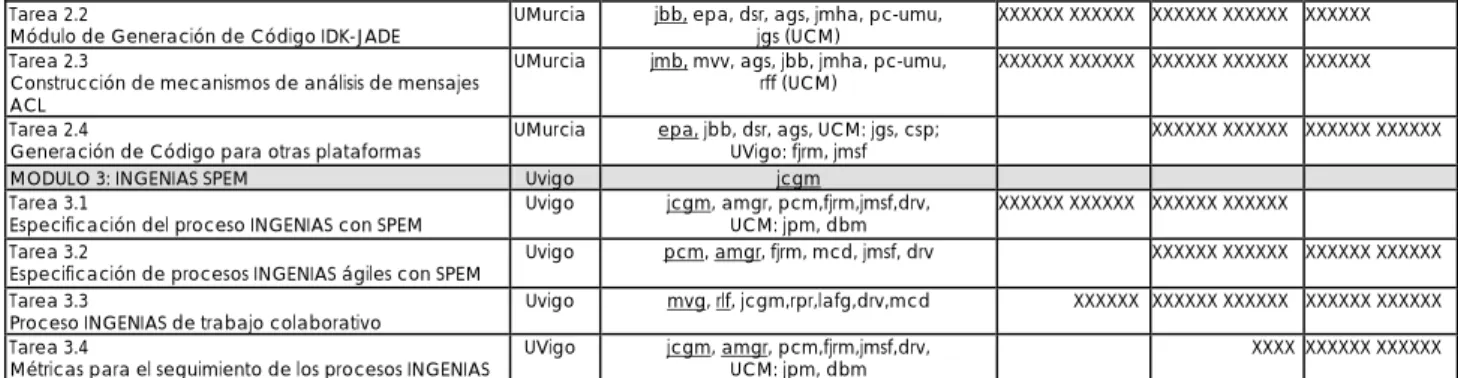
The timing of Project main tasks is shown in the following diagram.
Actividades/Tareas Ejecutor Centro Persona responsable y otras involucradas Primer año Segundo año Tercer año
MODULO 1: INGENIAS MDA UCM jpm
Tarea 1.1
Especificación del lenguaje de modelado de SMA UCM jpm, moo, jgs, euh, vgc, agm, csp, lpc XXXXXX XXXXXX XXXXXX Tarea 1.2
INGENIAS Development Kit (IDK) core UCM jgs, jpm, jgs, rff, euh, vgc, mag Uvigo: fjrm, amgr XXXXXX XXXXXX XXXXXX XXXXXX XXXXXX XXXXXX Tarea 1.3
Plugin Eclipse para desarrollo de módulos IDK UCM jgs, rff, euh, vgc, mag UMUrcia : epa y jbb XXXXXX XXXXXX XXXXXX XXXXXX XXXXXX XXXXXX Tarea 1.4
Herramienta de verificación de modelos
UCM rfh, jgs, euh, vgc, ccr, agm, jag XXXXXX XXXXXX XXXXXX XXXXXX | Tarea 1.5
Casos de estudio de SMA UCM jpm, rff, euh, vgc, jgm, jag, agm, csp, lpc, dbm, ccr, amgr (Uvigo), jbb (UMurcia) XXXXXX XXXXXX XXXXXX XXXXXX Tarea 1.6
Adecuación a estándares UCM jgs, jpm, moo, agm, jcgm (Uvigo), ags (UMurcia) XXXXXX XXXXXX XXXXXX XXXXXX XXXXXX MODULO 2: INGENIAS JADE UMurcia jbb
Tarea 2.1
Herramienta de Generación de Pruebas del Software UMurcia jbb, dsr, epa, mvv, tmc, ags, jmb, jmha XXXXXX XXXXXX XXXXXX XXXXXX XXXXXX XXXXXX
1. INGENIAS-MDA
(Methods and tools for modelling)
2. INGENIAS-JADE
(Implementation and testing tools)
3. INGENIAS-SPEM
(Software process)4.
Case
studies
(Applications for validation)5.
Coordination Dissemination6.
Tarea 2.2
Módulo de Generación de Código IDK-JADE UMurcia jbb, epa, dsr, ags, jmha, pc-umu, jgs (UCM) XXXXXX XXXXXX XXXXXX XXXXXX XXXXXX Tarea 2.3
Construcción de mecanismos de análisis de mensajes ACL
UMurcia jmb, mvv, ags, jbb, jmha, pc-umu,
rff (UCM) XXXXXX XXXXXX XXXXXX XXXXXX XXXXXX Tarea 2.4
Generación de Código para otras plataformas
UMurcia epa, jbb, dsr, ags, UCM: jgs, csp; UVigo: fjrm, jmsf
XXXXXX XXXXXX XXXXXX XXXXXX MODULO 3: INGENIAS SPEM Uvigo jcgm
Tarea 3.1
Especificación del proceso INGENIAS con SPEM Uvigo jcgm, amgr, pcm,fjrm,jmsf,drv, UCM: jpm, dbm XXXXXX XXXXXX XXXXXX XXXXXX Tarea 3.2
Especificación de procesos INGENIAS ágiles con SPEM Uvigo pcm, amgr, fjrm, mcd, jmsf, drv XXXXXX XXXXXX XXXXXX XXXXXX Tarea 3.3
Proceso INGENIAS de trabajo colaborativo Uvigo mvg, rlf, jcgm,rpr,lafg,drv,mcd XXXXXX XXXXXX XXXXXX XXXXXX XXXXXX Tarea 3.4
Métricas para el seguimiento de los procesos INGENIAS UVigo jcgm, amgr, pcm,fjrm,jmsf,drv, UCM: jpm, dbm XXXX XXXXXX XXXXXX
Figure 2. INGENIAS 2 project workplan
2.
Project achievements
The project is accomplishing the expected results as planned, and the impact of its results is greater than initial expectations. The following subsections describe the main achievements of each subproject.
2.1.
INGENIAS-MDA subproject
The following tasks have been performed:
Task 1.1: Specification of a MAS modelling language. The first version of the MAS
meta-model has been developed by using EMF. There are also adaptations of this language to deal with agent-based social simulation.
Task 1.2: INGENIAS Development Kit (IDK) core. There is a new distribution of IDK
at SourceForge.net. This version improves greater stability in the model editor, with more functionality and better usability of user interface. There are also improvements in the APIs to create IDK modules.
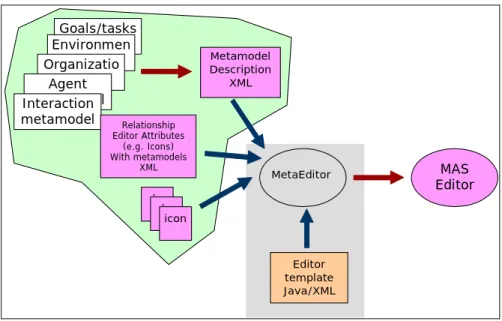
The generation of the IDK editor (the core of IDK) is driven by an interpreter of meta-model descriptors and an editor template (which determines the general aspect and distribution of editor elements). An advantage of this approach is that changes in the definition of metamodels can be easily applied to generate personalized editors. As a proof of concept, an editor for holonic manufacturing systems has been built by another research group using the IDK framework [5].
Goals/tasks metamodel Environmen t Organizatio n Agent metamodel Interaction metamodel MAS Editor Editor template Java/XML Metamodel Description XML ic oic oicon Relationship Editor Attributes (e.g. Icons) With metamodels XML MetaEditor
Figure 3. Generation of the IDK Model Editor from meta-model specifications
Task 1.4: Model verification tool. There is a new module for MAS model verification
based on Activity Theory.
Task 1.5: Case studies for MAS. Three case studies have been developed in
collaboration with Boeing Research & Technology Europe, by using INGENIAS methods and tools. The experience in these case studies has contributed to improve IDK tools.
Task 1.6: Adoption of standards. The specification of MAS meta-models with EMF
facilitates the adequacy to standards in line with model-driven engineering practices. There have been also contributions to a common MAS meta-model, promoted initially by AgentLink. Some publications are the result of this activity.
2.2.
INGENIAS-JADE subproject
The following tasks have been performed:
Task 2.1: Test generation tool. The architecture for the tool, which has been already
prototyped.
Task 2.2: Code generation module IDK-JADE. The new distribution of IDK provides
a new module that facilitates the generation of agents’ code on the JADE platform. These agents can be animated and monitored to see the evolution of their mental state. This facilitates the debugging of MAS specifications. Code generation can be 100% for the application of the analysis tool.
Task 2.3: Mechanisms for the analysis of ACL messages. There is a first integration of
2.3.
INGENIAS-SPEM subproject
The following tasks have been performed:
Task 3.1: SPEM specification of the INGENIAS Development Process (IDP). The first
specification of the INGENIAS process with SPEM has been developed in collaboration with the research group of M. Cossentino (Italian CNR) but the result does not follow at all the SPEM guidance because the goal for this specification is to find methodological fragments to be reused in a general development process and restrictions imposed by other specification made to define as disciplines what in other approach are consider simply phases of the lifecycle. The INGENIAS methodology has been experienced also with groups of students in the UVigo, and one of the conclusions is that users do not always follow all steps of the methodology, and in some cases they need the use of new model entities or view in order to get a correct specification that could be implemented in a satisfactory way. One reason for this is the lack of a tool to enact the INGENIAS process. Two new proposals of development process have been developed in the last weeks, first one tries to be as faithful as possible to the original proposal but taking into account the use of the last version of the IDK tool. The second one is an agile version that adapts the OpenUP development process. The first one have been done using an Eclipse Model Framework (EMF) model editor for the SPEM v1.0 (the last stable specification from the OMG) and the last one using as model the OpenUp guidance is based on SPEM v2.0 proposal for standardization. The OpenUP development process is an example of the capability of the EPF (Eclipse Project Framework) tools; at present we are evaluating the use or modification of this tool in order to get a management and edition tool for the INGENIAS process and its enactment.
Task 3.3: Enactment of INGENIAS process. This is currently under study, in order to
adapt EPF to INGENIAS.
Task 3.4: Metrics for INGENIAS process. By adapting COCOMO II, metrics for
evaluating the cost of MAS development process with INGENIAS have been applied taking into account measures on projects of agent-based applications. This task has started in advance to project plans in order to have a first version of metrics to be refined with the results of the case studies that are being developed in the project. Some works in this line have been done by the Alarcos Project of Castilla La Mancha University and we have plans to work with them to get a valuable set of metrics that can be used not only in the actual IDP models but also in other that can be obtained in the future.
3.
Indicators of project results
3.1.
Degree of satisfaction of project goals
The project has run now for a year and a half, which corresponds to one half of the overall duration of the project. In this period of time the project has already produced remarkable results. With respect to the original goals of the project, the following is an analysis of the level of accomplishment:
• Standardization of INGENIAS: a version of EMF specification of INGENIAS modelling language is already achieved.
• Adding testing to INGENIAS with the ACLAnalyser: the process of integration of the
ACLAnalyser within INGENIAS is now in the implementation phase. A modified architecture of the IDK has been produced in order to be able to integrate the ACLAnalyser in the form of a plug-in. Also, meta-models are being expanded to give them the capability of specifying agent-oriented software tests. All these new designs are summarised in a paper entitled “Testing Multi-Agent Systems” which is currently under review for an international journal.
• We have two specifications based on SPEM v1.0 of the traditional and original IDP
and an agile proposal based on SPEM 2.0 of the IDP for small teams, consisting of 3 to 6 team members, working on a project that will last between 3 and 6 months. A suggestion to agilizate the work by integrating an intelligent analysis of the descriptions in Natural Language is under going and expected to finish by the end of this year.
• INGENIAS in the context of business process: concerning the development of the
necessary infrastructure for the application of the methodology to business processes modelling, at this moment, new meta-models are being produced to add context awareness to applications and details related with ambient intelligence kind of applications. All these new elements are intended to develop this particular kind of applications with little effort and to increase productivity. There are plans to use as a testbed other project by Univ. Castilla-La Mancha on multisensor surveillance systems (a paper with the modelling with INGENIAS of the control of such systems is accepted for publication at Robotics and Autonomous Systems journal).
• Integration of results from other research group into the INGENIAS methodology is
being achieved as explained below.
3.2.
Relevance and originality of results.
The INGENIAS model-driven approach to agent-oriented software engineering has been the first to be defined and implemented in the agent community. Now, this approach is being followed by other research groups which have established collaborations with INGENIAS project members.
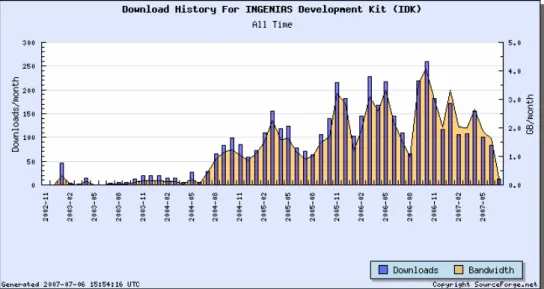
There is already a version of IDK available in SourceForge.net. This is gaining acceptance, according to the number of downloads (see Figure 4). As ACLAnalyser is also ready for delivery, we are requesting a domain for it at SourceForge.net, and expect to deliver it by September-October 2007. The availability of operative versions of the main software components of the project now is promoting its use by others, and we are getting feedback to prepare new versions with added functionality and improved usability. In this sense, we are preparing new training material that will be presented in a tutorial at CAEPIA 2007 (Salamanca, 12-13 november 2007). IDK has been also used in projects by different research groups at academia (see section 3.5) and industry (see section 3.4).
Figure 4. Number of downloads of IDK at SourceForge.net (July 2007)
3.3.
Publications
1. Juan Pavón, Millán Arroyo, Samer Hassan, Candelaria Sansores. Agent Based Modelling
and Simulation for the Analysis of Social Patterns. Accepted for publication at Pattern
Recognition Letters, with reference PATREC4203.
2. Rubén Fuentes Fernández, Jorge Gómez Sanz, Juan Pavón. Model integration in
agent-oriented development. Int. J. Agent-Oriented Software Engineering, Vol. 1, No. 1 (2007),
2-27.
3. Juan Pavón, Jorge Gómez-Sanz. Model Driven Development of Multi-Agent Systems.
Second European Conference on Model Driven Architecture (ECMDA-FA 2006). Model Driven Architecture – Foundations and Application, LNCS 4066, Springer-Verlag (2006) 284-298.
4. Rubén Fuentes, Jorge J. Gómez-Sanz, Juan Pavón. Integrating Agent-Oriented
Methodologies with UML-AT. Fifth International Joint Conference on Autonomous Agents
and Multiagent Systems (AAMAS 2006), ACM Press (2006) 1303-1310.
5. Juan A. Botía, Jorge J. Gómez-Sanz, Juan Pavón. Intelligent Data Analysis for the
Verification of Multi-Agent Systems Interactions. 7th International Conference on
Intelligent Data Engineering and Automated Learning (IDEAL 2006). Intelligent Data Engineering and Automated Learning – IDEAL 2006, LNCS 4224 , Springer-Verlag (2006) 1207-1214.
6. Jorge J. Gómez-Sanz, Juan Pavón. Defining Coordination in Multi-Agent Systems within
an Agent Oriented Software Engineering Methodology. 21st Annual ACM Symposium on
Applied Computing (SAC 2006). Proceedings of the 2006 ACM Symposium on Applied Computing, ACM Press (2006) 424-428.
7. Juan Pavón, Candelaria Sansores, Jorge Gómez-Sanz. Modeling of Social Systems with
INGENIAS. Workshop on Multi-Agent Systems and Simulation (MAS&S 2006), Industrial
Simulation Conference (ISC'2006), Eurosis (2006) 9-16.
8. Rubén Fuentes, Jorge Gómez-Sanz, Juan Pavón. Discovering Patterns in the Behaviour of
Open Multi-Agent Systems. 18th European Meeting on Cybernetics and Systems Research.
Cybernetics and Systems 2006, Vol. II, pp. 533-538.
9. Juan Pavón, Jorge Gómez-Sanz, J. J. Valencia-Jiménez, Antonio Fernández-Caballero.
Desarrollo de un sistema inteligente de vigilancia multisensorial con agentes software. Campus Multidisciplinar en Percepción e Inteligencia (CMPI-2006). Una Perspectiva de la Inteligencia Artificial en su 50 Aniversario, Universidad de Castilla-La Mancha (2006), 377-388
10. Juan Pavón, Millán Arroyo, Samer Hassan, Candelaria Sansores. Simulación de sistemas
sociales con agentes software. Campus Multidisciplinar en Percepción e Inteligencia
(CMPI-2006). Una Perspectiva de la Inteligencia Artificial en su 50 Aniversario, Universidad de Castilla-La Mancha (2006), 389-400.
11. Rubén Fuentes-Fernández, Jorge J. Gómez Sanz, and Juan Pavón, Model Driven
Development of Multi-Agent Systems with Repositories of Social Patterns. In Proceedings
of the 7th International Workshop "Engineering Societies in the Agents World" (ESAW 2006), LNAI 4457, pp. 126-142, 2007.
12. Jorge J. Gómez Sanz, The Construction of Multi-agent Systems as an Engineering
Discipline, LNAI 4457, Springer-Verlag (2007) 25-37.
13. Ruben Fuentes-Fernández, Iván García-Magariño, Jorge J. Gómez-Sanz, Juan Pavón,
Integration of web services in an agent oriented methodology, International Transactions
on Systems Science and Applications 3(2) 2007 (in press).
14. Jorge J. Gómez-Sanz, Rubén Fuentes, Juan Pavón, Managing Contradictions in
Multi-Agent Systems, IEICE Trans. on Information and systems, 2007 (in press).
15. Jorge J. Gómez-Sanz, Rubén Fuentes, Juan Pavón, Enabling Rapid Prototyping using
Decoupling of Code Skeletons and Code generation Process, INFOCOMP Journal of
Computer Science, special issue on INADIS 2006 (to be published in 2007).
16. Juan A. Botía, Juan M. Hernansáez, and Antonio F. Gómez-Skarmeta. On the Application
of Clustering Techniques to Support Debugging Large-Scale Multi-Agent Systems.
Programming Multi-Agent Systems Workshop (ProMAS 2006) in the AAMAS 2006. Hakodate, Japón. LNAI 4411. Springer-Verlag (2007), 219-229.
17. Alberto Caballero, Juan A. Botía and Antonio F. Gómez-Skarmeta. Trust and Reputation
Model based on WSMO. Trust in Agent Societies in the AAMAS 2006. Hakodate, Japón.
(a publicar en post proceedings LNCS)
18. Alberto Caballero, Juan A. Botía and Antonio F. Gómez-Skarmeta. A new Model for Trust
and Reputation Management with an Ontology based Approach for Similarity between
Tasks. MATES 2006. German conference on Multi-agent system Technologies. LNCS
4196.
19. Ignacio Nieto, Juan A. Botía and Antonio F. Gómez-Skarmeta. Gestión de la información
de la Web Semántica en un espacio de tuplas: una infraestructura para servicios sensibles
al contexto. In Proceedings del segundo Congreso Iberoamericano de Computación
Ubícua, Madrid, 2006.
20. Ignacio Nieto, Juan A. Botía and Antonio F. Gómez-Skarmeta. Semantic Tuple Space:
Artificial Intelligence Techniques for Ambient Intelligence (AITAmI'06). European Conference on Artificial Intelligence (ECAI). Riva de Garda, Italy.
21. Andrés Muñoz, Antonia Vera, Juan A. Botia, Antonio F. Gomez Skarmeta. Definiendo
comportamientos básicos en sistemas ubicuos con reglas de inferencia mediante
herramientas visuales. In Proceedings del segundo Congreso Iberoamericano de
Computación Ubícua, Madrid, 2006.
22. Andrés Muñoz, Antonia Vera, Juan A. Botia, Antonio F. Gomez Skarmeta. Defining basic
behaviours in ambient intelligence environments by means of rule-based programming
with visual tools. 1st Workshop of Artificial Intelligence Techniques for Ambient
Intelligence. ECAI 2006.
3.4.
Collaborations with industry
• Telefónica I+D: review of the model driven engineering framework and the provision of a
component agent framework, for its integration in IDK.
• An important result of this collaboration is the participation in European
project MOMOCS (FP6-2006-IST-034466), on Model driven Modernisation of Complex Systems.
• Boeing Research and Technology Europe, with the development of three research projects
(technology transfer):
• REMAIN: Airport resource management system.
• ATM: Air traffic control simulator.
• GAM: Autonomous Mission Management.
• UAV Collision and Detection.
3.5.
Collaborations with other universities
• Univ. Castilla la Mancha (A. Fernández Caballero): use of INGENIAS for the development
of multi-sensor surveillance systems (a paper has been accepted for publication in Robotics & Autonomous Systems).
• Univ. Castilla la Mancha (M. Piattini/ A. Vizcaíno) : application of INGENIAS for
agent-based software management [10].
• Univ. Politécnica de Valencia (A. Giret) : adaptation of IDK for holonic systems [5].
• Univ. Palermo (M. Cossentino) : SPEM specification of INGENIAS, and evaluation of
INGENIAS for autonomy and adaptation aspects in MAS development.
• Univ. Technology Sydney (B. Henderson Sellers). Integration of INGENIAS in FAME
(method engineering) [3].
• LIP6, Univ. Paris 6 (Z. Guessoum, A. El-Fallah-Seghrouchni). Application of model
driven engineering for MAS development. A result of this collaboration is the presentation
by Juan Pavón of the Dossier d’Habilitation à Diriger des Recherches, INGENIAS :
Développement Dirigé par Modèles des Systèmes Multi-Agents, dec. 2007.
• Univ. Savoie (M. P. Huguet). Model driven engineering and agents. PhD. Thesis of S. Azaiez.
• Univ. Bologna (A. Omicini y A. Ricci). Activity theory and MAS (two papers being
written).
3.6.
Human resources formation.
One PhD thesis has been finished and ready for presentation at UCM (expected date:
mid-september 2007): Candelaria Sansores, Methodology for the development of artificial societies
(director: Juan Pavón).
Other PhD theses are expected to be completed at UVigo by February 2008: Luis Vázquez López: Herramienta de definición de requisitos basada en Agentes Inteligentes, and by June 2009 Alma Gómez Rodríguez: The Ingenias Process Developments to debate.
At UMurcia, one PhD thesis is expected to be completed by december 2007: Alberto Caballero, The TRSIM Model for Management of Trust and Reputation in Agent Societies (director: Juan A. Botía).
Several works related with the use of INGENIAS have been presented by students of master programs at the respective universities:
• Iván García Magariño, Especificación de metamodelos con EMF (directors: Juan Pavón
and Jorge Gómez-Sanz), UCM, june 2007
• Samer Hassan Collado, Modelado y simulación de la evolución de valores en sociedades
humanas con agentes software (director: Juan Pavón), UCM, June 2007
3.7.
Project management and coordination
The coordination of the three subprojects has been as specified in the workplan. Apart of electronic communication means (email, phpCollab), there have been specific meetings (three in Madrid, two in Murcia and one in Orense) and other meetings when several members of the research teams attend to the same conferences or events (for instance, for the AgentCities.ES network, where the three partners participate).
Some results of this coordination are:
• A new version of IDK. UCM has been the developer, and UVigo and UMurcia have
contributed to its validation with case studies.
• There is a web site on agent-oriented methodologies. This has been disseminated through
AgentCities.ES network and AgentLink. It is available in Spanish and English.
• Join papers, as it can be seen from the list of publications in section 3.3.
There are other join publications under review and a workshop on MAS development, DESMA 2007, which will occur in CEDI 2007, Zaragoza (http://ma.ei.uvigo.es/desma/Articulos.htm).
4.
References
1. Bernon, C. et al.: An Overview of Current Trends in European AOSE Research. Informatica, An International Journal of Computing and Informatics 29 (2005), 379-390
2. Bernon, C. et al.: Agent Oriented Software Engineering. The Knowledge Engineering Review 20 (2005), vol. 20, nro. 2 (2005), 99-116.
3. Beydoun, G., González-Pérez, C., Low, G. and Henderson-Sellers, B.: Synthesis of a Generic MAS Meta-model. In: Proc. Software Engineering for Large-Scale Multi-Agent Systems, SELMAS'05 4. Caire G., et al.: Agent Oriented Analysis using MESSAGE/UML. In: The Second International
Workshop on Agent-Oriented Software Engineering (AOSE 2001), Lecture Notes in Computer Science, Vol. 2222. Springer-Verlag (2002) 119-135.
5. Giret, A., Botti, V., and Valero, S. MAS Methodology for HMS. In: Holonic and Multi-Agent Systems for Manufacturing: Second International Conference on Industrial Applications of Holonic and Multi-Agent Systems, HoloMAS 2005. Lecture Notes in Artificial Intelligence, Vol. 3593. Springer-Verlag (2005) 39-49
6. Gómez-Sanz J. J., and Pavón, J.: Meta-modelling in Agent-Oriented Software Engineering. In: Advances in Artificial Intelligence - IBERAMIA 2002. Lecture Notes in Artificial Intelligence, Vol. 2527. Springer-Verlag (2002) 606-615
7. OMG: Meta Object Facility (MOF) Specification. Version 1.4 (2002) formal/02-04-03 8. OMG: SPEM (2002)
9. Pavón, J., Gómez-Sanz, J.J. & Fuentes, R.: The INGENIAS Methodology and Tools. In: Henderson-Sellers, B. and Giorgini, P., editors: Agent-Oriented Methodologies. Idea Group Publishing (2005), 236—276
10.Rodríguez, O., Vizcaíno, A., Martínez, A. I., Piattini, M., & Favela, J. Using a Multi-Agent Architecture to Manage Knowledge in the Software Maintenance Process. Proc. Int. Conference on Knowledge-Based Intelligent Information & Engineering Systems (KES’2004), Wellington, New Zealand, 1181-1188.