N.T. Nguyen et al. (Eds.): IEA/AIE 2008, LNAI 5027, pp. 486–491, 2008. © Springer-Verlag Berlin Heidelberg 2008
Intelligent Systems
E. Sierra, A. Hossian, D. Rodríguez, M. García-Martínez, P. Britos, and R. García-Martínez
Software & Knowledge Engineering Center. Buenos Aires Institute of Technology Confluencia Academic Unit, National University of Technology- University of Comahue
School of Architecture. University of Buenos Aires.
Intelligent Systems Laboratory. School of Engineering. University of Buenos Aires
Abstract. This article describes an intelligent system architecture that based on neural networks, expert systems and negotiating agents technologies is designed to optimize intelligent building’s performance. By understanding a building as a dynamic entity capable of adapting itself not only to changing environmental conditions but also to occupant’s living habits, high standards of comfort and user satisfaction can be achieved. Results are promising and encourage further research in the field of artificial intelligence applications in building automation systems.
1 Introduction
According to the latest definitions internationally accepted for an “intelligent build-ing”, this is a building highly adaptable to the changing conditions of its environment [Krainier, 1996]. But, in an overall concept of comfort, the idea of adaptation to changing environmental conditions may be not enough. Building systems are con-structed in order to provide comfortable living conditions for the persons who live in them. It is well known that people usually differ in their personal perceptions of com-fort conditions. To some extent, the sensation of comcom-fort is an individual one and it is normally affected by cultural issues. Thus, the idea behind this research is to find techniques based on artificial intelligence in order to provide design recommendations for comfort systems in buildings so that these buildings can also be highly adaptable in terms of the comfort conditions desired by their users. In a few words, a building must “learn” to change its performance not only as a function of environmental condi-tions, but also as a consequence of preferences set by the people who live in it. The majority of recent developments in building energy management systems (BEMS) followed the advances made in computer technology, such as genetic algorithms and neural networks. Other methods have also been proposed including empirical models [Yao, 2004], weighted linguistic fuzzy rules [Alcala, 2005; Sierra, 2007], simulation optimization [Fong, 2006] and online adaptive control [Wang, 2001].
2 The Proposed Intelligent System Architecture
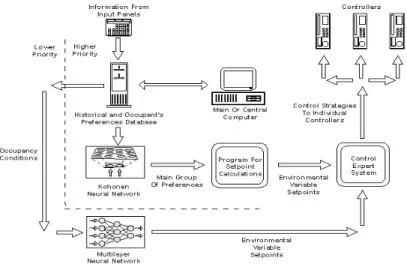
According to the latest trends in the field, intelligence in building systems tends to be distributed [So, 1999]. The proposed intelligent system architecture is shown in Fig-ure 1. There is a main computer where the functions of monitoring, visualizing and recording parameters is carried out while the regulation functions are left to the local controllers located throughout the building [Wong, 2001]. These controllers are re-sponsible for taking over local control tasks in the zone they serve. To accomplish its function, the centralized computer contains a database that keeps track of relevant information concerning building user’s preferences. For instance, this database keeps records of time, date, number of persons in a room, current temperature and humidity values, as well as temperature and humidity values desired by users. In order to do this, temperature and humidity input panels are located in the different rooms. Each user can eventually set them to what he or she thinks is an ideal comfort condition. As comfort perception is an individual sensation, the database in the main computer keeps track of every individual requirement.
Fig. 1. Intelligent System Architecture, where the negotiating agent resides in main computer
The information contained in the user’s requirements database for a given room is applied to a neural network of the self organizational maps of Kohonen (SOM) [Rich & Knight, 1991; Hilera & Martinez, 1995] type, which is used to cluster all the user’s requirements and discard all those groups of requirements which are not relevant in terms of their approximation to the main cluster of preferences. Once a unique group of requirements is selected, their values are applied as input to a program which pro-vides the limits as well as the average value for a particular environmental variable. This value is used as reference or set-point for the local control strategies set by an expert system which runs on the main computer. This expert system takes decisions concerning control strategies which are used to activate, deactivate or tune the
individual controllers. The information about relevant occupancy and setting condi-tions, as well as the final values of environmental variables is used to train a multi-layer neural network which outcomes will provide ideal environmental values in case of absence of occupants or of preference information given by them. In any case, set-points assigned to comfort variables provided by the analysis of user’s desired environmental conditions is given priority over any automatic calculation of these conditions.
3 Energy Saving Conditions
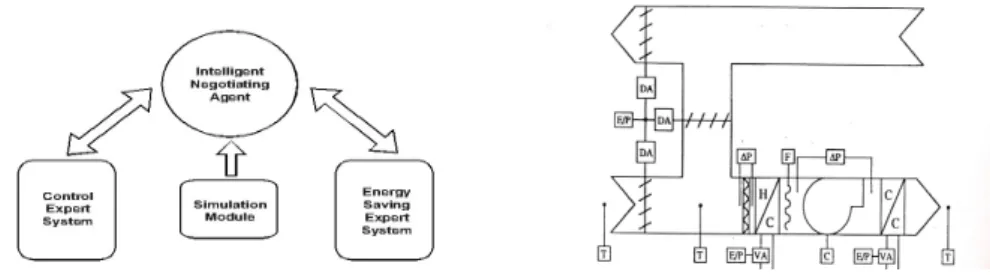
A very important issue in intelligent buildings technology is related to energy saving policies [Sierra et al, 2004]. Optimization procedures carried out to cut off energy consumption rates are not only justified in terms of operation costs reduction but also because of the environmental benefits implied in the adoption of energy saving strate-gies. In order to accomplish previously mentioned optimization procedures, an expert system [García-Martinez & Britos, 2004] containing rules that perform energy saving strategies is set up in the central computer. However, it is necessary to verify if the rules defined in the energy saving expert system may eventually alter the comfort conditions established by the control strategy expert system. As it is shown on Figure 2, there is an intelligent negotiation agent [Allen et al., 1991; Conry et al., 1988; Ferber & Drougol, 1992] which runs in the central computer created to deter-mine whether the application of energy saving strategies will: a) not affect current comfort conditions in a given space (not affected) b) affect current comfort conditions but within the limits found by the SOM neural network based upon preference infor-mation provided by occupants (partially affected) c) affect current comfort conditions beyond the limits set by occupant’s requirements (fully affected). The policy applied by the intelligent negotiation agent in the different situations mentioned earlier can be summarized as follows: [a] if comfort conditions are not affected, rules defining en-ergy saving strategies are given the highest priority; [b] if comfort conditions are partially affected, rules defining energy saving strategies are given an intermediate priority, just lower than the priority given to the rules that regulate the operation of main control actuators and [c] if comfort conditions are fully affected, rules defining energy saving strategies are given the lowest priority.
In summary, the intelligent negotiation agent was given a number of rules which express the desired energy saving policy (constraints) based on the building condi-tions. The occurrence of certain events inside the building (e.g. a temperature raises above a permitted upper limit) will trigger the appropriate rule within the agent. The agent executes the rule(s), with the purpose of readjusting the environmental condi-tions to some preferred set of values. The triggered rule(s) will cause a set of accondi-tions to be immediately executed. After the previously described negotiation policy has been applied, the control expert system located in the main central computer has an updated rule base which can be used to set up the operation mode of local controllers (on, off, normal) and tune them accordingly, for example, by determining the appro-priate set-point for the control variable.
4 An Example
With the purpose of providing an example that illustrates the functionality of the pro-posed intelligent system, the operation of the air – handling system will be described. It is assumed that the HVAC engineer has already designed the air handler in terms of laying out the ductwork, appropriately sizing the fan and heating and cooling coils, and selecting the proper dampers, damper actuators and motor contactor. From this design a system diagram has been constructed as shown in Figure 3.
The designations DA and VA stand for damper and valve actuators, respectively, C is for electrical contactor and H/C and C/C represent the heating and cooling coils. When building zone building served by the air –handler is “occupied”, i.e., the current date and time fall within a certain schedule, the system is said to be in occupied mode. In this mode, the fan is started and the heating and cooling valves and dampers are modulated so as to maintain the set-point temperature in the zone. This is called the “normal” operating condition. Control strategies describe how specific subsystems are to be controlled.
Fig. 2. Negotiation Control and Energy Saving Rules
Fig. 3. System Diagram for the Air Handler
Thus, some of the rules contained in the rule base of the control expert system will be stated as follows:
IF the date and time fall within the specified schedule
THEN the system shall enter the occupied mode.
IF the system is in the occupied mode,
THEN the supply fan shall be turned on,
AND the normally closed cooling valves and air dampers shall be controlled by a
se-quenced PI (Proportional plus Integral) controller to maintain the room air
tempera-ture set-point to 70 °F.
IF the date and time fall outside of the specified schedule
AND the room air temperature exceeds 55 ºF
THEN the system shall enter the unoccupied mode.
IF the system is in the unoccupied mode
THEN the supply fan shall be turned off, the heating valve shall be set to fully open and
the cooling valve and outside air dampers shall be set to fully closed.
IF the date and time fall outside of the specified schedule
AND the room air temperature is less than or equal to 55 ºF,
THEN the system shall enter setback mode.
IF the system is in the setback mode,
THEN the system will remain in this mode until the room air temperature exceeds 60 ºF.
Energy saving strategies were designed in order to diminish energy consumption levels while keeping a satisfying response to the building energy demand profiles:
Dry Bulb Economizer Control:
IF the system is in occupied mode
AND the outside air temperature rises above 65 ºF, the dry bulb economizer set-point
THEN the outside air damper will be set to a constant position of 20%.
Mixed Air Low Limit Control:
IF the system is in occupied mode
AND the mixed air temperature drops from 40 to 30 ºF,
THEN a proportional (P) control algorithm shall modulate the outside air dampers from 100
to 0%. Mixed air low limit control shall have priority over dry bulb economizer control.
Free cooling:
IF the system is in unoccupied mode AND the room air temperature exceeds 65 ºF
AND the outside air temperature equals to or is less than 55 ºF,
THEN the supply fan shall be turned on the heating and cooling valves shall be set to
fully closed and the outside air dampers shall be set to fully open.
As previously stated, the system tries to capture the occupants’ preferences by modi-fying the set-points of control variables to users’ demands.
5 Implementation and Results
A prototype of the proposed intelligent system has been implemented in CLIPS, a tool for developing expert systems. Neural network and negotiating agent algorithms have been programmed in C++. The system prototype has been tested in the building of the Ministry of Education, located in the city of Neuquén, Argentina. This building has been designed with a high degree of intelligence. After almost a year of continuous tuning and adjusting procedures, the most updated prototype of the system was put to work. The people who work in this public building was strongly encouraged to fill out surveys about the building's performance. The comments of users who admitted posi-tive changes in comfort conditions were confirmed by a survey. The survey outcomes were: 75 % percent of users were very satisfied with the performance of the new sys-tem, 20 % were just satisfied and 5% not satisfied. Such results encourage advancing in this direction of optimizing the operative and control strategies carried out by the developed system.
6 Conclusions
Techniques of artificial intelligence have been used in many decision, control and automation systems in the last twenty years. Building systems have not been an ex-ception. In this direction, the intelligent system that is proposed in this article tries to contribute in the field of intelligent buildings optimization, by transforming them in a dynamic space, with high standards of comfort and occupant’s satisfaction. In this sense, the ability inherent to intelligent systems that are capable of learning from their own environment plays a very important role in the achievement of these building performance optimization goals. Furthermore, results obtained as a consequence of the proposed system implementation are very encouraging. Thus, further research and development work in the field deserves particular attention.
7 Implications
The open architecture of the system allows for easy and continuous updates and unlimited expandability. Therefore, the model's design allows for its application to a large number of building categories. Finally, it was clearly illustrated that an adequate combination of intelligent technologies and expert knowledge has significant potential for improving building energy management, since it has the capability of modulating, with the assistance of rules, intelligent interventions.
References
Alcala, R., Casillas, J., Cordon, O., Gonzalez, A., Herrera, F.: A genetic rule weighting and selection process for fuzzy control and heating, ventilating and air conditioning systems. Ar-tificial intelligence 18, 279–296 (2005)
Allen, J.F., Kautz, H., Pelavin, R.N., Tenenberg, J.D.: Reasoning About Plans. Morgan Kauf-mann Publishers, Inc., San Mateo, California (1991)
Conry, S.E., Meyer, R.A., Lesser, V.R.: Multistage negotiation in distributed planning. In: En Bond, A., Gasser, L. (eds.) Readings in Distributed Artificial Intelligence, Morgan Kauf-mann Publishers, Inc., San Mateo, California (1988)
Ferber, J., Drougol, A.: Using reactive multiagent systems in simulation and problem solving. In: Avouris, N.M., Gasser, L. (eds.) Distributed Artificial Intelligence: Theroy and Praxis, Kluwer Academic Press, Dordrecht (1992)
Fong, K.F., Hanby, V.I., Chow, T.T.: HVAC system optimisation for energy management by evolutionary programming. Energy & Buildings 38, 220–231 (2006)
García Martínez, R., Britos, P.: Ingeniería de Sistemas Expertos. Editorial Nueva Librería. 649 páginas (2004), ISBN 987-1104-15-4
Hilera, J., Martínez, V.: Redes Neuronales Artificiales. Fundamentos, modelos y aplicaciones. RA-MA, Madrid (1995)
Krainier, A.: Toward smart buildings, Architectural Assn. Graduate School, Environment & Energy Studies Program (1996)
Edward, R., Kevin, K.: Introduction to Artificial Networks. Mac Graw-Hill Publications, New York (1991)
Sierra, E., Hossian, A., Britos, P., Rodriguez, D., Garcia Martinez, R.: Fuzzy Control for im-proving energy management within indoor building environments. In: Proceedings CERMA 2007 Electronics, Robotics & Automative Mechanics Conference, pp. 412–416. IEEE Com-puter Society Press, Los Alamitos (2007)
Sierra, E., Hossian, A., Labriola, C., García Martínez, R.: Optimal Design of Constructions: A Preliminary Model. In: Proceedings of the World Renewable Energy Congress (WREC 2004), Denver, Colorado, Estados Unidos (2004)
So, A.: Intelligent building systems. Kluwer Academic Press, Dordrecht (1999)
Wang, S., Burnet, J.: Online adaptive control for optimizing variable speed pumps of indirect water-cooled systems. Applied Thermal energy 21, 1083–1103 (2001)
Wong, K.: The Intelligent Building Index: IBI manual: version 2. Asian Institute of Intelligent Buildings, Hong Kong (2001)
Yao, Y., Lian, Z., Hou, Z., Zhou, X.: Optimal operation of a large cooling system based on an empirical model. Applied Thermal Energy 24, 2303–2321 (2004)