i
by
Hester Gerbregter Fischer
Thesis presented in fulfilment of the requirements for
the degree of Master of Music in the
Faculty of Humanities at Stellenbosch University
Supervisor: Ms Danell Herbst
ii
D e c l a r a t i o n
By submitting this thesis electronically, I declare that the entirety of the work contained therein is my own, original work, that I am the sole author thereof (save to the extent explicitly otherwise stated), that reproduction and publication thereof by Stellenbosch University will not infringe any third party rights and that I have not previously in its entirety or in part submitted it for obtaining any qualification.
March 2018
Copyright © 2018 Stellenbosch University All rights reserved
iii
A b s t r a c t
The aural training offered to string instrumentalists in tertiary education is the focus of this investigation. Knowledge of sound and directed application of aural skills have been shown to have a positive influence on the performance skills of musicians and should therefore be afforded research time and space. Research has shown that studying and teaching string-specific aural training contributes significantly to the education and training of aspiring string musicians. Much research supports the hypothesis that there is a definite need for string-specific aural training at tertiary education institutions. A few international institutions (not accessible to English-only students) are already successfully implementing string-specific aural training. However, these practises have failed to produce encompassing English literature on string-specific aural training and method. Although extensive research into the concepts and general skills of aural training has been conducted, literature in English on string-specific aural training is limited. The question of how to train the string student’s ear begs investigation and development. A logical point of departure in addressing this gap in music teaching would be to find out what is currently being taught to string students. Once this scenario is clear, it can be compared to what aural training is required by the string student according to international research and literature.
The object of this study was to describe the basic aural needs of the string student as portrayed by literature and to determine what is currently being taught to string students, in three different regions (United Kingdom, the United States of America, and Scandinavia). This thesis presents findings from this comparison between the aural needs and the currently taught aural skills in these regions. The knowledge gained from the study indicates that even though aspects of the aural research field is ancient, and known, academic research findings is not generally reflected in the practice of aural training of students.
Investigation into the methods used was conducted through an ethically considerate survey in which an online questionnaire was presented to the persons responsible for a string student’s tertiary education. The survey is not a representative sample of the regions of the study, because of the low number of respondents. This could be attributed to the e-mail distribution method which has become suspect as a result of cybercrime that makes respondents wary of responding to e-mail questionnaires. However, the secondary findings are more pertinent. The comparison was drawn between the areas identified by the participants as important aural areas, what the participants include in their teaching, and the literature. The study found that there is very low interest among pedagogues in the aural training field and that the impact of aural training (or the lack thereof) on their subject is misunderstood.
iv
O p s o m m i n g
Die gehooropleiding van strykinstrumentaliste in hul tersiêre opleidingsfase is die fokus in hierdie ondersoek. Kennis van gehoorvaardighede het 'n groot invloed op die prestasievaardigheid van musici en behoort dus navorsingstyd en ruimte gebied te word. Daar is bewyse wat die hipotese vir die behoefte aan stryk-spesifieke gehooropleiding by tersiêre onderwysinstellings ondersteun. 'n Paar instansies (nie toeganklik vir Engelstalige studente nie) implementeer reeds stryk-spesifieke gehooropleiding. Hierdie praktyke lewer egter nie 'n volledige Engelstalige literatuur oor strykspesifieke gehooropleiding en -metodes nie. Uitgebreide navorsing oor die konsepte- en algemene vaardighede van gehooropleiding is beskikbaar, met baie min literatuur oor stryk-spesifieke gehooropleiding. Die vraag bly egter, hoe om die strykstudente se gehoor te ontwikkel. Dit was dus wenslik om uit te vind wat tans aan strykstudente aangebied word en dit te vergelyk met die vaardighede wat benodig word deur die strykstudent.
Die doel van hierdie studie was om die basiese gehoorbehoeftes van die strykstudent te beskryf asook dit wat tans aan strykstudente geleer word in drie verskillende gebiede (Verenigde Koninkryk, die Verenigde State van Amerika en Skandinawië). Hierdie tesis bied die bevindinge van 'n vergelykende studie tussen die gehoorbehoeftes en die gehoorvaardighede wat tans aangebied word aan. Die resultaat dui daarop dat alhoewel aspekte in die gehoornavorsingsveld oud en bekend is, akademiese navorsing bevindinge nie gewoonlik in die praktyk van gehooropleiding aan studente weerspieël word nie.
Ondersoek na die metodes wat gebruik word, is deur middel van 'n opname uitgevoer wat aan etiese oorwegings voldoen het. 'n Digitale vraelys is aan die persone wat vir die strykstudent se tersiêre opleiding verantwoordelik is, gestuur. Hierdie kwantitatiewe studie kan nie as verteenwoordigende steekproef van die gebiede beskou word nie, as gevolg van die lae aantal respondente. Dit kan toegeskryf word aan die e-pos verspreidingsmetode wat minder betroubaar is weens kubermisdaad waar respondente versigtig is om op e-pos vraelyste te reageer. Die sekondêre bevindinge is wel meer relevant. Die vergelyking is getref tussen die areas wat deur die deelnemers as belangrike gehooropleidings-gebiede geïdentifiseer is, dit wat die deelnemers in hul onderrig insluit, en dit wat in die literatuur voorkom. Die resultate van die studie het bevind dat daar 'n baie lae belangstelling onder pedagoë in die gehooropleidingsveld is en dat hulle nie die implikasie van gehooropleiding oor hul vak verstaan nie.
v
A c k n o w l e d g e m e n t s
In the process of writing the thesis, I was surrounded by caring people. Thank you to all my students, parents and colleagues for their patience, encouragement, prayers, and cooked meals. I sincerely thank the following persons in particular:
My husband and children for their patience and encouragement.
My colleague, Marian Steyl, for inspiration, moral support and her sympathetic ear. Rencia van Wyk and Kevin Fryer for endless patient help with technical support. A calm voice in the storm, Tania Wait, for editing and so much more.
The final editing by Filicity Grové.
Dr Anzel Gerber for initiating and encouraging the study.
vi
T a b l e o f C o n t e n t s
Declaration ... ii Abstract ... iii Opsomming ... iv Acknowledgements ... v Table of Contents ... vi List of Figures ... ix List of Tables ... x CHAPTER 1: Introduction ... 1 1.1 Background ... 1 1.2 Research problem ... 21.3 Objective of the research... 3
1.4 Scope of the study ... 3
1.5 Research questions ... 4
1.6 Research design ... 4
1.7 Research methodology ... 5
1.8 Chapter outline ... 6
CHAPTER 2: Literature Study ... 8
2.1 Introduction ... 8 2.2 Basic concepts ... 11 2.2.1 Rhythm (Time) ... 11 2.2.2 Melody ... 14 2.2.3 Harmony ... 21 2.2.4 Summary ... 24
vii 2.3 Basic skills ... 25 2.3.1 Thinking ... 25 2.3.2 Listening ... 40 2.3.3 Reading ... 44 2.3.4 Performing ... 47 2.3.5 Summary ... 51 2.4 String-specific needs ... 51 2.4.1 Thinking ... 52 2.4.2 Listening ... 53 2.4.3 Reading ... 57 2.4.4 Performing ... 58 2.4.5 Summary ... 60 2.5 Regions ... 61
2.5.1 United Kingdom (England, Scotland, Wales, and Ireland) ... 61
2.5.2. United States of America ... 63
2.5.3. Scandinavian Countries ... 66
2.6 Summary ... 68
CHAPTER 3: Research Methodology ... 69
3.1 Research approach ... 69
3.2 Research design ... 69
3.3 Methodology ... 70
3.3.1 Questions ... 71
3.4 Sample selection and data collection ... 74
3.5 Data analysis ... 75
3.6 Ethical considerations ... 76
viii
3.8 Limitations ... 77
CHAPTER 4: Data Analysis ... 78
4.1 Participant classification ... 78
4.2 Basic concepts ... 79
4.3 Skills ... 80
4.3.1 Thinking skills ... 80
4.3.2 Listening skills ... 81
4.3.3 Performing and reading skills ... 83
4.3.4 Ranked skills ... 84
4.4 Skills taught to enhance basic concepts ... 85
4.4.1 Rhythm ... 86 4.4.2 Melody ... 87 4.4.3 Harmony ... 88 4.4.4 Disposition of concepts ... 89 4.4.5 Aggregation of concepts ... 91 4.5 String-specific skills ... 91 4.6 Conclusions ... 92 CHAPTER 5: Conclusion ... 94
5.1 The research topic ... 94
5.2 Findings of this research ... 95
5.3 What the research means to us ... 96
Reference list ... 98
ix
L i s t o f F i g u r e s
Figure 2.1: Diagram of chapter layout ... 9
Figure 2.2: Pythagorean temperament (Lehman, 2005b) ... 16
Figure 2.3: Just temperament (White, 2007) ... 16
Figure 2.4: Musical instrument with 19 keys per octave. (White, 2007) ... 17
Figure 2.5: Equal temperament (White, 2007)... 17
Figure 2.6: Interconnection in the brain (Thaut, 2005) ... 26
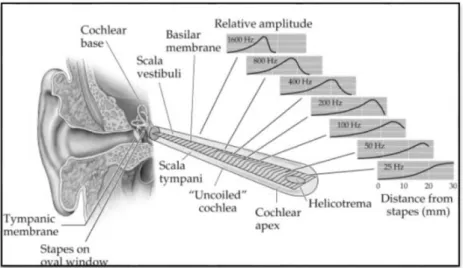
Figure 2.7: Anatomy of the ear indicating perception of frequency in starched out cochlea (Purves, Augustine, Fitzpatrick, Katz, McNamara, and Williams, 2001) ... 33
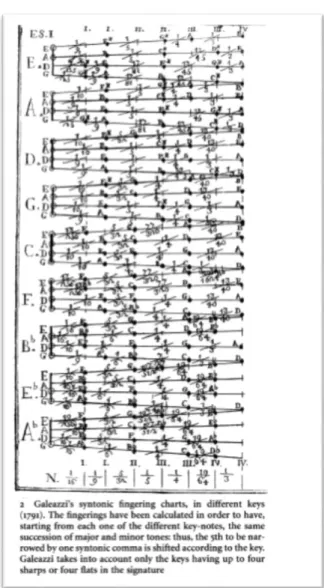
Figure 2.8: Finger chart for use during the 18th century music (Barbieri, Mangsen, 1991) ... 56
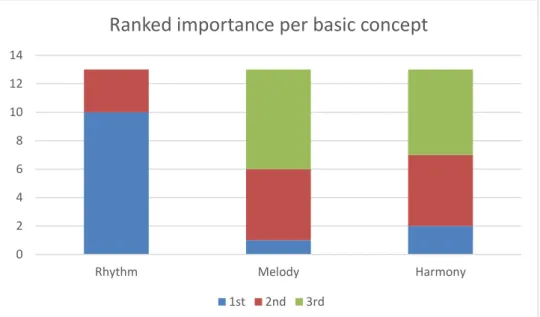
Figure 4.1: Ranked importance per basic concepts ... 79
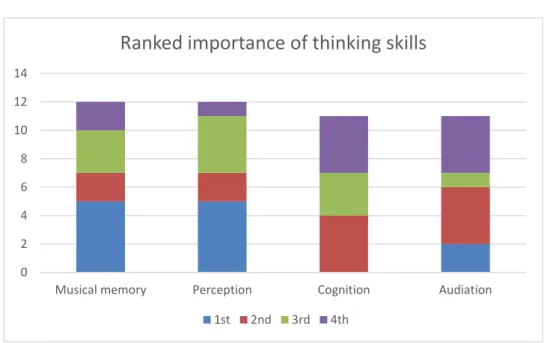
Figure 4.2: Ranked importance of thinking skills ... 80
Figure 4.3: Ranked importance of listening skills ... 82
Figure 4.4: Ranked importance of performing and reading skills... 83
Figure 4.5: Ranked importance of skills ... 85
Figure 4.6: Skills taught to enhance the concept Rhythm as aural skill... 86
Figure 4.7: Skills taught to enhance the concept Melody as aural skill ... 87
Figure 4.8: Skills taught to enhance the concept Harmony as aural skill ... 88
Figure 4.9: Disposition of concepts ... 90
x
L i s t o f T a b l e s
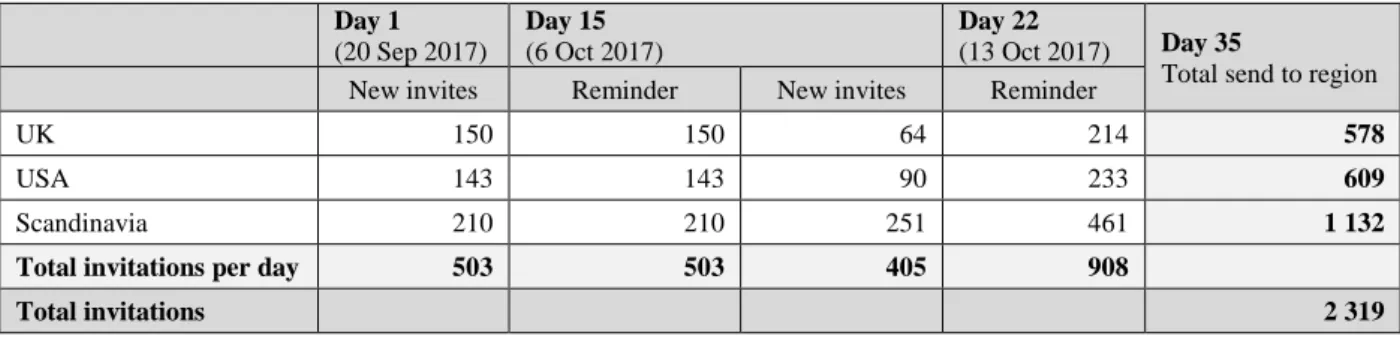
Table 3.1: Activity of e-mail sent to potential participants ... 74
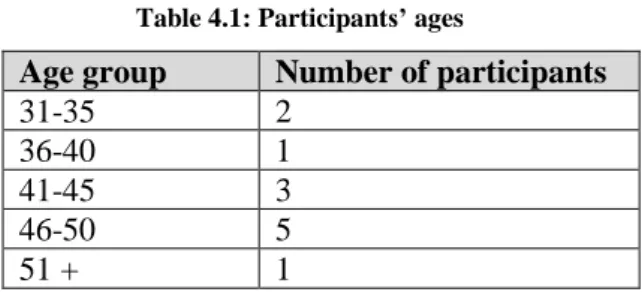
Table 4.1: Participants’ ages ... 78
Table 4.2: Disposition of concepts ... 89
1
C H A P T E R 1
I n t r o d u c t i o n
1.1
BACKGROUND
The virtue and importance of aural training for music students, and especially string players, is recognised by many (if not all) academics and music teachers. Gary Karpinski (2000:6), a leader in the aural training field, notes that “listening skills are essential to musicians because music belongs fundamentally to the aural domain.” The level at which a musician’s listening skills are refined impacts directly on the level of the musician’s performance. It is thus crucially important to train and develop the music student’s hearing and so enhance the musical performance. Denyoe and Guyver (2006:5) found that “the ear is the most valuable asset to any musician, and it must be tended to with the same care one would give to his/her own instrument.” Aural training is of vital importance for the enhancing of musical performance.
The research presented in this thesis focuses on the enhancement of the string player’s musical ear. My interest in the field of aural training that would serve this purpose was sparked by my passion as a cellist, a cello teacher, and a teacher of aural skills development at a Western Cape high school. In preparing learners for their aural assessments – especially learners in their final year of school (Grade 12) – it became evident that the aural skills (and the lack of appropriate skills) that learners demonstrated, were often related to the instrument(s) they play. At first, I thought that this was because each group of instrumentalists (e.g. flautists or violinists) had the same person as practical teacher and it could possibly be that each teacher’s skills focus is different. Research supported this: Wei (2013:4) noted that “students only had access to material taught by their teacher.” Some students are not exposed to a complete array of music subjects until they start music in a specialised music school or at a tertiary institution. As an aural teacher, I felt that this lesson was the equalising factor.
Teachers’ lesson topics come from various sources. Mishra (2000:1) found that many teachers adopt the ideas of influential pedagogues, or recall the way in which they themselves were taught. As will be explained, these influences are not always scientifically grounded. My experiences as a student were diverse: there was institutional aural training, as well as an unusual type of aural training presented by an East European teacher where the focus was on the needs of a string player. Another interesting experience arose when an Italian teacher requested me to teach his violin students solfège singing on a fixed-doh method. A further realisation of how diverse the methods of aural teaching actually are, crystallised when I encountered Dalcroze Eurhythmics. From these experiences, I realised that there are unique sets of aural
2 skills that need conquering in a player’s education as a string musician. I also realised that with the current group of high school learners in my aural class, this space is not necessarily the only place where they learn skills that typically belong to the ‘aural’ class.
Further interest was sparked by my teaching an Alzheimer patient to play the cello (about Grade 4 level). I was fascinated by and became curious about the intricate functioning of the brain, memory, physical string playing and perception. Much research about the functions of the brain focus on studying the absence of these functions. Examples of this form of research relate to perception and cochlear implants (McDermott, 2004) and the music perception development of children with cochlear implants (Polonenko, Giannantonio, Papsin, Marsella, & Gordon, 2017). The student’s remarkable ability to sight read on a “bad day” was notable as this is a very complex skill with great demands on memory.
Information and various insights gained through this research will enable string teachers and instrumentalists to revisit their method of developing aural skills and subsequently their level of performance on their instrument. Information and knowledge are key aspects to understanding most skills development and I agree with Walker’s (2010:11) view that states “as both a teacher and a student, … a skill is easier to improve when one understands various aspects of the skill.” The understanding and implementation of research in the field will greatly enhance the string student’s experience in becoming a performer.
1.2
RESEARCH PROBLEM
There is no clearly defined system available to the English-speaking world to train the string player’s ear. There are however methods available in Russian1. As mentioned above, the current method used by
English-speaking countries relies solely on the teacher’s ability, experience and discretion. The acceptable ranges of elements that need to be developed are not agreed on or researched. To this end, researchers often focus on the limitations of intonation (Walker, 2010:4). Although intonation constitutes a substantial and very important part of the string player’s aural abilities, it is not the only aspect required by the string player. Additional skills need to be developed to produce a competent string player. Compared to South Africa, the Scandinavian countries are better informed about string players’ aural needs, and because the English language supplies a vehicle for an improved understanding of the situation, we as South African researchers can gain greater insight into and learn much from their methods.
3
1.3
OBJECTIVE OF THE RESEARCH
The aim of this research is to identify the full scope of aural requirements of the string player. The findings of the research could serve to guide teachers and researchers in developing methods to train the string player’s hearing in a more structured and comprehensive manner.
1.4
SCOPE OF THE STUDY
The study focused on the aural training of string players. String instruments are similar with regard to ear training and the production and manipulation of sound. However, the cello is often the research focus in general string instrument research, because of its role in the sound stage: as solo instrument, melodic line, playing thirds and fourths under the melody, harmony (alto and tenor), as well as bass and rhythmic bass. The string instrument family features strongly in the baroque to modern periods, where each period confronts the string player with a unique set of demands.
In this study, research was limited to tertiary students. In South Africa, students are not necessarily exposed to aural lessons at primary and secondary school levels. The younger learner’s aural training is limited to lessons with the practical music teacher – generally, no formal music lessons are dedicated to aural training. Only more advanced students are afforded ensemble experience. Music students develop certain aspects of aural skills, which are assessed during their UNISA, Trinity or ABRSM graded exams. These tests are standardised across the instrument range and do not differ according to different instrumentalists and ages. Although tertiary institutions in South Africa offer more structured lessons for aural training, instruction is not group-specific. Some aural skills are however developed through ensemble playing. This research is therefore focused on adding value to tertiary education. Some of the aspects that will be identified for aural training are string instrument-specific and will feature more in this research, although more general aspects will also be discussed. There are differences in the terminology referring to the training of skills that pertain to the ear. In this research I used aural training to refer to aural training, ear training, and aural skills development; except for direct citations using the alternative terminology.
The criteria applied in the choice of countries to be included in this research include accessibility to the teachers and the language of instruction. In the selected countries, English is used (or available) as language of instruction.
4
1.5
RESEARCH QUESTIONS
The main research question for this study is:
How do different regions approach aural training for string players?
The sub-questions that guide this study in answering the main research question, are: 1. What aural skills are required to teach basic concepts?
2. What aural skills should string players develop to enhance performance excellence as professionals?
3. How does the approach in aural training in the different regions (UK, USA, and Scandinavia) compare to that prescribed in academic writing?
1.6
RESEARCH DESIGN
The research consists of an empirical study. This type of study is described as the ‘scientific’ method and is often used by researchers of the Arts. Dirkse (2011:25) encourages the use of empirical pedagogical music research, for the information that is gained improves the teaching methods and stimulates further research. Empirical researchers gain insight into their subject through the collection and interpretation of qualitative data. This research is used to answer primarily academic, but also practical questions. Moustakas (1994:11) acknowledges that empirical phenomenology also determines the meaning of experiences by the respondents. It was therefore important for me to work in an ethical manner with the collection of data to ensure the validation and reliability of the study. This research was quantitative in nature. Du Plooy-Cilliers (2014:18) points out that the method used influences the way the study is judged, and it is important to justify the chosen method. The strengths and weaknesses of the study are discussed in Chapter 3.
The data was collected via survey. The survey is a very old form of information collection, with Babbie (2014:247) finding reference to surveys held in the Old Testament in the Bible. Babbie considers descriptive, explanatory, and exploratory surveys as appropriate for social topics where the population is too large for direct observation and to measure attitudes among respondents (Babbie, 2014:247). My social study topic involves the description of aural training, where the population – a large number – have differing views and explanations, and opinions on the topic and sub-topics of aural training of the string player. These differing opinions and descriptions are evident through the literature review and should be mirrored in the data collected through the survey. Du Plooy-Cilliers and Cronjé (2014:149) describe the survey as a cross-sectional design that describes a phenomenon at one point in time. The data is collected once from the respondents with no follow-up or repeats. This study thus measures the state and attitude of aural training within a specific population at a specific time.
5
1.7
RESEARCH METHODOLOGY
Since questionnaires are effective in surveying (Creswell, 2003:14), I decided to make use of questionnaires in this research. Babbie and Mouton (2001:233) note that a questionnaire has as many statements as questions to determine the attitude of the respondent towards the statement. The questionnaire was sent via e-mail as an invitation to answer the questions hosted on a secure website. Du Plooy-Cilliers and Cronjé (2014:150) note that a questionnaire sent through e-mail is inexpensive and limited human resources are needed. The survey is self-administered and has both positive and negative aspects.
Data collection has to its advantage that the respondents can complete the survey in a time and place convenient to them. However, questions cannot be clarified immediately. The respondent will not be influenced by the person conducting the interview, as described by Smagorinsky (2007) and Du Plooy-Cilliers and Cronjé (2014). Some aspects that are eliminated as influence on the respondents by administrating the chosen method are the gender of the interviewer and facial expressions of the interviewer. This method of administering the questionnaire adds to the reliability of the survey. A negative aspect of this self-administered survey is that the respondent has no contact with the researcher if an area of the questionnaire is not understood. The researcher also has no opportunity to ask a follow-up question for greater clarity.
The data for the study was collected through a cross-sectional, inter-coder mail survey as described by Koonin (2014:253). There were no repeats of the survey. The question material was constructed from the material in the literature study. The study therefore investigates to what degree aural aspects are being taught to string players compared to what academic literature identifies as the requirements of the string player.
My role as researcher in this study was limited to setting up the questionnaire through the careful study of literature in the field of aural training. I distributed the invitation to potential participants. I present the data in this thesis and draw conclusions.
The aim of the research was to understand the experience of participants (Bezuidenhout & Cronjé, 2014). Assuming that there are no absolute ‘truths’ regarding human behaviour or experiences, such research is by definition subjective. As Smagorinsky (2008) describes the work of Vygotsky (1987), we learn that research is concerned with cognitive frameworks that are internalised through cultural practices. Although this study focuses on the teaching of string players of Western classical music, the respondentswere from different countries, backgrounds, and cultures of pedagogy. The experiences of the participants to achieve the final product were taken into consideration.
The population of the survey consisted of the four groups involved in the teaching of string instrumentalists: the practical lecturer for violin, viola and cello, the aural lecturer, orchestra or ensemble leader/lecturer and harmony lecturer. I believe that this is where the decisions about what is taught to the string player are made
6 and executed. The research relationship did not influence the study, because I had no contact (except for the survey) with the respondents. Institutions I surveyed are a representative number of the tertiary institutions in the United Kingdom, Universities in the United States of America, and Scandinavia. These institutions have a significant number of string players that aspire to becoming professional musicians. The reduction of surveys into statistics was initially done with the aid of a statistician. The data is analysed and expressed numerically. As described by Koonin (2014), it is important to ensure the validity of this study through a large sample size, random sampling and reliable research tools. The survey was constructed with the design and variables contained. The survey does not predict future behaviour.
Where research interacts with persons, ethical considerations need to be considered. The intended research and the design were presented to the Departmental Ethics Screening Committee (DESC), where it was deemed to be low risk. According to the institution’s rule, the collection of information is allowed to proceed after this process. The research was then forwarded to the Research Ethics Committee (REC) of Stellenbosch University.
All care was taken to ensure the reliability of the data. The details of the process can be found in Chapter 3. The study is limited to the three regions (UK, USA, and Scandinavia); the specific needs of the string player; the basic concepts that were studied; and the single method used.
1.8
CHAPTER OUTLINE
Chapter 1 provides an overview of the study as well as the background, research question and research methodology that was used.
Chapter 2 is a literature review, which is presented in four sections. The first contains concepts required in aural training, specifically rhythm, melody, and harmony. The second section deals with skills set out in the index of aural pedagogue Karpinski’s book, Aural Skills Acquisition (2000). The three concepts are investigated under four sub-headings: thinking, listening, reading, and performance. The third section addresses the pertinent needs of string players and how they relate to the four aural skills discussed in the previous section. The fourth and last section is a short history and investigation into the chosen countries’ music education systems.
Chapter 3 describes the methodology used in this research. The chapter covers the research approach, philosophy, research design, methodology, role of the researcher, description of participants, data analysis, ethical considerations, reliability and validity, and limitations.
Chapter 4 submits the results under the main headings presented in the literature study and found in the questionnaire. The data is integrated with the literature and conclusions are drawn in the summary of the chapter.
7
Chapter 5 reminds the reader of the research question and summarises the topic. The research questions are answered through the presentation of all secondary findings. The research’s validity is discussed, and potential further research recommendations are made.
8
C H A P T E R 2
L i t e r a t u r e S t u d y
“If tones relate to tones only, how can they ever relate to a man,
move a man?” (Cooke, 1960:105)
2.1
INTRODUCTION
Many researchers, like Lars Edlund (1963), share my sentiment that aural training is interdisciplinary and cannot exist as an independent discipline (e.g. Beckman, 2011:2). Fortunately, the interdisciplinary application of aural training is already apparent in many music classrooms worldwide. In aural training research done at selected American tertiary institutions, Butler (1997:41) found that even with different method and set outcomes, the structure of the programmes is based on the link that exists between aural and performance practice. The interdisciplinary nature of the field is beyond mere music. Tirovolas and Levitin (2011:23) refer to music education’s interdisciplinary nature by listing elements in education as: experimental psychology, music theory, musicology, computer science, biology, psycho-physics, neuroscience, and linguistics. In the preface to Lars Edlund’s book on post-tonal aural education (1963:7), it is evident that he also supports the idea that aural training is multifaceted, and he urges that, because of the “intimate connection” of aural and the practical music making, teaching aural skills should be done in a manner that ensures a cohesive type of training. From interdisciplinary consideration of aural training, thought should be given to the elements included in the syllabus of budding musicians. However, the teaching of interdisciplinary subjects does pose problems.
Taking the forementioned into consideration, it is necessary to remark that the concept of teaching any music-related subject to improve performance is questioned by some researchers. Byo (1997:52), Gardner (1991), Price (1992) and Grutzmacher (1987) point out that the skill developed in one area or lecture may be transferred to other areas (performance or teaching) with great difficulty. Thus, what is taught in aural training lessons is not necessarily used in other musical areas of music development. These findings seem to be substantiated by research in which graduate and undergraduate music majors responded alike on a test of their ability to detect performance errors: more experience did not give graduate students an advantage in the perception of pitch or rhythm errors (Byo, 1997:52). This transfer of skills acquired in one field is only possible if the individual understands both the musical and the notated representation (Wolf &
9 Kopierz, 2014:2). The skill transfer should therefore be possible if the subject is taught with complete understanding and connection to all relevant sections.
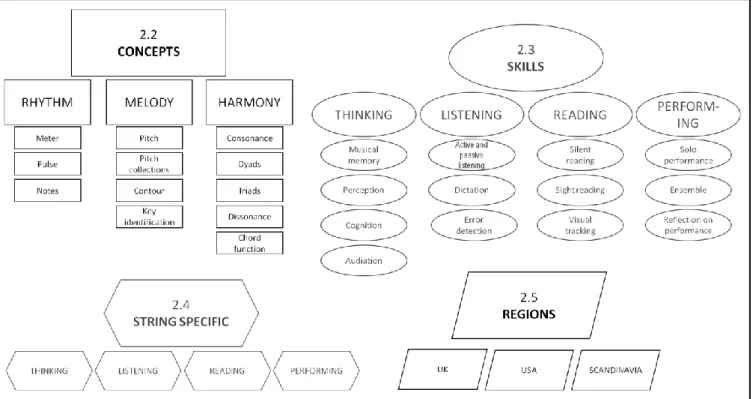
This chapter considers the categories and areas with which aural training lessons concern itself. The following diagram (Figure 2.1) presents a map of how this chapter is set out.
Figure 2.1: Diagram of chapter layout
The chapter answers the following questions pertinent to the aural needs of the string instrument student: what should be taught (concepts); why and how it could be taught (skills); who will benefit from this study (string students); and the regions included in this study (where). Aural education topics are discussed in two main sections: aural concepts and aural skills. Concepts and skills are divided into hierarchical sub-sections.
Concepts and skills
The difference between concepts and skills is explored for clarification. In a pedagogical article, Gault (2005:1) describes how he taught a skills course and how he observed that these skills were improving his students’ understanding of concepts. Just as one can possess skills, they may also be lacking or missing. The author needed skills to transfer or teach concepts. The skills did not necessarily have to do with the concepts, thus inferring that skills from unrelated disciplines can aid the conceptual understanding of the discipline of music. Therefore, one can accept that concepts can be gained from the skills of another person. This echoes the teachings of Emile Jaques-Dalcroze, who had not originally intended an instructional book, but relied on the skills of the teacher.
10 Hayes (1985:319) identifies three problems in teaching skills: firstly, the vast quantity of knowledge that takes years to acquire (for both the teacher and the student); secondly, the large number of skills required, that cannot be simplified; and thirdly, teaching methods unique to each individual. Skills to be taught are interdependent and cannot necessarily exist on their own. A specific skill can be identified, but it is gained or achieved in different ways. When skills of one discipline are required in another unrelated discipline, the need should be identified and taught.
In classroom music, the skills taught are often not purely musical, but could include elements such as social skills through music (i.e. working productively within a group, getting along). McClung (2000) notes that the skills taught will not be found in lesson plans, but that they are “subtext” to the curriculum. McPherson and Renwick (2011:234) argue that mastering a musical skill requires overcoming challenges, such as focusing over long periods, learning in a competitive environment, and overcoming setbacks. In other disciplines, these challenges might also be called skills. Individuals use different yardsticks to determine what qualifies as a skill, and to identify the challenges they might face.
Skills are developed through practice; concepts are taught. Shuker (2005:xvi) makes a distinction between concepts and terms; terms are more specific and descriptive of a musical practice and concepts are a “general analytical framing label”. The psychologist, Woodruff (1970:51), believes that exceptional conceptual capacity is what sets humans apart from animals, and this characteristic should be the essence of educational concern. He states that in all human acts, apart from reflex, a conceptual component of some kind is involved. He believes that concepts enable a person to perceive what he is doing (in the case of automatic behaviour), provide the basis of deterministic control, and provide capacity for critical analysis and conscious decision-making. He describes the repertoire of concepts as being determined by the environment in which a person finds himself. Concepts are thus necessary for learning any skill. It is important to note that the naming of concepts is not necessarily essential for the learning of skills, but can be required for the reflection on performance.
The methodology of teaching skills through concepts is ever changing. Stabley (2001:29) explains the changing of teaching methods: using improvisation and movement to teach concepts improves skills. Later in the article she mentions that some of the improvements include increased understanding of harmonic progression, tonal and rhythmical patterns, and expressive musical elements. The inclusive nature of aural training is hereby highlighted.
Rhythm (time), pitch (melody), and harmony are considered basic concepts in this chapter. These three concepts are identified as basic for they are found in most music (Krumhansl, 2000:159). Most researchers identify rhythm and pitch as basic building blocks of music. Kinney and Forsythe (2012:69) found that the perception and recreation of pitch and rhythm are the fundamental building blocks to learning and development in music. Ella Fourie’s (2016) research on sight-reading credits rhythm as the area in which students make the most mistakes during examinations. She defines the reading of notation as
two-11 dimensional; pitch and rhythm, thus strengthening the idea that pitch and rhythm are the most important in teaching. Jerde, Childs, Handy, Nagode and Pardo (2011:1572) drew on neuro-imaging studies to conclude that rhythm and melody are processed separately in the brain – melody and pitch in the short-term and rhythm in the long-term memory (no similar research was done on harmony). Although there are several elements that need to be studied in the discourse of aural training, Alvarez (1980:229) believes elements differ from one style period to the next, leaving only rhythm, melody and harmony as common elements. Therefore, this chapter will investigate them as basic concepts in their hierarchical subdivisions as well as their interdependency.
The necessary skills in aural training are discussed based on the process of music making. Gary Karpinski’s book, Aural Skills Acquisition (2000), serves as guideline to structure this section:
▪ Thinking (Musical memory, Perception, Cognition and Audiation);
▪ Listening (Audiation, Active and passive listening, Dictation, Error detection); ▪ Performing (Ensemble, Reflection on performance);
▪ Reading (Sight-reading, Visual tracking)
Specialised skills essential for the string player follow from the previous section to debate the skills that need to be added or refined to form a rounded education for a string player: Thinking; Listening; Reading; and Performing. Timbre will be discussed in detail in this section.
2.2
BASIC CONCEPTS
2.2.1
Rhythm (Time)
The notion of ‘rhythm’ is construed in many ways, offering different meanings to different people. The intended meaning is usually understood from the context of the sentence. Comparing phrases that contain the word rhythm illustrate the different interpretations of the word: to play in a fast rhythm; play the incorrect rhythm; use jazz rhythms; or have a natural sense of rhythm. This broad spectrum of meaning is attributed to the complexity of this compound and multifaceted concept. In some instances, the word should be replaced for clarity, for example: fast tempo. In other instances, the same word or term evokes different terms – a result of the many philosophies about time and rhythm.
Two important writers on this topic, Justin London (1993, 1995; 1999; 2002; 2012) and Christopher Hasty (1981; 1997; 1999) interpret the concept of rhythm and meter in completely different ways. London (1999) summarises some of his arguments against Hasty, departing from Zeno’s2 paradox of time as infinitely
12 dividable (London, 1999:261). That poses the problem that no matter how far you have travelled, the remainder of the time can always be halved. The suggested solution is denying that time is infinitely dividable. Bergson’s philosophy of time (experience of duration) is that of an event which requires awareness of the present while remembering the immediate past, but which remains distinct from the present – hence, experiencing the present as a continuation of the past (London, 1999:262). It is the experience of change, and as Susanne Langer (1953:112-113) explains, time is filled (physically, emotionally, or intellectually) with tension. She believes time is experienced and exists as tensions and resolutions, leading into the chicken-and-egg discussion of the being and becoming of an event. Vere Chappell (1962:517) derives the theory of coinciding of events; becoming and existing. Whitehead and Bergson’s philosophy explains that the world is an ongoing state of becoming as it endures through time (London, 1999:262). From the previous section, it is noted that the comprehensive and complex concept of time has been contemplated since the beginning of philosophy. For the purpose of this study, London’s philosophy of time is followed, viz. that of the subdivision of time into several concepts. This section of the chapter will deconstruct and explore the basic components of rhythm as meter, beat and pulse, and notational rhythm.
2.2.1.1 Meter
Meter is a feature common to many cultures of the world. Gotham (2014:1) finds that meter and rhythm are ubiquitous in the world surrounding humans. The concept of meter has various explanations. Gotham (2014:2) notes that it was a slightly forgotten aspect until the 20th century when research was conducted into the definition of meter and the interaction with structures. Hasty (1999:275) comments in his response to Justin London’s article (1999) that they do not “articulate” the same concept of meter. As a theoretical concept, it is the organising of timing structures in music. Holzapfel, Krebs and Srinivasamurthy (2014:1) explain that the metrical structure provided by meter can be partitioned into different time spans (e.g. beats and measures or bars). These beats or pulses are silent, but easily perceived pulsations that are grouped into bars. Beats have hierarchy, alternating between strong beats and weak beats. Normally the first pulse of each bar, the downbeat and strong pulse, determine the meter.
Meter can be anticipated. Several studies using tap research provide evidence. Rankin, Fink, and Large (2014:256) found not only that subjects can anticipate changes in tempo fluctuations that are made for purposes of emotional expression, but also that there could be inappropriate fluctuations, although with slight deterioration in quality. The anticipation of meter affects the interpretation of music. London (1993:3) describes the determining of metric content followed by the maintainenance of the perceived content. He likens the determining of metric parameters as matching content to “a small number of metric archetypes” (London, 1993:3). After determining of metric content, the following activity is cognitively less demanding: the listener will maintain the meter through complex patterns and syncopation until new, obvious cues are
13 given. London (1993) calls this the structuralist approach to meter, where meter is not part of the music as much as pitch or timbre, but heard and felt.
London (2002:4) holds that meter does not originate from the music, but should be seen as a synchronisation response to perceive “recurring events” from the environment. He therefore concludes that meter is “listener-generated”. Meter can be perceived in two ways: as a response to stimuli created by musicians or as the result of interaction between musician and audience. The concept of hypermeter, a larger scale relationship than simple or compound rhythmic patterns, is often mentioned. Interpreting meter as an organising system of pulses alone is missing the main function of meter.
2.2.1.2 Beat and pulse
There is a difference between pulse and beat. Pulse is a point in time without any duration and without the ability to give measurement to anything. It can be described as a “regularly recurring feeling of musical stress” (Karpinski, 2000:21-22). Pulse is an important aspect of rhythm (time) and is highlighted by Karpinski (2000:20) when he claims that all the temporal aspects of music listening and perception rely on pulse to create the feeling of meter, the notion of beat and the measurement of rhythmic durations. Beat, on the other hand, is the time between successive pulses that can be units of measurement (Karpinski, 2000:22). A beat cannot be perceived by feeling and it is thus incorrect to refer to feeling the beat of a song – it is the pulse that is felt.
Pulse is not as steady as initially taught to students. The fluctuation in pulse is bent by musicians to aid interpretation and emotional expression. Rankin et al. (2014:3) are among the researchers who note the fluctuation of tempo in performance. They observe that in the synchronization with the fluctuation, pulse is anticipated and tapping rate corresponds to performance without any ‘lag’ (Rankin et al., 2014:3). Further research in defining pulse leads to the hypothesis by London (2002:35) that hearing a pulse requires the potential of hearing an equal subdivision of the pulse. At a very fast tempo only simple (binary) divisions are possible (200-300ms3), as the smallest notable division is 100ms (London, 2002:38). The change in
tempo alters the possible divisions and therefore the possible hierarchical configurations do not remain constant. The subdivision of the pulse into simple or compound creates the rhythmic character of the pulse. Epstein (1995:7) emphasises that pulse, as experienced in the actual performance of music, is not purely periodic, but responds to tempo change in a way that is important in the conveyance of motion and emotion in music. A listener’s natural sense for pulse identifies sequences of identical sounds and groups them together in twos, fours or threes. The number of elements in each group depends on the tempo. Karpinski
14 (2000:15) notes that even though a performance uses fluctuations of tempo for expressive reasons, the audience infers a steady pulse that is the mean of the tempo experienced.
In an attempt to find an effective way to test the perception of pulse, Karpinski (2000:20) agrees with Madsen, Duke and Geringer (1986) that the most effective pulse test is in performance or conducting. The inter-relations of pulse, meter and rhythms are so complex that the listener would have to be sure about what he/she is hearing, before being able to notate it. For this purpose, Karpinski (2000:20) suggests using protonation leading to notational rhythms that are built on the silent pulse.
2.2.1.3 Notational rhythm
Notational rhythms are often described as the length of notes and the time between successive notes. London (2002:3) and Jerde et al. (2011:1572) describe notational rhythm to be the temporal organising based on patterns of duration, which is the onset between the attacking points of successive events. It is created from isochronic and non-regular occurring ‘beats’. This is a hierarchical system. Large (2008:90) summarises musical rhythms as encompassing complex patterns of stress timing that is not periodic. The learning of rhythm can occur in several ways and my view is supported by Kinney and Forsythe (2012:70): as an accompanying cognitive process to tonal information, as a separate phenomenon, or as incidental learning. Kinney and Forsythe (2012:70) motivate their views by referring to several studies revealing the effect of other musical concepts, non-rhythmic and non-temporal elements on the recollection of rhythm.
As mentioned earlier, the teaching of ‘rhythm and pitch’ to students is considered a very important (if not the most important) aspect in music teaching. As with the multiple meanings associated with the often-encountered concept ‘rhythm’, so too the term ‘pitch’ is sometimes misused – the more appropriate concept of “melody” is understood.
2.2.2
Melody
Melody, like rhythm, is a compound, hierarchical concept, but with less misconception than rhythm. Krumhansl (1979:346) notes that individual elements can be defined accurately in terms of their “physical properties”, but the combination of the elements can be more complex. Melody is found ubiquitously. It is also the first element of music to which children respond (Nakata & Trehub, 2004:456; Schmuckler, 2011:94). The study of melody is not only useful for the aural teacher and student, but for many other practitioners of music. Butler (1989:219-220) lists as outcomes for the study of melody the understanding of the listener’s capabilities and limitations, as well as the musical information conveyed to the listener through the complex relationships of all concepts. It is therefore important to study melody in all its aspects for not only aiding the understanding of aural performance, but also the understanding of the relationship
15 the melody holds to other concepts of music making. This section will investigate pitch, pitch collections, contours, tonality, and melody.
2.2.2.1 Pitch
In scientific terms pitch is the frequency of a sound wave measured in Hertz (Hz). Theoretically, there is an infinite number of pitches (both audible and inaudible to the human ear). For the performance of most Western classical music, according to Prince, Schmuckler and Thompson (2009:368), the differences between the tone frequencies are calculated logarithmically. However, the situation is not as straightforward as Prince et al. (2009) explain. There are different ways of calculating the tone frequencies: the logarithmic calculation as mentioned above is called equal temperament (Barbour, 1951). Four different temperaments will subsequently be discussed: Pythagorean temperament, Just temperament, Mean-tone temperament and Equal temperament.
The significance or implication of temperament holds true for all non-fixed tuned instruments and singers. Therefore, the temperaments are discussed in this general section of the chapter with string-specific implications discussed later.
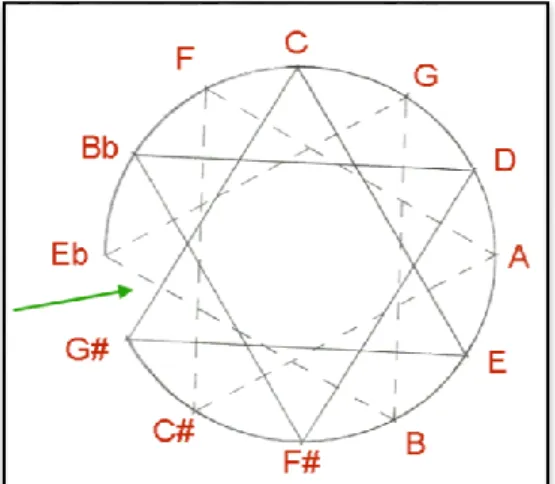
A Pythagorean tuning system is achieved by dividing the string of an instrument in half and then sounding it. The first four positive integers (tetraktys) are formed yielding the octave (2:1), perfect fifth (3:1) and perfect forth (4:3) above the unstopped string. An alternative explanation is stacking eleven perfect fifths on top of each other until all 12 tones are found (typically from E-flat to G-sharp). The problem is that the last fifth in the cycle is given the remaining cents4 (a diminished sixth flat by 24 cents). Figure 2.2
demonstrates that stacking perfect fifths does not yield a perfect octave, but overshoots it a little. This is known as the Pythagorean comma (Siljestam, 2013).
4 Jessop (2017:91) describes cents as subdivisions of a tone. Each semitone is divided into 100 cents. It is used to describe the
16
Figure 2.2: Pythagorean temperament (Lehman, 2005b)
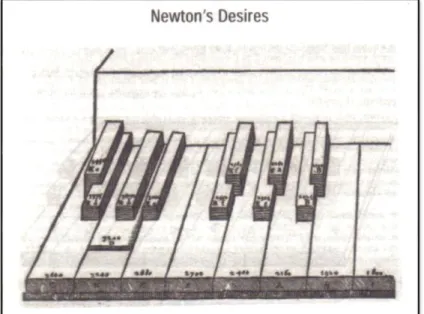
Just temperament has no defined origin in practise. Figure 2.3 illustrates this mathematical calculation that stems from the Greek theorist Ptolemy (Lewis, 1998). He divided the same string mentioned in Pythagorean tuning into five and set the foundation of just tuning. The use of this temperament is very speculative: White (2007) quotes Barbour when claiming that the temperament was favoured in the Baroque period as church modes were replaced by a diatonic system of scales. However, the tuning system is not very practical. Lewis (1998) believes that the system was purely of theoretical interest, because it was not possible to execute on a traditional fixed-tune instrument. Figure 2.4 presents an image of an organ with 19 keys to the octave that was intended to use for just temperament (White, 2007).
17
Figure 2.4: Musical instrument with 19 keys per octave. (White, 2007)
Mean-tone temperament has elements of both Pythagorean and Just temperament. It is based on intervals of fifths, but the pure fifth ratio of 3:2 is smaller and the thirds are larger (Lehman, 2005a). Mean-tone temperament was the leading tuning system during the 16th and 17th centuries. The system’s shortfall was
the ability to modulate effectively to unrelated keys (Lehman, 2005a) and keyboard instruments with split keys (15 notes per octave) would have been needed to accommodate this temperament.
Equal temperament was proposed by Aristoxenus in approximately 350BC and detailed by Galilei in 1581, but it was adopted into general practical use only in the mid-19th century (Barbour, 1951:2). Rameau
was a great supporter of equal temperament in the 18th century (Barbour, 1951:4; Jerold, 2015:94). Equal
temperament is the tuning that is found as the standard on all modern keyboard instruments. Researchers such as White (2007) see equal temperament as the answer to the temperament debate and as the ultimate compromise. In equal temperament only the octave is a ‘pure’ interval. The octave is divided in twelve equal parts, thus making all the intervals (except the octave) ‘imperfect’. Figure 2.5 demonstrates the equally-distributed frequency of the octave. This division of equal steps makes modulations to very distant keys possible. The negative aspect of the equal temperament is that the ‘colour signature’ of each key is weakened.
18 Recently, the discussion on temperament and tuning systems has fallen out of favour with researchers. Levitin and Rogers (2005:27) identify four reasons for this trend:
i. the pitch accuracy of real performers as measured by Carl Seashore in the 1930s proved that singers and violinists are remarkably inaccurate (up to 25 cents) and that Western classical audiences and musicians are not noticeably disturbed by the pitch intonation of professional performers;
ii. on average, professional piano tuners fail to tune notes more accurately than about 8 cents – this means that even if performers could perform very accurately, they would find it difficult to find suitable instruments;
iii. apparently, listeners adapt to whatever system to which they have been exposed. Most Western classical music audiences find Just intonation ‘weird’-sounding rather than ‘better’. Moreover, professional musicians appear to prefer equally tempered intervals to their just counterparts; and
iv. the perception of pitch has been shown to be categorical in nature. In vision, many shades of red will be perceived as ‘red’. Similarly, listeners tend mentally to ‘re-code’ mis-tuned pitches so that they are experienced as falling into the correct category. Mis-tuning must be remarkably large (>50 cents) before they draw much attention. This insensitivity is especially marked for short duration sounds.
The theoretical, mathematical explanation is almost a simplification of what happens in practice. Bachem (1950:80-81) describes the sensation of pitch as consisting of two elements: the tone height or logarithmic frequency, and the “c-ness” or the variations related to the notes in the octave often referred to as “tone quality” or “chroma”, which is not to be confused with tone colour or timbre. The distinction between the tone height and chroma is subjective based on experience. This raises the question of absolute pitch (AP). AP is the ability to identify a pitch that is sounded without any associated pitch by which to calculate. The identification of pitch by calculating relation to another pitch is called relative pitch. It is popularly believed that AP is an inborn ability, which allows the absolute pitcher to identify frequencies in a very similar way colours are identified. The absolute pitcher is only taught the name of the pitch (like the name of a colour is taught). Hung (2012:58) also reminds his readers that absolute pitch is not perfect and, in his research, absolute pitchers rate the same as relative pitchers at identifying intonation errors. Furthermore, Levitin and Rogers (2005:28) found that an absolute pitcher that honed their skill on a piano that is not properly tuned will always be out of tune. Levitin and Rogers (2005) also noted that some musicians can learn the one absolute pitch to which his/her instrument is tuned. AP is believed to be developed or stimulated in early childhood from a latent ability (Vitouch, 2003:111); it is not taught. However more research is required.
2.2.2.2 Pitch collections
Pitch collections or patterns refer to ordered pitches that make up a melody. These pitch collections or patterns can encompass several different structures. Milne, Sethares, Laney and Sharp (2011:1) give examples of these structures as chord tones, scales, tuning, or virtual and spectral pitches heard in response to complex tones or chords. There is thus an analytical process that places the pitches in relation to a
19 structure. Chrisman (1971:59) describes the pitch collections analytically as pitch content (the class-representation of the pitches usually related to a scale system) and the relationships between the pitches (intervals). Pitch collections’ content used compositionally can be reduced to pitch sets, which is the pitch represented in the pitch collection. Chrisman (1971:60) demonstrates this by example of a collection that contains many c and d pitches and would thus have a pitch set of c and a pitch set of d. This analytical process of pattern recognition is at the heart of the chunking process. It is a cognitive process that will be discussed under skills (2.3.1.1).
2.2.2.3 Contours
Contour is often referred to as the design or shape of the melody, the pattern of ascending and/or descending pitch intervals of a collection (Heaton, 2005:788). Even though there are variations in the explanation of contour, Edworthy (1985) mentions context of melody (e.g. melody length); Salamon and Gomez (2012) harmony, pitch continuity and exclusive allocation as melodic and non-melodic influences on perception of contour; they all acknowledge that contour is regulated by theoretical rules that ‘balance’ melodies. Müllensiefen and Wiggins (2011:2) stress the importance of contour when constructing a good melody referring to theoretical ‘rules’ such as balance between skips and step-wise motion. Contours are among the important elements to consider when analysing melody.
Another consideration is the similarities that exist in language and music regarding pitch contour. Stevens, Keller and Tyler (2011:59) attribute the ability of music and speech to communicate to pitch contour as it is present in both. Tonal language speakers (e.g. speakers of several Asian languages) are more sensitive and effective in music contour interpretation (Wayland, Herrera & Kaan, 2010:654). It should furthermore be noted that contour is also experienced in rhythm. The relationship between music and language is an extensive field of study: Stevens et al. (2011:60) identify elements such as pitch, stress, and timing (syllable duration and pause). The interpretation of contour is thus reliant on more than merely pitch. Schmuckler (2016) links contour with tonality as the primary influence in perception and memory skill (see 2.3).
2.2.2.4 Tonality identification
Tonality is a daunting concept if the cultural essence is considered. Krumhansl and Schmuckler (1979:347) describe tonality as a central organising structure of music. The diversity of understanding tonality is not only reliant on the culture, but also on each musical period, culture and theoretic tradition (Krumhansl, 2004:253). While researchers report several different tonalities – e.g. Žabka (2014:180) found seventy-two scale types in South India – the dilemma is not addressed by focusing only on Western classical music. A large selection of folk music influences Western classical music, e.g. the Hungarian tonal set or the pentatonic mode; church modes; jazz modes; and ragas. Furthermore, Western classical compositions have started moving away from tonality, first gradually with chromaticism, and then embracing bi-tonality,
20 polytonality, and a-tonality – a significant shift in the thought process in recognition of tonality. Lewin is one of the first researchers to attempt an analytical tool that uses mathematical formulae to calculate tonality and his formula includes a ‘neo-Riemannian’ theory (Hasegawa, 2013:574). Rink (2005) and Tymoczko (2011) developed a coherent theoretical framework for chromaticism. These tools have been formulated as an attempt to encapsulate all scale systems.
Krumhansl (1979:347) describes the diatonic scale as a set of seven pitches chosen from a set of 12 (the octave). The chosen seven are diatonic tones and the remainder are non-diatonic or chromatic tones. The diatonic tones conform to a fixed pattern of intervals. There is a well-established relationship between the tones and the tonal centre, the tonic. The non-diatonic tone has the weakest relationship and is thus unstable in relation to establishing a key. The dominant is the second stable tone after the tonic. The tonic, mediant and dominant sounded together (tonic triad) is the clearest key establishing unit. The tonic triad is sounded before many of the aural training exercises and tests.
Some aural training modules move beyond diatonic tonalities. Lars Edlund (1963) provides an example of post-tonal aural training. While most Western classical literature gives preferrence to the diatonic scale, it is not the only source of tonic identification, but arguably the most stable. Prince et al. (2009:368) identify the hierarchy of pitch classes with the tonic triad set as the most stable, followed by the rest of the diatonic pitches, and lastly the non-diatonic pitches.
2.2.2.5 Melody (pitch in context)
Melody is the culmination of pitches linked together to form intervals, in turn to form pitch collections with predetermined contour set in a tonality. Melody is thus not the mere organisation of successive pitches in time. Dowling and Fujitani’s (1971:524) argument in favour of this is that melody is determined by the relationship between the tones and not the absolute pitches themselves. Dowling and Fujitani (1971:530) describe melody (rhythm ignored) as a series of intervals between successive pitches. When melodies are transposed, the chroma and ultimately the pitch are altered. Dowling and Bartlett (1981:30) found in their research that even if the contour and the logarithmic sequence (intervals) of the melody remains the same, that test subjects could identify when a well-known melody had been transposed.
It is argued that melodies are built on harmonic structures, thus forming the bases of the tonality (Krumhansl, 2004:253). Researchers such as Temperley (1999:65) will even go as far as indicating that in establishing tonality, it is more important to establish the chords and chord progression sequence than to know what pitch is heard. Considering that each pitch is determined by the underlying or implied harmony, melody is based on harmony.
21
2.2.3
Harmony
The concept of harmony has been discussed and debated since Plato5, hence the connection with
mathematical algorithms (Fletcher, 2002:1205). The relationship between music, specifically harmony, and the natural world can be found in topics such as “harmony of the spheres”6 and ‘influences of music on
plant growth’7. This study will not venture into the complex mathematical equations or relationships with
nature regarding harmony. Rather, harmony will be studied as the juxtaposition of notes (two or more) in which a relationship is formed with notes sounded either simultaneously (vertically) and/or after one another (horizontally). Parncutt (2012) describes harmony theoretically as notes forming chords, combining sets of chords and finally chord progressions. It should be noted that chords are but mere sounds, they do not classify as harmony. Toch (1977:1) describes chords as empty vessels “waiting to be filled with substance”. This substance is referred to by Toch (1977:1) as meaning that will then be harmony. Clusters of notes (chords) are not harmony; they become harmony when put into a context of more chords. Randel (2001:366) highlights horizontal positioning by drawing attention to the fact that the time (rhythm) of the harmony is also important. Harmony could be described as note clusters forming chords that are rhythmically placed between other chords to form meaning. This section will consider harmony under the following subheadings: consonance, dyads, triads and dissonance, and chords in harmonic function.
2.2.3.1 Consonance
Consonance is described clearly by Plack (2010:R476) as the combination of notes (vertical or horizontal) sounding pleasant or resolved. The debate about consonance has raged for many decades, but research has moved far beyond the early 20th century Seashore’s sense of consonance – the debate can be traced as far back as the Pythagorean aesthetic absolute and Aristoxenus' relativism. The study of consonance often resorts to the field of psychoacoustics. Terhardt (1973:1061) refers to the psychoacoustics of harmony when he tries to describe an interval as “tonal consonance” which is “reliant on the absence of rapid beats” or also called roughness. Devaney and Ellis (2008:144) describe the beats as produced by interference between tones of proximate frequency. They are in support of literature claiming that two pitches whose overtones (upper-partials) are similar will sound consonant, whereas the absence of such similarity produces dissonance (Devaney & Ellis, 2008:144). These beats are thus formed by the proximity of two sinusoidal waves (sound waves). According to this theory, the degree of similarity can be determined by measuring
5Plato (ca. 429-347 BC) wrote in his monologue Timaeus in Greek, about the ‘harmony of the spheres’ that created the
World-soul’ as created by the Demiurge (a type of creator god) (Godwin, 1993). The music produced by the movement causes harmony.
6An introduction to the topic is found in The Music of the Spheres: Music, Science, and the Natural Order of the Universe
(James, J. 1995. USA: Springer-Verlag).
7Several studies have been made on the effect of different music on plant life. Recommended for further reading on the subject.
Measuring effects of music and healing energy using a seed germination bioassay (Hashi & Rochde, 2017). The Journal of Alternative and Complementary Medicine, Volume 10, Number 1, 2004, pp. 113–122.
22 the number of beats produced when the two tones are played simultaneously. In 1877, Helmholtz considered this the first scientific description of consonance which later led to the Helmholtz-Krueger theory in 1906 (Peterson, 1925:19). There is a definite relationship between harmony and mathematics. Cazden (1945:3) believes that music (and all its concepts) follows natural laws (“universal and eternal laws”) and therefore can be calculated mathematically. Fletcher (2002:1205) supports the mathematical calculation of consonance by referring to the calculations of Pythagoras (dividing a string length to form simple integers) to find “pleasant” sounds. Cazden (1945:3) describes the overtones following a “harmonic series”; the frequencies of the overtones are multiples of the fundamental frequency. The first six overtones are consonant harmonically to the fundamental tone.
In contrast, some researchers believe that the physiological and psychological aspects of tones should be taken into consideration (Plack, 2010:R476). The psychological research was led by Stumpf in the 19th century. He concluded that the more consonant the tones, the more they will be perceived as just one tone – this is called the fusion degree (Hofmann-Engl, 2010:854). McDermott, Lehr and Oxenham (2010:1035, 1038) made several ground-breaking discoveries in their empirical study of consonance. Using non-musical sounds, they found that participants who found beating unpleasant were not averse to dissonant harmonies. They concluded that consonance is learned by our preference of harmonic series (harmonicity). This degree of consonance leads to the idea that some harmonies are ranked major, minor, diminished and augmented, in decreasing order of consonance (Cook & Fujisawa, 2006:108). They also concluded that musical training and experience influence the concept of consonance. The cognitive research model was produced by Hofman-Engl in 1990 based on Terhardt’s virtual pitch model (Hofmann-Engl, 2010:855). Ironically the cognitive model is also explained through mathematical equations.
Another factor to take into account when studying consonance is social habituation. As mentioned before, training or experience in music plays a role. Cazden (1945:5) also considers age, culture (in and outside Western civilisation), historical time, and comparison against consonance (degree of consonance). Several researchers believe that consonance is innate (Tymoczko, 2011; Crowder, Reznick & Rosenkrantz, 1991; Kagan & Zentner, 1996; Trainor & Heimniller, 1998; Trainor, Tsang & Cheung, 2002; McDermott & Hauser, 2005b) – they tested the responses of adults against those of infants and several animals. The natural world interacts in a very predictable manner to consonance and dissonance.
2.2.3.2 Dyads
Dyads consist of two tones. Not all researchers regard dyads as harmony. Cook and Fujisawa (2006) believe harmony starts from triads. This can be understood psycho-acoustically when considering that dyads’ possibility of being dissonant is less than the possibility of dissonance of three note chords, with the exception of intervals of a second (or inverted second) (Rasmussen, Santurette & MacDonald, 2014:5). With reference to Bones and Plack (2015:9), who remind us that consonance and dissonance are achieved