IAS Series
Volume 24
ISBN 978-3-89336-949-2
he Helmholtz Association
Automated Optimization Methods for Scientific Workflows
in e-Science Infrastructures
Sonja Holl
management, execution, sharing and reuse of
in silico
experiments. Workflow management
systems simplify the management of scientific workflows by providing graphical interfaces for
their development, monitoring and analysis. Nowadays, e-Science combines such workflow
man-agement systems with large-scale data and computing resources into complex research
infra-structures. For instance, e-Science allows the conveyance of best practice research in
collab-orations by providing workflow repositories, which facilitate the sharing and reuse of scientific
workflows. However, scientists are still faced with different limitations while reusing workflows.
One of the most common challenges they meet is the need to select appropriate applications
and their individual execution parameters. If scientists do not want to rely on default or
experi-ence-based parameters, the best-effort option is to test different workflow set-ups using either
trial and error approaches or parameter sweeps. Both methods may be inefficient or time
con-suming respectively, especially when tuning a large number of parameters. Therefore, scientists
require an effective and efficient mechanism that automatically tests different workflow set-ups
in an intelligent way and will help them to improve their scientific results.
This thesis addresses the limitation described above by defining and implementing an approach
for the optimization of scientific workflows. In the course of this work, scientists’ needs are
investigated and requirements are formulated resulting in an appropriate optimization concept.
This concept is prototypically implemented by extending a workflow management system with an
optimization framework. This implementation and therewith the general approach of workflow
optimization is experimentally verified by four use cases in the life science domain. Finally, a
new collaboration-based approach is introduced that harnesses optimization provenance to make
optimization faster and more robust in the future.
This publication was written at the Jülich Supercomputing Centre (JSC) which is an integral part
of the Institute for Advanced Simulation (IAS). The IAS combines the Jülich simulation sciences
and the supercomputer facility in one organizational unit. It includes those parts of the scientific
institutes at Forschungszentrum Jülich which use simulation on supercomputers as their main
research methodology.
IAS Ser ies24
Sonja Holl Aut omat ed Op timization of Scientific W or kflo w she Helmholtz Association
Automated Optimization Methods for Scientific Workflows
in e-Science Infrastructures
Institute for Advanced Simulation (IAS)
Jülich Supercomputing Centre (JSC)
Automated Optimization Methods for Scientific
Workflows in e-Science Infrastructures
Sonja Holl
Schriften des Forschungszentrums Jülich
The Deutsche Nationalbibliothek lists this publication in the Deutsche Nationalbibliografie; detailed bibliographic data are available in the Internet at http://dnb.d-nb.de.
Publisher and Forschungszentrum Jülich GmbH Distributor: Zentralbibliothek
52425 Jülich
Phone +49 (0) 24 61 61-53 68 · Fax +49 (0) 24 61 61-61 03 e-mail: [email protected]
Internet: http://www.fz-juelich.de/zb
Cover Design: Jülich Supercomputing Centre, Forschungszentrum Jülich GmbH Printer: Grafische Medien, Forschungszentrum Jülich GmbH
Copyright: Forschungszentrum Jülich 2014 Schriften des Forschungszentrums Jülich
IAS Series Volume 24 D 5 (Diss., Bonn, Univ., 2014) ISSN 1868-8489
ISBN 978-3-89336-949-2
Persistent Identifier: urn:nbn:de:0001-2014022000
Resolving URL: http://www.persistent-identifier.de/?link=610
Neither this book nor any part of it may be reproduced or transmitted in any form or by any means, electronic or mechanical, including photocopying, microfilming, and recording, or by any information storage and retrieval system, without permission in writing from the publisher.
Scientific workflows have emerged as a key technology that assists scientists with the design, management, execution, sharing and reuse ofin silicoexperiments. Workflow man-agement systems simplify the manman-agement of scientific workflows by providing graphical interfaces for their development, monitoring and analysis. Nowadays, e-Science combines such workflow management systems with large-scale data and computing resources into complex research infrastructures. For instance, e-Science allows the conveyance of best practice research in collaborations by providing workflow repositories, which facilitate the sharing and reuse of scientific workflows. However, scientists are still faced with different limitations while reusing workflows. One of the most common challenges they meet is the need to select appropriate applications and their individual execution parameters. If scien-tists do not want to rely on default or experience-based parameters, the best-effort option is to test different workflow set-ups using either trial and error approaches or parameter sweeps. Both methods may be inefficient or time consuming respectively, especially when tuning a large number of parameters. Therefore, scientists require an effective and efficient mechanism that automatically tests different workflow set-ups in an intelligent way and will help them to improve their scientific results.
This thesis addresses the limitation described above by defining and implementing an approach for the optimization of scientific workflows. In the course of this work, scien-tists’ needs are investigated and requirements are formulated resulting in an appropriate optimization concept. In a following step, this concept is prototypically implemented by extending a workflow management system with an optimization framework, including general mechanisms required to conduct workflow optimization. As optimization is an ongoing research topic, different algorithms are provided by pluggable extensions (plugins) that can be loosely coupled with the framework, resulting in a generic and quickly extend-able system. In this thesis, an exemplary plugin is introduced which applies a Genetic Algorithm for parameter optimization. In order to accelerate and therefore make workflow optimization feasible at all, e-Science infrastructures are utilized for the parallel execution of scientific workflows. This is empowered by additional extensions enabling the execution of applications and workflows on distributed computing resources.
The actual implementation and therewith the general approach of workflow optimization is experimentally verified by four use cases in the life science domain. All workflows were significantly improved, which demonstrates the advantage of the proposed workflow optimization. Finally, a new collaboration-based approach is introduced that harnesses optimization provenance to make optimization faster and more robust in the future.
Acknowledgements
I would like to express my gratitude to all the people who supported me in any way during my PhD project. First and foremost, I would like to thank Prof. Martin Hofmann-Apitius for his advice and guidance though such a versatile research project. Visiting his research department was a wonderful working experience, especially collaborating with such a friendly and open minded group. I would like to thank Prof. Thomas Lippert and Daniel Mallmann for the opportunity to conduct my PhD research within the Federated Systems and Data group at the Jülich Supercomputing Center in the Forschungszentrum Jülich. It was a great workplace offering both an excellent technical infrastructure and social environment.
I am also very thankful to my supervisor Olav Zimmermann for his continuous support, fruitful discussions and numerous comments helping me sharpen my doctoral studies. Moreover, I thank Prof. Heiko Schoof to act as a very excited co-referee as well as further referees, Prof. Rainer Manthey and Prof. Diana Imhof.
I would like to acknowledge all my colleagues at the Jülich Supercomputing Center for providing technical background during the implementation, enormous efforts to create a stable and reliable infrastructure, proof-reading parts of this thesis, and offering a warm and cheerful office atmosphere in the coldest office in JSC. Additional thanks go to all the Studium Universale members offering friendly meetings as a welcome alternation to the PhD work.
A special thanks goes to Prof. Carole Goble for hosting me at the University of Manchester and her team, in person Dr. Khalid Belhajjame, Alan Williams, Stian Soiland-Reyes, Dr. Alexandra Nenadic and Dr. Katy Wolstencroft for providing excellent support and assistance during the implementation phase on extensions to the Taverna Workflow Management System and Research Objects.
Many thanks are due to my collaboration partners namely Prof. Magnus Palmblad, Dr. Yassene Mohammed, Daniel Garijo, Dr. Matthias Obst, Renato De Giovanni, Shweta
biological, medical or workflow provenance issues.
Finally, I am deeply grateful to my parents and grandparents as well as my two and ’a half’ brothers for being always there for me and supporting me in all my plans. I am indebted to Jen for his patience and never ending encouragement together with my flat mates, close friends, and people I met by carpooling for making my time in Jülich and Aachen a funny and relaxing one. Thanks for your open ears and hearts in all situations, continuous support as well as proof-reading parts of this thesis. Thank you all for walking along side with me this long and finally successful path.
Sonja Holl January 2014
Contents
List of Figures ix
List of Tables xi
List of Abbreviations xiii
List of Publications xv
1 Introduction 1
1.1 Scientific Workflows in e-Science . . . 1
1.2 Challenges for Scientists Using Life Science Workflows . . . 3
1.3 Goals of the Thesis . . . 5
2 Concept Development for State-of-the-Art Workflow Optimization 9 2.1 General Aspects of Scientific Workflows . . . 9
2.1.1 Scientific Workflows . . . 9
2.1.2 Scientific Workflow Management Systems . . . 12
2.1.3 e-Science Collaborations . . . 12
2.2 General Aspects of Optimization and Learning . . . 14
2.2.1 Mathematical Background and Notations . . . 14
2.2.2 Different Optimization Algorithms . . . 15
2.2.3 Design Optimization Frameworks . . . 17
2.3 State-of-the-Art Scientific Workflow Optimization . . . 18
2.3.1 Runtime Performance Optimization . . . 18
2.3.2 Output Performance Optimization . . . 19
2.3.3 Other Concepts of Workflow Modification . . . 20
3.1 Investigation of Scientific Workflow Management Systems in e-Science . 28
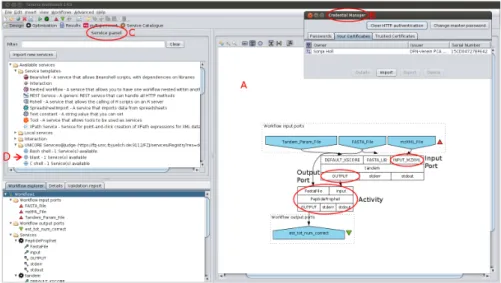
3.2 Extension of a Workflow Management System . . . 32
3.2.1 The Taverna Workflow Management System . . . 33
3.2.2 UNICORE Middleware . . . 35
3.2.3 Architecture of the Grid Plugin . . . 35
3.2.4 Development of the Grid Plugin . . . 36
3.2.5 Enhanced Parallel Application Execution . . . 38
3.3 Evaluation by Life Science Use Cases . . . 39
3.4 Discussion . . . 43
3.5 Conclusion . . . 44
4 A Framework for Scientific Workflow Optimization 47 4.1 The Approach of Scientific Workflow Optimization . . . 48
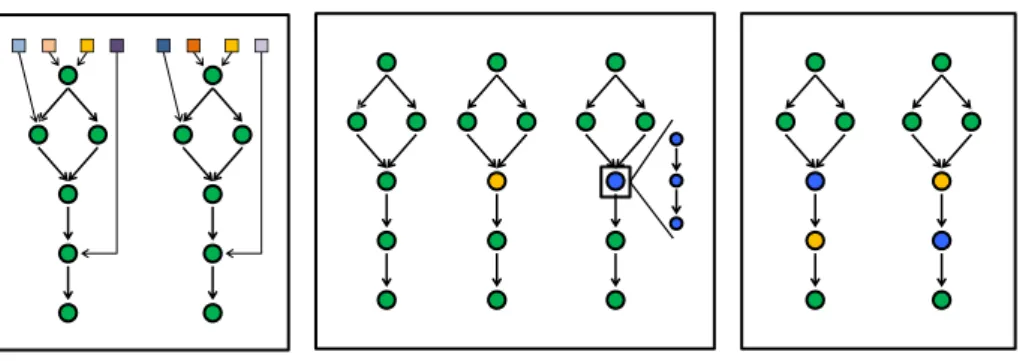
4.1.1 A New Optimization Phase in the Scientific Workflow Life Cycle 48 4.1.2 Investigation of Different Optimization Levels . . . 51
4.1.3 Definition of the Optimization Target . . . 54
4.2 The Usability Compliance of Workflow Optimization . . . 55
4.3 The Taverna Optimization Framework . . . 56
4.4 Enabling Optimization on Distributed Computing Infrastructures . . . 60
4.4.1 Three Tier Execution Architecture . . . 61
4.4.2 Implementation of Parallel Workflow Execution . . . 62
4.4.3 Parallel Optimization Use Case . . . 64
4.5 Discussion . . . 64
4.6 Conclusion . . . 65
5 Optimization Techniques for Scientific Workflow Optimization 67 5.1 Optimization Techniques for Scientific Workflow Parameters . . . 67
5.1.1 Genetic Algorithms . . . 70
5.1.2 A Genetic Algorithm for Scientific Workflows . . . 71
5.2 The Parameter Optimization Plugin . . . 72
5.2.1 Development of the Parameter Optimization Plugin . . . 73
5.2.2 Discussion . . . 76
5.3 Evaluation of the Parameter Optimization Plugin . . . 76
5.3.3 Biomarker Identification Workflows . . . 89
5.3.4 Protein Structure Similarity Workflows . . . 92
5.3.5 Discussion . . . 94
5.4 Simulation of Workflow Structure Optimization . . . 96
5.4.1 The Component Level . . . 96
5.4.2 Discussion . . . 99
5.4.3 The Topology Level . . . 100
5.4.4 Discussion . . . 102
5.5 Conclusion . . . 102
6 Discussion: Scientific Workflow Optimization in e-Science 105 6.1 Examination of Scientific Workflow Optimization . . . 106
6.1.1 General Aspects of Optimization . . . 106
6.1.2 Addressing Optimization Complexity . . . 111
6.2 Provenance-based Optimization . . . 115
7 Conclusion 123 7.1 Summary of the Work . . . 123
7.2 Future Work . . . 126
A Additional Figures and Descriptions 131
List of Figures
2.1 The main workflow structures . . . 10
2.2 A workflow in the context of optimization . . . 22
2.3 Three different requirements to investigate workflow optimization . . . . 24
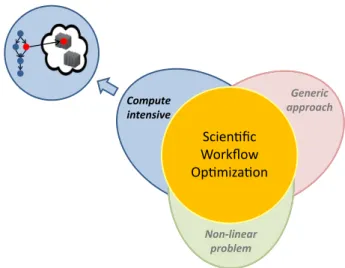
3.1 Three tier concept for workflow optimization. First approach: acceleration of compute-intensive applications . . . 27
3.2 The Taverna Workbench . . . 34
3.3 Taverna parallel execution . . . 34
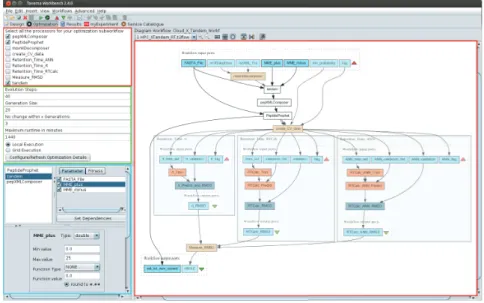
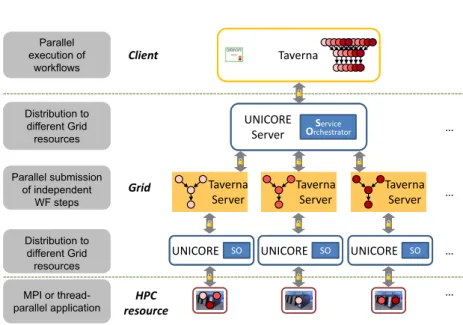
3.4 System architecture of the UNICORE-Taverna plugin . . . 37
3.5 Sweep jobs in Taverna . . . 40
3.6 The X!Tandem workflow . . . 41
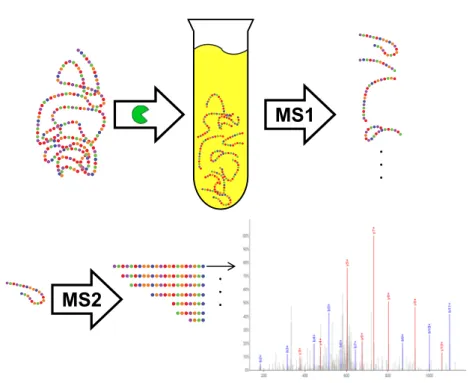
3.7 Concept of tandem mass spectrometry . . . 42
4.1 Three tier concept for workflow optimization. Second goal: generic and automated approach to be multipurpose extensible . . . 47
4.2 Extended scientific workflow life cycle . . . 49
4.3 Three defined levels for workflow optimization . . . 52
4.4 The Taverna optimization perspective . . . 56
4.5 Architecture of the new framework . . . 57
4.6 Taverna dispatch stack . . . 58
4.7 Control flow of the new optimize layer . . . 59
4.8 Three tier execution architecture . . . 61
4.9 The new security propagation mechanism . . . 63
4.10 Client workload of two different scenarios . . . 64
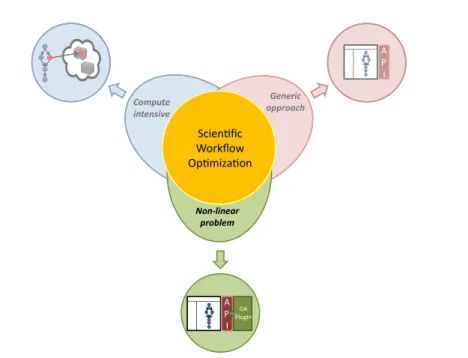
5.1 Three tier concept for workflow optimization. Third goal: addressing the non-linear optimization problem . . . 68
5.4 Plugin control flow . . . 74
5.5 Optimization process screenshot . . . 75
5.6 First iteration of Proteomics workflow . . . 79
5.7 Plot of the Proteomics workflow optimization . . . 81
5.8 General principle of Ecological Niche Modeling . . . 84
5.9 Abstract Ecological Niche Modeling workflow . . . 85
5.10 Biomarker identification workflow . . . 90
5.11 Support vector regression workflow . . . 93
5.12 Workflow for retention time prediction optimization . . . 98
5.13 Root mean square deviation values . . . 99
5.14 Abstract BLAST workflow . . . 102
6.1 Optimization Research Object Ontology . . . 118
7.1 Three tier concept and implementation for workflow optimization . . . . 124
A.1 Sequence logo of hybridE. coli. . . 131
A.2 Peptide identifications . . . 132
A.3 Sequence logo ofE. coli . . . 133
A.4 ENM workflow with SVM . . . 136
A.5 ENM workflow with Maxent. . . 137
A.6 Crassostrea gigas, SVM. . . 138
A.7 Crassostrea gigas, SVM comparison . . . 139
A.8 Prorocentrum minimum, SVM . . . 140
A.9 Prorocentrum minimum, SVM comparison . . . 141
A.10 Diagram of the RO-Opt Algorithm . . . 142
A.11 Diagram of the RO-Opt Fitness . . . 143
A.12 Diagram of the RO-Opt Optimization Run . . . 144
A.13 Diagram of the RO-Opt Search Space . . . 145
A.14 Optimization Provenance Ontology . . . 147
List of Tables
3.1 Evaluation of common scientific workflow management systems . . . 31 3.2 Description of UNICORE services . . . 36 3.3 Submission via the conventional submission mechanism and the developed
sweep generator . . . 43 5.1 Results of the optimization of X!Tandem . . . 80 5.2 Fitness values of interchanged MME+ and MME- values . . . 82 5.3 Results of the optimization of X!Tandem including 4 different parameters 83 5.4 Results for default values and optimization of SVM algorithm . . . 87 5.5 Results for default values and optimization of Maxent algorithm . . . 88 5.6 Comparison of the intelligent feature ranking optimization results . . . . 91
List of Abbreviations
ACO . . . Ant Colony Algorithm
API . . . Application Programming Interface AUC . . . Area Under the Curve
BPEL . . . Business Process Execution Language DAG . . . Directed Acyclic Graph
DEISA . . . Distributed European Infrastructure for Supercomputing Appli-cations
DN . . . Distinguished Name EA . . . Evolutionary Algorithm EFS . . . Ensemble Feature Selection ENM . . . Ecological Niche Modeling FDR . . . False Discovery Rate GA . . . Genetic Algorithm GUI . . . Graphical User Interface HAB . . . Harmful Algae Bloom HPC . . . High-Performance Computing HTC . . . High-Throughput Computing JERM . . . Just Enough Results Model
MIAME . . . Minimum Information About a Microarray Experiment MIM . . . Minimum Information Model
MME . . . Mass Measurement Error MO . . . Multi-Objective Optimization
MOEA . . . Multi-Objective Evolutionary Algorithm PSM . . . Peptide Spectrum Match
PSO . . . Particle Swarm Optimization RDF . . . Resource Description Framework
RO . . . Research Object
ROC . . . Receiver-Operating Characteristic SA . . . Simulated Annealing
SPI . . . Service Provider Interface SVM . . . Support Vector Machine SVR . . . Support Vector Regression
SWMS . . . Scientific Workflow Management System TPP . . . Trans-Proteomic Pipeline
VRE . . . Virtual Research Environment XML . . . Extensible Markup Language
List of Publications
1. Sonja Holl, Yassene Mohammed, André M. Deelder, Olav Zimmermann, and Mag-nus Palmblad, „Optimized Scientific Workflows for Improved Peptide and Protein Identification“,Molecular & Cellular Proteomics, 2013, submitted: 4/7/2013 2. Sonja Holl, Daniel Garijo, Khalid Belhajjame, Olav Zimmermann, Renato De
Giovanni, Matthias Obst, and Carole Goble, „On Specifying and Sharing Scientific Workflow Optimization Results Using Research Objects“,The 8th Workshop on Workflows in Support of Large-Scale Science, to be published, IEEE, 2013 3. Sonja Holl, Olav Zimmermann, Magnus Palmblad, Yassene Mohammed, and Martin
Hofmann-Apitius, „A New Optimization Phase for Scientific Workflow Management Systems“,Future Generation Computer Systems, 2013, to be published
4. Sonja Holl, Mohammad Shahbaz Memon, Morris Riedel, Yassene Mohammed, Magnus Palmblad, and Andrew Grimshaw, „Enhanced Resource Management en-abling Standard Parameter Sweep Jobs for Scientific Applications“,9th International Workshop on Scheduling and Resource Management for Parallel and Distributed Systems, to be published, IEEE, 2013
5. Shahbaz Memon, Sonja Holl, Morris Riedel, Bernd Schuller, and Andrew Grimshaw, „Enhancing the performance of workflow execution in e-Science environments by using the standards based Parameter Sweep Model“,Proceedings of the Conference on Extreme Science and Engineering Discovery Environment: Gateway to Discovery, XSEDE ’13, ACM, 2013, 56:1–56:7
6. Sonja Holl, Olav Zimmermann, and Martin Hofmann-Apitius, „A new optimization phase for scientific workflow management systems“, 2012 IEEE 8th International Conference on E-Science (e-Science), IEEE, 2012, pages 1–8
Hofmann-Apitius, „Secure Multi-Level Parallel Execution of Scientific Workflows on HPC Grid Resources by Combining Taverna and UNICORE Services“, Proceed-ings of UNICORE Summit 2012, Schriften des Forschungszentrums Jülich, IAS Series 15, Forschungszentrum Jülich, 2012, pages 27–34
8. Sonja Holl, Olav Zimmermann, and Martin Hofmann-Apitius, „A UNICORE Plugin for HPC-Enabled Scientific Workflows in Taverna 2.2“,2011 IEEE World Congress on Services, IEEE, 2011, pages 220–223
9. Bastian Demuth, Sonja Holl, and Bernd Schuller, „Extended Execution Support for Scientific Applications in Grid Environments“,Proceedings of UNICORE Summit 2010, Schriften des Forschungszentrums Jülich, IAS Series 5, Forschungszentrum Jülich, 2010, pages 61–67
Chapter 1
Introduction
1.1
Scientific Workflows in e-Science
In recent years, scientists have been enhancing their research activities by using comput-ing technologies [Hey2009; Bell2009]. Along with theory and laboratory experiments, computer simulations and data analyses are used to test and validate scientific hypotheses in order to gain new insights in scientific phenomena. Especially within the life sciences difficult, expensive or dangerous tests are implemented by so-calledin silicoexperiments – computer-based experiments. For example, new drug candidates can be tested and
pre-sorted by using high-throughput virtual screening methods before validating them in the laboratory. On that account, the interaction and binding of small molecules to target proteins is predicted in order to evaluate the inhibition or activation of specific functions. This reduces the number of required laboratory tests and in this way drug discovery is accelerated by addingin silicomodels instead of using traditionalin vivoandin vitro
experimentation only.
In silicodata analyses and simulations are accomplished by composing different combi-nations of software applications, which use data and computing resources. Not long ago, these computing studies were implemented by executing shell scripts or other scripting languages [McPhillips2009; Ludascher2009b]. Many scientists no longer preferred this type of processing due to the fact that scripts are difficult to program and reuse, especially when using different computing or data resources [Wolstencro2009; Jimenez2013].
As a result, scientific workflows [Deelman2006b; Gil2007] emerged, which describe the different compositions of existing algorithmic building blocks that formulate large
of individual processing steps. They facilitate not only the automation and comprehension but also the editing. Furthermore, their comprehensibility makes them suitable for dissemi-nation, reuse and reproducibility of best practice analysis recipes. Scientific workflows were quickly adopted by life science communities [Taylor2006a] as they can record the knowledge discovery process [Gil2008; Ludascher2009a]. Scientific workflows facilitate the reuse and reproducibility of scientific experiments with minimal effort. Scientists can perform identical or similar workflows without reinventing the entire experiment. Platforms that allow sharing scientific workflows by collaborative means are workflow repositories [Stoyanovic2010]. These scientific workflow repositories enable scientists to share scientific knowledge and facilitate distributed collaborations. An example is the myExperiment platform [Goble2010], which contains a highly popular workflow reposi-tory. As a consequence, scientific workflows play a substantial role for domain scientists as a graphical alternative to scripting and programming [De Roure2009c]. Furthermore, they are highly important for reuse and reproducibility purposes and also provide an instrument for collaborative work and knowledge sharing.
Scientific workflows also contain several data-intensive analyses and compute-intensive applications. These applications can exceed the power of desktop clients or laptops, which makes it necessary to utilize distributed data and computing resources [Mehta2012], especially including High-Performance Computing (HPC) and High-Throughput Com-puting (HTC) resources. The utilization of remote resources is provided by Scien-tific Workflow Management Systems (SWMSs), which are a further step to support domain scientists [Deelman2009]. Many SWMSs have been developed for the life sci-ences [Achilleos2012], for example Taverna, Kepler, Knime or PipelinePilot, all providing similar functionalities but diverse technical details. They are software packages, enabling the graphical design, one-click execution and monitoring of local or distributed scientific workflows.
In recent years, the combination of both, collaboration techniques and access to dis-tributed computing and data resources required for scientific workflows, have evolved as the term’enhanced science’(e-Science) [Hey2005]. E-Science was originally shaped in 1999 by John Taylor, Director of the Research Councils in the UK as the following:
’e-Science is about global collaboration in key areas of science and the next generation in-frastructure that will enable it’[NESC1999]. So called e-Science infrastructures comprise different services that enable seamless and secure inter-disciplinary collaborations (e.g. sharing of workflows) as well as provisioning of computing power [Taylor2006a] that can
be employed by compute- or data-intensive life science workflows [Hey2003; Mehta2012]. Access to those infrastructures and especially distributed computing resources is granted for example by so-called Grid and Cloud middleware [Lin2011]. Middlewares supply an abstract layer above computing and data resources to provide services that allow easy and seamless access to distributed computing resources. In silicoexperiments designed as scientific workflows can be scaled up and accelerated by utilizing distributed computing and data resources in SWMSs.
With rising popularity of workflow-based e-Science infrastructures, best practice work-flows can be shared, disseminated, searched, reused, validated and manipulated [Goble2007], just like within the myExperiment platform. However, even if a suitable workflow is found or a new workflow is designed from scratch, it is still required to set up the workflow regarding the specific problem at hand to improve the scientific results. Consequently, one might have to exchange applications and select configuration parameter and data inputs. Regardless of the user’s prior computer experience level, challenges arise with trial and error or parameter sweeps providing the only option to evaluate different workflow set-ups for mining possible solutions.
The next sections examine these challenges and scientists’ needs to investigate an alternative approach improving the procedure of setting up scientific workflows.
1.2
Challenges for Scientists Using Life Science
Work-flows
Scientific workflows have emerged as a useful instrument to comprehensively design and share the best practices and create reproducible scientific experiments [Littauer2012].
The workflows are designed from scratch by scientists or reused as a template from a workflow repository. After the design or searching phase, a scientist would end up with a workflow almost ready for execution. Nevertheless, as the workflow set-up depends on the used data and scope of experiment, the used components and their parameter settings may require adaptation according to the problem at hand and personal preferences to improve workflow results. Due to today’s abundance of life science applications [Tiwari2007] and the large number of available parameters provided by these components [Kulyk2008; Ku-lyk2006], workflow adaption constitutes a significant difficulty. Kulyk et al. [Kulyk2008] stated that parameters enhances the flexibility of applications but make them more
com-plex. This implies that improving a scientific workflow result may be challenging for both life science groups, experimentally affine domain scientists and computer affine bioinformaticians.
Assuming that the applied workflow and applications contain default parameters, do-main scientists would typically keep these default values as they do not know how the programs exactly work and how parameter changes may influence the result [Kulyk2008]. If they do not want to rely on default parameters, they reuse their own or third party generated workflow parameters and test them manually [Kulyk2008]. This trial and error process may become time consuming and ineffective. Due to the rising complexity of scientific workflows [Juve2012a] it may also become difficult to manage and overlook the individual workflow set-ups.
A recent analysis [Starlinger2012] also found that scientists develop and share designed workflows, but tend to almost exclusively reuse their own scientific workflows, instead of adapting workflows from other authors. Due to the fact that current repositories are still not large enough to provide a high number of relevant workflows, it is nevertheless justified to question how the reuse of workflows might be increased and how shared workflows can be turned into best practice workflows for a broad range of scientists in the future. Currently, domain scientists use the default values, rather than developing or manually adapting solutions themselves [CohenBoula2011].
Whereas trial and error might become time consuming, parameter sweeps are a com-monly used method by bioinformaticians. Many publications aim at supporting more appropriate solutions to speed up or ease the use of parameter sweeps (examples are [Oliveira2011], [Chirigati2012], or [Smanchat2013]). Bioinformaticians do not hesitate to use advanced methods as they design and program their own tools, which leads to the fact that they know how many programs work [Wassink2010]. However, with an increasing number of parameters, it is difficult to gather interrelations and dependencies of applications and parameters while using parameter sweeps. Additionally, the number of possible workflow set-ups may increase quickly and become computationally intensive. Certainly, parameter sweeps can be performed on a sample data set only to reduce the execution time. But nonetheless an intelligent search method could sample the search space more effective than a parameter sweep method can.
Many bioinformaticians also prefer the usage of the command line [Kulyk2008] instead of using a SWMS. The command line enables easier customization of parameter settings and, furthermore, automated scripts can be performed to obtain optimized parameters.
However, domain scientists may not want to reuse these scripted workflows and methods, as scripts are difficult to reuse due to the missing abstraction of composition and distributed resource [Wolstencro2009]. In turn, providing these advanced methods within SWMSs would require extended control and larger changes or extensions on SWMSs. Therefore, bioinformaticians are missing a platform to provide these improved methods without much effort and knowledge about the specific SWMS to enable a customized optimization of workflow settings.
Summarizing, the challenges of domain scientists and bioinformaticians in utilizing scientific workflows are:
• Choices for workflow structure and parameters may affect the overall scientific result.
• Workflows that are either developed from scratch or used as best practice require manual set-up and adaption to relate to the scope of experiment.
• The number of available applications and parameters to be set is large.
• Trial and error parameter determination is time consuming and inefficient.
• Parameter sweep explorations expand fast with increasing number of parameters.
• Advanced optimization scripts exist but require effort to be included into SWMSs. These challenges provide the motivation to investigate an automated approach that provides a generic method and supports the optimization of scientific workflows to foster the effective utilization of scientific workflows by domain scientists and bioinformaticians alike.
1.3
Goals of the Thesis
The previous section identified that both, domain scientists and bioinformaticians, are faced with various challenges during workflow utilization and therefore an automated and generic method for workflow optimization is desired. In order to test the feasibility of a general approach for scientific workflow optimization, this thesis examines the question and eventually presents a novel approach of how to assist scientists in the finding of useful workflow set-ups to obtain optimal scientific results. The approach should assist scientists in the process of workflow adaption in a simplified, time efficient and intelligent manner.
For a broad acceptance and collaborative use of workflow optimization, the general approach should be coupled with the commonly used workflow tools, i.e., SWMSs, available within e-Science infrastructures and should also consider different optimization targets.
As the optimization problems themselves may be as distinct as the diverse scientific workflows and their scopes, the use of different optimization algorithms may be required. Therefore it has to be examined which optimization algorithms are available and appropriate within the context of workflows. These algorithms may also target different levels of the workflow description, for instance parameter optimization or other workflow levels. As algorithms and levels could become obsolete at some point and researchers also want to have novel techniques available, it will not only be required to identify possible optimization objectives but moreover approach a technique that is able to subsequently incorporate novel optimizations. These methods should be easily insertable with less effort by bioinformaticians.
Similar to the time efficient methods developed for parameter sweeps [Oliveira2011; Chirigati2012; Smanchat2013], a time efficient workflow optimization technique has to be taken into account. In doing so, easily accessible resources and consequently those, which are already available within e-Science environments should be used.
In the course of this thesis, these challenges will be addressed by an investigation and development of a workflow optimization approach embedded in a user-friendly research environment to be used by experts and non-experts alike. This thesis will explore a time efficient and extensible approach as well as investigate possible methods and targets to pursue workflow optimization. These approaches will be generally assessed and therefore this thesis makes the following contributions:
• Requirement analysis and development of a concept for scientific workflow opti-mization.
• Design and implementation of an automated and generic method for workflow optimization.
• Introduction of an optimization plugin employed on workflow parameters.
In order to experimentally verify these contributions made to target workflow optimiza-tion, four use cases were implemented. They tackle issues from the following life science domains:
• Proteomics
A workflow for protein identification via tandem mass spectrometry. The workflow matches protein fragment weights from tandem mass spectrometry to a database for identification and evaluates the findings. This workflow was developed by the Leiden University Medical Center.
• Ecology
Ecological Niche Modeling workflow to perform species adaptation to environ-mental changes, developed within the BioVel Project. The workflow takes recent occurrences of a species and environmental layers into account, in order to create a model and predict the species’ resistance level in the present or/and in the future (e.g. 2050).
• Medical Informatics
Ranking of genes for intelligent feature selection. The workflow generates a ranked list of genes by performing a recursive feature elimination or ensemble feature selection by using several iterations of a support vector machine. This workflow was developed by the Fraunhofer Institute for Algorithms and Scientific Computing (SCAI).
• Structural Bioinformatics
Estimating the local structure similarity of a protein segment via Support Vector Regression (SVR). The workflow trains a local protein structure predictor that estimates the structural similarity of a protein segment, where only the sequence profile is known, to a reference structure. This workflow was developed by the Jülich Supercomputing Center, Forschungszentrum Jülich.
Based on the obtained results and experiences, the general approach will be discussed and a novel strategy on how to address identified issues in the future will be investigated.
This thesis is structured as follows: Chapter 2 starts with the basic introduction of scientific workflows, SWMSs, general aspects of optimization algorithms and related work. This is followed by the design for a workflow optimization approach from which the implementations within this thesis are derived. Chapter 3 consists of two parts: the first
section will investigate different SWMSs, and the second section addresses the extension of the selected SWMS to support parallel execution of applications to augment execution performance for optimization. In Chapter 4 different levels of workflow optimization will be discussed in combination with the development of a new scientific workflow life cycle phase for optimization. Additionally, this phase will be designed and implemented as a novel generic and automated optimization framework. In Chapter 5, an example plugin for parameter optimization will be developed. This plugin will extend the proposed framework and four use cases will be tested to evaluate this thesis approach. A detailed discussion of the results will follow in Chapter 6 concluding with a novel approach for provenance-based optimization to overcome identified issues. Finally, Chapter 7 summarizes the thesis research and outlines future work.
Chapter 2
Concept Development for
State-of-the-Art Workflow Optimization
This thesis develops an approach for workflow optimization in order to ease the finding of a best practice scientific workflow set-up. Before describing the investigation of a concept for workflow optimization in Section 2.4, the first three sections introduce the different topics to the reader. The first section provides an introduction on scientific workflows, SWMSs as well as their collaborative usage within e-Science infrastructures. A basic overview of optimization algorithms is given in the second section. Afterwards, related work is presented. Finally, the fourth section conveys the approach to design a concept for workflow optimization, based on the lessons learned from the previous sections.
2.1
General Aspects of Scientific Workflows
2.1.1
Scientific Workflows
Workflows in general have been standardized by the Workflow Management Coalition in 1994 [WMC2013]. Based on these building blocks scientific workflows [Singh1996] and business workflows [Aalst2004] evolved. As the scientific community had their own specific demands on workflows, both were separated at an early stage. This was already highlighted by Singh and Vouk [Singh1996] in the middle of 1996. Nevertheless, scientific workflows took a significant upturn only in the last decade [Ludascher2005; Deelman2006b; Fox2006; Barker2008] and still remain as a topic of research especially in the life sciences [Juve2012a; Achilleos2012].
Scientific workflows are a structured aggregation of computer-based components and precisely define their execution and data flow to automate a scientific experiment. Each component acts as an algorithmic fragment, producing, converting, modifying or consum-ing data by receivconsum-ing data from various inputs and conveyconsum-ing data through outputs. Data is being processed by components in a pipeline until all have finished their scientific task and output one or several results. The type of a component can be of different nature, such as a software program, a Web service, a local shell script, a binary executable, a Java program, data transformation or a Grid job [Wassink2009b]. Components are connected by linking inputs and outputs as a data or execution link and thus defining the workflow composition. A workflow composition, typically represented as Directed Acyclic Graph (DAG) [Deelman2009], clearly defines the design of a scientific experiment by offering a simple visualization of a complex processing model. Figure 2.1 shows an abstract view of an exemplary workflow. The workflow is data-centric, and therefore the output from one or several parallel tasks serves as the input for the subsequent task. The main characteristics of a scientific workflow are:
Single
Parallel
Sequence
Sub
‐
Workflow
Looping
Figure 2.1: The main workflow structures: single task, parallel execution, sequence of tasks, sub-workflows of several tasks, and looping.
Single
A single component is executed, representing an algorithmic or functional task.
Sequence
Two or more components are executed in a pipeline, whereas exactly one task is followed by one other task. The later task is fed by the output of the previous task.
Parallel
Several single components are executed simultaneously usually in different threads. Parallel execution can be data parallel, where each component performs the same task with differing data, or parameter parallel, where each component performs the execution on the same data with different input parameters. Additionally, they can be executed in task parallel, where each sub-task executes a piece of a main task.
Typically, a preceding component is used for data separation or distribution and a subsequent component for data aggregation or merging.
Sub-Workflow
A sub-workflow defines a set of components connected in any of the defined characteristics. Sub-workflows can be seen as a group of tasks, typically aiming to perform a specific purpose. Sub-workflows can usually be out-zoomed (minimized) in the entire workflow to a single component.
Looping
A component can be executed in a loop. It is iteratively executed with one or several varying parameter or data inputs until a specific case comes true of false. (Loops are only simulated by the underlying workflow language and do not exist in the graph.)
For a detailed view of different structures and characteristics of scientific workflows, please refer to [Juve2012a] and for a general overview of workflows to [Aalst2003].
Scientific workflows may have different states during their evolution. In this thesis, four definitions will be fixed for a better understanding of the different workflow states:
Workflow template
A workflow template is an abstract draft of anin silicoexperiment. A template has abstract definitions of applications and their used data types. It holds no further information about the execution and resources.
Workflow specification
A workflow specification is a concrete scientific experiment recipe. Explicit applications are selected, the inputs are specified for data types and the resource demands are set.
Workflow instance
An instance is a specific instantiation of a workflow. All parameters are set, input data is processed and the execution will be performed on a specific target resource.
Workflow run
A workflow instance that has already been executed.
2.1.2
Scientific Workflow Management Systems
SWMSs are the method of choice to conduct scientific workflows [Curcin2008]. In the last decade, several SWMSs emerged [Deelman2009] all aiming at facilitating the design, composition, execution, monitoring and management of scientific workflows. This is achieved by automation and simplification so that scientists can focus on their research and are not required to concentrate on the technical details of data acquisition, component execution and resource allocation. A SWMS is in charge of data stage-in and stage-out, scheduling computational tasks and managing their dependencies. Data in and stage-out describes the (transfer) process of loading and saving data on both the local system and a distributed resource environment. SWMSs partly vary in their properties, such as different workflow languages or graphical user interface concepts. Access to distributed computing resources is supported by many workflow systems whereas the implementations not only vary in the supported e-Science infrastructure but also in the supported Grid or Cloud middleware. More information and a precise distinction of SWMSs will be given in Chapter 3.
2.1.3
e-Science Collaborations
With the Web 2.0 [OReilly2009] community collaboration and social networking tech-niques, i.e., Virtual Research Environments (VREs), have been increasingly applied to scientific research. Collaboration, which means sharing, reuse and networking, has be-come an essential progress in science [Marx2012] where researchers want to investigate questions together that they cannot perform alone [Olson2008]. Especially scientific workflows received a lot of attention by the e-Science community due to their ability to comprise research processes and represent knowledge artifacts. The myExperiment project was launched in 2007 [De Roure2009b] and has grown to be the largest public repository of scientific workflows [De Roure2010]. myExperiment is a Web 2.0 based
e-Science infrastructure to enable collaborations and sharing of knowledge within the life science community [De Roure2009d]. It comprises a social networking environment with a workflow repository in the background. Workflows stored in these repositories can be tagged, rated and grouped to be searchable and reusable by third party research groups. Scientific workflows from many domains can be found on myExperiment (at the time of writing over 2500 workflows [UoM2007]) originating from different workflow types and domains, such as bioinformatics, physics, chemistry or geoscience. Initially, its aim was at supporting bioinformaticians as a part of the myGrid project [UoM2008a] and the SWMS Taverna [Missier2010; UoM2009]. Thus, the life sciences have still a higher representation [Achilleos2012] than other research domains.
Within the last years, a significant effort has been made to develop myExperiment to a 3rdgeneration VRE [De Roure2010]. Third generation VREs are different from the second generation with regard to the shared and reused objects. Whereas workflows were the main object itself back then, research is getting increasingly data-driven and so-calledpacksare gaining more attention nowadays. Packs are used within myExperiment and aggregate all objects associated with a specific experiment, for instance workflows, input and output data or publications. These aggregations show the process of how next generation research is going to take place. This new type of research is referred to as
linked data[Bizer2009]. Linked data describes the process of publishing and connecting structured data on the Web. To support linked data in myExperiment [De Roure2010], a separate server hosting and publishing all myExperiment files as Resource Description Framework (RDF) structured data according to the myExperiment ontology was created firstly. Second, a SPARQL (SPARQL Protocol and RDF Query Language) Web service endpoint was created to allow the querying and retrieving of any type of myExperiment entity as an RDF description. These RDF entities cannot only be queried by users but also by third party linked data services, such as the public voiD (Vocabulary of InterLinked Datasets) store [Alexander2011].
The 3rdgeneration data centric VREs are also taking the representation, storing and reusing of provenance into account. The storing of provenance data of scientific exper-iments plays an important role for the reusability and reproducibility [Achilleos2012]. Provenance within SWMSs can be applied at different levels whereas the typical work-flow provenance includes workwork-flow runs, specifications, and execution products. Each SWMS has its own mechanism and language to store and represent provenance; recent developments aim to harmonize these [De Roure2009a; Belhajjame2012a]. Provenance
aggregates information about a workflow, including specifications, execution traces or data items. Thus, these artifacts hold details for a subsequent understanding like the workflow structure and experiment purpose. In an ideal scenario, users run workflows in workflow management systems or portals and these technologies store workflow provenance. Other scientists in turn can search and reuse the individual provenance objects to produce their own scientific results.
2.2
General Aspects of Optimization and Learning
Scientific workflow optimization is formulated as an optimization problem in this thesis. Similar to real world problems such as vehicle routing or managing the energy consump-tion, workflow optimization can be defined as the maximization or minimization of specific subjects regarding concrete constraints. This section gives the reader a basis to optimiza-tion algorithms used in science and engineering to provide general knowledge regarding workflow optimization.
2.2.1
Mathematical Background and Notations
The general process of mathematical optimization of a problem can be described as the systematical comparison of possible parameter sets and the finding of a not yet known optimal (i.e., thebest) parameter set for a model. An optimization is focused at the maxi-mization or minimaxi-mization of so-calledobjective functions(orfitness functions) regarding various constraints. Within real-world problems, the typical goal is to find the best possible solution in a reasonable amount of time.
The model, which is the scope of the optimization, may be of various kinds and can range from design modeling such as aircraft wings [Sobieszcza1997] over power systems [AlRashidi2009] to drug discovery [Nicolaou2013]. Accordingly, objective functions differ in their type and scope, such as the drag and structural weight, the minimization of generator cost or the pharmacokinetic properties and synthetic accessibility, respectively.
The search space is spanned by the decision variables, while the solution space is defined by the objective functions and their constraints. The goal is to find anndimensional vector of values in the search space, which corresponds to a global optimum in the solution space.
optimiza-tion– only one fitness function is optimized – andmulti-objective optimization problems– many fitness functions are optimized. Both cases are also calledsingle-andmulti-criteria optimizationsin the literature. The problem is callednon-linear optimization problemif the objective function or constraints are non-linear. The solution of a problem can be a local or global optimum, which means for a global optimum that there is no other smaller/larger function value for all feasible points (global optimization). A local optimum is accordingly only the smallest/largest value for a specific neighborhood (local optimization). The reader may also refer to the available literature on optimization such as [Nocedal2006].
2.2.2
Different Optimization Algorithms
Optimization problems can be linear or non-linear problems and solved by a large variety of different optimization algorithms [Pham2000; Weise2009a; Blum2011; Nguyen2012]. Scientific workflows can in general belong to both problem types. This is due to their nature of defining a mixture of different algorithms, which can range from a linear function to a long running BLAST search [Altschul1990] or a complex structure prediction of protein folding [Floudas2007]. However, many used algorithms in the life sciences are non-linear problems [Bader2004], as their objective functions are not continuous and not differentiable with respect to the decision variables. Optimizing these algorithms means dealing with a rugged fitness landscape, maybe not including many gradient information. Therefore, only non-linear optimization problems will be part of the following investigation. Non-linear optimization problems can be solved by various optimization algorithms, which sample the search space to find agood(near optimal) solution in a reasonable amount of compute time. For single-objective optimization deterministic, stochastic or meta-heuristic methods can be used [Colaco2009]. Minimizing or maximizing a single-objective results in a one-dimensional vector of values. These values are also calledfitness valuesand function as the measure of the capacity of each solution. Deterministic algorithms, such as gradient descent [Debye1909; Holtzer1954] or branch and bound [Land1960], are iterative methods hopefully converging closer to the optimum in each iteration by a specific step size. Simulated Annealing (SA) [Kirkpatric1983], which is a stochastic method but sometimes classified as heuristic method, aims at finding the global optimum by simulating the cooling process of materials.
Heuristic search methods [Pham2000; Siarry2008; Gendreau2010] are widely used in bioinformatics [Vesterstrm2005] such as Evolutionary Algorithms (EAs), in particular Genetic Algorithms (GAs) [Goldberg1988; Holland1992b], Particle Swarm Optimizations
(PSOs) [Kennedy1995; Engelbrech2005] or Ant Colony Algorithms (ACOs) for continuous problems [Dorigo1999]. Heuristic search methods aim at seeking near optimal solutions in a reasonable amount of time, however it is not claimed that they obtain the optimum with certainty. EAs simulate the process of biological evolution, by using selection, crossover and mutation to reproduce individuals and select the fittest individual. Individuals have chromosomes, which in turn have genes, which encode a particular solution. PSOs move around candidate solutions in an n-dimensional search space. A candidate solution is called particle, which is being moved related to its own best-found fitness and neighborhood’s best previous position. ACOs were originally designed for discrete (combinatorial) optimization problems. Adapted to continuous problems they produce a population of ants representing several possible solutions, which can then be changed according to the pheromone density. The pheromone density is adapted by each ant within each step according to the efficiency of the solution. A detailed overview including references and examples for each of the presented algorithms is given in [Colaco2009].
Often it is required to consider several objectives in an optimization process. For exam-ple, a trade-off between sensitivity and specificity or between result quality and runtime. These optimization procedures manage two or more objectives and are called multi-objective or multi-criteria optimization. For multi-criteria optimization [Miettinen1999], the minimized or maximized optimal result is represented by a multi-dimensional vector of values. This vector of solutions is called thePareto optimal set(PS). The image of this Pareto set in the objective function space is calledPareto front(PF). The PS comprises many solutions, as there exist different trade-off solutions, each describing a compromise between the different objective functions. Therefore, none of the solutions can be rated as the best with respect to all objective functions. Accordingly, a decision maker is required to select the Pareto optimal (ideal) solution or even a small set of optimal solutions because one single optimal solution does not exist for an optimization algorithm. A decision maker can be used during the optimization process or afterwards, although this is more critical during the optimization process [Branke2004].
Objective Optimization (MO) problems are commonly solved by using a Multi-Objective Evolutionary Algorithm (MOEA) [Zitzler2000; Zhou2011; Deb2001]. This is based on their population-based nature, which can be seamlessly adapted to MO problems. A challenge for each MO algorithm is the rating of the different solutions. Within multi-objective optimization, each solution has several fitness measures, one for each multi-objective function so instead, each solution has to be rated regarding itsnon-dominanceand closeness
to the Pareto front. Additionally, methods to include diversity are required, which rates a solution as more suitable if it has no close neighbors. These aspects and some more, such as the classification of solutions, the selection, cross over and mutation mechanisms as well as elitism methods are implemented in many different fashions.
Approaches for PSO [ReyesSierr2006], SA [Suman2005], and other meta-heuristic inspired multi-objective algorithms have also been developed [Zhou2011], but they cause several more challenges than MOEA. On the one hand, it is more difficult to identify global and local best particles, which lead a population, and on the other hand, it is more difficult to maintain good particles and current non-dominated solutions.
There are some approaches to use multi-objective optimization methods for life science design problems [Handl2007]. Solving real-world problems such as molecular dock-ing [Boisson2008], structure-activity relationship [Namasivaya2012], phylogenetic tree inference [Poladian2006] or drug discovery [Nicolaou2013] still poses great challenges for scientists due to the complex adaption of the problem transferal to an appropriate problem model or further to an appropriate approximation model. Therefore, multi-object optimization is not generally used in the life sciences. Similarly, multi-objective opti-mization has not yet been widely used forparameter optimizationin the context of life sciences [Sun2012] in contrast to the engineering domain. However, it would be helpful to assess trade-offs, for instance between sensitivity and specificity or between result quality and runtime.
Within single and multi-objective optimization, hybrid approaches [Ishibuchi1996; Moscato1999; Blum2011] are becoming more popular, utilizing the different characteristics of deterministic and stochastic or evolutionary optimization algorithms in a joint usage. Primarily, two paradigms are typically applied with single-objective optimization, whereas a precise definition is still lacking [Blum2011]. One approach is a so-called integrative method, where one master optimization algorithm uses another embedded algorithm in order to substitute a specific function, such as the selection mechanism. Another type of method are so-called collaborative approaches, where two or more algorithms run in parallel and exchange information. Similar approaches exist for multi-object hybrid optimization methods.
2.2.3
Design Optimization Frameworks
In the engineering domain, many different optimization frameworks [Rao2009] have been established to optimize design models. These frameworks offer generic approaches to allow
users defining own specific objective functions, constraints and the optimization algorithm by implementing a range of various common single- or multi-objective algorithms. Some of these frameworks are open-source available but most frameworks are proprietary software. Some of the open-source solutions also embed MATLAB [TheMath1994] in the back-end execution, which is a commercial software. Some other requirements for future multidisciplinary design frameworks were recently identified in [Parejo2012] such as parallel processing, user guides, project templates and graphical user interface integration, which are all not yet sufficiently supported [Parejo2012]. Other identified requirements aiming at monitoring, editing, and sharing of optimization problems have recently been included into engineering optimization frameworks as new features [Heath2012]. One of the most popular multi-objective generic frameworks, which provides a graphical user interface is the MOEA-framework [Hadka2012]. It offers a small range of multi-objective algorithms, but is extensible by several means. To implement new problems or algorithms, users are required to provide methods in Java or C++.
2.3
State-of-the-Art Scientific Workflow Optimization
The term’scientific workflow optimization’is used in several different contexts in the literature. Before discussing the approach of this investigation, this section reviews related work and gives a short overview of existing technologies.
2.3.1
Runtime Performance Optimization
One of the common optimization targets is to improve the scientific workflow runtime performance [Wieczorek2009]. As the typical scientific workflow is executed in e-Science infrastructures, several different approaches exist to intelligently schedule workflows or tasks on the Grid and Cloud [Yu2008]. These solutions are usually implemented for a specific SWMS and aim at the acceleration of workflows/applications through intelligent scheduling and brokering methods.
Scientific workflow runtime optimization is very heterogeneous as different criteria of the workflow can be taken into account [Wieczorek2009]. Typical criteria are the workflow structure, data processing or the component (task) model. Whereas workflow structure optimization aims at clustering or dividing jobs, data processing tries to optimize the execution of jobs regarding their data usage, and component model optimization schedules
the single jobs regarding their task type.
Some of those solutions do not only support the optimization of for instance execution time and cost, but also other quality of service (QoS) parameters, such as reliability or security. The optimization extension for the WINGS/Pegasus SWMS developed by Kumar et al. [Kumar2010] focuses on the optimization of the runtime performance by modifying application parameters, which are likely to influence the runtime. The integrated framework takes quality of service requirements into account in order to adjust data dependent parameters so that, in a second step, the distributed data processing of applications can be improved. For example, some image processing applications have a parameter to adjust thechunksizeof a data element. This chunksize can influence the runtime of a component and therefore needs to be optimized with respect to the quality of service parameter for picture resolution.
Other proposed mechanisms apply heuristic-based optimization algorithms to manage the scheduling of large-scale scientific workflows. These methods focus on user specified quality of service constraints for certain applications. A threshold can be set and the method then tries to find a solution so that all constrains are met and optimized. Available solutions usually target only fixed bi-criteria optimization and incorporate Ant Colony Optimization [Chen2009], Multi-Objective Evolutionary Algorithms [Yu2007] or Genetic Algorithms [Prodan2005] for scheduling or recursive loop handling.
Active Harmony provides a performance-tuning tool that can be used without in-depth domain knowledge [Chung2006] for changes. Users can change parameters of scientific applications or libraries to improve the performance on-line (during runtime) and off-line, respective to the parameters. The system requires developers to include tuning into the applications to specify the tunable parameters. Each of these methods is specified as a variable of an objective function that is optimized by a simplex method. The objective function can be defined by the user for example the number of processors used per node.
2.3.2
Output Performance Optimization
During the time of writing, no other comprehensive approach for general workflow opti-mization was freely available, with exception of Nimrod/OK [Abramson2010], which is a more specialized workflow parameter optimization tool from the engineering domain. Nimrod/OK extends the SWMS Kepler [Ludascher2006] with so-calledactorsto apply optimization in a scientific workflow. The optimization process itself is seen as a workflow that is composed of several steps. To run an optimization in Nimrod/OK, the user has
to define a workflow consisting of a minimum of four tasks. These tasks comprise the set-up of a search space definer, points generator, the optimization process itself, and an optimization reporter. The computational model, which represents the objective function, is defined as a plain function expression or a MatlabNimrod actor execution [Enticott2010]. If a user wants to optimize a scientific workflow, it would require enveloping the workflow for it to be optimized into a second, optimization specific workflow. This mechanism lets the user design complex optimization workflows, which can combine various optimization methods within one workflow. In the available reports a simplex optimization, Hooke and Jeeves optimization and Genetic Algorithm [Lim2012] were presented as available optimization methods.
Another approach from the engineering domain for parameter optimization is us-ing a workflow that itself implements the optimization process developed by Crick et al. [Crick2009]. Although Crick uses the Taverna management system [Missier2010] to design a parameter optimization workflow, this is a static rather than a general approach. The publication describes a manually created workflow, which comprises an optimization method for parameter optimization. Each cycle of optimization has to be defined manually in the outer optimization workflow.
2.3.3
Other Concepts of Workflow Modification
Sonntag and Karastoyanova [Sonntag2012] developed a SWMS which allows users to interact with the workflow during execution. It uses the Business Process Execution Language (BPEL) to define workflows and offers a graphical user interface for interaction. Especially if one task has failed, this process allows users to go back one step and modify the specific task. The main objective was to substitute the common procedure of trial and error for scientists so that they do not have to re-execute the entire workflow but only need to re-execute single tasks [Sonntag2010].
Another recent publication discusses the recommendation of scientific workflow com-positions that assist researchers while building new scientific workflows [Koop2008]. In these approaches, different methods aim at suggesting several further steps to the user during the workflow design. More precisely, they show possible tasks or sub-workflows, which can be used to continue or complete the workflow. These suggestions are based on provenance analyses. The VisComplete system applies a graph-based approach, which analyzes the pipeline of direct acyclic graphs [Koop2008]. They extract all possible paths and additionally mine the input and output degrees for each vertex. The suggestions are
provided to the researchers in a user-friendly way. Minor [Minor2011], Leake [Leake2008] and Chinthaka [Chinthaka2009] incorporate case-based reasoning for the analysis and the suggestion process of the components of a scientific workflow. Chinthaka manages different cases by requesting the user to add keywords to inputs and outputs as well as to the tasks. Leake et al. present a mechanism to mine workflow provenance and build cases from the gained meta-data. Minor and Görg [Minor2011] provide an approach that analyses workflow descriptions. These descriptions are available in an Extensible Markup Language (XML)-based data format and can thus be easily compared. They analyze a pair of diverse workflow or sub-workflow versions in order to identify the delta of difference to derive a case from this.
2.4
A Concept for Scientific Workflow Optimization
The last sections introduced the reader to the context and related work of scientific work-flows and optimization. With this in mind, this section shortly revisits the motivation of this thesis and elaborates on a possible approach to investigate the capability of workflow optimization for the life sciences. This approach will function as basis concept for these thesis’ developments presented in the next chapters (Chapter 3, Chapter 4, and Chapter 5).
Due to the rising complexity of scientific workflows [Barga2007], the common methods used by scientists such as trial and error or parameter sweeps are no longer feasible. To make the reuse of scientific workflows more worthwhile to scientists, an automated and intelligent method that can be applied with less effort is required. The target group for this project is made up of domain scientists and bioinformaticians. Researchers from the first group are typically inexperienced with computer usage. Thus, the concept for workflow optimization will not only determine technical preferences but also establish aspects to make optimization fast, robust and handy to be adopted by life scientists. An important point is that scientists typically stick to their accustomed technologies in order to avoid dealing with yet another technique and another user interface. Violating this may indeed be one reason for life scientists not applying existing optimization frameworks from the engineering domain. In e-Science infrastructures, SWMSs turned out to be the standard solution for life scientists to manage scientific workflows visually. Thus, just as Abramson [Abramson2010] and Kumar [Kumar2010] implemented, the approach for scientific workflow optimization should ideally be incorporated to extensible SWMSs. SWMSs also provide mechanisms for provenance capturing and sharing purposes, which
may also be required to reproduce and understand optimized scientific workflows. Many design frameworks provide programming interfaces or configuration files to set up an optimization process. Additionally the workflow complexity expands during the optimization process, as it is the case in Nimrod/OK [Abramson2010]. Contrary to these aspects, the complexity of workflow optimization is aimed to remain hidden from the user within this thesis approach. The main focus has to be the optimization process rather than scripting configuration files or designing another workflow that performs the optimization. Summarizing these requirements as a starting point for the concept approach implies the following: Scientific workflow optimization should be investigated in a workflow management system, offering an easy-to-use graphical interface. The optimization process should not alter the workflow complexity.
System (Model) . . .
࢞
ࢌ ࢞
. . .Figure 2.2: A workflow in the context of optimization. One workflow execution corre-sponds to one evaluation of a model.
Conventionally the model (fitness function) is represented by a real function, an al-gorithm, or a simulation. In these cases, the optimization process has to deal with the parameters of a single function, algorithm, or simulation. Considering the optimization of scientific workflows (cf. Figure 2.2), it is not assessable which algorithms or simulations will be used in a workflow. The used algorithms and simulations in scientific workflows are typically non-linear problems [Bader2004]. They may have arbitrary functions and the optimization algorithm has to deal with different parameters. Thus, a workflow opti-mizations’ fitness landscape may be rugged and not assessable. Figure 2.2 illustrates the experimental set-up of workflow optimization that this thesis is based on.
In order to to deal with these issues properly, robust and versatile optimization tech-niques are required, such as meta-heuristic search methods. They provide optimal (sometimes near optimal) solutions in a reasonable time for real-world non-linear prob-lems [Alba2013]. Compared to parameter sweep approaches, these meta-heuristic