Der Fakultät für Wirtschaftswissenschaften der
Universität Duisburg-Essen, Campus Essen, vorgelegte Dissertation
zum Erwerb des Grades Dr. rer. nat.
Contribution Barriers to
Open Source Projects
Dipl.-Inform., Dipl.-Math. Christoph Hannebauer,
geboren in O
ff
enbach am Main
Datum der mündlichen Prüfung: 2016-10-19
Erstgutachter: Prof. Dr. Volker Gruhn
Zweitgutachter: Prof. Dr. Klaus Echtle
Contribution barriers are properties of Free/Libre and Open Source Software (FLOSS) projects that may prevent newcomers from contributing. Contribution barriers can be seen as forces that oppose the motivations of newcomers. While there is extensive research on the motivation of FLOSS developers, little is known about contribution barriers. However, a steady influx of new developers is connected to the success of a FLOSS project.
The first part of this thesis adds two surveys to the existing research that target contribution barriers and motivations of newcomers. The first exploratory survey provides the indications to formulate research hypotheses for the second main survey with 117 responses from newcomers in the two FLOSS projects Mozilla and GNOME. The results lead to an assessment of the importance of the identified contribution barriers and to a new model of the joining process that allows the identification of subgroups of newcomers affected by specific contribution barriers.
The second part of the thesis uses the pattern concept to externalize knowledge about tech-niques lowering contribution barriers. This includes a complete categorization of the existing work on FLOSS patterns and the first empirical evaluation of these FLOSS patterns and their relationships. The thesis contains six FLOSS patterns that lower specific important contribution barriers identified in the surveys.
Wikis are web-based systems that allow its users to modify the wiki’s contents. They found on wiki principles with which they minimize contribution barriers. The last part of the thesis explores whether a wiki, whose content is usually natural text, can also be used for software development. Such a Wiki Development Environment (WikiDE) must fulfill the requirements of both an Integrated Development Environment (IDE) and a wiki. The simultaneous compliance of both sets of requirements imposes special challenges. The thesis describes an adapted contribution process supported by an architecture concept that solves these challenges. Two components of a WikiDE are discussed in detail. Each of them helps to lower a contribution barrier. A Proof of Concept (PoC) realization demonstrates the feasibility of the concept.
Contents
Abstract II
Contents III
List of Definitions VII
1 Introduction 1
1.1 Models of FLOSS Communities . . . 1
1.1.1 The Onion Model . . . 2
1.1.2 Joining Scripts . . . 3
1.1.3 Steinmacher et al.’s Model . . . 4
1.1.4 Technical Aspects of the Joining Process . . . 5
1.2 Contributor Motivation . . . 8
1.2.1 Theoretical Works . . . 8
1.2.2 Empirical Works . . . 8
1.2.3 Attractiveness . . . 10
1.3 Contribution Barriers . . . 10
1.3.1 Rationale of the Definition . . . 11
1.3.2 Specific Contribution Barriers . . . 12
1.3.3 New Developers in General Software Development Projects . . . 13
1.3.4 Joining FLOSS Projects . . . 14
1.3.5 Exploring Contribution barriers . . . 15
1.3.6 Summary of Contribution Barriers . . . 19
1.3.7 The Effect of Lowered Contribution Barriers . . . 20
1.4 Research Goals . . . 22
1.4.1 Identification of Contribution Barriers . . . 23
1.4.2 Lowering Contribution Barriers . . . 23
1.4.3 Wiki Development Environments . . . 24
2 Contribution Barriers to FLOSS Projects 25 2.1 Exploratory Survey . . . 25 2.1.1 Demography . . . 26 2.1.2 Developers’ Motivation . . . 27 2.1.3 Contribution Barriers . . . 30 2.1.4 Discussion . . . 32 2.1.5 Conclusion . . . 33 2.2 Main Survey . . . 34 2.2.1 FLOSS Projects . . . 35
2.2.2 Research Hypotheses . . . 36
2.2.3 Participant selection . . . 38
2.2.4 Demography . . . 42
2.3 Contributor Motivation . . . 46
2.3.1 Usage Motivation . . . 46
2.3.2 Open Question on Modification Motivation . . . 47
2.3.3 Closed Question on Modification Motivation . . . 49
2.3.4 Open Question on Submission Motivation . . . 50
2.3.5 Closed Question on Submission Motivation . . . 52
2.3.6 Comparison to Related Work . . . 53
2.4 Contribution Barriers . . . 54
2.4.1 Open Question on Modification Barriers . . . 55
2.4.2 Closed Question on Modification Barriers . . . 56
2.4.3 Open Question on Submission Barriers . . . 58
2.4.4 Closed Question on Submission Barriers . . . 60
2.4.5 Discussion . . . 61
2.5 Improvement Suggestions . . . 63
2.5.1 Results . . . 64
2.5.2 Discussion . . . 66
2.6 Analysis . . . 66
2.6.1 Language and Contribution Barriers . . . 66
2.6.2 Experience and Contribution Barriers . . . 67
2.6.3 Projects and Contribution Barriers . . . 69
2.6.4 Own Need, Motivation, and Occupation . . . 69
2.6.5 Motivation and Contribution Barriers . . . 72
2.7 Threats to Validity . . . 76
2.7.1 Construct Validity . . . 76
2.7.2 Content Validity . . . 77
2.7.3 Internal Validity . . . 77
2.7.4 External Validity . . . 79
2.8 A New Model for Joining FLOSS Projects . . . 79
2.9 Conclusion . . . 80
3 FLOSS Pattern Languages 82 3.1 Introduction . . . 83
3.1.1 Classification of FLOSS Patterns . . . 83
3.1.2 Related Work on Pattern Languages and Pattern Maps . . . 84
3.1.3 Pattern Maps for the FLOSS Pattern Language . . . 85
3.2 Categories of FLOSS Patterns . . . 86
3.2.1 Integrate FLOSS Assets . . . 89
3.2.2 Start a New Project from Scratch . . . 91
3.2.3 Publish Closed Sources . . . 92
3.2.4 Licensing . . . 94
Contents
3.2.6 Cultivate a User Community . . . 98
3.2.7 Tools for New Developers . . . 102
3.2.8 Empower the Most Suitable . . . 105
3.3 Patterns Lowering Contribution Barriers . . . 108
3.3.1 Low Contribution Barriers . . . 109
3.3.2 Preconfigured Build Environment . . . 113
3.3.3 Unit Tests for Contributors . . . 117
3.3.4 Low-hanging Fruit . . . 120 3.3.5 Bazaar Architecture . . . 123 3.3.6 Exposed Architecture . . . 128 3.4 Evaluation . . . 132 3.4.1 Mozilla Firefox . . . 133 3.4.2 Rack . . . 138 3.4.3 Ruby on Rails . . . 141 3.4.4 Spree . . . 144 3.4.5 Rake . . . 148 3.5 Discussion . . . 151
3.5.1 FLOSS Patterns and the Success of FLOSS Projects . . . 151
3.5.2 Validation of Relationships . . . 154
3.5.3 Newly Observed Relationships . . . 157
3.6 Conclusion . . . 158
4 Wiki Development Environments 160 4.1 WikiDE Concept . . . 160
4.1.1 Requirements . . . 160
4.1.2 Existing Wiki Systems for Programming . . . 165
4.1.3 WikiDE Contribution Process . . . 169
4.1.4 Architecture . . . 170
4.2 CI Services . . . 175
4.2.1 Current Limits of FLOSS CI . . . 176
4.2.2 Security Analysis of CI Systems . . . 178
4.2.3 Secure Build Servers . . . 182
4.2.4 Validation . . . 186 4.2.5 Limitations . . . 187 4.2.6 Related Work . . . 188 4.2.7 Summary . . . 188 4.3 Reviewer Recommendations . . . 189 4.3.1 Related Work . . . 190 4.3.2 Expertise Explorer . . . 195 4.3.3 Empirical Evaluation . . . 199 4.3.4 Results . . . 201 4.3.5 Threats to Validity . . . 206
4.4 Proof of Concept Realization . . . 209 4.4.1 Environment Overview . . . 209 4.4.2 Software Forge . . . 209 4.4.3 Immediate Feedback . . . 212 4.4.4 Reviewer Recommendations . . . 214 4.4.5 Limitations . . . 214 4.5 Summary . . . 216 5 Conclusion 217 5.1 Identification of Contribution Barriers . . . 217
5.2 FLOSS Patterns . . . 218
5.3 Wiki Development Environments . . . 219
5.4 Future Work . . . 219
Primary Sources 221
List of Definitions
contribution barrier Definitions on pages 7, 10 contributor motivation Definition on page 7 FLOSS Definition on page 1
FLOSS Pattern Definition on page 82 FLOSS Project Definition on page 2
modification barrier Definitions on pages 7, 11 modification motivation Definition on page 7 multitenant CI system Definition on page 176 newcomer Definition on page 5
Own Need Definitions on pages 27, 47 social barrier Definition on page 16 Stupid Tax Definitions on pages 52
submission barrier Definitions on pages 7, 11 submission motivation Definition on page 7 usage barrier Definitions on pages 7, 11 usage motivation Definition on page 7 WikiDE Definitions on pages 24, 160
1 Introduction
Users of Free/Libre and Open Source Software (FLOSS) do not only receive an executable program but also its source code and thereby the freedom to modify the program to their demands. Thus, developers of FLOSS give away some of their power to the users without direct compensation. It might be astonishing that the FLOSS phenomenon even exists, on first sight against economic pressure. Nevertheless, some FLOSS projects like Linux [P*Lin15] and Apache [P*The15a] have been very successful and lead their respective markets [Gar15; QSu16]. Accordingly, the FLOSS phenomenon has also attracted research attention. One area of research focuses on the communities around FLOSS projects, as they drive development and marketing of the FLOSS project. This chapter outlines the current state of research on the FLOSS phenomenon in general and more specifically on how and why contributors join FLOSS projects. Furthermore, it derives own assumptions and models about FLOSS as the foundation for later chapters. Section 1.1 describes models that have been used in research to model FLOSS communities in general and more specifically how new contributors join a FLOSS project. Next, Section 1.2 summarizes the current state of research on motivations of FLOSS developers. Section 1.3 presents and discusses the research on contribution barriers to software projects, especially FLOSS projects. The chapter concludes with the research questions of this thesis in Section 1.4.
1.1 Models of FLOSS Communities
There are four different terms that mostly describe the same phenomenon: Free Software, Open Source Software, Free Open Source Software (FOSS), and Free/Libre and Open Source Software. The Free Software Foundation (FSF) uses the term Free Software to underline that its users have several freedoms [P*Fre15]. The Open Source Initiative (OSI) uses the term Open Source Software [P*Ope04] and underlines the superiority of its development model over traditional closed source software development. However, both definitions base solely on the license used for the software. Debates about the correct term are sometimes emotional and consequently the term FOSS tries not to take sides in the debate and instead tries to be a neutral term for the phenomenon. “Free” has a double meaning in English: First, it can refer to something available without cost. Second, it can refer to some kind of freedom. Although Free Software can often be acquired for free, the FSF refers to freedom. The term FLOSS tries to capture this by adding “libre” as an unambiguous reference to the freedoms of users of FLOSS. This thesis will use
FLOSS without committing to any special ideology or license.
Since FLOSS licenses grant freedoms to modify and redistribute FLOSS, there is no legal entity that holds the exclusive development rights for any FLOSS. As an exception, there may be a legal entity holding the rights on the name and logos of a FLOSS artifact. Although there is
no legal reason to see any entity as the owner of a FLOSS artifact, there is usually a community around it: A maintainer manages modifications to the FLOSS artifact and distributes its source code and compiled versions to its users. This community and its organizational structure together with its technical infrastructure and the source code belonging to the FLOSS artifact shall be called aFLOSS Project. The source code of the FLOSS project belongs to a specific application or library, both of which are referred to as components in this thesis.
1.1.1 The Onion Model
Ye and Kishida [YK03] proposed that the community of a FLOSS project resembles an onion with its layers. Figure 1.1 depicts this model. The core of the community are maintainers and core developers who decide about the direction of the FLOSS project. This includes a vote on which modifications to the application will be accepted and which will be rejected. The next layer around the core developers are the co-developers who contribute source code to the FLOSS project. In contrast, the next layer of active users contribute only other types of resources to the FLOSS project, like documentation, translations, and technical support for other community members. The outermost layer are passive users who do not contribute to the FLOSS project but only use its application. Outside are all people who do not use the FLOSS project at all.
Core Developers Co-Developers Active Users Passive Users Outsiders
Figure 1.1: The Onion Model of FLOSS communities
The onion model assumes that an outsider moves into the FLOSS project layer by layer. Thus, the outsider first uses the application, then joins a mailing list as an active user, afterwards contributes code, and eventually the community may welcome the former outsider as a core developer.
Research on FLOSS commonly uses the onion model [Duc05; Cro+05; CH06b; Rul06; Mas+09; Gel10], often with small variations to the number of layers, but there is also criti-cism [JS07], especially that employed developers skip the active user layer and contribute code as their first action in the FLOSS project [Her+06]. Jergensen et al. [JSW11] also found empirical evidence holding against the onion model, but with another explanation: While the first FLOSS projects hosted their infrastructure on their own, today most FLOSS projects rely on software forge services [Rie+09] like SourceForge [P*Sla15] and GitHub [P*Git15c]. They speculated that while the onion model does not apply to single FLOSS projects hosted by a software forge
1.1 Models of FLOSS Communities service, it may still be applicable to each software forge service as a whole.
The role migration in a software forge service as a whole has previously been analyzed using Markov Chains on the example of the SourceForge community. In the corresponding study [DR08a], the roles were defined differently to the onion model, though, distinguishing between developers and founders. One of their results implies that the role distribution on SourceForge was nearly stable in 2002: The fraction between gained and lost members is nearly equal for each role.
Another example of research on migration within the community of FLOSS projects is Rob-les and Gonzalez-Barahona’s study of core developers [RG06]. They analyzed how the group of core developers of 19 FLOSS project changed over time and found three categories of behavior: In 3 FLOSS projects, there was a stable group of core developers. In 9 FLOSS projects, there was more fluctuation and the group of core developers changed. The 7 remaining FLOSS projects were a mix, with some developers being core developers over the whole study period and some others coming and going.
1.1.2 Joining Scripts
Von Krogh et al. [KSL03] introduced the concept of a FLOSS project’s “joining script”. The joining script is a process that new developers should follow in order to be granted commit access to the project’s Version Control System (VCS). In terms of the onion model, this corresponds to the transition from active user to co-developer. Using the concept of the joining script to analyze the Freenet project, von Krogh et al. found that users’ early mails to the mailing list allowed a significant prediction of whether the posters would eventually become co-developers or not: If the first post contained a bug description with accompanying code, the poster was more likely to become a co-developer; however, if the first post was just an introduction or suggestion for improvements, the likelihood that the poster would become a co-developer was lower.
This observation supports Raymond’s first rule of Open Source development: “Every good work of software starts by scratching a developer’s personal itch.” [Ray00] Thus, software developers start to modify the source code of a FLOSS project if they experience a problem with the application that they want to fix and only then describe the problem and submit a patch.
Typically, the joining script is not fully documented. Thus, new developers need to learn the joining script via observation or trial-and-error. This learning can be cumbersome [JS07]. Von Krogh et al. analyzed only the Freenet project and did not claim that their analysis of Freenet’s joining script also applies to other FLOSS projects.
More recently, Zhou and Mockus [ZM12] found empirical data that seem to contradict the hypothesis that the first posts of promising developers usually contain code fixing their personal problems. While they also analyzed whether users’ first posts can predict future contributions, they did not analyze mailing lists like von Krogh et al. did. Instead, they used data from the issue trackers of the GNOME and Mozilla projects. Zhou and Mockus used the term Long Term Contributor (LTC) for posters that stayed on the project for at least three years and caused more than the 10thpercentile of changes per year. They used the term One Time Contributor (OTC) for posters with only a single post in their work for the project. Zhou and Mockus showed that users have significantly higher odds of becoming LTCs instead of OTCs (65 % higher at GNOME, and 112 % higher at Mozilla), if their first post is a comment to an existing thread instead of the start
of a new thread, and assumed that if a user’s first post was a comment instead of a patch, it shows a pro-community attitude.
Zhou and Mockus did not comment on this contradiction with von Krogh et al.’s work, but one cause may be differences in the joining scripts used by GNOME and Mozilla, as opposed to Freenet and the FLOSS projects Raymond observed. Another explanation may be differences between the definitions of LTCs and co-developers: LTCs are defined only by their activity in the issue tracker, regardless of whether they contribute code or not. Co-developers in contrast are defined only by their code contributions. The onion model also assumes that a co-developer has previously been an active user and therefore must have participated in discussions without contributing code, and the first post is the transition between passive and active user in the onion model.
In a case study of three FLOSS projects, Jensen and Scacchi [JS07] found different paths that developers may take from outsiders towards the developer roles for each FLOSS project. They further distinguish different subtracks for each path. This implies the existence of multiple joining scripts for each FLOSS projects, upon which new developers may choose or for externals reasons be dragged to.
1.1.3 Steinmacher et al.’s Model
Steinmacher et al. [SGR14] proposed a new model to better chart how new developers join a FLOSS project. Figure 1.2 depicts the elements of this model. The model purposefully omits non-code contributions and defines the stages outsider, newcomer, contributor, and member in order of increasing importance for the FLOSS project. Four different forces either help or hinder a developer’s migration towards the more productive states:
Outsider Newcomer Contributor Member
Stages Phases Onboarding Contributing Forces Retention Attractiveness Hindering Factors Motivation
Figure 1.2: Steinmacher et al.’s FLOSS joining model [SGR14]
• A FLOSS project’sAttractivenessdetermines whether the FLOSS project attracts both users as well as developers. As a force, it helps Outsiders to become Newcomers.
1.1 Models of FLOSS Communities
• Motivationcomprises the reasons why developers contribute to the FLOSS project. There-fore, motivation helps developers in all states to reach the next stages.
• According to Steinmacher et al.’s textual description,Hindering Factorshinder newcomers to become contributors and contributors to become members, although their diagram suggests that Hindering Factors do not have influence on outsiders becoming newcomers. Figure 1.2 reflects this discrepancy.
• A FLOSS project uses itsRetentionto let newcomers and contributors overcomeHindering Factorsand increase their motivation.
The origin of these forces is important for their differentiation. Attractiveness and Retention are attributes of the FLOSS project, while Motivation depends on the specific developer. Both developers and the FLOSS project may cause Hindering Factors.
Additionally, the model defines two different phases that the developers can be in. In the Onboarding phase, a newcomer tries to place a first source code contribution. The Contributing phase starts with the first source code contribution. Hence, all changes to the source code stem from developers in the Contributing phase. Thus, only these developers forward the FLOSS project with their work on the source code.
The model’s limitation to source code contributions has advantages and disadvantages. As a disadvantage, the model cannot differentiate between different ways to join a project if these ways differ only in terms of non-code contributions. Previous contributions as active user according to the onion model might influence how the four defined forces effect a newcomer. An advantage is the model’s universal applicability: Every developer joining the project must go through the stages defined in the model.
This thesis adopts Steinmacher et al.’s definition ofnewcomer: A person interested to contribute source code to the FLOSS project, but who has not yet been successful with the contribution: No source code modification from the newcomer has yet been merged into the main code base.
1.1.4 Technical Aspects of the Joining Process1
The specific activities required for the first code contribution to a FLOSS project have received less research attention than the general processes. Thus, this subsection derives a model for the technical aspects of the first code contribution. In terms of the models presented above, the first code contribution corresponds to the role migration from active user to co-developer in the onion model, the execution of the joining script, and to the onboarding phase in Steinmacher et al.’s model.
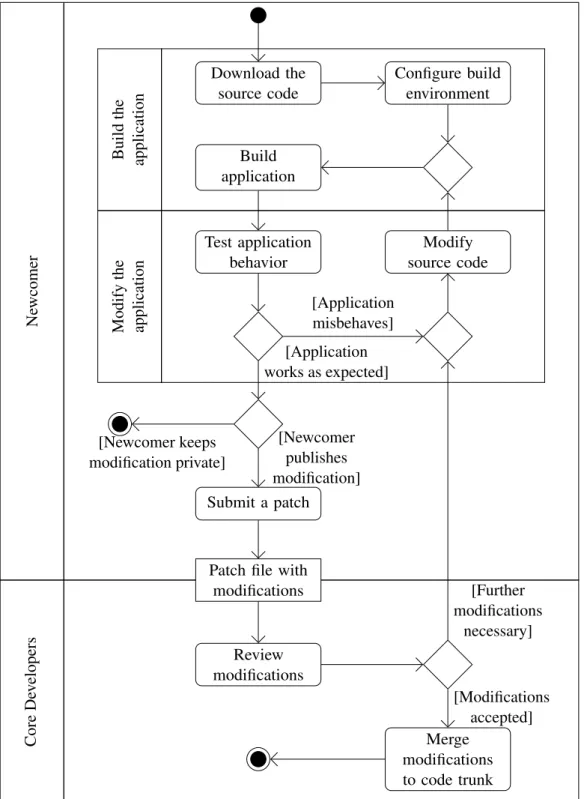
Figure 1.3 presents this process as a Unified Modeling Language (UML) activity diagram. UML swim lanes separate the tasks of the newcomer from those of the core developers. The process shall apply to most FLOSS projects and therefore abstracts from tasks that may be specific to individual FLOSS projects. Furthermore, the process focuses on the newcomer and simplifies the core developers’ tasks. For example, the diagram does not specify how the core developers select the reviewers of a patch among them and which methods they use for the review.
Build the application Modify the application Ne wcomer Core De v elopers Download the source code Configure build environment Build application Test application behavior Modify source code Submit a patch
Patch file with modifications Review modifications Merge modifications to code trunk [Application misbehaves] [Application works as expected] [Newcomer publishes modification] [Newcomer keeps modification private] [Further modifications necessary] [Modifications accepted]
1.1 Models of FLOSS Communities The joining process involves the three major activities Build the application, Modify the application, andSubmit a patch. Each of these activities involves sub-activities.
For the first major activity, Build the application, there are three sub-activities: Download the source code, afterwardsConfigure build environment, which may also involve setting up other parts of the Integrated Development Environment (IDE), and thenBuild application. Even applications written in interpreted programming languages need an interpreter that may require configuration. Of course, some newcomers may first only want to execute the application and only afterwards think about modifying it. Nevertheless, the mentioned activities are still required, but possibly with a different intention.
Afterwards, when newcomers Modify the application, they Test application behavior and may notice differences to the specification. This specification will often exist only as their personal expectation, for example when the application fails or when they need a feature that the application is missing. However, they might also have read specification documents in the form of tickets in the FLOSS project’s issue tracker. In any case, as long as the application misbehaves, the newcomer willModify source codeof the application and then repeat Build application and Test application behavior until the application works as expected.
As the last activity, the newcomerSubmit a patchwith the modifications back to the FLOSS project. Depending on the FLOSS project, this might literally mean the creation of a patch file in diffformat [HM76], but can also be something like a pull request in GitHub [P*Git15c]. The FLOSS project’s Core developersReview modificationsin this patch and decide whether to accept or reject the patch. The details of this process, like the number of reviews necessary and who exactly is eligible to review which patch depends on the FLOSS project. A core developer with appropriate rights will incorporate the modifications of an accepted patch into the main VCS of the FLOSS project in the activityMerge modifications to code trunk. The newcomer has the opportunity to rework rejected patches in further iterations of Modify the application and Build the application until they are accepted.
Each of the three major activities may have its own motivations and difficulties. As each activity necessarily requires the previous, one possible motivation for the earlier activities Build the application and Modify the application may be to reach the latter. For example, some newcomers may want to Build the application only because later they want to Modify the application. This is not always the case, though.
Build the application is necessary for using the application. Many FLOSS projects offer precompiled binaries, so most users will not have to perform this activity themselves. Modify the application can be a goal in its own right, when newcomers need a modified behavior for their own. Consequently, newcomers have motivations to use the application, to modify the application, and to submit their modifications back to the FLOSS project. These different types ofcontributor motivations will be called usage motivations, modification motivations, andsubmission motivations. Analogously, the difficulties related to the corresponding activities shall beusage barriers,modification barriers, andsubmission barriers. Modification barriers and submission barriers are the two kinds ofcontribution barriers, which will be defined more precisely in Section 1.3.
1.2 Contributor Motivation
This section outlines the state of research on FLOSS contributor motivation. A detailed description of all research work is outside the scope of this thesis, as FLOSS contributor motivation has been a domain of extensive research over the course of the last about 15 years. Von Krogh et al. [Kro+12] summarized the state of research on FLOSS contributor motivation as of 2011 with more details in a literature review. This section describes the main concepts and studies, especially in regard to new contributors.
Most, though not all research on FLOSS contributor motivation relies on self-determination theory (SDT) [GD05]. Like some of its predecessor theories, SDT distinguishes intrinsic and extrinsic motivations for an activity. Intrinsic motivations justify the activity itself, while extrinsic motivations justify the activity by its output. The joy of performing an activity is an example of an intrinsic motivation, while payment or praise for an activity are extrinsic motivations. While intrinsic motivations are always autonomous, extrinsic motivations differ in their degree of autonomy. A higher degree of autonomy results in a stronger motivation. Extrinsic motivations may be internalized and then have a higher degree of autonomy. Consequentially, some studies on contributor motivation have internalized extrinsic motivations as an additional class of motivations next to intrinsic and purely extrinsic motivations.
Theoretical works about FLOSS contributor motivation include the application of economical theories on FLOSS [LT02] and literature reviews [Kri06; Kro+12]. All other works known to me rely on empirical work which are on the one hand surveys of FLOSS developers and on the other hand analysis of public data from FLOSS projects like mailing lists. Theoretical and empirical works are difficult to compare, as the type of result of a study strongly depends on its methodology. Therefore this section presents theoretical and empirical works in separate subsections. The section concludes with how FLOSS projects can stimulate their contributors’ motivations through their attractiveness.
1.2.1 Theoretical Works
Early work on developer motivation includes Lerner and Tirole’s theoretical application of economic theories to the FLOSS phenomenon [LT02]. They explored reasons to explain the FLOSS phenomenon without stressing altruistic motivations and found egoistic reasons to work in FLOSS projects. They argued that there is a signaling incentive for FLOSS developers, as they increase their market value if they demonstrate their programming skills in a FLOSS project.
Ye and Kishida [YK03] agreed that altruism is not the main motivation for FLOSS developers, but they advanced the view that learning and social recognition are the most important intrinsic and extrinsic motivations for FLOSS developers. They derived this position from the onion model described in Section 1.1.1 and substantiate their claims with documented examples.
1.2.2 Empirical Works
Empirical surveys can be distinguished into open surveys, in which any interested FLOSS developer may participate, and closed surveys, which target a specific audience like the developers of a specific FLOSS project. While open surveys may suffer from a strong self-selection bias,
1.2 Contributor Motivation closed surveys only represent the situation in a specific and possibly atypical FLOSS project. Another type of empirical work is the analysis of public data about FLOSS projects such as VCS and issue tracker logs or mailing lists. Analysis of public data allows only indirect conclusions about the developers’ motivations. As a consequence of these different data sources, the empirical results often contradict or seem to contradict each other and there is no unified theory of FLOSS contributor motivation.
According to survey results of Hertel et al. [HNH03] and Hars and Ou [HO01], the enjoyment of programming is a major motivator for most developers. Besides this, pragmatic reasons such as needing the modification for their own project were most often mentioned not just in Hertel et al.’s, but also Lakhani and Wolf’s survey [LW03]. Improvement of one’s own programming skills was also frequently cited in these studies, and seems to be an important factor in starting FLOSS project involvement according to Gosh [Gho05]. David et al. found particularly high numbers of developers driven by the belief that source code should be open, and they should return something to the community for using it [DWA03].
As Krishnamurthy pointed out [Kri06], these surveys do not differentiate between different types of tasks within FLOSS projects. Types of tasks include but are not limited to usage
of the component, modification of the source code, and submission of resulting patches as described in Section 1.1.4. Exceptions include a survey of the motivation of active users instead of the developers within a FLOSS project [LH03], an analysis of the social structure in FLOSS projects [CH05b], and Benbya and Belbaly [BB10] also addressed this in a more recent survey of Sourceforge developers. Mair et al. [Mai+15] differentiated two types of tasks, source code contributions and mailing list participation in the community of the statistical FLOSS project R. However, they considered only three motivations: intrinsic, extrinsic, and hybrid. They showed that hybrid motivations have stronger effects on participation, and particularly extrinsic motivation is even negatively associated with mailing list participation.
Surveys that distinguish between modification motivations and submission motivations are rare, with Shah [Sha06] being the only exception I am aware of. In a qualitative empirical study using mailing lists and 88 interviews as data sources, she found that the primary usage and modification motivations are the developers’ own need, as they need the modification for themselves. Another identified reason is enjoyment of the coding task. However, the modification motivation ofnewcomerswas “need” in 42 out of 45 cases in her data set, i.e. they modified the application because they wanted to use the modification for themselves. Submission motivations were different and comparable to existing studies. Shah acknowledged that there are developers who modify the application but do not submit their modifications back to the FLOSS project, which is a consequence of the separation between modification and submission motivations.
Finally, most motivation surveys, again with Shah [Sha06] as the only exception, only looked at developers that are already developers in FLOSS projects, i.e. people who have mastered the onboarding phase. Their results are therefore likely biased towards the views of a small, but very visible minority of expert contributors, while the group of newcomers is much less visible and thus harder to reach.
1.2.3 Attractiveness
According to Steinmacher et al.’s model of a FLOSS community as described in Section 1.1.3, attractiveness is a property of a FLOSS project and a force that influences outsiders to become users and newcomers of the FLOSS project. When focusing on contributors of source code, attractiveness describes the properties of a FLOSS project that nourish contributor motivations of newcomers.
Ye and Keshida [YK03] postulated that Learning is an important contributor motivation. Hence, they suggested to design FLOSS projects in a way that enables learning, as that would increase the attractiveness of these FLOSS projects. Specifically, they suggested to favor programming languages that many developers want to learn over programming languages that many developers have mastered already.
Smaller FLOSS projects typically do not host their own technical infrastructure and instead rely on software forge services like Sourceforge [P*Sla15] and GitHub [P*Git15c] for their infrastructure [Rie+09]. Simmons and Dillon [SD06] proposed that software forge services should publish more metadata about their hosted FLOSS projects. With these metadata, interested developers will find it easier to acquire an overview over a FLOSS project and therefore have a higher chance to identify FLOSS projects that are interesting for them.
Steinmacher et al. gave the choice of license as one example for a factor influencing the attractiveness of a FLOSS project [SGR14]. However, current research contradicts each other on whether the choice of license has an effect on attractiveness and which type of licenses are more attractive [SAM06; CMP07; CF09; SSN09]. Other examples of attractiveness are project visibility, project age, and the number of developers [SGR14].
1.3 Contribution Barriers
Von Krogh et al. first introduced the term contribution barrier for hurdles that prevent newcomers to join a FLOSS project [KSL03]. This thesis uses the following definition:
Acontribution barrieris a property of a FLOSS project that has the ability to prevent motivated people from contributing source code modifications to the FLOSS project.
There are four types of research related to contribution barriers. First, a study may research a specific problem of FLOSS that is a contribution barrier. These studies usually do not refer to the contribution barrier concept, as the specific problem is an obvious research problem by itself. Second, there are studies that focus on the addition of new team members to existing software development projects and the problems with these additions. Since FLOSS projects are special cases of software development projects, these studies describe contribution barriers. Third, some studies describe how new developers join FLOSS projects. Fourth are studies that explicitly try to uncover or collect contribution barriers.
Subsection 1.3.1 discusses the rationale and implications of the above definition of the term contribution barrier and related definitions. The remaining part of this section describes related work of the four named types of research in detail.
1.3 Contribution Barriers
1.3.1 Rationale of the Definition
The definition of contribution barrier as stated at the beginning of this section is purposefully limited to source code contributions and excludes other types of contributions such as support to other users, documentation, or administration of a web site. These types of contributions also have their barriers, but they can be very different to the contribution barriers as defined here and therefore require a separate analysis that is outside the scope of this thesis.
The definition presupposes motivated people. This separates the broad field of contributor motivation as discussed in Section 1.2 from contribution barriers.
A contribution barrier only needs theabilityto prevent contributions and does not need to have prevented actual contributions to be seen as a contribution barrier. This is necessary as otherwise the context would influence which properties of FLOSS projects are contribution barriers and which are not. If the definition would omit this generalization, changes to the management of a FLOSS project would constitute new contribution barriers only after the changes had prevented contributions. Thus, the change of management itself would not impact contribution barriers directly, which would complicate discussions of those changes. Additionally, it would be impossible to discuss contribution barriers independently from specific FLOSS project contexts. Nevertheless, although a FLOSS project’s context is independent from theexistenceof contribution barriers, the context has a strong influence on theirimportance. Thus, the context has to be taken into account when evaluating contribution barriers.
Some research, for example that of Davidson et al. [Dav+14a], takes personal barriers into account. Personal barriers fulfill the definition of contribution barriers except that they are properties of the potential contributor and not of the FLOSS project. These personal barriers have been excluded from the definition because they either originate in a FLOSS project’s contribution barrier, in which case their separate consideration as personal barriers would be redundant, or they are not caused by the project, in which case there is nothing a FLOSS project could do about them.
Finally, while the definition is limited to FLOSS projects, a closed-source software development project may have properties that are equivalent to contribution barriers of FLOSS projects. Consequently, these properties may hinder development in the closed-source software develop-ment project. Thus, research results on contribution barriers can be applicable beyond the scope of FLOSS, but FLOSS is the medium of research. For example, a complex source code structure is difficult to understand for newcomers in both FLOSS and closed source projects. By definition, it is a contribution barrier only for FLOSS projects, but it is likely that closed source developers experience the same kind of difficulties as FLOSS developers when dealing with a complex source code structure.
As annunciated in Section 1.1.4, analogously to the structure of motivations, there are usage, modification, and submission barriers. Only modification and submission barriers constitute contribution barriers, as these directly hinder the contribution. Usage barriers will only be considered if they are characteristically more important for the modification than for the usage. For example, problems with the download of the application binaries is a usage barrier and will not be considered as contribution barrier, as the download is not even necessary for the modification – a newcomer may want to compile the application from source code anyway. On the other hand, if the FLOSS project develops a library, the libraries’ compilation can be
considered a contribution barrier, even if some users compile the library only for usage in their own applications. Borderline cases are rare, though, and the differentiation between pure usage barriers and contribution barriers is usually not difficult in practice.
The other end of the community spectrum also has its barriers: Occasional source code contributors, the co-developers, may have to overcome hurdles before they gain commit and review rights and become core developers. Section 1.1.2 already described related research from Zhou and Mockus on predictors for LTCs [ZM12]. These types of hurdles can be assumed to be very different to contribution barriers and are therefore also out of the scope of this thesis.
1.3.2 Specific Contribution Barriers
Section 1.1.2 describes the joining script as the activity an outsider has to perform to become a developer of the FLOSS project. The joining script is an informal, social process and therefore at most only partially documented. Adherence to the joining script can involve effort and therefore constitutes a contribution barrier by itself. [KSL03]
Furthermore, Jensen and Scacchi [JS07] observed that the joining script can be so sophisticated that mere understanding the joining script can be difficult for newcomers. Thus, understanding the joining script can be a contribution barrier. They further claim that this contribution barrier can be on a par with the technical contribution barriers.
FLOSS projects employ policies enforcing that submitted patches fulfill given requirements before the patches are merged into the main code repository. Successful code reviews from core developers of the patch are an omnipresent requirement. Rigby et al. [RGS08] described that these requirements may impose submission barriers. Slow code reviews frustrate the submitter. Furthermore, first contributions often do not adhere structural requirements. For example, a single patch file may include changes solving multiple issues, which may be against the policy.
The first and most difficult task when working on a new project is its first build, according to Fitzpatrick [SF09, p. 70f]. The first build requires setting up the IDE, solving issues with platform compatibility and library dependencies. Phillips et al. [PZB14] showed that builds often require substantial effort. The analyzed commercial companies maintained dedicated teams for the build. This shows that the effort required for the build may surpass the effort a possibly voluntary FLOSS developer may be willing to invest.
Midha et al. [Mid+10] proved statistically on 450 FLOSS projects that a low cyclomatic complexity [McC76] correlates with a high number of contributions from new developers. Therefore, a high cyclomatic complexity is a contribution barrier.
In an analysis of 1.4 million developers on GitHub, Terrell et al. [Ter+16] found evidence that gender-related factors influence the probability that a patch submission is accepted. The first result shows that women’s patches are more likely to be accepted than men’s. However, they argue that this is not related to the FLOSS project but to the developer and therefore does not qualify as a contribution barrier as per the definition of this thesis. They also show that acceptance rate drops if the author’s gender is recognizable and that this effect is stronger for women than for men. Thus, sensitivity to the gender of newcomers and possibly to their self-portrayals is a contribution barrier.
1.3 Contribution Barriers
1.3.3 New Developers in General Software Development Projects
Brooks [Bro95, Chap. 2] analyzed the effect of new developers on the schedule of a software development project. The new developers require training, so existing trained developers are busy mentoring the new developers and are less productive during that time. Brooks’s Law simplifies this dilemma as “Adding manpower to a late software project makes it later”.
Sim and Holt [SH98] observed seven patterns occurring when new developers join a software development project. They derived these patterns in an exploratory case study, in which they interviewed four new developers in software development project. They also described a course that they introduced for new developers. They believed that the course remedies some of the obstacles identified in the patterns. The exploratory study tried to carve out possible problems of new developers joining a software development project but did not quantify them. Consequently, it is unclear which of the patterns are specific to the software development project of their case study and which apply generally. Nevertheless, they found as a common theme among the seven patterns that some tasks are more frustrating than others and this does not depend very much on their difficulty or the time required to solve them, but in their perceived usefulness. For example, pattern three states that administrative tasks not directly related to the programming job are frustrating, while even difficult programming tasks do not decrease the motivation to work.
This finding may be even more important in the context of FLOSS, where there are often no external incentives for the work like the salary in closed-source software development projects. If a volunteer developer must perform a frustrating task in order to join a FLOSS project, the developer possibly refrains from joining the FLOSS project. Thus, frustrating, required tasks are by definition contribution barriers.
Begel and Simon [BS08] also stated that a problem that hinders new software developers from being productive, i.e. programming, “frustrates them” [BS08]. They observed eight new software developers at Microsoft over a period of about two months. These new software developers joined Microsoft immediately after leaving University and therefore had no or almost no experience in professional software development. Hence, the focus of their study lay on novices joining a software development project and not on experts joining a software development project, which would presumably better represent the situation of an onboarding newcomer in a FLOSS project. However, they identified some difficulties that may also apply to expert newcomers. Concretely, they collated the difficulties into the five categories Communication, Collaboration, Technical, Cognition, and Orientation. A central, cross-domain difficulty is asking others for help. The decision when to ask others for help is a Communication and Cognition difficulty, and whom to ask for help is an Orientation difficulty. The new developers feared that asking too many questions could be interpreted as a sign of incompetence, and therefore had a tendency to spend hours on problems that could have been solved quickly with the help of a more senior teammate. Collaboration difficulties comprised reluctance to urge other teams to finish prerequired legwork, and reluctance to decline tasks if they exceeded the new developer’s time capacities. The later difficulty resulted in bad prioritizations. In the Technical category, the study concluded that “tools [. . . ] were often a source of difficulty”. Participants had trouble to use the VCS, they had no access to test systems, and the development environment was unfamiliar. They also had difficulties to locate the position in the source code to be modified to implement a given change request.
In a qualitative study based on Grounded Theory, Dagenais et al. [Dag+10] interviewed 18 experienced software developers at International Business Machines Corporation (IBM) who recently joined an ongoing software development project. They determined “Orientation Aids” that helped the developers naturalize in a software development project, and “Obstacles” that made the naturalization harder for them. They classified items in the four categories “Early experimentation”, “Internalizing structures and cultures”, “Progress validation”, and “Cross-Factor”. There are three obstacles in the early experimentation phase: First, setting up a working IDE took between one week and two months. One of the interviewed developers dubbed this setup time as “lost”, so this developer perceived the IDE setup as less desirable than the main job, which is programming. The second obstacle are tools unique to the project, which is closely related to the first obstacle. Third, and contrary to Sim and Holt, upfront courses were seen as a cumbersome duty and slowing down the naturalization with the technical and social environment. A lack of documentation was the only obstacle for internalizing structures and cultures. The category progress validation comprises the three obstacles “Inadequate/No Feedback”, “Sensitive Tasks”, and “unprofessional/no feedback”, but the paper referred to them only superficially and never defined them, so it remains unclear what these obstacles are exactly and how they differ from each other.
Yates [Yat14] also used Grounded Theory to analyze mentoring. She approached mentoring from the program comprehension perspective and described current problems and improvements of onboarding sessions, in which experts transfer knowledge to new developers. Improvement suggestions were mostly micro-optimizations of onboarding sessions, but they also hint at general contribution barriers: Setting up the development environment is difficult for new developers, and each project uses its own terminology that new developers have to learn before they can communicate effectively.
1.3.4 Joining FLOSS Projects
Herraiz et al. [Her+06] analyzed the joining scripts of the GNOME project [P*The15e]. They recognized that there are multiple different ways to join GNOME as a developer. In particular, 7 of 8 analyzed volunteers joined GNOME adhering the onion model described in Section 1.1.1: They first post a message on the mailing list and only afterwards they report a bug, submit a source code modification, and eventually gain commit rights to the VCS. All members of a second group of 12 employees and university staffmembers used a different sequence, starting almost simultaneously with a message in the mailing list, bug reports, source code submissions, and VCS commits. However, the results may be seen as debatable, since the raw data presented in the paper seem to contain exceptions to those sequences described in the test.
Weiss et al. [WMZ06] showed that developers sometimes join FLOSS projects in groups: there are cases where multiple developers that collaborate in one FLOSS project join another FLOSS project together. In these cases, social contribution barriers are presumably lower than in cases where an outsider wants to join a FLOSS project, because only in the latter cases all developers are unknown to the outsider.
Bird et al. [Bir+07] found that joining a FLOSS project requires the acquisition of project-specific skills. This acquisition takes time. Table 1.1 shows the median times newcomers need for their first patch submission and acceptance for the three FLOSS projects Bird et al. had analyzed.
1.3 Contribution Barriers They also showed that motivation to join a project declines over time after initial contact with the project. Although the study did not explicitly state this, consequentially FLOSS projects that require long naturalization will gain less new developers.
Table 1.1: Time needed to acquire project-specific skills [Bir+07] Median time after the first email to the mailing list until . . . FLOSS project . . . first patch submission . . . first patch acceptance
Postgres 2. month 3. month
Apache 2. month 10. month
Python 6. month 13. month
Jergensen et al. [JSW11] found evidence that the majority of FLOSS developers dedicatedly use the VCS system, and no social mediums like mailing lists. One explanation they proposed is that these developers may have socialized in related FLOSS projects and therefore were already well-known in the community of the FLOSS project. This indicates that prior exposure to FLOSS projects reduces the effect of social contribution barriers.
Practitioners have also reflected on joining scripts. Turnbull [Tur14] exposed the key parts of typical joining scripts from a practitioner’s view. He emphasized the importance of polite communication both of newcomers as well as of existing developers of a FLOSS project, and explained that lack of kindness can be a contribution barrier. The technical part may sometimes be the easier part of a contribution to a FLOSS project than engaging in its culture and community. He pointed out that the setup of the development environment is the first step of a code modification. This must therefore be “incredibly easy”, as newcomers may not have acquired a high enough modification motivation yet to overcome considerable modification barriers. He argued that contribution barriers can be lower when the first modifications are on documentation and tests: Both are often neglected in FLOSS projects and thus the community welcomes this type of contributions. Another modification barrier is the lack of readability of the code, and code comments can lower this modification barrier.
1.3.5 Exploring Contribution barriers
Von Krogh et al. [KSL03] first described the concept of a “contribution barrier” in their analysis of the Freenet project. They explained that for each module of a FLOSS project, the contribution barrier is a set of the following four hurdles that prevent newcomers from modifying that module:
1. The module itself can be difficult to modify.
2. The programming language of the module may be unfamiliar to newcomers or just unsuited for the task.
3. The architecture of the FLOSS project may lack Application Programming Interfaces (APIs) to add new modules.
4. Tight coupling between modules may require newcomers to modify more modules than they are willing to.
These contribution barriers were derived from interviews of developers of the Freenet FLOSS project. These contribution barriers are therefore specific to Freenet and to the time of the interviews.
Practitioners also reflected about contribution barriers. Naramore [Nar10] asked the developers among her Twitter followers who had not yet contributed to a FLOSS project via a Twitter poll for their reasons to abstain from contributing. She received 264 responses. The three most frequent replies had the following order: First, they did not have enough time. Second, they were “not sure where or how to contribute”. Third, they lacked confidence in their skills. She also suggested some techniques to lower these contribution barriers.
Sethanandha et al. [SMJ10a] analyzed contribution processes in FLOSS projects. First, they reviewed current literature and then examined 10 FLOSS projects. The literature review yielded four specific submission barriers, specifically
• differences in tool sets between projects,
• long delays for reviews,
• lost patches that never receive a review, and
• rejected patches.
Steinmacher et al. collected contribution barriers [Ste+14a; Ste+15a] from different sources: They mined the mailing list as well as the issue tracker of the FLOSS project Hadoop and interviewed 11 people who failed joining Hadoop [Ste+13], monitored nine students joining FLOSS projects in a controlled experiment [Ste+14b], analyzed existing research in a systematic literature review for contribution barriers [SSG14; Ste+15b], and interviewed 36 developers of nine different FLOSS projects [Ste+14a].
With the results of the individual studies, Steinmacher et al. created a hierarchical classification for 58 individual contribution barriers. Contrary to the definition in this thesis, the classification contains a categoryNewcomers’ Characteristics that includes 17 barriers not depending on the FLOSS project but only on the newcomers. Aside from Newcomers’ Characteristics, five categories remain.Reception IssuesandCultural Differencescomprisesocial barriersrelated to the communication with the FLOSS project’s community. Contribution barriers in the category
Documentation problems cover different kinds of missing, incorrect, incomprehensible, and inaccessible documentation. Notably, problems with code comments also fall into this category. Steinmacher et al. also proposed the categoryNewcomers need orientationthat describes how newcomers may have difficulties to understand the technical and organizational structure of the FLOSS project. The largest category of contribution barriers isTechnical Hurdlesdepicted in Figure 1.4.
As shown in Figure 1.4, Technical Hurdles comprise a hierarchy consisting of five sub-categories. Local Environment Setup Hurdles contains the only technical hurdle for which Steinmacher et al. found evidence in all four data sources, “Building workspace locally”. The
1.3 Contrib ution Technical Hurdles Code/Architecture Hurdles Code Characteristics
Bad Code Quality
Code Complexity/ Instability
Codebase Size
Bad Design Quality
Lack of Code Standards Outdated Code Cognitive Problems Understanding the Code Understanding Architecture/ Code Structure Understanding Flow of Information Change Request Hurdles Lack of Information on How to Send a Contribution Delay to Get Contribution Accepted/Reviewed Getting Contri-bution Accepted Issue to Cre-ate a Patch Local Environment Setup Hurdles Building Workspace Locally Platform Dependency Library Dependency
Finding the Cor-rect Source
categoryChange Request Hurdles encompasses technical submission barriers occuring after the source code modification is already complete. Another technical hurdle with substantiated evidence is “Understanding the code”. However, its category nameCognitive Problemssuggests that Steinmacher et al. saw this more as a problem of the newcomers instead of a contribution barrier that the FLOSS project induces. Possible sources inside the FLOSS project for these problems of contributors are barriers in the categoryCode Characteristics. This category com-prises modification barriers such as “Bad Code Quality” and “Codebase Size”, for both of which Steinmacher et al. presented sound evidence.
Davidson et al. specialized on older developers in FLOSS projects, which includes those older than 50 years by their definition. As part of this research, they also collected contribution barriers that these older FLOSS developers experience. They interviewed 11 older FLOSS developers and 6 FLOSS maintainers [Dav+14b], and they performed a diary study with 4 older FLOSS developers in the process of joining their first FLOSS project [Dav+14a].
In the interviews, 5 of the 11 older FLOSS developers stated that they experienced technical challenges on their first contribution, and 2 mentioned social challenges on their first contribution. The technical challenges included difficulties understanding the source code, and adopting to the development environment. [Dav+14b]
The diary studies identified lack of communication as the most important contribution barrier, followed by problems setting up the development environment, and insufficient documentation. Other contribution barriers were mentioned, but much less frequently. [Dav+14a]
Gousios et al. [GPD14] mined GitHub for data about patch submissions, or “pull requests” in GitHub terminology. This included reasons for rejections. After a rejected patch, a developer may improve the patch or submit a patch for another issue, and therefore still join the FLOSS project as a developer. A patch rejection nevertheless constitutes a contribution barrier [SMJ10a], as co-developers are likely not to submit a patch again after rejection [Bay+12]. Thus, the reasons for rejection also indicate contribution barriers.
Of all patches identified as rejections (excluding themerged,deferred, andunknownreasons described in the paper), the reasons for rejection were
• in 43 % of the cases, another developer was currently developing or already had developed the same feature,
• in 24 % of the cases, the submitted patch was erroneous or otherwise incorrect,
• in 17 % of the cases, the patch did not fit the FLOSS project’s strategy, and
• in 16 % of the cases, the submission deviated from the FLOSS project’s submission procedures.
Tsay et al. [TDH14] also mined GitHub to study patch submission, but focused on predictors for acceptance of a patch. The predictors split into three groups: First are predictors directly related to the patch, like the number of files that have been modified. Second are predictors related to the contributor. Third are predictors related to the FLOSS project. In all categories, the study found multiple statistically highly significant predictors. The three project-related predictors are the age of the FLOSS project, its number of developers, and a measure for the popularity of the FLOSS project among the developer community. All three predictors decrease the chances
1.3 Contribution Barriers of acceptance statistically highly significantly. The FLOSS project’s popularity has the highest impact of the three predictors. Among the most influential predictors in general is the social distance between contributor and the FLOSS project’s community. As one interpretation, new developers who have not yet arrived in the FLOSS project’s community may have difficulties to get their contribution accepted.
Gousios et al.’s [GPD14] finding that the cause for 43 % of the rejections is redundant development of a patch by multiple developers yields another interpretation: Developers watching a FLOSS project closely notice more quickly if there is a parallel development and may resolve the redundancy before anybody submits a patch. Thus, those developers do not submit redundant patches to be rejected.
1.3.6 Summary of Contribution Barriers
There are multiple possible classifications of contribution barriers. This thesis mostly differentiates between modification and submission barriers. Another remarkable classification distinguishes between social and technical contribution barriers. Other classes in this classification are political and juridical contribution barriers, for example requiring the contributor to sign a contract that the contributor’s employer does not allow or a country’s export restrictions to source code implementing strong cryptography. However, political and juridical contribution barriers seem to have almost no relevance in research.
There are systematic studies of contribution barriers, but they rely on a thin empirical foun-dation. Anyhow, Steinmacher et al. [Ste+15a] aggregated multiple of those studies to come to more reliable conclusions. Assured or even quantitative propositions about contribution barrier incidence are not possible from existing research, but some contribution barriers stand out:
• Installation, configuration, and familiarization with the tools in the development environ-ment. This applies particularly to tools unique to the software development project. This barrier exists not only for FLOSS projects, but is also well documented for closed source software development projects. [SF09; Dag+10; SMJ10a; Tur14; Ste+14a; Dav+14b; Dav+14a; Yat14]
• Redundant work is a frequent reason for rejected patches. Surprisingly, only one study indicates this problem, although the study founds on a large data set. [GPD14]
• Low quality source code impedes contributions [KSL03; Tur14; Ste+14a]. Specifically a high cyclomatic complexity is a contribution barrier [Mid+10]. Although this barrier is not limited by design to FLOSS projects, I found no research connecting this problem to closed source projects. However, the barrier is difficult to detect in small data sets as they are typically available to studies of closed source systems.
• Understanding the joining script and adhering it is a contribution barrier by itself [KSL03; JS07; Ste+14a].
• The patch review process involves different steps that can be contribution barriers [RGS08; SMJ10a; Ste+14a].
• Several studies observed lack of documentation and difficulties with communication or general understanding [Ste+14a; Dav+14b; Dav+14a]. It remains unclear whether other, more specific contribution barriers are the underlying cause for these observations. This may be a modification or a submission barrier, and existing research offers little pointers to one direction or the other, because they most commonly do not distinguish between the two types of contribution barriers.
Generally, tasks become contribution barriers if they are frustrating. Some tasks are not frus-trating and therefore do not act as contribution barriers, even if they are time-consuming. [SH98; BS08]
The onboarding phase takes between 3 and 13 months in median from the first involvement with the FLOSS project till the first acceptance of a patch [Bir+07]. The specific duration depends on the FLOSS project and on the newcomer. During the onboarding phase, existing developers need to spend resources to support the newcomers with onboarding. This costs resources that cannot be used for actual development. This is also a consequence of Brooks’s Law [Bro95, Chapter 2], which will be discussed in the next section in more detail.
1.3.7 The Effect of Lowered Contribution Barriers
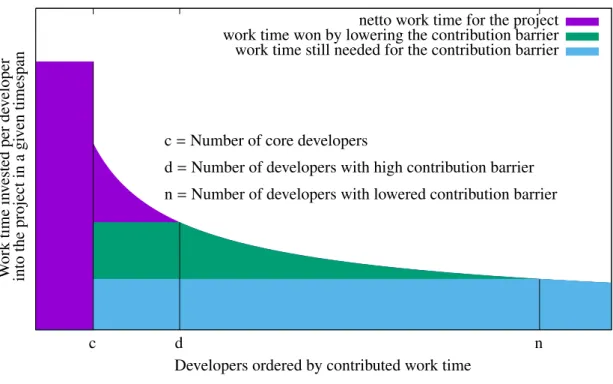
Steinmacher et al. [Ste+15a] discussed two potential problems of lowered contribution barriers. First, a higher number of co-workers in a cooperative work increases the coordination overhead and may therefore ultimately decrease productivity. Second, contribution barriers may act as gatekeepers that filter out those newcomers who lack technical or social skills or otherwise just do not fit into the FLOSS project’s community. This section incorporates Steinmacher et al.’s discussion of these problems including counterarguments and further reflects on the effects of lowered contribution barriers.
Brooks’s Law
Brooks [Bro95, Chapter 2] discussed the problem of increased coordination overhead by adding manpower to software projects. He argued that there are generally partitionable and unparti-tionable tasks. While the former will speed up when assigning additional workers to them, the latter will not benefit. Furthermore, adding workers has two disadvantages: New workers need training before they perform well, and a task may need intercommunication between its workers. Both negatively affect existing workers, because they must train the new workers and coordinate with them instead of their actual work. This lost performance may be greater than the added performance of the new workers, at least in the short term, so overall performance may actually decline after adding new workers to a task.
Raymond argued that Brooks’s Law applies only to the core developers of a FLOSS project and that co-developers need only very little coordination, as they work on easily separable subtasks [Ray00]. Capiluppi and Adams [CA09] and later Adams et al. [ACB09] found empirical support for Raymond’s argument against the intercommunication problem of Brooks’s Law in FLOSS projects. This is a result of the community structure of FLOSS projects: Some are scale-free networks, in which communication follows a power distribution over the community [Xu+05;
1.3 Contribution Barriers WMZ06]. Nevertheless, the loss of productivity through the training phase does exists [ACB09]. However, the training phase is the lesser of the two problems [Bro95, p. 18].
Other online communities also have barriers for participation. Especially wikis are also similar to FLOSS development, as they enable their users to contribute to the project. Assuming that communities of FLOSS and wiki projects have similar mechanics, it is interesting to look at the equivalent question for wikis: Do wikis suffer from a communication overhead when the number of contributors grows? Kittur et al. showed that the coordination overhead in Wikipedia increased over time while Wikipedia has been growing [Kit+07b]. Kittur and Kraut showed that this also applies to other wikis: More contributors result in more inefficiency [KK10].
Contrary to Brooks’s Law, research has shown that a high influx of new developers is related to the success of FLOSS projects [Sch+08; CSD10; CLM03; CAH03]. Additionally, Brooks argued that complex applications need large development teams to be successful, even if they are less efficient [Bro95, Chapter 3].
Contribution Barriers as Gatekeepers
Overcoming technical contribution barriers requires technical skill, and only those newcomers with social skills overcome the social contribution barriers. Thus, contribution barriers keep out newcomers with a lack of technical or social skills. Having a smaller group of skilled developers may be better than a larger group of mostly less skilled developers. Thus, the contribution barriers may positively act as gatekeepers for the FLOSS project. [Duc05]
Indeed, Sackman et al. found high performance differences of 25 to 1 between skilled and unskilled programmers [GS67; SEG68]. Unskilled programmers would therefore aggravate the problem of communication overhead described above, as their minor contributions cannot compensate the communication overhead necessary for their integration into the development team. However, Prechelt showed that the original figures of 25 to 1 were based on methodological problems and the interpersonal variation is in fact only between 2 to 1 and 4 to 1 [Pre99]. Consequently, technical contribution barriers have at most a low value as gatekeepers for technical skills.
Social contribution barriers presumably also do more harm than good: On the one hand, Ducheneaut [Duc05] argued that contribution barriers help filter out those individuals who do not fit into the FLOSS project. On the other hand, he admitted that contribution barriers are also problematic for the useful newcomers. Furthermore, advertising social requirements more explicitly, for example rules of netiquette [Ham95], would reduce the social contribution barriers that these social requirements cause: newcomers could socialize more quickly and with less problems.
Again, a comparison to wikis may yield additional insights. Do wiki contribution barriers have a positive value as gatekeeper or do they lower the performance of a wiki project? Kittur et al. found that a group of very involved core contributors in Wikipedia provided an initial thrust to the project, but later on, casual contributors became more and more important for the overall per-formance of Wikipedia [Kit+07a]. Kittur and Kraut also proved that article quality in Wikipedia improved with higher numbers of contributors, and that this is only possible with increased communication [KK08]. This is an analog to Linus’s Law of FLOSS development [Ray00, Rule 8]. Thus, more contributors in Wikipedia increase the quality but also the communication
![Figure 1.2: Steinmacher et al.’s FLOSS joining model [SGR14]](https://thumb-us.123doks.com/thumbv2/123dok_us/11055798.2992507/12.892.154.748.650.901/figure-steinmacher-et-al-floss-joining-model-sgr.webp)