Securing Remote Access Inside Wireless Mesh Networks
(Full Version)
Mark Manulis Cryptographic Protocols Group Department of Computer Science TU Darmstadt & CASED, Germany
Abstract. Wireless mesh networks (WMNs) that are being increasingly deployed in communities and public places provide a relatively stable routing infrastructure and can be used for diverse carrier-managed services. As a particular example we consider the scenario where a mobile device initially registered for the use with one wireless network (its home network) moves to the area covered by another network inside the same mesh. The goal is to establish a secure access to the home network using the infrastructure of the mesh.
Classical mechanisms such as VPNs can protect end-to-end communication between the mobile device and its home network while remaining transparent to the routing infrastructure. In WMNs this transparency can be misused for packet injection leading to the unnecessary consumption of the communication bandwidth. This may have negative impact on the cooperation of mesh routers which is essential for the connection establishment.
In this paper we describe how to establish remote connections inside WMNs while guaranteeing secure end-to-end communication between the mobile device and its home network andsecure transmission of the corresponding packets along the underlying multi-hop path. Our solution is a provably secure, yet lightweight and round-optimal remote network access protocol in which inter-mediate mesh routers are considered to be part of the security architecture. We also sketch some ideas on the practical realization of the protocol using known standards and mention extensions with regard to forward secrecy, anonymity and accounting.
1
Introduction and Motivation
The increasing deployment of wireless networks in urban areas set up in private households and in public places offers high potential for ubiquitous communication to mobile clients. A promising approach for combining the power of different wireless networks, possibly under distinct administrative control, while expanding their overall coverage area is the composition into awireless mesh network (WMN)through the deployment of dynamic routing protocols such as AODV [24], DSR [18], LQSR [13]. In this way a WMN consists of individual nodes (routers) which communicate with each other over wireless links in a multi-hop fashion. Many current WMNs are based on WLAN standards (IEEE 802.11a/b/g) so that mesh routing is performed at the network layer. A more efficient WMN infrastructure with mesh routing at the link layer is currently being specified within IEEE 802.11s. In contrast to a more general form of ad-hoc networks WMNs enjoystatictopology with mostly stable routing infrastructure. This infrastruc-ture allows for various carrier-managed services, which may also apply amongst wireless networks that compose thesamemesh. One of them is the remote network access.
A typical urban WMN connects not only residential networks but also networks of institutions of public interest such as civil administration, police station, doctor’s office/surgery, etc. Such networks (which we refer to ashome networks) can be accessed by employees through the mobile devices ini-tialized for this purpose while being in the proximity of the corresponding access points. On the other hand, it is desirable to allow remote access to these networks from locations covered by other wireless Information Security Applications: 10th International Workshop, WISA 2009, Busan, Korea, August 25-27, 2009.
networks, which are still part of the same mesh. For example, doctors visiting patients at home or em-ployees of a local health authority while inspecting restaurants in the neighborhood may wish to remotely access databases and application servers in their institutions in order to perform tasks that they would usually do within their native environment. Observe that these scenarios do not assume high mobility of the clients and the established WMN routing path will likely remain unchanged for the whole duration of the session.
An important security goal of a remote network access protocol is to protect the end-to-end commu-nication between the device and its home network, in particular to protect the application content from being eavesdropped or modified during its transmission. Another significant problem in WMNs is that intermediate mesh routers are under different administrative control and that their cooperation is cru-cial for the establishment and maintenance of the remote session. A promising approach to increase this cooperation and so improve the robustness of the remote connection is to deploy additional incentive mechanisms [9], e.g. let the home network reimburse the cooperating mesh routers for resources that they allocate to establish and maintain the remote session. It is clear that traditional end-to-end security mechanisms (such as IPsec VPNs) that are transparent to the underlying routing infrastructure do not adequately reflect the additional security needs of cooperating mesh routers along the remote path.
1.1 Refining End-to-End Protection with the Concept of Path Security
With traditional authentication and key establishment protocols for end-to-end security the mobile device and its home network can compute the secretend-to-end keyfor the session after authenticating each other. This key is sufficient to protect the application data exchanged between the device and its remotely accessed home network.
Nevertheless, the communication nature of WMNs allows the adversary to inject packets into the wireless channel and although the deployed end-to-end protection will prevent the end points from ac-cepting such rogue packets the cooperating mesh routers on the path will not be able to distinguish them from the “good” packets originated by the end points. As a consequence, mesh routers will forward rogue packets, thus wasting their own (costly) communication resources. This illustrates the need of stronger protection mechanisms that would ensure authentication at the packet level as well.
We observe that the above problem comes from the missing binding between the end-to-end protected (application) channel and the underlying multi-hop WMN channel. In this work we investigate how to efficiently bind these independent channels for the duration of the remote session.1 Our solution is to
refine the traditional concept of end-to-end security by achieving similar goals for the underlying path (path security). More precisely, we provide all entities involved into the remote session, i.e. the mobile device, its home network, and intermediate mesh routers, with the ability to compute an additionalpath keyas a by-product of an authentication protocol for the establishment of the end-to-end protected remote connection. In order to ensure security of this path key we also require authentication of intermediate mesh routers and the end points during the execution of this protocol. In this way the application content exchanged between the mobile device and its home network can be still protected using the end-to-end key whereas the path key will protect the multi-hop transmission of corresponding packets along the established path, thus thwarting possible resource consumption attacks on the mesh routers. The existence of the path key shared amongst the end points and the mesh routers may also offer further application-specific benefits once the remote connection is established. For example, it can be used to protect control messages used in quality-of-service (QoS) mechanisms in some real-time applications such as VoIP.
1
We remark that for networks with frequent route updates and for applications with highly mobile clients it would be rather undesirable to bind the application session to the underlying routing path. Yet,insideWMNs where the routes are rather stable and for remote sessions in which the clients remain static (as in our application examples) this binding is a promising practical method to provide stronger security guarantees for the remote connection.
1.2 Related Work
The security architecture for WLANs specified in IEEE 802.11i provides an authenticated network ac-cess of a mobile device to a wireless network with additional computation of a session key. The authenti-cation can be based on pre-shared keys (WPA, WPA2) or use the IEEE 802.1X specifiauthenti-cation based on the EAP framework [2], the latter is often used in combination with a RADIUS authentication server. How-ever, IEEE 802.11i has been designed for single-hop connections and is, therefore, not directly applicable for WMNs. A direct extension of IEEE 802.11i to a multi-hop scenario has been described in [22]. Fur-ther, with PANA [14] there exists an authentication carrying protocol that can encapsulate EAP messages and transmit them in a multi-hop fashion across WMNs as described in [10, 19]. In this way any EAP method, e.g. using username/passwords [11], shared keys [7], or public-key certificates [17, 25], can be applied. Alternatively, end-to-end security between the mobile client and its home network can be established using IPsec VPN tunnels.
The previously mentioned solutions, especially using current EAP methods, have been designed to achieve the classical end-to-end security goals. Therefore, they do not include any mechanisms that would be sufficient for the requirements of path security. In particular, they offer no protection against the impersonation of mesh routers and resource consumption attacks. On the other hand, with LHAP [29] there exists a light-weight authentication protocol (based on one-way hash functions) that can be used to obtain packet authentication in multi-hop communication scenarios. But LHAP was not designed to establish an end-to-end secure connection which is inherent to our setting. Moreover, LHAP does not offer mutual authentication between the mesh routers and the accessed home network.
Finally, we mention that the notion of path authentication is frequently used in the literature on rout-ing protocols, especially in the context of secure route updates and announcements [26–28]. However, this process is oblivious to the actual application and is therefore not applicable in our case.
1.3 Organization
In Section2we describe our remote network access protocol, calledSERENA, that simultaneously achieves the requirements of end-to-end and path security through the corresponding binding of the application channel to the underlying mesh path. In addition we provide some remarks on its efficiency and describe ideas on how to realize the protocol in practice using known authentication standards. In Section3we specify a single formal model for a secure remote network access protocol inside the wireless mesh cap-turing the mutual authentication and key establishment goals within the concepts of end-to-end and path security. The concept of path security is thereby modeled through the consideration of mesh routers as an inherent part of the security architecture. We utilize the classical modeling techniques from [5] which we extend to the multi-hop setting of WMNs. Following the model, in Section4we formally argue on the security of our protocol. Finally, in Section5we briefly discuss some further extensions regarding forward secrecy of the computed keys, anonymity of the mobile client with respect to the mesh network infrastructure, and accounting between the networks.
2
SERENA: A Single Protocol for End-to-End and Path Security
Here we introduceSERENA— our protocol for the secure remote access of the mobile deviceMto its wireless home networkHusing intermediate mesh routers{Ri}i, all belonging to the same mesh.
2.1 Notations and Building Blocks
– Apseudo-random functionPRF:{0,1}κ× {0,1}∗ → {0,1}∗which is used for the purpose of key derivation and can be realized using block-ciphers or keyed one-way hash functions. ByAdvprfPRF(κ) we denote the maximum advantage over all PPT adversaries (running within timeκ) in distinguish-ing the outputs ofPRFfrom those of a random function better than by a random guess. We usePRF to derive various keys and sometimes we assume that the output is split in two parts, e.g.PRFwith expansionsuch as the one defined within the TLS standard and analyzed in [15] can be used for this purpose.
– An asymmetric encryption schemesatisfying the property of indistinguishability under (adaptive) chosen-ciphertext attacks (IND-CCA2) whose encryption and decryption operations are denoted Enc andDec, respectively. By Advind-cca2
(Enc,Dec)(κ)we denote the maximum advantage over all PPT
adversaries (running within timeκ) in breaking the IND-CCA2 property of(Enc,Dec)better than by a random guess; The property of IND-CCA2 security is for example preserved in several encryption schemes including RSA-OAEP [16] and DHIES [1].
– A digital signature scheme with existential unforgeability under chosen message attacks (EUF-CMA) whose signing and verification operations are denotedSigandVer, respectively. BySucceuf(Sig-,cmaVer)(κ)
we denote the maximum success probability over all PPT adversaries (running within timeκ) given access to the signing oracle in finding a forgery; examples of such schemes include DSS [23] and PSS [6].
– Asequential aggregate signature schemewith existential unforgeability under chosen message at-tacks (EUF-CMA) whose aggregate signing and verification operations are denotedASigandAVer, respectively. BySucceuf(ASig-cma,AVer)(κ)we denote the maximum success probability over all PPT
adver-saries (running within timeκ) given access to the aggregate signing oracle of an uncorrupted signer in finding an aggregate signature forgery; for formal security definitions and construction examples we refer to [20, 21].
– Amessage authentication codefunctionMACwithweak unforgeability against chosen message at-tacks (WUF-CMA) [4], e.g., the popular function HMAC [3] can be used for this purpose. By SuccwufMAC-cma(κ)we denote the maximum success probability over all PPT adversaries (running within timeκ) given access to theMACoracle in finding aMACforgery.
2.2 Initialization ofSERENA
We assume that prior to the execution of Π the involved parties are in possession of the following long-lived keys: LLi of each mesh router Ri consists of a private/public signature/verification key
pair(ski, vki)which is suitable for the deployed aggregate signature scheme(ASig,AVer)and a de-cryption/encryption key pair(dki, eki);LLHconsists of a private/public signature/verification key pair (skH, vkH)which is suitable for the digital signature scheme(Sig,Ver) and a pair(M,(kM,αM)) where(kM, αM)is a high-entropy secret key consisting of aPRFkeykMand aMACkeyαMshared with the hostedM;LLMconsists of(kM, αM). In practice it is sufficient forHandMto sharekM and derive the correspondingMACkeyαMasPRFkM(l)for some publicly fixed labell. Further, we as-sume that the public keys of all routers of the same mesh (including the home networkH) are known. Note that due to the static infrastructure of wireless mesh networks this assumption is feasible (this is clearly in contrast to (dynamic) ad-hoc networks where such assumptions are undesirable).
2.3 LightweightSERENA— Specification
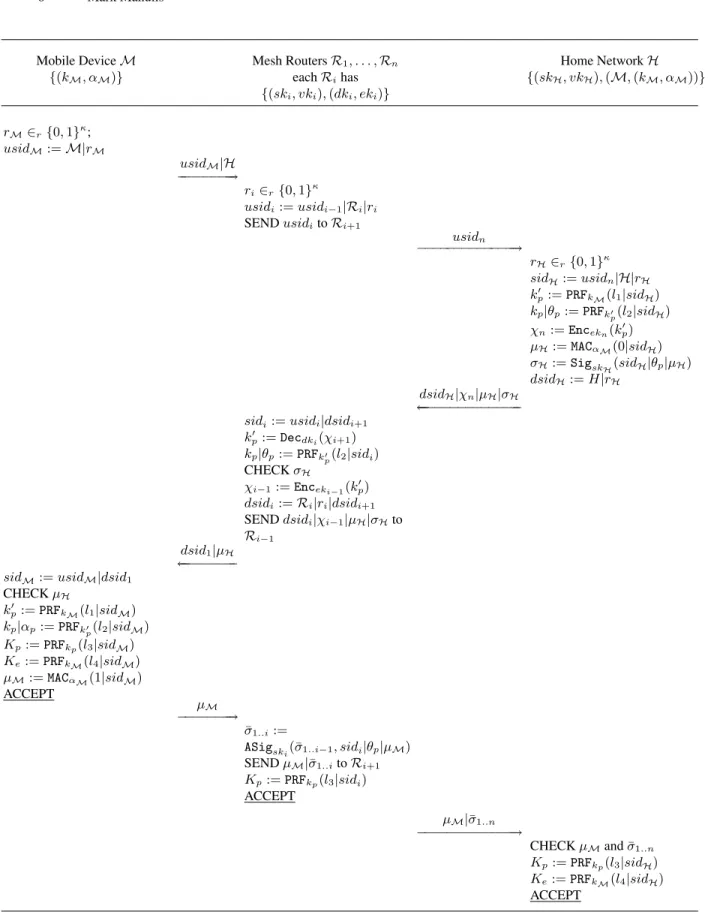
The detailed specification of lightweightSERENAis illustrated in Figure1. For the clarity of presenta-tion we assume that the path betweenMandHthrough the mesh network is given by a sequence of intermediate mesh routersR1, . . . ,Rnwhereby eachRiknows the next hop routerRi+1as a result of
underlying routing mechanism. In the following we highlight howSERENAmerges end-to-end protection with path security.
SERENA uses distinct labelsli,i = 1,. . .,4, which are fixed in advance, as input toPRF for the
derivation of different keys. Also, during the execution each partyP ∈ {M,{Ri}i,H}computes own
session idsidP as a concatenated bit stringM|rM|{Ri|ri}i|H|rH whererP denotes arandom nonce
chosen byP. For this parties use auxiliary variablesusidanddsidwhich contain respective substrings of concatenated identities and nonces, depending on the position ofP in the path.
BothHandMderive their end-to-end keyKeusing the shared keykMand their session ids. The equality of their session ids is ensured upon the verification of the corresponding MAC valuesµH and
µM, whereby bits 0 and 1 are used to guarantee thatµH6=µM.
The difficult part of the protocol from the security point of view is the computation of the path key
Kp and the mutual authentication between H and each mesh routerRi. The main idea is to let the
home network choose the secret key materialk0p which will be securely transported through the mesh network. Since the encryption ofk0p byHfor each routerRi would lead to the linear increase of the
ciphertext we apply a better approach —hop-by-hop re-encryption, i.e.k0p originally encrypted byH
forRnis re-encrypted byRnforRn−1and so on. The challenge of such re-encryption is to allow each
Rito independently verify that decryptedkp0 is essentially the same as the one originally sent byH, i.e.
without trusting the next-hop router. The trick is to use the PRF outputθp, which is never sent but is
signed withinσH, which in turn is forwarded along the mesh path until it reachesR1. The verification of
thisσHimplicitly requires eachRito recomputeθpand also to hold the same session id. Sinceθpand kp(used to derive the path keyKp) are both derived fromkp0, the validity of the signatureσH verified byRiimmediately implies the equality ofkp0 received byRifromRi+1and the originalk0psent byH.
Since the validity ofσH also implies thatRiandHshare the same session id, it is easy to see that at
the end of the protocol each mesh router computes the same path key. At the same time the validity of
σHis used for the authentication ofHtowards eachRi. The mobile deviceMcomputes the same path
key since it can derivek0p directly usingkM. The authentication of eachRi towardsHis performed
via the aggregate signatureσ¯1..n. EachRicontributes to the computation of this signature by executing
theASigalgorithm using its own signing keyski, the aggregate signatureσ¯1..i−1 previously received
fromRi−1, and the messagesidi|θp|µM. The successful verification ofσ¯1..n byHauthenticates the
established path and ensuresHthat the mesh routers{Ri}ihold the same session id and the path key as
H.
Note that during the protocol execution parties perform various checks. We assume that if at some point the corresponding check fails then the party immediately aborts. If parties do not abort then the execution ofSERENA was successful, meaning that from now on Mcan be granted access to H. In practice,Mwill be assigned an IP address from the domain ofHand treated byHas one of its native devices.
2.4 Efficiency ofSERENA
We stress thatSERENAis lightweight in the sense that the mobile deviceMdoesnotneed to perform any costly public-key operations. Hence,SERENAcan also be used with performance-constraint devices such as PDAs and smart phones provided they have a wireless IP interface. The public-key cryptogra-phy is used inSERENAfor the hop-by-hop re-encryption ofkp0 and the mutual authentication between
{Ri}iandH. On the other hand, hop-by-hop re-encryption and the use of aggregate signatures allows to
significantly reduce the (wireless) communication overhead which is the main bottleneck in WMNs (in contrast to the usually rich computation resources available to the mesh routers). Note also thatSERENA requires three communication rounds — by one round we mean a complete message flow betweenM
andHrouted through{Ri}i, which is optimal to achieve mutual authentication (with key confirmation)
based on the deployed challenge-response technique.
Remark 1. The modularity ofSERENAallows to completely remove public-key operations (and the cor-responding long-lived keys) resulting in a more efficient protocol that would nevertheless still ensure the
Mobile DeviceM {(kM, αM)} Mesh RoutersR1, . . . ,Rn eachRihas {(ski, vki),(dki, eki)} Home NetworkH {(skH, vkH),(M,(kM, αM))} rM∈r{0,1}κ; usidM:=M|rM −−−−−−−−usidM|H→− ri∈r{0,1}κ usidi:=usidi−1|Ri|ri SENDusiditoRi+1 −−−−−−−−−−−−−−usidn → rH∈r{0,1}κ sidH :=usidn|H|rH kp0 :=PRFkM(l1|sidH) kp|θp:=PRFk0 p(l2|sidH) χn:=Encekn(k 0 p) µH :=MACαM(0|sidH) σH:=SigskH(sidH|θp|µH) dsidH:=H|rH ← −−−−−−−−−−−−−−dsidH|χn|µH|σH−
sidi:=usidi|dsidi+1
kp0 :=Decdki(χi+1) kp|θp:=PRFk0 p(l2|sidi) CHECKσH χi−1:=Enceki−1(k 0 p) dsidi:=Ri|ri|dsidi+1 SENDdsidi|χi−1|µH|σHto Ri−1 ← −−−−−−−−dsid1|µH−
sidM:=usidM|dsid1
CHECKµH kp0 :=PRFkM(l1|sidM) kp|αp:=PRFk0 p(l2|sidM) Kp:=PRFkp(l3|sidM) Ke:=PRFkM(l4|sidM) µM:=MACαM(1|sidM) ACCEPT −−−−−−−−µM → ¯ σ1..i:=
ASigski(¯σ1..i−1, sidi|θp|µM) SENDµM|σ¯1..itoRi+1 Kp:=PRFkp(l3|sidi) ACCEPT −−−−µ−−−−−−−−−−M|σ¯1..n → CHECKµMandσ¯1..n Kp:=PRFkp(l3|sidH) Ke:=PRFkM(l4|sidH) ACCEPT
Fig. 1.Execution of lightweightSERENAprotocol betweenM,R1, . . . ,Rn, andH. Computations of
intermediate mesh routers are described per eachRiand are triggered upon the delivery of the expected
traditional end-to-end security betweenMandH. However, this modification will no longer allow for a secure computation of the path key and the mutual authentication between the home network and the mesh routers.
2.5 Implementation ofSERENAusing Authentication Standards
In order to realizeSERENA with existing authentication standards we have to consider the following connection links: the wireless link betweenMandR1and the wireless multi-hop path fromR1toH
over the last-hop routerRn.
We assume that R1 combines the routing functionality with that of an access point forM. Prior
to the execution ofSERENAthe mobile deviceMwould be typically connected toR1 at the data link
layer, which is preferable as no IP assignment forMis necessary in this case. Then, on the link between
MandR1our protocol can be implemented as a new EAP method within IEEE 802.1X framework.
Along the multi-hop path fromR1toH(which combines the functionality of a mesh router and the
authentication/application server) we can further implementSERENAusing encapsulated EAP messages within an appropriate carrying protocol, for example with PANA [14].
OnceSERENAis successfully executedHcan allocate an IP address forM(either as a parameter withinSERENAor via DHCP). This would complete the establishment of a secure remote network access betweenMandH. In the course of subsequent communication betweenMandHintermediate mesh routersR1, . . . ,Rncan continue acting as layer 2 bridges until the session is finished.
The end-to-end protection of the session content betweenMandHcan be achieved traditionally using the Authentication Header (AH) or Encapsulation Security Payload (ESP) mechanisms of IPsec in thetunnel mode, whereby the session key for this should be derived fromKe. The additional packet
protection that should prevent resource consumption attacks via packet injection can be also performed using AH and ESP, however, this time in thetransport modeand using the session key derived fromKp.
3
Security Model
Our model extends the two-party model from [5] towards the multi-hop communication nature of WMNs and the additional path security goals.
3.1 Participants and Communication
Mobile Device and Home Network The goal of the protocol, denoted abstractly byΠ, is to establish a secure remote network access between the mobile deviceMand its wireless home networkH. The identityM is assumed to be unique within H. BothM andH hold their corresponding long-lived keysLLMandLLH. Byκ∈ Nwe denote thesecurity parametersuch that all secrets used inΠ are polynomially bounded inκ.
Intermediate Mesh Routers We assume thatHis part of the WMN and that the connection between
MandHwill be established along a multi-hop path consisting of some intermediate WMN routers
R1, . . . ,Rn. For the ease of presentation, we considerR1as the first-hop router forMandRnas the
last-hop router beforeH. Typically, such route will be defined in the connection establishment phase by the underlying routing protocol. Each intermediate mesh routerRihas a long-lived keyLLi.
Instances, Sessions, Partnering, Session Keys In order to model participation ofM,H, and{Ri}i
in distinct sessions ofΠ we consider an unlimited number of instances: By[P, s]we denote the s-th instance ofP ∈ {M,H,{Ri}i}wheres∈N. Each instance[P, s]is initialized with the party’s long-lived key and invoked for one session which will be identified through a unique (public)session idsids
P.
Instances ofM,Hand{Ri}iwith identical session ids arepartnered, i.e. participate in the same session.
Prior to the termination ofΠ an instance[P, s]accepts if the protocol execution was successful (from the perspective of[P, s]) oraborts. A mesh routerRi accepts after it successfully authenticates
Hand computes thesession path keyKp ∈ {0,1}κ; the home networkHaccepts after it successfully
authenticates the mobile device and the intermediate mesh routers on the path, and computes thesession end-to-end keyKe∈ {0,1}κ(in addition toKp); and the mobile deviceMaccepts after it successfully
authenticatesHand computesKeandKp.
3.2 Adversary and Security Definitions
Adversarial Model AdversaryAis a PPT machine with complete control over the communication. It can mount attacks via the following set of queries:
- Invoke(P, m): This is the protocol invocation query for some entity P ∈ {M,H,{Ri}i}. In
re-sponse, a new instance[P, s]is created and its first protocol message is given toA. The optional inputmindicates the message expected by the instance to start the execution; for the initiator of the protocolmis supposed to be empty.
- Send(P, s, m): This query models communication control byAand contains a messagemwhich should be delivered to thes-th instance ofP ∈ {M,H,{Ri}i}. In response,Areceives the outgoing
message of[P, s], or an empty string if[P, s]terminates having processedm.
- Corrupt(P): This query models corruptions ofP ∈ {M,H,{Ri}i}. In response,AreceivesLLP.
- Reveal_Ke(P, s): This query models independence of end-to-end keys computed by the instances ofP ∈ {M,H}in different sessions. In response,Ais givenKeheld by the instance; the query is answered only if[P, s]has accepted.
- Reveal_Kp(P, s): This query models independence of path keys computed by the instances ofP ∈ {M,H,{Ri}i}in different sessions. In response,Ais givenKpheld by the instance; the query is
answered only if[P, s]has accepted.
- Test_Ke(P, s): This query will be used to define the AKE-security of the end-to-end keyKeand can
be asked only forP ∈ {M,H}. It is answered only if[P, s]has accepted and the answer is based on some secret bitb∈ {0,1}chosen in advance: Ifb= 1thenAis givenKe, otherwise a randomly
chosen value from{0,1}κ.
- Test_Kp(P, s): This query will be used to define the AKE-security of the path keyKpand can be
asked forP∈ {M,H,{Ri}i}. It is answered only if[P, s]has accepted and the answer is based on
some secret bitb ∈ {0,1}chosen in advance: Ifb= 1thenAis givenKp, otherwise a randomly
chosen value from{0,1}κ.
Definition 1 (Correctness).A protocolΠ iscorrectif the invoked instances ofM,H, and{Ri}i
ter-minate having accepted andallof the following holds:MandHhold the same end-to-end keyKe;M,
H, and{Ri}ihold the same path keyKp.
End-to-End Security Our first definition is about mutual authentication between MandH. It also ensures that partnered instances ofMandHaccept holding the same end-to-end keyKeand the same path keyKp.
Definition 2 (MA betweenMandH).Given a correct protocolΠbyGamema-m-hΠ (A, κ)we denote the interaction between the instances ofM,Hand{Ri}iwith a PPT adversaryAthat is allowed to query
(1) an uncorrupted instance ofMaccepts but there isnouncorrupted partnered instance ofH,or (2) an uncorrupted instance ofHaccepts but there isnouncorrupted partnered instance ofM,or (3) uncorrupted partnered instances ofMandHaccept without holding the same session end-to-end
keyKe,or
(4) {Ri}iare uncorrupted and uncorrupted partnered instances ofMandHaccept without holding
the same session path keyKp.
The maximum probability of this event over all adversaries (running in timeκ) is denoted Succma-m-hΠ (A, κ) = maxA |Pr[Awins inGamema-m-hΠ (A, κ)]|.
Πprovidesmutual authentication betweenMandHif this probability is negligible inκ.
The secrecy of the established end-to-end keyKeis modeled through the classical notion of authenti-cated key exchange (AKE) security adopted to our setting. Recall that the basic idea behind AKE-security is to require the indistinguishability of the key computed in sometestsession from some randomly cho-sen value by anyoutsideradversary. Observe that in case ofKewe must allow the adversary to corrupt
the intermediate mesh routers{Ri}ialso during the test session.
In order to define the AKE-security ofKe(denoted ase-AKE-security) we first specify the auxiliary
notion ofe-freshnessfor the instances ofMandH. It provides conditions under whichAcan be treated as an outsider with respect to the test session for which it has to distinguishKe.
Definition 3 (e-Freshness).In the execution ofΠ an instance[P, s]withP ∈ {M,H}ise-fresh if noneof the following holds:
– AasksCorrupt(P);
– IFP=M:AasksReveal_Ke(M, s)after[M, s]has accepted orReveal_Ke(H, t)after[H, t]has accepted and[M, s]and[H, t]are partnered;
– IFP =H:AasksReveal_Ke(H, s)after[H, s]has accepted orReveal_Ke(M, t)after[M, t]has accepted and[H, s]and[M, t]are partnered.
Definition 4 (e-AKE-Security).Given a correct protocolΠ, a uniformly chosen bitb, and a PPT ad-versaryAwith access to the queriesInvoke,Send,Corrupt,Reveal_Ke,Reveal_Kp, andTest_Ke, by Gamee-akeΠ ,b(A, κ)we denote the following interaction between the instances ofM,Hand{Ri}iwith
A:
– Ainteracts with instances via queries;
– at some pointAasks aTest_Kequery to an instance[P, s]which has accepted and ise-fresh(and remains such by the end of the interaction);
– Acontinues interacting with instances and whenAterminates, it outputs a bit, which is then set as the output of the interaction.
Awinsif the output ofGamee-akeΠ ,b(A, κ)is identical tob. The maximum probability of the adversarial advantage over the random guess ofb, over all adversaries (running in timeκ) is denoted
AdvΠe-ake(A, κ) = maxA |2 Pr[GameΠe-ake,b(A, κ) =b]−1|.
Path Security Here we formalize the additional path security requirements from Section1.1. First, we define mutual authentication between the home networkHand each mesh routerRion the path, which
also captures the equality of session path keys computed byHand each Ri. Note also that winning
conditions in this case require the instance ofRi to be uncorrupted, however, the adversary can still
corrupt any other Rj, j 6= i. This models attacks of malicious routers aiming to disrupt the mutual
authentication process and the computation of identical path keys between the (honest) intermediate mesh routers and the home network.
Definition 5 (MA betweenHandRi).Given a correct protocolΠbyGamema-h-rΠ (A, κ)we denote the
interaction between the instances ofM,Hand{Ri}iwith a PPT adversaryAthat is allowed to query
Invoke,Send,Corrupt,Reveal_Ke, andReveal_Kp.Awinsif at some point during the interaction: (1) an uncorrupted instance ofRiaccepts but there isnouncorrupted partnered instance ofH,or
(2) an uncorrupted instance ofHaccepts but there isnouncorrupted partnered instance ofRi,or
(3) Mis uncorrupted and uncorrupted partnered instances ofHand Ri accept without holding the
same session path keyKp.
The maximum probability of this event over all adversaries (running in timeκ) is denoted Succma-h-rΠ (A, κ) = maxA |Pr[Awins inGamema-h-rΠ (A, κ)]|.
Πprovidesmutual authentication betweenHandRiif this probability is negligible inκ.
Recall that the instances of participants are seen as partnered if they hold the same session ids. Hence, ifΠprovides both the mutual authentication betweenMandHandthe mutual authentication between
Hand eachRithen the execution ofΠin whichHaccepts implies the partnering for the corresponding
instances ofMand eachRi, which in turn implies that the instances ofM,{Ri}i, andHcomputed the
sameKp.
Further, we model the AKE-security of the path keyKp(denotedp-AKE-security) modeled using the
auxiliary notion ofp-freshnessthat specifies the conditions under whichAcan be treated as an outsider with respect to the test session for which it has to distinguishKp.
Definition 6 (p-Freshness).In the execution of Π an instance[P, s]withP ∈ {M,H,{Ri}i} is
p-freshifnoneof the following holds:
– AasksCorrupt(P);
– IF P = M:AasksReveal_Kp(M, s)after [M, s] has accepted orReveal_Kp(P0, t)forP0 ∈ {H,{Ri}i}after[P0, t]has accepted and[M, s]and[P0, t]are partnered;
– IF P = H: A asks Reveal_Kp(H, s) after [H, s] has accepted or Reveal_Kp(P0, t) for P0 ∈ {M,{Ri}i}after[P0, t]has accepted and[H, s]and[P0, t]are partnered;
– IF P = Ri:AasksReveal_Kp(Ri, s)after[Ri, s]has accepted orReveal_Kp(P0, t)for P0 ∈
{M,H,{Rj}j6=i}after[P0, t]has accepted and[Ri, s]and[P0, t]are partnered.
Definition 7 (p-AKE-Security).Given a correct protocolΠ, a uniformly chosen bitb, and a PPT ad-versaryAwith access to the queriesInvoke,Send,Corrupt,Reveal_Ke,Reveal_Kp, andTest_Kp, by Gamep-akeΠ ,b(A, κ)we denote the following interaction between the instances ofM,Hand{Ri}iwith
A:
– Ainteracts with instances via queries;
– at some pointAasks aTest_Kpquery to an instance[P, s]which has accepted and isp-fresh(and remains such by the end of the interaction);
– Acontinues interacting with instances and whenAterminates, it outputs a bit, which is then set as the output of the interaction.
Awinsif the output ofGamep-akeΠ ,b(A, κ)is identical tob. The maximum probability of the adversarial advantage over the random guess ofb, over all adversaries (running in timeκ) is denoted
AdvΠp-ake(A, κ) = maxA |2 Pr[GameΠp-ake,b(A, κ) =b]−1|.
If this advantage is negligible inκthenΠprovidesp-AKE-security.
4
Security Analysis of
SERENA
The following theorems show thatSERENAprovides both end-to-end and path security. Byqwe denote the total number of the invoked sessions.
Theorem 1 (MA betweenMandH).Given a WUF-CMA secureMACthe protocolSERENAspecified in Figure1provides mutual authentication between the participating mobile device and its home network in the sense of Definition2, and
Succma-m-hSERENA(κ)≤2q
2
2κ + 2Succ wuf-cma MAC (κ).
Proof. In our proofs we apply the meanwhile classical proving technique from [?]. Here we construct asequence of gamesGi,i = 0, . . . ,2 and denote byWinma-m-hi the event that an adversary Abreaks
the mutual authentication betweenMandHin gameGi, i.e., wins in the corresponding interaction
as described in Definition2. Note that Ais allowed to corrupt any mesh router Ri for the winning
conditions (1) – (3), but not for (4).
GameG0.[Real protocol] This is the realGamema-m-hSERENA(κ)played between a simulator∆and a PPT
adversaryA.∆simulates the actions of the participatingM,H, and{Ri}iaccording to the protocol
specification and answers all queries ofA.
GameG1.[Collisions for chosen noncesrM andrH] In this game the simulation aborts if during the interaction the simulator chooses the same random noncerM resp.rHon behalf ofMresp.Hin two different protocol sessions. Considering the collision probability for the same nonce to be chosen twice we obtain|Pr[Winma-m-h1 ]−Pr[Winma-m-h0 ]| ≤ 22qκ2.
Note that since inSERENAeach participant computes own session id as a concatenated stringM|rM|
{Ri|ri}i|H|rHthis game rules out the occurrence of the same session ids computed by the instances of
MandHin two different sessions, regardless of the chosen{ri}i. Thus, this game implies thatsidM andsidHremain unique for each invoked session.
GameG2.[MAC forgeries forµH andµM] This game is identical to GameG1 with the only
ex-ception that∆fails ifAasks aSend query to an instance ofMcontaining a validMACvalueµH not previously output by an instance ofHor aSendquery to an instance ofHcontaining a validµMnot previously output by an instance ofM.
The probability that the simulation aborts can be upper-bounded through the probability of forging any of the bothMACvalues. To see this, consider ∆ given access to theMACoracle.∆ simulates the execution ofSERENAaccording to the specification except that it computes µH andµM through the corresponding oracle calls. In case that the simulation aborts∆ is in possession of a validMACvalue (representing eitherµHorµM) which was not obtained through any previous oracle call. Hence,∆can easily output it as a forgery. This implies|Pr[Winma-m-h2 ]−Pr[Win1ma-m-h]| ≤2SuccwufMAC-cma(κ).
Having eliminated possible forgeries forµHandµMwe note that since theseMACvalues are com-puted over the session idssidHandsidM, respectively (that according to the previous game are unique for each new session) this game rules out any successful replay attacks usingµH andµM. Therefore, any successful verification ofµH by an instance ofM and ofµM by an instance of Himplies that there are two instances ofMandHthat hold the same session ids, and are, therefore partnered. Since
verification ofµH andµMis the necessary requirement for the acceptance of the instances ofMand
HinSERENAwe follow that this game ensures mutual authentication betweenMandHand excludes attacks by whichAcan win based on conditions (1) and (2).
Further, we focus on the attacks based on conditions (3) and (4). Since the session end-to-end key Ke is derived by the instances of M and H in a deterministic way as PRFkM(l4, sidM) and PRFkM(l4, sidH), respectively, it follows that if any two partnered instances ofMandHaccept then they hold identical values forKe, i.e. the probability ofAto win in this game through condition 3 is 0. Finally, we observe that if any two partnered instances ofMandHaccept then they hold the path key
Kp, which is computed in a deterministic way asPRFkp(l3, sidM)andPRFkp(l3, sidH), respectively. Hence, the probability thatAwins in this game through condition 4, is upper-bounded by the probability that these partnered instances have computed different values for the key materialkp. However,kp is derived in two deterministic steps using the shared secretkM, i.e.Mcomputesk0p:=PRFkM(l1, sidM) followed bykp|αp := PRFk0
p(l1, sidM) whereas Hcomputes k 0
p := PRFkM(l1, sidH) followed by
kp|αp := PRFk0
p(l1, sidH). This implies that the probability ofAwinning in this game through condi-tion 4 is also 0. Summing up the discussed probabilities ofAto win in this game based on conditions 3 and 4 we obtainPr[Winma-m-h2 ] = 0. Combining with the previous equations, we conclude the proof.
Theorem 2 (e-AKE).Given a WUF-CMA secureMACand a pseudo-randomPRFthe protocolSERENA specified in Figure1provides e-AKE-security in the sense of Definition4, and
Adve-akeSERENA(κ)≤ 4q
2 2κ + 4Succ wuf-cma MAC (κ) + 4qAdv prf PRF(κ).
Proof. As in the previous proof we construct a sequence of gamesGi,i = 0, . . . ,4 and denote by Wine-akei the event thatAbreaks the e-AKE-security of SERENAin game Gi, i.e., wins in the
corre-sponding interaction as described in Definition4.
GameG0.[Real protocol] This is the realGamee-akeSERENA(κ)played between a simulator∆and a PPT
adversaryA.∆simulates the actions of the participatingM,H, and{Ri}iaccording to the protocol
specification and answers all queries ofA. Recall, that theTest_Kequery is asked byAto an e-fresh instance of eitherMorHwhich has previously accepted. In order to preventAfrom active participation on behalf of eitherMorHwe first exclude possible impersonation attacks against any of these parties. For this we can re-use gamesG1andG2from the proof of Theorem1.
GameG1.[Collisions for noncesrM andrH] The simulation in this game aborts (and the output bit of the interaction is set at random) if the same random noncerM(orrH) is chosen by∆on behalf ofM(orH) in two different protocol sessions, implying
|Pr[Wine-ake1 ]−Pr[Wine-ake0 ]| ≤2q
2
2κ . (1)
GameG2.[MAC forgeries forµHandµM] The simulation in this game aborts (and the output bit of the interaction is set at random) ifAasks as part of itsSendquery toM(or toH) a validMACvalue
µH(orµM) which was not previously output by an instance ofH(orM), so that
|Pr[Wine-ake2 ]−Pr[Wine-ake1 ]| ≤2SuccwufMAC-cma(κ). (2) The elimination of possible forgeries and replay attacks forµH andµM implies that any accepting e-fresh instance ofM(orH) has a partnered instance ofH(orM) which is also e-fresh.
GameG3.[Pseudo-randomness ofk0p] This game is identical to GameG2 except that∆in each
session chooses the value fork0pat random on behalf of an instance ofHinstead of deriving it viaPRF and uses the same value in the simulation of the corresponding partnered instance ofM(to preserve consistency). Following the classical reductionist argument we obtain
Note that this game ensures independence betweenk0p (and consequently between all secrets that are derived usingk0psuch askp,αp, and the path keyKp) and the shared keykM(used to derive the end-to-end keyKe). We remark that the randomly chosen value forkp0 in this game will also be propagated
via hop-by-hop encryption across the mesh network in order to ensure consistency between the path key computed by the possibly corrupted instances of{Ri}iand uncorrupted instances ofHandM.
GameG4.[Pseudo-randomness ofKe] This final game is identical to GameG3 except that∆ in
each session choosesKeat random on behalf of an instance ofMinstead of deriving it viaPRFand uses the same value in the simulation of the corresponding partnered instance ofH(to preserve consistency), so that
|Pr[Wine-ake4 ]−Pr[Wine-ake3 ]| ≤qAdvprfPRF(κ). (4) This game implies that the answer given toAin response to itsTest_Kequery to some e-fresh instance ofMorHis a completely random value, regardless of the chosen bitb. Obviously, the probability of
Ato win in this game is then given by the probability of a random guess, i.e. Pr[Wine-ake4 ] = 12. The combination of the above equations concludes the proof.
Theorem 3 (MA betweenHandRi).Given EUF-CMA secure(Sig,Ver)and(ASig,AVer)the pro-tocolSERENA specified in Figure 1 provides mutual authentication between each participating mesh routerRiand the home networkHin the sense of Definition5, and
Succma-h-rSERENA(κ)≤ (n+ 1)q
2
2κ +Succ euf-cma
(Sig,Ver)(κ) +nSucc(ASigeuf-cma,AVer)(κ).
Proof. Similar to the previous proofs we construct a sequence of gamesGi,i = 0, . . . ,2and denote
byWinma-h-ri the event thatAbreaks the mutual authentication between anyRiandHin gameGi, i.e.,
wins in the corresponding interaction as described in Definition5. Note thatAis allowed to corruptM
for the winning conditions (1) and (2), but not for (3).
GameG0.[Real protocol] This is the realGamema-h-rSERENA(κ)played between a simulator∆and a PPT
adversaryA.∆simulates the actions of the participatingM,H, and{Ri}iaccording to the protocol
specification and answers all queries ofA.
GameG1.[Collisions for noncesriandrH] Similar to the proof of Theorem1we abort the
simu-lation in this game if during the interaction∆chooses the same random nonceriresp.rHon behalf of anyRiresp.Hin two different protocol sessions. Considering at mostnmesh routers we obtain
|Pr[Winma-h-r1 ]−Pr[Winma-h-r0 ]| ≤ (n+ 1)q
2
2κ . (5)
Obviously, this game implies that eachsidiandsidHremains unique for each invoked session, regardless of the chosenrM.
GameG2.[Signature forgery forσH] This game is identical to GameG1with the only exception
that∆fails ifAasks aSendquery to an instance of anyRicontaining a valid signatureσHnot previously output by an instance ofH.
Assume that∆simulates the protocol execution according to the specification except that it is given access to the signing oracle (representing the algorithmSig) which it queries in order to obtain the corresponding signaturesσH on behalf ofH. In case that the simulation aborts∆is in possession of a valid signatureσH which was not obtained through any previous oracle call, and can, therefore, be returned by∆as a corresponding forgery. Hence,|Pr[Winma-h-r2 ]−Pr[Win1ma-h-r]| ≤Succeuf(Sig-cma,Ver)(κ).
Since eachσH is computed over the corresponding session idsidH and verified byRi using own sidi (amongst other inputs) and the session ids are unique according to the previous game, this game rules out any successful replay attacks forσH. Since verification ofσH by eachRi is the necessary
requirement for the acceptance ofRiinSERENA, this game excludes attacks by whichAcan win based
GameG3.[Aggregate signature forgery forσ¯1..i] In this game the simulator chooses some index i∗ ∈[1, n]at random. It then computes secret/public signing/verification keys(ski, vki)for each mesh
routerRiwithi 6=i∗ whereas forRi∗ it gets access to the aggregate signing oracle (representing the algorithmASig). The simulation in this game is identical to GameG2with the only exception that∆
fails ifAasks aSendquery containing a valid aggregate signatureσ¯1..i∗to an instance ofRi∗+1(or to an instance ofHin case thati∗ =n) such thatσ¯1..i∗has not been previously output by theASigoracle on behalf of uncorruptedRi∗. The simulator can easily notice when such aSendquery occurs.
In case that the simulation aborts∆is in possession of a valid aggregate signatureσ¯1..i∗which was not obtained through any previous call toASig, and can, therefore, be returned by∆as a corresponding forgery. Hence,
|Pr[Winma-h-r3 ]−Pr[Winma-h-r2 ]| ≤nSucceuf(ASig-cma,AVer)(κ). (6) Since eachσ¯1..iis computed over the corresponding session idsidiand the last aggregate signatureσ¯1..n
is verified byHusing ownsidH(amongst other inputs) and the session ids are unique according to the previous game, this game also rules out any successful replay attack forσ¯1..n. Since verification ofσ¯1..n
byHis the necessary requirement for the acceptance ofHinSERENA, this game excludes attacks by whichAcan win based on the condition (2).
Further, we focus on the attacks based on condition (3). Observe, that due to the inclusion ofθpinto
the signed message the successful verification ofσH by any mesh routerRiimplies thatRimust have
computed the same value forθp, and consequently both Ri andHhold identicalkp that they use to
compute the path keyKp. Hence, the probability that partnered instances of some mesh routerRi and
Haccept with two different path keys in this game is 0, i.e.Pr[Winma-h-r3 ] = 0.Combining the previous equations, we conclude the proof.
Theorem 4 (p-AKE).Given EUF-CMA secure(Sig,Ver)and(ASig,AVer), a IND-CCA2 secure(Enc, Dec), and a pseudo-randomPRFthe protocolSERENAspecified in Figure1provides p-AKE-security in the sense of Definition7, and
Adve-akeSERENA(κ)≤ 2(n+ 2)q
2 2κ +4Succ wuf-cma MAC (κ) + 2Succ euf-cma (Sig,Ver)(κ)+
+2nSucceuf(ASig-cma,AVer)(κ) + 2qAdv(Encind-cca2,Dec)(κ) + 8qAdvprfPRF(κ).
Proof. In the following we construct a sequence of gamesGi,i = 0, . . . ,7 and denote byWinp-akei
the event that Abreaks the p-AKE-security of SERENA in game Gi, i.e., wins in the corresponding
interaction as described in Definition7.
GameG0.[Real protocol] This is the realGamep-akeSERENA(κ)played between a simulator∆and a PPT
adversaryA.∆simulates the actions of the participatingM,H, and{Ri}iaccording to the protocol
specification and answers all queries ofA. Recall, that theTest_Kpquery is asked byAto a p-fresh instance of eitherM,H, or some Ri which has previously accepted. Note in particular, that the
no-tion of p-freshness excludes any corrupno-tions ofM,H, and anyRi. In order to preventAfrom active
participation on behalf of either of these parties we first exclude possible impersonation attacks.
GameG1.[Collisions for noncesrM,rH, and{ri}i] The simulation in this game aborts (and the
output bit of the interaction is set at random) if the same random nonce is chosen by∆on behalf ofF,
M, orH, respectively, in two different protocol sessions. Thus,
|Pr[Winp-ake1 ]−Pr[Winp-ake0 ]| ≤ (n+ 2)q
2
2κ . (7)
GameG2.[MAC forgeries forµHandµM] The simulation in this game aborts (and the output bit of the interaction is set at random) ifAasks as part of itsSendquery toM(or toH) a validMACvalue
µH(orµM) which was not previously output by an instance ofH(orM). Obviously,
The elimination of possible forgeries and replay attacks forµH andµM implies that any accepting p-fresh instance ofM(orH) has a partnered instance ofH(orM) which is also p-fresh.
GameG3.[Signature forgery forσH] The simulation in this game aborts (and the output bit of the interaction is set at random) ifAasks as part of itsSendquery to someRi a valid signatureσHwhich was not previously output by an instance ofH, so that
|Pr[Winp-ake3 ]−Pr[Winp-ake2 ]| ≤Succeuf(Sig-cma,Ver)(κ). (9)
The elimination of possible forgeries and replay attacks forσH implies that any accepting p-fresh in-stance of a mesh routerRihas a partnered instance ofHwhich is also p-fresh.
GameG4.[Aggregate signature forgery forσ¯1..i] The simulation in this game is identical to GameG3
with the only exception that∆chooses an indexi∗ ∈[1, n]such that for the mesh routerRi∗it obtains aggregate signatures¯σ1..i∗through an oracle and aborts the simulation ifAasks aSendquery containing a valid aggregate signatureσ¯1..i∗to an instance ofRi∗+1(or to an instance ofHin case thati∗ =n) such thatσ¯1..i∗has not been previously output by any call to the oracle.
In case that the simulation aborts∆is in possession of a valid aggregate signatureσ¯1..i∗which was not obtained through any previous call toASig, and can, therefore, be returned by∆as a corresponding forgery. Hence,|Pr[Winma-h-r4 ]−Pr[Winma-h-r3 ]| ≤nSucceuf-cma
(ASig,AVer)(κ).
The elimination of possible forgeries and replay attacks for anyσ¯{1..i}implies that any accepting p-fresh instance ofHhas a partnered instance of eachRiwhich is also p-fresh.
GamesG2,G3, andG4imply that if at least one p-fresh instance of some protocol party accepts
then there exist partnered instances of all other parties which are also p-fresh.
GameG5.[Pseudo-randomness ofKe] This game is identical to GameG4 except that∆ in each
session on behalf of any partnered instances ofMandHchooses the end-to-end keyKeas a random value and not as an output ofPRF, s.t.|Pr[Winp-ake5 ]−Pr[Winp-ake4 ]| ≤qAdvprfPRF(κ).
This game ensures independence between the key material k0p that will be used to derive kp, θp, and finally Kp, and the end-to-end key Ke which may be revealed byA without compromising the p-freshness of an instance.
GameG6.[Pseudo-randomness ofk0p] This game is identical to GameG5 except that∆in each
session on behalf of the partnered instances ofMandHchooseskp0 as a random value and not as an
output ofPRF, s.t.|Pr[Winp-ake6 ]−Pr[Winp-ake5 ]| ≤qAdvprfPRF(κ).
Note that the chosen random value will also be used in the hop-by-hop encryption given by a se-quence ofχn, . . . , χ1.
GameG7.[Security ofχi] In order to exclude any information leakage aboutkp0 upon its
hop-by-hop encrypted transmission across the mesh network we consider the following game, in which∆ in each session computes eachχiasEnceki(β)whereβ is some randomly chosen value, independent of
k0p. Note that∆ deriveskp,θp, andKpon behalf of the partnered instances ofM,H, and{Ri}i still
usingkp0 (and notβ). It is possible to construct a distinguisher with given access to thereal-or-random encryption oracle (and the decryption oracle) that is able to useAin this and the previous game to break the IND-CCA2 security of(Enc,Dec), s.t.
|Pr[Winp-ake7 ]−Pr[Winp-ake6 ]| ≤qnAdvind(Enc-,cca2Dec)(κ). (10)
GameG8.[Pseudo-randomness ofkpandθp] In this game∆proceeds as before except that in each
session on behalf of the partnered instances ofM,H, and{Ri}iit chooseskpandθpas two independent
random values and not as an output ofPRF. Obviously,
|Pr[Winp-ake8 ]−Pr[Winp-ake7 ]| ≤qAdvprfPRF(κ). (11)
GameG9.[Pseudo-randomness ofKp] In this final game∆proceeds as before except that in each
and not as an output ofPRF. Obviously,
|Pr[Winp-ake9 ]−Pr[Winp-ake8 ]| ≤qAdvprfPRF(κ). (12) As a result of this game the answer given toAin response to itsTest_Kpquery to some p-fresh instance ofM,H, or anyRiis a completely random value, regardless of the chosen bitb. Obviously, the
probability ofAto win in this game is given by the probability of a random guess, i.e.Pr[Wine-ake9 ] = 12.
The combination of the above equations concludes the proof.
5
Forward Secrecy, Anonymity, and Accounting
SERENAcan be extended in a modular way to address forward secrecy, anonymity of mobile devices, and accounting between the cooperating networks of the same mesh.
Forward Secrecy of End-to-End and Path Keys The common way to achieveforward secrecy, i.e. to ensure that AKE-security holds even ifAgains access to the long-lived keys of participants after their instances have accepted in the test session, is to derive the key from some ephemeral secret information which is valid only for one particular session.
Forward secrecy ofKecan be obtained using the classical Diffie-Hellman technique by derivingKe
from an ephemeral secretgxMxH(where
Gis a cyclic group of prime orderqandxM, xH ∈Zq), e.g.
as an output ofPRFf(gxMxH)(l3|sid)with some randomness extractorf [12]. For this,MandHmust
exchangegxMandgxHas part of their first protocol messages. In order to ensure authentication,Hand
Mmust includegxM andgxHinto the computation ofµ
HandµM, respectively. The AKE-security of suchKewould then rely on the Decisional Diffie-Hellman Problem.
Forward secrecy ofKpcan be obtained similarly using the Generalized Diffie-Hellman technique [8]
by derivingKp fromgxM(Qixi)xH (wherex
M, xi, xH ∈ Zq and eachxiis chosen byRi). Note that
in this case there is no need to apply hop-by-hop encryption ofk0p so that all computations involving
k0p become obsolete and the key pairs(dki, eki)can be dismissed from the routers’ long-lived keys. The AKE-security ofKpwould then rely on the Group Decisional Diffie-Hellman Problem. Note that achieving forward secrecy increases the protocol costs and if forward secrecy is required forKeandKp
simultaneously then exponentsxMandxHshould be independent for each of the above techniques.
Anonymity ofM If necessarySERENAcan be extended to achieve anonymity ofMand unlinkability of its sessions simply by encrypting the identityMin the first protocol message using the IND-CCA2 secure encryption scheme(E,D). Here we assume that Hholds own decryption/encryption key pair (dkH, ekH)as part of its long-lived key, which is already the case asHis one of the networks of the mesh. This implies that the session id would be computed using the encryption ofM. We remark that this solution increases the costs by one public key operation for bothMandH.
Accounting betweenHand Ri InSERENAeach mesh router obtains σH computed by Hamongst other parameters on the session id which also includes the identity of eachRi. This signature can be
extended with the time-stampT and used for the purpose of accounting betweenHandRi, e.g. as an
incentive mechanism for the cooperation of mesh routers. Note that since the packets are routed in real-time, bothHand eachRican independently keep track on the size of the transmitted packets or on the
duration of the session. Further, any signatureσH0 computed byHfor some time interval[T, T0]could serve as a cryptographically protected acknowledgement ofHfor the reimbursement ofRi.
6
Conclusion
The relatively stable routing infrastructure provided by wireless mesh networks offers valuable connec-tivity service to the mobile clients. In this paper we addressed the remote wireless network access of a mobile client to its home network inside the same mesh. We refined the classical end-to-end security approach by the additional concept of path security and argued on its benefits with regard to security and robustness of the remote session. We formalized new goals using well-known and recognized model for authentication and key establishment and proposed a provably secure, yet lightweight, round-optimal, modular and thus extensible, remote network access protocol SERENAthat binds the end-to-end pro-tected application channel to the underlying stable routing path. We also mentioned howSERENAcan be effectively realized via combination of well-known authentication standards IEEE 802.1X, EAP, PANA, and IPsec.
References
1. M. Abdalla, M. Bellare, and P. Rogaway. The Oracle Diffie-Hellman Assumptions and an Analysis of DHIES. InCT-RSA’01,LNCS2020, pp. 143–158. Springer, 2001.
2. B. Aboba, L. Blunk, J. Vollbrecht, J. Carlson, and H. Levkowetz. Extensible Authentication Protocol (EAP). RFC 3748, IETF, 2004.
3. M. Bellare, R. Canetti, and H. Krawczyk. Keying Hash Functions for Message Authentication. InCRYPTO ’96,LNCS1109, pp. 1–15. Springer, 1996.
4. M. Bellare and C. Namprempre. Authenticated Encryption: Relations among Notions and Analysis of the Generic Composition Paradigm. InASIACRYPT’00,LNCS1976, pp. 531–545. Springer, 2000.
5. M. Bellare and P. Rogaway. Entity Authentication and Key Distribution. InCRYPTO ’93,LNCS773, pp. 232–249. Springer, 1993.
6. M. Bellare and P. Rogaway. The Exact Security of Digital Signatures - How to Sign with RSA and Rabin. In EUROCRYPT’96,LNCS1070, pp. 399–416. Springer, 1996.
7. F. Bersani and H. Tschofenig. The EAP-PSK Protocol: A Pre-Shared Key EAP Method. RFC 4764, IETF, 2007.
8. E. Bresson, O. Chevassut, D. Pointcheval, and J.-J. Quisquater. Provably Authenticated Group Diffie-Hellman Key Exchange. InCCS’01, pp. 255–264. ACM, 2001.
9. L. Buttyán and J.-P. Hubaux.Security and Cooperation in Wireless Networks. Cambridge Univ. Press, 2008. 10. O. Cheikhrouhou, M. Laurent-Maknavicius, and H. Chaouchi. Security Architecture in a Multi-Hop Mesh
Network. InSAR’06, 2006.
11. T. Clancy and W. Arbaugh. EAP Password Authenticated Exchange. RFC 4746, IETF, 2006.
12. Y. Dodis, R. Gennaro, J. Håstad, H. Krawczyk, and T. Rabin. Randomness Extraction and Key Derivation Using the CBC, Cascade and HMAC Modes. InCRYPTO’04,LNCS3152, pp. 494–510. Springer, 2004.
13. R. Draves, J. Padhye, and B. Zill. Comparison of Routing Metrics for Static Multi-Hop Wireless Networks. In SIGCOMM’04, pp. 133–144. ACM, 2004.
14. D. Forsberg, Y. Ohba, B. Patil, H. Tschofenig, and A. Yegin. Protocol for Carrying Authentication for Network Access (PANA). RFC 5191, IETF, 2008.
15. P.-A. Fouque, D. Pointcheval, and S. Zimmer. HMAC is a Randomness Extractor and Applications to TLS. In ACISP’03,LNCS2727, pp. 180–191.
16. E. Fujisaki, T. Okamoto, D. Pointcheval, and J. Stern. RSA-OAEP Is Secure under the RSA Assumption. Journal of Cryptology, 17(2):81–104, 2004.
17. P. Funk and S. Blake-Wilson. Extensible Authentication Protocol Tunneled Transport Layer Security Authenti-cated Protocol Version 0 (EAP-TTLSv0). RFC 5281, IETF, 2008.
18. D. Johnson, Y. Hu, and D. Maltz. The Dynamic Source Routing Protocol (DSR) for Mobile Ad Hoc Networks for IPv4. RFC 4728, IETF, 2007.
19. K. Khan and M. Akbar. Authentication in Multi-Hop Wireless Mesh Networks.PWASET, 16:178–183, 2006. 20. S. Lu, R. Ostrovsky, A. Sahai, H. Shacham, and B. Waters. Sequential Aggregate Signatures and Multisignatures
21. A. Lysyanskaya, S. Micali, L. Reyzin, and H. Shacham. Sequential Aggregate Signatures from Trapdoor Per-mutations.EUROCRYPT’04,LNCS3027, pp. 74–90. Springer, 2004.
22. H. Moustafa, G. Bourdon, and Y. Gourhant. Authentication, Authorization and Accounting (AAA) in Hybrid Ad hoc Hotspot’s Environments. InWMASH’06, pp. 37–46. ACM, 2006.
23. NIST. Digital Signature Standard (DSS). FIPS PUB 186-2, 2000.
24. C. Perkins, E. Belding-Royer, and S. Das. Ad hoc On-Demand Distance Vector (AODV) Routing. RFC 3561, IETF, 2003.
25. D. Simon, B. Aboba, and R. Hurst. The EAP-TLS Authentication Protocol. RFC 5216, IETF, 2008.
26. S. Xu, Y. Mu, and W. Susilo. Online/Offline Signatures and Multisignatures for AODV and DSR Routing Security. InACISP’06,LNCS4058, pp. 99–110. Springer, 2006.
27. M. Zhao, S. W. Smith, and D. M. Nicol. Aggregated Path Authentication for Efficient BGP Security. InACM CCS’05, pp. 128–138. ACM, 2005.
28. H. Zhu, F. Bao, T. Li, Y. Wu. Sequential Aggregate Signatures for Wireless Routing Protocols. InIEEE WCNC’05, pp. 2436–2439. IEEE, 2005.
29. S. Zhu, S. Xu, S. Setia, S. Jajodia. LHAP: A Lightweight Network Access Control Protocol for Ad Hoc Networks.Ad Hoc Networks, 4(5): 567-585. Elsevier, 2006.