L
ANGUAGE
-D
RIVEN
S
OFTWARE
E
NGINEERING
TIM
R
EICHERT
A thesis submitted in partial fulfilment
of the requirements of the
University of Northumbria at Newcastle
for the degree of
Doctor of Philosophy
Research undertaken in the
School of Computing, Engineering
and Information Sciences
This work brings together two fundamental ideas for modelling, programming and ana-lysing software systems. The first idea is of a methodological nature: engineering software by systematically creating and relating languages. The second idea is of a technical nature: using patterns as a practical foundation for computing. The goal is to show that the sys-tematic creation and layering of languages can be reduced to the elementary operations of pattern matching and instantiation and that this pattern-based approach provides a formal and practical foundation for language-driven modelling, programming and analysis.
The underpinning of the work is a novel formalism for recognising, deconstructing, creating, searching, transforming and generally manipulating data structures. The formal-ism is based on typed sequences, a generic structure for representing trees. It defines basic pattern expressions for matching and instantiating atomic values and variables. Horizon-tal, vertical, diagonal and hierarchical operators are different ways of combining patterns. Transformations combine matching and instantiating patterns and they are patterns them-selves. A quasiquotation mechanism allows arbitrary levels of meta-pattern functionality and forms the basis of pattern abstraction. Path polymorphic operators are used to specify fine-grained search of structures. A range of core concepts such as layering, parsing and pattern-based computing can naturally be defined through pattern expressions.
Three language-driven tools that utilise the pattern formalism showcase the applica-bility of the pattern-approach. Concat is a self-sustaining (meta-)programming system in which all computations are expressed by matching and instantiation. This includes parsing, executing and optimising programs. By applying its language engineering tools to its own meta-language, Concat can extend itself from within.XMF (XML Modeling Framework)is a browser-based modelling- and meta-modelling framework that provides flexible means to create and relate modelling languages and to query and validate models. The pattern functionality that makes this possible is partly exposed as a schema language and partly as a JavaScript library. CFR (Channel Filter Rule Language) implements a language-driven approach for layered analysis of communication in complex networked systems. The communication on each layer is visible in the language of an “abstract pro-tocol” that is defined by communication patterns.
1 Introduction 2
1.1 Problem Description . . . 2
1.2 Background . . . 3
1.2.1 Computing with Patterns . . . 3
1.2.2 Language-Driven Software Engineering . . . 4
1.2.3 Challenges and Guiding Principles . . . 6
1.2.4 Concatenative Programming . . . 7
1.3 Methodology: Language Layering . . . 9
1.4 Hypothesis and Approach . . . 13
1.5 Scientific Contribution and Novelty . . . 14
1.6 Relevant Publications . . . 15
1.7 Overview . . . 16
2 Related Work 18 2.1 Pattern Matching . . . 19
2.2 Program Transformation Systems . . . 21
2.3 Pattern Calculus . . . 22
2.4 Uniform and Homoiconic Languages . . . 23
2.5 Recognition Systems . . . 24
2.6 Language-Driven Approaches . . . 27
2.7 Concatenative Programming . . . 29
2.8 Self-Sustaining Systems . . . 29
2.9 XML Validation and Manipulation . . . 30
2.10 Layered Analysis and Protocol Re-Engineering . . . 31
2.11 Conclusions . . . 31
3 Pattern Core 32 3.1 Fundamentals . . . 33
3.1.2 Pattern Language . . . 34
3.1.3 Operational Semantics . . . 37
3.2 Matching Semantics . . . 38
3.2.1 Helper Functions . . . 39
3.2.2 Fundamental Pattern Expressions . . . 40
3.2.3 Hierarchical Matching . . . 43
3.2.4 Horizontal Matching . . . 44
3.2.5 Vertical and Diagonal Matching . . . 47
3.3 Instantiation Semantics . . . 51
3.3.1 Fundamental Pattern Expressions . . . 51
3.3.2 Hierarchical Instantiation . . . 53
3.3.3 Horizontal Instantiation . . . 54
3.3.4 Vertical and Diagonal Instantiation . . . 55
3.4 Transformations and General Purpose Patterns . . . 55
3.4.1 Unconditional Transformations . . . 55
3.4.2 Definition of General Purpose Patterns . . . 56
3.5 Path Polymorphic Matching . . . 57
3.5.1 Finding Instances of a Pattern in a Sequence . . . 58
3.5.2 Finding or Replacing All Instances . . . 58
3.5.3 Traversing Hierarchical Structures . . . 58
3.6 Meta-Patterns . . . 59
3.6.1 Pattern Representation . . . 59
3.6.2 Patterns on the Data Level . . . 60
3.6.3 From Data to Pattern Level . . . 60
3.6.4 Quasiquotation . . . 61
3.6.5 Partial Instantiation and Pattern Refinement . . . 69
3.7 Pattern Abstraction . . . 70
3.7.1 References . . . 71
3.7.2 Statically Parameterised References . . . 71
3.7.3 Dynamically Parameterised References . . . 72
3.8 Summary and Conclusions . . . 74
4 Towards Pattern-based (Meta-)Programming 75 4.1 Motivation . . . 76
4.2 Pattern-based Rewriting Systems . . . 76
4.2.3 Purely Concatenative Rewriting Systems . . . 81
4.2.4 Concatenative Rewriting with Patterns . . . 82
4.3 Computing with Patterns . . . 84
4.3.1 Formalising Pattern-based Computing . . . 84
4.3.2 Conditional Transformations . . . 84
4.4 Parsing and Unparsing with Patterns . . . 88
4.4.1 Unifying External and Internal Representation . . . 88
4.4.2 Grammar as Meta-Patterns . . . 88
4.5 Staged Processing and Views . . . 90
4.5.1 Internalisation, Computation and Externalisation . . . 90
4.5.2 Staging as Vertical Combination . . . 90
4.5.3 Structural View Abstraction . . . 91
4.5.4 Extensible Syntax for Programs and Data . . . 93
4.5.5 Extensible Syntax for Patterns . . . 95
4.5.6 Temporal Views on Computations . . . 96
4.6 Elliptical Patterns: A Practical Extension . . . 98
4.6.1 Matching Semantics . . . 99
4.6.2 Instantiation Semantics . . . 102
4.7 Summary and Conclusions . . . 104
5 Language Engineering with Concat 106 5.1 Syntactic Framework . . . 107
5.1.1 Typed Sequence Notation . . . 107
5.1.2 Syntactic Layering . . . 108
5.1.3 Unified Program Representations . . . 110
5.1.4 Standard Notation for Patterns . . . 110
5.2 Concepts of Core Concat . . . 112
5.2.1 Abstracting Patterns with Productions . . . 112
5.2.2 Creating Syntactic Interfaces with Views . . . 114
5.2.3 Defining Semantics with Operations . . . 115
5.2.4 Program Transformation with Macros . . . 118
5.2.5 Pattern Matching with Concrete Syntax . . . 120
5.3 Case Study: Implementing Combinatory Logic . . . 121
5.3.1 Definitions . . . 121
5.3.2 Basic Implementation . . . 123
5.3.3 Concrete Syntax for SKI Terms . . . 125
5.4 Language Layering in Concat . . . 130
5.5 Metacircular Implementation . . . 133
5.5.1 Implementation Alternatives . . . 134
5.5.2 Internalising the Pattern Language . . . 136
5.5.3 Implementing Pattern Operators . . . 138
5.6 Summary and Conclusions . . . 140
6 XMF: A Pattern-based (Meta-)Modelling Framework 142 6.1 Meta-Architecture . . . 143
6.1.1 The UML Meta-Architecture . . . 143
6.1.2 A Pattern-based Meta-Architecture . . . 145
6.2 XMF Overview . . . 147
6.2.1 Defining Models, Meta-Models and Views . . . 147
6.2.2 User Interface . . . 149 6.3 The XPLT Language . . . 150 6.3.1 XPLT Patterns . . . 150 6.3.2 Transformation Engine . . . 154 6.4 Modelling with XMF . . . 157 6.4.1 Model Representation . . . 157
6.4.2 Relationships between Models . . . 160
6.5 Creating Modelling Languages . . . 160
6.5.1 Internal XML Representation . . . 161
6.5.2 Display Views . . . 162
6.5.3 Edit Views . . . 162
6.6 Relationships and Constraints . . . 164
6.6.1 Defining Intra- and Inter-Model Constraints . . . 164
6.6.2 Interactive Modelling . . . 167
6.7 Summary . . . 168
7 Analysing Communication Systems 170 7.1 Complexity in Automotive Networks . . . 171
7.1.1 Protocols, Layering and Underspecification . . . 171
7.1.2 Underspecification: An Example . . . 173
7.2 Abstract Protocols and Complex Scenarios . . . 175
7.2.1 Abstract Protocols . . . 175
7.3.1 Channels, Filters and Rules . . . 177
7.3.2 Models, Abstraction and Interpretation . . . 178
7.3.3 Example: A CFR Model for the Notification Protocol . . . 179
7.4 Pattern-based Formalisation . . . 180
7.4.1 Messages and Channels . . . 180
7.4.2 Message Filters . . . 181
7.4.3 Communication Rules . . . 182
7.4.4 Application to the Notification Protocol . . . 183
7.5 Applications . . . 185
7.5.1 Specifying and Monitoring Complex Scenarios . . . 185
7.5.2 Reproducing Complex Scenarios for Test Automation . . . 187
7.5.3 Relevance for Different Stages of the Development Process . . . . 187
7.6 A DSL for Protocol Re-Engineering . . . 188
7.6.1 Syntax and Semantics . . . 189
7.6.2 Implementation . . . 191
7.7 Summary and Conclusions . . . 193
8 Conclusions and Future Research 195 8.1 Review of Key Pattern Concepts . . . 195
8.2 Language Creation and Layering . . . 198
8.3 Limitations . . . 200
8.4 Final Evaluation of the Hypothesis . . . 201
1.1 Interface Refinement as a Commuting Diagram . . . 10
1.2 Language Layering . . . 12
2.1 Binary Tree Example . . . 19
3.1 Data Language . . . 33
3.2 Illustration of Horizontal Matching . . . 45
3.3 Illustration of Vertical and Diagonal Matching . . . 48
4.1 Illustration of the Abstract Machine’s Rule Core . . . 79
5.1 Syntactic Framework for Programs . . . 107
5.2 Parse Tree for SKI Terms . . . 127
5.3 Black-Box View on Reduction of an SKI Term . . . 130
5.4 Internal Reduction of an SKI Term . . . 131
5.5 Layered Computation of an SKI Term . . . 131
5.6 Extending the Meta-Language with SKI Syntax . . . 133
6.1 Two Competing Presentations of the 4-Level Meta-Architecture . . . 143
6.2 Alternative Presentation of the UML Meta-Architecture . . . 144
6.3 A Pattern-based Meta-Architecture . . . 147
6.4 Models, Views and the User Interface . . . 148
6.5 Screenshot of XMF . . . 150
6.6 HTML User Interface for Displaying and Editing Classes . . . 158
6.7 HTML User Interface for Displaying Relationships . . . 159
7.1 Typical Communication Context in a Modern Automotive Network . . . . 172
7.2 Protocol Abstraction: Defining an Abstract Notification Layer . . . 174
7.3 Relating Abstract Protocol Layers . . . 179
7.6 CFR Model for the Notification Example in Visual Notation . . . 190
7.7 Partial Meta-Model of CFR . . . 191
7.8 CFR Implementation Overview . . . 192
1 Basic Rewriting System Algorithm . . . 78
2 Subterm Rewriting System Algorithm . . . 80
3 Examples of Productions . . . 113
4 View Definition for Rational Numbers . . . 115
5 Basic Sequence Operations . . . 116
6 Mapping over Sequences in Concat . . . 117
7 Example for using Typed Sequences in Operations . . . 118
8 Example of an Internalisation Macro . . . 119
9 Example of a Computation Macro . . . 120
10 Concrete Syntax Manipulation of Strings . . . 121
11 Reduction in the SKI Combinator Calculus . . . 123
12 Derivation in the SKI Combinator Calculus . . . 124
13 Grammar for Internalising SKI Terms . . . 126
14 Grammar for Externalising SKI Terms . . . 128
15 Defining the Meta-Language Syntax for SKI Variables . . . 129
16 Reduction and Derivation in Concrete Syntax . . . 130
17 Sequential Matching (Compilational Approach) . . . 134
18 Schema for Match and Instantiate Implementation . . . 135
19 Pattern Language Grammar in Concat (excerpt) . . . 137
20 Internalising Definitions of Operations . . . 138
21 Metacircular Implementation of Sequential Instantiation . . . 139
22 Metacircular Implementation of Unconditional Transformations . . . 139
23 Constraints for InstanceOf Relationships . . . 166
24 Request/Reply Message Format . . . 180
25 Definition of Message Filters . . . 181
26 Definition of Communication Rules and Channels . . . 182
3.1 Pattern Language . . . 35
3.2 Overview of the Notation . . . 38
4.1 Execution Scheme for Conditional Transformations . . . 85
4.2 Pattern Definitions for thenatListV iewExample . . . 92
4.3 Internalising an Alternative Syntax for Typed Sequences . . . 94
5.1 Layers of Syntax in Concat . . . 109
5.2 Concrete Syntax for Pattern Expressions . . . 111
My deepest gratitude goes to my external supervisor, mentor and friend Prof. Dr. Do-minikus Herzberg. I am forever indebted to him for his unwavering support through all the ups and downs, for sharing with me his deep insights into informatics and for always being there when I needed his help. Without Dominikus, this document would not exist.
I am very grateful to Dr. Nick Rossiter, my supervisor at Northumbria University, who gave me the chance to do highly interesting research, supported me throughout the years and gave valuable feedback on a draft of this thesis. Prof. Dr. Ahmed Bouridane, Prof. Dr. Maia Angelova and David Livingstone at Northumbria University were very supportive at different stages of my project and I am very thankful for that.
During active research and write up, I could always rely on the sharp mind of my friend and great software engineer Robert Skarwecki to produce tremendously valuable feedback on all levels, from big picture stuff to source code details and wording issues. Thank you so much for all the unbilled hours you spent on my project ;)
When studying Software Engineering at Heilbronn University, I became deeply inter-ested in programming languages and the “big” questions in computing. After graduation, it was Prof. Dr. Nicola Marsden who encouraged me to follow my passion and who helped me with finding a suitable PhD programme. I am deeply grateful to her for all the support she gave me over the years.
Aaron M¨uller, Florian Eitel, Wolfgang Schoch and Edmund Klaus helped validate and inspire my own research on Concat and CFR through their excellent bachelor and diploma thesis work. Manuel Sontag and Markus Willinger gave useful comments on a draft version of this document. Benjamin Sommerfeld assisted me with proofreading.
For support in the form of scholarships, I would like to thank the Robert Bosch Foun-dation, Gustav Berger-Stiftung and Thomas Gessmann-Stiftung. The XMF project was partially funded by the Ministry of Education Baden W¨urttemberg, Germany.
Socialising with a PhD student can be quite tough, as my family and friends have experienced over the years and especially in the last few months. All the more I would like to thank all of you for the love and support I received.
Declaration
I declare that the work contained in this thesis has not been submitted for any other award and that it is all my own work.
Name: Tim Reichert
Signature:
Introduction
This PhD thesis combines two fundamental ideas for modelling, programming and ana-lysing software systems. The first idea is of a methodological nature: engineering software by systematically creating and relating languages. The second idea is of a technical nature: using patterns as a practical foundation for computing. The result is a unified approach to software engineering that methodologically and technically scales from machine language to user interface. The research described in this thesis is both theoretical and practical. It formally defines a core of pattern functionality and a precise notion of language layer-ing and then applies this foundation by creatlayer-ing three tools: a sustainable programmlayer-ing framework for experimenting with language designs, a web-based meta-modelling envi-ronment and a protocol language for analysing modern automotive networks in layers of languages.
1.1 Problem Description
Millions of lines of source code that are hard to maintain and out of date with respect to the newest implementation technologies appear to be a quasi-standard in large software projects [96]. Language-driven approaches to software engineering promise a drastic re-duction in program size, more readable code and less platform-dependence [30, 35, 149]. The key to achieve this is a shift of focus in software development from programs to languages [49, 50]. Software engineering becomes an activity driven by the quest for the “right” means of expression [61]. While this view on software engineering has gained prominence in recent years and several approaches exist that can be called language-driven, there is still a need for a solid foundation for language-driven engineering.
cently, patterns have been investigated as a practical foundation for programming [9, 89]. This thesis is an attempt to capture the essence of Language-Driven Software Engineering (LDSE) and to define a pattern-based foundation for LDSE that is both formally sound and useful in practice.
Combining the unifying power of patterns and the unifying power of languages pro-mises to bridge a wide gap between the theoretical possibilities and practical actualities of the software field. Theoretically, computing can be captured by a few deduction rules of a calculus [33] and the ability to create abstractions based on other abstractions is a source of nearly unlimited expressive power [1, 22, 51]. Practically, mainstream programming languages require hundreds of pages of specifications [60] and applications consist of vast amounts of unreadable and redundant source code [92, 149].
1.2 Background
This section provides an introduction to the core concepts underlying the thesis and dis-cusses challenges for supporting a language-driven approach.
1.2.1 Computing with Patterns
Patterns play an important role in different fields of computing [166]. Regular expres-sions use patterns for manipulating text [158]. Functional programming languages con-struct and deconcon-struct algebraic data types and express conditional execution with patterns [122]. Logic programming languages use patterns – terms with variables – and their uni-fication to query knowledge bases and for implementing deduction [153]. Pattern-based schema languages for XML restrict valid documents to those that match the schema [126]. The defining property of patterns is that they describe operations on particular data structures, e.g., strings, algebraic types, terms and XML documents, in a declarative man-ner. Patterns mix elements of a data language with elements of a meta-language to define these operations. The simplest patterns are expressions of the data language, i.e., patterns that do not contain meta-language elements. More interesting are patterns that intersperse data language expressions with variables. More expressive power is provided by patterns that use operators to express optionality, recurrence or alternatives of patterns in a struc-ture [178]. Pattern operators can be used to define deeper concepts such as traversing, transforming or querying data [9]. Ultimately, the amount of expressive power and con-trol a pattern language requires is application-dependent.
The declarative nature of patterns allows their interpretation in different ways. Recog-nition uses a pattern to validate that data corresponds to a schema. Matching combines
recognition with decomposition of structures through variable bindings. Instantiation cre-ates data structures based on a pattern and variable bindings. Pattern-based transformation is defined by first matching a pattern that is the source of the transformation and then in-stantiating a pattern that is the target of the transformation. Querying a structure with patterns involves searching for occurrences of a pattern along paths in the structure. Re-fining patterns involves replacing a subset of meta-elements with data elements.
It shall be noted that in software engineering the term pattern is also used in a different sense, namely in the context of design patterns [57]. Design patterns are reusable solutions to common problems in designing and programming systems. In contrast to that, the pat-terns in this work are expressions in a pattern language that are interpreted as operations on data structures.
1.2.2 Language-Driven Software Engineering
Meta-linguistic abstraction – the creation of new languages through the use of existing ones – is a recognised principle for controlling complexity in engineering [1]. Through-out science, engineering and mathematics, specialised languages are used and invented to tackle problems more efficiently; examples include architectural diagrams, electric cir-cuit models and logics [50]. Specialist terminology is introduced constantly in natural language to make communication effective and efficient. In software development, the systematic creation and use of languages by engineers is still not an established prin-ciple. This is surprising to some degree, as software engineering is inherently concerned with language: all software is description based on language. This includes programs and, therefore, also compilers and interpreters. In a wider sense, it includes all communication with a computer or between computers via a syntactic interface.
Software engineers have the power to not only invent but also implement languages. In the early days of computing, it was necessary for engineers to manuallytranslateto machine language solutions expressed in natural language, mathematics or through dia-grams. The introduction of high-level languages abstracted practical computing from the computer itself. Programming in a high-level language does (at least in theory) not require knowledge about the underlying machine, machine code being executed and the relation-ship between expressions and machine code. The general principle is that of hiding the actualities of a system behind a syntactic interface and to substitute them for a conceptual model that explains the system behaviour.
This approachscalesbecause a language resulting from the abstraction process can be utilised to implement a new language that again provides its own conceptual model [177].
language implementing another: a functional programming language implemented using a compiler to machine code abstracts from the actual machine. Users of the language think in terms of a conceptual model of functions and their application to arguments. Using this language to implement an object-oriented language again abstracts from this implementation and replaces it with a model of objects sending messages [59].
The abstraction principles just described are powerful in the sense that every new language not only introduces its own notation, but also its own way of thinking [7]. A syntactic interface must be designed in such a way that it reflects the conceptual model and not the actual implementation. For example, if objects are implemented as dispatch tables [123], this detail must not be visible at the syntactic interface.
The need to find suitable software languages is not limited to programming. Modern software systems are more and more interconnected and communicate using different protocols. This is true not only for personal computers and mobile devices but also for embedded systems. For example, modern cars contain up to 100 microcomputers that communicate via several bus systems [23]. The communication behaviour exposed by these systems is complex. Analysing this behaviour in a meaningful way requires means to render it in a language that reflects how application developers think about the problems. What distinguishes language abstractions from other abstraction techniques, e.g., pro-cedural or object-oriented, is the focus on the syntactic interface and the ability to create conceptual models (execution models) independent of an implementation language. The concept of language also has associated with it a larger scope than that of function or object. By applying meta-linguistic abstraction to the creation of software, engineers can build languages that reflect the way they think about (parts of) a system and that – at the same time – are executable. This also blurs the boundaries between programming languages and user interfaces [84]: the system itself becomes the implementation of the language with its user interface being the syntax. The creation of a system can, therefore, be understood entirely in terms of creating and relating languages.
The overall goal of introducing new languages is to provide engineers with the most suitable means for creating, viewing and exploring a system [148]. What the most suitable language is depends on the particular system. This entails that new languages have to be created constantly using a combination of existing ones. All these observations lead to a view on software engineering that not only emphasises the importance of language but also considers the constant creation of new languages as the driving force of development. Software engineering becomes language engineering and thus islanguage-driven.
This work defines language layering (Section 1.3) and patterns as the methodological and technical foundation for LDSE and introduces tools for engineering languages buillt upon this foundation. In Section 2.6, several existing approaches that can be considered
language-driven will be discussed and contrasted to this work. All these approaches make the constant creation of new computer languages with the goal of achieving better means of expression a central theme and provide necessary methodologies and tools. Examples include Language-Oriented Programming [177] and Generative Development [35].
1.2.3 Challenges and Guiding Principles
One of the great challenges for realising a language-driven approach is the provision of tools for creating and relating languages. Key requirements are means for defining syntax and dealing with syntactic ambiguities. At the same time, the tools have to be highly flexible and must not unnecessarily restrict freedom of expression, e.g., by defining strict syntactic boundaries. Mainstream programming languages are not designed to be such tools. They are based on a design philosophy that strictly separates between language-and user-abstractions language-and, therefore, between language designer language-and language user.
While it is theoretically possible to introduce new languages by creating an interpreter or compiler [110], this approach is impractical when new languages are created, related and combined constantly, as in LDSE. Research on Domain-Specific Languages (DSLs) [163] has provided numerous examples of how expressive specialised computer languages with their own syntax and semantics can be and how generative techniques can be used to implement them [35]. However, the ability to create DSLs alone is not what LDSE is about. A language should not be a dead-end, but a tool that can be used to create new languages based on it [61].
Systems that are highly flexible may provide guiding principles for implementing language-driven tools. Examples are Smalltalk [59], Lisp [61] and Forth [21]. While these languages are not widely used in mainstream programming, the mere fact that after 30-50 years they are still in use and have the ability to adapt to new paradigms is a sign that they have strong means to sustain themselves [56]. The design philosophy behind these systems is to provide a small kernel of powerful abstractions and strong means of extensibility. This approach can also be applied to development environments and appli-cation software: Squeak, a Smalltalk IDE (Integrated Development Environment) written in Smalltalk, provides highly flexible means for evolution from within [85]. TEX [106], a typesetting system designed by Donald E. Knuth in the 1980s, provides a high level of typesetting quality and is widely used in academia and publishing. TEX is based on a lan-guage kernel with primitives for typesetting and it can be extended via its macro system. Besides bug fixes, the TEX kernel has been kept stable for almost 30 years. Nonetheless, the system adapted constantly via its macro system to growing demands and new
tech-Another design principle that provides a promising model for how to implement language-driven systems can be found in the telecommunications domain. Telecommu-nication systems are among the largest, most reliable and scalable systems that have ever been built [71]. It is a well known fact that telecommunication systems, like computer networks, are designed in layers [69]. The protocols which are used on each layer con-stitute a language. This enables engineers to view the operation of a system at different levels of abstraction through different forms of expression. A key design principle is that the encodings of these languages in the form of protocols have to be conflict free [68]. Applying layering does not necessarily mean defining everhigher levels of abstraction. It rather ensures that communication is at therightlevel of abstraction, i.e., the level of abstraction that reflects how an engineer thinks about a system.
1.2.4 Concatenative Programming
Recently, concatenative programming languages have been attracting research interest because they provide a particularly small core of primitive functionality and a simple, yet powerful, extension mechanism [45, 70]. Programs are formed by concatenating smaller programs based on a set of primitive programs. The only abstraction mechanism is that of associating an atomic program with a program that is its implementation; there are no variables involved. Concatenative programming can be seen as a purely functional version of stack programming [169]. Programs denote functions and the concatenation of programs denotes the composition of the respective functions they denote. Primitive programs of a concatenative language are literals and operations that re-arrange data. The same notation is used for programs and data. The functions denoted by literals and operations map a sequence rather than individual elements.
For example, the programdupmaps a sequence with at least one element to a copy of
that sequence in which the last element of the original sequence is duplicated. Although not entirely correct with regards to the functional semantics, it is nonetheless intuitive to think of the behaviourdup in an imperative manner, i.e., to state thatdup duplicates the last element in a sequence. Accordingly, the programdropremoves the last element andswapre-arranges the order of the last two elements in a sequence. Literals, such as numbers and strings, append their representation to a sequence. For understanding the execution of a compound program, it is useful to think about its execution in terms of the individual programs it consists of. For instance, the result of the concatenative program
1 2 dropcan be determined by applying the functions denoted by individual program
parts to an initially empty sequence in the order in which they appear in the program. The literal1denotes a function that appends1to a sequence. Given the empty sequence[],
the result of1 is[1]. Applying the function denoted by 2to this result yields [1 2]
and subsequently applyingdropyields[1].
Because programs and data have the same representation, appending the elements of the current result sequence and the remaining program always results in a valid pro-gram and applying the function denoted by that propro-gram to an empty sequence always produces the same result as applying the function denoted by the remaining program to the current result sequence. In other words, the execution state can always be repre-sented by a program. This makes program rewriting of concatenative programs partic-ularly easy [170]. Literals remain in place and the leftmost operation in the program is applied to the data sequence proceeding it. For example, the execution of the program
1 2 3 drop swap dupconsists of a sequence of steps that define the application of
the leftmost operation to data. The first step is the application ofdropwhich produces the new state1 2 swap dup. Next,swapis applied which results in state 2 1 dup. The application ofdup produces the final state 2 1 1. In effect, the literals before the leftmost operation in the program serve as a stack.
Given a primitive program *that multiplies two numbers, a program that calculates
the square of a number can be defined by concatenating the programdup with the pro-gram*to form the new programdup *. The square program is abstracted by the
defi-nitionsquare = dup *. The programsquareis atomic, because it is not formed by concatenating other programs, i.e., it consists of a single element. It is, however, not prim-itive, as its behaviour can be expressed by programdup *. Indeed, the semantics are that every occurrence ofsquarecan be replaced withdup *. Accordingly, the execution of program3 squareconsists of the state3 dup *, the state3 3 *and the final result
9. The basic idea is to replace all atomic, non-primitive programs with their definition, until the resulting compound program consists of primitive programs only. The resolution process entails that the order of individual programs in the program text of a compound program is transferred to the implementation level. Even after an arbitrary number of res-olution steps, sub-programs on a lower-level of abstraction can directly be associated with the atomic high-level programs they implement.
In concatenative programming,quotationsserve as both data structures and code con-tainers. They have the same syntax as programs but are surrounded by brackets. The semantics of quotations are the same as for all data: each quotation denotes a function that appends the quotation to a sequence. For example, the execution of the program
[2 *] 3 swapthat contains a quotation as the first element has the result3 [2 *].
The interesting part of quotations is implemented by the programcallthat “unquotes” a quotation by removing the surrounding brackets. For example, the concatenative program
and the result6. When combined withcalland operations to manipulate their internal structure, quotations provide a particularly simple form of meta-programming. A Turing-complete concatenative programming system can be built on quotations, a call mech-anism, an operation for testing equality and a few primitive operators for re-arranging elements such asdupandswap[99].
For this work, concatenative programming is of interest because concatenative pro-gram execution, meta-propro-gramming and abstraction can be expressed particularly well through pattern-based transformations. The reason for this is that (1) the complete state of the program execution can be represented as a program, (2) the effect of individual oper-ations is local, i.e., operoper-ations affect data elements in their proximity in the program text, (3) the quotation mechanism provides a structural distinction between passive and active code and (4) the variable-free abstraction and resolution mechanisms can be expressed through simple substitution operations. Concat, the programming and meta-programming system that will be presented in Chapter 5, is based on a combination of concatenative programming and pattern matching.
1.3 Methodology: Language Layering
Language-driven software engineering (LDSE) is based on the notion of creating lan-guages using other lanlan-guages. This idea can be captured by the methodological framework of language layering. In this section and in the remainder of this work, it will be demon-strated that layering, and more generally LDSE, can be built upon a simple methodologi-cal principle:behavioural equivalence. The approach is based on the notion ofrefinement; the idea dates back to the late 1960s and was formalised in the early 1970s ( [77,91,121]). Refinement in its most general form is also calledbehavioural refinement. It states that a specification S1 is behaviourally refined by a specification S2 (both having the same
syntactic interface) if the denotation of S2 implies the denotation of S1. The following
presentation is based on the FOCUSformalism (a stream-based algebra for components)
as described by Broy and Stølen [25]:
(S1 S2),([[S2]])[[S1]])
In other words,S2 refinesS1, if an and only if the implementation S2 guarantees to
be a valid behavioural substitute for the implementation ofS1. Behavioural equivalence
S1 !S2 demands that
Figure 1.1: Interface Refinement as a Commuting Diagram
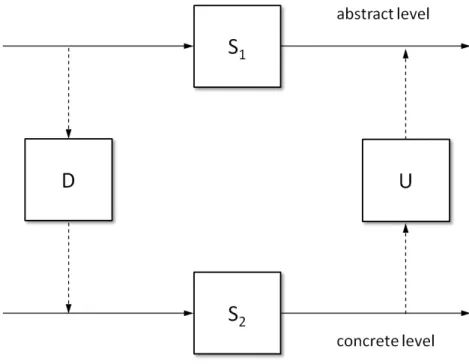
A more interesting form of behavioural refinement isinterface refinement. Interface refinement generalises behavioural refinement since it allows changes to the external in-terfaces of the specifications. Given two more specifications, namely D (the so-called
downwards relation) andU(upwards relation), interface refinement is defined as S1 D S2 U
The composite specificationD S2 U is a behavioural refinement ofS1. Figure 1.1
is a graphical representation of interface refinement. The operator “ ” denotes piped composition, see [25]; a more precise definition will be given below.
As is shown by Herzberg and Broy [69], a variant of interface refinement called com-munication refinement is the basis of layering as it is used as the predominant design principle in telecommunication systems and computer networks. Communication refine-ment constrains interface refinerefine-ment by the requirerefine-ment that the downwards and upwards relation in combination behave transparently. WithIdbeing the specification of the iden-tity function, it holds that
D U,Id
Engineers of distributed communicating systems have impressively demonstrated that layering is an important and fundamental design principle for the systematic and robust
protocols constitute languages and that protocol layers constitute language layers. It is all about protocols (read “languages”) and their interrelation. The basis of a protocol or language-driven approach is rooted in communication refinement and – less restrictively – in interface refinement.
For relating languages in programming, modelling and analysis, the primary inter-est is in equivalence relationships, not in refinement relationships. Protocol engineering brings with it unreliability, loss of messages and jitter – aspects which are irrelevant when a software system is viewed as a “stack” of languages. Another reason being that the key idea of abstraction and substitution in computing demands behavioural equivalence and not behavioural refinement. However, the methodological aspect of how to decompose behaviour and its description remains unaffected. This work reuses the compositional ap-proach of interface refinement and communication refinement for the purpose of relating computational processes and their descriptions. Interface relations can be seen as language relations because any computational process can be seen as an interpreter of a language with regards to its syntactic interface. Therefore, a computational process is at the same time an interpreter of a description and a description being interpreted. This fundamental duality of computations needs to be reflected by language layering.
To ease the definition of language layering, the assumption will be made that both the descriptions of computational processes and the data processed by computational pro-cesses are based on a uniform representation. As described in the previous section, this is the case for concatenative languages. Let⌃be an alphabet and letV ✓ ⌃⇤, where⇤
de-notes the Kleene closure, be a vocabulary of words. LetSbe the set of all sequences that
can be formed of words fromV, including nested sequences up to an arbitrary depth. In
the following, any description of a computational process, sayF, is given by a sequence F2 S, with the functionf :S ! Sdenoting the computational process itself,[[F]] =f.
Functions representing computational processes work on sequences as well. Concatena-tion of sequences is denoted by “ ”, which above was called “piped composiConcatena-tion”. On a descriptional level, the meaning of concatenation is given by function composition: [[F F0]] =f f0 with[[F]] =f and[[F0]] =f0.
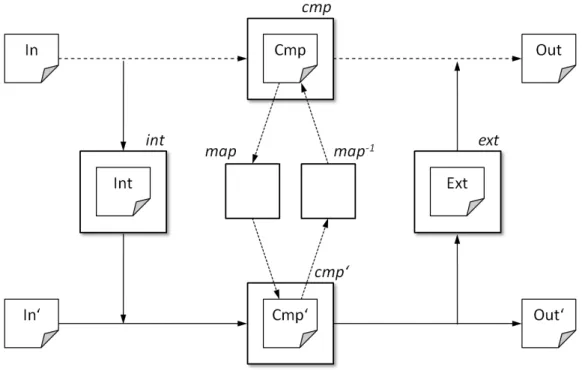
Definition 1(Language Layering). LetCmp 2S andCmp0 2 S be two descriptions of
two computational processes (functions)cmp:S!Sandcmp0 :S !Swith[[Cmp]] =
cmpand [[Cmp0]] = cmp0. Furthermore, let Int 2 S and Ext 2 S be descriptions of
two computational processes int : S ! S and ext : S ! S called internalisation
and externalisation; it holds that [[Int]] = int and [[Ext]] = ext. Given the following
arrangement, the languages realised byCmpandCmp0 are said to belayered: (Cmp!Int Cmp0 Ext),(cmp=int cmp0 ext)
Figure 1.2: Language Layering
The description on the “upper” computational layer is represented byCmp whereas Cmp0represents the description on the “lower” computational layer. DescriptionsIntand Extdescribe layer adaptions, an internalisation process and an externalisation process.
Similarly to communication refinement, language layering can be restricted by the requirement thatint ext=id(idstands for theidentity function). In this case,
internal-isation and externalinternal-isation define a bidirectional encoding relation calledview.
The relation betweenCmpandCmp0 in language layering can also be defined by two
relationsmap andmap 1 withCmp map = Cmp0 and Cmp0 map 1 = Cmp, thus
map map 1 = id. The mappingsmap andmap 1 can be described by corresponding
descriptions. It is possible to set up language layering in such a way thatmap =intand map 1 =ext.
The principle of language layering is pictured in Figure 1.2. Boxes represent compu-tational processes, document icons represent descriptions. A document icon inside a box represents a description of a computational process. Language layering can be recursively applied to any box in Figure 1.2.
Language layering provides the methodical framework for language-driven software engineering. It will be investigated further in the context of pattern-based computing (Sec-tion 4.5), language engineering (Sec(Sec-tion 5.4), modelling (Sec(Sec-tion 6.1 ) and system analy-sis (Section 7.3).
1.4 Hypothesis and Approach
This work is based on two foundational approaches. The goal of Language-Driven Soft-ware Engineering is to control complexity by making the theoretical potential of syntactic and semantic abstraction a practical reality in software engineering. Pattern-based com-puting aims to define a unified foundation for LDSE by focusing on theformal nature of computing [120]: a computing system processes symbols and through an interface it implies a model of computation by means of syntactic encodings of symbolic structures and operational input/output relations between symbolic structures. Patterns are natural tools to define, recognise, (de-)construct, transform and search symbolic structures [9]. Hypothesis The systematic creation and layering of languages can be reduced to the el-ementary operations of pattern matching and instantiation. This pattern-based approach provides a formal and practical foundation for language-driven modelling, programming and analysis.
This hypothesis is impossible to prove in general as there is no accepted consensus of what a language-driven foundation for the problem domains should be. What can be done, however, is (1) to assure that the pattern foundation is solid, (2) to support the hypothesis through the application of the foundation to the three problem domains and (3) to critically evaluate the results. The soundness of the pattern basis is assured by defining precise operational semantics for pattern matching and instantiation. The application part of the research consists of the implementation of three tools that support the language-driven approach. The evaluation is performed based on a range of examples to which these tools are applied.
The research approach taken can be summarised as follows:
1. Analysis of the problem domain and hypothesis building (Chapter 1) 2. Literature study (Chapter 2)
3. Formalisation of a framework that can support the hypothesis (Chapters 3 and 4) 4. Application of the approach to different domains (Chapters 5, 6, 7)
1.5 Scientific Contribution and Novelty
In the last few years, several approaches have emerged that can be considered language-driven, including Generative Programming [34], Model-Driven Engineering [151] and Domain-Specific Languages [55]. The novelty of the approach presented in this thesis is to provide a foundation for language-driven engineering based on patterns and language layering. The ensuing chapters demonstrate the applicability of this approach to core as-pects of software engineering: modelling, programming and analysis. The concrete out-comes of this work are three tools that are novel in themselves. All three tools are based on the formal foundation of patterns and the methodology of language layering:
Concat A self-sustaining, language-driven programming system based on tagged struc-tures and a mechanism for hiding these strucstruc-tures behind a user-definable syntactic terface. All aspects of the system – parsing its own character-representation into an in-ternal structure, program execution, meta-programming, rendering of output – is based on pattern matching and instantiation and on language layering. This includes not only the program-level but also the meta-level: Concat is defined using itself by means of a meta-circular implementation and thus is its own engine of evolution.
XMF (XML Modeling Framework) A web-based modelling- and meta-modelling framework that demonstrates how language-driven concepts can be applied to modelling and tooling. The framework uses patterns to define modelling languages, relate different models, create model instances, query models and to implement constraints. Bidirectional transformations map between models and their external representation. This view mech-anism provides visual means that can be used to create, edit and display models.
CFR (Channel Filter Rule Language) The realisation of a language-driven approach for the layered analysis of communication behaviour in complex networked systems. The system extends traditional protocol analysis in order to capture communication at the level of abstraction that reflects application design. This is achieved by abstracting communi-cation patterns on an existing protocol layer as messages on a new abstract protocol layer. The abstract protocol provides its own language for describing the communication of the system. This technique can be used to specify, monitor and test complex communication scenarios.
• A unifying foundation for language-driven software engineering through patterns • A formal definition of operations for matching and instantiating (meta-)patterns in
horizontal, vertical and diagonal manner
• A novel way of defining path polymorphic operations through pattern operations • A pattern-based approach for defining execution models using structural and
tem-poral views
• A pattern-based meta-architecture for modelling and meta-modelling
• Application of a single formalism to define, transform, query, constrain and relate models
• A methodological approach for layering languages that guided the design process for the above mentioned applications
• A novel approach for the specification of analysers for recovering communication design intentions and communication scenarios
With a mathematically defined set of primitive patterns and pattern combinators, as well as a range of tools and techniques based on them, the work provides theoretical and practical contributions that are relevant for research on self-sustaining systems, (meta-)programm-ing, (meta-)modelling and analysing complex systems.
1.6 Relevant Publications
The language layering techniques underlying this thesis and the protocol re-engineering approach of Chapter 7 are based on the author’s research on telecommunication systems that was published as a book chapter in theWiley Encyclopedia of Computer Science and Engineering[71]. The research on concatenative programming and a purely concatenative version of Concat are described in a paper that was presented at theInternational Con-ference on Software and Data Technologies (ICSOFT) [70]. Two publications describe CFR and its application in the automotive domain: a full paper presented at the Interna-tional Conference on Software Engineering (ICSE)[144] and a short paper presented at theSoftware Engineering (SE) conference [142]. XMF, its underlying pattern language and its utilisation for teaching language-driven software engineering are detailed in a paper presented at theInternational Conference of Education, Research and Innovation (ICERI)[143]. The meta architecture underlying XMF is formalised in an article that was published in a research report of Heilbronn University [72].
1.7 Overview
This section provides a short overview of the chapters that make up the rest of this thesis. Chapter 2 The work presented in this thesis is related and compared to similar work by other researchers. The chapter surveys approaches to software engineering that can be seen as language-driven. It compares this work to other work on pattern matching and related subjects such as recognition systems. Concat is related to other self-sustaining sys-tems, metacircular interpreters and highly flexible programming languages. The pattern language underlying XMF is compared with schema, transformation and query languages and the approach underlying CFR is related to work on forward engineering protocols. Chapter 3 The chapter is the formal foundation of the thesis. It defines operational se-mantics of the core pattern formalism underlying Concat, CFR and XMF. Pattern match-ing is defined in a unified manner on typed sequences. Horizontal combination of patterns includes sequencing, repetition and choice. Vertical combination defines staged applica-tion of patterns. Diagonal combinaapplica-tion enables the combinaapplica-tion of patterns and results to provide stack-like matching semantics. Transformations are based on the combination of matching and instantiation. Searching, querying and collectively transforming structures can be expressed by path polymorphic operators. A quasiquotation mechanism allows arbitrary meta-levels and is the foundation for pattern abstraction and self-referential def-inition of the pattern system.
Chapter 4 This chapter connects the core pattern approach to its application for pro-gramming. It defines rewriting as a composition of transformations and patterns that ex-press a strategy for applying transformations. Restrictions to rewriting systems are dis-cussed that produce a concatenative system. The notion of pattern-based computing is formalised based on rewriting. Conditional rules are defined as transformations that can initiate computational processes. Structural and temporal views define mechanisms to hide internal representations and certain computational steps. Grammars are defined as meta-transformations on a unified representation of strings and trees. Elliptical patterns are a practical extension for programs that manipulate nested structures.
Chapter 5 Concat and its programming and meta-programming features are introduced as a practical application of the pattern approach. Concat is a highly-extensible framework for creating and relating software languages. Concat defines a program-level and a
meta-productions and macros for defining computation, parsing and program transformation. New computational concepts can be introduced by applying the meta-language not only to the program-level, but also to itself.
Chapter 6 XMF, a tool and tool infrastructure for modelling and meta-modelling based on patterns is introduced. XMF applies the ideas of Concat to XML and Web-based tech-nologies. Partial instantiation is utilised to query and constrain models. Class and object models are introduced as examples and a mechanism based on HTML that provides visual means of creating, editing and viewing models is discussed.
Chapter 7 The chapter presents a language-driven approach for the analysis of com-munication behaviour in automotive networks. Roots of complexity and challenges in automotive applications are introduced. The presented approach is based on filtering to find dispersed communication patterns and on the abstraction of these patterns. Abstract protocols are used to define new language layers. A domain-specific language is presented that implements the approach and it is discussed how the language can be formalised with patterns.
Chapter 8 The final chapter evaluates the theoretical and practical results of the work and shows directions for future research.
Related Work
This chapter relates and compares the research described in this thesis to existing re-search. Pattern matching has been a subject of study in many sub-fields of computing (Section 2.1) and is the basis of several program transformation systems (Section 2.2). Recently, patterns have been investigated as a unifying framework for programming (Sec-tion 2.3). The pattern approach presented in this work is based on a uniform representa-tion for programs and data, a feature found in homoiconic languages (Secrepresenta-tion 2.4). The uniform representation makes it possible to naturally express various structural transfor-mations. These includes parsing which gives pattern an interpretation as grammars that define recognisers (Section 2.5). The goal is to utilise patterns for language engineer-ing. Several approaches have emerged in recent years that view language creation as the driving force of software development (Section 2.6). Concat is a pattern-based implemen-tation of a language-driven system inspired by concatenative languages (Section 2.7). Its extensibility mechanisms supports change from within, which make it a self-sustaining system (Section 2.8). XMF is based on the XPLT language which is at the same time schema, transformation and query languages for XML (Section 2.9). The abstract proto-cols in CFR and their bottom-up definition describe a protocol-re-engineering approach based on layering (Section 2.10)
2.1 Pattern Matching
Matching and instantiating patterns is certainly not a new idea. It underlies the replace-ment rules in rewriting systems [12, 16, 46] and has been extensively studied in computer science for various data structures, including strings [107], trees [78] and objects [48]. Algebraic datatypes lend themselves naturally to pattern matching because values are de-scribed as terms built from data constructors [93, 109]. In fact, pattern-matching on alge-braic data types is a common technique in functional programming languages [108] where it is sometimes referred to as “ML-style pattern matching” because of its importance in the ML programming language [122].
For instance, in ML a type for possibly empty binary trees with integers as leafs can be defined as follows:
datatype itree =
Empty | leaf of int | node of itree * itree;
The 0-ary constructorsEmptycreates an empty tree. The unary constructorleafcreates a leaf node and the binary constructornodecreates a node with two children. For exam-ple, the termnode (node (leaf 2, leaf 3), leaf 4)represents the tree in Figure 2.1. node HHH node cc # # leaf 2 leaf 3 leaf 4
Figure 2.1: Binary Tree Example
Pattern matching is defined on the nested structure of compound values. The type constructors can be used to distinguish cases when defining functions. For instance, the following function definition adds up the numbers at the leafs of a tree recursively:
fun addup Empty = 0 | addup (leaf n) = n
| addup (node (n, m)) = addup n + addup m;
The three cases of the function are defined by patterns on the left-hand side. The patterns make use of the three data constructors as well as variablesn andm in order to extract parts of the compound value. The resulting variable bindings are used in computations on the right-hand side.
Concat’s operation definitions are similar to ML function definitions on tuples of al-gebraic types. Nevertheless, Concat provides a more expressive pattern language and im-plements operator definitions as a syntactic layer on rewriting. The view mechanism de-scribed in this work can be seen as an application of the ideas outlined by Wadler [175] to layered computation and syntactic extension.
Logic programming languages such as Prolog [153] use patterns (terms with vari-ables) to implement a procedural semantics for derivation. The conditional rules of Con-cat are similar to productions in Prolog, but provide a functional rather than relational semantics and define the evaluation of conditionals as invocations of a rewriting system. Macro systems in various languages are based on patterns, either on strings, as in C pre-processor macros [100], or on structured representations as in Lisp [61]. The hygienic macro system of Scheme provides an elliptical pattern operator that serves as a founda-tion for intelligently transforming nested structures containing repeated occurrences of patterns [44]. The operator (see Section 4.6) implements elliptical pattern matching. It is the basis of structural transformations in XMF.
Various Lisp dialects provide a quasiquotation mechanism to construct lists from tem-plates. A quasiquote expression describes a list as a mix of static structures (quoted parts) and dynamic computations (unquoted parts). For example, the following S-Expression uses the backquote to declare the structure as a template and two commas for unquoting:
‘(node (leaf ,n) (leaf ,(+ n 1)))
If this S-Expression is evaluated, only the two parts that are unquoted by the commas are executed while the surrounding parts of the expression are treated as list structures. During evaluation, the unquoted parts of the expression are replaced with the results of the respective computations. For instance, evaluation of the example in an environment wherenis bound to2yields the result(node (leaf 2) (leaf 3)).
The quasiquotation mechanism defined in the pattern core and utilised in Concat is inspired by that of Scheme [98], but provides functionality for instantiationandmatching. It is utilised not only to create patterns using meta-patterns, but also to match the internal structure of patterns – including arbitrary quasiquoted and unquoted patterns.
Attempts have been made to integrate pattern matching into object oriented program-ming languages that do not provide built-in pattern support [167]. The recently devel-oped Scala programming language incorporates a match statement that allows prioritised matching on objects and types [127]. Concat follows a different approach that does not start with a language and integrates pattern matching, but starts with pattern matching and builds a language with its own syntax and semantics on top of it. The language designer
parts are replaced with a direct semantics [101].
2.2 Program Transformation Systems
Program transformation systems define the manipulation of programs as data [10,74,166]. Transformations are typically specified by a set of rules. ASF+SDF [41] is a generic toolset for defining programming language manipulation tools such as parsers, transform-ers, and analysers based on the Syntax Definition Formalism (SDF) [66]. SDF is also used by the Stratego/XT [165] framework for specifying parsers. A separate language in Stratego defines pattern-based rewriting rules and strategies for application of these rules. Concat on the other hand defines a single pattern formalism for parsing, rewriting and defining rewriting strategies. This provides a more elementary and yet highly flexible basis for programming and meta-programming.
Concat allows the extension of its pattern-language to include concrete syntax of pro-grams with which these patterns are matched. Sellink and Verhoef call patterns that are based on the concrete syntax of the data they transform “native patterns” and describe an approach that generates such patterns from context free grammars [147]. Similar meta-language extensibility is also supported by Stratego/XT and the TXL [32] source trans-formation language. Concat goes a step further systems in that it allows not only the use of literal syntax in patterns and the definition of patterns based on literal syntax, but a complete replacement of the meta-language syntax.
OMeta is an object-oriented language for pattern matching [180] designed for exper-imentation with programming languages [178]. It generalises Parsing Expression Gram-mar (see Section 2.5) so that patterns can operate on list structures and defines a rule-based language for transformations. In addition to that, it implements memoization and directly supports left-recursion [179]. Concat and the pattern formalism presented in this work provide similar operations to that in OMeta. However, details of the core semantics, es-pecially result combination in horizontal matching are different. More profoundly, this work is based on typed sequences while OMeta is based on S-Expression-like structures. The formalism in this work is based on matching and instantiation and transformations are pattern expressions. In OMeta, transformations are implemented using semantic ac-tions defined in a host language. For example, the following OMeta parser defined by Warth [178] binds the results of individual parsersexpandfacto variablesxandy; the
bindings are then used in semantic actions to create JavaScript arrrays:
exp = exp:x ’+’ fac:y -> [’add’, x, y] | exp:x ’-’ fac:y -> [’sub’, x, y] | fac
OMeta’s goal of language experimentation is similar to that of Concat, but OMeta relies primarily on a transformational approach, where a language is transformed into a target language for which an implementation exists. Concat on the other hand attempts to define a self-contained computational framework, which is reflected in the design of the core pattern formalism with its vertical and diagonal operators.
In Context-Oriented Programming (COP) [76], parametric method dispatch is gener-alised to arbitrary contexts so that code executed may depend on arbitrary system state. In Concat the range of computational concepts can be the entire program state, which makes Concat a natural choice for COP. In Core Concat, concepts such as operations and macros are implemented by separating transformation rules into an operational part (rules) and a contextual part (operator symbol, start- and end-tags) in the user interface.
2.3 Pattern Calculus
While patterns have been studied in many different sub-fields, there are few approaches that attempt to define a foundation for practical computing on patterns. The most compre-hensive work in this direction is that of Barry [9]. It is an attempt to provide a unifying framework for programming through pattern matching according to the principle “com-putation is pattern matching”. The work is based on a set of pattern calculi and a pro-gramming language namedbondi based on it. Patterns are defined to match on arbitrary data structure andpath polymorphismsupports traversal of these data structure for search-ing or querysearch-ing.Pattern polymorphism allows free variables in patterns for dynamically assembling and evaluating them.
All these techniques are implemented in the pattern system presented in this work as operators on typed sequences. Hierarchical matching defines pattern operations on the type and content component of typed sequences which are a uniform data representation for strings and trees. Traversal of typed sequences, as defined by path polymorphism, is expressed by thef ind,f indallandf ind inoperators that allow fine-grained control over
the type of data items that contain or surround the searched data. Pattern polymorphism is implemented by partial instantiation and used extensively in XMF to modularise schemas,
programming by providing means to express programming paradigms such as OO and functional programming using patterns, the focus of this thesis is to provide a foundation for language-driven engineering. Therefore, the focus is on means for creating syntax and defining systems in layers of languages.
2.4 Uniform and Homoiconic Languages
Typed sequences and their notation define a uniform syntax for representing programs and data. This greatly simplifies the specification of structural patterns. Bachrach and Playford use the term “Skeleton Syntax Tree Representations” for such uniform syntaxes for pro-grams [6]. Uniform representations are the basis of homoiconic languages, i.e., languages that use the same notation for programs and data and thus provide means for program manipulation [95, 116]. S-Expression are primarily used in Lisp [114] and Scheme [98]. In contrast to typed sequences, S-Expressions specify untyped lists structures and use encodingconventionsto express typing.
For example, in the S-Expression’(node (leaf 2) (leaf 3)), the symbols
node and leaf are used in a prefix position to indicate the type of data. However, this is merely a convention, i.e. the “special” meaning of the first element in the list is defined by the functions interpreting the data. Therefore, a postfix syntax such as
((2 leaf) (3 leaf) node) would be conceivable if the functions operating on
the data follow that schema. Similarly, in concatenative languages, words and quotation provide a nested sequence representation for programs and data.
Compound terms in Prolog consist of a functor and a fixed number of arguments that are atomic terms or compound terms. The functor can be used to encode the type of data. In this respect, terms in Prolog define compound values in a structurally similar way to algebraic datatypes. For example, the tree in Figure 2.1 can be represented by the termnode(node(leaf(2), leaf(3)), leaf(4)). The use of lists as argu-ments allows the representation of arbitrary length data, as is exemplarily shown by the
termleaves([leaf(1),leaf(2),leaf(3)]). Therefore, a Prolog term with a
single list argument closely corresponds to a typed sequence. XML (Extensible Markup Language) defines a structured representation that, at its core, is based on a mix of element tags and text in between. A subset of XML with elements that do not contain attributes corresponds very closely to typed sequences (see Section 3.1).
The advantage of uniform syntaxes is a syntactic layer that is shared by all languages based on the uniform syntax that can be used for structural manipulation. The drawback is the resulting lack of syntactic freedom. Common Lispreader macrosprovide a controlled way to break out of the syntactic restrictions by defining Lisp functions that transform
character data into S-Expressions during parsing [111]. For example, as defined by Gra-ham [61], the following reader macro allows to write quoatations using a quote character as prefix instead of using the quote macro explicitly.
(set-macro-character #\’ #’(lambda (stream char)
(list ’quote (read stream t nil t))))
The above reader macro defines a function that is called by the Lisp reader whenever the quote character appears in the stream. This function then callsreadon the character stream without the quote character and wraps the result in a list structure. This list struc-ture represents code that explicitly makes use of the quote macro. For example, reading
’xwith the reader macro activated yields the result(quote x).
The Factor programming language [45] provides a similar mechanism based onparse words. A parse word is a stack-based function that can explicitly manipulate program text. It gains control over the parser when a certain trigger is detected in the program text. The example
SYNTAX: ADD
scan-word suffix! scan-word suffix! \ + suffix! ;
defines a parse wordADDthat allows a simple form of prefix notation to be used for addi-tion instead of the standard postfix notaaddi-tion. Whenever the substringADDis encountered in the character stream the general parser calls the parse word which then reads in the next two words, adds them to the end of the parse result using thesuffix! word and finally also adds the symbol+. This means that the program ADD 2 3 is transformed
into2 3 +during parsing.
The view mechanism in Concat provides a more comprehensive approach that hides an internal representation behind a syntactic interface by defining transformations for internalisation and externalisation of programs and meta-programs. In Concat, even basic literals and the notations for lists are not hard-coded into the parser, but defined by the view mechanism.
2.5 Recognition Systems
struc-expressions define unambiguous parsers for strings. Hence, this work is related to pars-ing techniques and grammar formalisms in general andanalytical or recognition-based
formalisms and parsing techniques in particular.
Regular expressions [158] recognise strings based on operators that express concate-nation, repetition and alternation. For example, the expression a(b|c)* matches all strings starting with a followed by an arbitrary number of bs and cs. Parsing Expres-sion Grammars (PEGs) [52] can be regarded as an extenExpres-sion of regular expresExpres-sions to a more expressive parsing language. Prioritised choice (expressed using the/-operator) and greedy repetition make PEG grammars unambiguous. For example, the PEG gram-mar fragmentExp <- (’ab’ / ’a’) Restclearly defines a parsing strategy for a string such as “abc”. Even though both choices’ab’ and ’a’match the beginning of the string, it is the lefttmost choice’ab’that is always tried first. In case’ab’succeeds
’a’will never be tried – not even ifRestfails.
The unambiguity of PEGs make the formalism especially suitable for defining analyt-ical (rather than generative) grammars [64]. The theory of PEG parsing is based on the parsing algorithms described by Birman and Ullman [14]. First practical implementations of PEG-like operators go back at least to Schorre’s META II system in which the basic operations of PEGs are compiled into recursive-descent parsers [146].
Restricting the pattern core of Chapter 3 to horizontal operators, atoms, negation and references to define production rules yields the core PEG formalism. The use of a PEG-style grammar formalism to parse not only strings, but also nested sequences, is described by Baker [8]: the META II approach is used to parse S-Expression. Concat applies this approach to typed sequences. Because characters are also encoded as typed sequences, there is no conceptual difference between parsing and structural pattern matching.
A similar unification of parsing strings and pattern matching on nested structures can be realised with Definite Clause Grammars (DCGs) [19]. DCGs are a grammar formalism built into Prolog and other logic programming languages [150]. DCGs are syntactic sugar for regular Prolog rules. For example, the DCG grammar
as --> [a]. as --> [a], as.
recognises atomic sequences of as, such as [a] or [a,a,a]. It is equivalent to the following standard Prolog definition:
as([a|R],R).