Al-Marsoomi, Faaza Abduljabar
(2015)The development of a framework for
semantic similarity measures for the Arabic language.
Doctoral thesis (PhD),
Manchester Metropolitan University.
Downloaded from:
http://e-space.mmu.ac.uk/116/
Usage rights:
Creative Commons: Attribution-Noncommercial-No
Deriva-tive Works 4.0
Please cite the published version
The Development of a Framework
for Semantic Similarity Measures
for the Arabic Language
Faaza Abduljabar Al-Marsoomi
A thesis submitted in partial fulfilment of the requirements
of the Manchester Metropolitan University for the degree
of Doctor of Philosophy
School of Computing, Mathematics and Digital
Technology
The Manchester Metropolitan University
i
Abstract
This thesis presents a novel framework for developing an Arabic Short Text Semantic Similarity (STSS) measure, namely that of NasTa. STSS measures are developed for short texts of 10 -25 words long. The algorithm calculates the STSS based on Part of Speech (POS), Arabic Word Sense Disambiguation (WSD), semantic nets and corpus statistics.
The proposed framework is founded on word similarity measures. Firstly, a novel Arabic noun similarity measure is created using information sources extracted from a lexical database known as Arabic WordNet. Secondly, a novel verb similarity algorithm is created based on the assumption that words sharing a common root usually have a related meaning which is a central characteristic of Arabic language. Two Arabic word benchmark datasets, noun and verb are created to evaluate them. These are the first of their kinds for Arabic. Their creation methodologies use the best available experimental techniques to create materials and collect human ratings from representative samples of the Arabic speaking population. Experimental evaluation indicates that the Arabic noun and the Arabic verb measures performed well and achieved good correlations comparison with the average human performance on the noun and verb benchmark datasets respectively.
Specific features of the Arabic language are addressed. A new Arabic WSD algorithm is created to address the challenge of ambiguity caused by missing diacritics in the contemporary Arabic writing system. The algorithm disambiguates all words (nouns and verbs) in the Arabic short texts without requiring any manual training data. Moreover, a novel algorithm is presented to identify the similarity score between two words belonging to different POS, either a pair comprising a noun and verb or a verb and noun. This algorithm is developed to perform Arabic WSD based on the concept of noun semantic similarity.
Important benchmark datasets for text similarity are presented: ASTSS-68 and ASTSS-21. Experimental results indicate that the performance of the Arabic STSS algorithm achieved a good correlation comparison with the average human performance on ASTSS-68 which was statistically significant.
ii
Copyright
Copyright in the text of this thesis rests with the author. Copies (by any process) either in full, or extracts, may be made only in accordance with instructions given by the Author and lodged in the Manchester Metropolitan University Library. Details may be obtained from the Librarian. This page must form part of any such copies made. Further copies (by any process) of copies made in accordance with such instructions may not be made without permission of the Author.
The Ownership of any intellectual property rights which may be described in this thesis is vested in the Manchester Metropolitan University, subject to any prior agreement to the contrary, and may not be made available for use by any third party without the written permission of the University, which will prescribe the terms and conditions of any such agreement.
Further information on the conditions under which disclosures and exploitation may take place is available from School of Computing, Mathematics and Digital Technology.
iii
Declaration
I declare that no portion of the work referred to in the thesis has been
previously submitted for another degree or qualification at any other
university or other institute of learning.
__________________________
iv
Acknowledgement
All praise is due to God,
the Creator and Sustainer of the Universe.
I would like to express my sincere gratitude to my project supervisors, Dr James O‟Shea, Dr Keeley Crockett and Dr Zuhair Bandar, for their guidance, advice and continuous support throughout the production of this research and thesis. I would also like to thank the Arabic linguistic, Dr Khalid Abood for his assistance and advice during my study.
I would like to thank my parents and my sisters, Israa, Asma and Maada for their unwavering support and encouragement throughout the years.
Finally, I would like to thank my husband, Ahmed, and my wonderful sons, Mustafa, Osamah and Aihem for having the patience and understanding to allow me to pursue my dream. I couldn‟t have done it without you.
v
Contents
1. Introduction ... 1 1.1 Contribution ... 1 1.2 Research Questions ... 2 1.3 Hypotheses ... 3 1.4 Thesis Outline ... 42. Issues of Arabic Natural Language Processing ... 6
2.1 Introduction ... 6
2.2 Arabic Language ... 6
2.2.1 Characteristics of the Arabic language ... 7
2.2.1.1 The Arabic Script ... 7
2.2.1.2 The Arabic Word Structure ... 8
2.2.1.3 Sentence Structure and Word Order ... 10
2.2.1.4 Parts of Speech ... 11
2.3 Arabic Morphological Analysers ... 13
2.3.1 Buckwalter Arabic Morphological Analyser ... 13
2.3.2 Xerox Arabic Morphological Analysis and Generation ... 14
2.4 Arabic Part of Speech Taggers ... 15
2.4.1 Stanford Part-Of-Speech tagger ... 15
2.4.2 Khoja Arabic Part-Of-Speech Tagger ... 16
2.4.3 Automatic Tagging of Arabic Text ... 17
2.4.4 Hybrid Method for Tagging Arabic Text ... 17
2.5 Arabic Parsers ... 18
2.6 Word Sense disambiguation ... 20
2.6.1 Arabic Word Sense Disambiguation ... 23
2.6.1.1 An Unsupervised Approach for Bootstrapping Arabic Sense Tagging ... 23
2.6.1.2 Naïve Bayes Classifier for AWSD ... 24
2.6.1.3 Corpora based Approach for Arabic/English Word Translation Disambiguation ... 25
2.6.1.4 Lexical Disambiguation of Arabic Language: An Experimental Study ... 26
vi
2.6.1.5 A Semi-Supervised Method for AWSD Using a Weighted Directed
Graph ... 26
2.7 Category Norms ... 27
2.8 Conclusions ... 28
3. Semantic Similarity ... 30
3.1 Introduction ... 30
3.2 Word Semantic Similarity Measures ... 31
3.3 Short Text Semantic Similarity Measures ... 34
3.3.1 Corpus-based Measures ... 34
3.3.2 Knowledge-based Measures ... 35
3.3.3 Hybrid-based Measures ... 36
3.4 Evaluation of Semantic Similarity Measures ... 38
3.4.1 Word Similarity Benchmark Datasets ... 38
3.4.1.1 R&G-65 ... 38
3.4.1.2 M&C-30 ... 39
3.4.1.3 Resnik-30 ... 40
3.4.1.4 WordSim-353 ... 41
3.4.2 Short Text Similarity Benchmark Datasets ... 41
3.4.2.1 Lee50 ... 41
3.4.2.2 STSS-65 ... 42
3.4.2.3 Mitchell400 ... 43
3.4.2.4 S2012-T6 ... 44
3.4.2.5 STSS-131 ... 45
3.5 Arabic Resource That Support Semantic Similarity... 47
3.5.1 Arabic WordNet ... 47
3.5.2 Arabic Word Count ... 48
3.6 Conclusions ... 49
4. A Framework for Developing An Arabic Short Text Semantic Similarity Measure ... 51
4.1 Introduction ... 51
4.2 Overview of the NasTa Framework Phase 1 ... 52
vii
4.2.2 Arabic Noun Semantic Similarity Measure ... 55
4.2.3 Construction of the Joint Word Set ... 62
4.2.4 Semantic Similarity Component ... 63
4.2.5 Word Order Similarity Component ... 65
4.3 Overview of the NasTa Framework Phase 2 ... 71
4.3.1 Arabic Short Text Pre-Processing ... 73
4.3.2 Arabic Verb Semantic Similarity Measure ... 74
4.3.3 Arabic Word Sense Disambiguation ... 79
4.3.3.1 The Measurement of Noun-Verb Semantic Similarity ... 83
4.3.4 Construction of the Joint Word Set ... 85
4.3.5 Formation of the Lexical Semantic Vectors ... 86
4.3.6 Computation of the Overall Short Text Semantic Similarity ... 88
4.4 Conclusions ... 88
5. Evaluation of the Arabic Word Semantic Similarity Measures ... 91
5.1 Introduction ... 91
5.2 Creation of an Arabic Noun Benchmark Dataset ... 92
5.2.1 Selecting the Stimulus Nouns ... 92
5.2.2 Experiment 1: Constructing the Set of Arabic Noun Pairs ... 96
5.2.3 Experiment 2: Collecting the Human Similarity Ratings ... 101
5.2.4 Discussion ... 107
5.2.4.1 The Arabic Noun Benchmark Dataset ... 107
5.2.4.2 Comparison with the R&G Dataset ... 109
5.2.5 The Evaluation Procedure ... 111
5.2.5.1 Creation of Evaluation and Training Sub-Datasets ... 111
5.2.5.2 Tuning Parameters ... 114
5.2.6 Findings and Discussion ... 115
5.3 Creating an Arabic Verb Benchmark Dataset ... 117
5.3.1 Selecting the Stimulus Verbs ... 118
5.3.1.1 Decomposing the Arabic Verbs into a Hierarchy of Classes ... 118
5.3.1.2 Population of the Slots in the Frame with Arabic Verbs ... 123
5.3.2 Constructing the set of Arabic verb pairs ... 126
5.3.2.1 High Similarity Verb Pairs ... 126
viii
5.3.2.2.1 Creation of the List of Original Verbs ... 128
5.3.2.2.2 Experiment 1: Creation of the Lists of Synonyms ... 129
5.3.2.2.3 Experiment 2: Creation of New Lists of Synonyms ... 132
5.3.2.2.4 Selection of a Set of Medium Similarity Verb Pairs ... 133
5.3.2.3 Low Similarity Verb Pairs ... 133
5.3.3 Collection of the Human Ratings Experiment ... 135
5.3.4 The Evaluation Procedure... 141
5.3.4.1 Tuning Parameters ... 145
5.3.5 Findings and Discussion ... 146
5.4 Conclusions ... 149
6. Arabic Short Text Semantic Similarity Measure Evaluation ... 151
6.1 Introduction ... 151
6.2 The Arabic Short Text Benchmark Dataset (ASTSS-68) ... 152
6.2.1 Selection of the Stimulus Words ... 152
6.2.1.1 Decomposing the Arabic Words into a Hierarchy of Classes ... 153
6.2.1.2 Population of the Slots in the Frame with Arabic Words ... 161
6.2.2 Production of the Arabic Short Text Pairs ... 166
6.2.2.1 Creation of the Arabic Short Text Database Experiment ... 166
6.2.2.2 Selection of the Set of 68 Short Text Pairs ... 170
6.2.2.2.1 Selection of the candidate short text pairs by judges ... 170
6.2.2.2.2 Selection of the final short text pairs experiment ... 171
6.2.3 Collecting the Similarity Ratings for 68 Short Text Pairs ... 173
6.2.3.1 Pilot Study ... 173
6.2.3.2 Conduct of the Final Ratings Collection Trial ... 174
6.2.3.2.1 Experimental Results and Discussion ... 176
6.3 Evaluation of the Arabic Short Text Sematic Similarity (NasTa) Framework ... 190
6.3.1 Creation of an Optimization Short Text Pairs Set ... 191
6.3.2 Evaluation of the NasTa-A ... 191
6.3.2.1 Evaluation‟s Methodology ... 192
6.3.2.2 Evaluation‟s Results ... 192
6.3.2.3 Discussion ... 194
ix
6.3.3 Evaluation of the NasTa-F ... 201
6.3.3.1 Evaluation Methodology and Results ... 202
6.3.3.2 Discussion ... 205
6.3.3.3 Evaluation of NasTa-F with the Word Order ... 207
6.3.3.4 Comparison with the NasTa-A Performance ... 209
6.4 Conclusions ... 215
7. Conclusions and Future Work ... 218
7.1 Summary of Contributions ... 218
7.2 Summary of Work ... 220
7.3 Further Research ... 226
7.3.1 Semantic Similarity ... 226
7.3.2 Arabic Word Sense Disambiguation ... 227
7.3.3 Arabic Benchmark Datasets ... 228
References ... 230
Appendix 1 Examples of experimental materials used in the experiment of the construction of the set of Arabic noun pairs ... 239
Appendix 2 Examples of experimental materials used in the experiment of collecting the human similarity ratings for the set of Arabic noun pairs ... 248
Appendix 3 Examples of experimental materials used in the experiment of constructing the set of Arabic medium similarity verb pairs ... 255
Appendix 4 The Result of the One Sample t-test (KalTa-F measure) ... 259
Appendix 5 The List of 20 Arabic Categories ... 260
Appendix 6 The List of Arabic Themes ... 261
Appendix 7 Examples of experimental materials used in the experiment of creating the database of 1088 Arabic short texts ... 263
Appendix 8 The 7 Lowest Similarity Pairs in Arabic Short TextDataset ... 274
Appendix 9 The Optimization Dataset (ASTSS-21) ... 275
x
List of Figures
Figure 2.1: The formation of some Arabic words (writing related) from the root تزو
k-t-b ... 9
Figure 2.2: Attai‟s Rule based parser output a: c-structure, b: f-structure ... 19
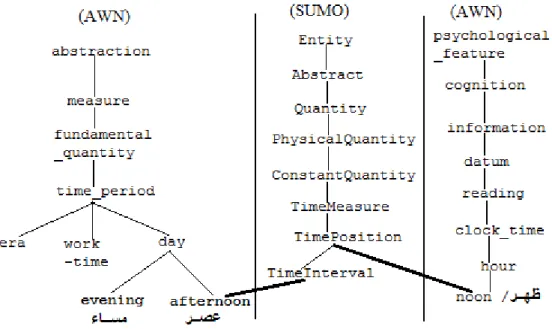
Figure 3.1: Fragment of the AWN with SUMO mapping ... 48
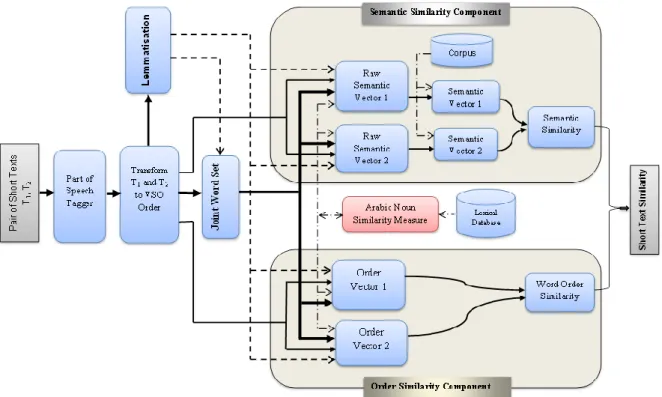
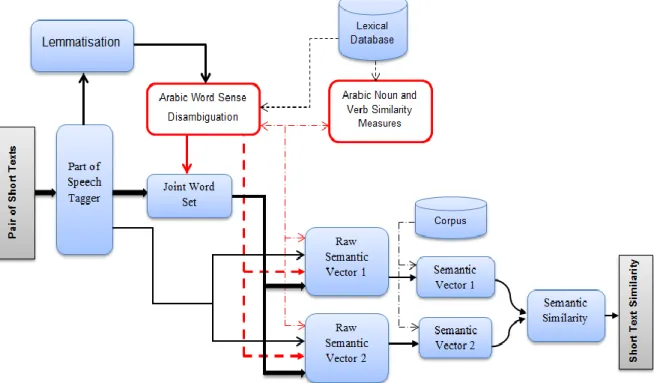
Figure 4.1: Arabic Short Texts Semantic Similarity Framework Phase 1 ... 54
Figure 4.2: The Arabic word حاكا in AWN and contemporary Arabic writing ... 56
Figure 4.3: A portion of Arabic WordNet noun hierarchy ... 58
Figure 4.4: Fragment of the AWN with SUMO mapping ... 61
Figure 4.5: Joint word set created for the short texts T1 and T2 ... 63
Figure 4.6: XLE-Webs ... 67
Figure 4.7: Figure 4.7 a. F-structure of VSO sentence. b. F-structure of SVO sentence. ... 67
Figure 4.8: F-Structure of T1 ... 69
Figure 4.9: Arabic Short Texts Semantic Similarity Framework Phase 2 ... 73
Figure 4.10: A portion of AWN verb hierarchy containing Hasaba (compute)... 75
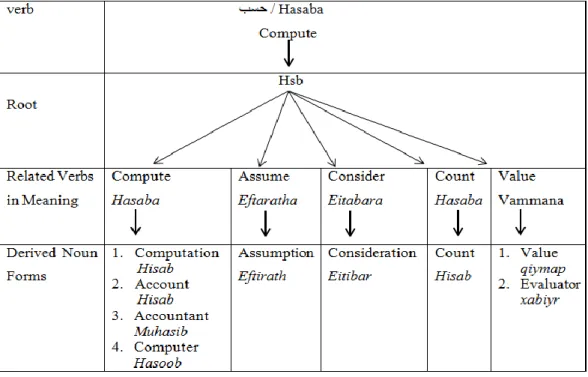
Figure 4.11: The Root, Related Verbs in Meaning and Derived Noun Forms for the Verb Hasaba تسؽ “Coumpte” in AWN ... 77
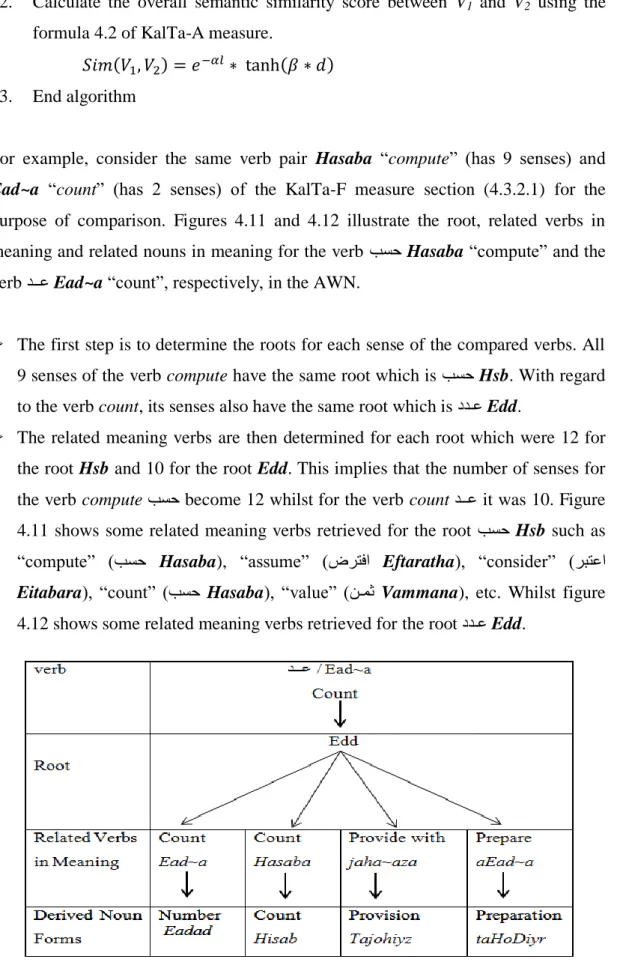
Figure 4.12: The Root, Related Verbs in Meaning and Derived Noun Forms for the Verb Ead~a لــػ “Count” in AWN ... 78
Figure 4.13: Joint word set created for the short texts T1 and T2 ... 85
Figure 5.1: The Correlation Coefficients of 60 Arabic Participants ... 107
Figure 5.2: Distribution of the similarity ratings in ANSS-70 dataset ... 108
Figure 5.3: Histogram of similarity ratings for noun pair 01, SD= 0.14 ... 109
Figure 5.4: Histogram of similarity ratings for noun pair 70, SD= 0.28 ... 109
Figure 5.5: Histogram of similarity ratings for noun pair 46, SD= 1.07 ... 109
Figure 5.6: Distribution of similarity ratings in the evaluation dataset... 112
Figure 5.7: Distribution of similarity ratings in the training dataset ... 112
Figure 5.8: The Correlation between the Ratings of Human and the KalTa-A measure without SUMO ... 117
Figure 5.9: The Correlation between the Human Ratings and the KalTa-A measure ... 117
xi
Figure 5.11: The decomposition of the state verbs at intermediate level ... 119
Figure 5.12: A Portion of Arabic Verbs Tree Structure ... 123
Figure 5.13: Distribution of the similarity ratings in AVSS-70 dataset ... 138
Figure 5.14: The Correlation Coefficients of 60 Arabic Participants ... 141
Figure 5.15: Distribution of similarity ratings in the evaluation dataset ... 143
Figure 5.16: Distribution of similarity ratings in the training dataset ... 143
Figure 5.17: The Correlation Coefficient between Human Ratings and KalTa-F Measure Ratings on the Evaluation Dataset ... 148
Figure 5.18: The Correlation Coefficient between Human Ratings and KalTa-F without Root Measure Ratings on the Evaluation Dataset ... 148
Figure 6.1: The top and second levels Arabic word decomposition ... 153
Figure 6.2: Arabic nouns sub-tree structure ... 155
Figure 6.3: A portion of Arabic verbs sub-tree ... 159
Figure 6.4: Distribution of the similarity ratings in ASTSS-68 dataset ... 189
Figure 6.5: The Correlation Coefficients of 62 Arabic Participants ... 190
Figure 6.6: Results for the one sample t-test ... 195
Figure 6.7: The Correlation between the Human ratings and NasTa-A measure ... 196
Figure 6.8: The performance of NasTa-F with word order vs. different POS classification and different window sizes ... 206
Figure 6.9: The Correlation between the Human Ratings and the NasTa-F without Word Order ... 207
Figure 6.10: The correlations achieved by NasTa-A algorithm and NasTa-F algorithm on ASTSS-68 dataset. ... 210
xii
List of Tables
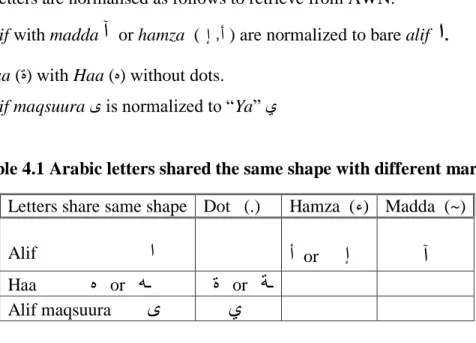
Table 4.1: Arabic letters shared the same shape with different marks ... 57
Table 5.1: The List of Arabic Categories Names ... 95
Table 5.2: List of Arabic Nouns (LAN) ... 95
Table 5.3: The Final Set of Arabic Noun Pairs ... 100
Table 5.4: Participants‟ educational background ... 102
Table 5.5: Age distributions for the Arabic population sample ... 103
Table 5.6: Semantic Anchors ... 104
Table 5.7: The Arabic Noun Benchmark Dataset ... 105
Table 5.8: Correlation Coefficient with Mean Human Judgments ... 108
Table 5.9: Training Dataset Noun Pairs with Human Ratings ... 113
Table 5.10: Evaluation Dataset Noun Pairs with Machine and Human Ratings .... 115
Table 5.11: The Performance of KalTa-A measure on the Evaluation dataset ... 116
Table 5.12: The 12 Arabic verb classification based on Case Grammar ... 120
Table 5.13: Arabic Verb Classification based on Case Grammar ... 121
Table 5.14: Populated verb sampling frame ... 125
Table 5.15: The High Similarity Verb Pairs ... 127
Table 5.16: The List of Original Verbs (LOV) ... 129
Table 5.17: The list of synonyms produced by participants for the original verb be capable ... 131
Table 5.18: The New List of 23 Verbs Produced in Experiment 1 ... 132
Table 5.19: The Set of Medium Similarity Verb Pairs ... 134
Table 5.20: The Set of Low Similarity Verb Pairs ... 135
Table 5.21: The Participants‟ Educational Qualification ... 136
Table 5.22: Age distributions for Arabic population sample ... 136
Table 5.23: Arabic Verb Benchmark Dataset ... 139
Table 5.24: Correlation Coefficient with Mean Human Judgements ... 141
Table 5.25: Training Dataset Verb Pairs with Human Ratings ... 144
Table 5.26: The Evaluation Dataset Verb Pairs with Human and Machine Ratings ... 146
Table 5.27: Performance of KalTa-F without Root and KalTa-F Measures on the Evaluation Dataset ... 147
xiii
Table 6.1: Distribution of the Arabic stimulus words between the content words
classes ... 154
Table 6.2: The distribution of Arabic categories between the concrete nouns classes ... 156
Table 6.3: The final allocation of concrete noun slots ... 157
Table 6.4: Arabic verb sub-frame ... 160
Table 6.5: Frequency breakdown for Arabic content words classes ... 162
Table 6.6: The set of 68 Arabic stimulus words ... 163
Table 6.7: Blocked design to distribute materials to participants ... 168
Table 6.8: The distribution of similarity ratings in the set of 66 short text pairs .... 172
Table 6.9: The distribution of similarity ratings in ASTSS-68 dataset pilot study . 174 Table 6.10: Participants‟ educational background ... 175
Table 6.11: Age distributions for Arabic population sample ... 175
Table 6.12: Arabic Short Text Benchmark Dataset (ASTSS-68) ... 177
Table 6.13: The Correlation Coefficient with Mean Human Judgements ... 190
Table 6.14: Short Text Similarity Ratings for ASTSS-68 dataset from Human and NasTa-A. ... 193
Table 6.15: The Performance of NasTa-A on the ASTSS-68 dataset ... 194
Table 6.16: The Semantic Vector Creation Process ... 199
Table 6.17: Short Text Similarity Ratings for ASTSS-68 dataset from Human and NasTa-F without word order based on Modern classification with different window sizes. ... 204
Table 6.18: Short Text Similarity Ratings for ASTSS-68 dataset from Human and NasTa-F without word order based on Traditional classification with different window sizes ... 205
Table 6.19: The Performance of NasTa-F without word order on the ASTSS-68 dataset ... 206
Table 6.20: Short Text Similarity Ratings for ASTSS-68 dataset from Human, NasTa-A and NasTa-F ... 211
Table 6.21: The Performance of NasTa-A and NasTa-F Algorithms on the ASTSS-68 ... 212
xiv
List of Abbreviations
A Agent
ANSS Arabic Noun Semantic Similarity ASTSS Arabic Short Text Semantic Similarity AVN Arabic VerbNet
AVSS Arabic Verb Semantic Similarity AWC Arabic Word Count
AWN Arabic WordNet
AWSAD All Word Sense Arabic Disambiguation B Benefactive
BAMA Buckwalter Arabic Morphological Analyser CG Case Grammar
C-Structure Constituent-Structure E Experiencer
F-Structure Functional-Structure HIT Human Intelligence Task HSM High Similarity of Meaning IC Information Content
KalTa-A ُسا– خٍّىٌا ٗثبشرKalimap TashaAboh – Aisom “Word Similarity-Noun” KalTa-AF ًــؼف ُسا–خٍّىٌا ٗثبشر Kalimap TashaAboh – Aisom FiEol “Word Similarit- Noun Verb”
KalTa-F ًــؼف– خٍّىٌا ٗثبشرKalimap TashaAboh – FiEol “Word Similarity-Verb” L Locative
LAN List of Arabic Nouns LCS Lowest Common Subsumer LFG Lexical Functional Grammar LOV List of Original Verbs
LSA Latent Semantic Analysis LSM Low Similarity of Meaning M&C Miller & Charles
MRS Microsoft Research MSA Modern Standard Arabic MSM Medium Similarity of Meaning
xv
NasTa ضـــٌٕا ٗــثبشر Nas TashaAboh “Short Text Similarity”
NasTa-A ُسا ضـــٌٕا ٗــثبشر - Nas TashaAboh– Aisom “Short Text Similarity-Noun”
NasTa-F ًـؼف ضـــٌٕا ٗــثبشر - Nas TashaAboh– FiEol “Short Text Similarity-Verb”
NLP Natural Language Processing O Object
PARC Palo Alto Research Centre (PARC) ParGram Parallel Grammar
PATB Penn Arabic Treebank POS Parts of Speech
R&G Rubinstein and Goodenough SD Standard Deviation
STSS Short Text Semantic Similarity SUMO Suggested Upper Merged Ontology SVO Subject-Verb –Object
synset synonym set WO Word Order
WSD Word Sense Disambiguation
WSD-STS Word Sense Disambiguation-based Sentence Similarity XLE Xerox Linguistic Environment
xvi
List of Glossary
1. An Arabic Equational Sentence is a sentence without a verb and its structure consists of the subject and predicate.
2. A Category Norm is defined as a set of words within the same theme, listed by frequency, which is created as responses by human participants to a specific category.
3. A Verbal Sentence is a regular sentence in Arabic and its structure consists of the verb, subject and object.
4. Lemmatisation is the task of finding the canonical form, or dictionary form, (which is also named the lemma) for words.
5. Parsing is the process of assigning a syntactic structure to a group of words and is automatically done using the text parser technique.
6. POS Tagging is the process of assigning a word class (grammatical category label) to each word in a textand is automatically performed using the POS tagger technique.
7. Word Sense Disambiguation is defined as the process of identifying the correct sense to a particular word based on the context in which it appears.
8. Word Structure or Morphology concerns the regulation, rules, and processes of the meaningful units of language, in terms of whether these units are words or parts of words, such as different kinds of affixes.
1
Chapter 1
Introduction
1.1 Contribution
This thesis presents research investigating a computational approach to Arabic short text semantic similarity, the similarity of the short text meaning. Short Text Semantic Similarity (STSS) measurements are developed to measure the similarity between very short texts of 10 -25 words long. This is the length of typical utterances in human dialogue (O‟Shea et al., 2010). The importance of STSS measures is growing due to the large number of applications that are emerging in numerous text-related research fields. For example, in web page retrieval, STSS measures are used for the improvement of the retrieval effectiveness by means of the calculation of the similarities of page titles (Park et al., 2005). Text mining can benefit from the use of STSS measure as criterion to detect concealed knowledge from textual databases (Atkinson-Abutridy et al., 2004). In conversational agent, the employment of STSS measure can greatly reduce the scripting process through the use of natural sentences instead of large numbers of structural patterns containing wildcards (O‟Shea, K. et al., 2010).
Unfortunately, research in the semantic similarity field has neglected the Arabic language. (Habash, 2010) reported that the research into Arabic computational semantics is much smaller than the research in other areas in Natural Language Processing (NLP) mainly due to the higher complexity and subtlety of Arabic. Despite this challenge, novel work on STSS using Arabic is presented in this thesis. The main contributions of the work in this thesis fall into three areas:
The contribution to the automatic measurement of Arabic semantic similarity. This includes a novel framework for developing an Arabic STSS measure which is the most significant contribution of the work in this thesis. Also, two novel Arabic word semantic similarity measures have been created: Arabic noun semantic similarity and Arabic verb semantic similarity. These measures are
2
expected to contribute to the development of the performance of many Arabic applications.
The contribution to Arabic semantic similarity resources. The production of two Arabic short text benchmark datasets for evaluating and optimizing the proposed STSS measurement algorithms. Similarly, two Arabic word benchmark datasets for evaluating the Arabic noun semantic similarity algorithms and the Arabic verb similarity algorithms. These datasets are the first of their kinds for Arabic. It is expected that these datasets will be regarded as a reference basis from which to evaluate and compare different methodologies in the field.
The contribution to Arabic Word Sense Disambiguation (WSD). The development of a new Arabic WSD algorithm to disambiguate all words (nouns and verbs) in the Arabic short texts without requiring any manual training data. Moreover, a novel algorithm is presented to identify the similarity score between two words which have different Parts of Speech (POS), either a pair comprising a noun and a verb or a verb and a noun. This algorithm is developed to perform Arabic WSD based on the concept of noun semantic similarity.
1.2 Research Questions
1. Is it possible to construct a framework for developing a short text semantic similarity measure for Arabic language?
2. Are there features of Arabic language which would prevent the construction of the framework for semantic similarity?
3. Do the necessary components exist for constructing a measure with a framework?
4. Where there are missing components from NLP that are required, is it possible to create these for the Arabic language? i.e.
Is it possible to measure the semantic similarity between a pair of Arabic nouns?
Is it possible to measure the semantic similarity between a pair of Arabic verbs?
3
Is it possible to disambiguate all words in an Arabic short text?
Is it possible to measure the similarity between Arabic words belonging to a different POS?
5. Is it possible to create suitable benchmark datasets for noun, verb, and STSS algorithms test?
1.3 Hypotheses
1. H0 (Null Hypothesis): it is not possible for a machine based Arabic noun
semantic similarity measure to re-produce human intuitive measures of semantic similarity.
H1: it is possible for a machine based Arabic noun semantic similarity
measure to re-produce human intuitive measures of semantic similarity.
2. H0: it is not possible for a machine based Arabic verb semantic similarity
measure to re-produce human intuitive measures of semantic similarity.
H1: it is possible for a machine based Arabic verb semantic similarity
measure to re-produce human intuitive measures of semantic similarity.
3. H0: it is not possible for an Arabic algorithm for all-word sense
disambiguation to achieve the same classification as human would make.
H1: it is possible for an Arabic algorithm for all-word sense disambiguation
to achieve the same classification as human would make.
4. H0: it is not possible for a machine based Arabic short text semantic
similarity measure to re-produce human intuitive measures of semantic similarity.
H1: it is possible for a machine based Arabic short text semantic similarity
measure to re-produce human intuitive measures of semantic similarity.
5. H0: it is not possible to construct a noun dataset for Arabic within a limited
size which effectively represents human intuition.
H1: it is possible to construct a noun dataset for Arabic within a limited size
4
6. H0: it is not possible to construct a verb dataset for Arabic within a limited
size which effectively represents human intuition.
H1: it is possible to construct a verb dataset for Arabic within a limited size
which effectively represents human intuition.
7. H0: it is not possible to construct a short text dataset for Arabic within a
limited size which effectively represents human intuition.
H1: it is possible to construct a short text dataset for Arabic within a limited
size which effectively represents human intuition.
1.4 Thesis Outline
The rest of this thesis is organised in three parts. First part comprises of two chapters (2 and 3) which presents a background material to this thesis. The second part (chapter 4) presents the Arabic STSS framework whilst the third part (chapter 5 and 6) concerns with creation of four datasets in order to use them in the evaluation process of the proposed framework‟s algorithms.
Chapter 2 describes the characteristics of the Arabic language and their influence on the STSS computation. This chapter reviews the Arabic NLP techniques used in text pre-processing. The main source of Arabic ambiguity and the current state of Arabic WSD algorithms created to manage this challenge are also reviewed in this chapter.
Chapter 3 reviews the current state of STSS measures and highlights the major challenges faced by the existing measures. This chapter reviews the current state of word similarity measures which are considered to be the main requirement of the creation of the STSS measure. The current states of word and short text benchmark datasets used in the evaluation processes of the existing word and STSS measures are also reviewed in this chapter with highlighting the challenges of the dataset design process.
Chapter 4 presents a novel framework (NasTa) for developing a measurement algorithm to calculate the semantic similarity between two Arabic short texts. The development process of NasTa consists of two phases. This chapter describes the
5
NasTa components of each phase with the novel algorithms that has been created to meet its requirements. This includes three Arabic word similarity measures and an Arabic word sense disambiguation algorithm.
Chapter 5 describes the production of the first two Arabic word similarity benchmark datasets and their creation methodologies: the Arabic noun benchmark dataset and the Arabic verb benchmark dataset. These datasets are used to validate of the Arabic word (noun and verb) measures presented in chapter 4. This chapter also describes the evaluation procedure of each measure which involves the creation of the training sub-dataset to use in the parameter optimization process and evaluation sub-datasets to use in the process of validating of the Arabic word measure.
Chapter 6 describes the production of the first Arabic short text benchmark dataset (ASTSS-68) with its creation methodology. The motivation of the creation of this dataset is to evaluate the ASTSS framework (NasTa) presented in chapter 4. This chapter describes the evaluation procedure of NasTa which involves the creation of an optimization dataset to use it in the optimization parameters process, evaluation of the Arabic short text algorithms created in the first and second phase of the NasTa framework development process and finally, comparing the performance of the Arabic short text algorithms to determine whether a combination should be used profitably in NasTa framework.
Chapter 7 concludes the thesis, highlights its contributions and suggest some new research directions for future work.
6
Chapter 2
Issues of Arabic Natural Language Processing
2.1 Introduction
This chapter will review the characteristics of the Arabic language and their influence on the automatic processing of Arabic, including Arabic script, Arabic word structure, sentence structure and Parts of Speech (POS) classifications. Word structure or morphology relates to regulations, rules, and processes regarding the meaningful units of language, in terms of whether these units are words or parts of words, such as different type of affixes (Ryding, 2005). The structure of the Arabic word is considered highly systematic in that it exhibits rigorous and elegant logic. This is explained in some detail in this chapter. The Arabic POS classification dilemma and its influence on Arabic pre-processing techniques including the morphological analyser, the POS taggers and the text parser are also discussed in this chapter.
There is a review of the two well-known Arabic morphological analysers which have been developed to deal with the internal structure of Arabic words and the current Arabic POS taggers which were developed to assign the POS of each word in the text. Word Sense Disambiguation (WSD) in general is described together with the main strategies which have been utilized to perform the WSD. The main source of ambiguity in the Arabic language is explained and current algorithms developed to perform the Arabic WSD are reviewed.
2.2 Arabic Language
Arabic is a Semitic language which is spoken and written by more than 300 million people in the world. It is read by 1.4 billion Muslims as it is the Holy Quran language (Farghaly and Shaalan, 2009). Classical Arabic, the standard form of the language which is used in the Holy Quran was first spoken by Arabs over fourteen centuries ago. Its grammar and vocabulary are more complex than Modern Standard Arabic (MSA). MSA is defined as the Arabs‟ attempt to speak Classical Arabic (Kaye,
7
1972). It is the formal language of Arabic countries that is used in the education sector (e.g. public schools and universities), public speeches, media and literature. MSA contrasts with colloquial Arabic, which is less sophisticated in its grammar and vocabulary than MSA. Various dialects (colloquial Arabic) are currently spoken in different parts of the Arab world. When this language is studied, the main emphasis is always placed on classical Arabic and MSA, whilst dialects are likely to be ignored (Al-Qahtani, 2005). The version of Arabic considered in this thesis is that of MSA, the language which is universally understood by Arabic speakers.
2.2.1 Characteristics of the Arabic Language
The Arabic language is considered a highly derivational and inflexional language which is based on a root and template to produce the language‟s words. This section addresses the characteristics of the Arabic language.
2.2.1.1 The Arabic Script
The Arabic script alphabet comprises two types of symbols (letters and diacritics) for the writing of words. The alphabet is made up of 28 letters which contain 25 consonants and 3 long vowels and which one writes from right to left. They comprise different shapes, resulting from their location in each word: for example initial, medial, final or stand-alone (Habash, 2010). These individual shapes have their origin in the Arabic style of writing whereby letters within a word are joined together in a cursive manner, subject to the context in which the words appear. The letters individually signify certain sounds and there is a good fit between the spelling of a word and the manner of its pronunciation (Ryding, 2005).
Three long vowels in the Arabic alphabet are written into Arabic words as part of the spelling of the word. They are represented by the letters ا alif, و waawand ي yaa. In the transformation process, words which have long vowels may change or replace
these letters with each other. For example, the long vowel letter
ا
alif in the verbيبـل
(said) is replaced with the long vowelو
waaw during the transformation process of the verb toيٛم٠
(say), whilst the long vowel letterا
alif of the verbعبـث
(sold) is replaced by the long vowel ي yaa to becomeغ١ـج٠
(sell). In addition, Arabic script has8
short vowels, which appear as diacritics above or below the letters. Consequently, the letter acquires its desired sound and thus a word receives its desired meaning
(Elkateb et al., 2006b). For example, the word
خسَهلَِ
means school. If the diacritics are changed toخسِهلُِ
the meaning changes to that of a female teacher. There are three main short vowels in Arabic (Fatha /a/ََ
, Damma /u/ َُ, Kasra /i/َِ
). Sukun َْ indicates there is no diacritic to add a vowel. Additional Arabic diacritics are Nunations and Shadda. Nunations only arise in the final position of nouns, adverbs and adjectives and resemble a dual version of their corresponding short vowels (twoFatha
َ
, two Dammaَ
and two Kasraَ
). Shadda َّ represents a consonant doubling diacritic (Habash, 2010). For example the word ًَ َهَك (darasa) means study whilst the word ًَ ّهَك (darrasa, double consonant r) means teach. In contemporary texts, the short vowels have been disappearing and readers are anticipated to fill in the missing diacritics by applying their knowledge of the language. The omission of short vowels from Arabic texts results in considerable ambiguity and poses challenges to the automatic processing of Arabic (Habash, 2010).Another symbol used in current Arabic script is that of punctuation. The Arabic writing system uses punctuation marks which are similar to those used in European languages. Attia (2008) reported that punctuation marks have been introduced into the Arabic writing system recently to some extent which has resulted in the absence of strict punctuation rules. Arabic writers write entire paragraphs without a full stop and sentences are often connected by the coordinating conjunctions ٚ wa and ف fa. With regard to this, Daimi (2001) declared that “Arabic is distinguished by its high context sensitivity with the desire to exhibit the different synthetic coherence relations”.
Arabic script does not use capitalization: as a result there is no distinction between small and capital letters in Arabic. Furthermore, Arabic script does not combine letters to generate a new sound as in English (Salem, 2009).
2.2.1.2 The Arabic Word Structure
Word structure or morphology concerns the regulation, rules, and processes of the meaningful units of language, in terms of whether these units are words or parts of
9
words, such as different kinds of affixes (Ryding, 2005). The Arabic word structure (morphology) is considered highly systematic in that it exhibits rigorous and elegant logic. Its theories focuse on two fundamental issues: derivational morphology describes how words are formed and inflectional morphology concerns how words vary or inflect in order to mark grammatical categories (Ryding, 2005).
Arabic words are formed based on a system of roots which mesh with patterns of vowels or patterns of consonants and vowels. The root is a sequence of 3 (occasionally also 2 or 4) consonants in a particular order which are called radicals. This bears the core meaning of Arabic words (lexical meaning). The pattern is a template of one or more vowels, or in combination with derivational affixes which have slots for root radicals, and possess grammatical meaning. The Arabic language has more than 10,000 roots and 85% of derived words are formed from 3 consonant (tri-literal) roots (Al Ameed et al., 2005).
(Ryding, 2005) stated that “the Arabic root-pattern process has evolved extensively and very productively in order to cover a vast array of meanings associated with each semantic field”. For example, most of the Arabic words (in different POS) which relate to writing are formed from the root of three consonants k-t-b (writing-related) as a result of switching in patterns of vowels or patterns of vowels and consonants, as shown in figure 2.1. The produced words can function as stems for grammatical affix in the inflectional stage.
Root
تزو k-t-b R1-R2-R3
Pattern R1aR2aR3a R1iR2aaR3a R1aaR2iR3 R1iR2aaR3 maR1R2aR3a …
Stem kataba write (v.) kitaaba writing (n.) kaatib writer (n.) kitaab book (n.) maktaba Library (n.) …
Figure 2.1 The formation of some Arabic words (writing related) from the root تزو k-t-b.
10
Inflectional morphology does not change the core meaning and part of speech of the stem but grammatical affixes are added in order to mark grammatical inflections, such as tenses (past/present), gender (masculine, feminine) and/or numbers (singular, dual (representing two entities), plural). For example, adding the suffix “ْا“ an to the stem “kaatib” (writer) produces the word “kaatiban” (two writers)
which signifies the dual masculine.
A multiple affix can appear in a word, when particular coordinating conjunctions, prepositions and particles, the definite article, and a class of pronouns attach themselves to the words. Thus a single Arabic word can represent a complete sentence in other languages. An example of this is the Arabic word ُٙروجفاٚ which means “and I told them”. This feature makes pre-processing tasks of Arabic texts very challenging as it hinders the matching of the word in Arabic text to the correct sense (correct lemma). It also poses two interesting challenges to the STSS computation: representation of the word in a short text especially for measure that calculates the similarity based on bag of words and also extraction of the semantic information from Arabic resources (described in chapter 3) directly where the Arabic words have been saved in these resources as lemmata.
2.2.1.3 Sentence Structure and Word Order
Arabic sentences have been classified as equational (verbless) sentences and verbal sentences (Ryding, 2005, Attia, 2008). The equational sentence is a sentence without a verb and its structure consists of the subject and predicate. The subject is a noun phrase whilst the predicate can be a noun phrase, adjective phrase, adverb phrase or prepositional phrase. An example of this as follows:
1. ًلِٕٙ ٟفا / My brother is an engineer. In this example the first word ٟفا (my brother is a subject (noun) and the second ًلِٕٙ (engineer) is a noun phrase predicate.
2. ٟوم تٌبطٌا / The student is intelligent. The word تٌبطٌا (the student) in this sentence is a subject and ٟوم (intelligent) is an adjective phrase predicate.
11
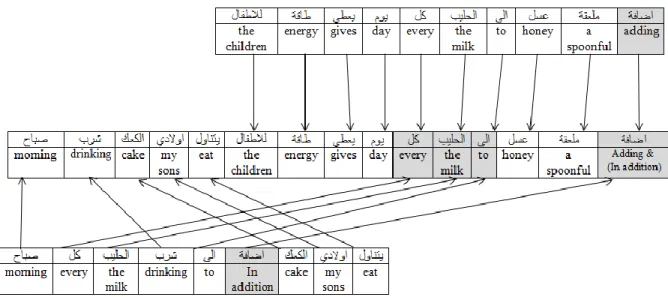
A verbal sentence is a regular sentence in Arabic and its structure consists of the verb, subject and object. The verbal sentence is considered syntactically flexible and has a relatively free word order (Attia, 2008). Every different order, the Subject-Verb -Object (SVO), VSO, and VOS are acceptable sentence structures in MSA. The English sentence (the man bought a car) can be written in Arabic in three ways as follows:
1. VSO order, حهب١س ًعوٌا ٜوزشا / bought the man a car 2. SVO order, حهب١س ٜوزشا ًعوٌا / the man bought a car 3. VOS order, ًعوٌا حهب١س ٜوزشا / bought a car the man
This feature poses a challenge for many Arabic applications such as machine translation (Salem, 2009), Arabic parsing (Attia, 2008) which increases the ambiguity and conversational agent (Hijjawi et al., 2014) which increases the complexity in terms of the actual understanding of Arabic sentences. For the work in this thesis, the Arabic STSS measure cannot take advantage of word order which contributes to English STSS measures.
In addition, MSA is a pro-drop language whereby the subject pronoun of a verb in a sentence is dropped and recovered later by convention. For example, the Arabic sentence حهب١س ٜوزشا (bought the car) is equivalent to حهب١س ٜوزشا ٛ٘ (he bought the car) (Diab et al., 2007 and Farghaly and Shaalan, 2009).
2.2.1.4 Parts of Speech
Compared with English and other European languages, Arabic enjoys a longer millennium-wide tradition of scholarly research relating to its grammatical description. The order established by the Arabic grammarian Sibawaihi, approximately fourteen hundred years ago is the method most frequently followed in traditional grammatical studies. In his renowned book Al-Kitab, Sibawaihi (1966) commences by classifying the Arabic POS into nouns, verbs and particles. The verb indicates an action and tenses that apply; Nouns which include people names, places, or objects have no tenses; the particle requires that it is joined by a verb or a noun or
12
both in order to be understood (Sawalha, 2011). This classification is still used today and is regarded as the Arabic grammar‟s leading principle (Suleiman, 1990).
The classification of POS is not listed in Arabic dictionaries whilst the structure of Arabic grammar books is subject to the division of POS into nouns, verbs, and particles. Wright (1896/2005), for example, applied the term noun as an umbrella etymology covering six types which include nouns, adjectives, numeral adjectives, demonstrative pronouns, relative pronouns and personal pronouns. He also divided particles into: prepositions, adverbs, conjunctions and interjections (Attia, 2008).
In the literature of modern Arabic linguistics, Suleiman (1990) carefully analysed the work of the earliest Arabic grammar theoretician (Sibawaih), in his book “Al-Kitab” and refuted his tripartite classification of Arabic POS. The main thrust of his argument was that no empirical or reasonable evidence was given by Sibawaih to support his theory that the Arabic POS are exclusively classified into nouns, verbs and particles. This was also the opinion of Attia (2008) who acknowledged that classifying the Arabic POS in the traditional manner into nouns, verbs and particles is insufficient for providing a complete computational grammar. This is supported by Sawalha (2011) who observed that the tripartite classification of Arabic POS by Sibawaihi does not pay sufficient attention to word structure (morphology).
This issue affects the Arabic text pre-processing techniques including morphological analysis (analysis of the Arabic words), POS tagging (assigning a grammatical category label to each word in a text) and text parsing (assigning a syntactic structure to a group of words). The morphological analyser is considered a precondition for the POS tagger and the text parser which provides them with the most important information they need. A considerable number of morphological analysers (used to analyse the Arabic words) continue to be influenced by the tripartite Arabic POS classification (Attia, 2008). A good example of this restricted point of view is the Xerox Arabic morphological analyser (Beesley, 2001). In these morphologies, Arabic words are strictly classified into verbs, nouns (including adjectives and adverbs) and particles allowing for no additional categorical description to be used and thus making them unsuitable to serve a POS tagger and a syntactic parser (Attia, 2008).
13
2.3 Arabic Morphological Analysers
Two principal strategies apply for developing Arabic morphologies. They are dependent on the level of analysis as follows:
1. Root-based morphologies: the analysis of Arabic words based on the system of roots and patterns as well as concatenations.
2. Stem-based morphologies: the analysis of the Arabic words at the stem level with the use of regular concatenation. The stem is considered the least marked form of the uninflected word and has no suffixes or prefixes. It is normally the perfective, third person, singular verb in MSA whilst nouns and adjectives appear in the form of singular indefinite.
Many morphological analysers were developed for Arabic but only some of them are available for purposes of research and evaluation, the remainder are proprietary commercial applications (Attia, 2008). The known analysers include Buckwalter Arabic Morphological Analyser (BAMA) (Buckwalter, 2002), Xerox Arabic Morphological Analyser (Beesley, 2001), Sakhr (Chalabi, 2004), Diinar (Dichy and Hassoun, 1998), and Morfix (Kamir et al., 2002). The best known are the first quoted analysers which are well documented and are available for researchers to evaluate (Attia, 2008). Each will now be reviewed.
2.3.1 Buckwalter Arabic Morphological Analyser (BAMA)
BAMA Morphology is regularly found in the literature and is believed to be the “most respected lexical resource of its kind” (Hajic et al., 2005). BAMA contains 38,600 Arabic lemmata and has been developed as a main database of Arabic word forms which interact with two concatenation databases. Arabic words are viewed as a concatenation of three regions: a prefix, a stem and a suffix. The prefix and suffix regions can be null. Prefix and suffix lexicon entries cover all possible concatenations of Arabic prefixes and suffixes, respectively. Each word‟s form is inputted separately. The stem is taken as the base, and information about the root is
14
also given. BAMA acts to verify the probable existence of each part in the three dictionaries and is deemed acceptable if the prefix and suffix are null.
There are three compatibility tables in BAMA which are accessed after the word is divided into its prefix, suffix and stem and a match for each is located in the lexicons. Verification of a compatible combination is subsequently undertaken by means of the compatibility tables. Successful verification indicates correct spelling of the word. The vowel marks are reconstructed by BAMA. An English glossary is provided and every possible combination of stems and affixes for a word is made available. All stems that have a similar meaning are grouped together by BAMA and then linked to a lemma ID. A Modern Written Arabic Dictionary (Wehr, 1979) was taken by Buckwalter as his reference source.
Arabic words are classified by BAMA based on the modern POS classification. There still remain, however, traces of generalizations in the large number of adjectives categorised to be nouns and particles are deemed to be function words (Attia, 2008).
2.3.2 Xerox Arabic Morphological Analysis and Generation
According to (Dichy and Fargaly, 2003), Xerox Morphology is held to be a system based on “solid and innovative finite-state technology”. It is a mathematical model which was used for the design of programs that can be signified via states and the transition between them (Attia, 2008). The machine has been adapted to the Xerox finite-state format. Beesley (2001) presented a description of this system which is believed to be more appropriate for the carrying out of morphological analysis. The approach of root-and-pattern is adopted by this morphology. 4,930 roots and 400 patterns are included, with 90,000 stems effectively generated. The advantage of using it being the fact that it is rule based and has a large coverage. Vowel marks are also reconstructed and an English glossary provided for each word.
It is subject to POS classification specifications, thus making it unsuitable to serve a syntactic parser as words are classified only into Verbs, Nouns (including adjectives
15
and adverbs) and Particles (Attia, 2008). A principle disadvantage of Xerox morphology is the increased rate of ambiguity. Attia (2008) stated that, on account of the fact that the system gives so many analyses for most words, including many spurious onesdue to the previous mentioned factor, it suffers from a very high level of ambiguity.
It was decided to use the BAMA Arabic morphological analyser in this study to obtain the lemma of each Arabic word in the short text as BAMA is freely downloadable as a java package whereas the Xerox system is a web based analyser. BAMA classifies words utilising modern POS classification and takes the stem as its base form. By contrast, Xerox is based on traditional POS and utilises root–pattern which increases the ambiguity, resulting in an increase in the number of solutions, which Xerox morphology provides for most words.
2.4 Arabic Part of Speech Taggers
POS tagging is the process of assigning a word class (grammatical category label) to each word in a textand is automatically performed using the POS tagger technique. The set of all grammatical category labels used in the tagging process is known as a POS tag set. The development of Arabic POS tagging has started recently and various techniques have been employed to resolve the problem of Arabic POS tagging.
2.4.1 Stanford Part-Of-Speech tagger
Stanford University originally developed this tagger (Stanford tagger) to apply to the English language (Toutanova and Manning, 2000). A further, improved version was presented which adds support for different languages together with improved speed and usage for English which was described by (Toutanovaet al., 2003).
The tagger is built based on the model of maximum-entropy. The maximum entropy intuition is to create a distribution through the continuous addition of features (Jurafsky and Martin, 2000). The term 'features' refers in this context to the
16
constraints which come into being when the tagger is trained, e.g. syntactical and morphological features. The total distribution contains the constraints that are added by each feature. (Jurafsky and Martin, 2000) provide further information. The most recent version includes trained models for the Chinese, German and Arabic languages. According to the authors in the README file, the tagger has 96.50% accuracy in Arabic. The tagger concentrates on the training part of the Penn Arabic Treebank (PATB) with a smaller POS tag set which makes it harder to allocate a "wrong" tag, thus contributing to the high level of accuracy. Examples from the set of POS tags used include (NN- Noun single, NNS -Noun plural, DT- Determiner, JJ- Adjective, VBD – Verb past tense, ect.)
2.4.2 Khoja Arabic Part-Of-Speech Tagger
In Khoja (2001) a combined statistical and rule-based method were proven to yield the best results from the various combinations experimented with. A set of 177 POS tags is used by the tagger which originates from Arabic traditional grammatical theory. This set consists of 103 tags for nouns, 57 for verbs, 9 particles, 7 residual and 1 for punctuation. The rule based method involves the development of a knowledge base of rules which has been written by linguists as a means of defining accurately how and where to allocate the various POS tags. The statistical based method involves the building of a trainable model and the usage of a tagged corpus for estimating its parameters. Once accomplished, the tagger can be employed to automatically tag other texts.
The Khoja testing phase used four different corpora. The largest corpus, amounting to approximately 59,000 words, was employed to train the tagger and create a number of lexicons, which were used to tag the test set. One of these lexicons listed each word jointly with all possible tags which were obtained in the corpus. In the initial stages of the tagging, each word was looked up in the lexicon and all possible tags for the word were identified in the lexicon. A stemming process was performed for any word that was not found in the lexicon. In all, the accuracy achieved by Khoja tagger was around 90%.
17
2.4.3 Automatic Tagging of Arabic Text
Another Arabic POS tagger was introduced by (Diab et al., 2004) using a learning algorithm known as the Support Vector Machine (SVM). This is a supervised machine learning algorithm which is robust and can handle a big number of features. It enjoys a good general performance. A number of features were drawn from a predefined linguistic context with the tagger designed to predict the class of a token. Arabic TreeBank was used to train the tagger and the data in the Arabic TreeBank was transliterated into Latin based ASCII characters by means of the Buckwalter transliteration scheme. A set of 24 POS tags was used by this tagger to achieve a level of accuracy of 95%. This set of 24 tags known as collapsed tags set was manually selected from the set of 135 tags created by Buckwalter (2002) to use with Arabic morphological analyser.
2.4.4 Hybrid Method for Tagging Arabic Text
A hybrid method was presented by Tlili-Guiassa (2006) for tagging Arabic text by combining a rule-based method and a memory-based machine learning method. In the simple memory-based learning method, appropriate examples are given for memory retention and the similarity between memory examples and new examples resulting in the prediction of new examples. The tagger determines the word x POS tag by searching for the k nearest neighbours and selecting the neighbour with the highest frequency of occurrence. In the testing phase, the tagger used a corpus containing texts which have been drawn from first stage educational books and Qur‟anic text that has been tagged through the use of a small tag set. The POS tag set used by this tagger is the set of POS tags derived from Khoja's tagger resulting in a performance of 85%.
(Sawalha, 2011) drew attention to the fact that most of the Arabic POS taggers were developed by NLP research groups for their own internal use only. The reported taggers used different sets of POS tags and evaluated using different test corpora. Of all the Arabic taggers, Stanford enjoys the highest performance score. Moreover, it is the only tagger that is freely available for download by researchers and therefore
18
subject to independent validation. Consequently, it has been adopted in this study for tagging each word in the Arabic short texts.
2.5 Arabic Parsers
Parsing is the process of assigning a syntactic structure to a group of words and is automatically done using the text parser technique. This technique has been used in variety of NLP applications such as automatic summarization and machine translation (Habash, 2010). Several parsers have been used for parsing Arabic text such as the Stanford parser (Klein and Manning, 2003), the Bikel parser (Bikel, 2002), Malt parser (Nivre et al., 2007), an Arabic Slot Grammar parser (McCord and Cavalli-Sforza, 2007) and a Rule based parser (Attia, 2008). The parser presented by (Attia, 2008) on the bases of the f-structure discussed later will be used in this research in order to manage the syntactical flexibility feature for the MSA. Therefore this parser is presented with more details in this section.
An Arabic parser was developed by Attia (2008), who created it within a framework called a Lexical Functional Grammar (LFG) (Bresnan, 2001). This was undertaken by means of the Parallel Grammar (ParGram) Project‟s (Butt et al., 2002) formalisms, tools and common inventory.
The aim of ParGram project is to provide full syntactic representation for many languages within the LFG framework. The project utilises the Xerox Linguistic Environment (XLE) as a platform that was built by Palo Alto Research Centre (PARC) in order to write grammar rules and lexical entries using LFG formalisms. The platform consists of three components suitable for creating a machine translation system which include a parser, transfer and generator (Attia, 2008).
After being supplied with enough rules and lexical entries, the system analyses (parses) sentences and gives both the functional-structure (f-structure) and constituent-structure (c-structure) representation for each sentence. The c-structure is defined as a phrase structure tree which encodes consistency (dominance) and precedence (surface order) for each sentence (Attia, 2008). The f-structure represents
19
a level of abstraction which is high enough for capturing parallelism amongst different languages and reduces cross linguistic syntactic differences. It gives information on grammatical functions of words such as (subject and object) and morpho-syntactic features such as tense, gender, number and person (Attia, 2008).
The grammar rules and notations for MSA were written using the XLE platform. The results of the pre-processing stages in the XLE system include grammatical category, essential morphological information and the morpho-syntactic features for each word. A set of Arabic rules, notations and constraints are employed to analyse the Arabic sentences by the XLE parser. The main results obtained by the XLE parser after parsing the Arabic sentences are the f-structure and the c-structure for the input sentence. This parser is available online at http://iness.uib.no/iness/xle-web
which allows input of an Arabic sentence and gives the f-structure as output. Figure 2.2 shows the c-structure and f-structure for the Arabic sentence خؽبفزٌا ًوا لٌٌٛا “the boy ate the apple” which is selected from (Attia, 2008).
(a) (b)
Figure 2.2 the Rule based parser output a: c-structure, b: f-structure.20
The output of this parser (f-structure) will be used in this thesis to manage the syntactical flexibility feature for MSA; the consequence of this is described in chapter 4.
2.6 Word Sense Disambiguation
Each individual word can possess several possible meanings, a process called Polysemy. The human being is able to ascertain the intentional meaning of a word used by another person in conversation and in writing. These possible meanings are known as senses and computers find it more difficult than human beings to comprehend the intentional meaning of a word in a given context. As a result, several algorithms for Word Sense Disambiguation (WSD) have been developed to perform this task. This acts to identify the correct sense of a particular word based on the context in which it appears (Navigli, 2009).WSD has been a problem in Computational Linguistics for a long time and impacts significantly on many real-world applications, such as machine translation, information extraction, and information retrieval.
WSD was originally considered as a part of Machine Translation in the late 1940‟s, when the use of computer software to undertake translations of one language into another was under consideration. However, it was rapidly evident that it presented a serious challenge and, indeed, WSD was subject to various attempts in the 1970‟s to resolve the problem by means of the use of Artificial Intelligence techniques. A turning point in WSD research was achieved in the 1980‟s when the large scale lexical resources released allowed for automatic extraction of knowledge (e.g. Wilks et al., 1990). Statistical and machine learning techniques were heavily used to perform WSD in the late 1990‟s.
The generic WSD task can be distinguished by means of two distinct tasks, which are the target word and all word. In target word (or lexical sample), a single ambiguous word is subject to being disambiguated in a given context. All-words WSD is a more general method which includes the disambiguation of all content words (nouns, adjectives, verbs and adverbs) in a text simultaneously.
21
The methods proposed to tackle WSD generally employ the context in which the ambiguous word occurs in order to disambiguate it, and use external knowledge resources to extract the context information. The fundamental component of WSD is the knowledge resource which can be partitioned into two types of resources structured and unstructured. Structured resources comprise thesauri, machine readable dictionary and ontologies such as Roget‟s International Thesaurus (Roget, 1911), Collins Cobuild English Dictionary (Sinclair, 2001) and English wordnet (Miller, 1995), respectively whilst unstructured resources comprise raw corpora and sense-annotated corpora. An example of raw corpora is the Brown Corpus (Kucera and Francis, 1967), which is published in 1961 in the United States and consists of one million word collection of texts. A further example of unstructured texts is the largest sense-tagged corpus known as SemCor (Miller et al., 1993), which contains 352 texts tagged with approximately 234,000 sense annotations. The reported knowledge resources are described with more details in (Ide and Vѐronis, 1998).
Several approaches have been proposed to perform WSD which can be categorised into 4 groups.
The supervised approach is popular due to its higher performance which trains a supervised learning algorithm using a large amount of manually annotated training data. Several machine learning algorithms have been used in supervised WSD such as decision trees, neural networks, Naive Bayes classifier, decision lists, support vector and instance base learning. A detailed description of each of these algorithms was given in Navigli (2009). The supervised learning algorithm trains a classifier using a set of labelled training data and generating a statistical model. This model is applied to a set of unlabelled test data to decide the appropriate sense for each ambiguous word. One of the significant disadvantages of this approach is that it requires a large amount of manually annotated training data which is usually created by humans. Unfortunately, human sense-tagging is labour intensive and time consuming (Navigli, 2009). It requires a human expert to be very familiar with each word‟s definition. In the lexical sample task, a human manually tags each occurrence of a single word (target word) in a text whilst in the case of all-words task, a human manually annotates all content words (nouns, verbs, adjectives and adverbs) in a text.