UNCORRECTED
PROOF
Authorisation in Grid computing
David Chadwick
*
University of Salford, UK
Abstract This paper briefly surveys how authorisation in Grid computing has evolved during the last few years, and presents the latest developments in which Grid applications can utilise a policy controlled authorisation infrastructure to make decisions about which users are allowed to perform which actions on which Grid resources. The paper describes the Global Grid Forum SAML interface for connecting policy based authorisation infrastructures to Grid applications, and then describes the PERMIS authorisation infrastructure which has implemented this interface. The paper concludes with suggestions about how this work will evolve in the future.
Ó2005 Elsevier Ltd. All rights reserved.
Introduction
Grid computing allows resources, including large scale expensive ones such as genetic databases, to be shared between members of virtual organisa-tions (VOs). However, if an organisation is to allow its resources to be shared amongst its VO partners, it needs to be able to determine who is authorised to access these resources in which ways, and who is not. Ideally each resource owner should be able to set the policy determining the rules for who is authorised to do what, and then leave the author-isation infrastructure to enforce this policy. The resource owner should not be expected to
individually identify and name each VO user who is to access his/her resource, as this soon becomes unwieldy and costly to manage. The resource owner should be able to delegate to other partners in the VO the ability to identify and nominate the users from their respective domain who are to be allowed to use his/her resource, leaving him/her to simply determine what type of access to grant to the different categories of user. It is only very recently that we have been able to achieve this, as will be described here.
The rest of this paper is structured as follows. Next section provides a brief history of Grid authorisation. Then the current Global Grid Forum draft authorisation interface is described. Further the PERMIS policy based authorisation infrastruc-ture that is compatible with the GGF interface is described. Finally last section concludes and looks at possible future work in this area.
3 4 5 6 7 8 9 10 11 12 13 14 15 16 17 18 19 20 21 22 23 24 25 26 27 28 29 30 31 32 33 34 35 36 37 38 39 40 41 42 43 44 45 46 47 48 49 50 51 52 53 54 55 56 57 58 * Present address: Computing Laboratory, University of Kent,
Kent, UK.
E-mail address:[email protected] 1363-4127/$ - see
1 front matterÓ2005 Elsevier Ltd. All rights reserved. doi:
UNCORRECTED
PROOF
2
A brief history of Grid authorisation
3 One of the earliest attempts at providing author-4 isation in VOs was in the form of the Globus Toolkit 5 Gridmap files (Sotomayor). This file simply holds 6 a list of the authenticated distinguished names of 7 the Grid users and the equivalent local user 8 account names that they are to be mapped into. 9 Access control to a resource is then left up to the 10 local operating system and application access 11 control mechanisms. As can be seen, this neither 12 allows the local resource administrator to set 13 a policy for who is allowed to do what, nor does 14 it minimise his/her workload. On the contrary it 15 maximises the work of the resource administrator 16 since (s)he must first pre-configure the Grid appli-17 cation with the names of every VO user who is to 18 be allowed to access the Grid resource, and then 19 (s)he must set the access controls on the local 20 operating system and/or application to ensure that 21 the local user names are restricted in what they 22 are allowed to do with the resource. The system is 23 neither scalable nor flexible, and there is no way 24 to distribute the administrative task throughout 25 the VO. Consequently several ways were devel-26 oped to improve upon this.
27 The Community Authorisation Service (CAS) 28 (Pearlman et al., 2002) was the next attempt by 29 the Globus team to improve upon the manage-30 ability of user authorisation. CAS allows a resource 31 owner to grant access to a portion of his/her 32 resource to a VO (or communityehence the name 33 CAS), and then let the community determine who 34 can use this allocation. The resource owner thus 35 partially delegates the allocation of authorisation 36 rights to the community. This is achieved by having 37 a CAS server, which acts as a trusted intermediary 38 between VO users and resources. Users first con-39 tact the CAS asking for permission to use a Grid 40 resource. The CAS consults its policy (which 41 specifies who has permission to do what on which 42 resources) and if granted, returns a digitally self-43 signed capability to the user optionally containing 44 policy details about what the user is allowed to do 45 (as an opaque string). The user then contacts the 46 resource and presents this capability. The resource 47 checks that the capability is signed by a known and 48 trusted CAS and if so maps the CAS’s distinguished 49 name into a local user account name via the 50 Gridmap file. Consequently the Gridmap file now 51 only needs to contain the name of the trusted CAS 52 servers and not all the VO users. This substantially 53 reduces the work of the resource administrator. 54 Further, determining who should be granted capa-55 bilities by the CAS server is the task of other
56 managers in the VO community, so this again
57 relieves the burden of resource managers. For
58 finer grained access control, the resource can
59 additionally call a further routine, passing to it
60 the opaque policy string from the capability, and
61 using the returned value to refine the access rights
62 of the user. Unfortunately this part of the CAS
63 implementation (policy definition and evaluation
64 routine) was never fully explored and developed
65 by the Globus team. Research by other groups into
66 policy controlled authorisation infrastructures
67 overtook the CAS work.
68 European researchers were never content with
69 the capabilities of either the manually generated
70 Gridmap file or the CAS. Consequently the EU
71 DataGrid and DataTAG projects developed the
72 Virtual Organisation Membership Service (VOMS)
73 (Alfieri et al., 2003) as a way of delegating the
74 authorisation of users to managers in the VO. VOMS
75 has gone through a number of iterations in its
76 development. Initially it was a system for
dynam-77 ically creating Gridmap files from LDAP directories
78 containing details about VO users. Resources could
79 pull a Gridmap file from this periodically. Thus the
80 resource owner never had to actually create or
81 manage the Gridmap file. This system, however,
82 was not scalable. The EU work then evolved into
83 a push system in which the VOMS server digitally
84 signed a ‘‘pseudo-certificate’’ for the VO user to
85 present to the resource. This pseudo-certificate
86 could contain a local user account name, in which
87 case no Gridmap file would be needed, or it could
88 contain other privileges or group membership
de-89 tails, in which case software would be needed by
90 the resource to interpret this information and
91 grant appropriate rights. The software they
de-92 veloped for this is called the Local Centre
Author-93 isation Service (LCAS) (Steenbakkers, 2003). LCAS
94 makes its authorisation decision based upon the
95 user’s certificate and the job specification, which
96 is written in job description language (JDL) format.
97 In its current re-incarnation, the VOMS server
98 now produces short-lived X.509 attribute
certifi-99 cates (ACs) (ISO 9594-8/ITU Rec. X.509, 2001) for
100 the user to push to the resource. This design is
101 similar in concept to the CAS, but differs in
102 message format and syntax. In VOMS the name of
103 the user is presented to the resource instead of the
104 name of the CAS server, and user attributes are
105 presented instead of opaque policy statements.
106 The message construct is signed by the VOMS server
107 instead of the CAS server, and is a standard X.509
108 AC instead of a proprietary capability. However,
109 what neither VOMS nor CAS nor LCAS provides is the
110 ability for the resource administrator to set the
UNCORRECTED
PROOF
111 policy for access to his/her resource and then let112 the authorisation infrastructure enforce this policy 113 on his/her behalf. This is what systems like Akenti 114 (Johnston et al., 1998), PERMIS (Chadwick et al., 115 2003), and Keynote (Blaze et al., 1999) provide. 116 The Globus team realised that ultimately this is 117 what is needed for Grid authorisation, and so, 118 within the remit of the Global Grid Forum (GGF), 119 set about defining a standard interface between 120 a Grid application that wants to know if a user is 121 authorised to perform a certain action, and an 122 authorisation infrastructure that is able to answer 123 such questions.
124
An authorisation interface for the Grid
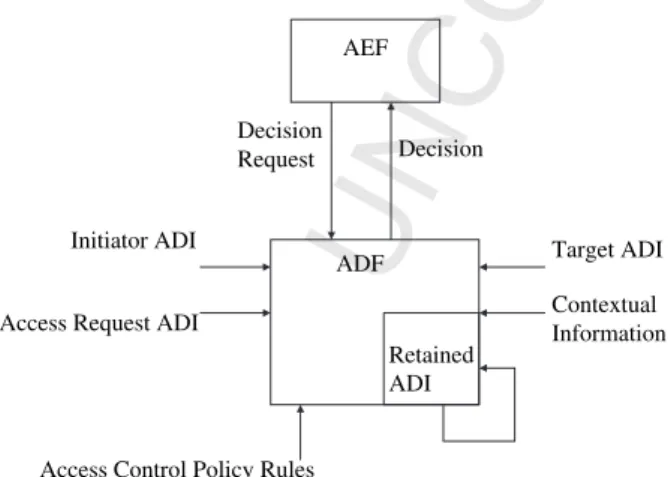
125 The ISO Access Control Framework standard (ITU-T 126 Rec X.812, 1995) recognised nearly a decade ago 127 that access control can be split into two compo-128 nents: an application dependent enforcement 129 function (AEF) and an application independent 130 decision function (ADF) e termed, respectively, 131 the policy enforcement point (PEP) and policy 132 decision point (PDP) in various IETF documents. 133 The PDP (or ADF) can be controlled by a policy (or 134 set of rules), and providing the policy is general 135 enough, the PDP is able to make decisions for any 136 type of application. All the ADF needs in addition 137 to the policy is details about the user (initiator), 138 the resource being protected (target), the access 139 request and environmental (or contextual) infor-140 mation such as the time of day (see Fig. 1). In 141 addition, if the ADF/PDP retains information about 142 previous requested actions it can make subsequent 143 decision based on this, for example, ATM machines 144 that will only allow you to withdraw a maximum 145 amount of money each day and will refuse re-146 quests once this limit has been reached. The Open
147 Group defined an Application Programmable
In-148 terface between the PEP and PDP and called it the
149 AZN API (The Open Group, 2000). However, this is
150 not general purpose enough, being constrained
151 to C programs only.
152 The Grid is increasingly moving towards web
153 services as the means of connecting its various
154 components together. Globus Toolkit is moving this
155 way too, and release 4 scheduled for the end of
156 2004, is expected to be web services compliant. In
157 2003 it was therefore opportune to specify a web
158 services interface that could be used to connect
159 a PDP to a Grid based PEP such as Globus Toolkit.
160 Fortunately the groundwork for this had already
161 been done by the Organization for the
Advance-162 ment of Structured Information Standards (OASIS),
163 who had issued the Security Assertion Markup
164 Language (SAML) specification in 2002 (OASIS,
165 2002a). SAML is a general purpose language that
166 allows different types of security assertions about
167 principals to be passed between clients and
serv-168 ers, encoded as XML messages. The language is
169 infinitely extensible and allows any type of
asser-170 tion to be defined, although three standard types
171 of assertions about principals were specified in
172 SAML v1.0: authentication assertions, attribute
173 assertions and authorisation decision assertions.
174 It is the latter type that are passed between the
175 PDP and PEP. SAML therefore provides a solid base
176 from which to specify the PDPePEP interface for
177 Grid applications. The SAML specification also
178 defines a requesteresponse protocol in SOAP over
179 HTTP for carrying the SAML assertions. SAML is thus
180 fully web services compliant.
181 Whilst SAML provides a solid basis for specifying
182 the PDPePEP interface, it does not define
every-183 thing that is needed for Grid applications. A SAML
184 profile is thus needed to rectify the deficiencies,
185 and this has been specified by the Global Grid
186 Forum as a draft standard specification (Von Welch
187 et al., 2004). Several important restrictions or
188 additions to SAML have been specified, including:
- The contents of the authorisation response. A simple Boolean (granted or denied) is sufficient for the PDPePEP interface, but SAML does not contain such a response,1 hence the GGF profile defines one.
- How the PDP gains access to the user’s author-isation credentials (initiator ADI inFig. 1). Two
Decision
Request Decision AEF
Initiator ADI
Access Request ADI
Target ADI Contextual Information
Access Control Policy Rules
Retained ADI ADF
Figure 1 Separating access control enforcement from decision making. 59 60 61 62 63 64 65 66 1The SAML Authorization Decision Response repeats the entire contents of the Authorisation Decision Request, which is useful if the request is sent by a party other than the PEP, for example, the principal. The SAML response thus details exactly what has been granted to the principal.
UNCORRECTED
PROOF
modes are possible, pull and push. In pull modethe PDP fetches the credentials, in push mode the PEP provides them. If the PDP is to fetch the credentials, how does it know where to get them from? The PDP could either be pre-configured with a (probably static) list of credential sources, or the client could tell the server where to pull the credentials from at the time of decision making. The latter is more scalable, and more dynamic than the former. Thus the GGF profile defines a Reference Statement which points to a repository where user credentials are located.
- Default values for all the parameters of the authorisation decision request. These are specified in the GGF draft as follows: if the name of the initiator is missing it is assumed to be anyone i.e. public access is being re-quested; if the requested action is missing it is assumed to be everything i.e. all the rights that have been granted to the initiator; if the target is missing it is assumed to be all the resources that are protected by the PDP policy; if the initiator’s credentials are missing then only the default ones (if any) that have been granted to everyone should be used. Note that no default values for the contextual informa-tion have been specified since in general it is not possible to define these.
- If too little information is passed to the PDP, it may simply deny access. Alternatively, at its discretion, the PDP may return ‘‘Granted sub-ject to’’ along with a set of conditions that must be fulfilled before access is granted, e.g., Granted subject to the time being between 9 am and 5 pm. It is then the responsibility of the PEP to evaluate these conditions before grant-ing access to the initiator. If the PEP is unable or unwilling to evaluate these conditions, it always has the option of issuing a new decision request and sending more information to the PDP (such as the missing contextual information).
239 Once this interface had been defined by the 240 GGF, it then needed to be implemented and tested 241 in one or more Grid applications to ensure that it 242 meets the needs of the Grid community. Globus 243 Toolkit v3.3, released in April 2004, has imple-244 mented this SAML interface, as has the PERMIS 245 authorization infrastructure, described in the next 246 section. The BRIDGES E-Science project currently 247 running at Glasgow University is the first Grid 248 application to pilot the combined GT3.3/PERMIS 249 infrastructure and the results are expected to be 250 published the last quarter of 2004.
251
The PERMIS authorisation infrastructure
252 PERMIS is software developed under the EC PERMIS
253 project (www.permis.org). It is now part of the US
254 National Science Foundation’s Middleware
Initia-255 tive (NMI) software release (www.nsf-middleware.
256 org). PERMIS is an attribute based access control
257 (ABAC) infrastructure. ABAC is a superset of role
258 based access controls (RBAC), in which access
259 control decisions are made based upon any
attrib-260 utes held by the user, and not just upon their
261 organisational roles (as in conventional RBAC). In
262 PERMIS, user attributes are held in X.509 standard
263 attribute certificates (ACs) (ISO 9594-8/ITU Rec.
264 X.509, 2001). An attribute certificate is a data
265 structure that binds details about the holder to the
266 attributes that are assigned to them, digitally
267 signed by the issuing attribute authority. The AC
268 is therefore tamper-proof, and its validity can be
269 checked by validating its digital signature, and
270 checking that it has not been previously revoked in
271 the current revocation list.
272 In PERMIS, managers throughout a VO can act as
273 attribute authorities and assign attributes (in the
274 form of X.509 ACs) to their staff e they do not
275 need any prior permission to do this. All they need
276 is a private signing key and a corresponding X.509
277 public key certificate (plus the necessary software
278 to create ACs). Thus the allocation of entitlements
279 (or ACs) is distributed throughout the entire VO
280 (and beyond if necessary2). However, each
re-281 source owner, when setting the policy that
con-282 trols access to his/her Grid resource, states which
283 attribute authorities (s)he trusts to issue X.509
284 ACs, and the PERMIS PDP will then discard all ACs
285 presented to it that are not digitally signed by one
286 of these trusted authorities. Thus we have partly
287 accomplished one of our earlier stated goals, i.e.
288 that a resource owner should be able to specify
289 a policy for controlling access to his/her resource,
290 and then leave the authorisation infrastructure to
291 enforce it.
292 The PERMIS distribution contains three software
293 tools for creating X.509 ACs. A user friendly
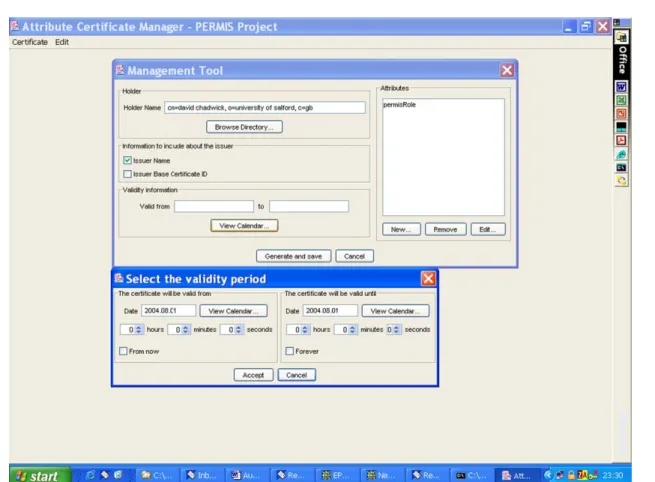
graph-294 ical Attribute Certificate Manager (see Fig. 2)
295 is designed to make it very easy for managers to
296 assign basic ACs to their staff, one by one. A more
297 sophisticated Privilege Allocator can create more
298 complex ACs, whilst a bulk loader tool is designed to
299 allow large numbers of users to be automatically
2PERMIS does not restrict who can issues ACs. Thus, for example, a professional society such as the Law Society or the General Medical Council, could issue ‘‘lawyer’’ or ‘‘doctor’’ ACs to their members, and access control decisions could sub-sequently be based upon them.
67 68 69 70 71 72 73 74 75 76 77 78 79 80 81 82 83 84 85 86 87 88 89 90 91 92 93 94 95 96 97 98 99 100 101 102 103 104 105 106 107 108 109
UNCORRECTED
PROOF
300 allocated ACs. The bulk loader works by searching301 an LDAP directory for users who have specific 302 attributes, then creating a specific AC for each of 303 them and writing these back to their respective 304 LDAP entries.
305 PERMIS provides a PDP that reads in the policy 306 set by the resource owner at initialisation time. It 307 then makes access control decisions for each 308 authorisation decision request provided by the 309 PEP, based on this policy. The interface between 310 the PDP and the PEP is implemented as a Java API 311 (for applications that want to combine the PDP and 312 PEP as one program), and as SAML requests over 313 SOAP and HTTP (for stand alone PDP servers, as 314 used by GT3.3).
315 The user’s X.509 ACs can be pushed to the 316 PERMIS PDP by the PEP, either as complete X.509 317 ACs, or as SAML Reference Statements. The PDP 318 can also pull X.509 ACs from a set of pre-config-319 ured LDAP servers, or from the locations specified 320 in the Reference Statements.
321 PERMIS policies are written in XML, according to 322 a DTD published at www.xml.org. This DTD pre-323 dates the XACML specification (OASIS, 2000b), and 324 for the most part is a subset of XACML, except that 325 the PERMIS policy supports delegation of authority, 326 a feature not currently supported by XACML. The
327 PERMIS authorisation policy is a set of sub-policies,
328 namely:
SubjectPolicyethis specifies the valid subject domains i.e. only users from these subject domains may be authorised to access resources covered by this policy. Each domain is specified as an LDAP subtree, using Include DN and Exclude DN statements. In Grid environments each user has a unique DN contained in his public key certificate. If his DN is not within a valid subject domain, the user will be denied all access to resources in the VO covered by this policy.
RoleHierarchyPolicyethis specifies the differ-ent roles and attributes that can be allocated to users, and the hierarchical relationships (if any) between them. A superior role inherits all the privileges of a subordinate role, as in conventional RBAC. Using role hierarchies can simplify Role Assignment Policies.
SOAPolicy e this specifies which attribute authorities (or Sources Of Authority) are trusted to allocate roles and attributes to users. This is the way that a resource owner specifies who within (and without) the VO is to be trusted to issue ACs.
Figure 2 The Attribute Certificate Manager Tool.
110 111 112 113 114 324 325 326 327 328 329 330 331 332 333 334 335 336 337 338 339 340 341 342
UNCORRECTED
PROOF
RoleAssignmentPolicy e this specifies whichroles and attributes may be allocated to which subjects by which SOAs, whether delegation of authority may take place or not, and how long the issued ACs are considered valid by this policy. This sub-policy effectively states who is trusted to allocate which roles to whom, and is central to the distributed management of trust. It can stop a trusted manager in one organisation issuing attributes or roles to staff in another organisation. Allowing delegation will allow a staff member to assign his/her attributes to another staff member. By re-stricting the validity of ACs, an issued AC may have a validity period of 2 years, but the resource owner may have a more stringent policy and be not prepared to accept ACs older than 1 year.
TargetPolicyethis specifies the target domains in which resources covered by this policy are located. Each domain is specified as either an
LDAP subtree, using Include DN and Exclude DN statements, or as a URL. Resources can further be refined by specifying their type e.g. all fileservers within the oZSalford, cZGB
domain.
ActionPolicy e this specifies the actions (or methods) supported by the various target resources, along with the parameters that should be passed along with each request e.g. action Open with parameter Filename.
TargetAccessPolicyethis specifies which roles and attributes are needed in order to perform which actions on which targets, and under which conditions. Note that this part of the policy, being ABAC, is not concerned with the distinguished names of the users. Conditions are specified using Boolean logic and might contain constraints such as ‘‘IF time is GT 9 am AND time is LT 5 pm OR IF Calling IP address is a subset of 125.67.x.x’’. All actions that are not specified in a Target Access Policy are denied. 343 344 345 346 347 348 349 350 351 352 353 354 355 356 357 358 359 360 361 362 363
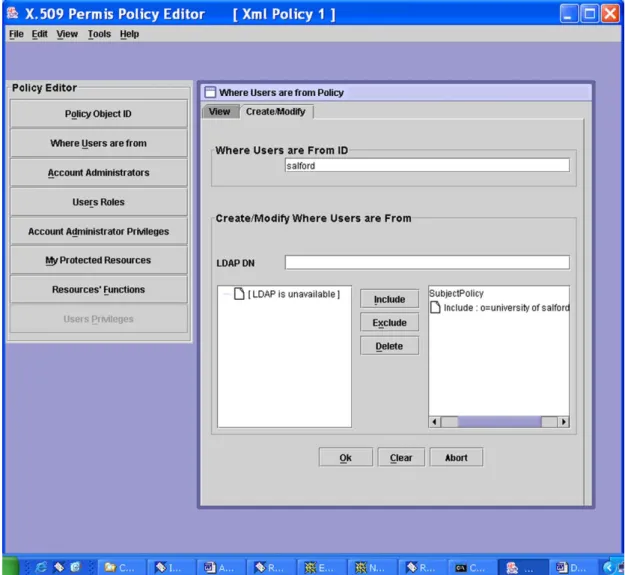
Figure 3 The Policy Management Tool.
364 365 366 367 368 369 370 371 372 373 374 375 376 377 378 379 380 381 382 383 384
UNCORRECTED
PROOF
395 Clearly setting the policy for controlling access396 to a resource is a potentially complex task, 397 especially if the resource owner was required to 398 write the XML to specify it. This would be beyond 399 the capabilities of most resource owners. Conse-400 quently, a user friendly GUI is provided to make it 401 easy to write PERMIS policies (seeFig. 3). Once the 402 policy is written, the resource owner digitally signs 403 it (to prevent it from being subsequently tampered 404 with), and the GUI stores it in the owner’s LDAP 405 directory entry. Each policy also has a unique ID so 406 that an owner can have several different policies 407 for different occasions. When the PERMIS PDP is 408 started it is told which policy ID to use, so it reads 409 in this policy from the owner’s LDAP entry, checks 410 the signature and validity time, and if valid, the 411 PDP knows that it has the correct policy written by 412 the resource owner. The resource owner can then 413 leave the authorisation infrastructure to control 414 access to his/her resource without having to 415 continually manage the system.
416
Conclusions and future work
417 Allowing a resource owner to set the policy for who 418 has permission to perform which actions on which 419 resource, and distributing the assignment of rights 420 to managers throughout a VO, is clearly something 421 that is needed to facilitate large scale Grid com-422 puting. Separating access control enforcement 423 into a policy controlled application independent 424 PDP and application dependent PEP, linked togeth-425 er via a web services SAML interface is something 426 that will facilitate the development of compre-427 hensive and sophisticated PDPs such as PERMIS and 428 Akenti. As Grid resource owners demand more 429 access control features, such as separation of 430 duties, mutually exclusive roles, dynamic delega-431 tion of authority, etc., then it becomes a question 432 of adding suitable rules to the policy base and 433 enhancing the PDP to correctly evaluate them. 434 At this point in time it is not clear which XML 435 based policy language will become the de-facto 436 standard for PDPs. XACML (OASIS, 2000b), from 437 OASIS has some industry support, and Grid re-438 searchers are now experimenting with it. But 439 Microsoft is also championing XrML (www.xrml.org) 440 as a general purpose language for expressing who 441 has the right to do what with digital content. 442 Clearly there is significant overlap between these 443 two languages, but with XrML now being part of 444 Microsoft Office 2003 and Windows Server 2003, it 445 could very well become the de-facto standard 446 for authorisation. The downside of XrML is that
447 a number of its features are patented, so users will
448 need to pay a license fee to use it.
449 Future work inside the GGF is likely to specify
450 a management interface to the PDP that will allow
451 the resource manager to dynamically update the
452 policy that is to be used for decision making. In
453 current systems it is a local matter how the PDP is
454 configured with the correct policy to be used, and
455 how the policy is changed according to the
chang-456 ing circumstances in the VO. Further, in the future,
457 autonomic PDPs could well be developed and
458 configured with meta-policies telling them which
459 access control policy to use under which
condi-460 tions. As one can see, policy based authorisation
461 and access controls are definitely here to stay.
462
References
464 Alfieri R, et al. VOMS: an authorization system for virtual
465 organizations, 1st European across grids conference, Santiago
466 de Compostela. Available from: http://grid-auth.infn.it/
467 docs/VOMS-Santiago.pdf; 13e14 February 2003.
468 Blaze M, Feigenbaum J, Ioannidis J. The KeyNote
Trust-469 Management System Version 2, RFC 2704; September 1999.
470 Chadwick DW, Otenko A, Ball E. Role-based access control with
471 X.509 attribute certificates. IEEE Internet Computing Marche
472 April 2003;62e9.
473 ISO 9594-8/ITU Rec. X.509. The Directory: Public-key and
474 attribute certificate frameworks; 2001.
475 ITU-T Rec X.812|ISO/IEC 10181-3:1996. Security frameworks for
476 open systems: access control framework; 1995.
477 Johnston W, Mudumbai S, Thompson M. Authorization and
478 attribute certificates for widely distributed access control.
479 In: IEEE 7th international workshops on enabling
technolo-480 gies: infrastructure for collaborative enterprises (WET ICE),
481 Stanford, CA; June, 1998. p. 340e5 (see also
http://www-482 itg.lbl.gov/security/Akenti/).
483 OASIS. Assertions and Protocol for the OASIS Security Assertion
484 Markup Language (SAML). (see http://www.oasis-open.
485 org/committees/security/); 19 April 2002.
486 OASIS. eXtensible Access Control Markup Language (XACML) v1.0.
487 Available from: http://www.oasis-open.org/committees/
488 xacml/; 12 Dec 2002.
489 Pearlman L, Welch V, Foster I, Kesselman C, Tuecke S. A
490 community authorization service for group collaboration. In:
491 Proceedings of the IEEE 3rd international workshop on
492 policies for distributed systems and networks; 2002.
493 Sotomayor B. The Globus Toolkit 3 Programmer’s Tutorial.
494 Access Control with Gridmaps.!http://www.casa-sotomayor.
495 net/gt3-tutorial/multiplehtml/ch15.htmlO.
496 Steenbakkers Martijn. Guide to LCAS v.1.1.16. Available from:
497 http://www.dutchgrid.nl/DataGrid/wp4/lcas/edg-lcas-1.1;
498 September 2003.
499 The Open Group. Authorization (AZN) API. ISBN 1-85912-266-3;
500 January 2000.
501 Von Welch, Siebenlist F, Chadwick D, Meder S, Pearlman Laura.
502 Use of SAML for OGSA authorization. Available from:https://
503 forge.gridforum.org/projects/ogsa-authz; Jan 2004.
502 Professor David Chadwick is the leader of the Information
503 Systems Security Research Centre (ISSRC) at the University of
UNCORRECTED
PROOF
Salford. This is part of Informatics Research Institute (seehttp://www.iris.salford.ac.uk/) which gained a 5* rating in the December 2001 RAE. Prof Chadwick has written over 40 books, journal and conference papers and the latest of these can be downloaded from http://sec.isi.salford.ac.uk/Papers. He was the editor of X.518 (1993) and is the author of several current
510 Internet and Global Grid Forum Draft Standards including the
511 Grid authorisation API draft standard. He has been the principal
512 investigator in over 10 research grants from a variety of sources
513 including JISC, EPSRC and the EC. He was the technical director
514 of the EC PERMIS project (www.permis.org) and instrumental in
515 its design and evolution.
504 505 506 507 508