Illinois State University
ISU ReD: Research and eData
Theses and Dissertations12-30-2018
Seeing Reading in First-Year Composition
Matthew Felumlee
Illinois State University, [email protected]
Follow this and additional works at:https://ir.library.illinoisstate.edu/etd
Part of theCommunity College Education Administration Commons,Community College Leadership Commons,Curriculum and Instruction Commons,Educational Methods Commons, Other Education Commons, and theReading and Language Commons
This Thesis and Dissertation is brought to you for free and open access by ISU ReD: Research and eData. It has been accepted for inclusion in Theses and Dissertations by an authorized administrator of ISU ReD: Research and eData. For more information, please [email protected]. Recommended Citation
Felumlee, Matthew, "Seeing Reading in First-Year Composition" (2018).Theses and Dissertations. 1036.
SEEING READING IN FIRST-YEAR COMPOSITION
Matthew Felumlee 253 Pages
This dissertation focuses on a study of reading-into-writing strategies employed by students in two sections of first-year-composition (FYC) that were paired with a support course as part of an accelerated learning program (ALP) at a community college. Each FYC course was comprised of 11 students whom the college had deemed college-ready without the ALP course, and 11 students who were deemed at remedial levels in reading and / or writing and who were subsequently required to enroll in the ALP course. The study employs grounded theory
methodology to identify and consider the many factors that influenced how reading was portrayed, conceived, taught, learned, and assessed within this context, and ultimately focuses its analysis on the teaching, learning, and assessment of reading and writing that occurred. Texts examined for this study include articulation initiatives, college-wide essential
competencies for learning, writing program and course outcomes statements, assignment descriptions, rubrics and instructor-to-student feedback, instructor reflective memos and, most importantly, student writing.
This dissertation presents five discrete but related findings regarding the role of reading in FYC. The first finding suggests that evidence of student reading practices can be made visible via a specific method for reading and analyzing student writing. The “seeing reading” method is then extended to other texts and contexts (institutional and instructional) and yields additional insights: the second and third findings analyze institutional texts, such as college-wide learning
outcomes, and their relationship to the formation of course outcomes, which in turn appear to bear some influence on the curriculum, assessment, and instructor attitudes and dispositions towards reading instruction. The final two findings deal with the immediate teaching-and-learning context of the classroom setting studied, and detail the ways in which in/explicitness of instruction in reading strategies relates to student activity—and especially the activity of using source texts in one’s own writing.
This dissertation concludes with recommendations for a more intentional, mindful approach to the integration of reading instruction into FYC. Suggestions include writing program self-studies to identify student and instructor values concerning reading, and how reading is portrayed in pedagogy, curriculum, and assessment practices. Careful and intentional alignment around a more explicit conception of reading can help students develop as readers, which in turn relates to reading-into-writing performance that is so key to success in college. Composition instructors are called upon to advocate for those values to curriculum committees and the like in ways that can help foster a more dynamic conception of reading not only in FYC but across the curriculum.
KEYWORDS: College Composition, Reading, Remediation, Basic Writing, Writing Assessment, Integrated Reading and Writing, Community College
SEEING READING IN FIRST-YEAR COMPOSITION
MATTHEW FELUMLEE
A Dissertation Submitted in Partial Fulfillment of the Requirements
for the Degree of DOCTOR OF PHILOSOPHY
Department of English ILLINOIS STATE UNIVERSITY
SEEING READING IN FIRST-YEAR COMPOSITION
MATTHEW FELUMLEE
COMMITTEE MEMBERS: Joyce R. Walker, Co-Chair Bob Broad, Co-Chair Ellen Carillo
i
ACKNOWLEDGMENTS
I am most grateful to my committee members, Drs. Bob Broad, Joyce Walker, and Ellen Carillo, each of whom contributed so much time, talent, and care to my project. Thanks to Bob and Joyce for playing “musical Chairs” so willingly and ably, and to Ellen for offering to read and comment from afar, despite not knowing me personally before embarking on this journey. Bob, you have influenced my development as a careful qualitative researcher, and while I still have a lot to learn, you have set me on a principled path I will continue to follow. Joyce, your
willingness to dive in to my topic and project so enthusiastically put wind in my sails when I needed it most—you prodded me to be so much more careful when considering the
pedagogical implications of my findings and arguments, and my project is much stronger for it. And Ellen, your work in reading was a big part of the impetus for my dissertation in the first place—so I feel truly honored that you found it worthy of your time and efforts.
I also feel a deep debt of gratitude to so many faculty and staff at Illinois State University who helped guide me during this process. There are so many forms, timelines, policies, and procedures to navigate during the dissertation process, and Dr. Angela Haas and Sherrie Howe went above and beyond to help ensure my success. Your commitment to graduate students at ISU is admirable and inspiring.
Many others at ISU served as trusted advisors and mentors during my coursework and exams. I would like to especially thank Drs. Chris DeSantis, K. Aaron Smith, and Amy Robillard for their time, advice, and assistance at various points along the way.
Dr. Julie Collins Bates, thank you for sharing so much of your own dissertation journey with me—your advice and encouragement were a gift I hope to pay forward someday.
ii
I am also blessed to have so many dedicated colleagues and friends at Heartland Community College who supported my work in so many ways. Special thanks go out to my Dean, Dr. Tom McCulley, for supporting the sabbatical during which the bulk of this dissertation was written, and to colleagues Richard Seehuus, Stephanie Kratz, and Zach Petrea for being willing to read, listen, and talk about my project. Your passion for teaching and learning inspires me daily. I am indebted to Distinguished Professor of Reading Lisa Cole for her willingness to share her expertise with me—I appreciate the journey we have taken together to better serve our students.
And last but certainly not least, none of my academic pursuits are possible without the support of my loving family. As a nontraditional student completing my degree part-time over the course of eight long years, I relied often on the support of my wife Joelle, my sons Colin and Owen, my parents Dan and Charlene Felumlee, and my in-laws David and Galeen Driscoll. Joelle spent many nights home alone with one—and then two—small children to care for, while I attended night class after night class. My kids’ support is typified by Colin’s attempt (at age 5) to make me note cards and study aids for my linguistics exams. Our parents’ support during this entire process was a gift I can never repay. I’d like to think that Galeen, a life-long educator now sadly departed, is nodding her approval from up above. We miss you, grandma Booboo.
iii CONTENTS Page ACKNOWLEDGMENTS i CONTENTS iii FIGURES x
CHAPTER I: BEYOND REMEDIATION: RECONCEPTUALIZING READING FOR COMPOSITION 1
Seeing Reading: An Introduction 1
Review of the Literature 5
Impacts of The Great Divide(s) on Reading 9
Other Touchstones in the 1980’s and 1990’s 16
The Reading Revival in Composition 17
Impacts of K-12 and Common Core 23
Student Reading in College Contexts 27
Reading: Resisting Definition 29
Prior Knowledge and Metacognition: Bridging Writing and Reading 37
Making Reading Visible 40
Conclusion: External and Internal Exigencies for Reading Pedagogy in Composition 47
CHAPTER II: CONTEXTS, METHODS, AND METHODOLOGIES 53
Introduction to This Study 53
Research Context 54
Research Methods 64
iv
Phase 2: Data Selection 68
Phase 3: Data Analysis 72
Phase 4: Close Analysis and Verification 77
Key Terms: Purposes for, Types of, and Strategies for Reading 78
Seeing Reading in Student Writing: The Method 81
The Student Artifacts 87
CHAPTER III: “SEEING READING” IN STUDENT WRITING 91
Finding Summary 91
Documents Analyzed for This Finding 91
“Neutral” Traits Explained 91
“Positive” Traits Explained 92
“Negative” Traits Explained 93
Neutral Traits Exemplified 94
Direct Quotations / Summary / Paraphrase 94
Statistical Information / Definitions 96
Application, Evaluation, Analysis, Interpretation, and Background 99
“Leads” and “Follows” Exemplified 103
Negative Traits Exemplified 107
Missed Opportunities 107
Distortions 108
Fuzzy Syntax 110
v
Springboarding 113
CHAPTER IV: “SEEING READING” IN INSTITUTIONS AND INSTRUCTION 116 Introduction: Purposes for, Types of, and Strategies for Reading 116
Finding 1: Institutional Influences on Reading 124
Finding Summary 124
Documents Analyzed for This Finding 124
Finding 2: Mismatch of Types of Reading in Theory and Practice 132
Finding Summary 132
Documents Analyzed for This Finding 132
CHAPTER V: IN/EXPLICITNESS OF READING INSTRUCTION 156
Introduction: Seeing Reading in Student Writing 156
Finding 1: Relationships Between Explicitness of Instruction and Student Activity 157
Finding Summary 157
Documents Analyzed for This Finding 157
Finding 2: Vague Reading Assessment 173
Finding Summary 173
Documents Analyzed for This Finding 174
Instructor Feedback and Comments 180
CHAPTER VI: TOWARD A PEDAGOGY FOR READING IN COMPOSITION,
AND IMPLICATIONS FOR THE FUTURE 189
Regarding Chapter 3: Seeing Reading in Student Writing 198
vi
Guiding Questions 198
Considerations 199
Strategies and Tools 200
Regarding Chapter 4 / Finding 1: Institutional Influences 201
Finding Summary 201
Guiding Questions 202
Considerations 202
Strategies and Tools 203
Regarding Chapter 4 / Finding 2: Mismatch of Types of Reading in Theory and Practice 206
Finding Summary 206
Guiding Questions 207
Considerations 207
Strategies and Tools 209
Regarding Chapter 5 / Finding 1: Relationships Between Explicitness of Instruction and
Student Activity 210
Finding Summary 210
Guiding Questions 211
Considerations 211
Strategies and Tools 212
Implementation 214
Regarding Chapter 5 / Finding 2: Vague Reading Assessment 217
vii
Guiding Questions 217
Considerations 218
Strategies 218
Implementation 220
Implications Regarding Writing Placement and Developmental, ALP,
and FYC Relationships 221
Conclusion 235
WORKS CITED 237
APPENDIX A: SEEING READING CODING SCHEME 244
APPENDIX B: ARTICULATION INITIATIVE DOCUMENT 250
APPENDIX C: SAM’S ESSAY RUBRIC 252
viii
TABLES
Table Page
1. Circa 2007 Writing Program
Course Sequence at Prairieview 59
2. 2017 Writing Program Course Sequence at Prairieview 60
3. Literacy Placement Process at Prairieview 62
4. Summary of Instructor Data Collected and Analyzed 66
5. Summary of Student Data Collected and Analyzed 67
6. Coding Scheme Preview 88
7. Purposes for Reading, Types of Reading, and Reading Strategies 122
8. Relevant Codes from Data for Reading Purposes, Types of Reading, and Reading Strategies 123
9. Articulation Agreement Language Alignment with English 101 Course Outcomes at Prairieview 126
10.English 101 Course Outcomes at Prairieview 129
11.Instances of Direct Quotation and Paraphrase in Sam’s and Zarina’s Students’ Writing 148
12.Instances of Background, Statistical Information, and Definitions in Sam’s and Zarina’s Students’ Writing 153
13.Instances of Analysis and Evaluation in Sam’s and Zarina’s Students’ Writing 165
14.Instructor Feedback on Student Essays 180
15.Coding Scheme Breakdown by Course (Sources) 227
ix
x
FIGURES
Figure Page
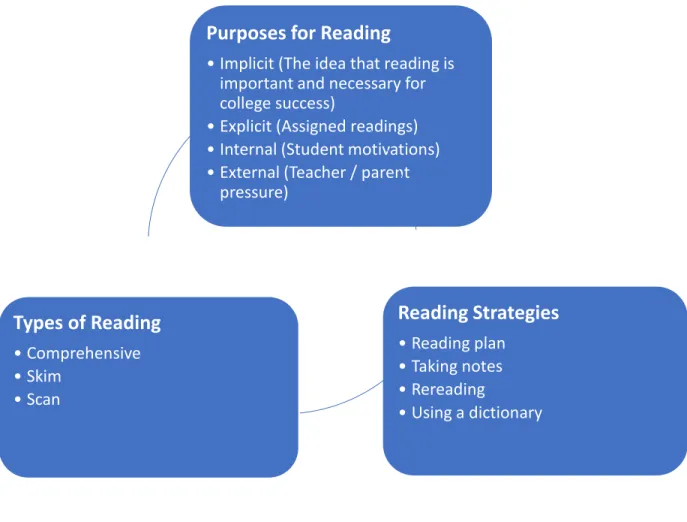
1. English 101 ALP model at Prairieview 58 2. The differences between purposes for reading, types of reading,
and reading strategies as used and applied in this study 79
1
CHAPTER I: BEYOND REMEDIATION: RECONCEPTUALIZING READING FOR COMPOSITION
Seeing Reading: An Introduction
In 2015, I was developing a first-of-its-kind course for my institution—a developmental-level integrated reading and writing course that would serve the college’s lowest-placing students. Previously, these students had been placed into separate developmental reading and writing courses—each course with its own curriculum, its own instructor (reading courses taught by reading instructors, and writing courses taught by faculty in English), and separate administrative oversight. This new course would replace the previous iterations.
Ultimately, I left this project feeling good about what my co-teacher and I had created, what I had learned, and the ways in which the developmental-placing students were being served by the new course. However, I quickly turned my attention back to the credit-bearing courses in first-year composition that comprise the bulk of my teaching load. And I was hit with a stark realization: twenty years into my teaching career, I am just now learning about and paying close and careful attention to my students as readers, and not just as writers. Why have I have mostly taken for granted that my first-year students know how to carefully and critically read our assigned texts, or those they self-select when researching for their projects? After all, I have virtually no evidence to support this assumption—and in fact, across my
discipline--perhaps all disciplines other than reading—these assumptions about student reading are common, while very little research has been done that might serve to support or resist them.
At the same time of the development and implementation of the new integrated course, I was also watching my oldest son work his way through kindergarten, first, and now
2
second grades. I was in awe as he began his own lifelong journey of literacy—and I noticed that for him (and his classmates), reading and writing are at first not “separate” at all, but very much interconnected activities. Inspired by these observations, my inquiry extended into the K-12 system in the United States, where I noticed that while writing is taught in very explicit ways throughout both K-12 and higher education, explicit reading instruction seems to largely disappear after about 4th grade, after which point “reading class” becomes the domain of
special education. Questions about why I took my college students’ reading for granted can be extended to K-12 as well. Why do we expend so much energy nurturing our students as writers, while relegating student reading to the realm of special education and remediation? This is likely a contributing factor to why so many of my students attach feelings of shame to their perceived shortcomings as readers.
These questions were the beginnings of the inquiry that forms the heart of this study, which focuses on learning to “see” reading in and around college composition—an inquiry that initially yielded even more questions. How can we look at student writing not only as evidence of a student’s writing practices, but also as at least partial evidence of that student’s reading practices? What does reading “look like” in our first-year composition (FYC) curricula,
pedagogies, and individual instructor philosophies? What notions of reading are at work in our transfer agreements, articulation initiatives, college-wide competencies, writing program statements, and course descriptions? What are the relationships between and among all these facets, and how do they relate to teaching and learning?
Of course, these questions and their respective answers are in some ways deeply contextual—a study of these questions at any given institution would yield its own unique
3
insights. However, as I hope the following study will show, such an examination can also yield findings that hold important implications beyond the immediate institutional context. In this case, my study of two sections of FYC (English 101, in this case) taught by two different
instructors at one community college yielded many interesting and useful findings, five of which are featured here, and each of which carries with it important and immediately-applicable implications that might be explored and applied in various other contexts. In this study, I set out to “see reading” in ways that would help me grow as a teacher and as a scholar, and that would contribute something of value to the field of composition more broadly. The resulting findings support a simple yet significant argument: yes, we can learn to see reading in these various places, and we can all learn from what we see.
This first chapter reviews the literature on reading emanating from composition, with a focus on the somewhat fractured history of reading / writing and remedial / first-year
composition (FYC) relationships. The review surveys this history, up to the present moment, to justify a call to be more mindful of the place and space for reading within current writing theory. Chapter 2 describes the methods, methodologies, and contexts for project, which is a study of two sections of an Accelerated Learning Program (ALP) English 101 class at a
Midwestern community college, and outlines the grounded theory methodology used to collect the data for this study. Chapter 2 concludes with a detailed explanation of the methods
employed towards the aim of “seeing” student reading practices vis a vis their writing—a project that informs all data analysis for this study.
Chapter 3 details the first of five total findings analyzed for this study by enacting the method for “seeing reading” in student writing articulated in Chapter 2. Chapter 4 details the
4
next two findings analyzed, both of which extend the concept of “seeing reading” from student artifacts to institutions and instruction, respectively. The first finding presented in this chapter suggests that if compositionists wish to become more intentional about teaching and assessing student reading, it is imperative to understand the ways in which outside forces, such as political mandates that limit remediation offerings, work to shape what reading means at colleges and, thus, in our classrooms. The second finding in this chapter examines teaching artifacts, from personal statements to assignment prompts, and locates many apparent
disjunctures between what the teachers say they value (“close,” “intensive,” “comprehensive” types of reading) and the types of reading actually called forth in much of their day to day assigned work (“skimming” or “scanning,” for example). Such disconnects likely exist in all instructors’ pedagogies, and this finding suggests a means for seeing and addressing them productively.
Chapter 5 presents the last two findings, both of which deal with the idea of
“explicitness” of reading in composition classrooms. These findings examine the importance of explicitness within writing instruction (finding three) and assessment (finding four), and the relationships between explicitness (or lack thereof) and student activity. Chapter 6, the final chapter, argues that current pedagogical values, such as metacognition and critical reading, largely assume, disregard, or ignore their precursors: cognition and comprehension. The chapter proceeds from these points of omission to then detail considerations, strategies, and tools that can be applied towards the development of writing pedagogies that account for reading more fully, directly and intentionally. Chapter 6 concludes by exploring key implications for the future of reading within composition, including writing placement practices, and the
5
need for more longitudinal studies that explore relationships between students deemed “college-ready” and “remedial” via these practices and procedures.
Review of the Literature
This chapter investigates the multiple and conflicting ways “reading” is defined in composition scholarship past and present, both explicitly and implicitly, and the ways in which these conflicts have worked to prevent sustained attention to reading from within composition. This chapter then examines various ways scholars in composition and in writing assessment are currently working to bridge this gap by making reading more visible in both theoretical and practice-oriented realms of writing instruction. There are two predominant themes that will be explored here: the first is that when composition does talk about reading, it often does so in a limited and limiting way, glossing over the multiple and complex “decoding” aspects of reading processes that are key to effective reading comprehension, in favor of a focus on more
“advanced” or privileged types and purposes for reading, such as reading to analyze, synthesize, or evaluate—reading types that are most often assessed, not coincidentally, via their representation in student writing.
Second, when the “decoding” aspects of reading are acknowledged, they are often presented in an oversimplified form. Whether intentional or not, this rhetorical move is used to justify the situating of comprehension aspects of reading as “mere” remedial concerns, distinct and separate from more desirable, higher-order “skills” like analysis, evaluation, and
application, and thus not the purview of first-year composition. I explore these themes here for purposes of bringing them to light, and ultimately testing their many assumptions throughout
6
this study via a close analysis of student writing for evidence of reading practices and processes. In short, this current study concludes that student reading and writing practices that might indicate comprehension struggles are prominent across the work not only of students placed into remedial classes, but also of students enrolled in first-year composition—findings which challenge commonplace distinctions between first-year composition and remediation.
The aim of this historical overview is to promote a more nuanced and multifaceted understanding of reading in composition than is evident in most of the scholarship—one that acknowledges the complexity of reading as a process (or rather, as a complex of processes); one that acknowledges and exposes the complexity of even “basic” decoding abilities required for reading comprehension; but one that also describes and accounts for the more advanced critical reading skills and strategies needed to analyze, synthesize, and evaluate texts and ultimately to learn, apply, and transfer that knowledge to and through college-level
coursework, as assessed most typically, again, through writing. Such an understanding might work to blur the typical and unfortunate hard distinction often drawn between “remedial” and “college-level” reading and writing instruction (and more consequently, perhaps, between remedial and college-level readers and writers), in that it forces writing teachers to come to know their students’ actual reading processes and practices, instead of teaching largely to assumed or imagined ones. What is called for in this moment is a compelling, coherent, and comprehensive working knowledge of reading / writing re/integration that the field of
composition might then deploy as it confronts important, immediate questions about what it means to read; how effectively our students read; the role of cognition, metacognition,
7
predisposition, and context in student reading; and how we know—questions that are crucial to the present and future of college writing instruction.
In one sense, reading and writing are seemingly so intertwined that it is very difficult if not impossible to develop a theory of writing that is not also a theory of reading, at least implicitly: one cannot write without also reading, even if that reading is merely of one’s own writing. Often, though, reading is relatively unexamined within these theories—even in the field’s most current theories that emanate from areas seemingly ripe for integration of reading, like genre studies, cognitive studies, and transfer theory. This chapter aims to identify several of those gaps and to propose ways (often, very simple ones) they might be bridged.
As will be demonstrated in this review, historical influences on composition’s
conceptualization of reading endure in unsettling ways. The history of college composition as a discipline has in fact always been not only a history of writing, but also one of reading / writing integration. As early as 1783, Hugh Blair, “who had enormous influence on the shape of
rhetoric, stated: ‘The same instructions which assist others in composing will assist them in judging and relishing the beauties of composition’” (qtd. in Jackson 146). However, even in this early statement, one can notice ways in which reading has been subtly subordinated by its integration into what is first and foremost an ostensible theory of writing. To Blair, it seems, teaching writing is enough—and reading skills will somehow materialize along the way. Now, more than 200 years later, this conception is still surprisingly prevalent, to varying degrees, at all levels of writing instruction in the United States, including K-12 education, mentioned later in this chapter. So, while writing has always been an explicit object of study in composition,
8
reading has not received the same sustained attention—often, though certainly not always, subverted or rendered invisible by our own writing-centric theories.
More recently, reading has been subsumed by phrases and resulting pedagogies like “reading to write,” the idea being that the purpose of reading is ultimately as inspiration for or to provide models for writing (Jackson 160). One might also question whether the rise of terms and concepts like “literacies” has done unintentional harm to our conception of reading by inextricably linking it to writing and other dimensions of literacies. Even the now-former International Reading Association recently changed its name to the International Literacy Association, to account “for the fact that educators nowadays need not only to teach and promote reading, but also a broad range of related skills in order to prepare students for life and work in the 21st century” (“International Reading Association”). While well-intentioned, the shift from “reading” to “literacy” has unintended and undertheorized consequences for reading, at times rendering it almost invisible. Given this history, as composition seems to be re/turning to reading in a more deliberate way, especially in terms of theories and practices for reading / writing integration in first-year composition (FYC), it is understandable that these efforts seem somewhat scattered.
The lack of sustained attention to the development of coherent theory has given rise to commonplace assumptions teachers make when students seem not to have read the assigned reading for the day. Most teachers have overheard hallway discussions where it is claimed that “students are not interested,” or that “the reading was not engaging.” We might hear (or even say) that students “did not spend enough time on the reading,” or “did not read it closely enough.” In this dissertation, I will explore another distinct possibility—one I believe to be true,
9
based on my own classroom-based research: sometimes, our FYC students face significant challenges when attempting to engage with, reflect on, or even comprehend the assigned reading to a meaningful degree due to a lack of adequate skills, dispositions, processes, and strategies needed for effective baseline comprehension of the text at hand.
This is an uncomfortable discovery: students in a first-year, credit-bearing composition class, whose apparent reading comprehension “abilities” (a loaded concept to be unpacked later) do not match our expectations and assumptions—assumptions which we base primarily on students’ educational attainment and presumptions about what “should have” been taught in high school or prior, or what “should have” been diagnosed or addressed earlier, in college writing placement procedures or via prior required remedial coursework. The discovery is uncomfortable because unlike with the commonplace assumptions we make about “bad
reads,”—all of which place the onus on the student to become more interested, more engaged, more active, less lazy—the responsibility for providing curricular and pedagogical interventions that might effectively address students’ readingchallenges lies with the teacher, the pedagogy, the program. The responsibility in this case lies with us, not them.
Impacts of The Great Divide(s) on Reading
The history of composition is rife with tales of splits of various sorts, and space does not permit full treatment of them all here. A brief list would include: various “lit / comp” splits (1800’s and 1980’s); FYC’s work, past and present, to distance itself from developmental composition and remediation; distinctions, both assumed and codified, between 2-year and 4-year schools and their respective student populations; composition’s shifting relationships with
10
rhetoric, assessment, and creative writing; and even the figurative and often literal “distance” in two-year colleges between developmental composition and reading programs. While the tales of these splits have been told and re-told in more general terms, this chapter presents a brief overview of the ways each of these splits has worked to disrupt how those in the field(s) have come to view reading specifically, and the relationship(s) between reading and writing more generally.
This history in the United States would likely begin in the 1870’s with the birth of writing programs and composition courses, most notably at Harvard—a development that marked the slow transition of rhetoric from “the art of speaking well” to “the art of writing well.” In 1874, Harvard famously instituted an entrance essay exam in English Composition for the first time. Brereton writes, “This moment, we have come to believe, marks one of the origins of our field because it led to (a) a reaction of shock among Harvard faculty over the students’ performance, (b) the almost universal practice of examining college entrants on their writing abilities, and (c) the subsequent widespread establishment of first year composition required for entering college students at many colleges” (32). While his aim in this piece is ultimately to disrupt that familiar narrative, it persists nonetheless.
The birth of composition and writing programs led, consequently, to the first of many notable “splits” between reading and writing, in part via disciplinary tensions between literature and composition, and regarding the place of reading within both. In 1884, Thomas Hunt advocated for the inclusion of literary studies at the college level, with the caveat that “the writing one does about literary studies is different from literature,” thus Jessica Yood notes that “the segregation between literature and writing . . . was born” (527). Importantly,
11
this initial tension, like those that followed, was not about where or how students might best learn how to read or write. Instead, this early split, like later ones, was primarily a disciplinary turf war concerned with self-preservation and prestige of disciplines and professions. In this sense, reading has often been co-opted to serve other purposes, and in the process, reading itself has been neglected. This trend, with roots in the earliest days of composition, endures and persists, and continues to frame ways we talk about reading in composition.
Our collective struggle with questions of reading naturally spills over into our
conversations about teaching. Ellen Carillo opens the introduction to her book Securing a Place for Reading in Composition with a recounting of a 2009 WPA-L thread in which Bob Schwegler, University of Rhode Island, asked “How well do your students read complex texts—other than literary texts?” Dozens responded—and Donahue observed that the replies tended to veer in one of two directions: “towards literature, saying that’s what those people teach; or towards developmental reading specialists, trained in more qualitative methods. But we don’t refer to the substantial body of work done on reading in our own field . . . particularly on the
interrelationship of reading and writing. Why not?” (qtd. in Carillo 2).
In the first half of her statement, Donahue is alluding to another widely-known reading / writing “split” that occurred through the 1980’s and 1990’s, which has its own
well-documented history, and even its own catchy moniker: “The Great Divide.” The touchstone in this alleged splitting of Literature and composition is what came to be known as the “Tate / Lindeman debate,” two divergent essays (by Gaty Tate and Erika Lindemann respectively) on the relationship between Literature and composition that appeared in College English in 1993. Salvatori and Donahue explain: “In his essay ‘A Place for Literature in Freshman Composition,’
12
Tate argued that the exclusion of literary texts from the freshman writing course made it more difficult for students to improve their writing” (206). The problem, to Tate, is that rhetoric, in largely displacing literature in freshman composition classrooms, contributes to “the increasing professionalization of undergraduate education in this country” (320). “By elevating nonfiction prose and the discourses of various disciplines to sacred heights,” he argues, we are “ignoring an enormously rich body of literature” that might help students join conversations outside of, rather than within, the academy (321). Tate’s primary focus here is on what students read, and to what end.
In “Freshman Composition” on the other hand, again according to Salvatori and Donahue, Lindemann argued that “for many years, students in writing courses had been harmed by a literature-centered pedagogy . . . one that focused on textual consumption rather than production” (206). Lindemann though, unlike Tate, does take up the question of reading in more detail: she mentions that some turn (back) to literature as part of a “welcome resurgence of interest in reading-as-process” (312), though it is not clear in her argument why the writing course she imagines could not also take up reading as process as part of its content. She sees first-year composition as a space to “offer guided practice in reading and writing the discourses of the academy and the professions” (312). In Lindemann, like in Tate, there is a concern not only with what to read, then, but also with the purposes for student reading.
I recount this history first because of the “status” of this debate within the field. But this reality has other unintended effects: among them, the fact that this debate frames “the reading question” as one concerned primarily with what students should read and where they should read it. What get lost in this discussion, of course, are questions about how our students read in
13
the first place and how we might come to know or care. Lindemann, like many in composition past and present, consciously distances FYC from anything we might call “remedial” since “to see freshman composition as remedial is to undervalue its importance as the only required course remaining in most college curricula” (312). To be sure, composition also has its own political reasons for constructing reading as remedial. “Some scholars claimed that composition / rhetoric specialists abandoned reading as they sought to ‘professionalize’ their sub-discipline . . . because reading instruction is often viewed as remedial” (Harkin 2005 quoted in Bosley 286). It is past time to question both the conscious and unconscious moves to abandon reading, as well as the assumptions that underlie conceptions of reading as remedial.
The “What We Read” paradigm endures even today, as evidenced by scholarship that still posits it as something to acknowledge, resist, and work against. Gerald Graff’s “Why How We Read Trumps What We Read,” written in 2009, is one of many examples. In this essay, Graff alludes back to his own 1992 assertion that “it is not only the text that makes reading difficult but also how students are expected to read it . . . they become difficult because students have to (or should have to) talk and write about them in rigorously analytic ways instead of simply enjoying them unreflectively as leisure entertainment” (67). It is worth noting here that “difficult” is the desired state of a given reading to Graff: in this model, a text is something to complexify, rather than to simplify—a fact which rests on an underlying assumption of student reading comprehension that, again, is not fully examined. In other words, the project of
complexifying a text requires, first and foremost, the ability to effectively read and comprehend that text. And this “ability” is of course both individual (with at least cognitive and
14
metacognitive dimensions) and socially situated. Composition simply does not have the
evidence, currently, to support its many casual underlying assumptions about student reading. Graff’s central premise is that there is no “necessary relation between the complexity of a text and the degree of difficulty in studying it,” that “any text becomes challenging when subjected to the right kinds of analysis” (67). But complexity of a text is, of course, a relative distinction, one made by each individual reader and predicated at least in part on that student’s antecedent knowledge (of the topic at hand; of the genre of text; etc.). Suggestions otherwise are rooted in the same presumptions about students-as-readers already mentioned. And while his argument is framed around the project of complexifying a “simple” text, and may be true within that context, it certainly would not hold in the opposing context: if the text in question was an undeniably complex one in relation to its reader(s). In other words, if readers do not have the lexical or prior knowledge to even approach a text, then we might say that meaningful study of that text is, for the moment, impossible. When comprehension breaks down, in other words, Graff’s argument does not hold.
He concludes, “Serious education means assigning texts that possess intrinsic richness, complexity, and value” (73), with his point being that this “complexity” can be found in
unexpected places, if we ask the right questions of a text. While overtly focusing on “how we read,” Graff actually spends considerable time defending pop culture and multimedia texts as objects of study—a “What We Read” consideration. And so in these examples at least, Tate / Lindemann endures in terms of its impact on how the field conceptualizes reading: FYC and remediation are still framed as largely separate entities; the teaching of the many strategies known to enhance students’ foundational reading effectiveness is still conceived as the work of
15
remediation; and questions of “what students should read” are taken up far more often than questions of how well our students can read.
Lindemann’s argument that seeing freshman composition as remedial in nature undervalues its importance perhaps unwittingly promotes a second notable split that still endures in the present moment: that between FYC and remediation. Arguably, this split has done more damage to reading in FYC than the literature / composition divide that is the ostensible focus of the Tate / Lindemann debate—at least, or especially, in two-year college settings. In fact, one might, perhaps controversially, argue the opposite of Lindemann’s claim: that if reading remediation, as currently conceived, is needed even among traditional first-year students, and if there is but one space in a student’s curriculum where this remediation might occur, then it is our job, first and foremost, to learn how to recognize these needs and to work to address them in FYC. Further, if after careful study composition comes to find that what it has been referring to as remedial instruction in reading is in fact necessary or at least beneficial for many if not most first-year students, perhaps it is time to re-think the compulsion to frame all perceived reading “deficits” as remedial in nature. That is in fact the position suggested by the data analyzed for this study, which elicited very few significant differences between FYC and at-risk or remedial students in terms of reading-into-writing skills or strategies.
In the second half of Donahue’s earlier statement, where she laments our turn to developmental reading specialists for knowledge about reading, she too is working to reinforce the notion that there is immense pedagogical and theoretical distance between “remedial education” (which is deemed the work of community colleges and adult education programs) and traditional first-year composition (at a four-year school, as it is typically imagined in our
16
scholarship). This binary has allowed scholars in composition to resist and even reject discourses surrounding how or how well college students read. Carillo points out that in the 1980’s and 1990’s scholars managed “to redefine reading instruction as something other than remedial” (4). Perhaps we would be better off if it had been redefined as something that is not only remedial, since this latter statement does not foreclose on the idea of reading as
foundational skill set that not all “college-ready” students possess to the degree we assume. A result of the “other than” paradigm is that even today, “most English professors view reading as a skill that college students should have already mastered” by the time they reach our
classrooms (Helmers qtd. in Bosley 286), despite very little evidence to support this view.
Other Touchstones in the 1980’s and 1990’s
It is true that reading in a broad sense has certainly received significant scholarly attention within composition scholarship past and present, though it is also true that the bulk of this work was published in the 1980’s and 1990’s, including but not limited to “great divide” scholarship. Salvatori and Donahue explain that in the 1980’s, prior to Tate-Lindemann, reader-response theories shifted the scholarly attention from “what texts mean to how readers make them mean”—a realization they characterize as “earth-shattering” at the time (202). For the first time, readers were situated “at the center of the interpretive exercise . . . Thanks to readers, texts snap into life. Without readers, texts are inert, expressionless, empty, mute” (202). During this time period, “the reader’s activity” was conceived along “multinational, multicultural, racial, ethnic, and gender lines” for the first time (203), which created a space for much more complex notions of readers and, consequently, of reading.
17
While the 1980’s gave rise to “the question of the reader, which brought attention to the question of writer qua reader,” these questions were unfortunately most often framed as problems, according to Salvatori and Donahue (203). This framing, they explain, coincided historically with the formation of composition departments as separate from literary studies (and its emphasis on theory). Composition turned its focus to production of writing—rather than “consumption” of text (i.e. reading), the latter of which was constructed within
composition as largely “passive, automatic, and derogatory” (204). In other words, this move away from “literary” reading in composition resulted, unfortunately, in a shift away from reading entirely. In short, “higher” forms of reading became the apparent domain of literary studies, while “lower” forms of reading became the domain of remedial education. This left little space for composition to engage reading on its own terms. By the end of the decade, “to write is to read is to write” was the “sheltering metonymy” of compositionists (204)—one that privileges writing and largely elides the possibility of reading as activity separate and distinct from writing.
The Reading Revival in Composition
Many scholars note a distinct lack of reading scholarship in composition that followed this brief period of activity in the 1980’s and 1990’s. Salvatori and Donahue note that from 2001-2011, reading was almost entirely invisible, at least in terms of the CFP categories and conference programs for the yearly CCCC convention (207). This invisibility, they argue, was not necessarily due to a view of reading as unworthy of critical attention, but more likely due to conceptions of reading as omnipresent in composition. Yet as Torodov argues, “what is
18
omnipresent and commonplace becomes unknown, unknowable, or unworthy of inquiry” (qtd. in Salvatori and Donahue 212). In other words, “omnipresence” can ironically manifest as something akin to invisibility, and in the case of reading, this attitude fostered a critical period of distinct neglect.
A recent revival of reading as a more explicit area of concern is visible throughout composition currently, however. For example, there is a Special Interest Group through CCCC called “The Role of Reading in Composition Studies.” An area cluster called “Postsecondary Reading / Literacy” is featured on the program for the 2019 CCCC Annual Convention, where proposals on the following were solicited:
- Integrated reading and writing instruction - Teaching reading in first-year/advanced writing - Politics of postsecondary reading instruction - Culture of reading in postsecondary contexts - Pedagogical approaches to teaching reading - Assessing reading in first-year/advanced writing - Disciplinary literacy
- Faculty training in reading instruction - Academic literacy
- Reading-writing connections (“Area Clusters”)
Further, scholars throughout composition, many of whom are featured throughout the
remainder of this chapter in much greater detail, have returned to reading with renewed focus on theorizing the relationships between reading and writing. This work includes but certainly
19
not limited to Ellen Carillo’s call for a mindfulness approach to student reading in composition (Securing); Horning’s theory of “expert reading” (“Manicules,” mentioned later); Tanya
Rodrigue’s work that studies the relationships between digital reading and writing (“The Digital Reader”); Dan Keller’s call for a renewed interest in reading pedagogy and the ways multimodal literacies are impacting what it means to read and to write (Chasing Literacy); and Mike Bunn’s open-source textbook chapter that calls on students to read like writers (“How to”). While the renewed sense of importance of reading to composition is encouraging, the vast majority of the present scholarship mirrors that of the past in that it largely avoids, undertheorizes, or takes for granted comprehension as a crucial dimension of student reading—a gap this current study aims to address.
Much of the recent composition scholarship on reading has taken up questions of reading / writing integration (Jackson; Saxon, Martirosyan, and Vick; Bosley; Marsh), often under the umbrella term “Integrated Reading and Writing” (IRW), a growing specialization which has also spawned dozens of new textbooks—most of which are directed towards a FYC audience, however, and not students in basic writing contexts. Others are concerned with how much students are expected to read (see Robillard) and student anxiety about reading
(Robillard; Carillo, “Making”)—both Robillard and Carillo are very much invested in affective dimensions of reading.
There has been considerably less work in English studies highlighting differences between reading and writing—“interconnectedness” seems to be the default in much of the scholarship, and is a position with much historical precedent (beginning with Blair, earlier). Part of the reason for this is likely that any careful articulation of said differences would entail
20
meeting reading on its own terms—something that composition as a field is not yet prepared to do, at least in part due to a general lack of reading expertise among compositionists.
Several scholars, most notably Sharon Crowley, dispute and disrupt both the
“interconnectedness” and the “writing-centric” narratives as they pertain to composition by arguing that a humanist education actually privileges “the act of reading” over that of writing. “The point of a humanist education, after all,” argues Crowley, “is to become acquainted with the body of canonical texts that humanists envision as a repository of superior intellectual products of Western culture” (qtd. in Carillo Securing 13). Carillo is quick to point out Crowley’s casual shifts in her argument between reading as a verb (“the act of reading”) and as a noun (as in, “the body of canonical texts” with which one ought to become familiar). In other words, Crowley’s argument commingles “how we read” with “what we read,” without necessarily differentiating them. Moreover, as Carillo questions, if Crowley is correct that reading has been privileged over writing, “then why hasn’t reading become one aspect of the teaching of
composition?” (13). In this current study, that question remains.
The “interconnectedness” narrative is also disrupted by many outside of composition, such as in The National Literacy Panel on Language-Minority Children and Youth finding that “reading skills were necessary but not sufficient by themselves to improve the writing skills of ELL students” (qtd. in Jackson 158). There are vast differences between the “decoding skills” needed for basic reading comprehension and the “encoding skills” of writing. Among other differences, “readers are constrained by author’s words, whereas authors choose from an unlimited number of words” (Fitzgerald and Shanahan, qtd. in Jackson 159). While IRW might be a useful model for approaching reading in a composition course, it is important to remain
21
aware of potential limitations of “interconnectedness” narratives, lest they too become unexamined commonplaces.
Among other limitations, it is notable that most of the current IRW scholarship emanates from English (composition), rather than from reading, and so the integration framework is inherently slanted towards “connecting reading” (the unknown) with “writing” (the known) rather than the other way around. In fact, reading has most often been theorized in terms of how it might serve writing or writers first and foremost, such as in Salvatori’s earlier project of “using ‘reading’ as a means of teaching ‘writing’” (441). While that project is now more than twenty years old, it is still perhaps as true in composition today that “to foreground and to teach—rather than just to understand—that interconnectedness is a highly constructed, unnatural, obtrusive activity—one that requires a particular kind of training that historically our educational systems and traditions have neither made available nor valorized” (445). Certainly, though, “unnatural” and “obtrusive” are relative terms, and speak even further to the relative obscurity of reading knowledge in composition.
It is important to note that reading, of course, has its own distinct history outside of its history of integration into composition studies. Whereas composition evolved from oral rhetorical traditions of Greek and Roman origin, “tradition in reading curriculum relied on British notions of primary instruction (for method), on religion (for content), and by the later 1800’s on scientific experiments (for theory)” (Langer and Allington qtd. in Langer and Flihan 2). In composition, the co-opting of reading does not acknowledge this distinct history; instead, much scholarly emphasis has been placed on articulating similarities between reading and writing—despite many obvious differences between reading and writing as social cognitive
22
activities. Scholars have often noted that “reading and writing are both meaning-making
activities;” that reading and writing are “similar composing activities in that writers and readers use similar kinds of knowledge . . . in the act of making their meanings” (Langer and Flihan 5); that “at the heart of both reading and writing is interpretation” (Berthoff, qtd. in Carillo, Securing 5).
Salvatori and Donahue ask: could the renewed attention to reading in composition “suggest that, given changes in student population, this attention to reading signals renewed attempts to confront and to embrace the fact that we cannot make simple (simplistic)
assumptions about what and how students read, and how that affects their writing?” (214). Hopefully, this is precisely what this attention suggests. To work against these assumptions, a more careful definition of reading is called for, one that would need to account for the vast complexity of reading as involving both social and cognitive processes, which include but certainly are not limited to the mechanisms involved in lifting of words from page in order to begin making meaning. I contend that a noted lack of ability of students to meaningfully engage college-level readings in a college-level class is, in fact, possible evidence of reading challenges that will require specific reading-based pedagogical interventions to address—interventions that need not be constructed as “remedial,” given the negative connotations of that term and the “have / lack” binary it tends to reinforce. As my later data analysis will demonstrate, for example, very few significant differences were observed in the ways that both “traditional” and “remedial” co-enrolled FYC students employed various reading-into-writing strategies. Even codes that might be linked more explicitly to reading struggles were similarly distributed among both populations of students—a finding that challenges conventional wisdom.
23
Further, given the decline in reading-specific programs and remediation in general, this important work will fall to composition instructors more often going forward, and especially those teaching at two-year colleges. It is time, then, for composition to acknowledge, address, and assess not only writing skills and practices, but also those of reading. The general lack of sustained attention to reading, when coupled with what seems to be a sudden reemergence of interest in reading, suggests that this history is one to be learned from so that we might avoid repeating it.
Impacts of K-12 and Common Core
In order to better understand how we conceive of reading at the college level, it is worth investigating the way that reading is approached in K-12 schools in the United States. After all, the vast majority of college students in the United States are products of this system, and regardless, the influence of K-12 on higher education in general and perhaps community colleges more specifically is undeniable. Even a brief examination of this system underscores the inherent problem with assuming sophisticated reading skills of incoming college students. For example, the Common Core, a set of educational standards now adopted by forty states, breaks reading down into three different categories for teaching and, ultimately, assessment purposes, as listed below, each with a sample outcome. Note that all three examples provided are from Common Core 5th grade ELA outcomes, since, importantly, this is the highest grade
level with all three areas attended to:
1. Foundational Skills (Grades K-5): “Know and apply grade-level phonics and word analysis skills in decoding words.”
24
2. Informational Text (Grades K-12): “Quote accurately from a text when explaining what the text says explicitly and when drawing inferences from the text.”
3. Literature (Grades K-12): “Explain how a series of chapters, scenes, or stanzas fits
together to provide the overall structure of a particular story, drama, or poem.” (English Language Arts Standards)
To reiterate: in the area of “foundational skills,” students are expected to apply grade-level skills in decoding words—and these skills are assessed from grades K-5. After 5th grade, it
is largely assumed by the system that these decoding skills (which have cognitive and social roots and include but are not limited to things like phonological awareness and lexical
knowledge) will continue to manifest on their own with time and practice, despite, of course, increasing complexity of the “grade-level” vocabulary in question. It is after successfully navigating 5th grade reading assessment, then, that most students in the U.S. educational
system are declared “able readers” from a comprehension standpoint, and explicit reading comprehension instruction is largely discontinued for these students. In fact, explicit instruction in foundational skills in reading continues past 5th grade generally only for students declared
learning-disabled, for whom reading instruction then becomes part of a broader special education curriculum. This fact explains the inclination of composition teachers to turn to developmental education specialists for pedagogical expertise on reading; it also largely explains the default position that foundational reading instruction belongs in remedial /
developmental programs in higher education, and is not the purview of first-year composition. But while all students certainly continue to read throughout K-12 and college (in fact, independent reading is by far the predominant “activity” of learning at both levels), they do not
25
generally receive continued instruction in how to read or how to read better at a foundational level. Further, beyond those early years, the effectiveness of students’ reading is not often assessed, except perhaps indirectly, through students’ writing. And even then, the assessment emphasis shifts in ways that often construct possible reading challenges as, instead, writing deficits. Importantly, and in addition, these are not the only two choices. Surely, there is “space” between reading and writing that we typically do not work very hard to define or access—the activity that occurs as a student moves between a thought generated by reading and the expression of that thought in writing. This sort of “third space” is largely under-acknowledged and unexplored.
In contrast, despite a lack of attention to reading beyond grammar school, almost all students do continue to receive required, explicit instruction in writing, up to at least FYC and in most cases beyond, including writing-intensive “capstone” courses required of many students in their senior year of college. In contrast to how we think about reading instruction, we consider this practice of near-perpetual writing instruction to be normal and necessary—likely because it simply reaffirms the place of composition in higher education. This valuing of writing over reading in composition has consequences across the curriculum, as teachers across all disciplines are quick to point out what they consider to be serious writing deficiencies in their college students—yet similar complaints about students’ reading are not often voiced. Further, any typical composition handbook will still prominently and unapologetically feature chapters on what might be considered “basic” grammar and mechanics (sentence structure, subject /verb agreement, etc.), without referring to these concerns as “remedial” in nature, and while
26
neglecting reading except in the form of related practices like research strategies or citation instruction.
The realities of our K-12 reading framework ultimately serve to reinforce the too-casual assumptions college writing instructors tend to make about their students’ reading abilities (i.e. that four-year college students most certainly can read effectively): by the time a typical U.S.-educated student reaches college, the educational system has mostly been declaring these students “able to read well enough” for six or more years. A lack of adequate reading skill is then often equated with disability, and / or the student in question is deemed in need of remediation—which is not the role of FYC as currently conceived. It is at least partly as a result of this K-12 model as described here that FYC teachers often resort to those commonplace assumptions when a classroom discussion of an assigned reading, for example, does not go as well as she had hoped: the reading perhaps “did not engage the students” or wasn’t
interesting; the students are just “too busy” (or, worse, “too lazy”) and “did not do the
reading;” or the students seemed to have done the reading, but “did not spend enough time on it” or perhaps “did not read it closely enough.” An analysis of our broader educational approach to reading instruction and assessment leaves open another obvious possibility: perhaps, in some cases, many students are unable to comprehend the text sufficiently enough to
meaningfully engage it at the level required or expected. One possible cause of these reading issues, of course, is that teachers at all levels have been neglecting student reading within the curriculum.
27
Student Reading in College Contexts
As English composition returns to reading, important questions are emerging. David Jolliffe and Allison Harl argue that “We need to know how students are learning to read before they come to college, how we continue to foster close, critical reading throughout the college years, and how our students develop reading abilities and practices that they will continue to inhabit and improve after college” (599). In order to contribute to narrowing this gap they set out to study “empirically what, how, and whether college students actually do read and how reading thus figures in the transition from high school to college” (600). In particular, they “studied the reading habits and practices of twenty-one first-year composition students” as they approached midterm in their first semester of college (600). Importantly, this kind of information cannot be gleaned from a standardized test—and yet is crucial to the development of students as readers.
They found that in some ways their study merely provided local confirmation of national surveys which suggest that students don’t spend as much time reading as their instructors think they should. In addition, however, their project produced some unique insights in that they found students who were not disengaged from academic reading entirely, but who were instead “actively involved in their own programs of reading aimed at values clarification, personal enrichment, and career preparation.” They “discovered students who were extremely engaged with their reading, but not with the reading that their classes required” (600).
This purported “disengagement” from reading that is supposedly “required” for class has been studied within a two-year college context most recently, with findings that would likely alarm classroom teachers as well as two-year college administrators. Del Principe and
28
Ihara, in “A Long Look at Reading in the Community College: A Longitudinal Analysis of Student Reading Experiences,” conducted case studies of five students and found that “by the end of their time in our CC, all of our student subjects had learned the lesson that reading isn’t truly ‘required’ in their classes and that it’s very possible to ‘get by,’ and even succeed, in
coursework without doing much, or even any, assigned reading” (183). Ultimately, they argue that their work points to a “’hidden curriculum’ of reading as nonessential across much of their curriculum, with college composition being perhaps an exception” (203).
Whereas the existing studies focus primarily on habits, practices, and attitudes of student writers, no other studies exist that examine specifically how students are “taught” to value, think about, and practice reading, and how they then “use” readings in their writing in a first-year composition course, and at a community college specifically. Such work might
reinforce or resist the idea of a “hidden curriculum” that devalues reading, in that it could more definitively articulate how we are asking students to read and to demonstrate comprehension and / or deeper understanding of both assigned and student-selected readings. The closest analogs to this work, elaborated upon later, are in L2 studies, where researchers have studied how students “take up” assigned prompts when completing required writing exams. This is an important distinction to make: whether students “do” the reading, and even whether they can succeed in specific courses without doing assigned reading, are different, but related concerns from how and to what extent students employ assigned readings in their academic writing. Such an inquiry can yield new insights into how we might begin to “see” evidence of reading (or misreading, or not reading, or more) in student writing.
29
This work creates space for new possible narratives: a student’s self-reported
“difficulty” or “ease” in comprehending a reading is related to but distinctly different from a qualitative analysis of the ways in which that student is asked to demonstrate and apply reading comprehension, and in which student writing might be viewed as evidence of that comprehension. While Del Principe and Ihara conclude that the students in their study “were assigned and expected to read in their composition courses, and their performance in those courses was tied strongly to whether and how well they had read” (204), they rely primarily on students’ reporting of their own experiences to draw these conclusions, and these self-reports, especially among newer college students, are most certainly rooted at least in part in these students’ K-12 experiences. In contrast, my study of two sections of ALP-based FYC aims to analyze both instructor artifacts (assignment sheets and rubrics, as two examples) and actual student writing to more definitively answer questions pertaining to how our assignments and assessments might encourage (or discourage) student engagement with readings, how we might hold students accountable for reading, and how we might come to “see” evidence of reading skills and strategies, including but not limited to evidence of comprehension, in writing they produce for specific academic tasks.
Reading: Resisting Definition
But what does it mean to read, exactly—or even generally? Note that this is a distinct question from how we read, though the two are often conflated. Amy Robillard notes that the question of what it means “to read” has been “variously attended to over the years by pointing to its status as both verb and noun (Helmers) or by noting that in its verb form it is visible in the
30
home (Brandt) but invisible at school (Scholes)” (202). But I contend that even in scholarship that poses the question quite directly, such as when Mariolina Salvatori and Patricia Donahue ask “What is reading?” there is apparent resistance to answering it. In the case of Salvatori and Donahue they note that although the question and others “provide context for our discussion, we cannot provide definitive answers” (200). They are perhaps unintentionally making an important point: that “reading” is so dependent on and articulated to so many other variables that defining it is not only difficult, but perhaps even inadvisable.
But until composition can devise a compelling definition of “reading”—flexible and tentative as it would need to be—it is difficult to proceed with the project of developing reading scholarship that is useful for classroom teachers. Perhaps the utter complexity of reading as a confluence of cognitive, social, and cultural processes, in combination with most compositionists’ limited study of reading, make defining reading a daunting task—one that scholars either avoid altogether in some instances, or oversimplify in others. But if composition is to meaningfully engage questions of how effectively college students can read, and how we know, some working-yet-flexible understanding of reading is required. These latter questions are often shrugged off as being the concern (or problem) of K-12, English education, or developmental education—especially when the working definition of “reading” is “mere
decoding.” Surely, the thinking goes, our incoming college students can read in this sense of the word . . . and if they can’t, “that’s not my problem.”
As a consequence of this resistance to more fully define reading, teachers who choose to be mindful of their FYC students’ reading comprehension skills and abilities are left with overly-simplistic notions of what it means “to read,” and they are prompted to go outside (or