7-31-2016
The Effects of Inquiry Project-Based Learning on
Student Reading Motivation and Student
Perceptions of Inquiry Learning Processes
Sarah A. JohnsonJosh Cuevas
Follow this and additional works at:https://digitalcommons.georgiasouthern.edu/gerjournal Part of theCurriculum and Instruction Commons
This quantitative research is brought to you for free and open access by the Journals at Digital Commons@Georgia Southern. It has been accepted for inclusion in Georgia Educational Researcher by an authorized administrator of Digital Commons@Georgia Southern. For more information, please [email protected].
Recommended Citation
Johnson, Sarah A. and Cuevas, Josh (2016) "The Effects of Inquiry Project-Based Learning on Student Reading Motivation and Student Perceptions of Inquiry Learning Processes,"Georgia Educational Researcher: Vol. 13 : Iss. 1 , Article 2.
DOI: 10.20429/ger.2016.130102
Abstract
Inquiry-based learning approaches have been promoted as an instructional method for students at all levels. An inquiry approach requires students to discover or construct knowledge through relevant activities and personal investigations. Due to the student driven nature of inquiry learning, it is reasonable to believe that students will become more motivated to read and to engage in critical thinking after participating in the inquiry approach. This quantitative study observes the effects of inquiry project based learning (PBL) on reading motivation and students’ perceptions of higher order thinking processes in a middle school language arts classroom. By comparing inquiry project based learning to fully guided instruction using an experimental study design, it was hypothesized that reading motivation and perceptions of inquiry thinking processes would increase after eight weeks of implementing the inquiry PBL model. The control and treatment group’s reading motivation was compared using pre-tests and post-tests of the Motivation for Reading Questionnaire (MRQ) (Wigfield and Guthrie 1997), and student perception of the type of learning and the learning processes they have experienced in the class was measured with an instrument created by Spronken-Smith, Walker, Batchelor, O’Steen, & Angelo (2012). An Analysis of Covariance (ANCOVA) was run to determine any change in groups after the treatment, and Pearson Correlations were run to examine relationships between motivation constructs and perceptions of learning processes. There was no indication that inquiry PBL had any significant effects on the treatment group in terms of reading motivation or perceptions of critical thinking.
Keywords
inquiry, project-based learning, reading motivation, higher-order thinking
Creative Commons License
Creative Commons Attribution- Noncommercial-No Derivative Works 4.0 License
This work is licensed under aCreative Commons Attribution-Noncommercial-No Derivative Works 4.0 License.
The Effects of Inquiry Project-Based Learning on Student Reading Motivation and Student Perceptions of Inquiry Learning Processes
Sarah A. Johnson University of North Georgia
Josh Cuevas
University of North Georgia
Abstract: Inquiry-based learning approaches have been promoted as an instructional method for students at all levels. An inquiry approach requires students to discover or construct knowledge through relevant activities and personal investigations. Due to the student driven nature of inquiry learning, it is reasonable to believe that students will become more motivated to read and to engage in critical thinking after participating in the inquiry approach. This
quantitative study observes the effects of inquiry project based learning (PBL) on reading motivation and students’ perceptions of higher order thinking processes in a middle school language arts classroom. By comparing inquiry project based learning to fully guided instruction using an experimental study design, it was hypothesized that reading motivation and perceptions of inquiry thinking processes would increase after eight weeks of implementing the inquiry PBL model. The control and treatment group’s reading motivation was compared using pre-tests and post-tests of the Motivation for Reading Questionnaire (MRQ) (Wigfield and Guthrie 1997), and student perception of the type of learning and the learning processes they have experienced in the class was measured with an instrument created by Spronken-Smith, Walker, Batchelor, O’Steen, & Angelo (2012). An Analysis of Covariance (ANCOVA) was run to determine any change in groups after the treatment, and Pearson Correlations were run to examine relationships between motivation constructs and perceptions of learning
processes. There was no indication that inquiry PBL had any significant effects on the treatment group in terms of reading motivation or perceptions of critical thinking.
Keywords: Inquiry, Project-Based Learning, Reading Motivation, Higher-Order Thinking
The Effects of Inquiry Project-Based Learning on Student Reading Motivation and Student Perceptions of Inquiry Learning Processes
Introduction
Inquiry-based learning approaches have been promoted as an instructional method for students at all levels. An inquiry approach requires students to discover or construct knowledge through relevant activities and personal investigations. In a review of the literature on outcomes of inquiry instruction, Saunders-Stewart, Gyles and Shore (2012) identified 23 learning
outcomes under the inquiry approach. While outcomes include cognitive, metacognitive,
affective, personal, and societal constructs, empirical studies are limited to areas of cognitive and affective outcomes. Empirical studies have primarily focused on the discipline of science.
Traditional instruction may not optimally enhance student learning because students are not engaged, motivated, and perceive no purpose for learning activities. In their research with male students, Wilhelm and Wilhelm (2010) have found a lack of motivation for traditional learning activities because the students did not perceive relevance or purpose for the activity; however, when curricular topics were framed as inquiry, engagement, literacy, and learning were promoted for all students because the purpose of learning was clear and students experienced competence and achievement. The inquiry approach encourages student ownership, sense of control, choice and autonomy, explicit purpose for learning, collaboration and personal relevance.
Literature Review Inquiry Based Learning
The constructivist view of teaching has been theorized by individuals such as John Dewey, Thomas Kuhn, Jean Piaget, and Lev Vygotsky whom believed knowledge is constructed from personal experience and is not acquired through information delivery (Kim, 2005). The learner’s ability to make meaning out of information determines his/her internalization of information and may result in various perspectives and new schemas. Constructivist teaching encompasses inquiry learning because it poses relevant problems to students, structures through conceptual learning, values the student’s point of view, and has a flexible curriculum that adapts to student deductions. It encourages students to work collaboratively, pose questions, explore new ideas, and take action.
Inquiry learning can be associated with instructional approaches such as constructivist teaching (Kim, 2005), discovery learning (Bahm, 2009), problem-based learning (Rotgans & Schmidt, 2011), and project based learning (Chu, Tse, & Chow, 2011) to name a few, and any of these approaches may fall on a spectrum of structured inquiry to open inquiry (Spronken-Smith, Walker, Batchelor, O’Steen, & Angelo, 2012). Saunders-Stewart, Gyles, and Shore (2012) established definitions of inquiry differentiated by process- the activities that develop cognitive skills such as critical thinking; content- students’ interactions with materials lead to deeper understanding and application; context- the environment defines the experiences where inquiry will occur; and strategy- the approach students take to carry out investigations such as problem-solving, planning, and self-regulation.
Though inquiry based learning appears to be an abstract and broad concept, the basic principles of the approach include student-centered learning, authentic investigations, and the development of advanced cognitive skills.
Inquiry and motivation. Student motivation is a concern for educators because when students do not engage in class activities, they will not put forth the effort to truly understand what they are studying (Rotgans & Schmidt, 2011). Because inquiry learning is designed to pursue student interests and encourage students to cooperate in self-directed learning, it follows that it would increase student motivation.
In their research on problem-based learning and self-regulated learning with 10th grade biology students, Sungur and Tekkaya (2006) found students in the problem-based learning group more likely to participate in class activities for challenge, curiosity, and mastery over the traditional group. Problem-based learning students valued the student-centered approach and their motivational beliefs were fostered. Likewise, a constructivist teaching approach used with 6th grade math students found that when assessed on learning strategies, constructivist students employed more learning strategies in attitudes to learning, interest, and motivation to learn, which were significantly higher than the control group (Kim, 2005). There was also a highly significant difference in students’ perceptions of relevance of learning task in the constructivist group.
Guthrie, Wigfield, and VonSecker (2000) studied the effects of instructional context on intrinsic motivation of 3rd and 5th graders for integrated reading and science instruction. Though they were not specifically investigating a defined inquiry method, concept-oriented reading instruction (CORI) shares underlying principles with inquiry including self-directed learning, collaborative activities, real-world or authentic activities, and clear learning goals. They used
subscales of the Motivation for Reading Questionnaire to assess the dependent variable. Their results supported the idea that real-world problems arouse attention, interest and sustained effort in science and curiosity for reading. Though the results were significant, no pre-tests were administered which limits the ability to derive meaning from the data. Summerlee and Murray (2010) found that university students who participated in enquiry-based learning (EBL) classes during their freshman year showed an increase in motivation to volunteer in their communities compared to students who did not take EBL classes. Though this finding is not directly related to academic motivation, it was an interesting effect and could be related to self-motivated
behaviors.
Inquiry learning processes and outcomes. The nature of inquiry is to engage in
discovering, questioning, critical thinking, and problem-solving to construct knowledge. Inquiry usually focuses on the process of thinking and not domain specific content. In fact few studies surrounding inquiry learning have directly measured academic achievement; this could be due to the nature of inquiry as a student-directed approach, making it difficult to test domain specific outcomes. However, Bahm (2009) studied the effects of discovery learning in 7th grade science classes where students formulated questions to open-ended scenarios and performed group work. A traditional class and a discovery learning class were given a pre and post-test for achievement and were tested again for retention of domain specific knowledge. The discovery learning group performed significantly higher on academic achievement and retention scores than the control group.
Spronken-Smith, et.al (2012) studied the intended learning outcomes of IBL from a structured approach to a guided approach. They found that students perceived they had experienced the expected higher order learning processes such as analyzing, applying, and
understanding, and responsibility for learning. Students had the highest perceptions of IBL when it was more self-guided, less structured, and when they were allowed to choose their own topics to investigate. Self-guided inquiry was also found to have positive outcomes for online college students over a guided inquiry approach (Cacciamani, 2010). The self-guided inquiry students were more likely to pursue inquiry beyond given information, link new knowledge to personal experiences, process information in demanding ways, and learn from instructor modeled strategies; however, the sample sizes for this study were small and limit the generalizability of the results.
Inquiry project based learning. Project-based learning allows students to explore issues, concepts, or themes without predefined answers. In two case studies of elementary
students in Hong Kong, Chu, Tse, and Chow (2011) used inquiry project-based learning to assess familiarity with information resources, and Chu, Tse, Loh, and Chow (2011) assessed attitudes towards reading ability and interests. In the first study, knowledge of information resources increased, but there was no control group to compare the actual effectiveness of the treatment. However, student perceptions of information literacy skills did positively increase after the project. The second study indicated that students’ attitudes toward reading did not change after experiencing project-based learning. More empirical research is needed on inquiry project-based learning to determine its effectiveness as a learning activity.
A case for fully guided instruction. While the constructivist approach to learning has been supported by many educators, there are researchers who believe its popularity has resulted from educational trends rather than research. Educational psychologists Clark, Kirschner, and Sweller (2013) argued that empirical evidence does not support inquiry based learning. Research comparing fully guided instruction (teachers provide explicit instruction of concepts and skills to
students) to partially guided instruction (students discover some or all concepts on their own) indicated when information is new to learners, students should receive explicit instruction of concepts and application, and they should be given the chance to practice the application while receiving feedback from the teacher. One particular study examining the quality of learning which occurred in a discovery based science class compared to one with explicit instruction found direct instruction paired with substantial guidance resulted in more learning than the discovery approach. The potential problems that can arise from minimally guided instruction include only the brightest students succeed while others become frustrated, increasing the achievement gap; students may discover incorrect information and develop misconceptions; and the failure to provide support to struggling students produces a measurable loss of learning.
A goal of inquiry learning is to encourage student autonomy and choice; however, in their discussion of urban legends in education, Kirschner and van Merrienboer (2013) state the problem with student-directed learning is that students are not equipped to determine what they need to learn. Research shows that learners do not always profit from controlling their own learning. In fact, learners often apply such control in a misguided manner and do not achieve the intended result of the learning task. When students are allowed to choose what and how they will learn, they often choose what they are already proficient in and are reluctant to learn new or challenging skills. Students may also become frustrated if they are given unlimited choice because too many options can be overwhelming.
Although Clark, Kirschner, and Sweller (2012) and Kirschner and van Merrienboer (2013) agree on the lack of empirical evidence to support inquiry learning approaches to teach new information, they do not discredit it completely. They assert that inquiry can be a useful approach to practice skills and concepts after explicit instruction. Similarly, student autonomy
also has its place in the educational setting. Shared control in which the instructor decides on a set of appropriate tasks to meet learner needs and allows the student to choose the task by which to learn had positive effects on motivation and learning in certain domains (Kirschner & van Merrienboer, 2013).
Research Questions
Though many studies have examined exploratory learning methods such as inquiry based learning and discovery learning with science and math curriculums, not many have explored this learning method from the perspective of a language arts curriculum. The current study will seek to examine the motivational and engaging effects of inquiry project based learning. A primary goal of inquiry learning is to give students more control and ownership of the learning activities and products. By allowing students to pursue topics of interest and to choose the presentation of knowledge, students may experience increased motivation to engage in reading informational or literary sources about their chosen topic and to share the information they have learned. Thus, the first question to be examined was whether students’ motivation would increase as a result of participating in inquiry project based learning with the expectation that motivation would indeed increase.
Students will be asked to engage in critical thinking in order to develop their own essential questions about presented topics and to discover real life examples to enrich
understanding of essential questions. They will be encouraged to have group discussions and to gain inquiry learning skills through independent and guided research. Participating in research about topics of interest may positively influence students’ perceptions of inquiry learning processes and outcomes including higher order thinking skills and enhanced learning experiences. The second question that will be addressed is whether students’ perceptions
regarding inquiry learning and constructs such as higher order thinking skills will be positively affected by the intervention.
Method Participants
The study was conducted at a public middle school in north Georgia. It is a rural, Title I school with approximately 1,350 students enrolled in grades 6th,7th and 8th. The racial
demographics of the student body were 56% Hispanic, 35% White, 4% African American, 2% Asian, and 2% two or more races. A high percentage of the student body come from low-income families, and 69% of the students are eligible for free or reduced meals. The school did not meet yearly adequate progress (AYP) in 2011, but did meet AYP the two previous years. The
percentage of Students Meeting and Exceeding Standards in 2011 was 84.32% (The Governor’s Office of Student Achievement 2014).
The participants consisted of 111 students from four 6th grade English Language Arts classes. All students were between the ages of 11 and 13 years. The racial demographics of the participants were similar to that of the school. There was a combination of English Language learners, on-level, and advanced students participating in the study. Four classes were used to create two conditions for the study. One control group consisted of two classes with a total of 50 participants and one experimental group consisted of two classes with a total of 61 participants. Materials/Measures
Reading materials. Fourteen novels were offered to each class as extended reading options which students read at school and at home. Students chose three novels they were most interested in reading and were assigned a novel based on availability. All novels were chosen to align with the county-wide thematic unit “What can I learn from the world around me?” which
revolves around fictional literature. A list of materials can be found in Appendix A. Books ranged in Lexile levels from 1020 to 550 (The Lexile framework for reading, n.d.). Students were expected to read their selected novels over the course of eight weeks.
Student motivation. Student motivation was measured by the Motivation for Reading Questionnaire (MRQ) which was developed by Wigfield and Guthrie (1997) during their
research on children’s motivation for reading. It contains 53 items which are graded on a 4-point Likert scale ranging from “Very different from me” to “A lot like me”, and the questions are grouped into 11 constructs: Reading Efficacy, Reading Challenge, Reading Curiosity, Reading Involvement, Importance of Reading, Reading Work Avoidance, Competition in Reading, Recognition for Reading, Reading for Grades, Social Reasons for Reading, and Compliance. The MRQ has been found to have internal consistency reliability, as measured by Cronbach’s alpha, ranging from .43 to .81. According to Wigfield and Guthrie (1997), “Work Avoidance and Reading for Grades had reliabilities of .44 and .43, respectively, at one time point, but they had reliabilities of .60 and .59 at a different time point. The remaining 9 aspects showed consistent reliabilities ranging from .52 and .81.” Since that time the scale has been used in a great deal of published research in the area of reading. All students completed the MRQ as a pretest within the first two weeks of the study and again after 8 weeks of instruction. The full MRQ can be found in Appendix B.
Perceptions of learning processes and outcomes under inquiry approach. Student perception of the type of learning and the learning processes they have experienced in the class was measured with an instrument created by Spronken-Smith et al. (2012). The questions were created to measure the desirable learning outcomes expected from inquiry approaches which were defined by reviewing the current literature on inquiry learning. This study focused on two
major sections of the survey. The first section contains 7 questions that have been adapted from Bloom’s taxonomy which encourages students to reflect on the type of learning experienced during class activities. Students reported to what degree the activities have encouraged them to engage in memorizing, explaining, analyzing, applying, evaluating/judging, creating, and reflecting using a 6-point Likert scale ranging from “A great deal” to “Not at all” and including “Not applicable”.
The second section asks students to reflect on learning processes and asks questions measuring students’ perceptions of whether they were challenged, presented with questions with more than one answer, were encouraged to make choices, etc. There are 12 questions related to learning processes which are rated on a 6-point Likert scale ranging from “Always” to “Never” and including “Not applicable”. Students were given a pre-test of the survey before engaging in inquiry activities and post-test after the completion of the 8 weeks. A complete form of the survey instrument can be found in Appendix C.
Procedures
Four classes of sixth grade English language arts students took part in this study. Two classes were the control group and received traditional instruction while the other two classes received the treatment, which is referred to as inquiry project based learning (PBL). All classes were presented with the same reading materials and participated in the unit “What can I learn from the world around me?” All classes had instructional goals such as reading comprehension of literary and informational text, literary analysis, expository and narrative composition, and techniques for using information resources. All classes met for the academic year for 75 minutes a day. Each unit of study lasted approximately nine weeks. The intervention took place for the entire 75 minutes one class period a week for eight weeks.
Control group. The control group chose from the same novels as the treatment group and read them in the same time frame, a period of 8 weeks. Similar to the treatment group, novels were supplemented with a variety of texts such as short stories, informational texts, etc. to teach the curriculum. A variety of strategies for reading and writing were also used such as activation of background knowledge, read-alouds, collaborative work, independent reading, literature circles and text related assignments; however, the control group was not assigned inquiry PBL. While both groups received mini-lessons on content and engaged in discussions about materials, the control group was completely guided in their questions, activities, and products.
Treatment group: Inquiry PBL. The basis for inquiry PBL is student voice and choice as well as authentic investigation. While much of the curriculum and reading material for the unit was the same as the control group, one class period every week was devoted to inquiry PBL or what the teacher referred to as inquiry circles (Harvey & Daniels, 2009) to the students. Similar to literature circles where students gather in small groups to discuss a specific text, inquiry circles involve small groups of students who are interested in discovering information about a chosen topic. While students read their assigned novels, the teacher asked students to think about meaningful questions or concepts that arose from the text or unit.
Membership in inquiry circles was assigned based on the topics students chose from reading a class novel. Students brainstormed topics of interest or questions that arose from their novel. Students who shared the same interest in a topic or question formed an inquiry group; groups consisted of 2-3 students. The inquiry process had five major phases adapted from Wilhelm and Wilhelm’s (2010) inquiry process. Phase 1: Each group was asked to develop essential questions as a basis for their collaborative research. Students were encouraged to
choose topics that were related to real world issues or phenomenon and answer questions that did not have simple answers or explanations. Topics were to be engaging, debatable, and require unpacking-involve a background of foundational principles, concepts, or procedures. Phase 2: Identified culminating group project to demonstrate knowledge (arrange a formal debate, create a documentary, give a public speech, engage in a service project, conduct and record interviews, etc.). Phase 3: Instructor provided instruction to activate background knowledge, build on conceptual knowledge, guide research skills and recommend text. Phase 4: Students engaged in independent and collaborative research to find informational sources, collaborated in inquiry circles to integrate new understandings, and built towards final project. Phase 5: Completed project and shared new knowledge and understanding with the class.
While the teacher acted as a facilitator to provide constructive feedback throughout the inquiry process and provide guidance for information resources, emphasis was placed on student autonomy to choose topics, create a group schedule, delegate tasks, find informational resources, and choose the mode of expression to share gained knowledge with the class. To ensure each group stayed on task and chose to present knowledge in an equitable manner, the teacher required each group to write a proposal for research and mode of presentation, and each student completed a group and self-evaluation at the end of the project.
Results
An ANCOVA was run to compare any changes between groups from the pre-test to the post-test in student responses on the MRQ for both the experimental and control group after the completion of the 8 weeks. An ANCOVA was also performed to examine individual constructs such as Reading Importance, Reading for Challenge, Reading for Curiosity, Reading for Social Reasons and Work Avoidance on the MRQ.
Out of the 109 students who took the Motivation for Reading Questionnaire, 2 students transferred out and 5 students failed to complete either the pre-test or post-test. This left a total of 102 students who completed both the pre and post-test. First, an ANCOVA analysis was
conducted to compare the overall change in reading motivation of the control group to the overall motivation of the treatment group while controlling for initial motivation levels. The difference between the two groups was not significant, p > .05. The two groups were then compared for the specific constructs. It was predicted that when students were able to choose what topics they would learn and read about, motivation for Reading Curiosity would increase, but no significant difference was found. Inquiry circles require collaboration and discussion from students allowing them to share learning with peers. Thus, two groups were compared for
motivation for Social Reasons, and the difference was not significant. Next, a comparison was run for Reading Importance, and a significant difference was found between the control group and the treatment group, p = .03. These results indicate the control group showed a greater increase in Reading Importance than the treatment group. Means and standard deviations for Reading Importance analyses can be found in Tables 1, 2, and 3. Comparisons were then made between the two groups for Work Avoidance and Reading Challenge. No significant differences were found for either construct.
Table 1
Between-Subjects Factors
Value Label N
Group 1.00 Control 52
Table 2
Descriptive Statistics
Dependent Variable: postimportance
Group Mean Std. Deviation N
Control 3.4615 .65564 52
Treatment 3.0800 .85928 50
Total 3.2745 .78232 102
Table 3
Tests of Between-Subjects Effects
Dependent Variable: postimportance
Source
Type III Sum of
Squares df Mean Square F Sig.
Partial Eta Squared Corrected Model 11.217a 2 5.609 10.974 .000 .181 Intercept 29.264 1 29.264 57.259 .000 .366 preimportance 7.507 1 7.507 14.688 .000 .129 Group 2.492 1 2.492 4.877 .030 .047 Error 50.597 99 .511 Total 1155.500 102 Corrected Total 61.814 101
a. R Squared = .181 (Adjusted R Squared = .165)
To test for differences in how the two groups perceived learning outcomes, an ANCOVA was conducted on each question of the Perceptions of Learning Processes and Outcomes under Inquiry Approach survey created by Spronken-Smith et al. (2012). Students were predicted to increase their perception of learning outcomes under the inquiry approach, especially those outcomes that require higher order learning processes such as analyzing, applying, and evaluating/judging. No significant differences were found between groups for perceptions of memorizing facts, explaining content, analyzing information, or applying skills to solve
information to determine how well-argued or supported by evidence it is, p = .001; however, the control group showed greater gains in this construct than the treatment group. Means and
standard deviations for perceptions of evaluation can be found in Tables 4, 5, and 6. There were no significant differences found on any remaining questions from the Perceptions of Learning Processes and Outcomes under Inquiry Approach survey including those that were predicted prior to the study such as perceived responsibility for learning, choice, intellectual challenge, learning how to answer questions, or amount learned because of peers. This suggests that the treatment had no significant effect on perceptions of learning outcomes under the inquiry approach, yet fully guided instruction did assist students in perceptions of how often they were asked to evaluate or judge information.
Table 4 Between-Subjects Factors Value Label N Group 1.00 Control 55 2.00 Treatment 48 Table 5 Descriptive Statistics
Dependent Variable: postevaluating
Group Mean Std. Deviation N
Control 2.8000 1.11222 55
Treatment 2.0833 .96389 48
Table 6
Tests of Between-Subjects Effects
Dependent Variable: postevaluating
Source
Type III Sum of
Squares df Mean Square F Sig.
Partial Eta Squared Corrected Model 13.420a 2 6.710 6.088 .003 .109 Intercept 103.098 1 103.098 93.546 .000 .483 preevaluating .256 1 .256 .232 .631 .002 Group 12.891 1 12.891 11.696 .001 .105 Error 110.211 100 1.102 Total 750.000 103 Corrected Total 123.631 102
a. R Squared = .109 (Adjusted R Squared = .091)
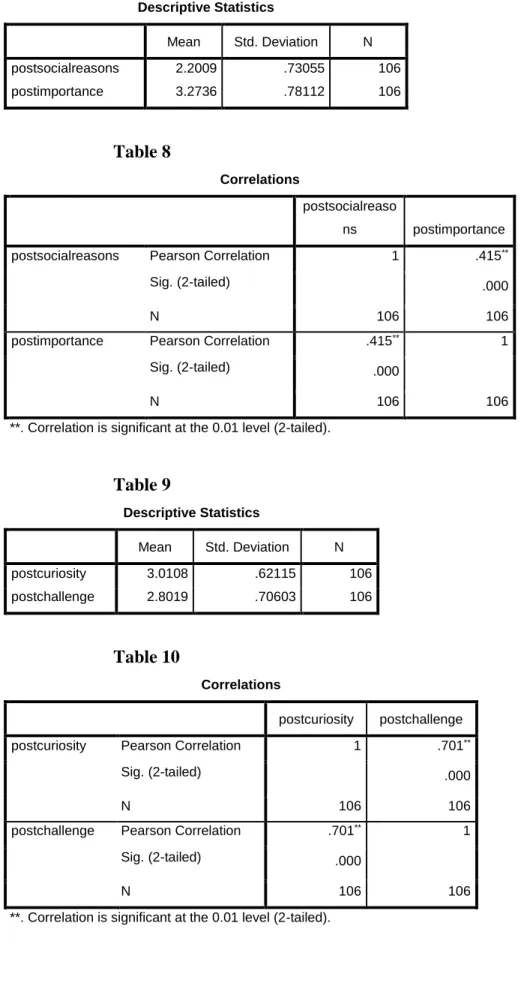
In order to further examine existing relationships between reading motivation, a Pearson Correlation was run for several different constructs of the MRQ. First, a correlational analysis was used to examine the relationship between Work Avoidance and Challenge. It seemed probable that these two constructs would be negatively correlated; however, no significant correlation was found. Reading for Social Reasons and Reading Importance were predicted to have a relationship because middle school students generally place importance on their social interactions. The results indicated a strong positive correlation, r = .415, p < .001. This shows that students who reported high motivation for social reasons also placed a greater importance on reading, and students who reported low motivation for social reasons did not place great
importance on reading. Means and standard deviations can be found in Tables 7 and 8. A strong positive correlation was also found between Reading Challenge and Reading Curiosity, r = .701,
p < .001. Students who reported being highly motivated by curiosity also reported being highly motivated by challenge and vice versa. Means and standard deviations can be found in Tables 9 and 10.
Table 7 Descriptive Statistics Mean Std. Deviation N postsocialreasons 2.2009 .73055 106 postimportance 3.2736 .78112 106 Table 8 Correlations postsocialreaso ns postimportance
postsocialreasons Pearson Correlation 1 .415**
Sig. (2-tailed) .000
N 106 106
postimportance Pearson Correlation .415** 1
Sig. (2-tailed) .000
N 106 106
**. Correlation is significant at the 0.01 level (2-tailed).
Table 9 Descriptive Statistics Mean Std. Deviation N postcuriosity 3.0108 .62115 106 postchallenge 2.8019 .70603 106 Table 10 Correlations postcuriosity postchallenge
postcuriosity Pearson Correlation 1 .701**
Sig. (2-tailed) .000
N 106 106
postchallenge Pearson Correlation .701** 1
Sig. (2-tailed) .000
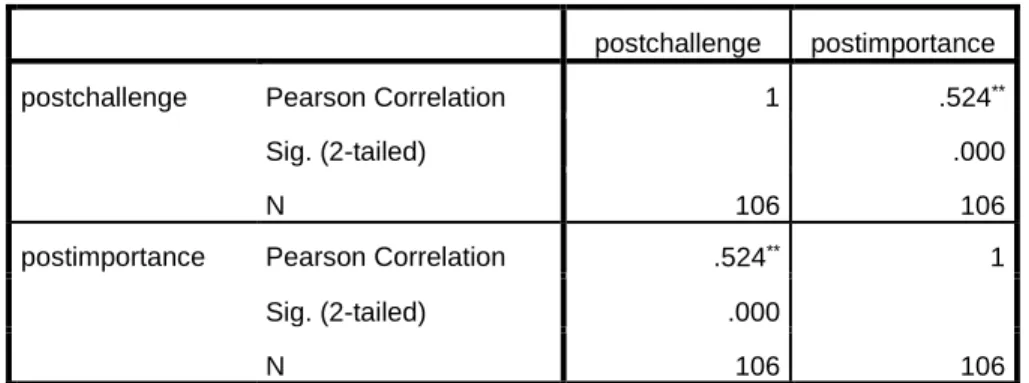
In addition, the relationship between Reading Challenge and Reading Importance was strongly positively correlated, r = .524, p < .001. The results indicate that students who viewed Reading as important also reported valuing Reading Challenge, and those who did not view Reading as being important did not value Reading Challenge. Means and standard deviations can be found in Tables 11 and 12.
Table 11 Descriptive Statistics Mean Std. Deviation N postchallenge 2.8019 .70603 106 postimportance 3.2736 .78112 106 Table 12 Correlations postchallenge postimportance
postchallenge Pearson Correlation 1 .524**
Sig. (2-tailed) .000
N 106 106
postimportance Pearson Correlation .524** 1
Sig. (2-tailed) .000
N 106 106
**. Correlation is significant at the 0.01 level (2-tailed).
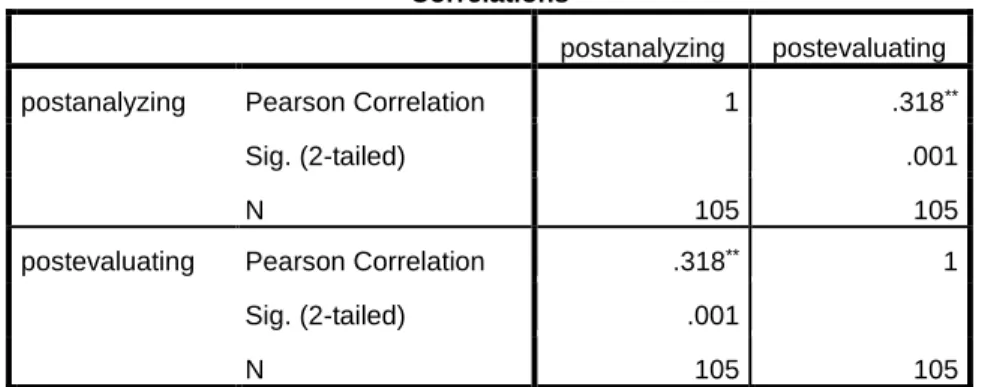
A similar Pearson Correlation was run on the Perceptions of Learning Processes and Outcomes under Inquiry Approach survey. Correlations were run on processes or outcomes which were predicted to have a relationship. First, analyzing and evaluating were found to be strongly positively correlated, r = .318, p = .001, indicating that students who perceived they
were asked to analyze information also perceived they were asked to evaluate/judge information and vice versa. Means and standard deviations can be found in Tables 13 and 14.
Table 13 Descriptive Statistics Mean Std. Deviation N postanalyzing 2.1524 .93830 105 postevaluating 2.4857 1.10170 105 Table 14 Correlations postanalyzing postevaluating
postanalyzing Pearson Correlation 1 .318**
Sig. (2-tailed) .001
N 105 105
postevaluating Pearson Correlation .318** 1
Sig. (2-tailed) .001
N 105 105
**. Correlation is significant at the 0.01 level (2-tailed).
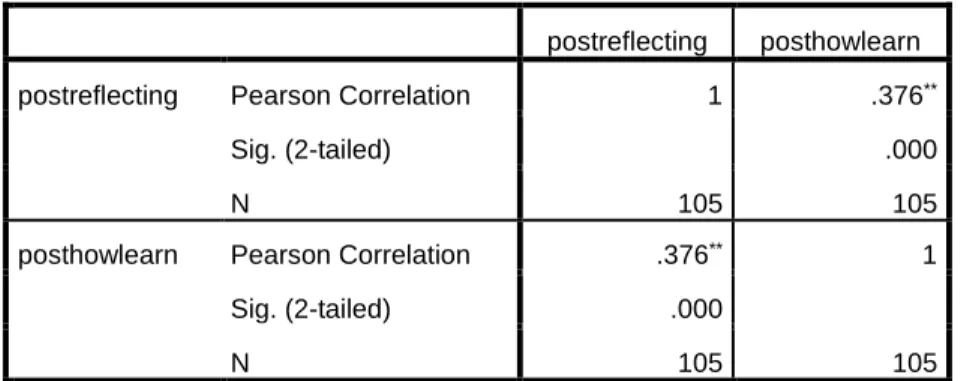
Next, reflecting on the meaning of learned information was compared to perceptions of how one was learning. A strong positive correlation was found, r = .376, p < .001, showing that students who felt they were often reflecting about what they were learning were also often thinking about how they were learning, and those who were seldom reflecting about what they were learning were seldom thinking about how they were learning. These findings indicate that if students are thinking about their own learning, they are experiencing metacognition. Means and standard deviations can be found in Tables 15 and 16.
Table 15 Descriptive Statistics Mean Std. Deviation N postreflecting 2.4190 1.13325 105 posthowlearn 2.2095 .98737 105 Table 16 Correlations postreflecting posthowlearn
postreflecting Pearson Correlation 1 .376**
Sig. (2-tailed) .000
N 105 105
posthowlearn Pearson Correlation .376** 1
Sig. (2-tailed) .000
N 105 105
**. Correlation is significant at the 0.01 level (2-tailed).
A final comparison was run between application and creating. There was a strong positive correlation found, r = .374, p < .001. The results show that students who perceived they were often asked to apply skills as they learned to solve problems also perceived they were often asked to create new ideas, solutions, or products based on what they had learned and vice versa. Means and standard deviations can be found in Tables 17 and 18.
Table 17
Descriptive Statistics
Mean Std. Deviation N
postapplying 2.3048 .99154 105
Table 18
Correlations
postapplying postcreating
postapplying Pearson Correlation 1 .374**
Sig. (2-tailed) .000
N 105 105
postcreating Pearson Correlation .374** 1
Sig. (2-tailed) .000
N 105 105
**. Correlation is significant at the 0.01 level (2-tailed).
Discussion
The findings in regard to the effectiveness of inquiry project based learning were not promising. There was no indication that inquiry PBL had any significant effects on the treatment group in terms of reading motivation or perceptions of critical thinking. These findings provide evidence that inquiry PBL in a language arts classroom is not effective in increasing student motivation and/or engagement with the same effects as problem-based learning in a science curriculum (Sungur & Tekkaya, 2006) or a math curriculum (Kim, 2005).
One interesting finding was that the group of students receiving traditional fully guided instruction showed a significant increase in Reading Importance which was measured by
responses to the questions “It is very important to me to be a good reader” and “In comparison to other activities I do, it is very important to me to be a good reader.” One possibility for this finding is that the control group was assigned topics to research so that their instruction could be fully guided. Therefore, the appropriateness of their reading materials was highly monitored by the instructor. On the other hand, the treatment group’s reading materials were less monitored
(2013) argue that students who feel frustrated as a result of minimally guided instruction may experience a decreased motivation for learning . It is possible that if students became frustrated with their reading materials, their perceptions of themselves as good readers may have decreased and affected their motivation for Reading Importance.
Another interesting outcome is that students engaged in fully guided instruction showed a highly significant difference in perceptions of how often they were asked to evaluate/judge information to determine how well it is supported or argued. One reason for this finding could be that students engaged in inquiry PBL were asked to find their own resources for research and may have felt ill-equipped to determine their value, while students engaged in fully guided instruction were given all of their information resources and asked to determine what
information would best support their purpose. According to Clark, Kirshner, and Sweller (2013), inquiry may be a valid instructional only after students receive explicit instruction.
Limitations
One strong limitation is that students in both groups still required a great deal of explicit instruction in order to learn how to take notes, research, and document findings. The inquiry PBL group may not have acquired the necessary skills before they were asked to be autonomous. As a result, inquiry learning may not produce the intended learning outcomes unless students have received adequate instruction and practice prior to the inquiry approach. Therefore, the research may have also been limited by the short duration of only eight weeks that the intervention took place. Studies with college students suggest that first year implementation of inquiry could be less effective if students are not equipped to learn autonomously (Spronken-Smith et al., 2012). This finding would support that long-term intervention of the treatment may show that as
students became more comfortable with the procedures, they would experience greater motivation and engagement.
Another limitation is the small sample size of only four classes involved in the study. An increase in sample size as well as replication of study in other language arts classes and with other teachers would provide for more confidence in outcomes. Though the study examined student motivation and perceptions of inquiry learning processes under inquiry PBL, it did not examine a direct measure of student learning. Due to the student-directed nature of the inquiry PBL, it is difficult to create a standardized measure to compare acquisition of knowledge between the two groups.
Future Research and Implications
It is clear that further research must be done to determine the value of inquiry learning. One issue that makes inquiry difficult to assess is the lack of a concrete definition of inquiry and the absence of clear procedures in order to implement it in the educational setting. For there to be any validity to future studies, clear and detailed procedures must be created for specific
expectations of learning. It is also important that future studies measure inquiry learning over longer time periods. Rotgans and Schmidt (2011) found that student autonomy and engagement are directly related their knowledge construction. The more knowledge they construct, the more autonomous and better able to direct their own learning they may become. Students must receive explicit instruction to gain skills and concepts necessary for inquiry learning to take place. Therefore, it may be necessary to measure inquiry over the course of a year to determine its true value.
One consideration for future studies is the suitability of inquiry for all students. Although academic level of the students was not a main focus of the study, it is worth noting that a large
percentage of students in the sample were considered English Language Learners. One argument against inquiry learning is that only the highest level students succeed (Clark, Kirschner, & Sweller, 2013). It is possible that inquiry is not conducive to learning for all students, especially those who are not on grade level academically due to language proficiency or other learning obstacles.
Finally, future research should not only assess student motivation and student perceptions of learning, but also assess inquiry learning’s effect on academic measures. Very few studies on inquiry learning have assessed academic achievement. While increasing student engagement is important, it is more important to produce measurable gains in learning. If inquiry learning could be shown to increase student achievement for some or all student populations, it would have value for implementation in educational settings to benefit students, but at this time, that is not a claim that can be made.
References
Balım, A. (2009). The effects of discovery learning on students' success and inquiry learning skills. Eurasian Journal of Educational Research (EJER), (35), 1-20.
Cacciamani, S. (2010). Towards a knowledge building community: From guided to self-organized inquiry. Canadian Journal of Learning & Technology, 36(1), 1-16. Chu, S., Tse, S., Loh, E., & Chow, K. (2011). Collaborative inquiry project-based learning:
Effects on reading ability and interests. Library & Information Science Research (07408188), 33(3), 236-243.
Chu S.K. W., Tse S.K., Chow K. (2011). Using collaborative teaching and inquiry project-based learning to help primary school students develop information literacy and information skills. Library & Information Science Research, 33(2) 132-143.
Clark, R. E., Kirschner, P. A., & Sweller, J. (2013, Spring) Putting students on the path to learning: The case for fully guided instruction. American Educator, 6-11.
Guthrie, J. T., Wigfield, A., & VonSecker, C. (2000). Effects of integrated instruction on motivation and strategy use in reading. Journal of Educational Psychology, 92(2), 331-341. doi:10.1037/0022-0663.92.2.331
Harvey, S., & Daniels, H. (2009). Comprehension & collaboration: Inquiry circles in action. Portsmouth, NH: Heinemann.
Kim, J. (2005). The effects of a constructivist teaching approach on student academic
achievement, self-concept, and learning strategies. Asia Pacific Education Review, 6(1), 7-19.
Kirschner, P. A., & van Merriënboer, J. J. (2013). Do learners really know best? Urban legends in education. Educational Psychologist, 48(3), 169-183.
Rotgans, J. I., & Schmidt, H. G. (2011). Cognitive engagement in the problem-based learning classroom. Advances in Health Sciences Education, 16(4), 465-479.
Saunders-Stewart, K. S., Gyles, P. T., & Shore, B. M. (2012). Student outcomes in inquiry instruction: A literature-derived inventory. Journal of Advanced Academics, 23(1), 5-31. Spronken-Smith, R., Walker, R., Batchelor, J., O’Steen, B., & Angelo, T. (2012). Evaluating
student perceptions of learning processes and intended learning outcomes under inquiry approaches. Assessment & Evaluation in Higher Education, 37(1), 57-72.
doi:10.1080/02602938.2010.496531
Summerlee, A., & Murray, J. (2010). The impact of enquiry-based learning on academic
performance and student engagement. Canadian Journal of Higher Education, 40(2), 78-94.
Sungur, S., & Tekkaya, C. (2006) Effects of problem-based learning and traditional instruction on self-regulated learning. The Journal of Educational Research, 99(5), 307-320. The Governor's Office of Student Achievement. (2014). Retrieved from http://gaosa.org The lexile framework for reading. (n.d.). Retrieved from https://lexile.com/
Wigfield, A. & Guthrie, J.T. (1997). Relations of children’s motivation for reading to the amount and breadth of their reading. Journal of Educational Psychology, 89, 420-432.
Wilhelm, J. D., & Wilhelm, P. (2010). Inquiring minds learn to read, write, and think: Reaching all learners through inquiry. Middle School Journal, 41(5), 39-46.
Appendix A Novels:
The Apothecary by Maile Meloy-740L
Becoming Naomi Leon by Pam Munoz Ryan- 830L Hatchet by Gary Paulsen-1020L
Hero by Mike Lupica-730L
Esperanza Rising by Pam Munoz Ryan -750L Flying Solo by Ralph Fletcher -590L
The False Prince by Jennifer Nielson - 890L The Lightning Thief by Rick Riordan-740L Schooled by Gordon Korman-740L
Stargirl by Jerry Spinelli- 590L
Appendix C
Survey instrument
This survey was developed by Spronken-Smith et al. (2008) and is available online at: http://akoaotearoa.ac.nz/project/inquiry-based-learning/resources/books/appendix-c-inquirybased-learning-report
To what degree has this course encouraged you to engage in the following activities? (Please rate using ‘A great deal’, Quite a bit’, ‘Some’, ‘Very little’, Not at all’, ‘Not applicable’)
1 2 3 4 5 6
1 .Memorizing facts, ideas, principles or methods so that you can repeat them accurately
1 2 3 4 5 6
2. Explaining the course content clearly in your own words to show that you understand
1 2 3 4 5 6
3. Analyzing information, texts, theories, or opinions
1 2 3 4 5 6
4. Applying theories, concepts, and/or skills learned to solve new problems or to solve familiar problems in new situations or in different ways
1 2 3 4 5 6
5. Evaluating/Judging information, theories, opinions to determine how well-supported by evidence and/or well-argued they are
1 2 3 4 5 6
6. Creating new ideas, solutions, products, etc. based on what you learned in the course
1 2 3 4 5 6
7. Reflecting on the meaning of what you were learning to you, your life, and/or society
In your experience as a student in this course, how often have you found that you: (Please rate using ‘Always’, ‘Usually’, ‘Sometimes’, ‘Rarely’, ‘Never’, ‘Not applicable’)
1 2 3 4 5 6
8. Were faced with questions/problems with more than one possible answer
1 2 3 4 5 6
9. Were encouraged to take responsibility for your own learning
1 2 3 4 5 6
10. Understood why you were studying what you were studying
1 2 3 4 5 6
11. Thought about how you were learning, and not just what you were learning
1 2 3 4 5 6
12. Were encouraged to make choices about what you would study
1 2 3 4 5 6
13. Were learning how to solve problems and/or answer questions
1 2 3 4 5 6
14. Discussed ideas/issues from the course with others outside of class
1 2 3 4 5 6
15. Felt intellectually challenged by the course
1 2 3 4 5 6
16. Learned more than you expected to by working on your own
1 2 3 4 5 6
17. Learned more than you expected by working with your peers
(Please rate using ‘Always’, ‘Usually’, ‘Sometimes’, ‘Rarely’, ‘Never’, ‘Not applicable’)
1 2 3 4 5 6
18. Questioned your own opinions, assumptions, and/or beliefs
1 2 3 4 5 6
.