ANNUAL ACTIVITIES 2008
Monteverde
Conservation
League
Children´s
Eternal
Rainforest
Monteverde,
Costa Rica
Butterflies in Bajo del Tigre.MONTEVERDE CONSERVATION LEAGUE
ANNUAL ACTIVITIES 2008
February, 2008
Monteverde, Costa Rica
CONTENTS
INTRODUCCIÓN
PART I: ADMINISTRATIVE REPORT
PROTECTION AND MANAGEMENT
MAINTENANCE AND OPERATIONS
LEGALISSUES
SECTORS AND STATIONS
FUNDECOOPERACIÓN
ENVIRONMENTAL
SERVICEPAYMENTS
LAND
PURCHASE
ENVIRONMENTAL
EDUCATION
INFORMATION AND PROMOTION
SALES
ANDSOUVENIRS
FINANCIAL
SITUATION
PART III: ANEXES
COLLABORATORS
CAPACITATION
HUMAN RESOURCES
LIST OF MEMBERS
SISTER
ORGANIZATIONS
Mission
“The Monteverde Conservation League is a non-profit organization. Its
mission is: to preserve, conserve, and rehabilitate tropical ecosystems and
their biodiversity.”
Objectives
The conservation, defense, and recuperation of the nation’s natural
resources, including its soils, water, air, flora, and fauna.
The recovery and protection of the physical, biological, and cultural
environment.
Seeking an adequate equilibrium and healthy coexistence between
human beings and nature.
Values and Principles
Biodiversity “includes not only the diversity of species of plants and animals
but also the varieties that exist in the same species. Human beings form a
part of biodiversity including their racial and cultural variations.”
“Human beings are an important component in the ecosystem they inhabit
because they depend directly on the soils, water, air, plants and other species.
At the same time, the stability of these ecosystems depends to a large extent
on how human beings and the other components interact.”
“The primary interest of this association is to offer future generations an
improved natural heritage and an environmental framework that minimizes
contamination.”
“…you will only achieve your mission and objectives if you have the support
and help of the users of natural resources in the mentioned areas, and
therefore count on their understanding of the importance and value of the
natural richness of our country is essential.”
“…you will look for the collaboration of and will offer your collaboration to the
distinct governmental or private institutions, municipalities, and other persons
and institutions both national and foreign, whose goals are similar to those of
the association.”
Remembering our great friend, member, and
collaborator, Dwight S. Crandell
For all of those who had the great pleasure of knowing
Dwight, we know that it is difficult to express in words the
amount of work, energy, and effort that he spent for the
conservation of Costa Rica's forests; especially the Children's
Eternal Rainforest (BEN). Dwight always had conservation in
his heart, which beat with hope to see this forest eternally
protected, and a promise ran through his veins to achieve that
goal, which was stronger than the rivers of the BEN. On the
night of February 11, 2008, the waters of those rivers were
surely singing his name.
Let us remember Dwight as a member of the MCL and
MCLUS, but also more for his deep laughter, his broken
Spanish, and for his special friendship.
Carlos L. Muñoz, ExDirector MCL
On the 22 of April, 2008 (Earth Day) the MCL placed a plaque with his name at the base of a large tree on the Tabacón Trail in San Gerardo (The Children's Eternal Rainforest).
…The tree represents the forest, but also represents Dwight's huge heart, and in the words of Vin Mendez, a stream of life itself…
INTRODUTION
The year 2008 began for the Monteverde Conservation League (MCL) as a year full of expectations and apprehensions, and day by day they began to become a reality. This year began with the goal of building a new station in Pocosol; the old station had served groups under inappropriate conditions for more than 6 years. The contruction took more than 8 months, a period in which uncondicional efforts were needed from employees and collaborators in order to achieve the new station, that allowed an adequate complement to the conditions of the site, that had scenic beauty and biological richness and a different structure that offered comfort and met the needs of the visitors. United with this project was the execution of another project to bring electricity to Pocosol. This Project counted on the support from the Ohio Rotary Club (USA), which donated US$9,000.00 and the work of eight of its members for one week. The MCL had to invest a similar amount of Money in order for the Project to work. Unfortunately the MCL was unable to finish the work, principally due to the fact that we have certain disagreements with the contracted consultant that developed the Project. However, the positive side is we did not lose the infrastructure (canal, tubes, a machine house, cables, etc.), and although the need for electricity in Posocol is not essential, the project should be completed this coming period.
As important as it is to establish infrastructure, it is also important to strengthen the organization with the arrival of new friends. This was the result of February 2008, a hike through the BEN, with representatives of Whole Food Markets and the organic products provider New Chapter. These people are individuals who indentified with the organization, and who have tried to benefit conservation as their organizations grew. They have organized different fundraising campaigns, and the profits all went directly to the Monteverde Conservation League, U.S. (MCL-US), profiting the conservation of natural resources. . The route started in Monteverde and ended in Pocosol in San Carlos, where the representatives of the businesses were allowed to socialize with representatives from
an NGO that fights to protect the world for our future generations. This has been an important aspect for our organization, and will promote more of the same opportunities for conservation interests.
Project of electrification of Pocosol .
Following the timeline of the MCL this period, we have also reinvested in the development of international participation and representation of the MCL using our employees. For example, the participation of the MLC and BEN in the Expo Agua and Sustainable Development in Zaragoza, Spain, with the participation of more than 100 countries on a governmental level. We received an express invitation from the Ministry of Tourism, and we were the only private organization representing our country. It was a unique and valuable experience, and focused on the area of use of water and sustainable development. In addition we were able to promote the BEN and generate contacts. It is also notable to mention the participation in our Executive Director in the Climate Change course in Budapest, Hungary, which allowed for the acquisition of knowledge and experience, as well as collect more international contacts. More recently, our Executive Director also participated in the World Nature Congress, held in Barcelona, Spain. This activity was organized by the International Union for Conservation of Nature, of which the MCL is a member. This permitted us the possibility to collect more contacts, strengthen relationships, suggest ideas, and solutions for the conservation of natural resources in the region and the world, as well as promote the BEN. Not any less important was the participation in the activities organized by Costa Rica, such as the ICE Environmental Fair, the INBio Fair, and most recently the Rural Community Tourism Fair. The BEN was promoted at all of these events, as well as the work the MCL does to protect natural resources.
To discuss a work period without acknowledging the efforts to resolve legal issues that would strengthen the protection of the BEN is impossible. This year was not an exception, and although we have not completed 100% of the obligations, the MCL has obtained successes. It is important to mention the sentence of the Finca Orquidea, where it has been ruled the MCL be paid the entire amount invested in the legal processes, as well as the issues against the business CONELECTRICAS, both of which have been settled and have allowed for a generation of economic resources for the organization and principally win the respect for the protected area and the resources we have there. However, we have been left with a bittersweet taste in the case of Bekom, with a verdict that was neither for or against the MCL. These different cases and many others, united with the project that has tried to modify the Possessory Information Law, have contributed to the generation of an important accumulated work, and have lead to an increase in the funding for investments in legal materials. Also important was the support given by protection and maintenance, as well as the first steps in the Territorial Ordinance Project.
In regard to legal issues, the court cases with the business CONELECTRICAS has provided a bridge between the two organizations, and has permitted the establishment of a Pre-contract of Environmental Service Payments and a cooperation. This important decision allowed for the acceptance of $US400,000.00 over the next 18 years, and over 38 years an indirect amount of US$1,200,000.00. In addition, another series of benefits was made possible that is directly related to the hydroelectric project as well as the protection of natural resources. The contract has not been signed yet, but it can happen at any moment as long as the first year includes the next month of July.
Another important aspect that came about this year consisted of the training and participation of our field staff (park guards, maintenance workers, and station managers) in the investigations in the BEN. We hope that is will be the same this year, and also want to provide incentives for staff to collect basic wildlife information throughout the entire protected area. For an adecuate promotion of our resources and work, it is fundamental to know what we have, even though it is at a general level.
All of these above mentioned points are written in more detail in the report; however, we should be clear about the description of work throughout the entire year so that it can be contained in a few pages. Also, I can say that the projections for the future are ambitious ones, and they will only be achieved with the participation of each and everyone one of our employees and collaborators. Everyone at the MCL hopes to achieve the inscription of all of the land in the BEN (through modification of the above mentioned law), continue with the LPPC, increase visitation to the BEN, increase the generation of economic resources through ecotourism, develop activities for environmental education, develop research with our field employees, develop and support native tree planting and production activities to plant in gardens or rehabilitating areas,
Gira de reconocimiento a la finca de Olger Badilla (al fondo), en Los Llanos de Arancibia, Pitahaya, Puntarenas, Finca comprada.
reintegrate the funds to the Land Purchase Fund, and before everything else achieve the self-sustainability of the institution.
Many thanks for the opportunity to present this report, and mostly believe in and support the projects we are developing for the well-being of the MCL, the BEN, and future generations.
Yúber Rodríguez
Executive Director, Interim
IPART
ADMINISTRATION REPORT
PROTECTION AND MONITORING PROGRAM
The protection and monitoring program is known for representing the daily efforts of the MCL by strengthening the conservation and protection of natural resources, and these activities are centered in the Children's Eternal Rainforest. Through the formation of the reserve, its perpetuity and natural restoration has been possible thanks to the forces of our park guards, who receive their name as the watchmen and protectors of the forest. Through activities such as patrols, hikes, operatives, confiscations, denunciations, constant courses, and lastly the incorporation of educational activities in their program, the guards are performing efforts that strengthen the organization. Without a doubt, the work that they do is extremely important, but due to the situation that there are few of them, it is neccessary to strengthen aliances and agreements with multiple collaborators from the level of state organizations to the members of surrounding communities. Area of Protection and Vigilance
As for the aspects of daily protection and vigilance, our guards are constantly working. For example, there are vigilance patrols through the various sectors of the BEN, and principally through those of high conflict such as: the Esperaza River (Hydroelectric Project la Manguera), the Pocosol sector (principally near the water sources for the Pocosol Hydroelectric Project on the Aguas Gatas and Peñas Blancas Rivers), as well as other sites with breachings of Forestry and Wildlife Laws.
Operatives
18 Wildlife Control Operatives have been performed, and these have been accomplished in partnership with different organizations and participants, such as: The Minsitry of the Environment, Energy, and Telecommunications (Monteverde and San Ramón offices), the Ministry of Public Safety ( Delegations of the San Carlos, San Ramón, and Puntarenas Police Forces), Ministry of Public Works and Transport (Transit Officials from San Carlos, San Ramón, and Puntarenas), as well as members of institutions sych as the Tropical Science Center, ASOVIRENAS of San Ramón, Delta Security Groups from Ciudad Quesada, and other volunteers. These Wildlife Control Operatives have included patrols in the forest and on the highway, as well as vigilance in ilicit activities such as poaching and land conflicts.
C
Cage with Raccoon, in San Carlos Decommissions, Rewards, and voluntary turn-ins
Table 1. Decommisions of wood, equipment, etc.
Quantity Description 1 Chainsaws 3 Firearms 6 Knifes 1 Flashlights 1 Shovels 4.900 inches Wood 8 Palmitos 8 Birds
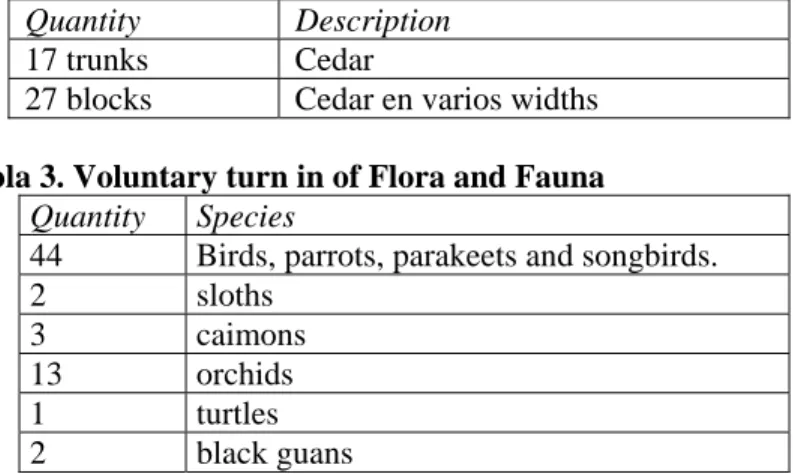
Tabla 2. Wood Turn-in
Quantity Description
17 trunks Cedar
27 blocks Cedar en varios widths Tabla 3. Voluntary turn in of Flora and Fauna
Quantity Species
44 Birds, parrots, parakeets and songbirds. 2 sloths
3 caimons 13 orchids 1 turtles
2 black guans
As for the decommission of dogs, it is important to mention that by order of the Fiscalia (organization of the Ministry of the Public), some of the owners are given custody whereas others are decommissioned and will stay under our custody. With respect to wood (decommissioned or turned in), it is given to schools. With respect to wild animals, if they are in good condition they are released, but if they are not in condition for release they are taken to a rescue center for rehabilitation.
Denunciations
Tabla 4. List of denunciations made by ACM employees for injury of natural resources.
Quantity denunciations Infraction More details
3 Law 7530 law of arms and explosives 4 Law 7375 forestry law
1 Against the business Sánchez Carvajal and Conelectricas for deliberate disobediances, extraction of material from the Peñas Blancas River without permission.
Presented to the Envrionmental Tribunal
1 OIJ for robbing a dog from the kennel Found in judicial custody 1 OIJ, for robbing a cable from Pocosol
Hearings and Cases
a. In the case of Conelectricas, they have participated in three hearings which correspond to the water sources on the Peñas Blancas River and Aguas Gatas River. In addition, we accompanied experts named by the judge to the site.
b. We participated in a hearing in regard to the boarder between Sr. Caramelo Corrales and the MCL, in the Pocosol sector.
c. In aspects of vigilance and protection, we have attended two cases for the infraction of the Wildlife Law, and two cases for the infraction of the Arms and Explosives Law.
We have visited the Courthouses in San Ramón, Fortuna, and San Carlos on 16 occasions in order to establish deunciations or to revise the documents of active cases.
Meetings
a. We had meetings with personnel from MINAET San Ramón in order to coordinate projects together. b.Also, we had meetings with employees of the Ministry of Public Safety in order to coordinate an improved way to perform our work.
c. In addition, we also participated in meetings with the Developments Associations of different communities, conservation groups, residents, collaborators, and many others.
Environmental Education Program Support
Many educational activities have been performed in Finca Steller, with school children as well as scouts. In order for these activities to be successful, we count on the support of parents, educators or group leaders, as well as employees of the MCL. We have had much support from Proyecto Asís, as well as the many other patrons (Rancho Margot, Hotel Bosques de Chachagua, Desafio Aventuras in La Fortuna, Chachagua Commissioner, Puente de le Economia Supermarket, and many others).
Completed Projects
Thanks to the support from la Fundación Benasís, we have been able to contruct and buy the following: Table 5.
Quantity Description Cost
1 Dog kennel construction ¢750.000 1 Construction of the greenhouse in the
nursery
¢500.000
3 Germination beds ¢150.000
1 Communication Radio ¢110.000
1 pair Hand-cuffs ¢60.000
5 Pepper spray for protection ¢75.000 1 Weed-wacker for the nursery ¢272.000
We have also been supported ecotoursim projects, accompanying groups from Monteverde to Pocosol and El Castillo to San Gerardo. In addition, we have been making signs to place in Environmental Service Payment areas, repairing roads, working on bringing electricity to Pocosol, contruction of the new Pocosol Field Station, repairing the electrification of Finca Steller, and supporting maintenance and general administration.
MAINTENANCE AND OPERATIONS PROGRAM
The maintenance and operations program provides all of the maintenance of the sectors in the BEN that are open to the public. This includes the maintenance of trails, roads, infrastructure, and signs. The maintenance staff also maintains boarders and fences within the BEN and around its perimeter, as well as works with volunteers. It is also common that maintenance contributes to the protection, environmental education, and investigation programs. One of the more important responsibilities is the attendance in court cases that have to do with land conflicts. In this case, the personnel must use Geographic Information System equipment (GPS) to verify information and elaborate maps and territorial ordinances. In the 2008 period, the program participated in seven cases and events.
Maintenance of boarders, fences, roads, trails, and field stations.
The definition and establishment of the outer limits o the BEN has been a priority for the maintenance program, and from there the importance to be able to continue with the implementation of the Land Ordinance Project (LOP). The advances with the LOP have been very satisfactory, thanks to the available technological equipment (GPS and computers), as well as the different GIS programs and available training. It is also important to mention the support from personnel, members, and collaborators of the MCL in the implementation of the LOP.
Description Distance in kilometers Senderos 50 Carriles 132 Caminos 10 Cercas 3 Rondas 10
In this period, new boarders were opened, including those in the limits with Leonel Arguedas (San Gerardo Sector) and Dionisio and Melvín González (Veracruz Sector), as well as the establishment of boarders in the Ampala Sector, BEN property.
Pocosol Station Projects
One of the strongest contributions of the Maintenance and Operations Program was the aid given in the construction of the new Pocosol Station. This construction lasted eight months, and the program aided regularly in activities such as providing materials (wood, cement, rocks, and sand), wood preparation (treatment with preservatives, sanding, and smoothing), reparations to the stations access roads, clearing rubbish, among other construction labors.
In this same sector, another project of the maintenance team was the electrification of Pocosol. Unfortunately the project has not been completed, although members worked extensively in the conduction of water (canal and tubing), electric conduction (cables and posts), as well as the capture of water and the machines used to due so.
Also in this sector, the team performed general maintenance, such as cleaning the greens, trails, raod improvements, infrastructure reparations, and vigilance during free days.
San Gerardo Station Projects
In the San Gerardo Sector, maintenance performed general maintenance activities, such as cleaning trails, greens, roof painting, and road reparations.
Bajo del Tigre Projects
The team also helped with general maintenance in this sector, mainly working on trails and buildings, as well as construction of a view point.
Legal Issues
The maintenance employees also provided support to the administration during field trips and activities with a foncus on legal processes. They mainly participated in cases such as Bekom, La Orquidea, Paquera, and INMan.
Other
Other support was given for inspections of farms for the Environmental Service Payments Program, boarder recognition with neighbors of the BEN (Peñas Blancas, San Luis, Ampala, Ojo de Agua, etc.), as well as
preliminary inspections of farms for the Land Purchase Campaign.
Also, the Group has participated in field investigations in the Chutas Sector with Mark Wainwright. These field trips were completed every three months, and were done to monitor and study the green-eyed frog (Lithobates vibicarius). In addition to this, some members of the maintenance crew participated in amphibian investigation training.
LEGAL ISSUES
As it has been explained from year to year, one of the main activities of the MCL and obviously its personnel resources, corresponds to legal issues. Many of these issues stem from land purchase and those individuals with low moral fiber who try to take advantage of the MCL and profit at the cost of conservation.
This year, the subject of legal issues again was one of the projects that demanded the most resources. These resources were economic and logistic, and obviously present a list of processes that are far from enjoyable. In the end, one of the projects with the most follow-up has been the Land Titling Project of the MCL.
This project attempts a modification in the Possessory Information Law that permits government securities to conservation organizations that can demonstrate national agreement an inscription of areas greater than 300 hectares. .This could make possible the consolidation of the property of private nature reserves through legal mechanisms, as well as a greater protection in the courts. To intent to justify and achieve this modification, the MCL has had meetings with deputies of the Legislative Assembly, accomplishing an important consent to support this initiative. The contacted deputies are: Xinia Nicolas and Mauren Ballesteros (Fracción Partido Liberación Nacional), Guyon Massey (Fracción Partido Renovación Cristiana ) and Grettel Ortíz (Fracción Partido Acción Ciudadana). It is hoped for the period of 2009 to have a favorable environment, and be able to propel this legal modification. It is known that the Legislative Assembly works very politically, and deal with many nacional priorities such as social convergences and divergences.
The following list presents those cases in which the MCL has labored in the past as much as the present: 1. Ordinary Case Bekom. This case was formulated by the MCL, and attempts to define the actual land
owned by the MCL, Hnos. Badilla Navarro and Roy Canet Zamora, three different people disputing the same land. This process has taken many years, and was given a sentence this period which did not declare winners or losers. This verdict was in favor of the General Attorney of the Republic (GAR). In conversations with the representative of the GAR, Official Mauricio Castro, he recommended that we continue with our normal labors on the property, and that he was very surprised about the verdict. In this case, the MCL is following up with an appeal of the verdict.
2. Ordinary Case La Orquídea. The MCL came out as the winner of this case. Although the verdict is in the stage of execution in which the opposition is obligated to pay the MCL for the damages and costs of the process, in the next few days the property will be entered into a public auction in order to pay for the legal costs.
3. Quittance of Peñas Blancas. This case is practically finished. The area of trespass of the CCT was defined, and was marked in the field as well as elaborated in the official corresponding plans. This trespass has permitted a redefinition of the boarders between the CCT and the BEN.
4. Leitón Family. This corresponds to the definitions of the properties in San Luis. They have been measured and we are waiting the submittal of the official plans. This case is waiting for the results of the topographer.
5. Ordinary Case Olman Castro. This began with an overlap of territories in the official plans, and the obtainment of title for MCL lands. This process has not shown any major movement, except the family members of Mr. Castro have recognized the error in the plan.
6. Prohibition Sanction of Possession on the Aguas Gatas River. This process was initiated against CONELECTRICAS for the Aguas Gatas Hydroelectric Project. This process was resolved through a settlement, and the opposition accepted all of the requested terms by the MCL. This case has closed.
7. Prohibition Sanction of Possession on the Peñas Blancas River. This process was initiated against CONELÉCTRICAS for the Peñas Blancas Hydroelectric Project. This process was resolved through a settlement, and the opposition accepted all of the requested terms by the MCL. This case has closed. 8. “Imposición de Servidumbre de Presa y Estribo” (A process that gives the opposition permission for
land use without penalty in BEN property) presented by CONELÉCTRICAS befote the Ministry of Government and Police. This process was canceled by the signing of the contract between the MCL and CONELECTRICAS.
9. Ordinary Case against INMan. INMan established an ordinary case requesting the environmental service payments contract to be dissolved, as well as the drawn payments for the MCL, absolute Rights to the property, as well as the payment of the legal processes. This case has passed the testimonies and is now waiting for a conclusion and sentence.
10. Prohibition Sanction of Possession of the Paquera Farm of the MCLUS. Both the interdiction and appeal were denied. The inscription of the legal representative of the MCL-US in Costa Rica is pending in order to proceed with the presentation of a ordinary case to find the best owner for the property.
11. Environmental Services Contract Payment and “de Servidumbre de engrape de presa y de área inundable y de creación de un fondo de cooperación”. A pre-contract has been signed. Basically what we are looping for is the acknowledgement from the hydroelectric business that they will be affecting the water flow in the BEN. We hope to establish an ESP ofUS$400,000.00 over 18 years, an indirect payment at a little under US$1,200,000.00 over 38 years, as well as another series of payments that will benefit conservation.
12. Prohibition Sanction of Possession against the Corrales Family. In the Pocosol sector, this case was defined through conciliation, where a modification of boarders was made.
13. Arturo Arguedas, Bajo Caliente Sector. A farm is in dispute as a payment reclamation for the court costs that the MCL won against Mario Arguedas. This process continued without our knowledge until the sentence was made, and an appeal was presented for lack of notification.
14. Ordinary Case of Mario Arguedas. This case closed in 1998, however the properties couldn’t be inscribed under the name of the MCL because of “Cedulas Hipotecarias en el inmueble”. For the interest of selling the property, again to the MCL, we have made the decision to request the inscription of the ordinary case in the register to make the sale, trespass, and creation of more cedulas impossible for this property.
15. Figuerola Case. It is about the properties donated by Mr. Manual Figuerola to the MCL. The MCL could not claim the lands until he passed away, but his death was not officially registered. The MCL had to prove his death in order to claim the property. His passing was proven, and the MCL was able to claim the land.
16. La Amistad Farm de IDA. Also known as the Chachagua Reserve, del IDA. The limits were being defined to this reserve and resulted in an overlap with MCL property. This overlap has not been confirmed in the field yet, but meetings have been organized with personnel from IDA, MINAET, and ICE.
17. Arturo Valverde Case. In the San Bosco Sector, an overlap with MCL land was detected with the properties of Mr. Arturo Valverde. We are waiting for the definition of this situation through conciliation. The property of Mr. Valverde is receiving environmental service payments from ICE.
18. Alvaro López Case. In the secondary access of the central offices of the MCL in Monteverde, because of conflicts for the use of principal access to the property, it was negotiated with Productores de Monteverde and Mr. Alvaro Lopez (resident) that the Entrance to the property would be through a small 14 square meter area on Mr. Lopez’s property. This conflict has not resolved to this day. The proposal that was accepted by Mr. Lopez was that the MCL could continue to use the area, and in recompense he would be given another piece of land between the two properties.
19. “Reglamento” of the Internal Use of Arms. There have been training and information sessions about the dispositions of this regulation. This situation made possible to elaborate the first regulation for the internal use of arms. Arms still have not been purchased.
20. Land Purchase, Olger Badilla Navarro’s Farm. Recommendations were given for the case and were elaborated in respect to the Option and Purchase and Sale Contract.
21. Land Purchase, Ignacio Picado Ramírez’s Farm. Recommendations were given for the case, and we are still waiting for the legal solution of the Legal Assessor. The problem was a badly registered property
value (too high) that will affect the legal payment for the property, as well as the elimination of a mortgage guarantee.
22. Other- Other cases have been submitted in name of: Sr. Alvaro Jiménez (Llanos de Arancibia, Pitahaya, Puntarenas), Sr. José Manuel Cruz (Cerro Amapala, San Luis, Guacimal, Puntarenas), and Carlos Araya Ledezma (San Jorge, Los Ángeles, San Ramón).
STATIONS AND SECTORS
With the creation of the largest private reserve in Costa Rica, the Children's Eternal Rainforst, the MCL has promoted the use of the periferal zones of the BEN in order to develop different activities directed at conservation and its perpetuity. For example, the BEN has promoted investigation in order to increase the amount of information we have about the resources we protect, as well as the development of environmental education,
reforestation, and ecotourism programs. In regard to the finances of the organization, in the last years ecotourism services have gained particular relevance. In the last member's assembly of February 2008, it was agreed upon and approved that the MCL would intent to increase the amount of visitation to the Sectors and Stations of the BEN, and especially the Biological Field Stations San Gerardo and Pocosol. This situation has inclined the administration as well as collaborators to define diverse strategies to increase and motivate
visitation. The improvment of infrastructure can be noted (buildings, roads, trails, etc.), as well as the acquisition of new equipment and personnel training, among other things. This has made possible the entrance of more than 27,000 visitors to our instalations in the last three years. As appears in figure 1, the visitation presents a similar behavior over the span of all three years, with peaks in March and July. Also, in the last year there has been a decrease in visitation for various reasons throughout the country. For example, groups have canceled their visit due to the risk of dengue in La Tigre de San Carlos, for the construction of the new field station in Pocosol, as well as a general decrease in visitation to the country and the recent creation of multiple night hikes in Monteverde. However, as heavy as this decrease in visitation may seem, it is important to note that as well as in the prior fiscal period, the income from station visitation and ecotourism has generated 25% of the income of the organization.
Figure 1. Visitation pattern for the Children’s Eternal Rainforest (the last three periods)
Biological Field Stations
It is important to remember that for this period there have been major successes at the field stations, especially the construction of the new Pocosol building, a strong effort to finalize the electrification of this station, as well as other goals to improve the visitation conditions. These activities in part are responsable for the 20% decrease in visitation to Pocosol with respect to the last period. This same issue also provoked the slight 1.6% visitation decrease in the prior period. A situation that is more difficult to justify is the drop in visitation to San Gerardo, which has diminished considerably since 2008, and is confirmed to be at more than 3 percent less as the same time last year. As far as the visitation to Pocosol, it is expected that the visitation will increase considerably next year. It is also expected that the health epidemics in La Tigra will be eliminated, and with this improvement it can be assured the volunteer group Global Works, one of our principal clients
that was absent due to this issue, will return. We are also hopeing for an increase in the reservations from Mapache Tours, who continue to be our principal client providor at Pocosol. It is important to remember that the decrease of visitors to Pocosol in the last period was due to the fact that the new building was not ready to accept groups. This provoked a lower estimate by about 150 people. Obviously the visitation will increase this 20% that did not arrive last year in 2008.
All of the prior notations have allowed us to see the product of visitation to the stations. This period we obtained 16% of the income of the organization through station visitation, which is in agreement with the budget presented by the Assembly last year (we were able to obtain 96% of the projected amount and budgeted income). In other words, we achieved a good part of the projected amounts. For next year, we hope to increase the net income of the stations by 38% with respect to what was obtained in 2008. This will interestingly result in a similar income for the last two periods, even though the income for 2008 was not as high as 2007.
o sum up, the station visitation should improve this
he investments carried out at the Pocosol Station, as T
period. We should focus on bringing clients back to Pocosol, should renew contacts for both stations, bring new contacts to both stations, as well as impliment the highly discussed topic of creating a strategic marketing plan for all of the visitation sites in the BEN. At this moment, a good piece of news is there has been an increase in the visitation to Pocosol, in an amount of double the confirmations as last year. Our service will continue, and as long as we provide a superior service, we will involve ourselves in constant renovation and improvments in order to do so.
T
much as in the construction of the new building as the electrification project, were up to as much as 65 million colones, and the portion contributed by the organization
was about 50 million colones. These funds were obtained from specific donations. The building has 7 rooms, all large and with a private bathroom. In addition, each has a small balcony as well as an open loft with a majestic view. On the lower floor, there is another room, public restrooms, and social areas for the attention of groups. With this building, the conditions in Pocosol have improved in terms of visitor attention as well as space with the increase of 4 new rooms.
Table. Comparative parameters of visitation or station use of the BEN, Period 2008. Parameters Pocosol Station San Gerardo Station Averages and Totals Actual Capacity 24 32 56 Visitors 701 589 1,290 Groups 57 50 107
Number People/ Group 12.3 11.8 12.1
Annual Occupation 1,020 1,374 2,394
Annual % Occupation 12.8 12.7 12.7
Average Stay 1.4 2.2 1.9
Days Station Occupied 80 111 96
Agencies or Contacts 20 31 47
% mayor de ocupación p/agencia 32.2 24.0 --
No. of contacts with occup. + 100 2 6 --
No. de contacts with occup. -10 8 14 --
Also, it is important to mention the instalation of a plaque in memory of the great work, care, and effort that Mr. Dwight Crandell performed for the Children's Eternal Rainforest and especially San Gerardo, which is located on the Tabacón Trail in San Gerardo. In addition, there are two plaques placed in the new station recognizing the support in the execution of this significant project provided by Bob Law, Jorge Maroto, Geovanny Rodríguez, Félix Campos, Fundecooperación, Fundación El Arte de Vivir, as well as employees and the Board of Directors.
Bajo del Tigre Visitor's Center
The total visitation to this sector corresponds to the highest in all the BEN, which is estimated to be 85%. The principal activities that are organized at this center are night walks through natural trails, but day walks are also available. The night walks are ran together with a group of local nature guides in the region, who have formed a business called the Twilight Walk. It is important to mention that through these night walks lead by the guides, visitation has improved at Bajo del Tigre. A proportion of 62% of the visitors who arrive to Bajo del Tigre come for the night walk, and this can be seen in more detail in figure 2. As a curious fact, the proportions of night visitors with respect to those that arrive during the day has decreased over time.
For example, in 2005, of 100 visitors 69 arrived at night, where 31 arrived during the day. In 2006, of 100 visitors 76 arrived and night and 24 during the day, and in 2007 of 100 visitors 74 arrived at night. During the last period, 62 visitors arrived for the night tour, whereas 38 arrived during the day. This last proportion could be explained in various ways, such as the night hike visitation could be decreasing, there may be an increase in competition in the area, or the amount of visitors during the day could be increasing. The reality is that the visitation of the site had decreased by 11% with respect to the changing proportions, which was a product of a decrease in the night visitation and not an increase in the daytime visitation. On the other hand, in similar conditions with the field stations, although there was a decrease in visitation, there was an increase in the net profits of the site.
Finca Steller Sector
This sector has continued to strengthen through the support given by the Fundación BENASIS, part of which was the construction of a new greenhouse for tree production. The site was being used for working with the illumination using palm leaves, however it was necessary to constantly eliminate dry leaves and replace them with new ones. The area was also open to the constant visitation of wild animals which would destroy the trees in production. To combat this, the area was surrounded by fencing and covered with roofing to protect the area from rain and sun, and to give the trees ideal conditions for growth.
Sector Steller with a scholastic group
This year, we were able to produce 3,700 trees of various species, such as: yellow almond (Dipterix panamensis, Fabaceae-Papilionaceae), cebo (Vochysia guatemalensis, Vochysiaceae), pilón (Hieronyma alcheornoides,
Euphorbiaceae), manú (Minquartia guianensis, Olacaceae), cedro amargo (Cedrela odorata, Meliaceae), and chiricano (Vantanea barbourii, Humiriaceae).
The sector has also been utilized on various occassions for the development of environmental education activities with students from local schools, groups of young Scouts and guides, and community groups.
SUSTAINABLE TOURISM IN THE CHILDREN’S ETERNAL RAINFOREST
(FUNDECOOPERACIÓN)
The principal form of operation that
the MCL used in its first twelve years
of existence was the execution of
integrated projects, with financial
resources mainly coming from outsider
sources (i.e. Southern countries,
England, Canada, and others). Eight
years later, the MLC had been
presented with the opportunity to
develop a new integrated project, but
under the concept of sustainable
tourism. In this case, the project would
channelize resources from Holland
through the means of the national
organization
FUNDECOOPERACIÓN. This
project, in a span of 18 months, would
establish an infrastructure, generate
local employment, and perform the
promotion of the sales of services. This
would develop using as a platform the
experience generated with the
ecotourism activities that are organized
at Pocosol, and involving the
communities of La Lucha from La
17
Fundecooperación Project, Visit of the local groups to The Tirimbina and the Corsicana in Sarapiqui, Heredia.
Tigra and San Juan of Peñas Blancas. At the conclusion of 20 months after the beginning of the
project, and even though there were pending activities to execute, the ACM asked for a time
extension to be able to finish the activity development. Unfortunately this amplification of the
project would lead to more costs as opposed to income, and also shows the difficulty communities
have to follow through with their obligations.
The principal problem has to do with the necessary infrastructure. This project was supposed to
finance the construction of the new building in Pocosol, a restaurant for a group of women from La
Lucha, a small cottage to receive tourists and guide them to a trail at La Lucha elementary school,
and the remodeling of the San Juan salon. The only successful projects were the construction of the
Pocosol building and the remodeling of the San Juan salon, and the restaurant and cottage
construction are pending. After this, there should be some training and promotion activities
organized. At this point in time, the project has used 56% of the allocated funds, and 44% have yet
to be utilized. 30% of the amount donated by FUNDECOOPERACIÓN is in the MCL’s accounts,
and the remainder is to be distributed. The MCL has presented approved budgets every trimester,
and has also taken field trips to show that its projects have been satisfactorily completed.
It is good to note that mucho of the delay was not
for fault of initiative by the MCL or the
communities, but a delay in the approval of the
proposal. This project was presented to
FUNDECOOPERACIÓN in 2004, and was
approved three years later, which did not inspire
a punctual start for the MCL and communities. In
addition to this, it is significant to mention the
enormous increase in materials costs in the last
years. A model has shown that the construction
of the new Pocosol station, according to the costs
in 2004, would have a value 35% of that of the
building constructed in 2008.
A meeting with the women from La Lucha, with representatives from FUNDECOOPERACIÓN.
Environmental Service Payments
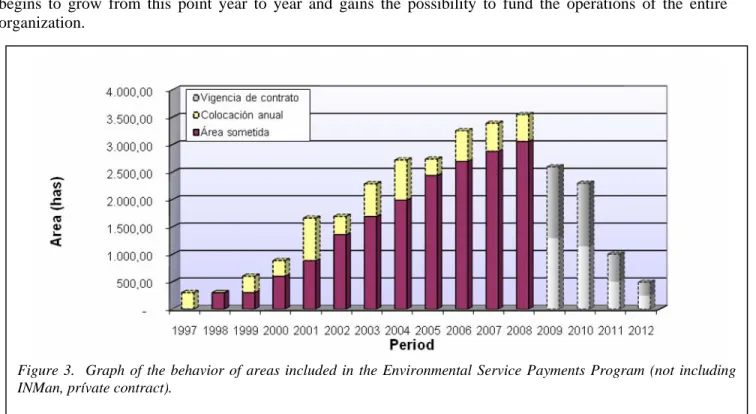
Since 1995, the government of Costa Rica began to recognize property owners’ efforts in the protection and regeration of forest on their properties. However, 1997 was the first year in which the government issued the first payment under the concept of Environmental Service Payments where forests or plantations were being protected and produced. It is precisely since 1997 that the MCL has received this economic benefit for carrying out its mission, a benefit that has become the principal financial income of the organization. As presented in Figures 3 and 4, the distribution of areas involved with Environmental Service Payments (ESP) begins to grow from this point year to year and gains the possibility to fund the operations of the entire organization.
Figure 3. Graph of the behavior of areas included in the Environmental Service Payments Program (not including INMan, prívate contract).
Figure 3 illustrates the behavior of the distribution of areas under the ESP program, and the only year that did not show growth was 1998, the second year of the program. The lack of growth was due to the lack of experience of the governmental entity MINAE and the MCL itself. After this year, the distribution continued to change, and has always increased. There are obvious increases in the years 2001, 2003, and 2004, where very large areas were added to the program. The exaggerated changes were due to a complete identification of the governmental organization FONAFIFO with the objectives and mission of the MCL, a situation that has been confirmed on multiple occasions through field visits with FONAFIFO representatives as well as external experts hired by the state.
Firgure 4 complements figure 3 and shows the financial trend product of the EPS. The payments began in 1997 with an amount close to 3 million colones, and after eleven years the MCL received a little over 100 million colones. In the period of 2008, the MCL achieved the addition of 489 more hectares, and lost the inclusion of another 331 hectares. This loss was due to the finalization of a respective contract, of which the properties should eventually be re-included to the program. It is important to mention that although there was a heavy loss in area, there was no loss in monetary gain. Actually, there was an increase, because since 2005 the form of payment was changed from colones to dollars, established by executive decree against the contract signature (much less valuable). In regard to the distribution for this year according to the Costa Rican government, the MCL counts an area of a little more than 3,500 hectares under protection. The MCL is also still under the contract of ESP with the business Inversiones la Manguera (INMan), although they have made an appeal to cancel their payment.
Figure 4. Graph of the behavior of the financial income from Environmental Service Payments.
BEN´s Area submissive Payment of Environmental Services
The MCL has also fought to establish an ESP Catalogue with CONELÉCTRICAS, a branch of the Pocosol Hydroelectric Project, which at present is almost to the point of the signing of the contract. This will assure a substantial and important amount of economic resources for the organization, at approximately a direct amount of US$400,000.00 over a period of 18 years, and an indirect amount of approximately US$1,179,840.29 over the next 38 years.
Map 1 is a map of the BEN, and shows the amount of area under the ESP program in the current (2008) as well as prior periods.
LAND PURCHASE
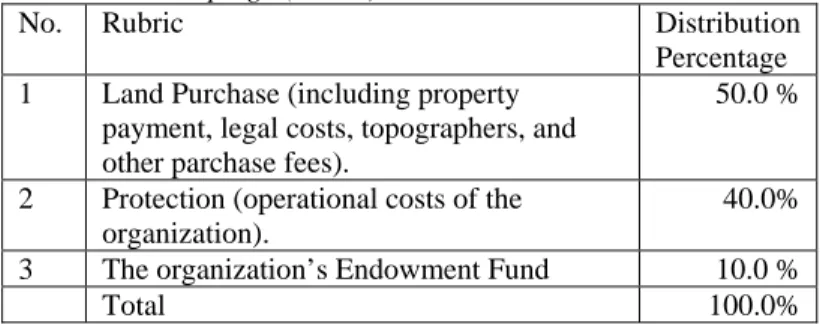
The protection of natural resources is strengthened with a strategic organization of natural boarders around the protected area, as well as the exclusion of any properties that are within that area. This is why it is so important to continue developing fundraising campaigns for land purchase, with the goal of providing protection of the protected area, as well as its perpetual conservation. This is why the Land Purchase and Protection Campaign (LPPC) was created, an effort mainly promoted by the MCL-US. This campaign raises funds for land purchase, as well as to assure its protection. In partnership with the efforts of the MCL-US, there are other organizations that are constantly supporting this campaign such as Kinderregenwald Deutschland e. V. and Children’s Tropical Forest U.K. The resources that are sent to the MCL are distributed in specific proportions which are presented in Table 3. This distribution is based on the necessities of the organization, not only performing the purchase of land, but also providing enough resources for the basic development of operations for the particular property. The application of this table is in accordance to the guidelines of MCL-US especially, who is in charge of the division of the resources and manage the 10% for their Endowment Fund. The percentage for land purchase (50%) arrives to the MCL in its entirety, and the remaining 40% is used for protection costs. It is important to mention that before the 40% is sent to the MCL, MCL-US uses part of it to cover its operation costs, as well as any obligations with collaborators in the United States that help finance the MCL. When these costs are paid for, the remainder is sent to the MCL to use for basic operations.
The MCL’s land purchase priorities are those properties that boarder the BEN as well as those that are located on the Pacific Slope. Also, the properties must not have any legal conflicts, and be strategically favorable in terms of conservation and consolidation of the protected area.
Table 3.Resource distribution for the Land Purchase and Protection Campaign (LPPC).
No. Rubric Distribution
Percentage 1 Land Purchase (including property
payment, legal costs, topographers, and other parchase fees).
50.0 %
2 Protection (operational costs of the organization).
40.0%
3 The organization’s Endowment Fund 10.0 %
Total 100.0%
Under the LPPC, the MCL has defined an approximate area of 10,000 hectares to purchase. Of those 10,000 hectares, it has also begun an inventory of some of the properties that are most desired for purchase, as well as those that are most available for sale. A priority list of 21 different properties has been defined, which total to an area of 1,500 hectares. Table 4 presents the preliminarily identified properties.
Tabla 4. List of contacted properties for sale and/ or established offers for the extension of the Children’s Eternal Rainforest.
No. Owner Area
(has)
Location Observations
1 Alfonso Baltodano 58,00 Pac.: Ojo de Agua, Guacimal, Puntarenas Boarders BEN, strategic. 2 Arley Vargas R. 20,00 Pac.: San Martín, Pitahaya, Puntarenas Boarders BEN, strategic. 3 Hnos. Anchía Méndez 103,16 Pac.: Ojo de AguaGuacimal, Puntarenas Boarders BEN, strategic.. 4 Ignacio Picado R. 5,42 Pac.: Amapala, Guacimal, Puntarenas Boarders BEN, strategic.. 5 José Ml. Cruz 102,00 Pac.: Amapala, Guacimal, Puntarenas Boarders BEN, strategic. 6 Lesmes Leitón C. 130,00 Pac.: San Martín, Pitahaya, Puntarenas Boarders BEN, strategic. 7 Marvín Anchía 23,00 Pac.: Veracruz, Guacimal, Puntarenas Boarders BEN, strategic. 8 Oldemar Salazar 15,63 Pac.: Amapala, Guacimal, Puntarenas Boarders BEN, strategic.. 9 Olger Badilla N. 46,00 Pac.: Los Llanos de Arancibia, Miramar Boarders BEN, strategic. 10 Olger Madrigal 14,97 Pac.:Ojo de Agua, Guacimal, Puntarenas Boarders BEN, strategic. 11 Santos Madrigal 55,87 Pac.: Veracruz, Guacimal, Puntarenas Boarders BEN, strategic. 12 Victor Ramírez B. 7,00 Pac.: Amapala, Guacimal, Puntarenas Boarders BEN, strategic. 13 Elvis Céspedez T. 260,00 Pac.: San Antonio, Guacimal, Puntarenas
Seperate from BEN; precio negotiable
14 Juano Espinoza 65,51 Pac.: San Martín, Pitahaya, Puntarenas Boarders BEN, strategic. 15 Manuel Vargas 207,11 Pac.: Arancibia, Pitahaya, Puntarenas
Seperate from BEN; precio negotiable
16 Eresvida Anchía 43,00 Pac.: Ojo de Agua, Guacimal, Puntarenas Boarders BEN, conflict 17 Arturo Arguedas 7,39 Pac.: San Martín, Pitahaya, Puntarenas Seized by MCL, in court 18 Everardo Arguedas 15,50 Pac.: San Martín, Pitahaya, Puntarenas ACM property, in court
19 Julieta Zamora - Atl.: La Tigra de San Carlos Private island in BEN
20 Teresa Suárez 42,21 Pac.: Ojo de Agua, Guacimal, Puntarenas Boarders BEN, conflict 21 Vianey Santamaria H. 281,00 Atl.: Rancho Alegre, San Ramón, Alajuela Within BEN; conflict
Total 1.502,77
Taking this list into account as a starting point, the MCL began negotiations with some of the owners, such as Eresvida Anchía, Santos Madrigal, Hnos. Anchía, Juano Espinoza, José Manuel Cruz, Alfonso Baltodano, Ignacio Picado and Olger Badilla. Circumstances allowed the MCL to acquire the properties of Igancio Picado and Olger Badilla Navarro. For all of the above mentioned cases, MCL representatives performed field trips to the properties in order to revise them, and in the cases of Olger and Ignacio, legal investigations were also performed. Once the property details were guaranteed, the MCL proceeded with the formalization of the land purchase. These properties can be found on Map 2. In the case of Ignacio Picado’s property, the MCL is hopeful (two months after its purchase) that the property will be cleared of legal issues such as eliminating any financial burdens and modifying its officially listed value. This property was purchased at US$2,800.00 per hectare, and market aspects and accessibility justify the purchase. Although the officially listed property value must be corrected, it is directly located between two properties of the BEN, and has also been pending as a possible land purchase for 16 years.
As for Olger Badilla Navarro’s farm, it was acquired through the formalization of a buying and selling of property, the same way the MCL acquired the Hnos Santamaría Farm. A payment plan was defined in which the MCL would pay 50% of the property value to the seller at the moment of purchase, and the second 50% when the seller turned in the property inscription to the National Property Register. This property is directly connected to the BEN, and also connects the BEN to the Aranjuez River. It has 100% forest cover, and the price estimate was very reasonable for the MCL at US$1,250.00 per hectare. It was the lowest price offer the MCL had received, and also met all of the requirements for land purchase. The intention of purchasing this property was also to battle raising land prices in the region. This has made it possible to say that the BEN is growing for the well being of the natural resources it protects.
Olger Badilla’s farm, a property purchase by the MCL..
Although the MCL continues to receive land purchase offers, the administration is very much aware of the financial situation of the organization, and at this point in time we do not want to create expectations of land purchase in the short term. More than anything, our largest goal is to be able to follow through with the current obligations we have with our donors and those individuals selling us their land.
Environmental Education Program- PEA
FINCA STELLER ACTIVITIESIn the term of 2008, the employees in La Tigra organized environmental activities in the forest as well as at schools, and about 9 schools around the BEN visited Finca Steller.
n addition, 6 visits to the schools themselves were organized, and on 5 occassions Finca Steller was visited by Boy Scouts.
We have had the additional support from many people in order to successfully achieve these school visits, and supporters included Chachagua Gas Station, Comissioner Chachagua, Álvaro del Castillo, Juan Sostheim, Los Ángeles Super Market, El Puente de la Economia Super Market, Hotel Bosque Chachagua, Steven Farrell, Desafio, and other volunteers
Monteverde Sector
In Monteverde the MCL was a participant in the event “Cuentos Ecológicos”, organized by the environmental education commission CEAM. Students in 4th, 5th, and 6th grades from 14 different public schools in the area wrote a 2-5 page long story focusing on an environmental theme.
This year’s theme was water. Hundreds of students participated, and one winner was chosen from each school. All participants received a t-shirt with the CEAM design, goody bags from the MCL as well as Acueductos Santa Elena, and participated in the award event the 2nd of December, 2008. Out of the 14 winners, three were chosen for 1st, 2nd, and 3rd place overall.
Ecological Stories winners
All the winners won a trip to Costa Rica’s “” National Park, and entrance to the Mega Fauna Park in Chomes. The 1st, 2nd, and 3rd place winners also received 2 free entrances to INBio Park, as well as DVDs with a water theme for their schools. All winners will also have their stories published in a book for Cuentos Ecológicos 2008.
INFORMATION AND PROMOTION PROGRAM
Environmental Education Campaign - Semana Santa OperativeMaterials were prepared with ecological messages and pamphlets to distribute to those people traveling in vehicles from San Ramón and San Carlos for Semana Santa, creating a conscience about not buying or extracting any forest products.
This campaign was made possible thanks to many people who believe in supporting this type of initiative: volunteers and 9 donors.
Fairs
ICE Environmental Fair
From the 05 to the 08 of June, the MCL participated in a fair who's focus was basic touristic promotion with 70 spaces for businesses and organizations. The representatives of the MCL for this event were Minor Elizondo, Park Guard, and Sergio Méndez, Environmental Educator. There was a total visitation of 500 individuals to the stand, where they were given information about the MCL and the BEN, as well as the services provided.
Health Fair
The Monteverde Health Fair took place on the 22 through the 26 of February, 2008. The MCL participated with a stand where they offered two origami sessions, as well as activities for children: coloring and learning about nature.
The Community Rural Tourism Fair
The MCL participated in this event from the 21 to the 23 of November, was placed in the games area, and was in charge of organizing activities for children. Walter Bonilla, Sergio Méndez, and Luz Mery Vásquez participated in the event. They made a presentation about global warming, provided information about the MCL and the BEN, and made coloring activities, raffles, and murals available for the children. There was a total visitation of 120 adults requesting information, and approximately a participation of 50 children in the activities.
Puppet´s workshop. Trip to Nicaragua
From the 04 to the 07 of April, 2008, 9 employees from the ACM traveled to Nicaragua with a focus on an exchange between the Network of Private Wildlife Reserves and the Rural Tourism Community Program, both Nicaraguan organizations.
They visited the Aguas Agrias Nature Reserve- La Nanda, located to the south of the Bombacho Volcano, and managed by a group of famers who were displaced by the war from the northern zone of the country. This cooperative is part of the Rural Tourism Community Project UCA Earth and Water. It was a wonderful experience to share and see the difficulties they face, such as drinkable water, transport, training, etc. Also, they visited the Private Reserve Montebelli en Ticuantepe where they had a meeting with members from the Nicaraguan Network of Private Wildlife Reserves. They shared experiences and hikes through trails, as well as an agreement to receive visitors to the BEN from the private reserves in
Nicaragua. Board´s diector of the Private Reserves of Nicaragua and MCL staff
27
ExpoAgua y Sustainable Development
The ExpoAgua was an universal exposition who's focus was how to responsably consume this precious liquid, as well as its management, each day becoming more scarce and contaminated. More than 100 countries participated in the event.
The Costa Rican comissary for the ExpoAgua raised funds so the Monteverde Conservation League (MCL) and the Children's Eternal Rainforest (BEN) could participate in the event, which was held in Zaragoza, Spain.
The delegated participants for the event were Marianella Muñoz and Giselle Rodríguez, whos participation extended from the 14th of June to the 02 of July 2008, and was made possible thanks to generous support from: donors, the Costa Rican Commissary, and Costa Rican Tourism Institute (2 courtesy round trip plane tickets San José-Madrid-San José). The delegation from the MCL participated in the Costa Rican Pavillion, located in the Latin American building. They focused on defining the mission of the MCL, the BEN, and the biological corridors in Costa Rica. In addition, it worked to promote the importance of the relation between the natural reserves in Costa Rica and their contribution to the mitigation of global climate change. The delegation also received donations for land purchase and conservation.
The Pavillion called the attention of thousands of adults and children. A total of about 7,000 individuals visited daily, and 10,000 on the weekends from various countries.
Pavilion of Costa Rica, is Giselle Rodriguez offering information
Pavilion of Costa Rica, is Marianella Muñoz explaining the history of the BEN.
Course on Climate Change at the Central European University, Budapest, Hungary
The climate change issue is central to the mission of the ACM as it has direct impact on the natural and social systems in general. Almost anything related to this major global phenomenon is complex and requires understanding and technical training in order for anyone to be able to see solutions and opportunities for conservation that may arise from mitigating actions to changes in the climate.
Since 1996 the Central European University (CEU) located in Budapest, Hungary, organizes a series of summer courses on topics of global interest. In July 2008, the CEU offered a one-week intensive course on climate change taught by members of the Intergovernmental Panel on Climate Change (IPCC), Professor Thomas Heller of Stanford University Law School; Dr. Bert Metz of the Netherlands Environmental Assessment Agency; Dr. Diana Urge-Vorsatz, Department of Environmental Science and Policy of the CEU; and Dr. Ferenc Toth of the International Institute for Applied Systems Analysis in Austria. A scholarships proposal that Carlos Muñoz presented enabled him to participate in the course.
The course touched on aspects of international environmental legislation on climate change, specifically on the 1992 Framework Convention (UNFCCC) and its 1998 Kyoto Protocol. Furthermore, it provided an overview on the scientific and technical aspects of the atmosphere as well as the consequences the natural environment and people may have to face from increasing global temperature. Finally, the course culminated
with a look at future options and possible solutions on this matter. The course was attended by 45 students from around the world many of whom enriched the quality of the course with their contributions and experiences in the field. Undoubtedly, the delegate from Costa Rica was not unnoticed.
However, one of the hardest things Carlos learned from course was to know how the climate change agenda is dominated by aspects of the global oil economy. While conservation is not a top priority in this agenda (which in principle seems reasonable for it to be), there are some chances of achieving something beneficial for biodiversity; for example what is called mitigation of greenhouse gases by avoided deforestation, which is a joint proposal between Costa Rica and Papua New Guinea.
A final lesson is that the ACM must be actively involved as far as possible to propose concrete actions for climate change that are relate to its mission. Yet the problem may seem overwhelmingly complex, our understanding of it gives perspective on how to approach it.
Participaction in Barcelona, España
In 2007, as a result of the incorporation of the BEN as a Human Patrimony, the MCL decided to apply for membership to the International Union for Conservation of Nature (IUCN), an application that was approved in only a few months after its submission. It is important to remember that the IUCN is the oldest global environmental network in the world, and unites more than 1,000 governmental and non-governmental organizations and 11,000 scientists, volunteers, and experts from more than 160 countries. In addition, the IUCN is operated by more than 1,000 professionals present in 60 offices, and hundreds of members in the public, non-governmental, and private sectors all over the world.
During the month of October, 2008, the World Nature Congress of the UICN was celebrated in Barcelona, Spain. It is an activity that takes place every four years, and it was expected to have a total amount of 8,000 participants, all world leaders responsible for the decisions having to do with sustainable development headed by governments, NGOs, the private sector, the Untied Nations, and universities. The main proposal was: ideas, actions, and Solutions for a diverse and sustainable world. This activity permitted the improvement of the way we utilize our natural environment for human development, social and economic. This activity was divided into two parts; a forum that facilitated the sharing of knowledge, ideas, and solutions that
included more than 800 participants over four days, and the Members Assembly.
Participation in the Assembly of members
Due to the affiliation of the MCL with the UICN, the organization had the opportunity to send a representative to the World Congress with all expenditures paid. The MCL’s representative was Yúber Rodríguez, and he was included in the National Committee of Costa Rica which had the opportunity to participate, understand, learn, and support ideas and solutions to the environmental issues of the region. Presentations such as: “The UICN Endangered Species Red List 2008 the latest results about the state of global species conservation”, “Prizes and Environmental Re-compensation: What are they and how to obtain them”, “Valuation of ecosystem services: the science and practice, or what did nature do for you today?” represent some of the activities organized at the congress. Also, the Members Assembly had the opportunity to vote and follow up on some important issues for the region, such as the following motions approved by the Assembly:
-. Motion No.133., Custodian of private protected areas and nature;
- Motion No.21., Stop to the Amphibian crisis;
- Motion No.141. Exploration and exploitation of Mesoamerican open-air mining
This Congress is an unparalleled model of the global preoccupation for the conservation of natural resources, and shows the huge appreciation for the efforts of the representatives of the UICN as well as the opportunity to gain experience, share achievements, and define common goals for the future. Also, this event permitted the unification of the MCL with the national commission, with the focus of improving efforts and working together.
Website of the MCL
Starting June 2008, the MCL has been working on the re-designing of its website. Arweb was chosen as the company for the project, and Giselle Rodríguez (Executive Secretary), Mia Roberts (Information Coordinator), and Yúber Rodríguez (Executive Director) have been collecting and writing materials for the site. The site will provide all of the information of the previous one, but will be more interactive, pleasant to the eye, and easier to navigate and search on the web. Interested visitors will be able to make reservations for San Gerardo and Pocosol through the site, as well as make electronic donations, and purchase items from our gift shop.
Sloth that fell of his mother
The website will also include an events calendar that will be updated consistently by the Information Coordinator, as well as community announcements updated by the Executive Secretary.
Hopefully the website will be finished and operational within two months. At present it is in its last stages of design.
Cash and Non-Monetary Donations Received in 2008
Donante Destino
MCL US Books for the General Fund
Bob Law Building Reparation (in front of Gas Station) MCL US Computer for Environmental Education La Tigra
Bob Law Environmental Education
Meter Duvernell & Laureanna
Raymons-Duvernell Environmental Education
Anónimo General Fund
CIEE General Fund
Richard Grossman General Fund Kenneth Levy & Amy Weissfeld General Fund Jack Longino & Nalini Nadkarni General Fund Panorama Tours SA General Fund Ringold Middle School, Mr. G´s 5th Grade
Class
General Fund Rowe Elementary School General Fund St. Ansgar Lutheran Church General Fund Valerie Stewart General Fund Worcester Prepatory School General Fund
Agregados H & M Holy Week Environmental Operative Agricenter S.A. Holy Week Environmental Operative Corporación JEAFA HCSA Holy Week Environmental Operative Ecotermales Fortuna Holy Week Environmental Operative Hotel Silencios del Campo Holy Week Environmental Operative Mercadeo materiales el tanque Holy Week Environmental Operative Humberto Mora Bermúdez Holy Week Environmental Operative Dagoberto Sancho Rojas Holy Week Environmental Operative Servicentro La Fortuna Holy Week Environmental Operative Arenal Vimai S.A. International Expo Agua Zaragoza, Spain Bosqueterno S.A. International Expo Agua Zaragoza María Ester Brenes International Expo Agua Zaragoza Isabel Ducca International Expo Agua Zaragoza Martha Campbell International Expo Agua Zaragoza Desafio La Fortuna International Expo Agua Zaragoza Valle Monteverde International Expo Agua Zaragoza Kinderregebwald Deutschland Land Purchase
MCL US Multifuntional Printer for Information
Bob Law Pocosol Project
Bumat de C.R: Publications for Publicity and Information Bob Law Purchase of bulb for projector
BENASIS Purchase 6 tents and portable stove
MCL US Purchase of Projector
Unkown, Bob Law y Bosque de Niebla Printer for Bajo del Tigre
ARWEB S.A.
Re-designing website
Marjorie R. Andrae Scholarship Fund ( Caminata Rosi Fallas) Albee Adventures Scholarship Fund ( Eylin Picado)
Any where CR S.A Scholarship Fund ( Eylin Picado) Maria Ester Brenes Scholarship Fund ( Eylin Picado) Complejo Atmosphera Scholarship Fund ( Eylin Picado) Freddy Cruz Méndez Scholarship Fund ( Eylin Picado) Jorge García Muñoz Scholarship Fund ( Eylin Picado)