Comparative Study on modeling Efficiency Between Support Vector
Machines (SVMs) model and Parallel OBF-NN model
By
Wan Mohd Hazim bin Wan Abd Halim Dissertation submitted in partial fulfillment of
The requirement for the Bachelor of Engineering (Hons) (Chemical
Engineering)
MAY 2014
Universiti Teknologi PETRONAS Bandar Seri iskandar
31750 Tronoh Perak Darul Ridzuan
CERTIFICATION OF APPROVAL
Comparative study on modeling efficiency between support vector machines (SVMs) model and parallel OBF-NN model
By
Wan Mohd Hazim Bin Wan Abd Halim
A project dissertation submitted to the Chemical Engineering Programme Universiti Teknologi PETRONAS
In partial fulfilment of the requirement for the BACHELOR OF ENGINEERING (Hons) (Chemical Engineering)
Approved by,
(Dr. Haslinda Bt Zabiri)
UNIVERSITI TEKNOLOGI PETRONAS TRONOH, PERAK
CERTIFICATION OF ORIGINALITY
This is to certify that I am responsible for the work submitted in this project, that the original work is my own except as specified in the references and
acknowledgements, and that the original works contained herein have not been undertaken or done by unspecified sources or persons.
ACKNOWLEDGEMENT
First and foremost, praised be to the almighty God for giving an utmost opportunity for the author to accomplish this final year project as part of the requirements for Bachelors of Engineering (Hons.) in Chemical Engineering at University Teknologi PETRONAS.
Secondly the author is grateful for all the supports show by parents. They have continuously provided moral and financial support until the end of this project. Also a ‘Thank You” to the assigned supervisor for this project, Dr Haslinda Bt Zabiri who has sacrificed his time in giving guidance and necessary improvements from time to time
Last but not least, the author would like to express his gratitude to fellow colleagues who have always provided moral supports and a never-ending assistance in ensuring this final year project is finished within the given time frame.
WAN MOHD HAZIM BIN WAN ABD HALIM
ABSTRACT
This project is about the comparative study between model efficiency between support vector machine (SVM) and parallel OBF-NN model. To demonstrate the concept, basic support vector regression (SVR) model is developed as nonlinear model identification. Best parameter and option for SVR model is selected in order to construct optimum model performance. The study is developed using selected case study, which is using van de vusse reactor datasets. The data consist of input and output than applicable to perform simulation as training and validation data. Lastly, an OBF-SVR model is developed that use OBF model as linear part and SVR model as nonlinear part align in parallel. The performance of each developed model is tested in their performance in validation to approach real system value. The developed OBF-SVR model is compared with OBF-NN model and the deviation between each model is investigated.
Table of Contents
CHAPTER 1 ... 1 INTRODUCTION ... 1 1.0 BACKGROUND OF STUDY ... 1 1.1 P R O B L E M STATEMENT ... 2 1.2 O B J E C T I V E OF STUDY ... 3 CHAPTER 2 ... 4 2.0. LITERATURE REVIEW ... 42.0.1 Support vector machines (SVMs) ... 4
2.2 Areas of application ... 5
2.3 SVM variants ... 5
2.4 Kernel based method ... 6
2.5 Advantages and disadvantages of SVM ... 6
2.6 Parallel OBF-NN models ... 6
2.7 Nonlinear Autoregressive Model process with exogenous input (NARX) ... 7
2.8 Support Vector Classification ... 8
2.9 Least square support vector machine (LS-SVM) ... 9
2.10 Support Vector Regression SVR ... 9
METHODOLOGY ... 10
3.0 Procedures ... 10
3.0.4 Compare and analyze result from simulation. ... 11
3.0.5 Proposed Recommendation ... 12
3.1 Model Structure and development ... 12
3.1.1 Parallel OBF SVR model ... 12
3.1.2 Parallel OBF SVR model ... 12
3.1.3 Parameter estimation ... 14
3.2 GANTT CHART... 15
CHAPTER 4 ... 16
4.1 The case study ... 16
4.2 Identification ... 17
4.3 Results and discussion ... 18
4.3.1 basic support vector regression development ... 18
4.3.2 Parallel OBF-SVR development ... 19
4.3.3 comparison between OBF-SVR with OBF-NN model ... 20
CHAPTER 5 ... 21
5.0 CONCLUSION ... 21
5.1 RECOMMENDATION... 21
REFERENCES ... 22
LIST OF FIGURES
Figure 1 OBF-NN model configuration ... 7
Figure 2: The separating hyper plane ... 8
Figure 3: Configuration of LS-SVM model... 9
Figure 4: OBF-SVR model configuration... 13
Figure 5: input & output data for training and validation ... 17
Figure 6: Epsilon-SVR model using RBF kernel ... 19
Figure 7: model validation for parallel OBF-SVR model ... 20
Figure 8: model validation for linear OBF model ... 19
Figure 9: model validation for OBF-NN model taken from published data ... 20
LIST OF TABLE Table 1: Validation performance for basic SVR options ... 18
CHAPTER 1
INTRODUCTION
1.0 BACKGROUND OF STUDYThe world technology has been developed so fast as a result of well knowledge application and implementation in complexity. In chemical engineering, the some chemical process has reaches it advance capability that make a process unpredictable, unstable, and promote lots of uncertainty in measurement parameters. This kind of process is specifically called non-linear system.
Non-linear system is a system that produces output indirectly proportional to the input in a process mechanism. In mathematics, non-linear system is an equation that has high polynomial and not easy to be solve. There are various applications of non-linear system in industry such as distillation column, catalyst operation, and pH meter [1] that need best control mechanism to ensure the system can perform their designed purposes. System identification studies has found some excellent mathematical method on modeling and approximating capabilities including neural networks that frequently used to control unsteady parameters and stabilizing equilibrium point for chaos dynamic system [2]. Besides, Vapnik and coworker have introduces support vector machines (SVMs) as a statistical learning theory. SVM has reported in some paper as an excellent model to search for classification and regression on large complex data sets. These two model neural network and support vector machine was believed to have certain benefit for modeling non-linear system and advance process control.
1.1 P R O B L E M STATEMENT
Predictive model are valuable tool for system designers. It’s allowing them to capture and reuse knowledge data that related to their system by training and modeling. Support vector machine have recently become famous as a method for data training and learning in science and engineering. There are many research have been done to study the application of SVM such as in text categorization, computer vision, and bioinformatics [3]. In fact, SVM is preferred in engineering application because its classification can be done very well [3].
SVM can provide better sample generalization and deliver unique solution compare to neural network since the optimality problem is more convex [4]. Besides, SVM can solve small- sized classification problems and produce high prediction ability. In contrast, investigating residual-based sequential identification of parallel linear and non-linear model approach has carried out previous research on parallel OBF-NN. Throughout the study, Orthonormal Basis Filters (OBF) neural network was selected to represent the linear subsystem.
It was stated that OBF model are widely being used in linear system identification [1]. OBF model are describes to have some great features as their parameters can be easily estimated using linear least square method. Furthermore, they are consistent in parameters that useful for most open loop identifications problems and estimation of time delays can be easily performed. In this paper, some advantages in common for SVM and parallel OBF NN is compared to investigate which model have more efficiency for identification. The case study of this project will be related to designing a CSTR reactor by using SVM and OBF-NN model in prediction of input and output for dynamic process of a reactor.
1.2 O B J E C T I V E OF STUDY
Support vector machines and neural network both have significant benefit and specialties. This study is aimed to critically compare the modeling efficiency between support vector machines (SVMs) model and parallel OBF-NN model. The scope of study about this carry out by using Van de Vusse CSTR case study
In order to observe the difference, each model will be developed for both linear and nonlinear part. The development of OBF NN model has been done and the data and analysis of the model has been published, so that, this paper will focus more on the development of OBF-SVM model.
Besides, this study also aimed to figure out the best support vector machine’s variant that can be comparable with neural network model. Instead to find understanding about the variant, it is also good to learn how to develop the simulation using specific tools in MATLAB
Lastly, the objective of this study also aimed to compare SVM model and OBF-NN model in their estimation and extrapolation capability.
CHAPTER 2
2.0. LITERATURE REVIEW
The world technology has been developed rapidly resulting a process to reaches it advance capability that make them unpredictable, unstable, and promote lots of uncertainty in measurement parameters. This kind of process is called non-linear system. Nonlinear system is a system that produces output indirectly proportional to the input in a process mechanism. In mathematics, non-linear system is an equation that has high polynomial and not easy to be solve. There are various applications of non-linear system in industry such as distillation column, catalyst operation, and pH meter [1] that need best control mechanism to ensure the system can perform their designed purposes. Best approach to develop a model is by defining them into two: fundamental white box model and black box model. The hybrid model are combination of these two model called grey box [1,4]. Support Vector Machines (SVM) is one of the black box model used in nonlinear system identification. Vapnik and co-worker have introduces SVM as a statistical learning method that has reported in some paper as an excellent model to search for classification and regression on large complex data sets.
In order to enhance data analysis, supervised learning machines was introduced. As a branch of artificial intelligence, learning machines work on data training and learn from it to classify data. In real system, learning machine will improve its performance from experiences and it might be able to discover the relationship between inputs attributes and a target attribute. The relationship is referred as a model in a structure and it is usually describe the phenomena lies in dataset that useful for predicting of targeting value attributes and input attributes [6].
2.0.1 Support vector machines (SVMs)
One of the best- s u p e r v i s e d learning methods is Support Vector Machines (SVMs) [7]. SVM is widely well known on its ability for classification and regression. SVM is a classification technique based on statistical learning theory [8]. That was applied with great successful in many challenging linear and non-linear classification problems and on large data sets [5]. SVM and its variants also being specified as kernel based model. It has been
studied intensively and applied to various pattern classification and function approximation problems. Pattern classification is to classify some object into one of the given categories called classes.
For a specific pattern classification problem, a classifier, which is computer software, is developed so that objects are classified correctly with reasonably good accuracy. Inputs to the classifier are called features, because they are determined so that they represent each class well or so that data belonging to different classes are well separated in the input space. In general there are two approaches to develop classifiers: a parametric approach [8] in which a prior knowledge of data distributions is assumed, and a nonparametric approach, in which no a priori knowledge is assumed. Neural networks [9-11], fuzzy systems[11], and support vector machines [5, 6, 12-15] are typical nonparametric classifiers. Through training using input and output pairs, classifiers acquire decision functions that classify an input into one of the given classes [16].
2.2 Areas of application
Due to development of SVM, it was being used in many areas for variety of application including handwritten digit recognition, object recognition, speech recognition, predictions [29] text categorization, color based classification, bioinformatics [8] and etc. [5].
2.3 SVM variants
SVM has been widely used since the need for model identification in technology has increase. Basic SVM also being developed to increase their performance in satisfying the function of model usage. These are some examples of SVM variants [17]:
1. Least square support vector machines
2. Linear programming support vector machines 3. Sparse support vector machines
4. Performance comparison of different classifiers 5. Robust support vector machines
6. Bayesian support vector machines 7. Incremental training
2.4 Kernel based method
It is an approach for a problem by mapping the data into a high dimensional feature space. Each coordinate is corresponding to one features of the data items that transform the data into a set of point in Euclidean space where various of method can be implemented to discover the relationship between the data [8].
2.5 Advantages and disadvantages of SVM
SVM can provide better sample generalization and deliver unique solution compare to neural network since the optimality problem is more convex [4]. Besides, SVM can solve small-sized classification problems and produce high prediction ability [17]. SVM also has benefit as it produce sparse solution which is the solution is expressed by small portion of training data [4]. In contrast, SVM also produce some weaknesses, It is sensitive to noise; a relatively small number of mislabeled examples can dramatically decrease the performance [16]. Even though they yield very accurate solutions, they are not preferred in online applications where classification has to be done in great speed. This is due to the fact that a large set of basic functions is usually needed to form the SVM classifier, making it complex and expensive [3].
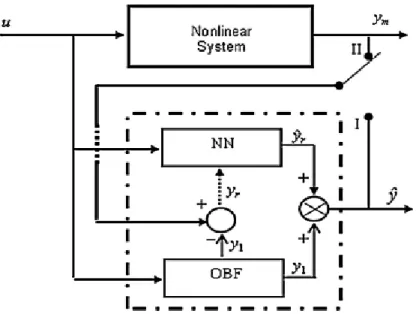
2.6 Parallel OBF-NN models
Non-linear system identification has been widely developed in all field of technology include control, instrumentation, power systems, communication systems, signal processing, neuroscience, and in satellite communications, etc.[11]. The scope of the development has focused on non-linear built with static nonlinearity and linear dynamics. The most common non- linear model that has control-based strategies is neural networks (NN) model.
Research has discovered that NN have high efficiency in data learning from complex process with nonlinearity significant [1]. The most famous type of NN implemented in process control are recurrent neural networks (RNN) and feed forward neural network or Multi-Layer Perceptron (MLP)[18]. Instead of having great efficiency, NN also have some weakness as they have poor extrapolation capability in regions outside training. To solve this problem, two solution was suggested which is using dynamic nonlinear model and utilize wiener model
in industrial nonlinear system and it consists of dynamic linear part together with static non-linear part.
One of the common classes for subsystem is Orthonormal Basis filters (OBF) model that have some advantages which is more parametric and require efficient optimization method [19] and involve complex structure including the usage of two types of input designs [20]. OBF models have recently found widespread applications in linear system identification [1]. OBF models have several characteristics that make them very promising for control relevant system identification. Their parameters can be easily estimated using linear least square method. They are consistent in their parameters for most practical open-loop identification problems and time delays can be easily estimated and incorporated into the model. To model the nonlinear subsystem, MLP NN is chosen due to its simpler structure and fewer parameters in comparison to RNN.
Figure 1 OBF-NN model configuration
2.7 Nonlinear Autoregressive Model process with exogenous input (NARX)
One of black box model called Nonlinear Autoregressive model process with exogenous input (NARX) has been proved to show promising qualities from dynamic system applications. It
has been implemented in wide area of chaotic time series as input for neural network, in relation with number of neurons, and training algorithm that verified it performance [11].
NARX is said to have exogenous input that cause the model to relate current value to past value of the same series and both current and past value of the driving series. Besides, time series prediction is to predict one or more parameter and variable in future point in time. This is a special case of function estimation that capable to figure out underlying functional relationship between previous and next figure up value.
2.8 Support Vector Classification
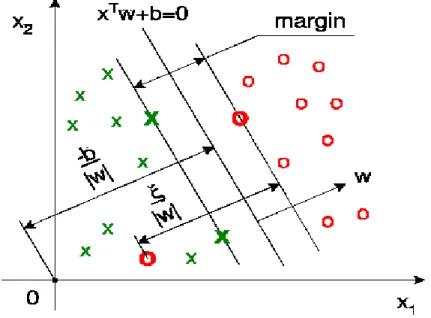
Support vector machines are famous in classification implementation to solve problems. It has been found to be effective with their decision-making and remarkable robust performance in dealing with noisy data [29][30]. SVC operates by separating dataset of binary label for training with a hyper-plane and uses it to identify information of the datasets. Wise selection of kernel type will determine the performance of SVC in solving problems, example kernel: polynomial, Gaussian radial basis, hyperbolic tangent, and etc. [8].
The application of SVC has been widely been used in sensors, text and face detection, bioinformatics, and more.
2.9 Least square support vector machine (LS-SVM)
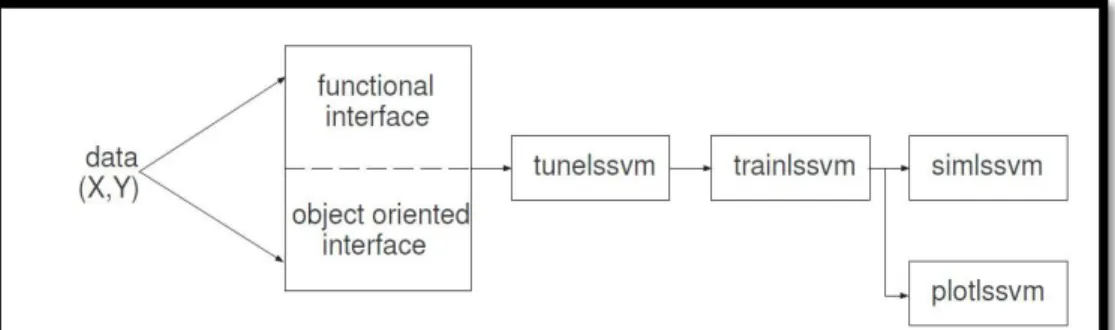
Least square support vector machine (LS-SVM) is one of SVM variant that has wider range of implementation in solving nonlinear system. LS-SVM is the advance version of standard SVM that deal with classification and regression as discussed previously [25]. It is discussed to be effective in solving both linear and nonlinear equation. A study done by Jiepin state that LS-SVM is more effective as compared to basic LS-SVM model in term of generalization [33].
Figure 3: Configuration of LS-SVM model
2.10 Support Vector Regression SVR
SVM also can be performed in regression instead of classification. It was found that SVR
has the capability to minimize the generalization error bound in order to achieve generalized
performance and also perform minimization in observed training error [28]. The pure SVR model used for estimation and validation of a non-linear system in problems involving regression tend to map input data to high dimension space to compute optimal regression function in the. For train and test model, 25% data will used to perform validation randomly. Support vector regression was
found to operate by searching hyper-parameter C, gamma, and epsilon to correspond to final
model and selected kernel function [29].
There are difficult to determine the fixed optimal value for those parameters but the recommendation said it can be obtained directly from training data and estimated noise level [29]. In order to improve SVR model in prediction, it is a good practice to use multi-attribute analysis by group. Support vector regression (SVR) has its role at discovering nonlinear structure that present unseen in sample data and the assumption is taken for error distribution using regression [28]. SVR has become tools in many fields such as in financials and time series prediction, approximation in engineering analyses, convex quadratic programming and etc. [28].
CHAPTER 3
METHODOLOGY3.0 Procedures
This chapter will explain the methodology that is used to achieve the objective of the research. The aim of the research is to configure out which model will produce better efficiency toward input and output design of CSTR reactor by classification. Data analyze by both model is compared and further study on the comparison trend and factor will be carried out. The methodology can be represented in following chart:
Literature review and collecting information
Data collection and Learn Data Handling
Develop proposed model
Compare and analyze result from model simulation
3.0.1 Literatures Review & Collecting Information
At this point, the supervisor and student have reach agreement on the evaluation work plan, establishing a clear and mutual understanding of how the project is to be carried out and what is to be achieved. Information obtained from journal, textbook and research paper. The information collected is then analyzed and distilled into credible, reliable and useful results for presentation.
3.0.2 Data collection and Learn Data Handling
Previous research has been done to study effectiveness of OBF-NN compare to basic neural network model. Same data input will be used in this project to measure which model would be the best in effectiveness. But, the data need to be learned to avoid any misunderstanding and uncertainties associated with the data.
3.0.3 develop SVM model
Modeling technique needs to be selected to ensure accuracy to the experimental data. The variety of parameters can give effect to the behavior of the developed system.
1. Propose a case study
2. Gather information and dataset
3. Develop pure linear support vector regression (SVR) model 4. Select best option of SVR model
5. Develop parallel OBF-SVR model 6. Run simulation for developed model
3.0.4 Compare and analyze result from simulation.
The capability of SVR model is compared with published data of OBF-NN model; this will review problem statements, objectives, and make judgments based on results. All figures and result for analysis is taken and lists properly to thoroughly observe the differences. Besides, some listed factors of measurement is critically analyze for best explanations regarding the result. The result will be discussed for discussion and recommendation.
3.0.5 Proposed Recommendation
Outcome of this project, we will know which predictive model have more efficiency properties and advantages for designing selected process. We will propose a set of recommendation in the end of this project based on result achieved in this investigation. This recommendations and mitigations are very essential to the future development of the process design and process control in engineering development.
3.1 Model Structure and development 3.1.1 Parallel OBF SVR model
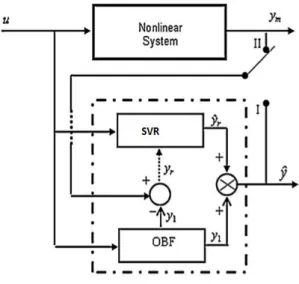
Parallel OBF SVR model is a black box model that use combination of linear-plus-SVR models. It uses residual from a linear model to be applied in SVR model to improve nonlinearity in nonlinear system. The benefit of having parallel combination is to improve nonlinear model that perform worse that linear model and produce overall nonlinear model that has better or as good as linear model. The model involves the usage of residual that inherit the characteristics of the original system. [1]
3.1.2 Parallel OBF SVR model
Model structure:
Consider a general nonlinear output error (NOE) model structure expressed as:
( ) ( ( ) ( ) ̂( )) ( ) ( )
Where e (k) refers to the system white noise. A general linear model structure, on the other hand, may be represented as:
( ) ( ) ( ) ( ) ( )
Without generality (1) and (2) can be combined to get:
( ) ( ) ( ) ( ( ) ( ) ̂( ) ̂( ) ( ) ( )
Equation 3 represents a parallel structure in which a linear model is combined with linear
model presented by f (). For this study, orthonormal basis filters (OBF) is selected as linear
model. It has some characteristics which is their parameters can be easily estimated using linear least square method. They are consistent in parameters for in many open-loop identification application and time delays can be estimated easily. The OBF model is expressed as
( ) (∑
( )) ( ) ( ) ( )
Where N is the number of orthonormal basis filters, are the optimal OBF model parameters,
( ) are the orthonormal basis filters, q is the forward shift operator, ( ) is the input to the
system, and ( ) is the system white noise.
For nonlinear model, support vector regression is used expressed as:
( ) ∑( )
( ) ( )
Where C is positive constant known as regularization parameter. There are dual variables are
subject to constraints , , and kernel function ( ). The sample points that
appear with non-zero coefficient in equation 5 are called support vectors (SVs).
3.1.3 Parameter estimation
The model is developed using based on residual generated from data training, it is an interesting perspective as there are cases where residuals are not due to randomness and probably contained real character of the system. In that case, high correlation in residuals is observed in order to indicate the failure of the model to capture full characteristic and behavior of investigated system. The sequential identification structure proposed for the residuals-based parallel OBF-NN models is illustrated in Figure 2. The linear OBF model is identified first, and the nonlinear SVR model is then developed using training data with the predicted residuals. The pseudo-independent nature of this parallel structure allows both the models to capture the essential characteristics of the underlying process separately and hence more accurately.
Given a set of nonlinear data to be identified ( ) ( )], the algorithm can be described as
follows:
1. Develop a parsimonious OBF model using methods described byto get .
2. Calculate the predicted residuals using ̂
3. Develop the SVR model using standard BP algorithm with ( ) ( ( ) (
) ̂ ( )) ̂ ( )] inputs and ̂ ( ) as outputs of the model.
The usage of residuals provides another interesting perspective. In [2], it is stated that there are cases where residuals are not due to randomness and may actually inherit the characteristics of the original system. Under such circumstances, a high correlation in the residuals is usually observable, indicating the failure of the model to capture the full characteristics of the underlying system.
3.2 GANTT CHART
No Activity
1 Perform SVM model study 2 Develop SVM model 3 Test model using dataset 4 Compare with published data
5 Compare performance between SVM and NN model
Detail /week 1 2 3 4 5 6 7 8 9 10 11
Development of support vector machine model
x x x x x
Development of parallel OBF-SVR x x
Comparative study of OBF-NN & OBF-SVR
x x
CHAPTER 4
4.1 The case studyThe estimation and identification function of the proposed SVR model are compared with basic SVR model and parallel OBF NN model using nonlinear van de Vusse reactor datasets that consist of input and output data which is widely being implemented in identification and control strategies. The basic SVR model is identified using 75% data for training and 25% data for validation as was normally done by pure linear OBF and parallel OBF NN model. The quality of SVM identification depends on proper tuning of model parameters, in this case, kernel selection with their complexity parameter and regularization parameter, which is C and
. The basic structure of SVR model is configured with OBF model in parallel and the developed model is in term of performance is compared with developed OBF-NN model. In the van de Vusse reactor, reactant A is to be converted to desired product B, but the product B turn out to product C as a by product. in accordance to the reaction, a high-order parallel reaction occurs that convert reactant A to by-product D.
→ → →
The description of mathematical model of the reactor using ordinary differential equation (ODE) is as follow: ( ) ( ) ( ) ( ( ))
The net heat reaction ( ) for above reaction is expressed as:
( ) (
)
Where represents the pre-exponential factors and are activation energies. Fixed parameters of the system are taken from literature.
4.2 Identification
This section explains the input and output data for the identification of selected case study
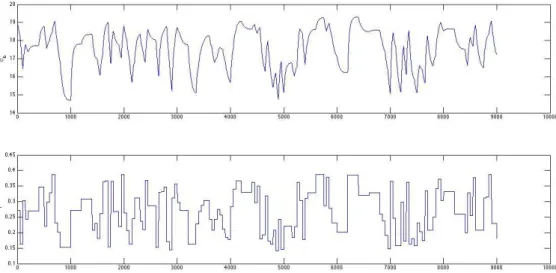
Figure 5: input & output data for training and validation
The simulated data is generated by training 6752 data and 2250 data for testing. The nonlinear system identification is carried out for the SISO system by considering the dynamic characteristics from the changes in the space velocity, Fv = qr /Vr (h−1 ), and the product outlet concentration, CB (kmol/m3). In development of parallel SVR model, the residual from train and test data also being included to improve the identification.
4.3 Results and discussion
This section explains the development of parallel OBF-SVR models and their behavior on dealing with datasets. Both linear and nonlinear part of the model is constructed and the performance for each development is executed using selected data as simulation.
4.3.1 basic support vector regression development
Basic SVR or pure SVR model is the first step before it comes to be compared. There are some consideration need to be done in-term of SVR type and the selection of kernel. Perfect selection of these options would give best parameter for better model performance.
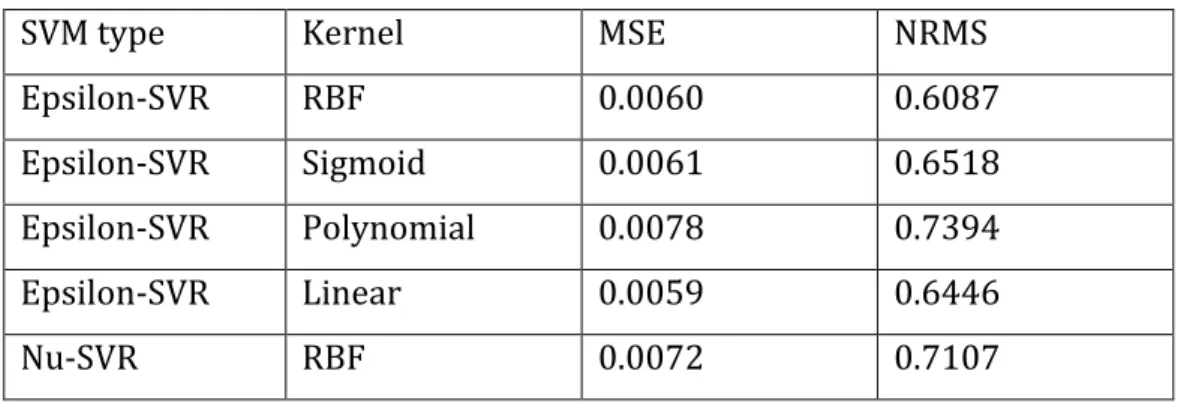
Table 1: Validation performance for basic SVR options
SVM type Kernel MSE NRMS
Epsilon-SVR RBF 0.0060 0.6087
Epsilon-SVR Sigmoid 0.0061 0.6518
Epsilon-SVR Polynomial 0.0078 0.7394
Epsilon-SVR Linear 0.0059 0.6446
Nu-SVR RBF 0.0072 0.7107
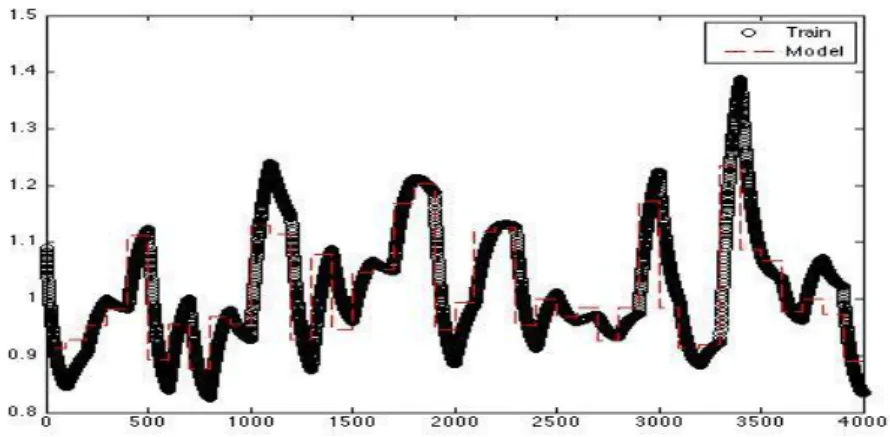
As mentioned in literature review, improvement in SVR model can be done by model selection. The selection basically done by the experts in two ways: configuring parameter and kernel selection. Figure shows model estimation that compare prediction output value with real output value. To determine best parameter, the accuracy of the model is calculated and compared. From the result, Epsilon-SVR type SVM using RBF kernel is selected as it shows lowest MSE and NRMS value. Same SVR model using linear kernel also shows promising result but it requires longer time for train and test that give some drawback in-term of time efficiency.
Figure 6: Epsilon-SVR model using RBF kernel
4.3.2 Parallel OBF-SVR development
In order to develop proposed OBF-SVR model, the linear OBF model is developed first. The residual that comes from the linear OBF model is then being used by nonlinear SVR model to be trained with the predicted residual. The performance of OBF model is show below:
Figure 8: model validation for parallel OBF-SVR model
The performance of linear OBF model has been improved when the linear part of the model been replaced with SVR model. Linear OBF model shows 79% in plot fit whereas OBF-SVR model shows 81% in plot fit between true values and model-estimated value. Besides, RMSE value for OBF-SVR validation is 0.1873 whereas linear OBF model is 0.2043,
which indicate OBF-SVR model more promising than pure linear OBF model. The
pseudo-independent natures present of the parallel OBF-SVR structure enable both models to figure out main characteristics of the process separately that can improve accuracy.
4.3.3 comparison between OBF-SVR with OBF-NN model
Developed parallel OBF-SVR model is then been compared with parallel OBF-NN model taken from published data. The performance comparisons are done on the validation capability.
The validation of NN model shows 98% of plot fit which is far better than parallel OBF-SVR model which is 81% in plot fit (refer figure 9). In difference with OBF-OBF-SVR, OBF-NN are capable to predict accurately. The result indicates that the performance of OBF-SVR in
identification of a system is not as good as OBF-NN model.
CHAPTER 5
5.0 CONCLUSION
According to the study, parallel OBF-SVR model has been developed as an advance derivative of support vector machine model. It has been tested for system identification for both linear and nonlinear identification system and compared with published data of OBF-NN model. Based on the result, it indicate that parallel OBF-NN model has better performance than OBF-SVR in system identification as it have better prediction capability as well as generalization performance. It is also can be stated that OBF-NN model show promising performance and has great potential in model predictive control.
5.1 RECOMMENDATION
Result is reliable as all procedure in model development is done accordingly. In order to improve the performance of OBF-SVR model, other option that influence model performance need to be improved. The selection of kernel must be correctly based on the problem of study. The SVR type also needs to be revised in their selection instead of kernel. Performing SVR structure in-group attribute or multi-attribute analysis instead of single analysis also can do the improvement. Another option for SVR development is by developing least square support vector regression.
REFERENCES
1. Zabiri, H., et al., Integrated OBF-NN models with enhanced extrapolation capability for
nonlinear systems. Journal of Process Control, 2013. 23(10): p. 1562-1566.
2. Kulkarni, A., V.K. Jayaraman, and B.D. Kulkarni, Control of chaotic dynamical systems
using support vector machines. Physics Letters A, 2003. 317(5-6): p. 429-435.
3. Keerthi, S.C., C. DeCoste, D., Building Support Vector Machines with Reduced Classifier
complexity. 2006.
4. Auria, L. and R.A. Moro, Support Vector Machines (SVM) asa Technique for Solvency
Analysis. 2008, German Institute for Economic Research: Berlin.
5. Czibula, G., I.G. Czibula, and R.D. Gaceanu, A support vector machine model for intelligent
selection of data representations. Applied Soft Computing, 2014. 18: p. 70-81.
6. Alpaydin, E., Introduction to Machine Learning. 2004: MIT Press.
7. Christmann, A. and R. Hable, Consistency of support vector machines using additive
kernels for additive models. Computational Statistics & Data Analysis, 2012. 56(4): p.
854-873.
8. Cristianini, N. and J. Shawe-Taylor, An Introduction to Support Vector Machines and Other
Kernel-based Learning Methods. 2000: Cambridge University Press.
9. Hong, Y.-S.T., Dynamic nonlinear state-space model with a neural network via improved
sequential learning algorithm for an online real-time hydrological modeling. Journal of
Hydrology, 2012. 468-469: p. 11-21.
10. Nandi, S., et al., Hybrid process modeling and optimization strategies integrating neural
networks/support vector regression and genetic algorithms: study of benzene
isopropylation on Hbeta catalyst. Chemical Engineering Journal, 2004. 97(2-3): p.
115-129.
11. Sahoo, H.K., P.K. Dash, and N.P. Rath, NARX model based nonlinear dynamic system
identification using low complexity neural networks and robust H∞ filter. Applied Soft
Computing, 2013. 13(7): p. 3324-3334.
12. Bansal, S., S. Roy, and F. Larachi, Support vector regression models for trickle bed reactors.
Chemical Engineering Journal, 2012. 207-208: p. 822-831.
13. Ben-Hur, A. and J. Weston, A user's guide to support vector machines. Methods Mol Biol,
2010. 609: p. 223-39.
14. Cai, J., Applying support vector machine to predict the critical heat flux in concentric-tube
open thermosiphon. Annals of Nuclear Energy, 2012. 43: p. 114-122.
15. Li, H., Y. Liang, and Q. Xu, Support vector machines and its applications in chemistry.
Chemometrics and Intelligent Laboratory Systems, 2009. 95(2): p. 188-198.
16. Abe, S., Support Vector Machines for Pattern Classification. 2010: Springer.
17. Hu, L., S. Lu, and X. Wang, A new and informative active learning approach for support
vector machine. Information Sciences, 2013. 244: p. 142-160.
18. Ge, H.-W., et al., Identification and control of nonlinear systems by a dissimilation particle
swarm optimization-based Elman neural network. Nonlinear Analysis: Real World
Applications, 2008. 9(4): p. 1345-1360.
19. Computationally efficient nonlinear predictive control based on neural
Wiener models. Neurocomputing, 2010. 74(1-3): p. 401-417.
20. Arefi, M.M., et al., Wiener-neural identification and predictive control of a more realistic
21. Plug- flow tubular reactor. Chemical Engineering Journal, 2008. 138(1-3): p. 274-282.
Squares Support Vector Machines. 2008.
25. K. De Brabanter et. LS-SV l b Toolbox Use ’s G ide 2011
22. Yang, Y.H.G., A. Khan, G., Support Vector Machines for Environmental Informatics:
Application to Modelling the Nitrogen Removal Processes in Wastewater Treatment Systems. 2006.
23. J.A.K. Suykens, J.V., B. De Moor, Optimal control by least squares support vector machines.
2000.
24. Eugen, D., The use of NARX Neural Networks to predict Chaotic Time Series. 2008.
25. Vandewalle, J.S., J, LS-SVMlab Toolbox User’s Guide. 2011.
26. Vojtesek, J.D., P., Simulation analyses of continuous stirred tank reactor. 2008.
27. Basak, D., Pal, S., Patranabis, D. C., Support Vector Regression, 2007
28. Cherkassky, V. & Yunqian, ma. Practical Selection of SVM Parameters and Noise
Estimation for Support Vector Regression, 2003
29. Hu, Q., et al., Noise model based v-support vector regression with its application to
short-term wind speed forecasting, 2013.
30. Suganyadevi, M.V. and Badulal, C.K, Support Vector Regression Model For The Prediction
of Loadability Margin of Power System. 2013. 24(14) p. 304-315.
31. Che, J., and Wang, J., Short-term Load Forecasting Using a Kernel-Based Support Vector
Regression Combination model. 2014. 134(2014) 602-609
32. Zhang, C., et al. Knowledge-based support Vector Classification Based C-SVC. 2013. P
Appendix
1.0 Option selection for basic SVR
-S (SVM type): 3 (epsilon-SVR) -t (kernel): 2- RBF
-S (SVM type): 3 (epsilon-SVR) -t (kernel): 3 - sigmoid
MSE NRMS
0.0060 0.6087
MSE NRMS
-S (SVM type): 3 (epsilon-SVR) -t (kernel): 1-polynomial
-S (SVM type): 3 (epsilon-SVR) -t (kernel): 0-Linear
MSE NRMS
0.0078 0.7394
MSE NRMS
-S (SVM type): 4 (nu-SVR) -t (kernel): 2-RBF Nu-SVR takes long time to be executed
USING DIFFERENT N FOLD (n=50) s-3 t-2 (does not give any changes)
MSE NRMS
0.0072 0.7107
MSE NRMS