https://doi.org/10.1007/s10831-018-9170-8
Severing telicity from result
On two types of resultative compound verb in Dongying Mandarin
Chenchen Song1
Received: 4 June 2017 / Accepted: 6 March 2018 © The Author(s) 2018
Abstract This paper investigates the peculiar behaviors of resultative compound verbs in Dongying Mandarin, a previously unstudied variety of Mandarin Chinese. Data from multiple syntactic contexts (e.g. completive, negation, future/irrealis, potential) show that resultative complements in this variety fall in two contrasting categories: atelic and telic. Atelic resultatives have full lexical tones and require a grammaticalized telic marker (liu) in various [+telic] contexts, whereas telic resultatives assume the neutral tone and prohibitliuin the same contexts. The theoretical discussion begins with an evaluation of two neo-constructionist approaches, featuring event decomposition and Inner Aspect, and ends with a middle-way model combining and adapting the two. The main proposal is that in Dongying Mandarin, telicity is not encoded in the resultative complement itself, but in a Low Inner Aspect position between the action and the result verbs, which turns the state denoted by the resultative complement into a telos of the complex event. I derive the surface compound verb via the Defective Goal theory (Roberts in Agreement and head movement: clitics, incorporation, and defective goals. MIT Press, Cambridge, MA,2010) and analyze the tonal variation as Root allomorphy. Keywords Resultative complement·Compound verb·Telicity·Event decomposi-tion·Inner aspect·Dongying Mandarin·Mandarin Chinese
1 Introduction
Dongying Mandarin (DY) is a variety of Northern Mandarin Chinese. It is spoken in the prefecture-level municipality of Dongying which is located near the Yellow River
B
Chenchen Song1 Theoretical and Applied Linguistics, Faculty of Modern and Medieval Languages, University of
Delta (37◦46N 119◦15E) on the northern coast of Shandong Province, China.1 In Dongying Mandarin, the V-V resultative compounds2show some peculiar distribu-tional patterns that undermine the standard assumption that the resultative morpheme denotes a natural endpoint and makes the verbal event telic. For instance, unlike Stan-dard Mandarin (STM), the majority of resultative compounds in Dongying Mandarin cannot be used on their own in completive contexts, but obligatorily take a suffixliu (1a); compare with STM (1b), wherele(the counterpart ofliu) is only optional and preferably left out.3
(1) a. Te (DY) he d6-sui hit-smashed *(liu) le hu6pingr vase liæ. le “He smashed the vase.”
b. Ta (STM) he da-sui hit-smashed ?(le) le huaping vase le. le “He smashed the vase.”
This micro-variation between Dongying Mandarin and Standard Mandarin is clear and seemingly has to do with the compound verb structure. I will argue that this is indeed the case. To be specific, I will demonstrate that the semantic component denoting telicity is outside of most resultative complements in Dongying Mandarin and encoded in liu instead. In particular, I will distinguish two types of resultative complement in Dongying Mandarin: “atelic resultatives” (the majority) and “telic resultatives” (a small number). The contribution of this paper is threefold. First, Dongying Mandarin reveals empirical facts that Standard Mandarin fails to reveal. Second, I will further adapt the split-VP model along the lines of Cuervo (2003) (event decomposition) and Travis (2010) (Inner Aspect). Third, the Dongying vs. Standard Mandarin distinction exemplifies a new dimension of cross-linguistic variation in complex event formation.
This paper is structured as follows. Section2is an overview of Chinese resultative compounds. Section3and Sect.4respectively discuss and identify atelic and telic resul-tatives in Dongying Mandarin. Section5evaluates two recent theoretical approaches to Mandarin resultative compounds. Section6proposes a novel approach to account for the Dongying Mandarin data. Section 7 examines two potential counterexam-ples. Section 8 provides an explanation for the cross-dialectal variation. Section 9
concludes.
1 Dongying has three districts (Dongying, Hekou, Kenli) and two counties (Guangrao, Lijin). The data in
this paper are from the variety spoken in Dongying District, of which I am a native speaker. Unless specified, all data are my own, with confirmation from four other native speakers.
2 Here “compound” is used in a conventional pre-theoretical sense and does not mean these constructions
are true lexical items.
3 Liæis the Dongying Mandarin counterpart of the Standard Mandarin sentence-finalle. I will come back
Table 1 Chinese predicate-complement compounds
Classification Examples
Resultative da-sui“hit-smashed,”xi-jing“wash-clean”
Directional zou-jin“walk-enter; walk into,”pa-shang“climb-ascend; climb up” Aspectual ting-jian“listen-see; hear,”yong-kai“use-open; begin to use”
2 Overview
Traditionally, Chinese resultative compounds are classified under the type of com-pound verb termed “predicate-complement,” which is made up of a main verb and a verbal complement. Chao (1968) defines three semantic types of verbal complement: resultative, directional, and aspectual,4as in Table1.
Li and Thompson (1981) treat directional and aspectual complements as subtypes of resultatives. Resultative compounds are a most important type of compound verb in Chinese (see Hu2015for a recent overview and Shi2003for a diachronic investi-gation).
As we have seen in Sect.1, Dongying Mandarin resultative compounds obligatorily require aliuin completive contexts. This is the multi-functional particle LE.5While the exact property of LE is still under debate (cf. Chao1968; Li and Thompson1981; Shi
1990; Sybesma1997; Soh2008, 2009), researchers generally observe two positions for it which can be associated with different meanings—one directly following the verb (verbal LE), the other following the entire sentence (sentential LE), as in (2).6
(2) a. Ta (STM) he ma scold le le ta he de poss haizi. child “He scolded his child.” b. Ta he ma scold ta he de poss haizi child le. le
“He is scolding his child (contrary to what one may expect).”
(Soh2009: 628) According to Soh (2009), thelein (2a) entails the finishing of the verbal event “scold his child,” while that in (2b) does not. One false impression one may get from the English translations is that the verbal LE marks past tense. This is not true, because the verbalLEcan also appear in non-past contexts, such as future (3a) and imperative (3b). English past-tense verbs likescoldedare paraphrases rather than verbatim translations.
4Chao (1968) and subsequent works use the term “phase complement,” with “phase” defined as the
begin-ning/middle/ending stage of an event. To avoid confusion with Chomskyan (2000,2001,2008) Phase (cyclic spell-out), I use “aspectual” for Chaoian phase complements.
5 I use capital letters to abstract away from the cross-dialectal phonological variation.
6 Note that in (2b), eitherma“scold” or some part ofta de haizi“his child” needs to be stressed in order
(3) a. Deng-dao (STM, future) wait-till ming-nian next-year ni you sheng bear le le haizi, baby women we yiqi together qu go kan see ni. you
“After you give birth to your baby next year, we will go to see you together.”
b. Kuai (imperative) quickly chi eat le le nide your fan! meal “Quickly eat (up) your meal!”
In (3),ledoes not mark past tense, but denotes a guaranteed event endpoint like the birth of the baby and the total consumption of the meal. The standard assumption is that this is an aspect marker. While I follow this basic assumption, it will turn out in the course of our discussion that the aspect marking function of the verbal LE is not homogenous either (Soh2009: 627 has a similar remark).7I use “perfective” for grammatical/outer aspect and “telic” for lexical/inner aspect (in the sense of Smith
1991and Travis2010), though this distinction will turn out to be cancelable (Sect.6). Telicity refers to the existence of a fixed terminal point in an event’s internal temporal organization, i.e. some final part of the event must be realized (Bohne-meyer and Swift2004). As Smith (1991: 19) says, telic events have “a natural final endpoint” or are “intrinsically bound,” whereas atelic events have “arbitrary final end-points.” Among the four Vendlerian event types (Vendler1957), states (e.g.know, love) and activities (e.g.run, walk) are atelic, while accomplishments (e.g.build a house, draw a circle) and achievements (e.g.recognize, find) are telic (Dowty1979: 54). In Mandarin, unlike in English, there are very few mono-morphemic achievements and probably no mono-morphemic accomplishments (Tai 1984; Soh 2014; Huang
2015). Instead, these two telic event types are predominantly expressed by phrases or V-V compounds. For example, “write a letter” is an accomplishment ([+telic]) in English but not in Chinese. As in (4a), one can write a letter without finishing it. In order to turn this into a telic event, an aspectual complement likewan “fin-ish” orhao“good” is needed (4b). Note thatlein (4) marks perfectivity rather than telicity. (4) a. Wo (STM) I zuotian yesterday xie write le le yi-feng one-cl xin, letter keshi but mei not xie-wan. write-finish “I wrote a letter yesterday, but didn’t finish it.”
b. Wo I zuotian yesterday xie-wan/hao write-finish/good le le yi-feng one-cl xin. letter
“I finished writing a letter yesterday.” (Smith1994: 113) As Lin (2004) points out, in a resultative V1–V2compound, V2“describes the end state that is brought about by the V1event,” and the entire compound verb is “necessarily telic.” For example, in STMda-sui huaping “hit-smashed the vase,”sui “smashed” is the end state caused byda “hit,” However, this point is challenged by Dongying
7Among others, thelein (3) does not mark viewpoint perfectivity (but event telicity), because perfectivity
Mandarin, where the counterpart of “hit-smashed the vase” isd6-sui-liu hu6pingr instead of*d6-sui hu6pingr. The latter is ill-formed both as an isolated phrase and in sentences requiring telic predicates such as (1a). In fact,d6sui hu6pingr is difficult to parse; it is more prone to be interpreted asd6sui-hu6pingr“hit the smashed vase” (despite the pragmatic oddness), withsui“smashed” analyzed as a modifier ofhu6pingr “vase.”8Since such resultative complements cannot convey telicity without the help ofliu, I call them “atelic resultatives.” In the next section, I will justify this term by four tests.
3 Atelic resultatives
3.1Liuis a telic marker
As we have seen, atelic resultatives on their own are ill-formed in contexts with a telicity requirement, such as completive sentences, and the ill-formedness can be saved byliu. Below are more examples.
(5) a. Te (DY) he d6-sui hit-smashed *(liu) le hu6pingr vase liæ. le “He smashed the vase.”
b. Te he ku-hong cry-red *(liu) le yæ eye liæ. le “He cried his eyes red.” c. Te he zu-shu make-cooked *(liu) le fæ meal liæ. le “He made the meal ready.”
In (5a),d6-suialone is not equivalent to the English accomplishment verbsmashbut must rely on an additionalliu. Similarly, in (5b) and (5c),ku-hongandzu-shualone are not equivalent to Englishcry redandmake readyeither, but must rely onliuto achieve the same semantic effect. More generally,liuis required as long as an inherent end point is made reference to, as in the following sequenced events.
(6) a. Siæ (DY) first duo-sui chop-minced *(liu) le rou, meat zai then mæ ba ne the sui-rou minced-meat lai lai gao-de put-to guo-liou. pan-inside
“First chop the meat till minced, and then put the minced meat into the pan.” b. Siæ first mæ ba ne the sheng raw ji-dæ chicken-egg lai lai zhu-shu boil-cooked ?(liu), le zai then tiæ add shui. water “First boil the eggs till ready, and then add water.”
These sentences are not completive, as indicated by the absence of the sentence-final liæ(cf. Sect.3.2). Nevertheless, the event sequencing makes it necessary for the first
8 The informants generally do not like the phrased6sui hu6pingrand report it to be at best ambiguous
event to be telic.Liuis required to yield the natural judgment and, as aforementioned, without it native speakers preferably parse anaction-state-objectstring asaction (attributive-)state-object, e.g. “chop the minced meat” in (6a),9which is prag-matically odd but gramprag-matically fine.10Note that while the verbal LE in sequenced events is arguably a perfective marker in Standard Mandarin (cf. Tham and Soh2006; Wu2005), this cannot be the case in Dongying Mandarin.11On the one hand, the verbal
9 In (6b), where there is no post-verbal object, the omission ofliuis less bad.
10 Unlike the situation in footnote8, here the informants’ judgments are rather clear, i.e.duo sui roumeans
“chop the minced meat” instead of “chop-minced the meat.”
11 A reviewer mentions STM verballeis generally odd in isolated activity sentences (cf. Tham and Soh2006;
Wu2005, though see Soh and Gao2006; Zhang1997for disagreement) and suggests the obligatoriness of DYliuin atelic resultatives may simply mean these are activities. While acknowledging this intuition, I suspect the obligatoriness of DYliuand the oddness of STMleare two heterogeneous phenomena, and that accounts for one cannot be carried over to the other. There are three main reasons. First, DYliuis always strictly required, while the acceptability of STMlevaries from context to context, e.g. it is quite natural in (i). (i) Ta he li cut le le fa. hair “He had a haircut.”
Second, the sentences showing the oddness of STMlemust be paraphrased in Dongying Mandarin (by the particlelai), as in (ii), where LE issues do not arise at all.
(ii) (a) ?Ta (STM) he chi eat le le rou. meat
“He ate meat.” (Wu2005: 300)
(b) Te (DY) he chi eat rou meat lai. lai
“He ate meat.”
The event-sequencing sentences which reportedly cancel the oddness oflemust also be paraphrase (by the particledi).
(iii) (a) Women (STM)
we kan watch le le dianying, movie ranhou then gei give ni you da make dianhua. phone call
“We watched the movie, then called you.” (Tham and Soh2006: 185)
(b) Næ (DY) we siæ first kæ watch di di diæying, movie you then ji give ni you d6 make di di diæhu6. phone call “We first watched the movie and then called you.”
Third, isolated sentences (e.g. those without discourse particles) are always ungrammatical in Dongying Mandarin regardless of the event type or the availability ofliu, as in (iv), which means the ungrammaticality has nothing to do with the verbal LE (unlike STM).
(iv) (a) *Te (DY, activity)
he chi eat (liu) le fæ. meal “He has eaten.”
(b) *Te (achievement) he d6-sui hit-smashed (liu) le hu6pingr. vase “He smashed the vase.”
LE is not obligatory (and preferably left out) in the Standard Mandarin counterparts of (6), as in (7). (7) a. Xian (STM) first duo-sui chop-minced (?le) le rou, meat zai then ba ba sui-rou minced-meat fang-jin put-into guo-li. pan-in
“First chop the meat till minced, and then put the minced meat into the pan.” b. Xian first ba ba sheng raw ji-dan chicken-egg zhu-shou boil-cooked (*le), le zai then tian add shui. water “First boil the eggs till ready, and then add water.”
On the other hand, as mentioned in footnote7, the perfective LE is incompatible with future events, butliuin (6) is equally obligatory in future contexts, as in (8).
(8) a. Ni (DY) you yih6r later siæ first duo-sui chop-minced (*liu) le rou, meat zai then mæ ba ne the sui-rou minced-meat lai lai gao-de put-to guo-liou. pan-in
“Later you first chop the meat till minced, and then put the minced meat into the pan.” b. Ni you xi6yihuir next time siæ first mæ ba ne the sheng raw ji-dæ chicken-egg lai lai zhu-shu boil-cooked ?(liu), le zai then tiæ add shui. water
“Next time you first boil the eggs till ready, and then add water.”
Furthermore, that the [+telic] component in contexts like (5)–(6) is inliurather than in the resultative complement is also evidenced by (9), sentences that are sometimes used in casual registers.12These sentences do not have resultative complements at all but still require telic predicates.
(9) a. Te (DY) he d6 hit *(liu) le hu6pingr vase liæ. le
“He hit the vase (into pieces/halves).” b. Siæ first duo chop *(liu) le rou… meat
“First chop the meat (into mince/chunks)…”
In (9), it does not matter whether the vase is broken into many small pieces or two/three parts and whether the meat is chopped into minces or larger chunks; what matters is that the vase is broken and the meat is no longer a whole piece, both of which are
12 Dongying Mandarin, as an exclusively spoken variety, is already casual compared to Standard Mandarin,
but there are further register differentiations within the variety. See Feng (2010,2012) for the register system in Chinese and its possible correlation with the grammar.
result states. Such resultative readings are not cancelable, i.e. one cannot say “he hit-liuthe vase/chop-liuthe meat but the vase/meat is still intact.” Remember that unlike in English, in Chinese “hit/break” and “chop” are activity verbs that do not entail any result, so the resultative readings must come fromliu. The pattern in (9) is similar to English particle verbs likeeat up (vs.eat) and also reminiscent of the telicizing prefixes in some languages, such asmeg- in Hungarian (10) (see É. Kiss2002for more details of Hungarian verbal prefixes).
(10) a. Tanul-t-am (Hungarian) study-pst-1sg a the szavakat. words
“I studied the words (and that’s all).” b. Meg-tanul-t-am meg-study-pst-1sg a the szavakat. words.
“I studied the words (and learned them all by heart).”
In (10a),tanul“study” only indicates such an action took place, with no result guar-anteed. By contrast, with the verbal prefixmeg-in (10b) , the studying event has a guaranteed result, i.e. the words are mastered by heart. As such,liuin (9) has the same function asmegin (10): both add a telicity component to the verbal event. In Sect.7.2
I will show that this bareliuis likely to be an aspectual complement rather than an aspect marker, but this does not change the fact that its role is to express telicity.13
3.2 Negation withliu
That theliuaccompanying atelic resultatives in Dongying Mandarin is a telic rather than perfective marker is also supported by negation data. The Chinese languages have multiple negative particles for different purposes. Dongying Mandarin uses at least four of them:bu“not” (general purpose),mu“not” (for possessive “have”14and perfective predicates), hou“don’t” (imperative), and beng “needn’t” (imperative/modal). The four negators are exemplified in (11).
(11) a. Siaohong (DY) Xiaohong bu not shang-xiao. ascend-school
“Xiaohong doesn’t go to school (i.e. she isn’t a student).” b. Siaohong Xiaohong mu not shang-xiao. ascend-school
“Xiaohong didn’t go to school (e.g. she’s sick at home).” c. Siaohong Xiaohong ai, sfp hou don’t shang-xiao ascend-school æ! sfp
“Xiaohong, don’t go to school (e.g. find a job instead)!”
13 That the bareliumay be an aspectual complement does not mean theliuaccompanying atelic resultatives
is also one. The latter is necessarily an (inner) aspect marker in our model (see Sect.6.4).
14 Muin Dongying Mandarin andmeiin Standard Mandarin. Note that DYyou“have” is exclusively
a possessive verb and has no auxiliary function. It can neither mark perfectivity as in Southern Chinese varieties (cf. Wang1965) nor followmeias in Standard Mandarin (mei-you“not-have”).
d. Siaohong Xiaohong ai, sfp beng needn’t shang-xiao ascend-school æ! sfp “Xiaohong, don’t go to school (there’s no need)!”
Neithermu, norhou, norbengis compatible with a perfective context, asmunegates perfectivity (Lin 2003), andhou/beng (being imperative) are only used for irrealis scenarios. If we change “go to school” in (11b–d) to “went/has gone to school” ( shang-xiao di liæ), the sentences immediately become ungrammatical.
(12) a.*Siaohong (DY) Xiaohong mu not shang-xiao ascend-school di dist liæ. le “*Xiaohong didn’t went to school.” b.*Siaohong Xiaohong ai, sfp hou don’t shang-xiao ascend-school di dist liæ! le “*Xiaohong, don’t went to school!”
c.*Siaohong Xiaohong ai, sfp beng needn’t shang-xiao ascend-school di dist liæ! le “*Xiaohong, you needn’t went to school!”
As such, if a LE is compatible withmu/hou/beng, it cannot be a perfective marker. This is precisely the case with theliuin atelic resultatives, as in (13).
(13) a. Te (DY) he mu not d6-sui hit-smashed liu le hu6pingr vase æ. sfp “He didn’t smash the vase.”
b. Te he mu not ku-hong cry-red liu le yæ eyes æ. sfp “He didn’t cry his eyes red.” c. Te he hæ still mu not zu-zhong make-cooked liu le fæ meal æ. sfp “He hasn’t made the meal ready.”
In (13),liuis compatible withmuand therefore not a perfective marker. In fact, what is complementary withmuis the sentence-finalliæ, or more exactlyli-. Previous studies show the sentence-final LE in many Chinese varieties is not mono-morphemic, but contracted from a perfective LE plus a declarative/confirmative particle (æin DY) (cf. Liu1985; Mei1994; Song2015).15The complementarity ofmuandli-is manifested in a comparison of (13a) and (1a) (repeated below), which are otherwise identical.
15 That the sentence-final particles can be phonologically contracted is clear in Dongying Mandarin. In all
our examples except those involving the potential-liu(Sect.3.4), the declarative SFPæis resyllabified with the preceding morpheme, e.g.yæ-æ→yæ-næ/yæ-Næ,fæ-æ→fæ-næ/fæ-Næ, etc. Informants do not accept phonologically standalone SFPs where they should be contracted.
(14) Te (DY, =1a) he d6-sui hit-smashed liu le hu6pingr vase li-æ. le- sfp “He smashed the vase.”
As such, it isli-that performs the perfectivizing function.16 Given the minimal dis-tinction between (13a) and (14), we can conclude that the verballiuin both sentences performs the same telicizing function. Thus, the structural difference between (13a) and (14) can be represented as below; (13b–c) follow the same pattern.
(15) a. Subject NEG[−pfv]Event[+telic]SFP (=13a)
b. Subject Event[+telic]ASP[+pfv]-SFP (=14)
(16)–(17) are examples of atelic resultatives inhou/beng-negated sentences.
(16) a. Hou (DY) don’t d6-sui hit-smashed liu le hu6pingr vase æ. sfp “Don’t smash the vase!”
b. Hou don’t ku-hong cry-red liu le yæ eye æ. sfp “Don’t cry your eyes red!”
(17) a. Beng (DY) needn’t ku-hong cry-red liu le yæ eye zhuang pretend tæciæren! poor
“Don’t cry your eyes red and pretend to be poor (there’s no need)!” b. Beng needn’t zao early zu-zhong make-ready liu le fæ meal deng-zhou wait-prog te he æ! sfp
“Don’t make the meal ready early and wait for him (there’s no need)!” The verballiuin the above examples, being compatible withhou/beng(and actually required), is not a perfectivizer. And given the invariability of the predicate phrases in (16)–(17) and (5), we can identify theliuhere as a telicizer too.
Finally, a special use of the general-purpose negatorbucan also confirm the teliciz-ing function of the verballiu. As in (18a),buplus a telic event can form a conditional clause expressing an extreme situation (guois an aspectual complement meaning “suc-cessfully doing something”).17The same meaning cannot be conveyed when the event followingbuis atelic, as in (18b). (18) a. Siaoming (DY) Xiaoming bu not bei-guo memorize-pass kewenr text bu not shui-jiao. sleep
“Xiaoming wouldn’t go to bed until he successfully memorized the text.”
16 Unless necessary, I will keep glossingliæaslefor expository convenience.
17 Chao (1968: 664) mentions a similar construction: whileyou“have” is normally negated bymei, it can
also be negated bybuin conditional clauses, as in (i). (i) Bu not you have yi-ge one-cl kekaode dependable ren person bangmang, help shi shi bu-hui not-will chenggong succeed de. de
“Without having a dependable man to help, you will certainly not succeed.”
b.?Siaoming Xiaoming bu not bei memorize kewenr text bu not shui-jiao. sleep
“lit. Xiaoming doesn’t memorize the text and doesn’t sleep.”
Strikingly, if we apply this construction to atelic resultatives (19), the verbal liu becomes obligatory just like in the completive sentences in (5). The events intro-duced by “until” are necessarily telic, for otherwise they would not qualify as extreme situations. (19) a. Bu (DY) not d6-sui hit-smashed *(liu) le hu6pingr vase ni you hen very næ-shou uncomfortable han?! sfp “You don’t feel comfortable until you smash the vase?!” b. Te he bu not ku-hong cry-red *(liu) le yæ eyes bu not sæhuo. stop “He won’t stop until crying his eyes red.” c. Bu not zu-zhong make-ready *(liu) le fæ meal bei18 don’t chu-menr! exit-door “Don’t you go out until you make the meal ready!”
In sum, the negation data in this section provide convincing evidence that in Dongying Mandarin atelic resultatives, telicity is not encoded in the resultative complements themselves but in the verballiuinstead.
3.3Liuin future and irrealis contexts
According to Soh (2008) and Tham and Soh (2006) among others, the perfective verbal LE is incompatible with future events. However, as we have seen in Sects.3.1and3.2, DYliuis equally obligatory in future contexts, as in (20).
(20) a. Te (DY) he dai will duo-sui chop-minced *(liu) le rou meat æ. sfp “He will mince the meat.”
b. Ni you dai will d6pur plan mæ ba ne the hu6pingr vase lai lai d6-sui hit-smashed *(liu) le o? sfp “Are you planning to smash the vase?”
c. Ni you yih6r later dai will xi6-mu scare-absent *(liu) le mei. pulse “Later you’ll be scared to death.”
The same is true for other irrealis contexts such as subjunctive (21) and imperative (22).
(21) a. Wo (DY) I menliang-zhou guess-prog ni you zaoken tomorrow dangmer probably dai will tang-huai perm-bad *(liu) le tou. head
“I guess you’ll probably damage your hair tomorrow by perming it.” b. Kuai quickly chuæ-hao wear-good ?(liu) le yishang! clothes “Quickly put on your clothes!”
Recall that sometimes the STM verballeis also compatible with future and irrealis contexts (see Sect.2), though, unlike in Dongying Mandarin, this only occurs with mono-morphemic verbs but not with V-V resultative compounds, as in (22).
(22) a. Kuai (STM, =3b) quickly chi eat le le nide your fan! meal “Quickly eat (up) your meal!” b. Kuai quickly chi-wan eat-finish *(le) le nide your fan! meal “Quickly finish eating your meal!”
If the STM bareleand the DY verballiuhave the same telicizing function as we separately concluded in Sects.2and3.1, then the grammaticality difference between (21a) and (22b) can only be due to the property of the resultative compound. I will return to this point in Sect.8.
3.4 Double-liupotential construction
A final piece of evidence for the existence of atelic resultatives is a special potential construction featuring doublelius. It is absent in Standard Mandarin but exists in quite a few dialectal Northern Mandarin varieties (Lamarre1995) including Dongying Mandarin. With intransitive verbs, the twolius are stacked next to each other (23).
(23) a. Te (DY) he qu go liu le liu le æ. sfp “He is able to get there.” b. Te he sing wake liu le liu le æ. sfp “He is able to wake up.”
According to Song (2016), the firstliuin (23) turns the atelic eventsqu“go” andsing “wake”19into telic events “get there, arrive” and “wake up,” and the secondliuis a modal item expressing the subject’s ability to realize the verbal event. Importantly, the
19 Note thatsing“wake” only denotes the activity of waking and does not entail the result of being awake.
Therefore, one could say:
(i) Te (DY) he sing-liu wake-le.pfv bæ-tiæ half-day mu not sing-liu. wake-le.tel
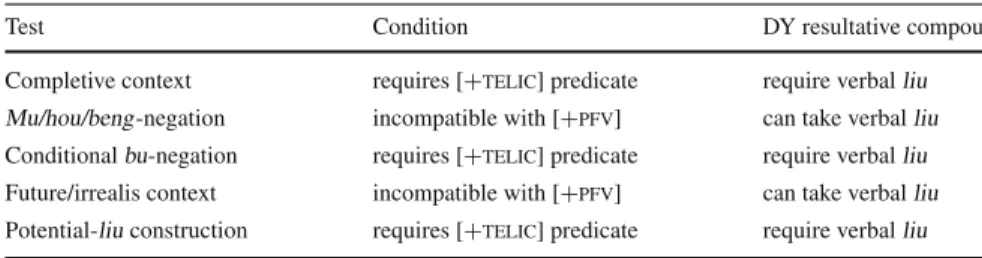
Table 2 Evidence for Dongying Mandarin telic markerliu
Test Condition DY resultative compounds
Completive context requires[+telic]predicate require verballiu Mu/hou/beng-negation incompatible with[+pfv] can take verballiu
Conditionalbu-negation requires[+telic]predicate require verballiu
Future/irrealis context incompatible with[+pfv] can take verballiu
Potential-liuconstruction requires[+telic]predicate require verballiu potential-liuis only compatible with telic events (which have a realizable endpoint) but not with atelic events like states and activities, as in (24).
(24) a.*Te (DY, state) he zhidao know liu le.pot æ. sfp
Intended: “He is able to know.”
b.*Te (activity) he qu go liu le.pot æ. sfp
Intended: “He is able to go.”
We can use the selectional restriction of the potentialliuto test the telicity property of a predicate: predicates that are compatible with it are necessarily [+telic]. It turns out that the resultative compounds we have seen so far are incompatible with the potential liu; they must take a verballiufor the construction to work, as in (25).
(25) a. Te (DY) he d6-sui hit-smashed *(liu) le hu6pingr vase liu le.pot æ. sfp “He is able to smash the vase.”
b. Te he zu-zhong make-ready *(liu) le fæ meal liu le.pot æ. sfp “He is able to make the meal ready.”
The tests in this section are summarized in Table2. They all demonstrate the verbal liuin Dongying Mandarin is a functional item making the resultative compound telic.
4 Telic resultatives
The majority of resultative compounds in Dongying Mandarin are atelic. However, there is also a small group of them that show the opposite distributional pattern, being incompatible with the telicizingliuin all the tests in Table2. Takepo“broken, damaged, wounded,”duæ“broken (in half),” andshe“dead” for example (underline marks neutral tone20). First, the telicizingliuis forbidden in completive sentences.
20 The neutral tone (qingsheng“lit. light tone”) is a weakened tone form in Mandarin Chinese which can
(26) a. Te (DY) he g6-po cut-broken (*liu) le shou hand liæ. le “He cut his hand.”
b. Te he shui-duæ tumble-broken (*liu) le tui leg liæ. le “He broke his leg.”
c. Te he chai-she trample-dead (*liu) le ne-guo that-cl miyang ant liæ. le “He trampled that ant to death.”
In (26), the V-V compounds alone entail the endpoints “be wounded,” “be broken in half,” and “be dead” without the aid ofliu. The same is true for sequenced events (27).
(27) a. Te (DY) he jiang just g6-po cut-broken (*liu) le shou hand you then k6-po crack-broken tou head liæ. le “He had just cut his hand and soon also cracked his head.” b. Te he shui-duæ tumble-broken (*liu) le tui leg ch6modianr almost si-liu. die-le “He broke his leg and almost died.”
Second, for these three items,liuis forbidden in conditionalbu-negation, as in (28).21
(28) a. Te (DY) he bu not g6-po cut-broken (*liu) le shou hand bu not sæhuo. stop “He won’t stop until he cuts his hand.” b. Te he bu not shui-duæ tumble-broken (*liu) le tui leg bu not sæhuo. stop “He won’t stop until he breaks his leg.” c. Te he bu not chai-she trample-dead (*liu) le ne-guo that-cl miyang ant bu not sæhuo. stop “He won’t stop until he tramples that ant to death.”
Third,liuis also forbidden in potential-liusentences involving the three items, as in (29). (29) a. Te (DY) he g6-po cut-broken (*liu) le shou hand liu le.pot æ. sfp “He is able to cut his hand.”
b. Te he shui-duæ tumble-broken (*liu) le tui leg liu le.pot æ. sfp “He is able to break his leg.”
21 Whileliuis equally forbidden inmu/hou/beng-negation, those are not suitable tests here, for they, being
incompatible with perfectivity, can only prove the well-formedliuis not a perfective marker, but cannot guarantee it is a telic marker (remember in Sect.3we identified theliuin these cases as a telic marker by minimal pair comparison).
c. Te he chai-she trample-dead (*liu) le ne-guo that-cl miyang ant liu le.pot æ. sfp “He is able to trample that ant to death.”
In conclusion, the three neutral-tone resultative complements are intrinsically telic; call them “telic resultatives.” Telic resultatives in Dongying Mandarin form an independent equivalence class with two defining characteristics:(i) they cannot co-occur with the telicizingliu;(ii) they are in the neutral tone (i.e. phonologically subminimal22).
Interestingly, most of the STM aspectual complements classified by Chao (1968) and Li and Thompson (1981) (cf. Sect.2) pattern with DY telic resultatives,23such as zhao“touch” (=DYzhou) andjian“see” (=DYjiæ) in (30)–(31).24
(30) a. Te (DY) he zhao-zhou look for-touch (*liu) le jiaoshi classroom liæ. le “He found the classroom.”
b. Te he bu not zhao-zhou look for-touch (*liu) le jiaoshi classroom bu not sæhuo. stop “He won’t stop until he finds the classroom.” c. Te he zhao-zhou look for-touch (*liu) le jiaoshi classroom liu le.pot æ. a “He is able to find the classroom.”
(31) a. Te (DY) he ting-jiæ listen-see (*liu) le dongder sound liæ. le “He heard the sound.”
b. Te he bu not ting-jiæ listen-see (*liu) le dongder sound bu not chu-menr. exit-door “He won’t go out the door until he hears a sound.” c. Te he ting-jiæ listen-see (*liu) le dongder sound liu le.pot æ. a “He is able to hear the sound.”
The parallelism between telic resultatives and aspectual complements is not accidental, but will turn out to reflect an underlying commonality concerning Inner Aspect. To sum up our empirical data, the atelic and telic resultatives in Dongying Mandarin form two clearly contrasting categories, as in Table3, which challenges the traditional view that resultative compounds are necessarily telic.
22 If there is a correlation between functional categories and prosodic subminimality (Roberts and Roussou
2003), then the neutral-tone elements in Chinese may be somewhat grammaticalized.
23 An exception iswæ“finish,” which I till return to in Sect.7.
24 Although the aspectual complements are idiosyncratically selected by the main verbs, they are more
productive than one might expect. For instance, in addition tozhao-zhouandting-jiæ, one can also say zhao-jiæandting-zhou, with no major difference except for the idiosyncratic contribution ofjiæ(highlighting the result) andzhou(highlighting the successful achievement).
Table 3 Atelic and telic resultative complements in Dongying Mandarin
Liuin[+telic]contexts Tone
Atelic resultatives obligatory lexical (full)
Telic resultatives forbidden neutral (light)
5 Two approaches to Mandarin resultative compounds
How can the atelic and telic resultatives be differentiated in structural terms? In this section, I will review two recent theoretical approaches to Mandarin resultative com-pounds and show that they both face problems.
5.1 Event decomposition
Complex events may be decomposed into subparts. Since events are linguistically introduced by verbs, their semantic decomposition can be reflected in syntax via an elaborate VP structure. This idea has been widely pursued in the past twenty years (e.g. Hale and Keyser1993; Marantz1997; Borer2005), and has led to a research program known as neo-constructionism (see Acedo-Matellán2016for a recent overview). As a specific instantiation of this approach, Cuervo (2003)—following Distributed Mor-phology (DM; Morris and Marantz1993; Halle and Marantz1994; Marantz1997et seq.) and building on Harley (1995)—proposes three flavors of the verbalizer that cor-respond to three event primitives, i.e.vDO(activity),vGO(change), andvBE(state).25 An event may contain one or morevs. Lin (2004) and Kan (2007) apply this frame-work to Standard Mandarin resultative compounds, arguing that an item likeku-shi “cry-wet” in (32) has the structures in (33). Although differing in details,26they both identify the action “cry” asvDOand derive the surface word order by successive head movement (vBE-to-vDO). (32) Lisi/Meimei (STM) Lisi/sister ku-shi cry-wet le le shoupa. handkerchief
“Lisi/The little sister cried the handkerchief wet.”
25 Throughout this paper, I usevin the Marantzian sense, i.e. as a verbalizer and eventuality introducer (à
la Marantz2013). To avoid confusion, I follow a standard treatment and label the Chomskyanv(i.e. the external argument introducer) as Voice (à la Kratzer1996).
26 For example,v
GOis labeled in Lin (2004) asvδ, and Kan (2007) further decomposes the complement ofvBEinto a relational element P and a measuring-out element XM.
(33) a. Lin (2004: 112) b. Kan (2007: 250)
The models in Lin (2004) and Kan (2007) encounter three problems facing the Dongy-ing Mandarin data. First, it is unclear where the telicizDongy-ingliucan be accommodated in (33). Second, the atelic/telic variation remains mysterious, as the trees in (33) only provide one way to derive the V-V compound (byvBE-to-vDO movement). Third, in order to derive the correct surface word order, both models have to stipulate that the vBE-to-vDOmovement involves right-adjunction, which is exceptional in an otherwise left-adjunction language like Mandarin and also goes against Kayne’s (1994) hypoth-esis that head adjunction is always to the left.
5.2 Inner aspect
The telicizingliuin Dongying Mandarin has a more natural place in another split-VP model—the Inner Aspect theory in Travis (2010) (also see Borer2005) which posits an inflectional category Asp within the VP domain, between the External Argument (EA) introducing head and the lexical verb, as in (34).
Travis (2010: 9) splits the event spine into two parts: an idiosyncratic part including V1, V2, and X, and a more productive part (Inner) Asp. V1is the EA introducing head semantically identified ascause, Asp is identified asbecome, and V2is the contentful lexical verb (ibid. p. 5). Note that V2, being able to head and project, is not a DM Root (in the sense of Chomsky2013, Alexiadou2014) but a categorized verb. The above model can be simplified as in (35).
(35) VoiceP Voice cause IAspP IAsp become vP
The simplification reveals that in Travis’ model V2 is the only locus for open-class lexical morphemes, while V1 is “closer to a light verb” (ibid. p. 12), such as the Tagalog causative markermag inmag-tumba“caus-fall down; cause to fall down,” mag-sabog“caus-explode; scatter,”mag-luwas“caus-go into the city; take into the city,” etc. Travis also mentions Chinese and assumes Chinese resultative complements to be in the same structural position as English PP goal phrases (XP in (34)) (p. 246). So, the sentence in (32) can be represented as in (36a), whose simplified version is (36b).
(36) a. b.
V1/Voice is null because in a resultative compound likeku-shi“cry-wet,” both “cry” and “wet” are lexical verbs with their own Roots. The Inner Aspect model is adopted for Standard Mandarin in i.a. Su (2012) and Woo (2013). While it also provides a potential locus for DY liu, when applying it to our data we immediately meet two problems.
First, as in (37), the only position available for the telicizing liu is Asp, which causes a linearization problem similar to that in Sect.5.1. In order to get the correct surface word order ku-shi-liu shoujuanr “cry-wet-le the handkerchief,” two steps of head movement are needed: X-to-V2(right-adjunction) and[V2-X]-to-Asp (left-adjunction). The direction of head adjunction is inevitably arbitrary.
(37) a. Meimei (DY) sister ku-shi cry-wet liu le shoujuanr handkerchief liæ. le “The little sister cried the handkerchief wet.”
b. V1P DP sister V1 AspP Asp liu V2P V2 cry XP X wet DP handkerchief
Second, if Asp encodes telicity, then telic resultative complements likepo“broken, damaged, wounded,”duæ“broken (in half),” andshe“dead” need to be either base-generated at Asp or moved there. However, both options encounter difficulties. If they are base-generated at Asp, then they are inflectional aspect markers and should not predicate the internal argument of the compound. This is clearly not true. The predication may be literal (38a) or metaphorical (38b), but it is always there. (38) a. shui-duæ tui“tumble-broken leg; break the leg”⇒“the leg is broken”
b. ting-jiæ dongder“listen-see (perceive) sound; hear the sound”⇒“the sound is perceived”
Alternatively, if the telic resultatives are base-generated at X and then moved to Asp, then their derivation becomes identical to that of atelic resultatives, and all the observed distinctions between the two classes become mysterious. In addition, if the neutral tone of telic resultatives has to do with Asp, then this should affect both X and V2(which are moved together) rather than X alone. So, Travis’ model is not suitable for Dongying Mandarin, either (which is not surprising as different languages may have different VP structures). An adapted Inner Aspect model is seen in Zhang (2017), which combines Inner Aspect with Ramchand’s (2008) tripartite event decomposition, as in (39).
(39) Zhang (2017) InitP EA Init AspP XP Asp ProcP Proc ResP Res AP
However, a closer examination reveals that (39) is in fact equivalent to (37). In Ram-chand (2008), a complex event may have three subevental components:Init, Proc, andRes.InitandResare defined as states, whileProcis the only dynamic part of the event spine.27 Since Chinese resultative compounds like “cry-wet” have a dynamic main verb and a stative resultative complement, the entire compound verb should be lower than Asp. Therefore, apart from the different notation, (39) and (36) are essentially the same, and so are their problems.
In sum, Dongying Mandarin poses two significant problems that neither the event decomposition model nor the Inner Aspect model can readily account for:(i) how to derive the surface word order without arbitrary head adjunction direction;(ii) how to account for the distribution of telic resultatives and especially their neutral tone. Next, I will adapt the two previous approaches and develop a novel model to solve these problems.
6 A middle-way approach
6.1 Low Inner Asp
As we have seen, the event decomposition and the Inner Aspect approaches both reveal useful components of the VP-internal structure and are helpful models, but they both also need to be further adapted to cover the Dongying Mandarin data. I tentatively propose (40) for this purpose. Since each ofvDOandvBEcan categorize a lexical Root, they are both under V2P in Travis’ framework (orvP in the simplified version). My main innovation is putting Asp between two lexical verbs rather than between a lexical verb and a light verb.
27 Ramchand (2008: 42) definesInitas stative because this “gives a simpler ontology” and “allows a
(40) VoiceP
Voice vDOP
vDO(-√) AspP
Asp vBEP
vBE(-√) DP
The logic behind (40) is as follows. Since Asp heads are in the Extended Projection (EP) of the [V] category, and the base of an EP is the lexical category itself (i.e. the categorizer), it follows that in a multi-categorizer model each categorizer can start an EP until another categorizer is merged in. As such, all Asp heads could be the same functional category which simply recurs in different EPs.28Note that this is not to say each verbalizer must have an Asp in its EP or must have an EP at all. While reducing the event structure to a series ofvand EP heads, I assume the interaction of thev heads and the way they project (short) EPs to be language-specific and, in Biberauer’s (2016) terms, emergent. The advantage of (40) is that it enables us to specify aspectual information for the individual lexical verbs that together make up a complex event. The telicizingliuin Dongying Mandarin resultative compounds, which specifies aspectual information for the stative verb it selects, qualifies as an Asp head in the EP ofvBE.
6.2 Verb movement and linearization
In atelic resultatives,vDOprecedesvBE, andvBEprecedesliu. As aforementioned, this causes a linearization problem:vBE-to-Asp movement is left adjunction while [vBE -Asp]-to-vDOmovement is right adjunction, which violates Kayne’s (1994) hypothesis that head adjunction is always to the left and, more importantly, makes the direction of head adjunction arbitrary. To solve the problem, I propose thatvBE-liu does not further move tovDO. This proposal can be backed up by a head movement constraint proposed in Roberts (2010). Roberts accounts for head movement by the notion of Defective Goal, i.e. a Goal whose formal features are properly included in those of the Probe. When the Probe agrees with such a Goal, the formal features on the latter are exhaustively copied, which is formally indistinguishable from the copying involved in movement. This means that only Defective Goals can undergo head movement.
In a DY resultative compound such asd6-sui “hit-smashed” (41),vDO andvBE both have the categorial feature [V], while Asp bears the feature [ASP]. If we regard DO/GO/BE as grammaticalized feature values, the [V] onvDOandvBEwould respec-tively be [V: DO] and [V: BE]. Moreover, Asp, as part of the verbal EP, should also have a [V] feature, which is lexically unvalued, i.e. [V: ]. Since the formal feature of
28 This converges with Soh’s (2008) independent study on the semantics of STMle. Soh argues thatleonly
has one underlying function, i.e. denoting transition, and that its different surface interpretations are given rise to by different structural positions. I will come back to this point in Sect.8.
vBE([V]) is properly included in the features of Asp ([V][ASP]),vBEis a Defective Goal for Asp and in effect moves to Asp when it is probed by the latter. By comparison, vDOis neither a Probe for Asp nor properly includes its features, sovBE-Asp does not further move tovDO, and the surface word order becomesvDO>vBE>Asp.29As a result of the head movement relation between Asp andvBE, Asp’s [V: ] gets valued as [V: BE]. (41) a. vDOP vDO d6[V:DO] AspP Asp liu[ASP][V: ] vBEP vBE sui[V:BE] DP
b. [vDOP[vDO d6] [AspP[Aspsuii-liu] [vBEPtiDP]]]
Note that the selection between Asp andvBEis a syntactic one between two categories (i.e. c-selection). Telicity belongs to the overall complex event rather than tovBE, which in itself denotes a state and is by definition atelic. Asp does not valuevBEas [+telic] (there is nothing onvBEthat needs such valuation), but turns the state denoted byvBEinto an endpoint in relation to the higher subevent (vDO). In other words, the property of vBE remains unchanged throughout the derivation. What gets fixed is merely its function in the event structure. The Low Inner Asp serves to connectvDO andvBEin a single complex event (accomplishment) instead of letting them remain two independent events (which is possible in Chinese where serial verbs are allowed). The derivation in (41) is in line with the intuition thatliuonly directly affects the meaning of the resultsui“smashed” but merely indirectly affects that of the actiond6 “hit” (viasui). Further evidence for this is thatd6can have its own aspectual suffixes,
such as (42).
(42) a. d6-de (DY)
hit-asp.do sui-liu
smashed-asp.be
“hit on and off/repeatedly till smashed b. d6-ber
hit-asp.do sui-liu
smashed-asp.be
“hit (and stop) till smashed (according to the plan)”
29 Following Berwick and Chomsky (2011), I assume syntactic derivation to be purely hierarchical, so the
DP in (41a) should not be considered as followingvBEin syntax, though it eventually does so at PF. Also
note that while Chinese Asp is generally conceived as head-initial (cf. Travis2010, Su2012, Woo2013, Zhang2017), the linearization problem in (36) stays even if it were head-final, for head-finality alone cannot derive the surface word order V2>X>Asp>DP (it derives V2>X>DP>Asp instead).
c. d6-che hit-asp.do
sui-liu
smashed-asp.be
“hit (crudely and thoroughly) till smashed (without care)”
In (42),de, ber, cheonly modify the action verbd6“hit,” whileliuinvariantly mod-ifies the result verbsui “smashed.” Such double-suffixed resultatives have a natural explanation in the model in (40), which allows eachvto have a separate EP and each EP to have its own head movement cycle. The examples in (42) can be derived as follows. (43) a. AspP Asp de/ber/che[ASP][V: ] vDOP vDO d6[V:DO] AspP Asp liu[ASP][V: ] vBEP vBE sui[V:BE] DP
b. [AspP[Aspd6i-de/ber/che][vDOPti[AspP[Aspsuij-liu] [vBEPtjDP]]]]
In sum, thev-to-Asp movement is a byproduct of Agree between a Probe (Asp) and a Defective Goal (v). In atelic resultatives this leads to the left-adjunction ofvto Asp.
6.3 Root allomorphy and neutral tone
Telic resultatives in Dongying Mandarin are incompatible withliuand systematically assume the neutral tone. Tone is a lexical property that should be specified in the spell-out instruction of the Root. Since a Root relies on a category for interface interpretation, when the categorial label is modified, the Root interpretation may also be modified (e.g. in"creaseVvs."increaseN). Below I will argue that the neutral tone of telic resultatives is precisely due to such a label change.
Marantz (2007) proposes that DM categorizers are Phase heads. This might lead one to think that in the complex event structure in (40), the merger of the higher vDO—or Voice, depending on which version of the Phase Impenetrability Condition one adopts—would trigger the spell-out of its complement, which includes the lower vBE. Although this has no influence on the Dongying Mandarin data, asvBE-liudoes not further move up, I want to point out that it is a false conception, because what is merged onto the clausal spine are not the bare verbalizers, but the categorized verbs, i.e. the v-√combinations (which are pre-derived in separate workspaces). Whilev is a Phase head for the Root, it is not one for the clausal spine. The first Phase head
on the clausal spine is still Voice, as in Chomsky’s original proposal. Thus, the two lexical verbs in the resultative V-V, together with the Low Inner Asp between them, are spelled out together.
At spell-out, syntactic operations like Agree take place (à la Chomsky2008, also see Citko2014), the syntactic representation is mapped to PF, and the corresponding Vocabulary Items (VIs)30 are inserted. In DM, VIs target terminal nodes (including complex heads) based on their featural specification. The featural specification of the complex headvBE-Asp is <√, [V:BE], [ASP]>. My proposal is that atelic and telic resultatives represent two scenarios of Root exponent insertion: for atelic resultatives likesui, only the <√sui, [V]> part has a VI, while [ASP] gets spelled out by a separate liu, as in (44a). For telic resultatives likepo, however, the entire <√po, [V], [ASP]> has a dedicated VI, and the separate spell-out of [ASP] is blocked, as in (44b). (44) a. <√sui, [V:BE], [ASP]> =suì-liu
b. <√po, [V:BE], [ASP]> =po
The prerequisite of the above proposal is that there must be two types of resultative VI in Dongying Mandarin: one specified for [ASP] and the other not. The existence of these two types is clearly manifested in (45), where the same Root in (44b) also has an atelic use, as exemplified in (46).
(45) <√po, [V:BE], [ASP]> =pò-liu
(46) a. Te (DY) he g6-po cut-broken (*liu) le shou hand liæ. le “He cut and hurt his hand.” b. Te he d6-pò hit-broken *(liu) le shenghuo-guilü life-routine liæ. le “He broke his life routines.”
As an observation,√pois spelled out as neutral tone when its meaning involves some bodily injury. This is also true for other telic resultative morphemes, as in (47)–(48).
(47) a. Te (DY) he shui-duæ tumble-broken (*liu) le tui leg liæ. le “He tumbled and broke his leg.” b. Te he huo with ji6-liu home-in cie-du `æ cut-broken *(liu) le liæxi contact liæ. le “He broke contact with his family.”
30 Vocabulary Items in DM are the language-specific phonological exponents of Roots/formal features and
(48) a. Te (DY) he chai-she trample-dead (*liu) le ne-guo that-cl miyang ant liæ. le “He trampled that ant to death.”
b. Te he yao-sˇı bite-dead *(liu) le ne-guo that-cl shir matter liæ. le “He firmly insisted on that matter.”
(47)–(48) show that the exponent of a Root can be conditioned by the context it appears in (cf. Siddiqi2009). In our case, what seems to play a role is the semantic property of the internal argument. When it is a living body, the [ASP]-equipped exponent is inserted; otherwise the less specified exponent is inserted, as in (49).
(49) a. <√po, [V: BE], [ASP], [DP: BODY]>⇒po b. <√po, [V: BE], [ASP], [DP: ELSE]>⇒pò
In sum, the distinction between atelic and telic resultative morphemes lies in the featural specification of their VIs: atelic resultatives have featurally less specified VIs, while telic resultatives have more specified ones. In Dongying Mandarin this is overtly reflected in tonal change. Since phonological reduction is a typical concomitant of grammaticalization (Hopper and Traugott2003; Roberts and Roussou2003), and [ASP] is an inflectional category in the verbal EP (Travis2010), the telic resultative morphemes in Dongying Mandarin are presumably in some sort of grammaticalization process.
6.4 Aspectual complement or aspect marker
Before finishing this section, I want to make a distinction between aspectual (i.e. Chaoian phase) complements and aspect markers, which will show us why theliu accompanying atelic resultatives cannot be an aspectual complement.
First of all, the two classes differ in their categorial status, which is reflected in their different argument taking ability. An aspectual complement, being a subtype of verbal complement, is essentially a lexical verb, with a verbalizer and a Root. As such, it should be able to have an argument structure as mentioned in Sect.5.2. An aspect marker, on the other hand, directly spells out the Asp head, which in most cases is merely a feature bundle. There being no verbalizer, it cannot have an argument structure, but only serves as an auxiliary. Take (50) for example.
(50) a. Te (DY) he g6-po cut-broken shou hand liæ. le “He cut his hand.” b. Te he d6-sui hit-smashed liu le hu6pingr vase liæ. le “He smashed the vase.”
In (50a),shouis an argument ofpo; in (50b),hu6pingris an argument ofsuirather thanliu. In fact, we cannot imagine anything that could ever be an argument ofliu. So, whateverliuis, it cannot be a verbal complement.
Second, since aspectual complements have verbal Roots, they in principle form an open class. By contrast, aspect markers have narrow and dedicated semantics, and synchronically one Asp value is usually associated with only one exponent. From this perspective,liuis an aspect marker rather than an aspectual complement. Third, since one head can only have one complement (a requirement of binary Merge), an aspectual complement cannot co-exist with another (e.g. DP) complement of the same head. This means if theliuaccompanying atelic resultatives were an aspectual complement, the structure of a transitive resultative compound V1-V2could only be (51a) but not (51b).
(51) a. V1P V1 V2P V2 liuP liu DP b. V1P V1 V2P V2 liu DP
However, (51a) in effect establishes a thematic relation betweenliuand the object DP, which is contradictory to our earlier observation that the atelic resultative accompa-nyingliuhas no argument-taking ability. Therefore, (51a) cannot be the right structure. If that is so, however, then there is no way to derive a V-V-liuconstruction withliu being an aspectual complement, which means thisliumust be an aspect marker.31
7 Potential counterexamples
7.1Wæ: telic or atelic?
Wæ“finish, be finished” is traditionally classified as an aspectual complement, but with regard to our tests in Sect.3, it shows mixed patterns, as in (52).
(52) a. Te (DY, completive) he chi-wæ eat-finished (liu) le fæ meal liæ. le “He has finished the meal.”
b. Te (potential-liu) he chi-wæ eat-finished fæ meal ?(liu) le liu le.pot æ. sfp “He is able to finish the meal.”
c. Hou (hou-negation)
don’t mæ ba shao-di brought ne the fæ meal lai lai dou all chi-wæ eat-finished ?(liu) le æ. sfp
“Don’t finish eating all the meal you bring!”
31 NB this does not meanliucan never be an aspectual complement. As mentioned in Sect.3.1and footnote
d. Beng (beng-negation) needn’t mæ ba ne the fæ meal lai lai dou all chi-wæ eat-finished ?(liu) le æ. sfp “Don’t finish all the meal (there’s no need)!”
e. Te (mu-negation) he mu not chi-wæ eat-finished (?liu) le fæ. meal “He hasn’t finish the meal.”
The consistent full tone suggests thatwæis an atelic resultative, but the optionality of liuin (52) indicates it can be either atelic or telic. As such, the telicity ofwæseems to be on a continuum, which is impossible in our model, for the VI of a resultative complement either contains [ASP] or does not—there is no middle state.
A solution to this problem is implied in Travis’ (2010) three loci of telicity marking, i.e. V1, Asp, and X in (34), or Voice, Asp, and vBE(-√) in (40). The implication here is that if telicity can be encoded in more than one locus, it may also not be grammatically encoded at all, but form an inherent part of the Root meaning, i.e. the (-√) part ofvBE(-√). Since semantic interpretation is based on both composition and encyclopedic information, as long as one of the two yields a telic reading, the overall telicity requirement of the context can be met.
Therefore, we can hypothesize that the Low Inner Asp is only optionally selected into the Numeration in the case ofwæ, which literally means “finish” and lexically specifies an endpoint for the verbal event. When Asp is present,wæundergoes head movement and requires a separately spelled-out Asp exponentliu; when Asp is absent, liucannot be inserted, and the contextual requirement for telicity is satisfied by the Root meaning ofwæ. Whileliumay be more preferred in some contexts than others, as in (52), the certainly impossible scenario is to have√wÆ-v-Asp spelled out as a whole, for there is no such exponent in the DY Vocabulary.
Sincewæcan well follow the atelic patterns, it is not a real counterexample. The mixed distribution in (52) is just a result ofwæ’s special lexical meaning.
7.2 The position of bareliu
Another potential counterexample is the bare telicizingliumentioned in Sect.3.1. In (53)(=9a),liudoes not accompany a resultative complement, which means it is not in the EP ofvBE. However, its presence is equally obligatory.
(53) Te (DY, =9a) he d6 hit *(liu) le hu6pingr vase liæ. le “He hit the vase (into pieces).”
There are two logical possibilities behind this phenomenon. First, thisliucould be in the EP ofvDO, which then patterns withde/ber/chein (42), as repeated in (54).
(54) a. d6-de (DY, =42a)
hit-asp sui-liu smashed-asp
Nevertheless, ifliuin (53) occupies the same position asdein (54), they should be interchangeable, which is not true, as in (55).
(55) *d6-liu hit-asp
sui-liu smashed-asp
Intended: “hitTELsmashedTEL”
The ungrammaticality of (55) may have to do with the position ofvDO—there is no higher subevent whichvDOcan serve as a telos for. This means that the Asp abovevDO does not mark telicity, but merely denotes the termination of the action verb, which is essentially viewpoint perfectivity. However, since viewpoint aspect is specified for the entire (complex) event rather than for its subparts,liuin (55) cannot be in the local EP ofvDO, but should be in the IP domain above Voice (hence Outer Aspect). But if so, it cannot come between the V-V compound; rather it should either precede or follow it (as well as other things in VoiceP, unless there is V-to-I movement). In Dongying Mandarin, the IP-CP domain is linearized after VoiceP, as is evidenced by the sentence-final position of the perfectivizingli-(56).
(56) Te (DY, =1a) he [VoiceP d6-sui hit-smashed *(liu) le.tel hu6pingr vase ] li-æ. le.pfv- sfp “He smashed the vase.”
In sum, the boldfacedliuin (55) can be neither a telic nor a perfective marker, which makes it semantically uninterpretable (or vacuous), hence the ungrammaticality. Note that this does not meanvDOcan never have its own Asp layer. Items likede,ber, and che(as well asmagin Tagalog) clearly exemplify the availability of such a High Inner Asp position. What we can conclude is merely that DYliu(more exactly the aspectual value it spells out) is not eligible for this position.
The second possible explanation for the bareliuis that it is not an Asp marker of any kind, but a telic resultative complement. This is plausible because Mandarinliu synchronically still has a full-tone counterpartliˇao“end, be ended,” which makes it a possible candidate for the telic derivation. In addition, the bareliupasses the telic tests in Sect.3as well. As in (57), it is incompatible with an additional telicizingliu in completive context, conditionalbu-negation, and the potential-liuconstruction.
(57) a. Te (DY, completive) he d6-liu hit-le (*liu) asp hu6pingr vase liæ. le “He broke the vase.”
b. Te (conditionalbu-negation) he bu not d6-liu hit-le (*liu) asp hu6pingr vase bu not sæhuo. stop “He won’t stop until he breaks the vase.”
c. Te (potential-liuconstruction)
he d6-liu hit-le (*liu) asp hu6pingr vase liu le.pot æ. sfp “He is able to break the vase.”
If the bareliuis a telic resultative complement, then it is base-generated atvBEand then moved to AspBE, with the composite label <
√
as a whole. Insofar as our data is concerned, this possibility seems more tenable. In any case, the bareliuis not a real counterexample to our model either.
8 Standard Mandarin vs. Dongying Mandarin
At the beginning of this paper, I mentioned the atelic vs. telic resultative complement is a point of micro-variation. To recapitulate, this distinction only manifests itself in Dongying Mandarin but not in Standard Mandarin. For example, in Standard Mandarin both normal and aspectual complements behave in the same way in the completive, negation, and future/irrealis tests (the potential-liutest is not applicable to STM), as in (58)–(59). (58) a. Ta (STM) he da-sui hit-smashed (?le) le huaping vase le. le “He smashed the vase.”
b. Ta he mei not da-sui hit-smashed (*le) le huaping. vase “He didn’t smash the vase.” c. Ta he mingtian tomorrow keneng probably hui will da-sui hit-smashed (*le) le huaping. vase “He will probably smash the vase tomorrow.” (59) a. Ta he dao-diao pour-drop (?le) le sheng-cai remaining-dish le. le “He threw away the leftovers.” b. Ta he mei not dao-diao pour-drop (*le) le sheng-cai. remaining-dish “He didn’t throw away the leftovers.” c. Ta he mingtian tomorrow keneng probably hui will dao-diao pour-drop (*le) le sheng-cai. remaining-dish “He will probably throw away the leftovers tomorrow.”
Sui“smashed” is a normal resultative complement anddiao“dropped; TEL” a typical aspectual complement in Standard Mandarin, but as we can see, they have identi-cal distributions. In addition, there is no clear tonal contrast between non-aspectual and aspectual verbal complements. So their distinction seems more taxonomical than formal.
Where in the grammar can we locate the cross-dialectal variation? One hypothe-sis is that V-V resultatives can only be accomplishments/achievements in Standard Mandarin but may also be activities in Dongying Mandarin.32While this nicely sum-marizes the main findings of this paper, i.e. that there is a systematic class of atelic resultatives in Dongying Mandarin, a natural further question is why there should be such a typological difference. After all, resultative compounds are not lexical
itives, and the Vendlerian event types are an empirical generalization rather than a formal parametrization. Following the Borer-Chomsky Conjecture (Baker2008), we ideally want to locate this typological variation in the functional lexicon.
Comparing our middle-way model for Dongying Mandarin (Sect.6) and the event decomposition models in Lin (2003) and Kan (2007) for Standard Mandarin (Sect.
5.1), I tentatively suggest that the variation in question is one of complex event organi-zation. Dongying Mandarin and Standard Mandarin may have fundamentally different strategies to compose complex event types from simple ones. In order to get a telic event like accomplishment or achievement, Dongying Mandarin combines an action verb with an “aspectualized” stative verb (60a), while Standard Mandarin combines an action verb with a dynamic verb (60b) (V =v-√).
(60) a. VDOP VDO AspP Asp VBEP VBE DP b. VDOP VDO Vδ/GOP Vδ/GO DP
In (60), the action verb is invariably an activity, while both the aspectualized stative verb and the dynamic verb are change-of-states. As such, the key difference between the two varieties is how dynamicity is achieved in the lower subevent—via a functional category Asp as in DY or via a special verbalizervδ/GOas in STM. Since no Low Inner Asp is involved in the derivation of telic events in Standard Mandarin, theliu-related phenomena, including the atelic-telic contrast, do not arise. To wit, the cross-dialectal variation can be reduced to the existence/absence of a specific flavor of the verbalizer (which in turn is a matter of diachronic grammaticalization).
In both varieties, simple events cannot form complex ones without their introducing heads being syntactically connected. Recall that an atelic resultative compound is not even parsed as a unit without the mediatingliu(Sects.2–3.1). Besides, as mentioned in footnote28, the Low Inner Aspliuand Outer Aspli-in Dongying Mandarin, as well as the verbal and sententialles in Standard Mandarin, may well be the same morpheme. Soh (2008) unifies the various readings of LE with the semantic function “transition,” which may also be the single Asp value (as contrasted with other values like progressive) covering the different uses of LE: Asptransitis a perfectivizer when merged in the IP domain and a telicizer when merged in the VoiceP domain.
9 Conclusion
I began this paper by observing a contrast between two types of resultative complement in Dongying Mandarin, which I respectively dubbed as atelic and telic resultatives. Atelic resultatives have full lexical tones and require a verbal LE (liu) in various [+telic] contexts, whereas telic resultatives assume the neutral tone and prohibitliu in the same contexts. As there is no previous study of Dongying Mandarin, I first reviewed two recent theoretical approaches to Standard Mandarin, respectively in
the event decomposition and the Inner Aspect models. Since neither turned out to be readily applicable to Dongying Mandarin, I adapted them and proposed a novel middle-way model featuring a Low Inner Asp position between two open-class lexical verbs. I accounted for the compound linearization with the Defective Goal theory and analyzed the tonal variation as Root allomorphy. In addition, I resolved two apparent counterexamples as further support for the proposed model and located the cross-dialectal variation in the dynamicity-creating functional category used in complex event derivation.
To conclude, Dongying Mandarin reveals that telicity is not a necessary property of the resultative complement, which in itself merely denotes a state and relies on extra functional mediation to serve as the telos of a complex event. In addition, it became clear in our discussion that there are various non-trivial differences between Dongying Mandarin and Standard Mandarin concerning the nature of the morpheme LE. For instance, Dongying Mandarin has a special sentential LE form (Sect.3.2), an additional modal LE (Sect.3.4), a different LE-distribution in sequenced events (Sect.
3.1), etc. A comparative study of the LE-related issues is a valuable direction of future research.
Acknowledgments Thanks to Ian Roberts, Theresa Biberauer, Erin Pretorius and Cherry Lam for con-structive and inspiring discussions, and to the anonymous reviewer for very helpful feedback. The research reported here is partly based on my MPhil thesis (Song2015) and financially supported by Agricultural Bank of China (2014/15), China Scholarship Council and Cambridge Trust (2015/18). Any errors in the text are my own.
Open Access This article is distributed under the terms of the Creative Commons Attribution 4.0 Interna-tional License (http://creativecommons.org/licenses/by/4.0/), which permits unrestricted use, distribution, and reproduction in any medium, provided you give appropriate credit to the original author(s) and the source, provide a link to the Creative Commons license, and indicate if changes were made.
References
Acedo-Matellán, Víctor. 2016.The Morphosyntax of Transitions. Oxford: Oxford University Press. Alexiadou, Artemis. 2014. Roots Don’t Take Complements.Theoretical Linguistics40 (3/4): 287–297. Baker, Mark. 2008.The Syntax of Agreement and Concord. Cambridge: Cambridge University Press. Berwick, Robert C., and Noam Chomsky. 2011. Biolinguistics: The Current State of its Evolution and
Development. InThe Biolinguistic Enterprise: New Perspectives on the Evolution and Nature of the Human Language Faculty, ed. Anna Maria Di Sciullo, and Cedric Boeckx, 19–41. Oxford: Oxford University Press.
Biberauer, Theresa. 2016. Going beyond the input: 3 factors and syntactic innovation.Presentation at LAGB Annual Meeting, 6–9 September 2016, York.
Bohnemeyer, Jürgen, and Mary Swift. 2004. Event Realization and Default Aspect.Linguistics and Philos-ophy27 (3): 263–296.
Borer, Hagit. 2005.Structuring Sense. Oxford: Oxford University Press.
Chao, Yuen Ren. 1968.A Grammar of Spoken Chinese. California: University of California Press. Chomsky, Noam. 2000. Minimalist Inquiries: The Framework. InStep By Step: Essays on Minimalist Syntax
in Honor of Howard Lasnik, ed. Roger Martin, 89–155. Cambridge, MA: MIT Press.
Chomsky, Noam. 2001. Derivation by Phase. InKen Hale: A Life in Language, ed. Michael Kenstowicz, 1–52. Cambridge, MA: MIT Press.
Chomsky, Noam. 2008. On Phases. InFoundational Issues in Linguistic Theory: Essays in Honor of Jean-Roger Vergnaud, ed. Robert Freidin, Carlos Peregrín Otero, and Maria Luisa Zubizarreta, 133–166. Cambridge, MA: MIT Press.