Abstract—In present days the area of data migration is very topi-cal. Current tools for data migration in the area of relational database have several disadvantages that are presented in this paper. We pro-pose a methodology for data migration of the database tables and their data between various types of relational database systems (RDBMS). The proposed methodology contains an expert system. The expert system contains a knowledge base that is composed of IF-THEN rules and based on the input data suggests appropriate data types of columns of database tables. The proposed tool, which con-tains an expert system, also includes the possibility of optimizing the data types in the target RDBMS database tables based on processed data of the source RDBMS database tables. The proposed expert system is shown on data migration of selected database of the source RDBMS to the target RDBMS.
Keywords—expert system, fuzzy, data migration, database, rela-tional database, data type, relarela-tional database management system
I. INTRODUCTION
N present days the area of data migration is very topical. Various information systems and their databases are often transferred between different types of hardware or software equipment. This activity requires the proper coordination and management, because it is necessary transfer data and their structure to the new system correctly [5]. In the area of bases we had to correctly migrate logical structure of the data-base and their data stored in datadata-base tables along with appro-priate data types. We also need to remember that various types of relational database systems (further in text referred as RDBMS), which contain and manage databases, have different characterics and properties. All RDBMS are based on the relational model [1], [2], but the specific properties and activities provided in the database can be imple-mented differently. Such as naming and support of data types, SQL commands for creating and editing database tables, as well as the specific features of the RDBMS, which may not be supported in another RDBMS.
Now we would like to define the process that is used to migrate the database data.
The general process of data migration, which is used for da-tabase migration and data between different types of RDBMS is called ETL (Extract, transform and load) and consists of the following 3 steps:
Bogdan Walek is with the Department of Informatics and Computers, Uni-versity of Ostrava, 30. dubna 22, 701 03 Ostrava, Czech Republic (e-mail:[email protected]).
Cyril Klimes is with the Department of Informatics and Computers, Uni-versity of Ostrava, 30. dubna 22, 701 03 Ostrava, Czech Republic (e-mail:[email protected]).
1. Extracting data from the source database.
2. Transforming data into usable form for migration to the target database.
3. Migration of data to the target database.
The ETL process uses the terms source and target databases that are refined here:
Source database – database of source RDBMS, from which
data are migrated
Target database – database of target RDBMS, into which
data are migrated
There are a lot of reasons for data migration between vari-ous types of RDBMS, we would like to state here only few of them:
1. Upgrading to new version of the same RDBMS – in the
case of regular upgrading of sotware equipment in the company, including new version of RDBMS, we need to migrate data to new RDBMS
2. The existing RDBMS is insufficient – in the case of a
large increase of stored data, insufficient speed or ca-pacity of RDBMS
3. Change of company policy – in the case of changing
security or another type of policy in company, we need to upgrade to better, more sophisticated RDBMS 4. Economical problems in company – this can lead to
un-installing commercial and expensive RDBMS and in-stalling open-source and cheaper RDBMS instead 5. A lot of various applications and RDBMS – we need to
unify various database and various RDBMS to one spe-cific RDBMS to ensure better efficiency and consisten-cy of data
As mentioned above, one of the main differences between various types of RDBMS is the naming and definition of data types that are supported. For illustration there is a definition of several data types according to SQL3 standard [3] and their equivalents in the selected RDBMS in the table below:
TABLE I DIFFERENCES IN DATA TYPES
SQL3 MySQL Oracle MSSQL INTEGER TINYINT SMALLINT INTEGER MEDIUMINT BIGINT SMALLINT INTEGER TINYINT SMALLINT INTEGER BIGINT
CHARACTER CHAR CHAR
NCHAR CHAR NCHAR CHARACTER VARYING VARCHAR TINYTEXT VARCHAR2 NVARCHAR2 VARCHAR NVARCHAR CHARACTER LARGE OBJECT MEDIUM-TEXT TEXT LONGTEXT BLOB LONG BLOB CLOB NCLOB LONGBLOB TEXT NTEXT LONG-VARCHAR
Bogdan Walek, Cyril Klimes
A methodology for Data Migration between
Dif-ferent Database Management Systems
I
From the table we can conclude that the naming of data types and their support in various RDBMS are very different.
Currently there are also a lot of tools for data migration be-tween databases of various types of RDBMS. We provide here only a few of them, because it is not possible to quantify and describe all of these tools:
1.SwisSQL Data Migration Tool 2.ESF Database Migration Toolkit 3.DatabaseBridge
4.Cross-Database Studio 5.Data Management Center
Now allow us to summarize the most important features of these tools:
a)Tools can enable migration of database tables and their data
b)Some tools have problems with migration of foreign keys that are a part of the relations between database tables c)Some tools enable migration of procedures, functions and
triggers stored in a database
d)Some tools are capable of comparing selected tables of source and target database and compare them
e)Tools can´t be modified or extended by user
f)There is no possibility to change parameters or features of target database tables and their attributes (such as data types, etc.)
II.PROBLEM FORMULATION
From the summary of the tools for data migration between various types of RDBMS we can conclude that tools enable migration of database tables and their data. The disadvantage of some tools is the inability to migrate foreign keys that are a part of relations between database tables. Another disadvan-tage is the impossibility of modifying or extending of existing tools. It is also impossible to change parameters and features of target database tables and their attibutes. For example data-base specialist can´t change data types of the target datadata-base tables attributes.
So the main goal of this article is to propose a methodology for data migration between of RDBMS, which should help to reduce or eliminate disadvantages of the existing tools. The methodology will also propose an expert system for proposal of the suitable data types for attributes of target database tables. Based on the methodology we are also proposing a tool for migrating database tables and their data that can be mod-ified and extended by a database specialist.
III. PROBLEM SOLUTION
The main aim of this paper is to propose the methodology for migrating database tables and their data between various types of RDBMS.
Here are the main steps of the methodology that are visual-ly displayed in the following figure:
Fig. 1 A methodology for data migration
The main steps of the methodology will be described in the next part of this paper.
A. Specification of the source and target RDBMS
At the beginning it is necessary to specify the RDBMS of the source database. With the type of RDBMS we need to specify the version of the selected RDBMS, because various versions of the same type of RDBMS can be different. The best way to obtain information about type and version of RDBMS is to connect with source database and load the me-tadata of the database that contains the required information.
We also need to specify the RDBMS of the target database. With the type of RDBMS we need to specify the version of this RDBMS. This information will be used in the next steps of the methodology.
There are examples of several types of RDBMS along with the list of their versions:
• MySQL – versions: 3.2.3, 4.0, 4.1, 5.0 • Oracle – versions: 8i, 9i, 10g, 11g • PostgreSQL – versions: 8.3, 8.4, 9.0, 9.1 • MSSQL – versions: 2005, 2008, 2008 R2, 2012
B. Loading the logical structure of the source database
In the next step it is necessary to load the logical structure
of the source database. Logical structure of the database con-tains the database tables, their attributes and the relations be-tween database tables. We devide the process of loading the logical structure of the source database into two parts:
a)Loading the database tables
b)Finding and identifying all relationships between database tables
First part contains loading these properties for each data-base table:
1.Database table name 2.A list of attributes 3.Data types of attributes 4.Size of the data types
Visually the first part is shown in the following figure:
Fig. 2 Loading database tables and their attributes
Loading database tables and their attributes can be imple-mented in different ways, one of them is to use JDBC driver and load metadata of the database using predefined methods for loading table names and a list of their attributes.
In the second part we need to find and identify of all rela-tionships between database tables in the source database. For each relation we had to define this set:
R = (PK_TABLE, PK_COL, FK_TABLE, FK_COL), where:
PK_TABLE – name of referenced database table
PK_COLUMN – column that contains the primary key of
the referenced tables
FK_TABLE – name of the referencing database table FK_COLUMN – column that contains the foreign key of the
referencing database table
The process of finding relationships in database is shown in the following figure:
Fig. 3 Finding relationships between database tables
In this figure is shown the process of finding relationships only for TABLE I. We had to repeat this process for combina-tion of all pairs of database tables and then the result of this process will be a set of all the relations in the source database.
C. Proposal of suitable data types by expert system
In this step we propose the expert system which will pro-pose a set of suitable data types of the attributes in the target database tables. The proposal of suitable data types will be based on the type of the RDBMS of the source database, the type of the RDBMS of the target database and the specific attribute found in the source database table.
The expert system contains knowledge base that is com-posed of the suitable IF-THEN rules.
Input data for expert system are:
1. The type of RDBMS of the source database (SOURCE_DB)
2. The name of the attribute in the source database table (SOURCE_DATA_TYPE)
3. The type of RDBMS of the target database (TARGET_DB)
Output of the expert system is:
1. Evaluated attribute in the target database table
An example of the IF-THEN rules for finding suitable data types for data type VARCHAR, when RDBMS of the source database is MySQL and RDBMS of the target database is ORACLE is shown below:
IF SOURCE_DB IS MySQL AND
SOURCE_DATA_TYPE IS VARCHAR AND TARGET_DB IS ORACLE THEN
SUITABILITY OF VARCHAR2 IS VERY BIG IF SOURCE_DB IS MySQL AND
SOURCE_DATA_TYPE IS VARCHAR AND TARGET_DB IS ORACLE THEN
SUITABILITY OF NVARCHAR2 IS VERY BIG
IF SOURCE_DB IS MySQL AND
SOURCE_DATA_TYPE IS VARCHAR AND TARGET_DB IS ORACLE THEN
SUITABILITY OF BLOB IS VERY SMALL
Evaluation of suitable data types for source data type VARCHAR, if source RDBMS is MySQL and target RDBMS is Oracle is presented in the following table:
TABLE II
EVALUATING SUITABILITY OF THE PROPOSED DATA TYPES
Data type name Suitability of the data type
VARCHAR2 0.99
NVARCHAR2 0.99
CHAR 0.99
LONG 0.01
BLOB 0.01
Evaluation of data types results in a number from <0,1>, that indicates the degree of suitability of the proposed data type. 0 indicates that the data type is completely unsuitable, 1 indicates that the data type is very suitable.
From the table above we can conclude that very suitable da-ta types are VARCHAR2, NVARCHAR2 and CHAR, but data types LONG and BLOB are very unsuitable, because they are designed for storing large strings.
D. Selection of suitable data types
In this step the user (database specialist) can select one of the evaluated suitable data types for each attribute in the target database table. Or he can use default data type that was prede-fined by the expert system.
E.Generating SQL dump file for creating the target data-base in the RDBMS
At the end we propose generating SQL dump file that con-tains SQL command for creating database tables, their attributes and relationships in the RDBMS of the target data-base tables.
SQL dump file contains these parts:
a)SQL CREATE commands for creating database tables and their attributes
b)SQL ALTER commands for creating primary and foreign keys in the database tables
c)SQL INSERT commands for inserting data to the data-base tables
After that, the generated SQL dump file will be imported to the RDBMS of the target database and the target database will be created.
IV. RESULTS
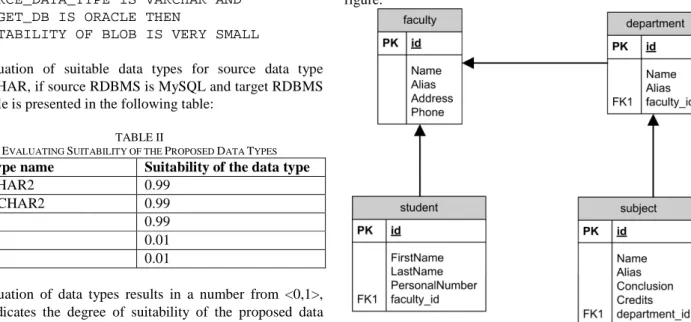
The methodology will be verified by means of the tool that is created for data migration between various types of RDBMS. RDBMS of the source database is MySQL. RDBMS of the target database is Oracle. Selected database is the uni-versity database.
Logical structure of this database is shown in the following figure:
Fig. 4 Selected database logical structure
A. Specification of the source and target RDBMS
As the source RDBMS was selected RDBMS MySQL 5.0. As the target RDBMS was selected RDBMS Oracle 11g.
B.Loading the logical structure of the source database
Logical structure of the database was loaded by methods predefined in java.sql and JDBC driver.
Fig. 5 Loading the logical structure of the source database
Then we found these relationships between the database tables:
Fig. 5 Finding relationships between the database tables
C. Proposal of suitable data types by expert system
In this step we propose data types by expert system that is implemented in LFLC tool [4].
Firstly we define linguistic variables and fuzzy sets for each value of specified linguistic variable. The fuzzy set for linguis-tic variable SOURCE_DATA_TYPE represented by triangular functions is shown in the following figure:
Fig. 6 Identify possible data type in LFLC tool
Then we create a knowledge base for evaluating data type – as for example the knowledge base of data type VARCHAR2:
Evaluation of data types for source data type VARCHAR is shown below:
D.Selection of suitable data types
In this step the user can select one of the proposed data types – we select the first data type VARCHAR2.
E. Generating SQL dump file for creating the target data-base in the RDBMS
In this step the tool generates SQL dump file that can be in-cluded in Oracle, part of this SQL dump is shown below:
Fig. 8 SQL dump for RDBMS Oracle
Then we can import SQL dump into the database of RDBMS Oracle:
Fig. 9 The department table in the target database Data of the department table are shown below:
Fig. 10 Data of the department table V.CONCLUSION
In this paper we analyzed the current state in data migration between various types of the RDBMS. Then we evaluate fea-tures and disadvantages of current tools for data migration. Next, we propose the methodology for data migration between various types of RDBMS that contains the expert system for
Fig. 7b Evaluation of data types
Fig. 7a A knowledge base in LFLC tool
decision support during the process of data migration. The expert system proposes suitable data types for attributes of target database tables and can be modifiied or extended, if it´s necessary. In conclusion we propose a tool that is based on the proposed methodology. Results are shown on the data migra-tion of the selected database.
ACKNOWLEDGMENT
The presented topic is also a part of the internal grant SGS10/PřF/2012, called Fuzzy modeling tools for analysis and design of information systems, at the Department of In-fomatics and Computers, University of Ostrava.
REFERENCES
[1] P. Atzeni, V. De Antonellis, Relational Database Theory. The Benja-min/Cummings Publishing Company, Inc., Redwood City, 1993, ch. 1. [2] L. Jan Harrington, Relational database design and implementation.
Elsevier Inc., Burlington, 2009, ch. 4,5.
[3] ISO, ANSI: Framework (SQL/Framework). International Organization for Standartization, 2003.
[4] H. Habiballa, V. Novák, A. Dvořák, V. Pavliska, “Using software pack-age LFLC 2000”, 2nd International Conference Aplimat 2003, Brati-slava, 2003, pp. 355-358.
[5] J. Morris, Practical data migration. The British Computer Society, Chippenham, 2009, ch.1.