Information support for knowledge-intensive business processes —
combining workflows with document analysis and information retrieval
Andreas Abecker, Ansgar Bernardi, Heiko Maus, Claudia Wenzel
German Research Center for Artificial Intelligence (DFKI) GmbHP.O.Box 2080, D-67608 Kaiserslautern, Germany Phone:+49 631 205 3582, Fax:+49 631 205 3210 {aabecker,bernardi,maus,wenzel}@dfki.uni-kl.de Abstract
Explicit modeling of business processes and their en-actment in workflow systems have proved to be valu-able in increasing the efficiency of work in organiza-tions. We argue that enacted business processes - that is: workflow management systems - form a solid ba-sis for adequate information support in complex and knowledge-intensive business processes.
To support this claim we demonstrate results from two different projects: The VirtualOffice approach employs workflow context information to support the high-precision document analysis and understanding in standard office settings; the combination of workflow context and document analysis techniques allow for the automatic handling of incoming paper mail with respect to the appropriate workflows. TheKnowMore approach focuses on the support of people who work on knowledge-intensive tasks by automatic delivery of relevant and goal-specific information; the context of the workflow, an extended process model, and a de-tailed modeling of information sources are combined to this end. Both approaches show ways to proceed from workflow systems towards active knowledge man-agement.
Introduction
Workflow Management is a widespread technology for automating structured business processes. Today it is mainly used to coordinate complex processes where many activities must be scheduled and dispatched among many possible agents. Further support comes from an integrated handling of application programs used in the process chain and a streamlined passing of application data and electronic documents flowing be-tween different process steps.
Now consider today’s complex and often document-driven business processes which are characterised by manifold interfaces and document and information ex-change with the company’s environment. Within such processes the respective employees use to deal and han-dle with a great amount of information and knowledge transferred by and embedded in explicit, often paper-Copyright c°2004, American Association for Artificial In-telligence (www.aaai.org). All rights reserved.
based forms, letters, books, manuals, records, and all kinds of documents.
The knowledge and information applied to perform the several activities in a given process step typically are not represented in the WfMS. Nevertheless, it is usually available and often explicitly accessible somewhere in the information space of the company, since otherwise the employees would not be able to do their jobs.
For instance, imagine a workflow for buying the re-quired hardware and software to equip a new project team. Here, the responsible clerks know which cat-alogues and websites to consult, or which colleagues to ask. Here, one would like the WfMS to automati-cally present relevant information sources to base the buying decisions on. Therefore, it should be possi-ble to represent the service process supporting the ac-tual business process by appropriate information and knowledge sources. To enact such a service process, the WfMS should possess interfaces for exchanging knowl-edge items with the surrounding system environment, which would be appropriate to enable powerful support services. Moreover, having such a semantically rich in-terface between the WfMS and its system environment would even allow to directly pump information items extracted from incoming documents to the appropriate places in the data models of the actual workflow in-stance. Such a mechanism would diminish the bottle-neck at the company’s interface to the “external world” which is often characterized by paper-based commu-nication, or at least by electronic documents which obey other data models and conceptualizations than the company-internal information system. Such a semanti-cally enriched interface between WfMSs and their en-vironment could greatly improve their integration with the other parts of the enterprise information infrastruc-ture, especially with document management systems.
Unfortunately, such considerations are not subject of current WfMS approaches ((Georgakopoulos et al.
1995), (Alonso et al. 1997)). Contemporary systems exhibit only a very thin interface for data exchange with other office applications such as text processing applications or corporate data bases.
In order to overcome this limitation, this paper will present two different solutions which describe how a
workflow management system information provider documents information context request WWW workflow instances workflow engine document index
...
Figure 1: Information Support for Workflows: A Common Description Frame
true knowledge transfer between business processes and their surrounding information space can be established. Both approaches focus on process-embedded informa-tion delivery from documents.
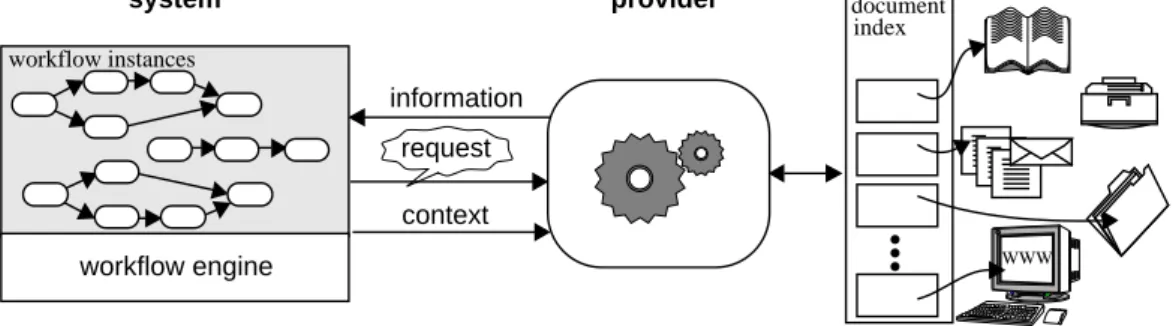
Although the approaches have been come from com-pletely different motivations, they nevertheless fit into the same common description frame which is sketched in Figure 1.
The WfMS represents running business processes by workflow instances and executes them by means of a workflow engine. The second system is the mediator system which we callinformation provider.
The information provider gets an information re-quest and some additional context information from the WfMS. It accesses the documents by some kind of doc-ument index. This index may consist of an inverted in-dex file as required for information retrieval tasks, but it might be any more sophisticated document model as well. The retrieved information is handed over to the WfMS. So the interface between the two systems com-prises three different kinds of information.
Central to all our considerations is the notion of con-text. Since the context required highly depends on the actual information request, the common description frame does not answer the questions where necessary context comes from and what it consists of. We ar-gue that context delivery may require different system architectures. This statement will be clarified by intro-ducing two different solutions instantiating the general description frame:
The next chapter describes theVirtualOffice project (see also (Wenzel 1998)) which integrates paper-based information into any kind of workflow activity. After-wards, chapter 3 introduces theKnowMoreproject (see also (Abecker et al. 1998)) which aims at supporting so-called knowledge-intensive tasks by pro-active docu-ment delivery. After a review of some related work in chapter 4, we summarize in chapter 5 with some gen-eral insights on possible solutions for the questions how semantically enriched interfaces can be established and how context information can be dealt with practically. This will hopefully lead to ideas for the future work in integrating and further developing process-oriented
information and knowledge management.
The VirtualOffice Scenario:
Information Support by Paper
Documents
Although the paperless office has been a buzzword for many years now, it still has not come into reach. On the contrary, the enactment of business processes by admin-istrative workflows has even complicated the integration of paper documents since such workflows require elec-tronic representations of all documents involved.
Looking a little bit closer, such workflows are char-acterized by heterogenous documents which belong to one common process and arrive in a chronological or-der. A typical example is an insurance process with initial applications for contracts, changes in the poli-cies, annual invoices, and damage claims. Another ex-ample are business trips where the traveller has to fill out an application, the application must be confirmed, some invoices, e.g., for plane tickets, have to be payed in advance and, finally, several receipts must be ac-counted for. Certainly, there are a lot of similar ex-amples but within this paper we will use a purchasing process within a company as a basis for our examples.
The VirtualOffice project which being conducted at DFKI Kaiserslautern tackles the above-mentioned problem of integrating paper-based information into workflows. In order to achieve a solution, a system for document analysis and understanding (DAU) is used as workflow application which even benefits from this in-tegration: As stated in (Baumannet al. 1997a) context information from business processes improves the anal-ysis of business letters and is therefore a crucial point of our research.
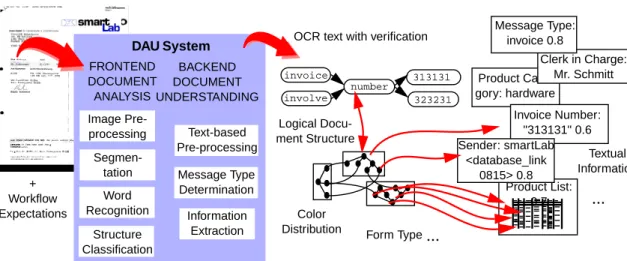
In order to get an impression how document anal-ysis and understanding works, figure 2 reveals typical analysis steps and results. Usually, DAU systems are divided into two parts: The analysis front-end of the system works as provider of uniform information about the characters appearing in a scanned document along with additional logical attributes. This information is interpreted by the system’s document understanding components which form the back-end.
Input Word Recognition Structure Classification Segmen-tation Image Pre-processing Message Type Determination Information Extraction Text-based Pre-processing DAU System BACKEND DOCUMENT UNDERSTANDING FRONTEND DOCUMENT ANALYSIS Analysis Steps + Workflow Expectations Results of Document Analysis
OCR text with verification
Color
Distribution Form Type number invoice involve 313131 323231 Logical Docu-ment Structure
...
Product Cate-gory: hardware Results of Document Understanding Message Type: invoice 0.8 Clerk in Charge: Mr. Schmitt Invoice Number: "313131" 0.6 Sender: smartLab <database_link 0815> 0.8 Product List: 0.7 Textual Information...
Figure 2: Document Analysis and Understanding: Steps and Results.
Theanalysisof a scanned document starts with low-level image preprocessing such as skew angle adjust-ment and upside-down detection. Afterwards, segmen-tation divides the document into geometrically con-nected components and identifies segments of charac-ters, words, lines, and blocks. Then, text recognition explores the captured text segments, generates charac-ter hypotheses, and merges them into word hypothe-ses. Structure classification takes this given geometric structure to hypothesize the so-called logical objects of a document, e.g. title, author, chapter, etc.
Withindocument understanding, the generated word hypotheses are validated by dictionary look-up in the text-based preprocessing step. Now, the content-based part of analysis is invoked. First, the message type of a document has to be derived (e.g. confirmation of order by supplier xyz). This information is used to start a more in-depth analysis for the extraction of reference data, products, the date of the letter and so on. For more information on DAU, please refer to (Baumannet al. 1997b).
The basic scenario of our integration of DAU into WFMSs fits well into the general architecture presented in Figure 1: The DAU system represents an informa-tion provider and a company’s mail box represents the collection of documents involved. The task which is requested by a workflow instance represents an infor-mation need of this particular instance. In order to support DAU in answering this request, the workflow instance transfers context information to the DAU sys-tem. Having finished the task, the DAU system hands over the data requested and consequently satisfies the information need of the workflow instance.
WithinVirtualOffice, two different kinds of tasks are distinguished: The process identificationtask is stated whenever workflows inform DAU that they are waiting for particular documents. In this case, DAU analyses
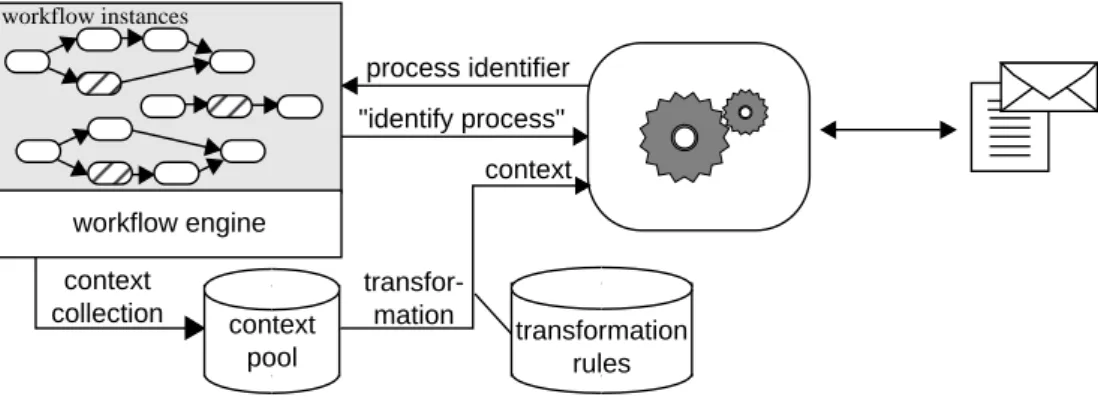
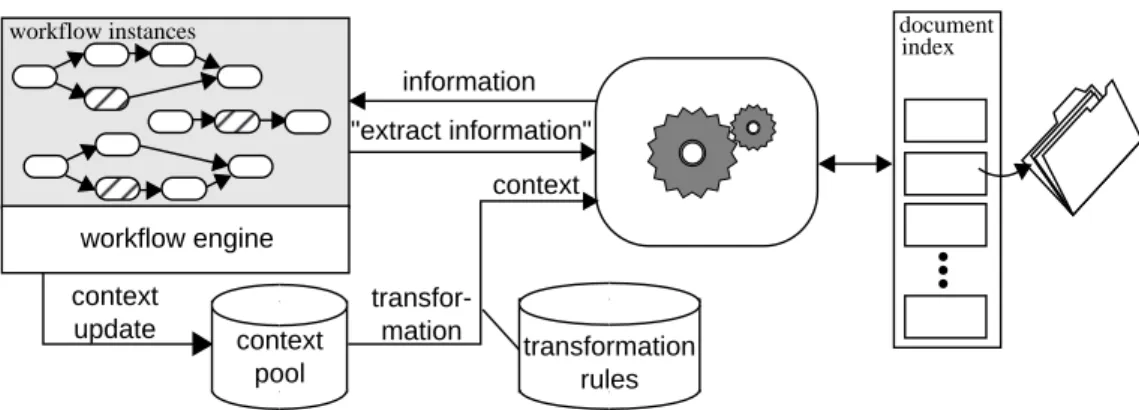
incoming documents in order to determine the correct workflow instance to which the document has to be as-signed. This scenario is discussed in the following sec-tion and shown in Figure 3. The second task which we callinformation extractionis stated when workflows request information contained in particular documents. Then, DAU analyses the document in order to deliver the information requested. This scenario is subject to section 2.2 and displayed in Figure 4.
This chapter concludes with a summarization of all design and implementation extensions which have to be accomplished in order to integrate a DAU information provider.
Solving the Task of Process Identification
Process identification, i.e., assigning an incoming doc-ument to the corresponding workflow instance, is ba-sically a match of information contained in documents with the corresponding data available in workflow in-stances. To achieve this, the relevant data in workflow instances have to be collected for two different reasons: First of all, they build one kind of input for the in-stance match. Imagine there are a lot of open inin-stances and a new document has to be assigned to them. In this case, the more data we have about the instances and the expected document (e.g, document type, sender, prod-ucts mentioned and even possible references to other events within the same instance) the more accurate the match can be accomplished. On the other hand, these same data specify the analysis task for DAU since they define which items DAU has to search for.The resulting scenario is an instantiation of our gen-eral scenario and shown in Figure 3. In this scenario, several activities within different workflow instances state the current context of these instances whenever new context is available. All these workflow context data are transferred to the context pool, a database
"identify process" workflow management system document analysis and understanding incoming business letter context collection transformation rules transfor-mation process identifier context workflow instances workflow engine context pool
Figure 3: Information Support by Process Identification for Paper Documents.
available outside the WfMS.
There, the context is stored until an event occurs in a workflow instance which implies a response by a document (shown by hatched oval activities), i.e., the workflow has an information need which will be satis-fied by an incoming document related to the event or workflow. This information need is stated by handing over the request of “process identification” to the DAU system and by formulating its context by means of a so-called expectation. It describes content and mean-ing of the expected document, additional information need such as a list of data which has to be extracted, and some administrative data in order to identify the workflow after a process determination was successful. In order to allow the DAU to interpret the expecta-tion, it is connected to the DAU’s document ontology which describes structure and content of the documents of the domain under consideration. Such an expecta-tion is generated by using the context pool as input for a rule interpreter. The rule interpreter uses trans-formation rules which relate the context intrans-formation of the context pool to possible contents of an expected document.
Thus, these rules transform the data scheme used in the context pool into the DAU domain ontology. For instance, a rule states that the receiver of the (already known) order is the sender of the expected correspond-ing invoice.
After generation, the expectation is stored at the in-formation provider’s (namely the DAU system’s) side in a so-calledexpectation set. Since the expectation set stores all expectations of all processes, it contains the whole workflow context relevant from the DAU point of view. Access to the expectation set is triggered by any incoming document for which DAU has to perform a process identification. Note that the identification of the corresponding process takes all expectations of all workflow instances into account. Consequently, this task can be seen as inherent to the business letter do-main. The result of the process identification task is
a unique process identifier and, of course, the name of the document which is assigned to the process. The ex-pectation of the correponding instance is deleted after the process identification has been verified within the instance.
This ends the process identification scenario. Data kept within the context pool are deleted when the cor-responding process instance has come to an end.
Solving the Task of Information Extraction
Information support by incoming paper documents is not complete by only handing over the document to the corresponding workflow instance. Instead, the rele-vant information contained in the document should be transferred into an electronic representation. This is formulated by a second task called information tion. The time for stating such an information extrac-tion task is not restricted to process identificaextrac-tion only. On the contrary, a workflow can also state a separate in-formation extraction task after a document has already been assigned.Figure 4 provides a conceptual view on the informa-tion extracinforma-tion scenario: In this context, only one work-flow instance is of further interest. Within this instance, the context pool is still updated after a process identi-fication request whenever new context is available. If an activity states an information extraction request, a new expectation is generated as described above. The request now includes a list of identifiers according to the business letter ontology which have to be extracted from the attached business letter. In contrast to our process identification scenario, the DAU now has not only the raw paper image at its disposal but it can also access previous analysis results for this document image such as OCR and process identification results. This is accomplished by using an adminstrative document in-dex.
workflow management system document analysis and understanding attached business letter context update transformation rules transfor-mation context workflow instances workflow engine context pool information "extract information" document index
...
Figure 4: Information Support by Information Extraction from Paper Documents.
Implementation Issues
One requirement of theVirtualOfficeproject was to use commercial WfMSs. Therefore, we have to face some conceptual restrictions, e.g., it is impossible to extend the workflow model in order to provide the necessary context information. Thus, our solution uses the inter-faces as provided by WfMSs and adds the concept of workflow context data. This allows us to incorporate any WfMS which is based on the WfMC standard for Interfaces 2/3 (Workflow Management Coalition 1998). In order to extend a conventional workflow to be able to get an automatic information support from paper documents, the following working steps have to be ac-complished: At the workflow side, the collection of con-text has to be modeled at build time of the workflow by including some actions which retrieve workflow con-text data and store them in the concon-text pool. Further-more, the workflow has to be extended with activities which state expectations and handle documents after their assignment. At the information provider’s side, the ontology for the specification of DAU tasks and the domain ontology for documents have to be made acces-sible. Furthermore, DAU techniques need an interface to use information stored in the expectation set. Be-tween the two systems, a set of transformation rules has to be specified.
The KnowMore Scenario:
Active Information Support by
Workflow Integration
The VirtualOffice scenario emphasized the use of workflow-context information for improved document analysis and information extraction. Our second scenario has a different focus: The KnowMore ap-proach targets on supporting a person working on some knowledge-intensive task by actively, i.e., without an explicit, detailed request by the employee, delivering context-sensitive and relevant information.
The KnowMore Scenario in an Example
To illustrate this approach we consider a snippet from a rather simple process: managing a contact to a po-tential customer at our research institute. After the initial contact (e.g., a telephone call), the relevant top-ics of interest are identified (for instance, specific tech-nologies or tools potentially useful for the customer, or former projects dealing with similar issues as the cus-tomer’s problems) and appropriate information mate-rial is selected (for example, a technology whitepaper, a brochure about a specific tool, or a project flyer). Hav-ing done this, a nice information package can be sent to the potential customer, whose reaction will then de-termine the further steps (e.g., arranging a meeting, or terminating the process due to lack of interest). Most of these activities can be considered knowledge-intensive. It is easy to imagine useful support for these activities: When selecting the information material to be sent ac-tive suggestions from the system would be helpful, sup-posed that the system takes into account the informa-tion from the activities done so far, e.g., the selected topics. An automatic, context-aware archiving of the results is useful when a similar process is started at a different time and / or location: The initial contact will then profit from information about earlier contacts to the same company or about similar cases.Figure 5 shows a screenshot of our experimental sys-tem prototype. On the left, in the background, we see an editor window of the workflow application used to indicate relevant information material. To do this it is necessary to fill the text fields in the input mask. TheKnowMoresystem provides support in the follow-ing way:
When the workflow engine starts this activity, the system takes the information needs associated to the activity and finds out whether some element of the OM is relevant to this task (i.e., whether there is some ma-terial which is relevant wrt. the topics identified). This suggested decision value is inserted in the user input mask offering a proposed solution (in the example, the
suggestion comprises documents about the DFKI, a pa-per about corporate memories, and some material on the ESB system which is an example of an organiza-tional memory). The suggested information elements are ordered according to their relevance computed by the retrieval function as well as to a predefined order based upon their information type. The information el-ements are then offered to the user as hyperlinks in the KnowMore information browser (we use standard web browsers with Java applets for the user interface).
The user is free to accept or dismiss the suggestions or to select different material according to personal knowl-edge. Whatever the choice, the system keeps track of the solutions and the workflow, and records the results automatically together with the relevant context infor-mation. If, sometime later, further material is to be se-lected, the system remembers the results of the earlier steps and modifies the suggestions accordingly. Thus the system actively offers supply to the user by provid-ing context-specific relevant information.
Solving the Task of Active and
Context-Aware Information Supply
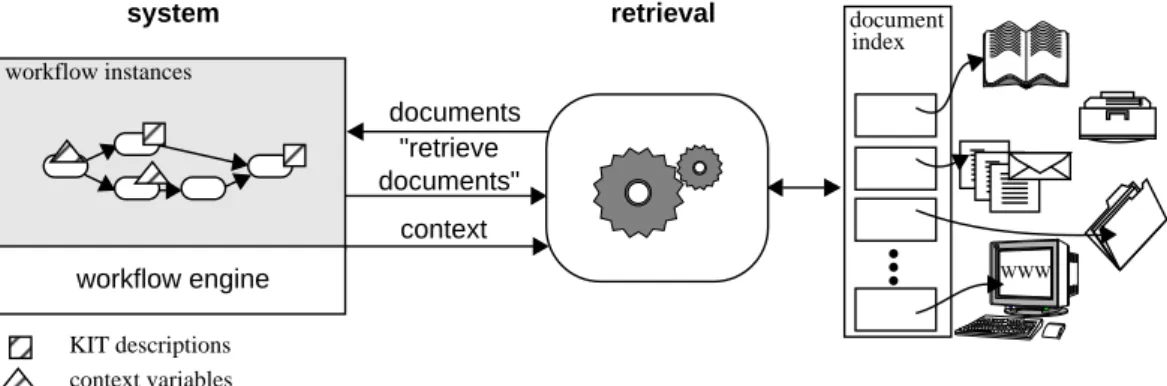
In order to provide the services described, the Know-Moreapproach combines an extended workflow model with sophisticated information agents. As illustrated in Figure 6, the workflow actively asks to retrieve relevant documents. To this end, specific modeling activities are needed at process definition time, which facilitate the adequate enactment at runtime.
Process Definition Time.
• Model business processes. Model the overall business process with a conventional BPM or work-flow tool.
• Extended modeling of knowledge-intensive tasks. The knowledge-intensive tasks (KIT) among the activities of a particular process require special attention. In order to facilitate the intended active information support, the KIT representation — il-lustrated in Figure 6 as a hatched square — extends the conventional description of a workflow activity by a support specification describing the respective in-formation needs as generic queries or query schemes, together with the information agent responsible for their processing. At runtime, the agent’s processing of the instantiated queries will deliver relevant infor-mation which help to execute the activity in question. • Attach extended information flow. In order to instantiate the query schemata at runtime, thus ex-ploiting situation-specific knowledge and context pa-rameters, the retrieval process must have access to the workflow parameters. These parameters are rep-resented in variables which are handled by the work-flow environment. As they go typically beyond what is modeled in a conventional workflow specification we talk about KIT variables, although there is no conceptual difference between them and conventional
workflow variables. They simply describe the infor-mation flow between tasks in the workflow, and are the communication channel between workflow and in-formation retrieval agents. In Figure 6, hatched tri-angles indicate addional KIT variables.
To enable the necessary reasoning for intelligent re-trieval, the KIT variables must be embedded into a domain ontology (essentially, this means that their values must be of a type defined as an ontology con-cept).
In summary, the KIT variables partially model the data flow in the process and represent the relevant context of the knowledge-intensive activities at run-time.
• Model information sources. The information which is actively offered to support particular tasks is taken from a variety of knowledge sources avail-able in an organizational memory. These sources are of different nature, resulting in different structures, access methods, and contents. To enable the precise-content retrieval from the heterogeneous sources, a powerful representation scheme for uniform knowl-edge description is needed. To this end, structure and metadata, information content and information context are modeled on the basis of formal ontolo-gies. The document index in Figure 6 is thus real-ized as a set of descriptions modeling the information sources and facilitating an ontology-based access and retrieval.
Process Enactment Time.
• Enact knowledge service processes. Whenever a knowledge-intensive activity is reached during work-flow enactment, the workwork-flow engine not only starts this activity, but in addition initiates an appropri-ate information agent (which is specified in the KIT description).
The information agent performs the actual retrieval of relevant information from the information sources. It relies on domain knowledge – available in a domain ontology – to realize an extended, ontology-based in-formation retrieval, and utilizes the context informa-tion from the ongoing workflow — found in the in-stantiated KIT variables — in order to determine rel-evant information.
Traversing the formal ontologies according to spec-ified search heuristics (Liao et al. 1999), the infor-mation agent is able to extend and refine the given queries and to reason about the relevance of available information items.
• Realize context-aware information storage. Whenever a workflow activity results in the creation of an information item worth preserving, an appro-priate information agent takes into account the cur-rent context of the process — available via KIT vari-ables and access to the workflow control data. Thus the information is automatically linked to its creation
Figure 5: Active Support by Suggesting Relevant Information Material. workflow management system information retrieval documents documents context WWW document index
...
workflow instances workflow engine KIT descriptions context variables "retrieve documents"Figure 6: Information Support by Information Retrieval for Knowledge Intensive Tasks.
context and can be retrieved accordingly, should the need arise.
Implementation Issues
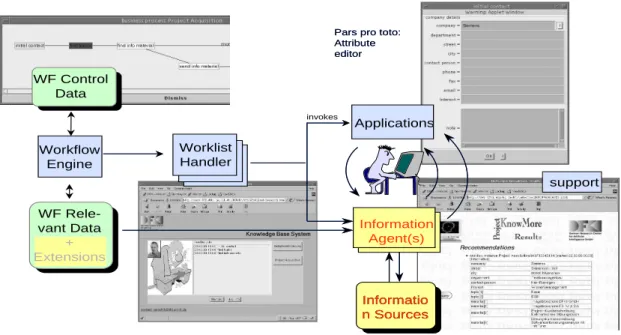
Figure 7 illustrates that the realization of the Know-More system fits well into the standard architecture of a WfMS as promoted by the workflow management coalition (Workflow Management Coalition 1999): The KIT descriptions are an extension of the workflow rel-evant data handled by a WfMC-conform workflow en-gine. The worklist handlers start the relevant activities and trigger in addition the information agents specified in the KIT descriptions. These agents then access the context information in the extended workflow relevant data, evaluate parameters and search heuristics to find relevant information and offer the results to the user. In spite of the fact that the KnowMore prototype uses
a self-developed workflow engine, the results are thus compatible with a vast amount of existing and com-mercially available workflow implementations.
Related Work
Document analysis and understanding has reached a point where the resulting systems are successfully put on the market. But these DAU systems are mostly standalone applications with only one task, e.g., ex-tracting all data from a form. Furthermore, the con-text used is static, e.g., given by predefined keywords. Up to now, the use of dynamic context as provided by business processes is still a unique feature of the Virtu-alOffice project (Wenzel 1998). Although commercial solutions provide an integration of document analysis and imaging into WfMSs (e.g., FormsRec AIDA
solu-support Worklist Handler Workflow Engine WF Rele-vant Data + Extensions WF Control Data Applications invokes
Pars pro toto: Attribute editor Pars pro toto: Attribute editor Information Agent(s) Informatio n Sources Informatio n Sources
Figure 7: The KnowMore extensions fit well into the WfMC standard workflow architecture. tion from ICR1), they only offer an isolated analysis of
documents, i.e., they do not consider any open work-flow instances waiting for a particular document. For example, the COI IntelliDoc solution2 classifies
docu-ments according to a set of predefined keywords. Af-terwards, the documents are routed to corresponding WfMS worklists to which the keywords are assigned.
Concerning Organizational Memory based support for running workflows, there are two interesting related projects. (Staab and Schnurr 1999) present a project conducted at the University of Karlsruhe which is very close in spirit to the KnowMore approach. Compared to our system, they explore in more depth the infer-ential power of ontology-based retrieval on top of the Ontobroker software (Fensel et al. 1998). They in-troduce the notion of context-based views for coupling workflow and retrieval which is the analogue to our in-formation needs. The approach presented seems to be more developed in some respect than ours, for instance concerning XML-based document representations, or a deeper conceptual integration of workflow and ser-vice process. However, they make strong assumptions about the underlying ontologically annotated Intranet information sources, and it seems not completely clear how far their implementation is already. Another very interesting approach is the one by (Kaathoven et al.
1http://www.icr.de 2http://www.coi.de
1999) who describe the mechanism of knowledge flow chunks for synchronizing a conventional WfMS schedul-ing activities with a concurrently runnschedul-ing OM-based task support system assisting in enacting specific activ-ities. Their general considerations about conventional WfMS machinery and external knowledge services com-plement our interfacing ideas. But, they also seem to be still at the conceptual level of their work.
Conclusion
We demonstrated that the combination of business pro-cesses and their enactment in WfMSs with the infor-mation space of an organizational memory can lead to effective user support. Two different approaches have been presented to illustrate this claim:
The VirtualOffice project basically aims at improv-ing the company’s information logistics by a smoother transfer of information contained in paper documents into the electronic workflows. Thus its service can be applied virtually throughout the whole process and in each process which has interfaces to the external envi-ronment of the company where media breaks occur. It supports the business process object level where paper documents are an integral element.
TheKnowMoreproject is not so much focused on the object level optimization of whole, and arbitrary work-flows. Instead, it concentrates on knowledge-intensive core processes of a business, and knowledge-intensive
tasks at the heart of those processes. Not the processes themselves are improved, but a meta-level is added, an additional knowledge-service process which helps the user working on her tasks.
Both examples emphasize the use of the business pro-cess models and their enactment in the WfMS as in-dispensable source of context information. Looking in some detail at this common goal, we can extract the following observations:
Successful coupling of workflow and knowledge-intensive application requires some formal semantics as the basis of communication. That is, we need a mapping from the context information modeled in the workflow to the ontology of the information provider. The examples illustrate two principal approaches to this end:
• When the workflow modeling is extended especially with respect to the support of knowledge-intensive activities, it might be possible to consider the avail-able ontology already at process modeling time. The resulting KIT representation is then well-grounded in the ontology of the information provider.
• On the other hand, if the already-defined workflow is to be left untouched, it is possible to add the neces-sary semantics by defining transformation rules which map the terms already used in the workflow model to the ontology of the information provider.
To effectively access the workflow context informa-tion it seems useful to treat the workflow instances as first order citizens in the information world. Two ap-proaches have been presented to realize this goal: • The explicit modeling of context information in KIT
variables extends the data flow model in the work-flow. This is suitable if the workflow engine controls when and what is transferred outside.
• The handling of a separate context pool is suitable to deal with situations where a large amount of workflow instances provide volatile context information which is required by activities outside of the workflow’s in-fluence. The continuous collection of context infor-mation and its organization according to the needs of the supporting application (e.g. the DAU com-ponent) even allows to handle context information which the WfMS only creates temporarily and which otherwise might not be available when needed. In summary, the extension of the workflow scenario is a suitable way to provide active and extended services and to transform available information into process-oriented actionable knowledge. Some of the sketched solutions seem still a little bit clumsy. However, our observations might indicate some further work worth investigating which might result in suitable adaptations of future WfMS in order to ease the utilization of work-flow context information.
References
A. Abecker, A. Bernardi, K. Hinkelmann, O. K¨uhn, and M. Sintek. Toward a technology for organizational memories.IEEE Intelligent Systems, May/June 1998. G. Alonso, D. Agrawal, A. El Abbadi, and C. Mo-han. Functionality and limitations of current workflow management systems. IEEE Expert, 1997.
S. Baumann, M. Malburg, H. Meyer auf’m Hofe, and C. Wenzel. From paper to a corporate memory : A first step. In KI-97 Workshop on Knowledge-Based Systems for Knowledge Management in Enterprises, Freiburg, Germany, 1997.
Stephan Baumann, Majdi Ben Hadj Ali, Andreas Den-gel, Thorsten J¨ager, Michael Malburg, Achim WeiDen-gel, and Claudia Wenzel. Message extraction from printed documents - a complete solution. InFourth Interna-tional Conference on Document Analysis and Recogni-tion (ICDAR 97), Ulm, Germany, August 18-20, 1997. D. Fensel, St. Decker, M. Erdmann, and R. Studer. Ontobroker: The very high idea. In Proc. 11th Int. Florida AI Research Symposium (FLAIRS-98), May 1998.
D. Georgakopoulos, M. Hornick, and A. Sheth. An overview of workflow management: From process modeling to workflow automation infrastructure. In
Distributed Databases 3. Kluwer Academic Publishers, Boston, 1995.
Rob van Kaathoven, Manfred A. Jeusfeld, Martin Staudt, and Ulrich Reimer. Organizational memory supported workflow management. In August-Wilhelm Scheer and Markus N¨uttgens, editors, Electronic Business Engineering – 4. Internationale Tagung Wirtschaftsinformatik, Saarbr¨ucken, Germany. Phys-ica Verlag, Heidelberg, 1999.
Minghong Liao, Knut Hinkelmann, Andreas Abecker, and Michael Sintek. A competence knowledge base system for the organizational memory. InXPS-99 - 5. Deutsche Tagung Wissensbasierte Systeme, W¨urzburg, Germany, number LNAI 1570 in Lecture Notes in Artificial Intelligence, Berlin, Heidelberg, New York, March 1999. Springer-Verlag.
Steffen Staab and Hans-Peter Schnurr. Knowledge and business processes: Approaching an integration. In
OM ’99 - Proceedings of the international Workshop on Knowledge Management and Organizational Mem-ory (IJCAI-99). Stockholm, Sweden, 1999.
C. Wenzel. Integrating information extraction into workflow management systems. InNatural Language and Information Systems Workshop (NLIS/DEXA 98), Vienna, Austria, 1998.
Workflow Management Coalition. Workflow Client Application Application Programming Interface (In-terface 2 & 3) Specification. WFMC-TC-1009, Version 2.0, 1998.
Workflow Management Coalition. Terminology and Glossary. WFMC-TC-1011, Version 3.0, 1999.