University of Pennsylvania
ScholarlyCommons
Departmental Papers (CIS)
Department of Computer & Information Science
6-13-2011
On Provenance Minimization
Yael Amsterdamer
Tel Aviv University
Daniel Deutch
Ben Gurion University
Tova Milo
Tel Aviv University
Val Tannen
University of Pennsylvania
, [email protected]
Follow this and additional works at:
http://repository.upenn.edu/cis_papers
Part of the
Computer Sciences Commons
Yael Amsterdamer, Daniel Deutch, Tova Milo, and Val Tannen. 2011. On provenance minimization. InProceedings of the thirtieth ACM SIGMOD-SIGACT-SIGART symposium on Principles of database systems(PODS '11). ACM, New York, NY, USA, 141-152. DOI=10.1145/1989284.1989303 http://doi.acm.org/10.1145/1989284.1989303
© ACM, 2011. This is the author's version of the work. It is posted here by permission of ACM for your personal use. Not for redistribution. The definitive version was published inProceedings of the thirtieth ACM SIGMOD-SIGACT-SIGART symposium on Principles of database systems, {(2011)} http://doi.acm.org/10.1145/1989284.1989303" Email [email protected]
This paper is posted at ScholarlyCommons.http://repository.upenn.edu/cis_papers/646
For more information, please [email protected].
Recommended Citation
On Provenance Minimization
Abstract
Provenance information has been proved to be very effective in capturing the computational process
performed by queries, and has been used extensively as the input to many advanced data management tools
(e.g. view maintenance, trust assessment, or query answering in probabilistic databases). We study here the
core of provenance information, namely the part of provenance that appears in the computation of every
query equivalent to the given one. This provenance core is informative as it describes the part of the
computational process that is inherent to the query. It is also useful as a compact input to the above
mentioned data management tools. We study algorithms that, given a query, compute an equivalent query that
realizes the core provenance for all tuples in its result. We study these algorithms for queries of varying
expressive power. Finally, we observe that, in general, one would not want to require database systems to
evaluate a specific query that realizes the core provenance, but instead to be able to find, possibly off-line, the
core provenance of a given tuple in the output (computed by an arbitrary equivalent query), without rewriting
the query. We provide algorithms for such direct computation of the core provenance.
Disciplines
Computer Sciences
Comments
Yael Amsterdamer, Daniel Deutch, Tova Milo, and Val Tannen. 2011. On provenance minimization. In
Proceedings of the thirtieth ACM SIGMOD-SIGACT-SIGART symposium on Principles of database systems
(PODS '11). ACM, New York, NY, USA, 141-152. DOI=10.1145/1989284.1989303 http://doi.acm.org/
10.1145/1989284.1989303
© ACM, 2011. This is the author's version of the work. It is posted here by permission of ACM for your
personal use. Not for redistribution. The definitive version was published in
Proceedings of the thirtieth ACM
SIGMOD-SIGACT-SIGART symposium on Principles of database systems
, {(2011)} http://doi.acm.org/
10.1145/
1989284.1989303
" Email [email protected]
On Provenance Minimization
∗Yael Amsterdamer
Tel Aviv University and University of Pennsylvania
Daniel Deutch
Ben Gurion University and University of Pennsylvania
Tova Milo
Tel Aviv University [email protected]
Val Tannen
University of Pennsylvania [email protected]
ABSTRACT
Provenance information has been proved to be very effec-tive in capturing the computational process performed by queries, and has been used extensively as the input to many advanced data management tools (e.g. view maintenance, trust assessment, or query answering in probabilistic databases).
We study here thecoreof provenance information, namely
the part of provenance that appears in the computation of every query equivalent to the given one. This provenance core is informative as it describes the part of the computa-tional process that is inherent to the query. It is also useful as a compact input to the above mentioned data manage-ment tools. We study algorithms that, given a query, com-pute an equivalent query that realizes the core provenance for all tuples in its result. We study these algorithms for
queries of varying expressive power. Finally, we observe
that, in general, one would not want to require database systems to evaluate a specific query that realizes the core provenance, but instead to be able to find, possibly off-line, the core provenance of a given tuple in the output (com-puted by an arbitrary equivalent query), without rewriting the query. We provide algorithms for such direct computa-tion of the core provenance.
Categories and Subject Descriptors
H.2.1 [Database Management]: [Data Models]
General Terms
Algorithms, Theory∗This work has been partially funded by the NSF grant
IIS-0629846, the NSF grant IIS-0803524, by the Israel Science Foundation, by the US-Israel Binational Science Founda-tion, by the EU grant MANCOOSI and by the ERC grant Webdam under agreement 226513.
Permission to make digital or hard copies of all or part of this work for personal or classroom use is granted without fee provided that copies are not made or distributed for profit or commercial advantage and that copies bear this notice and the full citation on the first page. To copy otherwise, to republish, to post on servers or to redistribute to lists, requires prior specific permission and/or a fee.
PODS’11,June 13–15, 2011, Athens, Greece.
Copyright 2011 ACM 978-1-4503-0660-7/11/06 ...$10.00.
1.
INTRODUCTION
Recordingprovenance information for query results, that
explains the computational process leading to their genera-tion, is now a common technique. In particular, the work
of [19] suggested capturing provenance information via
poly-nomials. The idea is to associate every tuple in the input database with an annotation, and to extend the operations of relational algebra so that they will work on these anno-tated tuples. The resulting annotation of every output tuple is a polynomial over the original annotations, that reflects the operations performed on the original tuples to obtain the output tuple. Provenance polynomials were shown to be very useful, serving as input to many advanced data man-agement tools, such as view maintenance, trust assessment, or query answering in probabilistic databases (See e.g. [18,
25, 30]). We note that provenance polynomials give atrace
of the computational process associated with every tuple in the query result. For example, if the provenance annotation
pof an output tuple isx·y·y+z+z (=x·y2+ 2z) where
x, y, zare annotations that uniquely identify three input
tu-ples (e.g., tuple ids) then p indicates that there are three
different ways (derivations) to compute the output tuple,
one usesxonce andytwice while the other two use onlyz,
once.
Consequently, the evaluation of two equivalent queries (in the standard sense of [9]), on a given input database in-stance, may lead to different provenance polynomials for the same output tuples. While this is sometimes useful, there are many cases in which what is of interest is not the computa-tional process induced by the query chosen among equivalent queries (which is affected by optimizers and may change over time), but rather the “core” computational process, whose use of input tuples must be “included” in the query
evalu-ationfor every equivalent query. We are therefore led to a
notion ofcore provenance capturing the core computation.
We will define this notion formally, for provenance that is
defined in a very general way (namely, using theN[X]
semir-ing [19]) and then see that the core provenance is not only informative in exposing the core of the execution, but is also
compact. We propose using this compact representation to alleviate practical challenges that arise in data management tools due to the size of provenance information [10, 27].
Following the above observations, the present paper ad-dresses two main challenges: defining the core provenance, and then realizing it. Towards the definition, we introduce an order relation p ≤ p′ on provenance polynomials. In-tuitively, this order relation captures the “terseness” in the use of tuples. For example, in this order using a tuple once
is terser than using it twice, within the alternative ways of computing the same answer. In a more complex example,
x·y2+ 2z≤x·y2+x·z+y·zbut the opposite is not true. The ordering of polynomials lifts naturally to queries. Given two
equivalent queriesQ, Q′(denotedQ≡Q′), we say thatQis
“terser” w.r.t. provenance than Q′, and we write Q⊆P Q′
if for any input databaseD and any tupletin the output,
where the annotation oftinQ(D) ispand that oftinQ′(D) isp′, we havep≤p′. Now, given a class of queriesC, we can
formally define core provenance for a queryQ∈ C: it is the
provenance yielded by a queryQ′∈ Csuch thatQ′≡Qand
for any otherQ′′∈ C equivalent toQ, we haveQ′ ⊆P Q′′.
In that case, we say that Q′ is a provenance-minimal
(p-minimal) query inC equivalent toQ.
We then study the realization of this core provenance, first via queries and then by direct computation, as follows.
Realization via Queries.
Given a queryQand a class ofqueriesCwe aim at finding a p-minimal query inCequivalent
toQ. Since the identification of the p-minimal query (and
thus the core provenance) depend on a “context” class of
al-ternative query plansC, the choices for this class become
im-portant. In this paper we study the p-minimization in query classes of increasing expressivity, for which there exist solid foundations of provenance management using polynomials:
conjunctive queries (CQ), conjunctive queries with
disequal-ities (CQ̸=) and unions of conjunctive queries with
dise-qualities (U CQ̸=). When considering disequalities, we
fur-ther distinguish the classes ofcompletequeries, i.e. queries
that disequate all of their distinct arguments. The classes of complete conjunctive queries and unions thereof are denoted
cCQ̸= andcU CQ̸=, respectively.
We note that query minimization in terms of the query length (or number of joins [9], referred to hereinafter as “standard minimization”) has been extensively studied for these classes of queries. Interestingly, in general the queries that realize the core provenance may be very different than the minimal ones in the sense of [9]. In particular, there are
conjunctive queries for which an equivalent query inU CQ̸=
yields a “terser” provenance, as the latter query allows only a subset of the original derivations for each output tuple.
Table 1 summarizes the results on finding p-minimal queries, contrasted with results on standard minimization. Follow-ing the above discussion we distFollow-inguish between findFollow-ing the
p-minimal equivalent query among all queries inU CQ̸=, or
in a further restricted classC. For instance, when given as
input a query inCQ̸=, there are cases where not only that
terser provenance can be obtained by resorting to U CQ̸=,
but furthermore no equivalent query that realizes its core
provenance inCQ̸= exists. I.e., for some sets of equivalent
queries in CQ̸=, each query leads to strictly more
prove-nance than some other query in the set, for some output
tuple. If the input query is inCQ, then we can use
stan-dard minimization to obtain an equivalentCQquery which
is p-minimal among all those inCQ, but an equivalent query
entailing terser provenance may be still found inU CQ̸=.
The complexity of our p-minimization algorithms is in general exponential in the query size (with the exception
ofcCQ̸= for which we suggest a PTIME algorithm). This
is unavoidable as the corresponding decision problem (de-scribed in the sequel) is DP-complete [16].
Query “Standard” P-minimal P-minimal Class Minimal in in Class Overall
Class/Overall
CQ̸= InCQ̸= No p-minimal InU CQ̸=,
query exists EXPTIME
CQ InCQ same as InU CQ̸=, “standard” EXPTIME minimization cCQ̸= IncCQ̸= same as IncCQ̸=, “standard” PTIME minimization U CQ̸= InU CQ̸= different than InU CQ̸=, “standard” EXPTIME minimization
Table 1: Summary of Results
Realization by Direct Computation.
Core provenance is also useful in improving the efficiency of provenance-based analysis tools, in the sense that they may be fed with smaller provenance polynomials. While so, we would not want database systems to be obligated to evaluate a specific query that real-izes the core provenance, but would rather allow optimizers to evaluate the most efficient query. We would thus like to be able to evaluate any equivalent query, but then (possibly off-line) find the core provenance of given tuples in there-sult, without re-evaluating the query. We show that this is
possible by manipulations on the provenance polynomials of the individual tuples in the query result. Moreover, we show
that this can be doneeven in absence of the original query
(e.g. if it is not available due to confidentiality or to its loss, etc.), assuming that we know the input database and the set of constants used in the query (if any are used).
Paper Organization.
The rest of this paper is organized as follows. In Section 2 we provide the main definitions used throughout the paper. In Section 3 we study provenance-wise minimization of conjunctive queries, and in Section 4 we study it for union of conjunctive queries. In section 5 we study minimization applied directly on provenance polyno-mials. In Section 7 we provide an overview of related work, and we conclude in Section 8.2.
PRELIMINARIES
We provide in this section the formal definitions used throughout the paper. The definitions of these notions will be accompanied by simple examples, which nevertheless will be valuable in explaining the more complicated construc-tions in the secconstruc-tions that follow.
2.1
Classes of Queries
We start by briefly recalling the basic definitions for
con-junctive queries and union thereof from [1]. We use the
standard notions of relational databases and schema, with-out repeating their definitions in [1].
We assume in the sequel the existence of a domainV of
variables and a domainC of constants. Conjunctive queries
are then defined as follows:
Definition 2.1. A rule based conjunctive query Q with
disequalities, over a database schemaS, is an expression of the form:
ans(u0) :=R1(u1), ..., Rn(un), E1, ..., Em where:
• R1, ..., Rn are relation names in S, ans is a relation
• Eachuiis a vector(l1, ..., lk), where∀j∈ {1, .., k}lj∈
V ∪ C.
• Each Ei is an expression of the form lj ̸= lk where
lj∈ V andlk∈ V ∪ C.
R1(u1), ..., Rn(un) are called the relational atoms of Q, andE1, ..., Em are the disequality atoms. We require that
every variable that appears in a disequalityEi appears also
in a relational atom uj of the query. ans(u0) is called the rule head, and is denotedhead(Q), whileR1(u1), ..., Rn(un),
E1, ..., Em is the rule body, denotedbody(Q). The variables
and constants in the body of Q are called the arguments of Q, and are denoted V ar(Q) and Const(Q) respectively. The variables appearing in head(Q) are called the
distin-guished variables ofQ, and each of them must also appear
inbody(Q). Finally, ifhead(Q)is of arity 0, we say thatQ
isboolean.
We useCQ̸= to denote the set of all conjunctive queries
with disequalities; the subset of queries in which no
dise-quality expression appears is denoted byCQ.
We say that a conjunctive query is complete (following
[21]) if it explicitly specifies all disequalities between pairs of distinct variables (or a variable and a constant) occurring in it. More formally:
Definition 2.2. A query Q ∈ CQ̸= is complete if (1)
for every pair of distinct variablesx, y∈V ar(Q), the query contains the disequality x ̸= y (or y ̸= x), (2) for every
x∈V ar(Q)andc∈Const(Q), it containsx̸=c.
We usecCQ̸=to denote the class of allcomplete
conjunc-tive queries with disequalities.
Example 2.3. In the following example, x, y are
vari-ables and cis a constant. Q, Q′ are both in CQ̸= but only
Q′ is complete (i.e. Q′∈cCQ̸=):
Q: ans(x,y):=R(x,y),S(y,c),x̸=y,y̸=c Q′: ans(x,y):=R(x,y),S(y,c),x̸=y,y̸=c,x̸=c
We next also recall the definition of union of conjunctive queries, as follows:
Definition 2.4. A union of conjunctive queries with
dis-equalities is an expression of the formQ=Q1∪Q2∪...∪Qm
where for each i ∈ {1, ..., m}, Qi ∈ CQ̸=, and for each
i, j ∈ {1, ..., m} head(Qi) and head(Qj) are of the same relation. We say that eachQiis anadjunctof the queryQ.
The set of adjuncts ofQis denoted byAdj(Q).
We useU CQto denote the class of union of conjunctive
queries with no disequalities, useU CQ̸=where the adjuncts
may include disequalities, andcU CQ̸= where each adjunct
is complete.
We further intuitively extend the definitions of V arand
Constfor unions of conjunctive queries, such thatV ar(Q) =
∪
Qi∈Adj(Q)V ar(Qi) andConst(Q) =
∪
Qi∈Adj(Q)Const(Qi)
Example 2.5. Figure 1 depicts the queryQunion, which
is incU CQ̸=. Intuitively, its first adjunctQ1 looks for pairs of different tuples (since it requiresx̸=y) where the value of the first (second) attribute in the first tuple equals the value of the second (first) attribute in the second tuple, while the second adjunctQ2seeks for a single tuples, where the values in the two attributes are equal. For both adjuncts, the head relation is a tuple which contains a single variablex.
Q1: ans(x) := R(x, y), R(y, x), x̸=y Q2: ans(x) := R(x, x)
Qunion: Q1∪Q2
Qconj: ans(x) := R(x, y), R(y, x)
Figure 1: Example Queries
Assignments and Query Results.
We formally define thenotion ofassignmentsof database tuples to query relational
atoms, and use it to define query results, as follows:
Definition 2.6. Anassignmentαof a queryQ∈CQ̸=
to a database instanceDis a mapping of the relational atoms of Q to tuples in D that respects relation names and in-duces a mapping over arguments, i.e. if a relational atom
R(l0, ..., ln) is mapped to a tuple R(a0, ..., an) then we say that li is mapped toai (denotedα(li) =ai) and we require
that a variableliwill not be mapped to multiple distinct
val-ues, and a constant li will be mapped to itself. We also
require the induced mapping over arguments to respect dise-qualities appearing in Q.
Given such an assignmentα, we defineα(head(Q))as the tuple obtained fromhead(Q)by replacing each occurrence of a variableli byα(li), and a constantli by its value.
The set of all such assignments for a database instance
D is denotedA(Q, D), and the result of evaluating a query
Q ∈ CQ̸=, denoted Q(D), is then defined as ∪α∈A(Q,D)
α(head(Q)). ForQ=Q1∪Q2∪...∪Qn, we further denote
Q(D) =∪i=1,...,nQi(D), andA(Q, D) =∪i=1,...,nA(Qi, D)
Finally, we defineA(t, Q, D) ={α∈A(Q, D)|t=α(head(Q))}
as the set of all assignments yielding t.
A B Provenance a a s1 a b s2 b a s3 b b s4 Table 2: Relation R A Provenance a s2·s3+s1 b s3·s2+s4 Table 3: Relation ans
Example 2.7. Consider the queryQuniondepicted in
Fig-ure 1, and the databaseDwhose single relationRis depicted in Table 2 (ignore for now the Provenance column). There are two possible assignments for the first adjunct Q1, the first(second) maps the atom R(x,y) to the tuple (a,b) (the tuple (b,a)), the atom R(y,x) to the tuple (b,a) (the tuple (a,b)), and the head to the tuple (a) (the tuple (b)); there are two possible assignments forQ2, mapping its single atom ei-ther to (a,a) or (b,b), and its head to (a) or (b) respectively.
A((a), Qunion, D), for instance, contains exactly the first
as-signment ofQ1 and the first ofQ2, since these are the only assignments that map the head to (a).
2.2
Query Containment and Homomorphisms
We next recall the definitions of query containment and equivalence, as well as the definition of homomorphism be-tween queries.Definition 2.8. Given queriesQandQ′ over a database
Q⊆Q′) if for every database instanceD of the schema R,
Q(D)⊆Q′(D). We say thatQ, Q′ are equivalent (denoted
Q≡Q′) ifQ⊆Q′ andQ′⊆Q.
Example 2.9. Consider the queriesQ2andQconjin Fig.
1. It is easy to verify thatQ2⊆Qconj.
Homomorphisms between Queries.
We next define ho-momorphism between conjunctive queries, as follows:Definition 2.10. Let Q, Q′ ∈ CQ̸=; a homomorphism
h : Q → Q′ is a mapping from the atoms of Q to those of Q′, inducing a mapping on the instances of arguments occurring in these atoms, such that:
1. If an atom auses a relationR (resp. is a disequality) so does (is)h(a).
2. The head ofQis mapped to the head ofQ′.
3. If one instance of a variablex∈V ar(Q)is mapped to an instance ofy∈V ar(Q′)then all instances ofxare mapped to instances ofy.
4. Each occurrence of a constant c∈Const(Q) must be mapped to an occurrence ofc.
Example 2.11. ReconsiderQ2, Qconjfrom figure 1. There
exists a homomorphism fromQconj toQ2 mapping the two atoms ofQconj to the single atom ofQ2. The induced ho-momorphism over variables maps bothx, yto x. Note that there is no homomorphism fromQ2 toQconj becausexwill
necessarily be mapped to bothxandy.
2.3
Provenance of Query Results
We use here provenance annotations that are elements
from theprovenance semiring[19], as these annotations
al-low to capture the computational process inflicted by a given query evaluation. A semiring is an algebraic structure with two operations: addition and multiplication [23]; the prove-nance semiring is defined as (N[X],+,·,0,1), whereN[X] is the set of all polynomials with natural numbers as
coeffi-cients, over some pre-defined set of variablesX. Each
mul-tiplicative term in a polynomial is called a monomial. For instance, the monomials ofx+x·y·z arexandx·y·z.
An N[X]-relation P maps each tuple t to a provenance
annotationP(t). We consider here inputN[X]-relations that
are abstractly-tagged [19], meaning that ∀t P(t) ∈ X, and
∀t̸=t′P(t)̸=P(t′) (the case of non-abstractly-tagged input relations is discussed in Section 6). For instance, reconsider the relation depicted in Table 2: the provenance annotations are depicted in the last column; all annotations are distinct and the relation is abstractly-tagged.
In the sequel we will use the notationss(orsifor some
in-dexi) for provenance annotations,p(orpi) for polynomials,
andm(ormi) for monomials.
Given a database instanceDand a queryQ∈U CQ̸=, we
adopt the definition of [20] for the provenance of each tuple in the query result1:
Definition 2.12. Given a query Q ∈ CQ̸=, a database
instance D of N[X]-relations, a tuple t∈ Q(D), we define the provenance oftw.r.t. QandD, denoted byP(t, Q, D), as follows: P(t, Q, D) =∑α∈A(t,Q,D)∏R
i∈body(Q)P(α(Ri)), whereA(t, Q, D)is the set of all assignments yieldingtas a
1The definition in [20] forU CQis an adaptation of the
orig-inal definition in [19] for SPJU queries.
result (See Definition 2.6). If Q=Q1∪Q2∪...∪Qn then
P(t, Q, D) =∑i=1,...,nP(t, Qi, D).
In the case of boolean queries, where the only possible tuple in the result is the empty tuple, we may use the notation
P(Q, D) for the provenance of this single tuple, and call it the provenance ofQforD.
Example 2.13. Reconsider the relationRdepicted in
Ta-ble 2, this time along with the provenance annotation of its tuples, and reconsider the queryQunion from Figure 1.
The output relationansalong with the provenance annota-tions assigned to its tuples is depicted in Table 3. Consider for example the output tuple (a); it is computed from Q1 as the result of an assignment that maps the first (second) atom to the tuples annotated bys2 (s3 resp.), and from Q2 as the result of an assignment that maps its single atom to
s1. Consequently its provenance is computed as s2·s3+s1. Similarly, (b)is obtained due to the assignment for Q1 that assigns s3 to the first atom ands2 to the second one, and the assignment that assigns the single atom ofQ2 tos4.
We note that different queries which are equivalent with respect to containment may yield different provenance poly-nomials for the same database and result tuple.
Example 2.14. ReconsiderQconj as well asQunionfrom
Figure 1. These two queries are equivalent. However, con-sider the provenance of the output tuple(a)forQconjand the
relationR depicted in Table 2. This output tuple is yielded by an assignment that maps the first atom of Qconj to s2 and the second atom tos3, and by an assignment that maps both atoms to s1. Thus, the provenance of (a) forQconj is
s2·s3+s1·s1. The provenance of tuple(b)would bes3·s2+s4·s4. In both cases, the provenance polynomial is different than the polynomial yielded by query Qunion.
Note.
The above definition of provenance polynomialsin-dicates the existence of an isomorphism between the
as-signments and the monomials of the polynomial, when the monomials are written in a form where all coefficients and exponents equal 1 (This isomorphism simply maps each as-signment to the monomial it yields). For ease of presenta-tion and to have the isomorphism between assignments and monomials clearly visible, we will assume that the polyno-mial is indeed written in this form. When this complicates the reading, we will also give (in brackets) the “compact” expression with coefficients and exponents. For instance, in
Example 2.14 above we wrote s2·s3 (rather thans3·s2) as
one of the monomials in the provenance of the tuple (a) to
reflect the fact that the corresponding assignment mapped
the first atom ofQconjto a tuple annotated withs2, and the
second to a tuple annotated withs3. Similarly, we wrote the
other monomial as s1·s1 to reflect that the corresponding
assignment mapped both the first and second atoms tos1.
So far we have repeated existing definitions for general concepts. The following subsection presents definitions which are specific to the context of core provenance.
2.4
An Order Relation
We next define an order relation over the provenance nomials, that will allow comparing different provenance poly-nomials yielded by equivalent queries. The order relation we define below reflects relative “terseness” of a provenance of a given tuple in the query result, and will be used in the
sequel for defining minimal provenance. Intuitively, we will
say thatp≤p′if there is an injective mapping of the
mono-mials inpto the monomials inp′, such that each monomial
is mapped to a monomial in which it is contained. Recall the correlation between the polynomials and assignments of atoms to tuples, where each monomial corresponded to such
an assignment; consequently, if a queryQ(Q′) generates a
tupletwith provenancep(p′), thenp≤p′means that each
assignment ofQ is contained within an assignment of Q′,
thus the provenance ofQis more “terse”. Formally,
Definition 2.15. Given two monomialsm=s1·...·skand
m′=s′1·...·s′k′ we say thatm≤m′if there exists an injective
mappingIm:{1, ..., k} → {1, ..., k′}such thatsi=s′Im(i)for every1≤i≤k.
Given twopolynomialsp=∑i=1,...,nmi and
p′ = ∑i=1,...,n′m′i, we say that p ≤ p′ if there exists an
injective mappingIp from monomials inpto monomials in
p′ such thatmi≤Ip(mi) for every1≤i≤n.
We say thatp=p′ if it holds thatp≤p′ andp′≤p. Finally, we say thatp < p′ ifp≤p′ but notp=p′.
Example 2.16. Letp1=s1·s2+s3+s3 andp2=s1·s2·
s2+s2·s3+s3·s4+s5, thenp1 < p2. To see that this holds, observe that we can map the monomials1·s2tos1·s2·s2, map the first occurrence ofs3tos2·s3, and the second occurrence ofs3 tos3·s4; but in the other direction we cannot e.g. map the monomials3·s4 of p2 to any monomial ofp1.
We then utilize the order relation over provenance
poly-nomials to define an order relation overqueries which are
equivalent in the “standard” sense.
Definition 2.17. For two equivalent queriesQ, Q′we say
thatQ⊆P Q′if for every abstractly-tagged database instance
D, and for every tuple t in the result of evaluatingQ(Q′) overD, P(t, Q, D)≤P(t, Q′, D). We say that Q≡P Q′ if
Q⊆P Q′ andQ′ ⊆P Q; we say that Q⊂P Q′ if Q⊆P Q′
but notQ≡P Q′.
Example 2.18. Reconsider the queriesQconj, Qunionfrom
Figure 1. As observed above,QunionandQconj are
equiva-lent. We will show in the sequel (Theorem 3.11) thatQunion⊂P
Qconj. But already now we can observe that in some cases
Qconjentails more provenance (and thus that the queries are
not equivalent in terms of provenance): in examples 2.13 and 2.14 we have shown that for the output tuple(a)the prove-nance ofQunionwass2·s3+s1while the provenance ofQconj
wass2·s3+s1·s1, which is strictly larger.
We now define the notion of minimal query in terms of provenance, as follows:
Definition 2.19 (Minimal Provenance). We say that
a queryQis provenance-minimal (p-minimal) in a class of queriesC 2 if∀Q′∈ C Q′≡Q⇒Q⊆P Q′.
The provenance yielded by a p-minimal query is calledcore
provenance.
We then define the PROVENANCE-MINIMIZATION problem,
with respect to a given classCof queries, as follows: given a
queryQ∈ C, find, if exists, a queryQ′∈ Csuch thatQ′≡Q
andQ′ is p-minimal. We study in the sequel
PROVENANCE-MINIMIZATIONfor the query classesCQ, CQ̸=, cCQ̸=, U CQ̸=.
2C
may e.g. beCQ,CQ̸=, etc.
Note.
We note that “standard” query minimization ([9, 22,26]) aims at minimizing the querylength, i.e. the number
of relational atoms in the query (equivalently, minimizing the number of joins [22]). We show in the sequel that such minimization does not necessarily minimize the provenance. Another important note is that (unlike for comparison based on length) it can be the case that two equivalent queries will be incomparable with respect to our order relation, and we will show such an example in the sequel (See Theorem 3.5).
3.
MINIMIZING CONJUNCTIVE QUERIES
In this section we focus on solvingPROVENANCE-MINIMIZATION
for conjunctive queries. We start by presenting a homomor-phism theorem that will be of use in all of our p-minimization algorithms. We then consider first p-minimization within
the most general class,CQ̸=. Then we turn to analyze
sub-classes ofCQ̸=which are of interest, namelyCQandcCQ̸=.
3.1
Homomorphisms and Provenance
In the work on “standard” minimization, where one aims at minimizing the number of joins in a given query, homo-morphism mappings between queries play an important role. Evidently, this is also the case for provenance minimization, albeit in a different manner. We first recall the homomor-phism theorems from [9, 21]:
Theorem 3.1 ([9, 21]). Given two queries Q ∈ CQ
(Q ∈ cCQ̸=) and Q′ ∈ CQ (Q′ ∈ CQ̸=), there exists a homomorphism from Q′ toQif and only ifQ⊆Q′.
We note that the requirement onQwith disequalities to
be complete is essential; otherwise, homomorphism implies inclusion but the converse fails in general, as indicated by the following example:
Example 3.2 (Adapted from [22]). Consider the
fol-lowing queries:
Q:ans() :=R(x, y), R(y, z), x̸=z Q′:ans() :=R(x, y), x̸=y
Qis included inQ′: if there existsx, y, zsuch thatR(x, y),
R(y, z)andx̸=z, then eitherx̸=yory̸=z, in both cases there exists a tuple R(w, t) withw ̸=t which thus matches
Q′. But there is no homomorphism from Q′ toQ as if we can either mapR(x, y)occurring inQ′ toR(x, y)orR(y, z)
occurring inQ; but in both cases the disequalityx̸=ycould not be mapped tox̸=z.
We shall see below that the property exemplified in Exam-ple 3.2 will have interesting implications on the (in)existence
of p-minimal queries equivalent to a given query inCQ̸=.
We next present a counterpart theorem that will form the basis for our provenance minimization algorithms.
Theorem 3.3. Given two equivalent queriesQ, Q′∈CQ̸=,
if there exists a homomorphismhfromQ′toQthat is
sur-jectiveon relational atoms, thenQ⊆P Q′.
Proof sketch. LetDbe an input database, and lett∈
Q(D) (thus t ∈ Q′(D)). Let p=∑imi (p′ =
∑
im′i) be
the provenance oftwith respect toQ(Q′) andD. We claim
thatp≤p′. For that we need to show an injective mapping
I mapping each monomialmiinpand some monomialm′i′
We defineIas follows: formi, there exists an assignment
α to Q that yielded it. Given the surjective mappingh :
Q′ → Q, define β as the assignment which assigns each
relational atoma′ ofQ′, α(h(a′)). It is straightforward to
show thatβ is indeed a satisfying assignment forQ′ (proof
omitted). Since h is surjective on relational atoms, every
tuplet′ assigned tok different atoms byαis assigned to at
leastkatoms byβ. Finally, letI(mi) bem′i′, the monomial
yielded by the assignment of β to Q′. Then each variable
P(t′) which appearsktimes inmiappears at leastktimes
inm′i′, and by definition of the order relation,mi≤m′i′.
We still have to show that the mapping I between the
monomials is injective. For that, considermi, mjs.t. i̸=j.
Let αi (resp. βi), αj (resp. βj) be the assignments that
yielded these monomials, respectively, in the evaluation of
Q(resp. Q′). Different monomials in our presentation (See
note at the end of Section 2.4) are always yielded by different
assignments; thusαi andαj must be distinct assignments;
that is only possible if they assign some relational atoma
inQdifferent tuples, let us call themti andtjrespectively.
Then there exists some relational atoma′ inQ′ such that
h(a′) =a (by the surjectiveness ofh). By the construction
of βi and βj, βi (βj) assigns a′ the tuple αi(h(a′)) = ti (αj(h(a′)) = tj), and thus they are distinct assignments,
which yield different monomials. That meansmi and mj
are always mapped byI to different monomials inp′, i.e. I
is injective.
We note that unlike the case of queries inclusion (Theorem 3.1), Theorem 3.3 requires the homomorphism to be
surjec-tive. The following example shows that a non-surjective
mapping does not guarantee an order on the provenance.
Example 3.4. Consider the following two simple boolean
queriesQ, Q′:
Q: ans() := R(x),R(y)
Q′: ans() := R(x)
There exists a (trivial) homomorphism fromQ′toQ, but no surjective one (sinceQ′ has less atoms). For the simple unary relationRbearing a single tupleR(a)with provenance
s, the provenance of the (boolean) result of evaluatingQover
Riss·s, while forQ′ the provenance iss < s·s.
In contrast, mapping both atoms ofQto the one of Q′ is a surjective homomorphism fromQtoQ′. It is easy to see that the provenance ofQ′ is smaller.
In the sequel we consider different subclasses ofCQ̸=, and,
where possible, utilize the above results for minimizing the provenance of a given query within the sub-class.
3.2
General Conjunctive Queries
We start with general queries in CQ̸=. Note that [22]
has shown that for standard minimization, for each query
Q∈CQ̸= there exists a minimal equivalent query inCQ̸=.
Interestingly, this is not the case for p-minimal queries, as the following theorem holds:
Theorem 3.5. There exists a queryQ∈CQ̸= such that
Qhas no p-minimal equivalent query inCQ̸=.
Proof sketch. Consider the queriesQnoP minandQalt
from Figure 2. We can show thatQnoP minis equivalent to
Qalt. But none of these queries is p-minimal, as the following Lemma holds: A B Provenance a b s1 b a s2 a a s3 Table 4: Relation R in Database D A B Provenance a b s′1 b c s′2 c a s′3 a a s′4 Table 5: Relation R in Database D’ QnoPmin: ans() := R(x1, x2), R(x2, x3), R(x3, x4), R(x4, x5), R(x5, x1), S(x1), x1̸=x2 Qalt: ans() := R(x1, x2), R(x2, x3), R(x3, x4), R(x4, x5), R(x5, x1), S(x1), x1̸=x3 Qalt2: ans() := R(x1, x2), R(x2, x3), R(x3, x4), R(x4, x5), R(x5, x1), S(x1), x1̸=x4 Qalt3: ans() := R(x1, x2), R(x2, x3), R(x3, x4), R(x4, x5), R(x5, x1), S(x1), x1̸=x5 Figure 2: Queries inCQ̸=
Lemma 3.6. It neither holds thatQnoP min⊆P Qalt, nor
thatQalt⊆P QnoP min.
Proof. Consider a databaseD with the RelationR
de-picted in Table 4, and the relationS consisting of a single
tuple (a) annotated withs0. The provenance expression for
QnoP minis
s1·s2·s1·s2·s3·s0+s1·s2·s3·s1·s2·s0+s1·s2·s3·s3·s3·s0
(
= 2·(s1)2·(s2)2·s3·s0+s1·s2·(s3)3·s0.
)
ForQalt, the provenance expression is
s3·s1·s2·s1·s2·s0+s3·s1·s2·s3·s3·s0
(
= (s1)2·(s2)2·s3·s0+s1·s2·(s3)3·s0.
)
which is strictly smaller. In contrast, for a databaseD′
with Relation R as depicted in Table 5, and relation S as
before, the provenance obtained forQnoP minis
s′1·s′2·s′3·s′4·s′4·s0
and forQaltit is
s′1·s′2·s′3·s′4·s′4·s0+s′4·s′1·s′2·s′3·s′4·s0
which is strictly greater.
The following lemma concludes the proof by showing that
no other equivalent query inCQ̸=has a minimal provenance:
Lemma 3.7. There exist database instancesD, D′for which
there is no queryQ∈CQ̸= equivalent to QnoP min(and to
Qalt) such that bothP(Q, D)≤P(QnoP min, D)andP(Q, D′)≤
P(Qalt, D′)hold.
Proof sketch. The databasesD, D′ are as in the proof
of Lemma 3.6 above. Assume by contradiction the existence
of suchQ. It must contain exactly 5 atoms in whichR
oc-cur and exactly one atom in whichS occur (otherwise if it
contains less it will not be equivalent and if it contains more it will have greater provenance for one of the Databases).
must be at least 5 different variables inQ; it follows thatQ
must be of the form
Q:ans() :=R(z1, z2), R(z2, z3), R(z3, z4),
R(z4, z5), R(z5, z1), S(z1), E
Where E is some conjunction of disequalities between
z1, ..., z5. However, for most choices of E there exists a
database instance for which the query result is not
equiv-alent toQnoP min. There are only two other queries
equiva-lent toQnoP minof the form ofQ, depicted in figure 2:Qalt2,
whose provenance is equivalent to that ofQaltonD, D′; and
Qalt3, whose provenance is equivalent to that ofQnoP minon
D, D′. Thus, neither of them could beQ, implying that such
Qdoes not exist.
This concludes the proof of Theorem 3.5.
The construction that we have used in the proof is in-spired by [17]. Interestingly, note that in the above proof we constructed two equivalent queries, both minimal in the standard sense (but not isomorphic). This settles an open problem posed in [22], indicating the correctness of the fol-lowing Lemma:
Lemma 3.8. There exists a query Q ∈ CQ̸= such that
Q has no minimal equivalent query which is unique up to
isomorphisminCQ̸=.
While there are queries for which no p-minimal equivalent
query in CQ̸= exists, we will see in Section 4 that there
always exists an equivalent p-minimal query inU CQ̸=. But
before that, let us consider other restricted classes in which the p-minimal query can be found. The conclusions for these restricted classes will gradually lead us towards the general
solution for the overall p-minimal query inU CQ̸=.
3.3
Conjunctive Queries without Disequalities
We considerCQ, i.e. the class of conjunctive queries with
no disequalities. The following theorem shows that inCQ,
the “standard” minimal query is also p-minimal. As a result, a standard minimization algorithm (such as in [9]) can be used here to obtain the p-minimal query.
Theorem 3.9. LetQ∈CQ. ThenQis a minimal query
(in the standard sense) iffQis p-minimal inCQ.
Proof sketch. Assume thatQis minimal, and consider
some queryQ′ ∈ CQequivalent toQ. By the equivalence
between Q and Q′, and from theorem 3.1 there is a
ho-momorphism h : Q′ → Q. We can show that this
homo-morphism is surjective on relational atoms, and thus from
theorem 3.3,Q⊆P Q′.
Following the lines of [16] (for standard query minimiza-tion), we define the decision problem corresponding to
p-minimization in CQas follows: given two queries Q, Q′ ∈
CQ, where Q′ is a sub-query of Q, decide if Q′ is the p-minimal equivalent ofQ. Note thatverifying p-minimality
of a queryQ is a restricted case. The following is a
corol-lary of Theorem 3.9, resulting from the known hardness of conjunctive query minimization [16]:
Corollary 3.10. The decision problem corresponding to
PROVENANCE-MINIMIZATIONinCQis DP-Complete3.
3DP is the class of decision problems that can be expressed
as the intersection of an NP and a co-NP problem [16].
In the context of “standard” minimization, the obtained minimal query is minimal also among all equivalent queries
inU CQ̸= [9]. Interestingly, this is not the case for
prove-nance minimization, as the following theorem holds.
Theorem 3.11. There exists a query Q∈CQsuch that
Q is p-minimal in CQbut there exists an equivalent query
Q′∈U CQ̸=, such thatQ′⊂
P Q.
Proof. Consider again the queriesQconjandQunionfrom
Figure 1. It is easy to see that there is no surjective
homo-morphism from Qconj to any of its sub-queries, and thus
(following theorem 3.9) Qconj is p-minimal withinCQ. To
show thatQunion⊆P Qconj, observe that every assignment
to Qunion that yields every output tuple t is either an
as-signment to its first adjunct,Q1, or its second argumentQ2.
In the former case the same assignment to Qconj will also
yield the output tuplet, and in the latter case this
assign-ment will have a counterpart assignassign-ment toQconjthat maps
two atoms to the same tuple. In both cases the provenance
monomials yielded byQconj are greater or equal, and thus
the provenance polynomial of each tuple forQconjis greater
or equal, i.e. Qunion⊆P Qconj.
Last, Qunion ⊂P Qconj because there exists a database
instance and output tuple for which Qunion yields strictly
less provenance (See Example 2.18).
The above theorem shows that even for queries which are
p-minimal inCQ, there may be equivalent queries inU CQ̸=
with smaller provenance. In the next section we show that
equivalent p-minimal queries in U CQ̸= always exist, and
explain how to compute them.
3.4
Complete Conjunctive Queries with
Dise-qualities
The last sub-class ofCQ̸= that we study here, and will
be very useful when we considerU CQ̸=in the next section,
iscCQ̸=, the class ofcompleteconjunctive queries with
dis-equalities. Recall that completeness means here that for
every pair of distinct variablexand argumentloccurring in
the query,x̸=l appears in the query. In this case, we will
show that like inCQ, p-minimization within thecCQ̸=class
is equivalent to standard minimization. However, we will further show that in contrast to Theorem 3.11 the p-minimal
incCQ̸= is also theoverall p-minimal in U CQ̸=. Another
difference fromCQis the complexity of (p-)minimization in
cCQ̸=, which we prove to be polynomial.
The following theorem holds:
Theorem 3.12. Given a queryQ∈cCQ̸=,Qis minimal
in the standard sense iffQis p-minimal incCQ̸=, and that is iffQis p-minimal inU CQ̸=. The (p-)minimal equivalent of any Q ∈ cCQ̸= can be computed in time polynomial in the size ofQ.
Proof sketch. Recall the proof sketch of theorem 3.9,
showing that in CQ minimality and p-minimality are the
same. Note that this proof was based only on theorems
3.1 and 3.3. Since those theorems also hold for cCQ̸=, it
can be proved in a similar manner that p-minimality and
minimality in cCQ̸= are the same. Thus, if we minimize
Q we will get Q′, the equivalent of Qwhich is p-minimal
incCQ̸=. The p-minimality ofQ′ inU CQ̸= (thus making
it the general p-minimal equivalent of Q) is a corollary of
To show thatQ′ can be computed efficiently, we use the following Lemma:
Lemma 3.13. A query Q∈cCQ̸= is (p-)minimal if and
only ifQ does not contain duplicated relational atoms (i.e. two atoms of the same relation with the same arguments).
Thus, a simple minimization algorithm forcCQ̸= will
com-pare every two relational atoms and remove the duplicates. This can be done in PTIME.
4.
MINIMIZING UNIONS
We next consider minimizing the provenance forU CQ̸=,
union of conjunctive queries with disequalities. As observed
above, resorting toU CQ̸= in search of a query with
min-imal provenance may be necessary even if the input query is guaranteed to be a conjunctive query. Our study of min-imization of queries in this class is done in two steps, as
follows. We start by introducing thecanonical rewritingof
a query, which is essentially its rewriting as a union of
com-pletequeries; we then introduce a minimization algorithm, based on canonical rewritings, and we show that its result is a p-minimal equivalent of the original query.
4.1
Canonical Rewritings
Recall the queries in Example 2.18: the queriesQconj, Qunion
are equivalent, butQunion has less provenance. Intuitively,
this is because Qunion employs a by-case reasoning: each
combination of equalities and disequalities among each pair of variables is dealt with separately, using distinct conjunc-tive queries. Intuiconjunc-tively, such a by-case reasoning is imple-mented by the canonical rewriting of a query. We next first
define apossible completionof a query, which corresponds to
a particular “case”, and then the canonical rewriting, which encapsulates all the possible “cases”.
Definition 4.1. Let Q ∈ CQ̸=. A possible completion
ofQis a query incCQ̸= obtained by splitting the arguments
V ar(Q)∪Const(Q)intomdisjoint subsets,V1, ..., Vm, such
that (1) each set contains at most one constant, and (2) ifQ
contains the disequalityli̸=lj, thenli andlj are not in the
same subset. Then, for each subsetVi that contains a
con-stantc, every occurrence of an argument from this subset is replaced in the relational atoms ofQbyc; for each subsetVi
without a constant, all the occurrences of arguments within it are replaced inQby some new variablevi; and finally all
the disequalities inQare removed, and instead a disequality
vi ̸=vj for each two new variables vi, vj and a disequality
vi̸=cfor each new variableviandc∈Const(Q)are added.
A canonical rewriting of Q, denoted by Can(Q), is then
a query in cU CQ̸= where each possible completion of Qis isomorphic to exactly one adjunct inQ, and vice versa.
Finally, an extended canonical rewritingwith respect to a set of constantsC which is a superset ofConst(Q), is de-fined in a similar manner, except that every possible com-pletion is obtained by splitting V ar(Q)∪C into disjoint sets as before. We denote it Can(Q, C). In particular,
Can(Q) =Can(Q, Const(Q)).
Example 4.2. Consider for example the query
Q:ans(x, y) :=R(x, y), x̸=a, x̸=y
Its canonical rewriting with respect to C = {a, b} (which containsConst(Q)) is Can(Q, C) :=Q1∪Q2∪Q3∪Q4∪Q5 Q1: ans(v1, a) := R(v1, a), v1̸=a, v1̸=b Q2: ans(v1, b) := R(v1, b), v1̸=a, v1̸=b Q3: ans(v1, v2) := R(v1, v2), v1̸=a, v1̸=v2, v2̸=a, v1̸=b, v2̸=b Q4: ans(b, a) := R(b, a) Q5: ans(b, v2) := R(b, v2), v2̸=a, v2̸=b
We next study some basic properties of the (extended) canonical rewriting. First, it is easy to show that it preserves the query results:
Theorem 4.3. For any queryQ∈CQ̸=, and any
super-setCof the constants inQ,Q≡Can(Q, C).
Furthermore, we show that the output tuples of the canon-ical representation bear the same provenance as those of the original query:
Theorem 4.4. For every query Q ∈ CQ̸= and any
su-persetC of the constants inQ,Q≡P Can(Q, C).
Proof sketch. We use the following lemma:
Lemma 4.5. For every queryQ∈CQ̸=, and two different
adjuncts Q1, Q2 in Can(Q), ifαis an assignment for Q1, then it is not valid forQ2.
Now, letDbe an input database andta tuple in the query
result. It follows from the lemma that each assignment to
Can(Q) satisfies exactly one of its adjuncts, and thus has the
same provenance as its corresponding assignment forQ, i.e.
P(t, Can(Q), D)≤P(t, Q, D). Conversely an assignment to
Qdecides (in)equalities between variables (and constants),
consequently corresponds to an assignment to exactly one adjunct ofCan(Q), thusP(t, Q, D)≤P(t, Can(Q), D); since
this holds for every tupletin the result set, it follows that
Can(Q)≡P Q.
4.2
Provenance Minimization Algorithm
We are now ready to present an algorithm for finding ap-minimal equivalent of a query inU CQ̸=. By doing so, we
will prove the following theorem:
Theorem 4.6. Given a queryQ∈U CQ̸=, there exists a
p-minimal equivalent query Q′ ∈ U CQ̸=; Q′ may be found in time exponential in the size ofQ.
We next give the algorithm, analyze it and then show that its exponential complexity is inevitable.
Algorithm.
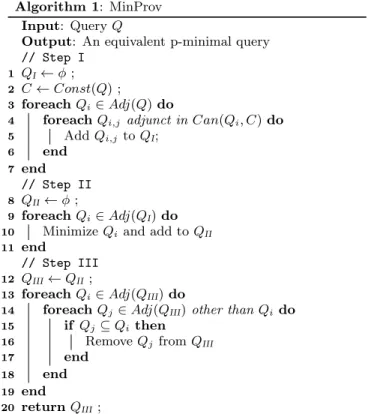
The minimization methodM inP rovis depicted in Algorithm 1 and operates in 3 steps. First (step I), itre-places each adjunct of the input query Q by its canonical
rewriting with respect to the full set of constants inQ,
ob-taining a queryQI as a result. Then, in step II, each of the
adjuncts is minimized separately, using any efficient
algo-rithm for minimization ofcCQ̸=queries (such as the simple
algorithm depicted in the proof of theorem 3.12), obtaining
QII as the union of minimized queries. Finally, in step III
the algorithm checks every pair of adjuncts inQIIfor query
Algorithm 1: MinProv
Input: QueryQ
Output: An equivalent p-minimal query
// Step I QI←ϕ; 1 C←Const(Q) ; 2 foreachQi∈Adj(Q)do 3
foreachQi,j adjunct inCan(Qi, C)do
4 AddQi,j toQI; 5 end 6 end 7 // Step II QII←ϕ; 8 foreachQi∈Adj(QI)do 9
MinimizeQiand add toQII
10 end 11 // Step III QIII←QII; 12
foreachQi∈Adj(QIII)do
13
foreachQj∈Adj(QIII)other thanQi do
14
if Qj⊆Qi then
15
RemoveQjfromQIII
16 end 17 end 18 end 19 returnQIII; 20
each adjunct in it is complete, therefore Theorem 3.1 holds and checking for containment amounts to checking for the existence of a homomorphism. Whenever a contained query
is found, it is omitted by the algorithm. QIII(and the
algo-rithm output) is thenQIIwithout the contained adjuncts.
Example 4.7. Consider the queries depicted in figure 3.
We apply the M inP rov algorithm on Qˆ, showing the ob-tained intermediate queries. Step I of the algorithm com-putes the canonical rewriting of (the single adjunct of )Qˆ, resulting inQˆI Then, in step II, each of the adjuncts ofQˆI
are (p-)minimized. Recall (Lemma 3.13) that a complete conjunctive query is p-minimal if and only if it has no du-plicated relational atoms; the only adjunct which is not p-minimal isQˆ1. We remove the duplicated atoms to obtain its p-minimal equivalent,Qˆmin1. Consequently the result of step II of the algorithm is QˆII. Finally, in step III of the
algorithm we eliminate contained adjuncts. In this case we can easily verify thatQˆ2,Qˆ3andQˆ4are contained inQˆmin1. There are no other containments between adjuncts; thus the result of step III (and the algorithm output), QˆIII, is the
union of the remaining adjuncts,Qˆmin1 andQˆ5.
Correctness.
First, it is easy to see thatQ≡M inP rov(Q). We next show that the query that is computed is indeed the minimal one.Proposition 4.8. For every two equivalent queries,Q, Q′∈
U CQ̸=, M inP rov(Q) ⊆P Q′, i.e. M inP rov returns a
p-minimal query equivalent toQ.
Proof. We say in the sequel that a queryQis complete
w.r.t. a set of constantsCif it is complete and additionally
contains a disequalityv̸=c for everyv∈V ar(Q),c∈ C.
The following lemma is an adaptation of a Theorem in [26], adapted to consider queries with disequalities.
ˆ Q: ans() :=R(x, y), R(y, z), R(z, x) ˆ QI: Qˆ1∪Qˆ2∪Qˆ3∪Qˆ4∪Qˆ5 ˆ Q1 : ans() :=R(v1, v1), R(v1, v1), R(v1, v1) ˆ Q2 : ans() :=R(v1, v2), R(v2, v1), R(v1, v1), v1̸=v2 ˆ Q3 : ans() :=R(v1, v2), R(v2, v2), R(v2, v1), v1̸=v2 ˆ Q4 : ans() :=R(v1, v1), R(v1, v2), R(v2, v1), v1̸=v2 ˆ Q5 : ans() :=R(v1, v2), R(v2, v3), R(v3, v1), v1̸=v2, v2̸=v3, v1̸=v3 ˆ QII: Qˆmin1∪Qˆ2∪Qˆ3∪Qˆ4∪Qˆ5 ˆ Qmin1: ans() :=R(v1, v1) ˆ QIII: Qˆmin1∪Qˆ5
Figure 3: Example forM inP rov, Step by Step
Lemma 4.9. Let Q ∈ cCQ̸=, Q′ ∈ U CQ̸=, such that Q
is complete with respect to the constants in Q′, Q⊆Q′ iff there exists an adjunctQ′i∈Adj(Q′)s.t. Q⊆Q′i.
Now, letC=Const(M inP rov(Q))∪Const(Q′). We next
show thatCan(M inP rov(Q), C)⊆P Q′; since
Can(M inP rov(Q), C)≡P M inP rov(Q), this will prove propo-sition 4.8. LetQibe one of the adjuncts inCan(M inP rov(Q), C). Since we removed contained adjuncts in step III of the al-gorithm, and thus every two adjuncts must differ in some equality/disequality, every monomial contributed to the
prove-nance byQimust be unique. SinceCan(M inP rov(Q), C)⊆
Can(Q′, C), it holds thatQi⊆Can(Q′, C). Thus, by lemma
4.9 (Qi is complete on all the constants inQ′) there exists
some adjunctQ′jinCan(Q′, C) s.t. Qi⊆Q′j. The contain-ment and completeness on the other direction also holds,
thus there exists some adjunctQkinCan(M inP rov(Q), C)
s.t. Q′j⊆Qk. We get thatQi⊆Q′j⊆Qk, and since we
re-moved all containments fromM inP rov(Q),Qi≡Qk, thus
Qi⊆Q′j⊆Qi, i.e. Qi≡Q′j.
Since at step II we minimized each adjunct, Qi is
p-minimal. In particular, Qi ⊆P Q′j. Thus, for every input
databaseDandt∈Q(D),Qicontributes at most the
prove-nance thatQ′jdoes. This is true for every such adjunctQiin
Can(M inP rov(Q), C), thusP(t, Can(M inP rov(Q), C), D)≤
P(t, Can(Q′, C), D). Since it is true for every t and D,
Can(M inP rov(Q), C)⊆P Can(Q′, C).
Complexity Upper Bound.
The complexity of M inP rovis EXPTIME in the size of its input query: step I of the
algorithm replaces each adjunct of the original queryQwith
its canonical rewriting, which is of exponential size. Then we may have an exponential number of adjuncts, but each
of them is ofpolynomial size (by definition of the canonical
rewriting). Then the overall complexity of steps II and III is (respectively) polynomial and exponential in the maximal size (number of relational atoms) of an adjunct in their input query.
This concludes the proof of Theorem 4.6 above.
Complexity Lower bound.
The EXPTIME complexity ofM inP rovis inevitable as the following theorem holds:
Theorem 4.10. For everyn∈Nthere exists a queryQn
of sizeΘ(n) such that any p-minimal equivalent ofQn is of