http://www.sciencepublishinggroup.com/j/ajai doi: 10.11648/j.ajai.20180202.12
ISSN: 2639-9717 (Print); ISSN: 2639-9733 (Online)
The Effectiveness of Borehole Heat Exchanger Depth on
Heat Transfer Rate, Study with Numerical Method Using a
CFD 3D Simulation
Ebrahim Mohammed, Wei Liu
*, Waleed Karrar
College of Mechanical and Electrical Engineering, Hohai University, Changzhou, China
Email address:
*
Corresponding author
To cite this article:
Ebrahim Mohammed, Wei Liu, Waleed Karrar. The Effectiveness of Borehole Heat Exchanger Depth on Heat Transfer Rate, Study with Numerical Method Using a CFD 3D Simulation. American Journal of Artificial Intelligence. Vol. 2, No. 2, 2018, pp. 22-29.
doi: 10.11648/j.ajai.20180202.12
Received: September 22, 2018; Accepted: October 10, 2018; Published: October 30, 2018
Abstract:
Excess solar thermal energy is available, while in winter, when thermal energy is needed for heating systems, its quantity is usually not sufficient. There are different options to cope with the seasonal offset of thermal energy supply and demand. One of these options is borehole thermal energy storages (BTES). Borehole thermal energy storages coupled with ground source heat pumps have been widely developed and researched. The major disadvantage of (BTES) is the initial capital cost required to drill the boreholes. Geothermal energy piles were developed to help offset the high initial cost of these systems. This study investigates thermal performance of vertical ground heat exchangers with constant inlet water temperatures and deferent borehole depths. The performances of three models of U-tube with depth of 100m, 60m, and 30m are evaluated by numerical method using a CFD 3D simulation. The simulation results show that heat transfer rates decrease in the heating mode for 100m depth, and show that the best borehole depth regarding to heat transfer rate efficiency is 60m depth borehole. However for heat storage capacity the model of 100m depth is the best. The results show that increasing the depth of borehole heat exchangers lower the heat exchange efficiency with the ground. By comparing with 100 m depth, the heat transfer rates per unit borehole depth lower of 3.1% in 60 m depth. According to all results, it is highly recommended to construct medium depth around 60 m depth of borehole with U-shaped pipe configuration, due to higher efficiency in heat transfer rate.Keywords:
Heat Transfer Rate, Different Borehole Depths, Numerical Method, CFD 3-D Simulation1. Introduction
One of the most current topic under researches in field of energy is how to develop and utilize renewable energy resources. And solar energy seems to be the most promising resource. But a seasonal solar thermal energy storage system is needed because solar radiation is discontinuous, unreliable, while the demand for continuous and stable energy supply. [1] The viable option for utilization renewable energy is central solar heating plants with seasonal storage that can cover the space heating and domestic hot water demands of big communities at an affordable price. [2] Ground-source heat pump (GSHP), regarded as a higher energy efficient technology, and is widely used in heating and cooling in
concrete pile. Nowadays application of geothermal pile- foundation heat exchangers have been more popularized, inasmuch as, outlays would be declined and less ground area would be occupied [4-18]. The advantages of vertical loop are that they require small area, they are in contact with soil that varies very little in temperature and thermal properties, and they require the smallest amount of pipe and pumping energy. [5] Geothermal energy pile systems can help minimize the initial costs. Energy piles are based on the combination of borehole heat exchangers and deep foundations that provide structural support. Energy pile systems have been developed more recently and have an increasing demand because of their energy efficiency and economic benefit. Both types of underground heat exchangers, geothermal energy piles and borehole heat exchangers are coupled with ground source heat pump systems providing a more efficient alternative to conventional air source heat pumps. [6].
Various analytical, and numerical models have been developed for the modelling and simulation of borehole heat transfer. Classical analytical models for determining the thermal response of a borehole system include the line-source solution that treats the radial heat transfer and the cylindrical-source solution that models the borehole as a cylinder surrounded by homogeneous ground and having constant heat-flux across its outer boundary. The issue of the accuracy of line-source and cylindrical-source solutions has been addressed by many researchers. The design of a borehole system is generally carried out using commercial software, such as Earth Energy Designer (EED), the Ground Loop Heat Exchanger Program (GLHEPRO), (TRNSYS), and (CFD-FLUENT), among others [7]. Different pipe configurations in vertical grouted boreholes including single U-pipe with different depths for different diameters boreholes are modelled in detail in this study using (CFD-FLUENT) finite element methods. Pipe loop configuration, fluid flow rate and pipe separation are some of many design parameters which affect system efficiency and they are numerically modelled here. Heat transfer and fluid flow are the two main physical processes combined in the numerical model. Heat exchange rates, which arise from temperature distributions in the ground, at the borehole wall and in the carrier fluid in different ground loop configurations, are discussed for a variety of ground loop configurations [8-15].
2. Review of Literature on Borehole Heat
Exchanger
Tao Tao et al. [9] work on project in Hebei China to develop strategies to reduce its cost of thermal energy storage. The non-pressurized solar system was adopted and the circulating pumps are low power. In addition, many small standard tanks were interconnected instead of a single storage tank. After long-term solar collection, the efficiency of the solar collectors was about 39.3% on average. Hassam ur Rehman et al. [10] Implemented different control strategies
in order to achieve high fraction of solar heating system with a seasonal storage and minimize electricity demand of the system. The solar energy fraction increased and the electricity consumption reduced by 20%. This was because the system capability to utilize the available low radiation solar energy annually. Additionally, the borehole thermal energy storage system efficiency showed an increasing trend during 5years of its operation. Moreover, the average temperature of the system increased and as a consequence, the COP of the heat pump increased. The effects of some design parameters, including the number of thermal energy storage units, and the solar receiver thermal conductance on the process efficiency and net power output were assessed by Julian D. Osorio et al. [11]. They obtained slight improvements in average net power output by incorporating a two tank thermal energy storage component. Julian D. Osorio et al concluded that the solar receiver conductance has a stronger effect on the system performance, and the system performance is also influenced by the solar radiation and air temperature variations among seasons. They achieved maximum process efficiencies of between 26.0% and 29.4% depending on the season with a combination of improved design parameters.
Qingqing Xu, and Stevan Dubljevic. [12] provided a model of the state-of-the-art in the solar thermal system with borehole seasonal storage mathematically modelled by ordinary differential equations, and hyperbolic partial differential equation according to the energy balance. Then, the discrete systems of these integrated systems are obtained by the application of the Cayley Tustin time discretization method. The efficient borehole thermal energy storage design with less heat losses, using GHEADS, an advanced simulation tool was proposed by Farzin M. Rad et al. [13] They concluded that GHEADS, with more capability, compare to the TRNSYS default component, provide more cost effective design. The new design achieves a 38% reduction of the BTES footprint and the number of boreholes. Francesco et al. [14] developed and validated an innovative numerical model and applied it to improve the energy efficiency of pile heat exchangers, via Taguchi parametric analysis to determine the relative importance of various design parameters for achieving maximum exchanged energy. The results showed that the maximizing the total pipe surface area available for heat transfer is the most important factor for increasing energy efficiency. They have also recommended to maximize the concrete thermal conductivity in order to result in greater energy exchange. The outcomes of the multiple simulations performed by Bidarmaghz A. et al. [15] show that ground heat exchanger configuration may affect system efficiency, Based on numerical results in a large diameter borehole and for a given borehole length. They concluded that the thermal performance of the system is not significantly related to pipe geometry placement, at least for the spiral and multiple U-pipes analyzed.
storage efficiency increases with size but several years are required to reach an operational status, and these kind of systems are in urban areas are beneficial due to the low floor space demand. Simon Chapuis, and Michel Bernier. [17] Implemented borehole heat exchanger model using two independent U-tube networks in TRNSYS. They modified the original DST model to handle simultaneous charging and discharging in the same borehole, and results show that it is possible to have a solar fraction of 98% for space heating with 2293 m2 of flat plate solar collectors. Various pile diameters and pipe loops of borehole heat exchanger have been modeled and simulated by Willis Hope Thompson [6] and he concluded that the large diameter pile systems were shown to offer an overall better performance as the pile diameter was increased in size and as the number of loops was increased. Results of his study show that the more loops added to the system provides a greater effective heat transfer area for the system to dissipate the injected heat rate to the surrounding earth. And also the larger diameter piles showed a greater ability to dissipate the heat.
Hatef Madani et al. [20] presented a method to approach the challenge of capacity control in Ground Source Heat Pumps. They have described the development of a model of the system which includes several sub-models such as the heat pump unit, building, ground source, thermal storage tank, auxiliary heater, and climate. They have developed computer model which has been used for comparative analysis of different control methods and strategies aiming at the improvement of the system seasonal performance. Behrad Bezyan et al. [18] compared results of three
pile-foundation heat exchangers (U-shaped, W-shaped, and Spiral-shaped with 0.4 m pitch), and they concluded that, pile-foundation heat exchanger including Spiral-shaped configuration with 0.4 m pitch size, has the highest efficiency in heat transfer rate and energy output. Heat exchange rates of the several types of vertical ground heat exchangers were investigated by Jalaluddin, and Akio Miyara [19] with different inlet water temperatures and various borehole depths, and results of the simulation show that temperature difference between the circulated water and the ground surrounding the borehole affects significantly to the heat exchange rate. And the water temperature change between the inlet and outlet does not increase as much as increasing the borehole depth.
3. Configuration of the System
3.1. Models Illustration
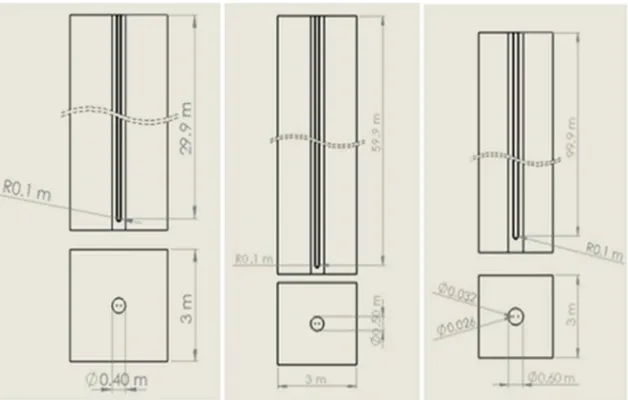
Figure 1 shows three different models with various dimensions has investigated in this paper. The models depth are 100m, 60m, and 30m. And piles diameters are 0.6m, 0.5m, and 0.4m respectively. Pipes are High-density polyethylene (HDPE) with inner diameter of 0.026 m, and 0.003 m thickness which have been constructed and fixed via concrete vertically inside the piles. Soil domain around pile foundation has been modeled as a rectangular shape with 3m width. Properties of water, soil, concrete and pipes (HDPE) such as thermal conductivity, density and heat capacity have been mentioned in Table 1.
Figure 1. Models of borehole heat exchanger with various dimensions.
3.2. Component’s Properties
Table 1. Properties of system's components.
component Density (kg/m3) (C
p )Heat Capacity (J/kg K) Thermal Conductivity (W/m K)
soil 1850 1200 1.78
Backfill (concrete) 2500 840 1.6
Pipe HDPE 1100 1465 0.42
water 998 4182 0.6
4. Simulation and Results
4.1. Mesh Configuration
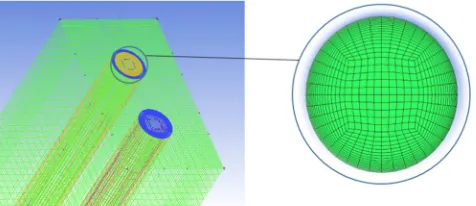
ICEM-CFD has been used to create the mesh for the assembly of the system that consist of four parts as flowing: soil domain, pile, pipe, and water domain. The Blocking Feature in ICEM has been used as it is more controllable. So that the size of the cells can be constrained in order to ensure high quality of overall mesh, and sufficient accuracy of the numerical simulation results. The mesh quality has been determined based on determinant 2x2x2 and angle as it shown in figure 4. And the results ensured that the heat transfer in and around the fluid domain would be resolved
4.2. Boundary Conditions Set up
Boundary conditions of all three models have been set up as flowing:
Figure 3. Soil domain, inlet and outlet scan plane mesh.
Figure 4. Mesh Quality with Pre-Mesh Histograms.
The velocity and temperature of the inlet water have been specified as 0.4 m/s and 35 ° respectively for all of the models. And mass flow rate ( ) has been calculated by this equation: . And it has value as 0.00021237 m3/s (0.21086) Kg/s. with 26mm inner pipe diameter and 998 Kg/m3 water density. Temperature under depth of 5 m is almost constant and it is 18.2 ° Therefore, the initial temperature of soil (domain) have been specified as 18.2 ° . Solver transient time for 48, 168, and 2160 hours has been set-up using k-epsilon model equation.
4.3. Simulation Results
Mechanisms of heat transfer rate in this system are convection and conduction. Both convection and conduction as a heat transfer mechanisms occurring between the fluid and the High-density polyethylene (HDPE) pipe wall as the circulation fluid flows through the geothermal heat exchanger. Conduction is occurring between the HDPE pipe, the pile, and the surrounding soil transferring heat away from the borehole heat exchanger.
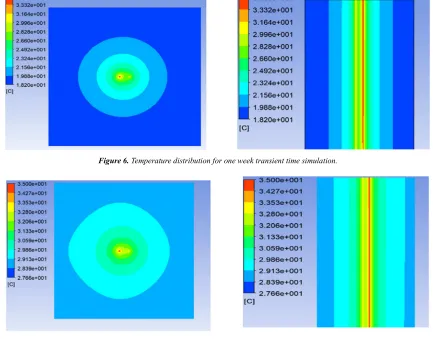
Figure 6. Temperature distribution for one week transient time simulation.
Figure 7. Temperature distribution for 3 months transient time simulation.
We will use the following equations for evaluating heat transfer rate in constant temperature on surface consideration:
(1)
! exp % &'
(2)
Table 2. the total heat transfer rate.
Model Inlet temperature (T(° in) Outlet temperature (Tout) (°
Temperature
difference Time (hour)
Heat transfer rate (W/m)
100m depth
35 29.5 5.5 48 48.3
35 30.1 4.9 168 43.1
35 33.2 1.8 2160 16.3
60m depth
35 31.5 3.5 48 51.4
35 31.9 3.1 168 45
35 33.9 1.1 2160 16.2
30m depth
35 33.4 1.6 48 46.8
35 33.6 1.4 168 41.9
35 34.27 0.73 2160 21.45
)*+,- & ./01 / 3 (3)
As:
. 456 7+8! 7. 7+8!
79, 7. 79,
Heat transfer rate inside a borehole heat exchanger can be computed via the following equation:
Q= : (W/m) (4)
on outlet temperature obtained by FLUENT-CFD with various time set up simulation.
The distribution of temperature for different periods of time simulation shown on Figures 5, 6, and 7.
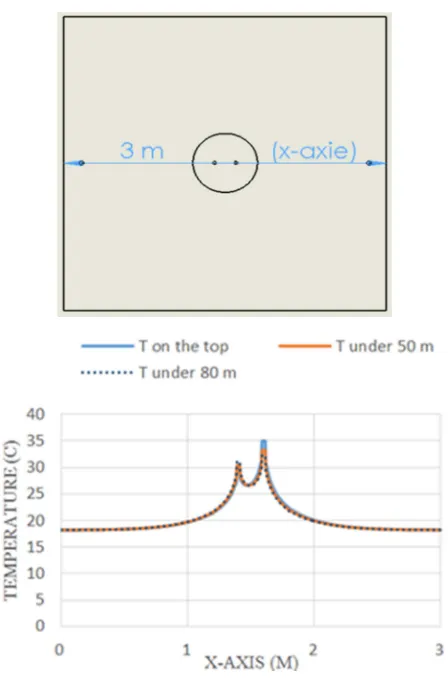
The heat distribution along X-axis in the top surface, and different depths are displayed in figure 8.
Figure 8. Temperature distribution along x-axis.
In this paper there are three cases have been investigated by 3-D modeling and simulation to study the effect of the borehole depth on heat transfer, and the total heat energy can be transferred from the water circulated on single U-tube to the soil.
These three different models have been designed with depth of 100m, 60m, and 30m.
In case of 100m depth model has been set up for three different times as flowing: 48 hours, 168 hours (one week), and 2160 hours (3 months). The results in table 2 for these cases show that the heat transfer rate decreased with increasing of time as 48.3, 43.1, and 16.3 respectively. The approximate equation of heat transfer rate (Q1) has been
determined with trend line by excel as shown in figure 9.
Q1 = 1*10-05t2 - 0.0464t + 50.494 (5)
Figure 9. Changing of heat transfer rate with time for 100m depth model.
In case of 60m depth model has been set up for the same period of time as that for 100m depth model, and shows these results of heat transfer rate as 51.4, 45, and 16.2 (w/m) respectively as in table 2. And the approximate equation of heat transfer rate (Q2) has been determined with trend line by excel as
shown in figure 10.
Q2 = 2*10-05t2 - 0.0573t + 54.108 (6)
Figure 10. Changing of heat transfer rate with time for 60m depth model.
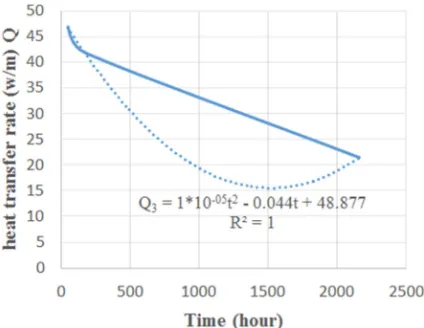
The last case was the model of 30m depth, and the period of simulation time has been set up as the same as previous models and shows the results of heat transfer rate as 46.8, 41.9, and 21.45 (w/m) respectively as in table 2.
And the approximate equation of heat transfer rate (Q3) has
been determined with trend line by excel as shown in figure 11.
Figure 11. Changing of heat transfer rate with time for 30m depth model.
Results have been reported in Table 3. Based on the results, it can be found that the model of 100m depth can stores more heat than the other two models for the same boundary condition and simulation time, however heat transfer rate with unit of borehole depth is the best in 60m depth model.
Table 3. Total heat absorbed by the soi.
Equation ; < =>
?@AB
CD
E
F The depth (m) Stored Heat (KW)
Q1 32046.81216 100 3204.68
Q2 47856.56832 60 2871.39
Q3 34227.66336 30 1026.83
According to the results in Table 3 a comparison for total stored heat in three deferent borehole heat exchanger models have been conducted and illustrated in figure 12.
Figure 12. Heat stored in three deferent models.
5. Conclusion
The outcomes of the simulations performed in this work show that borehole heat exchanger configuration affects system efficiency. Based on numerical results in a different diameters borehole and for a given borehole depths, it seems that as long
as the same pipe length is embedded inside the borehole, thermal performance of the system is not significantly related to pipe geometry placement. Regarding the results in Tables 2 and 3, by comparison of three U-shaped deferent depth models heat exchangers, it has been concluded that, 60m depth heat exchanger, has the highest efficiency in heat transfer rate and energy output of 51.4 (W/m). Increasing the depth lowers temperature difference between circulated water and surrounding ground and then lowers the heat exchange rate. And the deepest borehole heat exchanger can stores more heat but with low efficiency in heat transfer rate.
The results of this study can assist in the development of standards and guidelines for different diameter energy piles and borehole depths. The research in this paper can be continued by expanding incorporating more geometries and different independent variables.
Also the same models can be used to test different flow rates and circulation fluids within the piles.
Nomenclature
V Velocity of water (m/s). D Inner diameter of pipe (m).
Mass flow rate (kg/s).
A Cross-sectional area of pipe (m2). T Average temperature of water ( °). Ts Temperature of surface ( °).
h Convective heat transfer coefficient (W/m2c).
& Average of h in the whole pipe Cp Specific heat (J/ Kg.C).
Tout Outlet average temperature ( °).
Tin Inlet average temperature ( °).
PA Ambience of pipe (m).
L Length of pipe (m). As Area surface of pipe (m2). Q Energy output (W/m).
Q1 Heat transfer equation for model of 100 m depth.
Q2 Heat transfer equation for model of 60 m depth.
Q3 Heat transfer equation for model of 30 m depth.
l Depth of pipeline (m). R² Correlation coefficient.
References
[1] GAO, Liuhua; ZHAO, Jun; TANG, Zipeng. A review on borehole seasonal solar thermal energy storage. Energy procedia, 2015, vol. 70, p. 209-218.
[2] GUADALFAJARA, M.; LOZANO, M. A.; SERRA, L. M. Simple calculation tool for central solar heating plants with seasonal storage. Solar Energy, 2015, vol. 120, p. 72-86. [3] ZHU, Neng; WANG, Jingmei; LIU, Long. Performance
evaluation before and after solar seasonal storage coupled with ground source heat pump. Energy Conversion and Management, 2015, vol. 103, p. 924-933.
[5] Kavanaugh, Stephen P., and Kevin D. Rafferty. Geothermal heating and cooling: design of ground-source heat pump systems. ASHRAE, 2014.
[6] Thompson III, Willis Hope. Numerical Analysis of Thermal Behavior and Fluid Flow in Geothermal Energy Piles. Diss. Virginia Tech, 2013.
[7] Javed, Saqib. Thermal modelling and evaluation of borehole heat transfer. Chalmers University of Technology, 2012. [8] Weiss, Werner. Solar heating systems for houses: a design
handbook for solar combisystems. Routledge, 2003.
[9] TAO, Tao, et al. Low cost and marketable operational experiences for a solar heating system with seasonal thermal energy storage (SHSSTES) in Hebei (China). Energy Procedia, 2015, vol. 70, p. 267-274.
[10] Ur Rehman, H., Hirvonen, J. and Sirén, K., 2016. Design of a simple control strategy for a community-size solar heating system with a seasonal storage. Energy Procedia, 91, pp. 486-495. [11] Osorio, J. D., Hovsapian, R. and Ordonez, J. C., 2016. Effect
of multi-tank thermal energy storage, recuperator effectiveness, and solar receiver conductance on the performance of a concentrated solar supercritical CO2-based power plant operating under different seasonal conditions. Energy, 115, pp. 353-368.
[12] Xu, Q. and Dubljevic, S., 2017. Modelling and control of solar thermal system with borehole seasonal storage. Renewable Energy, 100, pp. 114-128.
[13] Rad, F. M., Fung, A. S. and Rosen, M. A., 2017. An integrated
model for designing a solar community heating system with borehole thermal storage. Energy for Sustainable Development, 36, pp. 6-15.
[14] Cecinato, F. and Loveridge, F. A., 2015. Influences on the thermal efficiency of energy piles. Energy, 82, pp. 1021-1033. [15] Bidarmaghz, A., G. Narsilio, and I. Johnston. "Numerical
modelling of ground heat exchangers with different ground loop configurations for direct geothermal applications." In Proceedings of the 18th International Conference on Soil Mechanics and Geotechnical Engineering, Paris, France, pp. 2-6. 2013.
[16] Bär, K., Rühaak, W., Welsch, B., Schulte, D., Homuth, S. and Sass, I., 2015. Seasonal high temperature heat storage with medium deep borehole heat exchangers. Energy Procedia, 76, pp. 351-360.
[17] Chapuis, Simon, and Michel Bernier. "Seasonal storage of solar energy in borehole heat exchangers." (2009).
[18] Bezyan, B., Porkhial, S. and Mehrizi, A. A., 2015. 3-D simulation of heat transfer rate in geothermal pile-foundation heat exchangers with spiral pipe configuration. Applied Thermal Engineering, 87, pp. 655-668.
[19] Miyara, A., 2012. Thermal performance investigation of several types of vertical ground heat exchangers with different operation mode. Applied Thermal Engineering, 33, pp. 167-174.