Article
Thermal Bridge Modeling and a Dynamic Analysis
Method Using the Analogy of a Steady-State Thermal
Bridge Analysis and System Identification Process
for Building Energy Simulation: Methodology and
Validation
Heegang Kim1, and Myoungsouk Yeo2*
1 Department of Architecture and Architectural Engineering, Graduate School of Seoul National University,
Seoul 08826, Korea; [email protected]
2 Department of Architecture and Architectural Engineering, College of Engineering, Seoul National
University, Seoul 08826, Korea; [email protected]
* Correspondence: [email protected]; Tel.: +82-2-880-7353
Abstract: It is challenging to apply heat flow through a thermal bridge, which requires the analysis of 2D or 3D heat transfer to building energy simulation(BES). Research on the dynamic analysis of thermal bridges has been underway for many years, but their utilization remains low in BESs. This paper proposes a thermal bridge modeling and a dynamic analysis method that can be easily applied to BESs. The main idea begins with an analogy of the steady-state analysis of thermal bridges. As with steady-state analysis, the proposed method first divides the thermal bridge into a clear wall, where the heat flow is uniform, and the sections that are not the clear wall (the thermal bridge part). For the clear wall part, the method used in existing BESs is applied and analyzed. The thermal bridge part (TB part) is modeled with the linear time-invariant system (LTI system) and the system identification process is performed to find the transfer function. Then, the heat flow is obtained via a linear combination of the two parts. This method is validated by comparing the step, sinusoidal and annual outdoor temperature response of the finite differential method(FDM) simulation. When the thermal bridge was modeled as a third-order model, the root mean square error(RMSE) of annual heat flow with the FDM solution of heat flow through the entire wall was about 0.1W.
Keywords: thermal bridge; modeling and dynamic analysis; system identification;
1. Introduction
Globally, governmental policies are focused on reducing carbon emissions. To reduce carbon emissions, energy consumption must be reduced; thus, efforts are being made to reduce energy consumption in all fields, such as industry and transportation. Minimizing energy consumption in buildings is also being studied.
Over the years, research groups focused on building energy have developed various architectural and mechanical techniques to reduce building energy consumption. Developing and evaluating these techniques requires experimental and/or computer simulation methods. Although experimental methods, such as mock-up tests, are important, these methods have limitations in evaluating all cases under various conditions. As a result, the field of BES has consistently evolved, and various building energy analysis and calculation methods have been developed and applied [1,2].
The building envelope is the most important part of the BES because it directly protects the building from various external conditions, such as the outdoor temperature. The analysis of the
building envelope, which is the physical boundary between the exterior and the interior, is the most basic element of the BES, and many studies have been conducted and applied in this area.
Analysis of the building envelope is done to study the heat transfer phenomena of conduction through the building envelope. Conduction, the mechanism of heat transfer in a solid, is represented by a Fourier equation, which is a differential equation of time and space. Since the BES is numerically calculated for all heat transfer phenomena occurring in a building over one year, if the computing time is too large for one time-step, it is difficult to apply that calculation to the BES. Therefore, analysis of the building envelope is approached while simply assuming a 1D form. Importantly, it is reasonable to understand the building envelope as a 1D form. In general, the layers constituting the wall can be assumed to have a 1D form, but the thermal bridge is not 1D. A thermal bridge(TB) is defined as the part of the building envelope where the otherwise uniform thermal resistance is significantly changed by full or partial penetration of the building envelope by materials with a different thermal conductivity, and/or a change in thickness of the fabric, and/or a difference between internal and external areas, such as occur at wall/floor/ceiling junctions [3]. As can be seen from the definition of TB, TB is difficult to understand with a 1D form because of the complexity of its materials and geometry. The heat flow through the TB in the building heat balance cannot be ignored, especially if the building is highly insulated [4]. Therefore, the analysis of TB is a complex multidimensional problem, but remains necessary in BES.
Most BES programs, such as EnergyPlus [5] or TRNSYS [6] , assume that the heat flow though the building envelope is a uniform heat flow in 1D. In the 1D analysis platform, the heat flow through the TB is ignored because the heat flow, which requires multidimensional analysis, cannot be calculated. To solve this problem, the steady-state analysis results of the TB, which are relatively easy to calculate, are simply added at each time-step in the dynamic analysis. This method is inaccurate because it cannot reflect the time delay and decrement effects caused by the thermal inertia of the TB [7]. Alternatively, a method for reconstructing the building envelope, including the TB, into an equivalent wall and analyzing both in 1D has been proposed. Various methods for constructing an equivalent wall have been studied, and most of the research on TB dynamic analysis in the BES has focused on this method. This powerful method is applicable to the BES program while accurately reflecting the thermal behavior of an unsteady state of the TB, but it is not often used because of its complexity. The parameters supplied by the equivalent wall methods can be directly introduced via the interface of the simulation programs without modification of the source code or of the generated files [7]. However, it is not easy to replace the existing complete source code for clear wall analysis. In addition, if building engineers want to evaluate and strengthen the thermal performance of the building envelop, it is necessary to determine whether to strengthen the insulation of the clear wall or to supplement TB details, such as the use of thermal breakers. In this case, the amount of heat flow through the clear wall and the TB part should be divided and simulated in the BES.
The aim of this study is to develop a thermal bridge modeling and a dynamic analysis method that can be efficiently applied to a BES program. The proposed TB modeling and dynamic analysis method proceeds by adding the additional analysis model separately from the clear wall analysis code used in the existing BES program. As a result, it is possible to analyze the heat flow through the clear wall and the TB part, separately. The main idea comes from an analogy of steady-state thermal bridge analysis and system identification. The proposed method is verified by comparing the heat flow obtained while applying the proposed method to a specific TB and the heat flow computed by applying the FDM method. The annual heat flow simulated by applying the proposed method was compared with that of existing methods.
2. Thermal Bridge Modeling and Analysis Methods
Several approaches have been applied to analyze the TB. TB modeling and analysis starts by analyzing the conductive heat transfer through the wall. In conduction, the total heat flow rate can be obtained from the temperature gradient, which is Fourier's first law.
where 𝑞′′ is the heat flux (W/m2), 𝑘 is the thermal conductivity (W/mK), and 𝑇 is the temperature (K). The temperature can be obtained for the governing equation, which is called the Fourier's second law or heat diffusion equation (2).
𝜕𝑇
𝜕𝑡 = 𝛼∇
2𝑇 (2)
where 𝑇 is the temperature (K), 𝑡 is the time(s), and 𝛼 is the thermal diffusivity (m2/s). Unfortunately, it is difficult to obtain an analytical solution, such as the TB, from Equation (1) and (2) with complex geometry. Instead of an analytical solution, a numerical solution can be obtained via the finite difference method (FDE), the finite volume method (FVM), the finite element method (FEM), or the boundary element method (BEM) [8]. Although a numerical solution can be obtained, it is complicated and time-consuming to solve it and is limited to the BES, which is mainly simulated for one year.
Under the theoretical background of TB modeling and analysis, various thermal bridge modeling and analysis methods have been studied. Several papers summarize TB modeling and analysis methods [7,9,10]. The most common method is to ignore the TB and analyze only the clear wall (neglecting the thermal bridge). The method is used because it is challenging to perform a dynamic analysis of TB. Another approach is to analyze the clear wall with a dynamic condition and analyze the TB with a steady-state condition [11]. This method is useful because the BES is performed while reflecting the thermal bridge analysis, but it is inaccurate because it does not reflect the heat capacity. The heat diffusion equation is a partial differential equation(PDE), but there is a method to create and analyze a state-space model by converting a PDE to an ordinary differential equation(ODE) using finite difference spatial discretization [12]. As a result of its greater number of ODEs, a model reduction process is required to apply this state-space model method to the BES. Most of the models for application to the BES, which is a 1D analysis platform, have been studied as a 1D equivalent wall (equivalent wall method) [7]. The method for constructing an equivalent wall can be divided into several methods: the structure factors method [13], the matrix of transfer functions method [14], the one harmonic method [15], and the identification method [16]. Various modeling methods and analysis methods exist and are applicable to the BES in various ways depending on the model’s
complexity, accuracy, and analytical convenience. Indeed, there are few cases where a building is analyzed by applying it to a BES, possibly because the models that have been researched are not simple enough or because the developers or users are unfamiliar with a BES. There is a need for a thermal bridge analysis model that is simple and easy to understand and can utilize existing source code for clear wall analysis. Therefore, in this paper, a thermal bridge modeling and dynamic analysis method is proposed in a similar way to the relatively well-known steady-state TB analysis method.
3. Methodology
3.1. Analogy of Steady-State Thermal Bridge Analysis
The steady-state TB analysis is used to calculate the linear thermal transmittance(𝛹) or the point
thermal transmittance(𝜒) by performing a numerical simulation (the detailed calculation method is
found in ISO 10211 [3]). Thermal transmittance is a concept similar to the U-value of the clear wall, which is a physical quantification of how well heat can flow through a TB.
The heat flow rate through a wall between two different environments with two different temperatures can be calculated by Equation (3) [3]:
Φ1,2= 𝐿3𝐷,1,2(𝑇1− 𝑇2) (3)
𝐿3𝐷,1,2= ∑ 𝑈𝑘,1,2𝐴𝑘 𝑁𝑘
𝑘=1
+ ∑ 𝛹𝑚,1,2𝑙𝑚 𝑁𝑚
𝑚=1
+ ∑ 𝜒𝑛,1,2 𝑁𝑛
𝑛=1
. (4)
The detailed description can be found in [3]. The concept of calculating the heat flow rate in a steady-state is a linear summation or linear combination of (𝑈, 𝛹, 𝜒). In other words, the thermal
coupling coefficient consists of the heat flow through the clear wall(𝑈𝐴), the linear thermal bridge
part (𝛹𝑙), and the point thermal bridge part (𝜒), each of which has an independent relationship that does not affect the others. In practice, the heat flow through each part affects the other parts, but for convenience, a linear calculation formula is created.
For simplicity, assuming that there is only one linear thermal bridge part and no point thermal
bridge part in the wall for the 2D calculation, the linear thermal transmittance(𝛹) is determined by
Equation (5):
𝛹 = 𝐿2𝐷− ∑ 𝑈𝑗𝑙𝑗 𝑁𝑗
𝑗=1
(5)
where 𝐿2𝐷 is the thermal coupling coefficient obtained from a 2D calculation using numerical
analysis methods, such as FDM, FVM, or FEM. 𝑈 is the thermal transmittance of the 1D component
and 𝑙 is the length over which the value 𝑈 applies.
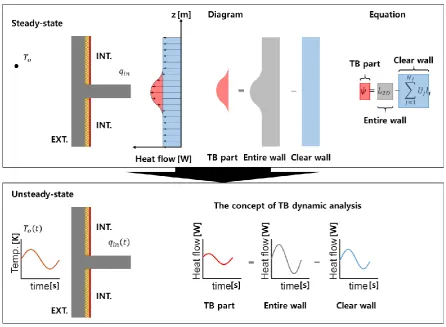
The concept for obtaining the linear thermal transmittance becomes clear when Equation (5) is multiplied by the temperature difference. The heat flow through the entire wall minus the heat flow through the clear wall is considered as the heat flow through the linear thermal bridge part. Here, the heat flow through the entire wall is obtained by numerical analysis, and the heat flow through the clear wall is obtained using the existing method (simple hand calculations).
Figure 1. Concept for the analogy of a steady-state thermal bridge (TB) analysis.
To proceed with this proposed method, it is first necessary to clearly disaggregate the range of the clear wall and TB part. In steady-state analysis, the dimension system described in ISO 14683 [18] should be determined for calculating the linear thermal transmittance. This is done to determine the value of 𝑙 in Equation (5). Although the amount of heat flow through the entire wall is the same, the ratio of heat flow through the clear wall and the TB part is different depending on the dimension system. The linear thermal transmittance varies depending on the dimension system, which only involves setting and analyzing the range of the clear wall. Similarly, in dynamic analysis, the dimension system can also be applied. The heat flow through the entire wall does not depend on the dimension system, but the function of the TB part can be different, as the value of the linear thermal transmittance varies depending on the dimension system in a steady-state. Therefore, the dimension system should be determined according to the analysis range of the clear wall (wall area) in BES
3.2. Linear Time Invariant System for the Thermal Bridge Part and System Order
To complete the concept obtained by the analogy of a steady-state thermal bridge analysis, it is necessary to find the function of the TB part. The function of the TB part expresses the heat flow into the room through the TB part according to the outdoor temperature. Since the theoretical background is rendered via Equation (1) and (2), the TB part can be defined by the linear time-invariant system (LTI system), and this relationship is expressed in the general formula below:
𝑎0𝑞𝑖𝑛
(𝑛)(𝑡) + 𝑎 1𝑞𝑖𝑛
(𝑛−1)(𝑡) + ⋯ + 𝑎
𝑛−1𝑞𝑖𝑛̇ (𝑡) + 𝑎𝑛𝑞𝑖𝑛(𝑡)
= 𝑏0𝑇𝑜 (𝑚)
(𝑡) + 𝑏1𝑇𝑜(𝑚−1)(𝑡) + ⋯ + 𝑏𝑚−1𝑇𝑜̇ (𝑡) + 𝑏𝑚𝑇𝑜(𝑡)
(6)
temperature is not related to the LTI system, and only the constant multiple of the outdoor temperature affects the LTI system:
𝑎0𝑞𝑖𝑛
(𝑛)(𝑡) + 𝑎 1𝑞𝑖𝑛
(𝑛−1)(𝑡) + ⋯ + 𝑎
𝑛−1𝑞𝑖𝑛̇ (𝑡) + 𝑎𝑛𝑞𝑖𝑛(𝑡) = 𝑏0𝑇𝑜(𝑡). (7)
In the state-space model, the ODEs obtained using finite difference spatial discretization can also be expressed via Equation (7), but the system order, which is the highest order of the linear differential equation, becomes very large. The higher the system order is, the higher the accuracy of the model muse be. This process becomes complicated and time-consuming, so it is necessary to choose the system order to simplify the model.
3.3. Thermal Bridge Transfer Function and System Identification
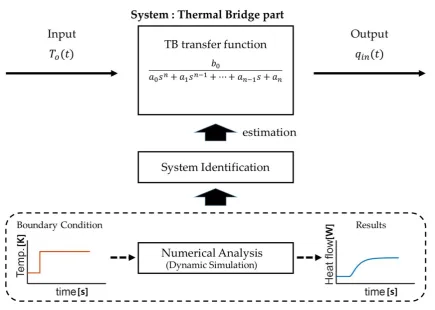
The function of the TB part mentioned above can be expressed as a transfer function related to the input and output relationship. The transfer function of a linear time-invariant differential equation system is defined as the ratio of the Laplace transform of the output to the Laplace transform of the input under the assumption that all initial conditions are zero [19]. CTF also originates from the transfer function, and wall conduction analysis using the transfer function has been studied and widely used [20]. Therefore, the model for the TB part can be easily applied to the BES by expressing it as a transfer function. Using Equation (7), the transfer function of TB part(TBTF) is as shown in Equation (8).
𝑇𝐵 𝑇𝑟𝑎𝑛𝑠𝑓𝑒𝑟 𝑓𝑢𝑛𝑐𝑡𝑖𝑜𝑛 =ℒ[𝑜𝑢𝑡𝑝𝑢𝑡]
ℒ[𝑖𝑛𝑝𝑢𝑡] =
𝑞𝑖𝑛(𝑠)
𝑇𝑜(𝑠)
= 𝑏0
𝑎0𝑠𝑛+ 𝑎1𝑠𝑛−1+ ⋯ + 𝑎𝑛−1𝑠 + 𝑎𝑛
(8)
Figure 2. The strategy of the system identification for the TB part.
3.4. Procedure
The proposed method involves disaggregating the thermal bridge into the clear wall and TB parts, similar to the steady-state TB analysis method, and linearly combining each thermal characteristic. For the clear wall, the existing method of dynamic analysis is applied, and for the TB part, the transfer function using the system identification process is applied. The modeling procedure can be summarized as follows:
1. Step 1: Disaggregation stage
Determine the dimensional system.
2. Step 2: Dynamic simulation stage
Perform the dynamic simulation of the entire wall and the clear wall.
3. Step 3: Model construction stage
Choose the LTI system order of the TB part and construct the TBTF.
4. Step 4: System identification stage
Obtain the parameter of TBTF using the system identification process.
4. Explanatory Example
To apply and validate this methodology, a simple thermal bridge model is analyzed according to the procedure of the proposed method. The target wall is selected as the wall of a general residential building, the same as the wall suggested in a previous paper [22]. The model geometry is shown in Figure 3a, and the material dimensions and thermal properties are shown in Table 1.
for the process and the results are shown in Table 2. The steady-state performance indicators in Table 2 differ slightly depending on the mesh grid size of the numerical simulation.
Figure 3. Geometry of model: (a) the entire wall (1~9 is the material number in Table 1); (b) the clear wall (external dimension system); (c) the clear wall (internal dimension system).
Table 1. The material dimensions and thermal properties.
# Material Lx (mm) Ly (mm) 𝒌 (W/mK) 𝝆 (kg/m3) 𝒄 (J/kgK) 1
Brick 135 1500 0.700 1600.0 850.0
2 135 1500 0.700 1600.0 850.0
3
Extruded polystyrene 100 1500 0.035 25.0 1470.0
4 100 1500 0.035 25.0 1470.0
5
Air gap 65 1500 0.560 1.185 1004.4
6 65 1500 0.560 1.185 1004.4
7
Plasterboard 10 1500 0.500 1300.0 840.0
8 10 1500 0.500 1300.0 840.0
9 Concrete 1810 300 2.600 2300.0 930.0
Table 2. Steady-state analysis results (grid size: 20 mm).
Dimensional system
Thermal Transmittance Heat Flow (∆𝐓 = 𝟐𝟎 °𝐂) Entire
Wall (W/m2K)
Clear Wall (W/m2K)
TB Part (W/mK)
Entire Wall (W)
Clear Wall (W)
TB Part (W)
External 0.6945 0.2980 1.3086 45.8376 19.6657 26.1719
4.1. Disaggregation Stage: Step 1
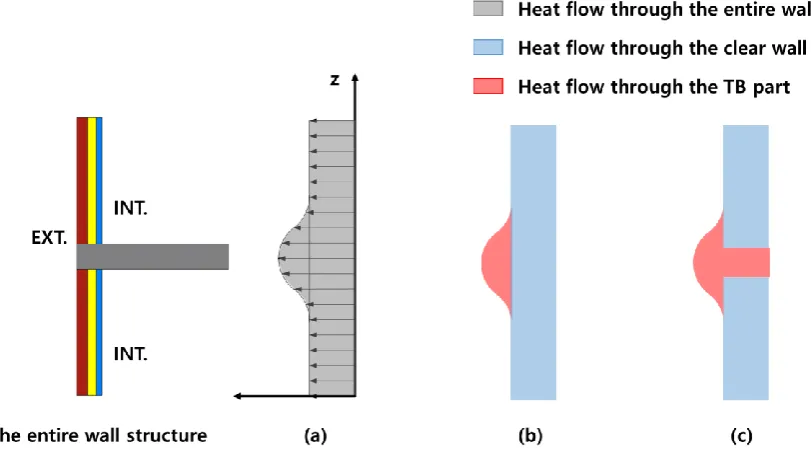
part, and the heat flow through each part varies according to the dimension system related to the analysis range of the clear wall in BES. Figure 4 conceptually illustrates the heat flow in a steady-state according to the dimension system. Therefore, the meaning of disaggregation is to determine the dimension system, which affects the geometry of the clear wall model in the next step (Figure 3b,c).
In this case study, the external dimension system is determined, and the clear wall is disaggregated into the geometry as shown in Figure 3b.
Figure 4. The heat flow in steady-state analysis according to the dimension system: (a) the entire wall; (b) external dimension system; (c) internal dimension system.
4.2. Dynamic Simulation for System Identification: Step 2
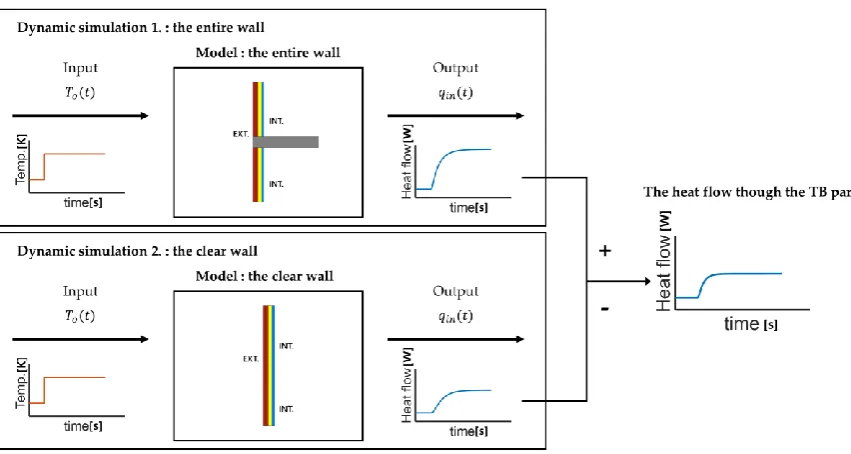
The input and the output data for the SI of the TB part are obtained by performing a dynamic simulation, which involves a numerical analysis. The commercial software, VOLTRA [24], is used for this purpose. This software is capable of 3D dynamic analysis; the FDM method is also applied.
The input data are the outdoor temperature(𝑇𝑜(𝑡)), and the output data are the heat flow into
Figure 5. The method for obtaining the heat flow through the TB part.
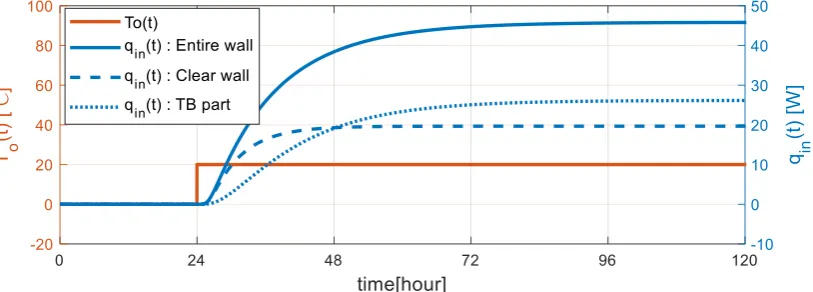
The outdoor temperature corresponding to the input data (or boundary condition) is given as a step function from 0 °C to 20 °C after one day and the indoor temperature and initial temperature of all structures are 0 °C. The simulation duration was set to 20 days, which is a sufficient time to reach a steady state. For accuracy, the simulation time step is set as 60 seconds (Table 3.).
Table 3. Simulation configuration.
Time step Duration Initial Condition Boundary Condition
60 s 1,728,000 s
(20 days)
All structures and
𝑇𝑖= 0 ℃
𝑇𝑜(𝑡) = 0 ℃ , 𝑡 < 86,400 s
𝑇𝑜(𝑡) = 20 ℃ , 𝑡 ≥ 86,400 s
4.3. Model Construction and Transfer Function: Step 3
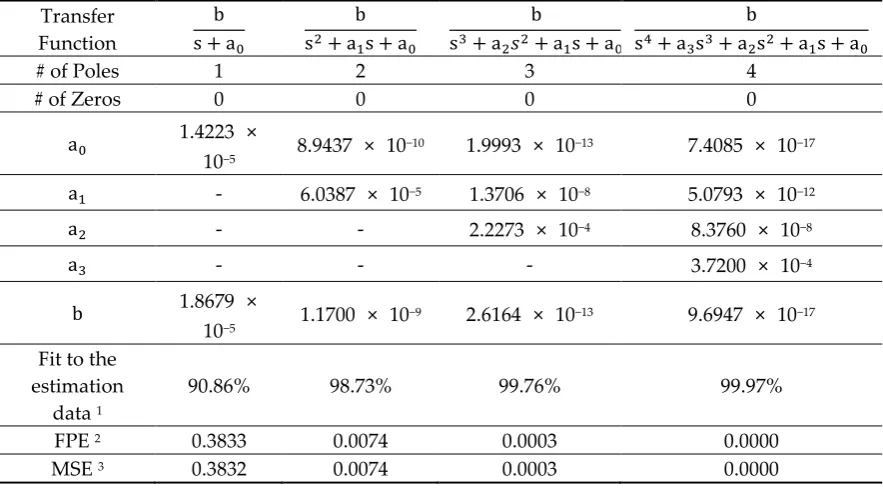
The system model is constructed by assuming that the TB part is an LTI system. At this time, the system order should be chosen to produces a simple TBTF. Since the highest power of 𝑠 in the denominator of the transfer function is the system order, choosing the system order is the same as determining the form of the TBTF. In this case study, the first to fourth order are chosen without specifying the system order. The most accurate and efficient system model can then be selected by comparing the four case models estimated through the system identification process with the FDM model. The form of TBTF according to the system order can be found in Table 4. It should be noted that the number of zeros corresponding to the numerator is 0. Therefore, to obtain the TBRF, the number of parameters to be estimated is the system order plus one.
4.4. System Identification: Step 4
System identification is performed with the outdoor temperature (input) and heat flow into the room through the TB part (output), which are the results of the dynamic simulation in Step 2. Here, we use the model form constructed in step 3.
constant as a step function, and the form of the model to be estimated is determined, it is possible to curve fit the output with the solution formed by the differential equation.
5. Results and Validation
5.1. Dynamic Simulation Results and System Identification Results
The result of the dynamic simulation is shown in Figure 6. The data for system identification of the TB part include the outdoor temperature as input data and the heat flow into the room through the TB part as the output data. All data are time series data, with 28,800 values for 1,728,000 s (20days) at 60 s intervals. To verify the result of the dynamic simulation for system identification, this result is compared with the steady-state result. Since the input data of the dynamic simulation are made constant with the step function, the final heat flow value of the dynamic simulation must be similar to the steady-state result. The comparison results are shown in Table 4. This simulation is considered valid because the steady state errors for all the results of the entire wall, clear wall, and the TB part are very small (under 0.001%).
Figure 6. Dynamic simulation results.
One of the considerations when performing a dynamic simulation for system identification is the simulation duration. The longer the simulation duration is set, the greater the amount of input and output data when the same time step is applied. The system can be estimated more accurately using a large amount of input and output data, but this is inefficient because data that have reached a near steady state and have changed little are meaningless. Therefore, it is recommended to run the simulation for 10 days, which is twice the time needed to reach 99.99% of the steady-state value; at least 5 days should be simulated.
Table 5 shows the results of the system identification. Here, the model accuracy increases as the system order increases. For the fourth-order system model, the FPE and MSE show accuracy with a value of 0 to the fourth decimal place.
Table 4. Final values of dynamic simulation and the time to reach 99.99% of the steady-state value.
Entire wall Clear wall TB part
𝑞𝑖𝑛(1,728,000𝑠) 45.8468 W 19.6659 W 26.1717 W
steady-state Error 0.0000 % -0.0010 % 0.0008 %
the time to reach 99.99% of the steady-state value
427,380 s (4 d 22 h 43 m 00 s)
193,740 s (2 d 05 h 49 m 00 s)
90,240 s (1 d 01 h 04 m 00 s)
Table 5. System identification results.
Transfer Function
b s + a0
b s2+ a
1s + a0
b s3+ a
2𝑠2+ a1s + a0
b s4+ a
3s3+ a2s2+ a1s + a0
# of Poles 1 2 3 4
# of Zeros 0 0 0 0
a0 1.4223
×
10−5 8.9437 × 10
−10 1.9993 × 10⁻¹³ 7.4085 × 10⁻¹⁷
a1 - 6.0387 × 10⁻⁵ 1.3706 × 10⁻⁸ 5.0793 × 10⁻¹²
a2 - - 2.2273 × 10⁻⁴ 8.3760 × 10⁻⁸
a3 - - - 3.7200 × 10⁻⁴
b 1.8679 ×
10−5 1.1700 × 10
−9 2.6164 × 10⁻¹³ 9.6947 × 10⁻¹⁷
Fit to the estimation
data 1
90.86% 98.73% 99.76% 99.97%
FPE 2 0.3833 0.0074 0.0003 0.0000
MSE 3 0.3832 0.0074 0.0003 0.0000
1 Fit to the estimation data: Normalized root mean square error. 2 FPE: Final prediction error for the
model. 3 MSE: Mean square error.
5.2. Validation of the System Identification
The validation of the SI is the most important step to ensure that the heat flow into the room through the entire wall including the TB part, which is the final result of the proposed method, is accurate. This is because the clear wall is calculated using the existing verified method, while only the model for the TB part is estimated by the SI. To validate of the models, the heat flow into the room according to three inputs (step input, sinusoidal input, and annual outdoor temperature) is compared with the heat flow calculated using the FDM model. The three inputs are shown in Table 6 and Figure 7. The step input is the same as the input for the SI. Since the outdoor temperature changes mainly with each day, the sinusoidal input is set to a 24 h periodic function with an amplitude of 20 °C. Lastly, since the accuracy of each model according to the step input cannot be guaranteed when the actual outdoor temperature is used as the input, the annual outdoor temperature from the weather data in Seoul, South Korea, which is applied in the BES, is used for validation. As shown in Figure 7, this outdoor temperature data cover one year, and the time step is 1 h, which yields 8760 data (max.: 31.3 °C; min.: -10.6 °C).
The heat flow calculated using the FDM model is simulated using VOLTRA, a previously used commercial program. It is also assumed that the heat flow data obtained by simulation using the FDM model are actual values. The heat flow using all the models estimated above (from the 1st-order to the 4th-order model) is simulated using MATLAB. “lsim”, a function in MATLAB, is used to simulate the time response of the dynamic system to arbitrary inputs for the estimated model [25].
Table 6. Inputs for validation of the system identification.
Step Input Sinusoidal Input Annual Outdoor
Temperature Input
𝑇𝑜(𝑡) = 0 ℃ , 𝑡 < 86,400 s
𝑇𝑜(𝑡) = 20 ℃ , 𝑡 ≥ 86,400 s 𝑇𝑜(𝑡) = 20 sin (
2𝜋
Figure 7. Annual outdoor temperature input.
Table 7. Amplitude and time shift comparison with the FDM sinusoidal response.
System Model FDM Model First-Order Second-Order
Third-Order
Fourth-Order
Amplitude (W) 4.7632 10.0831 7.5334 9.0707 9.4769
Amplitude error (basis on FDM
model) (%)
- +5.85% −20.92% −4.78% −0.52%
Time shift error (basis on FDM
model)
- −16,200 s
(−4 h 30 min)
−2,700 s
(−45min)
360 s
(6 min) 0 s
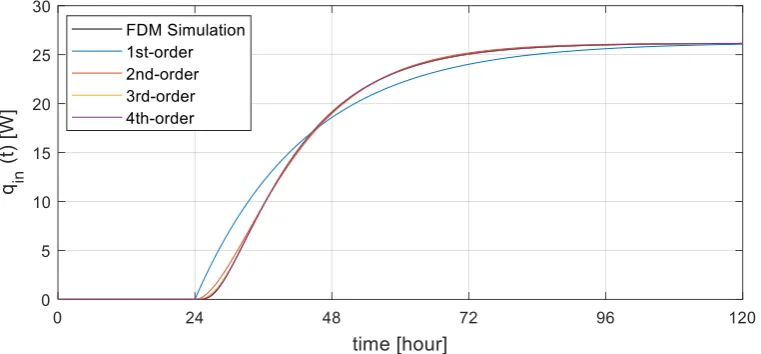
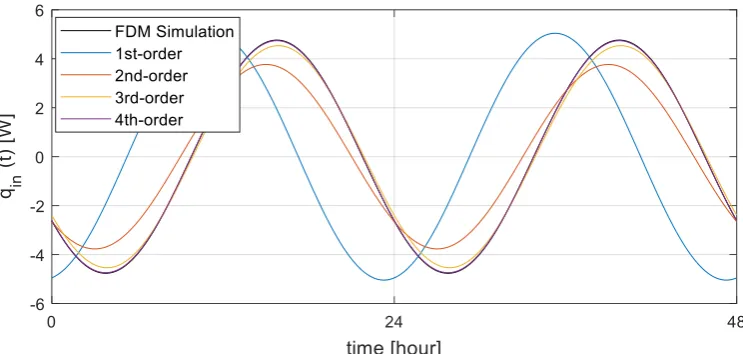
Comparison graphs for the step response and sinusoidal response are shown in Figures 8 and 9. The rest of the models, except for the first-order model, are almost identical to the FDM simulation results. Since the first-order model is the simplest model for the TB part, it can be easily produced; however, its accuracy is lower than that of other models. On the other hand, it is difficult to distinguish the fourth-order model from the results of the FDM model in the graph. In the sinusoidal response comparison, the amplitude and time shift of the fourth-order model are also almost the same for the FDM (Table 7). The third-order model also shows very accurate results.
Figure 9. Sinusoidal response of the models.
Figure 10 presents a graph comparing the simulation results of each model for one year. The results of FDM and all other estimated models are almost the same, so it is difficult to distinguish each result with a graph for one year. For a more detailed illustration, the results for a specific period (6 days from August 15 to August 20 in summer) are shown in Figure 11. The first-order model has apparent differences from the other estimated models. In the second-order model, a distinguishable error occurs, but in the third-order and fourth-order models, there is almost no difference from the FDM model results. Figure 12 shows the graph of each model error over time for one year, and Table 8 shows the root mean square error(RMSE) of each model. The most accurate model is the fourth-order model, whose RMSE value is 0.0895 W. The accuracy increases as the system fourth-order increases, but the complexity of the model also increases. Considering that the heat flow through the entire wall is 45.8376 W under steady-state conditions (when the indoor and outdoor temperature difference
𝛥𝑇 = 20 ℃) and −38 W~10 W in the annual simulation, the RMSE of the third-order model, which is only 0.1007 W, remains accurate, even if the TB part is estimated as a third-order model. Indeed, even the RMSE value of the first-order model, the most inaccurate model, is only 0.6920 W. Therefore, all estimated models can be used for BES. In addition, considering the model complexity and the accuracy of the results, it is recommended to estimate the TB part as a third-order model. The simplest modeled first-order model is slightly inaccurate, but remains sufficient for BES with TB. Therefore, the proposed method is validated.
Figure 11. System response for the annual outdoor temperature (Summer).
Figure 12. Residual of the heat flow rate: (a) First-Order model; (b) Second-Order model; (c) Third-Order model; (4) Fourth-Order model.
Table 8. System response RMSE of each model for the annual outdoor temperature.
Model First-Order
Second-Order Third-Order
Fourth-Order
RMSE 0.6920 0.1366 0.1007 0.0895
6. Comparison and Discussion
Thus far, the modeling of the TB part using the proposed method has been described and discussed. This model will now be described with a focus on the heat flow through entire wall, including the TB part. In the BES, it is also important to analyze only the TB part, albeit focusing more on the heat flow into the room through the entire wall for various purposes, such as calculating the indoor temperature or controlling the heating and cooling system. Therefore, the annual heat flow into the room through the entire wall is calculated using the proposed method and then compared to the results of the calculations using other models. The other models are defined as follows.
• FDM simulation: A model defined as a true value in this comparison simulated by the FDM method;
• Model 1: A model that ignores TB and analyzes only the clear wall (clear wall + ignored TB part);
• Model 3: A model that proposes the TB part as a first-order system (clear wall + 1st-order);
• Model 4: A model that proposes the TB part as a third-order system (clear wall + 3rd-order).
Figure 13. shows the annual heat flow calculated using each model. When looking at the graph on a yearly scale, there is little difference between the FDM model and the proposed the first-order model and third-order model; consequently, it looks like a single graph. On the other hand, Model 1 shows a significant difference from the FDM model. The error is greater in Model 1, especially in winter. This is because the indoor and outdoor temperature difference in winter is greater than the indoor and outdoor temperature difference in summer. This means that the simulation results, without considering the TB part in the BES simulation, will give inaccurate results, especially in winter. The result of Model 2 shows a similar trend to the FDM model, but it can be seen that the amplitude is large. This is phenomenon occurs because the TB part is calculated in steady-state conditions. In an actual dynamic simulation, the value of the heat flow changes before reaching a steady-state at every moment. Figure 16 shows the residual of each model error over time for one year.
Figure 13. Heat flow through the entire wall (One year)
Figure 15. Heat flow through the entire wall (Winter)
Figure 16. Residual of annual heat flow through the entire wall: (a) Model 1.; (b) Model 2.; (c) Model 3.; (d) Model 4.
For a more detailed illustration, the results for a specific period (6 days from August 15 to August 20 in summer and 6 days from January 15 to January 20 in winter) are shown in Figures 14 and 15. It can be seen that the results of the third-order model are almost identical to those of the FDM model. Further, the results of the first-order model are slightly more inaccurate than those of the third-order model but are significantly more accurate than those of Model 1 and Model 2. To quantitatively confirm the accuracy of each model result, the root mean square error (RMSE) is obtained, as shown in Table 9.
Table 9. The TB analysis method for the models and RMSE of each model for annual heat flow.
Model Model 1. Model 2. Model 3. Model 4.
TB part analysis Ignored 𝜓𝛥𝑇 first-order third-order
Year 16.2445 4.3467 0.6920 0.1007
Summer (JUL, AUG, SEP) 4.1399 3.9504 0.6371 0.0917
The proposed method is thus verified by various responses, proving that its accuracy is significantly improved compared to existing TB analysis methods. It is thus proposed as a dynamic analysis method considering that the steady-state TB analysis method consists of a linear combination of the heat flow through the clear wall and TB parts. The range of the TB part is also worth discussing. K. Martin suggested that the location of the cut-off plane for a correct dynamic thermal characterization of a TB occurs where the inner surface temperature deviates by more than 0.2K [16]. This proposal is well suited to explain the dynamic properties of the TB itself and can be seen as a way to define the range of the TB part. Since this paper discusses how to apply the TB part to the BES, it is necessary to define the TB part by understanding how to analyze the entire wall and the clear wall in the BES. In the BES, when analyzing a wall, 1D analysis is performed by entering the area of the wall along the interior or exterior dimension system. This means that the heat flow through the part corresponding to the interior or exterior dimension is already analyzed and reflected in the BES. Indeed, the TB should be analyzed in the BES to provide an additional analysis of the entire wall minus the part that is already being analyzed. Otherwise, the range for analyzing the clear wall in the BES must also be modified, which may not be a simple method for the BES users. Therefore, to apply the TB model and analysis method to the BES, it is necessary to define the TB part in terms of heat flow according to the existing method for analyzing walls in the BES.
In this study, the TB part is assumed to be an LTI system. This is not very different from the existing equivalent wall concept, where the equivalent wall has a simple 1D multilayer structure and the same thermal properties as an actual wall [26]. As shown in the Appendix, the system order and the differential order of the LTI system have the same meaning as the number of equivalent wall layers or equivalent heat capacities. This also the same as changing a large number of differential equations to a low-order model under a state-space approach. These various methods have different approaches, but, consequently, they can be converted into an LTI system to analyze a thermal bridge. Some methods use a step response or sinusoidal response to verify the proposed method [15,22]. This paper's method inversely estimates a system that fits the step response.
The TB part was estimated by performing SI with the input data (step input) and output data. As mentioned earlier, this is not very different from curve fitting. For example, if a first-order system is estimated, the solution of the first-order differential equation is 𝐴𝑒𝑥𝑝(−𝜆𝑡), which thus involves the process of finding the 𝐴 and 𝜆 that best fit the output data graph. If a second-order system is estimated, then the solution form of the second-order differential equation is slightly more complicated but can also find the coefficients that fit the graph.
This method has a limitation in that it requires dynamic numerical analysis. Nevertheless, fewer data and time resources are needed because only the simulation period is required to perform system identification using a step-response, rather than a year-long numerical analysis of the building envelope. In addition, this process is highly useful because it can be applied to various simulations in the BES using the results obtained through a single, short dynamic numerical analysis, rather than performing a dynamic numerical analysis for every case.
6. Conclusions
TBs that require multidimensional heat transfer analysis are an important part in BESs. While the steady-state analysis method for TBs is more-or-less completely established and applicable, various studies have been conducted on dynamic analysis methods. One of the most important objectives of the steady-state analysis of TB is to analyze and diagnose indoor surface condensation problems. However, dynamic analysis of the TB should be applicable to the BES platform because it is designed to analyze the building energy and must be calculated along with many other factors necessary for building energy analysis. Therefore, we studied TB modeling and dynamic analysis methods that can be effectively applied to the BES.
temperature response. In addition, the validity of the proposed method was proven through comparison with existing methods used in the BES.
The modeling procedure consists of four steps: the disaggregation stage, the dynamic simulation stage, the model construction stage, and the system identification stage. First, the entire wall is divided into a clear wall that can be used for the 1D analysis and a TB part that requires multidimensional analysis (the disaggregation stage). This disaggregation criterion determines the extent to which the clear wall should be analyzed in the BES and determines the dimension system. Next, the entire wall and the clear wall are numerically analyzed to calculate the amount of heat flow into the room (the dynamic simulation stage). At this time, the outdoor temperature is set as the step input. This stage involves the process of obtaining the input and output data for system identification, where the input is the outdoor temperature, and the output is the differential heat flow into the room through the entire wall and the clear wall. The next step is to construct the transfer function of the TB (TBTF) by considering the TB part as an LTI system and choosing the system order (model construction stage). Finally, we identify the TBTF constructed in the model construction stage using the input and output data obtained in the dynamic simulation stage (the system identification stage). Through this process, the TB part can be modeled as a transfer function (TBTF), and the thermal bridge dynamic analysis can be performed by linearly adding the TBTF to the 1D wall analysis used in the BES. This method has the advantage of utilizing existing methods or code since it adds the results of multidimensional analysis while retaining the existing clear wall analysis method. One dynamic simulation must be performed to model the TB part.
When the thermal bridge was modeled as a first-order model and a third-order model, the RMSE of annual heat flow rate with the FDM solution of heat flow through the entire wall was about 0.69 W and 0.1W. Time shift error for sinusoidal response was -45 min for a first-order model and 6 min for a order model. When thermal bridge part was modeled by the proposed method, the third-order model could guarantee a very large accuracy, and the first-third-order model could guarantee a simple and some degree of accuracy.
Further studies should investigate the application of the proposed method to TBs of various geometric shapes and materials. As suggested by the linear thermal transmittance in the steady state analysis of a TB [3,18], a study to find the TBTF corresponding to each type by sorting the various types of TBs into several types seems to be necessary. Additional research is needed for the TB model when the indoor temperature is a time-varying variable.
Author Contributions: Conceptualization, methodology, software and writing-original draft preparation, Heegang Kim; conceptualization, writing-review and editing, supervision, Myoungsouk Yeo
Acknowledgments: This research was supported by Basic Science Research Program through the National Research Foundation of Korea (NRF) funded by the Ministry of Education (NRF-2015R1D1A1A09061467).
Conflicts of Interest: The authors declare no conflict of interest.
Appendix A
Thermal Network Model and the LTI system
Figure A1. The 2R1C model.
• 2R1C model
The governing equations of the 2R1C model (Figure A1) are
CTB
𝑑𝑇𝑇𝐵(𝑡)
𝑑𝑡 =
𝑇𝑜(𝑡) − 𝑇𝑇𝐵(𝑡)
𝑅𝐿
+𝑇𝑖(𝑡) − 𝑇𝑇𝐵(𝑡) 𝑅𝑅
(A1)
𝑞𝑖𝑛(𝑡) =
𝑇𝑇𝐵(𝑡) − 𝑇𝑖(𝑡)
𝑅𝑅
. (A2)
Equation (A1) describes the state of the model, and Equation (A2) describes the output of the model. Assuming that the indoor temperature(𝑇𝑖(𝑡) = 𝑇𝑖) is a constant, introducing the temperature difference
𝑇𝑇𝐵∗ (𝑡) = 𝑇𝑇𝐵(𝑡) − 𝑇𝑖 (A3a)
𝑇𝑜∗(𝑡) = 𝑇𝑜(𝑡) − 𝑇𝑖. (A3b)
and recognizing that 𝑑𝑇𝑇𝐵∗ (𝑡)/𝑑𝑡 = 𝑑𝑇𝑇𝐵(𝑡)/𝑑𝑡, it follows that
𝐶𝑇𝐵
𝑑𝑇𝑇𝐵∗ (𝑡)
𝑑𝑡 =
𝑇𝑜∗(𝑡) − 𝑇𝑇𝐵∗ (𝑡)
𝑅𝐿
−𝑇𝑇𝐵
∗ (𝑡)
𝑅𝑅
(A4)
𝑞𝑖𝑛(𝑡) =
𝑇𝑇𝐵∗ (𝑡)
𝑅𝑅
. (A5)
Equations (A4) and (A5) are the governing equations for temperature difference. Given
𝑑𝑞𝑖𝑛(𝑡)/𝑑𝑡 = (1/𝑅𝑅) × 𝑑𝑇𝑇𝐵∗ (𝑡)/𝑑𝑡, eliminate 𝑇𝑇𝐵∗ (𝑡) by substituting Equation (A5) into Equation (A4):
𝐶𝑇𝐵𝑅𝑅
𝑑𝑞𝑖𝑛(𝑡)
𝑑𝑡 + (
𝑅𝑅
𝑅𝐿
+ 1) 𝑞𝑖𝑛(𝑡) =
𝑇𝑜∗(𝑡)
𝑅𝐿
. (A6)
Then, the LTI system for the 2R1C model can be provided as Equation (A6).
Figure A2. The 3R2C model.
• 3R2C model
The governing equations of the 3R2C model (Figure A2) are
CTBL
𝑑𝑇𝑇𝐵𝐿(𝑡)
𝑑𝑡 =
𝑇𝑜(𝑡) − 𝑇𝑇𝐵𝐿(𝑡)
𝑅𝐿
+𝑇𝑇𝐵𝑅(𝑡) − 𝑇𝑇𝐵𝐿(𝑡) 𝑅𝐶
CTBR 𝑑𝑇𝑇𝐵_𝑅(𝑡) 𝑑𝑡 = 𝑇𝑇𝐵𝐿(𝑡) − 𝑇𝑇𝐵𝑅(𝑡) 𝑅𝐶 +𝑇𝑖(𝑡) − 𝑇𝑇𝐵𝑅(𝑡) 𝑅𝑅 (A8) 𝑞𝑖𝑛(𝑡) = 𝑇𝑇𝐵𝑅(𝑡) − 𝑇𝑖(𝑡) 𝑅𝑅 . (A9)
Equations (A7) and (A8) describe the state of the model, and Equation (A9) describes the output of the model. Assuming that the indoor temperature(𝑇𝑖(𝑡) = 𝑇𝑖) is a constant, introducing the temperature difference
𝑇𝑇𝐵𝐿
∗ (𝑡) = 𝑇
𝑇𝐵𝐿(𝑡) − 𝑇𝑖 (A10a)
𝑇𝑇𝐵𝑅
∗ (𝑡) = 𝑇
𝑇𝐵𝑅(𝑡) − 𝑇𝑖 (A10b)
𝑇𝑜∗(𝑡) = 𝑇𝑜(𝑡) − 𝑇𝑖. (A10c)
and recognizing that 𝑑𝑇𝑇𝐵𝐿
∗ (𝑡)/𝑑𝑡 = 𝑑𝑇
𝑇𝐵𝐿(𝑡)/𝑑𝑡 and 𝑑𝑇𝑇𝐵𝑅
∗ (𝑡)/𝑑𝑡 = 𝑑𝑇
𝑇𝐵𝑅(𝑡)/𝑑𝑡, it follows that
CTBL 𝑑𝑇𝑇𝐵𝐿 ∗ (𝑡) 𝑑𝑡 = 𝑇𝑜∗(𝑡) − 𝑇𝑇𝐵𝐿 ∗ (𝑡) 𝑅𝐿 +𝑇𝑇𝐵𝑅 ∗ (𝑡) − 𝑇 𝑇𝐵𝐿 ∗ (𝑡) 𝑅𝐶 (A11)
CTBR
𝑑𝑇𝑇𝐵𝑅 ∗ (𝑡) 𝑑𝑡 = 𝑇𝑇𝐵𝐿 ∗ (𝑡) − 𝑇 𝑇𝐵𝑅 ∗ (𝑡) 𝑅𝐶 −𝑇𝑇𝐵𝑅 ∗ (𝑡) 𝑅𝑅 (A12) 𝑞𝑖𝑛(𝑡) = 𝑇𝑇𝐵𝑅 ∗ (𝑡) 𝑅𝑅 . (A13)
Equations (A11), (A12), and (A13) are the governing equations for temperature difference. When
𝑑𝑞𝑖𝑛(𝑡)/𝑑𝑡 = (1/𝑅𝑅) × 𝑑𝑇𝑇𝐵∗ 𝑅(𝑡)/𝑑𝑡, eliminate 𝑇𝑇𝐵𝑅
∗
(
𝑡)
by substituting Equation (A13) into Equation(A12); then, Equation (A12) becomes
CTBR𝑅𝑅
𝑑𝑞𝑖𝑛(𝑡) 𝑑𝑡 = 𝑇𝑇𝐵𝐿 ∗ (𝑡) 𝑅𝐶 −𝑅𝑅 𝑅𝐶
𝑞𝑖𝑛(𝑡) − 𝑞𝑖𝑛(𝑡). (A14)
When Equation (A14) is expressed in terms of 𝑇𝑇𝐵∗ 𝐿, the following equation can be obtained:
𝑇𝑇𝐵𝐿
∗ (𝑡) = C
TB_R𝑅𝑅𝑅𝐶
𝑑𝑞𝑖𝑛(𝑡)
𝑑𝑡 + (𝑅𝑅+ 𝑅𝐶)𝑞𝑖𝑛(𝑡). (A15)
Again, eliminate 𝑇𝑇𝐵𝑅
∗ and 𝑇
𝑇𝐵𝐿
∗ by substituting Equations (A13) and (A15) into Equation (A11)
CTBLCTBR𝑅𝑅𝑅𝐶 𝑑2
𝑑𝑡2𝑞𝑖𝑛(𝑡) + (
𝐶𝑇𝐵𝐿𝑅𝐿(𝑅𝐶+ 𝑅𝑅) + 𝐶𝑇𝐵𝑅𝑅𝑅(𝑅𝐿+ 𝑅𝐶) 𝑅𝐿 )𝑑𝑞𝑖𝑛(𝑡) 𝑑𝑡 + (𝑅𝐿+ 𝑅𝐶+ 𝑅𝑅 𝑅𝐿 ) 𝑞𝑖𝑛(𝑡) = 𝑇𝑜∗(𝑡) 𝑅𝐿 . (A16)
Finally, the LTI system for the 3R2C model can be given as Equation (A16).
References
1. Harish, V.; Kumar, A. A review on modeling and simulation of building energy systems. Renewable and
sustainable energy reviews 2016, 56, 1272-1292.
2. Wang, H.; Zhai, Z.J. Advances in building simulation and computational techniques: A review between
1987 and 2014. Energy and Buildings 2016, 128, 319-335.
3. ISO, E. 10211 : 2017 Thermal Bridges in Building Construction–Heat Flows and Surface Temperatures–
Detailed Calculations. International Organization for Standardization, Geneva, Switzerland 2017.
4. Martin, K.; Erkoreka, A.; Flores, I.; Odriozola, M.; Sala, J. Problems in the calculation of thermal bridges
5. Crawley, D.B.; Lawrie, L.K.; Pedersen, C.O.; Winkelmann, F.C. Energy plus: energy simulation
program. ASHRAE journal 2000, 42, 49-56.
6. Fiksel, A.; Thornton, J.; Klein, S.; Beckman, W. Developments to the TRNSYS simulation program. 1995. 7. Quinten, J.; Feldheim, V. Dynamic modelling of multidimensional thermal bridges in building
envelopes: Review of existing methods, application and new mixed method. Energy and Buildings 2016,
110, 284-293.
8. Simões, N.; Prata, J.; Tadeu, A. 3D Dynamic Simulation of Heat Conduction through a Building Corner
Using a BEM Model in the Frequency Domain. Energies 2019, 12, 4595.
9. Baba, F. Dynamic Effect of Thermal Bridges on the Energy Performance of Residential Buildings. M.A.
Sc., Concordia University, 2015.
10. Iodice, P.; Massarotti, N.; Mauro, A. Effects of inhomogeneities on heat and mass transport phenomena
in thermal bridges. Energies 2016, 9, 126.
11. Bienvenido-Huertas, D.; Quiñones, J.A.F.; Moyano, J.; Rodríguez-Jiménez, C.E. Patents analysis of
thermal bridges in slab fronts and their effect on energy demand. Energies 2018, 11, 2222.
12. Gao, Y.; Roux, J.; Zhao, L.; Jiang, Y. Dynamical building simulation: A low order model for thermal
bridges losses. Energy and Buildings 2008, 40, 2236-2243.
13. Kossecka, E.; Kosny, J. Equivalent wall as a dynamic model of a complex thermal structure. Journal of
Thermal Insulation and Building Envelopes 1997, 20, 249-268.
14. Nagata, A. A simple method to incorporate thermal bridge effects into dynamic heat load calculation
programs. In Proceedings of International IBPSA Conference; pp. 817-822.
15. Xiaona, X.; Yi, J. Equivalent slabs approach to simulate the thermal performance of thermal bridges in
building constructions. IBPSA, Proceedings Building Simulation 2007, 287-293.
16. Martin, K.; Escudero, C.; Erkoreka, A.; Flores, I.; Sala, J. Equivalent wall method for dynamic
characterisation of thermal bridges. Energy and Buildings 2012, 55, 704-714.
17. DOE, U. EnergyPlus Version 9.0.1 Documentation: EnergyPlus Engineering Reference. US Department
of Energy, Washington, DC 2016.
18. ISO, E. 14683 : 2017 Thermal bridges in building construction-Linear thermal tansmittance-Simplified
methods and default values. International Organization for Standardization, Geneva, Switzerland 2017. 19. Ogata, K. System dynamics; Pearson/Prentice Hall Englewood Cliffs, NJ: 2004; Vol. 13.
20. Li, X.Q.; Chen, Y.; Spitler, J.; Fisher, D. Applicability of calculation methods for conduction transfer
function of building constructions. International Journal of Thermal Sciences 2009, 48, 1441-1451. 21. Tangirala, A.K. Principles of system identification: theory and practice; Crc Press: 2018.
22. Martinez, R.G.; Riverola, A.; Chemisana, D. Disaggregation process for dynamic multidimensional heat
flux in building simulation. Energy and Buildings 2017, 148, 298-310. 23. TRISCO. Manual. PHYSIBEL, Belgium 2005, Version 11.0 w.
24. Manual, V. Manual. PHYSIBEL, Belgium 2006, Version 6.0 w.
25. MATLAB, M. MATLAB R2018b. The MathWorks: Natick, MA, USA 2018.
26. Kośny, J.; Kossecka, E. Multi-dimensional heat transfer through complex building envelope assemblies