Dr Nagham Saeed
Senior Lecturer in Electrical Engineering
School of Computing and Engineering
Email: [email protected]
•
About UWL
•
WinSTEM group and WiEEE society
•
SENLOCDA Research Group.
•
My research background
•
My current research
•
My research interests.
3
About UWL
The University of West London is ranked as the
top modern university* in
London
,
8
th
modern university* in the UK
and ranked as the
50th
university nationally by the Guardian University Guide 2019
.
98%
of our graduates are in employment or further study within six months of
graduation** and they achieve the second highest starting salaries of all the
London modern universities.
WinSTEM Group
WInSTEM is a group of academics in the School of Computing and
UWL Women in
SENLOCDA Research Group
Aim
Sensing, Localisation & Contextual Data
Analytics for Smart Industrial Services
SENLOCDA for
Smart Industrial
9
SENLOCDA
research group members
Dr Kourosh
Behzadian
Senior Lecturer
in
Civil
Professor Xinheng (Henry)
Wang
Professor of
Computing
Dr Liang
Chen
Lecturer in
Cyber
Dr Wei Jie
Associate Professor in
Computing
Dr Nagham
Saeed
Senior Lecturer
in
Electrical
Dr Chekfoung Tan
Lecturer in
Applied
Project
Management
Dr Ying Zhang
Senior Lecturer in
Computer Science
Dr Massoud Zolgharni
Smart Trolley
by Henry Wang
Smart trolley is an
integrated platform
to provide smart
services to passengers and airport operators. Its services
are supported by following underlying technologies: indoor
localisation and navigation, IoT, cloud computing, big data
analytics, artificial intelligence, and batch charging of the
trolleys.
Service provided
•
Indoor positioning
•
Entertainment programmes
•
Boarding reminder
•
Charging mobile devices
Smart Trolley’s Underlying
Technologies:
Cloud, IoT and LBS
•
Data
storage
•
Big data
analytics
•
Monitoring
•
Data storage
•
Big data
analytics
•
Data
visualization
•
…
Intelligent
Sensing
(Passengers
&
environment
)
Acquired data (destination airport, gender, age group, location, number of passengers in one specific area…)Sensing and
communications
•
Flight
information
•
Entertainment
•
Charging
mobiles
•
Indoor
positioning
…
•
LBS
Services
Chigoo
’
s
Server @
airports
Airport
’
s
server
Central
Datacentre
•
Flight
info
Research Background –IMAN
Motivations :
•
Achieved
better communication
with Mobile Ad Hoc Network.
•
Analyse MANET routing protocols
performance in different contexts
-
No
optimum routing protocol can handle all expected network contexts changes
without the network performance been degraded.
-
Each identified routing protocol
addresses the objectives
of its development.
-
During a MANET life cycle, only
one routing protocol
can be utilised.
Main Research Aim
:
•
Study the
communication challenges
in Mobile Ad Hoc Network (MANET) .
•
Design and Simulate
an adaptive system that learns from past experiences. Intelligent
Suggested Optimum
Protocol
MANET Models
Optimiser
Current Context
IMAN
Intelligent Node in
MANET
Topology and Decision
packets traffic
Intelligent node
Intelligent node/
Optimisation Unit
Information
Stack
Optimiser
Decision
Maker
Model
I-MAN Optimal Selection
Case
Previous
routing
protocol
Time
(sec)
Current Context
Optimal
settings
No. of
nodes
Mobility
(m/s)
I-MAN
protocol
default
---
0-320
16
4
AODV
1
AODV
320-960
16
4
DSR
2
DSR
960-1920
55
4
OLSR
3
OLSR
1920-2880
55
9
OLSR
4
OLSR
2880-3840
21
9
DSR
5
DSR
3840-4800
21
17
AODV
18
Cost Comparison
Cost = data drop + delay + load + R.A. + (1-Throughput)
0
0.5
1
1.5
2
2.5
3
3.5
4
4.5
5
0
960
1920
2880
3840
4800
Time(sec)
C
o
st
AODV
DSR
I-MAN
OLSR
320
Cost Percentage Chart
I-MAN
4%
DSR
39%
OLSR
30%
1. IoT Intelligent Supervision System
in Oil Pipelines Grid
Motivations :
•
Appreciate the oil pipelines transmission process through
visual simulation from source to
destination.
•
Provide
visual monitoring system
for the transportation process.
•
Reduce
the waste in resources.
•
Evaluate and analyse the parameters
affecting oil pipelines transmission grid.
•
Enhance the security
of the oil transportation process. The project aims to involve the
latest technologies and minimise reliance on the human workforce.
Main Research Aim
:
Design and simulate
a user-friendly Intelligent control and monitoring system for oil pipelines
grid to decrease environmental and financial losses whilst achieving better communication.
The main factors of improvement can be:
better quality of service, reduced losses in products
and resources (such as equipment, devices and manpower) and reduced damage to the
environment
.
•
The
security
of oil transportation through pipeline grids is a high
priority.
•
For example, after 2003, the Iraqi government was no longer
able to provide sufficient security. One of the areas most
affected were the oil pipelines. The unsecure conditions created
a golden opportunity for oil theft and intrusion.
Bombed pipelines near the water supply,
river Tigris
22
•
The
reliability
of IoT allows the user to gain useful data to satisfy the
needs, analyse health, gain the direction, achieve better
communication and have a higher accuracy percentage. In this
research, the Internet of things were the
pressure and volume
sensors near the valves and pumps.
•
Nowadays, AI has proven its
effectiveness
in many disciplines and
therefore Neuro-Fuzzy (NF) will be used as the prediction tool in the
system.
•
The project proposed to
blend
Internet of Things (IoT) with artificial
intelligence (AI) to create a
knowledge-based system
to monitor and
supervise oil transportation through the pipeline grid.
•
Apply an
IoT intelligent system
in oil pipeline transportation grids to
decrease environmental and financial losses whilst achieving better
communication.
Three stages are proposed to develop the
final simulated supervision system, they
are:
•
stage one; Neuro-fuzzy Supervision System
•
stage two; Hierarchy Neuro-fuzzy
Supervision System
•
stage three; IoT Hierarchy Neuro-fuzzy
Supervision System
.
•
The first phase showed
promising
results,
while work will continue with the other two
phases.
Neuro-fuzzy Supervision System Stages
25
Oil
Produced
Terminate
Oil pumped through pipelines
IOT volume
sensors
IoT pressure
sensors
Oil
Received
Supervision unit
NF Models
yes
No Start
Pump units
Pumping relay stations
Production and relay valves
Stage One:
Process (Physical Subsystems)
26
Oil Pipeline Supervision System in Simscape
Reservoir out
Pipeline grid
Pipeline grid
Pump
Relay Pump
Reservoir in
Stage One:
Sensors
Pressure Sensor 1
Volume out
Pressure Sensor 2
Pressure Sensor 3
Pressure Sensor 4
Pressure Sensor 5
Pressure Sensor 6
Stage One:
Control System
28
Oil Pipeline Supervision System in Simscape
Reservoirs' parameters
Decision to pump on/off
Decision to valves
open/close
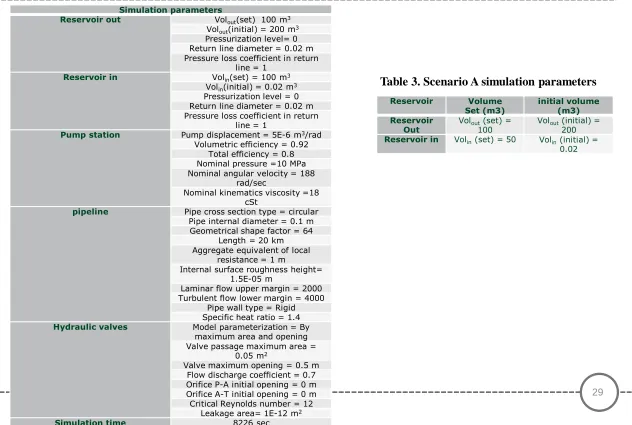
Simulation parameters
Reservoir out Volout(set) 100 m3
Volout(initial) = 200 m3
Pressurization level= 0 Return line diameter = 0.02 m Pressure loss coefficient in return
line = 1
Reservoir in Volin(set) = 100 m3
Volin(initial) = 0.02 m3
Pressurization level = 0 Return line diameter = 0.02 m Pressure loss coefficient in return
line = 1
Pump station Pump displacement = 5E-6 m3/rad
Volumetric efficiency = 0.92 Total efficiency = 0.8 Nominal pressure =10 MPa Nominal angular velocity = 188
rad/sec
Nominal kinematics viscosity =18 cSt
pipeline Pipe cross section type = circular Pipe internal diameter = 0.1 m Geometrical shape factor = 64
Length = 20 km Aggregate equivalent of local
resistance = 1 m
Internal surface roughness height= 1.5E-05 m
Laminar flow upper margin = 2000 Turbulent flow lower margin = 4000
Pipe wall type = Rigid Specific heat ratio = 1.4
Hydraulic valves Model parameterization = By maximum area and opening Valve passage maximum area =
0.05 m2
Valve maximum opening = 0.5 m Flow discharge coefficient = 0.7 Orifice P-A initial opening = 0 m Orifice A-T initial opening = 0 m
Simulation Setting
29
Reservoir Volume
Set (m3) initial volume (m3) Reservoir
Out Volout100(set) = Volout(initial) = 200
Reservoir in Volin(set) = 50 Volin(initial) =
0.02
Table 1. Normal condition simulation parameters
Various simulation data were used to create this model which will
be the prediction tool for the supervision system.
NF model
Stage One:
Test
Stage One Results
32
Simulation in Simscape Software
Package
Stage Two:
Hierarchy Neuro-fuzzy Supervision
System
Oil
Produced
Terminate
Oil pumped through pipelines
IOT volume
sensors
IoT pressure
sensors
Oil
Received
Global Supervision unit
NF Models
yes
No Start
Pump units
Pumping relay stations
Production and relay valves
Stage Two:
Hierarchy Neuro-fuzzy Supervision
System
•
By adding Local Supervision System units near to the sensors, it is expected
it will reduce unnecessary communication traffic between the Global
Supervision system and the process sensors.
•
Decentralising will reduce the load on the Global System and will mean a
reduced impact if a single point of failure (SPOF) occurs
in the Global
System.
AI AI AI
Stage three;
IoT Hierarchy
Neuro-fuzzy
Supervision
System
36
Objects Layer
Information AcquisitionMobile Wireless Sensor Network (RFID,3G,4G,5G, GSM, UMTS, Wifi, Bluetooth Low Energy, Infrared, Zigbee)
Satellite
Wireless Access Point Data routing
mechainsm
Smart Phone
AI
Tablet Devices Laptop/computer CPU
IoT Sensors
Gateway
Transport Layer/Network Layer
Application Service Layer
Application
Data
management
Data storage Interface Data miningProposed Action
Monitoring Intelligent
guidance
Monitoring and
Controlling Water
Monitoring and Controlling
Water Pipelines in Buildings
setup function{
begin serial data transmission;
state I/O pins used;
nullify variables;
}
loop{
for 1 second do:
flow1 = pulseCountInOneSecond / calibrationFactor;
flow2 = pulseCountInOneSecond / calibrationFactor;
if flow1 - flow2 > 0 for 5s -> leak();
else -> no leak;
}
Prototype
flowchart
Flow meter rates comparison graph
Implementation in Progress of
CollaborateCom2019
Full Paper Submission deadline
31 March 2019
To be held in August
KEYNOTES
•
Niki Trigoni a Professor at Oxford University Department of
Computer Science and fellow of Kellogg College.
•
Professor Tasos Dagiuklas is the leader of the Smart Internet
Technologies (SuITE) research group at the London South
Bank University where he also acts as the Head of Division in
Computer Science. Tasos has 10+ EU projects and received
funding of £7+ million,
•
Mr Jun Xu is Vice President of Huawei Cloud Division, before
he was Vice President of Huawei Enterprise USA in that role.
Aim
Bring together practitioners and researchers from both academia
and industry in order to have a forum for discussion and technical
presentations on the
recent advances in application and
implementation of the Internet of Things in Engineering
.
Researchers are invited to submit their state-of-art work to
address the IoT challenges in Engineering application and
showcase achievements in the field.
Topics of interest include, but are not limited to:
•
Engineering Applications, including: Smart Grid/Smart Metering;
surveillance and Intelligent Transportation Systems.
•
Smart House/Neighborhood/City, including: Mobility
management, Context awareness, Sustainable design and
Industrial use cases showing gaps to be filled by future research
2.
Effective Cardiology Diagnostic
learning framework for human
electrocardiograms (ECGs) readings
Motivations :
-
Globally, cardiovascular conditions are the
most common cause
of death.
-
To
reduce diagnostic and therapeutic errors
that are
inevitable in human clinical practice.
-
To
improve healthcare quality and outcomes
and providing
affordable care in health sector (e.g. NHS).
-
To
eliminate inefficiencies
that leads to cost-saving
Main Research Aim
:
Establish and test a diagnostic framework based on Patients
Electrocardiograms (ECGs) Readings. The Cardiology framework is a deep
learning system based on big data analysticss (patient records) and
classification
Patient medical condition Report
Patient data
Filters
Classification
Image
AI
Wearable seansors
2.
Deep learning Diagnostic Procedure
Motivation:
•
Improve students’ engagement
in their modules, and hence
improve the overall quality of their attempt at summative
assessment, by using a range of feed-forward techniques.
•
Encourage moving from feedback to feed-forward
. The end
of module feedback given to students is difficult to feed-forward
into future assessment
Main Research Aim
:
The aim is to
evaluative mechanisms and methods
to assess
the
effectiveness
of
feed-forward
within
assessment
intervention.
3.
Assessment in Education
4. Renewable Energy Management System
Motivations :
•
Better quality of service
in Micro Grid (MG) electricity stations. will optimize the
electrical vehicle (EV) user time and decide the optimize solution for the driver
according of his needs.
•
Another step forward to create
smart city
•
Efficient management system
for EV will encourage more people to own one
before 2040.
Main Research objectives
:
Design and create a management system
for the renewable energy in MG
electricity stations with the Support of Artificial Intelligence and Internet of Things
(IoT).
Renewable Energy for
Electricity Stations in Micro Grid
a
Electricity station (WT)
Petrol and electricity station
with
Mobile charging unit Petrol and
Electricity station
(PV)
b
c
1
2
3