Volume 2007, Article ID 81282,11pages doi:10.1155/2007/81282
Research Article
Biomedical Image Sequence Analysis with Application to
Automatic Quantitative Assessment of Facial Paralysis
Shu He,1John J. Soraghan,1and Brian F. O’Reilly2
1Department of Electronic and Electrical Engineering, University of Strathclyde, Royal College Building, Glasgow G1 1XW, UK 2Institute of Neurological Sciences, Southern General Hospital, 1345 Govan Road, Glasgow G51 4TF, UK
Received 26 February 2007; Revised 20 August 2007; Accepted 16 October 2007
Recommended by J.-P. Thiran
Facial paralysis is a condition causing decreased movement on one side of the face. A quantitative, objective, and reliable assessment system would be an invaluable tool for clinicians treating patients with this condition. This paper presents an approach based on the automatic analysis of patient video data. Facial feature localization and facial movement detection methods are discussed. An algorithm is presented to process the optical flow data to obtain the motion features in the relevant facial regions. Three classification methods are applied to provide quantitative evaluations of regional facial nerve function and the overall facial nerve function based on the House-Brackmann scale. Experiments show the radial basis function (RBF) neural network to have superior performance.
Copyright © 2007 Shu He et al. This is an open access article distributed under the Creative Commons Attribution License, which permits unrestricted use, distribution, and reproduction in any medium, provided the original work is properly cited.
1. INTRODUCTION
Facial paralysis is a condition where damage to the facial nerve causes weakness of the muscles on one side of the face resulting in an inability to close the eye and dropping of the angle of the mouth. The commonest cause of facial palsy is a presumed herpes simplex viral infection, commonly re-ferred to as Bell’s palsy, which causes temporary damage to the facial nerve. Treatment of such viral infections has been the source of controversy in the past, partly because it has been difficult to audit the effectiveness of treatment. Facial paralysis may also occur as a result of malignant tumors, her-pes zoster infection, middle ear bacterial infection, following head trauma, or during skull base surgical procedures, par-ticular in the surgical removal of acoustic neuroma [1]. As the facial nerve is often damaged during the neurosurgical removal of these intracranial benign tumours of the hearing nerve, facial nerve function is a commonly used indicator of the degree of success of the surgical technique. As most meth-ods of assessing facial function are subjective, there is a con-siderable variability in the results between different assessors. Traditional assessment of facial paralysis is by the House-Brackmann (HB) grading system [2] which was proposed in 1983 and has been adopted as the North American standard for the evaluation of facial paralysis. Grading is achieved by asking the patient to perform certain movements and then
using clinical observation and subjective judgment to assign a grade of palsy ranging from grade I (normal) to grade VI (no movement). The advantages of the HB grading scale are its ease of use by clinicians and that it offers a single figure description of facial function. The drawbacks are that it re-lies on a subjective judgment with significant inter- and in-traobserver variation [3–5] and it is insensitive to regional differences of function in the different parts of the face.
and then measuring the intensity difference and edge diff er-ence between the two sides of the face. However, this method cannot separate the intrinsic facial asymmetry caused by fa-cial nerve dysfunction from the extrinsic fafa-cial asymmetry caused by orientation, illumination, shadows, and the natu-ral bilatenatu-ral asymmetry.
In this paper, we present an automated, objective, and re-liable facial grading system. In order to assess the degree of movement in the different regions of the face, the patient is asked to perform five separate facial movements, which are raising eyebrows, closing eyes gently, closing eyes tightly, screwing up nose, and smiling. The patient is videotaped us-ing a front face view with a clean background. The video se-quence begins with the patient at rest, followed by the five movements, going back to rest between each movement. A highly efficient face feature localization method is employed in the reference frame that is grabbed at the beginning of the video during the initial resting phase. The image of the subject is stabilized to compensate for any movement of the head by using block matching techniques. Image subtraction is then employed to identify the period of each facial move-ment. Optical flow is calculated to identify the direction and amount of movement between image sequences. The opti-cal flow computation results are processed by our proposed method to measure the symmetry of the facial movements between each side of the face. These results combined with the total pixel intensity changes and an illumination com-pensation factor in the relevant facial regions are fed into classifiers to quantitatively estimate the degree of movement in each facial region using the normal side as the normal base line. Finally, the regional results are then fed into to another classifier to provide an overall quantitative evaluation of fa-cial paralysis based on HB Scale. Three classification meth-ods were applied. Experiments show the radial basis function (RBF) neural network has superior performance.
The paper is organized as follows. InSection 2, the face feature localization process is presented. In Sections3 and
4, image stabilization and key movements detection are in-troduced. In Section 5, the algorithms of the extraction of motion features are developed. InSection 6, the quantitative results obtained from three classification methods are com-pared andSection 7concludes the paper.
2. LOCALIZATION OF FACIAL REGIONS
Many techniques to detect faces have been developed. Yang [14, 15] classifies them into four categories: knowledge-based, feature-knowledge-based, template-knowledge-based, and appearance-based. Template-based and appearance-based methods can be ex-tended to detect faces in cluttered background, different poses, and orientation. However, they need either lot of pos-itive and negative examples to train the models or they need to be initialized manually and their computation is either time or memory intensive [15]. Our main objective is to de-velop an automatic assessment of facial paralysis for clinical use by measuring facial motion. In order to localize the facial features quickly, accurately and without any manual interac-tion, the patient is videotaped using a front face view with a clean background. Knowledge-based methods are designed
F-L F-R
E-R E-L
N-L N-R
M-L M-R
Figure1: Illustration of facial regions. F: forehead region; E: eye
region; N: nasal region; M: mouth region, L: left, R: right.
mainly for face localization in uncluttered background but a method is proposed for facial feature localization. It pro-cesses a 720×576 image in 560 milliseconds on a 1.73 GHz laptop. It was tested using 266 images in which faces have the in-plane rotation within±35 degrees and achieved a 95.11% accuracy for all eight facial regions as shown inFigure 1to be localized precisely.
The face area is segmented, the pupils are localized and the interpupil distance is then used to scale the size of each fa-cial region. The middle point between the two pupils is used as a fulcrum to rotate the interpupillary line to the horizon-tal so that the face is made perpendicular in the image. Since most subjects and especially those with a facial palsy do not have bilateral symmetrical faces, the mouth may not be sym-metric on the line of the pupil middle point. The mouth cor-ners are therefore separately localized and the middle point of the mouth is assigned. The nasal regions are initially as-signed by the positions of the pupils and the middle point of mouth. They are calibrated by minimizing the difference between the left and right sides of nose. Finally, a face region map is assigned as shown inFigure 1.
2.1. Face boundary search
The face area has to be identified before starting the search for the face features. In our approach, the subject’s face is viewed frontally and is the only object in the frame. The face boundary can be detected by horizontal and vertical pro-jections of an edge-detected image. Figure 2 demonstrates that the left and right face boundaries are identified by verti-cal projection of a Sobel-filtered image. Similarly, horizontal projection of the binary image is used to find the top bound-ary of face.
2.2. Detection of the ROI of eyes and mouth
(a) Original frame (b) Sobel filering
8.7 37.03
Gr
ay
va
lu
e
0 719
Distance (pixels) (c) Vertical projection
Figure2: Face boundary detection using Sobel filter and vertical projection.
the collar. The intensity values of Gaussian-weighted image can be expressed as
I(x,y)=Ioriginal(x,y)∗w(x,y), (1)
whereIoriginal(x,y) denotes the intensity value of original
im-age at pixel (x,y), andw(x,y) is computed as
w(x,y)=e−((x−xo)2+(y−yo)2)/(2∗((xright−xleft)/3)2), (2)
wherexrightandxleftare the horizontal positions of right and
left face boundaries. The center of the face (xo,yo) can be
estimated as
xo=xleft+ (xright−xleft)/2,
yo=ytop+ (xright−xleft)∗3/4 (3)
since the height of face is approximately 1.5 times of the width. The ROI (region of interest) of the head is assigned with thexright,xleft,ytop.
Due to varied skin color and lighting conditions, a dy-namic threshold is applied to the image such that only those facial features information is included for analysis. It is ob-tained by the solution of
1 N∗
M
i=Threshold
C(i)=0.1. (4)
Here, the threshold is set to a value that only 10% of pixels present since the irises, nostrils, and the mouth border oc-cupy no more than 10% of the ROI of head.Nis the number of pixels in the ROI of head. C(i) = Histogram (ROIhead).
M=255 if working on 8-bit images.
An example of an inverted, thresholded, Gaussian-weighted image is shown inFigure 3(a). The vertical position of eyebrow, eye, nostril, mouth can be determined by its hor-izontal projection as shown inFigure 3(b). In some cases, the eyebrow or nostril may not be identified but only the pupils and mouth corners are the essential key points necessary to assign the facial map. With the eyes and mouth vertical po-sition and the face borders, the ROI of eyes and mouth on each side can be set to allow refining of the pupils and mouth corners positions.
2.3. Pupil search
This approach is based on the characterization of the iris and pupil. The iris-pupil region is dark compared to the white of the sclera of the eye ball and to the luminance values of the skin color. The iris localization is based on an eye tem-plate which is a filled circle surrounded by a box. The filled circle represents the iris and pupil as one part [17]. The eye width to eye height relation can be expressed as approxi-mately 3 : 1, and the eye height is interpreted as the iris di-ameter [18]. Therefore, the eye template can be created as shown inFigure 4(a). This eye template is scaled automati-cally depending on the size of the face area. The iris is roughly localized by searching the minimum difference between the template and the ROI of the eye. The pupil is darker than the iris and therefore its position can be determined by searching the small circle with the lowest intensity value within the iris area. Here, the diameter of a small circle is set to be 1/3 of the iris diameter.
2.4. Mouth corner search
(a) Gaussian filtering of face
Eyebrow Eye Nostril
Mouth
(b) Horizontal projection (c) ROI of eyes and mouth
Figure3: Detection of the vertical position of facial features.
(a) Eye template (b) Detected pupil center
Figure4: Pupil center detection.
n
n n
n
n Nucleus
USAN
Figure5: USAN corner detector.
the right candidates [20]. An example of the detected mouth corners is shown inFigure 6.
3. IMAGE STABILIZATION
Subjects will raise their head spontaneously when asked to raise there eyebrows and also shake their head while smiling. Before measuring facial motion, these rigid global motions need to be removed so that only the nonrigid facial expres-sions are kept in the image sequences for analysis. Feature tracking is normally considered to help solve this problem. A set of features are tracked through the image sequence and their motion is used to estimate the stabilizing warping [21]. However, in our work there are no key features in the face which do not change in structure when the movements are carried out. Therefore, all facial features are used for track-ing. An ROI of the face encompassing the eyebrows, eyes, nose, and mouth in the reference frame is defined by the po-sition of the pupils, mouth corners, and interpupils distance, as shownFigure 7. The image is stabilized by finding the best matched ROI of the face between the reference and the subse-quent frames. The affine transformation given by (5) is
per-(a) (b)
Figure6: The detected mouth corners.
500 450 400 350 300 250 200 150 100
100 150 200 250 300 350 400 450 500 550 600
Figure7: The ROI of the face in the reference frame.
formed on the subsequent frame. Image stabilization can be formulated as a minimization problem given by (6),
x y
=
cosθ −sinθ sinθ cosθ
x y
+
dx d y
. (5)
Here, (x,y) is the original image coordinates, which is mapped to the new image at (x,y).dx,d yare the horizontal and vertical displacements.θis the rotation angle. The scal-ing factor is not included as the distance between the subject and the camera is fixed and the face maintains constant size through images sequences in our application,
(dxn∗,d yn∗,θn∗)=arg min
dx,d y,θ (x,y)⊂ROI
Tn(x,y)−Iref(x,y).
(6)
Here, dxn∗,d yn∗,θn∗ are the optimal transformation
pa-rameters for the framen.Iref(x,y) is the intensity of pixel at
(x,y) in reference frame.Tn(x,y) is the intensity of pixel at
dxn,d yn,θn are initialized to the optimal values in the last
framedxn−1∗,d yn−1∗,θn−1∗.
4. KEY MOVEMENTS DETECTION
To examine the five key movements in the relevant regions, the timings of the five movements are identified. An algo-rithm based on image subtraction is proposed to determine the start and end of each movement so that information is only extracted from the appropriate time in the videos and from the appropriate facial region. The video sequence be-gins with the subject at rest followed by the five key move-ments and going back to rest in-between each movement. Therefore, the rest frames between movements have to be detected as splice points. This is achieved by totaling up sev-eral smoothed and varying thresholded pixel changes until five peaks and four valleys of sufficient separation can be ex-tracted. The equation to produce the line from which the splice points can be detected is given in (7) as follows:
Y(n)=smooth
4
m=0(x,y)⊂ROI
thresh
×In(x,y)−Iref(x,y), (0.1 + 0.02m)
.
(7)
Here,In(x,y) andIref(x,y) are the intensity of pixel (x,y) at
thenth frame and the reference frame. The ROI is the face re-gion, defined in session III.mis index for the threshold level. 0.1 is an empirical threshold bias to keep the high-intensity changes and remove the small pixel changes which may be produced by noise. The varying intensity of motion can be detected by changingm. By summing the different intensi-ties of motions, the peak of motion is obvious and the splice points are easy to detect.
An example ofY(n) is the highest curve inFigure 8while the rest five curves from up to bottom are the plots atm=0 to 4, respectively. The splice points are shown as the dotted lines inFigure 8. The five displacement peaks of movement correspond to the five key movements in the exercise: raising eyebrows, closing eyes gently, closing eyes tightly, scrunching nose, big smile.
5. REGIONAL FACIAL MOVEMENT ANALYSIS
5.1. Motion magnitude by image subtraction
Neely et al. showed that image subtraction is a viable method of quantifying facial paralysis [9,10]. This method is therefore used to measure the motion magnitude of each key movement in the relevant region. Figure 9(a)
shows a reference frame grabbed with the subject at rest.
Figure 9(b) shows the frame with the subject raising eye-brows. Figure 9(c) is the difference image between Figures
9(a) and9(b). The pixel is bright if there have been pixel changes and it is black if there has been no change. From
Figure 9(c)it is clear that there are some changes in the fore-head with no difference in the areas of the nose or mouth.
0 1 2 3 4 5 6 7 8 9
T
otal
pix
el
ch
ange
×104
0 100 200 300 400 500
Frame number
Figure8: Total of thresholded, smoothed, pixel displacements.
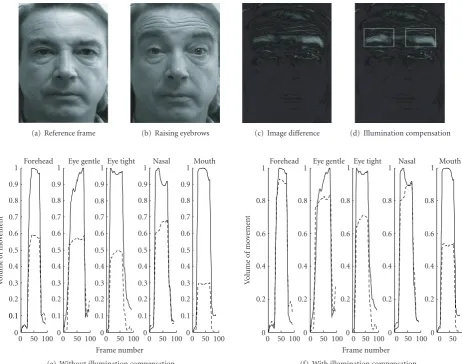
It has been observed that in general the more light falls on a region of the face, the more changes will be detected and the results of video taken in nonhomogeneous light-ing conditions may be skewed. In our work, after the facial map is defined in the reference frame, the ratios of the in-tensity mean values between left side and right side in the relevant regions are calculated and then used as illumination compensation factors to adjust subsequent frames.Figure 9
illustrates a frame taken in nonhomogeneous lighting con-ditions. The original image lighting conditions are shown inFigure 9(a). This subject has almost completely recovered except for a mild weakness of the eye and mouth on the right side.Figure 9(c)shows difference between images Fig-ures9(a)and9(b). Note that the left side of the image is the subject’s right side. Here, it is obvious that more changes are detected on the left side of the forehead than on the right side.Figure 9(d)shows that the difference between im-ages after the illumination compensation for the forehead re-gion has been applied. The highlighted areas have the similar intensity, that is similar movement magnitude. The move-ment magnitude in the relevant region can be computed by (8) as
mag(n)=
(x,y)⊂R
In(x,y)−Iref(x,y)∗w(x,y)∗lum, (8)
where w is the Gaussian weights, similar to (1), but set (xo,yo) to be the center of the region,xrightandxleftare right
and left boundaries of the region, and lum is the illumination compensation factor, which is set to
lum=
(x,y)⊂left
Iref(x,y)/ (x,y)⊂right
Iref(x,y) (9)
for right side, and lum=1 for left side.
(a) Reference frame (b) Raising eyebrows (c) Image difference (d) Illumination compensation
0 0 0 0 0
0.1 0.1 0.1 0.1 0.1
0.2 0.2 0.2 0.2 0.2
0.3 0.3 0.3 0.3 0.3
0.4 0.4 0.4 0.4 0.4
0.5 0.5 0.5 0.5 0.5
0.6 0.6 0.6 0.6 0.6
0.7 0.7 0.7 0.7 0.7
0.8 0.8 0.8 0.8 0.8
0.9 0.9 0.9 0.9 0.9
1
1 1 1 1
0.1
0 50 100 0 50 100 0 50 100 0 50 100 0 50 100 Forehead Eye gentle Eye tight Nasal Mouth
V
o
lume
of
mo
ve
ment
Frame number (e) Without illumination compensation
0
0.2 0.2 0.2 0.2 0.2
0.4 0.4 0.4 0.4 0.4
0.6 0.6 0.6 0.6 0.6
0.8 0.8 0.8 0.8 0.8
1 1 1 1 1
0 0 0 0
0 50 100 0 50 100 0 50 100 0 50 100 0 50 100 Forehead Eye gentle Eye tight Nasal Mouth
V
o
lume
of
mo
ve
ment
Frame number (f) With illumination compensation
Figure9: Illustration of the solution of varying illumination.
plots inFigure 9(e) show the magnitude of the five move-ments in the relevant facial region. The broken line indicates the detected movement on the subject’s right side of the face and the solid line indicates the movement detected on the left. Thex-axis shows the frame count for each movement and the y-axis indicates the proportional volume of move-ment from the reference frame, the normal side being stan-dardized to 1. The output from the forehead and nose show similar responses for the left and right sides but the move-ment amplitude for the eye and mouth region for right side is weaker than left side.
Figures9(e)and9(f)compare the results with and with-out illumination compensation. Figure 9(e) indicates that detected motion on the right is significantly less than the left whileFigure 9(f)shows similar movement magnitude for both sides except for the eye and mouth, which is in keeping with the clinical situation.
The illumination compensation factors, which are the ra-tios of the intensity mean values between the left and right side for each region, are between 0.56 and 1.8 for all the subjects’ videos in our study. This illumination compensa-tion method is very effective in correcting the magnitude
but it needs to be investigated further whether the illumi-nation compensation factors can be used linearly to ad-just the intensity for those videos with ratios out of this range.
5.2. Motion measurement by optical flow
The magnitude of the movement on each side of the face (i.e.,
be measured but the direction should also be taken into ac-count when assessing the degree of palsy.
Optical flow is an approximation of the velocity field re-lated to each of the pixels in an image sequence. Such a dis-placement field results from the apparent motion of the im-age brightness in time [22]. In a highly textured region, it is easy to determine optical flow and the computation con-verges very fast because there are high gradients in many di-rections at every location. Optical flow to track facial mo-tion is advantageous because facial features and skin have a great deal of texture. There are many methods for the es-timation of optical flow. Barron and Fleet [23] classify op-tical flow algorithms by their signal-extraction stage. This provides four groups: differential techniques, energy-based methods, phase-based techniques, and region-based match-ing. They compared several different methods and concluded that the Lucas-Kanade algorithm is the most accurate.
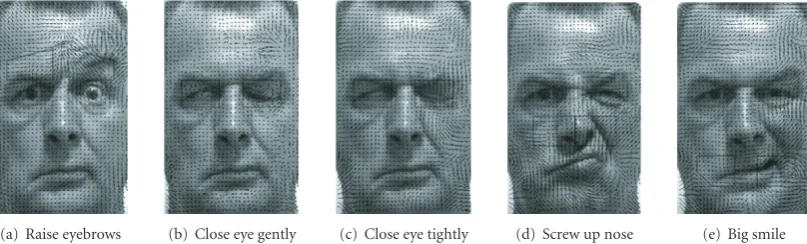
The Lucas-Kanade algorithm [24], including the pyra-mid approach, is employed to compute optical flow on five pairs of images, that is the reference frame and the frame with maximum motion in each movement. Using the pyra-mid method with reduced resolution allows us to track the large motion while maintaining its sensitivity to subtle facial motion and allows the flow computation to converge quickly. Figures10–12show the results of optical flow estimation for a normal subject, a left-palsy subject and a right-palsy sub-ject. InFigure 10, the motion flows are approximately sym-metrical between two highlighted regions. There is almost no motion in the left side of the forehead and the nose in Figures
11(a)and11(d), whereas there is an obvious flow towards right on the left side of mouth inFigure 11(e). Note that the right side of image is the subject’s left side.Figure 12shows a subject who cannot close his eye but when attempting to do so his iris moves upward. Although this movement of the iris is detected by the image subtraction method, it should be discriminated from the motion of the eyes closing and re-moved from the calculation of the degree of movement. Fig-ures12(b)and12(c)shows little flow detected in the right eye confirming the severe palsy in the eye region.
In each facial feature region, the flow magnitude is thresholded to reduce the effect of small computed mo-tions which may be either produced from textureless areas or affected by illumination and the flow magnitude is center weighted by a Gaussian filter. Given the thresholded flow vec-torvi =(ui,vi) in the region, the overall flow vector of each
region can be expressed asv=(u,v), the components of the vector,uandv, denote of overall displacement on the hor-izontal and vertical direction.u=iui∗wi,v=
ivi∗wi,
herewiis the Gaussian weights, similar to (1), but set (xo,yo)
to be the center of the region,xrightandxleftare right and left
boundaries of the region.
When subjects raise their eyebrows, close their eyes or screw up their nose, the muscles in each relevant region move mainly in the vertical direction. Studies have shown that even for normal subjects neither the amplitude nor the orientation of horizontal displacements on each side are con-sistently symmetrical.Figure 13shows two normal subjects raising their eyebrows. InFigure 13(a), the mean horizon-tal displacements are negative for both sides, that is, in the
same direction, while inFigure 13(b), the mean horizontal displacements on each side are opposite. InFigure 13(a), the amplitude of the mean horizontal displacements in the left side is larger than that in the right side, while inFigure 13(b)
they are similar. The movement in the horizontal direction does not contribute much information when measuring the symmetry of the eyebrow, eyes, or nose movements. There-fore, the displacements strength and the vertical displace-ments are only used for these symmetry measuredisplace-ments. The symmetry of the facial motion is quantified by
Symy=1−
|vleft−vright
vleft+vright, (10)
Symr=1−
vleft − vright vleft + vright
, (11)
wherevleftandvrightare the overall vertical displacements for
left side and right side,vleftandvrightare the overall flow
vec-tor for left side and right side. Symyand Symrwill be within
the range 0-1. The motions on each side of face are symmet-rical when both approximate 1. When both approximate 0 the dysfunctional side has no movement at all. While when Symy=0 and Symr=1 indicate that the motion on each side
is the same amplitude but opposite direction, that is one eye closed, the other eye cannot close but the iris moves upwards in the presence of severe paralysis.
The muscle around the mouth will move to the side of face when normal people smile. The horizontal displace-ments should be negative, that is, move towards the left on the left side of mouth; and should be positive, that is, move towards the right on right side. This is used as a constraint to calculate the overall flow vector of left region and right region, formulated as
uleft=
ui<0 ui∗wi,
vleft=
ui<0 vi∗wi,
uright=
ui>0 ui∗wi,
vright=
ui>0 .
(12)
In the left mouth region, each motion vector with a negative horizontal displacement is taken into account. Only those with the positive horizontal displacement are taken into ac-count for the right side. This allows elimination of the ap-parent muscle movement on the weak side produced by the muscles on the normal side as in Figures11(e)and12(e).
This method was tested in 197 videos. Symy and Symr
are correlated with HB grade around 0.83 in the forehead and around 0.7 in the rest of the region. Details are shown inTable 1.
6. QUANTITATIVE ASSESSMENT AND EXPERIMENTS
6.1. Quantitative assessment
(a) Raise eyebrows (b) Close eye gently (c) Close eye tightly (d) Screw up nose (e) Big smile
Figure10: Results of optical flow estimation on five frames with peak motion for a normal case.
(a) Raise eyebrows (b) Close eye gently (c) Close eye tightly (d) Screw up nose (e) Big smile
Figure11: Results of optical flow estimation on five frames with peak motion for a left palsy case.
Table1: Correlation analysis between Symy, Symr, and HP grade.
Corr with Symy Corr with Symr
Forehead 0.8303 0.8381
Eye gentle 0.7351 0.7603
Eye tight 0.6968 0.7071
Nose 0.6981 0.7199
Mouth 0.7158 0.7206
There are a number of classification methods. k-nearest neighbor (k-NN), artifical neural network (ANN), and sur-port vector machine (SVM) are the most widely used clas-sifiers. They can be used successfully for pattern recognition and classification on data sets with realistic sizes. These three classification methods were employed for the quantitative as-sessment of regional paralysis and the overall facial paralysis. The HB grades the overall facial nerve function and it is insensitive to small changes in each facial region.
The regional facial function is measured by examining the key movements in the relevant region and classified to six grades from 1 (normal) to 6 (total paralysis). Five clas-sifiers are trained for the five movements, respectively. Each has four inputs as follows.
(1) arg min (magleft, magright)/arg max (magleft, magright). Here, magleft, magright denotes the total relative pixel change in the region from the resting face to the peak of the movement, which can be calculated using (8). The input value computed here gives the ratio of the
total pixel change between the dysfunctional side and the normal side.
(2) The illumination compensation factor, calculated by (9), which is the ratio of mean intensities for each re-gion between the dysfunctional side and the normal side. Although the illumination compensation factors can be used to correct the magnitude if it is between 0.56 and 1.8, the performance of this linear compen-sation is not ideal. As shown inFigure 9(d), the two highlighted regions have the similar intensity but are not identical. In order to further compensate for the illumination, the illumination factor is included as an input to the classifier.
(3) Symy, defined by (10), represents the symmetry
rel-ative to the vertical component of the total amount of displacements from the resting face to the peak of movement.
(4) Symr, defined by (11), represents the symmetry
rela-tive to the strength of the total amount of displace-ments from the resting face to the peak of movement.
Outputs are graded from 1 to 6, with 6 representing severe palsy and 1 being normal. These regional results are then used as the inputs for the overall classifier to analyze the HB overall palsy grade.
6.2. Experiments
(a) Raise eyebrows (b) Close eye gently (c) Close eye tightly (d) Screw up nose (e) Big smile
Figure12: Results of optical flow estimation on five frames with peak motion for a right palsy case.
Table2: Test data performance of RBF NN.
Disagreement 0 1 2 3 4 5 ≤1
Forehead 68.71 24.52 4.02 2.75 0 0 93.23
Eye gentle 44.36 47.90 3.23 4.51 0 0 92.26
Eye tight 41.27 51.84 3.69 3.20 0 0 93.11
Nose 61.78 24.53 10.18 3.51 0 0 86.31
Mouth 49.80 38.22 8.43 3.55 0 0 88.02
HB 63.92 30.26 5.82 0 0 0 94.18
(a) Normal subject I (b) Normal subject II
Figure13: Results of optical flow estimation on forehead for two
normal subjects.
other aetiologies as well as normal subjects. Their HB and re-gional gradings were evaluated by a clinician. As the dataset was not large, the leave-k-out-cross-validation test scheme instead of k-fold was adopted.
Multilayer perceptron (MLP) network and radial basis function (RBF) network are the most popular neural net-work architectures [24,25]. Experiments show RBF networks provide consistently better performance than MLP networks for facial palsy grading. The centers of each RBF NN were ini-tialized using the k-means clustering algorithm before start-ing trainstart-ing.
Tables2,3, and4present the average classification per-formance, in percentages, for the 20 repetitions of the leave-k-out cross-validation, with k=20. The numbers in the first columns give the percentage of the results which are the same as the clinician’s assessments. Columns 2–6 show the percentages where the disagreement is from 1 to 5 grades, respectively. The last columns show the percentage of the disagreement within 1 grade. The comparison of the per-formance is graphically illustrated inFigure 14. The results show that the RBF NN outperforms the k-NN and SVM. The disagreement within one grade between the results of the RBF NN and the clinical assessment is 94.18% for the HB overall grading, which is 5.38% higher than SVM and
70 75 80 85 90 95 100
P
er
centage
of
disag
re
ement
w
ithin
1
gr
ad
e
Forehead Eye
tight Eye gentel
Nasal Mouth Overall H-B RBF
k-NN SVM
Figure14: Comparison of the performance of three RBF, k-NN,
SVM.
10.71% higher than k-NN. The variation of the performance for RBF NN is similar to that of SVM. Both RBF NN and SVM provide more stable results than the k-NN. The varia-tion of the results of disagreement within 1 grade is shown in
Table 5.
Table3: Test data performance of k-NN.
Disagreement 0 1 2 3 4 5 ≤1
Forehead 65.33 21.12 5.79 4.61 3.15 0 86.45
Eye gentle 39.91 44.57 7.73 5.90 1.89 0 84.48
Eye tight 36.73 45.62 6.65 5.28 5.72 0 82.35
Nose 55.68 21.83 13.47 7.11 1.91 0 77.51
Mouth 44.01 35.19 11.62 8.35 0.83 0 79.20
HB 58.13 25.26 12.88 3.73 0 0 83.39
Table4: Test data performance of SVM with Gaussian radial basis function kernel.
Disagreement 0 1 2 3 4 5 ≤1
Forehead 65.98 25.14 7.22 1.66 0 0 91.12
Eye gentle 41.05 44.32 9.81 4.82 0 0 85.37
Eye tight 38.79 48.33 10.88 2.10 0 0 87.12
Nose 59.28 23.45 14.32 2.95 0 0 82.73
Mouth 43.37 37.11 17.58 1.94 0 0 80.48
H-B 59.73 29.07 11.2 0 0 0 88.80
Table5: The variation of the performance (Disagreement≤1).
RBF k-NN SVM
Forehead 5.6% 8.1% 7.1%
Eye gentle 11.3% 14.6% 10.7%
Eye tight 11.0% 15.2% 10.2%
Nose 9.1% 13.5% 8.0%
Mouth 10.2% 14.2% 9.3%
HB 7.1% 13.3% 7.8%
are only 4 or 5 inputs in our work. The centers of each RBF NN were initialized using the k-means clustering algo-rithm before starting training. Experiments show that RBF networks can discover the nonlinear associations better than SVM and k-NN in our application.
6.3. Discussion
The most encouraging aspect of these results is that the dis-agreement within one grade between the results of the RBF NN and the clinical assessment was around 90% for regional grading and 94% for the HB overall grading. The best that clinical assessment alone can achieve is usually an inter- or intraobserver variation of at least one grade. The system is objective and stable as it provides the same regional results and HB grade during the analysis of different videos taken from the same subjects on the same day whereas clinicians have inconsistent assessments.
The subjects who could not finish the prescribed move-ments correctly failed to be correctly classified. The patients were asked to practice the prescribed facial movements be-fore being videotaped. These practice runs help minimize the noncorrespondence error.
The results show that the best agreement is in the fore-head region as in this region the optical flow can be estimated with a high degree of accuracy. The estimation of the optical
flow in the eye region has poor performance, especially for those faces with makeup or very irregular wrinkles on the eyelids. The structure of the eyebrows does not change sig-nificantly during raising of the eyebrows but the structure of eyes changed significantly when performing eye closure. The error of optical flow estimation in the other regions is the major reason for their disagreement being greater than 1 grade. More effective algorithms for the optical flow esti-mation should be investigated to offer more reliable results and for better performance of the networks for regional mea-surement. The disagreements between the clinical and the es-timated H-B values are greater than 1 grade only when the regional results introduce a higher average error.
The proposed algorithms have been implemented in Java with Java Media Framework (JMF) and ImageJ. The average video with 500 frames can be processed in 3 minutes on a 1.73 GHz laptop. This overall processing time should satisfy the requirement of the practicing physician.
7. CONCLUSION
method of measuring the degree of a facial palsy in a clinical setting.
REFERENCES
[1] C. Diamond and I. Frew,The Facial Nerve, Oxford University Press, Oxford, UK, 1979.
[2] J. W. House, “Facial nerve grading systems,”Laryngoscope, vol. 93, no. 8, pp. 1056–1069, 1983.
[3] C. H. G. Beurskens and P. G. Heymans, “Positive effects of mime therapy on sequelae of facial paralysis: stiffness, lip mo-bility, and social and physical aspects of facial disamo-bility,” Otol-ogy & NeurotolOtol-ogy, vol. 24, no. 4, pp. 677–681, 2003.
[4] J. B. Kahn and R. E. Gliklich, “Validation of a patient-graded instrumnet for facial nerve paralysis: the FaCE scale,” Laryn-goscope, vol. 111, no. 3, pp. 387–398, 2001.
[5] J. Linstrom, “Objective facial motion analysis in patients with facial nerve dysfunction,”Laryngoscope, vol. 112, no. 7, pp. 1129–1147, 2002.
[6] H. Scriba, S. J. Stoeckli, D. Veraguth, and U. Fisch, “Objec-tive evaluation of normal facial function,”Annals of Otology, Rhinology & Laryngology, vol. 108, no. 7, part 1, pp. 641–644, 1999.
[7] P. Dulguerov, F. Marchal, and D. Wang, “Review of objective topographic facial nerve evaluation methods,”American Jour-nal of Otology, vol. 20, no. 5, pp. 672–678, 1999.
[8] S. McGrenary, B. F. O’Reilly, and J. J. Soraghan, “Objective grading of facial paralysis using artificial intelligence analy-sis of video data,” inProceedings of the 18th IEEE Symposium on Computer-Based Medical Systems(CBMS ’05), pp. 587–592, Dublin, Ireland, June 2005.
[9] J. G. Neely, A. H. Joaquin, L. A. Kohn, and J. Y. Cheung, “Quantitative assessment of the variation within grades of fa-cial paralysis,”Laryngoscope, vol. 106, no. 4, pp. 438–442, 1996. [10] T. D. Helling and J. G. Neely, “Validation of objective measures for facial paralysis,”Laryngoscope, vol. 107, no. 10, pp. 1345– 1349, 1997.
[11] J. G. Neely, “Advancement in the evaluation of facial func-tion,” inAdvances in Otolaryngology—Head and Neck Surgery, vol. 15, pp. 109–134, Elsevier Science, New York, NY, USA, January 2002.
[12] G. S. Wachtman, Y. Liu, T. Zhao, et al., “Measurement of asym-metry in persons with facial paralysis,” inProceedings of Com-bined Annual Conference of the Robert H. Ivy and Ohio Valley Societies of Plastic and Reconstructive Surgeons, Pittsburgh, Pa, USA, June 2002.
[13] Y. Liu, K. L. Schmidt, J. F. Cohn, and S. Mitra, “Facial asym-metry quantification for expression invariant human identi-fication,”Computer Vision and Image Understanding, vol. 91, no. 1-2, pp. 138–159, 2003.
[14] M.-H. Yang, D. J. Kriegman, and N. Ahuja, “Detecting faces in images: a survey,”IEEE Transactions on Pattern Analysis and Machine Intelligence, vol. 24, no. 1, pp. 34–58, 2002.
[15] M. H. Yang, “Recent advances in face detection,” inProceedings of 17th International Conference on Pattern Recognition (ICPR ’04), Cambridge, UK, August 2004.
[16] G. C. Feng and P. C. Yuen, “Multi-cues eye detection on gray intensity image,”Pattern Recognition, vol. 34, no. 5, pp. 1033– 1046, 2001.
[17] J. Rurainsky and P. Eisert, “Template-based eye and mouth de-tection for 3D video conferencing,” inVisual Content Process-ing and Representation, vol. 2849 ofLecture Notes in Computer Science, pp. 23–31, Springer, Berlin, Germany, 2003.
[18] L. G. Farkas,Anthropometry of the Head and Face, Raven Press, New York, NY, USA, 1995.
[19] S. M. Smith and J. M. Brady, “SUSAN—a new approach to low level image processing,”International Journal of Computer Vision, vol. 23, no. 1, pp. 45–78, 1997.
[20] M. Hess and G. Martinez, “Facial feature extraction based on the smallest univalue segment assimilating nucleus (SUSAN) algorithm,” in Proceedings of the Picture Coding Symposium (PCS ’04), San Francisco, Calif, USA, December 2004. [21] C. Guestrin and F. Cozman, “Image stabilisation for
fea-ture tracking and generation of stable video overlays,” Tech. Rep. CMU-RI-TR-97-42, Robotics Institute, Carnegie Mellon University, Pittsburgh, Pa, USA, November 1997.
[22] M. Elad and A. Feuer, “Recursive optical flow estimation— adaptive filtering approach,” inProceedings of the 19th Con-vention of Electrical and Electronics Engineers (EEIS ’96), pp. 387–390, Jerusalem, Israel, November 1996.
[23] J. L. Barron and D. J. Fleet, “Performance of optical flow techniques,”International Journal of Computer Vision, vol. 12, no. 1, pp. 43–77, 1994.
[24] S. Baker and I. Matthews, “Lucas-Kanade 20 years on: a uni-fying framework,”International Journal of Computer Vision, vol. 56, no. 3, pp. 221–255, 2004.