S H O R T R E P O R T
Open Access
High-dimensional star-shaped
distributions
Wolf-Dieter Richter
Correspondence:
[email protected] University of Rostock, Institute of Mathematics, Ulmenstraße 69, Rostock, Germany
Abstract
Stochastic representations of star-shaped distributed random vectors having heavy or light tail density generating functiongare studied for increasing dimensions along with corresponding geometric measure representations. Intervals are considered where star radius variables take values with high probability, and the derivation of values of distribution functions ofg-robust statistics is proved to be based upon considering random events whose probability is asymptotically negligible if the dimension of the sample vector is approaching infinity. Moreover, a principal component representation ofp-generalized elliptically contouredp-generalized Gaussian distributions is discussed.
Keywords: Increasing dimension, Star-shaped distribution, Star radius distribution,
Star-uniform distribution,p-generalized elliptically contoured distribution, Principal component representation,g-robust statistic, Indeterminate form
Introduction
Among the frequently obtained impressions one gets from analyzing high-dimensional data sets are that an observation point’s distance from the zero element of the sample space is likely to belong to a certain interval from the positive real line, away from zero, and that the distribution of the direction of the vector seems to be close, in a certain sense, to a uniform distribution on the set of all directions that are observable from a certain center. The first observation can be reflected from a probabilistic point of view by a measure concentration type property including what is done in (Biau and Mason 2015) and (Vershynin2016), and the second is part of background for testing uniformity on high-dimensional spheres, see e.g. (Cutting et al.2017), possibly after projecting data points onto spheres as, e.g., in (Banerjee and Ghosh2004).
In situations of the described type, it may be reasonable to model the data, or their residuals after fitting to a model, by multivariate star-shaped distributions. In this regard, (Balkema and Embrechts 2007) and (Balkema et al. 2010) discover conditions ensur-ing that star-shaped distributions with the Gauss-exponential law beensur-ing one of the most known examples appear as limit laws in certain high-risk scenarios.
Distributions from the class of star-shaped distributions are flexible with respect to convexity or radial concavity, allow different variability of probability mass along different directions of the sample space and are able to model light and heavy distribution centers and tails. Because there is no natural number being representative for large dimensions, one might like to consider sequences or schemas of series ofn-dimensional vectors with
napproaching infinity. However, for simplicity of notation, we instead consider here just a single random vectorXtaking values inRnand assume afterwards thatnis tending to infinity in formulas holding forX.
Let us recall at this point the following general aspect of uni- or multivariate asymp-totic probabilistic analysis being of particular importance, for example, in large deviation theory, but not exclusively there. Studying the limit behavior of certain sequences of dis-tributions on specific subsets of their ranges of definition and comparing it to how the appearing limit law itself behaves on the same sets needs to precisely know the latter one. In this respect, it is an independent problem to study the behavior limit laws show on the sets of interest. Similarly, if a sequence of distributions of increasing dimension is approx-imated in a certain part of its range of definition by a high-dimensional star-shaped limit law then studying the latter one is an independent problem being in the core of interest of the present note.
With the agreement of considering just one single vectorXof dimensionn, particular questions concerned by the buzzword ’big data’ are approached in the present short note by reflecting above mentioned impressions gained from data in the language of probabil-ity distributions. To be more specific, we are dealing here with star-shaped distributions inRnand correspondingly distributed vectors. Such vector allows a stochastic represen-tation as a product of a random generalized radius variableRand a random vectorU being star-uniformly distributed on a star-sphere and independent ofR, as well as a cor-responding geometric measure representation. Some consequences which can be drawn from these representations in case of increasing dimension are studied. In particular, a representation ofp-generalized elliptically contoured distributions is considered from the point of view of principal components.
The paper is structured as follows. In “Preliminaries” section, we present prelimi-nary facts on star-shaped distributions including the notions of star surface content measure and star-uniform distribution on a star sphere. “A principal component repre-sentation” section deals with the particular class ofp-generalized elliptically contoured distributions and it is studied there how they apply to modeling high-dimensional data. “A measure concentration property” section is then aimed to consider typical intervals whereRtakes values ifXis star-shaped distributed, and in “Ong-robust statistics” section distributions of univariate statistics are described which can basically be derived from star-uniformly distributed vectors. Such distributions are not affected by whetherXhas a density generating functionggenerating light or heavy distribution tails and is therefore calledg-robust. The derivation of values of distribution functions ofg-robust statistics is proved to be based upon considering random events whose probability is asymptotically negligible if the dimension of the sample vector is approaching infinity.
Preliminaries
LetK⊂Rnbe a star body having the origin in its interior and assume that the Minkowski functionalhK ofK is positively homogeneous of degree one. We callK(r) = rK and its
boundaryS(r) = rSthe star ball and star sphere of star radius r > 0, respectively. If
g :[ 0,∞) →[ 0,∞)satisfies 0 < I(n,g) < ∞whereI(n,g) =
∞
0
rn−1g(r)dr then it is
called a density generating function. In such case,
is called a star-shaped density andK its contour defining star body. The correspond-ing probability measure is denoted g,K and the normalizing constant allows the
representation
C(g,K)= 1
OS(S)I(n,g)
whereOS(S) means the star-generalized surface content ofS, see (Richter2014). If the
additional assumptionC(g,K)=1 is satisfied thengis called a density generator. In the following example, we recall an explicit analytical representation of the star-generalized surface content measureOSin caseSis ap-generalized ellipsoid with main axes of half
lengthsa1, ...,anand indicate relationships to representations in other particular cases.
Example 1Let K = {x ∈ Rn : |x|a,p ≤ 1} where |x|a,p =
n
i=1|
xi
ai|
p
1/p
,a =
(a1, ...,an)T,ai>0,i=1, ...,n,p>0, and S+(−)=S∩ {x:xn > (<)0}the upper (lower)
half of the(a,p)-ellipsoid S= {x:|x|a,p=1}. Then
OS(A)=an
⎛ ⎜ ⎝
G(A∩S+)
+
G(A∩S−)
⎞ ⎟
⎠ d(x1, ...,xn−1) 1−
n−1
i=1
|xi
ai|
p
1−1/p, A∈B(S) (1)
where G(A∩S+(−))= {ϑ∈Rn−1:∃η=η(ϑ)s.t.(ϑT,η)T ∈A∩S+(−)},B(S)=Bn∩S andBndenotes the Borelσ-field inRn.
• Ifp=2anda=1n=(1, ..., 1)TthenOS(A)is the Euclidean surface content of the
measurable subset A of S.
• Ifp=1thenOS(A)can be considered as a particular polyhedral generalized surface
content of A.
• IfOS,∞(A)is defined as the limit ofOS(A),A∈B(S)asp→ ∞thenOS,∞can be considered as another particular polyhedral generalized surface content measure. For the whole class of polyhedral generalized surface content measures, see (Richter and Schicker2017).
• Generalizations of representation (1) hold true for all cases where K is a ball with respect to any norm or antinorm, see (Richter2015).
The next example deals with the asymptotic behavior of star surface content and vol-ume of star spheres and star balls or ellipsoids, respectively, if dimension is approaching infinity.
Example 2[a] It is well known that if S is the Euclidean unit sphere thenOS(S) =ωn
whereωn=2πn/2/ (n2)is the Euclidean surface content of S. It is known thatarg sup
n ωn=
7and that ωn is monotonously decreasing starting from this value, see e.g. (Loskot and
Beaulieu2007). Moreover, according to Stirling’s formula,
OS(S)∼
√ 2e 1+61n(
2πe n )
(n−1)/2as n→ ∞
meaning that the ratio of the quantity on the left hand side divided by that of the right hand side tends to one if n tends to infinity. Obviously,OS(S)is tending to zero quite fast
(b)If S is the ln,p-sphere having unit star radius, p>0, then the star surface content of S is
known to beOS(S)=ωn,pwhereωn,p=2n( (1p))n/(pn−1 (np)).Note that
OS(S)∼
p
√ 2π
p
n
n p−12
2 (1p)
p
n
enp,n→ ∞.
Letn,p= ωnn,pdenote the volume of the ln,p-ball. The asymptotic relations following from
the latter one,
pn
n,p∼
pe
2
p
1
p
p
n and
p nlnn
n,p ∼
1
e, n→ ∞,
generalize two results given in (Chen and Lin2014) for the particular Euclidean case p=2.
(c)It is well known that the star surface content of the(a,p)-ellipsoid S= {x∈Rn:|x|a,p=
1}isOS(S)=a1· · ·anωn,p,thus
OS(S)∼a1· · ·an
p
√ 2π
p
n
n p−12
2 (1p)
p
n
enp, n→ ∞. (2)
If a random vectorXfollows the star-shaped densityϕg,K then it allows the stochastic
representation
X=d R·U
meaning thatXis distributed asR·U. The nonnegative random variableRis independent of the random vectorU,Rhas density function
fR(r)=I(n,g)−1rn−1g(r)I[0,∞)(r)
andUhas the star-uniform distribution
ωS(A)=
OS(A)
OS(S)
,A∈B(S).
Here, I[0,∞)(r) = 1 ifr ≥ 0 and I[0,∞)(r) = 0 otherwise. Accordingly, the geometric measure representation of star-shaped distribution laws reads
g,K(B)=
1 I(n,g)
∞
0
rn−1g(r)FS(B,r)dr,B∈Bn
where
FS(B,r)= OS
1
rB
∩S
OS(S) =ωS
1 rB
∩S
is the star sphere intersection proportion function of the set B. Let the Minkowski functional ofKbe denotedhK then
R=d hK(X),
andRis called the star radius ofX.
A principal component representation
It will be shown which way principal component analysis can be used to identify those components of such star-shaped distributed vectors being of major importance for the modeling process. In particular it turns out that covariance ellipsoids beingl2-ellipsoids have the same main axes as density level set ellipsoids beinglp-ellipsoids.
Let Xi,i = 1, ...,n be independent random variables correspondingly following the
densities
fp(x;μi,σi)=
Cp
σi
exp
−|x−μi|p
pσip
,x∈R
whereCp = p1−1/p/
2
1
p
. ThenEXi = μiandV(Xi) = κσi2are expectation and
variance ofXi, respectively,i=1, ...,n. Here and in what follows we use the notation
κ(n)=p2p
n+2
2
n
2
andκ=κ(1).
Letσ = (σ1, ...,σn)T,X = (X1, ...,Xn)T andμ = (μ1, ...,μn)T, thenX−μallows the
stochastic representation
X−μ=d Rσ,pUσ,p
whereRσ,p = |X−μ|σ,pandUσ,p = R1σ,p(X−μ)are independent. The star radiusRσ,p
follows thep-generalizedChi-distribution withnd.f. having according to (Richter2007) the density
f(r)= r
n−1e−rpp
pnp−1
n p
I[0,∞)(r),
and the stochastic basis vectorUσ,pis star-uniformly distributed on the star sphereS=
Eσ,pfrom Example 2(c) withai = σi,i = 1, ...,n,Uσ,p ∼ ωσ,p. Thus, using notation in
(Richter2014),Xbelongs to the classECσ,p,μ,Inand its density generating function can be
chosen asg(r)=gp(r)=e−
rp pI
[0,∞)(r). Note thatEUσ,p=0nand, becauseER2σ,p=κ(n),
cov(Uσ,p)= κ(κ
n)D 2
where
D=diag(σ1, ...,σn).
It follows thatEX = μandcov(X) = κD2. Now, denote an orthogonaln×n-matrix O=Oi,j
i,j=1,nand let the transpose of itsi’th row beOi=(Oi,1, ...,Oi,n)T. The random
vectorY=O(X−μ)follows thep-generalized elliptically contoured density
fY(y)=
Cn p
σ1· · ·σn
exp
−1
p|O
Ty|p
σ,p
,y∈Rn, (3)
that isY belongs to the classECσ,p,0n,O. Note thatEY =0nandcov(Y)=EYYT ==
κOD2OT =σi,j
i,j=1,nwhere
σi,j=cov(Yi,Yj)=κOTi D2Oj, 1≤i,j≤n.
Thus,fY =ϕgp,OKand the boundary ofKisS=Eσ,p. Note thatOKis a star body having
the properties introduced at the beginning of this section. The covariance ellipsoid ofYis
C()= {x∈Rn:xT−1x=1} =
x∈Rn:
n
i=1
||Oix||2
σ2
i
where yxmeans the orthogonal projection ofx into the linear space spanned up by
y. The main axes ofC()belong to the spaces spanned up by the vectorsOi and have
half lengths of size√κσi,i = 1, ...,n, respectively. Moreover, the setC()is symmetric
with respect to any of the linesLi = L{Oi},i =1, ...,n. The latter holds also true for the
p-generalized ellipsoids
OEσ,p= {Ox∈Rn:|x|σ,p=1}
becauseEσ,pis symmetric with respect to the lines
L∗i = {x∈Rn:x=λei,λ∈R},
fori=1, ...,n, and
OL∗i = {λOei:λ∈R} = {λ0i:λ∈R} =Li
with e1, ...,en being the standard orthonormal basis vectors inRn. One may chose the
variances according to the maximization procedure from principal component analysis, σ1 ≥ σ2 ≥ ... ≥σn. For high-dimensional data holdsσn → 0 asn → ∞. This
circum-stance allows to introduce data reduction. Therefore, methods from this area of statistical analysis apply to model data of arbitrary fixed or increasing dimension byp-generalized elliptically contoured distributions ifp≥1. Ifp∈(0, 1), certain maximization principles from PCA are to be changed with corresponding minimization principles. In this sense, representation (3) may be called a principal component representation ofp-generalized elliptically contouredp-generalized Gaussian densities. With slight changes, the density generating functiong =gpmay be replaced in (3) with an arbitrary one for representing
generalp-generalized elliptically contoured densities.
A measure concentration property
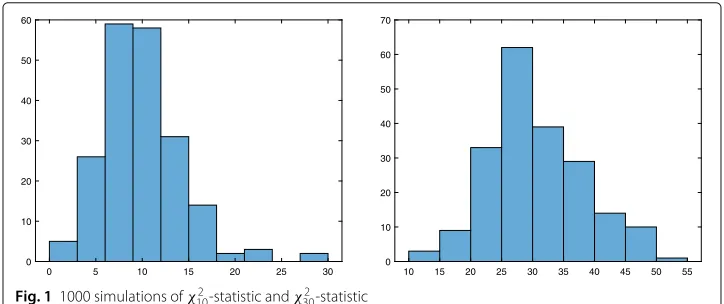
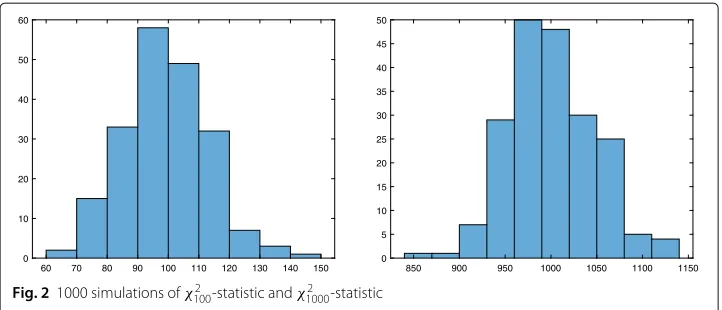
A χ2-distributed random variable with n d.f. can be considered as the square of the Euclidean norm of ann-dimensional standard Gaussian vector. The probability mass of such vector is the more concentrated in a relatively small shell having radius of order√n the larger the vector’s dimension is, see Figs.1and2. Observing the empirical ”relative concentration numbers” 30/10, 45/30, 90/100 and 300/1000 one may argue that suitably defined numbers might even converge to zero in some sense. This will be proved here within the even more general frame ofχp-distributions. For definitions and properties of
these distributions we refer to (Richter2007; 2009; 2014; 2015; 2016).
0 5 10 15 20 25 30
0 10 20 30 40 50 60
10 15 20 25 30 35 40 45 50 55 0
10 20 30 40 50 60 70
Fig. 11000 simulations ofχ2
60 70 80 90 100 110 120 130 140 150 0
10 20 30 40 50 60
850 900 950 1000 1050 1100 1150 0
5 10 15 20 25 30 35 40 45 50
Fig. 21000 simulations ofχ1002 -statistic andχ10002 -statistic
If a multivariate distribution converges to the standard Gaussian law then the square of the Euclidean norm of the correspondingly distributed vectorX, i.e. the square of the Euclidean radiusR= |X|1,2of such vector, will tend under some additional assumption to theχ2-distribution withnd.f. . Let nowXfollow a star-shaped distributiong,K, what
can we say then about the behavior of (the suitably defined power of ) its generalized (star) radius? In this section we derive typical intervals where star radius variables of high-dimensional star-shaped vectors take values.
Proposition 1Forδ >0chosen such that
α= δ12
I(n+2,g)I(n,g) I2(n+1,g) −1
is approaching zero as dimension n is tending to infinity, and independently of the shape defining star body K, the typical behavior of the random star radius of a vector following the star-shaped distributiong,Kwith density generating function g is described by
P
(1−δ)I(n+1,g)
I(n,g) ≤R≤(1+δ)
I(n+1,g) I(n,g)
≥1−α.
ProofObviously,
ERk = I(n+k,g) I(n,g) .
Now, Tschebyscheff ’s inequality applies
According to (Biau and Mason2015), the behavior of |X|1,p asnincreases is called
the distance concentration phenomenon in the computational learning literature. For sums of independent random variables or matrices, sharper concentration inequalities of exponential type are proved in (Vershynin2016).
For more details on moments ofp-spherical random vectors, see (Arellano-Valle and Richter2012), for an asymmetric situation if p = 1 see (Henschel and Richter2002). The following corollary deals with a class of light tailed high-dimensional star-shaped distributions.
Corollary 1Let K be any star body as introduced in “Preliminaries” section. If the density generating function of a high-dimensional star-shaped distributiong,Kis that of Kotz type
g(r)=rk−1e−trsI[0,∞)(r), and
δ √1
n
(meaning thatδ√n→ ∞as n→ ∞) then, for sufficiently large n, there holds
P
(1−δ) (
n+k s )
t1/s (n+k−1
s )
≤R≤(1+δ) (
n+k s )
t1/s (n+k−1
s )
≥1−α.
ProofFirst we check thatαtends to zero: because
I(n+2,g)I(n,g) I2(n+1,g) =1+
1
s(n+k) +O
1 n2
,
where O(.) means Landau’s big O symbol, it follows
α= δ12
1
s(n+k)+O
1 n2
,n→ ∞.
Suchαapproaches zero asntends to infinity ifδ2·n → ∞forn → ∞. Finishing the proof, we finally observe that
I(n+1,g) I(n,g) =
k+n s
t1/s k+n−1
s
Remark 1On using Stirling’s formula, it can be seen that
n+k s
n+k−1
s
=
n+k s
1/s
1+O
1 n
as n→ ∞. (4)
Before turning to the case of heavy distribution tails, we note that asymptotic relation (4) makes the statement of Corollary 1 more specific in the sense that
IKt(R)=
(1−δ)
n+k ts
1/s
,(1+δ)
n+k ts
1/s
is a reasonable interval whereRtakes values with high probability if we are given a high-dimensional star-shaped vector with density generating function of Kotz type and fixed or increasing dimensionn. The most essential role is played here by parameterswhich basically determines the relative heaviness or lightness of the distribution tails.
Corollary 2Let K be any star body as introduced in “Preliminaries” section. If the density generating function of a star-shaped distributiong,K is that of Pearson type VII with
parameters s>0,k>n+2[12] where k−n→ ∞as n→ ∞,
g(r)=1+ r s
−k
I[0,∞)(r),
and
δ √1
nas well asδ 1 √
then, for sufficiently large n, with probability greater or equal to1−α,the star-radius R of the high-dimensional vector X belongs to the interval
IP7(R)=
(1−δ) sn
k−n−1,(1+δ) sn k−n−1
.
ProofChecking thatαtends to zero, we find that
I(n+2,g)I(n,g) I2(n+1,g) =1+
1 n+
1 k−n−2+
1 n(k−n−2). The proof is finished by observing that
I(n+1,g) I(n,g) =
sn k−n−1
Remark 2Let δ = δ(n) → +0 and α = α(n) → +0 as n → ∞ such that
nδ2(n)→ ∞and assume that in the situation of Corollary 2 there holds additionally that
(k−n)δ2(n)→ ∞. The statements of Corollaries 1 and 2 can be reformulated then as
P(R> (1+δ)ER or R< (1−δ)ER)=O(α(n))as n→ ∞
where Landau’s symbol O defined for the asymptotic relation f(n) = O(g(n)), n → ∞ guaranties the existence of a constant C such that for all n there holds|f(n)/g(n)| ≤ C. Moreover, in the situation of Corollaries 1 and 2 we have that
ER=
n+k ts
1/s
1+O
1 n
andER= sn k−n−1,
respectively.
Remark 3Let us finally mention that because in fact we are considering sequences or even schemas of series of vectors and distributions, the assumption k−n → ∞stated in Corollary 2 is not contradictory. Instead, it ensures a certain variability of the result. More-over, we remark that (Henschel2001) and (Henschel and Richter2002) study the exact distribution of R in case of simplicially contoured vectors (or ln,1-spherical vectors having
nonnegative components). General ln,p-spherical vectors and their star radius R are studied
in (Richter2009), (Arellano-Valle and Richter2012) and (Richter2014), tables of corre-sponding exact quantiles of Rpand R are to be found in (Müller and Richter2016) and (Richter2016).
Ong-robust statistics
If the distribution of a statistic does not depend on the density generating functiongof a star-shaped sample vector densityϕg,K then it is commonly calledg-robust. It is well
known that Student and Fisher type statistics possess besides theg-robustness property further optimality properties. Here we will see that decisions based upon such statistics are done by closer analyzing random events whose probability is asymptotically negligible if the dimension of the sample vector is approaching infinity.
Let a random vectorXfollow the distribution lawg,K,X∼g,K, and the sets
B(t)= {x∈Rn:T(x) <t},t∈R
being generated by a statisticT :Rn→Rsuch that the equation
FS(B(t),r)=C(t),∀t
is satisfied whereC(t)∈[ 0, 1] does not depend onr. A statisticTof this type isg-robust. It follows by the geometric representation proved for star-shaped distributions in (Richter 2014) that
P(T(X) <t)=g,K(B(t))=
OS(B(t)∩S)
OS(S)
. (5)
The distribution law ofT(X)is determined already by that of vector’sXcentral projection onto the star sphereS. Thus, fort∈R, the probabilityP(T(X) <t)is defined by theωS
-value of the random eventB(t)∩Sin the geometric probability space(S,B(S),ωS), and its
representation in (5) will be called its ratio representation. It can be observed that many star spheres show the asymptotic behaviour
OS(S)→0 asn→ ∞. (6)
For a particular case of such type, see Example2(a). The statistical model concerned in this case is dealing with independent and homoscedastic random variables. In case of increasing dimensions, we are confronted then with sequences of probability spaces with asymptotically negligible setS.
Example 3In case S is the unit ln,p-sphere, condition (6) is satisfied.
In the following example we restrict our consideration to then-dimensional standard Gaussian lawg,K =whereg(r)=e−r2/2andK=x:x12+...+x2n≤1
.
Example 4A set A ⊂ Rn belongs to the classA(dir,dist) if there exist functions eA :
[ 0,∞)→Sn(1)and RA: [ 0,∞)→[ 0,∞)satisfying the following two assumptions:
A1)The set A allows the representation
A∩Sn(r)=Hn(eA(r),RA(r))∩Sn(r), r>0,
where Hn(e,R)= {x∈Rn:ex=λe,λ≥R}is a half space and Sn(r)the Euclidean sphere
of radius r.
A2)The functionC:[ 0,∞)→Rnwith
C(r)=RA(r)eA(r), r≥0
is a piecewise continuous curve such that A becomes a Borel set.
The functions eAand RAare called directional type and distance type functions of the set
A, respectively. If A∈A(dir,dist)then
(A)= C√(n−1)
2π
∞
0
rn−1e−r2/2 α∗(r)
0
(sinα)n−2dαdr,
α∗(r)= arctan(r/R
A(r))2−1
1/2∈(
where C(n) = 21−n/2/ (n/2), see (Richter1995). If the function r → α∗(r)is constant then
(A)= ωn−1
ωn
α∗
0
(sinα)n−2dα
where
ωn−1
ωn ∼
n
2π,n→ ∞.
Example 5Let σ1X,σ > 0,be a standard Gaussian distributed random vector in Rn. The statistic
Te,N = (X,e)
NX/√k
is known to be Student distributed with k d.f. for alle∈Sn(1)and all k-dimensional linear
subspacesN of Rnsuch thate⊥N and k≤n−1.
Let A = B(t) = {Te,N < t}. Then A∈ A(dir,dist)where eA(r) = e,the distance type
function is RB(t)(r)= ˜tr/(t˜2+1)1/2, ˜t=t/
√
n−1and the functionα∗(r)=arctan(1/˜t) is constant. Evaluating with k=n−1the limit of(A)as n→ ∞leads to the well known result0,1(t)where0,1 denotes the cumulative distribution function of the univariate standard normal distribution.
For similar properties of a corresponding exact Student test in nonlinear regression, see (Ittrich2000) and (Ittrich and Richter2005).
Example 6For a related consideration on the p-generalized Fisher statistic, see (Richter2009).
Remark 4If one is interested in avoiding the asymptotic negligibility of S in case of increasing dimension one may leave the class of statistical models dealing with indepen-dent homoscedastic observations. Density level sets of sample vectors having heteroscedas-tic components may be star-shaped. If S is an(a,p)-ellipsoid then, according to asymptotic relation (2), condition (6) may by violated and even asymptotically stabilizing.
Acknowledgement
The author likes to thank all the Reviewers, Associated Editor and Editor for their valuable comments.
Funding Not applicable.
Availability of data and material Not applicable.
Competing interests
The author declares no conflict of interest
Received: 5 September 2018 Accepted: 21 May 2019
References
Arellano-Valle, R. B., Richter, W.-D.: On skewed continuousln,p-symmetric distributions. Chil. J. Stat.3(2), 193–212 (2012)
Balkema, A., Embrechts, P., Nolde N.: Meta densities and the shape of their sample clouds. J. Multivar. Anal.101, 1738–1754 (2010)
Banerjee, A., Ghosh, J.: Frequency sensitive competitive learning for scalable balanced clustering on high-dimensional hypersurfaces. IEEE Neural Netw.15, 702–719 (2004)
Biau, G., Mason, D.: High-dimensional p-norms. In: Hallin P Mason, Steinebach (eds) Mathematical statistics and limit theorems, pp. 21–40. Springer, Cham, (2015)
Chen, C. P., Lin, L.: Inequalities for the volume of the unit ball inRn. Mediterr. J. Math.11, 299–314 (2014)
Cutting, C., Paindaveine, D., Verdebout, T.: Testing uniformity on high-dimensional spheres. Anna Stat.45(3), 1024–1058 (2017)
Henschel, V.: Ausgewählte lineare Modelle in simplizial konturiert verteilten Grundgesamtheiten. GCA-Verlag, Herdecke (2001)
Henschel, V., Richter, W.-D.: Geometric generalization of the exponential law. J. Multivar. Anal.81(2), 189–204 (2002) Ittrich, C.: Exakte Methoden in Regressionsmodellen mit einem nichtlinearen Parameter und sphärisch symmetrischen
Fehlern. Shaker, Aachen (2000)
Ittrich, C., Richter, W.-D.: Exact tests and confidence regions in nonlinear regression. Statistics.39, 13–42 (2005) Loskot, P., Beaulieu, N. C.: On monotonicity of the hypersphere volume and area. J Geo.87, 96–98 (2007).https://doi.org/
10.1007/s00022-007-1891-1
Müller, K., Richter, W.-D.: Extreme value distributions for dependentjointlyln,p-symmetrically distributed random
variables. Depend. Model.4, 30–62 (2016).https://doi.org/10.1515/demo-2016-0002
Richter, W.-D.: A geometric approach to the Gaussian law. In: Mammitzsch/Schneeweiß (ed.) Symposia Gaussiana, pp. 25–45. Walter de Gruyter & Co., berlin, Conf. B. (1995)
Richter, W.-D.: Generalized spherical and simplicial coordinates. J. Math Anal. Appl.335, 1187–1202 (2007).https://doi. org/10.1016/j.jmaa.2007.03.047
Richter, W.-D.: Continuousln,p-symmetric distributions. Lith. Math J.49(1), 93–108 (2009).https://doi.org/10.1007/
s10986-009-9030-3
Richter, W.-D.: Geometric disintegration and star-shaped distributions. J. Stat. Distrib. Appl.1(20) (2014).https://doi.org/ 10.1186/s40488-014-0020-6
Richter, W.-D.: Convex and radially concave contoured distributions. J. Probab. Stat., [56]12 (2015).https://doi.org/10. 1155/2015/165468, Article ID 165468
Richter, W.-D.: Exact inference on scaling parameters in norm and antinorm contoured sample distributions. J. Stat. Distrib. Appl.3(8) (2016).https://doi.org/10.1186/s40488-016-0046-z
Richter, W.-D., Schicker, K.: Polyhedral star-shaped distributions. J. Probab. Stat., 35 (2017).https://doi.org/10.1155/2017/ 7176897
Vershynin, R.: Four lectures on probabilistic methods for data science 41 (2016). arXiv 1612.06661. Cornell University. https://arxiv.org/abs/1612.06661
Publisher’s Note