ORIGINAL ARTICLE
Ke-Chang Hung · Jyh-Horng Wu
Mechanical and interfacial properties of plastic composite panels made
from esterifi ed bamboo particles
Abstract In this study, different extents of acetylated and
butyrylated bamboo particle/plastic composites (BPPC) were produced by the fl at-platen pressing process. The effect of esterifi cation on mechanical and interfacial proper-ties of BPPC was evaluated by a universal testing machine, X-ray diffractometer (XRD), 13C CP/MAS nuclear mag-netic resonance (NMR) spectrometer, and scanning elec-tron microscope (SEM). The results showed that the internal bond (IB) and wood screw-holding strength of BPPC were signifi cantly increased after acetylation, even though the weight gain of acetylated bamboo particles was only 2%. In addition, SEM micrographs revealed that acetylated bamboo particles were effectively trapped by the polymeric matrix on the IB-fractured surface of BPPC. These results indicate that the interfacial interaction between the bamboo particle and the polymeric matrix can be enhanced through acetylation.
Key words Bamboo particle/plastic composites ·
Mechani-cal properties · Interfacial properties · Esterifi cation · X-ray diffraction
Introduction
In tropical areas, especially Asian countries, bamboo is a basic natural resource and plays a great role in the people’s daily life and culture because of its rapid growth rate, ex-cellent fl exibility, and exex-cellent machinability.1,2
Today, bamboo is widely used as a raw material for construction, furniture, pulping, and handicraft works, resulting in many by-products (bamboo shavings and sawdust) from the bamboo-processing industry. Therefore, one of the unprec-edented challenges in the bamboo products industry is how to improve the properties and performance of bamboo
K.-C. Hung · J.-H. Wu (*)
Department of Forestry, National Chung-Hsing University, Taichung 402, Taiwan
Tel. +886-4-2284-0345, ext. 136; Fax +886-4-2285-1308 e-mail: [email protected]
products by using the woody residues and thus recycling them. In addition to the many uses of bamboo, manufactur-ing of thermoplastic composites is becommanufactur-ing popular as a promising value-added option.3–6
It is forecast that the demand for natural fi ber/plastic composites will grow by about 50% and 60% per year for automotive applications and for building construction products, respectively.7
Using natural fi bers together with plastic has many advantages, such as low density, low equipment abrasive-ness, high stiffness and strength, relatively low cost, and good biodegradability.8
However, in spite of these advan-tages, the use of natural fi bers in industrial practice is limited by diffi culties associated with surface interactions. The main drawback of natural fi ber/plastic composites is the incom-patibility between the hydrophilic lignocellulosics and the hydrophobic thermoplastic polymers. Many problems have been identifi ed, including poor fi ber dispersion caused by intermolecular hydrogen bonding,9 and wide polarity differ-ences of the surfaces that prevent effi cient polymer/fi ber bonding.10,11
Poor interfacial adhesion leads to composites with poor mechanical properties.12,13
Thus, over the past two decades, several physical and chemical approaches have been used to overcome these problems. One of these approaches is chemical modifi cation of lignocellulosic mate-rials to both increase their hydrophobicity14
and improve their dimensional and thermal stability.15,16
Another problem is that most wood fl our (or wood fi ber)/plastic composites (WPC) are currently manufac-tured by injection molding or extrusion. However, in general, making composites with large particles is diffi cult with both processes. It is well known that the infl uence of particle size on the mechanical strength, especially on bending strength, of WPCs is great. A previous study showed that a WPC with large wood particles could be suc-cessfully prepared by a fl at-platen pressing process, and it showed better strength properties than that with small par-ticles.17
Thus, in the present study, bamboo particle/high-density polyethylene (BP/HDPE) composites were produced by fl at-platen pressing. In addition, the prepared compos-ites with unmodifi ed and esterifi ed bamboo particles were characterized in terms of their morphology and mechanical Received: April 27, 2009 / Accepted: September 25, 2009 / Published online: February 10, 2010
behavior. Furthermore, the basic properties of esterifi ed bamboo particles were investigated by various spectromet-ric techniques.
Experimental methods
Materials
Dried shavings of 3-year-old kei-chiku bamboo (makino bamboo; Phyllostachys makinoi Hayata) were provided by the local bamboo-processing factory and were chipped to particles (16–24 mesh) without any pretreatment. HDPE (LH901) was purchased from USI Co. (Kaohsiung, Taiwan) with a melt index of 0.95 g/10 min and density of 0.953 g/ cm3
. Acetic anhydride, butyric anhydride, and dimethylfor-mamide (DMF) were purchased from Sigma Chemical (St. Louis, MO, USA). The other chemicals and solvents used in this experiment were of analytical grade.
Esterifi cation
Bamboo particles (1.2 kg) were immersed in a DMF solu-tion containing 20 mM acetic anhydride (acetylasolu-tion) or butyric anhydride (butyrylation) with potassium carbonate (1.1 mM) as a catalyst. The reaction was conducted at 100°C with stirring for 1–8 h to obtain bamboo materials esterifi ed in different degrees. At the end of modifi cation, the esteri-fi ed bamboo particles were washed with acetone and then Soxhlet-extracted using acetone for 6 h to remove the resi-dues of acetic acid or butyric acid. Finally, the esterifi ed bamboo particles were dried at 105°C for 12 h, and the weight percent gain (WPG) was calculated as follows: WPG = 100(M1− M0)/M0, where M0 and M1 are the
oven-dried weights of the bamboo particle before and after ester-ifi cation, respectively.
Composite processing
The fl at-platen pressing process used for manufacturing bamboo particle/plastic composites (BPPC) followed the process of Chen et al.17
The weight ratios of oven-dried bamboo particle and HDPE powder were 0/100, 20/80, 30/70, 40/60, 50/50, 60/40, 70/30, and 80/20 (w/w), respec-tively. The target density of BPPC was 0.85 ± 0.05 g/cm3
with a format of 30 × 20 × 1.2 cm, and three boards were prepared for each weight ratio. All BPPC were produced in a two-step pressing process: fi rst, hot pressing at 200°C for 8 min, and then fi nishing by cold pressing until the tem-perature of BPPC was down to 25°C (∼12 min).
Determination of composite properties
To determine the properties of the composites, several tests, including fl exural properties [modulus of rupture (MOR) and modulus of elasticity (MOE)], internal bond strength, and wood screw-holding strength were carried out
according to Chinese National Standard (CNS) 2215. A specimen size of 23 × 5 × 1.2 cm was used to evaluate MOR and MOE by the three-point static bending test with a loading speed of 10 mm/min and span of 18 cm. Specimens 5 × 5 × 1.2 cm were used for internal bond strength and wood screw-holding strength at a tensile speed of 2 mm/ min. The samples were conditioned at 20°C and 65% rela-tive humidity for 2 weeks before testing. At least fi ve speci-mens of each blend were tested.
X-ray diffraction measurement
X-ray diffractograms were obtained with an MAC science MXP18 instrument (Japan), and bamboo samples were pre-pared by powdering. The diffraction patterns were mea-sured from 2θ= 2° to 35° using CuKα1 radiation, at 40 kV
and 30 mA. The crystallinity index (CrI) of the bamboo particle was calculated according to the following equation: CrI (%) = 100(I200 − Iam)/I200,
18
where I200 is the maximum
intensity of the 200 lattice refl ection of the cellulose crystal-lographic form at 2θ= 22° and Iam is the intensity of
diffrac-tion of the amorphous material at 2θ= 18°.
Solid-state CP/MAS 13
C-NMR analysis
Solid-state samples were examined by cross-polarization magic angle spin (CP/MAS) 13
C-nuclear magnetic reso-nance (NMR). The spectra were recorded on a Bruker DSX-400WB FT-NMR spectrometer (Germany) at a fre-quency of 100 MHz. Chemical shifts were calculated rela-tive to tetramethylsilan (TMS) for NMR control.
FTIR-ATR spectral measurements
Fourier transform-infrared (FTIR)-attenuated total refl
ec-tance (ATR) spectra of unmodifi ed and esterifi ed
bamboo samples were recorded on a Spectrum 100 FTIR spectrometer (Perkin-Elmer, USA) equipped with a DTGS (deuterated triglycine sulfate) detector and a MIRacle attenuated total refl ectance (ATR) accessory (Pike Tech-nologies, USA). The spectra were collected by co-adding 64 scans at a resolution of 4 cm−1
in the range from 650 to 4000 cm−1
.
Scanning electron microscopy
Analysis of variance
All results are expressed as mean ± SD (standard devia-tion). The signifi cance of difference was calculated by Scheffe’s test,19
and values < 0.05 were considered to be signifi cant.
Results and discussion
Effects of the bamboo particle content on mechanical properties of BPPC
The various mechanical properties present in the different composites are shown in Table 1. The MOR of all samples ranged from 9.9 to 25.6 MPa. The highest bending strength was found in the BPPC with 20% or 30% bamboo particle (BP), and both composites were not signifi cantly different from the neat plastic (25.6 MPa). However, when the amount of BP was changed from 30% to 60%, the MOR slightly decreased from 23.1 to 17.6 MPa. This decline in MOR at more than 30 wt% BP may be attributable to aggregation of the woody materials, as reported by previous authors.20,21 Moreover, a drastic decrease in bending strength was observed when the BP content was more than 60% (see Table 1). A possible explanation for this could be related to the lack of adequate interfacial adhesion between the bamboo particle and the plastic at a high BP loading.22 Thus, the strength decreased signifi cantly with increased content of bamboo material at 60%–80% in the BPPC. Similarly, the internal bond and the wood screw-holding strengths exhibited the same trend for the tested formulations in Table 1. With the MOE, the modulus increased as the amount of BP was increased up to 30% and then leveled off or remained constant up to 60% (∼1.5 GPa). Once the BP loading exceeded 60%, however, a signifi cant decrease in the modulus was observed. A similar effect has also been shown in wood particle–HDPE composite.17
Accordingly, for mechanical and bamboo residue utilization consider-ations, the BPPC with 60 wt% of bamboo particles should be a suitable formulation.
Effects of acetylation on mechanical properties of BPPC
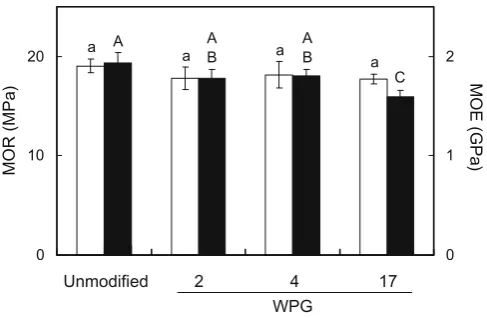
The static bending properties of BPPC with 60 wt% of acetylated or untreated bamboo particles are shown in Fig. 1. No signifi cant differences in MOR were found among all the tested samples. The MOR of all acetylated BPPC (WPG 2–17) is around 19 MPa, which is similar to that of the unmodifi ed one. However, the MOE of BPPC with acety-lated BP is slightly lower than that of an unmodifi ed sample, especially at the highest WPG. The modulus decreases sig-nifi cantly, from 1.8 to 1.6 GPa, when increasing the WPG of acetylated BP from 4 to 17. Similar results were reported by Pasquini et al.23
This phenomenon should be infl uenced by the nature of lignocelluloses after acetylation. Figure 2 shows the evolution of X-ray diffraction patterns of acety-lated bamboo particles. The results showed two diffraction peaks for 2θ= 22° and 15° before treatment, by which the crystallinity index (CrI) calculated is 58.5%. The former peak is attributed to the 200 plane of the crystal lattice and
Table 1. Effect of mixture ratio of bamboo particle (BP) and high-density polyethylene (HDPE) on mechanical properties of bamboo particle/ plastic composites (BPPC)
BP/HDPE (wt%) Density (g/cm3) MOR (MPa) MOE (GPa) Internal bond
strength (MPa)
Wood screw-holding strength (N)
0/100 0.74 ± 0.06b 25.6 ± 0.7a 0.9 ± 0.2cd >5* 913.4 ± 60.4a
20/80 0.76 ± 0.01b 23.7 ± 0.8ab 1.2 ± 0.0bc >5* 813.2 ± 44.1ab
30/70 0.82 ± 0.01ab 23.1 ± 0.4ab 1.5 ± 0.0ab >5* 823.8 ± 43.8ab
40/60 0.85 ± 0.00a 22.1 ± 0.8bc 1.5 ± 0.1ab 2.7 ± 0.1a 850.8 ± 34.3a
50/50 0.86 ± 0.01a 19.9 ± 1.1cd 1.5 ± 0.1a 2.7 ± 0.1a 838.2 ± 20.6a
60/40 0.89 ± 0.02a 17.6 ± 0.3d 1.4 ± 0.1ab 2.0 ± 0.3b 833.1 ± 59.2a
70/30 0.85 ± 0.03a 13.5 ± 1.5e 1.0 ± 0.2cd 0.7 ± 0.1c 642.4 ± 128.9b
80/20 0.81 ± 0.05ab 9.9 ± 1.9f 0.8 ± 0.2d 0.3 ± 0.1c 442.0 ± 120.2c
* Over maximum limitation (5 MPa) Values are mean ± SD (n = 5)
Means in each column with different superscript letter are signifi cantly different (P < 0.05)
0 10 20
Unmodified 2 4 17
WPG
MOR (MPa)
a
a a a
0 1 2
MOE (GPa)
A A
B
A B
C
the latter peak corresponds to the refl ection of planes 110 and 1ı¯0 of the native cellulose lattice. After acetylation, however, both peaks vanish gradually (Fig. 2B–D). These results are similar to the diagram obtained by Thiebaud et al.24
In addition, the extent of decrystallization is a function of ester content (or WPG). In other words, the extent of acetylation greatly infl uenced crystallinity index, so with a higher extent of acetylation there was a lower crystallinity index. When the WPG of acetylated bamboo particles achieved 2, 4, and 17, their CrI were calculated as 56.6%, 54.2%, and 48.3%, respectively. This reduction trend is completely congruent with the MOE changes seen in Fig. 1. Therefore, it is evident that the MOE of BPPC is greatly infl uenced by the crystallinity of lignocelluloses.
Furthermore, the internal bond is the best single measure of the quality of lignocellulosic composites because it indi-cates the strength of the bonds between particles. Figure 3 shows that acetylation can improve the internal bond strength of BPPC. However, it can be seen that, regardless
of the WPG of acetylated bamboo particles, the strength of BPPC increased from the original 1.2 MPa to ∼2.5 MPa after acetylation. Similar results were also observed in the wood screw-holding strength of BPPC (Fig. 4). These results indicate that even though the weight gain of acetylated bamboo particles was only 2%, acetylation also provides suffi cient interfacial adhesion with the plastic matrix. Com-pared with unmodifi ed composites, the internal bond and wood screw-holding strengths of acetylated composites were improved by 94% and 25%, respectively.
Reactive characteristics of acetylation of bamboo particles
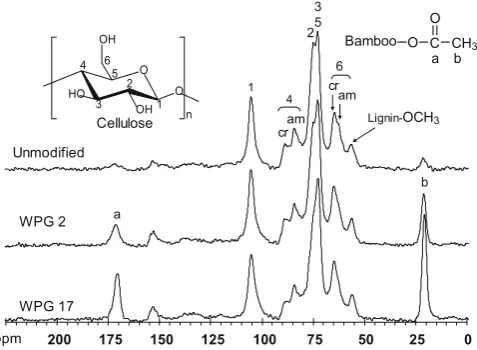
In this study, solid-state CP/MAS 13C-NMR was used to elucidate the characteristics of BP before and after acetyla-tion. Figure 5 shows a characteristic carbohydrate pattern, namely C1 (105.3 ppm), C4 (88.7 and 84.3 ppm), C2 (74.8 ppm), C3, C5 (72.8 ppm), and C6 (64.6 and 62.8 ppm) for unmodifi ed BP.25
Hemicellulose carbons also resonated
2 12 22 32
2θ
Intensity
A
B
C
D
Fig. 2. X-ray diffraction diagrams of different extent of acetylated bamboo particles: unmodifi ed (A); WPG 2 (B); WPG 4 (C); WPG 17 (D)
0 1 2 3
Unmodified 2 4 17 WPG
Internal bond strength (MPa)
a
a
a
b
Fig. 3. Effect of acetylation on internal bond strength of BPPC (BP/ HDPE = 60/40). Error bar is SD (n = 5). Bars with different letters indicate signifi cant differences among groups (P < 0.05)
0.5
Unmodified 2 4 17
WPG
a a
a b
b
Wood screw-holding strength (kN)
1.0
0.0
Fig. 4. Effect of acetylation on wood screw-holding strength of BPPC (BP/HDPE = 60/40). Error bar is SD (n = 5). Bars with different letters indicate signifi cant differences among groups (P < 0.05)
0 25 50 75 100 125 150 175 200 225
Unmodified
WPG 2
WPG 17
1
cr am
2 3 5
4
cr am 6
Lignin-OCH3
ppm
Cellulose O
HO
OH OH
O n 1 2 3 4
5 6
a
b
Bamboo C CH3
O
a b
O
Fig. 5. 13C cross-polarization magic angle spin (CP/MAS) nuclear
in the same fi eld as cellulose ones, so they could not be precisely identifi ed. The chemical shift at 56.5 ppm corre-sponded to lignin methoxy groups and the broad signal between 125 and 160 ppm to aromatic rings of lignin. However, after acetylation, the intensities of peaks at 74.8 (C2) and 62.8 (amorphous C6) ppm decreased and shifted downfi eld, and the decrease in signal intensity was more pronounced in C2, while no signifi cant change was observed
at 72.8 ppm (C3). In addition, peaks at 170.1 ppm
(CH3COO–) and 20.7 ppm (CH3COO–), assigned to the
acetyl group, were also found in Fig. 5 (WPG 2 and WPG 17). These results indicate that the order of reactivity of cellulose hydroxyl groups was C2–OH > C6–OH > C3–OH when the bamboo particles were modifi ed by acetic anhy-dride in DMF. This result is similar to those reported by Dicke26
and Jebrane and Sèbe.27
Morphology of acetylated bamboo particles and HDPE composites
SEM micrographs of the fractured surface for the compos-ite samples (Fig. 6), correspond to the surface of fractured BPPC with 60 wt% of unmodifi ed BP (Fig. 6A), acetylated BP of 2 WPG (Fig. 6B), acetylated BP of 4 WPG (Fig. 6C), and acetylated BP of 17 WPG (Fig. 6D). Although only selected parts of the BPPC are shown in the fi gures, they are assumed to be as representative of the sample as possi-ble. Accordingly, the unmodifi ed bamboo particles (Fig. 6A) are pulled out practically completely from the poly-meric matrix; i.e., the fracture of the BPPC did not lead to the bamboo particles breaking. This result clearly indicates that the interfacial adhesion between the bamboo particle and the plastic was very weak. However, as shown in Fig. 6B–D, the SEM micrographs reveal that acetylated bamboo particles are well trapped by the polymeric matrix, regard-less of the extent of acetylation. Thus, a better stress trans-fer from the weaker plastic phase to the bamboo particle through the interface could be expected; this is believed to
be caused by improved interfacial interaction, resulting in high internal bond strength (see Fig. 3).
Effects of different esterifi cations on mechanical properties of BPPC
To understand the infl uence of acyl chain length of esteri-fi ed bamboo particles on mechanical properties, MOR, MOE, internal bond strength, and wood screw-holding strength of BPPC with WPG = 2 of acetylated and butyry-lated bamboo particles were further investigated in this study. Except for the internal bond strength, there were no signifi cant differences between acetylation and butyrylation (Fig. 7). Compared with the acetylated composite, there was a twofold decrease in the internal bond strength of the butyrylated composite. In other words, the effect of butyry-lation on increasing the strength of composites was not signifi cant. This phenomenon might be attributed to the relatively hydrophobic butyryl group being not suffi cient to substitute for the hydroxyl group of the bamboo particle by butyrylation at 2 WPG, which does not effi ciently improve the interfacial adhesion between the polymeric matrix and lignocellulosic material. In addition, FTIR spectra (Fig. 8) also clearly confi rmed that the intensity of the C = O stretch-ing band of the butyrylated bamboo particle at 1735 cm−1
was obviously lower than that of an acetylated one. The effect of different esterifi cations with higher WPG samples on properties of BPPC should be the subject of future sys-temic and detailed investigation.
Conclusions
Bamboo particle/plastic composites with high bamboo par-ticle loading (60 wt% of bamboo parpar-ticles) were success-fully prepared by the manufacturing method of forming and fl at presses similar to particleboard production. Addition-ally, it was shown that the acetylation of bamboo particles is a useful method to improve the interfacial interaction of BPPC. When the degree of acetylation had achieved only 100
(A)
0 0 1
m m
(B)
100 m
(D)
100 m
(C)
Fig. 6. Scanning electron microscopy (SEM) micrographs of different extents of acetylated BPPC (BP/HDPE = 60/40): unmodifi ed (A); WPG 2 (B); WPG 4 (C); WPG 17 (D). Arrows, BP
0 10 20 a
a
b b
0 1 2
b a
b
0 1 2
a
a a
b
a a
b
Wood screw-holding
strength (kN)
Internal bond strength
(MPa)
MOE (GPa)
MOR (MPa)
Unmodified Acetylated Butyrylated WPG 2
Unmodified Acetylated Butyrylated WPG 2 3
Butyrylated 1.0
0.5
0.0
2000 3000 4000
A
B
C
Absorbance
600 800 1000 1200 1400 1600 1800 2000
Wavenumber (cm-1)
1735
Fig. 8. Fourier transform-infrared (FTIR) spectra of different esteri-fi ed bamboo particles (WPG 2): unmodiesteri-fi ed (A); acetylated (B); buty-rylated (C)
2 WPG, the composites exhibited an excellent interfacial adhesion between the acetylated bamboo particle and poly-meric matrix. Compared with the unmodifi ed composites, the acetylated composites improved the internal bond strength by 94% and the screw-holding strength by 25%. To our knowledge, this is the fi rst report to address the properties of acetylated BPPC made by the fl at-platen pressing process. Furthermore, as it is known that the hydroxyl groups of bamboo are most often the reactive sites, the evidence of occurrence of the chemical modifi ca-tion was checked by solid-state 13
C-NMR. The results revealed that the order of reactivity of bamboo cellulose was C2–OH > C6–OH > C3–OH when it was modifi ed by acetic anhydride in DMF. Moreover, according to XRD analysis, the crystallinity of cellulose in bamboo particles decreased with increasing WPG. In addition, it is well known that acetylation not only improves the dimensional stability of lignocellulosic materials but also increases their decay resistance. Thus, future studies should focus on the durability and mildew resistance of the acetylated BPPC during natural weathering, and the physicochemical proper-ties of weathered specimens also should be evaluated.
Acknowledgments We thank the National Science Council for fi nan-cial support (NSC97-2313-B-005-044-MY3).
References
1. Zhang J, Wang R, Ma N, Zhang W (1995) Fibre morphology and main physical and chemical properties of some bamboo wood of
Phyllostachys. For Res 8:54–61
2. Obataya E, Kitin P, Yamauchi H (2007) Bending characteristics of bamboo (Phyllostachys pubescens) with respect to its fi ber–foam composite structure. Wood Sci Technol 41:385–400
3. Deshpande AP, Rao MB, Rao CL (2000) Extraction of bamboo fi bers and their use as reinforcement in polymeric composites. J Appl Polym Sci 76:83–92
4. Thwe MM, Liao K (2003) Durability of bamboo–glass fi ber rein-forced polymer matrix hybrid composites. Compos Sci Technol 63:375–387
5. Okubo K, Fujii T, Yamamoto Y (2004) Development of bamboo-based polymer composites and their mechanical properties. Com-posites A 35:377–383
6. Liu H, Wu Q, Han G, Yao F, Kojima Y, Suzuki S (2008) Compati-bilizing and toughening bamboo fl our-fi lled HDPE composites: mechanical properties and morphologies. Composites A 39:1891–1990
7. Jiang H, Kamdem DP (2004) Development of poly(vinyl chloride)/ wood composites. A literature review. J Vinyl Addit Technol 10:59–69
8. Bledzki AK, Reihmane S, Gassan J (1998) Thermoplastics rein-forced with wood fi llers: a literature review. Polym-Plast Technol Eng 37:451–468
9. Raj RG, Kokta BV, Maldas D, Daneault C (1989) Use of wood fi bers in thermoplastics. VII. The effect of coupling agents in poly-ethylene–wood fi ber composites. J Appl Polym Sci 37:1089– 1103
10. Maldas D, Kokta BV, Daneault C (1989) Infl uence of coupling agents and treatments on the mechanical properties of cellulose fi ber–polystyrene composites. J Appl Polym Sci 37:751–775 11. Harper D, Wolcott M (2004) Interaction between coupling agent
and lubricants in wood–polypropylene composites. Composites A 35:385–394
12. Najafi SK, Hamidinia E, Tajvidi M (2006) Mechanical properties of composites from sawdust and recycled plastics. J Appl Polym Sci 100:3641–3645
13. Mansour SH, Asaad JN, Iskander BA, Tawfi k SY (2008) Infl uence of some additives on the performance of wood fl our/polyolefi n composites. J Appl Polym Sci 109:2243–2249
14. Tronc E, Hernández-Escobar CA, Ibarra-Gómez R, Estrada-Monje A, Navarrete-Bolaños J, Zaragoza-Contreras EA (2007) Blue agave fi ber esterifi cation for the reinforcement of thermoplas-tic composites. Carbohydr Polym 67:245–255
15. Rowell RM (1983) Chemical modifi cation of wood. For Prod Abstr 6:363–382
16. Gardea-Hernández G, Ibarra-Gómez R, Flores-Gallardo SG, Hernández-Escobar CA, Pérez-Romo P, Zaragoza-Contreras EA (2008) Fast wood fi ber esterifi cation. I. Reaction with oxalic acid and cetyl alcohol. Carbohydr Polym 71:1–8
17. Chen HC, Chen TY, Hsu CH (2006) Effects of wood particle size and mixing ratios of HDPE on the properties of the composites. Holz Roh Werkst 64(3):172–177
18. Tserki V, Zafeiropoulos NE, Simon F, Panayiotou C (2005) A study of the effect of acetylation and propionylation surface treat-ments on natural fi bers. Composites A 36:1110–1118
19. Neter J, Kutner MH, Nachtsheim CJ, Wasserman W (1996) Applied linear statistical models. McGraw-Hill, Boston, pp 756–791
20. Bouza R, Lasagabaster A, Abad MJ, Barral L (2008) Effects of vinyltrimethoxy silane on thermal properties and dynamic mechan-ical properties of polypropylene–wood fl our composites. J Appl Polym Sci 109:1197–1204
21. Bengtsson M, Gatenholm P, Oksman K (2005) The effect of cross-linking on the properties of polyethylene/wood fl our composites. Compos Sci Technol 65:1468–1479
22. Balasuriya PW, Ye L, Mai YW, Wu J (2002) Mechanical properties of wood fl ake–polyethylene composites. II. Interface modifi cation. J Appl Polym Sci 83:2505–2521
23. Pasquini D, Teixeira EM, Curvelo AAS, Belgacem MN, Dufresne A (2008) Surface esterifi cation of cellulose fi bres: processing and characterisation of low-density polyethylene/cellulose fi bres com-posites. Compos Sci Technol 68:193–201
24. Thiebaud S, Borredon ME, Baziard G, Senocq F (1997) Properties of wood esterifi ed by fatty-acid chlorides. Bioresour Technol 59:103–107
25. Boonstra MG, Pizzi A, Tekely P, Pendlebury J (1996) Chemical modifi cation of Norway spruce and Scots pine. A 13C NMR
CP-MAS study of the reactivity and reactions of polymeric wood com-ponents with acetic anhydride. Holzforschung 50:215–220 26. Dicke R (2004) A straight way to regioselectively functionalized
polysaccharide esters. Cellulose 11:255–263