R E S E A R C H
Open Access
Learning from the parallel pathways of
Makers to broaden pathways to
engineering
Christina Foster
1, Aubrey Wigner
2, Micah Lande
1*and Shawn S. Jordan
1Abstract
Background:Makers are a growing community of STEM-minded people who bridge technical and non-technical backgrounds to imagine, build and fabricate engineering systems. Some have engineering training, some do not. This paper presents a study to explore the educational pathways of adult Makers and how they intersect with engineering. This research is guided by the following research questions: (1) What can we learn about the educational pathways of adult Makers through the lens of constructivist grounded theory? and (2) How do the educational pathways of Makers intersect with engineering? This study relied on qualitative interviews, using artifact elicitation interviews and constructivist critical incident technique interviews, of 42 adult Makers. Results: Through inductive analysis of a collection of interviews with Makers, a theme emerged where Makers from different educational backgrounds and with different careers (e.g., art, STEM, business) were making artifacts that had similar purposes. We present two cases of parallel pathways, (1) musical artifacts and (2) large-scale interactive artifacts, to demonstrate the multiple, parallel life pathways that Makers take to making their artifacts and the contextual events and activities that are critical to the direction of these pathways.
Conclusions:The stories and life pathways of adult learners engaged in Making can offer valuable insight into how we might identify practices that promote the access and success of a larger and more diverse population of students for engineering. Makers are engaged in activities that embody the Engineer of 2020 (e.g., lifelong learning, creativity, and practical ingenuity). By studying Makers, we can consider the multiplicity of pathways into engineering majors and careers.
Keywords:Engineering education, Making, Engineering, Pathways
Introduction
Engineering is increasingly understood as a lifelong learn-ing pathway rather than an event that happens only in a university setting. The National Academies Engineer of 2020(National Academy of Engineering 2004) and ABET, the US accreditation body for engineering programs (ABET 2012, 2014, 2015) have both identified a wide range of qualities that are vital for future engineers. The identified qualities include the ability to engage in lifelong learn-ing, function creatively, work across disciplines, prac-tical ingenuity, and the ability to communicate with broader audiences in addition to maintaining technical expertise in engineering fields. These qualities are
important for, and learned within, a wide range of prac-tices. To better understand how engineering education manifests during a lifetime, and how engineering skills and mindsets can be acquired later post-college, we seek to understand how skills, knowledge, and tacit knowledge are built. This paper explores one method for discovering how engineers are made, both through traditional and non-traditional processes.
To see what events and skills make an engineer, we explored the life pathways of Makers, a self-identified group of creatives that bridge across many areas of tech-nical and non-techtech-nical expertise. A combination of qualitative techniques was used for data collection cluding a screening questionnaire, artifact elicitation in-terviews, and critical incident interviews. This paper expands on the collection methods used in order to in-form others of possible approaches for understanding * Correspondence:[email protected]
1Arizona State University—Polytechnic Campus, Mesa, AZ, USA Full list of author information is available at the end of the article
the skills learned and pathways taken by a sector of the adult community who embodies many of the qualities important to the engineer of the future.
Background
What is a Maker?
A Maker is a modern-day tinkerer and hands-on doer and fashioner of stuff. Makers are do-it-yourself-minded individuals participating in informal communities (doing it with others) that support and celebrate building and prototyping technical proof-of-concept exploration and ad hoc product development. The label “Maker” is a self-determined one assigned by affinity with or involve-ment in a larger Maker community. The range of expert-ise could be large, but novices and experts alike share an enthusiasm and appreciation for building and creation. Individuals and groups embark on projects of all sorts, led primarily by their interests and curiosities, informed by their skills or the skills they want to learn. Making comes from an imaginative, creative mind-space, and is often done outside the confines of established engineer-ing education curricular activities. For example, one might make creative efforts like fire-breathing robots as performance art, combining contributions from community members with electrical, mechanical, and embedded systems know-how. Makers are rich in cre-ative confidence, with their expertise sometimes lying in the ability to learn new skills as needed rather than already possessing immediate solutions to the prob-lems that they encounter.
The Maker Movement is an emerging and developing sub-culture that values the tinkering, hacking, re-making, and creating of artifacts that require the use of both tech-nical and creative skills. Making has a do-it-yourself ethos and is historically rooted in efforts likePopular Mechanics magazine which demystified everyday stuff for hobbyists and the Whole Earth Catalog: Access to Tools (1972) which surveyed everyday tools for the counterculture movement of the 1960s. Additional real-world touch-stones are the growth of Radio Shack stores, and the 1980s television programMacGyverwhere the lead char-acter would resolve each episode’s predicament by fash-ioning an escape plan out of found objects (Zlotoff 1985).
Technology and sharing of information via the Inter-net have greatly increased the ability for smaller commu-nities with shared interests to coalesce and grow. Makers participate in communities of practice (Sheridan et al. 2014, Wegner 2010), gathering with like-minded individuals and groups to learn skills and share interests and affinities. They populate maker spaces and hacker spaces (Tweney 2009) to gather with other Makers. A significant part of such participation is to benefit from opportunities to continually learn from, teach and mentor other Makers. Makers exemplify the
collaborative model of additive innovation by seeking and offering inspiration in their community, sharing and learning recipes with others, iterating on their own designs, and sharing artifacts of their designs back with the community to inspire others (Jordan and Lande 2015).
What is an engineer?
The work of an engineer is framed by the nature of en-gineering, the types of problems engineers solve, the knowledge and methods used to solve those problems, and the best practices that engineers should follow.
The nature of engineering stems from its name, as it was derived from the Latin root ingenerare meaning to create. Koen (1985) wrote:“To identify a situation call-ing for an engineer, seek a situation callcall-ing for change”. The changes engineers make have a distinct function; they are intended to create an optimum solution for a human or societal need (Koen 2003). Engineering’s purpose to create solutions is often conceptualized as problem solving (Sheppard et al. 2009). The types of problems that engineers deal with are design problems and are characteristically practical, achievable, ill-structured, context-specific, and have no definitive solu-tion (Cross 2008; McKenna et al. 2011). Like engineering problems, their outcomes—engineering solutions—are not rigid. An engineering solution is the “best change within available resources” (Koen 2003) and can take many forms, including systems, processes, and artifacts.
The method that engineers use to solve problems is often referred to as engineering design and relies upon the use of heuristics (Koen 2003). Engineering design indeed is the common denominator across all engineered products and is what can be used to identify the presence of engineering activity (Koen 1985). Like the diversity among engineered artifacts, the engineering design process is complexly varied in the ways it is performed. As Bucciarelli (1994) pointed out, the engineering design process does not take one sin-gular form. Pahl et al. (2007) also show that the engineering design process is a complex landscape of approaches, stages, principles, purposes, and traditions. Design is not stagnate, absolute, guaranteed, or deterministic. Rather, it is a dynamic, complex process that is a part of a greater feedback loop used by the engineer to know engineering and construct new engineering knowledge. However, across any variation of the engineering design process, the characterization remains the same. Engineering design is systematic, iterative, purposeful, creative, and social (ABET 2014; Bucciarelli 2003; Cross 2008).
the four dimensions being basic sciences knowledge, de-sign knowledge, social science knowledge, and knowledge from doing. In this model, the engineer must converge and internalize the knowledge found within these four di-mensions in order to carry out the engineering method. Regardless of the model, engineers use knowledge to make decisions and build consensus during the engineering de-sign process. Engineering knowledge enables engineers to reason through heuristics, with heuristic reasoning as“not regarded as final and strict but as provisional and plausible only, whose purpose is to discover the solution to the present problem” (Polya, 2014). This enables engineers with the flexibility needed for determining the most logic-ally compelling argument for the context. Acceptance of a heuristic depends on whether it works and is useful in a specific context. As engineers create and use heuristics to guide their work, they gain expertise that informs their work. This contributes to the consensus-building nature of engineering which is used to determine best practices (Koen 1985). Determining what is state of the art through heuristic reasoning guides engineering practice to its goal—to develop an optimum solution for the design problem at hand.
The best practices of engineers are reflected by codes of conduct. These codes“acknowledge the overall mission of the profession as contributing to human welfare”and that engineers must be competent (Sheppard et al. 2009). The attributes that engineers must possess to do their work are practical ingenuity, strong analytical skills, discovery and design, creativity, communication, ac-countability, mastery of principles of business and management, professionalism, and life-long learning (ABET 2014; NAE 2005).
Broadening engineering pathways
A more inclusive vision of engineering crossed with Making could build future engineering capacity by en-gaging individuals not attracted to the traditional engin-eering community. Additionally, the actions of Makers as citizen engineers could raise awareness among the public about engineering. The Center for the Advance-ment of Engineering Education’s Academic Pathways Study (Atman et al. 2010) studied undergraduate persist-ence in engineering and found two groups of students with different motivations for engagement. The first group sought financial security, aiming for graduation while overcoming barriers of foundational math and sci-ence courses. The second group approached their stud-ies with intrinsic psychological motivation, seeking meaning and impact through their studies. Students in the second group represented myriad races, ethnicities, and socio-economic statuses (Atman et al. 2010).
The purpose of our research is to change the conversation to highlight the possibilities for the second group, which
includes underrepresented minorities. We acknowledge the differences between engineering students, practicing engi-neers, and Makers but find the possible overlaps and stories of pathways below to have the potential to inform trans-formational change in our field. There are considerable ben-efits to STEM education, as well as resulting societal benefits, for those who have influence over student deci-sions to have an appreciation of the multiplicity of pathways into STEM careers. Likewise, pathways can show the value of technical literacy based on Making activities. This is espe-cially true for underrepresented groups to make the case that they are evident in the population of people already doing engineering and other STEM activities.
Methods
This paper presents a study to explore the educational pathways of adult Makers and how they intersect with engineering. This research is guided by the following re-search questions and rere-search design:
RQ1. What can we learn about the pathways of adult Makers through the lens of constructivist grounded theory?
RQ2. How do the educational pathways of Makers intersect with engineering?
This research, guided by RQ1 and RQ2, is situated within a broader 4-year study exploring Making as a means of engaging current engineering students as well as adults and pre-college students in the engineering landscape described inThe Engineer of 2020, ABET a-k, and21st Century Skills.
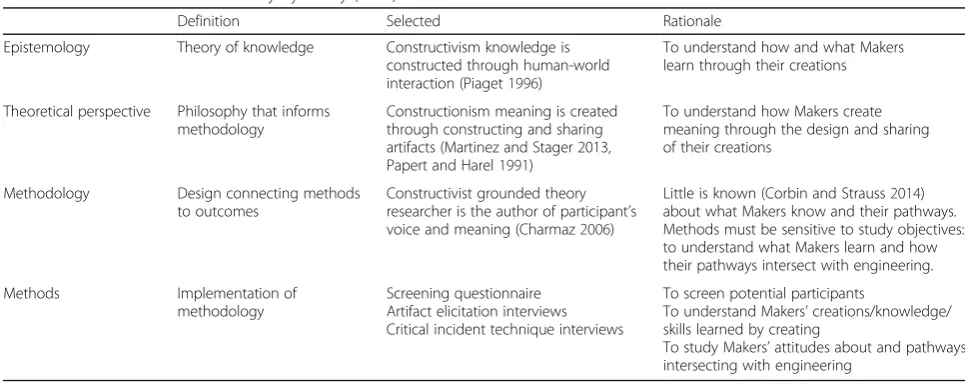
constructing and sharing artifacts. This theoretical per-spective focused the study on how Makers create mean-ing through the design and sharmean-ing of their creations. The design of the research study guided the implemen-tation of the methods. The methods specifically relied upon screening questionnaires, artifact elicitation inter-views, and critical incident technique interviews in order to understand Makers’ creations, knowledge, and skills learned by creating and to study Makers’attitudes about and pathways intersecting with engineering. The re-search design, organized through Crotty’s (1998) frame-work, is summarized in Table 1, and the overall process is summarized in Fig. 1.
Following the research design, researchers began with administering screening questionnaires to conduct stratified sampling. For those potential participants that were selected for the study, interviews were conducted and analyzed according to the methodological frame-work. Through inductive analysis under the constructiv-ist grounded theory, the pathways were compared and results were shared. Figure 1 summarizes this process.
Population and sampling
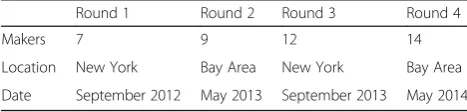
This study relied upon a population of adult Makers in order to understand how their pathways intersect with formal engineering education. We sought out Makers who participate in Maker Faires. A total of 42 Makers who exhibited at two flagship Maker Faires participated (see Table 2).
The Bay Area Maker Faire draws over 500 exhibi-tors annually. A stratified purposeful sampling strat-egy (Patton 2002) was used for initial selection of participants. Participants were selected to maximize variation across the strata described in Table 3 while oversampling for underrepresented groups and ensur-ing that all participants self-identify as Makers. This
sampling strategy was appropriate to target the Maker population relevant to the research questions, whereas representative sampling may not provide a complete picture of knowledge, skills, attitudes, and pathways of Makers necessary to inform theory generation. Each participant received a monetary incentive for his or her time.
Makers who have a formal engineering degree were selected to provide insight into how formal engineering education has helped them in their chosen pathway. Makers who have informal engineering education expe-rience (e.g., robotics team) were selected to provide breadth to the study and illuminate how informal education expe-riences influence engineering pathways and career choices.
At the conclusion of the study, 42 adult Makers had participated with the artifact elicitation interview, and 25 of those participants went on to complete the critical in-cident interview. The demographic data, as provided by the individual Makers, is shown in Table 4.
Unlike larger quantitative statistical studies, we seek to identify factors and characterize the landscape through a small number of in-depth examples, but do not claim to generalize or predict more broadly, thereby making a smallerNappropriate (Pawley 2013) for the aims of our study. With our qualitative research approach and the exploratory nature of our research questions and theory-building efforts, our number of interviews has produced more than enough “thick description” (Geertz 1994) for the study’s purpose to discern patterns about partici-pants’ pathways through formal and informal engineer-ing experiences.
Data collection
The study began with administering a screening questionnaire to potential participants to inform the stratified purposeful sampling strategy. Fifteen-minute
Table 1Elements of a research study by Crotty (1998)
Definition Selected Rationale
Epistemology Theory of knowledge Constructivism knowledge is constructed through human-world interaction (Piaget1996)
To understand how and what Makers learn through their creations
Theoretical perspective Philosophy that informs methodology
Constructionism meaning is created through constructing and sharing artifacts (Martinez and Stager 2013, Papert and Harel1991)
To understand how Makers create meaning through the design and sharing of their creations
Methodology Design connecting methods to outcomes
Constructivist grounded theory researcher is the author of participant’s voice and meaning (Charmaz2006)
Little is known (Corbin and Strauss2014) about what Makers know and their pathways. Methods must be sensitive to study objectives: to understand what Makers learn and how their pathways intersect with engineering.
Methods Implementation of methodology
Screening questionnaire Artifact elicitation interviews Critical incident technique interviews
To screen potential participants
To understand Makers’creations/knowledge/ skills learned by creating
artifact elicitation interviews (Douglas, Jordan, Lande, & Bumbaco, 2015) based on the method of photo elicitation (Clark-Ibáñez 2004; Harper 2002) were then conducted in person at Maker Faires with each study participant to learn more about the artifacts they were showcasing. A longer, 1-hour, critical incident technique interview (Flanagan 1954) was conducted with each participant in the months following Maker Faire to understand their life pathways.
Screening questionnaire
Prior to each Maker Faire, all Makers with information publicly available online were contacted through email and asked to complete a short online screening ques-tionnaire. The questionnaire consisted of short answer questions (see Table 5) and requested contact informa-tion and their exhibit locainforma-tion at the Maker Faire. The results were collected in a spreadsheet that was used to select initial participants using the stratified purposeful sampling strategy described above and was also used to contextualize the artifact elicitation and critical incident technique interview questions.
Artifact elicitation interviews
Semi-structured artifact elicitation interviews (Douglas, Jordan, Lande, & Bumbaco, 2015), based on the research method of photo elicitation (Clark-Ibáñez 2004; Harper 2002; Morley et al. 2011), were used to elicit “thick de-scription” from participants (Geertz 1973). Interviews were conducted in person with 41 Maker participants and via Skype with one Maker participant to examine the pathways related to engineering that had been followed toward the creation of the artifact on display. The 41 in-terviews conducted in person took place at each partici-pant’s exhibit booth at the Maker Faire where they were typically interacting with Maker Faire attendees and show-ing/demonstrating their creation. Following obtaining re-search consent, approximately 15 minutes was spent with
each Maker participant, asking them to describe their artifact, show how their artifact works, describe their process for Making, and describe the knowledge, skills, and attitudes they learned or gained from Making (see Table 6). We asked probing questions about the artifact to elicit “thick description” (Geertz 1973). Questions evolved after each round of data collection based on emergent themes that were discovered during early analysis.
Constructivist critical incident technique interviews
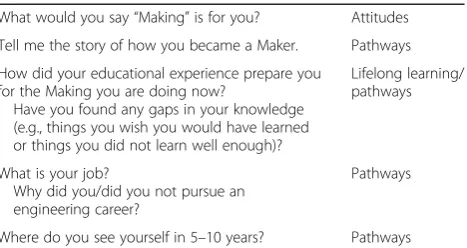
Semi-structured constructivist critical incident technique interviews (Flanagan 1954; Klein 1999; Klein et al. 1989) were used to examine the educational and career path-ways of Makers and how they intersect with formal en-gineering education and careers in enen-gineering. Klein used critical incident technique interviews to study decision-making in a variety of fields, and the method has been used very successfully in engineering education research (Adams et al. 2007; Adams et al. 2011; Adams et al. 2010; Adams, Mann, Forin, & Jordan, 2009; Pears et al. 2008; Walther and Radcliffe 2007). This technique aligns well with RQ1 of this study to understand the de-cision points contributing to pathways intersecting with engineering by providing interviewees with an opportun-ity to describe the critical incidents in their lives that led them to engage in Making and/or engineering (educa-tional experiences, mentors, deeply held philosophical views, etc.). Following each Maker Faire, all participants who completed an artifact elicitation interview were asked to participate in a critical incident technique inter-view via email. All Maker participants who were willing to complete the critical incident interview were con-tacted via Skype. Each interview typically lasted for 1 hour. The interview consisted of questions (see exam-ples, Table 7) designed to examine decision points in their educational pathways and how they relate to Fig. 1Research process
Table 2Participant recruitment (N= 42) and interviews (participant pool, location, date)
Round 1 Round 2 Round 3 Round 4
Makers 7 9 12 14
Location New York Bay Area New York Bay Area
Date September 2012 May 2013 September 2013 May 2014
Table 3Stratifications for purposeful sampling
Primary strata Secondary strata
Self-identified Maker
With/without formal engineering
Education experience (e.g., engineering degree) With/without informal engineering education experience (e.g., robotics team, hacker space) Member of an underrepresented group based on ethnicity or gender
engineering. Questions evolved after each round of data collection based on emergent themes that were discov-ered during early analysis.
Data analysis
Throughout the study, part of the research team con-ducted inductive analysis on the transcribed interviews, which provided feedback to inform questions asked in the interview protocol. Each part of the research team was designated a coding approach so as to reduce bias in the identification of themes.
To examine the pathways of the Maker participants, interview transcriptions were analyzed inductively. Open coding (Corbin and Strauss 2014), theoretical memoing (Glaser 1978), and sorting were used to identify key in-fluences in the participants’pathways. Sorting and theor-etical coding are being used to connect the resultant themes into a theory for the larger work in progress.
Data analysis challenges
Characterizing Makers and their pathways is a challen-ging endeavor. Most Makers do not follow traditional pathways, i.e., education followed by a career in their field; instead, they cross among disciplines, make major career changes, learn diverse skills and knowledge, and so on—often for the purpose of realizing their goals as Makers. The Maker community is built on a culture of acceptance and supporting one another in their individ-ual and group interests and pursuits. As Making goes
mainstream, it continues to be a place where people from all backgrounds can gather and showcase their arti-facts, whether it be a transformative innovation or an offbeat artifact. The Maker showcase events (including flagship Maker Faires, mini Maker Faires, and other fea-tures events) have seen their total attendance grow 24 times since the first Maker Faire; this translates to ap-proximately 22,000 exhibitors and attendees in 2006 to 530,000 exhibitors and attendees in 2014 (Maker Media Inc. 2015). With this growth comes an increase in the diversity of artifacts being showcased and people from different pathways. Browsing by topic on the Maker Faire website will lead you to 70 exhibit topics to ex-plore. These exhibition topics range broadly and include areas such as young Makers, electric vehicles, rockets, art and design, craft, sustainability, and even education (Maker Media Inc. 2014). The Maker Movement is a place for people of all sorts; this type of diversity makes analyzing their life pathways a challenge. Data were ana-lyzed inductively using NVivo in several iterations. Spe-cifically, researchers explored the Maker’s life pathways for critical incidents, including major milestones and key influences, and inductively coded them.
Results
A view from the top
The inductive analysis revealed the broad range of Makers’ reported educational backgrounds and careers.
Table 4Demographics of interviewees
Age Ethnicity Gender
18–25 4 White 16 Female 17
26–30 10 Asian 11 Male 25
31–40 14 Hispanic 3
41–60 9 No response 12
60+ 1
No response 4
Table 5Screening questionnaire questions
Are you a Maker? Primary strata
How many years are you a Maker? Secondary strata
As a Maker, what do you make? Context for interview
Why are you attracted to Making? Context for interview
Have you been involved with any group Maker activities?
Primary strata
Have you taken any engineering classes or have an engineering degree?
Primary strata
Do you have an engineering related job/career?
Secondary strata
Ethnicity, gender Primary strata
Age Secondary strata
Table 6Sample artifact elicitation questions Can you tell me about what you brought to the Maker Faire?
What technology does it use? Can you show me how it works?
Knowledge and skills
What knowledge and skills did you have to learn to make this [insert name of artifact]?
Knowledge, skills
Where did you learn these things? Lifelong learning
How did you come up with the idea for this [insert name of artifact]?
What could you improve in your [insert name of artifact]?
Attitudes
Table 7Sample constructivist critical incident technique interview questions
What would you say“Making”is for you? Attitudes
Tell me the story of how you became a Maker. Pathways
How did your educational experience prepare you for the Making you are doing now?
Have you found any gaps in your knowledge (e.g., things you wish you would have learned or things you did not learn well enough)?
Lifelong learning/ pathways
What is your job?
Why did you/did you not pursue an engineering career?
Pathways
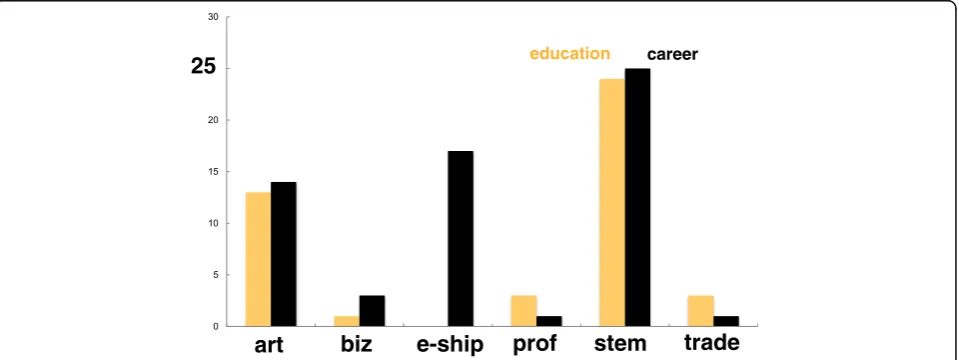
Makers were educated in a range of fields, including fine art, trade school, engineering from bachelors to PhD, game design, and creative writing. Their career experi-ences were similarly varied and included professionals, academics, civil servants, and tradespeople. Makers often move between multiple careers through the course of their lives. Of the 42 participants, including those who reported having more than one career, 25 have formal engineering education experience, 13 have an ing degree or are currently studying toward an engineer-ing degree, and 21 have informal engineerengineer-ing education experience (e.g., robotics clubs). Of the same participant pool, 22 reported having an engineering-related career and 7 reported not having an engineering-related career. Participants often reported multiple careers. A given par-ticipant might have been a machinist, engineer, and artist at different times of their lives, for example. Consolidating the responses for educational backgrounds and careers into like categories reveals that the frequency of educational background and career for the art and STEM categories is somewhat proportional. Additionally, most Makers have STEM and/or art education backgrounds and careers, in addition to being involved with entrepreneurship in their careers. From this vantage point, it seems as though the Makers’pathways are mostly linear (e.g., an individual who has an educational background in STEM has a career in STEM). Looking across the educational background to a career for the individual participants reveals that 34 path-ways are linear, with 16 involving entrepreneurship in the career. Two pathways show crossover between art and STEM, and four pathways show crossover between multiple categories (e.g., tradesman, professional, busi-ness). Twenty-four of the 42 interviewees had careers or education experiences bridging across multiple cat-egories. A summary of educational backgrounds and career pathways is shown in Fig. 2.
As shown in Fig. 2, the majority of Makers we inter-viewed had some experience, educational or career, in art or STEM. However, a broad overview like the one presented above fails to capture the nuance of how any given Maker made their way from education to career, from career to their second career, or their journey of turning a hobby into an entrepreneurial venture. To gain deeper insight into how individuals might make their way into Making and how they might pass through en-gineering, more specific analysis was required as is ex-plored below.
A new direction for analysis: parallel pathways
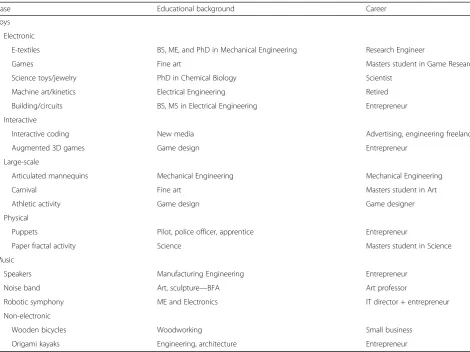
Through the inductive analysis, a critical theme emerged where Makers from different educational backgrounds and with different careers (e.g., art, STEM, business) were making artifacts that had a similar purpose (see Table 8). These groupings of Makers, based upon the ar-tifacts they made, became an interesting technique to study the complexity of Makers’ pathways. Two of the broader case areas are listed below along with the educa-tion and career backgrounds of the individual makers. Within these areas, we can compare makers with wildly different relationships to engineering who produce simi-lar artifacts. This process for comparison is intended to prompt new questions, uncover new dimensions, and produce alternatives (Khan and VanWynsberghe 2008). This is important when studying pathways to consider the multiplicity of ways that Makers arrive at Making and how it intersects with engineering. With this new direc-tion, artifacts produced by the Makers were grouped based upon similarity. Two examples of artifact types, and their more specific sub-categories, are shown below (see Table 8). The two specific categories we explore further in this paper are bolded, large-scale toys, and music (elec-tronic). The focus for analysis within each case was on the
events, activities, and processes that were key to the Makers’ pathways (Khan and VanWynsberghe 2008). While the data from screening questionnaires provides an interesting view at the major milestones along the Makers’ life pathways, it tells us little about the specific events that occurred in their pathway and the skills that they gained through the activities and events (Table 8).
Two cases of parallel pathways, (1) musical artifacts and (2) large-scale interactive artifacts, are presented in this paper to demonstrate the multiple, parallel pathways that Makers take to making their artifacts and the con-textual events and activities that are critical to the direc-tion of these pathways. These cases were selected as illustrative examples for this paper because the Makers within each case have different educational backgrounds and different careers, despite making artifacts of similar engineering sophistication. Examining the similarities and differences in the pathways within each case illus-trates how Making intersects with engineering and how engineering pathways might be broadened. The findings in this section are highly contextual, dependent upon thick descriptions, and have not undergone comparative analysis across the cases. In-depth comparison within
the cases and across the cases needs to be performed to better understand the pathways of Makers and how they intersect with engineering. However, the cases provide a unique starting point for discussion of the pathways of Makers.
Case 1: musical artifacts
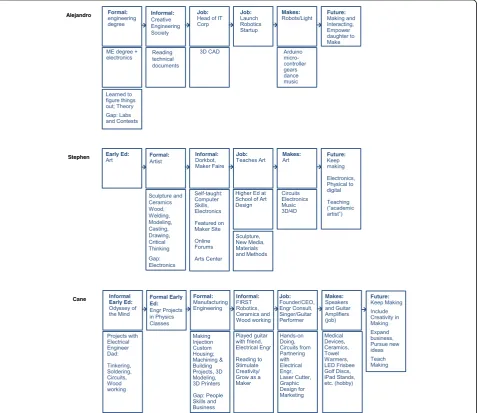
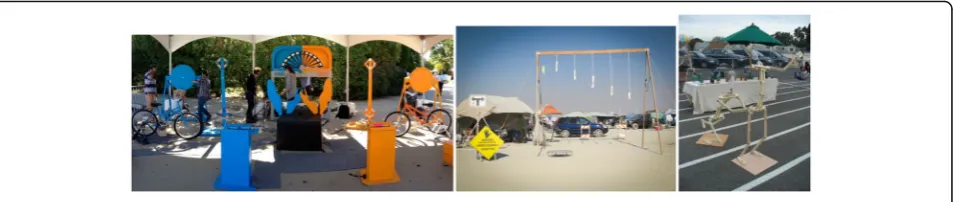
Alejandro, Cane, and Stephen (pseudonyms) make mu-sical artifacts (see Fig. 3). Alejandro makes robots that dance to micro symphonies. Cane makes musical speakers from up-cycled products (e.g., soda cans and lunch boxes) for his growing business. Stephen makes musical instruments from discarded products (e.g., chil-dren’s toys) for improvisational performances with an or-ganized group. Each of these Makers used technical knowledge and skills to bring their artifacts to fru-ition; however, each of their pathways to technical ac-tivities is different. Through three stages of data collection (screening questionnaire, artifact elicitation interview, and critical incident interview), new dimen-sions of their individual pathways were uncovered (see Fig. 4).
Table 8A list of cases and the Makers that comprise them
Case Educational background Career
Toys
Electronic
E-textiles BS, ME, and PhD in Mechanical Engineering Research Engineer
Games Fine art Masters student in Game Research
Science toys/jewelry PhD in Chemical Biology Scientist
Machine art/kinetics Electrical Engineering Retired
Building/circuits BS, MS in Electrical Engineering Entrepreneur
Interactive
Interactive coding New media Advertising, engineering freelance
Augmented 3D games Game design Entrepreneur
Large-scale
Articulated mannequins Mechanical Engineering Mechanical Engineering
Carnival Fine art Masters student in Art
Athletic activity Game design Game designer
Physical
Puppets Pilot, police officer, apprentice Entrepreneur
Paper fractal activity Science Masters student in Science
Music
Speakers Manufacturing Engineering Entrepreneur
Noise band Art, sculpture—BFA Art professor
Robotic symphony ME and Electronics IT director + entrepreneur
Non-electronic
Wooden bicycles Woodworking Small business
Alejandro’s pathway seems somewhat standard for en-gineering; he had 6 years of engineering schooling, which allowed him to obtain a Mechanical Engineering degree with an emphasis in Mechatronics. He attributes his theory-heavy formal engineering education experi-ences to enable him to “look for things and figure out
things.”However, he wished his formal engineering edu-cation had more lab experiences and contests because “it is also frustration that teaches you a lot”. Like many engaged engineering students, he sought out informal engineering education experiences by participating in an engineering society; specifically for Alejandro, he would Fig. 3Musical artifacts of the Makers (Alejandro, Cane, and Stephen, respectively)
build and present Rube Goldberg devices at science fairs. Alejandro became familiar with the label “Maker” when he was invited to present his robots at the Maker Faire. His drive for Making came from the ability to go “against the socially accepted project in engineering school.” He pursued the intersection between art and engineering through his Making, allowing dance and music to inspire the creation of his robots. When his peers in engineering school tried to label him as an artist for making non-traditional engineering devices, he would respond to them saying, “I’m not an artist. I’m just an engineer that creates moving things.” When asked what his future aspirations are, Alejandro reminds us that his artifact at the Maker Faire was the first per-formance for his dancing robots and that he has four more performances to make to represent different forms of dance (e.g., Bolero). While working a technical day job, he has launched a robotics start-up to pursue his in-terests in dancing and musical robots. Alejandro’s path-way reflects one of a traditional engineer inspired and informed by his art.
Cane’s pathway is another example of one that seems standard for engineering; he has an engineering degree in manufacturing engineering and is working as a con-sultant using the knowledge he gained from his engin-eering education while also running a business that relies upon manufacturing and electrical engineering knowledge and skills to make musical artifacts (e.g., modeling, casting, using solid works). Like Alejandro, Cane participated in informal engineering education ex-periences; however, Cane’s focus was on his interest in teaching, so he sought out experiences in this vein (e.g., being a mentor for FIRST Robotics). His passion for the arts also led him to experiences outside of engineering (e.g., teaching ceramics and woodworking). A defining life event for Cane was growing up with a dad who was an electrical engineer and working on projects with him while learning technical and non-technical skills (e.g., soldering and woodworking). He also attributed engin-eering projects in the science classroom as shaping his pursuit of an engineering degree. Cane’s identity as an “inventor” drove him to manufacturing engineering whereby he learned “how to make things.” Once again, his passion for the arts led him to launch a business where he could combine his engineering knowledge and skills with music. Unlike Alejandro, he did not see a dis-connect with engineering and the work that he is doing; rather, he wishes that his formal engineering education could have been extended to include developing inter-personal skills and business skills to enable people to le-verage their ideas and pursue their goals. According to Cane, his future will include continuing to make the things he is making, to expand his business to other products, and to get involved with teaching again. Cane’s
pathway reflects one that was driven by early childhood experiences and a pursuit to use his engineering educa-tion to implement his art.
Stephen’s pathway is dissimilar to that of Cane and Alejandro in that he is trained as an artist and works as a professor of art at a school of art design. Stephen points to positive experiences with art from an early age and how art“engaged”him. To Stephen, interacting with the world around him and learning new skills and know-ledge is critical. He pursued the arts because“it is an ex-cuse to learn everything.”His knowledge and skills span a wide array (e.g., woodworking, modeling, casting, ma-terials, and drawing). Through his formal education in sculpture and ceramics, he became interested in technol-ogy.“I’ve always been interested in technology and oddly I got into sound as an art form from sculpture.” Through this interest, he began to learn about electron-ics and made “boxes that make noise.” He became in-volved with informal education activities that support technical activities, including a group dedicated to doing things with electronics. From his musical artifacts, he formed a group that mimics that of jazz improvisation, where the members“have a relationship with each other even before they get on stage and have a relationship with the instruments.” When asked how he learned to make his musical artifacts, he points to his formal art education and self-directed learning. He points out that he is interested in engineering and that he would have pursued it had it been available to him.“If I had had ac-tually somebody advising me when I was getting out of high school and going to college and I knew engineering as a career, I might have been an engineer to be honest, because I love engineering as a concept of being aware of your world and being in your world.”To Cane, engin-eering is “taking that knowledge of the world and creat-ing because it is a very creative endeavor, creatcreat-ing something new that exists in that world that changes how people interface with that world.” Recognizing the similarity with art, he says,“that’s what art is all about at a certain level.” His future aspirations are to keep Making, specifically electronics, and to continue being an “academic artist” that enables him to pursue Mak-ing with technology. Although his pathway differs from that of an engineering pathway, he has overlap in the knowledge and skills he has obtained and his purpose for Making.
Case 2: Large-scale interactive artifacts
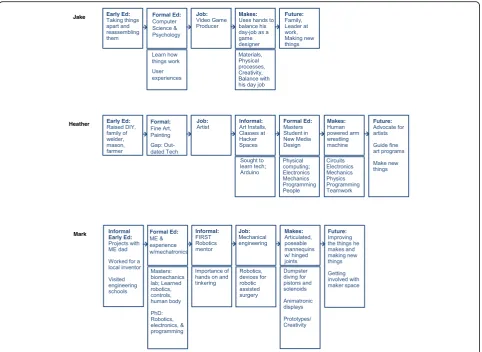
attendees can experiment with how high they can jump. Mark made articulated, life-size, stick-figure mannequins with hinged joints that Maker Faire attendees can pos-ition to create poses and stories. Each of the Makers col-laborated with like-minded individuals to bring the artifact to fruition. Heather worked with fellow graduate students, while Jack and Mark worked with friends of the same discipline. All three of these Makers’artifacts were created in the spirit of fun and to showcase at the Maker Faire; the artifacts were outside of the Makers’ normal realm of Making. Like in the first case, each of these Makers used technical knowledge and skills to bring their artifacts to fruition; however, each of their pathways to technical activities is different. Through three stages of data collection (screening questionnaire, artifact elicitation interview, and critical incident inter-view), new dimensions of their individual pathways were uncovered (see Fig. 6).
Heather’s pathway is intertwined with art and tech-nical activity. Heather grew up in a do-it-yourself envir-onment, where all members of her family made things with their hands (e.g., her father was a welder, and her mother made the family’s clothes and grew their food). She encountered difficulties in her life after graduating high school, but art rescued her. She entered into an undergraduate program for fine art and became trained as a painter. She pursued her painting career for 10 years. As she worked in art galleries, she became dissatisfied with painting because to her, it seemed “outmoded and, technologically speaking, it had died a long time ago.” She was drawn to interactive work because of its “en-gaging and thought-provoking” characteristics. This prompted a path of self-directed learning to adopt new skills in technology; she took courses at local hacker spaces to learn Arduino, robotics, and kinetics. During this shift in her pathway, she never forgot the role that art has in her life. “I owed my life to my art because it got me out of situations that my peers are still embroiled in. No matter what I do, I always owe my art my best.” With this dedication to art, she began to plan how she could appropriate her developing skills with Arduino, robotics, and kinetics to be“a better artist.” During her self-directed learning, she found the local programs
lacking for an individual like herself who had no tech-nical foundation. She entered into a graduate program at an interactive art school. During this formal education experience, for which she was still enrolled in during the time of the Maker Faire, she acquired the skills and knowledge needed to know to propel her forward (e.g., mechanics, electronics, fabrication, and production). Preparing to graduate, she recognized “so now I know what to ask and how to ask.” She gives credit to her graduate program for “getting her over that bump” and exposing her to like-minded individuals who can partici-pate and contribute in her Making. To Heather, Making is “a verb; it is finishing something.”She sees the Maker Movement as a place that brings together different sects, from “those that just want to build” to those that want to engineer and“make sure all the technical components are there.” She sees herself as the jock. When asked about her future aspirations, she says she would like to (1) “be an advocate for artists with art knowledge and purpose and intent”, (2) “guide more traditional institu-tions of fine art into this idea to give artists digital tools,” and (3)“for my own selfish intent, I want to make things that are awesome, things that I see in my head and make them happen.”
“When I’m building it, I’m working with a lot, you know, I’m working with tools and actually like getting calluses on my hands as opposed to when I’m Making video games it’s all virtual.” Through Making interactive arti-facts, he learns about materials, like conduit, and pro-cesses. He purposefully selects projects for Making that are less time intensive to allow for time for his young son and work, but relies upon Making to“push creativity in a different direction.”He also tries to keep his Making separate from his job as a game producer, but acknowl-edges that they inform one another, specifically with “creativity and having to create access to tools.”He iden-tifies himself as“more of a designer and a visionary and about user experience.” Recognizing how Making has shifted his mindset, he now considers himself an artist. Before Making became mainstream and he became fa-miliar with the label, he considered himself “as a cre-ative, but not necessarily an artist.”He now feels like he is an artist because he has a “skill set” and is making ideas“into real things.”In the future, Jack hopes to be a leader at work, raise his family, and continue to make new things. His views of art and technical work
influence his directions in life; this is interesting to com-pare to Heather, whose pathway has also been influenced by her views of art and technical work.
studied electronics, robotics, and programming. He uses his knowledge and skills for his job, designing devices for robotic-assisted surgeries. He credits the blend of his knowledge and his interest in “combining engineering and art”for the reasons he makes the articulated manne-quins and animatronics features. The artifact initially began as a hobby: “I have had a career in robotics, and I’ve had kids, and I enjoy entertaining kids particularly at Halloween time.” However, “sharing it with other people”drove him and his friend to bring the artifacts to the Maker Faire. He has been showcasing these artifacts for 8 years, each time making them better.“People loved them; they tore them apart; they broke all the wires in them, so we figured we would make them better. Each year we have improved the mechanical design of them.” In addition to his recreational Making and his engineer-ing career work, he mentors high school students to promote “hands-on learning through robotics.” When asked about gaps in his education experiences with en-gineering, he references a list of technical topics that he wished he had more exposure to, including statistics, programming language, and digital electrons. When asked if there are any other gaps, he refers to his“artistic talent” and that he never pursued art courses, but learned it on his own. In the future, Mark aspires to continue to improve the things he makes, make new things, and teach at local tech shops. His pathway is fa-miliar to engineering. It is starkly different than that of Heather’s and overlaps with Jack’s in his dedication to make physical artifacts.
Summary
The inductive analysis of data revealed a theme whereby individuals of differing educational backgrounds and ca-reers were making similar artifacts. Upon exploration of Makers’ pathways, as grouped by the types of artifact made, revealed an intertwining of experiences that spanned across engineering and art as well as traditional and extracurricular experiences. Makers were willing to go outside of the realm of traditional engineering to fuel their abilities to make. The cases of parallel pathway cases provide lessons for how to explore the rich, nu-anced pathways of Makers, and how they span across multiples disciplines, experiences, and activities.
Discussion
The inductive analysis of data provided a rich narrative of each Maker’s pathway. With each set of data collec-tion, there was something to be learned about the Makers’ pathways. This was useful in understanding the breadth of Makers’pathways and how they overlap with one another and intersect with engineering. Overall, Making can offer valuable insight into how to identify
practices that promote the access and success of a larger and more diverse population of students within engin-eering. Opportunities may exist to export interview tech-niques for other uses. Artifact elicitation interviews, for example could be used with entrepreneurs to better understand to the values and skills behind product de-velopment or with robotics engineers to gain insight into the creation of a robot. Combining this with critical inci-dent interviews could offer new insights that relate to new opportunities for pathways into engineering. The life pathways of Makers can begin to change the conver-sation to highlight the efficacy and the possibility for those who are engaged in Making and seeking meaning and impact through their studies.
Specifically, from the methods of this study, we get a snapshot, though a very detailed snapshot, of one artifact at one point in time. The critical incident interview is in relation to this one artifact and does not provide a fully fleshed out life history. However, when aggregated, these snapshots form a broader picture, which describes the community of Makers in a useful way and allows us to see possibilities for broadening engineering pathways.
The screening questionnaire was useful in unearthing the major milestones along the individual’s pathway (e.g., degrees, clubs, and what they make). However, the re-sponses from the screening questionnaire provided no context for Making. With this dataset alone, individual pathways might have looked linear (e.g., an engineering major working in a technical field) and overlooked other important events and turning points in the pathways.
The artifact elicitation interview provided a context for the Makers’ pathways. By providing an opportunity to conduct a live-action interview (i.e., interviewing each Maker with their artifact), we were able to ask probing questions about the artifact and the knowledge, skills, and attitudes that the Maker learned from Making. By watching the Maker operate and showcase their artifact, we gained an understanding of the functionality of the device and technical and non-technical components, which informed probing interview questions. From the probing interview questions, Makers had the opportun-ity to bring up experiences they have had in their path-ways (e.g., examples of learning knowledge and skills through self-directed learning and informal education activities). The setting for artifact elicitation interviews was exciting. The Maker Faires were filled with people that had enthusiasm for the artifacts. Makers were ready to show their artifact and interact with the public. These interviews could only last 15 min in order to be respect-ful of the participants’ time and allow them to interact with other attendees.
critical points in their life (e.g., education, career, and fu-ture aspirations). By conducting this interview via Skype, the Makers were able to give more of their time to re-spond to questions and were able to elaborate upon their pathways to Making.
Identifying appropriate methods for studying pathways remains a challenge. In the case of the Makers, examining the pathways is a nuance, non-linear, and includes pivots due to defining life events (e.g., engineer to entrepreneur). Utilizing a qualitative research approach of constructivist grounded theory, using artifact elicitation interview and critical incident interview methods, is a useful contribu-tion to telling the story of the life path and providing a deeper look at the knowledge and skills that are learned that may be related or useful to engineering.
Conclusions
Adult Makers show us that anyone—credentialed or simply curious—can participate in engineering as a hobby and/or a profession and that engineering is often not a binary category where one is performing either as an engineer or a non-engineer. Instead, we see a wide range of actors with widely varying skill sets engaged in engineering activities. More importantly, we see non-engineers valuing engineering expertise and knowledge in new ways through the lens of Ma-king. Similarly, engineers are either discovering new outlets for their existing engineering skills or learning new engineering and non-engineering skills in pursuit of their passions. While this work is still ongoing, it may showcase some ways in which engineering educa-tion can be enhanced to better reach the goals out-lined in The Engineer of 2020. If adults are finding interdisciplinary projects framed by personal interest as a way of learning practical ingenuity, creativity, and some analytic skills, perhaps there is a way educators can harness student passions (interests and motiva-tions?) in a similar manner to achieve similar results. Furthermore, the interest shown by non-engineers for learning engineering as adults, along with existing en-gineers expanding their scope of knowledge, could have ramifications in the adult education sector. Per-haps, there is a currently unmet demand for adult education in engineering, which could be met by exis-ting universities offering, for example, night courses on circuits for non-engineers. And, as demonstrated by the quote:
If I had had somebody actually advising me when I was getting out of high school and going to college and I knew engineering as a career, I might have been an engineer to be honest, because I love engineering as a concept of being aware of your world and being in your world.
Engineering is perhaps being presented to young adults in a way that obfuscates the creativity and impact that engineering can have in the world around them. When adult artists suggest they would have chosen dif-ferent career paths if they had been presented with en-gineering as a creative career which embraces practical ingenuity, ethics, and communication as well analytic skills, then there is perhaps a better way going forward to market engineering to incoming students.
Through an in-depth exploration with qualitative inquiry, a new perspective is offered that can inform us of how access to engineering from qualified learners may be improved. Makers are self-directed learners and have diverse technical and non-technical backgrounds; many may be qualified to enter engineering majors. The study of Makers unveils opportunities and new dimen-sions for access and migration to engineering.
A more inclusive vision of engineering crossed with Making could build future engineering capacity as well as raise awareness to the general public of the work and impact such work offers. If we return to the Figueiredo (2008) four-dimensional transdisciplinary model of en-gineering, Makers interviewed showed strong capabilities in“design knowledge”and “knowledge from doing” cat-egories. This combines with a lower demonstration, but high interest, in the “basic science knowledge” and “so-cial science knowledge” categories. Makers are deve-loping strong abilities in knowledge domains that relate to engineering as well as interest in basic science know-ledge and social science knowknow-ledge as one might find in an ideal engineering student. Within this context, the ac-tivities of and people engaged in Making may make for engaged learners with a broad level of expertise across the four-dimensional transdisciplinary model. It suggests that interest in Making, and in particular, in knowledge of design and knowledge from doing, can lead to greater interest in learning the basic science as applied to engin-eering. This alternative entry and pathways into being interested in engineering as a way of Making may attract a broader base in a potential audience by way of age, prior education, and interest that the prototypical current engineering student.
you and could be a way to improve access to engineer-ing. These pathways show that engineering may be ap-proachable for non-engineers involved in Making and technical activities. The examples of Maker pathways could be used as example stories for how students may pursue engineering in the future.
The stories and life pathways of adult learners engaged in Making can offer valuable insight into how we might identify practices that promote the access and success of a larger and more diverse population of students. We do not equate engineering students, practicing engineers, and Makers completely but find the possible overlaps and stories of pathways within to be possible for a trans-formational change in our field. Makers are engaged in activities that embody the Engineer of 2020 (e.g., lifelong learning, creativity, and practical ingenuity). By studying Makers, we can consider the multiplicity of pathways into engineering majors and careers.
Acknowledgements
The National Science Foundation supported the Maker Educational Pathways Study (NSF Award #1232772). A portion of this article was previously presented at the American Society for Engineering Education conference in Seattle, WA in 2015. We gratefully acknowledge James Oplinger, Andrew Heiman, Matthew Dickens, Stephanie Bryan, and Carolyn Starr for their assistance in interviewing participants.
Authors’contributions
All authors made substantial contributions to the article and participated in the drafting of the article. All authors read and approved the final manuscript.
Ethics approval and consent to participate
This study was approved by the Arizona State University Institutional Review Board. Participants signed consent forms which explained the nature of the study and the protections placed on their identities. In the analysis and presentation of this data, pseudonyms were used for all participants.
Competing interests
The authors declare that they have no competing interests.
Publisher’s Note
Springer Nature remains neutral with regard to jurisdictional claims in published maps and institutional affiliations.
Author details
1Arizona State University—Polytechnic Campus, Mesa, AZ, USA.2Michigan State University, East Lansing, MI, USA.
Received: 26 May 2017 Accepted: 25 December 2017
References
ABET. (2012). Criteria for accrediting engineering programs. Retrieved May 26, 2017, from the ABET website http://www.abet.org/wp-content/uploads/ 2015/05/E001-15-16-EACCriteria-03-10-15.pdf.
ABET (2014).Criteria for accrediting engineering programs. Baltimore, MD: ABET Retrieved May 26, 2017, from http://www.abet.org/wp-content/uploads/ 2015/05/E001-15-16-EAC-Criteria-03-10-15.pdf.
ABET (2015).Proposed revisions to criteria for accrediting engineering programs definitions, general criterion 3 student outcomes, and general criterion 5 curriculum. Baltimore, MD: ABET Retrieved May 26, 2017, from http://www.abet.org/wp-content/uploads/2015/11/Proposed-Revisions-to-EAC-Criteria-3-and-5.pdf. Adams, R., Daly, S.R., Mann, L.M., Dall’Alba, G. (2011). Being a professional: three
lenses into design thinking, acting, and being.Design Studies,32(6), 588–607.
Adams, R., Fincher, S., Pears, A., Börstler, J., Boustedt, J., Dalenius, P., Lindberg, V. (2007). What is the word for‘Engineering’in Swedish: Swedish students conceptions of their discipline.
Adams, R., Forin, T., Srinivasan, S., Mann, L. (2010). Cross-disciplinary practice in engineering contexts: a developmental phenomenographical perspective. In
Proceedings of the 9th International Conference of the Learning Sciences-Volume 1, (pp. 1158–1165).
Adams, R., Mann, L., Forin, T., & Jordan, S. (2009). Cross-disciplinary practice in engineering contexts. In M. Norell Bergendahl, M. Grimheden, L. Leifer, P. Skogstad, & U. Lindemann (Eds.),Proceedings of the 17th International Conference on Engineering Design (ICED 09)(Vol. 9: Human Behavior in Design, pp. 343–355). Palo Alto, CA: The Design Society.
Atman, C. J., Sheppard, S. D., Turns, J., Adams, R. S., Fleming, L. N., Stevens, R., others. (2010). Enabling Engineering Student Success: The Final Report for the Center for the Advancement of Engineering Education. CAEE-TR-10-02. Center for the Advancement of Engineering Education (NJ1). Seattle, WA. Retrieved May 26, 2017, from http://eric.ed.gov/?id=ED540123 Bucciarelli, L.L. (2003). Engineering philosophy. Delft: Delft University Press. Bucciarelli, L.L. (1994). Designing engineers. Cambridge, MA: MIT Press. Charmaz, K. (2006).Constructing grounded theory. London ; Thousand Oaks, Calif:
Sage Publications.
Clark-Ibáñez, M. (2004). Framing the social world with photo-elicitation interviews.American Behavioral Scientist,47(12), 1507–1527. Corbin, J., Strauss, A. (2014).Basics of qualitative research: techniques and
procedures for developing grounded theory. Sage publications.
Cross, N. (2008). Engineering design methods: Strategies for product design (4th ed.). West Sussex, England: John Wiley & Sons Ltd.
Crotty, M. (1998).The foundations of social research: Meaning and perspective in the research process. Sage Publications. London.
Douglas, E., Jordan, S., Lande, M., & Bumbaco, A. (2015). Artifact elicitation as a method of qualitative inquiry in engineering education. InProceedings of the American Society for Engineering Education (ASEE) Annual Conference and Exposition(p. 26.235.1–26.235.10). https://doi.org/10.18260/p.23574 Figueiredo, A. D. (2008). Toward an epistemology of engineering. In D. Goldberg
& N. McCarthy (Ed.), Proceedings Workshop on Philosophy & Engineering (pp. 94–95). London: Royal Engineering Academy.
Flanagan, J.C. (1954). The critical incident technique.Psychological Bulletin,51(4), 327. Geertz, C. (1973).The interpretation of cultures: selected essays(Vol. 5019). Basic books.
Cambridge, MA.
Geertz, C. (1994). Thick description: toward an interpretive theory of culture. In
Readings in the philosophy of social science, (pp. 213–231). Cambridge; London: The MIT Press.
Glaser, B. G. (1978).Theoretical sensitivity: advances in the methodology of grounded theory. Sociology Pr. Sociology Press. San Francisco, CA. Harper, D. (2002). Talking about pictures: a case for photo elicitation.Visual
Studies,17(1), 13–26.
Jordan, S., and Lande, M. (2016). Additive innovation in design thinking and making. International Journal of Engineering Education, 32(3), 1438–1444. Khan, S., & VanWynsberghe, R. (2008). Cultivating the under-mined: cross-case analysis as knowledge mobilization. InForum qualitative Sozialforschung/ forum: Qualitative social research, (vol. 9).
Klein, G., Calderwood, R., Macgregor, D. (1989). Critical decision method for eliciting knowledge.Systems Man and Cybernetics IEEE Transactions On, Cambridge, MA.19(3), 462–472.
Klein, G. A. (1999).Sources of power: how people make decisions. MIT press. Koen, B.V. (1985)Definition of the engineering method. ASEE Publications.
Washington, DC.
Koen, B. V. (2003).Discussion of the method: conducting the engineer’s approach to problem solving. Oxford University Press. New York.
Maker Media Inc. (2014). Meet the makers NY 2014. Retrieved May 26, 2017, from http://makerfaire.com/new-york-2014/meet-the-makers/
Maker Media Inc. (2015). Media kit and Resources. Retrieved May 26, 2017, from http://makerfaire.com/media-kit-press-resources/.
Martinez, S.L., and Stager, G. (2013). Invent to learn: Making, tinkering, and engineering in the classroom. Constructing modern knowledge press. McKenna, A., Kremer, G. E., Plumb, C., Ro, H. K., and Yin, A. (2011). Approaches to
engaging students in engineering design and problem solving. Proceedings of the American Society for Engineering Education (ASEE) Annual Conference and Exposition, Vancouver, BC, Canada.
American Society for Engineering Education (ASEE) Annual Conference & Exposition. Vancouver, British Columbia.
National Academy of Engineering (2004).The engineer of 2020: Visions of engineering in the new century. Washington, DC: National Academies Press.
National Academy of Engineering. (2005). Educating the engineer of 2020: Adapting engineering education to the new century. National Academies Press.
Pahl, G., Beitz, W., Feldhusen, J., and Grote K. H. (2007). Engineering design: A systematic approach. (Wallace, K., & Blessing, L., Ed.) (3rd ed.). London, England: Springer-Verlag Publishing.
Papert, S, & Harel, I. (1991). Situating constructionism.Construction,36, 1–11. Patton, M.Q. (2002).Qualitative research and evaluation methods. Thousand Oaks:
Sage Publications.
Pawley, A. (2013).“Learning from small numbers”of underrepresented students’ stories: discussing a method to learn about institutional structure through narrative. InProceedings of the American Society for Engineering Education (ASEE) Annual Conference and Exposition. Atlanta, GA.
Pears, A. N., Fincher, S., Adams, R., Daniels, M. (2008). Stepping stones: capacity building in engineering education. InFrontiers in Education Conference, 2008. FIE 2008. 38th Annual. Saratoga Springs, NY. (pp. 1–6). IEEE.
Polya G. (2014). How to Solve it: A new aspect of mathematical method. Princeton, NJ: Princeton University Press.
Piaget, J. (Ed.) (1996).Logique et connaissance scientifique. Paris: Gallimard. Sheppard, S., Macatangay, K., Colby, A., and Sullivan, W. (2009). Educating engineers:
Designing for the future of the field. San Francisco, CA: Jossey-Bass Publishers. Sheridan, K, Halverson, ER, Litts, B, Brahms, L, Jacobs-Priebe, L, Owens, T. (2014). Learning in the making: a comparative case study of three makerspaces.
Harvard Educational Review,84(4), 505–531.
Tweney, D. (2009). DIY freaks flock to‘hacker spaces’worldwide. Retrieved May 26, 2017, from http://www.wired.com/2009/03/hackerspaces/
Walther, J., & Radcliffe, DF. (2007). The competence dilemma in engineering education: moving beyond simple graduate attribute mapping.Australasian Journal of Engineering Education,13(1), 41–51.
Wegner, E. (2010). Communities of practice and social learning systems: the career of a concept. Social learning systems and communities of practice, 3, 179–198.
Whole Earth Catalog (1972).The last whole earth catalog: access to tools (8. Print). Bladensburg, Maryland: Craftsman.