R E S E A R C H
Open Access
Preservation of image edge feature based
on snowfall model smoothing filter
Honghui Fan and Hongjin Zhu
*Abstract
This paper proposed a snowfall model as a novel smoothing filter. The pixel composition of the image was similar to the geographic features, so it could be smooth because of snow accumulation. In the snowfall processing, luminance changes are linked to terrain and snowfall amount. Curvature and luminance gradient decided the amount of snowfall; the amount of snowfall became large on the parts where the curvature was large, and it became little on the parts where the gradient was steep. Snowfall algorithm simulates the natural snowfall process, which nonlinear diffusion and the target feature could be preserved well. Snowfall model has the same function as the Gaussian filter. The number of regions was reduced after Gaussian filter and snowfall model smoothing, respectively. The contrast experiment was carried out based on Watershed algorithm. The image area segmentation that pretreated through snowfall model was compared with Gaussian filter smoothing. The experimental result showed that the proposed snowfall model was a smoothing filter. It was able to realize edge preservation, which was the original purpose, and it was also possible to apply to region segmentation.
Keywords:Smoothing filter, Snowfall model, Edge characteristics, Image preservation, Region segmentation
1 Introduction
Image smoothing makes images easier for feature extract-ing and recognizextract-ing, and it could eliminate image space noise [1, 2]. Usually, image noise is mainly composed of high-frequency component; smoothing filter can enhance image low-frequency component to remove the high-fre-quency noise [3–5]. The typical smoothing process in-cludes mean filter, median filter, and Gaussian low-pass filter. Mean filter is used to reduce noise in the image process, and it is an intuitive and simple method to make the image smooth [6]. Its principle is reducing the amount of intensity variation on pixel and the next [7]. Mean filter is based on the template for image convolution operation to achieve smooth processing [8]. It uses the average gray-scale value of template pixels instead of the object pixels [9]. Mean filter output is an average value of the pixels within the filter template territory. Processing result re-duces the image grayscale sharp changes and rere-duces the noise, but also has the negative effect of the fuzzy edges [10]. Median filter is a nonlinear digital filtering technique, and it is used to perform noise reduction in an image [11].
Pixels on the local area are sorted according to grayscale and according to the intermediate value of statistical sort-ing to replace the object pixel [12]. If the nature of the noise is not relevant to a random noise with the contents of the image, the median filter is effective and the effect-iveness is better than the mean filter [13,14]. Based on the median filter method, random spike noise signals are
re-moved and edge blur degradation is reduced [15, 16].
Gaussian low-pass filter has the properties of having no overshoot to a step function input while minimizing the rise and fall time [17]. The pixels of space distribution are used as a reference value in an image denoising process; the weight distribution is determined based on distance to the target pixel, according to the calculate principle, the Gaussian low-pass filter blur effect close to human natural vision [18,19]. Using a weight template the standard devi-ation for the convolution operdevi-ation can realize the image smoothing process, with a standard deviation value be-coming larger and the image smoothing effect becom-ing stronger. The above-described smoothbecom-ing process methods do not retain the image edge effect, so the image processing results lose the edge characteristics of the original image [20,21].
* Correspondence:[email protected]
College of Computer Engineering, Jiangsu University of Technology, Changzhou 213001, People’s Republic of China
In the process of image generation and transmission, noise may be physically included due to various factors. Since noise is an obstacle to image processing, so it needs to be removed [22]. When the mechanism for generating such noise can be mathematically modeled [23], a noise cancelation method corresponding to the model could be used, but if it is not, the noise is reduced by the smoothing method [24,25]. Image noise contains many high-frequency components; smoothing is a method of using a low-frequency emphasis filter to blur images to reduce noise [26].
In our research, we proposed a new smoothing method that reduces the noise through pseudo-snow in the image, making the snowfall in the natural world and the terrain becoming flat. Therefore, this research proposed the snowfall model as a smoothing technique for an image.
2 Snowfall model algorithm
In general, when it was snowing, even if the amount of snow was small, a smooth convex or concave flat surface would be smoothed. As the amount increases, the snow covered sharp edges and concave parts, resulting in flat
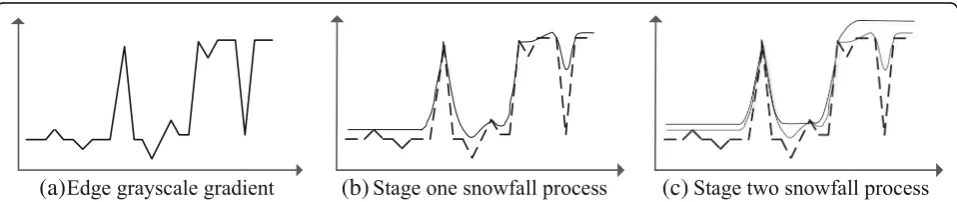
grounds. Figure 1 shows an example of the smoothing
effect when the snow falls twice. The distribution of image grayscale was deemed topographic map in image process; natural snow covered terrain was simulated based on mathematical modeling of the snow course. The image was compared to geographical features, and it was smoothed so that the snow may pile. The steps of features of the snowfall model algorithm are shown as follows.
(1) All of image pixels additive operation execution; (2) Concave waveform smoothing process as a priority
target;
(3) Convexity larger waveform as a reservation target.
Based on the above image processing, desired result of the smoothing process is shown in Fig.1.
In order to achieve the smoothing effect of the snow-fall model, the luminance slope and curvature parame-ters need to be defined. The luminance gradient value
and curvature of convex waveform were required as snow-fall calculation parameters to achieve self-adaptive smoothing process. Curvature and luminance gradient de-cided the amount of snowfall. The upward convex wave-form curvature was given a negative value and recorded as negative curvature, and downward convex waveform curvature was given a positive value and recorded as posi-tive curvature. When curvature value and gradient value were relatively large, we need to give less snowfall in the image process. Similarly, if positive curvature value and gradient value were relatively large, we need more snow-fall to achieve a blur effect. Snowsnow-fall calculation parame-ters were divided into horizontal and vertical directions. One-dimensional differential filter and two-dimensional differential filter were used to calculate the gradient value.
To prevent an unnatural snowfall effect, planarization process of waveform was needed for getting a natural snowfall effect. In a snowfall process as shown in Fig.2a, curvature values of all grayscale were calculated, then the value of the curvature has changed waveform section as a processing target. Curvature value was from positive to negative corresponding to the waveform changes from concave to convex; thus, the curvature value became 0 from positive. The average of the adjacent grayscale values was set as the target grayscale value after snowfall process, the first planarization process effect as shown in
Fig. 2b and waveform processing by convex to concave
change as shown in Fig. 2c. Similarly, the average value of adjacent grayscale was set as the concave grayscale value, and snowfall effect after planarization process ef-fect as shown in Fig.2d.
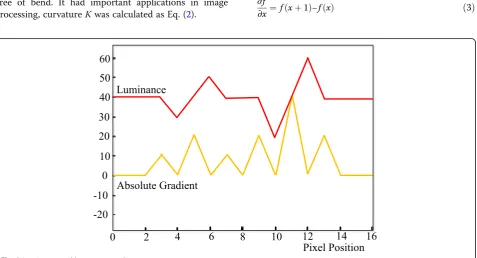
Gradient value was an important parameter in image grayscale level changing, and it was a snowfall gradient calculation parameter in the snowfall model. Gradient values Gra were calculated by the one-dimensional dif-ferential filter; because the positive and negative gradient values were not considered in the calculation, so the ab-solute value of the gradient values was calculated as shown in Eq. (1), in order to satisfy the calculation of snowfall, which was normalization between 0 and π/2.
Figure3 shows the waveform of the luminance and
ab-solute luminance gradients.
(a)
(b)
(c)
Fig. 1Snowfall processing illustration.aEdge grayscale gradient.bStage one snowfall process.cStage two snowfall process
Gra¼ g−0
255−0
π
2
ð1Þ
3 Method—smoothing based on the snow fall
model
Curvature was used to indicate the curve or surface de-gree of bend. It had important applications in image processing, curvatureKwas calculated as Eq. (2).
K¼ x
0
y}−x}y0 x0
ð Þ2þð Þy0 23=2 ð2Þ
First-order derivative and second-order derivative in the xdirection of image functionf(x, y) values were cal-culated by Eq. (3) and Eq. (4).
∂f
∂x¼f xð þ1Þ−f xð Þ ð3Þ
Fig. 2Snowfall correction process.aLuminance value.bWaveform is concave to convex.cWaveform is convex to concave.dProcessing completed
∂2f
∂x2 ¼ f xð þ1Þ þf xð −1Þ−2f xð Þ ð4Þ
Similarly, first-order derivative and second-order de-rivative in they direction were calculated by Eq. (5) and Eq. (6).
∂f
∂y ¼ f yð þ1Þ−f yð Þ ð5Þ
∂2f
∂y2 ¼ f yð þ1Þ þf yð −1Þ−2f yð Þ ð6Þ
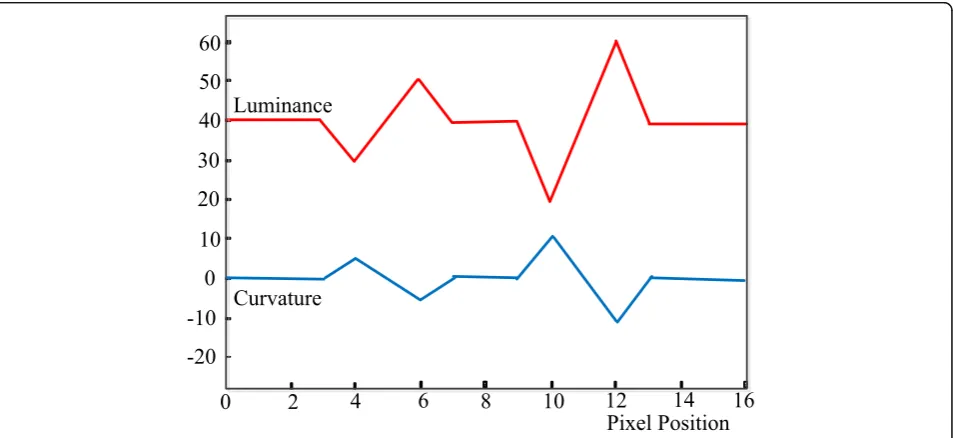
When the luminance values draw a concave waveform, the curvature valueKwas positive; conversely, curvature
value k was a negative value. If the waveform of the
grayscale value was linear, K was 0. Figure4 shows the luminance value and curvature waveform corresponding relation.
A pair of luminance gradient g(x) and curvature k(x) was calculated to produce S(x), i.e., a measure of snow-fall amount at a pixelx. More specifically, a weight G(x) was defined so thatcosG(x) was maximum with gradient
g(x) = 0 and smaller with largerg(x) in magnitude. In addition, another weight based on the curvature was used, where it became larger with negative values (concave) and smaller with positive ones (convex). This second weight was defined by exp(k(x)/10) as an ex-ample. A combination of the two weights was used to calculate S(x). Integrating the measure S(x) over an en-tire image,S(total) was to get a measure of snow amount for the entire image. S(total) was not depth of snow. Therefore, a scaling factor was needed and it was col-lated with real depth of snowfall. However, the process
above corresponded to one-time snowfall. It was re-peated, if further smoothing was necessary. If repeated once, it corresponded to depth. It should be noted that gradient and curvature should be calculated again prior to the next snowfall.
Snowfall amountSwas calculated using gradient value and curvature value. Horizontal snowfall amountSHwas calculated by horizontal direction gradient absolute value GH and curvature value KH. Vertical direction SV could be calculated as the same. The total amount of snowfallSwas calculated by Eq. (7).
S¼SHþSV
¼ exp KH 10
cosGHþ exp KV 10
cosGV
ð7Þ
The curve of the relationship between the curvatureK and snowfall indicated that the larger Kmeans a greater amount of snowfall S. In addition, the relationship be-tween the gradient absolute value Gra and the snowfall amount S indicated that the greater the gradient abso-lute value Gra, the smaller the amount of snowfall. For basic snowfall controlled parameters in the horizontal axis, the gradient of horizontal was GH(xi, yj) and the curvature of horizontal wasKH(xi,yj). For basic snowfall controlled parameters in the vertical axis, the gradient of vertical was GV(xi, yj) and the curvature of vertical was
KV(xi,yj). The detailed calculation in image processing of snowfall is shown in Fig. 5. In order to simulate the process and amount of natural snowfall as much as pos-sible, the amount of snowfall in the horizontal direction and the amount of snowfall in the vertical direction are
Fig. 4Luminance value and curvature
considered comprehensively; because the specific appli-cation needs are not considered at present, total snowfall is finally designed as the average of horizontal direction and vertical direction. In the subsequent research, the ratio of the amount of snowfall in the horizontal direc-tion and the amount of snow in the vertical direcdirec-tion could be adjusted according to the specific application requirements.
In the process of snowfall, the whole image is taken as the processing object. In the specific calculation process, in each local snowfall amount calculation, the adjacent
five pixels of the target pixel is treated as the local snow-fall range. If the x direction is calculated, the left and right adjacent five pixels are used as the local snowfall range. If theydirection is calculated, the top and bottom five pixels adjacent are used as the local snowfall range.
Based on the above calculation step, we calculate the snowfall amount to achieve image smooth processing, and additional operation of grayscale value might be causing an unnatural snowfall effect. Grayscale value waveform might be becoming convex waveform, although the ori-ginal waveform was concave, or the oriori-ginal grayscale
Fig. 5Calculation in image processing of snowfall
(a)
(b)
(c)
(d)
value waveform for convex became a concave waveform after the snowfall process; these phenomena are not nat-ural snowfall effect in image smoothing.
4 Results and discussion
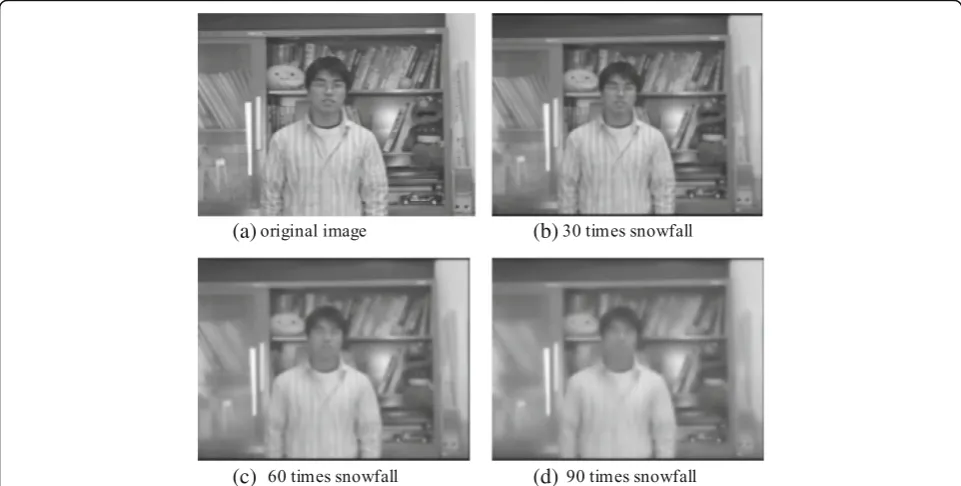
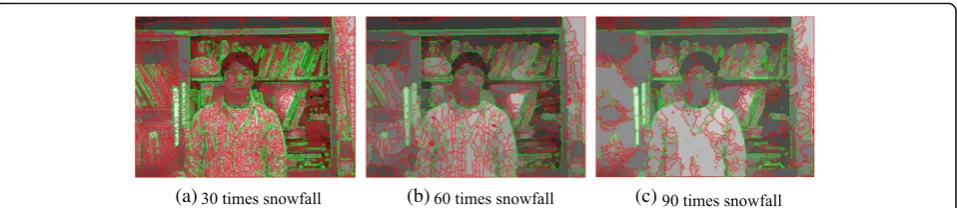
In this experiment, the snowfall model is used as the preprocessing of the region segmentation based on the watershed algorithm to verify the smoothing effect of the snowfall model. In order to verify the smoothing characteristics of the snowfall model, the image with com-plex background was processed with the snowfall model. With the increase of snowfall times, the smoothing effect is enhanced. The step length of snowfall chooses 30 after analyzing the effect of different snowfall times, which can clearly distinguish the difference of smoothing effect. In the comparison experiment, 30, 60, and 90 times the snowfall processing was carried out on the original image. Figure 6ais an original image, 30, 60, and 90 times was snowfall processed in the original image, with smoothing results as shown in Fig.6b–d. As the number of snowfall increases, the smoothness is more obvious, so the smooth filtering effect of Fig.6dis the most significant.
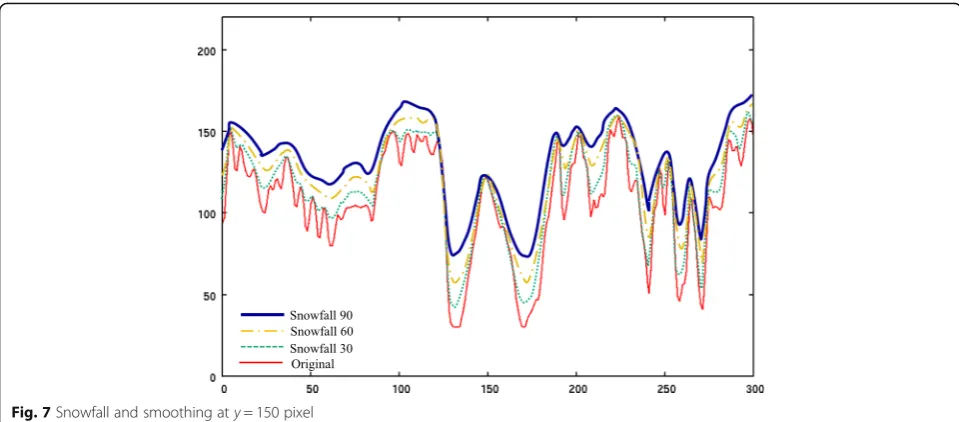
In order to compare and analyze the local effects of snowfall processing, a row of pixels aty= 150 is taken as the analysis object. The changes in the pixel values of the original image and the 30, 60, and 90 times snowfall processing are shown in Fig. 8. Thex-axis of Fig.8 rep-resents positional information in the x-direction of the pixel, and the y-axis represents the luminance value. The red line represents the luminance distribution of the original image. The three lines from the bottom to top represent the change of luminance after the 30, 60, and 90 times of snowfall processing. By observing the waveform changes in Fig. 8, we can see that the small concave in the original image waveform becomes more
and more smooth with the increase of snowfall times. From an analysis and comparison of three snowfall pro-cesses, waveform became smooth gradually. In Fig. 7, a handful of waveform values were less than the original image, the reason was the normalization in snowfall process.
As expected, moderate luminance variation and con-cavity were smoothed while large luminance variation and steep edges were preserved. At the same time, this technique increased the luminance value with each snowfall in the same way as snow falls on the ground,
Fig. 7Snowfall and smoothing aty= 150 pixel
Fig. 8Nine local area luminance change calculation
resulting in increase in the average luminance value. However, it did not matter since this technique was ex-pected for use in conjunction with differential filters such as the watershed segmentation.
Gaussian low-pass filter has the property of having no overshoot to a step function input while minimizing the rise and fall times. The pixels of space distribution were used as a reference value in the denoising process. The weight distribution was determined based on distance to the target pixel, so the Gaussian low-pass filter blur ef-fect was close to human natural vision. Equation (8) is a two-dimensional Gaussian function of the standard devi-ationσ.
G xð ;yÞ ¼ 1
2πσ2 exp − x2þy2
2σ2
ð8Þ
Using a weight template, which is from Eq. (8), the convolution operation could realize image-smoothing processing, with σvalue becoming larger and the image smoothing effect becoming stronger.
The above-described smoothing process methods do not retain image edge effect, so the image processing re-sults lose edge characteristics of the original image. To retain the original edge characteristics of the smoothing process was necessary for image preprocessing method; Fig.8is a grayscale level distribution of nine local neigh-borhoods, and average grayscale value was calculated on the minimum variance field as the output grayscale value of the center. This process could keep the original image edge features and remove noise and retain the smooth-ing process effect.
Based on the watershed algorithm for image segmen-tation, first we find the minimum (minima) of grayscale difference and carried on the label, the label number was the serial number of each region. Grayscale value was based on the baseline moving upward starting from 0 to 255; mobile search for the maximum value was the watershed point, so as to complete the image region seg-mentation based on watershed algorithm.
The watershed algorithm for image segmentation could be induced in regional excessive segmentation, so
image-smoothing pretreatment was needed before the segmentation. To verify the validity of the snowfall model, Gaussian low-pass filter was as the pretreatment of the re-gional segmentation based on the watershed algorithm. Comparative analysis experiments of edge-preserving smoothing processing result showed that good blur ef-fect was achieved based on optimal value parameters. The pretreatment processing result was segmented with regional segmentation based on the watershed algorithm. To ensure the effectiveness and rigor of the proposed al-gorithm, the original image and three kinds of snowfall image region segmentation experiments were imple-mented. Regional segmentation result is shown in Fig.9. The result showed snowfall pretreatment processing had a different edge information. Compared with the conven-tional smoothing algorithm, the snowfall model could in-tegrate the regions while maintaining the edges.
The Caucasian low-pass filter and snowfall models with different parameters were compared in detail. With the increase of parameters σ, the smoothing effect of Gaussian filter is enhanced; with the increase of snowfall times, the smoothing effect of snowfall model has the same characteristic. In order to compare with the Gaussian filter, the segmentation results corresponding to different snow-fall times and the segmentation results corresponding to the different Gaussian filter parametersσ are investigated and analyzed. Finally, the number of regions and the number of edges are both not much different as a
(a) (b) (c)
Fig. 9Region segmentation results based on the snowfall model.a30 times snowfall.b60 times snowfall.c90 times snowfall
Table 1The number of regions and edges in smoothing method
Gaussian filter Snowfall model
σ Edge retention Region Amount Edge retention Region
0.0 4799 3780 0 4799 3780
0.5 4309 3755 20 3031 3833
1.0 3034 3653 40 2290 3864
1.5 2107 3210 60 1721 3733
2.0 1570 2848 80 1400 3515
group to make comparative analysis. Table 1 summa-rizes the changes in the number of boundary lines that overlap the number of regions and the boundary in each smoothing method with different parameters.
Figure10shows a comparison by drawing each of the smoothing methods of Table1. The outline of the image edge and region segmentation image had carried on the contrast. The snowfall image edge information and Cau-casian low-pass filter processing results are showed in Fig. 10; the vertical axis was the number of area infor-mation, and the horizontal axis was the number of over-lap edge. The blue line above represents the snowfall model, and the red line below represents the Caucasian low-pass filter. An upward line proved the algorithm had better edge retention characteristics. The upper left point was the original data, with the smoothing process increasing the number of regions was slowly decreased; at the same time, dislocation phenomenon of image edge features was also enhanced. The adap-tive snowfall model retained the image edge features
while achieving a good regional segmentation. Based on the analysis of experimental data where we might draw a conclusion, in five kinds of preprocessing algo-rithm, the snowfall model was an optimal smoothing process algorithm.
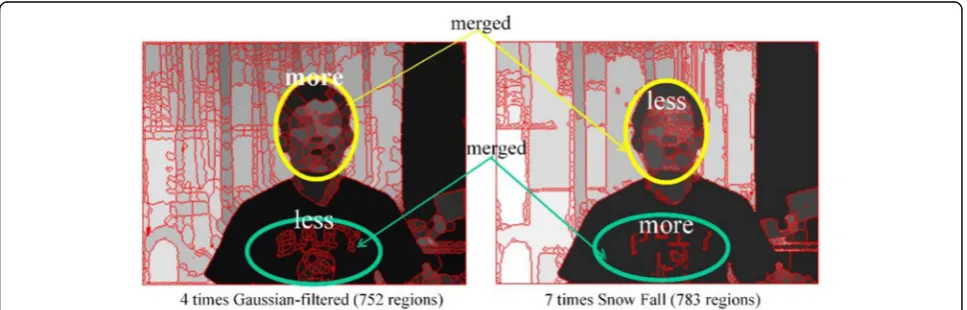
Segmentation results based on the watershed algo-rithm with snowfall (seven times) and Gaussian filter (four times) are shown in Fig. 11; the difference of seg-mentation results was more obvious in the background region, and more regions were merged by using snowfall. Increasing the process number of Gaussian-filter and snowfall, the segmentation results were compared and analyzed. Less area was merged in larger grayscale value part (higher luminance part), and more area was merged in lower grayscale value part (lower luminance part) by using snowfall. Because region was not merged in the tiny part by snowfall, result in the overall number differences of region was not big, but snowfall had bet-ter effect than Gaussian-filbet-ter, such as background and character area.
Fig. 10Quantitative analysis and comparison of information
Fig. 11Results of image edge information comparison
5 Conclusions
Snowfall model as a novel edge preserving smoothing filter based on nature snowfall was presented in this paper. The moderate luminance variation and concavity are smoothed while large luminance variation and steep edges are pre-served. At the same time, this technique increases lumi-nance value with each snow fall in the same way as snow falls to the ground, resulting in an increase in average lumi-nance value. In order to verify the smoothing effect of the snowfall model, it was applied to the pretreatment of region segmentation based on the watershed algorithm. In addition, compared with Gaussian-filter, experimen-tal results showed that the snowfall model had the same function as the Gaussian-filter. Although region was not merged in the tiny part, smoothing effect of snow-fall was better than Gaussian-filter in the lower lumi-nance part. However, it does not matter since this technique is expected for use in conjunction with dif-ferential filters such as watershed segmentation. In the future, we would further study the parameters of snow-fall model on smoothing effect and application, especially the matching degree with the watershed algorithm, and suppressing over-segmentation.
Funding
This work was supported by Natural Science Fund of Changzhou (CE20165028, CE20175026), Qing Lan Project of Jiangsu Province, Natural Science Research Project of Jiangsu Province (BY2016030–05).
Availability of data and materials We can provide the data.
Authors’contributions
Two authors take part in the discussion of the work described in this paper. The author HF designed the experiment and wrote the first version of the paper. The author HZ verified the proposed method and performed the part experiments of the paper. Both authors read and approved the final manuscript.
Authors’information
Honghui Fan, Doctor of Engineering, Associate Professor, Graduated from Yamgata University of Japan in 2011 and worked in Jiangsu University of Technology. His current research interests include computer application technology, image processing and image restoration. Hongjin Zhu, Doctor of Engineering, Associate Professor, graduated from Yamgata University of Japan in 2010 and worked in Jiangsu University of Technology. Her current research interests include image processing, computer vision, and pattern recognition.
Ethics approval and consent to participate
Not applicable.
Consent for publication Not applicable.
Competing interests
Both authors declare that they have no competing interests.
Publisher’s Note
Springer Nature remains neutral with regard to jurisdictional claims in published maps and institutional affiliations.
Received: 6 June 2018 Accepted: 25 July 2018
References
1. C Song, C Xiao, X Li, et al., Structure-preserving texture filtering for adaptive image smoothing [J]. J. Vis. Lang. Comput.45, 17–23 (2018)
2. D Min, S Choi, J Lu, et al., Fast global image smoothing based on weighted least squares [J]. IEEE Trans. Image Process.23(12), 5638–5653 (2014) 3. S Gonzalez, M Brookes, PEFAC-a pitch estimation algorithm robust to high
levels of noise [J]. IEEE/ACM Trans. Audio Speech Lang. Process. (TASLP) 22(2), 518–530 (2014)
4. KM Wong, TT Wong,Edge-preserving smoothing filter for particle based rendering [J]. Game Engine Gems 3(2016), p. 91
5. M Mazhari, RPR Hasanzadeh, Suppression of noise in SEM images using weighted local hysteresis smoothing filter [J]. Scanning38(6), 634–643 (2016) 6. R Verma, J Ali, A comparative study of various types of image noise and
efficient noise removal techniques [J]. Int. J. Adv. Res. Comput. Sci. Softw. Eng.3(10), 617-622 (2013)
7. H Hiary, R Zaghloul, A Al-Adwan, et al., Image contrast enhancement using geometric mean filter [J]. SIViP11(5), 833–840 (2017)
8. K He, J Sun, X Tang, Guided image filtering [J]. IEEE Trans. Pattern Anal. Mach. Intell.6, 1397–1409 (2013)
9. H Choi, J Jeong, Despeckling images using a preprocessing filter and discrete wavelet transform-based noise reduction techniques [J]. IEEE Sensors J.18(8), 3131–3139 (2018)
10. KK Sirur, Y Peng, Z Qinchuan,Effect of Smoothing Filters on Time-Domain Waveform Image Segmentation [C], Proceeding IIP'17 Proceedings of the 2nd International Conference on Intelligent Information Processing (ACM, New York, 2017), p. 19. Article No. 19, Bangkok, Thailand—July 17 - 18, 2017. 11. L Jin, M Jin, X Xu, et al.,Structure-Adaptive Vector Median Filter for Impulse
Noise Removal in Color Images [C], Image processing (ICIP), 2017 IEEE international conference on (IEEE, Beijing, 2017), pp. 690–694.https://doi. org/10.1109/ICIP.2017.8296369.
12. C Tsiotsios, M Petrou, On the choice of the parameters for anisotropic diffusion in image processing [J]. Pattern Recogn.46(5), 1369–1381 (2013) 13. A Roy, J Singha, L Manam, et al., Combination of adaptive vector median
filter and weighted mean filter for removal of high-density impulse noise from colour images [J]. IET Image Process.11(6), 352–361 (2017) 14. V Gupta, V Chaurasia, M Shandilya, Random-valued impulse noise removal
using adaptive dual threshold median filter [J]. J. Vis. Commun. Image Represent.26, 296–304 (2015)
15. Yang Q, Mao W, Tang H, et al. Deblending with Weak Signal Preserved by Dip Vector-Median Filter [C]. 2017 SEG international exposition and annual meeting. society of exploration geophysicists, 2017.
16. S Huo, W Zhu, T Shi, Iterative dip-steering median filter [J]. J. Appl. Geophys. 144, 151–156 (2017)
17. B Pan, Bias error reduction of digital image correlation using Gaussian pre-filtering [J]. Opt. Lasers Eng.51(10), 1161–1167 (2013)
18. L Karacan, E Erdem, A Erdem, Structure-preserving image smoothing via region covariances [J]. ACM Trans. Graph. (TOG)32(6), 176 (2013) 19. C Lopez-Molina, B De Baets, H Bustince, et al., Multiscale edge detection based on
Gaussian smoothing and edge tracking [J]. Knowl.-Based Syst.44, 101–111 (2013) 20. NM Zaitoun, MJ Aqel, Survey on image segmentation techniques [J].
Procedia Comput. Sci.65, 797–806 (2015)
21. Z Guo, H Pan, J Chen, et al.,Image Filtering Enhancement [C], International conference on sensing and imaging (Springer, Cham, 2018), pp. 493–499 22. J Ahmad, MA Khan, SO Hwang, et al., A compression sensing and noise-tolerant image encryption scheme based on chaotic maps and orthogonal matrices [J]. Neural Comput. & Applic.28(1), 953–967 (2017)
23. MR Islam, C Xu, Y Han, et al., A novel weighted variational model for image denoising [J]. Int. J. Pattern Recognit. Artif. Intell.31(12), 1754022 (2017) 24. H Yang, M Gunzburger, Algorithms and analyses for stochastic optimization
for turbofan noise reduction using parallel reduced-order modeling [J]. Comput. Methods Appl. Mech. Eng.319, 217–239 (2017)
25. RVK Reddy, KP Raju, MJ Kumar, et al., Comparative analysis of common edge detection algorithms using pre-processing technique [J]. Int. J. Electr. Comput. Eng. (IJECE)7(5), 2574–2580 (2017)