R E S E A R C H
Open Access
Segmentation method based on
multiobjective optimization for very high
spatial resolution satellite images
Saleh El Joumani, Salah Eddine Mechkouri
*, Rachid Zennouhi, Omar El Kadmiri and Lhoussaine Masmoudi
Abstract
In this paper, a new multicriterion segmentation method has been proposed to be applied to satellite image of very high spatial resolution (VHSR). It is consisted of the following process: For each region of the grayscale image, a center of gravity has been calculated and it has been also selected a threshold for its histogram. According to a certain criteria, this approach has been based on the separation of the different classes of grayscale in an optimal way. The proposed approach has been tested on synthetic images, and then has applied to an urban environment for the classification of data in Quickbird images. The selected zone of study has been laid in Skhirate-Témara province, northwest of Morocco. Which is based on the Levine and Nazif criterion, this segmentation technique has given promising results compared those obtained using OTSU and K-means methods.
Keywords:Segmentation, Multicriterion, Entropy, Otsu, K-means, Satellite image VHSR (Quickbird), Levine and Nazif criterion
1 Introduction
Segmentation is the technique and procedure used to divide the image into different non-overlapping regions according to their characteristics. The pixel values in the same region have similar attributes while the pixel values from diverse regions have various features. Various methods have been developed and used with a relative success. They can be roughly classified into several cat-egories according to the dominant features they employ, such as edge-based method [1], region-growing method [2], neural networks method, physics-based method [3–5], and histogram thresholds method [6].
However, in some practical situations, solving segmen-tation problems need more information than what is contained in one-single image band. In these cases, the use of several image color components or a multispec-tral image is necessary [7–9]. In practice, the application of such method, on a VHSR image, leads to inaccurate results. In certain specific cases, variant region of interest are classified to be homogenous, this is due to two main critical issues in color image segmentation: (1) what's the
way segmentation method should be used?; and (2) what's the way color space should be adopted? [10]. It demon-strated that, for unsupervised classification problems, histogram thresholding is a suitable method for achieving good segmentation results with a low computation com-plexity for a wide class of images [4, 10].
In this case, a number of classification algorithms, based on 2D histogram analysis, are obtained by multidimen-sional histogram projection which are focused on two color procedures. These algorithms have been elaborated and used successfully [7–9, 11].
This work proposes a method that focuses on the sepa-ration of different classes of grayscale in an optimal way according to some criterion, using typical techniques of image segmentation. We calculate the center of gravity for each region of the grayscale image and the threshold of its histogram [7–9]. In order to show the feasibility of the proposed method, firstly, we will compare our approach with OTSU and K-means methods by testing and applying them on synthetic images. Secondly, we will evaluate our algorithm on land cover and land use classification using a satellite image of a selected urban zone.
This task confirm that the segmentation technique provides better results when it is established on a
* Correspondence:[email protected]
LETS/Geomat Laboratory, Physics Department, Mohammed V University, B.P N° 1014 Av. Ibn Battouta, Rabat, Morocco
combination of criteria. Thus, the diversity of images to which it could be applied successfully. At the same time, it reveals the weakness of the criteria when it' s used separately, without being combined.
The first chapter of this article presents the proposed multicriteria segmentation approach. The second one de-scribes the multiobjective function. The third one presents the VHSR satellite image we used in this study. The fourth chapter introduces the criterion of Levine and Nazif, and the last one reveals the experimental outcomes and the discussion.
2 Description of the method
Multiobjective optimization extends from the theory of optimization by allowing several design goals to optimize simultaneously. A multiobjective optimization problem is solved in a way similar to the simple objective classic problem. The goal is to find a set of values for the design variables that simultaneously optimize several objective functions (or costs). In general, the solution obtained by the separated optimization of each objective (simple objective optimization) does not represent a possible solution for the multiobjective problem.
The proposed approach in [12] is justified by the simple reason that, in almost all cases, the segmentation process, based on the optimization of one criterion only, does not work very well for many images. Frequently, the optimal value of the threshold for each criterion does not produce satisfactory image segmentation. Here, we propose opti-mal thresholds that allow optimizing a set of criteria. The method of thresholding was based on three criteria:
1. The modified within-class variance criterion, 2. The overall probability of error criterion, and 3. The entropy criterion.
The identification of these three criteria in the thresh-olding algorithm requires the introduction of three parameters:w1,w2, andw3, see eq. (7) and the detail of which we shall see later.
Our aim is to increase the information about the position of the optimal threshold that allows us to obtain the correct segmentation.
In this subsection, we present the different criteria that we will minimize later for the process of multilevel image thresholding. Functions (criteria) that we chose are the modified within-class variance, the overall prob-ability of error and the entropy.
2.1 Modified within-class variance criterion
Thresholding based on within-class variance tends to classify an image as the object and the background of similar sizes. In order to overcome this drawback, an objective function was derived from the classical
within-class variance criterion; some a priori knowledge about the characteristics of the resulting segmentation, such as uniformity or homogeneity, of the regions and simplicity of the interiors of the regions was introduced. The proposed modification consists, in the integration in the criteria, of the ideal segmentation properties. The criter-ion expressing the uniformity and the homogeneity of the regions is the within-class variance criterion, defined as follows:
MVarð Þ ¼I αXNR j¼1
Varð Þj 2 βj
þγj ð1Þ
And we assume that the number NR of regions is two.
αis given by 1
10000XM ffiffiffiffiffiffiffi NR
p
whereMis the image size.
βj¼ 1
1þLogð ÞNj , Nj denotes the number of pixels in the
regionj.
γj¼ R Njð Þ Nj
2
, andR(Nj) is the number of the regions
of which cardinal is equal toNj.
Var(j) is defined as (www.cpe.eng.cmu.ac.th/wp-con-tent/uploads/CPE752_08.pdf ):
Varð Þ ¼R XJj¼1PJmj−mG2 ð2Þ
With
mj¼ 1
Pj
X
i∈Cj
ipi
Pj¼
X
i∈Cj
pi
mG¼
XL−1
i¼0 iPi
pi¼Xh iL−ð Þ1 j¼0h jð Þ
jis the number of region;Pjis the probability of classj;
mj is mean intensity of the pixels in class j; mG is the
global mean; pi is the probability density function of
different pixels of the image;h(i) is the number of occur-rences of the gray level of pixeli∈[0,L−1], andLis the total number of grayscales.
2.2 Overall probability of error criterion
e Tið Þ ¼Pi
Z
−∞ Ti
Pið Þx dxþPiþ1 Z þ∞
Ti
Piþ1ð Þx dx ð3Þ
i= 1; 2;…; d−1 with respect to the thresholdTi, Then, the overall probability to minimize is
E Tð Þ ¼Xd−1
i¼1e Tð Þi ð4Þ WhereTis the vector of thresholds: 0 < T1 < T2 <…< Td−1 < 255.
2.3 Entropy criterion
The entropy of the two classes A and B are defined by
HAð Þ ¼t −Xti¼1 pi Ptlog
pi
Pt ð5aÞ
HBð Þ ¼t −XLi¼tþ1 pi
1−Ptlog pi
1−Pt ð5bÞ
and the total entropy is
HTð Þ ¼t HAð Þ þt HBð Þt ð5cÞ
The first problem with this approach, highlighted by Pal [13], is that the entropy Shannon is not defined for probability densities including zero probabilities. Pal and Pal then proposed a new definition of entropy based on exponential gain information:
HTð Þ ¼t −Xti¼1pi Pte
1−piPt−XL
i¼tþ1
pi
1−Pte
1−pi
1−Pt
; ð5Þ
2.4 Objective function
The multiobjective function applied to two thresholds images (like medical images) by Nakib [12] is defined as follows:
MOBJ1ð Þ ¼T w1MVarðR Tð ÞÞ þ w2E Tð Þ ð6Þ
Obviously, this function has certainly been success-ful but it showed its limits. For that reason, we
thought about introducing another factor such as entropy.
Therefore, for the multithreshold images, we propose to modify this objective function (6) by introducing the entropy information, which we can take into account as follows:
MOBJ2ð Þ ¼T w1MVarðR Tð ÞÞ þw2E Tð Þ
þw3HTð ÞT ð7Þ
WhereT is the vector of thresholds: 0 < T1< T2<…< Td-1< 255.
In addition, the weighting parameters given by
○For the function MOBJ1 (6):w1= 1−w2
w2¼ X
i¼1
d σ2
i σ2
Histogram
○For the function MOBJ2 (7):w1= 1−w2−w3
w2¼ X
i¼1
d σ2
i σ2
Histogram
w3¼XmG
j¼1
d mj
Where d is the number of the Gaussians; σi is the
standard deviation of the ith Gaussian probability dens-ity function; and σHistogram is the standard deviation of
Fig. 2®Digital Globe: area of study—QuickBird panchromatic image—region of interest for panchromatic image (urban areas, forest, and River)
Table 1Quickbird MS image specification
Band Wavelength (nm) Spatial resolution (m2)
Blue 450–520 (485) 2.4 × 2.4
Green 520–600 (560)
Red 630–690 (660)
Near-infrared 760–900 (830)
the original histogram. The weighting parameters
(w1 , w2 , and w3) allow touching the boundary of the
feasible domain. This operation was used when the goal of the segmentation is to extract the target from the ori-ginal image.
3 Quickbird image data
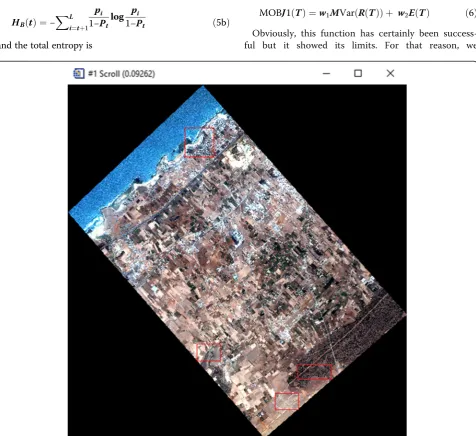
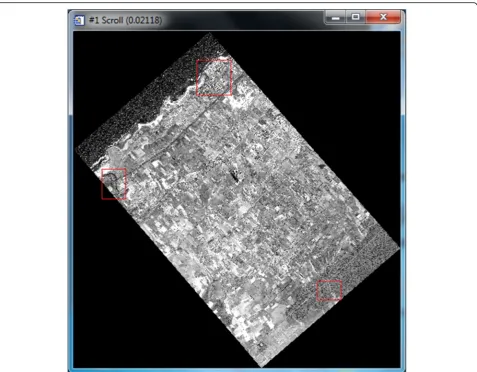
The Quickbird image (Figs. 1 and 2) retained for this work is a selected urban zone of the Skhirate-Témara province, in the northwest of Morocco, delimited by lon-gitude φ1= 6°57′58.87″ W and latitude λ1= 33°55′ 35.99″N and covers about 90 Km2. This image was cap-tured on June 15, 2006. We used the panchromatic band and the multispectral band (see the characteristic in Table 1).
4 Levine and Nazif evaluation of criteria
One of the most intuitive criterions being able to quan-tify the quality of a segmentation result is the intra-region uniformity. Weszka and Rosenfeld [14] propose such a criterion with thresholding that measures the ef-fect of noise to evaluate some thresholded images. Based on the same idea of intra-region uniformity, Levine and Nazif [15] also defined a criterion that calculates the uni-formity of a region characteristic based on the variance of this characteristic [16]:
LEV1ð ÞIR
¼1− 1
Cardð ÞI X
k¼1
NR X
s∈Rk½gIð Þs− X
t∈RkgIð Þt
2
maxs∈RkðgIð ÞsÞ−mins∈RkðgIð Þs Þ
ð Þ2
ð8Þ
Where
(I).IRcorresponds to the segmentation result of the image in a set of regionsR= {R1,…,RNR} havingNRregions, (II).Card(I) corresponds to the number of pixels of the
image I,
(III).gI(s) corresponds to the gray-level intensity of the pixels of the imageIand can be generalized to any other characteristic (color, texture…).
Sezgin and Sankur [17] proposed a standardized uni-formity measure. Based on the same principle, the meas-urement of homogeneity of Cochran [18] gives a confidence measure on the homogeneity of a region. How-ever, this method requires a threshold selection that is often arbitrarily is done, limiting thus the proposed method. Another criterion to measure the intra-region uni-formity is developed by Pal and Pal [19]. It is based on a thresholding that maximizes the local second-order en-tropy of regions in the segmentation result. In the case of Fig. 3Comparison between two multiobjective functions (MOBJ1 and MOBJ2)
Table 2Values of Levine and Nazif evaluation of criteria for various functions (MOBJ1 and MOBJ2)
Imagery Threshold Filter Criterion intra-region of Levine and Nazif
Criterion inter-region of Levine and Nazif
Criterion intra-inter region of Levine and Nazif
Multiobjective1 Multiobjective2 Multiobjective1 Multiobjective2 Multiobjective1 Multiobjective2
Image_synt [22] 2 2.5 0.0120 0.0372 0.2943 0.1834 0.5542 0.5310
slightly textured images, these criteria of intra-region uni-formity prove to be effective and very simple to use. How-ever, the presence of textures in an image often generates improper results due to the over influence of small regions. Complementary to the intra-region uniformity, Levine and Nazif [15] defined a disparity measurement between two regions to evaluate the dissimilarity of regions in a segmentation result. The formula of total inter-region disparity was defined as follows:
where wRk is a weight associated to Rk that can be
dependent of its area, for example, g k is the average of the gray-level ofRk.gIð ÞRk can be generalized to a feature
vector computed on the pixel values of the regionRksuch
as for LEV1. pRkRj Corresponds to the length of the
perimeter of the regionRkcommon to the perimeter of
the region Rj. This type of criterion has the advantage
of penalizing the over segmentation. (Formula intra-inter region)
LEV2ð Þ ¼IR
XNR k¼1WRk
XNR
j¼1=Rj∈W Rð Þk
PRknRjgIð ÞRk −gI Rj
gIð Þ þRk gI Rj
" #
XNR k¼1WRk
Note that the intra-region uniformity can be combined with the inter-region dissimilarity by using the following formula:
where C2
NR is number of combinations of two regions
amongNR.
This criterion [20] combines intra- and inter-region disparities. Intra-region disparity is computed by the normalized standard deviation of gray levels in each re-gion. The inter-region disparity computes the dissimilar-ity of the average gray level of two regions in the segmentation result.
Haralick and Shapiro [21] consider that
(I). The regions must be uniform and homogeneous, (II).The interior of the regions must be simple without
too many small holes,
(III).The adjacent regions must present significantly different values for the uniform characteristics, and (IV).Boundaries should be smoothed and accurate.
5 Contribution of the new multiobjective function
The improvement of the objective function requires on the way to identify the contribution of our method. We precede by a comparison between two eqs. (6) and (7).
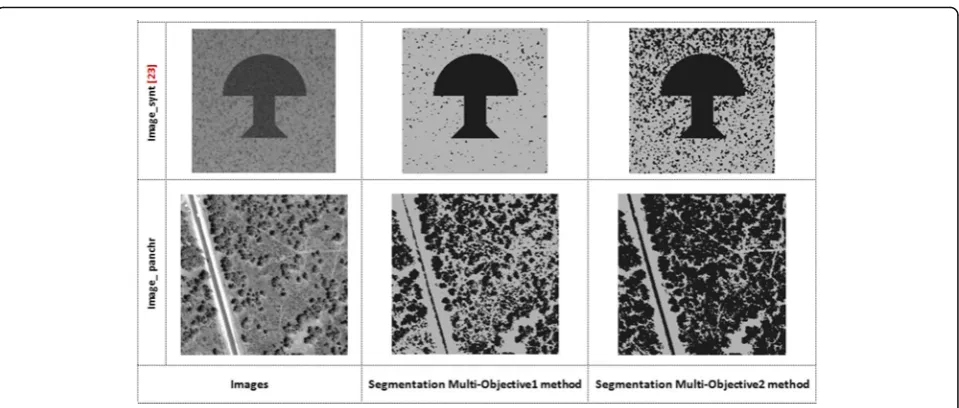
So, in this section, we will compare our new multiob-jective function MOBJ2 with that of Nakib MOBJ1 so the introduction of entropy in the multiobjective func-tion, and after several test of this function on synthetic
images and on high spatial resolution images, clearly, we could observe the positive contribution to the segmenta-tion process. The result of the segmentasegmenta-tion is obviously amazing (see Fig. 3), and this is well justified of course through the assessment criteria obtained in Table 2.
6 Experimental results and discussion
Thresholding based on within-class variance tends to classify an image as the object. The experiments pre-sented here concern the pixel classification of both a synthetic image and the classification of our Quickbird image in the different land cover and land use classes.
In order to evaluate the proposed technique, we con-ducted the first phase of experimentation on synthetic images. We have chosen a first image, which contains a texture to study the influence of small regions. We no-ticed that the inter-region, the intra-region, and the intra-inter-region criterion values of our proposed
method are lower than those provided by Otsu’s one.
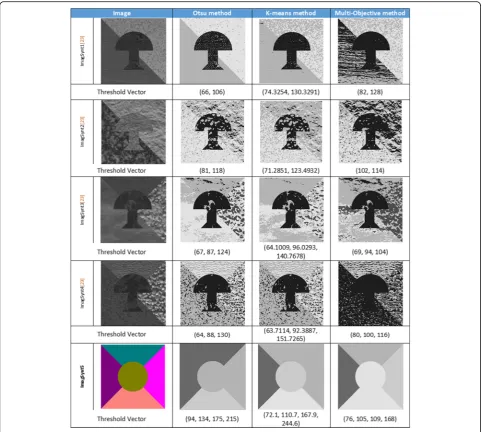
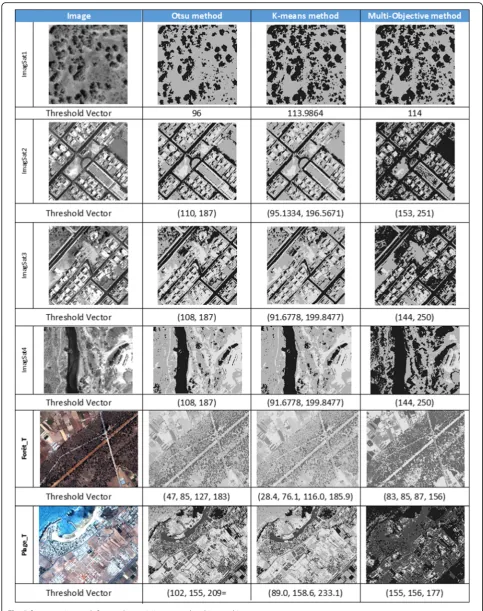
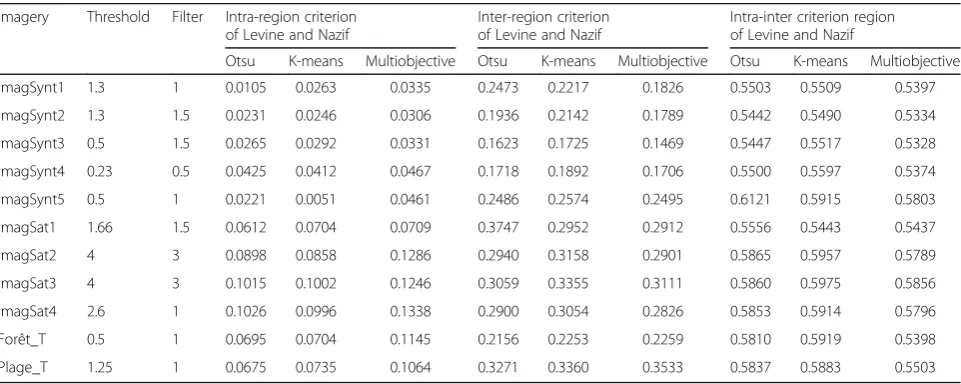
The same findings were obtained when processing other synthetic images having different morphological proper-ties. Figure 4 presents the segmented results for syn-thetic images, and Fig. 5 presents the segmented results for panchromatic images. Also, to evaluate the proposed technique, we have used the Levine and Nazif evaluation of criteria. From Table 3, it can be seen that the
pro-posed method performs better than Otsu’s method.
LEV
3
ð Þ ¼
I
R1
2
1
þ
1
C
2NRX
Ni;j¼R1;i≠j
gIð ÞRi−gI
ð Þ
Rjj
j
512− 4 2552N R
X
NRi¼1
σ
2R
i
0
B
B
@
1
C
C
A
ð10ÞTable 3Values of Levine and Nazif evaluation of criteria for various methods
Imagery Threshold Filter Intra-region criterion of Levine and Nazif
Inter-region criterion of Levine and Nazif
Intra-inter criterion region of Levine and Nazif
Otsu K-means Multiobjective Otsu K-means Multiobjective Otsu K-means Multiobjective
ImagSynt1 1.3 1 0.0105 0.0263 0.0335 0.2473 0.2217 0.1826 0.5503 0.5509 0.5397
ImagSynt2 1.3 1.5 0.0231 0.0246 0.0306 0.1936 0.2142 0.1789 0.5442 0.5490 0.5334
ImagSynt3 0.5 1.5 0.0265 0.0292 0.0331 0.1623 0.1725 0.1469 0.5447 0.5517 0.5328
ImagSynt4 0.23 0.5 0.0425 0.0412 0.0467 0.1718 0.1892 0.1706 0.5500 0.5597 0.5374
ImagSynt5 0.5 1 0.0221 0.0051 0.0461 0.2486 0.2574 0.2495 0.6121 0.5915 0.5803
ImagSat1 1.66 1.5 0.0612 0.0704 0.0709 0.3747 0.2952 0.2912 0.5556 0.5443 0.5437
ImagSat2 4 3 0.0898 0.0858 0.1286 0.2940 0.3158 0.2901 0.5865 0.5957 0.5789
ImagSat3 4 3 0.1015 0.1002 0.1246 0.3059 0.3355 0.3111 0.5860 0.5975 0.5856
ImagSat4 2.6 1 0.1026 0.0996 0.1338 0.2900 0.3054 0.2826 0.5853 0.5914 0.5796
Forêt_T 0.5 1 0.0695 0.0704 0.1145 0.2156 0.2253 0.2259 0.5810 0.5919 0.5398
The second phase of experimentation was conducted on a set of summary images with a VHSR (panchromatic image with a spatial resolution of 0.61m × 0.61m). While adjusting the threshold and the filter coefficients to seg-ment each image, we also calculated their centers of gravity as well as their uniformity criterion of intra-region and intra-inter intra-region of Levine and Nazif. This was done for the multicriteria method and the Otsu method.
To evaluate quality of segmentation results in the case of real images, which usually contains several unknown degradations, the second phase of this comparative ex-perimental study conducted as a result and evaluated using a real gray level image and a set of VHSR satellite images. We could infer from obtained evaluation criter-ion values (Table 3), which remains constantly inferior to those obtained when using Otsu’s algorithm, that the multiobjective optimization method provides more stable and reliable results especially in the case of high-resolution satellite images.
7 Conclusions
In this work, we proposed a new multicriterion segmenta-tion method based on the separasegmenta-tion of different classes of gray levels in an optimal way according to certain criteria and applied it to VHSR satellite images. Therefore, we im-plemented a segmentation method based on multiobjec-tive optimization function MOBJ2 developed and take account of entropy. We tested the function with respect to that of Nakib MOBJ1 while appealing to Levine and Nazif evaluation criteria and gave good results.
We applied the MOBJ2 according to the segmentation of multiclass images such as synthetic images and samples of panchromatic image of VHSR in order to assess the MOBJ2 function compared to that of the OTSU and the K-means available MATHLAB. The evaluation of the seg-mentation by introducing Levine and Nazif assessment criteria shows that the multiobjective function developed is better than the OTSU method and the K-means.
Abbreviations
LEV1:The formula that calculates the uniformity of intra-region based on the variance of this characteristic; LEV2: The formula that calculates the inter-region disparity total; LEV3: The formula that calculates the combination of the intra-region uniformity and the inter-region disparity; MOBJ1: The multiobjective function applied to two threshold images by Nakib; MOBJ2: Our multiobjective function applied to images with at least two thresholds; VHSR: Very high spatial resolution
Acknowledgements
Since 2007, this satellite image has been used for several research projects. Consequently, all LETS/Geomatic PhD students who use this satellite image in their research work always express their thanks to the Spanish Agency for International Cooperation which has financed the acquisition of this image in 2007.
Funding
We do not have any funding for this work.
Authors’contributions
The authors’contributions for this work are as follows: OE suggests the multiobjective function idea and participates at the automatization program. SE and SEM carried out the development of image segmentation algorithm based on the revised multiobjective function (MOBJ1 and MOBJ2) and participated in the design of the study, and performed the experimentation of this algorithm for the assessment of the multiobjective function. RZ carried out the algorithm of thresholding program and helped for the choice of the evaluation criteria. SEM conceived of the study and participated in its design and coordination, and helped to draft the manuscript. Moreover, of course, the work conducted under the direction of our Professor LM. All authors read and approved the final manuscript.
Competing interests
The authors declare that they have no competing interests.
Received: 31 July 2016 Accepted: 27 December 2016
References
1. B. A. Maxwell and S.A. Shafer, Physics based segmentation: looking beyond color, Proceedings of Image Understanding Workshop, 1996
2. B Bouda, L Masmoudi, D Aboutajdine, CVVEFM: Cubical voxels and virtual electric field model for detection in color images. Signal Process. 88, 905–915 (2008). Elsevier
3. M Ortega, Y Rui, K Chakrabarti, A Warshavsky, S Mehrotra, TS Huang, Supporting ranked boolean similarity queries in MARS. IEEE Trans. Knowl. Data Eng.10(6), 905–925 (1998)
4. A Clement, B Vigouroux, Unsupervised segmentation of scenes containing vegetation (Forsythia) and soil by hierarchical analysis of bi-dimensional histograms. Pattern Recogn. Lett.24, 1951–1957 (2003)
5. L Vincent, P Soille, Watersheds in digital spaces: an efficient algorithm based on immersion simulation. IEEE Trans. Pattern Anal. Mach. Intell.13(6), 583–598 (1991) 6. CM Onyango, JA Marchant, Physics based color image segmentation for
scenes containing vegetation and soil. Image Vis. Comput.19, 523–538 (2001) 7. R Zennouhi, L Masmoudi, A new 2D-histogram scheme for colour image
segmentation. Imaging Sci. J.57, 260–365 (2009)
8. S Mechkouri, R Zennouhi, L Masmoudi, J Gonzalez, Colour image segmentation using hierarchical analysis of 2D-histograms: application to urban land cover and land use classification. Geo Observateur18, 43–57 (2010)
9. S Mechkouri, R Zennouhi, S El Joumani, L Masmoudi, J Gonzalez, Quantum segmentation approach for very high spatial resolution satellite image: application to Quickbird image. J. Theor. Appl Inf Technol62(2), 539–545 (2014) 10. HD Cheng, XH Jiang, Y Sun, J Wang, Color image segmentation: advances
and prospects. Pattern Recogn.34, 2259–2281 (2001)
11. O Lezoray, H Cardot, Hybrid color image segmentation using 2D histogram clustering and region merging, inICISP, vol. 1, 2003, pp. 22–29
12. A Nakib, H Oulhadj, P Siarry, Image histogram thresholding based on multiobjective optimization. Signal Process.87, 2516–2534 (2007) 13. NK Pal, SK Pal, Entropy: a new definition and its applications. IEEE Trans.
Syst. Man. Cybern.21, 1260–1270 (1991)
14. JS Weszka, A Rosenfeld, Threshold evaluation techniques. IEEE Trans. Syst. Man. Cybern.8(8), 622–629 (1978)
15. MD Levine, AM Nazif, Dynamic measurement of computer generated image segmentations. IEEE Trans. Pattern Anal. Mach. Intell.7(2), 155–164 (1985) 16. S Chabrier, B Emile, C Rosenberger, H Laurent, Unsupervised performance
evaluation of image segmentation, Special Issue on Performance Evaluation in Image Processing. EURASIP J. Appl. Signal Process. Vol. 2006 Article ID 96306, 1-12, (2006)
17. M Sezgin, B Sankur, Survey over image thresholding techniques and quantitative performance evaluation. J Electron Imaging13(1), 146–168 (2004)
18. WG Cochran, Some methods for strengthening the commonX2tests.
Biometrics10, 417–451 (1954)
19. NR Pal, SK Pal, Entropic thresholding. Signal Process.16(2), 97–108 (1989) 20. C Rosenberger,Mise enœuvre d’un système adaptatif de segmentation
d’images, PhD. thèses(Université de Rennes1, Rennes, 1999) 21. RM Haralick, LG Shapiro, Image segmentation techniques. Comput Vis
Graph Image Process29(1), 100–132 (1985)