IJIRT 148808
INTERNATIONAL JOURNAL OF INNOVATIVE RESEARCH IN TECHNOLOGY164
Non-Orthogonal Random Access scheme in Spatial
Group Based Random Access for 5G Networks
Thanneru Nomu
1, RSVS Aravind
2 1Pursuing M.Tech (CS), dept. of ECE, Newton’s Institute of Engineering College, Alugurajupally,
Macherla, Guntur Dist, AP, India
2Associate Professor Dept. of ECE, Newton’s Institute of Engineering College, Alugurajupally,
Macherla, Guntur Dist, AP, India
Abstract- The massive amounts of machine-type user equipment (UEs) will be supported in the future fifth generation (5G) networks. However, the potential large random access (RA) delay calls for a new RA scheme and for a detailed assessment of its performance. Motivated by the key idea of non-orthogonal multiple access, the non-orthogonal random access (NORA) scheme based on successive interference cancellation (SIC) is proposed in this paper to alleviate the access congestion problem. Specifically, NORA utilizes the difference of time of arrival to identify multiple UEs with the identical preamble, and enables power domain multiplexing of collided UEs in the following access process, while the base station performs SIC based on the channel conditions obtained through preamble detection. Our analysis show that the performance of NORA is superior to the conventional orthogonal random access (ORA) scheme in terms of the preamble collision probability, access success probability and throughput of random Access. Simulation results verify our analysis and further show that our NORA scheme can improve the number of the supported UEs by more than 30%. Moreover, the number of preamble transmissions and the access delay for successfully accessed UEs are also reduced significantly by using the proposed random access scheme.
INTRODUCTION
CELLULAR machine-to-machine (M2M)
communication has attracted great attention as one of major candidate technologies to develop an Internet of Things (IoT) platform, in which a massive number of machine (sensor/device) nodes communicate with the network or each other for a wide range of IoT or M2M applications such as e-health, public safety, surveillance, remote maintenance and control, and smart metering [1]. A network connection of each machine node is initiated through a random access
(RA) procedure [2]. At the first step of RA procedure, a number of machine nodes access the eNodeB based on contention using given limited RA preambles on physical RA channels (PRACH), which may result in a significant preamble (PA) collision problem. Then, at the second step of RA procedure, the eNodeB should allocate physical uplink shared channel (PUSCH) resource blocks (RBs) to each of machine nodes for its RA-step 3 data transmission. Since PUSCH resources are mainly utilized for uplink user data transmission, in general, a small amount of PUSCH resources are reserved for the RA procedure. At this time, some of machine nodes may fail to receive the RB allocation due to a lack of PUSCH resources, and if so, they reattempt RAs and spend extra time in the RA procedure, which causes much severer RA congestion. Therefore, both of an efficient RA overload control scheme [3]–[7] and an efficient resource allocation scheme [8], [9] are required for the cellular M2M communications.
LITERATURE SURVEY
IJIRT 148808
INTERNATIONAL JOURNAL OF INNOVATIVE RESEARCH IN TECHNOLOGY165
nodes successfully transmit their PAs at the first step of RA procedure, a much severer bottleneck of RA may occur at the second step of RA procedure due to lack of PUSCH resources for RA procedure. Hence, a more efficient resource allocation scheme is required in the RA procedure.
Several solutions have been proposed to handle the RA congestion problem in pioneering works, such as access class barring (ACB) [9–13], extended access barring (EAB) [14], dynamic allocation [15], specific back off scheme [16], and pull-based scheme [17]. By introducing a separate access class, ACB allows the eNodeB to control the access of UEs separately. Two vital parameters in the ACB method are the barring factor which represents the probability of barring and the back off factor which indicates the back off time before retrying random process if the UE fails the ACB check. Many scholars have worked on the dynamic adjustment of the barring factor. In [10], a joint resource allocation and access barring scheme is proposed to achieve uplink scheduling and random access network (RAN) overload control, in which the access barring parameter is adaptively changed based on the amount of available RBs and the traffic load. In [11], two dynamic ACB algorithms for fixed and dynamic preamble allocation schemes are proposed to determine the barring factors without prior knowledge of the number of MTC devices. [9] Formulates an optimization problem to determine the optimal barring parameter which maximizes the expected number of MTC devices successfully served in each RA slot. [12] Proposes a two-stage ACB scheme to increase access success probability. In the first stage, the UEs use the barring factor broadcast by the eNodeB. The UEs which pass the ACB check are viewed as primary UEs and allowed to select non-special preambles randomly, while the UEs which fail are treated as secondary UEs and select the special preambles. In the second stage, each secondary UE calculates its barring probability independently based on the expected number of secondary UEs.
NON-ORTHOGONAL RANDOM ACCESS MECHANISM
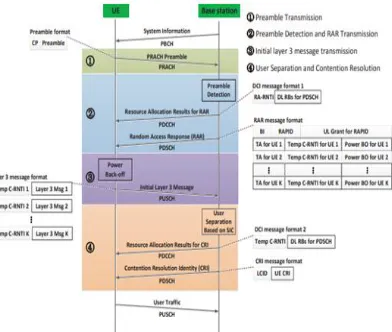
In this section, we give a detailed description of the NORA scheme, which consists of PRACH preamble transmission, random access response, initial layer 3
message transmission and contention resolution (as illustrated in Fig. 1).
A. Preamble Transmission Each UE first receives the system information broadcast on Physical Broadcast
Channel (PBCH) and acquires necessary
configuration information to complete the RA process [35]. The information includes PRACH
configuration information such as PRACH
Configuration Index, PRACH Frequency Offset, Root Sequence Index, etc. and RACH configuration information such as Number of RA Preambles, Maximum Number of Preamble Transmission, RA Response Window Size, Power Back-off Offset, MAC Contention Resolution Timer, etc. When a UE starts to perform random access, it randomly selects a preamble sequence from the available preambles broadcast by the base station and transmits it in the next available RA slot. Preamble sequences are identi- fied by their Random Access Preamble Identity (RAPID). There is also a one-to-one mapping between Random Access Radio Network
Temporary Identifier (RA-RNTI) and the
time/frequency resources used by the PRACH preamble.
B. Preamble Detection and RAR transmission 1) Arrival time based multi-preamble detection: The base station first extracts the relevant PRACH signals within specific time/frequency resources through time-domain sampling and frequency-tone extraction. Then the base station computes the PRACH preamble power delay profile (PDP) through frequency-domain
periodic correlation. Since different PRACH
IJIRT 148808
INTERNATIONAL JOURNAL OF INNOVATIVE RESEARCH IN TECHNOLOGY166
[7]. The Timing Advance (TA) value is calculated based on the time of arrival τ .
Fig. 1. Non-orthogonal Random Access Process
ANALYTICAL MODEL FOR NORA
Based on the SGRA, the eNodeB can independently detect PAs utilized by the k-th spatial group SGk for k = 1, K. mk denotes the number of detected PAs in SGk, and the total number of detected PAs in the cell is expressed as M = PK k=1 mk. In addition, tk,i denotes the PA detection time instant of the i-th node in SGk. It indicates the round trip delay between the eNodeB and the i-th node, and is used to determine the timing alignment (TA) value [11]. From the results of PA detections, random access response (RAR) messages are delivered to the corresponding nodes at the second step of RA procedure. Here, the RAR message includes a PA identifier (PI), TA value, and uplink resource grant (URG) for the third step of RA procedure, at which nodes convey the RA-step 3 data including radio resource control (RRC) connection request, tracking area update, or scheduling request on the allocated PUSCH resource informed by the URG. Ωk,i = {PIk,i, TAk,i, URGk,i} denotes the RAR message and its contents for the i-th node in SGk for k = 1, K and i = 1,, mk. The i-th machine node in SGk transmits the RA-step 3 data with transmission power Pk,i on the allocated uplink RBs informed by URGk,i within Ωk,i. The signal-tonoise ratio (SNR) of RA-step 3 data transmitted by the ith node in SGk is calculated as SNRk,i = Hk,iPk,ir −α k,i /N0, where Hk,i, rk,i, α, and N0 are the channel coefficient, the distance from the eNodeB, the path loss coefficient, and the noise
power, respectively. We assume that total Q RBs on PUSCH are reserved for M2M communications, and they are divided into U RBs and V RBs for PRACHs
and the RA-step 3 channels (RA-S3CHs),
respectively, i.e., Q = U + V . Since one PRACH requires 6 RBs and one RA-S3CH requires 2 RBs with QPSK modulation [11], the number of available PRACHs u and the number of available RA-S3CHs v are expressed as u = U/6 and v = V /2, respectively A. Preamble Transmission Let R depict the total number of available preambles in a RA slot. Consider a specific preamble r and let Y i r be a random variable which takes value 1 if the preamble is used by exactly i out of m UEs and 0 otherwise. It readily follows that [4],
First, we consider the scenario where one preamble is used by two UEs, i.e. i = 2. The UEs are assumed to be uniformly distributed in the cell, thus the time interval between two UEs’ arrivals ∆t is depicted as ∆t = |d1 − d2| c , (6)
where trms is the root meam square (RMS) of the delay spread. p s2 represents the probability of differentiating the preamble transmissions of two UEs which select the same preamble. Let p id denote the probability of successfully separating the i-th UE’ preamble signals within the ZCZ for i ≥ 3. Based on the proposed NORA mechanism
B. Message Transmission According to Section II. C, the UEs with successful preamble transmission will receive the RAR message and transmit the initial layer 3 message. In particular, the UEs in a NORA group will transmit their messages in the same resource blocks. However, due to channel distortion, the decoding of the layer 3 message may not be successful. As a result, the UEs with unsuccessful message transmission will return to preamble transmission.
IJIRT 148808
INTERNATIONAL JOURNAL OF INNOVATIVE RESEARCH IN TECHNOLOGY167
failed (i.e. Uk 0 ,P F [l − 1]) in the k 0 RA slot. Among these faild UEs, pk 0 k of them end up transmitting the l-th preamble in the k-th RA slot after the random backoff process. Since these UEs perform uniform backoff within the backoff window WBO (length determined by BI in the RAR message), the value of pk 0 ,k differs regarding k 0 (k 0 min ≤ k 0 ≤ k 0 max).
D. Delay Analysis Define Tl as the average access delay of a successfully accessed UE that transmits exactly l preambles. Based on the RA process proposed in Section II, Tl contains two parts. The first part originates from the time spent on l−1 failed preamble or message transmissions while the other parts originates from the time consumed by the l-th successful preamble and message transmission.
RESULTS
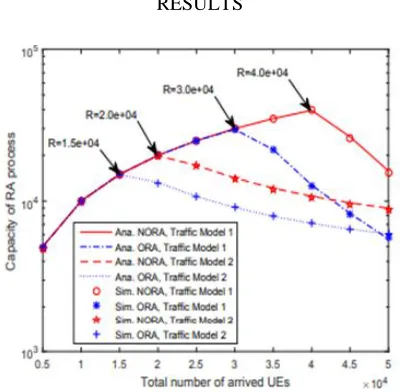
Fig. 2. Throughput of RA process of the NORA and ORA schemes under both Traffic Models
Fig. 3. Collision and access success probability of the NORA and ORA schemes under both Traffic Models
Fig.4. CDF of the number of preamble transmissions and access delay for the successfully accessed UEs in NORA and ORA schemes under both Traffic Models
Fig. 5. Average number of preamble transmissions and access delay for the successfully accessed UEs in NORA and ORA schemes under both Traffic Models
IJIRT 148808
INTERNATIONAL JOURNAL OF INNOVATIVE RESEARCH IN TECHNOLOGY168
In this paper, we have proposed the NORA scheme to alleviate the potential access congestion problem regarding the massive-connection scenarios in 5G networks. Specifically, the spatial distribution characteristics of UEs were utilized to realize multi-preamble detection and RAR reception, which effectively improves the preamble transmission success probability. Moreover, NORA allows simultaneous message transmission of multiple UEs, thus alleviates the demand on limited PUSCH resources. In addition, we have presented the analytical model to investigate the transient behavior of the NORA process with non-stationary arrivals
under realistic assumptions. Besides, a
comprehensive evaluation of our proposition is given, including throughput, access success probability, number of preamble transmission and access delay. Simulation results indicate that NORA outperforms ORA in terms of all the considered metrics, especially for a relatively large number of UEs (e.g. 50000 UEs). Compared with ORA, NORA can increase the throughput of the RA process by more than 30%. Moreover, NORA manages to halve the required preamble transmissions and access delay when the total number of UEs is near the RA throughput.
REFERENCES
[1] M. U. Celik, G. Sharma, A. M. Tekalp, and E.
Saber, “Lossless generalized-LSB data
embedding,” IEEE Trans. Image Process., vol. 14, no. 2, pp. 253–266, Feb. 2005.
[2] M. U. Celik, G. Sharma, and A. M. Tekalp,
“Lossless watermarking for image
authentication: A new framework and an implementation,” IEEE Trans. Image Process., vol. 15, no. 4, pp. 1042–1049, Apr. 2006.
[3] Z. Ni, Y.-Q. Shi, N. Ansari, and W. Su,
“Reversible data hiding,” IEEE Trans. Circuits Syst. Video Technol., vol. 16, no. 3, pp. 354– 362, Mar. 2006.
[4] X. Li, W. Zhang, X. Gui, and B. Yang, “A novel