Balanced and Scheduled Charging of WSN nodes using Passes Algorithm
Dr. N. Kasthuri1 and M. Gayathri2
1Professor, Department of ECE, Kongu Engineering College, Erode. Email: [email protected] 2PG Scholar, Department of ECE, Kongu Engineering College, Erode. Email: [email protected]
Article Received: 01 March 2018 Article Accepted: 09 April 2018 Article Published: 28 April 2018
1. INTRODUCTION
Wireless Sensor Networks (WSNs) consist of group of abundant cheap micro sensors nodes deployed in different
places to monitor and measure various conditions such as temperature, humidity, pressure, soil makeup, noise
levels, and so on[1]. The sensors in a WSN can self-organize into a multi-hop system to monitor covered areas and
collect information. WSN is built with wit few hundred to the several thousand nodes in which one node to
connected to another or more nodes. Each sensor nodes consist of several parts namely Radio Transceiver,
Microcontroller and battery. Its application includes monitoring control in industry process, environmental
protection, and security systems [3]. The cost of the sensor nodes varies depending upon the size of the sensors as
its size varies. However, most of these devices run on batteries and their overall sizes limit battery capacity and
lifetime. Nowadays using Wireless power. transfer technique, a new concept of Wireless Rechargeable Sensor
Network (WRSN) is used to solve the problem of limited power in WSN’s [4]-[6]. There are different ways to solve
Wireless sensor nodes such as inductive coupling, Electromagnetic radiation (EM radiation), and magnetic
resonance coupling [7]. Inductive coupling is simple with high power transfer efficiency in centimeter range and it
is driven by magnetic field induction. But this technique is used only in short distance charging and the charging
direction is accurately assigned. EM radiation has advantages of high power efficiency over long distance range but
in omnidirectional radiation, the power gets wasted on transmission increases with increase in distance and tiny
receiver size. In unidirectional radiation it has complex tracking mechanism and it requires LOS (Line-Of-Sight).
And in magnetic resonance coupling it delivers more power efficiently in longer ranges [8].
In recent days, the main problem in WSN’s is wireless charging. In WRSNs, the nodes are of small size [9] made up
of a sensing unit, a processing unit, a transceiver unit, and a power unit. These nodes are randomly deployed inside
or fairly close to the monitoring area. They must consume extremely low power, operate in high volumetric
densities autonomously without manual supervision, and be adaptive to the environment [10]. Wireless Charging
Vehicle (WCV) travelling inside WSN is used to recharge a sensor’s battery [7], [12]-[14]. It visits each node in the A B S T R A C T
As the interdisciplinary of wireless communication, the supportive charging issue in Wireless Rechargeable Sensor Networks (WRSNs) is a popular researching problem. Using wireless power transfer technology, electrical energy can be transferred from wireless charging vehicles to sensors, providing a new hypothesis to prolong the network lifetime. However, existing techniques on cooperative charging usually there is the possibility of increasing dead nodes. In this paper, Passes algorithm for on-demand charging architecture for large-scale WRSNs is developed. In Passer algorithm, task interdependency is utilized to enhance charging efficiency and not revisit the visited node. A local searching algorithm has been employed, in which nearby nodes on the way to primary nodes, the targets of Wireless Charging Vehicle’s (WCV’s) current movement, will be charged as passer nodes. Such a strategy not only makes full use of the available remaining time of a charging deadline, but also solves the complex scheduling problem with spatial and temporal task interdependency. Analysis and simulations are conducted to show the superiority of the scheme.
network to recharge and checks it frequently that each node never run out of battery. During network initialization,
WCV collects sensor location. The status and communication between the nodes is enhanced using powerful
antennas. There is also a GPS positioning system and its location can be obtained by a so-called Base Station (BS)
all the time. BS [14] is used for collecting data, managing the network, remotely commanding WCV, calculating
recharging sequence, and dispatching charging vehicles. When WCV runs low on its own energy, it returns to BS
for a quick battery replacement. In WRSNs, nodes running out of battery energy usually send out charging requests
to WCV, which will decide when and in what sequence to charge such dying sensors. Most algorithms use off-line
approaches with deterministic charging cycles. With such deterministic approaches, network dynamics such as
abrupt changes in traffic. Second, variations in local networks are usually ignored, wasting opportunities of
promptly responding to local charging requests [2]. In this work we focus on methods to balance the charging
cycles and to reduce the dead nodes by using passes algorithm.
2. LITERATURE REVIEW
The cooperative charging issue in Wireless Rechargeable Sensor Networks (WRSNs) is still a research problem.
With wireless power transfer technology, electrical energy can be transferred from wireless charging vehicles to
sensors, providing a new paradigm to prolong the network lifetime. But this technique on cooperative charging
takes periodical and deterministic approach, and it does not consider the non-deterministic factors.
Chi Lin [1], developed a Primary and Passer-by Scheduling (P2S) algorithm for on-demand charging architecture
for WRSNs. In P2S, task interdependency is utilized to enhance charging efficiency. Author used a local searching
algorithm, by which the nodes near to primary nodes, the targets of Wireless Charging Vehicle’s (WCV’s), will be
charged as passer-by nodes. This strategy not only make full use of the available remaining time of a charging
deadline and it also helps to solve the complex scheduling problem of spatial and temporal task interdependency.
However, the work by Chi Lin [1] does not give information about directional antenna, multiple devices charging
concurrently, etc. He assumed that sensor’s charging request can reach WCV through a real time transmission
protocol anytime, anywhere. In a WRSN with one WCV, charging requests are sent to the WCV from different
locations. However, WCV wants to combine the charging deadlines and charging locations in order to support the
largest number of surviving nodes in the network.
For that problem, Chi Lin used charging deadlines to develop a Hamiltonian cycle and then a combination of
charging deadline and charging distance is used to choose a few passer-by nodes in order to improve the efficiency
of such charging cycles.
Author proposed a new charging scheduling algorithm (P2S), for wireless rechargeable sensor networks. This
scheme combines primary charging and passer-by charging by both temporal and spatial relationships among
different requests. The on-demand technique is highly efficient since it takes advantage of the wireless charging
number of urgent charging requests in the future and thus improves WCV’s efficiency, charging throughput, and
successful charging rate
3. PASSES ALGORITHM
3.1. System model and problem statement
We consider WRSN in which the nodes are deployed randomly. There is only one WCV used to charge the sensors.
The work of WCV is to monitor each sensor’s battery and charge the sensor when in need. When the residual
energy level of the sensor falls below the threshold, it sends the charging request to WCV. These requests are stored
in the WCV’s queue Ω with respect to the sender’s residual lifetime. WCV using the shortest path algorithm
identifies the shortest path for each sensor nodes. WCV tries to recharge the passer by nodes [11] between one node
in the queue to the next node in the queue. But ones the requested node goes to the critical position WCV moves to
the respective node immediately so as to recharge the node. Each sensor’s charging request reach the WCV at
anytime and anywhere through real time transmission protocol [15]. When a WCV drain out of battery it goes to the
base station and recharges its battery. The base station which serves as a energy source for WCV is located at the
centre of the network. WCV picks one or several nodes as its destination after receiving the charging request and
moves towards them to recharge and once the WCV is drained below its residual energy it travels back to the BS to
recharge/replace its battery.
3.1.1. Problem statement
The problem in the existing system is that, there is a possibility in scheduling that there might be at least one or
more dead nodes. The queue gets filled and drops the next incoming request.
3.2. Passes algorithm
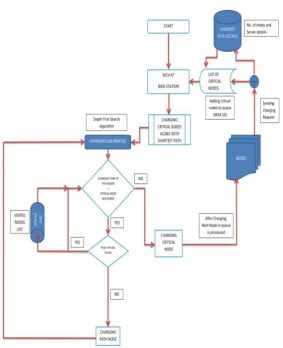
In this section, we detail the process of Passes algorithm as shown in Fig 1. The nodes whose residual energy below
the threshold is called critical node, sends its charging request to WCV. These requests are stored in the WCV’s
waiting queue. Using shortest path algorithm WCV finds the shortest path to its destination and travels along the
path to reach the critical nodes. WCV then recharges the critical nodes. Here, Depth First Search (DFS) algorithm is
used as charging sub process. WCV charges the passer by nodes along path before reaching the destination. WCV
frequently checks the lifetime of the critical node while charging the passer by nodes ones the critical node is about
to die it stops recharging the passer by nodes and travels directly to the critical node so as to recharge the critical
node’s battery. DFS stack stores already visited passer by nodes so that WCV need not recharge the already
visited/charged node. When WCV doesn’t visit the already visited node the requests in the queue is processed soon
and the new request gets placed in the waiting queue without getting dropped. And when WCV doesn’t visit the
already visited node the possibility of dead node gets reduced. The advantage of increased throughput, reduced
packet loss will be explained simulation part.
1. Step 1: Start the program
3. Step 3: WCV Checks for the Charge Request
4. Step 4: Charge requests are stored in the queue for processing
5. Step 5: Based on the nodes in queue, shortest path from the WCV to the critical node is calculated
6. Step 6: WCV charges the in-between nodes based on Depth first search algorithm
7. Step 7: Once the intermediate nodes are charged, they are stored as visited nodes and not charged again till
the next cycle.
8. Step 8: Critical nodes are charged along with the intermediate unvisited nodes.
9. Step 9: Then, the Shortest path for next critical node is calculated and in-between unvisited nodes are
charged along with next critical node.
10. Step 10: Step 5 to Step 9 are repeated, till the queue is empty.
11. Step 11:Stop the Program
Fig. 1. Flow Chart for Passes Algorithm
4. RESULTS AND ANALYSIS
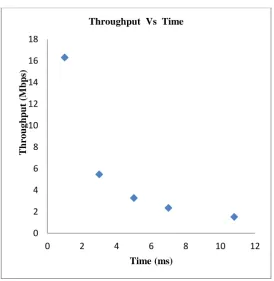
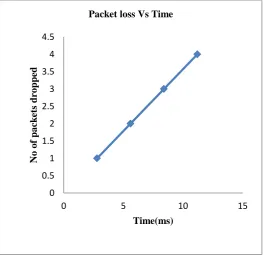
The performance of the proposed schemes is evaluated via ns-2 simulation. The throughput has been increased
using Passes algorithm compared to the existing system. And the packet drop has been fairly reduced. The
Fig 2(a): Throughput Vs Time for existing method
Fig 2(b): Throughput Vs Time for passes algorithm
The comparison result in terms of packet drop for existing and Passes algorithm has shown in the Fig 2(c), 2(d).
0.395 0.4 0.405 0.41 0.415 0.42 0.425 0.43 0.435 0.44 0.445 0.45
0 1 2 3 4 5 6
T
hro
ug
hp
ut
(M
bp
s)
Time(ms)
Throughput Vs Time (After Packet loss)
0 2 4 6 8 10 12 14 16 18
0 2 4 6 8 10 12
T
hro
ug
hp
ut
(M
bp
s)
Fig 2(c): Packet loss Vs Time for existing method
Fig 2(d) : Packet loss Vs Time for Passes algorithm
5. CONCLUSION
In existing system there is a possibility of dead nodes due to improper scheduling. In the proposed method Passes
algorithm is used to eradicate this problem. DFS is used in Passes algorithm which stores the visited node in DFS
stack and ensures that WCV does not revisit the visited node. So that all the nodes are serviced equally. Hence there
is no possibility for dead nodes.
0 0.5 1 1.5 2 2.5 3 3.5 4 4.5
0 2 4 6
No o f pa ck et dro pp ed Time(ms)
Packet loss Vs time
0 0.5 1 1.5 2 2.5 3 3.5 4 4.5
0 5 10 15
REFERENCES
[1] I. F. Akyildiz, W. Su, Y. Sankarasubramaniam, and E.Cayirci, “Wireless sensor networks: a survey,”
Computer networks, vol. 38, no.4, pp. 393-422, 2002.
[2] L He, Y. Gu, J. Pan, and T. Zhu, “on-demand charging in wireless sensor networks: Theories and
applications.” In 10th IEEE International Conference on Mobile Ad-Hoc and Sensor System (MASS).
IEEE, 2013, pp. 28-36.
[3] A. Mainwaring, D. Culler, J. Polastre, R. Szewczyk, and J. Anderson, “Wireless sensor networks for
habitat monitoring,” in Proceedings of the 1st ACM international workshop on Wireless sensor networks
and applications. ACM, 2002, pp. 88-97.
[4] M.Erol-Kantarci and H. T. Mouftah, “Suresense: sustainable wireless rechargeable sensor networks for the
smart grid,” IEEE Wireless Communications, vol. 19, no. 3, pp. 30-36, 2012.
[5] S. He., J. Chaen, F. Jiang, D. K. Yau, G. Xing, and Y. Sun, “Energy provisioning in wireless rechargeable
sensor networks,” IEEE Transactions on Mobile Computer, vol. 12, no. 10, pp. 1931-1942, 2013.
[6] T.Xie, Y. Shi, Y. T. Hou, and A. Lou, “Wireless power transfer to increase the max flow of rechargeable
wireless sensor networks,” in 2015 IEEE Tenth International Conference on Intelligent Sensor, Sensor
Networks and Information Processing (ISSNIP). IEEE, 2015, pp.1-6.
[7] L. Xie, Y. T. Hou, and A. Lou, “Wireless power transfer and applications to sensor networks,” IEEE
Wireless Communications, vol. 20, no. 4, pp. 140-145, 2013.
[8] P Sample, D.T. Meyer, and J. R. Smith, “ Analysis, experimental results, and range adaptation of
magnetically coupled resonators for wireless power transfer,” IEEE Transactions on Industrial Electronics,
vol. 58, no. 2, pp. 544-554, 2011.
[9] G. J. Pottie and W. J. Kaiser, “Wireless integrated network sensors,” Communications of the ACM, vol. 43,
no. 5, pp. 51-58, 2000.
[10] J. M. Kahn, R. H. Ktz, and K. S. Pister, “Next century challenges: mobile networking for smart dust,” in
Proceedings of the 5th annual ACM/IEEE international conference on mobile computing and networking.
ACM, 1999, pp. 51-58, 2000.
[11] C. Lin, D. Han, J. Deng and G. Wu, “P2S: A Primary and passer-by Scheduling Algorithm for On-demand
charging Architecture in Wireless Rechargeable Sensor Networks,” IEEE Transaction On Vehicular
Technology, vol. 66, no. 9, pp. 8047-8058, Sep. 2017.
[12] Y. Peng, Z. Li, W. Zhang, and D. Qiao, “Prolonging sensor network lifetime through wireless charging,”
in 31st IEEE Real-time Systems Symposium (RTSS). IEEE, 2010, pp. 129-139.
[13] F. Zhang, X. Liu, S. A. Hackworth, R. J. Sclabassi, and M. Sun, “In vitro and in vivo studies on wireless
powering of medical sensors and implantable devices,” in 2009 IEEE/NIH Life Science Systems and
Applications Workshop. IEEE, 2009, pp. 84-87.
[15] L. He., P. Cheng, Y. Gu, J. Pan, T. Zhu, and C. Liu, “Mobile-to-mobile energy replenishment in
mission-critical robotic sensor networks,” in 2014 Proceedings of IEEE International Conference on