474 Abstract—Achieving concurrence in software requirements is a two-way process that conventionally relies on same-time, same-place interactions. Very difficult process in software development, requirements engineering is overwhelmed with additional challenges in the evolving dynamics of geographically distributed software teams. Depicting the media-selection theories, it is posited that a combination of lean and rich media is needed for an effective process of requirements negotiations when stakeholders are geographically dispersed. This paper presents the comparison of the effectiveness of the requirements negotiations when preceded by the asynchronous discussions to those negotiations with no prior asynchronous discussions. The findings indicate that requirement negotiations were more effective when the groups conducted asynchronous structured discussions of requirement issues prior to the synchronous negotiation meeting. Asynchronous discussions were useful in resolving issues related to uncertainty in requirements, thus allowing synchronous negotiations to focus more on removing ambiguities in the requirements
Index Terms—Global software development, Requirements engineering, requirements negotiations, media selection
I. INTRODUCTION
The primary measure of success of a software system depends on the software systems Requirements Engineering (RE). Zave provides one of the clearest definitions of RE[16] [18]: Requirements engineering is the branch of software engineering concerned with the real world goals for, functions of, and constraints on software systems. It is also concerned with the relationship of these factors to precise specifications of software behavior, and to their evolution over time and across software families. It is the process of discovering the requirements of a software system by identifying stakeholders and their needs, and documenting these in a form that is amenable to analysis, communication, and subsequent implementation. There are a number of intrinsic issues related to this process. One such significant issue to be considered in requirements engineering process is the problem of common ground [4] [20].
Requirements engineering is not only a process of determining and specifying requirements, it is also a process of facilitating effective communication and negotiation of these requirements among different stakeholders. Software
Lecturer, Department of CSE,
VLB Janakiammal College of Engineering and Technology, Coimbatore -42, Tamil Nadu, India.
Ph: 9003643185
development process is a collaborative problem-solving activity [20]. The requirements engineering phase of software development projects is characterized by the intensity and importance of communication activities. The success of such an activity depends on the ability to generate, share, and integrate information. Identifying or generating the large set system requirements is an intense collaborative process that requires the development of a common understanding of the problem, as well as of the solution space of the problem and solution spaces[16][18].
A. Problem of Common Ground
Common ground is the knowledge that all the stakeholders have in common when communicating during the requirements gathering process. Decision making tasks, customary in software development and particularly in requirements engineering, are more effective when all the participants have a common understanding because finding or establishing common understanding between people facilitates interpersonal relationships and mutual understanding [10][11]. Common ground is often dynamically obtained during social gathering and communication established rather than obtained from the previous knowledge [3]. Common ground cannot be obtained during the commencement of the software project itself, given the differences in professional backgrounds of software clients and developers, as well as goals and priorities for the software system [8]. Software inspections and requirements workshops are few important techniques to be considered for instituting common ground in software development. Such techniques play a vital role in removing the misunderstandings and clarifying the meaning of requirements early in software development process, and they highly depend on the collaborative activities between different stakeholders [3] [12] [8]. While requirements inspections are validation techniques that intend at assuring that the system requirements are satisfying the stakeholders’ intent, requirements workshops acts a logical medium for including all the relevant stakeholders in focused meetings where requirements are elicited, modeled and negotiated.
Once the requirements are elicited and a requirements specification is developed, preserving a concurrence with all the stakeholders can be a problem, especially where stakeholders have divergent goals [8]. In distributed scenarios, requirements negotiation is one of the most difficult and communication intensive practice of software engineering, since arranging co-located meetings is often
Distributed Requirements Negotiations Using
Mixed Media
impractical [3]. One of the efficient and appropriate medium for the distributed scenarios is videoconferencing, which is considered to be a synchronous rich media. Its main advantage is its synchronicity (i.e., the capability of conveying information in a timely manner) and richness [13] [14] (i.e., the ability to convey the sense of physical presence of individuals, as well as a number of visual and verbal cues). However, videoconferencing has few overheads also e.g., the costs of infrastructure setup and maintenance. In contrast, asynchronous lean media, such as email or discussion forums, lacks all these facilities or advantages as that of the synchronous media. Thus, this is an indicative that to improve the effectiveness of distributed requirements negotiations, a combination of rich synchronous media and lean asynchronous media is needed [19].
II. ISSUESINDISTRIBUTEDSOFTWARE
DEVELOPMENT
As part of the globalization efforts currently pervading society, software project teams have also become distributed worldwide. Many companies have started distributing their development process. The traditional method used for requirements elicitation in requirements engineering phase has been the face-to-face meeting or the interviews [3]. This method is considered to be the most effective rich communication media for involving appropriate stakeholders in an effective negotiation of requirements [8]. However, this method has become difficult in bringing the stakeholders together in a site for the requirements engineering process due to increase in globalization of the industry and the enhancements in the distributed development [3]. Case studies of requirements meetings reveal that when it comes to selecting participants for such meetings, managers try to strike a balance between allowing the software practitioners to talk to 'the right people' and maintaining the smooth running of the rest of the business. Furthermore, frequent meetings that involve key stakeholders from engineering and marketing departments are an integral part of software development in multi-site organizations. The main problem in software requirements discussions is that the traditional elicitation methods rely on the same-time, same-place interactions where people get together in a meeting room and discuss about the requirements of the software [3]. But now-a-days companies started outsourcing the software development and hence the development becomes distributed and co-located meetings are becoming challenging. Hence there is a demand to study requirements negotiations in geographically distributed settings, and ways in which they can be supported effectively.
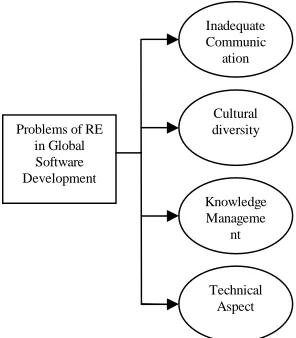
A. RE Challenges Due To Distributed Development The task-technology fit theory proves appropriate and potentially critical in understanding how computer-mediated communication supports collaborative tasks of software engineering and in particular geographically distributed software projects [8]. The main problems are described in the form of a model of RE challenges due to geographical distribution of stakeholders, illustrated in Figure 1. From the
model, it is obvious that there are four major problems in requirements engineering due to the geographical distribution of software development.
Inadequate communication- Distance introduces barriers
to informal and face-to-face communication (synchronous), and the stakeholders’ communication is dependent on the quality of using synchronous or asynchronous electronic communication tools. The main stakeholders e.g.: customers, business management, and developers will not be able to communicate effectively and each will try to sought to exert power and influence over the others
Figure 1: A model of problems in RE activities due to GSD
Knowledge management- The sheer quantity of
information about requirements from multiple sources at remote customer sites cannot be appropriately shared with the developers. Furthermore, by channeling the information about business strategy requirements to developers through key stakeholder, development manager, distance will be exploited to strengthen certain positions of power in organization.
Cultural diversity- Differences in stakeholders’ language and national culture affect global collaboration. The impact of differences in organizational and functional culture is another major concern in requirements engineering. The remote sites develop their own organizational culture; this widens the distance between the different functional departments of the organization (marketing, business management, and development). Cultural diversity always has a significant impact on achieving a common understanding and negotiation of requirements. Empirical studies of joint decision-making provide evidence that cultural factors have an impact on the ability to support construction of common ground.
Technical Aspects- Several technical aspects effect requirements engineering in distributed environment. The requirements process depends on the coordination and control mechanisms that can reduce the impact caused by the team distribution. The main factors found are the pattern, process and configuration management.
Explicitly, the distributed communication between clients and developers is problematic because of differences in
Problems of RE in Global Software Development
Inadequate Communic ation
Cultural diversity
Knowledge Manageme
nt
476 software processes, professional backgrounds, and culture across sites. Failure to achieve a common understanding of system features, combined with reduced trust and the inability to effectively resolve conflicts results in budget and schedule overruns and, ultimately, in damaged client-supplier relationships.
III. MEDIASELECTIONTHEORIES
The study of grounding in distributed, computer-mediated environments has to be related to media-selection theories. Reaching common ground and shared understanding in software requirements is a complex process that involves both uncertainty and equivocality reduction, and the task technology fit theories are useful in studying the design of improved processes and tools that support multicultural and distributed computer-mediated software teams. Research advocate that for people with little common ground video and audio-based communication channels are highly helpful for completing collaborative tasks, whereas people with an extensive preexisting common ground text based single-channel media such as e-mail are efficient communication channel.
The main idea of this paper is that a mix of synchronous and asynchronous communication media is needed to achieve common ground in distributed requirements negotiations in an effective manner. One of the rich media environments that allow analysis of multiple viewpoints in requirements meetings in the distributed requirements negotiations is videoconferencing. On the basis of various literatures there exists a debate between researchers about the expediency of videoconferencing over audio conferencing for distributed group work. However there is some consensus that the addition of video is valuable in negotiation situations and relationship building. Researches on distributed requirements negotiations found that videoconferencing supported meetings to be as conducive to win-win situations as face-to-face meetings. Conversely there are hypothetical, as well as realistic, considerations for which videoconferencing alone is not the most desirable medium for effective distributed requirements negotiations.
The primary constraint is on organizing
videoconferencing sessions. Synchronous interaction and videoconferencing sessions in particular have additional overhead since setting up the necessary infrastructure is too expensive. Other overheads are the maintenance of video conferencing sessions at remote sites and its coordination across organizational boundaries. The various researches on the media selection theories suggests that relying on synchronous media alone may not yield the best results in terms of performance and that a combination with a less rich media would facilitate a more rational approach to decision making.
The media richness theory argues that performance depends on the appropriateness of the match between the media characteristics and information requirements of the
task (clarification versus additional information) and that matching media to collaborative tasks is motivated by the need to reduce uncertainty and equivocality. Here there is a necessity to define uncertainty and equivocality [1] [2]. It is defined as the difference between the amount of information required and the amount of information already possessed about a situation, while equivocality is the existence of multiple and conflicting interpretations about a situation. From the above concepts it is obvious that the media can be ranked according to their richness. Face-to-face interaction is considered as the richest, followed by videoconferencing, and written text is the leanest medium. The media richness theory emphasizes that rich media would lead to better group performance for equivocal communication situations, while lean media are suited for uncertain communication situations. Equivocality is reduced by providing sufficient clarifications and this is favored by the capacity of rich media to enable users to explore the multiple interpretations of the situation by communicating more quickly and exchanging more types of information. On the other hand, uncertainty can be reduced by obtaining sufficient additional information which is a matter of searching for a clearly identifiable answer which is possibly with lean media [1] [2].
While asynchronous communication such as email was found better suited for conveyance of information as when communicating project information that related to planning activities, real-time communication media such as teleconferencing or videoconferencing sessions were found as more appropriate for convergence to decisions as when negotiating common understanding with respect to project scope and implementation. Whenever engaged in group work, the communication medium which we use to exchange information must be able to reduce uncertainty as well as equivocality [1] [2]. The former is reduced by eliminating information omission while the latter by removing information ambiguity. Translating this theory of media richness more closely to the area of computer-mediated communication, research suggests that uncertainty reduction is better addressed by lean media i.e., email and more generally asynchronous communication tools, that focus on factual information rather than emotional cues, while equivocality reduction is better handled by rich media such as videoconferencing, F2F meetings and other synchronous tools, that provide immediate feedback. With respect to grounding processes, a number of studies show a positive relationship between the richness of communication technology and the ability to establish common ground [1] [2].
remain open after the final synchronous negotiation. In conclusion, the use of rich media high in social presence should be used to assure attention for small amounts of information. The use of lean media low in social presence, although possibly resulting in decreased motivation, increases the ability to process large amounts of information over longer periods of time [15].
A. Improvisation of Hypothesis
To review the main aspect of this paper, we propose that a mix of lean and rich media is needed to improve requirements engineering activities when stakeholders are geographically dispersed[7]. Although rich synchronous media with a effective social presence such as synchronous videoconferencing meetings are needed for removing equivocally and converging to a shared agreement, lean asynchronous media low in social presence such as text-based discussions are also considered to be valuable in providing an early mechanism to remove uncertainties, that is, to clarify issues, and thus provide a better focus and structure to the discussion during synchronous negotiation sessions [1] [2]. According to the media switching theory, even though synchronous videoconferencing meetings may ensure project stakeholders’ motivation and attention in the discussion of possibly conflicting requirements, the high social presence important to support social relationships could also impede unbiased or prompt decisions. Therefore, an asynchronous text-based communication medium emerges as a useful complement for the preparation of such meetings: They allow the group of participants to process information and consider requirements issues and provide missing information at their own time and pace.
Previous work [8] [1] on communication effects on the distributed requirements negotiations indicate the concept of resolving issues and stated four different hypotheses
regarding the removal of uncertainties and
ambiguities[8][1].
Hypothesis H1- During asynchronous discussions of mixed media teams the percentages of closed uncertainties are higher than the percentages of closed ambiguities.
Hypothesis H2- During synchronous negotiations of all teams the percentages of closed ambiguities are higher than the percentages of closed uncertainties.
The above hypothesis can be validated by the following variables.
Percentage closed uncertainties during asynchronous discussion = the ratio of closed uncertainties after asynchronous discussion to uncertainties after discovery
Percentage closed ambiguities during asynchronous discussion = the ratio of closed ambiguities after asynchronous discussion to ambiguities after discovery.
Percentage closed uncertainties during synchronous negotiation = the ratio of closed uncertainties after
synchronous negotiation to uncertainties before synchronous negotiation.
Percentage closed ambiguities during synchronous negotiation = the ratio of closed ambiguities after synchronous negotiation to ambiguities before synchronous negotiation.
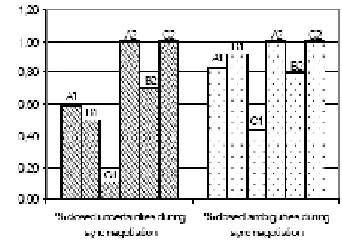
In testing H1, the percentage of closed uncertainties is compared to that of closed ambiguities during the asynchronous discussion for using the mixed media. In testing H2, the percentage of closed uncertainties is compared to that of closed ambiguities during the synchronous discussion. With regard to the H1 hypothesis, Figure 2 shows that asynchronous discussions were more useful to close uncertainties than ambiguities, as expected.
Figure 2: Uncertainty and Equivocality reduction during asynchronous discussion
In the above figure A2, B2, C2 depict the mixed media team. Although participants had a high number of uncertainties to be discussed during the asynchronous discussion, they were able to close many of them. With regard to the H2 hypothesis, Figure 3 shows higher percentages of closed ambiguities than closed uncertainties during synchronous negotiation.
Figure 3: Uncertainty and Equivocality reduction during synchronous discussion
478 requirements. Activities of requirement gathering are typically followed by modeling and inspection activities which trigger the need to further collect information about requirements and their context (reducing uncertainty) and resolve conflicts due to multiple viewpoints in the requirements engineering process (reducing equivocality) [1] [2]. According to the media richness theory, it is an indicative that a preliminary resolution of uncertainties through an asynchronous discussion prior to the synchronous negotiation can shorten the list of requirements issues to be negotiated during real-time discussions. By means of asynchronous communication, participants can take their time to collect information that is lacking or answer clients’ concerns (when answering involves uncertainty reduction only). There is an opportunity to use the rich media negotiation meetings to mostly resolve ambiguities (equivocality) in requirements since the higher interactivity level available in rich media allows the exploration of multiple viewpoints. Hence, the second hypothesis concerns the role of asynchronous discussions in relation to the participants’ ability to remove uncertainty in the requirements engineering communication process (those issues that require clarifications and/or answers without the need to negotiate).
In addition, a preliminary asynchronous discussion can be useful in anticipating the building of a common ground
between remote stakeholders. The text-based
time-insensitive nature of asynchronous communications allows for the gathering of information providing context to certain issues in discussions or helps clarify differences in terminology or those issues that do not require negotiation [1] [2]. As a result, participants have the opportunity to start developing a common ground earlier than in synchronous negotiations; there is a greater chance for clarifications and questions to be asked without the added concern of time constraints inherent in real-time requirements meetings. The subsequent synchronous requirements negotiations therefore are expected to more quickly converge to an agreement but with apparently shallow interactions. We expect that real-time conversations would be rich in references to posted messages exchanged in the asynchronous discussion
IV. MIXEDMEDIA
This section describes a unique tool that aids the process of requirement gathering, records issues and gives a clear graphical representation reporting the difference in the number of issues gathered in the synchronous and asynchronous stages [5] [9]. There were many project teams involved in this proposal [6]. The goal of each project team was to develop a requirements specification (RS) in an iterative process. Reaching a mutual understanding between clients and developers meant reducing equivocality and uncertainty by resolving all open issues found by clients in an evolving RS throughout the process. Fig. 2 illustrates the RS
development life cycle and consisted of 11 phases of continuous requirements discovery and validation, through which the understanding and documentation of requirements had to be improved. Each of these stages consisted of tasks for either the client or developer groups or a team (project) task. The final deliverable is the final version of the RS (RS 2.0), which reflected the shared understanding of the project that the clients and developers built over the 11 phases [1] [2]. The team tasks were supported by synchronous communication (scheduled videoconference sessions).
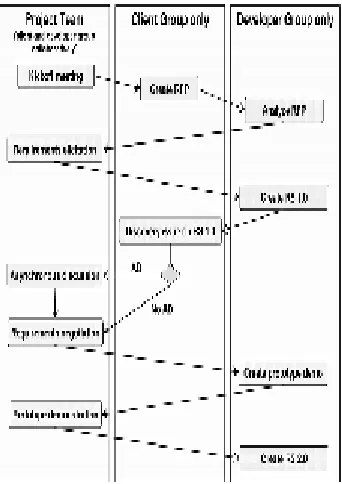
Figure 4: Basic block diagram for use of the mixed media in requirements negotiations
Figure 4 illustrates the basic block diagram that the project is based on. It consists of three basic blocks namely client group, developer group, and client and developer group combined called as the product team. It gives a clear schema of the phases in requirement gathering with the proposed change depicted.
The first step is the creation of the Request for proposal as usual which contains the requirements of the product that is to be built stated by the client. This is followed by the analysis of it. The next step is the Requirement Elicitation where the clients and the developers meet to clarify the doubts of the RFP [2]. This step is followed by the creation of the Requirement Specification 1.0. This step is followed by the Requirement Negotiation. This step is usually conducted by the means of synchronous discussions. It is proposed that there should be an asynchronous discussion stage prior to the synchronous discussions. The final step is the preparation of RS 2.0 which is posted by the developer to the client.
authentication the administrator is given the power to add the team. The team must provide their team id, team name and password. The team information provided will be stored in the database. After the completion of the ream registration process the members of the team is registered under the team id. The member information is also stored in the database [2]. The next step is to register the client. The client must provide the client name and password. The client information is also stored in the database. Finally the project team must be assigned to the client team.
The client will be provided with a form that enables him to upload the RFP document. The database will contain the entry of the uploaded file. The developer can login any time into the system and download the document [2]. After the authentication is complete using the client id and password provided by the client during the registration stage, the client is allowed to upload the RFP (Request for proposal) document to the developer. The document that is uploaded is transferred to the main server followed by an entry of the document written into the database.
Once the RFP is transferred an elucidation process is conducted for the issues discussed in the RFP. This process is called Requirement Elicitation. After the Requirement Elicitation process the developer team prepares the RS 1.0 document. Once the RS 1.0 document is prepared, it is sent to the client. For sending the document the developer team has to log on to the system and transmit the document through the system and enter the document name into the database. After the review of the RS 1.0 document by the client team the Requirement Negotiation occurs. The client and developer must logon at the same time into the system. The client and the developer will be provided with an exclusive chat room with which they can share their views synchronously.
According to the basic block diagram the teams must go to an asynchronous discussion followed by the synchronous discussion. Then the developer team creates RS 2.0 document which must be sent to the client. For this the developer team has to log on to the system and transmit the document through the system and enter the document name into the database [2]. The developer will be provided with an issue resolving form for both synchronous and mixed media methods. The developer has to just check the issues that had been resolved and click the submit button. This has to be done for both synchronous and mixed media methods. The number of issues resolved will be entered into the database [5][6].
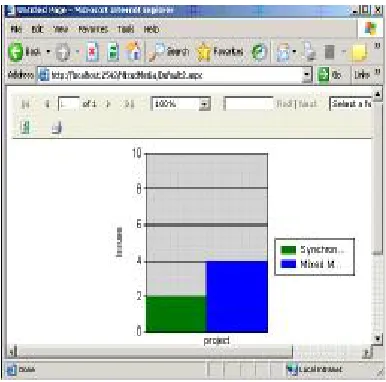
Figure 5 shows the comparison graphical report of the number of issues recorded during the synchronous media and the mixed media. From the graphical report it is evident that the use of mixed media is more constructive in the distributed requirements negotiations than the use of the rich synchronous media. In the graph the X axis denotes the media used for the project and the Y axis denotes the number of issues recorded for the project by the team members.
Figure 5: Graphical report of the number of issues resolved in the synchronous and mixed media stages
V. CONCLUSIONSANDFUTUREWORK
Developing common ground is one of the most challenging problems of distributed teams, due to inherent communication gaps among multi-cultural geographically distributed stakeholders. The usefulness of asynchronous discussions prior to requirements negotiations consists in focusing the synchronous negotiation meeting on the issues that could not be resolved during the asynchronous discussion and the preliminary results in our research confirm this thesis. The task-technology fit provides us with tools to understand the appropriateness of asynchronous media for reducing missing information in requirements, as well as of synchronous media for negotiating mutual agreement on those issues that require more than uncertainty reduction. Today’s synchronous technologies for distributed groups are still limited in the quality of communication and ease of use. Even if forthcoming advances in technologies will increase the chances of successful adoption of synchronous communication such as videoconferencing and shared access to applications, yet coordinating meetings and technology infrastructures across multiple sites in distributed development is likely to stay problematic. Working towards increasing the effectiveness of synchronous requirements negotiations is thus an endeavor with long term impact.
Future work may to enhance the system by automating the document creation stages and the issue recording stages so that the process becomes much effective easier. Another future work may to enhancing the authentication procedures and the document transfer methods.
REFRENCES
[1] Damian D, Lanubile F, and Mallardo T (2006), “The Role of Asynchronous Discussions in Increasing the Effectiveness of Remote Synchronous Requirements Negotiations”, Proc. of the Int’l Conf. on Software Engineering (ICSE’06), ACM Press, pp.917-920.
[2] Damian D, Lanubile F, and Mallardo T, “On the Need of Mixed Media in Distributed Requirements Negotiations”, IEEE Transactions on software Engineering, pp. 116-132.
480
[4] B.Boehm, P. Bose, E.Horowitz, and M.J. Lee, “Software Requirements as Negotiated Win Conditions,” Proc in the First Int’l Conf. Requirements Eng. pp. 74-83, 1994.
[5] Prof. Filippo Lanubile, Teresa Mallardo (2006), “Investigating the Impact of Computer Mediated Communication on Remote Requirements Negotiation”, 3rd Workshop of the National Interest Group on Software Engineering Genoa, 2-3
[6] Mallardo T, Calefato F, Lanubile F, and Damian D (2007), "The Effects of Communication Mode on Distributed Requirements Negotiations", Proceedings of the ICGSE Workshop on Global Requirements Engineering (GREW 2007), Munich, Germany
[7] R.L. Daft and R.H. Lengel, “Information Richness: A New Approach to Managerial Behaviour and Organizational Design,” Research in Organizational Behaviour, B.M. Staw and L.L. Cummings, eds., vol. 6, pp. 191-233, CT JAI Press, 1984.
[8] R.L.Daft and R.H. Lengel, “Organizational Information Requirements, Media Richness and Structural Design,” Management Science, vol. 32, no. 5, pp. 554-571, 1986.
[9] D.E. Damian, A. Eberlein, M.L.G. Shaw, and B.R. Gaines, “Using Different Communication Media in Requirements Negotiation,” IEEE Software, vol. 17, no. 3, pp. 28-36, May/June 2000.
[10] D. Damian and D. Moitra, eds., IEEE Software, special issue on global software development, vol. 23, no. 5, Sept./Oct. 2006.
[11] D. Damian and D. Zowghi, “Requirements Engineering Challenges in Multi-Site Software Development Organizations,” Requirements Eng. J., vol. 8, no. 3, pp. 149-160, 2003.
[12] M.Halling, S. Biffl, and P. Grunbacher, “An Economic Approach for Improving Requirements Negotiation Models with Inspection,” Requirements Eng. J., vol. 8, no. 4, pp. 236-247, 2003.
[13] M. Jackson, A.H. Anderson, R. McEwan, and J. Mullin, “Impact of Video Frame Rate on Communicative Behavior in Two and Four Party Groups,” Proc. Int’l Conf. Computer Supported Cooperative Work, pp. 11-20, 2000.
[14] F. Henri, “Computer Conferencing and Content Analysis,” Collaborative Learning through Computer Conferencing: The Najaden Papers, A. Kaye, ed., pp. 117-136, 1991.
[15] F. Lanubile, T. Mallardo, and F. Calefato, “Tool Support for Geographically Dispersed Inspection Teams,” Software Process: Improvement and Practice, vol. 8, no. 4, pp. 217-231, 2003.
[16] L. Macaulay, Requirements Engineering, Springer, 1996.
[17] A.J. Maule and A.C. Edland, “The Effects of Time Pressure on Human Judgment and Decision Making,” Decision Making: Cognitive Models and Explanations, R. Ranyard, W.R. Crozier, and O. Svenson, eds., pp. 189-204, Routledge, 1997.
[18] B. Nuseibeh and S. Easterbrook, “Requirements Engineering: A Roadmap,” Proc. 22nd Int’l Conf. Software Eng., pp. 35-46, 2000. [19] S.E. Poltrock and J. Grudin, “Videoconferencing: Recent Experiments
and Reassessment,” Proc. 38th Hawaii Int’l Conf. System Sciences, p. 104a, 2005.
[20] Jiang L, Eberlein A (2003) Requirements Engineering: A Review and a Proposal, Proceedings of the Third ASERC Workshop on Quantitative and Software Engineering, Feb. 17- 18, 2003, Banff, Alberta, Canada.
Mrs. B.Arthi was born in Coimbatore, Tamil Nadu, India. She obtained her