Development and validation of a questionnaire to evaluate medical
students' and residents' responsibility in clinical settings
Omid Asemani
1, Mohammad Taghi Iman
2*, Mohammad Khayyer
3, Seyed Ziaaddin
Tabei
4, Farkhondeh Sharif
5,
Marzieh Moattari
61Assistant Professor, Department of Medical Ethics and Philosophy of Health, School of Medicine, Shiraz University of
Medical Sciences, Shiraz, Iran;
2Professor, Department of Sociology, Shiraz University, Shiraz, Iran;
3Professor, College of Education and Psychology, Shiraz University, Shiraz, Iran;
4Professor, Department of Medical Ethics and Philosophy of Health, School of Medicine, Shiraz University of Medical Sciences, Shiraz, Iran;
5Professor, Department of Psychiatric Nursing, Community Based Psychiatric Care Research Center, College of Nursing
& Midwifery, Shiraz University of Medical Sciences, Shiraz, Iran;
6Professor, Department of Nursing, College of Nursing & Midwifery, Shiraz University of Medical Sciences, Shiraz,
Iran.
Corresponding Author:
Mohammad Taghi Iman
Address: School of Sociology, College of Social Sciences, Shiraz University, Shiraz, Iran. PO: 7194685111 Email: [email protected]
Tel/ Fax: 98 711 36 28 96 61
Received: 28 Feb 2014 Accepted: 11 Oct 2014 Published: 21 Oct 2014
J Med Ethics Hist Med, 2014, 7:17
© 2014 Omid Asemani et al.; licensee Tehran Univ. Med. Sci.
Abstract
There is a shortage of quantitative measures for assessing the concept of responsibility as a fundamental construct in medical education, ethics and professionalism in existing literature. This study aimed to develop an instrument for measuring responsibility in both undergraduate and graduate medical students during clinical training.
Instrument content was based on literature review and mainly qualitative data obtained from a published grounded theory research. The draft questionnaire (Persian version) was then validated and revised with regard to face and content validity. The finalized 41-item questionnaire consists of four domains that were identified using factor analysis. Test-retest reliability and internal consistency were also assessed.
Test-retest reliability was rather high, ranging between 0.70 and 0.75 for all domains. Cronbach’s alpha coefficients were 0.75 - 0.76 for all domains and 0.90 for the composite scale of the whole questionnaire. Correlations between the four domains of the instrument were also satisfactory (r ≤ 0.47 for most domains). The correlation between each domain and the composite scale was higher than its correlation with other domains (r ≥ 0.79 for most domains). The instrument demonstrated good construct and internal validity, and can be suitable for measuring the concept of responsibility in practice in different groups of undergraduate and graduate medical trainees (MTs).
Page 2 of 8 (page number not for citation purposes)
Introduction
The concept of "responsibility" is considered to be a core value in medical education, medical ethics and medical professionalism. It is one of the main characteristics highly expected of members of the health care profession (1). Nevertheless, the existing literature consists of a limited number of scattered studies on this concept in health care (2) and more specifically in the field of medical ethics (3). A considerable bulk of related studies have merely attempted to explain this concept in relation to other research subjects or introduce new scopes of responsibility into preexisting notions (4-6). Thus the concept of responsibility itself has literally been employed as an intelligible and basic concept with a completely obvious meaning for readers of scientific papers (7, 8), and has rarely been handled as an independently ascertainable subject for research.
To the best of our knowledge, studies are also rare in the case of measuring responsibility as a quantitative term. In this respect, Mergler's study (9) is a remarkable instance. She has developed a questionnaire for assessing "personal responsibil-ity" in adolescents using data from focus groups and a number of related measures in the literature. Additionally, a general aspect of this concept can be found in at least one item of many quantitative instruments developed for assessment of "profes-sionalism" (10, 11). The current study aimed to develop a questionnaire to contribute to the existing literature on concrete measurement of the concept of responsibility in medical trainees (MTs). This questionnaire measures responsibility in both undergraduate and graduate MTs during clinical trainings.
Method
Conceptual framework
The items of the questionnaire were obtained by literature review and mainly from a PhD disserta-tion (12). The latter was a qualitative research that used “grounded theory methodology” to provide a theoretical explanation for the phenomenon of responsibility in MTs and the involved processes in the clinical settings of Shiraz University of Medical Sciences (SUMS). Consequently, three categories were extracted that could explain how MTs took on and met their educational responsibilities: 1) Try to find acceptance towards expectations; 2) Try to be committed to meeting expectations (including three subthemes of "commitment to others", "commit-ment to self-improve"commit-ment", and "commit"commit-ment to fulfill academic duties"); and 3) Try to cope with unacceptable expectations (including two sub-themes of "adopting effective strategies" and "adopting non-effective strategies").
Based on the above-mentioned qualitative re-search and considering the objective of this study,
responsibility in MTs may be defined as their “ability to gain acceptance toward existing educa-tional expectations, and their desire and attempt to meet those expectations, or their reaction to unacceptable ones using effective or non-effective strategies”. Eventually, the items of the instrument were generated based on the emergent themes and subthemes of the above-mentioned qualitative study.
Development of the questionnaire
A total of 55 initial questions were designed and collected as a draft questionnaire (Persian version). In order to ensure face and content validity, these items were reviewed for syntax, appropriateness (13), difficulty, relevancy and ambiguity by a number of experts including clinical attending physicians and professional nurses as well as MTs. Participating trainees were representatives of all groups of MTs including undergraduates and medical residents, and minor modifications were made to the layout and wording accordingly.
In order to test the content validity of this initial version, each item was rated by at least ten experts and MTs to calculate content validity ratio (CVR) and content validity index (CVI). Since the questionnaire had to be short and easy to complete, the purpose was to determine whether each item should be retained or rejected (14, 15). Finally, after a cautious rejection of 9 items, a 46-item questionnaire was developed for further validation. Lack of conformity between the items and their corresponding category and content overlap were two main causes for item rejection. Response to items was based on a 5-point Likert scale ranging from strongly agree to strongly disagree. Addition-ally, in the demographic section of the instrument, questions with regard to age, gender, educational level, monthly household income, marital status and total grade point average of undergraduate education were added.
Study population
The questionnaire was administered to under-graduate MTs in their 5th year (juniors or medical students), 6th year (medical externs) and 7th year (seniors or medical interns), as well as graduate MTs (residents) in various specialties.
Page 3 of 8 (page number not for citation purposes) their freedom to participate and a confirmation of
confidentiality.
Statistical analysis
Exploratory factor analysis and then confirmato-ry factor analysis were performed using varimax rotation to identify distinct domains in the ques-tionnaire. In all items, higher score (score 5 in the Likert scale) represents higher responsibility. The internal reliability was estimated overall and for each domain using Cronbach's alpha coefficient. Pearson correlation coefficients were calculated between each domain of the questionnaire to assess redundancy and independence. The concurrent and divergent validity of the instrument were examined by calculating correlation coefficients between the domain and composite scores of the instrument. All
analyses were performed using IBM SPSS Statis-tics version 21. All statistical testing was also two-sided, and P≤ 0.05 was considered to be statistical-ly significant.
Results
Participant characteristics
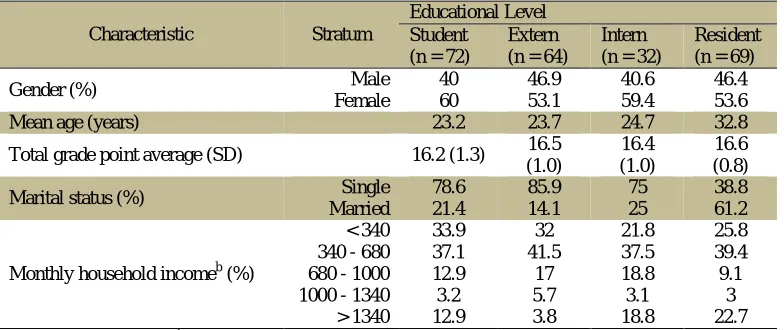
Table 1 demonstrates MTs' demographic charac-teristics (n = 237) stratified by their educational level. Since all trainees were either single or married, we have demonstrated here only two options for marital status. In addition, monthly household income has been exchanged from Rials (the currency of Iran) to dollars for international comprehension. Of the 237 participants that completed the questionnaires, 195 (82 %) rated all 46 questions.
Table 1. Demographic characteristics of participating MTs
Characteristic Stratum
Educational Level Student
(n = 72)
Extern (n = 64)
Intern (n = 32)
Resident (n = 69)
Gender (%) Male
Female 40 60 46.9 53.1 40.6 59.4 46.4 53.6
Mean age (years) 23.2 23.7 24.7 32.8
Total grade point average (SD) 16.2 (1.3) 16.5
(1.0)
16.4 (1.0)
16.6 (0.8)
Marital status (%) Single
Married 78.6 21.4 85.9 14.1 75 25 38.8 61.2
Monthly household incomeb (%)
< 340 340 - 680 680 - 1000 1000 - 1340 > 1340 33.9 37.1 12.9 3.2 12.9 32 41.5 17 5.7 3.8 21.8 37.5 18.8 3.1 18.8 25.8 39.4 9.1 3 22.7
SD= standard deviation; b in dollars. Reliability
To assess reliability, the internal consistency of the four domains (see validity and the factor loading results) and the composite score for the 237 participants were determined (Table 2). As can be seen, the calculated internal consistency for the composite score and all domains were high with Cronbach's alpha > 0.70. Test-retest reliability was conducted after a two-week interval using 35 MTs.
The results were good with intra-class correlation coefficients all above 0.80. Moreover, internal consistency of the split-half coefficients was computed using a two-way fixed model. Cronbach's alpha coefficient was 0.84 for part one and 0.79 for part two, and the Guttman split-half coefficient and intra-class correlation coefficient were 0.88 and 0.90 respectively.
Table 2. Characteristics of the instrument composite and domain scores Responsibility measure No. of items Cronbach's alpha Test-retest
CtFE domain 15 0.75 0.71
SCvs.DC domain 11 0.75 0.75
ItBEiME domain 10 0.74 0.75
AoE domain 5 0.76 0.72
Composite 41 0.90 0.90
CtFE= commitment to fulfill expectations; SCvs.DC= self-centeredness vs. duty-centeredness; ItBEiME= inclination to be engaged in meeting expectations; AoE= acceptance of expectations.
Validity
Face and content validity were assessed by our expert panel including clinical attending physicians and nurses as well as a number of undergraduates and medical residents. After the process of
Page 4 of 8 (page number not for citation purposes) loading. After exploratory factor analysis and by
using component matrices and a scree plot (Fig 1), it was decided that four or five components had to be retained. Following a number of successive confirmatory factor analyses, the 41-item instru-ment was finalized with four domains. In this way, 5 items with low (one item) or negative (two items) factor loadings, and items lacking consistency with the extracted domains were deleted.
The extracted domains were as follows:
1. "Commitment to fulfill expectations (CtFE)" with 15 items and extracted eigenvalue of 9.77
2. "Self-centeredness vs. duty-centeredness (SCvs.DC)" with 11 items and extracted ei-genvalue of 3.76
3. "Inclination to be engaged in meeting ex-pectations (ItBEiME)" with 10 items and extracted eigenvalue of 2.15
4. "Acceptance of expectations (AoE)" with 5 items and extracted eigenvalue of 1.84
Fig 1. The scree plot. The curve reaches a fairly stable plateau after five factors
These components could explain 42.75 % of the total variance of MTs' responsibility in clinical settings. The results of the principal component analysis (PCA) are demonstrated in Table 3. In this table, all calculated factor loadings with values larger than 0.3 are shown in addition to rotated eigenvalues and the percentage of variance by each significant extracted factor. The instrument is available in the appendix at the end of the article.
Table 3. Results of factor loading using principal component analysis (PCA) as extraction method Factors
CtFE SCvs.DC ItBEiME AoE
CIb FLc CI FL CI FL CI FL
Qd1 0.74 Q16 0.68 Q27 0.64 Q37 0.71
Q2 0.68 Q17 0.65 Q28 0.60 Q38 0.60
Q3 0.67 Q18 0.63 Q29 0.52 Q39 0.56
Q4 0.65 Q19 0.63 Q30 0.51 Q40 0.47
Q5 0.64 Q20 0.55 Q31 0.50 Q41 0.36
Q6 0.59 Q21 0.55 Q32 0.48
Q7 0.57 Q22 0.54 Q33 0.43
Q8 0.55 Q23 0.54 Q34 0.41
Q9 0.54 Q24 0.50 Q35 0.40
Q10 0.52 Q25 0.44 Q36 0.30
Q11 0.52 Q26 0.42
Q12 0.51
Q13 0.50
Q14 0.50
Q15 0.49
Rotated eigenvalue 6.236 5.119 3.760 2.412
% of variance 15.210 12.485 9.172 5.882
Cumulative % 15.210 27.696 36.867 42.749
CtFE= commitment to fulfill expectations; SCvs.DC= self-centeredness vs. duty-centeredness; ItBEiME= inclination to be engaged in meeting expectations; AoE=acceptance of expectations; C= Content of the Item (see the appendix); FL: factor loadings; Q: question.
Table 4 illustrates the intra-scale correlations between the instrument domains and the composite score. As can be seen, all inter-correlation measures between domains are lower than that of
Page 5 of 8 (page number not for citation purposes)
Table 4. Intra-scale correlations between the instrument domains and the composite score
Responsibility measure Responsibility measure
Composite AoE CtFE ItBEiME SCvs.DC
Composite 1.00
AoE domain 0.53 1.00
CtFE domain 0.79 0.22 1.00
ItBEiME domain 0.82 0.32 0.48 1.00
SCvs.DC domain 0.82 0.43 0.42 0.63 1.00
CtFE= commitment to fulfill expectations; SCvs.DC= self-centeredness vs. duty-centeredness; ItBEiME= inclination to be engaged in meeting expectations; AoE= acceptance of expectations;
All correlations were significant at the 0.01 level
Discussion
In this study, we developed a questionnaire for practical measuring of MTs’ responsibility in clinical settings. The main source for generating the items of this instrument was a published grounded theory research (GTR) (12). As demon-strated by factor loading, the instrument assesses
MTs' responsibility with respect to four domains. Overall, there was a suitable correspondence between the items of this questionnaire and the emergent categories and sub-categories of the GTR. This correspondence will be discussed in more detail below.
Table 5. Corresponding items of the "responsibility questionnaire" generated based upon emergent catego-ries and sub-categocatego-ries of a published PhD dissertation
Responsibility
measure/Corresponding items
Emergent categories of the grounded theory research (GTR)
"Try to find acceptance towards expectations"
"Try to be committed to meeting expectations"
"Try to cope with unac-ceptable expectations"
CtFE domain/Q1-Q15 Q1, Q2, Q4, Q5, Q10,
Q14
Q7, Q8, Q9, Q11, Q12,
Q13, Q15 Q3, Q6
SCvs.DC domain/Q16-Q26 Q17, Q19, Q21, Q22 --- Q16, Q18, Q20, Q23-26
ItBEiME domain/Q27-Q36 --- Q27-Q36 ---
AoE domain/Q37-Q41 Q37-Q41 --- ---
CtFE= commitment to fulfill expectations; SCvs.DC= self-centeredness vs. duty-centeredness; ItBEiME= inclination to be engaged in meeting expectations; AoE= acceptance of expectations.
There was not a close correspondence between items of the component "commitment to fulfill expectations (CtFE domain)" and its corresponding category "try to be committed to meeting expecta-tions" in the GTR. As table 5 demonstrates, questions 1, 2, 4, 5, 10 and 14 in this domain have been generated based on the dissimilar category "try to find acceptance toward expectations" in the GTR. Originally, these items aimed to assess how "acceptance parameters" of motivation, hope, attitude, etc. might influence MTs' responsibility in practice. Moreover, questions 3 and 6 were generated to assess how effectively MTs might deal with "unacceptable duties" in this domain. While this distribution of items seemed unusual at the beginning, a more thorough contemplation revealed that despite their original purpose, these items could also measure trainees' responsibility. In fact, these items would measure trainees’ level of commitment, especially in situations where they might find their personal benefit or convenience in conflict with their duties. Therefore, contrary to our expectation, factor analysis revealed that MTs responded to these questions in the same manner they responded to the questions based upon the
category "try to be committed to meeting expecta-tions".
Page 6 of 8 (page number not for citation purposes) In the case of the extracted component
"inclina-tion to be engaged in meeting expecta"inclina-tions" (ItBEiME), all items were consistent with the second category of the GTR "try to be committed to meeting expectations". According to factor loading, items of this domain would measure MTs' inclination and desire for engaging in fulfillment of academic duties. On this basis, higher responsibil-ity was usually followed by a higher inclination to be involved in meeting expectations. Finally, all five items of the fourth component "acceptance of expectations" (AoE) also corresponded to the category "try to find acceptance towards expecta-tions" in the GTR. This domain measures which criteria of duties or expectations are personally evaluated by MTs to be accepted and then fulfilled. As mentioned before, the literature on responsi-bility as a quantitative measure is rather limited (9), especially in the fields of medical education and medical ethics. Moreover, results of published works often cannot be applied to all countries alike due to social and cultural differences unless adaptability measures are implemented. There are also certain nonspecific instruments that have investigated the concept of responsibility mainly for other purposes (16, 17) or rather broadly and in order to evaluate concepts such as "professional-ism" (10, 11). Additionally, these instruments are often employed by third parties. Therefore, we believe the present valid and reliable questionnaire could specifically contribute to the existing literature on the subject and be utilized as a self-reporting instrument for assessing Iranian MTs' responsibility in practice.
The most important limitation of the present questionnaire may be that in general assessment of responsibility in a group of MTs, only the more responsible ones complete and return the question-naires to researchers. This is especially true when
forms are sent electronically or by mail, in which case the results would most likely be false or unreliable. It is therefore proposed that in these situations the instrument be delivered and then collected back in face-to-face appointments. The questionnaire can also be administered to MTs as a mandatory assignment in one of their formal courses such as medical ethics, or as a required twelve/six-monthly evaluation form for educational purposes.
Conclusion
In this study, we aimed to develop an instrument for practical evaluation of responsibility in medical trainees. The questionnaire was prospectively validated in a diverse population of both under-graduate and under-graduate MTs all recruited from educational settings of SUMS. The instrument was intended as a generic survey to supplement the literature on practical assessment of responsibility in MTs within clinical settings. This instrument is intended to measure trainees' beliefs, attitudes and behaviors with regard to the concept of responsibil-ity in practice. We believe that this questionnaire can be used to provide highly beneficial infor-mation for medical education and ethical develop-ment purposes.
Acknowledgment
The present research would not be possible without the valuable assistance of numerous people. The authors would like to thank all participating MTs for their kind cooperation in the collection of data for both the GTR and the present study.
Financial Support
Page 7 of 8 (page number not for citation purposes)
References
1. Thistlethwaite J, Spencer J. Professionalism in medicine. New York: Radcliffe; 2008.
2. Faseleh-Jahromi M, Moattari M, Peyrovi H. Iranian nurses’ perceptions of social responsibility: a qualitative study. Nurs Ethics 2014; 21(3): 289-98.
3. Asemani O, Iman MT, Moattari M, Tabei SZ, Sharif F, Khayyer M. An exploratory study on the elements that might affect medical students' and residents' responsibility during clinical training. Iran J Med Ethics Hist Med 2014; 7: 8. 4. Kwizera EN, Iputo JE. Addressing social responsibility in medical education: the African way. Med Teach 2011; 33(8):
649-53.
5. Gibbs T, McLean M. Creating equal opportunities: the social accountability of medical education. Medical Teach 2011; 33(8): 620-5.
6. Boelen C, Woollard B. Accountability and accreditation: a new frontier for educational institutions. Med Edu 2009; 43(9): 887-94.
7. Grace PJ. Professional advocacy: widening the scope of accountability. Nurs philos 2001; 2(2): 151–62.
8. Ross PT, Williams BC, Doran KM, Lypson ML. First-year medical students" perceptions of physicians" responsibilities toward the underserved: an analysis of reflective essays. J Natl Med Assoc 2010; 102(9): 761-5.
9. Megler A. Personal responsibility: the creation, implementation and evaluation of a school-based program, [Dissertation]. Brisbane, Australia: Queensland University of technology; 2007.
10. Parker M. Assessing professionalism: theory and practice. Med Teach 2006; 28: 399–403.
11. Burford B, Carter M, Morrow G, Rothwell C, Illing J, McLachlan J. Professionalism and conscientiousness in healthcare professionals. Durham University, 2011.
https://www.hcpc-uk.org/assets/documents/1000361BProfessionalismandconscientiousnessinhealthcareprofessionals-progressreportS2.pdf
(accessed in 2014)
12. Asemani O, Tabei SZ, Iman MT, Sharif F, Moattari M, Khayyer M. Theoretical explanation and evaluation of responsibility in medical students and residents of the Shiraz University of Medical Sciences during clinical training, [Dissertation]. Shiraz, Iran: Shiraz University of Medical Sciences; 2014.
13. DeVon HA, Block ME, Moyle-Wright P, et al. A psychometric toolbox for testing validity and reliability. J Nurs Scholarship 2007; 39(2): 155-64.
14. Lynn MR. Determination and quantification of content validity. Nurs Res 1986; 35(6): 382-5. 15. Lawshe CH. A quantitative approach to content validity. Pers Psychol 1975; 28(4): 563-75.
16. Hall M, Zheng B, Dugan E, Camacho F, Kidd KE, Mishra A. Measuring patients trust in their primary care providers. Med Care Res Rev 2002; 59(3): 293-318.
17. Forati Kashani M, Dabiran S, Noroozi M, Aramesh K. Professionalism in postgraduate students of TUMS: patients perspective. Iran J Med Ethics Hist Med 2010; 3(4): 46-56. [in Persian]
Appendix
All questions were based on a 5-point Likert scale (strongly agree/agree/to some extent agree/disagree/strongly disa-gree). The instrument is presented below with the items organized according to the identified components:
Component I: Commitment to Fulfill Expectations (CtFE)
Q1. I accept and fulfill my duties perfectly even when I do not have enough motivation for doing them. Q2. I fulfill my duties perfectly even when I have no hope for positive consequences.
Q3. I fulfill my duties perfectly even when I do not like doing them.
Q4. I fulfill my duties perfectly even when I consider them beneath my dignity and professional status.
Q5. I fulfill my duties perfectly even when I feel offended or dissatisfied on account of misconduct or imposition, etc. on other people’s side.
Q6. I fulfill my duties perfectly even when I need to justify myself for doing them.
Q7. I hold myself accountable for my duties even if my accountability causes problems and inconveniences for me. Q8. I fulfill my duties precisely and perfectly even if they cause hardships and difficulties for me.
Q9. I respect my patients' rights even if it creates problems for me. Q10. I usually fulfill my duties regardless of my personal interests.
Q11. For me, it is important to fulfill duties in the best way possible, not just perform them. Q12. I am respectful to patients and colleagues even if their behavior or requests are not respectful. Q13. I accept constructive criticism in a positive manner even if made by a nurse or a junior colleague. Q14. I usually fulfill my duties regardless of my attitude towards them.
Q15. I often try to follow positive role models in my practice.
Component II: Self-Centeredness vs. Duty-Centeredness (SCvs.DC)
Q16. I prefer to ignore others' (nurses, senior coworkers, etc.) professional comments or guidance and just do my own work.
Q17. I prefer not to consult colleagues (nurses, seniors, coworkers, etc.) on my tasks; it would save my face and my dignity.
Q18. I make jokes about patients with my colleagues.
Page 8 of 8 (page number not for citation purposes)
Q20. I believe neglecting duties is not appropriate, but I may do so when I am tired, or in other extremely rare situa-tions.
Q21. I do not believe in fulfilling duties unless it brings me personal gain.
Q22. I believe I should consider my own benefits and convenience when I am dividing professional tasks between my-self and my colleagues.
Q23. I sometimes satisfy my dissatisfaction or irritation at others in the way I perform my tasks or duties (for instance by becoming less active or less involved, etc.).
Q24. I believe respect for the law and observation of rules is good, provided that it is not in conflict with my personal convenience.
Q25. I believe lackadaisical performing of duties is inappropriate, but I may do so when I am tired, or in other extremely rare situations.
Q26. I believe evading duties and imposing your own responsibilities on others is not appropriate, but I may do so in some situations (for example in the case of risky patients, during midnight hours, etc.).
Component III: Inclination to Be Engaged in Meeting Expectations (ItBEiME)
Q27. I believe dedication to duty is pointless/unnecessary, and I only try to perform the tasks. Q28. I believe active involvement in duties to be unnecessary, and I only try to perform the tasks.
Q29. I do not refuse to help my colleagues (nurses, fellow students, etc.) if I can, even in cases beyond my official du-ties.
Q30. I think feeling sympathy for patients is pointless/unnecessary, and I only try to meet their medical needs. Q31. I perform only the minimum amount of duties that is required of me (I do no more than I need to). I prefer not to create any unnecessary difficulties or hardships for myself.
Q32. I am enthusiastic and energized about fulfilling my duties, regardless of how difficult they may be to perform. Q33. I believe it is not necessary to have good relations with my colleagues in order to improve my performance, and I prefer to simply perform my duties.
Q34. I do not refuse to help my patients if I can, even when that creates hardships and difficulties for me.
Q35. I believe it is pointless and unnecessary to stress over perfect fulfillment of duties, and I only try to perform the tasks that are required of me.
Q36. I perform my duties with delay or lower precision if I realize the task is not urgent or particularly important (in the case of midnight duties or health-obsessive patients, for instance).
Component IV: Acceptance of Expectations (AoE)
Q37. I believe what is assigned to me as a duty should be sensible, otherwise I do not accept it or I take it lightly. Q38. I believe what is assigned to me as a duty should be fair, otherwise I do not accept it or I make light of it. Q39. I do not accept or fulfill tasks or expectations that are beyond my lawful scope of duty, even if this is harmful to me in some way.
Q40. When I cannot satisfy myself that something (a duty, a request, etc.) is right and acceptable, I become inattentive to it (for instance I ignore a nurse request or a senior professional order, etc.).