e-ISSN: 2278-7461, p-ISSN: 2319-6491
Volume 6, Issue 4 [April 2017] PP: 06-12
Solar Drying Modes of Catfish (
Clarias gariepinus
)
Y.Yuwana
1, R.N.B. Tarigan
2, E. Silvia
31Department of Agricultural Technology, University of Bengkulu, Bengkulu, Indonesia, 2,3Department of Agricultural Technology, University of Bengkulu, Bengkulu, Indonesia,
Abstract: A solar dryer uniquely designed was used to dry catfish (Clarius gariepinus)employing different
drying modes, namely intact hanging fish (IH), intact laying fish (IL), split hanging fish (SH) and split laying fish (SL). The drying was run to investigate the drying time to complete the drying process of every mode using the fish moisture content of 20% to justify the resulted dry fish, and sensory evaluation was conducted to assess the quality of dry fish. The sun drying together with sensory evaluation was done on the corresponding modes as a comparison. The results of the experiment indicated that all modes completed the drying process 8.1 to 12.8 times faster than those of corresponding sun drying. There were no significant differences between IH mode and IL mode, and between SH mode and SL mode, but in general the split fish dried 1.43 times faster than the intact fish. In terms of dryer capacity IH mode was 4 times IL mode, whereas SH mode was 4.5 times SL mode. The sensory evaluation scores of the split modes were higher than those of the intact modes. Although the split modes demand more effort and time for the drying preparation, these findings suggest that the spilt hanging mode of drying should be the best choice for the application.
Keywords: Catfish, drying modes, solar dryer
I.
INTRODUCTION
Drying is the most common method of preserving fish. Sun drying is extensively conducted to dry agricultural product, including fish, in developing countries, especially in tropical region. It is usually done in good weather condition, by spreading products on a surface made of various materials such as a concrete, mats, tarred roads [1]. Sun drying is easily practiced, but it is space intensive (Prakash and Satyanayarana, 2014) may prompt to product's inferiority and losses because of insects, pests, animals, dust, dirts, rains and unwanted microorganisms ([2] [3].To overcome this handicap solar dryers have been developed by employing various types solar energy manipulation, including direct type solar dryers in which the dryer works similar to sun drying except the product to be dried is covered with transparent materials and moisture is removed from the product from its top surface [4] [5] [6] [7], indirect type solar dryers in which the drying air is heated by a collector which collects solar energy from the sun, and moisture of the product is evaporated by the heated drying air [8] [5] [9] [10] and mix type solar dryers where wet product to be dried receives drying energy both directly from the sun and the hot air heated by the collector [2] [11] [12]. Although some types have been explored for fish drying, such as direct solar tunnel dryers [13] [14] [15], indirect cabinet solar dryer [16], natural convection [17], tunnel ([18] [19], mixed type solar dryers [17] [18] [19], they are still subjected for improvement to increase the drying performance to accommodate various types of fish species.
2.1. Equipment
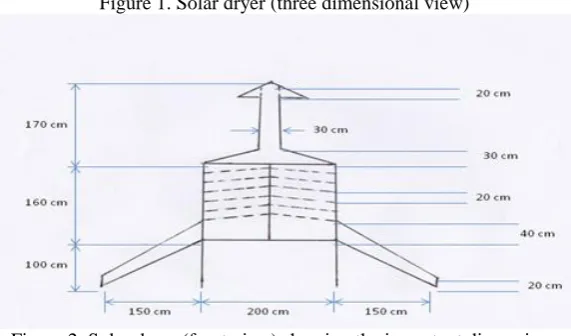
The construction of the solar dryer was done in the Laboratory of Agricultural Technology, Department of Agricultural Technology, Faculty of Agriculture, University of Bengkulu, Indonesia. The main structure the dryer was made of light steel slabs as a frame, covered by 14% UV transparent plastic and occupied 5 x 3 m2 horizontal total area, as shown in Fig. 1 and 2. The dryer consisted of the drying chamber, chimney and two wings of heat collector (right wing and left wing). The drying chamber measured about 2 m wide, 3 m long and 1.6 m height, and was equipped with 12 trays mounted in six stories (6 trays for right wing, 6 trays for left wing) measured about 3 m x 0.85 m each to place the fresh fish to be dried. Two front doors were provided to the drying chamber to facilitate in-out movement of the trays during operation of the dryer. The trays were made of anti-corrosive wire mesh and framed with light steel slabs. The dimension of the chimney was 0.30 m x 1.4 m x 3 m, equipped with an air outlet at its upper end installed in the middle of the top roof. The heat collector was made of aluminum sheet, painted in black on its upper surface and was insulated with plywood at its lower surface. An air inlet was complemented at the lower end of the heat collector. The dryer was installed in an open area and was oriented across the sun.
The solar dryer operated as follows. As long as sun rays strike the structure of the dryer, the drying chamber collects solar energy directly from the sun rays passing through its roof and the wall while the heat collector accumulates solar energy from the sun rays passing through its roof and striking the upper surface plate. The solar energy gain in the drying chamber increases the drying air while the absorbed energy by the surface plate increases its temperature and uses it to heat the entering fresh air from the inlet and the heated air flows into the drying chamber and further increases the drying air in it. Due to the enclosed system of the drying air in the structure of the dryer, there is a pressure gradient between a point in the lower end of the heat collector and a point in the upper of the chimney, then creates a continues flow of the drying air from the inlet passing through the trays to the outlet. The passing drying air heats the fish on the trays and evaporates its moisture content, and the fish moisture content decreases during the drying process. The drying process is terminated when the fish moisture content reaches determined level.
The other equipments used in this study were the thermo-hygrometers to measure the temperatures and relative humidities of the drying air and ambient air, the electronic balance (accuracy 0.1 g) to weigh the fish samples, freezer and refrigerator to preserve the fish and fish samples, and the oven to determine the moisture content of the samples.
2.2. Materials
Catfish (Clarias gariepinus) available in local pond was kept in stock to be ready when it was needed for experiment. In every experiment the preparation of fish was as follows. The fish measured about 150 to 170 g was cleaned and sectioned on its abdomen to sort out the entrails. Some fish was kept intact and some other was split. The split fish provided to be hung, it was stretched using a bamboo stick to keep splitting. Beside bamboo stick, aluminum foil sheets and plastic bags were prepared to conserve the fish samples.
2.3. Experiment
Figure 1. Solar dryer (three dimensional view)
Figure 2. Solar dryer (front view) showing the important dimensions
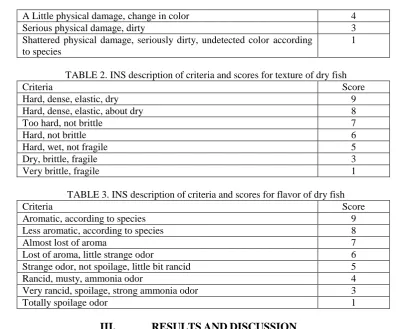
evaluation. Four groups of clean fish were also prepared for sun drying experiment following the same treatment and experimental setting. Four thermo-hygrometers were prepared, three were placed on each story and one was installed in shading area outside the dryer to observe the temperatures and relative humidities of the drying air and ambient air. The fish samples prescribed for observation were weighed periodically. Observation of the temperatures, relative humidities and weight of fish samples was conducted in every hour along the drying process. When the drying process was interrupted during night time and bad weather, the fish samples were wrapped in the aluminum foil sheet and then entered in the plastic bags to be conserved in the freezer. The drying process was terminated when the fish moisture content had reached about 20% [25]. By the end of the experiment, the fish samples destined for observation were taken to the laboratory to be placed into the oven having 105oC for 24 hours to determine their dry weight. The fish sample moisture content was calculated in wet basis. The dry fish samples conserved for the sensory evaluation were placed in the hermetic plastic bags and stored in the refrigerator ready for assessment by panelists. The experiment was conducted in three replications. The average values of drying air temperature, drying air relative humidity, ambient air temperature, ambient air relative humidity, fish moisture contents are presented in the form of curves in function of drying time. The fish moisture content threshold of 20% was used to justify dry fish where the drying process was terminated and the drying times corresponding to the drying modes were calculated. The sensory evaluation was carried out according to the criteria and the procedure issued by Indonesian National Standard (INS) 01-2721-1992 [26]for dry fish. The criteria together with their scores for appearance, texture and flavor were described in Table 1, 2, 3. Thirty experienced panelists were prepared for the sensory evaluation.
TABLE 1. INS description of criteria and scores for appearance of dry fish
Hard, dense, elastic, about dry 8
Too hard, not brittle 7
Hard, not brittle 6
Hard, wet, not fragile 5
Dry, brittle, fragile 3
Very brittle, fragile 1
TABLE 3. INS description of criteria and scores for flavor of dry fish
Criteria Score
Aromatic, according to species 9
Less aromatic, according to species 8
Almost lost of aroma 7
Lost of aroma, little strange odor 6 Strange odor, not spoilage, little bit rancid 5
Rancid, musty, ammonia odor 4
Very rancid, spoilage, strong ammonia odor 3
Totally spoilage odor 1
III.
RESULTS
AND
DISCUSSION
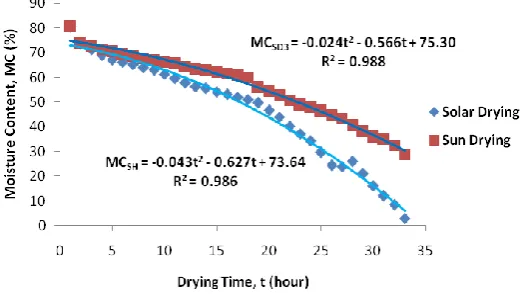
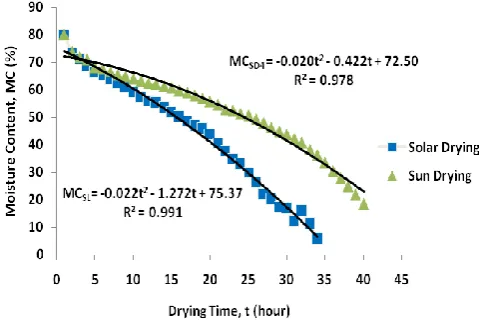
Fig. 3 and 4 present the temperatures plotted against drying time and the relative humidities plotted against drying time respectively. Experimental data also indicate that the drying air temperature was 43(±2.8)oC, on the other hand the ambient temperature was 33.3(±1.5)oC in which the dryer was able to generate the drying air temperature of about 10oC higher than that of ambient air. The drying air relative humidity was 35.3(±2.7)%, whereas the ambient air relative humidity was 58.8(±2.9)% in which the dryer produced the drying air relative humidity of about 23% lower than that of ambient air.The relationships between the fish moisture content and drying time for different drying modes are shown in Fig. 5, 6, 7 and 8. Utilizing the fish moisture content of 20% to justify dry fish, the drying time to complete the drying process for every mode can be described as follows. Fig. 5 indicates that the intact hanging fish (IH) mode completed the drying process in 41.4 hours, which was 8.1 hours faster than that of the sun drying, SD1 (49.5 hours). Next from Fig. 6, the intact lying fish (IL) mode completed the drying process in 41.5 hours and 9.7 hours faster than that of the sun drying, SD2 (51.2 hours). Furthermore, from Fig. 7, the split hanging fish (SH) mod finished the drying process in 28.8 hours and 8.8 hours faster than that of the sun drying, SD3 (37.6 hours). Finally from Fig. 8, the split laying fish (SL) mode finished the drying process
Figure 4. Relative humidities plotted against drying time
Figure 5. Relationship between the fish moisture content and drying time for the intact hanging fish mode
Figure 8. Relationship between the fish moisture content and drying time for the split laying fish mode
29.0 hours and 12.8 hours faster than that of the sun drying, SD4 (41.8 hours). So overall the drying times to complete the drying process for different drying modes are summarized in Table 4. In terms of drying time, there were no significant differences between IH mode and IL mode, and between SH mode and SL mode, but in general the split fish dried 1.43 times faster than the intact fish. In terms of dryer capacity IH mode was 4 times IL mode, whereas SH mode was 4.5 times SL mode.
TABLE 4. Drying time to complete drying process for the different drying modes Mode of Drying Drying Time (hour)
Intact Hanging Fish (IH) 41.4 Intact Laying Fish (IL) 41.5 Split Hanging Fish (SH) 28.8 Split Laying Fish (SL) 29.0
The result of the sensory evaluation revealed the average scores for visual, texture and flavor of dry fish as shown in Table 5. For all parameters the scores of the solar drying fish were higher than those of the sun drying fish, but the split fish higher scores than those of intact fish.
TABLE 5. The average of sensory evaluation scores .
Parameter
Treatment
IH SD1 IL SD2 SH SD3 SL SD4 Visual 7.8 6.5 7.8 6.5 8.6 7.2 8.6 7.2 Texture 7.4 6.4 7.3 6.4 8.1 7.1 8.1 7.2 Flavor 6.8 6.4 6.9 6.3 7.1 6.5 7.1 6.5
IV.
CONCLUSION
There were almost no different drying times between the intact hanging fish mode and the intact laying mode and between the split hanging mode and the split laying mode, but the split modes were faster than the intact modes. The capacity of the dryer for the split modes was much higher than those of intact modes. The sensory evaluation scores of the split modes were higher than those of the intact modes. Although the split modes demand more effort and time for the drying preparation, these findings suggest that the spilt hanging mode of drying should be the best choice for the application.
REFERENCES
[1] Abur, B.T., H.Dan-Dakouta and G. Egbo. 2014. Food security: Solar dryers and effective food preservation. Int. J. Adv. Engg. Res. Studies 3(2):166-171.
[2] Panchal, S., S.K. Solanki, S.Yadav, A.K. Tilkar and R. Nagaich. 2013. Design, construction and Testing of solar dryer with roughened surface solar air heater. Int. J. Innov. Res. Eng & Sci.7(2):7-17.
[3] Sontakke, M.S. and S.P. Salve. 2015. Solar drying technologies: A review. IRJES. 4(4):29-35.
[5] Nandwani, S.S. 2011. Design construction and study of direct indirect natural circulation solar dryer in Costa Rica. ISIESCO Sci. Tech. Vision 7(11):43-47.
[6] Almuhanna, E.A. 2012. Utilization of a solar greenhouse as a solar dryer for drying dates under the climatic conditions of the Eastern Province of Saudi Arabia. J. Agric. Sci. 4(3):237-246.
[7] Arun, S., S. Ayyappan and V.V. Sreenarayanan. 2014. Experimental studies on drying characteristics of tomato in a solar tunnel greenhouse dryer. IJRTE.3(4):32-37.
[8] Banout, J. and P. Ehl. 2010. Using a double-pass solar drier for drying of bamboo shoots. J. Agr.& Rural Dev. Trop. Subtrop. 111(2):119-127.
[9] Sulaiman, F., N. Abdullah and Z. Aliasak. 2013. Solar drying system for drying empty bunches. J. Phys.Sci. 24(1): 75-93.
[10] Phadke, P.C., P.V. Walke and V.M. Kriplani. 2015. A review on indirect solar dryers. ARPN J.Eng.Appl.Sci.10(8):3360-3371.
[11] Azimi, A., T. Tavakoli, H.K. Beheshti and A. Rahimia. 2012. Experimental study on eggplant drying by an indirect solar dryer and open sun drying. Iranica J. Energy & Environment 3(4):348-354.
[12] Munir, A., U. Sultan and M. Iqbal. 2013. Development and performance evaluation of a locally fabricated portable solar tunnel dryer for drying of fruits, vegetables and medicinal plants. Pak. J. Agri. Sci. 50(3):493-498.
[13] Sablani1, S.S., M.S. Rahman, I. Haffar, O. Mahgoub, A.S. Marzouki. M.H. Ruzeiqi, N.H. Al-Habsi1 and R.H. Al-Belushi. 2003. Drying rates and quality parameters of fish sardines processed using solar dryers. Agricultural and Marine Sciences, 8(2):79-86.
[14] Swati, M. N. and P.M. Chauhan. 2015. Development of greenhouse solar tunnel dryer for industrial fish drying of selected species from the western coastal region of India. Res. J. Engng. Sci. 4(10):1-9. [15] K. B. Uddin, K.B., M. S. Reza, M. N. Islam and M. Kamal. 2014. Influence of salt on drying
performance of silver jewfish (Otolithes argentatus) in a Hohenheim type solar tunnel dryer. J. Bangladesh Agril. Univ., 12(1): 227–233.
[16] Onyinge, G.O., A.O. Oduor and H.E. Othieno. 2015. The design and testing of an indirect cabinet solar dryer, for thin layer drying of Rastrineobola argentea fish, under the climatic conditions of Masero, Kenya. African Joyrnal of Food Science, 9(1): 1-16.
[17] Hubackova, A., I. Kucerova, R. Chrun, P. Chaloupkova and J. Banout. 2014. Development of Solar Drying Model for Selected Cambodian Fish Species. The Scientific World Journal Volume 2014, Article ID 439431, 10 pages. http://dx.doi.org/10.1155/2014/439431
[18] Basunia, M.A., H. H. Al-Handali, M. I. Al-Balushi, M. S. Rahman and O. Mahgoub. 2011. Drying of Fish Sardines in Oman Using Solar Tunnel Dryers. Journal of Agricultural Science and Technology, B 1: 108-114.
[19] Chavan, B.R., A. Yakupitiyage and S. Kumar. 2011. Drying Performance, Quality Characteristics, and Financial Evaluation of Indian Mackerel (Rastrilliger Kangurta) Dried by a Solar Tunnel Dryer. Thammasat Int. J. Sc. Tech., 16(2): 11-25.
[20] Anonymous. 2014. Ministry of Maritime and Fisheries: Performance Report of Ministry of Miritime and Fisheries 2014. (in Indonesian)
[21] Anonymous. 2015. Directorate General of Domesticated Fisheries: Performance Report of Production Directorate 2015. (in Indonesian).
[22] Agbabiaka, L.A, A.S. Amadi, L.O. Eke, C.U. Madubuko and A.S. Ojukannaiye. 2012. Nutritional and storage qualities of catfish (Clarias gariepinus) smoked with Anthonatha macrophylla. Science Research Reporter, 2(2): 142-145
[23] Chukwu, O. and I.M. Shaba. 2009. Effects of Drying Methods on Proximate Compositions of Catfish (Clarias gariepinus). World Journal of Agricultural Sciences, 5(1): 114-116.
[24] Omodara, M. A., F.F. Olayemi, S.N. Oyewole, A.R. Ade, O.O. Olaleye, G.I. Abel, and O. Peters. 2016. The Drying Rates and Sensory Qualities of African Catfish, Clarias gariepinus Dried in Three NSPRI Developed Fish Kilns. Nigerian Journal of Fisheries and Aquaculture, 4(1): 42 – 49.
[25] Anonymous. 2009. Indonesian National Standardization : Smoked Fish. Indonesia Standardization Board. Jakarta Indonesia. (in Indonesian)