e-ISSN: 2278-067X, p-ISSN: 2278-800X, www.ijerd.com
Volume 13, Issue 11 (November 2017), PP.01-07
An Improved Hough Transform for Circle Detection
Nitin Bhatia
Department of Computer Science, DAV College, Jalandhar 144008, India Corresponding Author:Nitin Bhatia
Abstract:-Digital image processing relies heavily on detection of various objects. Detection of geometric
objects like lines and circles helps image understanding. In this paper, an improved version of Hough transform for circle detection in digital images is presented. Hierarchical Hough transform has been modified to achieve better computational efficiency. An important property of square root of integers has been examined and applied to work in the favour of algorithm. The experimental analysis shows considerable improvement in speed of the algorithm without compromising the accuracy.Keywords:-Circle detection, Hough transform, hierarchical Hough transform, Automatic thresholding.
--- --- Date of Submission: 01-11-2017 Date of acceptance: 09-11-2017 ---I.
INTRODUCTION
Curve detection in digital images has a variety of applications. Line and circle detection are two of the many different geometrical objects that can be detected from images. Circular objects can be located in a digital image with the help of circle detection [1]-[4]. Most popular technique to detect circles from images is Hough transform [5]. In literature, many variations of Hough transform are available. Fast Hough transform or hierarchical Hough transform is one such variation [6]. Randomised Hough transform uses randomised image pixels to vote for Hough space cells or bins instead of using all pixels, thus reducing time required [7]. Fuzzy Hough transform uses fuzzy logic to decide the membership of an image pixel to a Hough bin [8].
Apart from techniques based on Hough transform, other techniques have also been proposed [9]-[12]. Mingzhu and Huanrong [9] give a simple method of choosing a pixel and then finding two other pixels, one in horizontal and other in vertical direction, and fit a circle to these three points. The efficiency of the method depends on the selection of initial pixel. Chen et al. [10] propose an algorithm in which edge image is divided into several sub-images by the properties of circle, and then the parameters of circles are calculated using the point pairs chosen from the sub-images followed by a data merging method to process the parameters. Ayala-Ramirez et al. [11] present a circle detection method based on genetic algorithms. The method does not work well while detecting small circles from digital images. Cuevas et al. [12] propose a method based on Electro-magnetism optimization, which is a nature inspired technique to detect circles. The technique requires a number of parameters to be set manually to detect circles. We propose a method based on hierarchical Hough transform. The main feature of this method is its speed. The proposed method shows its robustness to the presence of noise as well. We conduct experiments on a large number of images most of which are natural images and the accuracy of the method is observed to be the same as that of conventional Hough transform. The method shows very high efficiency in terms of time requirements. The comparisons are made with techniques given by [12] and [13].
II.
HOUGH
TRANSFORM
Hough transform continues to be one of the landmark algorithm for curve detection in digital images. It works on the basis of voting in the Hough parameter space, a three dimensional space in case of circles. The local maxima is then selected as the bin which corresponds to circles in the image space.
A. Classical Hough Transform
Classical or standard Hough transform choses the simplistic approach of using equation of circle as
(x − h)2− y − k 2− r2= 0. Using all image points as (x, y) and voting for each bin as (h, k, r). This
minimalistic approach is time consuming. B. HierarchicalHoughTransform
by number of edge pixels larger than a predefined threshold value, the accumulator cell is sliced into octants and each octant is tested further. The subdivision of Hough space is depicted by Fig. 1.
Fig. 1. Hierarchical subdivision of Hough space.
The octants failing to attract enough votes are barred from further contests. The process reaches the unit cell in
2
log
L
moves. Therefore, considering the number of edge pixels as
E
I , the complexity reduces to2
(
Ilog
)
O E
L
. In the next section, we show that the proposed technique has an even further reduced time complexity.
III.
THE
PROPOSED
METHOD
A. Elimination of Edge Pixels at Coarser Level
The boundary of a right circular cone centered at
( , )
h k
with radiusr
is given as2 2 2
0 0
( , , )
(
)
(
)
0
f h k r
h
x
k
y
r
(1)
At any level, the Hough space cubic cell can have lower left corner as
( , , )
h k r
1 1 1 and upper right corner as 2 2 2( ,
h k r
, )
. The boundary plans of the cubic cell are defined by
1
0
h h
h h
2
0
1
0
k
k
k
k
2
0
1
0
r
r
r
r
20
If the axis r is represented vertically, then the top boundary plane is
r
r
20
. This plane intersects with thecube, represented by Eq. 1, to produce a circle given in Eq. 2.
2 2 2
0 0 2
(
h
x
)
(
k
y
)
r
0
(2)
This circle is centered at
(
x y
0,
0)
and has radiusr
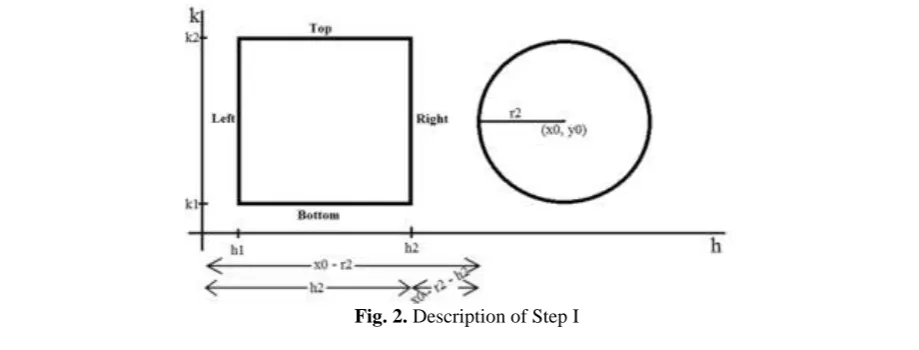
2 as given by Fig. 2. This circle cannot intersect the squareor rectangle that represents the top of the cubic Hough space cell if it lies above, below, to the right of or to the left of the top, bottom, right or left boundaries, respectively.
Therefore, at a coarser level, an edge pixel
(
x y
0,
0)
does not vote for a cubic cell defined by 1 1 1 2 2 2[( , , ) ( ,
h k r
h k r
, )]
if the following conditions are not met:
Circle lies to the right of the right boundary:
x
0
r
2h
2
0
Circle lies to the left of the left boundary:
x
0
r
2h
10
Circle lies above the top boundary:
y
0
r
2k
2
0
Circle lies below the bottom boundary:
y
0
r
2k
10
Elimination of edge pixels at a coarser level saves substantial amount of time. For example, in one of the sample image, the time saved by this step is 40%.
Fig. 3. A view of the Hough space for circle parameters.
B. Elimination of Edge Pixels at a Finer Level
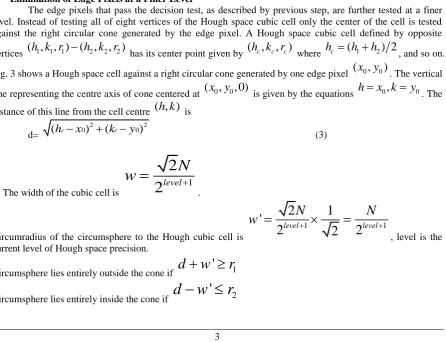
The edge pixels that pass the decision test, as described by previous step, are further tested at a finer level. Instead of testing all of eight vertices of the Hough space cubic cell only the center of the cell is tested against the right circular cone generated by the edge pixel. A Hough space cubic cell defined by opposite
vertices
( , , ) ( ,
h k r
1 1 1
h k r
2 2, )
2 has its center point given by( ,
h k r
c c, )
c whereh
c
(
h
1
h
2) 2
, and so on.Fig. 3 shows a Hough space cell against a right circular cone generated by one edge pixel
(
x y
0,
0)
. The verticalline representing the centre axis of cone centered at
( ,
x y
0 0, 0)
is given by the equationsh
x k
0,
y
0. Thedistance of this line from the cell centre
( , )
h k
isd=
2 2
0 0
(
h
c
x
)
(
k
c
y
)
(3)
The width of the cubic cell is
1
2
2
levelN
w
.
Circumradius of the circumsphere to the Hough cubic cell is
1 1
2
1
'
2
level2
2
levelN
N
w
, level is the current level of Hough space precision.
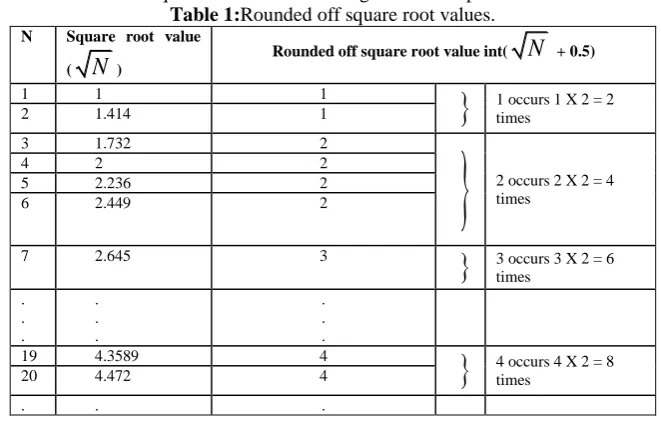
Equation (3) involves the square root operation which is time consuming Instead of using a relatively slow inbuilt sqrt(N) function, we pre-compute and store the rounded off square root values in an array. Let us examine an important property of rounded off square root for integers.
C. Square Root Property of Integers
Theorem: An integer k is rounded off square root for all the integers in the interval (k2-k, k2+k].
Proof: Let k be the rounded off square root value of integer N then,
0.5
1
k
N
k
2 2
2 2
0.5
0.5
0.25
0.25
(
1) 0.25
(
1) 0.25
(
1) 1
(
1)
1
k
N
k
k
k
N
k
k
k k
N
k k
k k
N
k k
k
k
N
k
k
2 2k
k
N
k
k
□The algorithm used to pre-compute the rounded off square root values is given here. The tradeoff for using the
pre-computed square root values is the additional space requirement of
R
words.The Algorithm:Rounded off square root computation
Set Maxradius to
2
N
, Square_root(0) to 0 and counter to 1 For I = 1 to MaxradiusFor J = I to 2I
Set Square_root(counter) to I Increment counter by 1 end for
end for
The algorithm stores rounded off square root values for integers from 0 upto Maxradius.
Table 1:Rounded off square root values.
N Square root value (
N
)Rounded off square root value int(
N
+ 0.5)1 1 1
1 occurs 1 X 2 = 2times
2 1.414 1
3 1.732 2
2 occurs 2 X 2 = 4 times4 2 2
5 2.236 2
6 2.449 2
7 2.645 3
3 occurs 3 X 2 = 6times . . . . . . . . .
19 4.3589 4
4 occurs 4 X 2 = 8times
20 4.472 4
. . .
D. Automatic Thresholding for Voting
4 2
r
8
, wherer
is the radius of the circle. For the edge pixels after pixel reduction, the threshold valuemust be set to
1
8 (1
)
2
r
which is explained as follows.
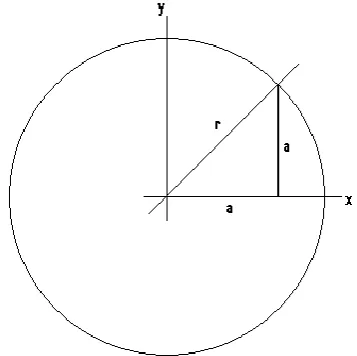
Fig. 4. Calculation of radius dependant threshold
A digital circle with radius
r
has 8-way symmetry and in an octant, the maximum number of pixelswill be
a
r
2
. Thus, the complete circle will have8
2
r
pixels, but 8 pixels will repeat in the process of
computation. Thus, the maximum number of pixels a digital circle can have is
T
4 2
r
8
. The actual threshold however, will be much less than4 2
r
8
due to the edge pixel reduction process. This is explained as follows. We compute the number of pixels that contribute towards the actual threshold, say,T
'
in an octant.Starting from
y
r
to2
r
y
, which belongs to the octant 1, (as shown in Fig. 4), only
r
r
2
pixelscontribute towards
T
'
. Thus, the total value ofT
'
for the complete circle will be8
r r
2
1
after reducing the repeating pixels on the circle during the scanning process. The percentage reduction in thethreshold is
'
100
p
T
T
T
T
. which is
200
2 1
%
2
2
r
r
. Typically, forr
10, 20,30, 40,50
thevalues of
T
p
68.22746%, 63.03596%, 61.47668%, 60.72562%,60.28372%
, respectively.We compare the proposed method to one of the work by Cuevas et al. [12] theoretically and to Chiu and Liaw [13] by using experiment analysis. The proposed method is automatic as it automatically calculates the value of threshold. The method given in [12] requires manual adjustment of various parameters for accurate
detection of circles. Moreover, the technique presented is based on an algorithm that has complexity
O E C
(
I2)
where
E
I is the number of edge pixels andC
is a predefined constant value. Therefore, the actual complexityof the algorithm is
O E
(
I2)
. It also suffers from a drawback that it requires large number of floating pointoperations and also calls random function to generate a set of three elements to be used as initial population for
detection task. In contrast, the proposed technique has a low complexity with
O E
(
Ilog
2L
)
. For Hough space with dimensions 1024x1024x1024, the number of times the algorithm needs to iterate is10
E
I. Apart from that, the pixel reduction technique reduces the parameterE
I to a great extent. Our experiments show thatE
I isIV.
EXPERIMENTAL
ANALYSIS
A. Execution EfficiencyAn extensive experimentation using 100 different images (natural as well as synthetic) has been performed (results are shown for 25 only). Table 2 shows the execution time comparison of proposed technique with technique given by [13].
Table 2:Execution time comparison.
Image Name
Execution Time (sec.) [13] vs. HHT % Circle detection by [13] Proposed
Hierarchical HT
Img1 0.0865 0.063 27.1466
Img2 0.0828 0.078 5.7425
Img3 1.5780 1.375 12.8623
Img4 0.2143 0.062 71.0733
Img5 1.0078 0.734 27.1674
Img6 0.5867 0.313 46.6518
Img7 0.1296 0.098 24.3769
Img8 0.5230 0.374 28.4873
Img9 0.4056 0.387 4.5830
Img10 0.1054 0.068 35.4618
Img11 0.1053 0.088 16.4245
Img12 0.1598 0.075 53.0790
Img13 0.1288 0.091 29.3374
Img14 1.7950 0.2313 10.5070
Img15 0.3726 0.1033 37.9267
Img16 0.1816 43.1148
Img17 0.7781 0.3138 59.6723
Img18 0.3611 0.2186 39.4684
Img19 0.2402 0.1155 51.9198
Img20 0.2980 0.2091 29.8406
Img21 0.4211 0.3323 21.0819
Img22 0.8739 0.7022 19.6505
Img23 1.1989 1.0173 15.1488
Img24 0.8327 0.5647 32.1820
Img25 1.9383 0.7897 59.2583
The proposed technique shows 59.67% improvement of speed.
B. Robustness to Noise
Robustness to noise is a prime requirement for the circle detection methods. The proposed method works well even in the presence of noise. We added varying amount and type of noise to the images containing circular objects. The experiments are conducted using noisy images and results are presented. Fig. 5 shows an image containing circles along with 3% and 5% added noise and their corresponding results.
V.
CONCLUSIONS
The proposed technique uses some very peculiar properties of hierarchical Hough transform and suggests improvement over the existing technique, thereby achieving a significant improvement in execution time taken. The improved version is showing a maximum of 59.67% of time improvement. The proposed method thus proves itself a very important technique in circle detection. In future, the similar technique can also be applied to other curve detection methods to achieve improvements.
REFERENCES
[1]. H. Yazid, H. Yazid, M. Harun, S. Mohd, A.A. Mohamed, M. Rizon, S. Sayuti, Circular discontinuities detection in welded joints using Circular Hough Transform, NDT & E International 40 (2007) 594-601. [2]. C.-P. Chang, J.-C. Lee, Y. Su, P.S. Huang, T.-M. Tu, Using empirical mode decomposition for iris
recognition, Conput. Stand. Interfaces 31 (4) (2009) 729-739.
[3]. N.V. Huan, H. Kim, A novel circle detection method for iris segmentation, in: Proceedings of Congress on Image and Signal Processing, Sanya, China, 2008, pp: 620-624.
[4]. N. Bhatia, M. Chhabra, Improved Hough transform for fast Iris detection, in: Proceedings of 2nd International Conference on Signal Processing Systems, Dalian, China, 2010, pp: V1-172 - V1-176. [5]. R. Duda, P. Hart, Use of Hough transform to detect lines and curves in pictures, Communications of
the ACM 15 (1975) 11-15.
[6]. N. Guil, E.L. Zapata, Lower order circle and ellipse Hough transform, Pattern Recognition, 30 (10) (1997) 1729-1744.
[7]. C. Xing, J. Wang, An improved method for circle detection”, ICIRA 2008, Part I, LNAI 5314, pp. 463–468, 2008.
[8]. J.H. Han, L.T. Koczy, T. Poston, Fuzzy Hough transform. In: Proceedings of the 2nd International Conference on Fuzzy Systems, 1993, pp. 803–808.
[9]. Z. Mingzhu, C. Huanrong, A new method of circle’s center and radius detection in image processing, in: Proceedings of the IEEE Int. Conf. on Automation and Logistics, China, 2008. pp. 2239-2242. [10]. G. Chen, J. Ji, L. Sun, A novel circle detector based on sub-image point pairs, in: Proceedings of the
IEEE Int. Conf. on Information and Automation, China, 2008. pp. 661-666.
[11]. V. Ayala-Ramirez, C.H.G.-Capulin, A.P.-Garcia, R.E.S.-Yanez, Circle detection on images using genetic algorithms, Pattern Recognition Letters 27 (2006), 652-657.
[12]. E. Cuevas, D. Oliva, D. Zaldivar, M.P.-Cisnero, H. Sossa, Circle detection using electro-magnetism optimization, Inform. Sci. (2011), doi:10.1016/j.ins.2010.12.024.
[13]. S.-H. Chiu, J.-J. Liaw, An effective voting method for circle detection, Pattern Recognition Letters 26, (2005) 121-133.