What is Imagination? Perspectives Held by
New Entrants into a B.Ed. Program
Blaine E. Hatt, Rob Graham,
Schulich School of Education, Nipissing University
This paper examines the preconceived notions and prior educational experiences that students entering a Bachelor of Education program have regarding imagination. Prior to the commencement of any course work, students (N=138) were asked in a survey to respond to two questions: “What is imagination?” and “Why do you hold that view?” The findings of this research project revealed that many students held traditional perceptions of imagination, such as the formation of a mental image or a concept of that which is not real or present, and the ability to deal creatively with reality. Students reported that their assumptions were based on ideas communicated to them by older siblings, parents, or primary elementary teachers. The evidence of traditional mindsets respecting imagination held by students entering a Bachelor of Education program calls for a deeper exploration of and conversation about the role of imagination in public education, especially in what some perceive to be a technologically advancing learning landscape requiring the essential 21st century competencies of critical thinking and creativity.
Cet article porte sur les notions préconçues et les expériences éducatives antérieures relatives à l’imagination d’étudiants au baccalauréat en éducation. Avant de commencer les travaux de leur programme, les étudiants (N=138) ont répondu à deux questions d’un sondage : « Qu’est-ce l’imagination? » et « Pourquoi êtes-vous de cet avis? ». Les résultats de ce projet de recherche révèlent que plusieurs étudiants entretenaient des perceptions traditionnelles de l’imagination, telles que la formation d’une image ou d’un concept mental qui n’est pas réel ou présent, ou bien la capacité d’affronter la réalité de façon créative. Les étudiants ont indiqué que leurs avis étaient basés sur des idées que leur avaient transmises leurs sœurs et leurs frères ainés, leurs parents ou leurs enseignants au primaire. Face à cette mentalité traditionnelle chez des étudiants qui débutent un baccalauréat en éducation, il serait nécessaire d’étudier en profondeur le rôle de l’imagination dans l’éducation publique et d’en discuter, notamment dans le contexte de ce que certains perçoivent comme étant un paysage d’apprentissage caractérisé par des progrès technologiques qui exigent les compétences essentielles du 21e siècle, soit la pensée critique et la créativité.
Conceptualizing Imagination
to conjure, or bring to light images of something within oneself or within another that in reality
do not exist. Egan (2005) defines imagination as “The ability to think of things as possible - the source of flexibility and originality in human thinking” (p. 220). White (1990) analyzes the
concepts of imagination through an examination of Aristotle, Hobbes, Descartes, Locke, Berkeley, Hume, and Kant and their portrayals of imagination as imagining and/or having images. White further examines the theories expressed by Sartre, Ryle, and Wittgenstein who rejected the views of images and proffers his own concept of imagination as the mental
construction of a possibility. Kant (as cited in Warnock, 1978) declared, “I give the name
Imagination” to the synthesis of the manifold functions of “appearance, perception, and synthesis” (p. 28). These faculties loosely correspond to those posited by Hume who referred to imagination as the “supreme human faculty” (as cited in Streminger, 1980, p. 91) composed of three distinguishing and different functions: cognitive, aesthetic, and artistic.
The use of the imagination to construct ideas, propositions, concepts, objects, or systems that transcend the empirical realm or impose a new order on past impressions is known as the
cognitive function (Streminger, 1980). Warnock (1978) presents the view that Hume’s cognitive function perceives ideas as images, as “that which enables us to see things ‘in our mind’s eye’”
(p. 15). When speaking of imagination, we often hear it said, “picture to yourself” or “picture yourself doing.” In sport, this process is known as visioning but it is not limited to sport for it can and does apply to all aspects of life. This is not unlike Ricouer’s (1978) contention that imagination involves not just the seeing of that which is actual but metaphorically “seeing as … old age as the close of day, time as beggar, nature as a temple with living pillars, and so forth” (p.
8).
The aesthetic function is the ability to use the imagination to reorganize past emotional impressions and/or perspectives and structure them into elements or building blocks for future application or employment in the creative process (Streminger, 1980, p. 96). Denker (2004) contends that feeling the emotional impact of aesthetic conditions is “particularly helpful in extending the limits of imagination” (p.58). The purpose of the aesthetic function is to engage a
free play of the imagination while attending the emotional feeling(s) that inspire it. It serves to broaden understanding and provides an emotional identification with that which is imagined, and it enables a broader range of emotions than can be experienced in actual life and living.
Hume (as cited in Streminger, 1980) conceives of the artistic faculty (Hume uses the term artistic faculty rather than artistic function) as that which enables us to imagine new possibilities and potentialities by reorganizing or simplifying known experiences, memories, senses, and understanding. The artistic faculty is the logical extension and is a direct consequence of the aesthetic and the cognitive functions working to establish organizing, uniting
principles such as “resemblance, contiguity in time or place, and cause and effect” (p. 97).
Causal relationship, the ability to erect structures in the mind through the agency of new
combinations and associations, is the most important organizing principle because it “bridges the gap between the observed and the unobserved” (as cited in Streminger, 1980, p. 98). It is
through the act of bridging that imaginability comes into existence and abstract ideas are used
not only to refer “to the particular thing it represents but generally to things of that sort”
precipitates the process of creativity and the innovative event without being involved or changed by the consequences of its actions.
Ribot stated: “Every invention, whether large or small, before being implemented, embodied
in reality, was held together by the imagination alone …. All the objects in life, including the
simplest and most ordinary ones, are, so to speak, crystallized imagination” (as cited in
Vygotsky, 2004, p. 10). Crystallized or embodied imagination is a cyclical process. The elements out of which it was formed were derived from the reality of the innovator. It was then subjected, through the thoughts and feelings of the innovator, to a complex reworking and then
transformed into the product(s) of the imagination. Furlong (1961) has commented that “Feeling
can operate in at least three ways in relation to imagination: as stimulus, as material, and as
companion” (p. 34)—that same triadic relationship exists between thought and reality. Finally, the product(s) of the imagination is/are given material form and returned to reality, but returned as a new active force with the potential to alter existing reality.
Vygotsky (1992) posited specific principles respecting the operation of the imagination: Imagination is based on experience and experience is based on imagination; emotions influence imagination and imagination influences emotions; and, imagination becomes reality and reality
becomes imagination. These principles align with Hume’s triadic theory of imagination:
cognitive (imagination is based on experience and experience is based on imagination), aesthetic (emotions influence imagination and imagination influences emotions), and artistic (imagination becomes reality and reality becomes imagination).
The Need for Imagination Has Never Been Greater!
The paradigmatic shift in work, public, and private lives and living occurred coincidentally
around the arrival of the new millennium, and the term “21stcentury” has been widely used to denote such cataclysmic change. We are nearing the end of two decades into the century and the expectation that the present learning landscape would be shaped by rapidly emerging technologies has been greatly diminished. Despite the incredible advancement of interactive devices and the explosion of educational computer software, the promise of a drastically futuristic education seems to have been broken, and nothing much has changed in schools
(Gardner, 2007; Jenson, Taylor, & Fisher, 2010; Russel, Bebell, O’Dwyer, & O’Connor, 2003).
Textbooks, handouts, worksheets, one-way dissemination of information, and written evaluations (tests, essays, and examinations) are still prevalent in pedagogical practice and in the systematic measurement of student learning.
Prensky (2005/2006) observed that the pervasiveness of technology influenced the way learners engage in learning, but the active discussion of the ideal 21st century learning as “a
student-centred approach to deepening learning, enabled by technological tools, that results in
healthy, active citizenship in a global society” (Grose, 2014, p. 8) has receded. Anderson and
Dron (2011) posited that the history of distance education reveals that pedagogy has been aligned with the technologies of the time, and that today the rapidly emerging technologies offer some unique opportunities for potentially creative and transformative learning. However, the 21st century competencies of critical thinking, communication, collaboration, and creativity are
“rarely incorporated deliberately throughout the curriculum” (Kay, 2010, p. xx) because “high
namely, literacy and numeracy.
The requirements for the Ontario Secondary School Diploma clearly show the hegemony of literacy and numeracy. Of the 15 compulsory credits for high school graduation, seven are focused on English (4) and mathematics (3). The remaining eight credits listed in order are: science (2), Canadian history (1), civic and career studies (1), French (1), geography (1), health and physical education (1), and the arts (music, visual arts, dance and drama) (1). It is also worth noting that the arts are listed last, and that music, visual arts, drama, and dance are bundled within the arts as if each were not a recognizable and integral form of knowledge and understanding.
In addition, students in Grade 9 must write and pass (minimum of Level 2 [60-69%] achievement but preferred Level 3 [70-79%] attainment) a provincial examination in mathematics administered under the direction of the Education Quality and Accountability Office (EQAO), and Grade 10 students must pass the EQAO’s Ontario Secondary School Literacy
Test (OSSLT) with a minimal score of 75% to earn a secondary school diploma. The OSSLT and
the math scores are often publicized and used as important indicators of a school’s capability
and competence in attaining or exceeding standards of learning set by the province in literacy and numeracy. The hegemony of literacy and numeracy has created a widening gap between the literacy and numeracy subjects and other subjects and has resulted in a major crisis regarding
students’ creativity (Kim, 2011).
The world outside of schools is changing at an ever-increasing rate and globalization has established fierce competitions among applicants for entry into professional or paraprofessional careers, or practical jobs by demanding more work-related experiences, skills, aptitudes, and competencies. Schools that are striving to keep pace with the technological changes are falling behind and will continue to do so if imagination creativity education (ICE) does not preeminent in school curricula. Anne Harris, Senior Lecturer in Creative Arts at Monash University, has observed:
Globally, early childhood and primary education research continues to note the value of creativity, curiosity and imaginative play for young children. As students progress into secondary education, however, time for arts and imagination falls away to make room for literacy, numeracy and science instruction, standardised test preparation, college entry and international rankings. (Harris, 2015, “Creative pedagogies and arts education,” para.1)
A study conducted by International Business Machines Corporation (IBM, 2010) revealed that over 1500 CEOs world-wide identified creativity as the single most important entrepreneurial competency for leadership in a highly competitive global economy. The ability to deal effectively with job-related complexities and ambiguities while critically analyzing and creatively finding solutions to real-world problems was viewed as paramount. Following closely on the heels of creativity and critical thinking were the desired competencies of collaboration and communication.
The New London Group posited that the means of communication among people today in a global community are no longer constrained by language(s); learners must be able to effectively
manage “different visual and iconic meanings; and variations in the gestural relationships
among people, language and material objects” (Davis, Ovando, & Minami, 2013, p. 410). It is
other for imagination and creativity. Creativity, the act of bringing into existence novel or new ideas that offer value to others, is partly enabled by online collaborative knowledge networks. The innovative thinking that can occur within these communities of practice (Canadian Foundation for Innovation [CFI], 2013/2014; Wenger, 2000) can be partly fueled by the source of imagination and inspiration derived from within each community. Christensen (2015) suggests that ideation in cognitive processes often involves three primary modes of thinking:
“imagination, creativity, and innovative” (para. 2). He explains the difference among the three: “Imagination is about seeing the impossible, or unreal. Creativity is using imagination to unleash the potential of existing ideas in order to create new and valuable ones. Innovation is
taking existing, reliable systems and ideas and improving them” (para. 4). The focus of
imagination is on the impossible and/or the improbable; that of creativity on what might be possible or probable verified through trial and error; and that of innovation on concretizing something that does not presently exist or on improving something already in existence.
In January, 2014, Google’s hardware division purchased Nest, which develops smart home
products, for $ 3.2 billion. In speaking of the success of Nest as an organization and its sale to Google, Anne Manning, the founding partner of Drumcircle and an Innovation Fellow with Encore.org, stated:
Nest … business … was about looking at familiar objects, seeing them in a new light, and inventing products that will change people’s lives. In other words, it was about imagination and creativity. …In organizations, innovation comes from people who use imagination and creativity to solve complex problems. Imagination and creativity are the catalysts for transforming knowledge into insights, valuable ideas, and successful implementation. In essence [individuals and organizations] see the potential instead of the problem. [They] see the reasons to act rather than the reasons not to act. Ultimately, breakthrough results depend on these cognitive capabilities. (Manning, n.d., para. 3-6)
The innovation that Christensen, Manning, CFI, and Wenger speak of cannot be achieved without a concerted effort to incorporate innovation and its attendant auspices of imagination and creativity into the teaching/learning landscape of universities, colleges, schools, businesses, and organizations (Budget, 2017).
In post-secondary educational settings, there is considerable work that needs to be done with applicants entering the teaching profession to craft within them their innate sense of imagination and prepare them for a new way of thinking and teaching which some scholars suggest should be the result of a technology-enabled world. However, a technology-enabled world is not a universal construct within Canada. Teachers need to capitalize simultaneously on the technology and the pedagogy of post-modernity while continuing to respect issues of accessibility and equality (Graham, 2016). This is a complex and difficult task to manage.
a new approach to teaching and learning in the 21st century because the need for imagination has never been greater.
ICE: An Orientation to Teaching and Learning
As researchers, we conducted a study of all entrants into a northern Ontario Faculty of Education to determine their perspective of ICE. ICE is an orientation to teaching and learning that positions imagination and creativity in the forefront of learning experiences. It is not reserved just for the arts but can and should be woven into the fabric of every discipline to create a diverse curriculum for all learners. It provides teachers and learners with the opportunities to explore, recognize, and utilize their talents, skill, possibilities, and potentialities.
In the introduction to many current Ontario curriculum documents the skills developed through imaginative and creative endeavors are given expression and indirectly referenced in some of the specific expectations such as the ability to make connections between and integrate knowledge and ideas; to think critically or engage in critical/creative analysis; to apply knowledge and skills in problem solving; to communicate effectively; to engage in critical inquiry; to take risks and make mistakes; and, to persevere. But the introductions do not advocate the development or the teaching of imagination and creative skills, nor do they suggest the implementation of a pedagogical approach that places a premium value on imagination and/or creativity.
ICE can serve as the common ground that unites all disciplines of study and fosters holistic growth in each learner. The purpose of ICE is to bring imagination, creativity, and education (as innovation) into the forefront of educational planning, curriculum development, program planning, and teaching/learning in the classroom. The limitations and fears that quite often and easily beset learners and their concept of self-esteem are replaced by the principles of ICE that support and sustain an expanded awareness of and appreciation for personal abilities and capabilities. Focusing the ICE lens to view limitations and challenges as opportunities for imagination and creativity opens a world of authenticity and originality for learners. Learners come to understand the imaginative and creative process and are deeply engaged in learning that is empowering, that allows them to retain and expand their imagination so they are more flexible, more critical, and more creative in their thinking and able to come up with innovative solutions to real-life problems.
Gardner (2006) contends that there are two legitimate reasons for undertaking new
educational practices: “[1] current practices are not actually working; and [2] conditions in the
world are changing significantly” (p. 10). Sir Ken Robinson lends his voice to that of Gardner in
his TedTalk Do Schools Kill Creativity? and has engaged many in renewed conversations about education, the nature of creativity, and how emerging technologies offer the potential of extending creative abilities while simultaneously transforming teaching and learning (TED, 2006). While the significant impact that imagination has on the process of learning has not been openly accepted, there is general agreement of the need for imagination in the development of a more sophisticated skillsets required by contemporary learners, and in transforming the prevailing vision of learning and teaching on the part of educators.
styles of students, to pedagogical approaches to instruction and styles of teaching, to classroom management, to curriculum, and to school and beyond. Driver, Asoko, Leach, Mortimer, & Scott (1994) emphasized the need for institutions to understand the perceptions of pre-service teachers because many of their perceptions are long-standing and resistant to change (Joram & Gabriele, 1998; Clark 1988), while others may undergo revision or reinvention through the training provided by teacher education programmes (Bramald, Hardman, & Leat, 1995).
As informative as these studies were and continue to be, there have been no studies specifically conducted on pre-service teachers and their perceptions of imagination, and only very few that tangentially reference imagination in matters relating to becoming a teacher. Moreover, none have been conducted involving new entrants into teacher education. This study begins the process of filling that gap by examining pre-conceived notions of imagination as an essential step in considering how to improve the professional preparation of new entrants into teacher education and by furthering the conversation on transforming 21st century learning and teaching.
Methodology
Upon acceptance into the Bachelor of Education (B.Ed.) program, and before officially beginning any coursework, we invited new entrants to respond to a survey consisting of six open-ended questions: 1) What is imagination and why do you hold this view? 2) What is creativity and why do you hold this view? 3) What was the most interesting thing you created or helped to create? 4) If you were to take a course in Imagination Creativity Education (ICE), what topics do you think the course should address? 5) Was there a teacher, or were there teachers, from your past educational experiences who demonstrated imagination creativity in their
teaching, or who encouraged imagination creativity in their students’ learning? Please describe; and, 6) Do you think Imagination Creativity Education (ICE) is essential in the learning process of teachers and students? Please explain. This paper deals specifically with the responses and findings associated with Question 1 of the survey: What is imagination and why do you hold this view? Responses to other questions in the survey will be taken up in subsequent research, data analysis, and writing of papers.
The questions were administered in previous years as exit tickets to students enrolled in the elective course Imagination Creativity Education in 21st Century Classrooms. We learned a great deal from the exit tickets especially as each related to ICE as an enabler in helping pre-service teachers discover or rediscover their self-efficacy with respect to imagination and creativity. We learned of their enriched understanding of imagination and creativity and the
vital role each played in students’ learning; of their deep engagement in the course assignments
that increased their confidence and competence in using ICE; in their overall enjoyment of the course as being different from other university courses taken in the past; and, in their firm commitment to ICE as an orientation to teaching/learning no matter the subject, discipline, or topic. While the responses proved helpful as reflective feedback on the course, the collected data was not helpful in determining the preconceived notions or the a priori factor of imagination that students had before entering the course. Additionally, on an annual basis only a few students (22-28) were enrolled in the course and their exit responses were an a posteriori factor and were heavily influenced by their exposure to and reflection of the content, theories, and activities incorporated into the teaching/learning of ICE.
world view that privileges understanding, multiple participant meanings, social and historical construction, and theory generation (Creswell, 2008). As researchers, our main objective was to gain an understanding of and a familiarity with the phenomenon of imagination from the new
entrants’ perspectives which was deeply interesting to us (Berg, 2001). As investigators, we
taught ICE as an option course for several years. Our exposure through lived experience to the various aspects of ICE enabled us to formulate ideas about how and why students perceive imagination the way they do. We felt that we had a fairly solid understanding of their attitudes, opinions, and behaviour associated with ICE as subject matter, but we were not entirely certain our understanding was applicable to new entrants of the B.Ed. program. Before delving into the existing literature on imagination, we wanted to employ exploratory research techniques to determine and share in the understanding and perceptions of imagination that new entrants held and to explore how they gave structure and meaning (Berg, 2001) to imagination. We, therefore, used exploratory research to guide our question building process and the design of our survey to clearly identify the main issues that we wanted addressed in the survey and to significantly reduce the level of bias in our research project.
Exploratory qualitative research provided us with the ability to examine how new entrants make sense of imagination and why they hold the perspective(s) they do. Open-ended questions are exploratory in nature and provide participants with the opportunity to respond freely without influence and provide answers that were meaningful to them and rich in personal experience. Open-ended questions provided a greater pool of data for us, as researchers, to analyze, explore, and probe for important trends, thematic meaning(s), and understanding(s) not immediately apparent.
Participants
The present study was conducted with new entrants into a one-year B.Ed. program. None had participated in or been formally introduced to the course offerings in the program, and none had been introduced to the content, theories, or activities associated with ICE; thus, the findings and results of the study were based on primary data. Six hundred and thirty-eight new entrants were invited by e-mail to participate in the study and 138 completed the survey.
At the time of this investigation, the Faculty of Education offered three divisions which concentrated on the unique developmental, curricular, and classroom context for: Primary/Junior (P/J)—Kindergarten-Grade 6; Junior/Intermediate (J/I)—Grades 4-10; and, Intermediate/Senior (I/S)—Grades 7-12. As researchers, we do not delve into a discussion of the similarities and differences that exist among the divisions. Such a discussion would not contribute to the focus of our inquiry as new entrants typically register for a specific division based on personal preference or educational preparedness for teaching and not on a working knowledge or acquaintanceship with the rigours and requirements of each division.
We did not aggregate the data to reflect educational background, race, or ethnicity. Gender was specifically targeted to determine if there was any difference in the perception of female and male entrants while age was only generally referenced. The distribution of respondents by age indicated that respondents above 25 years were few in number but equal for both females and males. The majority of female and male respondents fell in the age range of 20-25 years. This observation is important insofar as it contextualizes the limited experience new entrants had in identifying imaginative ways of learning or in determining imaginative ways to engage and inspire the learning of others in their projected teaching practice. Overall, in the reporting, we focused the discussion of our findings on division results with respect to imagination.
Data Analysis
Once the survey data was gathered, it was transcribed and all responses were prepared for each investigator. After the transcription of the data, the exploratory design moved into the next phase of analysis, descriptive research, which included initial coding or the coding of data to provide an overall impression of what the data revealed. We recognized the need for a process that allowed each researcher the opportunity to reorient with the data. We selected a systematic design strategy as described by Strauss and Corbin (as cited in Creswell, 2008), and we termed
this phase of the research process the “analogue reorientation analysis.” During this phase we
examined the data collected and formed categories of information pertaining to the perceptions shared by new entrants. Initial coding began the process of segmenting information contained in the data into categories. Items and passages of interest were highlighted with a standard highlighter and bracketed with jot notes (these included quick reminders, theoretical hunches, and more general ideas). As each category was spotlighted, subthemes emerged and were carefully identified and placed in the appropriate category. Categories were then examined to reveal interrelationships and to develop the discussion that led to our concluding remarks.
In addition to the analogue-reorientation analysis we incorporated many of the concepts and theories surrounding qualitative data analysis as espoused by Creswell (2014) and Lincoln and Guba (1985). Using a qualitative method of content analysis, text segments that referenced distinct ideas were tagged by code names. Thematic categories were identified and new codes were marked as discrete ideas not previously identified and clustered into appropriate categories. Codes and their associated text passages were linked thereby amassing a data set of codes and their frequency of use.
The process described above was inductive and is referred to as the constructivist design. The design is commonly used in education and provides an established procedure for examining emerging themes that reveal the views, values, beliefs, feelings, and assumptions of participants involved in a research project. In this case, we honoured an inductive style as we focused on the interpretation and meaning-making of imagination as presented in the data provided by participants.
result was an analytical approach that combined a data-driven inductive process (Boyatzis,
1998) with a deductive framework (Crabtree & Miller, 1999) derived from Hume and Vygotsky’s
theoretical principles of imagination: cognitive/experience (C&E), esthetic/emotions (A&E), and artistic/reality (A&R).
Results
As we began the process of identifying existing relationships and emerging patterns between the categories and subthemes we recognized the need to change our reasoning. Whereas in the beginning our inductive reasoning was open-ended and exploratory, the more we applied the principles of selective coding and recognized patterns in the data the more we began to narrow our thinking and to apply the principles of deductive reasoning. Trochim (2006) observed that
“most social research involves both inductive and deductive reasoning processes at some time in
the project” (para. 4.)—we had reached that time in our analysis of the data. We had completed our inductive coding and in doing further analysis on the data we realized that our analysis was pointing us in the direction of matching our results to a deductive analysis. We replaced the inductive constant-comparative method of data analysis promoted by Lincoln and Guba (1985) with a deductive coding process of themes to analyze the responses of the participants and to extract additional meaning from the data. The deductive analysis was based upon the insights of two seminal scholars that we, as researchers, agreed had made a significant contribution to the field of imagination: Hume (as cited in Streminger, 1980) and Vygotsky (1992).
The interaction of texts, examination of data, stages of coding, and identification of themes involved several iterations before an interpretive stage commenced. Our preliminary analysis and encoding of themes derived from the participants’ written comments to: What is
imagination? Their responses compelled us to conduct a deeper analysis. During the early stages of analysis inductive codes were assigned to data that described new theme(s) in the text(s). Additional codes expanded our preliminary codes and drew a closer link to the deductive framework of Hume and Vygotsky and their theoretical principles of imagination. Definitive themes were then established by re-clustering succinct coded phrases and/or texts under headings that reinforced Hume and Vygotsky’s framework of cognitive/experience,
aesthetic/emotions, and artistic/reality. The analysis of the data with respect to categories and
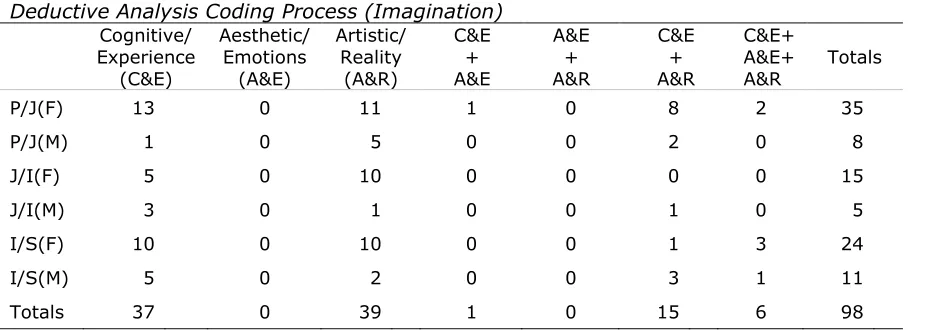
Table 1
Deductive Analysis Coding Process (Imagination)
Cognitive/ Experience
(C&E)
Aesthetic/ Emotions
(A&E)
Artistic/ Reality
(A&R)
C&E + A&E
A&E + A&R
C&E + A&R
C&E+ A&E+
A&R Totals
P/J(F) 13 0 11 1 0 8 2 35
P/J(M) 1 0 5 0 0 2 0 8
J/I(F) 5 0 10 0 0 0 0 15
J/I(M) 3 0 1 0 0 1 0 5
I/S(F) 10 0 10 0 0 1 3 24
I/S(M) 5 0 2 0 0 3 1 11
subthemes revealed the following. In the category of Thinking subthemes that were clustered were: mind thoughts; thinking outside the box; cognitive creations; exploration of creative ideas; human consciousness; pictures in the mind; problem-solving; thinking without limitations; and, thinking beyond the possible.
In the category of Reality subthemes that were clustered were: innovation, unreal, freedom, and validation of childhood. By far, the dominant subtheme was that of Unreal which evidenced a strong perception of imagination impacting or altering reality. Coded phrases that were clustered under Unreal were: dreams and fantasises; outside or beyond reality; not perceived by the five senses; alternate reality; worlds beyond words; impressions/perceptions of the unknown; above the norm; magical; unrealistic; and, limitless capacity.
A third category was identified that conjoined Thinking and Reality. The subthemes clustered in this category were: creativity validates reality of childhood; thinking (outside the box) not real in the world; combination of fantasy and reality; thought constructions that stretch reality; multifaceted constructs; a tool to explore creativity and overcome obstacles in the real world; no parameters, rules, or boundaries; and, conceiving that which may not be and comprehending its effect on our model of the world.
A fourth category, Emotional Self-Identity, presented itself and subthemes clustered in this category were: understanding self-expression, self-identity; communication between the mind and soul; strong character traits; ideation without actually knowing the means of creation;
creating something completely one’s own internally; personal experience—“As a child I had a very vivid imagination”—and, educational background such as courses in psychology and human exploration.
Thinking was the dominant theme in the first principle of cognitive/experience. It was coded twice as often as all of the other themes (prior knowledge; identity; limitless; and, experiences/exploration) combined. The thematic analysis of the data associated with cognitive/experience suggested that new entrants regarded thinking, especially that which is
metaphorically expressed as “outside the box,” as being an essential characteristic of
imagination.
Unlike the overwhelming data that needed to be carefully analyzed for the first principle, there were no themes singularly identified for the second principle: aesthetic/emotions. None identified a regard for aesthetic/emotions as a characteristic of imagination. Such direct evidence suggests that if participants regarded aesthetic/emotions at all as a characteristic of imagination, they did so in connection with another or other principle(s).
The dominant theme in the principle of artistic/reality was Unreal. It was coded several times more than other themes such as: validating childhood, innovation, identity and freedom. The thematic analysis of the data associated with the artistic/reality principle suggests that
participants view the unreal, especially that which is metaphorically expressed as “out of this world,” as being an essential characteristic of imagination.
One of the interesting findings in our analysis was that sixteen respondents coupled Principle 1 (cognitive/experience) and Principle 3 (artistic/reality) in their responses to: What is imagination? These respondents perceived imagination as a fusion of thinking and the unreal
(beyond or outside reality). One respondent summarized the prevailing view as “thought constructs that stretch reality.” Their perception is consistent with the lexicographical or
denotative meaning of imagination: “[T]he formation of a mental image or concept of that which is not real or present; the ability to deal creatively with reality” (“Imagination,” 1980, p. 657).
an experience that results in a creative, artistic, or innovative process that extends or alters reality; it is not directly connected with aesthetics or emotions. In its simplest form, it is a cognitive-physical process and not a non-cognitive-visceral process. Yet, such a view is not true of all participants, for there were a very few who perceived imagination as an interconnectedness of the cognitive-physical and the non-cognitive-visceral.
One participant referenced the aesthetic/emotions in relation to cognitive/experience as:
“[Imagination] not perceived by the five senses;” and, an additional six participants referenced
the aesthetic/emotions in association with both cognitive/experience, and artistic/reality. Their responses are intriguing to us as researchers in that they raise a deeper research question: What is it that enabled these participants to make the linkage between and among the three principles of Hume and Vygotsky while the majority of their peers focused on the first or the third principle and failed to recognize the importance of the second principle in imagination?
A Visual Set of Metrics as Interpretation
Figures 1, 2, and 3 offer another set of metrics that visually represent and further categorize the information found in Table 1.
Figure 1: Female Pre-service Teachers’ Responses to What is Imagination? highlights the
responses of all female participants (P/J, J/I, I/S) in the study with specific reference to the three Hume and Vygotsky principles. Thirty-eight percent (38%) of the respondents referenced Principle 1 (cognitive/ experience) in their explanation or definition of What is Imagination? None, or 0%, referenced Principle 2 (aesthetic/emotions) and 42% referenced Principle 3 (artistic/reality) in their responses. Only 1% referenced cognitive/experience and aesthetic/emotions; none, or 0% referenced aesthetic/emotions and artistic/reality; 12 % referenced cognitive/experience and artistic/reality, and 7% referenced or identified all three principles as operative within their perception of imagination.
Figure 2: Male Pre-service Teachers’ Responses to “What is Imagination?” visually
represents the responses of all male participants (P/J, J/I, I/S) in the study with specific reference to their identification of the three Hume and Vygotsky principles. Similar to the responses from female participants, 36 % of male participants referenced Principle 1 (cognitive/experience) and none, or 0%, referenced Principle 2 (aesthetic/emotions); and 32 % referenced Principle 3 (artistic/reality). Interestingly, 4% conjoined Principles 1 and 2 (cognitive/experience and aesthetic/emotions); none, or 0%, combined Principles 2 and 3 (aesthetic/emotions and artistic/reality); and 4%, or nearly half as many as female participants, identified all three principles as inherent in their perception of imagination. As significant as that may well be, a more surprising finding was that 24% of male respondents coupled Principles 1 and 3 in their explanation or definition of imagination which echoed the lexicographical or denotative meaning of imagination. Male respondents were twice as likely to connect Principles 1 and 3 as female respondents. Such a finding raises an interesting issue and holds the potential for future investigation.
Figure 3: Female and Male Pre-service Teachers’ Responses to What is Imagination?’
represents the amalgam of all respondents and their identification of the three Hume and Vygotsky principles inherent in their perception of imagination. For Principle 1, 38% identified cognitive/experience as integral in their perception of imagination. This is consistent with the results of females and males in their identification of Principle 1 as represented respectively in Figures 1 and 2 above. None, or 0%, recognized Principle 2 (aesthetic/emotions) as a stand-alone characteristic of imagination while 40% identified Principle 3 (artistic/reality) as integral to their perception of imagination.
When combining the responses for both female and male respondents, the coupling or conjoining of principles was not significant: 1% coupled Principles 1 and 2; none, or 0%, conjoined Principles 2 and 3, and only 6% connected Principles 1, 2, and 3. Not surprisingly, 15% identified Principles 1 and 3 as integral in their intuitive responses to What is Imagination?
We say, not surprisingly, as 12% of female respondents (Figure 1) and 24% of male respondents (Figure 2) identified these principles as inherent in their perceptions of imagination. As noted earlier, the reason or rationale for this strong conjoining by females and a stronger conjoining by males is beyond the limited scope of this study but it raises an interesting question for future investigation.
When asked why they held their individual perspective of imagination, 14 participants (10%) expressed having no idea why they held the perception that they did; eight (6%) participants credited their perception of imagination to personal experiences and self-involvement with creativity and innovation while the majority (84%) indicted that their perceptions of imagination were derived from concepts communicated to them by parents, older siblings, and/or primary school teachers (K−Grade 3). Within this latter grouping many stated that their perception had been formed at an early age and reinforced by significant people in their childhood and early schooling. They trusted or respected the source of their instruction and did not feel it necessary to question or further examine their perception of imagination until confronted with the question on the survey.
Discussion and Concluding Remarks
This study, limited as it is in scope and audience, contributes to the expanding field of imagination by establishing that imagination can be viewed as a combinatory construct (cognitive/experience, aesthetic/emotions, artistic/reality) of which new entrants into a teacher
education program have a partial understanding. It further establishes new entrants’
perceptions of imagination as the mind at play or one’s ability to think of new ideas or
constructs that can and will alter present reality. It is a cognitive dexterity and a non-cognitive elasticity that facilitates the omnificence and manipulation of ideas and things but is also a generative force: a cognitive, aesthetic, and artistic openness to possibility and probability.
Imbedded in the responses of many of the participants is a traditionalized perception of imagination not unlike its denotative definition. This is not surprising given their limited exposure to imagination in either their personal learning or their professional engagement with teaching in the classroom. It would appear from this study that new entrants are in the process of forming and formulating perceptions of imagination. There were a few participants who were cognizant of and able to articulate the three principles of Hume and Vygotsky in their responses. They perceived the ability of imagination in personal learning and in professional praxis to transform the cognitive and the non-cognitive (emotions) into valuable reformations of reality for the benefit of the self as learner and society at large.
In classroom instruction in the late 1990s, and the early 2000s, the Ontario Ministry of Education (OME) did not recognize the importance or functionality of imagination as a teaching/learning construct in the prescribed curricula. In the revised Ontario Curriculum Language Grades 1-8, the word imagination appears only once in reference to the role of the school library in fostering within students the ability to “use information and research with understanding, responsibility, and imagination” (OME, 2006, p.30). In the Grade 9 and 10
English prescribed curriculum, imagination was referenced three times (OME, 2007a), and in the Grade 11 and 12 English Curriculum imagination was directly mentioned seven times (OME, 2007b). The Ontario curriculum documents for Grades 1-8 (OME 2005a); Grades 9-10 (OME, 2005b); and Grades 11 and 12 (OME, 2007) in mathematics make no mention of imagination in any context.
Given the lack of emphasis on imagination in the Ontario curricula, it is not surprising that teachers did not emphasize its importance in their teaching strategies or learning activities. It is also not surprising, perhaps even understandable, that if students are repeatedly exposed to instructional practice that contains scant formal recognition of the importance of imagination, they would have very little, if any, in-depth knowledge, understanding, or experiential acquaintance with it. And, if parents or teachers had likewise been exposed to similar instructional practice during their schooling, it is not surprising that their concept of imagination would align with the denotative meaning of imagination and hence be passed forward from generation to generation.
Surprisingly, none of the participants referenced information and communications technology (ICT) as instrumental in developing or fostering imagination. As digital natives, the participants in this study have been raised with television, video games, computers, cell phones, and the internet as companion to their learning and yet none identified ICTs as responsible for their perception of imagination. Perhaps they were of a view similar to that of Wang (2013) who wrote specifically of computers as an ICT: “Computers cannot think because they cannot
imagine. Imagination requires the intuitive combination of seemingly unrelated elements, and computers are simply not programmed to make such intentional fusions of thought with the realization that the new representation is genuinely creative” (p. 213).
Despite the belief in the late 1990s and early 2000s that technological advancements would herald an unprecedented growth in skill-based competencies, especially in creativity and innovation, such a revolution in education has not occurred. Greenfield (as cited in Wolpert, 2009) analyzed more than 50 studies on learning and technology including research on multi-tasking and the use of computers, the internet, and video games and concluded that
“Technology is not a panacea in education because of the skills that are being lost…. most visual
media are real-time media that do not allow time for reflection, analysis, or imagination …”
imagination. Wang (2013) reinforces this concept when speaking specifically of design technology:
Perhaps in the end the best we can say about the imaginative creations of design technology is that they are magical—and then add, cautiously, as a disclaimer, that the magic is caused by the humanity of designers, not by any ICTs that they might use to assist them in their work. (p. 214)
Given that access to a plethora of up-to-date information is available with a single keystroke we, as educators, need to ensure that the gains and losses of a digital enhanced education are transparent and that new entrants into teaching can deliver a 21st century education system that coordinates the best of all disciplines and technology initiatives. In this study, the recognition on the part of new entrants that ICTs are not a panacea in/for education is a strong foundation upon which to build the principles of ICE.
From our perspective, holding a comprehensive understanding of imagination opens an important educational space for further investigation of the transforming potential imagination holds for all learners—students and teachers alike. However, the results of this investigation signal some cause for concern in that so few of the incoming entrants held a composite perception of imagination. Perhaps, this is a further evidence of an education system that typically undervalues the role of imagination in the process of teaching or learning. More optimistically, the results of this investigation call for deeper levels of conversation and collaboration among scholars, participants, and in-service educators about how to better cultivate a sense of imagination within learning spaces.
Future research based upon this study may focus on a deeper analysis of participants who hold a comprehensive conception of imagination. Perhaps these individuals may be able to provide glimpses into some of the valuable experiences and practices they were exposed to that enabled them to hold this conception. Determining commonalities could lead to valuable insights for educators looking to improve professional practices related to imagination and correlatively to imagination creativity education (ICE).
References
Anderson, T. & Dron, J. (2011). Three generations of distance education pedagogy. The International Review of Research in Open and Distributed Learning (IRRODL), 12(3).
doi:10.19173/irrodl.v11i2.865
Bramald, R., Hardman, F., & Leat, D. (1995). Initial teacher trainees and their views of teaching and training. Teaching and Teacher Education, 11(1), 23-31. doi:10.1016/0742-051x(94)e0009-t Boyatzis, R. (1998). Transforming qualitative information: Thematic analysis and code development.
Thousand Oaks, CA: Sage.
Government of Canada. Budget 2017. (n.d). Canada’s innovation and skills plan. Retrieved from: https://www.budget.gc.ca/2017/docs/themes/Innovation_en.pdf
Canadian Foundation for Innovation (CFI). (2013/2014). Annual report 2013-2014. Retrieved from: www.innovation.ca/sites/default/files/pdf/CFI-AnnualReport-2013-14-web.pdf.
Clark, C.M. (1988). Asking the right questions about teacher preparation: Contributions of research on teacher thinking. Educational Researcher, 17(2): 5-12. doi:10.2307/1174582
Crabtree, B.F, & Miller, W.L. (1999). A template approach to text analysis: Developing and using codebooks. In B.F. Crabtree & W.L. Miller (Eds.), Doing qualitative research in primary care: Multiple strategies (pp. 93-109.). Newbury Park, CA: Sage.
Creswell, J. W. (2008). Educational research: Planning, conducting, and evaluating quantitative and qualitative research (3rd ed.). Upper Saddle River, NJ: Pearson/Merrill Prentice Hall.
Creswell, J. W. (2014). Research design, qualitative, quantitative, and mixed methods approaches (4th
ed.). Thousand Oaks, CA: Sage.
Davis, K. A., Ovando, C. J., & Minami, M. (2013). Language and literacy acquisition. In B. Irby, G. H. Brown, R. Lara-Alecio, & S. A. Jackson (Eds.), Handbook of educational theories (pp. 395-418). Charlotte, NC: Information Age Publishing.
Dede, C. (2010). Comparing frameworks for 21st century skills. In J. Bellanca & R. Brandt (Eds.), 21st Century Skill (pp. 51–76). Bloomington, IN: Solution Tree Press.
Denker, C. (2004). The impact of aesthetic imagination on our ethical approach towards nature. Postgraduate Journal of Aesthetics, 1(2), 51-58. Retrieved from:
http://www.pjaesthetics.org/index.php/pjaesthetics/article/viewFile/17/15
Driver, R., Asoko, H., Leach, J., Mortimer, E., & Scott, P. (1994). Constructing scientific knowledge in the classroom. Educational Researcher, 23(7), 5-12. doi:10.2307/1176933
Egan, K. (2005). An imaginative approach to teaching. San Francisco, CA: Jossey-Bass.
Fasko, D. (2006). Creative thinking and reasoning: Can you have one without the other? In J.C. Kaufman & J. Baer (Eds.), Creativity and reason in cognitive development (pp. 159-176). New York:
Cambridge University Press.
Furlong, E. J. (1961). Imagination. London, England: George Allen & Unwin.
Gardner, H. (1993) Creating minds: An anatomy of creativity seen through the lives of Freud, Einstein, Picasso, Stravinsky, Eliot, Graham, and Gandhi. New York, NY: BasicBooks.
Gardner, H. (2006). Five minds for the futures. Boston, MA: Harvard Business School Press.
Graham, R. (2016). Techno-resiliency in education: A new approach to understanding technology in education. Cham, Switzerland: Springer.
Grose, K. (2014). From 21st century learning to learning in the 21st century: Influences on transforming teacher knowledge of constructivist practices in technology-rich learning environments (Doctoral dissertation). Available from ProQuest Dissertations & Theses database. (UMI No. 3686946).
Harris, A. (2015, January). Creativity in the schools sounds good—so what’s the hitch? The Conversation. Retrieved from: http://theconversation.com/creativity-in-schools-sounds-good-so-whats-the-hitch-34411
Imagination. (1980). Houghton Mifflin Canadian Dictionary of English Language. Markham, ON: Houghton Mifflin Canada.
IBM. (2010). Capitalizing on complexity: Insights from the global Chief Executive Officer study. Retrieved from https://www01.ibm.com/common/ssi/cgibin/ssialias?htmlfid=GBE03297USEN Jenson, J., Taylor, N., & Fisher, S. (2010). Critical review and analysis of the issue of “skills, technology
and learning”. Retrieved from Ontario Ministry of Education website: http://www.edu.gov.on.ca/eng/research/Jenson_ReportEng.pdf
John-Sterner, V. (2000). Creative collaboration. New York, NY: Oxford University Press. Joram, E. & Gabriele, A.J. (1998). Preservice teacher’s prior beliefs: Transforming obstacles into
opportunities. Teaching and Teacher Education, 14(2), 175-191. doi:10.1016/s0742-051x(97)00035-8 Kay, K. (2010). 21st century skills: Why they matter, what they are, and how we get there. In J. A. Bellanca
& R.S. Brandt (Eds.). 21st century skill: Rethinking how students learn (pp. xiii–xxxi). Bloomington, IN: Solution Tree Press.
Kim, K. H. (2011). The creativity crisis: The decrease in creative thinking scores on the Torrance Test of Creative Thinking. Creativity Research Journal, 23(4), 285–295. doi:
Lincoln, Y. S. & Guba, E. G. (1985). Naturalistic inquiry. Newbury Park, CA: Sage.
Manning, A. (n.d.). 4 Ways creative thinking drives professional success [Web blog post]. Retrieved from: https://www.extension.harvard.edu/professional-development/blog/4-ways-creative-thinking-drives-professional-success
National Education Association (NEA). (n.d.). Preparing 21st century students for a global society: An educator’s guide to the 4Cs. Retrieved from: http://www.nea.org/assets/docs/A-Guide-to-Four-Cs.pdf
Pajares, M. F. (1992). Teachers’ beliefs and educational research: Cleaning up a messy construct. Review of Educational Research, 62(3), 307-333. doi:10.2307/1170741
Prensky, M. (2005/2006, December/January). Listen to the natives. Educational Leadership, 63(4), 8-13. Retrieved from: www.ascd.org/ASCD/pdf/journals/ed_lead/el200512_prensky.pdf
Ricoeur, P. (1978). Imagination in discourse and in action In A. Tymieniecka (Ed.), Analecta Husserliana: The yearbook of phenomenological research (Vol. vii, pp. 3-22). Dordrecht, NL: Springer Science & Business Media.
TED. (2006, June). Sir Ken Robinson: Do Schools Kill Creativity? [Video file]. Retrieved from: www.northcrestmontessori.com/sir-ken-robinsons-schools-kill-creativity-ted2006/ Russell, M., Bebell, D., O’Dwyer, L., & O’Connor, K. (2003). Examining teacher technology use:
Implications for preservice and inservice teacher preparation. Journal of Teacher Education, 54(4), 297–310. doi:10.1177/0022487103255985
Streminger, G. (1980). Hume’s theory of imagination. Hume Studies, 6(2), 91-118. Retrieved from: http://www.humesociety.org/hs/
Trochim, W. M. K. (2006). Deduction & induction. Retrieved from www.socialreseachmethods.net/kb/declind.php
Vygotsky, L. S. (2004). Imagination and creativity in childhood. Journal of Russian and East European Thought, 42(1), 7-97. doi:10.2753/rpo1061-0405280184
Wang, J. (2013). Challenging ICT application in architecture, engineering and industrial design education. Hershey, PA: IGI Global.
Warnock, M. (1978). Imagination. Berkeley, CA: University of California Press.
Wenger, E. (2000). Communities of practice and social learning systems. Organization, 7(2), 225-246. White, A. R. (1990). The language of imagination. Oxford, England: Blackwell.
Wolpert. S. (2009, January 27). Is technology producing a decline in critical thinking? Studies shed light on multi-tasking, video games and learning. Retrieved from: http://newsroom.ucla.edu/releases/is-technology-producing-a-decline-79127
Blaine E. Hatt is a Professor in the Schulich School of Education at Nipissing University. His research interests include curriculum studies, imagination creativity education (ICE), multiliteracies pedagogy and preservice teacher education and hiring practices.