Synthesis and Characterization of
Polyimide-Zeolite Mixed Matrix Membrane
for Biogas Purification
Budiyono
#,,1,T.D. Kusworo
#,2, A.F. Ismail*,
3, I.N. Widiasa
#,4, Seno Johari
@,5and Sunarso
@,6#
Department of Chemical Engineering, University of Diponegoro , Jl. Prof. Sudharto SH, Semarang, Indonesia
1
2
@Department of Animal Agriculture, University of Diponegoro, Jl. Prof. Sudharto SH Semarang, Indonesia 5senojohari@yahoo co.id
*Advanced Membrane Research Technology Center, Faculty of Chemical and Natural Resources Engineering,
Universiti Teknologi Malaysia, 81310 UTM, Malaysia
3
Abstract— Biogas has become an attractive alternative energy source due to the limitation of energy from fossil. In this study, a new type of mixed matrix membrane (MMM) consisting of polyimide-zeolite was synthesized and characterized for biogas purification. The MMM consists of medium concentration of polymer (20 %wt polyimide), 80 % N-Methyl-2-pyrrolidone (NMP) and 25 % zeolite 4A in total solid were prepared by a dry/wet phase inversion technique. The fabricated MMM was characterized using S EM, DSC, TGA and gas permeation. Post treatment coating procedure was also conducted. The research showed that surface coating by 3 % silicone rubber toward MMM PI 20 % gave the significant effect to improve membrane selectivity. The ideal selectivity for CO2/CH4 separation increased from 0.99 for before coating to 7.9 after coating for PI-Zeolite MMM, respectively. The results suggest that PI-Zeolite MMM with good post treatment procedure will increase the membrane selectivity and permeability with more saver polymer requirement as well as energy saving due to low energy for mixing.
Index Term
—
mixed matrix membrane, polyimide, zeolite, biogas purificationI. INT RODUCT ION
Biogas has become an attractive alternative energy source due to the limitation of energy fro m fossil. Th is is due to its characteristics i.e. renewab le source, environment friendly, clean, cheap and versatile fuel. However, the use of b iogas is limited by its low quality. Except the ma in component of CH4 (55-80 vol%), b iogas contains substantial a mount of
CO2 (20-45 vol%) and H2S (0-1 vol%) [1]. In addition,
biogases are also frequently saturated by water vapour. The presence of CO2 as an inco mbustible gas reduces its calorific
value and makes it uneconomica l to co mpress and transport to longer distances. The H2S content poses serious problems
of odor, toxicity for hu man and anima l health, and corrosion [2]. Nevertheless, if biogas is cleaned up suffic iently, biogas has the same characteristics as natural gas (NG) [3]. There is a lot of potential if biogas could be made viable as a transport vehicle fuel like Co mp ressed Natural Gas (CNG). Besides the use of biogas as a vehicular fuel, sma ll scale or bulk biogas storage for do mestic consumption is a lso potential large market. Therefore , b iogas purificat ion before compression at high pressure for storage in cylinders is essential.
A variety of processes are be ing used for re moving CO2 and H2S fro m NG in petrochemical industries. Several basic mechanis ms are involved to achieve selective separation of gas constituents. These may include physical or che mica l absorption, adsorption on a solid surface, me mbrane separation, cryogenic separation and chemica l conversion. However, me mb rane separation processes h ave emerged during the last two decades. This is due to the fact that me mb rane separation processes may offer mo re capital and energy efficiency co mpared to the conventional separation processes [4]. In addition, advantages of me mbrane technology are its s imp lic ity, i.e. no absorbent, which has to be regenerated; it can be easily retrofitted, modularized and scaled-up for several applications [5].
relative ly e xpensive and high viscosity cause the high energy requirement for mixing during membrane preparation.
Kusworo et al. [12] has made an effort to decrease polymer cost of poly imide and increase processability by mixing PI with the cheaper poly mer (polyether sulphone, PES) with ratio 20:80 by 25 wt% of total polyme r in N-Methyl-2-pyrro lidone (NMP). These co mposite me mbranes offer relat ively low cost of polyme r besides easy to cast the polymer solution so it will reduce the mixing power. However, Kusworo at a l [12] is still use polymer in 25 % concentration. In effort to decrease the polymer require ment, in this study, the MMM consists of mediu m concentration of polymer (20 wt% PI) we re synthesized and characterized for biogas purification. The effect of coating on the separation performance of fabricated membrane was also examined.
II. EXPERIMENT AL
A. Material selection
The selection of poly me rs and fille rs in this research is to obtain a MMM having high permeability and selectivity of CO2/CH4. The polyimide poly mer is selected due to it’s
characteristics that polyimide poly me r has aro matic rings and functional groups of big volu me , which act like mo lecula r sieves, as a materia l fo r me mb ranes used for gas separation is reasonable. Due to high glass transition temperature and low solubility of polyme r, it is possible to apply polyimide in a wide range of te mperatures and pressures. Moreover, the polymer is characterized by h igh selectivity and permeability to the gases in comparison to the others. According to Hao et al. [11], poly imide made fro m 6FDA -HA B has CO2/CH4
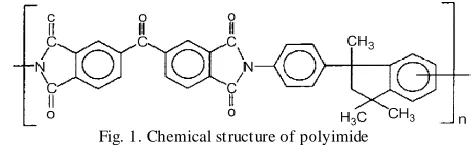
selectivity up to 60. Po lyimide poly mers used in this research was mat rimide resin. Matrimide was obtained fro m Alfa Aesar Johnson Matthey Company USA. The matrimide polymers were dried overnight in a vacuu m oven at 120 ◦C before used for dope preparation. N-methyl-pyrro lid inone (NMP) was fro m Merc k. The che mica l structure of the polyimide is shown in Fig. 1.
Zeolite molecu lar sieve was selected due to their high selectivity and compatibility towards polar compounds, such as H2S [12]. The zeolite 4A was purchased from Aldrich and
the particle size was 2 m. In order to re move the adsorbed water vapour or other organic vapors, all zeolite partic les were dehydrated at 300 oC for 3 h before use.
Fig. 1. Chemical structure of polyimide
B. Fabrication of asymmetric flat sheet MMM
In this study, the polymer solution consists of 20 wt% PI polymer 80% NM P and 25 wt % zeo lite in the total of solid. The homogeneous polyimide were prepared according to the following procedure; the inorganic molecu lar sieve partic les were dispersed into the solvent and stirred for 24 h followed by the addition of a desired a mount of polyimide. The solution was agitated with a stirre r at least 24 h to ensure complete d issolution of the polymer. Before casting, the homogeneously prepared solution was degassed under vacuums for 3 h. Flat sheet me mbrane was prepared according to the dry/wet phase inversion technique. The
solution was poured onto a clear, flat and smooth glass plate that was placed on the trolley. Stainless steel support casting knife was used to spread the solution to a uniform thic kness by pneumatic force . Me mbranes were cast at diffe rent shear rates by varying the speed of the trolley (casting speed). The glass plate with the me mbrane film was then imme rsed into the coagulant bath or water bath. During this process, solvent e xchange occurred and solidified the me mb rane film to a complete membrane structure.
To ensure all of the solvent in the me mbrane structure is re moved, me mbranes were imme rsed in an aqueous bath for 1 day, followed by imme rsion in methanol for 4 h and air -dried for 24 h at roo m te mperature. The mixed matrix me mb ranes were finally dried in oven at 120 ◦C for 4 h to remove all the residual solvents.
C. Post-treatment procedure
The me mbrane sheets were coated with highly permeable elastomeric silicone poly mer (Sy lgard 184 Dow Corn ing). The me mbrane coating was done after the uncoated me mb ranes were tested. The intention of coating is to fill any surface pinholes or defects on me mbrane surface. Membranes were submerged in the 3% w/ w solution of silicone in n-he xane for 24 hours and subsequently placed in oven for 3 days at 120 oC to allow curing before permeation testing.
D. Membrane characterization
A Supra 35 VP Fie ld Emission Scanning Electron Microscopy (FESEM ) was used to observe the me mbrane structure and to determine the dimension of the fibers. Membrane sa mples were fractured in liquid nitro gen. The me mb ranes were mounted on an a lu minum disk with a double surface tape and then the sample holder was placed and evacuated in a sputter-coater with gold.
The changes in the chemical structure caused by silane treatment we re identified using Fourie r transform infrared spectroscopy (FTIR). The IR absorption spectra were obtained at room te mperature in a range of 4000 to 500 c m-1 with a spectral resolution of 8 cm-1 and averaged over 16 scans.
The glass transition temperature of each cast film was determined using diffe rential scanning calorimetry (Mettle r Toledo DSC 822e). A sma ll piece of me mbrane or pure polymer sample was first stored under vacuum at 100 oC for 24 hours to re move adsorbed water; then weighed and placed into alu miniu m DSC pans. The scanning range was 50- 320
o
C with scanning rate of 10 oC min-1 in the first DSC cycle to re move thermal history and then cooled fro m 320 to 25 oC at the rate of 10 oC min-1; fina lly the second cycle was carried out with the same procedure.
E. Module fabrication and gas permeation experiment
Membranes formed were e xposed to two diffe rent gases CH4 and CO2 and were measured its permeabilit ies. The
p
A
Q
l
P
ii
(1)
where Qi is the volumetric flo w rate of gas i,
p
is pressurediffe rence across the me mbrane (c mHg), A is me mbrane affective surface a rea (c m2) and l is me mbrane skin thic kness
(c m). The ideal separation factor
i/j can be calculated byusing equation below:
(2)
Fig. 2. Gas permeation test cell
For biogas separation testing, in this study we were used gas sample of CO2 and CH4 to represent the biogas product. The
gas permeation properties for each flat sheet polyimide -zeolite mixed matrix me mb rane were measured by using variable pressure constant volume method.
III.RESULT S AND DISCUSSION
A. Morphology of asymmetric PI-Zeolite mixed matrix membranes
An understanding of how preparation conditions lead to diffe rent morphologies is vital for generating mixed matrix me mb ranes with desirab le transport properties. The FESEM analysis was performed in order to investigate the effect of preparation process such as the effect of mediu m poly me r concentration on the morphology of mixed matrix me mb ranes and the relation with the separation performance of these me mbranes. As s uggested by previous studies [13-14] that the ma in proble ms faced during fabricat ion of mixed matrix me mb rane were surface effects, aggregation and poor polymer-sieve contact. Koros and co-worke rs [13] observed that mixed matrix me mbrane with zeo lite and glassy polymer possessed poor polyme r-sieve contact. It was found that the mixed matrix me mbrane contained the unselective voids of about 0.1-0.2 m around the sieves. Moreover, the interface between a poly mer matrix and inorganic filler plays an important role to determine the performance of fabricated mixed mat rix me mb ranes. Therefore, in this study, the feasibility of fabrication mixed matrix me mb rane at med iu m polymer concentration was investigated. Hence, the characterizat ion and comparison of polyimide-zeolite for uncoated and coated would be further discussed.
FESEM characterization was carried out on the fabricated me mb rane in order to determine the qualitative analysis of polyimide-zeo lite mixed matrix me mb rane. The FESEM micrographs of the polyethersulfone –zeo lite mixed matrix
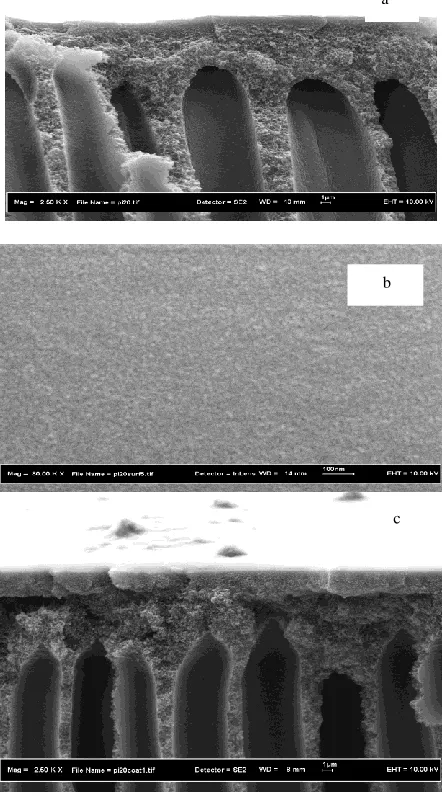
hollow fiber me mb rane are shown in Fig. 3-5. Fig. 3a-d illustrates the partial cross -sectional area of representative neat polyimide me mbrane with uncoated and coated. As can be seen from the SEM micrographs, of all me mb ranes e xhibited the porous structure. The skin layer of neat PI me mb rane became increasingly denser when me mbrane was subjected silicone coating as shown in Fig. 3c-d. Fig. 3 a lso suggests that the neat PI me mb rane clea rly reveals the presence of some macro voids under the skin layer. Moreover, both neat me mbranes coated and uncoated have substructure relatively thic k and have pore sizes suitable for Knudsen diffusion, the determining step of the overall selectivity is the Knudsen diffusion occurred in the substructure. Additional silicone coating only seals defects of the outermost skin, thus the overall fiber selectiv ity is not improved.
b a
c
j i j
i
l
P
l
P
)
/
(
)
/
(
/
Fig. 3. SEM picture of asymmetric uncoated neat polyimide membrane at the: (a) uncoated membrane cross section; and (b) outer surface image layer (c) coated membrane at cross section and (d) at outer surface image layer
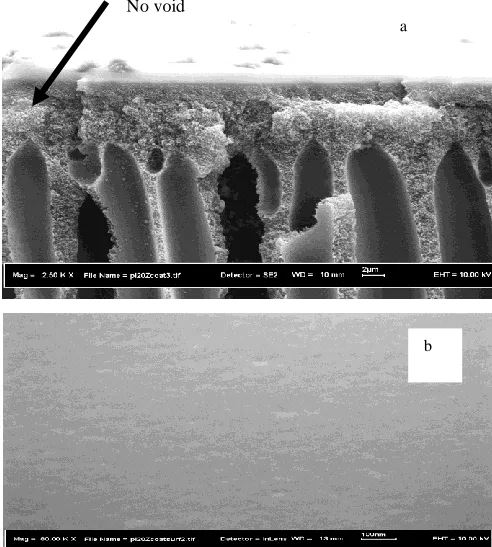
The FESEM micrographs of the polyimide–zeolite mixed matrix me mbrane at med iu m poly me r concentration are shown in Fig. 45. Fig. 45 presents the partial cross -sectional area of representative PI-zeolite mixed matrix membrane with and without silicone coating.
Fig. 4. SEM picture of asymmetric uncoated polyimide-zeolite mixed matrix membrane at the: (a, b) cross section and (c) outer surface image layer
Fig. 4a-c c learly reveals the presence of some agglo meration of zeolite and voids in the interface of zeolite and polyme r matrix. As suggested by previous study that d uring fabrication of polyimide -zeolite me mb rane, one factor p lays a great importance is partic le agglo merat ion due to sedimentation or mig ration to the surface [13-15]. Due to the totally diffe rent physical properties and difference in density between zeolite and poly me rs, precip itation of zeo lite may occur during the MMM preparation, resulting in format ion of inhomogeneous zeolite and poly mer phases in the filled me mb rane. The agglo me ration of zeolites will cause the pinholes that cannot be reached by polymer segments, forming as non-selective defects in the MMM. On the med iu m concentration of polymer was generally the zeolite particle do not have enough time to precip itate; while the solvent was rapidly evaporated to form me mb rane. Moreover, the zeolite particle will tend to form agglomeration.
The effect of silicone coating on the morphology of PI-zeolite mixed matrix me mbrane was depicted in the Fig. 5. The FESEM mic rographs reveal that the mixed matrix me mb rane with silicone coating has denser on the outer skin layer co mpared to uncoated me mbrane. Fu rthermore because of the silicone coating effect the packed chains in the polymer matrix denser and the packed structure in the outer skin layer p rovide a high degree of size and shape discrimination between the gas molecules.
Fig. 5. SEM picture of asymmetric coated polyimide-zeolite mixed matrix membrane at the: (a) cross section and (b) outer surface image layer
Fig. 5a -b depict that the interfac ia l gaps between polyme r host and zeolite can be reduced by post treatment me mbrane with silicone rubber coating. Moreover, the smooth surface of PI-zeolite me mbrane in the Fig. 5b indicates that the zeolite partic le adheres we ll to the poly mer matrix. Fore most, by referring to Fig. 4-5, the differences in adhesion between PI-zeolite with post treatment using
a
voidsvoids
voids
d
a
No void
b
c a
a
silicone rubber coating can be successfully distinguished. The post treatment using silicone rubber can seal the voids between zeolite and polymer host.
B. Thermal Gravity Analysis
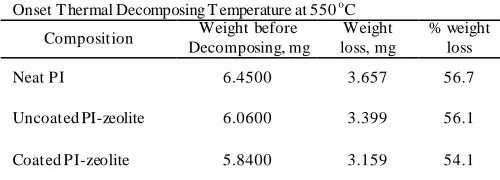
Thermal stability is one of the most important properties of poly mer nanocomposites me mbrane. Deco mposition temperature, vary differently depending on the interaction of polymer mat rix and inorganic fille r. This characterizat ion is conducted to study the relat ionship between the therma l decomposition temperatures with the weight loss of the composition. Fro m the TGA curve, although the onset therma l decomposing temperature is the same but the weight losses of the composition are diffe ring according to its content. The we ight loss of the composition is shown in Table I.
TABLE I
EFFECT OF SILICONE RUBBER ON T HE THERMAL ST ABILIT Y OF PI-ZEOLIT E MIXED MAT RIX MEMBRANE
Onset T hermal Decomposing T emperature at 550 oC
Composition Weight before
Decomposing, mg
Weight loss, mg
% weight loss
Neat PI 6.4500 3.657 56.7
Uncoated PI-zeolite 6.0600 3.399 56.1
Coated PI-zeolite 5.8400 3.159 54.1
The same thermal deco mposing temperature is used to identify the rate of each co mposition to diffuse as already shown in Table I. The silicone rubber coating has a great effect on the onset decomposing temperature. Introducing silicone coating to the PI matrix can increase the initia l decomposing temperature of neat matrix mo re or less. This can be seen when the increasing of the co mposition of a mino functional, the we ight losses of the co mposition retarded. It is proven when silicone coating subjected to PI-zeo lite mixed matrix me mb rane gives the smallest percent of we ight loss among others. In this condition, the compositions become stable which was affected fro m the strong interaction between PI matrix and zeo lite, so the diffusion of small molecules was retarded although under the high temperature. The influence of s ilicone rubber on the glass transition temperature of PI-zeolite mixed matrix me mbranes are tabulated in Table II. The Tg of the mixed matrix me mb ranes
increased about 0.9-1.5 oC with the addit ion silicone rubber on the mixed matrix me mbrane as depicted in Table II. This phenomenon indicates that the surface modificat ion of mixed matrix me mbrane using silicone rubber coating affects the mechanica l properties. The increase of Tgmight be due to the
zeolite restricts the movement of the poly me r cha ins by the addition of silicone rubber, therefore the interaction of zeolite partic les and poly mer was increased. However, Li et al [15] observed that the ma in factors causing the increase of
Tg with an increase of zeolite loading is due to a fair
interfacia l interaction between polyme r and zeolite. As presented in Table II, it can be concluded that the silicone rubber coating could induce the adherence between polymer matrix and zeolite particles.
TABLE II
EFFECT OF SILICONE RUBBER ON T HE GLASS T RANSIT ION T EMPERAT URE OF PI-ZEOLIT E MIXED MAT RIX
MEMBRANE
Membrane Tg (oC)
Neat PI 319.5 Uncoated PI-zeolite 320
coated PI-zeolite 321.7
C. Gas Separation Performance of PI -zeolite mixed matrix membrane
The effect of mod ification on gas separation performance is important para meter in me mb rane modificat ion for gas separation. Thus, this testing was carried out in order to study the me mbrane effectiveness due to the effect of coating on polyimide-zeolite surface. The me mb rane effectiveness in the gas separation performance was determined by the me mb rane permeability and selectivity for tested biogas purification. In this study, we were used gas sample of CO2
and CH4 to represent the biogas product. The gas permeation
properties for each flat sheet polyimide-zeolite mixed matrix me mb rane were measured by using variable pressure constant volume method. The permeability and selectivity for tested gases CO2/CH4 obtained are presented in Table III.
Table III summarizes the permeability and selectivity data of uncoated PI, coated PI, uncoated zeolite and coated PI-zeolite.
Generally, the idea to put inorganic filler into organic polymer is to enhance gas permeability of poly me r nanocomposites memb ranes due to the disturbed polymer chain packing by the nanofille rs [16]. Therefo re, the we ll dispersed and good adherence of polyimide-zeo lite will be effectively increased the gas permeability due to more effectively insert between poly mer chains of the matrix. As shown in Table III, the permeability of uncoated PI and uncoated PI-zeolite me mbrane for all gases were very high. These results indicated that these me mbranes have a big porosity or many voids were formed on the uncoated PI-zeolite mixed matrix me mbrane as shown in the Fig. 4. However, the selectiv ity values for uncoated neat PI and uncoated PI-zeolite at 20 wt% po ly mer concentration for a ll gases were very low. These might be an indication o f the Knudsen diffusion phenomena resulted in the me mbrane due to the presence of severe voids between zeolite part icles and agglomerat ion as shown in Fig. 3a-b and Fig. 4. Genera lly, Knudsen-diffusion controls the permeation of gas through porous me mb rane and the selectivity for b inary gas in Knudsen-diffusion is given by equation as follow
2 / 1
B A o
M
M
(3)where MA and MB are the molecula r we ight of co mponent A
diffusion behaviour, the permeability of CH4 and CO2
became la rger due to gas flowing through the interface between zeolite particles and polyme r matrix. Moreover, the unselective voids would be functioned as pinholes that allow all gases molecules pass rapidly without any selectivity. Thus, the permeability of all gases is increased thus reducing the gas selectivity. Hence, the selectivity of the resulting membrane was lower than that of the neat polymer.
In this study, we investigated the effect of simp le post treatment to seal the unselective void on the PI-zeolite me mb rane using silicone rubber. Gas separation performance of coated me mbrane was also influenced by therma l curing time. In th is study the coated me mbrane fibers was dried in a vacuum oven at temperature 120 0C for 72 hours. Gas separation performance o f this fab ricated me mb rane was improved and comparison between coated and uncoated me mb rane was made. Table III shows the comparison of permeab ility and selectivity for tested biogas purification between coated and uncoated PI-zeolite membrane.
T ABLE III
BIOGAS PURIFICAT ION PERFORMANCE OF PI-ZEOLIT E MIXED MAT RIX MEMBRANE
Membrane
S ingle gas permeance (GPU)
S electivity
CO2 CH4 CO2/CH4
Uncoated neat PI 25.23 31.37 0.80 Coated neat PI 10.51 0.58 18.2 Uncoated PI-zeolite 168.04 169.18 0.99 Fro m the tabulated data obtained, it can be observed that the PI-zeo lite mixed matrix me mb rane fabricated with med iu m polymer concentration coated with silicon rubber yie ld lo w permeab ility and increase the selectivity in the separation of CO2/CH4 compared to the uncoated me mbranes. The
increase of selectivity fro m 0.99 to 7.99 might be caused by suppression of Knudsen diffusion mechanis m using the silicone rubber coating. This is probably due to the defects at the outermost skin layer have been sealed by the silicone coating. The surface structure of the me mb rane was improved by reducing the defects on the me mbrane surface, hence resulting in increase selectivity and low permeab ility. Therefore, the gas transport mechanism that dominated this coated me mbranes are a co mbination of mo lecular sieving and solution diffusion. This phenomenon indicated that the voids generated by the unfavourable interaction between polymer and zeo lite can be reduced using silicone rubber coating.
IV. CONCLUSION
In this study, mixed matrix me mb rane polyimide -zeolite was fabricated for biogas purification. Based on the e xperimental results and analysis, the following conclusions can be made.
The FESEM for the cross -sectional and surface area images of mixed matrix me mbrane films indicated that the simple post treatment such as silicone rubber coating can be used to reduce the interface voids between inorganic particles with polyme r host in the fabrication of mixed matrix membrane.
The coated PI-zeo lite mixed matrix me mb ranes had increased the CO2/CH4 selectivity and reduce
permeability of methane gas.
The PI-zeolite mixed matrix me mbranes have been potentially applied on the biogas purification
REFERENCES
[1] Kapdi, S.S., V.K. Vijay, S.K. Rajesh, R. Prasad., Biogas scrubbing, compression and storage: perspective and prospectus in Indian context, Renew. Energy 30 (2005) 1195–1202.
[2] Truong, L.V.A., N. Abatzoglou., A H2S reactive adsorption process
for the purification of biogas prior to its use as a bioenergy vector, Biomass and Bioenergy, 29 (2005) 142–151
[3] Esteves, I.A.A.C., M.S.S. Lopes, P.M.C. Nunes, J.P.B. Mota. 2008. Adsorption of natural gas and biogas components on activated carbon, Separation and Purification Technology 62 (2008) 281–296. [4] Lin, W.H., and T.S.Chung.. Gas permeability, diffusivity, solubility,
and aging characteristics of 6FDA-durene polyimide membranes, Journal of Membrane Science, 186 (2001), 183–193
[5] Baker, R.W., Membrane T echnology and Applications, McGraw-Hill, New York, (2000) pp. 301–392.
[6] Baker, R.W., Future directions of membrane gas separation technology, Ind. Eng. Chem. Res. (2002), 1393–1411.
[7] Lin, H. and B.D. Freeman. 2004. Gas solubility, diffusivity and permeability in poly(ethylene oxide), J. Membr. Sci. 239: 105–117. [8] Stern, S.A., Polymers for gas separation: The next decade, J. Membr.
Sci. 94 (1994): 1–6.
[9] Robeson, L.M., Polymer membranes for gas separation, Curr. Opin. Solid State Mater. Sci., 4(1999) 549–552.
[10] Harasimowicz, M., P. Orluk, G. Zakrzewska-Trznadel, A.G. Chmielewski, Application of polyimide membranes for biogas purification and enrichment, Journal of Hazardous Materials, 144 (2007):698–702
[11] T.D. Kusworo, A.F. Ismail, A. Mustafa, T. Matsuura, Dependence of membrane morphology and performance on preparation conditions: The shear rate effect in membrane casting, Sep. Purif. Technol. 61 (2007) 249-257.
[12] Hao, Y., Young, K. Yang,W.H. Young, and K. Seff., Crystal structure of a hydrogen sulfide sorption complex of zeolite LTA, Zeolites,
17(1996): 495–500
[13] Vu, D.Q., Koros, W.J. and Miller, S.J. (2003). Mixed Matrix Membranes Using Carbon Molecular Sieves I. Preparation and Experimental Results, Journal of Membrane Science, 211: 311-334. [14] Jiang, L.Y., T .S. Chung, C. Cao, Z. Huang, S. Kulprathipanja, (2005)
Fundamental understanding of nano-sized zeolite distribution in the formation of the mixed matrix single- and dual-layer asymmetric hollow fiber membranes, J. Membr. Sci. 252: 89–100.
[15] Li, Y. Guana, H. M. Chung, T. S. Kulprathipanja, S., Effects of Novel Silane Modification of Zeolite Surface on Polymer Chain Rigidification and Part ial Pore Blockage in Polyethersulfone (PES)– Zeolite a Mixed Matrix Membranes. Journal of Membrane Science, 275 (2006) 17–28.
[16] T. Ramanathan, F.T. Fisher, R.S. Ruoff, L.C. Brinson, Amino -functionalized carbon nanotubes for binding to polymers and biological system, Chem. Mater., 17 (2005) 1290-1295.