IJIRSE/2017/Vol 5. Iss. 1/ Page 9
A Transportation Problem Analysed
by a New Ranking Method
Dr. A. Sahaya Sudha
1, P. Chinthiya
21 Associate Professor, 2 PG Scholar, Department of mathematics
Nirmala College for Women Coimbatore, India
Abstract—.This paper describes a ranking method of hexagonal fuzzy numbers using the area of trapezium. This ranking is used in a transportation problem in which the values of transportation costs are represented as hexagonal fuzzy numbers and then the fuzzy transportation problem(FTP) is converted into a crisp valued Transportation Problem using a new ranking. A numerical example is applied to obtain an initial Basic Feasible solution of transportations in minimizing transportation time by North-West Corner method.
Keywords-Ranking; Hexagonal fuzzy numbers; Fuzzy Transportation Problem.
I. INTRODUCTION
In a fuzzy environment ranking fuzzy numbers is an important decision making procedure. Most of the real world problems that exist are fuzzy in nature, than probabilistic or deterministic. Fuzzy sets was first given by Zadeh [15] in 1965. Ranking fuzzy numbers was first proposed by Jain in the year 1976 for decision making in fuzzy situations by representing in fuzzy set. Jain [6] proposed a method using the concept of maximizing set to order the fuzzy numbers and the decision maker considers only the right side membership function. Yager [14] proposed four indices to order fuzzy quantities in [0, 1]. Liou and Wang [9] presented ranking fuzzy numbers with integral value. Centroid based distance method to rank fuzzy numbers was given by Cheng [4] in 1998. Wang and Kerre [13] classified the existing ranking procedures into three classes. The first class consists of ranking procedures based on fuzzy mean and spread and second class consists of ranking procedures based on fuzzy scoring whereas, the third class consists of methods based on preference relations and concluded that the ordering procedures associated with first class are relatively reasonable for the ordering of fuzzy numbers specially. The ranking procedure presented by Adamo [2] satisfies all the reasonable properties for the ordering of fuzzy quantities. The Ranking of fuzzy numbers by area between the centroid point and the original point was given by Chu and Tsao [5] in 2002.The fuzzy risk analysis based on ranking of generalized trapezoidal fuzzy numbers was given by Chen and Chen [3]. Abbasbandy and Hajjari [1] proposed a new approach for ranking trapezoidal fuzzy numbers. Stephen Dinagar and Kamalanathan [12] defined a ranking based on area method. Since then several methods have been proposed by various researchers which includes rank, mode, divergence and spread [8], Rajarajeshwari and Sahaya Sudha [10] defined Ranking of Hexagonal fuzzy numbers using centroid
.
II. PRILIMINARIES
2.1 Definition [ 7]
Let X be a nonempty set. A fuzzy set
A
in X is characterized by its membership function A: X [0, 1], where A(x) is interpreted as the degree of membership of element x in fuzzy A for each x X.2.2 Definition: [7]
The characteristic function of a crisp set A
X assigns a value of either 1 or 0 to each individualin the universal set X .This function can be generalized to a function such that the value assigned to the
IJIRSE/2017/Vol 5. Iss. 1/ Page 10
membership grade of the element in the set A. The function is called the membership function and the set
à = {(x, ))/x X} defind by for each x X is called a fuzzy set
2.3 Definition: [7]
A fuzzy set defined on the universal set of real numbers R is said to be a fuzzy number of its membership function has the following characteristics
(i) is continuous mapping from R to the closed interval [0,1] (ii) = 0 for all x [- , ] [ , ]
(iii) is strictly increasing on [ ] and strictly decreasing on [ ]
(iv) = 1 for all x [ ] where
2.4 Definition: [7]
A fuzzy set defined on the universal set of real numbers R is said to be a generalized fuzzy number of its membership function has the following characteristics
(i) : R [0,1] is continuous
(ii) = 0 for all x [- , ] [ , ]
(iii) is strictly increasing on [ ] and strictly decreasing on [ ]
(iv) = w for all x [ ] where
2.5 Definition: [7]
A fuzzy number A is a trapezoidal fuzzy number denoted by ( ) and its membership function is given below, where ≤ ≤ ≤
(x)=
2.6 Definition: [7]
A generalized fuzzy number = ( ) is said to be a generalized trapezoidal fuzzy number if its membership function is given by
(x)=
Hexagonal Fuzzy Numbers
2.7 Definition: [11]
IJIRSE/2017/Vol 5. Iss. 1/ Page 11
otherwise
a
x
a
for
a
a
x
a
a
x
a
for
a
a
a
x
a
x
a
for
a
x
a
for
a
a
a
x
a
x
a
for
a
a
a
x
x
H A,
0
,
2
1
,
2
1
1
,
1
,
2
1
2
1
,
2
1
)
(
6 5 5 6 6 5 4 4 5 4 4 3 3 2 2 3 2 2 1 1 2 1 ~
2.8 Definition: [11]
A generalized fuzzy number is a hexagonal fuzzy number denoted by
( ) where ( ) are real numbers and its membership
function (x) is given below.
otherwise
a
x
a
for
a
a
x
a
a
x
a
for
a
a
a
x
w
a
x
a
for
w
a
x
a
for
a
a
a
x
w
a
x
a
for
a
a
a
x
a
x
for
x
H
A
,
0
,
2
1
,
2
1
,
,
2
1
2
1
,
2
1
0
)
(
~
6 5 5 6 6 5 4 4 5 4 4 3 3 2 2 3 2 2 1 1 2 1 1
III. PROPOSED APPROACH
IJIRSE/2017/Vol 5. Iss. 1/ Page 12 Area of trapezium = ( )
= distance between B ( ) and E ( )
= )
= distance between C ( ) and D ( )
= )
= [ )+ )]
Area of trapezium = ( )
= distance between B ( ) and E ( )
=
= distance between A ( ) and F ( )
=
= [ )+ )]
Hence the ranking function is given by R ( ) = +
R ( ) = [ ) + )] + [ ) + )]
R ( ) = [ ( ) + ) + )] ___________ (3.1)
IV. MATHEMATICALFORMULATIONOFFUZZYTRANSPORTATIONPROBLEM
IJIRSE/2017/Vol 5. Iss. 1/ Page 13
.
0
~
,
.,
,...
3
,
2
,
1
,
~
.,
,...
3
,
2
,
1
,
~
~
~
1 1
1 1
1 1
j
and
i
all
for
x
and
b
a
n
j
b
x
m
i
a
x
x
c
ij m
i
j n
j i n
i
j ij m
j
i ij m
i n
j
ij ij
to
Subject
Z
Minimize
Where
c
~
ijthe fuzzy unit transportation cost from ith Machines to the jth Foundries. The fuzzy transportation table is:Table 4.1: Fuzzy Transportation Table
V. THE ALGORITHM FOR THE PROPOSED WORK IS AS FOLLOWS
Step 1:
Construct the fuzzy transportation table for the given problem and then convert into a balanced, if it is not.
Step 2:
Using the above rankingmethod (3.1) the fuzzy transportation problem is converted into a crisp problem.
Step 3:
Apply North West Corner (NWC) method to obtain an initial basic feasible solution.
Step 4:
1) Select the north-west (upper left hand) corner cell of the transportation table and allocate as much as possible so that either the capacity of the first row or first column is satisfied i.e., = min
( ).
2) If > , we move down vertically to the second row and make the second allocation of magnitude = min ( ) in the cell (2, 1).
If < , we move right horizontally to the second column and make the second allocation of magnitude = min ( ) in the cell (1, 2).
If = , there is a tie for the second allocation. We can make the second allocation of magnitudes
= min (
) = 0 in the cell (1, 2).
Or
= min (
) = 0 in the cell (2, 1).
M A C H I N E S
FOUNDRIES
1 2 … N Supply
1
11
~
c
~
c
12 …c
~
1na
1 221
~
c
~
c
22 …c
~
2na
2. . . … . .
M
1
~
m
c
c
~
m2 …mn
c
~
m
a
Demand
b
1b
2 …n
IJIRSE/2017/Vol 5. Iss. 1/ Page 14
Step 5:
Repeat the above steps moving down towards the lower/ right corner of the transportation table until the optimal solution is obtained.
VI. NUMERICAL EXAMPLE
A company manufactures certain type of products in three different Machines. The company has to execute the transportation of the three Machines to four different Foundries. The information about the cost of transportation is imprecise and here hexagonal fuzzy numbers are used to represent the cost. The fuzzy transportation problem is given in table 6.1
Step 1:
Construct the fuzzy transportation table for the given fuzzy transportation problem and then convert it into a balanced one, if it is not.
TABLE 6.1 FUZZY TRANSPORTATION TABLE
Foundries
Machines
Supply
(3,7,11,15,
19,24;0.5) (13,18,23,28,33,40;0.7) (6,13,20,28, 36,45;0.4) (15,20,25,31,38,45;0.8) 16 (16,19,24,29
34,39;0.2) 10,12;0.5) (3,5,7,9, (5,7,10,13, 17,21;0.6) (20,23,26,30,35,40;0.4) 36 (11,14,17,21, 25,30;0.7) (7,9,11,14, 18,22;0.6) (2,3,4,6, 7,9;0.5) (5,7,8,11, 14,17;0.9) 20
Demand 24 18 20 10
Step 2:
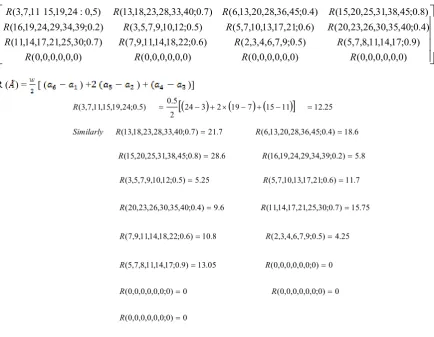
Using ranking method (3.1) in the fuzzy transportation problem is converted into a transportation problem.
) 0 , 0 , 0 , 0 , 0 , 0 ( ) 0 , 0 , 0 , 0 , 0 , 0 ( ) 0 , 0 , 0 , 0 , 0 , 0 ( ) 0 , 0 , 0 , 0 , 0 , 0 ( ) 9 . 0 ; 17 , 14 , 11 , 8 , 7 , 5 ( ) 5 . 0 ; 9 , 7 , 6 , 4 , 3 , 2 ( ) 6 . 0 ; 22 , 18 , 14 , 11 , 9 , 7 ( ) 7 . 0 ; 30 , 25 , 21 , 17 , 14 , 11 ( ) 4 . 0 ; 40 , 35 , 30 , 26 , 23 , 20 ( ) 6 . 0 ; 21 , 17 , 13 , 10 , 7 , 5 ( ) 5 . 0 ; 12 , 10 , 9 , 7 , 5 , 3 ( ) 2 . 0 ; 39 , 34 , 29 , 24 , 19 , 16 ( ) 8 . 0 ; 45 , 38 , 31 , 25 , 20 , 15 ( ) 4 . 0 ; 45 , 36 , 28 , 20 , 13 , 6 ( ) 7 . 0 ; 40 , 33 , 28 , 23 , 18 , 13 ( ) 5 , 0 : 24 , 19 , 15 11 , 7 , 3 ( R R R R R R R R R R R R R R R RR ( ) = [ ( ) + ) + )]
IJIRSE/2017/Vol 5. Iss. 1/ Page 15
Foundries
Machines
Supply
12.25 21.7 18.6 28.8 16
5.8 5.25 11.7 9.6 36
15.75 10.8 4.25 13.05 20
Demand 24 18 20 10
Step 3:
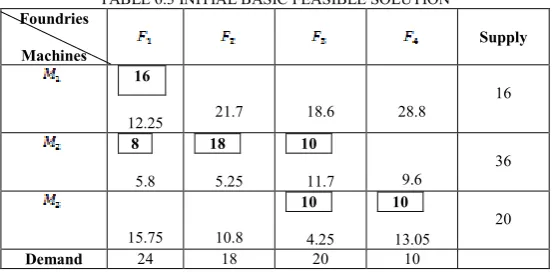
Applying NWC method the initial basic feasible solution is obtained
TABLE 6.3 INITIAL BASIC FEASIBLE SOLUTION
Foundries
Machines
Supply
16
12.25 21.7 18.6 28.8
16
8
5.8
18
5.25
10
11.7 9.6
36
15.75 10.8
10
4.25
10
13.05
20
Demand 24 18 20 10
Step 4:
The transportation cost according to the above route is given by
Z = 12.25 16 5.8 8 5.25 18 11.7 0 4.25 10 13.05 10 Z = 626.9
RESULT AND CONCLUSION:
The overall cost of the process is 626.9 which is the minimum cost. This cost is arrived when we supply 16 machines of and 8 machines of to foundries for a demand of 24 units. Similarly for a demand of 18 units for foundry is supplied with 18 machines of . Then for a demand of 20 machines in foundry is supplied with 10 units of machine and with 10 units of machine . Then for a demand of 10 units for foundry is supplied with 10 units of machine .This is the optimal cost on consideration of various parameters.
In this paper we have proposed a method where a hexagonal fuzzy ranking is obtained using an area of trapezium. This method can be used in a Transportation problem where a number of parameters are involved and the fuzzy hexagonal values are converted into a crisp value and the solution is obtained as explained in the example.
Future Directions: This method can also be used easily for different industrial as well as social applications where the parameters to be analysed are more in number.
REFERENCES
[1] Abbasbandy S. and Hajjari T. A new approach for ranking of trapezoidal fuzzy numbers, Computer and Mathematics with Application, 57(2009)413-419.
[2] Adamo J.M., Fuzzy Decision trees, Fuzzy sets and systems, 4(1980)207-219.
IJIRSE/2017/Vol 5. Iss. 1/ Page 16
[4] Cheng C.H., A new approach for ranking fuzzy numbers by Distance method, Expert system application 95 (1998) 307-317. [5] Chu T.C. and Tsao C.T., Ranking fuzzy numbers with an area between the centroid point and original point, Computers and
Mathematics with Applications, 43(2002) 111-117.
[6] Jain R., Decision making in the presence of fuzzy variables, IEEE Transactions on systems, Man and Cybernetics 6 (1976)698-703. [7] Kufmann A. and Gupta M.M., Fuzzy mathematical models in engineering and management science, Elsvier Science Publishes,
(1988).
[8] Kumar A., Singh p., Kaur A., Kaur P., Ranking of generalised trapezoidal fuzzy numbers based on rank, mode, spread and divergence, Turkish Journal of Fuzzy Systems, 1(2010)141-152.
[9] Liou T.S and Wang M.J., Ranking Fuzzy numbers with integral value, Fuzzy Sets and Systems, 50(1992) 247-255. [10] Rajarajeswari P. and Sahaya Sudha A., Ranking of Hexagonal Fuzzy numbers using centroid AARJMD 1 (2014) 265-277. [11] Rajarajeshwari P.,Sahaya Sudha A. and Karthika R., A New Operation on a Hexagonal Fuzzy Number , IJFLS 3(2013)15-26. [12] Stephen Dinagar D. and Kamalanathan S., A method for ranking of fuzzy numbers using new area method, IJFMA 1(2015) 61-71. [13] Wang X and Kerre E.E., Reasonable properties for the ordering of fuzzy quantities (I), Fuzzy sets and systems, 118(2001) 375-385. [14] Yager R.R., A procedure for ordering fuzzy subsets of the unit interval, Information Sciences, 24 (1981)143-16.
[15] Zadeh L.A., Fuzzy sets, Information and Control, 89 (1965) 338-353.